
Part 1
At twenty years old, Wynn Halloran owned almost nothing.
Everything she could still claim fit into a small canvas duffel bag, except for the silver railroad pocket watch hanging from a worn leather cord beneath her sweater and the ten-dollar bill folded twice in the inside pocket of her pea coat.
The watch had belonged to her grandfather.
The money was all she had left.
By the end of that day, she would spend every dollar of it on an abandoned Pennsylvania Railroad depot that had not seen a passenger train since 1958.
The county planned to demolish it in the spring.
The freight-room roof was partly collapsed. Most of the windows had been boarded for decades. There was no electricity, no running water, and no track anymore, only a long scar of ballast disappearing between bare hardwoods in the Allegheny foothills.
Wynn bought it anyway.
She did not know that beneath the old ticket booth, under floorboards darkened differently from the rest, a station agent had hidden something before locking the depot for the last time.
Something that had been waiting there for more than sixty years.
Railroads had been part of Wynn’s family long before she understood what a railroad was.
Her grandfather, Padraig Halloran, had grown up in a coal patch house in Lackawanna County, the youngest of seven children. His father died of black lung when Padraig was still a boy, and at fifteen he left school to work on a section gang because grief did not cancel grocery bills.
Later he became a brakeman on the Pennsylvania Railroad.
For more than three decades, he rode freight trains through sleet, heat, lake-effect snow, freezing rain, and the sort of winter wind that came tearing through the valleys as if there were nothing between Canada and a brakeman standing beside a switch.
Every working day he carried a silver pocket watch.
It was flat-topped, plain, and worn smooth at the edges from years of handling. He kept it in the breast pocket of his denim work shirt, attached to a leather cord, and set it carefully to railroad time.
Padraig believed lateness was a kind of dishonesty.
A railroad man, he liked to say, should know where he was, where his train was, and what time it was.
Wynn’s father, Sean, had grown up hearing those lessons over supper in the family’s narrow Scranton row house.
Sean spent his teenage years insisting he would never work for the railroad.
“I’ve seen what it does to your hands,” he once told Padraig.
Padraig looked at his own scarred knuckles and shrugged.
“Hands are for using.”
Sean took an office job after high school. For two years he worked for an insurance company in downtown Scranton, wearing pressed shirts, ties, and black shoes that never collected cinders.
Then one Monday morning in 1998, he walked into the office, put his nameplate on his desk, stared at the gray partitions around him, and realized he could not do it anymore.
That night he told Padraig he had applied to Conrail’s track maintenance crew.
“The office felt like somebody else’s coat,” Sean said.
Padraig studied him for a moment, then took the silver watch from his pocket and slid it across the kitchen table.
Sean frowned. “What’s this for?”
“Railroad man ought to know the time.”
Sean smiled.
That was all.
Two years later Sean married Mary Doherty. Wynn was born the following autumn.
For the first twelve years of her life, Wynn knew her father by the sound of his boots on the kitchen floor in the evening and the faint mixture of diesel fuel, steel dust, cold air, and grease that clung to him after work.
Sean taught her the names of freight cars before she knew the capitals of all fifty states.
Boxcar.
Gondola.
Hopper.
Tanker.
Reefer.
He showed her railroad switches and explained points, frogs, sidings, signals, and schedules. When she was old enough to understand him, he told her the railroad was honest because steel did not care what you wanted.
“Gravity doesn’t negotiate,” he said once.
Wynn had been sitting beside him at the kitchen table, doing homework while he cleaned grime from under his fingernails.
“And trains don’t lie,” he continued. “A train gets there when it gets there. You can explain why it was late. You can fix what made it late. But you can’t argue that it wasn’t late.”
At twelve, Wynn lost him.
A freight derailment happened on a cold March morning north of Pittston. A rail had broken in a frozen tie plate. Sean was part of the ground crew responding when a second car shifted above him and came off the rails.
He died before Mary reached the hospital.
After that, time inside the Halloran house seemed to split into two separate systems.
There was ordinary time—the clock on the stove, school mornings, birthdays, rent, seasons.
And there was the time before Sean died and the time after.
Padraig survived his son by fourteen months.
He died on a Sunday morning in his armchair with the silver pocket watch open on the table beside him.
Wynn inherited it.
The morning after his funeral, she threaded the old leather cord through the bow and put it around her neck.
For years afterward, the watch rested beneath her clothes and ticked lightly against her chest.
Mary did not recover from Sean’s death.
For the first year she barely left the house except for groceries and church. Sometimes Wynn would come home from school and find her mother sitting in the kitchen with one of Sean’s shirts folded in her lap.
Then Mary joined a grief support group.
There she met Brendan Cauley.
Within six months they were married.
Within a year Brendan lived in the row house.
He never struck Wynn. Never screamed at her. Never gave her a bruise anyone could point to.
His cruelty was quieter.
He made her feel temporary.
Her shoes were always in the wrong place. Her music was too loud even when it could barely be heard. She used too much hot water. She left lights on. She occupied the bathroom too long. She ate food he had been saving.
Nothing was enough to start a fight.
Everything was enough to remind her she was unwelcome.
Mary defended her at first.
Then less often.
Then hardly at all.
At sixteen, Wynn took a busser job at Vera’s, a small diner near the old Delaware, Lackawanna and Western rail yards in Scranton.
Vera Kosciusko, the owner, was in her early sixties and had been widowed twice—once by a steelworker and once by a yard switchman.
She ran the diner with strong coffee, clean counters, and an instinct for knowing when conversation would help and when it would only make things worse.
When Wynn applied, Vera looked at her school clothes, her nervous hands, and the way she checked the time before answering questions.
“Can you work Tuesdays?”
“Yes.”
“Saturdays?”
“Yes.”
“Show up late?”
“No.”
Vera nodded.
“Then start tomorrow.”
For six months, Vera asked her nothing personal.
Wynn cleared plates. Swept floors. Refilled sugar dispensers. Learned which regulars wanted extra onions on their home fries and which ones claimed not to want dessert before ordering pie.
Eventually, one quiet evening after closing, Vera found her sitting alone in the back booth.
“You always wear that watch?”
Wynn touched the cord at her collar.
“It was my grandfather’s.”
“Who?”
“Padraig Halloran.”
Vera stopped wiping the counter.
“Padraig Halloran?”
Wynn nodded.
Vera set down the cloth.
“Your grandfather ate eggs in that booth every Saturday morning for nineteen years.”
Wynn stared at her.
“You knew him?”
“Knew his order, anyway. Two over easy. Rye toast. Sausage when he thought nobody was going to tell his doctor.”
Wynn smiled for the first time that night.
“And Sean?” Vera asked softly.
“My father.”
Vera’s expression changed.
“I brought a casserole to his wake.”
What followed lasted nearly four hours.
A whole pot of coffee disappeared between them.
Wynn told Vera about Sean. Padraig. Mary. Brendan. The house that had somehow become less hers with every passing year.
Vera listened.
At the end she tapped the tabletop once.
“Then this booth is yours whenever you need it. You hear me, Halloran girl?”
Wynn heard her.
She finished high school living partly from a duffel bag.
Some nights she slept at home.
Some nights she slept on the back bench in Vera’s kitchen after closing.
Other nights she stayed with friends when their parents allowed it—or failed to notice.
She graduated in June and turned eighteen the same week.
For the next two years she worked whenever she could, sometimes at Vera’s and sometimes at another diner on Wyoming Avenue.
She tried to save.
But wages disappeared into food, transportation, clothes, school books, and the small costs of surviving.
Then, in February of her twentieth year, she came home after a closing shift and found a cardboard box on the porch.
Her clothes were inside.
So were her textbooks.
A photograph of Sean in his Conrail jacket.
A few pieces of family jewelry.
On top lay the silver pocket watch.
Wynn stared at it.
She normally wore it, but that morning she had left it on her dresser.
Brendan had gone into her room.
He had taken it.
He had set it on top of the box like evidence.
A sheet of notebook paper was taped to the door.
The handwriting was Mary’s.
Wynn read it under the yellow porch light.
Wynn,
Brendan and I have decided this is the best thing for everyone. You are an adult now. We need our own space. Please do not come back tonight or any night. Please do not call.
Mom.
Wynn read it twice.
Then she tried the front door.
Locked.
The back.
Locked.
The side entrance.
Locked.
She walked around through the alley and tried the basement door.
Locked.
Every door to the only permanent home she had ever known had been closed to her.
She returned to the porch, picked up the watch, and hung it around her neck.
Then she lifted the box and walked eleven blocks through the cold to Vera’s diner.
Vera was still cleaning when Wynn arrived.
She looked at the box.
Then Wynn’s face.
Without asking anything, she turned the sign from OPEN to CLOSED.
“Sit.”
Wynn sat in the back booth.
Vera brought eggs, home fries, toast, and coffee.
She waited until Wynn finished eating before asking, “What happened?”
Wynn told her.
Vera listened without interrupting.
When Wynn finished, Vera nodded once.
“You’ll stay upstairs.”
Wynn blinked.
“What?”
“I’ve got that little room above the diner. Empty since Walter died.”
“I can’t afford—”
“I didn’t ask what you could afford.”
“Vera—”
“Your rent is the morning shift Tuesday through Saturday.”
“That’s already my shift.”
“Then you’re an excellent tenant.”
Wynn laughed once despite herself, then covered her mouth.
Vera looked away and began collecting dishes.
Wynn lived above the diner for two months.
There was a narrow bed, an old chest of drawers, one window facing the alley, and a bathroom down the hall.
Vera fed her three times a day.
Every Sunday, a fresh bar of lavender soap appeared on the bathroom shelf because Wynn had once mentioned that her grandmother used it.
Vera never mentioned the soap.
Neither did Wynn.
Those two months were among the kindest of Wynn’s life.
And that was exactly why she knew she could not stay there forever.
Vera was sixty-two. Her knees bothered her. The diner’s refrigerator had begun making a noise that suggested an expensive repair. She worked too many hours already.
Wynn did not want Vera’s kindness to turn into another load the older woman had to carry.
So she searched for rooms.
Scranton rents were beyond her.
The places she could afford often came with broken locks, suspicious landlords, or streets where walking home after a night shift made her uneasy.
One evening, sitting in the back booth with coffee and Vera’s aging laptop, Wynn typed three words into a search engine:
cheapest property Pennsylvania
She was not seriously expecting anything.
Then the fifth result appeared.
A county surplus auction page.
Penn Forest Township.
Eleven abandoned structures scheduled for disposal before planned demolition.
A Grange hall.
A one-room schoolhouse.
An old creamery.
A blacksmith shop.
A dance pavilion.
Wynn scrolled farther.
Then stopped.
Former Penn Central / PRR branch line depot. Whitlock Junction. Abandoned 1958. Scheduled demolition spring following year.
Price: $10.
Wynn sat perfectly still.
She read it again.
Then a third time.
The next morning she turned the laptop toward Vera.
“What do you think?”
Vera adjusted her glasses.
She read the listing.
Then she leaned closer.
“Whitlock Junction?”
“You know it?”
“I know that name.”
Vera looked at Wynn.
“Your grandfather worked that branch on temporary assignment in fifty-three and fifty-four.”
Wynn’s hand went automatically to the watch.
“He did?”
“He used to talk about it. Said the agent at Whitlock made the best coffee on the whole division.”
Vera smiled faintly.
“Also said it was the loneliest station he’d ever seen. Said you could stand on the platform at midnight and hear the river and nothing else.”
Wynn looked at the photograph on the webpage.
The depot was half-hidden by trees.
Its siding had faded dark red.
A station sign still hung beneath the roofline.
“I think I’m going to see it.”
Vera studied her.
“I think you are too, pet.”
The trip from Scranton to Bedford took most of a day.
Two bus transfers.
Then a county shuttle that ran only twice a week.
It dropped Wynn at a crossroads four miles from the township office.
She walked the rest.
The road curved through narrow valleys filled with bare winter timber. Chimney smoke lay low in the cold air. There were no sidewalks and few houses.
The pocket watch ticked beneath her sweater.
Penn Forest Township’s office occupied a small frame building beside a shuttered general store.
Inside, a woman named Dorothea Kratzer sat behind a counter surrounded by filing cabinets, deed books, and a mug of tea.
She looked up when Wynn entered.
“You here about one of the surplus properties?”
“The depot.”
Dorothea’s eyebrows rose.
“You’ve seen the pictures?”
“Yes, ma’am.”
“You understand that building’s been closed since 1958?”
“Yes.”
“Freight roof’s partly down.”
“I saw.”
“No electric.”
“I know.”
“No plumbing.”
“I know.”
“Track was pulled in sixty-one.”
Wynn nodded.
“County’s scheduled to take the whole building down in March.”
Wynn put the folded ten-dollar bill on the counter.
“I have ten dollars.”
For several seconds Dorothea said nothing.
Then she rose, crossed to a shelf, and pulled down a deed book.
“You understand you’re taking responsibility for the structure?”
“Yes.”
“Taxes are negligible, but they’re yours.”
“Yes.”
Dorothea opened the book.
“Sign here.”
Wynn signed.
“Here.”
She signed again.
“And here.”
Wynn wrote Wynn Mary Halloran in the careful slant Padraig had taught her.
Dorothea took the bill.
She folded it once and placed it in a metal cash box.
Then she brought down a brass stamp.
The stamp struck the paper with a quiet, flat sound.
Dorothea looked at Wynn.
“It’s yours.”
Wynn glanced at the deed.
Just like that.
“What now?”
“It’s a mile and a half down the old railbed.”
Dorothea looked toward the window.
“My husband’s truck is outside. I’ll drive you.”
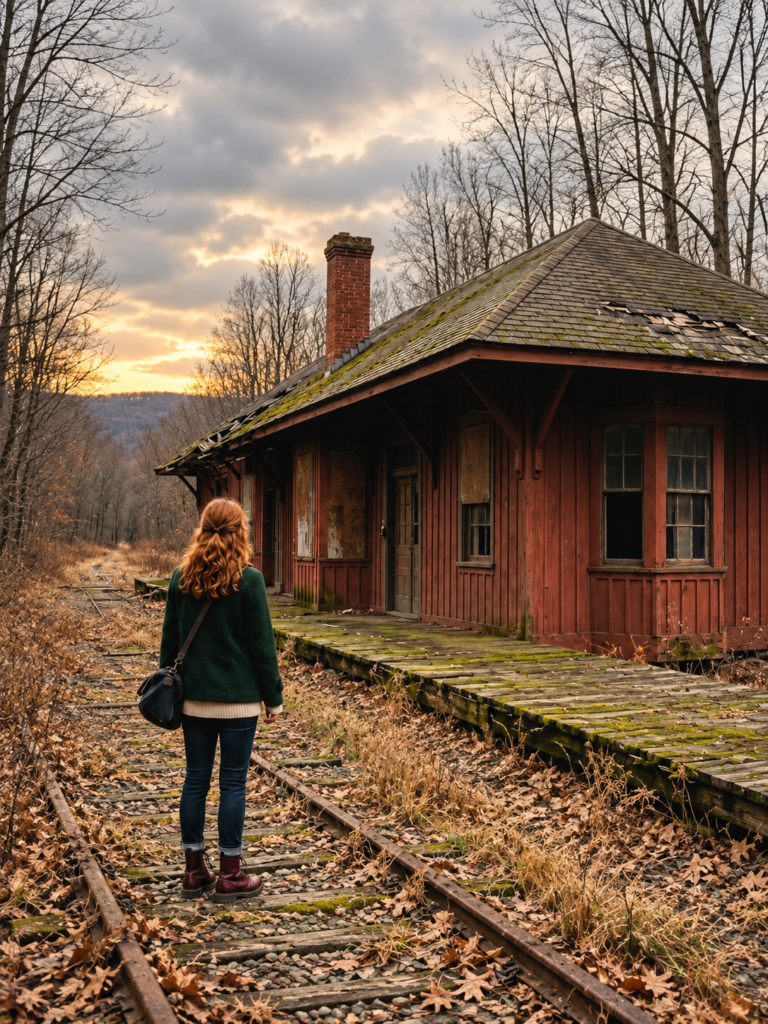
Whitlock Junction stood in a clearing where the old railbed widened into what had once been a passing siding.
Wynn saw the station through the windshield and stopped breathing for a second.
The building was small and low, with faded board-and-batten siding the color of dried clay. A wide roof overhang sheltered the platform. A brick chimney rose from the back.
The freight-room roof sagged badly.
The platform boards were green with moss.
Above the bay window hung a sign in faded lettering:
WHITLOCK JCT
PENN RR
Dorothea unlocked the waiting-room door.
“There you go.”
Wynn stepped inside.
The waiting room was long and narrow.
Slate floor.
Dark wooden wainscoting.
A bench along one wall.
A black potbellied stove in the corner.
At the far end stood the ticket-booth door beneath the bay window.
The depot smelled of dust, cold stone, pine boards, and something faintly metallic.
Dorothea handed her the key.
“Bench is solid enough to sleep on if you’ve got a bag.”
“I do.”
“I’ll be back the day after tomorrow.”
The pickup drove away.
The engine disappeared.
Silence settled over the clearing.
Wynn stood alone inside the depot she had just bought for ten dollars.
She touched the stove.
The bench.
The wall.
Then she crossed the waiting room and opened the ticket-booth door.
The booth was barely six feet square.
An agent’s desk faced the bay window.
There was a tall stool, rows of pigeonholes, a small iron safe, and a chalkboard on the wall.
A final message remained faintly visible beneath decades of dust:
6:42 P.M.
EASTBOUND
FINAL
Wynn sat on the stool.
Outside, the old railbed disappeared between the trees.
For the first time since being locked out of her mother’s house, she felt something she could not quite name.
Not safety.
Not yet.
Possibility.
She wondered whether Padraig had ever stood on this platform.
Whether he had accepted a cup of coffee from the station agent Vera remembered.
Whether he had checked the watch now hanging around Wynn’s neck while a freight train passed this exact window.
She slid from the stool.
That was when she noticed the floor.
Most of the ticket booth was laid with old pine boards bleached gray-brown by age.
But the boards directly beneath the stool were darker.
Not much.
Just enough.
Wynn knelt.
She ran her fingertips across the seam.
There was a narrow gap.
Straight.
Deliberate.
Cut by a tool.
Wynn stared at it.
Then she went into the freight room and searched through the debris until she found a flat piece of old iron.
She carried it back into the booth.
Worked one end into the gap.
And pried.
The darker boards lifted together.
They were attached beneath by leather hinges stiffened almost solid with age.
Under them was a compartment built between the floor joists.
Inside lay three things.
A tin lockbox.
A sealed envelope.
And a folded American flag.
Part 2
For several seconds Wynn remained kneeling on the ticket-booth floor with one hand still holding the piece of iron.
The compartment was not an accidental hollow under the boards.
Someone had constructed it.
Carefully.
The tin box rested on old oilcloth. Beside it lay a thick cream envelope, its edges yellowed but surprisingly clean. The American flag had been folded into the tight triangular shape used for military flags.
Wynn knew enough history to recognize the pattern of stars.
Forty-eight.
Whatever had been placed beneath the floor had been there a long time.
She lifted the flag first and placed it gently on the desk.
Then the envelope.
Across the front, in faded brown ink, someone had written:
To whoever finds this.
The tin box was heavy.
She set it on the desk and opened the lid.
For one strange moment, Wynn simply stared.
Money.
Bundles of old United States currency filled the box.
Twenties.
Fifties.
A small stack of hundreds.
Some of the notes were old enough to look unfamiliar, their paper darker and their printing slightly different from modern bills.
The paper bands holding them together had become brittle.
Wynn sat down on the floor and counted.
Then counted again.
Nine thousand three hundred twenty dollars.
She whispered the number.
“$9,320.”
She had never held that much money.
She had spent the morning walking four miles to buy a building because she owned exactly ten dollars.
Now more than nine thousand dollars sat on the desk above her.
But there was more.
Under the bills lay a leather pouch.
Inside were eleven silver dollars, each wrapped separately in tissue.
And a railroad pocket watch.
Wynn’s breathing slowed.
She picked it up.
Hamilton 992B.
Silver hunting case.
A railroad-grade watch.
She knew exactly what it was because Padraig had talked about watches with the seriousness other men reserved for religion.
She drew his watch from beneath her sweater and set both watches side by side.
The resemblance made her throat tighten.
Then she remembered the envelope.
She broke the seal carefully.
Inside was a letter covered in neat, slanted handwriting.
Wynn moved the stool closer to the window to catch the fading daylight.
The letter began:
To whoever finds this,
My name is Harlan Bowyer. I have been the station agent at Whitlock Junction on the Bedford branch of the Pennsylvania Railroad from 1932 until today, the 17th of June, 1958.
Wynn stopped.
Station agent.
The man who had sat in this booth.
The man who had used this desk.
The man who had hidden the box.
She kept reading.
Harlan wrote that the branch was being closed.
The final passenger train would run that Friday evening. Afterward the building would be locked, the rails eventually removed, and there would be little reason for anyone to return.
He was sixty-four years old.
He had no children.
His wife, Eleanor, had died during the influenza season of 1949.
For twenty-six years, Harlan had watched trains arrive from Bedford in the morning and leave toward Pittsburgh in the evening.
He had known the regular passengers.
He had handled waybills.
Sold tickets.
Kept schedules.
And every morning at five, he made coffee for brakemen working the through freights.
It wasn’t part of his job, he explained.
He did it anyway.
Coffee is a small kindness, he had written, and a small kindness on a cold morning is sometimes the difference between a good day and a hard one.
Wynn read that sentence twice.
She thought of Vera turning the diner’s sign to CLOSED.
Eggs.
Home fries.
Coffee.
No questions until after Wynn had eaten.
She read on.
Harlan had saved part of every paycheck.
He did not trust banks. He had lost what little money he possessed when the Bedford Trust failed in 1933.
So he kept his savings beneath the station floor.
The eleven silver dollars had belonged to Eleanor’s family.
The Hamilton watch had been issued to him by the railroad in 1934.
He was leaving it behind because, after the line closed, he no longer wanted to carry railroad time.
Then the letter changed.
If you are reading this letter, you came into this depot after I am gone.
Maybe long after.
Maybe the building has been forgotten.
Maybe you came looking for shelter or quiet or a place to begin again.
Wynn lowered the page.
Outside the bay window, evening had begun to fill the woods.
She looked around the booth.
A place to begin again.
Her fingers tightened around the paper.
She continued.
Whatever brought you here, I want you to know that the depot has been waiting for you.
A small station is a kind of patient thing.
It waits for the train, and then it waits for the next train, and then eventually, when there are no more trains, it waits for whoever will come next.
Harlan wrote that he had been the one waiting at Whitlock Junction since 1932.
Now he was leaving the waiting to whoever found the letter.
Take what is in this box.
It is for you.
The flag, he explained, had belonged to Eleanor’s brother, a brakeman on the Erie Railroad who was killed in a coupling accident in 1944.
Keep it folded the way I have folded it.
Be kind to the building.
And near the end:
The coffee tastes better here than anywhere on the division. I do not know why, and I have stopped trying to find out.
The letter was signed:
Harlan Bowyer
Station Agent
Whitlock Junction
June 17, 1958
Wynn finished.
She sat without moving.
There were no dramatic sounds.
No distant whistle.
No sudden wind.
Only the old building cooling around her and the steady ticking of Padraig’s watch.
She read the letter again.
Then she folded it along its original creases, slid it into the envelope, and placed it beside the watch.
Her eyes burned, but she did not cry.
Padraig had rarely cried.
Sean had not either.
Restraint had somehow traveled through the Halloran family along with railroad work and pocket watches.
Wynn rested both hands on the edge of the desk.
Then she spoke into the empty depot.
“Thank you, Mr. Bowyer.”
She glanced at the broken freight roof visible through the inner doorway.
“I’ll try.”
That night she slept on the wooden waiting-room bench in her coat.
The lockbox was under her head inside the duffel.
She woke several times because branches scraped the siding and small animals moved beneath the platform.
Before dawn she rose, stepped outside, and stood on the mossy boards.
The railbed ran east and west through a pale winter mist.
For sixty years people had treated Whitlock Junction as a building whose story was finished.
Wynn suddenly understood that she did not.
The next morning she began making a list.
Roof.
Windows.
Stove.
Water.
Door.
Floor.
Chimney.
She wrote in a cheap pocket notebook she had brought from Scranton.
The list grew to several pages.
When Dorothea returned in the green pickup, she found Wynn on the freight-room roof examining the collapsed section from below.
“You planning to stay?” Dorothea called.
Wynn climbed down.
“Yes.”
Dorothea looked toward the building.
“Thought you might.”
Wynn told her about the floor compartment.
About Harlan Bowyer.
The money.
The letter.
Dorothea listened carefully.
“Bowyer,” she said. “Name’s in some old township records.”
“I want to keep the letter here.”
“Then keep it dry.”
“What about the money?”
Dorothea advised her not to leave nine thousand dollars in an abandoned building.
Wynn agreed.
In Bedford she opened an account at a credit union and placed most of the cash somewhere safer.
Then she started spending Harlan’s savings slowly.
Not like a windfall.
Like a responsibility.
Cedar shingles.
Roofing tar.
A used kerosene cookstove.
A proper mattress.
A wool blanket.
Work gloves.
A claw hammer.
Handsaw.
Galvanized nails.
Nothing glamorous.
Everything necessary.
She learned roofing from a library computer.
The first section she shingled came out crooked.
She pulled half of it off and did it again.
Her palms blistered beneath the gloves.
Her shoulders ached.
At night she fell asleep so deeply the silence no longer frightened her.
Dorothea arranged for the county to inspect an old well behind the depot.
To everyone’s surprise, the well was still sound.
After Wynn installed a hand pump, cold water rose from underground tasting faintly of iron and stone.
The bay window needed new glass.
The stove needed its flue cleaned.
Several boards on the platform were rotten.
The freight-room door hung badly on its hinges.
Wynn mentioned the door while eating lunch one day at a Bedford diner.
An elderly man at the next table leaned over.
“You’re the girl with Whitlock Depot?”
Wynn nodded.
“Door sagging?”
“About three inches.”
“Mortise hinges?”
“I think.”
“You think?”
He sighed.
“Name’s Augie Klein. Carpenter forty-six years. Finished carpenter twenty-five. Bad-tempered retiree the rest.”
Wynn smiled.
The next Saturday Augie arrived carrying his own tools.
He examined the door.
“You were going to fix this yourself?”
“I was going to try.”
“Trying is how doors end up nailed shut.”
He showed her how to support the weight, reset the hinges, check the jamb, and work slowly instead of fighting the wood.
When Wynn offered to pay him, Augie looked offended.
“Pay me with coffee next time.”
The next Saturday he came back.
Then once more for the bay window.
Word spread through Penn Forest Township.
Dorothea appeared every Wednesday with a thermos and a copy of the township newsletter.
A retired Conrail engineer named Marcus Linwood drove out one afternoon in an old Ford pickup.
He backed onto the clearing and opened the tailgate.
Inside was a wooden crate.
“What is it?” Wynn asked.
“Things my wife wants out of the attic.”
He lifted out old timetables.
A brass conductor’s lantern.
A Pennsylvania Railroad porcelain mug.
And a short length of original rail stamped 1928.
Marcus ran his hand over the steel.
“Been keeping these forty years.”
“You want me to buy them?”
“No.”
He looked toward the depot.
“They belong here more than they belong with me.”
He returned every other Sunday.
Usually he brought nothing.
He just sat on the platform and drank coffee.
Marcus had known men who worked the old branch. Not Harlan personally, but conductors and engineers who remembered Whitlock Junction.
“Quiet place,” Marcus said once.
“My grandfather called it lonely.”
Marcus considered that.
“Same thing, depending on who you are.”
The largest visit came two months after Wynn bought the station.
Vera pulled into the clearing in a car packed with boxes.
Wynn ran down the platform.
“What are you doing here?”
“Bringing the rest of your things.”
“You drove all the way from Scranton?”
Vera climbed out stiffly.
“I’ve survived worse decisions.”
She brought clothing.
Kitchen utensils.
Blankets.
An old lamp.
Several books.
And one framed photograph.
Sean Halloran in his Conrail jacket.
Wynn stopped when she saw it.
The photograph had been in the box Mary left on the porch.
Wynn had packed it away above the diner.
She had not looked at it closely since.
Vera held it out.
“Thought this belonged here.”
Wynn took it.
Her father’s smile was crooked, as if someone had called his name just before the picture was taken.
For three days, Vera stayed at Whitlock.
She slept on a folding cot in the freight room.
Together they painted the ticket booth a soft cream color.
The fresh paint made the narrow space brighter without erasing its age.
On Vera’s final morning, they loaded the empty boxes into her car.
Then Vera stood beside the driver’s door.
She looked at the depot.
At the repaired section of roof.
At the new glass in the bay.
At Wynn.
“Padraig would be proud.”
Wynn swallowed.
Vera continued.
“Sean too.”
Wynn looked down.
Vera touched her shoulder.
“You’re a Halloran in the only way that matters.”
Then she got into the car and drove back toward Scranton.
Wynn stood in the clearing until the engine disappeared.
She sat on the platform bench.
And for the first time since the night Mary locked her out, she cried.
Not loudly.
Not dramatically.
She simply bent forward and covered her face while months of cold anger, fear, embarrassment, exhaustion, and relief finally found somewhere to go.
The depot held the sound.
By April, the freight-room roof was tight.
By May, the bay window had glass.
By June, the stove worked safely.
The slate floor was scrubbed.
The walls had fresh paint.
Dorothea sewed curtains for the windows.
Wynn made a small sleeping room in the freight section.
She placed Sean’s photograph above the cot.
Padraig’s pocket watch stayed with her most days, but at night she placed it on the shelf beside the photograph.
Harlan Bowyer’s Hamilton remained on the agent’s desk.
Wynn had it serviced.
Then she wound it.
Set it to railroad time.
And listened.
Tick.
Tick.
Tick.
For the first time in decades, two railroad watches were running inside Whitlock Junction.
One had belonged to the man who waited there until the trains stopped.
The other had come back through the granddaughter of a brakeman who had once passed through.
Then Wynn began making coffee.
Part 3
At first, the coffee was not a business.
There was no sign.
No menu.
No cash register.
Wynn simply kept a kettle near the potbellied stove and several mismatched mugs on a shelf in the waiting room.
The old railbed had become an informal path over the years.
Hikers used it.
Birders.
Railroad-history enthusiasts.
Occasionally backpackers who had taken a wrong turn somewhere and were surprised to find a restored depot in the woods.
When they stepped inside, Wynn offered coffee.
“How much?” people asked.
“Nothing.”
Some accepted that.
Others left things.
A loaf of bread.
A jar of honey.
Wildflowers.
Once, a dozen eggs.
Someone folded a five-dollar bill and placed it under a mug.
After that Wynn set an old tin on the bench.
She never labeled it.
People understood.
The depot slowly became what it had once been.
Not a station in the literal sense.
No train arrived at 6:42.
No conductor called passengers aboard.
But people stopped there intentionally.
They sat.
They talked.
They rested.
They drank something hot.
And then they continued.
By autumn Marcus Linwood brought Wynn a hand-painted wooden sign.
WHITLOCK JCT COFFEE
She laughed when she saw it.
“You made this?”
“My lettering’s bad.”
“It’s perfect.”
“That’s not the same thing.”
“It is to me.”
They hung it beneath the platform roof.
Dorothea arrived a week later with a string of white lights for winter evenings.
Augie built a new platform bench from reclaimed white oak taken from an old barn in the next valley.
Every addition came from somebody who had decided the depot mattered.
Wynn kept Harlan Bowyer’s letter in a protective sleeve inside the ticket booth.
Sometimes visitors asked about the building.
She would tell them about the branch line.
The last train.
The floor compartment.
The old station agent.
The coffee.
She did not romanticize the money.
The $9,320 had been important.
Without it, repairing the depot would have been almost impossible.
But the money was not the part of Harlan’s gift that changed her most.
The letter was.
Maybe you came looking for shelter or quiet or a place to begin again.
Wynn had not known she was looking for a beginning when she found the surplus listing.
She had believed she was looking for cheap shelter.
Four walls.
A roof.
A door nobody else could lock against her.
That mattered.
She never pretended it didn’t.
For months after she moved into the depot, Wynn still checked the door twice before sleeping.
She kept the key beneath her pillow at first.
When wind rattled the walls, she sometimes woke confused and expected to see the ceiling of Vera’s upstairs room.
She saved money obsessively.
She knew what it felt like to own ten dollars and nothing more.
Security was not a poetic concept to her.
It was dry shingles.
A working stove.
Food on a shelf.
Boots without holes.
A key that belonged to her.
But slowly, something inside her changed.
She stopped thinking of the depot only as the place that had rescued her from homelessness.
It became hers because she worked on it.
And because other people worked on it with her.
Augie taught her carpentry.
Marcus gave the station pieces of its history.
Dorothea brought township news and coffee.
Vera brought her father’s photograph.
Harlan had left the lockbox.
Each person contributed something.
Even Padraig and Sean, who were gone, had contributed.
Padraig had given her the watch.
Sean had taught her to read schedules, recognize freight cars, understand switches, and respect honest work.
On a clear evening in late October, Wynn sat alone on Augie’s white-oak bench.
The ridge beyond the clearing had gone dark against an orange sky.
Leaves covered the old railbed.
She held Padraig’s silver watch in one hand.
Harlan’s Hamilton in the other.
She opened both.
The second hands moved together.
Exact.
Railroad time.
She smiled.
Padraig had spent thirty-two years believing that time mattered because other people depended on you being where you promised to be.
Sean had walked away from an insurance office because he could not bear to spend his life wearing somebody else’s coat.
Harlan Bowyer had served coffee to brakemen every morning at five even though no rule required him to do so.
Vera had fed a homeless girl before asking what happened.
Wynn had once thought these were separate kinds of people.
They were not.
They all shared the same private rule.
Do the small necessary thing in front of you.
Do it properly.
Do it for someone even if nobody is watching.
That evening, Wynn thought of her mother.
Mary.
For months, Wynn had avoided thinking about her because anger was easier to carry when she treated the note on the door as the final fact.
Please do not come back tonight or any night.
Please do not call.
There were nights when Wynn imagined returning to Scranton simply to show Mary what she had done.
The restored depot.
The repaired roof.
The money.
The visitors.
The sign.
She imagined Brendan hearing about it and understanding he had not ruined her.
But over time, even that fantasy lost its force.
Mary had not locked Wynn out because she possessed some secret plan for Wynn’s future.
She had not pushed her daughter toward Whitlock Junction out of hidden wisdom.
She had wanted peace in her own house.
She had chosen Brendan.
She had chosen avoidance.
And she had failed her daughter.
Wynn did not excuse it.
But she began to understand it differently.
Mary had loved Sean with such total devotion that after he died she seemed unable to look directly at anything that carried too much of him.
Wynn had his expressions.
His way of laughing.
His interest in railroads.
Sometimes even his stubbornness.
Brendan did not create Mary’s grief.
He gave Mary a way to organize her life around avoiding it.
Wynn had become the reminder that would not leave.
That did not make Mary’s decision right.
Understanding was not the same as forgiveness.
But Wynn no longer needed to wake each morning still arguing with a locked front door.
That door was two hundred miles behind her.
She had another door now.
A better one.
She had rehung it herself with Augie Klein watching and correcting her measurements.
As winter approached, Whitlock Junction changed again.
The white lights Dorothea brought glowed beneath the eaves.
People began arriving specifically for the coffee.
Some had heard about the restored depot from friends.
Others followed the old railbed.
Railroad enthusiasts drove from neighboring counties.
Older visitors sometimes recognized the station’s layout immediately.
One man stood in the waiting room for nearly ten minutes without speaking.
Finally he pointed at the ticket window.
“My father bought me a ticket there.”
Wynn looked at him.
“Here?”
“Nineteen fifty-five. I was seven.”
He laughed softly.
“Thought the place was huge.”
Wynn poured him coffee.
He sat on the bench.
When he left, he placed a folded ten-dollar bill in the tin.
Exactly what Wynn had once paid for the entire station.
She kept that bill separately for a long time.
Marcus brought old photographs whenever he found them.
In one image, Whitlock Junction appeared in winter beneath heavy snow, its platform crowded with crates.
In another, three railroad men stood beside the bay window.
None was labeled.
Wynn studied their faces and wondered whether one might be Harlan.
She could not prove it.
So she did not invent an answer.
The unknown mattered too.
Not every part of history needed to become certain.
Harlan’s letter was enough.
So were the objects he left.
The eleven silver dollars.
The folded flag.
The Hamilton watch.
Wynn never unfolded the flag.
Harlan had asked the finder to keep it the way he left it.
She did.
She eventually placed it in a glass-fronted wooden case Augie built, protected but still folded into its triangle.
The eleven silver dollars remained wrapped.
The watch stayed wound.
The money was spent cautiously, mostly on the station.
Not all of it.
Wynn kept a reserve because experience had taught her that roofs fail and furnaces stop working and emergencies do not care whether money has sentimental meaning.
Harlan had saved the money through practical discipline.
She honored it the same way.
By the following spring, the demolition date had become irrelevant.
The township had no reason to remove a building someone now owned and maintained.
Instead Whitlock Junction appeared in the local newsletter under a small article Dorothea wrote about historic preservation.
Wynn clipped it out.
Vera framed a copy and hung it beside the register in Scranton.
When customers asked about it, Vera would say only, “Halloran girl.”
As though that explained everything.
In some ways, it did.
Wynn visited Scranton occasionally.
She always stayed with Vera.
She passed the row house only once.
She did not stop.
The porch looked exactly as she remembered it.
Same narrow steps.
Same front window.
Different curtains.
She slowed for half a block, then kept walking.
The pocket watch ticked under her coat.
When she returned to Whitlock that evening, she unlocked the depot and stood for a moment inside the waiting room.
The familiar smell met her.
Wood smoke.
Coffee.
Pine.
Old iron.
She turned on the small lights.
Set water to heat.
Checked Harlan’s watch.
And felt no desire to be anywhere else.
It struck her then that home was not simply the place where your belongings happened to be.
Nor was it automatically the place where your family lived.
Home was the place where your presence was not an argument.
At Whitlock Junction, Wynn never had to justify the chair she sat in.
No one complained that she used too much water.
No one moved her things into a cardboard box.
No one put her heirloom on top as a warning.
The depot had been abandoned for decades.
Yet the abandoned building had made room for her more easily than the house where she had grown up.
There was sadness in that realization.
But also freedom.
Years earlier, Harlan had written that a small station was patient.
It waited for one train.
Then another.
Eventually, after the trains stopped, it waited for whoever came next.
Wynn came to think of patience differently because of him.
Patience was not passivity.
It was maintenance.
Harlan had kept making coffee.
Padraig had kept his watch accurate.
Sean had kept reporting to the track.
Vera had kept the back booth available.
Dorothea had kept township records nobody expected to need.
Augie had kept his tools sharp after retirement.
Marcus had kept railroad objects in an attic for forty years until there was somewhere meaningful to bring them.
Everyone had been preserving something.
A skill.
An object.
A memory.
A place.
A kindness.
Then, at the right moment, preservation became inheritance.
Not legal inheritance in the ordinary sense.
Harlan was not Wynn’s relative.
He had never known her name.
He died without knowing who would open the compartment.
But he had trusted that eventually somebody would.
Somebody who needed what he had left.
That possibility was enough for him.
On the anniversary of the day Wynn bought the depot, Dorothea arrived carrying a thermos.
Marcus came after her.
Then Augie.
Late in the afternoon Vera’s car appeared at the far end of the road.
Wynn laughed when she saw it.
They gathered in the waiting room.
No ceremony had been planned.
No speeches.
Vera brought pie.
Dorothea brought sandwiches.
Marcus brought coffee beans.
Augie complained that everybody else’s coffee tasted burnt and then drank three cups.
At 6:42 p.m., Wynn happened to glance at the chalkboard.
The faint old words were still there.
6:42 P.M.
EASTBOUND
FINAL
She had never erased them.
Outside, no train arrived.
No whistle sounded.
There were no rails.
But the waiting room was full.
Vera sat in the back corner talking to Dorothea.
Marcus had begun telling Augie a story about a Conrail locomotive with a bad traction motor.
Steam rose from mugs.
Light from the stove moved across the slate floor.
Wynn stood behind the old ticket desk.
Harlan’s Hamilton lay open beside her.
Her grandfather’s watch hung against her collarbone.
For a moment she imagined the station agent sitting where she stood.
June 1958.
The branch closing.
The last train coming.
An old man placing his savings beneath the floor because he could not know what would happen to the building but wanted to believe that somebody might come after him.
He had hidden money.
But more importantly, he had left instructions for how to use loneliness.
Wait.
Keep something warm.
Offer coffee.
Let the next person in.
Wynn looked around the room.
The depot was no longer waiting.
Or perhaps it was still waiting, just differently.
Every person who arrived on the old railbed brought some unknown part of his life through the door.
A tired hiker.
A retired railroader.
A man remembering a ticket his father bought in 1955.
Somebody grieving.
Somebody lonely.
Somebody merely cold.
The station received them all.
Just as it had received her.
Later, after everyone left, Wynn washed the mugs and swept the waiting room.
She banked the stove.
Checked the locks.
Then she returned to the ticket booth.
She opened the hidden compartment beneath the floor.
It was mostly empty now.
The lockbox was kept elsewhere.
The money had been banked and partly spent.
The flag was protected.
The watches had places of their own.
But Wynn kept Harlan’s original letter inside the compartment from time to time, sealed within protection from damp.
She read it again that night.
Not all of it.
Only the line she knew nearly by heart.
Maybe you came looking for shelter or quiet or a place to begin again.
Wynn smiled.
“All three,” she said.
She replaced the letter.
Closed the floorboards.
And sat on the station agent’s stool.
Through the bay window, the moon lit the old railbed.
Sixty years earlier, rails would have shone there.
A locomotive headlight might have appeared between the trees.
Padraig Halloran might have stood on a caboose platform checking his watch.
Harlan Bowyer might have lifted his coffee pot at five in the morning.
Now there was only the path.
But Wynn no longer thought of “only” as a small word.
Only a path could still bring people.
Only a building could still shelter them.
Only a cup of coffee could change a hard morning.
Only ten dollars could buy a condemned depot.
Only one locked door in Scranton could send a young woman toward another door she did not know existed.
Wynn never decided that losing her home had been a blessing.
Some wounds did not need to be renamed before a person could move forward.
What Mary did hurt her.
Brendan’s coldness hurt her.
Homelessness frightened her.
No later happiness made those things good.
But neither did they get the final word.
That belonged to Wynn.
She was twenty when she walked four miles through the Allegheny foothills with one ten-dollar bill in her pocket.
She signed her name three times.
Wynn Mary Halloran.
She took possession of a station everybody else had given up on.
Then the station, in its own quiet way, took possession of her life.
She repaired its roof.
It gave her shelter.
She cleaned its windows.
It gave her a view forward.
She reopened its waiting room.
It gave her people.
She wound Harlan’s watch.
It reminded her that time could continue after loss.
And beneath the booth, an old station agent who had been gone for decades gave her more than $9,320, eleven silver dollars, a railroad watch, and a folded flag.
He gave her evidence that somebody could prepare a kindness without knowing who would need it.
That was what stayed with Wynn longest.
Harlan Bowyer had hidden the lockbox in 1958.
He could not have known Wynn would be born.
Padraig could not have known his granddaughter would one day own the lonely stop where he had once worked a temporary assignment.
Sean could not have known the freight-car names he taught his little girl would become part of the language of a place where she would rebuild herself.
Vera could not have known that closing the diner early and serving one plate of eggs would lead to any of it.
Dorothea could not have known what would happen when she stamped a ten-dollar deed.
Augie could not have known how many people would sit beneath the door he rehung.
Marcus could not have known his attic full of railroad objects was waiting for a home.
None of them knew the ending while they were doing the small thing in front of them.
That was the lesson Wynn trusted.
You did not have to know where every track led.
You did not have to see the next station.
You did not have to understand why one door had closed.
Sometimes you just kept the watch wound.
Kept the coffee hot.
Kept the roof from leaking.
And when somebody appeared out of the cold carrying nearly nothing, you opened the door.
Years later, visitors would sometimes ask Wynn how she found Whitlock Junction.
She could have told the story a dozen ways.
She could have started with the internet listing.
Or the ten-dollar deed.
Or the hidden box.
Or the $9,320.
But usually she touched the old silver watch beneath her sweater and said:
“My grandfather rode this line.”
That felt like the true beginning.
Then, if visitors had time, she told them the rest.
About Padraig.
Sean.
Vera.
The cardboard box on the porch.
The four-mile walk.
Dorothea’s brass stamp.
The darker floorboards.
Harlan’s letter.
The coffee.
And sometimes, when she finished, visitors would look around the restored waiting room and say how lucky she had been.
Wynn never argued.
Luck had been part of it.
But she knew luck alone did not repair roofs in winter.
Luck did not reglaze windows.
Luck did not haul shingles, carry water, clean chimneys, learn hinges, work shifts, or wake before daylight.
Harlan had left a chance.
Wynn had built a life from it.
That distinction mattered to her.
One winter morning, years after she first opened the hidden compartment, snow covered the old railbed.
Wynn arrived in the waiting room before sunrise and lit the stove.
She filled the kettle.
Ground coffee.
Set out clean mugs.
At five o’clock, she looked at Harlan’s Hamilton.
Then at Padraig’s watch.
Both showed the same time.
A few minutes later someone knocked.
A hiker stood outside, shoulders white with snow.
Wynn opened the door.
“Come in.”
The stranger stamped snow from his boots.
“Sorry. I saw the lights.”
“That’s what they’re for.”
“Are you open?”
Wynn glanced at the kettle.
Steam had just begun to rise.
She thought of Harlan.
Coffee is a small kindness.
She smiled.
“Coffee’s ready.”
Outside, snow continued falling across the place where the tracks had once been.
Inside, the stove warmed the slate floor.
Two railroad watches ticked steadily within the old depot.
Whitlock Junction had spent decades waiting.
Now, once again, someone had arrived.

