
Part 1
The letter arrived on a Tuesday morning, folded once inside an envelope so thin Anna could almost read through it.
She noticed it because it was the only thing in her mailbox.
No advertisement. No utility notice. No envelope stamped FINAL REMINDER in aggressive red letters. Just a pale piece of paper bearing the seal of a regional notary she had never heard of.
Anna carried it upstairs with two grocery bags cutting into her fingers, set it beside the calculator on her kitchen table, and forgot about it for several hours.
That was easy to do lately.
Her apartment had become a place where one problem waited politely behind another. Rent was due in nine days. The electric bill had already passed its due date. Two freelance clients had promised payment and then vanished into the familiar silence of people who always seemed to have money when they were assigning work and none when it came time to pay for it.
By evening, Anna had added the same figures three times and received the same impossible answer.
She pushed the calculator away.
That was when she remembered the letter.
She opened it standing beside the kitchen table.
The first paragraph was formal enough that she nearly stopped reading.
Then she saw the name.
Friedrich Adler.
Her maternal grandfather.
Deceased three weeks earlier.
Anna lowered herself into a chair.
She had not seen Friedrich in years. Almost no one in the family had. He had left the city decades ago after selling his apartment, taking what savings he had, and moving somewhere in the countryside. At first he had written letters. Then Christmas cards. Then occasional notes. Eventually even those stopped.
Family conversations had reduced him to a collection of jokes.
Friedrich had gone strange.
Friedrich hated modern life.
Friedrich had built some ridiculous house in the dirt.
Friedrich was too stubborn to admit he had made a mistake.
Nobody described him as destitute, exactly. He had never begged for money or asked anyone to rescue him. But Anna’s family had their own definition of poverty.
If a person owned little, earned little, and lived far from the conveniences everyone else considered necessary, then something must have gone wrong.
By that measure, Friedrich Adler had failed spectacularly.
Anna read on.
She was named as the sole heir to his remaining property.
The description occupied one line.
A residential structure with auxiliary facilities in a rural district.
Coordinates followed.
Assessed value: minimal.
Anna actually laughed.
It was not a happy sound.
Of course.
Even her inheritance was apparently worth almost nothing.
She called her mother.
There was a pause when Anna mentioned Friedrich’s name, followed by a tired sigh.
“I wondered when they’d reach you.”
“You already knew?”
“They contacted me.”
“And?”
“And I declined.”
Anna looked again at the letter.
“You declined your share?”
“If you want to call it a share.”
Her mother sounded almost irritated by the idea that the matter was still alive.
“Anna, there is nothing there. An old house in the middle of nowhere. Your grandfather spent years building strange things nobody asked for. The place is probably unsafe.”
“The letter says auxiliary facilities.”
Her mother gave a short laugh.
“He was always building something. Digging something. Reinforcing something. He never listened to anyone.”
“So you haven’t seen it?”
“Not in years.”
“Then how do you know it’s worthless?”
Another pause.
“Because if it were worth something, he wouldn’t have lived like that.”
The sentence stayed with Anna after the call ended.
She tried an uncle next.
He advised her to sign whatever papers were necessary to refuse the inheritance.
A cousin joked that at least the property would have room for one more body eventually.
Nobody asked for the coordinates.
Nobody wanted photographs.
Nobody wondered what Friedrich had actually built.
Their certainty bothered Anna more than their cruelty.
That night she lay awake beneath the thin apartment ceiling while traffic murmured several floors below.
Rent.
Utilities.
Debt.
Food.
She knew refusing the inheritance would eliminate one potential problem.
It would not solve any of the problems she already had.
At two in the morning, curiosity finally defeated exhaustion.
Anna opened her laptop and entered the coordinates.
The map shifted away from the city, then farther, toward a sparsely populated rural district. A secondary highway narrowed into a local road. The local road split. One branch wound toward a low range of hills.
She switched to satellite view.
For a moment she thought the coordinates were wrong.
There was no obvious house.
Only grass, scrub, earth, and an irregular dark shape pressed into one hillside.
Anna zoomed closer.
The roofline emerged.
Or part of one.
The building did not appear to stand beside the hill.
It appeared to disappear into it.
Two weeks later, after signing more documents than she expected an almost worthless inheritance to require, Anna packed her car.
She told herself she was going only to inspect the property.
One night.
Two at most.
Then she would determine whether the place could be sold.
She left her apartment early in the morning.
The city thinned around her until apartment blocks became commercial strips, commercial strips became detached houses, and houses gave way to long stretches of open land.
Pavement narrowed.
Then it turned to gravel.
Eventually even the gravel ended.
Anna followed a packed dirt road between fields and low wooded rises. Her phone signal disappeared fifteen miles before she reached the property.
She was already wondering whether she had made a mistake when the house finally appeared.
She slowed.
The photographs in the paperwork had not prepared her.
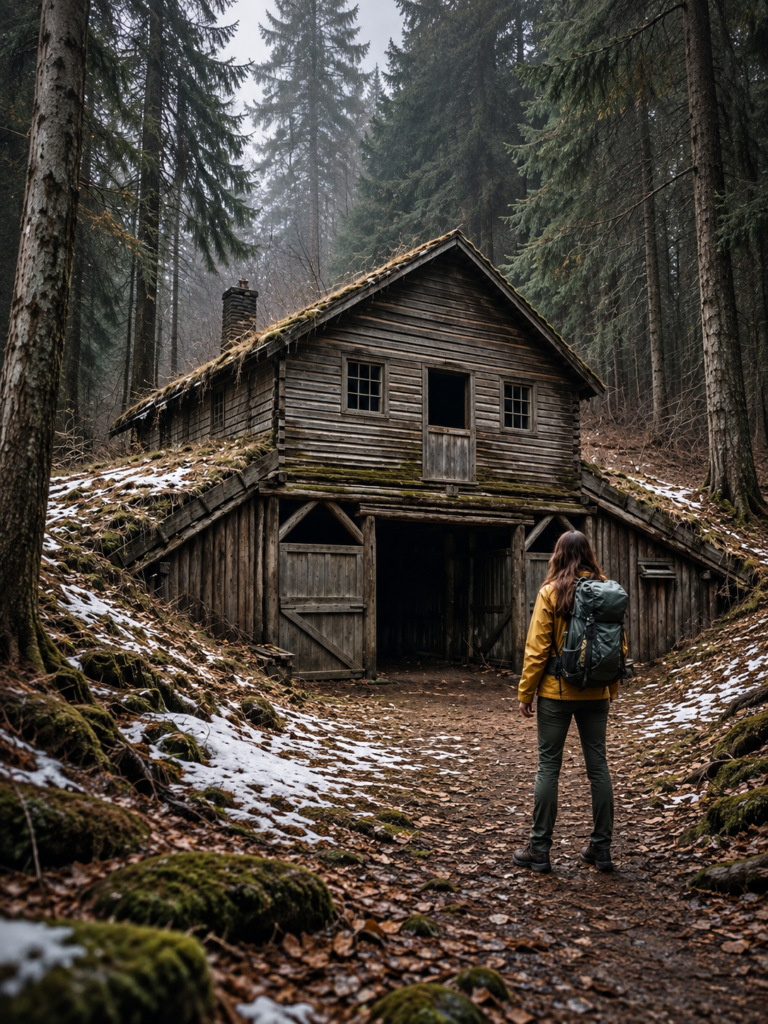
The building was modest from the front. Weathered wooden boards. Small windows positioned unusually high. A low roof that looked older than anything Anna would willingly stand beneath in the city.
But the sides vanished into the hillside.
Earth climbed almost to the eaves.
Grass grew above sections of the structure. Scrub clung to the slope.
The house had not been built on the land.
It had been inserted into it.
Anna parked and sat behind the wheel for several seconds.
“So this is it.”
Outside, the air smelled of soil and distant rain.
There were no neighboring houses visible from the yard. No power lines. No obvious outbuildings. No neglected piles of machinery.
She had expected decay.
Instead, everything looked old but deliberate.
The front door was heavy.
Its handle had been worn smooth.
Inside, Anna stopped again.
The room was dim without being dark. Narrow windows admitted controlled strips of daylight. The wooden floor felt solid beneath her boots. A table stood near one wall with two chairs tucked beneath it. There was a narrow bed, a small stove, shelves, jars, simple cooking equipment, folded blankets.
Nothing matched.
Nothing decorated the space merely for decoration’s sake.
But almost nothing appeared broken.
She checked one wall.
No obvious mold.
Another.
No water staining.
The air carried the smell of timber and earth, but not the sour dampness she expected from a house partly underground.
Her grandfather had apparently lived with almost nothing.
Yet what he had kept, he had maintained.
Anna set down her bag.
The silence surprised her most.
The hillside seemed to absorb every sound.
No traffic.
No pipes.
No neighbors through the wall.
She could hear the soft friction of her sleeve when she moved her arm.
For the first time in weeks, her mind stopped adding numbers.
Then another detail registered.
The temperature.
Outside, the afternoon had been warm enough that she had driven with one window partly open.
Inside, the air was cool.
Not chilly.
Not damp.
Simply cool.
Anna unpacked and told herself it meant nothing.
Old underground houses were probably cooler. That was hardly mysterious.
She stayed the night.
Before dawn, the silence woke her.
She had slept in her clothes beneath one of Friedrich’s blankets. For several moments she did not remember where she was.
Then she noticed that the room felt almost exactly as it had when she had gone to sleep.
She expected the floor to be painfully cold.
It was not.
She opened the front door.
Morning air struck her face with noticeably more bite than the air inside.
Anna frowned.
Outside, the horizon was just becoming visible.
She found the well mentioned in the property documents behind high grass near the house. Drawing water was harder than turning a city faucet, and she nearly lost the bucket once when the rope slipped through her fingers.
But the water came up clear and intensely cold.
She carried it inside.
Her phone still had no signal.
Then she tried her car.
The starter clicked.
Nothing else happened.
Anna tried again.
Click.
Silence.
She stared at the dashboard.
“No.”
A third attempt produced nothing useful.
She stopped rather than drain the battery entirely.
For the first time since leaving the city, anxiety rose sharply through her.
She had intended to inspect the property.
She had not intended to become trapped at it.
Her supplies suddenly looked inadequate.
Rice.
Oats.
Beans.
Tea.
Bread.
A few canned goods.
Enough for several days, perhaps longer if she rationed carefully.
Fortunately, Friedrich had left food.
Rows of preserved vegetables stood on shelves. Dried herbs hung in bundles. Potatoes remained in storage. Some jars looked ancient enough that Anna refused to touch them. Others appeared properly sealed.
She cooked oats in water.
They tasted terrible.
Hunger made her finish every spoonful.
For the next several days, she lived by small calculations.
How many meals?
How much firewood?
How much water?
How long until the road improved enough for help to pass?
Rain arrived before she found an answer.
At first it fell lightly.
Then steadily.
Then hard enough that water ran down the hill in narrow brown streams.
Anna walked partway toward the road and turned back after her boots sank nearly to the ankles.
She was stranded.
But the house behaved strangely well.
The temperature barely moved.
She lit the stove to cook and discovered the room required surprisingly little heat afterward. Moisture did not collect on the walls. The air never became stale even when she kept the door closed.
She began paying attention.
At night, she listened for leaks.
There were none.
She pressed her hand to the earthen side of an interior wall.
Cool.
Dry.
Steady.
Friedrich’s house, which her family had described as a half-buried shack, appeared more comfortable in bad weather than Anna’s apartment.
She baked bread from a handwritten recipe in an old notebook.
The first loaf was dense enough to be used as a weapon.
She ate it anyway.
The second was better.
She rationed rice and beans. Learned how little firewood she needed to boil water. Swept floors that were already reasonably clean.
She began to understand why everything in the house seemed arranged with such precision.
Waste here had consequences.
On the fourth day after the rain began, Anna was reorganizing a cupboard for the second time when she felt air touch her ankle.
She stopped.
There should not have been a draft.
The door was closed.
So were the windows.
She crouched.
There it was again.
A faint current moving along the floor.
Anna followed it toward a corner partially obscured by a small cabinet.
She moved the cabinet aside.
At first she saw nothing.
Then the light caught a narrow seam between floorboards.
She brushed away dust.
A rectangle appeared.
Her pulse accelerated.
There were scratches near one edge. Not crude gouges, but the smooth marks left by repeated use.
A concealed door.
Except, Anna realized, concealed was not quite the right word.
Friedrich had not tried very hard to hide it.
He had merely built it into the floor and apparently assumed that anyone who needed it would know it was there.
Anna found the latch.
She did not open it.
Not that day.
Instead she stood abruptly, went outside, and spent half an hour splitting wood simply because the physical work gave her hands something to do.
That night, she kept looking toward the corner.
Her family had mentioned Friedrich’s strange construction.
The legal description had mentioned auxiliary facilities.
Anna had assumed that meant a shed she had not found.
Now she wondered if the notary’s wording referred to something else entirely.
Sleep came badly.
Before dawn, she dreamed of tunnels.
In the morning she ate first.
Oats.
Tea.
Then she returned to the floor.
The latch moved with little resistance.
Anna pulled.
The section of floor lifted.
Cool air rose from below.
She aimed her flashlight downward.
A ladder descended into darkness.
She stood above it for a long moment.
Then she put one foot on the first rung.
The wood held.
She descended.
At first the light from the room above followed her.
Then it weakened.
Anna switched on her flashlight.
The beam struck a stone floor.
She climbed down another step.
And another.
When her boots finally touched the bottom, she raised the flashlight.
The light traveled across thick wooden posts.
Heavy beams.
Shelving.
Crates.
Tools.
Then farther.
And farther still.
Anna slowly turned in place.
The underground chamber extended well beyond the apparent footprint of the house above.
“This isn’t a cellar,” she whispered.
The beam caught ventilation pipes disappearing upward through the earth.
Drainage channels ran beside the walls.
Heavy structural posts stood at carefully measured intervals.
One section contained long racks and worn partitions.
Anna studied the shapes until she understood.
Stalls.
Animals had once been kept underground here.
Farther back, shelves held crates labeled in faded handwriting.
POTATOES.
APPLES.
CARROTS.
GRAIN.
HONEY.
Some dates were decades old.
Others were surprisingly recent.
Anna opened one crate and found cleaned tools wrapped in cloth, their metal surfaces protected with oil.
No rust worth mentioning.
No mold.
No smell of rot.
She touched a post.
Solid.
She knocked with her knuckles.
The sound was dense.
Near the rear of the chamber stood a small worktable.
A notebook lay on it.
Anna picked it up.
Friedrich’s handwriting filled the pages.
Temperatures.
Measurements.
Airflow observations.
Sketches of ventilation routes.
Drainage calculations.
Seasonal records.
He had logged changes of only a few degrees as if they mattered deeply. Some diagrams had been redrawn again and again with tiny corrections.
Anna sat on the bench beside the table.
Her flashlight rested between her hands.
All her family’s descriptions returned to her.
Stubborn.
Poor.
Strange.
Useless.
She looked around again.
The underground room was not improvised.
It was engineered.
Not with sleek equipment or expensive materials, but with patience.
Friedrich had spent years learning what the hill would do naturally, then shaped the house around it.
Anna turned another page.
A line of numbers described summer temperatures.
Another described winter.
The difference was remarkably small.
She looked toward the ventilation pipe above her.
Then toward the dry walls.
Then toward the food shelves.
For days she had wondered why the house seemed untouched by the weather.
Now she had the beginning of an answer.
The hill was not swallowing the house.
The house was using the hill.
Anna remained underground until her legs became stiff.
When she finally climbed back through the opening, the room above no longer looked poor.
It looked efficient.
The high windows.
The small stove.
The thick walls.
The placement of the bed.
The absence of unnecessary openings.
She had arrived intending to decide what the house was worth.
For the first time, Anna realized she did not yet understand what she owned.
And until she did, selling it would mean placing a price on something she had not even learned to read.
Part 2
Anna returned below the following morning with Friedrich’s notebook tucked beneath her arm.
Once she knew what to look for, the underground space became less mysterious and more impressive.
The details were everywhere.
The floor sloped by such a small degree that she had missed it at first, guiding water toward drainage channels. Ventilation shafts had not been placed symmetrically because symmetry was not the goal. Air entered one section, traveled across the storage areas, and escaped through another.
The former animal stalls made sense too.
Friedrich’s notes explained that livestock had once provided warmth in selected sections during cold months. Their placement allowed heat to rise without destabilizing the cooler storage areas.
Even the earth overhead varied in thickness.
Anna spent hours moving between notebook and structure.
When Friedrich mentioned airflow, she followed the pipe.
When he mentioned moisture, she inspected the floor.
When he recorded a problem, she found the alteration he had made to solve it.
The deeper she looked, the less accidental anything appeared.
She found another notebook in a crate.
This one contained fewer diagrams and more practical records.
Potatoes.
Apples.
Onions.
Honey.
Grain.
Preserves.
How long each could be stored.
Where.
Under what conditions.
Which methods had failed.
Friedrich did not romanticize failure. If something spoiled, he recorded it and changed the method.
One sentence had been underlined twice.
Consistency mattered more than absolute temperature.
Anna read it several times.
Her thoughts turned involuntarily toward the city.
Her life there had been built around inconsistency.
Income changed.
Rent changed.
Clients changed expectations without warning.
Food cost more.
Utilities rose.
Work disappeared and returned unpredictably.
She had reacted continuously to conditions she could not control.
Friedrich had approached life differently.
He had identified the variables he could reduce.
Temperature.
Moisture.
Fuel consumption.
Food loss.
Dependence on frequent purchases.
His family had interpreted that withdrawal from ordinary systems as failure.
Standing beneath several feet of earth in a room that had remained dry and structurally sound for decades, Anna began to suspect the opposite.
Friedrich had not failed to adapt.
He had simply adapted to different things.
Soil.
Air.
Water.
Heat.
Time.
Anna brought a small crate of potatoes downstairs.
They had begun to wrinkle while sitting in the room above.
She arranged them according to Friedrich’s notes and checked them the next day.
Then the next.
The deterioration slowed.
She brought down carrots.
Then onions.
She rotated them as his notes recommended.
Nothing miraculous happened.
That was what impressed her.
The system behaved predictably.
Anna discovered that predictability could feel like a luxury.
She tried a small batch of fermented vegetables next.
The process frightened her more than she wanted to admit. Friedrich’s notes were detailed, but consuming food she had prepared herself under unfamiliar conditions felt different from reading instructions.
She salted the vegetables carefully, packed them into a ceramic vessel, weighted them, and placed them in the section indicated by one of Friedrich’s markings.
Days later, she opened the container.
The smell was sharp.
Clean.
Alive.
She tasted a small piece.
Then another.
It was better than she expected.
A thought entered her mind.
Not a plan.
Just a thought.
This place did not only keep food from spoiling.
Under the right conditions, it could transform it.
She pushed the idea aside.
Anna had learned to distrust optimism when money was involved.
Then she met the neighbor.
After the weather cleared, she was removing stones and branches from the road when an old truck approached.
The driver stopped.
A man several years older than Anna stepped out. His manner was reserved, his expression giving away almost nothing.
“You’re at the Adler place?”
“I inherited it.”
“Friedrich’s granddaughter?”
Anna nodded.
His eyes moved briefly toward the house.
“Didn’t know anyone was coming back.”
“Neither did I.”
That almost made him smile.
They worked together for several minutes, moving debris.
Eventually he mentioned an apple harvest he had lost the previous year.
“Storage?”
“Storage.”
“What happened?”
He shrugged.
“Same thing that happens. Too warm, then too cold. Moisture. By the time I knew I had a problem, half the crates weren’t worth taking anywhere.”
Anna rested both hands on the shovel.
She could have said nothing.
Instead she heard herself ask, “How are you storing them this year?”
The man looked at her.
“Probably the same way.”
That evening Anna reread Friedrich’s records on apples.
The question followed her to bed.
The next time she saw the neighbor, she made an offer.
“I want to test something.”
He waited.
“I have underground storage. Stable temperature. Good airflow. If you want, bring me two crates.”
He narrowed his eyes.
“For what price?”
“No price.”
That made him more suspicious than a fee would have.
Anna explained.
“It belonged to my grandfather. I’m still learning how it works. I don’t want to promise anything. Two crates. If it fails, we’ve learned something. If it works, we’ve learned something.”
The following day he returned with apples.
He helped her carry the crates below.
His reaction was almost satisfying.
For several seconds he simply stood between Friedrich’s beams and shelves, looking around.
“Your grandfather built all this?”
“Apparently.”
“He never showed me.”
“Apparently he didn’t show anybody much.”
The man ran a hand along one post.
“People said he was crazy.”
“I’ve heard.”
He glanced at her.
“People say a lot.”
Anna checked the apples too frequently during the first week.
Then every few days.
They remained firm.
Weeks later, she returned the crates.
The neighbor lifted an apple, inspected it, then bit into it.
He chewed.
“How much?”
Anna thought she had misunderstood.
“For what?”
“Storage.”
“I said it was a test.”
“Test’s over.”
He took several folded bills from his pocket.
Anna named an amount quickly, immediately regretting how small it sounded.
He paid without negotiating.
After he drove away, Anna stood beside the road with the money in her hand.
It was not much.
But unlike the payments she waited weeks to receive from freelance clients, the exchange had been direct.
She had provided something useful.
It had worked.
She had been paid.
Word traveled.
A beekeeper asked whether the underground room could provide stable storage.
A woman making small batches of cheese wanted to know how reliable the temperature was.
Anna refused to pretend she knew more than she did.
“I can show you my records.”
“Can you guarantee it?”
“No.”
“What can you guarantee?”
“That I’ll monitor it. That I won’t take more than I can manage. And that if I see a problem, I’ll tell you before I pretend there isn’t one.”
People seemed to respect that answer.
Anna accepted small quantities.
She started a notebook of her own.
Names.
Dates.
Contents.
Placement.
Conditions.
Pickup times.
Payments.
She cleaned Friedrich’s drainage channels. Repaired a loose board. Learned how small adjustments in ventilation changed one section without disturbing another.
Money arrived gradually.
Enough for fuel.
Then enough to replace worn tools.
Then enough that buying groceries no longer required choosing which bill would be late.
The amount would not have impressed anyone in the city.
The effect on Anna was enormous.
For the first time in years, she was not selling promises about future work.
She was maintaining something that already functioned.
Every transaction came with responsibility, but it did not feel like performance.
Her job was attention.
Observe.
Record.
Maintain.
Do not overload the system.
By autumn, the shelves below held apples, honey, jars, cheese, and vegetables belonging to several local people.
Anna learned to say no.
“No, I can’t take that much.”
“No, I haven’t tested those conditions.”
“No, I’m not opening another section yet.”
Restraint produced an unexpected result.
People trusted her more.
That trust created another problem.
Attention.
At first it appeared as curiosity.
Vehicles slowed near the property.
People Anna did not know asked whether she was Friedrich Adler’s granddaughter.
One man from another district drove out claiming he had heard about her underground storage.
His questions were polite.
His eyes were not.
They moved across the hillside, the house, the yard.
“Interesting place.”
“Yes.”
“Planning renovations?”
“No.”
“Expansion?”
“No.”
He smiled.
“Seems like a lot of potential.”
Anna said nothing.
The language bothered her.
Potential.
Expansion.
Underused.
Those were city words.
Words people used when something was not producing as much money as they believed it should.
Soon other questions followed.
Did Anna know the zoning classification?
Were the underground sections legally documented?
Had Friedrich obtained permits?
Some questions came from neighbors.
Some from strangers.
Some were framed as friendly advice.
Anna became more cautious.
She stopped letting curious visitors below.
She reduced the amount she accepted rather than increasing it.
Then, late in autumn, a man arrived wearing a clean jacket and practical boots.
He introduced himself as a representative of a development company interested in acquiring land in the district.
Anna invited him inside because refusing immediately seemed less useful than hearing what he wanted.
He looked around the main room.
Unlike her relatives, he did not laugh.
He complimented the natural insulation.
He referred to Friedrich’s construction as innovative.
Then he called the property underutilized.
Anna almost smiled.
There it was.
The word she had been expecting.
He placed an offer on the table.
Anna read it.
The amount was more money than she had possessed at any point in her adult life.
“You could walk away from all the maintenance,” he said. “Start fresh somewhere easier.”
Anna looked at the page again.
Months earlier she might have accepted before he finished the sentence.
Instead she asked, “Why now?”
“Excuse me?”
“My grandfather lived here for years. Nobody cared. My family believed this place was worthless. Why is your company interested now?”
The representative gave her a practiced smile.
“Markets change.”
“That isn’t an answer.”
“Needs change. Smart investments require foresight.”
Anna slid the offer back across the table.
“I’ll think about it.”
He left his card.
She did think about it.
For several hours.
Not because she desperately wanted to sell.
Because she was surprised by how little she wanted to.
The money represented escape from uncertainty.
But the house had already given her something she had never managed to purchase with money.
A workable life.
A week later, an inspector arrived.
An anonymous complaint had questioned the safety and legality of underground commercial storage on residential property.
Anna felt cold for the first time since moving into the house.
The inspector was not hostile.
That almost made it worse.
He asked questions in a neutral voice while taking notes.
Anna showed him the rooms.
Then she remembered a metal document box she had found among Friedrich’s papers.
Inside were old diagrams.
Registrations.
Construction documents.
Permits.
She spread them across the table.
The inspector examined them carefully.
“These are old.”
“Are they invalid?”
He read another page.
“Not that I can see.”
Anna waited.
Eventually he closed the folder.
“The structure appears documented.”
Relief came too early.
More visits followed.
Different questions.
Different officials.
Nothing directly accused her of wrongdoing.
Nothing shut her down.
But each inspection cost her hours and left behind another layer of unease.
One official remarked that although the underground spaces were technically legal, they might not meet contemporary expectations.
“What expectations?” Anna asked.
The answer wandered through several sentences without becoming specific.
She began sleeping badly.
A sound outside could pull her awake.
She checked records twice.
Then three times.
She reread Friedrich’s notebooks, not to understand airflow now, but to see whether he had faced anything similar.
He had.
The entries were characteristically unemotional.
Questions from officials.
Complaints from neighbors.
Requests for clarification.
Then one sentence:
Persistence often outlasts authority when supported by fact.
Anna traced the words with her fingertip.
The developer’s representative returned two weeks later.
This time he did not bother pretending his visit was casual.
“Have you reconsidered our offer?”
“No.”
“I think you should.”
“Why?”
He looked toward the hidden door area, though Anna had never shown him what lay beneath it.
“Operations like yours invite scrutiny.”
“My operations are legal.”
“For now.”
Anna stared at him.
He continued.
“Processes can become unpleasant. Compliance is easier when interests align.”
The anger that rose in Anna surprised her.
She had spent years accommodating clients, landlords, creditors, anyone who possessed enough leverage to make her life harder.
She had apologized for invoices.
Accepted late payments.
Accepted unreasonable changes.
Accepted uncertainty because she believed she had no alternative.
Now she heard the same structure beneath the representative’s polite language.
Give us what we want because resisting us may become inconvenient.
Anna opened the door.
“You need to leave.”
His expression hardened.
“Opportunities don’t stay open forever.”
“Good.”
He stepped outside.
Anna closed the door behind him.
That night she descended below and sat at Friedrich’s worktable.
The underground room was steady around her.
No drama.
No reassurance.
Only evidence.
Posts carrying weight.
Air moving through channels.
Earth moderating temperature.
A system performing exactly the work it had been designed to perform.
Anna understood something then.
Selling the property would not simply mean exchanging a strange house for money.
It would mean surrendering the first stable system she had ever learned to participate in.
She would not do it merely because someone wealthier had decided its value belonged in different hands.
The next morning Anna called an attorney.
The consultation cost enough to make her hesitate before confirming the appointment.
She paid anyway.
Then began the least glamorous fight of her life.
Forms.
Records.
Registrations.
Service agreements.
Clarification of permitted uses.
Insurance questions.
Inspections.
Copies.
Receipts.
More forms.
Anna documented everything.
She formalized the storage arrangements.
She kept maintenance records.
She made clients sign clear agreements.
She organized Friedrich’s permits chronologically.
The process was expensive and exhausting.
It was also effective.
The questions became less threatening when she could answer them with paper.
Winter approached.
The visits slowed.
No one shut the operation down.
The developer stopped appearing.
One evening Anna stood outside while wind crossed the hillside and realized she was exhausted.
But the feeling was different from the exhaustion she remembered from the city.
There, exhaustion had come from running without getting anywhere.
Here, she had spent energy defending something real.
For the first time, responsibility did not feel like a trap.
It felt like a choice.
Part 3
The first frost appeared without ceremony.
Anna noticed it when she stepped outside to draw water and the grass crackled beneath her boots.
Winter tightened gradually around the hill.
Road conditions worsened.
Daylight shortened.
Clients came less often.
Below the house, almost nothing changed.
The underground temperature shifted only slightly.
Air continued moving through the ventilation channels.
The storage shelves held their contents without strain.
Anna’s paperwork remained in order.
The officials who occasionally appeared now treated the property with routine indifference rather than suspicion.
On paper, the problem had been solved.
Anna discovered that another question remained.
How much was enough?
It became impossible to ignore as the underground shelves filled.
Apples.
Honey.
Cheese.
Fermented vegetables.
Root crops.
Not crowded.
Not yet.
But no longer empty.
Several clients wanted to increase their volume.
One proposed a long-term arrangement.
Another knew someone interested in using a larger section.
Even Anna’s attorney pointed out that expansion might strengthen the business by making it more visible and financially significant.
The arguments were reasonable.
That was what made them dangerous.
Anna knew how easily fear could disguise itself as ambition.
For years she had wanted more money because less money meant risk.
Now she finally possessed stability, and everyone seemed to assume the logical next step was to grow until she needed more staff, more infrastructure, more clients, more paperwork, more land, more exposure.
She returned to Friedrich’s notebooks.
He had written about expansion.
Rarely.
When more space had been added, the reason was practical.
More livestock.
A storage requirement caused by a particular season.
A physical necessity.
Never simply because unused space existed.
Friedrich had written repeatedly about sufficiency.
Anna had once interpreted that kind of thinking as poverty.
Now she saw the discipline in it.
A system could fail not only because it lacked resources.
It could fail because someone demanded too much from it.
One evening she sat at Friedrich’s worktable with a blank notebook.
For the first time, she ignored measurements.
She wrote questions.
What did she want the house to become?
How many clients could she manage personally?
How much responsibility could she carry before stability became another form of constant pressure?
Did she actually want employees?
More construction?
More traffic?
More regulation?
More income?
The answers came slowly.
Then all at once.
She did not want to build an empire.
She wanted a life that worked.
Anna wrote one sentence beneath the questions.
Improve, don’t expand.
That decision shaped the following months.
She replaced corroded sections of ventilation pipe.
Reinforced drainage channels.
Adjusted shelving to improve circulation.
Built a better recordkeeping system.
Inspected posts and beams systematically rather than only when something looked wrong.
She repaired the windows upstairs instead of installing larger modern replacements.
Improved the stove rather than buying a bigger one.
Insulated a few weak areas without altering the house’s basic structure.
Each improvement reduced a point of failure.
None increased the system beyond Anna’s ability to understand it.
Winter passed.
Then spring.
Anna did not notice the anniversary of her arrival until several days after it had happened.
By then she had stopped measuring her life primarily by dates.
She noticed seasons in other ways.
The southern slope thawed first.
The well water changed temperature slightly.
Certain areas below reacted differently as the earth warmed.
She could sense shifts in airflow before checking an instrument.
Her grandfather’s notebooks remained open on the worktable, but increasingly Anna consulted her own records too.
She was no longer simply copying Friedrich.
She understood what he had been doing.
That distinction mattered.
Her income was steady.
Not extraordinary.
Steady.
Bills were paid.
The house was maintained.
Tools were replaced before they failed.
Food was stored.
Fuel was available.
There was enough money left for unexpected repairs.
Anna no longer opened her banking app with a physical tightening in her stomach.
One morning she realized she had gone an entire week without calculating how many months she could survive if work disappeared.
The realization stopped her.
In the city, she had measured safety by runway.
How many weeks until the account reached zero?
How many late bills before penalties?
How many days could groceries be stretched?
Now the question had changed.
She knew what the house required.
She knew what her clients owed.
She knew what was stored below.
She knew how much fuel she used in an average cold week.
She knew where her water came from.
Knowledge had replaced much of the fear.
Anna had spent years imagining success as a dramatic feeling.
Triumph.
Vindication.
Relief powerful enough to erase everything that came before it.
Actual stability felt quieter.
It felt like waking up and knowing breakfast existed.
Like replacing a tool when it wore out instead of forcing it to survive another month.
Like sleeping without mentally negotiating tomorrow’s expenses.
Like resting when tired because an afternoon away from work would not cause the entire structure of her life to collapse.
The house seemed to respond to the same philosophy.
It did not require constant renovation.
Its beams did not demand admiration.
The earth surrounding it performed the same work every day without announcement.
Anna maintained what required attention and left the rest alone.
Visitors still appeared occasionally.
Some arrived because they were genuinely interested.
Anna showed them selected parts of the system when she believed they understood what they were seeing.
Others arrived with the old look in their eyes.
Calculation.
How much could this become?
How much could it produce?
How could it scale?
Those visitors usually left disappointed.
Late that summer, the developer’s representative returned.
Anna saw his vehicle coming down the road and felt none of the panic his previous visits had caused.
He stepped out.
His manner had changed.
Less certainty.
More caution.
“Ms. Adler.”
“Hello.”
He glanced at the hillside.
“Looks the same.”
“It mostly is.”
He gave a small smile.
“Our plans in the district have changed.”
Anna waited.
“We’ve shifted attention elsewhere.”
“All right.”
“But the previous offer—if you were interested in revisiting the conversation—”
“No.”
She did not explain.
He seemed to expect one.
When none came, he put his hands into his jacket pockets.
“You never wondered what you could have done with the money?”
“Of course I wondered.”
“And?”
Anna looked toward the house.
“I figured out what I wanted to do without it.”
There was nothing else to discuss.
He left.
Anna did not feel victorious.
That surprised her.
Once, she had imagined how satisfying it might be to reject him after succeeding.
Instead, his offer simply no longer mattered.
The final confirmation arrived months later in the least dramatic form possible.
A local official came to perform a broader records review.
Anna supplied everything requested.
Agreements.
Maintenance logs.
Permits.
Registrations.
Inspection records.
Storage records.
The process lasted hours.
The official went below.
Measured.
Looked at ventilation.
Examined the drainage channels.
Checked structural documents against visible construction.
Anna answered questions.
Finally they returned upstairs.
The official closed the folder.
“Unusual place.”
Anna almost laughed.
“I’ve heard that.”
“But the records are excellent.”
“Thank you.”
“Maintenance too.”
Anna waited for the qualification.
It never came.
The official glanced toward the floor.
“Functionally sound. Better documented than a lot of newer operations I see.”
Then he packed his papers and left.
Anna remained at the table.
Months earlier, she would have treated the words like a verdict.
Now they were merely confirmation of something she already knew.
The house worked.
She descended below after sunset.
No clients were present.
No inspector.
No attorney.
No developer.
Only Anna.
She walked the central aisle slowly.
Her flashlight was no longer necessary; she had improved the practical lighting in the sections she used most often. Still, the place retained the atmosphere of that first discovery.
Posts.
Beams.
Shelves.
Earth.
Air moving softly through metal channels.
She stopped beside Friedrich’s worktable.
For years Anna had thought of her grandfather mostly through other people’s descriptions.
Difficult.
Stubborn.
Strange.
Poor.
She wished she had asked him questions when he was alive.
That regret could not be repaired.
No notebook could explain every choice.
No building could replace a conversation.
But standing where he had stood, Anna understood more about him than she ever had while he was alive.
He had not built this place to impress anyone.
That was perhaps why nobody had been impressed.
He had not designed it for resale value.
He had not built it to demonstrate wealth.
He had wanted continuity.
A roof that required little fuel.
Storage that did not depend on electricity.
Air that moved without complicated machinery.
Food that lasted.
Systems simple enough to maintain himself.
Limits he could understand.
Her family had looked at what Friedrich lacked.
They had not asked what he had made unnecessary.
Anna ran her fingers across the edge of the worktable.
He had not left her treasure in the conventional sense.
There was no box of cash.
No gold hidden behind a wall.
No fortune that transformed her life overnight.
What he had left was more demanding than money.
A system.
And behind the system, a method of thinking.
Look carefully before changing something.
Understand what a structure can carry.
Do not confuse maximum capacity with wise use.
Reduce dependencies when possible.
Keep records.
Repair small failures before they become large ones.
Know the difference between enough and more.
Most of all, respect physical reality more than other people’s opinions.
Anna smiled faintly.
If someone had told her a year earlier that these ideas could feel like an inheritance, she would have laughed.
Back then, inheritance meant money.
Property.
Something easily priced.
Now she knew value could hide inside function.
Summer began to fade.
Anna prepared for colder weather without urgency.
She inspected the stove.
Checked stored fuel.
Cleaned drainage channels.
Reviewed shelves.
Reduced a few client allocations where she thought the room was becoming too crowded.
One person complained.
Anna refunded the unused portion of the arrangement and wished him well.
She did not panic over lost income.
That alone showed her how far she had come.
On a clear evening, she carried a chair outside and sat facing the slope.
The sunlight lowered across the fields.
The house behind her absorbed the day’s last warmth.
From the road, it still looked unimpressive.
A weathered wooden front disappearing into dirt.
The kind of place someone might pass and assume its owner could not afford anything better.
Anna thought of her old apartment.
The traffic.
The rent notices.
The calculator.
The repeated arithmetic that had never produced security.
She did not hate the city.
She did not romanticize isolation.
Living here required work.
The well did not draw itself.
Roads still became difficult.
Equipment still failed.
Food could still spoil if she became careless.
Clients could leave.
Regulations could change.
The house promised none of the magical safety people liked to imagine when they talked about escaping ordinary life.
It offered something more practical.
Consequences Anna could understand.
If she ignored maintenance, problems developed.
If she overloaded storage, conditions suffered.
If she conserved fuel, it lasted.
If she monitored moisture, she could respond before damage spread.
The cause and effect were visible.
Anna had spent years trapped inside systems where effort and outcome often seemed unrelated.
Here, attention mattered.
Darkness settled.
She carried the chair inside and closed the heavy front door.
The familiar sound filled the room softly.
Anna checked the stove.
Then the windows.
Then one shelf of jars.
She moved toward the corner where she had first discovered the faint draft more than a year earlier.
The hidden floor door no longer seemed hidden.
It was simply part of the house.
Anna rested her palm on the wood.
The first time she had touched it, she had been frightened by what might be underneath.
Now she smiled at the memory.
She lifted the door and descended.
Below, the air remained steady.
She walked past stored apples and honey.
Past shelves she had rearranged.
Past a drainage section she had repaired.
Past Friedrich’s old tools, several of which she still used.
At the worktable, two notebooks rested side by side.
His.
Hers.
Anna opened Friedrich’s.
The pages had softened from years of handling.
Temperatures.
Measurements.
Corrections.
Failures.
Small improvements.
A life represented not through declarations, but through observations.
She closed it.
Then opened her own.
Her records had begun the same way.
Dates.
Storage locations.
Humidity.
Client names.
Maintenance.
Over time other lines had appeared.
Not emotional confessions.
Just thoughts she considered worth keeping.
One entry read:
More capacity does not mean more should be used.
Another:
Stability is something you maintain, not something you achieve once.
Anna turned to a blank page.
She thought for a moment.
Then wrote:
Enough leaves room to live.
She put down the pen.
The sentence felt almost embarrassingly simple.
Friedrich probably would have approved.
Or perhaps he would have criticized the wording and replaced it with a measurement.
Anna laughed softly.
The sound traveled only a short distance before earth and timber absorbed it.
She returned upstairs.
Before bed, she prepared oats for the following morning and set water within reach of the stove.
Outside, the hillside released the warmth it had gathered during the day.
Inside, the temperature adjusted slowly.
Almost imperceptibly.
Anna lay beneath the blanket and listened.
For years she had fallen asleep calculating disaster.
Now her mind moved through tomorrow’s ordinary work.
Check the apples.
Clean one vent.
Meet the beekeeper in the afternoon.
Repair the loose shelf before winter.
Nothing dramatic.
Nothing impossible.
A day with edges she could see.
The strange house her family had dismissed as worthless had never contained the kind of treasure Anna once thought would save her.
What it contained was harder to recognize.
Stored food.
Dry earth.
Heavy beams.
Moving air.
Old notebooks.
Decades of patient corrections.
A grandfather’s refusal to mistake complexity for progress.
Anna had inherited all of it.
But the most valuable part was not the property itself.
It was the realization that security did not always arrive as more money, more space, more growth, or more choices.
Sometimes security came from understanding exactly what was enough—and having the discipline not to destroy it by demanding more.
The house held.
Anna maintained it.
And because she finally understood what her grandfather had built, her life held with it.

