
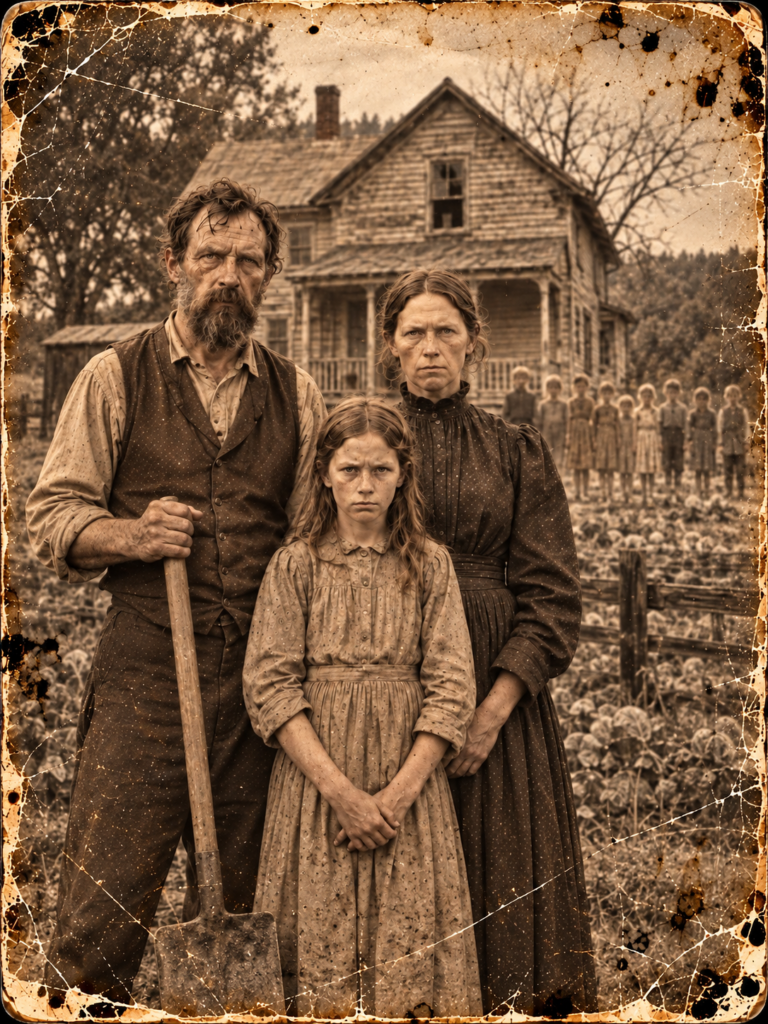
Part 1
In April 1912, Amos Hale found 11 children living in a house that had been empty for months.
He found them not in rooms, not in beds, not gathered around a kitchen table, but in a county ledger.
The volume lay open beneath the weak electric lamps of the Mercer County courthouse, its corrected entries carried forward from 1911 so that school appropriations and poor-relief payments could be calculated for the coming year. Hale had spent most of the morning comparing household rolls against supplementary school lists. It was monotonous work, the sort of work he preferred. A figure in one column had to agree with the figure beside it. A household recorded in the enumeration roll had to exist in the tax book, the school register, or the relief accounts. Every number had somewhere to go.
Before joining the county office, Hale had worked as a railway freight clerk. Freight had taught him that small discrepancies were rarely small. A misplaced digit could send a crate 200 miles in the wrong direction. A missing car number could hold up an entire train. Records did not need to be dramatic to matter. They only needed to fail to agree.
The Barlow entry failed immediately.
Ebenezer Barlow, farm holder.
Eliza Barlow, deceased.
Then 11 children.
The first was Martha Barlow, age 16 when the entry had originally been prepared. Beneath Martha appeared 10 younger names, each given an age, each marked male or female, each listed as remaining in the household.
Hale knew enough about Black Ridge to stop reading.
The Barlow farm had been vacant since the previous autumn.
Ebenezer Barlow had disappeared after a dispute involving quarry debts. Eliza Barlow had died during the influenza winter of 1910. Martha, their daughter, had gone to live with an aunt in town.
The farmhouse stood closed above an abandoned quarry road.
Yet the county roll still contained 11 children.
Hale’s first assumption was clerical error.
Rural records accumulated such errors easily. One clerk copied another. A temporary boarder was carried forward as family. A nickname became a legal name. A child who moved away remained on a school list for 2 years because no one bothered to remove him. In the worst-maintained townships, an error could survive so many revisions that no one remembered which entry had been wrong first.
The Barlow household might have begun with Martha and gathered invented siblings over time.
But the names were too orderly.
Each was distinct.
Each child had aged correctly from the previous return.
Each name appeared not merely on the household roll but on the school-age supplement.
Beside each stood the notation that the child remained at the property.
Hale pulled the earlier volume.
The names were there.
He pulled another.
There again.
The same children, moving forward through the years.
Ten separate lives progressing one year at a time in county ink.
He copied the names into his leather document case exactly as they had been written.
Then he took the Ridge Road west.
Black Ridge was not a place people visited without business.
The township had grown around stone.
Old cuts scarred the hillsides where quarry crews had worked dark rock out of the ridge in the final decades of the previous century. Some pits remained active. Others had flooded or collapsed. Service roads wandered through scrub and second-growth timber, ending abruptly where companies had abandoned them.
Farmhouses and laborers’ cottages occupied the more stable slopes.
The Barlow property stood higher than most.
A narrow lane descended from its front gate toward the village roughly 300 yards below. The house faced that lane. The mailbox, the church road, the school path, and the route used by the mail cart all converged on the same exposed strip of ground.
There was no ordinary way to approach or leave the farm unseen.
The nearest occupied house belonged to Agnes Fenn.
Mrs. Fenn was a widow in her 60s who had lived on Black Ridge long enough to remember when the quarry whistles still divided the working day. She received Hale in a warm kitchen smelling of coal smoke and boiled tea. Her window faced directly toward the Barlow lane.
Hale placed his notebook on the table.
He asked whether she remembered the Barlow children.
Mrs. Fenn stared at him.
“Child,” she said.
Hale looked down at his list.
He read Martha’s name.
Mrs. Fenn nodded.
Then he read the second name.
She shook her head.
The third.
Nothing.
By the fifth she pushed the list away.
“No second child,” she told him. “Not one that walked that road.”
Hale asked what she meant.
Mrs. Fenn turned and pointed through the kitchen window.
For years, she said, she had seen Martha Barlow descend the lane.
Martha fetched water.
Martha met the mail cart.
Martha walked to church.
When Eliza became ill, Martha carried provisions back from the village.
Sometimes she went alone.
Sometimes Ebenezer accompanied her.
No younger boy followed with a pail.
No little girl waited by the mailbox.
No group of children walked the school road.
Hale asked whether sickness might explain it.
The answer was immediate.
Not for 8 years.
He did not accept Mrs. Fenn’s testimony merely because she delivered it confidently. Memory could sharpen itself around conclusions made years later. People overlooked neighbors. Rural children sometimes remained indoors through illness or disability. Families could be secretive without being criminal.
Hale thanked her and walked the ground himself.
From Mrs. Fenn’s kitchen window the Barlow lane was clearly visible.
The slope behind the farmhouse dropped steeply toward old quarry cuts. A hidden footpath might have existed, but any child going to school, church, the well, or the village would have used the front lane unless there were a compelling reason not to.
At the Barlow farm, the contradiction deepened.
The house was weathered but ordinary.
Two stories.
A porch beginning to rot above the lane.
Boarded windows.
A rear shed partly collapsed against the rise.
There was no second cottage.
No bunkhouse.
No large barn adapted for living quarters.
Nothing suggested that 10 additional children had occupied the property.
Hale walked around the structure twice.
Behind the kitchen the ridge pressed close to the house. The pantry wall seemed almost to disappear into the dark stone itself.
He made a note.
Then he returned downhill.
His next stop was Kettering Coal Yard.
Coal deliveries, unlike memories, left receipts.
The yard clerk found a string-tied packet of old delivery stubs. The Barlow address appeared repeatedly.
Hale compared the quantities with those of neighboring farms.
The figures were not proof.
A bad chimney could waste fuel. A farm family might heat water for laundry, keep workrooms warm, or operate an additional stove.
But the Barlows had ordered much more winter coal than 3 people should reasonably have required.
The county records suggested a large household.
The neighbor saw only Martha.
The fuel account suggested more bodies were being kept warm than anyone outside the farm had seen.
Back at the courthouse Hale went first to the school returns.
The Black Ridge records were stored in the basement, tied in cotton tape and stacked beside obsolete tax duplicates. Dust came away from the covers in gray sheets.
He found the 10 names.
Every one had been excused from school.
The explanation was identical.
Chronic chest complaints.
There were no attendance days.
No partial terms.
No record that any of the children had once appeared in a classroom and then become too ill to continue.
Each year they remained at the Barlow farm.
Each year they were excused.
Each annual excuse appeared to bear a parent’s signature.
Hale laid the forms side by side.
The same stiff handwriting repeated.
The same phrase.
The same error.
Recuperating had been misspelled in precisely the same manner across years of supposedly separate medical explanations.
One teacher had changed.
The wording had not.
A child’s age advanced correctly by 1 year while the stated illness remained unchanged word for word.
It could still be fraud of an ordinary kind.
Ebenezer Barlow might have discovered that the school authority rarely inspected remote households. Perhaps the names represented boarders or laborers’ children and he preferred to keep them home. Perhaps the repeated excuses concealed illegal work.
Hale continued.
The poor-relief vouchers ended the clerical explanation.
Ebenezer Barlow had collected county maintenance payments for 8 consecutive years.
Not a single household allowance.
Ten individual payments.
One for each child.
Renewed at intervals.
Entered as custodial maintenance.
The distinction mattered.
The county did not believe it was feeding a poor family.
It believed it was paying Ebenezer Barlow to care for 10 specific minors.
A census error could be copied.
A school clerk could repeat an excuse without inspection.
But 10 separate maintenance payments had originated somewhere else.
Some office had assigned those children to Barlow.
Hale stopped treating the matter as a correction.
He sent a request to the former poor children’s board.
The board no longer existed as a separate institution. Its responsibilities had been absorbed into county administration years earlier, and its surviving papers had been scattered among several rooms near the county infirmary.
A retired physician named Dr. Silas Renwick still possessed a key to one of those rooms.
Renwick was an old man by then, narrow in the shoulders, carrying a medical satchel from habit rather than need.
When Hale told him he was investigating the Barlow household, the physician’s face changed before Hale had explained why.
“Barlow,” Renwick said.
“The quarryman?”
Hale opened the enumeration copy.
Renwick led him upstairs.
The old office smelled of paper, damp plaster, and dust. Shelves leaned beneath correspondence that had not been touched for years.
The placement ledger was found in a cabinet.
Its pages were ruled in faded violet ink.
Hale read the first Barlow entry.
Then the second.
Then all 10.
The names from the household roll were present.
But they had not been born Barlow.
Beside each name stood an original surname.
Later that surname had been crossed through.
One child had come from a Pittsburgh charitable home after both parents died.
Another had been surrendered by a mother unable to provide for him.
Two had been transferred from an overcrowded county institution.
Others had entered poor relief through illness, death, abandonment, or temporary guardianship that became permanent when no relative returned.
Their ages upon arrival ranged from 4 to 13.
Destination:
Barlow Farm, Black Ridge.
Beside each name were Dr. Renwick’s initials.
The old physician placed a finger on the page.
“Those are mine,” he said.
He remembered examining them.
Not every face.
Not after so many years.
But he remembered the process.
Children were inspected before farm placement. Their general health was recorded. Clothing was described. Shoes were assigned inventory numbers in case garments had to be transferred or replaced.
Hale stared again at the ledger.
On later county documents, the wards had gradually become Barlow children because administrative shorthand placed each minor beneath the custodian’s surname.
What looked in 1911 like an unusually large biological family was actually 1 daughter and 10 county wards.
At the far right of the placement ledger were disposition columns.
Every one was blank.
No adoption.
No release.
No transfer.
No return to an institution.
No employment placement.
No death certificate.
Nothing.
Renwick found the individual transfer cards.
Each carried an intake number.
A physical description.
Clothing.
The number fixed to the shoes worn when the child entered county custody.
If a placement ended lawfully, more paperwork should have followed.
No paperwork existed.
Ten real children had been delivered to the Barlow farm under county authority.
Their official lives ended at Black Ridge.
Hale closed the ledger.
Until that moment, the problem had concerned numbers.
Now there were 10 missing children.
He notified the sheriff.
The Barlow property was ordered preserved against salvage, sale, or demolition.
Then Hale went to speak with Martha.
Martha Barlow was 17.
She lived with an aunt in town and dressed plainly, in gray, with her dark hair cut close around her face. She had the guarded manner of someone accustomed to deciding what could safely be said before speaking at all.
Hale did not begin with the missing wards.
He asked about the house.
Her mother.
Her father.
The pantry.
Martha’s hands tightened.
She told him about rules.
Her father did not permit her to linger in the pantry after dark.
When quarry men visited the house, Eliza sometimes sent Martha upstairs early.
There were noises beneath the kitchen floor.
Martha had been told they were pipes.
Then water.
Then rats.
In winter, her father said the ridge itself cracked and shifted.
Hale asked whether she had ever heard voices.
Martha looked down.
Only then did Hale notice the cord beneath her collar.
She drew out a small brass key.
“Coughing,” she said.
“Mostly coughing.”
Bread disappeared from the kitchen in quantities she did not understand.
Her mother carried lamp oil into the pantry after midnight.
Once Martha heard a child crying.
She tried to open the pantry door.
Her father struck her.
The brass key had belonged to Eliza.
Shortly before dying, her mother had pressed it into Martha’s hand.
Never let Ebenezer have it again.
That was all Eliza said.
Martha did not know what it opened.
After her father disappeared, she left the farm and never returned.
The sheriff accompanied them back to Black Ridge.
Martha stood for several seconds in the kitchen before crossing into the pantry.
It was narrower than Hale remembered.
Shelves held broken jars, spoiled flour, and dishes furred with dust.
Against the lower wall stood a waist-high cupboard.
The brass key fit its lock.
Inside were old sacks and warped boards.
Martha stepped back.
Hale removed the sacks.
Behind them, the cupboard seemed shallower than its exterior dimensions allowed.
A false rear panel had been fitted into the shelving.
Below the lowest shelf he found a concealed wooden catch.
He raised it.
A narrow masonry panel shifted.
Cold air came through the gap.
The opening behind it was low.
Too low for a man to enter without crawling.
The sheriff caught Hale by the shoulder when he leaned toward it.
The Barlow property sat above abandoned quarry workings. An unventilated passage could contain bad air. Roof supports could have failed. Rainwater might have flooded unseen chambers.
No one was entering blindly.
Then Hale saw the slate.
It lay behind the panel against the wall.
Ten sets of initials had been written on it in chalk.
Some had been crossed over and written again.
A small sewing tin sat beside the slate.
Inside were household lists in Eliza Barlow’s handwriting.
Bread.
Lamp oil.
Onions.
Soap.
Cough mixture.
Beside several entries she had written the same word.
Below.
At the bottom of the tin lay a folded pencil sketch.
It showed the pantry.
A short stone passage.
A rectangular room identified with 2 words:
old ice.
Beyond the room a sloping passage ran toward the old quarry service road.
Hale looked again at the black opening behind the cupboard.
For the first time, the missing children had a location.
Not yet a fate.
But a location.
Part 2
The oldest quarry plans for Black Ridge were stored in property files no one had opened in years.
Hale found them on broad sheets of linen that had yellowed along the folds. Surveyors had added corrections in different inks as quarry ownership changed, shafts were expanded, and service tunnels were abandoned.
Before mechanical refrigeration became common, quarry operators had cut ice-storage chambers into sections of the ridge.
Winter ice was packed underground and preserved for summer use.
One such chamber appeared behind the Barlow property.
Its dimensions were close to the rectangle on Eliza’s sketch.
A service passage entered near the retaining wall behind what later became the farmhouse.
Another route descended toward the old quarry road.
Near its lower end the original survey showed a drainage outlet and ventilation shaft.
Hale laid Eliza’s sketch over a copy of the plan.
Her line followed the abandoned quarry route.
The hidden opening in the Barlow pantry and the old ventilation point should have connected to the same underground room.
Before Hale could organize a proper inspection, the weather opened the ridge for him.
Heavy rain struck Mercer County.
For 2 days water ran off Black Ridge in brown sheets. Soil slipped above the old quarry cut. A laborer sent to inspect washouts along the service road noticed that part of the hillside had collapsed.
Behind the slide was a dark opening.
The vent.
The sheriff brought 2 quarry laborers equipped with rope, shovels, lanterns, and the caution of men who understood unstable stone.
They began from the outside.
Hale remained beside the sheriff’s motorcar with the quarry plan spread across the hood, checking direction and approximate depth as the men removed rubble.
The shaft was partly blocked.
Its stone walls remained intact.
As loose rock was pulled free, air began moving from within.
It smelled of wet stone and old ash.
Not fresh.
But not the dead, stagnant air of a chamber sealed for decades.
Someone had maintained airflow through part of the passage far more recently than the quarry plans suggested.
Hale and the sheriff returned to the farmhouse.
Martha’s key opened the cupboard.
They removed the false shelving.
A lantern held at the hidden opening drew its flame slightly toward the quarry.
Another lantern at the lower vent responded to the same current.
The passages connected.
They chose the quarry side.
The opening was wider and safer.
A rope was fixed outside.
The sheriff went first.
Hale followed carrying the 10 placement cards wrapped in oilcloth inside his document case.
The passage sloped gently upward into the ridge.
Its walls were rough cut, nothing mysterious in their workmanship. Old quarrymen had made this place for storage and drainage.
Water moved through a shallow channel along one side.
The ceiling forced the men to bend.
The temperature fell.
About 30 feet inside, the passage widened.
The lantern illuminated the old ice chamber.
Hale stopped.
The room had been altered.
Ten iron rings had been driven into the walls.
They were spaced at regular intervals.
Below each was a narrow wooden platform.
A child could sleep on one.
An adult would have difficulty.
Several platforms had rotted through.
One retained a strip of mattress ticking.
Near another, pressed into the dust, lay a small brass button.
Nothing moved in the room.
Hale became aware of the sound of water running behind them and of the sheriff breathing through the cloth tied across his mouth.
The place did not explain itself through spectacle.
Its purpose was visible because it was so plain.
Ten rings.
Ten platforms.
Ten missing wards.
Hale opened his document case.
Near the foot of the nearest sleeping platform lay something metallic.
He crouched.
A small tag, darkened with corrosion.
A number had been stamped into it.
He compared the number with the first placement card.
They matched.
The sheriff checked another.
A second match.
Then another.
The tags had once been fixed to the children’s shoes when they entered county custody.
The same identification system that recorded them in the poor children’s board office had followed them beneath Black Ridge.
No one could now claim that the room had housed quarry workers or vagrants.
The county’s own numbers lay beside the beds.
Hale understood at last how Agnes Fenn could have watched the Barlow property for 8 years and seen only Martha.
The other children had never been permitted to use the lane.
They had not gone to school.
Had not collected mail.
Had not attended church.
Had not fetched water.
Had not stood at the gate.
They had lived beneath the pantry.
The county records had been accurate in one sense.
There really had been 11 children attached to the Barlow address.
Martha upstairs.
Ten wards below.
The lie was not in the number.
It was in what the number allowed people to imagine.
At the rear of the chamber, the drainage channel ended against a stone wall.
Hale consulted the quarry plan.
It should have continued.
The original culvert sloped downhill beyond the chamber.
Instead, someone had sealed it with fitted rock and mortar.
The sheriff refused to disturb it.
Not until the coroner arrived.
They withdrew.
The chamber was secured.
By evening the quarry entrance was guarded, and no one was allowed to cross the sleeping platforms or touch the shoe tags.
When the coroner arrived, the blocking stones were numbered before removal.
The upper courses had been placed deliberately.
Mortar remained between the joints.
Behind them, the culvert had partly collapsed.
The first remains appeared among stone and mud.
Small bones.
Then more.
The work changed immediately.
No one spoke unnecessarily.
Everything recovered was marked according to location.
Fragments of clothing.
Buttons.
Shoe tags.
Pieces of decayed leather.
Bone.
The remains were commingled.
The condition of the culvert made it impossible to determine immediately whether the children had died separately over time, whether some bodies had been placed there after death, or whether any had been alive when the lower route became impassable.
That question would never be answered completely.
Among the debris the men found a rusted biscuit tin.
It had been wrapped in oilcloth.
Inside was a letter.
The handwriting belonged to Eliza Barlow.
It had never been posted.
The paper had survived better than almost anything else because of the tin.
Eliza named Ebenezer.
She wrote that he kept the pantry entrance barred.
Several children suffered from coughs and fever.
She had been carrying provisions below secretly because Ebenezer feared county officials would remove the wards if they learned how sick they were.
If the wards were removed, the maintenance payments would stop.
The letter was neither a full confession nor a clear accusation.
It did not say when confinement began.
It did not explain why the children had been placed underground in the first instance.
It did not say whether Ebenezer intended to kill them.
It did not identify which children were alive when Eliza wrote.
Most disturbing were the final lines.
“Ebenezer has closed the lower door again,” Eliza wrote, “because the coughing had stopped.”
The sentence ended there.
No explanation followed.
The inquest opened in June 1912.
Seven of the 10 wards were identified with reasonable confidence.
Shoe tags were compared with intake cards.
Fragments of clothing corresponded to descriptions.
Buttons and small personal objects provided additional support.
Three children could not be assigned individually.
Their records existed.
Their numbers existed.
But the remains could not be separated with enough certainty to restore names to each set.
The official finding listed them as unidentified county wards recovered at Black Ridge.
The phrase was bureaucratic.
Hale hated it.
The children had entered the county system with names.
The system had transformed them into numbers.
Then, when the numbers could no longer be reliably assigned to bones, the system lost their names again.
Ebenezer Barlow was charged in absentia with unlawful confinement and neglect resulting in death.
Search notices went through Pennsylvania and into Ohio, particularly to quarry districts where workers often moved after accidents, debts, or labor disputes.
No confirmed trace of him was found.
He had disappeared the previous autumn.
Whether he knew the ridge would eventually give up its chamber could not be established.
The investigation did not end with Ebenezer.
Hale returned to the school records.
For 8 years teachers and clerks had accepted blank attendance columns beside repeated medical excuses.
No one had gone to the Barlow farm to see the children.
The poor children’s board had placed wards on isolated properties without requiring reliable quarterly inspection.
Maintenance money continued because receipts were signed.
After Eliza’s death, payments still went to Ebenezer.
No official demanded that the children appear in person.
No one asked why 10 chronically ill minors had never attended even a partial school term.
No one compared the handwriting on the medical excuses.
No one wondered why every illness lasted year after year while ages continued advancing.
Each office possessed a fragment.
The school knew the children existed but never saw them.
Poor relief paid for them but did not inspect them.
The enumeration office counted them.
The former children’s board had delivered them.
The neighbors saw only Martha but had no reason to know that 10 others were supposed to be there.
No single person possessed the entire arrangement until Hale began asking why the columns did not agree.
That failure became one of the central findings of the Black Ridge inquiry.
The Barlow case was not hidden by flawless secrecy.
It was hidden by divided responsibility.
Every office knew enough to continue its own paperwork.
No office knew enough to understand what the paperwork meant.
The county ended private ridge placements without regular inspection.
New procedures required physical confirmation of children under custodial maintenance.
Repeated school excuses were to trigger visits.
Placement records had to include clear disposition entries when a child left a household.
The reforms were practical.
They arrived after the 10 children no longer needed them.
The Barlow farmhouse was condemned.
Investigators removed the false shelving, the sliding panel, the slate of initials, Eliza’s sewing tin, and the sketch.
The ice chamber was documented.
The remains were removed under the coroner’s authority.
Then both entrances were sealed.
Above the old quarry service road, the county placed a stone marker.
It did not carry Ebenezer Barlow’s name.
It read:
County Wards Recovered 1912.
Martha attended none of the hearings.
She gave her statement once.
She identified her mother’s handwriting.
Then she returned the brass pantry key to the sheriff.
According to her aunt, Martha never again kept a pantry in her own home.
Bread remained in a covered box beside the stove, where she could see it.
That detail did not appear in the formal findings.
Hale learned it later.
He wrote it privately.
Perhaps because after months of ledgers, tags, vouchers, bones, and testimony, he had begun to understand that official records preserved facts more easily than consequences.
The courthouse corrected the enumeration roll.
A clerk drew a red line through the words:
Barlow children 11.
In the margin he wrote:
Martha Barlow, one natural child, 10 wards. Disposition discovered Black Ridge, June 1912.
The correction was precise.
It was also incomplete.
The county now knew who the 10 children had been.
It knew where they had been kept.
It knew where their remains were found.
It knew Ebenezer had received money for their maintenance.
It knew Eliza had carried food below.
What it did not know was exactly what had happened between those facts.
And the person at the center of that uncertainty was not Ebenezer.
It was Eliza.
Part 3
The easiest version of the Black Ridge case made Eliza Barlow another victim.
That version had much to support it.
She had hidden the pantry key from her husband.
She had given it to Martha before dying.
She had concealed food for the children.
She had drawn a map of the chamber and lower passage.
She had preserved the children’s initials on a slate.
She had written a letter naming Ebenezer as the man who barred the entrance.
Those were the actions of someone trying, in some limited way, to preserve evidence.
Perhaps Eliza had been afraid.
Perhaps she lived under the same authority that kept the children confined.
Perhaps illness weakened her before she could act.
Perhaps she intended the letter to reach officials and died before posting it.
It was possible.
The other interpretation was harder.
Eliza had known.
Not briefly.
Not accidentally.
She knew children were beneath the pantry.
Her household lists accounted for their bread, medicine, lamp oil, soap, and food.
She knew they coughed.
She heard them.
She carried provisions.
She possessed the key.
Her daughter remembered her entering the pantry after midnight.
The hidden chamber had existed for years.
At what point did fear become participation?
At what point did secret kindness become assistance in maintaining the confinement?
No document answered.
The letter itself complicated both interpretations.
Eliza wrote that Ebenezer kept the entrance barred.
That suggested opposition.
But she also wrote of carrying supplies below in secret rather than reporting the situation.
Perhaps she could not report it.
Perhaps every practical route to help was controlled by her husband.
Black Ridge was isolated.
Ebenezer was physically violent enough to strike Martha for approaching the pantry.
A woman dependent upon a husband in an isolated quarry household had far fewer options in 1910 than a later reader might imagine.
Still, 10 children remained underground.
The oldest placement predated Eliza’s death by years.
No single moment of coercion could explain the entire period.
Investigators searched for evidence that Eliza had attempted to contact someone.
A priest.
A doctor.
The poor children’s board.
A neighbor.
The school.
No message was found.
That did not prove none had existed.
Records disappeared.
Letters were lost.
People failed to act.
But nothing survived.
Dr. Renwick was asked whether Eliza ever raised concerns when he visited Black Ridge.
The question itself revealed another failure.
Renwick had not visited after placement.
His role ended when children left county custody for the farm.
The board considered successful transfer the conclusion of a case rather than the beginning of supervision.
He had examined the children.
He had initialed their cards.
Then others assumed responsibility.
Those others, in turn, assumed the children remained healthy because no formal complaint arrived.
The structure was almost designed to create disappearance without requiring conspiracy.
Every person completed a task.
No one followed the child.
Hale returned repeatedly to the chronology.
The first wards arrived when Martha was young.
Some were older than she was.
Others younger.
Coal purchases increased.
Maintenance payments accumulated.
School excuses began.
The family remained outwardly poor.
That mattered.
Ebenezer did not appear to have transformed the county money into visible prosperity.
There was no large bank account.
No expensive livestock.
No renovated house.
Quarry debts suggested the opposite.
The payments may simply have supported the farm.
That did not make the arrangement less criminal.
It made it more ordinary.
The children may have become income.
Bodies attached to vouchers.
Every child kept in the household produced another maintenance sum.
Sickness threatened the arrangement.
If county officers learned that several wards suffered from chronic disease, they might reclaim them.
If they came to the farm, they might discover the chamber.
So illness was concealed.
School absence became chronic chest complaint.
The same excuse was copied repeatedly because its purpose was not medical accuracy.
It was administrative quiet.
As long as the paperwork looked complete, no one climbed Black Ridge.
The underground room itself may not initially have been intended as a place of death.
That possibility emerged from the quarry plans.
The old ice chamber was cool, protected from weather, and large enough to hold multiple beds.
A poor family seeking additional sleeping space might conceivably adapt such a chamber.
But the iron rings altered that explanation.
Why install them?
Why place them at regular intervals beside sleeping platforms?
No surviving record explained whether the children had been chained routinely, restrained only during punishment, or whether the rings served some other household purpose before the room was occupied.
The coroner would not state more than the evidence allowed.
The chamber had been used to house children.
Iron rings were present.
The lower culvert had been sealed deliberately.
Children’s remains lay beyond it.
Everything after those facts involved inference.
Hale appreciated the restraint even when it frustrated him.
He had begun the case because records did not agree.
He would not finish it by forcing certainty where none existed.
The sealed culvert remained the central physical question.
Old quarry plans showed it continuing toward the ventilation route.
At some point, stone and mortar closed it.
Had Ebenezer sealed the lower exit to prevent children from escaping?
If so, when?
Had the collapse behind the masonry occurred naturally before the sealing?
Or had the passage failed later?
Did children die in the chamber and then have their remains moved into the culvert?
Did some crawl or get pushed into the lower route before the stones went in?
The evidence could not establish sequence.
The coroner refused to speculate publicly.
Eliza’s final sentence offered only the darkest possibility.
“Ebenezer has closed the lower door again because the coughing had stopped.”
Again.
The word suggested repetition.
The lower route had been opened and closed before.
Perhaps Eliza sometimes opened it.
Perhaps Ebenezer did.
Perhaps children were moved.
Perhaps the chamber’s ventilation was controlled through the lower passage and sealing it made the environment worse.
Investigators could prove none of it.
The second half of the sentence was worse.
Because the coughing had stopped.
Why would silence cause Ebenezer to close a door?
If coughing meant living children, its absence should have prompted inspection.
Unless he already knew what the silence meant.
Or unless Eliza meant something different.
The letter broke off before clarification.
It became the line newspapers quoted most often when fragments of the case reached surrounding counties.
Hale disliked that.
A sentence detached from uncertainty became a story.
Stories created villains easily.
Records did not.
Ebenezer Barlow deserved no protection from what could be established.
He had signed the maintenance vouchers.
He kept the pantry barred according to Eliza.
The children remained confined.
Their deaths occurred while they were legally in his custody.
Then he disappeared.
Those facts were enough.
But Hale resisted embellishment because embellishment had helped create the conditions of the case in the first place.
Officials had looked at the phrase Barlow children and imagined a family.
Teachers saw chronic chest complaints and imagined sick children in beds.
Relief clerks saw signed receipts and imagined food reaching wards.
The imagination filled spaces the records did not prove.
Hale had learned to distrust that comfort.
The most important truth at Black Ridge was not hidden in anything supernatural.
There was no curse in the quarry.
No legend required.
No inexplicable architecture.
The passage existed because quarrymen built it.
The chamber had stored ice.
The ventilation shaft appeared on old plans.
Everything beneath the Barlow house belonged to ordinary human history.
That made the case harder to accept.
A mythical dungeon might have belonged to another world.
The Barlow chamber existed because an abandoned industrial space happened to provide privacy.
Children disappeared into it because systems designed to protect them trusted signatures more than sight.
No extraordinary evil was necessary.
Only isolation.
Money.
Fear.
Indifference.
And time.
Agnes Fenn had lived 300 yards away.
She saw nothing because the children never reached the lane.
Schoolteachers knew their names.
They saw nothing because a signed excuse was sufficient.
County officials paid for their maintenance.
They saw nothing because vouchers were accepted without inspection.
Dr. Renwick saw them once.
He assumed others would see them afterward.
Martha heard them.
She was a child herself, trained not to ask questions and struck when she tried.
Eliza saw them.
That was the difference.
She alone among the surviving witnesses stood on both sides of the pantry wall.
The question of what she did with that knowledge followed the case long after Ebenezer disappeared.
Some investigators believed the key proved she eventually tried to stop him.
Why give it to Martha otherwise?
If Eliza supported the arrangement fully, she could have allowed Ebenezer to keep control of the entrance.
Instead she removed access from him before her death.
Perhaps she hoped Martha would discover the chamber.
Perhaps she believed the girl would carry the key to someone safer.
Yet Eliza gave no explanation Martha remembered.
Only a command.
Never let Ebenezer have it again.
Was that an attempt to protect the remaining children?
By then, were any still alive?
The chronology made the answer uncertain.
The influenza winter of 1910 took Eliza.
Ebenezer remained until autumn 1911.
The farm was abandoned before Hale opened the ledger in April 1912.
Some children had been assigned years earlier.
The condition of the remains did not allow investigators to determine exact individual death dates.
Hale searched receipts for hints.
Coal.
Food.
Medicine.
Lamp oil.
The quantities fluctuated.
There were declines.
But households changed consumption for countless reasons.
No honest calculation could turn those figures into a reliable death sequence.
He examined the slate of initials.
Some had been crossed through.
Then rewritten.
Did crossing indicate death?
Punishment?
Transfer between platforms?
Nothing on the slate explained the marks.
Again, the evidence offered shape without meaning.
The county received criticism in newspapers after the inquest.
Officials responded defensively at first.
No clerk, they argued, could personally inspect every rural household.
The old poor children’s board had operated under limited funds.
Teachers depended on parental statements because transportation across quarry townships was difficult.
All true.
None changed the result.
Ten children entered county custody.
The county placed them at Black Ridge.
For years it paid for them.
Not once did its system require a person to stand in front of each child and verify that child’s condition.
The reform enacted after the case was therefore simple.
See the child.
The language appeared almost embarrassingly obvious when written into procedure.
Custodial wards receiving county maintenance had to be physically observed at regular intervals.
School-age children absent under recurring medical exemptions had to be visited.
Placement officers could not treat an initial transfer as permanent proof of welfare.
A signature alone would no longer close the file.
Hale thought often about how little would have been required.
One inspector.
One visit.
One question to Agnes Fenn.
One teacher unwilling to copy recuperating for an eighth year.
One relief clerk asking why 10 children never appeared.
One physician wanting to examine the chronic cough.
The secrecy at Black Ridge had looked formidable only because nobody touched it.
The pantry wall was not thick.
The false shelving was crude.
The brass key existed.
The vent was on an old quarry plan.
The county had all 10 names.
The children had not vanished from the records.
They remained visible the entire time.
That fact became, for Hale, the most terrible part.
They were not forgotten.
Their names were renewed annually.
Money moved because of them.
Their ages advanced.
Their supposed illnesses were documented.
They existed perfectly on paper.
And because the paper continued to function, no one noticed that the lives behind it had stopped.
After the inquest, Hale returned once more to the Barlow farm before condemnation crews began removing unsafe sections.
The sheriff had already taken the pantry fixtures into evidence.
Without the false shelves, the hidden passage looked less secret.
It was simply a hole in a wall.
Daylight from the kitchen reached a few feet into the stone.
Hale stood where Martha must have stood as a child after hearing crying.
The house was silent.
He tried to imagine the difference between the ordinary noises of a farm and the sounds of 10 children kept beneath it.
Footsteps overhead.
Pans.
Water.
Coal being carried.
Ebenezer’s voice.
Martha moving through the kitchen.
Eliza unlocking the cupboard at night.
Below, children who had once had other surnames.
Other homes.
Other parents.
Some probably remembered those earlier lives.
The youngest perhaps did not.
The placement system had eventually given them the Barlow name in administrative shorthand.
Hale wondered whether the children themselves had begun using it.
The records could not tell him.
He went downstairs no farther than the pantry entrance.
The chamber had been emptied.
He had no reason to enter.
The evidence had already been collected.
He closed the cupboard door from habit, then stopped.
There was no reason to hide the opening anymore.
He opened it again.
That was how workers found it when they arrived.
Months later, Hale encountered Martha by chance outside a dry-goods shop.
She had changed little.
They spoke briefly.
He told her the county marker had been placed above the quarry road.
She nodded.
He almost asked whether she wanted to see it.
He did not.
Martha asked only whether the children had been named.
“Seven,” Hale said.
“And the others?”
“We know who the 10 wards were. We cannot say which remains belong to the other 3.”
Martha looked down the street.
For several seconds she said nothing.
Then she asked whether that meant they had their names or did not.
Hale had no good answer.
The distinction mattered to officials.
It did not matter to Martha.
She had lived above them.
Not known them.
Heard them.
Not seen them.
She had been the 11th child in a household she believed contained 1.
The county eventually placed the known names in its permanent file.
The marker remained general.
County Wards Recovered 1912.
No Barlow name.
No accusation.
No attempt to state what could not be proven.
Hale approved of that.
He was less certain about Eliza’s letter.
The original was filed separately because prosecutors could not determine its legal meaning.
It showed knowledge.
It implicated Ebenezer.
It suggested concealed aid.
It did not establish when Eliza began resisting her husband or whether resistance had ever gone beyond carrying food.
Years later, people who heard the Black Ridge story tended to decide what kind of woman Eliza had been.
Some called her brave.
They imagined a terrified wife secretly feeding imprisoned children, preserving evidence, hiding the key, and trying too late to undo her husband’s crimes.
Others called her complicit.
They pointed out that secret food kept the system functioning.
A person who feeds captives without freeing them may ease suffering while prolonging captivity.
They asked why Eliza never walked 300 yards to Agnes Fenn.
Why she never sent Martha with a message.
Why she never took the brass key to the sheriff while she still could.
Both versions required assumptions.
Hale preferred the uncertainty.
Not because uncertainty was kinder.
Because it was what the evidence supported.
Eliza Barlow knew children were below.
She supplied them.
She feared Ebenezer.
She hid the key from him.
She wrote a letter.
She died before anything changed.
Between those facts lay a moral distance no ledger could measure.
The case began with arithmetic.
Eleven children written beneath 1 household.
One visible.
Ten missing.
It ended with arithmetic too.
Ten ward cards.
Ten iron rings.
Ten sleeping platforms.
Ten initials.
Ten county maintenance payments renewed year after year.
Seven individual identifications.
Three names without certain remains.
One natural daughter who had grown up above the chamber.
One father who vanished.
One mother whose final intention remained unknowable.
The numbers aligned at last.
Hale had spent his working life believing that agreement between columns brought clarity.
Black Ridge taught him otherwise.
Sometimes numbers could agree perfectly and still conceal the truth.
The county had counted the Barlow household correctly.
There had been 11 children attached to that address.
That count was never the mistake.
The mistake was believing that counting a child meant knowing where the child was.
Years after the investigation, the old Barlow entry remained in the courthouse correction volume.
The original words could still be read beneath the red line.
Barlow children 11.
Beside them, the amendment:
Martha Barlow, one natural child, 10 wards. Disposition discovered Black Ridge, June 1912.
Anyone opening the book without knowing the case might have passed over it in seconds.
A clerical correction.
One phrase replaced with another.
Nothing on the page conveyed the chamber.
Nothing conveyed the 10 platforms.
Nothing conveyed the shoe tags in the dust.
Nothing conveyed Martha’s brass key.
Nothing conveyed Agnes Fenn looking from her kitchen window for 8 years and seeing 1 girl on a road where county records insisted 11 children lived.
That knowledge existed elsewhere.
In testimony.
In evidence boxes.
In the sealed quarry passage.
In a woman’s unfinished letter.
The county could correct the classification.
It could not correct the years.
The old ice chamber was never reopened for ordinary use.
Stone sealed the pantry side.
The quarry entrance was blocked again after documentation.
Vegetation gradually reclaimed the service road.
The farmhouse itself deteriorated.
People in Black Ridge learned where the marker stood, but few went looking for the old vent.
There was nothing mysterious left to find.
The children had been found.
The uncertainty belonged entirely to the living.
Why had Ebenezer done it?
Money was part of the answer.
Control perhaps another.
Neglect certainly.
But the precise progression from county placement to underground confinement had vanished with him.
Why had Eliza stayed silent?
Fear may have answered.
Dependency.
Shame.
Complicity.
Illness.
Perhaps all of them at different times.
Why had officials not noticed?
That answer was easier.
Because every form had been filled in.
That was the lesson Hale carried longest.
Systems failed not only when records disappeared.
They failed when records continued so smoothly that nobody looked behind them.
The Barlow children had not fallen through a gap in county paperwork.
Paperwork had followed them faithfully into the dark.
Each year their ages changed.
Each year an excuse appeared.
Each year money was paid.
Each year an official record quietly affirmed that the children remained in the home.
And in the most literal sense, they did.
They remained at Black Ridge.
The record had told the truth so narrowly that it became a lie.
Martha Barlow lived many years afterward.
According to the few family recollections preserved, she rarely spoke about the farm.
She married eventually.
She kept a modest kitchen.
And, as her aunt had once explained to Hale, she never built a pantry.
Bread sat near the stove.
Visible.
That choice may have meant nothing more than habit.
Or it may have been the only memorial Martha could tolerate.
A house in which food was never carried through a hidden door.
A house where bread remained above ground.
The county marker gave the children a public place.
Martha’s kitchen gave them another.
Neither answered the last question.
The question waited inside Eliza Barlow’s unfinished letter.
Did she preserve it because she had tried to save the children?
Or because she knew she had not tried soon enough?
No witness could answer.
No later confession appeared.
Ebenezer was never found.
Martha had been too young and too deliberately excluded to know.
Amos Hale refused to invent certainty merely to complete the story.
He had found the children because he trusted what the documents actually said.
He would not betray them afterward by claiming the documents said more.
So the Black Ridge record ends where evidence ends.
With a locked pantry.
A brass key.
A hidden chamber.
Ten children assigned by the county to a farm where no neighbor ever saw them.
A father who collected payment while they remained beneath the ridge.
A mother who knew they were there, carried food into the darkness, hid the key, and left behind an unfinished warning.
And one sentence stopped halfway through its meaning:
“Ebenezer has closed the lower door again because the coughing had stopped.”
Nothing followed.
No explanation.
No absolution.
No final accusation.
Only the silence that had frightened Eliza enough to write it down.

