
Part 1
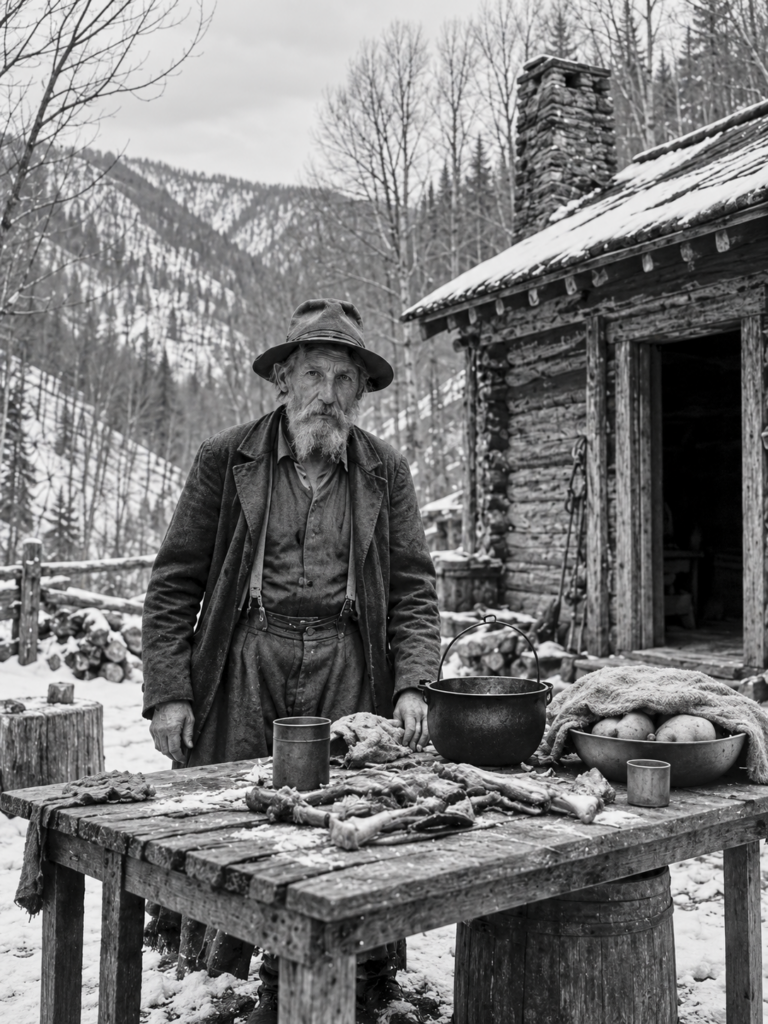
In the spring of 1849, a group of men climbed into a narrow hollow in eastern Kentucky looking for a family that had not been seen in nearly 3 years.
There had been 7 of them when they disappeared from ordinary life.
A husband and wife.
Children.
Relatives whose names have not survived consistently in the versions of the story that came later.
They had entered the mountains in 1846 with livestock, tools, seed corn, blankets, a Bible, and everything else a family believed it needed to make a permanent home beyond the last dependable road.
At first, nobody thought anything of their absence.
Mountain families could go months without appearing in town.
A creek rose.
Snow blocked a gap.
A mule died.
A harvest failed and left nothing worth carrying to market.
There were dozens of ordinary reasons for people to disappear behind the ridges for a season.
Then one winter passed.
No one came out.
A second winter followed.
Still nothing.
By the 3rd spring, even the neighbors who believed strongly in minding their own affairs had begun to wonder.
The search party followed an old creek path until the trail narrowed into laurel.
They found the cabin intact.
That was the first strange thing.
No fire had destroyed it.
No tree had crushed the roof.
The door still hung on its hinges.
Clothes remained inside.
Tools stood where tools were kept.
The table had been set.
Plates remained upon it.
Whatever had happened there had not looked, at first glance, like flight.
Then one of the men noticed what remained on the dishes.
The story becomes uncertain after that.
According to the version later passed through several families, a county coroner eventually reached the hollow.
He examined the cabin.
He entered the root cellar.
What he found there persuaded him to make a decision that would define the way similar stories were handled for generations.
He did not prepare a public report.
He did not summon deputies.
He did not bring the remains back to town for formal examination.
He burned the cabin.
Then he told anyone who asked that the family had moved west.
That was a useful answer in 1849.
Families did move west.
They left Kentucky for Missouri, Arkansas, Texas, and territories whose boundaries changed faster than county clerks could follow.
A man could vanish into the continent without requiring a crime, a body, or an explanation.
The cabin burned.
The story did not.
It remained where Appalachian stories often remained when the official record wanted nothing to do with them.
In kitchens.
On porches.
Beside winter fires.
In warnings given to children without explanation.
Do not take that trail.
Do not stop at that house.
Do not ask that family what happened during the starving winter.
The mountains carried many such instructions.
Some were superstition.
Some preserved practical knowledge.
Others came from events nobody wanted repeated closely enough to determine the difference.
The people who later told stories about the so-called flesh eaters of Appalachia used other names as well.
The changed ones.
The hollow folk.
People who went into the woods one way and returned another.
Those names made the stories sound supernatural.
The older records, when they can be found at all, suggest something less comforting.
The mountains did not need supernatural creatures.
Human beings were sufficient.
To understand the old accounts, one had to understand what deep Appalachia meant before roads, telephones, grocery stores, relief agencies, rail lines, county clinics, and automobiles.
The mountains were not merely remote.
They were structurally isolating.
A cabin visible from one ridge might stand less than 1 mile away in a straight line and still require most of a day to reach.
Between 2 families could lie a creek too swollen to cross, a wall of rhododendron, a cliff band, loose rock, deep mud, or a slope so steep a horse refused it.
During winter, those obstacles became larger.
Snow filled the gaps.
Water froze.
Then thawed.
Then rose.
Trails vanished under drifts.
Game retreated.
Families who had expected to visit one another in November sometimes did not meet again until March.
In the 18th and early 19th centuries, many settlers moving into the Appalachian interior came from Scots-Irish communities shaped by hardship long before they crossed the Atlantic.
They carried a suspicion of distant authority.
The mountains rewarded it.
A tax collector could not easily reach them.
Neither could a sheriff.
Neither could a doctor.
That independence was freedom in summer.
In winter it could become abandonment.
The first generation still traveled outward.
They traded hides, roots, herbs, timber, and livestock.
They bought salt.
Powder.
Iron.
Cloth.
The next generation traveled less.
Their children sometimes went farther into the mountains.
Then farther still.
A family might eventually live in a hollow whose only reliable human contact consisted of people sharing the same blood.
At that point, isolation stopped being a temporary condition.
It became culture.
The laws of the outside world still existed.
But law is an abstract thing when the nearest man carrying it is 3 days away and has no reason to visit.
The same could be said for church doctrine, medical knowledge, and social taboo.
They weakened with distance.
Not immediately.
Slowly.
One winter at a time.
A surviving account from 1809 was attributed to a Methodist circuit rider named Reverend James Caldwell.
He traveled through what is now Buchanan County, Virginia, serving isolated settlements that rarely saw clergy.
In late February, Caldwell followed a frozen creek into a community of perhaps 30 people.
The winter had nearly destroyed them.
His journal described adults reduced to bone and skin.
Children lay wrapped near hearths too weak to cry.
Food stores were gone.
Several houses had little firewood remaining.
Caldwell had seen hunger before.
The frontier made certain a traveling preacher would.
What disturbed him stood behind the largest cabin.
Inside the smokehouse hung meat.
He could not identify it as deer, hog, bear, sheep, or cattle.
Bones had been split for marrow.
But the scene, according to the account, did not resemble the aftermath of one frantic act committed at the edge of death.
There was order.
Cuts.
Storage.
A method.
Caldwell did not confront the settlement.
He held a service.
He prayed with those able to speak.
Then he left.
His account concluded with a sentence that survived because of its restraint.
He did not write that he had found monsters.
He wrote that he did not believe the people had committed a sin.
He believed the mountains had committed a sin upon them.
Other accounts followed the same shape.
In western North Carolina, a surveyor in 1792 reportedly encountered a family living in a cave after 3 disastrous winters.
His official report said almost nothing.
A private letter said more.
A military officer traveling through eastern Tennessee in 1814 wrote of what he called a custom of the starving time.
When food disappeared completely, the community had rules about who ate and who did not.
There was selection.
Obligation.
Precedent.
In southern West Virginia in 1837, a teacher recorded that certain winter deaths were marked differently from others.
Families would not explain why.
Graves associated with those deaths used a recognizable arrangement of stones.
Other local families understood the sign and did not disturb them.
No single account proves a widespread practice.
What made the stories difficult to dismiss within the narrative preserved around them was repetition.
The same conditions.
Extreme isolation.
Repeated hunger.
Generational continuity.
Silence.
And, most importantly, behavior that eventually seemed less like a desperate exception than a procedure inherited from the previous winter.
That distinction matters.
People have consumed human remains during starvation in many documented catastrophes.
Shipwrecks.
Sieges.
Lost expeditions.
Mountain accidents.
The act occurs at the far end of survival, where ordinary moral categories collide with the physical refusal of the body to die quietly.
Such cases are remembered as tragedies precisely because the people involved understood what had happened as an emergency.
The act belonged to the disaster.
When rescue came, the disaster ended.
Deep Appalachian isolation offered something different.
For some communities, there was no rescue event.
The winter ended.
Then another winter arrived.
A family crossed the line once.
Years later, the same conditions returned.
The knowledge from the first event remained.
The second crossing became easier because it was no longer unimaginable.
Children who survived grew older.
They had children.
They did not inherit only land and names.
They inherited instructions.
How to preserve corn.
How to trap.
How to find a spring beneath ice.
How to treat fever.
What to do when snow closed the gap and the food ran out.
Practical knowledge rarely arrives with an essay explaining its moral origin.
A child learns because an elder demonstrates.
After enough generations, the explanation becomes simple.
This is what our family does.
That is how a crisis becomes precedent.
Precedent becomes custom.
Custom becomes tradition.
And tradition, given enough time, becomes identity.
The outside world later called such families flesh eaters.
That name implied appetite.
The older accounts pointed more often toward arithmetic.
A bad winter reduces human survival to numbers.
A household burns calories simply remaining warm.
Wood must be cut.
Water carried.
Animals fed.
Shelter repaired.
A family that stored enough corn, beans, dried meat, and salt pork for an ordinary season could discover by January that the season was not ordinary.
By February there might be nothing.
Game could vanish.
Deer moved.
Traps remained empty.
Children cried less as they weakened.
The oldest family member stopped rising from bed.
Then came the first death.
The ground outside might be frozen too hard for burial.
Within the house remained the living.
The transcript from which these stories descend makes the central argument brutally simple.
The first generation did not need to think of itself as evil.
It needed only to decide that wasting what remained of a dead family member while living children starved made less sense than using it.
The first decision broke the taboo.
The next generation inherited knowledge of the broken line.
That was the transformation.
Not a curse descending from the trees.
Not some ancient creature entering the house.
A moral boundary eroded by repetition until the descendants no longer remembered why the boundary had existed.
One historical case became repeatedly associated with this discussion, though it came from far north of the Kentucky and West Virginia hollows.
In 1879, a Cree man known as Swift Runner emerged from the winter alone.
He had entered it with a family.
A wife.
Children.
Other close relatives.
By spring, they were gone.
His initial explanation did not satisfy the people who heard it.
He appeared too well nourished.
A search party traveled to the camp.
The evidence there showed that the family had died violently and that Swift Runner had consumed their remains over an extended period.
The Cree people who examined what had happened did not reduce the matter to simple starvation.
They used the concept of the Wendigo.
To outsiders, that word was often flattened into monster or spirit.
Within the stories surrounding the case, it described something more complicated.
Hunger without satisfaction.
A person altered by crossing a forbidden boundary.
An appetite that became moral and psychological rather than merely physical.
The horror lay not only in consumption but in transformation.
Swift Runner was executed in December 1879.
The legal system dealt with the crime as an act committed by a man.
The cultural explanation surrounding him treated it as something that could spread.
Not necessarily like a disease of the blood.
Like permission.
One person crosses a line.
The next person sees that survival continues afterward.
The impossible becomes possible.
In that sense, the old Wendigo fear and the Appalachian accounts touched at one disturbing point.
A taboo can be transmitted in reverse.
Parents normally teach children what must never be done.
But parents can also teach, through survival, what can be done.
A mother who feeds a starving child something forbidden has not merely kept the child alive.
She has altered what that child knows about the world.
The child now knows the act is survivable.
Knows the family has done it.
Knows the dead can be treated in a way other families would consider unthinkable.
If no outside community ever arrives to challenge that knowledge, then the family becomes its own moral universe.
The hollow becomes the world.
And within that world, the difference between horror and duty can disappear.
Part 2
By the beginning of the 20th century, Appalachia was changing.
Not evenly.
That was important.
Rail lines reached coal towns.
Timber companies drove roads into previously inaccessible country.
Schools appeared.
Churches became connected to larger denominations.
Men who had rarely left their home ridges began working underground beside strangers from other counties, other states, sometimes other countries.
Children carried lessons home.
Mail arrived more regularly.
The world entered the mountains.
But the deepest hollows changed last.
For decades, 2 Appalachian realities existed beside one another.
In one, a family could ride a train, buy canned food, attend school, read a newspaper, and speak with a sheriff.
In the other, people still lived according to systems shaped before the Civil War.
Sometimes the 2 worlds sat only a few ridges apart.
One of the stories associated with that transitional period came from Greenbrier County, West Virginia.
The county already occupied a strange place in American folklore because of the 1897 death of Zona Heaster Shue, whose mother claimed her daughter had appeared after death and accused her husband of murder.
The more obscure account came 4 years later.
In 1901, a county surveyor entered a remote area to establish property lines.
He encountered a homestead that, according to the account, had not been visited officially in roughly 20 years.
An elderly couple lived there with adult children and grandchildren.
The surveyor expected poverty.
He found something else.
The garden was productive.
Livestock appeared healthy.
Buildings were maintained.
The family itself seemed unusually well for people living so far from supply roads.
Behind the house stood a cemetery.
The surveyor counted more graves than the family history seemed to require.
He asked.
Relatives, they told him.
People who had died during old winters.
He noted the explanation.
Then he left.
A year later, his work took him through the same property.
The cemetery had changed.
2 graves he distinctly remembered were gone.
Not empty.
Gone.
The stones had been removed.
The earth where the graves had been was disturbed and carefully smoothed.
The surveyor asked again.
This time the family became hostile.
They ordered him off the land.
He reported the incident to the sheriff.
The sheriff declined to investigate.
That response is easy to read as laziness from a distance.
The surviving story interprets it differently.
A rural sheriff understood his county not merely as a jurisdiction but as a web of blood, resentment, isolation, and practical limits.
He knew which roads became impossible after rain.
He knew which families would speak to deputies.
He knew which families possessed rifles and remembered grievances from before he was born.
He also knew a jury would be selected from the same population.
An investigation was not an abstract principle.
It meant sending known men into a known hollow to accuse people whose cousins might sit on the eventual jury.
So he told the surveyor to let it go.
People in that part of the county handled their own affairs.
Leave them alone.
Versions of the same advice appeared repeatedly in mountain law enforcement.
Leave the mountain alone and the mountain will leave you alone.
It was not justice.
It was management.
The practical result was silence.
Whatever occurred beyond the ridge remained beyond the ridge.
The same system that allowed isolated communities to develop their own rules also encouraged authorities to avoid confronting them once those rules came into conflict with the outside world.
Fear played a role.
So did cost.
A sheriff with 4 deputies could spend days attempting to reach a single household.
A prosecutor could invest months in a case whose witnesses refused to testify.
Local officials were sometimes related by marriage or blood to the people being investigated.
Even without direct complicity, everyone understood the price of opening a door nobody knew how to close.
By the 1930s, the federal government began documenting Appalachian life on a scale previously impossible.
The Works Progress Administration sent interviewers into rural communities during the Great Depression.
They collected songs.
Recipes.
Folktales.
Work histories.
Religious customs.
Family stories.
Much of what they preserved became invaluable to understanding Appalachian culture.
Among those interviews, according to the source narrative, were a smaller number that unsettled the people recording them.
One reportedly came from Mingo County, West Virginia, in 1938.
The interviewer spoke with an elderly woman about winter death customs.
She described something she called the rendering.
The term was not spoken as a secret confession.
That was what troubled the interviewer.
According to the woman, when a family member died during winter, burial was sometimes delayed.
Certain parts of the remains were preserved.
Later they were consumed by surviving relatives.
She described the act as a means of retaining the dead person’s strength within the family.
There was no theatrical horror in her explanation.
No visible shame.
No attempt to shock.
She spoke in the same manner another person might use to explain how her mother cured ham or baked bread.
The interviewer asked whether she understood that the wider society regarded such behavior as illegal and morally unacceptable.
The woman reportedly answered that the wider society had never done anything for her family.
It therefore possessed no authority to tell them how to honor their dead.
The interview was flagged.
It did not appear in the ordinary published folklore material.
The pattern, at least as represented in the transcript, appeared elsewhere.
Eastern Kentucky.
Southwestern Virginia.
Mountain communities in northern Georgia.
The number of accounts was small compared with the enormous quantity of ordinary WPA material.
But the details were similar.
Winter.
Family.
Death.
Preservation.
Consumption.
An inherited interpretation that transformed the act from emergency into continuity.
That last element separated what the interviews described from familiar stories of survival cannibalism.
The Donner Party did not establish a hereditary custom.
The survivors of disasters did not return home and create ceremonies around what they had been forced to do.
Here, the claim was different.
Some Appalachian communities had transformed necessity into meaning.
That transformation helped explain why the old practice could continue after hunger itself became less severe.
A custom born from starvation might have disappeared once food became available.
A religious act would not disappear so easily.
Several stories described the rendering not as eating for nourishment but as refusing to abandon the dead.
Strength returned to the household.
The dead remained physically within the family.
Burial in frozen earth was not considered the only respectful possibility.
An outsider saw desecration.
The family saw continuity.
That moral inversion made the practice harder to eradicate because ending it could feel, within the family, like betraying ancestors.
Imagine 4 generations surviving brutal winters through an act they came to consider sacred.
Then a road arrives.
A school opens.
A preacher comes from another county.
A child learns that the family’s sacred practice is regarded outside the hollow as one of humanity’s greatest taboos.
The resulting shock did not necessarily create guilt.
It created division.
One WPA account described a woman who said she first understood her family was different at around 12 years old.
She attended a church gathering.
Food covered the tables.
Neighbors spoke openly about what they cooked at home.
For the first time, she understood that meals she associated with winter were not shared by other families.
The realization did not produce immediate horror.
It produced disorientation.
The world became larger in an instant.
Her family had taught her one meaning.
The world beyond the hollow supplied another.
From then on she understood that part of her life could never be described outside the household.
This was the beginning of the double life.
Children attended public schools but remained silent about winter customs.
Men worked beside outsiders in coal mines.
Women married into families unfamiliar with the old practices.
People moved away.
Some rejected what they had been taught.
Others protected it.
For families willing to abandon the old ways, modern access offered an escape.
Food could be bought.
Doctors reached the sick.
Bodies could be transported.
Frozen ground no longer determined burial.
The original practical conditions disappeared.
In those families, the old practices became memories.
Then uncomfortable stories.
Then something nobody mentioned.
Other households reacted differently.
The arrival of outsiders felt less like rescue than judgment.
Roads did not merely bring food.
They brought census workers.
Police.
Teachers.
Health inspectors.
People asking questions.
A family that had defined itself for generations through independence could interpret every connection as surveillance.
Some withdrew.
They moved deeper where possible.
Stopped answering questions.
Stopped welcoming visitors.
The more the outside world attempted to understand them, the more carefully they guarded what happened at home.
That tension appears repeatedly in later stories.
In 1952, according to one account, a logging crew working in remote McDowell County, West Virginia, found an apparently abandoned cabin.
It had been occupied recently.
Enough bedding and household material remained to suggest perhaps 4 or 5 people.
Behind the house stood a smokehouse.
Inside were remains later identified by a county coroner as human.
The report reportedly noted signs consistent with butchering for food preparation.
No suspect was identified.
No major public case followed.
The matter disappeared.
In 1967, a hiker in eastern Kentucky reported a camp deep in what became associated with Daniel Boone National Forest.
He described a drying rack containing strips of meat with an appearance and odor he considered unusual.
He left.
A ranger later returned to the location.
The site had been cleared.
Whatever had hung from the rack was gone.
Nothing further came from the report.
In 1983, a social worker conducting welfare checks in Harlan County entered a household and later described the conditions in language so vague that the vagueness became the most striking part.
Beyond anything I have been trained to address.
The report was sealed.
Researchers later attempting to obtain the file were reportedly told it had been lost.
Again and again, certainty disappeared at the point where institutional action should have begun.
A discovery.
A report.
Then silence.
Not always because the story was true.
Records disappear for ordinary reasons.
Witnesses misinterpret what they see.
Rumor attaches itself to ambiguous documents.
But within the narrative preserved in these accounts, institutional avoidance became almost as important as the alleged practice itself.
The mountains did not merely conceal.
People helped them.
A state trooper named Harold Fulton entered this pattern in 1923.
He was assigned to a remote section of Wyoming County, West Virginia.
A neighboring family reported that a nearby homestead had shown no activity for several weeks.
Fulton went to investigate.
He found an elderly woman living alone.
According to neighbors, at least 6 people had previously occupied the property.
The woman told the trooper the others had gone to find work in coal camps.
Fulton found the explanation suspicious.
He examined the outbuildings.
In the smokehouse was meat he could not identify.
That was where his investigation effectively ended.
Fulton later wrote to his commanding officer.
He did not request assistance.
He requested reassignment.
The surviving version of his letter described a man who had reached the limit of what duty could compel him to pursue.
He had seen something he did not wish to see again.
He did not believe further investigation would produce any result his department wanted.
The request was granted.
No formal case began.
Without an opened case, there was nothing to close.
Institutionally, the event disappeared.
In eastern Kentucky in 1931, a deputy described practices in a remote Pike County household as inconsistent with civilized behavior.
He recommended investigation.
The recommendation was logged.
No action followed.
In southwestern Virginia in 1944, a health inspector reported apparent storage and consumption of material of human origin.
The county forwarded the document to the state.
The response advised discretion concerning the cultural practices of isolated communities.
Exercise discretion.
The phrase captured the institutional solution.
Do not say nothing happened.
Simply decline to force a conclusion.
The outside world was slowly entering Appalachia, but in some places its officials still behaved like visitors who knew the road behind them was long.
Then came the stories from even later decades.
In 1971, hikers in Cherokee National Forest reportedly found a strange structure.
A stone platform.
Metal hooks fixed to timber.
A drainage channel cut into stone.
They photographed it and reported the location.
Forest Service personnel returned later.
The structure had been dismantled.
The site had been cleaned.
No conclusion followed.
In 1989, a retired coal miner from Mingo County contacted a university folklorist.
He claimed that during his childhood in the 1930s and 1940s, his family had practiced what he called the old way.
Recently deceased family members were consumed in winter.
He said the custom ended when a road reached their community in the late 1940s.
The professor asked why a road mattered.
The answer was practical.
Once the road existed, a funeral home could come.
Once the dead left the household, private access to the body ended.
That explanation stripped the story of supernatural imagery.
No creature.
No curse.
No secret appetite drawing strangers into the woods.
Infrastructure ended the practice.
The road changed what was possible.
The road did what sermons and laws had failed to do.
It connected the hollow to witnesses.
The interview was reportedly never published in full.
The professor feared that identifying details would expose communities already burdened by generations of stereotypes.
That concern reveals the central difficulty of every story about the supposed flesh eaters of Appalachia.
The region has long been caricatured.
Poor.
Backward.
Violent.
Ignorant.
Uncivilized.
Outsiders have repeatedly transformed real deprivation into entertainment.
Any claim about cannibalistic mountain families risks becoming another weapon against millions of people who had nothing to do with such practices and whose actual history is infinitely larger than the darkest stories told about it.
That problem encouraged silence too.
Researchers might discover something disturbing and hesitate to publish because the truth about 1 isolated household could become a lie about an entire region.
So documents remained unpublished.
Names were removed.
Interviews stayed in archives.
Local families refused researchers.
Officials used careful language.
The result was a historical fog in which proof, rumor, folklore, and institutional fear became increasingly difficult to separate.
And somewhere inside that fog sat the original question.
When starvation ended, did the practice end with it?
For some families, almost certainly within the logic of the transcript, yes.
For others, the stories say no.
Because by then it was no longer about hunger.
It was about who they were.
Part 3
The legend prefers monsters.
Monsters are easier.
A monster lives outside humanity.
It has features that separate it from us.
Claws.
Teeth.
A curse.
A hunger no ordinary person shares.
Once identified, the monster can be hunted, banished, killed, or avoided.
The old Appalachian flesh-eater stories refuse that comfort.
In their darkest form, they are not stories about predators hunting strangers.
The families did not wait beside trails for travelers.
They did not raid towns.
They did not become a hidden tribe stalking the forest.
They consumed their own.
That distinction changes everything.
The dead person was not prey.
It was a mother.
A husband.
A child.
A grandmother.
Someone loved.
That is why the language of the rendering mattered.
If people had merely killed strangers for food, the outside world possessed categories for them.
Murderers.
Bandits.
Criminals.
But a family preserving and consuming the remains of its own dead according to an inherited winter ritual occupies a more difficult moral space.
The act is horrifying to the surrounding culture.
Within the household, it can be imagined as love.
Continuation.
Duty.
The grandmother had done it.
Her grandmother had taught her.
The person who died expected the family to follow the same practice.
The living did not necessarily believe they were violating the dead.
They believed they were refusing waste.
Refusing separation.
Keeping something of the person within the people who remained.
That interpretation did not make the act acceptable to the outside world.
It made the people performing it harder to understand.
The old narrative connects this to the concept of Wendigo not as a literal creature but as a transformation of relationships.
The first desperate act changes what the family understands to be possible.
The second generation receives that possibility without the original shock.
The 3rd generation receives it as knowledge.
Eventually it no longer needs starvation to justify itself.
Tradition supplies its own justification.
Religion may enter.
Family loyalty may enter.
The act can acquire a calendar.
Rules.
Preparation.
Words.
At that point the original emergency has disappeared, yet the response remains.
That is how human practices survive long after the conditions that created them.
The same pattern can be seen in customs far less disturbing.
A household continues cooking a certain meal after the ingredient that once made it necessary becomes obsolete.
A community maintains a festival whose original purpose nobody remembers.
A family repeats phrases belonging to ancestors whose circumstances vanished generations earlier.
Tradition separates behavior from cause.
The flesh-eater story asks what happens when the inherited behavior is not harmless.
What happens when the practice created by starvation outlives starvation?
The answer given by the transcript is not dramatic.
It hides.
Once roads and schools arrive, the family learns the outside world’s judgment.
Secrecy increases.
The practice shifts from communal necessity to private observance.
Instead of disappearing, it becomes invisible.
Whether that ever occurred as widely as the stories claim is another question.
Even the source ultimately admits an important limit.
There is no confirmed modern case establishing that ritualized consumption continues in Appalachian households today.
The last primary accounts in the narrative come from older interview material.
Everything after that becomes circumstantial.
Suspicious remains.
Sealed reports.
Stories about remote households.
Oral tradition.
Files allegedly misplaced.
The uncertainty matters.
It prevents the story from honestly becoming an accusation against living Appalachian families.
Yet uncertainty also functions perfectly within the folklore.
A confirmed ending would close the story.
A missing ending allows the hollow to remain dark.
The families who are asked about old customs supposedly respond in a familiar way.
They do not confirm.
They do not deny.
The mountain has its ways.
People from outside have no business asking.
That response may signify nothing more than fatigue with outsiders.
A community mocked and exploited for generations develops good reasons to distrust researchers.
Silence does not prove guilt.
But in the architecture of the old stories, silence is always interpreted as another locked door.
The institutions surrounding Appalachia participated in their own silence.
Churches failed to reach every hollow.
Schools arrived unevenly.
Law enforcement knew that its authority weakened with every mile beyond the road.
Governments encouraged settlement in places they later neglected.
Companies entered when timber and coal became valuable but often cared little about the people already living there.
Then, when troubling practices were allegedly discovered, the same institutions found reasons not to examine them too closely.
The church could claim ignorance.
The sheriff could call it a family matter.
The state could advise discretion.
The researcher could protect confidentiality.
The university could leave an interview unpublished.
The newspaper could decide the story was impossible to verify.
Every individual decision might be defensible.
Together they formed what the narrative describes as a covenant of silence.
No single participant created it.
That was why it lasted.
The mountain family kept quiet because exposure threatened the family.
The sheriff kept quiet because an investigation threatened order.
The researcher kept quiet because publication threatened innocent communities.
The state kept quiet because acknowledgment threatened institutional credibility.
Everyone had a reason.
Silence accumulated.
And accumulated silence begins to resemble absence.
That is how stories disappear from official history while remaining vividly alive in local memory.
The 1846 family becomes an example.
If the coroner truly burned the cabin, his action destroyed the evidence that might have transformed rumor into record.
If he believed he was protecting the county from scandal, his practical decision created a legend far more durable than a court case would have been.
People filled the missing report with narrative.
The table remained set.
The root cellar contained what should not have been there.
The cabin burned.
The county said the family went west.
Each detail survived because no authoritative version replaced it.
That is one of the strange laws of secrecy.
Destroying evidence does not always destroy a story.
Sometimes it protects the story from contradiction.
The same is true of the allegedly sealed welfare report in Harlan County.
The missing investigation in McDowell County.
The WPA transcript omitted from publication.
Fulton’s request for reassignment.
The health inspector advised to exercise discretion.
Every gap becomes part of the mythology.
Yet beneath the mythology remains a historical truth larger than whether any individual account is accurate.
Appalachian communities did experience extraordinary isolation.
Families did endure severe hunger.
Authorities did neglect remote populations.
Roads and modern infrastructure transformed mountain life.
The region was repeatedly treated as economically useful land inhabited by politically disposable people.
Timber could be extracted.
Coal could be extracted.
Human suffering was easier to leave behind.
That abandonment is the soil in which darker stories became believable.
A society that refuses to enter a hollow cannot later be certain what happened there.
A government that does not send a doctor, teacher, or relief supplies should be cautious when judging the moral universe people constructed in its absence.
That was the meaning behind Caldwell’s line.
The mountains had committed a sin upon them.
The phrase shifts responsibility without removing agency.
It asks what happens when geography, hunger, neglect, and isolation compress human choice until every option is terrible.
The flesh-eater legend answers in the darkest possible way.
People survive.
Then their children inherit the method.
That is more disturbing than a supernatural curse because no supernatural force is necessary.
The source returns repeatedly to a kind of silence found deep in Appalachian hollows.
Old people distinguish quiet from silence.
Quiet is empty.
Silence contains attention.
A harmless hollow may be still because nothing is happening.
Another place feels silent because something happened there and nobody speaks of it.
The distinction belongs to folklore, but it captures something real about memory.
Land acquires meaning through stories.
A ruined foundation is merely stone until someone tells you who died there.
A root cellar is only a hole in the ground until someone refuses to open it.
A cemetery is ordinary until 2 graves disappear.
After that, a visitor does not experience only geography.
He experiences what he has been told.
The mountains become an archive.
Not an accurate archive.
A human one.
Fragmented.
Exaggerated.
Selective.
Full of missing pages.
The people who grew up inside those stories sometimes carried them even after leaving.
A family moved to Cincinnati.
Detroit.
Baltimore.
Lexington.
Louisville.
The old hollow passed to someone else.
Children grew up with electricity and schools.
Grandchildren knew supermarkets instead of winter storage.
But some habits remained.
A grandmother became unusually attentive when snow was forecast.
Someone refused to discuss a particular relative’s death.
A family recipe was never written down.
Certain winter words were not explained to children.
Perhaps those details meant nothing.
Perhaps memory had been converted into behavior long after the original explanation vanished.
Trauma works that way.
So does culture.
Not all inheritance is conscious.
This is one reason the transcript ultimately describes the flesh eaters not as a tribe or cult but as families.
There was no central organization.
No leader.
No doctrine shared across the mountain chain.
The idea was instead that similar conditions created similar responses in communities separated from one another.
That claim makes the story simultaneously more plausible in mechanism and less provable in detail.
No conspiracy is required.
Only repetition.
Another severe winter.
Another isolated family.
Another death.
Another decision.
If repeated enough times, the same behavior could appear in multiple places without those communities ever meeting.
But the same logic requires caution.
Similar stories can also spread culturally without the underlying events being true.
One circuit rider’s journal becomes a local tale.
A local tale attaches itself to another county.
A mysterious graveyard receives an explanation borrowed from elsewhere.
A sealed file becomes evidence because nobody can read it.
Folklore too reproduces under isolation.
The source rarely resolves that tension.
Instead, it lives within it.
That ambiguity should remain.
Because the true horror of the story is not dependent on proving that hidden flesh-eating families still exist.
The unsettling part is the mechanism the legend describes.
Civilization feels permanent while its supporting structures remain invisible.
A child opens a refrigerator and finds food.
A body dies and professionals arrive.
The law can be called.
A road connects the house to other people.
A doctor can reach the sick.
A school exposes children to norms beyond the family.
A church, courthouse, hospital, funeral home, grocery store, newspaper, telephone line, and neighbor are all pieces of a system.
Remove enough pieces and life changes.
Remove them for 1 week and people improvise.
Remove them for 1 year and people adapt.
Remove them for generations and adaptation becomes culture.
That is the mirror at the center of the flesh-eater legend.
It asks not whether Appalachian families were uniquely capable of terrible acts.
It asks whether they were unique at all.
The answer given by the story is no.
They were ordinary human beings placed under extraordinary conditions for extraordinary lengths of time.
That conclusion refuses the comfort of regional prejudice.
If the story is about backward mountain people, everyone outside the mountains is safe.
If the story is about humans, nobody is.
The narrator of the old account returns finally to roads.
Modern Appalachia contains highways, hospitals, universities, tourism, fiber-optic lines, national parks, factories, towns, and suburbs.
Most of the total isolation described by frontier accounts no longer exists.
A family can call for help from places where a horse once needed a day to reach the nearest settlement.
Winter remains dangerous, but starvation does not operate in the same manner.
The old conditions have largely broken.
That should mean the old practices ended with them.
Perhaps they did.
The transcript itself eventually calls any claim of modern continuation speculation.
There is no confirmed case in its record establishing an unbroken ritual tradition into the present day.
That limitation is essential.
Without it, history turns into accusation.
But the stories continue.
People still warn about certain hollows.
Old family names still produce pauses.
Researchers still encounter subjects that local residents would rather not discuss.
Some of this is almost certainly ordinary mountain privacy.
Some may be the long shadow of genuine deprivation.
Some is folklore doing what folklore always does: transforming trauma into narrative.
And perhaps somewhere inside it remains a fragment of something that happened.
A winter nobody survived cleanly.
A family that made one choice.
Children who remembered.
Then grandchildren who no longer remembered the choice, only the rule.
That is how the tale reaches back toward the vanished cabin of 1846.
A search party enters after years of silence.
The table is still there.
Clothes remain.
Something in the cellar cannot be reconciled with ordinary life.
A public official arrives.
He faces a decision.
Bring the truth down from the mountain.
Or destroy what he has seen.
He chooses fire.
Whether that first story occurred exactly as remembered matters less to the legend than the choice.
The official thinks he is ending it.
Instead he establishes the pattern.
Find.
Understand enough to be afraid.
Look away.
The mountain keeps the rest.
More than 170 years later, that pattern is the real protagonist of the story.
Not hunger.
Not flesh.
Silence.
A silence maintained for different reasons by different people.
Shame.
Fear.
Mercy.
Prejudice.
Loyalty.
Institutional convenience.
Academic caution.
Family protection.
Each generation adds another layer.
Eventually the silence becomes older than anyone who knows what first created it.
Then the road ends.
There is a chain between 2 posts.
Beyond it, a track climbs into trees.
GPS loses confidence.
Cell service disappears.
The canopy closes overhead.
The world outside remains only a few miles away, but distance in the mountains has never been measured honestly by miles.
A visitor can stop there.
He can look up the road and imagine the people who once lived beyond such places without doctors, stores, funeral homes, schools, or certainty that anyone would come if winter became impossible.
He can imagine hunger.
He can imagine what desperation does.
What he should not do is imagine himself morally superior too quickly.
That is the warning carried beneath the sensational name.
The flesh eaters were easier to understand when called monsters.
The legend made them something other.
The deeper story makes them relatives.
Human beings.
People who loved their children.
Buried their parents.
Feared winter.
Remembered what their grandparents taught them.
Made decisions.
Survived those decisions.
Then taught survival to the next generation without preserving the horror of the first choice.
That is how the impossible becomes ordinary.
Not all at once.
Quietly.
A little easier the 2nd time.
Easier again the 3rd.
Eventually nobody remembers there was ever another way.
If such practices survived into modern times, the transcript cannot prove it.
Perhaps no one alive follows anything resembling the rendering.
Perhaps the last person who knew the old way died decades ago.
Perhaps every modern rumor is only the afterimage of poverty and prejudice.
That may be the correct answer.
Yet the old stories remain compelling because they describe a danger that did not vanish with the custom.
Human beings normalize what surrounds them.
We inherit assumptions before we learn to question them.
Civilization is partly the process by which different households are forced to compare their rules.
Roads matter.
Schools matter.
Neighbors matter.
Courts matter.
Witnesses matter.
Connection matters.
They create the mirror in which a family sees that its private normal may not be normal elsewhere.
The deepest hollows once lacked that mirror.
They contained only the family.
Only winter.
Only precedent.
Only the mountain.
That is what the story ultimately means when it calls the flesh eaters a mirror.
The reflection is not Appalachia.
It is humanity under pressure.
Strip away food.
Strip away communication.
Strip away institutions.
Strip away the expectation that another person will ever arrive and ask what happened.
Then wait.
Not 3 days.
Not a month.
Generations.
The question becomes less comfortable the longer one considers it.
What would remain of the rules we consider permanent?
Which would survive?
Which would bend?
Which would be replaced by something our descendants accepted without ever knowing we once found it unthinkable?
The legend answers with firelight in a winter cabin.
A family at a table.
The dead not entirely gone.
The living refusing to waste what the mountain has already taken.
Outside, snow closes the trail.
No sheriff is coming.
No minister.
No doctor.
No neighbor.
There is only the household.
And whatever decision is made inside will become part of what the children understand about survival.
Years pass.
The road opens again.
Spring comes.
Then summer.
The children grow.
Another winter arrives.
The knowledge remains.
By the time the outside world finally reaches the hollow, perhaps with a surveyor, a teacher, a trooper, a welfare worker, or a logging crew, it is too late to ask when necessity became tradition.
Nobody remembers.
That is the line the story never finds.
The first family had a choice.
The next generation had precedent.
The next had custom.
Eventually someone inherited identity.
And identity is much harder to surrender than hunger.
The mountains themselves are indifferent to all of it.
That may be the final cruelty.
They do not create morality.
They do not punish.
They do not forgive.
Ridges rise.
Creeks run.
Snow falls.
Laurel closes old paths.
Cabins rot.
Cemeteries sink into leaves.
The forest takes the physical evidence eventually.
Wood collapses.
Iron rusts.
Bones return to soil.
Only stories resist.
Drive far enough into Appalachia and there are still roads that narrow from pavement to gravel, gravel to dirt, dirt to 2 tracks under trees.
There comes a point where turning around feels sensible even when nothing has happened.
No figure appears.
No voice calls.
No threat is made.
There is only the sensation that the connected world is behind you and another kind of country begins ahead.
In the old telling, that is where a wise traveler stops.
Not because a hidden family is waiting.
Not because some flesh-eating creature moves through the trees.
Because curiosity does not create a right to enter every private place.
And because every mountain has histories strangers do not understand.
The source ends with silence.
Not a scream.
Not a revelation.
A car stopped where pavement gives way to gravel.
Trees closing over the road.
A driver listening.
Nothing.
Yet not an empty nothing.
A weighted silence.
The kind that makes a person think of everything a landscape has seen and everything people have chosen not to record.
If he is wise, he reverses.
The car backs slowly toward pavement.
Cell service returns.
Houses appear.
Then stores.
Traffic.
Cemeteries with names, dates, flowers, and bodies buried according to rules shared openly by the community.
The ordinary world.
Behind him remain the hollows.
Perhaps empty of everything except deer, old foundations, and stories.
Perhaps not.
The distinction matters less than what the stories carried out.
Civilization is not a permanent human condition.
It is an arrangement.
Roads.
Food.
Law.
Witnesses.
Memory.
Contact.
Remove enough of those things for long enough and the human animal does not disappear.
It adapts.
That is why the legend of the flesh eaters is less frightening when treated as a tale about monsters.
Monsters excuse us.
Human beings do not.
The mountains are not the mirror.
The families are not the mirror.
The mirror is the question left behind.
How much of what we call morality survives because we are good?
And how much survives because the road is still open?
The old Appalachian story never answers.
It only leaves the fire burning in the cabin while snow closes the hollow.
Outside, the mountains wait.
Inside, a family survives.
And somewhere between survival and memory, a line disappears.
By the time anyone comes looking for it, nobody remembers where it used to be.

