
Part 1
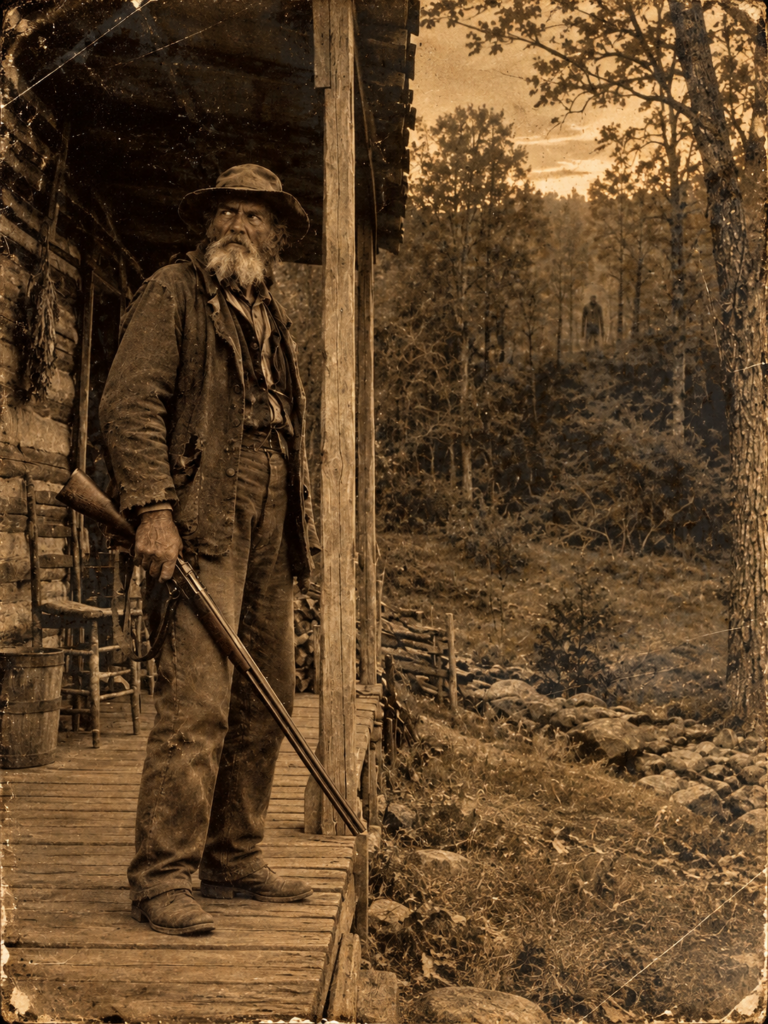
Harlon Messer had not slept with his back to a window in 47 years.
At 81, he lived outside Calico Rock, Arkansas, in a small house above a gravel road where the nearest tree line began close enough to the porch that a man sitting with his coffee could study the timber without getting out of his chair.
Harlon did that often.
Visitors noticed it before they noticed anything else.
He could hold a conversation, refill a cup, complain about rain or the price of feed, and still part of his attention remained fixed on the woods.
He had hunted the Ozarks since he was 9.
Whitetail.
Turkey.
Black bear.
Wild hogs.
He had slept beneath bluffs, crossed flooded creeks in the dark, followed wounded animals through cedar thickets, and spent more nights under those trees than most people would spend outdoors in an entire lifetime.
He knew the woods well enough that ordinary danger no longer interested him much.
Ask about bears and he would shrug.
Ask about copperheads and he would tell you where to put your feet.
Ask how to survive a flash flood in a narrow Ozark hollow and he would give you practical instructions.
But ask him whether he had ever encountered something he could not explain, and the old man changed.
He did not laugh.
He did not lean into the story the way a man does when he enjoys frightening a visitor.
He usually set his coffee down.
Then he looked past the porch railing toward the tree line.
“They know when you’re alone.”
That was all he said at first.
Who they were depended on how long a person was willing to sit quietly.
Harlon did not claim to know what lived in the deepest Ozark timber. He had no Latin name for it. No photograph. No skull hanging over his fireplace. No cast of a footprint.
He did not call it Bigfoot.
He did not call it a ghost.
He simply called them watchers.
The name had nothing to do with what they looked like.
It came from what they did.
They watched.
And if a person remained where he was not wanted, sometimes watching became something else.
Harlon had learned the first rule when he was 7 years old.
His grandfather, Cutler Messer, taught it to him.
Cutler belonged to a generation that had learned the forest without maps or satellite imagery. He knew where springs rose during dry years, where hogs crossed the creek after rain, where rattlesnakes denned, and which hollows could be walked after dark.
He also knew which ones could not.
According to Cutler, there were 3 kinds of danger in the Ozarks.
The first was what a man could see.
Copperheads.
Black bears.
Wild boar.
Falling timber.
Floodwater.
Those dangers demanded skill, but they were honest.
A snake struck because a foot came too close.
A sow bear charged because cubs were behind her.
Water rose because it had rained somewhere upstream.
The second danger was what a man could hear but not yet see.
Thunder beyond a ridge.
A rockslide beginning above a trail.
The groan of a tree about to come down.
Those required attention.
Then there was the 3rd kind.
“The kind that goes quiet.”
Cutler told his grandson that if the woods suddenly stopped, Harlon was not to stand there trying to understand why.
He was to leave.
Not run.
Running announced fear.
Running also made noise.
“You walk steady,” Cutler told him. “You leave the same way you came in. Keep your eyes ahead.”
“And if I hear something?”
“Keep walking.”
“What if it’s behind me?”
“Especially then.”
Harlon asked why.
Cutler looked at him for a long time.
“Because if the whole woods knows enough to shut up, you ought to be smart enough to listen.”
For years, Harlon treated that lesson as one more piece of old mountain caution.
Then came the fall of 1968.
He was 23.
He had been following a large buck through the country south of Boxley Valley.
The animal had 12 points if Harlon had read the rack correctly through the timber, and by late afternoon he knew he was close.
Fresh scrape marks showed on cedar bark.
Tracks cut sharply into creek mud.
Droppings were warm.
Harlon followed slowly.
The afternoon was cool and bright.
Jays argued overhead.
Squirrels worked in dry leaves.
Somewhere uphill, a woodpecker hammered at a dead trunk.
Then everything stopped.
Not faded.
Stopped.
Harlon froze in the trail.
The sudden absence of sound was so complete that for a moment he thought something had happened to his hearing.
He rubbed one ear.
Then the other.
The creek still whispered 20 yards away.
He could hear his breathing.
His heartbeat.
Nothing else.
No bird.
No squirrel.
No insects.
Even the movement of air through the canopy seemed gone.
He remembered Cutler.
Leave.
Harlon did not.
Not immediately.
At 23, a man sometimes believes old rules are meant for other people.
He crouched beside a fallen oak.
5 minutes passed.
Then 10.
Then 15.
The silence held.
He began to feel watched.
Years later, Harlon would struggle to describe that sensation without sounding foolish.
It was not the ordinary knowledge that a deer might be standing behind brush.
It had weight.
Pressure.
The back of his neck became hot.
His breathing shortened.
His body seemed to know something his eyes had not discovered.
Then a branch broke uphill.
Not a twig.
A living branch.
Green wood snapped under weight.
Approximately 40 yards behind him.
Harlon did not turn around.
Every impulse in him wanted to.
He did not.
He rose slowly, placed his rifle over his shoulder, and began walking downstream.
He kept his pace steady.
Behind him, something moved.
Not footsteps.
He never described them that way.
It was more like mass displacing brush.
A sapling bent.
Leaves dragged.
Something heavy shifted its weight from one place to another.
Whenever Harlon walked, it followed.
Whenever he slowed, it slowed.
Distance remained almost exact.
40 yards.
He could not see it.
He did not try.
For more than a mile, the thing stayed behind him.
Then, as he approached more open country, ordinary sound returned.
One jay called.
Another answered.
The creek became louder.
The pressure at the back of Harlon’s neck disappeared.
When he finally looked around, nothing stood behind him.
He went home.
He told his wife he had seen no deer worth shooting.
He did not return to that hollow for 3 years.
It was the first time he obeyed his grandfather too late.
It was not the last time the Ozarks reminded him.
The mountains had been teaching similar lessons long before Harlon Messer was born.
The Ozark Plateau covers a vast region across Arkansas, Missouri, and adjoining country, a landscape of ridges, limestone bluffs, springs, caves, sinkholes, steep ravines, and hollows where the canopy can hide the ground even from the air.
Maps suggest knowledge.
The Ozarks often punish that assumption.
A ridge that appears gentle on paper can become a wall of loose stone.
A creek that looks insignificant can rise several feet after rain miles away.
A straight-line distance of 2 miles can require half a day.
And there are places where local people simply do not go.
Older Ozark families rarely explained those places in detail.
They did not need to.
Knowledge passed through instruction.
Do not camp there.
Do not cross that creek after dark.
Do not follow a whistle into the trees.
If the dog refuses the trail, turn around.
People from outside sometimes interpreted those rules as superstition.
The families who lived there called them experience.
Long before European settlement, the Indigenous nations of the region carried their own prohibitions regarding certain hollows, cave mouths, and creek bottoms.
The exact language varied.
The principle did not.
Some places belonged to something else.
Early explorers heard the same warnings and often translated them into the categories they understood.
Wolves.
Panthers.
Hostile hunting parties.
Dangerous ground.
Yet even skeptical men sometimes declined to test what their guides refused to enter.
Through the 1800s, settlers wrote home about valleys where horses would not cross water.
Cattle avoided certain patches of bottomland even when grass was plentiful.
Dogs pulled against leads or lay flat and refused to move.
Animals did not know local stories.
That was why old hunters watched them.
A frightened man might imagine.
A dog did not care about legend.
One of the earliest disappearance accounts associated with the later pattern occurred in 1831.
A trapper named Emmons Wakefield was working along the upper Kings River in what is now Carroll County, Arkansas.
One morning he left camp to inspect a line of beaver sets.
He told his partner, Silas Crane, that he would return before noon.
He did not.
Crane waited until late afternoon.
Then he searched.
For 2 days he followed the trap line, crossed the creek repeatedly, checked bluffs, game paths, and every place a man might have fallen.
He found Wakefield’s hat.
Then his powder horn.
Then one moccasin.
All 3 lay within roughly 100 yards of creek bank.
There was no blood.
No torn clothing.
No sign of a fight.
No tracks from another man.
Wakefield himself was gone.
Crane recorded one detail in his journal.
Near the scattered belongings, the ground had been pressed down.
Not walked over.
Pressed.
As if something of great weight had rested there.
Crane had no explanation.
That phrase returned in later accounts.
Something of great weight.
Harlon knew exactly what it meant.
In the spring of 1982, he found the evidence himself.
He was scouting turkey above the Mulberry River when he entered a clearing about 30 feet across.
Dense oak, hickory, and cedar surrounded it.
The location was remote enough that Harlon had no reason to expect people.
At the center of the clearing, the earth was compressed.
He walked around it first.
No vehicle tracks.
No logging marks.
No fallen tree.
The depression was oval.
Approximately 8 feet long.
About 4 feet wide.
Harlon crouched and pushed his thumb into the soil.
The ground was harder than the forest floor around it, packed almost solid.
Vegetation along the edge had been pushed outward.
Not crushed.
Bent.
Small plants remained alive.
Grass leaned away from the center as if a massive object had slowly lowered itself onto the spot.
Harlon measured the depression with his stride.
Then he looked for tracks.
None entered.
None left.
He widened the search.
Still nothing.
Whatever had occupied the clearing had been heavy enough to compact the earth.
Yet it had apparently arrived without crossing the surrounding ground.
Harlon stood there for perhaps 3 minutes.
Then the forest seemed to change.
No sound disappeared suddenly this time.
He simply became aware that he had stayed long enough.
He left.
He did not run.
By then Cutler Messer had been dead many years, but Harlon followed his instructions exactly.
Walk steady.
Eyes ahead.
Do not look behind you.
Among serious Ozark outdoorsmen, conversations about such events usually began carefully.
A man might ask another man he had known for 20 years:
“You ever have something happen out there you couldn’t account for?”
Then came silence.
Not ridicule.
Silence.
A look toward the ground.
A decision about whether the questioner could be trusted.
Then, sometimes, a nod.
A retired Missouri game warden told one such story from 1994.
He had spent 28 years in wildlife enforcement.
He understood night woods.
He had confronted armed poachers.
He had dealt with injured animals and angry hunters.
He had once been charged by a black bear with cubs.
Fear in the forest was not new to him.
At approximately 2:15 one morning, he was patrolling a ridge above the Eleven Point River corridor.
He was alone.
He carried a spotlight, radio, and service weapon.
From a hollow below came a sound.
The warden stopped.
It was low.
Sustained.
Not a howl.
Not a scream.
Not a bear.
Not a cat.
The nearest comparison he later offered was a moan, though even that word was wrong.
The sound had resonance.
He felt it in his sternum.
For approximately 10 seconds, the vibration continued.
Then it ceased.
The warden waited.
A minute later it came again.
This time uphill.
Roughly 200 yards away.
Same frequency.
Same duration.
Then silence.
He was attempting to decide how an animal could have moved from below him to above him so quickly when the sound came a 3rd time.
Behind him.
Closer.
The warden keyed his radio.
“I’m coming out.”
Dispatch asked if he was injured.
“No.”
“Do you require assistance?”
A pause.
“Yes.”
“What’s the situation?”
Another pause.
“There is something out here, and I do not know what it is.”
He reached the trailhead about 40 minutes later.
The deputy waiting there said the warden looked as if he had seen a ghost.
He had seen nothing.
That was precisely the problem.
Reports like his shared certain details.
First came silence.
Then the feeling of observation.
Sometimes a low sound followed, one that seemed too deep to belong to familiar wildlife.
Then movement.
Not charging.
Not fleeing.
Pacing.
Matching the person.
Staying just far enough away to remain unseen.
Finally, in some cases, came physical evidence.
Compressed soil.
Bent vegetation.
No tracks.
Harlon called the makers of those signs watchers.
He believed they were territorial, but not in the ordinary sense.
A bear might defend food.
A cat might defend young.
The watchers seemed to defend places.
Enter certain country and they noticed.
Sometimes they did nothing more.
A person might feel watched for several minutes, then leave and never experience anything else.
Sometimes they drove people.
Harlon had experienced that twice in one drainage south of the upper Buffalo River.
When he tried moving north or west, deeper into the country, a low vibration approached.
When he changed direction toward the trail, the sound receded.
He tested it more than once.
North.
Closer.
South.
Farther.
West.
Closer.
East.
Farther.
“It was herding me,” he said.
He obeyed.
But Harlon believed there was a 3rd response.
Watch.
Drive.
Take.
He knew 3 experienced outdoorsmen who entered deep Ozark country alone and never returned.
One was Delbert Hicks of Newton County.
Delbert vanished in November 1971.
He had trapped the upper Buffalo country since adolescence.
He knew its drainages intimately.
He carried proper gear.
He had a blue tick coonhound that had worked beside him for 8 years.
One Tuesday morning, Delbert left his cabin to check beaver traps along Sneed’s Creek.
The dog returned alone that evening.
Searchers went out.
For 9 days they covered the country.
They eventually found Delbert’s pack.
It hung from a tree branch approximately 12 feet above the ground.
Not caught.
Not thrown.
Hung.
His rifle remained in its scabbard.
The canteen was full.
His coat had been folded neatly and placed across the pack.
Below the tree was an oval patch of compressed earth.
8 feet by 4.
No tracks entered it.
No tracks left.
They never found Delbert.
No blood.
No body.
No torn clothes.
No indication of a fall.
No convincing evidence of animal attack.
The official file eventually described his disappearance as death by misadventure.
Harlon had hunted with Delbert.
He did not accept that explanation.
“Delbert didn’t make a woods mistake,” he said.
Harlon believed Delbert had entered a place where every warning had already been given.
And for reasons no surviving man could know, he had stayed.
Part 2
People always wanted a description.
Harlon understood why.
A thing with a shape could be classified.
Height.
Weight.
Hair.
Teeth.
Number of legs.
Once it could be described, it could be compared against known animals.
The Ozark accounts resisted that comfort.
Most witnesses saw nothing.
They heard.
They felt.
They found evidence.
The few who claimed a direct sighting usually described something only long enough to make the mystery worse.
In 2003, a woman in Douglas County, Missouri, entered a familiar hollow looking for morel mushrooms.
She had gathered mushrooms there every spring for more than 20 years.
It was not wilderness to her.
She knew which creek flooded first.
She knew the dead elm stands.
She knew where turkey scratched the leaves and which slope received enough morning sun to produce mushrooms after warm rain.
That morning was overcast and still.
She was kneeling at the base of a dead elm when she looked up.
Something stood about 50 yards away at the tree line.
Her first thought was simple.
A person.
Tall.
Dark clothing.
Watching her.
Then she realized the proportions were wrong.
The arms appeared too long.
The torso leaned slightly forward from the waist.
And what she had interpreted as clothing did not hang like fabric.
It appeared continuous with the body.
Dark skin.
Dark hair.
Hide.
She did not know.
For about 3 seconds, she stared.
The figure did not shift weight.
Did not turn its head.
Did not move its arms.
It possessed the frozen stillness of an animal that knows it has been detected.
Then the woman looked away.
That detail bothered her most afterward.
She had not decided to break eye contact.
Her eyes simply moved.
She compared the sensation to accidentally looking at the sun.
The body rejects the image before conscious thought makes a choice.
2 seconds later, she looked back.
Nothing stood there.
No brush moved.
No branch shook.
No sound indicated retreat.
The space between the trees was empty.
She gathered her mushrooms.
Then she walked home at a pace she later described as just short of running.
She stayed away for 2 years.
When she finally returned, she brought her husband and their German Shepherd.
The dog reached the creek near the entrance to the hollow and stopped.
It sat.
Whined.
Its owner pulled the leash.
The dog refused.
They went home.
The inability to maintain visual contact appeared in other accounts, though rarely.
A witness saw something.
The eyes shifted.
The thing disappeared.
One could explain some cases through panic.
A frightened brain processes information imperfectly.
Seconds are lost.
Motion goes unnoticed.
But witnesses often described the gaze aversion itself as involuntary.
Not fear.
Not a decision.
A refusal somewhere below decision.
Old hunters generally disliked theories about neurology.
Harlon especially.
He had little interest in whether an academic explanation sounded more respectable than a mountain one.
His position was simpler.
The deep woods were not empty.
They had never been empty.
Human beings were visitors there.
Not owners.
According to Harlon, the mistake of modern people was assuming intelligence belonged exclusively to them.
A hunter carried a rifle, GPS receiver, flashlight, radio, and knowledge from books.
He entered the forest assuming every other living thing belonged somewhere beneath him in the order of understanding.
Harlon considered that dangerous.
“There’s no reason,” he once said, “for the smartest thing in the woods to introduce itself to you.”
The 1977 encounter was the experience he discussed least.
He was still a young man then, though experienced enough to know the difference between common wildlife and something he could not identify.
He had entered the Buffalo River bottoms alone.
At some point, he became aware that something was following.
He never saw it.
For approximately 6 miles, it remained with him.
What Harlon remembered most clearly was breathing.
Deep.
Heavy.
Measured.
Not the panting of a bear.
Not the rhythm of a deer.
Not a hog.
The breathing came from the timber and maintained distance while Harlon walked.
When he slowed, it slowed.
When he stopped briefly, the breathing stopped.
Then resumed after he moved.
He eventually reached open country.
The sound ended.
Harlon never claimed more than that.
He did not add glowing eyes, claws, or a dramatic attack.
He heard breathing for 6 miles.
He knew every large animal in those woods.
It matched none of them.
That was enough.
Over time, Harlon developed a theory.
The surface was only part of the Ozarks.
The other half lay underneath.
The plateau rests on limestone and dolomite shaped by water over immense periods of time.
Caves.
Sinkholes.
Springs.
Subterranean streams.
Passages that open, close, collapse, flood, and reconnect.
Thousands of caves have been documented.
Many more have not.
Some entrances are hidden beneath vegetation.
Others lie behind rockfall.
Some are underwater.
Others occur in country so difficult that few people have reason to search.
Harlon believed the watchers used that underground landscape.
Not dens.
Roads.
According to him, that explained why so little conventional evidence appeared on the surface.
A creature moving primarily through cave systems would emerge unpredictably.
It could appear in a hollow without leaving a long trail through the surrounding forest.
It could disappear the same way.
The idea also fit the geography of the reports.
Many occurred where caves, sinkholes, springs, and exposed limestone were dense.
Harlon did not call this proof.
He called it the only explanation that made sense to him.
Some cavers carried similar unease.
One man from Springfield, Missouri, had explored Ozark cave systems for more than 30 years.
He described an experience in an unnamed cave in Barry County.
He refused to reveal its location.
He had entered alone.
That violated standard cave safety practice, but he knew the first half mile and expected no difficulty.
Beyond the mapped section, he found a descending passage.
It sloped downward perhaps 20 degrees.
He followed it.
The passage opened into a chamber approximately 60 feet across and perhaps 40 feet high.
His headlamp could not reach the far wall clearly.
The floor was unusually smooth.
The temperature was wrong.
The rest of the cave held steady near the familiar coolness of Ozark limestone.
The chamber was perhaps 10 degrees warmer.
The caver stood at the entrance and swept his lamp downward.
Grooves crossed the floor.
Parallel marks.
Roughly 1 inch deep.
Approximately 2 inches apart.
They curved through the limestone in repeated patterns.
He first assumed tools had made them.
Then he looked more closely.
The grooves resembled the marks that multiple digits might make if dragged through stone under enormous pressure.
He spent about 30 seconds examining them.
Then he became aware of the silence.
Caves have sound.
Water drips.
Air moves.
Boots scrape.
Breathing returns from stone walls.
This chamber seemed to absorb sound.
The caver stood listening.
He later used a phrase familiar from surface encounters.
Active silence.
Not absence.
Suppression.
He turned around.
He climbed back toward the mapped passage.
He did not run.
He also did not stop to photograph the markings.
After exiting, he drove home.
He did not enter another cave in that drainage for more than a year.
He never officially reported the chamber.
When asked why, he gave 2 reasons.
He did not want another person to go there.
And he did not want whatever might be inside to know that people had found it.
Another account came from a hydrologist working for the Missouri Department of Natural Resources in 2009.
He was conducting a groundwater survey near the North Fork of the White River.
His assignment was ordinary.
Locate spring outlets.
Collect samples.
Record conditions.
Move on.
One spring emerged from a narrow crack at the base of a bluff in a remote section of state forest.
The opening was approximately 3 feet wide and 5 feet high.
He did not need to enter.
Curiosity changed that.
He had a headlamp.
He ducked inside.
For the first 30 feet, the passage looked ordinary.
Low limestone.
Wet stone.
Sandy floor.
A thin stream along one wall.
At approximately 40 feet, he found bones.
They were not scattered randomly.
Someone—or something—had arranged them along the right wall.
Long bones.
Femurs.
Tibias.
Vertebrae.
Ribs.
Mostly deer.
There were skulls as well.
Each skull had been placed upright facing the passage.
The hydrologist did not believe he had discovered evidence of anything supernatural.
His immediate assumption was human activity.
A hunter.
A local eccentric.
Some private ritual he did not want to understand.
Then he examined the sand.
No boot prints.
No shoe marks.
No bare human footprints.
The only disturbances were long shallow furrows.
They ran past the line of bones.
Deeper into the cave.
The ceiling ahead dropped to approximately 2 feet.
Water deepened.
The hydrologist did not follow the marks.
He backed out.
Collected his sample.
Continued his survey.
He included a short description of the bones in his field notes.
No known investigation followed.
Harlon considered caves central not because every cave contained a watcher, but because old warnings repeatedly gathered around cave country.
Do not camp near that opening.
Do not enter that sink.
Do not follow air blowing from that crack.
Do not sleep where the ground sounds hollow.
Whether the warnings preserved literal encounters or generations of practical caution mattered less to him than the consistency.
People who survived the woods tended to respect rules they could not fully explain.
The disappearances were more difficult.
Statistics were less useful than individual cases because every missing-person investigation contained uncertainty.
People became lost.
People fell.
People suffered medical emergencies.
Accidents happened in terrain where bodies could remain concealed for years.
Harlon accepted all of that.
He did not attribute every disappearance to watchers.
He only paid attention to the ones that carried familiar details.
Experienced person.
Good weather.
Known territory.
Equipment left behind in strange arrangements.
No blood.
No tracks.
Sometimes compressed earth.
In 1987, a retired postal worker named Grady Bowen went turkey hunting in Taney County, Missouri.
He was 62.
He knew the woods.
Grady told his wife he would return by noon.
At 3:00 that afternoon, his truck remained at the trailhead.
She called the sheriff.
Search teams worked approximately 4 square miles over the next 5 days.
They found Grady’s turkey calls near a creek crossing.
His thermos lay nearby.
His hunting vest hung from a low branch.
Then they found one boot.
The right one.
It sat upright in the middle of a game trail.
Not on its side.
Not wedged into mud.
Placed.
The left boot was never found.
Neither was Grady.
His shotgun disappeared with him.
Searchers found no useful blood trail.
No unexplained tracks.
No sign of struggle.
The case remained open.
Harlon did not claim to know what happened.
He only said the arrangement of belongings bothered him.
Animals scattered things.
Floodwater scattered things.
Panic scattered things.
Something about an upright boot in the middle of a trail suggested intention.
Night accounts carried another character.
In daylight, a person could explain almost anything.
A falling branch.
A distant animal.
A shadow.
At night, when the canopy erased the stars and the nearest road might be several miles away, explanations became harder to hold.
In October 2011, an experienced hunting guide from Shannon County, Missouri, camped alone on a gravel bar along the Current River.
Bluffs rose approximately 200 feet on either side.
He had used the location before.
The evening was calm.
No wind.
A small fire burned beside him.
He was drinking coffee when a whistle came from the eastern bluff.
Not a bird.
Not an ordinary human whistle.
A clean, sustained tone.
Approximately 5 seconds.
Then it stopped.
The guide listened.
A matching whistle answered from the western bluff.
Same length.
Same purity.
The calls alternated.
East.
West.
East.
West.
With every exchange, the pitch changed slightly.
Lower.
Closer.
Whatever produced the sounds seemed to be descending both bluffs toward the river.
The guide extinguished his fire.
Later, he could not explain why.
Instinct.
He flattened himself on his sleeping pad.
Darkness closed over the gravel bar.
The whistles stopped.
Then rocks shifted.
Something heavy was walking on the river stones.
Slowly.
Deliberately.
The guide could not see it.
The sound moved in a broad arc approximately 30 yards from camp.
Stone pressed against stone.
Weight displaced gravel.
For perhaps 15 minutes, the movement circled.
Then it continued downstream.
Stopped.
The whistle returned.
One source now.
Close to the water.
3 identical tones.
Evenly spaced.
Then silence.
The guide remained awake with one hand on his rifle until daylight.
When he could see, he walked the perimeter.
The stones had shifted in a rough arc around his campsite.
Something heavy appeared to have moved there.
He found no print he could identify.
He packed.
He still guided clients on that stretch of river afterward.
He never slept on that gravel bar again.
A different witness in 2012 possessed training that made easy explanations even less satisfying.
He was a retired Army Ranger with 2 combat deployments.
After leaving the service, he bought 40 acres near Jasper, Arkansas, in the Boston Mountains.
He built a cabin on a ridge.
He hunted hogs.
He owned a thermal monocular.
At approximately midnight one autumn night, he sat on the porch scanning the tree line.
Thermal equipment does not require visible light.
Warm-bodied animals appeared bright against cooler vegetation.
Deer.
Coyotes.
Raccoons.
At roughly 100 yards, a large heat signature appeared among the trees.
The Ranger stopped moving.
The figure was upright.
He estimated approximately 7 feet in height.
Broad through the upper body.
It faced the cabin.
For 2 minutes, he watched.
The figure did not sway.
Did not shift weight.
Did not appear to breathe in any obvious way.
It remained perfectly still.
Its heat signature was unusually intense.
Then it turned.
Slowly.
Not startled.
Not fleeing.
It rotated with the deliberate movement of a person deciding a conversation had ended.
It moved toward the timber.
Then the thermal image disappeared.
Not gradually behind trunks.
One moment there.
Next moment gone.
The Ranger scanned for another hour.
Nothing.
He later told his wife.
A neighbor.
A retired state trooper.
And Harlon Messer.
Harlon listened without interruption.
Then he asked one question.
“How far off that porch were you willing to go after you saw it?”
“Not one step.”
Harlon nodded.
“Then you’re smarter than most.”
The watchers, as he understood them, did not behave like predators.
They behaved like sentries.
Observe.
Warn.
Drive.
Only then, if the person refused every signal, take direct action.
That interpretation allowed Harlon to fit otherwise unrelated stories into a single pattern.
It did not explain what they were.
He never pretended it did.
One final characteristic complicated even that theory.
Time.
Hunters sometimes reported hours passing without corresponding memory.
A trail expected to take 40 minutes required 2 and a half hours.
A woman sat on a log for what felt like 10 minutes and discovered the sun had shifted far across the sky.
One hunter followed a blood trail for approximately an hour and found 4 hours gone when he checked his watch.
Harlon had experienced it once.
Fall, 1991.
He was hunting above Whitaker Creek.
He entered at first light, around 6:30.
He remembered perhaps 2 or 3 hours of normal hunting.
Walking.
Stopping.
Watching the ridge.
Checking wind.
At some point, he looked at his watch.
4:15 p.m.
Nearly 10 hours had elapsed.
Harlon stared at the dial.
He checked the sun.
The watch was correct.
He had no memory of lunch.
Yet the food was gone from his pack.
No memory of losing consciousness.
No sense of waking.
No injury.
Nothing.
Just missing hours.
He walked out.
He told nobody for years.
He did not return to Whitaker Creek for 2.
When asked what he thought occurred during those missing hours, Harlon always gave the same answer.
“I don’t know.”
If pressed, he added another.
“And I don’t need to.”
Part 3
The Ozarks changed around Harlon Messer.
He watched roads penetrate country that had once required a horse or a full day on foot.
Cell towers appeared on ridges.
ATV tracks cut slopes where older trails had followed contours for generations.
GPS made people feel harder to lose.
Satellite maps made remote land feel examined.
The result, Harlon believed, was not that wilderness had become harmless.
It was that people entered it with less humility.
His grandfather’s generation had inherited rules.
Modern visitors inherited equipment.
Equipment was useful.
It was not the same thing.
Harlon worried most about people who went deep into the woods without any sense that local boundaries existed.
In 2008, several college students from Texas traveled to the Buffalo River country for a backpacking trip.
Harlon would not identify the hollow where they camped.
That refusal was deliberate.
He believed naming dangerous places attracted the wrong kind of attention.
People heard a warning and treated it as an invitation.
The students spent 2 nights there.
During the first, they heard noises among the trees.
They joked about coyotes.
Owls.
Perhaps another group of campers.
They stayed.
On the second night, 2 students slept inside the same tent.
When they woke, the tent had moved approximately 3 feet.
Wind had not blown it.
The stakes remained driven into the original positions.
The fabric had somehow been pulled free from those stakes, shifted with 2 sleeping men inside, and set down several feet away.
Neither occupant had awakened.
The students packed immediately.
At a local outfitter, they described what happened.
They no longer laughed.
The outfitter knew the hollow.
He did not tell them what older hunters said about it.
He simply wished them a safe trip home.
Harlon’s grandfather had hunted near that place.
Never inside.
Older trail systems curved around it.
Even game paths avoided the center.
That mattered to Harlon.
Deer had no mythology.
They had no stories about watchers.
If generations of animals repeatedly chose the longer route around a hollow, Harlon considered that worth respecting.
“When the deer won’t go,” he said, “I won’t either.”
Even government employees developed rules.
A former Forest Service ranger who worked in Stone County, Arkansas, during the 1990s described an unofficial policy in his district.
It was never printed.
Never entered into formal procedure.
Senior rangers passed it verbally to new staff.
Certain areas were not patrolled alone after dark.
Officially, no such restricted zones existed.
Unofficially, everyone knew them.
The explanation given to outsiders was terrain.
Steep ground.
Poor radio coverage.
Night navigation risks.
Among rangers, the reason carried a joking name.
The morale problem.
Men sent into those areas alone reported similar experiences.
Sudden sounds they could not identify.
Radios failing despite normal coverage.
Flashlights dimming inexplicably, then returning to full power after the ranger left.
Above all, the feeling.
Something very close.
Watching.
The sensation became so severe that several experienced employees requested different assignments.
After the 3rd ranger in 2 years indicated he would rather transfer than continue solo night patrols, the local supervisor created an unwritten rule.
2 people after dark.
No exceptions.
The ranger who later described the policy believed it remained in effect when he retired in 2003.
Whether that was still true afterward, he did not know.
He did know what an official answer would sound like.
Safety policy.
Difficult terrain.
Standard precaution.
Institutions preferred language that could be filed.
Old hunters preferred language that worked.
Do not go alone.
Harlon saw no contradiction between practical caution and mystery.
A man did not need to know what was in the dark to know he should not walk toward it.
By the time Harlon reached his 80s, people regularly asked what he thought the watchers actually were.
His answer disappointed those looking for certainty.
He did not know.
He had spent roughly 60 years gathering observations.
That had not produced a species.
He believed only a handful of things.
First, they were old.
Not merely an undiscovered animal population living unnoticed for a few decades.
Old in a deeper sense.
Their behavior seemed woven into the landscape itself.
Stories preceded modern roads.
Preceded logging.
Preceded written settlement records.
Warnings had passed through cultures that otherwise shared little.
Second, he believed they were few.
If large numbers of heavy animals lived on the surface, evidence would be unavoidable.
Carcasses.
Tracks.
Road kills.
Scat.
Hair.
Regular photographs.
None existed convincingly.
Harlon imagined scattered groups, perhaps associated with deep cave systems and remote drainage networks.
Third, he believed they were intelligent.
Not necessarily in a human way.
He had never seen tools.
Never heard a language.
Never encountered anything resembling human construction.
The intelligence appeared behavioral.
Matching a person’s pace.
Changing position to influence direction.
Using multiple sounds from different points.
Waiting.
Distinguishing between a traveler passing through and one who remained.
Those patterns implied awareness.
Fourth, Harlon believed the watchers were declining.
He heard fewer credible accounts than his grandfather had.
Cutler had heard fewer than his own elders.
Roads, development, logging, tourism, and constant human intrusion pushed deep wilderness into smaller islands.
If the watchers depended on those places, their territory was shrinking.
Some visitors interpreted that as reassuring.
Harlon did not.
Anything forced into decreasing territory became more dangerous at the boundary.
He used ordinary wildlife as comparison.
Pressure changed behavior.
An animal with somewhere to retreat often retreated.
An animal with nowhere left to go defended.
Modern hikers could therefore be encountering the watchers at precisely the wrong stage.
Not because the watchers had become evil.
Because retreat had become difficult.
Harlon disliked the word evil.
He also disliked the word hate.
“They don’t hate us.”
He said it firmly.
To him, hatred required personal attention.
Emotion.
Investment.
The watchers did not seem interested in people that way.
A person simply crossed a line.
The response followed.
A river did not hate the man it drowned.
A cliff did not hate the man who stepped from it.
The danger existed without emotion.
Harlon believed the watchers were similar.
Territory.
Boundary.
Response.
That was all.
The possibility that they guarded something beyond themselves interested other people more than it interested him.
Researchers speculated.
Caves.
Breeding sites.
Underground passages.
Something buried.
Something geological.
Something older.
Harlon generally refused to continue those discussions.
“You don’t need to know what’s behind a locked door to understand somebody wants it locked.”
That was sufficient for him.
Yet certain stories made even Harlon wonder.
Especially those involving caves.
The warm chamber.
The grooves.
The bones.
The absence of tracks.
The repeated association with limestone country.
He never claimed an answer.
He only believed that anyone imagining the Ozarks as a landscape consisting entirely of what could be seen from roads understood very little of them.
Below the forests lay another country.
Dark.
Branching.
Older than any trail.
Even mapped caves contained passages no public visitor entered.
Unmapped systems extended beneath ridges where people walked every day without knowing hollow space existed under their boots.
Water moved through those places.
Air moved.
Animals used them.
What else used them remained an open question.
There was another reason Harlon resisted certainty.
Certainty made people careless.
Call the watcher a bear and a hunter prepared for a bear.
Call it an ape and someone entered the woods trying to photograph an ape.
Call it supernatural and someone else brought charms, prayers, or courage meant for ghosts.
Every label created expectations.
The watchers, if they existed as Harlon believed, benefited from those expectations being wrong.
So he preferred no name beyond the one describing their behavior.
Watchers.
Nothing more.
As sunset approached his property outside Calico Rock, the woods beyond the porch changed by degrees.
Bird calls became less frequent.
Shadows lengthened between trunks.
The road below the house lost its brightness.
Harlon sometimes stopped talking at that hour.
Not because he expected something to appear.
Because listening was a habit.
At 81, he still noticed which birds called.
Which dogs barked down the road.
Whether frogs continued from the drainage.
Whether insects remained normal.
A visitor might hear an ordinary evening.
Harlon heard a system.
If part of it disappeared, he noticed.
He had survived precisely because he noticed.
Not because he believed himself fearless.
He considered fear useful.
His grandfather had never taught him not to be afraid.
He had taught him what to do with fear.
Do not panic.
Do not run.
Do not turn curiosity into stupidity.
If every animal in the woods suddenly behaves as though something has entered the area, do not insist upon being the only creature wise enough to ignore it.
Leave.
That was the whole philosophy.
For Harlon, the most dangerous outdoorsman was not the inexperienced person who knew he was inexperienced.
It was the man who believed good equipment made him master of the landscape.
He had watched younger hunters arrive with expensive rifles, satellite communicators, thermal optics, mapping apps, and enough confidence to treat every remote hollow as recreational space.
Most returned safely.
The old man never denied that.
Most people entered the Ozarks and encountered nothing stranger than rain, mosquitoes, rough trails, and their own poor decisions.
That fact did not erase the other stories.
Delbert Hicks had known the woods.
Grady Bowen had known the woods.
The Missouri game warden had known the woods.
The hunting guide on the Current River knew the woods.
The retired Army Ranger knew how to function in darkness better than almost anyone.
Experience did not make the watchers impossible.
It only made some witnesses harder to dismiss.
And experience, in Harlon’s mind, created another responsibility.
A person who had spent enough years outdoors should recognize the moment when ordinary explanations no longer improved the situation.
A hunter did not gain anything by proving bravery to an empty forest.
If something wanted him gone, leaving cost nothing.
Staying might cost everything.
Harlon himself had broken that principle when he was young.
The buck in 1968.
The unseen follower.
The later encounters.
Each had reduced his willingness to test warnings.
By old age, his rules had become almost severe.
Never remain in a hollow after the forest goes silent.
Never follow an unexplained whistle.
Never chase movement that keeps the same distance from you.
Never investigate compressed ground alone.
If a dog refuses a trail, trust the dog.
If a route feels wrong, leave before you can explain the feeling.
Do not assume the absence of tracks means the absence of something large.
And if you hear movement behind you after everything else has gone quiet, keep your eyes forward.
People sometimes accused Harlon of allowing fear to control him.
He did not object.
He was 81.
Many men who had laughed at caution were not.
That did not prove watchers existed.
It proved caution worked.
Toward the end of one long conversation, sunset disappeared behind the ridge.
Harlon’s coffee had gone cold.
He looked across the yard.
The first darkness had entered the timber.
A visitor asked whether, after 60 years, he still considered himself safe in the Ozarks.
The old man smiled faintly.
Safe was not a word he used for wilderness.
He had survived it.
He respected it.
Those were different things.
“I’ve hunted these woods 60 years,” he said.
He paused.
“And not one day of it was I the most dangerous thing in them.”
He let that sit.
Then he added:
“Not once.”
The old man believed this was where modern people made their greatest mistake.
They entered wilderness assuming humanity occupied the top position automatically.
A rifle reinforced the idea.
Technology reinforced it.
Maps reinforced it.
If danger appeared, the person would identify it.
If an animal approached, the person would detect it.
If something existed, science would already have named it.
Harlon did not reject science.
He rejected arrogance.
Large parts of the natural world had once been unknown and were later documented.
Animals known perfectly well to local populations had been dismissed by outsiders.
Cave systems remained incompletely mapped.
New species were still described.
Human perception itself had limits.
Against those facts, Harlon considered absolute certainty a fragile thing.
He did not require visitors to believe him.
Belief was less important than behavior.
A skeptical man could follow Cutler Messer’s rule.
A believer could ignore it and die from an ordinary fall.
The woods did not award points for theories.
They responded to actions.
That was why the old warnings survived.
Walk steady.
Keep your eyes forward.
Do not look back.
Simple instructions.
A child could remember them.
Perhaps that simplicity was the reason they crossed generations.
Somewhere along the line, the original explanations disappeared.
Maybe people once knew more.
Maybe they never did.
Maybe the rules were built from hundreds of encounters in which those who behaved one way returned and those who behaved another did not.
Eventually, survival itself became the explanation.
Harlon saw the same process among Forest Service employees.
No one needed to write a report declaring unknown creatures inhabited a patrol sector.
All the supervisor needed to know was that trained rangers sent there alone at night repeatedly refused to return.
The policy became 2-person patrols.
The paperwork could call it terrain safety.
The reason underneath did not need a name.
Old mountain families had operated that way for generations.
No official map needed to mark a dangerous hollow.
A father simply told his son to use the other trail.
No scientific paper needed to establish unusual behavior near a cave.
People stopped camping beside it.
No sheriff needed to prove what happened to a missing hunter.
Other hunters stopped lingering where his belongings were found.
Knowledge survived through avoidance.
That may have been all Harlon inherited from his grandfather.
Or it may have been something much older.
He sometimes imagined Cutler as a boy, sitting on another porch while another old man explained the same 3 dangers.
The ones you see.
The ones you hear.
The ones that make everything else go quiet.
How far back did that instruction travel?
No one knew.
Perhaps through pioneer families.
Perhaps through hunters who learned from people already living in the mountains.
Perhaps through generations so distant that the original encounter had been forgotten entirely.
The instruction remained because it worked.
By full dark, Harlon’s porch light reflected faintly from the window behind him.
That was why his chair faced the glass.
He would never sit with his back toward it.
47 years had passed since the night that habit began.
He rarely discussed the reason in detail.
The lesson mattered more than the story.
Beyond the yard, darkness settled completely between the trees.
Nothing moved.
Nothing called strangely.
The forest sounded normal.
Harlon listened anyway.
According to him, that was how a person remained alive long enough to become old.
Not by imagining danger everywhere.
By noticing when the ordinary world changed.
The watchers did not need to hate anyone.
They did not need to understand human fear.
They did not need to chase every person who entered the woods.
They required only a boundary.
A person crossed it.
They noticed.
Most of the time, perhaps, they watched.
Sometimes they warned.
Sometimes they drove.
And, if Harlon Messer was right, sometimes they took.
The Ozarks remain full of dark ridges after sunset.
Water still moves through limestone beneath the forest.
Cold air still leaves cave mouths where no road goes.
Game trails still bend around places without offering reasons.
Hunters still occasionally stop and realize the birds have gone silent.
A person standing there today has more technology than Cutler Messer ever imagined.
A phone.
A GPS unit.
A satellite communicator.
Perhaps thermal optics.
None of it changes the oldest choice.
Stay.
Or leave.
Most people come back from the deep timber.
Harlon always emphasized that.
Most hear nothing.
See nothing.
Return with sore legs, photographs, empty ammunition, or a cooler full of meat.
But some come out with a story they do not tell for years.
Some stop camping in a certain drainage.
Some refuse to patrol a certain ridge alone.
Some cover mirrors.
Some discover missing hours.
Some find belongings where a person should still be.
And a few never come back at all.
The old man did not claim every one of those cases belonged to his watchers.
He did not need them all.
One would have been enough.
When the porch conversation finally ended, Harlon usually remained in his chair while visitors walked toward their vehicles.
The gravel road led downhill.
Cell service returned a few miles later.
So did convenience stores, streetlights, traffic, and the comfortable architecture of a world people believed they understood.
Behind them, the Ozarks remained dark.
Harlon had lived beside that darkness nearly his entire life.
He did not fear it in the simple sense.
He respected the possibility that it contained things he did not understand.
That distinction had kept him alive.
Before a visitor left, Harlon sometimes repeated the rule one final time.
Not dramatically.
Almost casually.
“Walk steady.”
Then:
“Keep looking ahead.”
And finally:
“No matter what you hear behind you, don’t turn around.”
The advice sounded primitive once a person reached the highway.
It sounded different deep in the timber.
Different when the birds stopped.
Different when the wind died.
Different when a green branch broke 40 yards uphill.
Different when something heavy began matching every step.
At that moment, a person had 2 choices.
He could stand still and demand an explanation.
Or he could remember that the forest had already given him one.
Everything else had gone quiet.
That was the warning.
The rest was only whether he listened.

