
Part 1
There are places where the ground lies.
They do not announce themselves with cliffs, storms, or roads washed out by floodwater. They do not look hostile. Quite the opposite. They look easy.
A low road following a river. A soft bend under hardwood trees. Grass coming up green on both banks. A hollow that appears small enough to cross before supper.
A man looks at such country and thinks he understands it.
Most of the time, he does.
That is what makes places like Dead Man’s Bend dangerous.
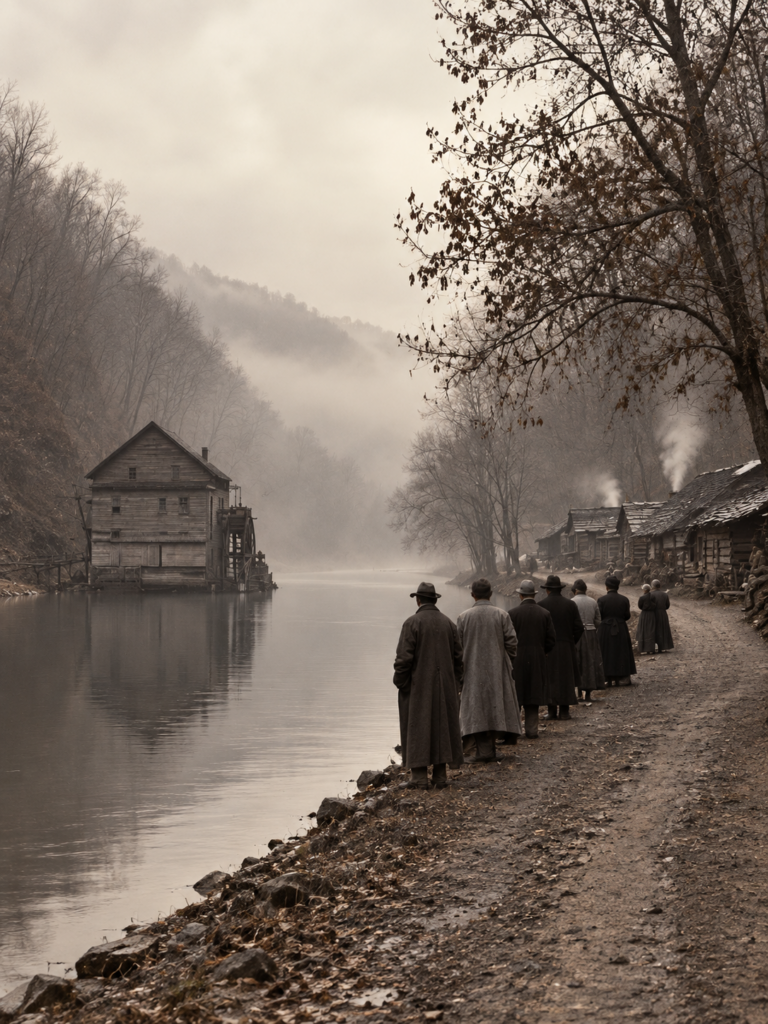
The hollow lay deep in the mountains of West Virginia, in a fold of land so narrow that even in midsummer the sun touched the valley floor for only a few hours each day. The river came down from the high country, slowed between the ridges, then doubled sharply back upon itself beneath a wall of timber.
The people who lived near the mouth of the valley called that turn Dead Man’s Bend.
Nobody seemed to know who had named it.
Nobody laughed at the name.
When county surveyors eventually put the hollow on official maps, they left the old designation exactly as they found it. That in itself was unusual. Ugly names were often cleaned up when land changed hands, when timber companies arrived, when developers wanted acreage to sound inviting.
Dead Man’s Bend survived every mapmaker.
Some said the men who first surveyed the valley had refused to call it anything else.
The surviving account begins in the autumn of 1921 with a state survey agent named Elbert Kratic.
He was 38 years old, tall, narrow through the shoulders, and hardened by years of walking country that other men preferred to examine from maps. His face was long and weathered. He had developed a permanent squint from reading compass needles in bad light and judging distant markers through rain, sleet, and mountain haze.
His manner did not match his appearance.
Kratic spoke softly. He was patient with clerks, frightened farmers, suspicious landowners, and men who answered boundary disputes with rifles leaning beside kitchen doors.
His hands told the other half of him.
They were rough, corded, scarred hands, the hands of a man who climbed rock faces, dragged chains through thorn and timber, drove stakes into frozen soil, and trusted himself in places where help might be 2 days away.
The state land office valued him precisely because he went where others would not.
He also kept unusually detailed notes.
Every surveyor carried a field book, but most recorded only bearings, distances, corner markers, timber stands, and property lines. Kratic wrote those things, then continued. He described the land. He described the people who lived on it. He recorded conversations, local beliefs, unusual behavior, weather patterns, and details that seemed unimportant at the time but refused to fit anywhere else.
He wrote every evening.
Rain or snow, cabin or camp, lamp or firelight, he opened the small oilcloth-bound notebook he carried inside his coat and set down what he had seen.
He had one habit that would matter later.
When he encountered something he could not explain, he did not improve it.
He wrote it exactly as he remembered it.
That autumn, a timber concern wanted rights to hardwood farther up a river valley in the western part of the state. There were stands of oak, hickory, and black walnut thick enough to make the lease valuable, but the boundaries were old and disputed.
Before the company could send crews in, the state wanted the line walked and the residents identified.
It was ordinary work.
Nothing in the file suggested otherwise.
Yet 2 younger survey agents found reasons not to take the assignment.
One claimed a family emergency. According to office gossip, the excuse appeared only after he saw the name Dead Man’s Bend on the map.
The second man simply failed to report for work during the week the assignment was offered. By the time he returned, Kratic had already taken it.
He asked no questions.
He packed a canvas bag with provisions for a week, checked his brass compass, folded his letter of introduction into an inside pocket, and traveled toward the valley.
The last building before the road entered the hollow was a country store owned by Orville Tandy.
Kratic reached it on a Tuesday near sundown.
Cold rain blew sideways from the ridge, finding the seams in his coat. Tandy’s store stood alone beside the road, a low plank building with a smoking chimney, narrow windows, and a porch sagging toward the mud.
Inside, a stove glowed red.
Shelves were half empty, as mountain stores often were after summer supplies had run low and before winter freight arrived.
Orville Tandy was nearly 70, perhaps older. He was thin enough to seem constructed from sticks, with a white beard yellowed around the mouth from years of pipe smoke. His eyes were pale blue and watery.
They missed nothing.
Kratic warmed his hands at the stove, introduced himself, then placed the state letter on the counter.
Tandy read slowly.
At first his expression did not change.
Then he reached the paragraph describing the boundary beyond the bend.
He stopped.
He set the letter flat on the counter.
For several seconds he looked at Kratic without speaking.
“Does the state know where it’s sending you?”
Kratic glanced at the paper.
“The state drew the survey.”
“That isn’t what I asked.”
Kratic waited.
Tandy tapped one finger against the page.
“Everything above that turn belongs to Coates ground.”
“Legally?”
“I didn’t say legally.”
Kratic pulled his notebook from his coat.
Tandy watched him open it.
“The Coates family has been up there since before this county was a county,” the old man said. “Maybe before anybody thought much about counties at all.”
Kratic asked whether they were squatters.
Tandy shook his head.
Dangerous?
The old man considered that.
“Not the way you mean.”
“Do they object to surveys?”
“Likely.”
“Do they shoot surveyors?”
Tandy did not answer.
Kratic changed the question.
“What sort of people are they?”
Tandy turned toward the stove.
For a moment, rain against the windows was the only sound in the store.
Then he said, “They aren’t bad people the way a thief is bad. They aren’t drunks looking for trouble. They aren’t mean for pleasure.”
He looked back at Kratic.
“They’re courteous.”
Kratic waited.
“They keep to themselves,” Tandy continued. “They keep the old ways. And they keep a bargain.”
“With whom?”
The old man’s face closed.
“That’s enough talking after dark.”
Kratic almost smiled.
Tandy did not.
“There are things,” the old man said, “that ought not be named after sundown with a door shut and rain on the roof. Names carry farther than people think.”
Kratic wrote that down.
The old man noticed and gave a tired shake of his head.
Still, he answered practical questions.
The Coates family occupied several cabins around the inside of the river bend. The oldest member was a woman everyone called Aussie Coates. Her son Absalom handled most dealings with outsiders.
Absalom was large, quiet, and difficult to unsettle.
There was another man named Harlon, who farmed a patch of bottomland.
A man called Doss rarely spoke. Tandy claimed he had not heard Doss address an outsider in so many years that nobody could say whether he still remembered how.
Then there was Verly.
“What about her?” Kratic asked.
Tandy rubbed his thumb along the edge of the counter.
“She’ll seem kind.”
“Is she?”
“Yes.”
The answer came too quickly.
Tandy looked toward the dark windows.
“She’s genuinely kind. That’s the trouble. You’ll think kindness means what it means everywhere else. Up there, it doesn’t.”
Kratic wrote her name beneath the others.
“How many are there altogether?”
Tandy gave him a number, then began speaking about something else.
Kratic brought him back.
The family, Tandy finally explained, had not accepted a new person into the household or sent an old one away in more years than he could remember.
That statement seemed to carry significance for the old man.
Kratic could not see why.
He recorded it anyway.
Then Tandy told him about the missing men.
There had been 9 within the old storekeeper’s lifetime.
Not 9 together.
Not a massacre.
One man every few years, sometimes a decade between them.
Each had traveled past Dead Man’s Bend for an ordinary reason.
A surveyor had gone there late in the previous century on behalf of a railroad that was never built.
A timber cruiser went to estimate board feet.
A debt collector walked in after a Coates who supposedly owed money.
A traveling preacher heard there was an isolated family in the hollow and decided they needed saving. For several weeks after he disappeared, people at the mouth of the valley claimed that on very still nights they could hear a distant man’s voice from somewhere beyond the bend.
Preaching.
Always far away.
Never getting closer.
A federal revenue agent went looking for an illegal still nobody had ever proved existed.
He was armed.
He did not return.
A representative from a coal company went in carrying a leather case and enough money, so he said, to make the Coates family an offer they could not refuse.
The offer apparently failed.
So did the man.
There was a hunter who followed a wounded deer over the ridge into the hollow.
Another traveler took the valley because it appeared shorter on the map than the ridge road.
Nine men.
Tandy had personally known every one of them to enter the upper valley.
None came back.
“And nobody investigated?” Kratic asked.
“Oh, they investigated.”
Tandy’s voice had gone quiet.
“The county sent men the first few times. Badges. Dogs. Search parties.”
“What happened?”
“The county quit sending them.”
Kratic looked up.
Tandy leaned both hands on the counter.
“That is what you ought to pay attention to.”
The official explanations differed.
Drowned.
Lost in winter.
Left the county.
Skipped a debt.
Exposure.
Accident.
There was always a word that would fit neatly into a ledger.
Always a word that allowed somebody to close the file.
Kratic slept beside Tandy’s stove that night.
At first light, he packed his things.
The rain had passed.
Tandy stood on the porch watching him tighten the straps on his pack.
“You don’t have to go,” the old man said.
Kratic adjusted the brass compass case at his belt.
“I do, actually.”
“No. You’re expected to go. That isn’t the same thing.”
Kratic looked up the valley.
Mist hung above the river.
He had heard variations of such warnings before. Mountain families distrusted government men. Old communities accumulated stories. Every isolated valley had its ghosts, curses, feuds, and places where strangers were told not to wander.
A professional learned to respect custom without mistaking it for fact.
“I’ll be back in a week,” he said.
Tandy studied him.
Then the old man said, “If you come back, I’ll feed you.”
Kratic smiled faintly.
“I’ll hold you to it.”
The first mile of the valley road was good.
It had been graded once, perhaps years before. Drainage ditches still worked in places. Wagon wheels had packed the earth firm.
Then the road began to forget what it had been.
It narrowed to 2 wheel ruts with grass between them.
The river moved on Kratic’s left.
It was brown from rain, but unusually quiet.
That was the first observation he entered in his field book.
Moving water should speak.
It should strike stone, curl around roots, slap mud banks, break against deadfall.
This river seemed to move without sound.
The second thing he noticed was the absence of birds.
October woods in West Virginia were rarely silent. Jays screamed in the canopy. Crows traded calls across ridges. Squirrels cracked nuts, scratched bark, and threw debris from branches.
Yet as Kratic walked deeper into the hollow, the sound diminished until his own boots seemed indecently loud.
Without deciding to, he began stepping more softly.
The fog arrived before noon.
That troubled him more.
Morning fog should have been lifting as the day warmed. Instead, pale vapor rose from the river and thickened.
It carried the smell of wet stone.
Standing water.
And beneath both, something faintly sweet.
He could not identify it.
Once he noticed the odor, he could not stop noticing it.
Near midday the road curved with the river.
Trees leaned over it, narrowing the sky. Sunlight became dim and green.
Then Kratic saw the old mill.
It stood in the inside of the bend, gray boards and heavy beams weathered almost to the color of river stone.
The wheel was half sunk in moving water.
Kratic stopped.
The wheel was not turning.
He watched it for several minutes.
Water pressed steadily against the paddles.
Nothing obstructed them.
No log.
No collapsed beam.
No visible damage to the shaft.
A mill wheel placed in moving water should move.
This one did not.
Kratic opened his field book.
He wrote one sentence.
The mill wheel does not turn.
He underlined it.
Then he added another.
He had decided not to walk down to the water to investigate.
After a pause, he wrote a third.
He was not entirely certain the decision had been his.
Beyond the mill, the Coates cabins appeared.
There were 6 or 7, scattered inside the crook of the river. They were old but maintained, with solid roofs and clean chinking between logs. Thin columns of smoke rose vertically from chimneys into motionless air.
Kratic felt relieved.
Smoke meant fires.
Fires meant people.
People could be questioned.
Negotiated with.
Understood.
He had almost reached the first cabin when a man appeared in the road.
Kratic stopped so abruptly the survey chain on his pack shifted against his shoulder.
There had been nobody ahead of him.
He was certain.
No door stood nearby. No path entered the road. No brush offered sufficient cover.
Yet the man was there.
He was enormous.
Older than Kratic, with a gray beard, pale eyes, and the heavy frame of someone who had spent a lifetime working outdoors. What struck Kratic most was his stillness.
The man did not fidget.
Did not shift his weight.
Did not glance toward the cabins.
He seemed to possess the patience of something that had never once been late.
“Elbert Kratic,” he said.
Kratic said nothing.
“The state sent you.”
“How do you know my name?”
The man ignored the question.
“They’ve sent men before.”
Kratic looked past him.
No one stood at the cabin windows.
“The state ought to learn,” the man continued, “to leave this valley off its papers.”
There was no threat in his voice.
That made it worse.
“You’re Absalom Coates?”
“I am.”
Kratic glanced back along the road.
The fog had thickened around the mill.
For the first time since leaving Tandy’s store, he felt cold beneath his coat.
Not because of anything Absalom had said.
Because somehow the man had known he was coming.
They let him stay.
That surprised him more than hostility would have.
The Coates gave him a small cabin with a dry mattress.
They fed him at a long table.
They answered questions about boundary stones, creek lines, old fences, and timber ownership with patient courtesy.
No one threatened him.
No one touched his equipment.
During daylight, they allowed him to walk anywhere his work required.
Only one rule was given.
Aussie Coates delivered it on the first evening.
She sat at the head of the table, a narrow old woman whose eyes were clouded by age but whose attention remained sharp beneath the milkiness.
“You can walk wherever you please while the light’s up,” she told Kratic.
The table went silent.
“You can eat here. Sleep here. Finish what you came to finish.”
Kratic put down his fork.
“But?”
“Do not go to the water beyond the mill after dark.”
He studied her face.
“Why?”
Aussie did not hesitate.
“The bend keeps what it takes.”
Nobody at the table moved.
“The water past the wheel is where the taking is done.”
Kratic felt Doss looking at him.
Aussie continued.
“A man who isn’t owed should never stand where a debt gets paid.”
Kratic wrote the words down later exactly as she had spoken them.
He also recorded what happened immediately afterward.
Doss Coates, the silent man, lifted his head.
For the first and only time during Kratic’s stay, he looked directly into the surveyor’s eyes.
Then he gave one small shake of his head.
No.
Kratic did not know whether it meant do not ask, do not doubt, or do not go.
He only knew it was a warning.
And from the expression on Doss Coates’s face, he suspected that even giving that much had cost him something.
Part 2
For 3 days, Elbert Kratic worked.
He drove stakes into the soil, read bearings from his compass, checked old corners against county plats, measured creek lines, and walked the slopes above the Coates cabins.
No one interfered.
That should have eased him.
Instead, each ordinary hour made the valley feel less ordinary.
The mill wheel never turned.
Not once.
Kratic passed it in the morning, at midday, and in late afternoon. Water pressed around the paddles, sometimes slow, sometimes visibly stronger after rain upstream.
The wheel remained fixed.
The fog was equally strange.
It occupied the bend as if bounded by invisible walls.
Kratic could climb the eastern slope until he emerged into clear October sunlight, then turn and look down upon a single hollow filled with white mist beneath an otherwise empty blue sky.
Birds called from the ridges.
None entered the valley.
On the second day, Kratic wrote about his dog.
He had brought the animal as far as the first mile of road. It was an old survey hound that had followed him through storms, swamps, and bear country.
At the edge of the hollow, it sat down.
Kratic coaxed it.
The dog refused.
He pulled the lead.
The animal flattened itself against the leaves and trembled.
Eventually he tied it at a farm below the valley and continued alone.
By the third evening, he had written twice that he wished he had trusted the dog.
The cold behaved strangely too.
There was little wind in the hollow, yet pockets of freezing air gathered close to the river. A man could walk 10 steps and feel the temperature fall hard enough to raise gooseflesh, then walk another 10 and return to ordinary autumn chill.
Most of all, Kratic wrote about the water.
Upstream, it remained brown.
At the bend, below the mill wheel, it darkened.
Not black.
Not blue.
Not green.
He tried several descriptions in his notes and crossed them out.
Finally he wrote only that the water was the wrong color.
Once, in full daylight, he stood on the bank well above the mill and looked into it.
For a fraction of a second he experienced a certainty so complete that his body reacted before his mind.
He was looking the wrong way.
He was not looking down into water.
He was looking down into a night sky.
There were stars beneath him.
He stumbled backward.
The impression vanished.
Brown water moved between the banks.
Kratic closed his field book and did not write again until the next morning.
His handwriting from that point onward changed.
The letters narrowed.
Lines drifted.
Words were pressed harder into the paper.
On the fourth night he could not sleep.
His cabin had gone cold despite the small fire. He lay awake listening to timber contract in the walls.
Then he heard footsteps.
Not one person.
Many.
The entire family was moving through the darkness.
He recognized the different rhythms after days among them: Absalom’s heavy measured tread, Aussie’s slower dragging step, others behind.
They passed his cabin.
All were going toward the mill.
No one spoke.
Kratic sat up.
What disturbed him was not simply that they were outside.
He had heard no doors open.
No voices.
No movement before the footsteps were already passing.
He could not explain how the entire Coates household had emerged from separate cabins without making a sound.
He opened his field book.
The footsteps faded downhill.
Toward the one place he had been told never to go.
Then the river changed.
For 4 days it had moved almost silently.
Now, in the darkness, it roared.
Kratic heard the full force of floodwater where no flood had been.
The sound filled the hollow, deep enough to tremble through the floorboards.
Beneath it came something else.
At first he mistook it for wind.
Then for distant speech.
He sat very still.
The sound resembled hundreds of voices speaking at once from an immense distance.
They seemed to be getting closer.
Kratic barred the door.
He did not go outside.
Whatever else happened later, his field book makes that clear.
He remained in the cabin with a candle burning beside him, writing while his hand grew increasingly unsteady.
The voices continued.
Twice, he believed he heard his own name.
Not shouted.
Not called for help.
Simply spoken.
Elbert.
As though someone were identifying an object already in hand.
He covered his ears.
The sound remained.
That frightened him more than anything else.
It did not seem to travel through the air.
Near dawn, everything stopped.
Not gradually.
The river did not quiet in stages.
The voices did not fade.
The sound ceased with the clean finality of a door being closed.
Kratic sat in silence.
Then he heard footsteps returning from the water.
The family came back in the same order.
No one spoke.
Doors opened and closed now, though Kratic could not later explain why that detail bothered him.
Before the candle died, he wrote one final sentence.
In the morning, the old woman will know I heard the water.
Then below it:
I do not think a man is allowed to hear it twice.
At first light, Kratic opened his cabin door.
The entire Coates family stood by the river.
Not beyond the mill.
On the near bank.
They formed a loose line in the gray dawn, backs toward the cabins, faces turned toward the bend.
Aussie.
Absalom.
Harlon.
Verly.
Doss.
The others.
No one moved.
Mist hung among them.
Kratic remained in the doorway.
His field book contains only 2 sentences describing that moment.
They were not waiting for morning.
They were waiting for me.
Then Absalom turned.
Only Absalom.
He left the others by the bank and walked toward the cabin.
Kratic later emphasized that the man did not appear angry.
He was not threatening.
He looked tired.
“You heard it,” Absalom said.
Kratic did not answer.
Absalom nodded as though an answer were unnecessary.
“What happened last night?”
The large man looked toward the river.
“What always happens.”
Kratic felt irritation overcome fear for a moment.
“I am a state surveyor. I have work to finish. If there is something dangerous in this valley, tell me plainly.”
Absalom looked at him for a long time.
Then he did.
The settlement, he said, was older than the Coates family.
Long before their people came into the valley, others had lived at the bend. Their names had been lost. No graves remained that anyone could identify. No courthouse record preserved them.
Those people had entered into an arrangement with something in the water.
Absalom did not call it a spirit.
He did not call it a demon.
He did not claim to know what it was.
That, he told Kratic, was the mistake outsiders always made.
They imagined the Coates worshipped it.
Fed it deliberately.
Spoke to it.
Served it through ceremonies passed from one generation to another.
There were no ceremonies.
No prayers.
No conversations.
No sacred words.
There was only an agreement.
The water gave the valley something.
Kratic asked what.
Absalom struggled to explain.
Longevity, perhaps, though not immortality.
Protection.
Isolation.
A strange ability to remain untouched by changes that consumed the country beyond the ridges.
War came and went.
Companies rose and collapsed.
Roads changed.
Towns expanded.
The valley stayed what it had always been.
“And in return?” Kratic asked.
Absalom looked toward the mist.
“It is owed.”
“What?”
“What comes due.”
“That is not an answer.”
“It is the only one we have.”
The Coates family had not made the original bargain.
They had inherited its keeping.
Absalom compared it to a debt accumulated by an ancestor whose name had been forgotten. A man could protest that he had never borrowed the money, but the debt existed whether he recognized it or not.
Someone had to stand between the water and the outside world.
For generations, that burden had belonged to the family living at the bend.
“We’re tired,” Absalom said.
It was the first time Kratic heard emotion enter his voice.
“We don’t expect you to pity us.”
“I don’t understand you.”
“No.”
“What happens to the men?”
Absalom met his eyes.
That question changed something between them.
“The 9 Tandy told you about?”
Kratic’s stomach tightened.
“So you know.”
“We know everyone who comes up the road.”
“What happened to them?”
Absalom took a long breath.
“The water didn’t take them.”
Kratic stared at him.
“That is exactly what everyone says happened.”
“No.”
“You expect me to believe they all simply disappeared?”
“They chose.”
Kratic almost laughed, but Absalom’s face stopped him.
“Every one?”
“Every one.”
“Men don’t choose to vanish.”
“They did after they understood.”
“Understood what?”
Absalom looked back toward the river.
“That there was nowhere else left to go.”
Kratic thought of the 9 names Tandy had described.
The surveyor.
The preacher.
The federal agent.
The coal buyer.
Ordinary men who had walked into the valley expecting to walk out again.
Absalom spoke quietly.
“None was dragged. None was bound. We never had to force one.”
“You expect me to believe they walked into that river willingly?”
“I expect nothing from you.”
“Then why tell me?”
“Because you heard it.”
Kratic said nothing.
Absalom’s expression changed.
For the first time there was something like pity in it.
“They came the way you came,” he said. “Certain they were leaving.”
Kratic felt sudden anger.
“You think I’m staying here?”
“No.”
“I’m leaving this morning.”
“I know.”
“I’ll be at Tandy’s before evening.”
Absalom nodded.
The calmness of the gesture enraged him further.
Kratic went inside.
He rolled his blanket, packed his instruments, closed his field book, and shouldered his bag.
He even thanked the Coates family for their hospitality.
No one stopped him.
The family remained by the river as he walked away.
No threat followed.
No command to return.
No rifle appeared.
Kratic looked back once.
Absalom stood among the others.
None had moved.
Kratic headed downriver.
The road was easy.
That fact appears several times in the pages that follow.
Easy road.
Good footing.
Downhill.
He kept the river on his right, exactly as he remembered from the journey in.
The fog should have thinned within the first mile.
It did not.
Kratic continued.
After some time, he saw the old mill through the mist.
That was expected.
He passed it.
The dead wheel remained still.
He walked on.
Perhaps 20 minutes later, the road curved.
Kratic stopped.
Ahead stood the old mill.
Same gray beams.
Same motionless wheel.
Same dark water.
He turned around.
Fog concealed the road behind him.
He removed his brass compass.
The needle moved.
Slowly at first.
Then it began circling.
It completed one rotation.
Then another.
It never settled north.
Kratic put the instrument away.
He began walking faster.
He passed the mill again.
The road sloped downward.
He followed it.
The fog brightened.
Trees opened.
For a moment he believed he had reached the mouth of the valley.
Then he stepped from the mist onto the bank at Dead Man’s Bend.
The Coates family was still standing there.
Absalom had turned toward the road.
He showed no surprise.
Kratic understood then.
Not completely.
But enough.
The valley had folded the road back upon itself.
He tried again.
A practical mind demands repeated proof.
Kratic left the road and climbed the ridge.
He forced his way through laurel and hardwood, moving straight uphill until his lungs burned. The slope became steep enough that he used his hands.
He expected to reach the crest.
Instead, the trees thinned.
He stepped downward into fog.
The mill stood below him.
He tried the river.
He removed his boots, tied them around his neck, and entered the shallows, following the current toward the mouth of the valley.
For several hundred yards, the water barely reached his knees.
Then the current strengthened.
Not violently.
Almost gently.
It turned him.
Kratic fought it.
The water rotated his body as easily as a sleeping man being rolled in bed.
Minutes later he staggered onto the bank.
The Coates cabins stood ahead.
He tried once more.
This time he did nothing.
He sat beside the road.
If movement caused the folding, he reasoned, perhaps stillness would allow the valley to change.
He waited through the afternoon.
Light failed.
Fog gathered between the trees.
Then the river began to wake.
The first low roar came from beyond the mill.
Kratic stood immediately.
Whatever theory he had intended to test ended there.
He would not remain beside that water after dark.
He walked back toward the cabins.
This time no one was waiting for him.
Part 3
By the final afternoon, Elbert Kratic’s handwriting had steadied.
That may be the most disturbing change in the surviving field book.
Fear had made the earlier pages uneven. Words leaned across margins. Several sentences broke off unfinished.
The last pages are calm.
It is the calm of a man who has exhausted every argument against the truth in front of him.
Kratic sat beneath a large oak within sight of the bend and wrote.
He recorded the mill.
The fog.
Tandy’s count of the missing men.
Aussie’s warning.
The voices.
The family walking down to the water.
Absalom’s explanation.
The road.
The compass.
The ridge.
The river.
He wrote that every direction had become Dead Man’s Bend.
Then he wrote what he had come to believe.
The assignment had not brought him to the valley by chance.
The timber lease had been bait.
The disputed boundary had been bait.
Perhaps even the refusal of the younger survey agents had played a part, though whether they had escaped through instinct, luck, or fear he could not know.
Kratic had believed the state sent him.
Now he suspected something else had reached beyond the valley and arranged circumstances until a particular man was walking a particular road.
His name, he wrote, had been on the count before he entered Tandy’s store.
Perhaps before the file reached his desk.
There was no evidence for this conclusion.
He admitted that.
But by then evidence had become difficult to define.
He had walked downhill and returned uphill without turning.
His compass had abandoned north.
The river had refused to carry him out.
He could no longer pretend he inhabited a landscape governed entirely by the rules he had spent his career measuring.
The survey itself suddenly seemed absurd.
Lines on paper.
Bearings.
Corner markers.
A man using a brass instrument to impose direction upon country that had decided direction no longer applied.
Kratic filled the remaining pages slowly.
He understood that the notebook might be the only part of him that could leave.
That thought gave him a final task.
Near the mouth of the valley stood a low stone wall marking an old boundary.
It lay farther down the road than most points he could now reach, near the uncertain edge where the Coates ground touched the ordinary world.
Kratic packed his field book inside its oilcloth wrapping.
Then he walked.
The road folded.
He continued.
The mill appeared once.
Then disappeared.
He kept going.
At some point, the fog thinned.
The old stone wall emerged beside the road.
Kratic stopped.
For reasons he could not explain, the valley had allowed him that far.
Perhaps the wall marked the true boundary.
Perhaps whatever held him did not care about the book.
Perhaps it wanted the book to leave.
There was no way to know.
Kratic found a loose gap between stones.
He pushed the oilcloth bundle deep inside, beyond casual sight but close enough that a hand searching the wall might find it.
He stood there for a while.
Beyond the wall, the road continued toward Tandy’s store.
He could see a stretch of it.
Ordinary road.
Mud.
Fallen leaves.
Daylight.
The living world was close enough to walk into.
Kratic tried.
The precise sequence is unclear because the field book was no longer with him, but later evidence leaves little doubt that he did not cross.
Whatever rule governed the valley had permitted the record to reach the boundary.
It did not extend the same permission to the man.
At some point Elbert Kratic turned around.
He walked back toward the fog.
Back toward the dead mill wheel.
Back toward the cabins.
Back toward the water whose voice he had already heard once.
Darkness was coming.
The field book cannot tell us what happened after that.
It cannot say whether the Coates family met him.
It cannot say whether Aussie spoke to him again.
Whether Doss looked at him.
Whether Verly offered him food.
Whether Absalom walked beside him toward the river.
It cannot say whether the water began roaring at moonrise or whether Kratic heard his name a second time.
Most importantly, it cannot tell us what Absalom meant when he said every previous man had chosen.
The explanation ends where Kratic’s writing ends.
Everything beyond it is silence.
The book was found the following week.
A hired man who did occasional work for Orville Tandy discovered the oilcloth parcel wedged inside the wall.
By then the timber company had begun asking questions.
Their survey agent was late.
They wanted the boundary.
They wanted a report.
They wanted a date for the cutting crews.
Tandy read the notebook from beginning to end.
He had watched men enter Dead Man’s Bend for more than 40 years.
He had warned them.
Nine had gone before Kratic.
Now there were 10.
The old storekeeper faced a decision.
He could send the field book to county authorities.
He could tell them exactly what Kratic had written.
He could demand another investigation.
But Tandy had lived long enough to remember the earlier search parties.
He remembered the deputies.
The dogs.
The men who had gone up looking.
He remembered, more importantly, how quickly the county eventually learned not to look.
So Tandy gave officials the answer they wanted.
Elbert Kratic had drowned.
The explanation was simple.
He had been working near the river after recent rain. The bank was slick. He must have fallen into deep water, been pulled under, and carried downstream.
No body had been recovered.
Mountain rivers did that.
The county accepted the report.
The ledger entry was concise.
Elbert Kratic, age 38.
State survey agent.
Drowned in the line of duty.
Autumn, 1921.
Body not recovered.
Matter closed.
One word.
Drowned.
Tidy enough to file.
Tandy did not surrender the field book.
He understood that a county willing to accept drowning without a body would have little patience for a notebook describing a motionless mill wheel, a road that returned to its beginning, voices inside water, and a compass circling uselessly in fog.
At best, the book would be dismissed as the final writing of a frightened man.
At worst, someone would destroy it.
So Tandy hid it.
He kept the same oilcloth wrapping Kratic had used.
According to a neighbor who knew him in his later years, the old man stored the notebook inside a tin box beneath a loose floorboard.
Occasionally, on windless nights, he took it out.
He would sit beside the stove after the store closed and read several pages.
Then he returned the book to the box and remained awake for a long time, looking toward the door.
He never visited Dead Man’s Bend.
Not once.
Near the end of his life, Tandy gave the notebook to someone he trusted.
The identity of that person was never recorded clearly.
Perhaps Tandy intended it that way.
He attached one instruction.
The book was never to be taken back into the valley.
Not to the Coates cabins.
Not to the mill.
Not even to the mouth of the hollow.
Whatever else happened, Kratic had carried the account out as far as he could.
Tandy believed it should remain out.
The notebook then passed through private hands for decades.
Parts of its history are uncertain.
There were no institutional archives because the official record required none.
The official record already had its answer.
Drowned.
The truth, if that is what the field book contained, survived separately.
That distinction mattered.
Records survive because institutions preserve them.
Some truths survive because individuals refuse to destroy them.
Dead Man’s Bend changed.
Time eventually reached even that isolated country.
The Coates family disappeared from public view.
The timber rights were finally sold. Trees that had stood during Kratic’s survey were cut decades later.
Cabins collapsed.
Roofs caved in.
Chimneys fell.
The old mill decayed until only a few gray timbers remained beside the river.
Roads improved elsewhere.
Cars replaced wagons.
Maps grew more accurate.
The mountains became easier to enter.
People began hiking places their grandparents had approached only for work.
To a modern visitor, the hollow seemed ordinary.
That was always its great advantage.
Hardwoods rose along the slopes.
Water curved through the valley.
In spring the banks greened.
In autumn the ridges burned gold and red.
There was little left to connect the place with a forgotten survey agent from 1921.
Yet visitors sometimes wrote about the silence.
They used different words.
The accounts did not appear coordinated.
Many of the hikers had never heard the story of the Coates family.
Still, the descriptions repeated themselves.
Beautiful.
Quiet.
Strangely quiet.
Some visitors reported entering the hollow intending to stay until late afternoon, only to turn back earlier without knowing exactly why.
One described the sensation as a change in the quality of the silence.
At first it felt peaceful.
Later it felt attentive.
Another wrote about standing near the remains of the old mill.
The river moved visibly.
He could not hear it.
He watched the surface, trying to decide whether the silence was unusual.
Then, without any obvious cause, he felt an urgent need to leave before dark.
He did.
He never knew about Aussie Coates.
He never heard her rule.
Yet almost 100 years after she warned a surveyor not to stand beyond the wheel after sundown, a stranger obeyed it without being told.
Stories continued.
An elderly woman who lived near the region was once asked what had happened to the Coates family.
She said people misunderstood the question.
The Coates had not truly left.
A family burdened by that kind of obligation, she said, could not simply pack belongings into a wagon, cross the ridge, and begin again.
The debt was older than their name.
If nobody called Coates remained at the bend, then someone else must have taken the place.
Someone always stood between the water and the world.
When asked who, she refused to answer directly.
She only said the valley kept a count.
That was the phrase Tandy had used in another form.
Nine men.
Then Kratic.
Ten.
But if Absalom had told the truth, those men had not merely died.
They had become part of something the surviving record never explained.
Perhaps that was what the old woman meant.
Perhaps it was only another mountain story growing around an unexplained disappearance.
There is no proof that a road can fold back upon itself.
No accepted account of a river that prevents a man from leaving.
No natural explanation for a mill wheel that remains motionless while water presses against it, though mechanical failures can be hidden.
Fog behaves strangely in valleys.
Compasses can malfunction.
Fear changes distance.
Exhaustion changes memory.
A man alone in unfamiliar country can become convinced of patterns that do not exist.
Every detail in Kratic’s notebook can be challenged separately.
That is the reasonable approach.
It may even be the correct one.
The difficulty lies in the accumulation.
Tandy’s warnings came before Kratic’s experience.
The Coates family knew he was coming.
The dog refused the road.
The birds remained above the hollow.
The fog stayed where fog should not have stayed.
The river became loud only after dark.
Kratic tried the road.
The ridge.
The current.
Stillness.
Every method returned him to the bend.
And after writing those things, a reliable state employee with no known reason to abandon his work vanished completely.
No body was recovered.
His instruments were never found outside the valley.
His belongings did not turn up in another state.
He did not withdraw money, contact family, or begin a new life under another name.
The county used the word drowned because the word was available.
Perhaps he did drown.
Perhaps he eventually walked into the river exactly as Absalom said the others had done.
If so, one question remains.
Why would a sane man choose it?
That was the final mystery in the Coates explanation.
The valley did not seize people.
It brought them to a point where they gave themselves.
Kratic had resisted that claim.
He had laughed at it inwardly.
He had thanked the family and walked away.
Hours later, with every route returning him to the same water, the claim may have begun to mean something different.
Choice becomes a strange word when every alternative has been removed.
If a man can walk in every direction and arrive at the same place, whether his final step is voluntary becomes difficult to judge.
Perhaps that was the cruelty of the bargain.
Not force.
Certainty.
The Coates did not need chains because the valley itself eliminated escape.
The water did not have to drag a man under because eventually it could make the rest of the world unreachable.
Then it could wait.
The old woman near Dead Man’s Bend offered one final thought.
The hollow, she said, was quiet because the water was patient.
That was why animals avoided it.
That was why hikers left early.
That was why generations of people who knew nothing of the field book felt watched beneath those trees.
The debt had never been canceled.
The family who once kept it had changed or vanished.
The mill had rotted.
The cabins had fallen.
The county ledger had yellowed with age.
None of those things mattered.
Whatever waited there had waited before the Coates family arrived.
It had no reason to hurry.
Perhaps that is why the ground still looks easy.
A difficult road warns a traveler.
A cliff tells him to turn back.
Floodwater announces itself.
Dead Man’s Bend offers no such courtesy.
The road follows the river.
The grade is gentle.
The trees are beautiful.
A man can walk it on an autumn afternoon believing he has plenty of daylight left.
He may hear no birds.
He may notice that the river is quieter than moving water should be.
He may come upon the remains of an old mill and stand for a while trying to understand why something about the place feels wrong.
Then perhaps he will check the time.
Perhaps for no reason he can explain, he will decide to return to his car.
If he does, he may emerge from the hollow before sunset and never think seriously about it again.
That would be the sensible outcome.
Two young state surveyors in 1921 found reasons not to accept an assignment at Dead Man’s Bend.
They lived.
Elbert Kratic accepted it.
He did not.
The difference may be coincidence.
It may be superstition.
It may be nothing more than a story carried for generations through a country where every river has drowned someone and every old road has its ghosts.
But if the field book was truthful, then somewhere beyond the last ordinary turn of that West Virginia river, the old account is not finished.
The names have changed.
The cabins are gone.
The wheel has rotted almost entirely away.
Yet the bend remains.
And there are places where the ground lies.
It looks easy.
That is how it begins.

