
Part 1
In the spring of 1867, a land agent named Thomas Aras Burch rode out of Salt Lake City carrying the ordinary instruments of an ordinary assignment: a surveyor’s chain, a ledger, a field compass, and written instructions to record a settlement tucked against the western slope of the Wasatch.
The place appeared in church records under a simple name.
Harrow’s Ward.
Burch was expected back within 2 days.
He returned after 11.
The horse that carried him down from the high bench looked exhausted. Burch looked worse. He went directly to the office that had commissioned him, placed the chain and instruments on the counter, and handed over the ledger.
The pages reserved for Harrow’s Ward were blank.
Not poorly completed. Not damaged.
Blank.
That same week Burch resigned his commission. Soon afterward he moved his family to California. He lived for many years after that, yet according to the few people who later tried to question him, he refused to describe what had happened during those missing days.
He left only 1 sentence.
It appeared in a letter written to his brother in June 1867.
“The men keep the women in the stone, and the stone was there before the men.”
Whatever Harrow’s Ward had been, it did not remain on the maps for long.
Within a decade the name disappeared from territorial records. The ward was dissolved, but its members were not reassigned to surrounding congregations. The road climbing the bench was plowed under and seeded. Families living in the lower valley gradually stopped speaking about the settlement.
No public decree ordered them to forget it.
No sermon demanded silence.
They simply stopped.
The disappearance might have been explained as one more small frontier settlement dying when water failed, crops weakened, or families moved on. That happened everywhere. Roads vanished beneath grass. Cabins collapsed. Names disappeared from maps.
But Harrow’s Ward had not died slowly.
It seemed to have been removed.
To understand why, one had to understand the valley in which it stood.
Utah Territory in 1867 was still young by the standards of settled places. The first Latter-day Saint wagon companies had entered the Salt Lake Valley only 20 years earlier. In that short span, settlements had been laid out across country that demanded extraordinary labor merely to survive. Irrigation ditches crossed dry ground. Farms appeared where sage had dominated. Houses, meeting halls, mills, barns, and eventually great masonry structures rose in valleys where newcomers had arrived with almost nothing.
The achievement was real.
So was the haste.
The first generation could still remember the beginning. Men and women who had crossed the mountains in the 1840s were alive when Burch rode toward Harrow’s Ward. If a building had been raised after settlement, somebody should have remembered its construction.
That simple fact became important because behind the Harrow homestead stood a wall.
It was not a rough fieldstone wall assembled by farmers clearing their land. Its blocks had been squared, faced, and fitted with narrow mortar joints. The workmanship suggested trained hands, specialized tools, organized labor, and time.
There was another difficulty.
Nobody could say who had built it.
The first surviving record of the Harrow family appeared in 1851.
Even that entry was strange.
Church membership records normally supplied useful information: a baptism, a place of origin, a previous ward, a mission, some connection by which a family could be placed inside the administrative world around it.
The Harrows were listed as a transfer.
But the ward from which they supposedly transferred could not be found in the surviving territorial record.
Beside the entry, someone had later written a short notation.
Came with the place.
The wording mattered.
It did not say that the family came to the valley.
It suggested that when officials began trying to account for the land, the Harrows were already there, attached to the property as firmly as the stone behind their house.
During the following decade, official recordkeeping repeatedly failed to make the family ordinary.
The tithing rolls provided one example.
In a Mormon agricultural settlement, tithing was woven into community life. Grain, animals, eggs, labor, and other goods were carefully recorded. Household names appeared beside quantities and contributions.
The Harrow household appeared on the rolls in 1858, 1859, and 1860.
Beside it was a single word.
Exempted.
The notation had been made by Bishop Orin Pike.
Nothing else in the surviving accounts suggested Pike was careless about such matters. Local descriptions remembered a severe, practical man who expected obligations to be met and who had little patience for evasions.
Yet the Harrows were left alone.
The 1860 census complicated things further.
An enumerator named Alma Ford visited the household. He was a schoolteacher, accustomed to writing neatly and following forms exactly. He completed the required columns, including age, birthplace, and the birthplaces of parents.
For each member of the Harrow household, Ford entered the same phrase.
Here before us.
The old patriarch.
The older woman.
The sons.
The 9 women living there.
Here before us.
Then, 11 days later, Ford prepared another sheet for the household. This one was almost entirely blank.
Across it he wrote:
There is no family to count up there. There is one old thing and it has made the shape of a family, and the family is the clothes it wears to come down to the store.
Ford abandoned teaching that spring. He took employment on a railroad survey far to the south and apparently never returned to the valley.
By 1863, people below the bench had begun using the Harrow name differently.
Mothers called wandering children home by warning them that they might “fetch up at the Harrow place.”
There was no known case of a Harrow harming a child.
That was not why the warning worked.
The children responded to the tone.
Adults spoke of the family quietly, with the instinctive caution people use when discussing something they have agreed not to examine too closely.
At the crossroads below the bench stood a general store. Its proprietor, Desirette Hail, kept credit accounts for nearly every family within riding distance.
There was no Harrow account.
They came down only a few times each year. They purchased salt, lamp oil, powder, cloth, and other necessities. They did not bargain. They did not ask for credit. They paid in coin.
The coins troubled Hail.
They were heavier than the money commonly circulating through the territory, and he refused to store them with the rest of his receipts. He kept them in a separate tin.
After his death, his widow took that tin to the well behind the store and threw the entire contents into the darkness.
When her daughter later asked why, the widow gave only 1 explanation.
The money was cold.
Not cool from weather.
Cold, she said, the way something is cold after spending a very long time underground.
One coin escaped the well.
Hail’s son had stolen it as a boy and hidden it. Nearly 40 years later he carried it to a Salt Lake jeweler experienced in old and foreign currency.
The jeweler examined the piece beneath magnification.
It resembled silver. On one side was a human profile. On the other stood what appeared to be a many-pointed tower. Around the edge ran unfamiliar characters.
The jeweler could not identify the alphabet.
He could not identify the mint.
He would not offer a value.
When he asked where the coin had come from, the old man reportedly answered:
“A valley that isn’t on the map anymore.”
He took it home.
The coin later disappeared.
By the time Thomas Burch climbed the bench in 1867, those details had accumulated without forming any explanation. They were simply irregularities surrounding a family the valley had learned to avoid.
Then Burch saw the wall.
His profession depended upon measurement. His surviving notes, fragmentary as they were, contained none of the language of a frightened storyteller. They described dimensions, grades, materials, boundaries.
Behind the Harrow house, built partly into the rising ground, was a long masonry wall.
The blocks were dressed.
The courses ran straight.
The joints were so narrow that Burch claimed he could not push the point of his pencil between them.
At the center was a low stone arch.
Beyond it, steps descended beneath the hillside.
Burch asked Father Harrow who had built it.
The old man looked at him for a long time.
“We did not cut it,” he said.
Then he added:
“We only keep what is kept in it.”
The wording disturbed Burch more than an answer about unknown builders might have done.
Not what had been built there.
What was kept there.
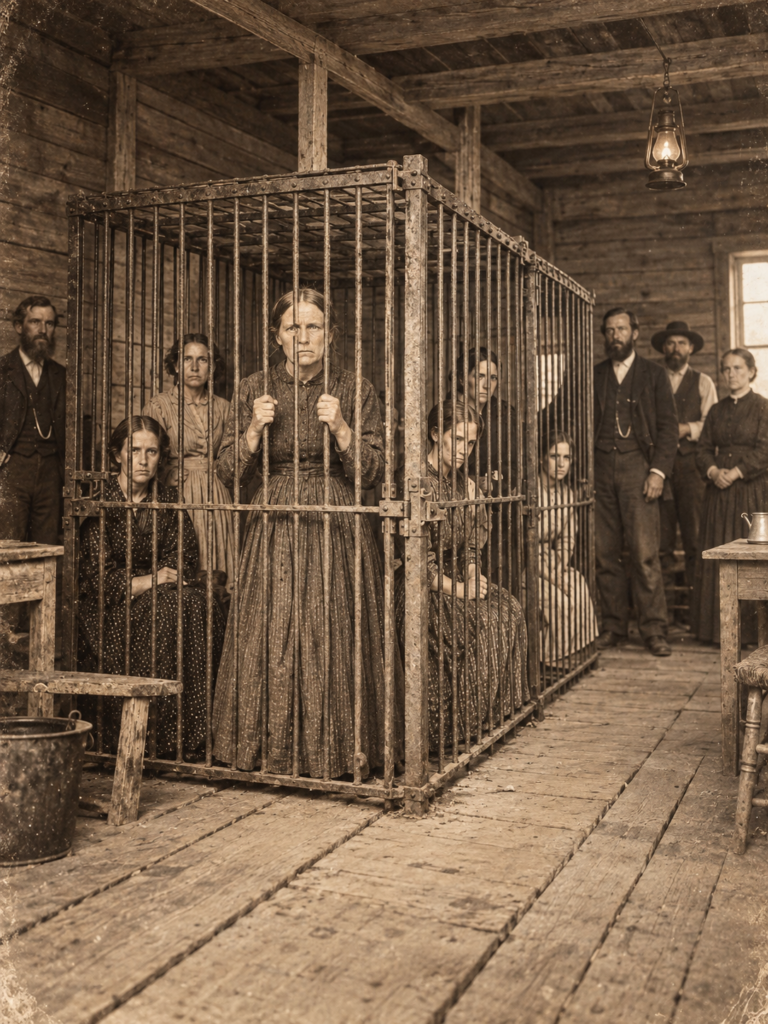
Near the back of the house stood a long, low outbuilding.
Inside were stalls.
They were barred with iron.
And inside the stalls were women.
Later retellings confused the geography, placing the women underground, but the earliest surviving descriptions were consistent on that point. The women lived above the stone chambers. The arch and descending steps were beneath and behind them.
They occupied the ground over the entrance.
As though their presence were part of the lock.
Burch never wrote enough for anyone to know precisely what he witnessed during his 11 days on the bench. But almost 10 years before his arrival, Bishop Orin Pike had already encountered the same arrangement.
Pike kept a journal.
Most of it was painfully ordinary.
Weather. Crops. Baptisms. Water disputes. Prices. Illnesses. Deaths. Small grievances.
That ordinariness gave his Harrow entries their weight.
His first reference, in 1856, was almost casual.
He had ridden past the bench. He saw the old woman near the house. She did not return his greeting. The land appeared well kept.
A year later Pike raised the question of visiting the Harrows formally. If they appeared on his ward rolls, he reasoned, they were his pastoral responsibility.
Several men advised him to leave them alone.
None would explain why.
Pike did not accept that.
In the winter of 1857, he rode up.
His journal entry that evening consisted of 5 words.
They knew my mother’s name.
He wrote the sentence twice.
His mother had died in Nauvoo, before the westward journey. According to Pike, he had never spoken her name to anyone in the valley.
After that entry, his journal fell silent for 11 days.
When he resumed writing, something about the entries had changed.
He began spelling out the day of the week before every date.
Monday.
Tuesday.
Wednesday.
The habit continued as though the names of the days had become necessary anchors.
Months later he tried to describe what he had encountered.
He wrote about the old house.
The masonry wall.
The arch.
The steps.
Then he wrote about the women.
He had gone there believing they were captives.
He came away believing something else.
“They are not prisoners,” he wrote. “I went up thinking to free the captives, and I came down understanding that they are not captives. They are the hinge.”
He claimed the family did not confine them merely from cruelty.
The arrangement, he wrote, served a purpose older than the Harrows themselves.
Its purpose was to keep something from coming up the steps.
Pike added another sentence.
“I am ashamed to write that I believe them.”
For the next decade the lower valley practiced a strange discipline.
Do not climb the bench.
Do not accept the Harrows’ money.
Do not shake their hands.
Do not involve yourself in whatever occurred behind the old wall.
Most importantly, do not go down the steps.
No law enforced those rules.
They survived because enough people believed there was a reason for them.
Then the territorial government sent Thomas Burch with a surveyor’s chain and a blank ledger.
The valley’s caution collided with bureaucracy.
Burch returned after 11 days and resigned.
His unfinished survey left an administrative problem.
A blank on a government map invited correction.
In 1868 the territory sent another man.
His name was Hyram Kums, a territorial marshal.
Kums had a badge, a rifle, and little patience for superstition. He intended to determine why a government surveyor had failed at an assignment that should have taken a morning.
His first report was short.
He reached the Harrow property.
The household appeared healthy and orderly.
Several women lived in an outbuilding under conditions he called unusual but not unlawful.
He found no justification for Burch’s alarm.
That should have ended the matter.
Instead, 11 days later, Kums filed another report.
It was a blank sheet containing a single sentence.
“I was wrong to call them women. There is one thing up there and it is wearing them. And it is wearing the men too, and the wall is the only part of that place that is telling the truth.”
Kums resigned within the month.
He left Utah Territory.
Among his private papers was another observation.
During his visit he had stood inside the outbuilding and counted 9 women.
Not 1 of them looked at him.
They did not plead.
They did not threaten him.
They did not watch his weapon or his badge.
All 9 stared in the same direction.
Toward the floor beneath which the steps descended.
Kums wrote that they watched the entrance the way a dog watches a door it has been punished for approaching.
Then he drew a heavy line across the page.
There was, however, 1 person who stayed at Harrow’s Ward long enough to learn more.
Her name was Patience Order.
She was a midwife.
In the autumn of 1866, several months before Thomas Burch arrived, a Harrow man rode down from the bench on a black horse and stopped at her house.
One of the women, he said, was in labor.
Something was wrong with the birth.
The Harrows needed help.
The valley warned Patience not to go.
Desirette Hail warned her.
Bishop Pike warned her.
Neighbors warned her.
Patience listened to all of them.
Then she packed her instruments and clean cloth.
There was a woman in difficult labor on the hill.
For a midwife, that ended the discussion.
The Harrow man led her upward after dark.
He barely spoke.
At the top of the bench, Patience saw the old house, the wall, and the outbuilding.
Inside, she found 9 iron-barred stalls.
A woman occupied each.
Yet the details did not fit what Patience expected from imprisonment.
The women were clean.
They were properly fed.
The straw beneath them was fresh.
Their blankets were good.
There were no marks of obvious neglect.
Then Patience examined the locks.
The doors locked from the inside.
The women possessed the keys.
They could leave whenever they chose.
The woman in labor saw Patience’s confusion.
Patience asked the obvious question.
Why stay behind bars if nobody was forcing them?
The woman looked at her with the exhausted expression of anyone enduring a difficult pregnancy.
Then she answered.
“Because when we are out of the stone too long, it comes up the steps to find us.”
She paused.
“And it is better that we go down to it on the turning days than that it come up for us on all the rest.”
Patience remembered those words.
Turning days.
Over the following week, while she attended the mother and child, she began to understand what they meant.
The 9 women were not waiting to be freed.
They were keeping a schedule.
And on certain days, according to a calendar Patience could neither recognize nor calculate, 1 of them would unlock her own door, walk across the yard, pass through the stone arch, and descend beneath the hill.
Part 2
The first time Patience Order watched 1 of the women prepare for a turning day, nobody performed a ceremony.
That absence unsettled her more than ritual might have done.
There were no robes.
No chanting.
No candles arranged around the entrance.
No scripture was read.
The Harrow men merely checked the time.
The oldest woman stood near the stone wall.
One of the younger women opened her stall.
She stepped outside.
Someone gave her a lamp.
Then she walked toward the arch.
The others watched.
The woman descended.
Nobody followed.
For a measured period the family remained almost completely silent.
Then footsteps returned from below.
The woman emerged carrying the lamp.
Her face had lost its color.
She gave the lamp back, returned to the outbuilding, stepped into her stall, and locked the door from the inside.
No one asked what she had seen.
No one needed to.
On another turning day, a different woman went down.
Then another.
The men did little beyond guarding the entrance and keeping the count.
It was a wheel.
Nine women moving around an obligation none claimed to have invented.
Patience asked how the calendar worked.
She received no useful answer.
The turning days did not follow Sundays. They did not match a lunar cycle she recognized. They did not coincide with harvests, planting, or any church calendar.
They came irregularly.
Sometimes days apart.
Sometimes clustered close together.
There was 1 pattern Patience could identify.
They became more frequent in winter.
During the darkest part of the year, the intervals shortened sharply. Sometimes 2 women descended on the same day.
They would come back gray and quiet.
For hours afterward they rarely spoke.
Patience asked Mother Harrow, the oldest of the women, how long this had been happening.
The old woman answered without drama.
“Longer than there have been names for the months.”
Patience waited for more.
None came.
Finally Mother Harrow said:
“We did not start it. We only have not yet let it stop.”
Patience recorded those conversations in letters to her sister Mercy.
Her earlier correspondence had been full of frontier life: difficult births, mud, weather, sickness, stubborn husbands, expensive thread, livestock, hunger, and occasional humor.
During her time at the Harrow place, the humor disappeared.
Her handwriting became smaller.
She began doing what Bishop Pike had done years earlier.
She wrote the days of the week in full.
Monday.
Tuesday.
Wednesday.
At first she planned to leave as soon as the mother had recovered.
The birth had been difficult, but the child survived.
The mother strengthened.
There was no medical reason for Patience to remain.
Yet she stayed.
In one of her later letters she admitted that she had grown fond of the Harrow women.
She described them not as fanatics but as tired, intelligent people trapped inside an inheritance that had consumed their lives before they were old enough to question it.
They spoke gently to Patience.
They knew things about her.
At first the knowledge could be dismissed. Midwives were public figures in small communities. People talked. A woman who entered hundreds of homes left pieces of herself everywhere.
Then Mother Harrow addressed Patience by another name.
Not Mercy.
Not Patience.
A name Patience claimed nobody had ever spoken to her.
She wrote to her sister that it was the name she sometimes heard in the moments before waking.
The letter stopped for several lines after that.
When Patience wrote again, her tone had changed.
She had begun accepting the Harrows’ central premise.
There was something beneath the bench.
The women were not merely its victims.
Their presence prevented it from rising.
The great horror, Patience wrote, was not that 9 women were imprisoned.
It was that there were only 9.
The wheel, she believed, had once been turned by many more.
Perhaps hundreds.
Now only a handful remained.
Every winter became harder.
Every turning day came sooner.
One day there would not be enough people left to maintain whatever bargain the Harrows had inherited.
Then whatever waited below would no longer wait.
Patience’s final surviving letter to Mercy was calm.
She had made a decision.
She intended to take a turn.
“Do not grieve,” she wrote. “The door was never in the wall. The door is a person who agrees to go down. I have agreed.”
Then she asked Mercy to kiss their mother for her.
“I will see you, I think, sooner than either of us would choose.”
Patience Order never returned to the settlements.
No search party climbed the bench.
That fact disturbed later readers almost as much as the letter itself.
She was a known woman with family, patients, a profession, and a place in the valley. People noticed her absence.
They knew where she had gone.
Still nobody went after her.
Hyram Kums rode to the foot of the bench road.
He sat on his horse for nearly an hour.
Then he turned around.
In his daybook he wrote:
No cause to go up.
It was an extraordinary sentence from a lawman investigating the disappearance of a woman.
But perhaps Kums did not mean that there was no reason.
Perhaps he meant that reason itself was insufficient.
The valley had come to believe Patience had not been taken.
She had consented.
And whatever held power over Harrow’s Ward seemed to depend upon consent in a way ordinary captivity did not.
The locks closed from the inside.
The women held their own keys.
The steps could be descended voluntarily.
The door was not the stone arch.
The door was the person who agreed.
Those details became central to every interpretation that followed.
For skeptics, they could be understood as the psychological machinery of a closed religious household. Human beings could be trained to guard their own confinement. Belief could make chains unnecessary. A prisoner who had internalized a doctrine might defend the very system that trapped her.
Nothing supernatural was required.
That explanation was possible.
Perhaps even probable.
But it did not explain every detail.
The stone remained.
The wall behind the Harrow house appeared too old for a settlement founded in 1851.
The steps continued beneath the bench.
Patience described chambers below that were dry and swept.
Not collapsed.
Not flooded.
Maintained.
The masonry matched the wall above: carefully cut blocks fitted with a precision difficult to reconcile with an improvised frontier cellar.
The Harrows denied building it.
More strangely, nobody else claimed to have built it either.
If skilled immigrant masons had done the work, as later explanations suggested, there should have been some memory of the labor. Stonework on that scale required quarrying, transport, food, tools, teams, and time.
The valley was small enough that such a project should have been noticed.
Yet all surviving stories began after the structure was already present.
A later sketch of the property, supposedly based on Patience Order’s description, added another anomaly.
The lower windows of the Harrow house sat partly below the level of the yard.
It looked less like a house intentionally built into a hill than a house around which the ground had risen.
The dressed masonry emerged from soil as though a larger structure had been swallowed.
To some researchers, that suggested nothing mysterious. Hillsides move. Floods deposit sediment. Foundations settle. Earth accumulates.
To others, the appearance suggested a buried level that had once stood above ground.
The debate could have remained architectural.
Instead, the documentary record became stranger.
Harrow’s Ward was founded on paper in 1851.
Its membership records were irregular.
Its tithing exemption was unusual.
Its census entry dissolved into frightened language.
A bishop visited and returned convinced the women were keeping something below ground.
A marshal filed 2 contradictory reports.
A midwife disappeared after writing that she intended to join the women.
A government surveyor returned with a blank ledger.
Then the settlement disappeared from official use.
Those who wanted an ordinary explanation had one.
The Harrows may have been a splinter religious family practicing an abusive private doctrine in isolation. Frontier settlements were capable of extreme social control. Religious language could justify cruelty. Authorities frequently ignored abuse inside remote households when victims were hidden behind family authority and local fear.
The iron stalls, under that interpretation, were simply cages.
The turning days were doctrine.
The thing beneath the stone was an invented explanation for suffering.
The Harrow women had been conditioned so completely that they locked themselves in.
Patience Order, isolated from her community and immersed in the household for weeks, had gradually adopted the same belief.
The wall might have been built by skilled European converts.
The apparently buried lower level might have resulted from soil movement.
The ward disappeared because church and territorial authorities wanted to erase an embarrassment.
Every component could be explained without a supernatural presence.
That explanation possessed an important strength.
Human beings did not need monsters beneath the ground to imprison other human beings.
History already supplied enough examples.
The trouble was that the explanation worked most cleanly when each irregularity was considered separately.
The wall was masonry.
The vanished membership was bureaucracy.
The self-locking cages were psychological conditioning.
The cold coins were folklore.
The contradictory reports were frightened men.
The blank survey was negligence.
Patience’s letters were religious contagion.
Each answer was plausible.
Together they formed a coincidence dense enough to keep the story alive.
The inside locks were particularly difficult.
Cruelty usually preferred control.
A captor locked a door from the outside.
Yet Patience insisted that each woman possessed her own key and could walk out.
Why create that detail if the purpose were simple imprisonment?
Believers answered that question with the turning days.
The stalls were not designed to prevent the women from escaping the family.
They were meant to keep the women positioned above the stone, separated from whatever influence moved beneath them except when the schedule required contact.
The bars were not keeping something out.
They were helping maintain a boundary.
That interpretation could not be proved.
Neither could it be entirely removed from the surviving account.
Then came the question of ownership.
Harrow’s Ward vanished during a period when western land was being surveyed, deeded, consolidated, and transformed into legal property.
That larger process was ordinary history.
Rails advanced.
Mining interests expanded.
Land companies accumulated tracts.
Maps became instruments not merely of geography but of ownership.
The Harrow bench, however, did not pass into the hands of an ordinary homesteader.
Researchers tracing the title claimed the property entered the records through a land company chartered around the same period the ward disappeared.
The company shared names with men connected to rail, mining, and newspaper interests.
The parcel itself remained largely untouched.
Year after year, somebody maintained legal control over land that appeared to have little practical value.
It was not developed.
It was not meaningfully farmed.
It was not subdivided.
The old road disappeared.
The bench remained.
If that chain of title was accurate, the question changed.
Harrow’s Ward had not merely been forgotten.
Its ground had been owned while the story of the people who lived there faded.
That did not prove a hidden civilization, a buried world, or anything waiting beneath the steps.
But it introduced motive into the process of forgetting.
Land whose history complicated ownership was easier to control when fewer people remembered what had stood on it.
The late 19th century was full of contested surveys, speculative companies, railroad grants, mining claims, water rights, and overlapping assertions of title.
Against that background, an erased settlement required no supernatural conspiracy.
Money alone could produce silence.
The more extravagant theories went much further.
They connected Harrow’s Ward to claims that old maps had been deliberately altered, that earlier civilizations had been erased from accepted history, and that monumental buildings around the world belonged to a forgotten culture rather than the societies credited with constructing them.
The evidence for such claims was far weaker than their believers admitted.
Even the Harrow material itself was uncertain.
The most dramatic surviving sources were copies, later transcriptions, or documents whose provenance could not always be independently verified.
The historical society said to have preserved Patience Order’s letters suffered serious archival damage during a humidity failure in the 1980s.
Several boxes were lost to mold.
Among the missing materials were supposedly the final letters.
What survived were transcriptions made decades earlier.
The originals could no longer be checked.
To believers, that loss looked convenient.
To skeptics, it looked exactly like what happens to old paper stored badly for a century.
Both interpretations could occupy the same empty space.
That was the difficulty.
Every missing document could become evidence of suppression.
But a theory that transformed every absence into confirmation could never be disproved.
By the same logic, dismissing every irregularity because the strongest documents were missing risked pretending that absence settled the matter in the opposite direction.
The responsible position was less satisfying.
Much of the story could not be verified.
No photograph showed the chambers beneath the bench.
No surviving architectural plan mapped the stairway.
No excavated object could be securely tied to a pre-settlement structure.
No body proved what happened to Patience Order.
No independent witness described whatever lay below and returned with measurable evidence.
There were fragments.
A surveyor’s sentence.
A bishop’s confession.
A marshal’s conflicting reports.
A midwife’s letters.
A blank ledger.
A place that vanished.
As evidence in a courtroom, it would have been painfully thin.
As folklore, it was unusually specific.
Then, in 1871, the valley produced what later researchers considered the last direct administrative trace of Harrow’s Ward.
It was not a public deed.
It was a covenant.
According to the account, the document was discovered folded into the back of an old tithing ledger. It bore the names of local elders, the bishop who followed Orin Pike, and a county recorder.
The language was legal rather than religious.
The Harrow bench was to remain unsurveyed.
It was not to be sold.
It was not to be settled.
It was not to be entered.
The signers bound themselves and their heirs to maintain what the document called the old keeping.
Then the covenant became specific.
No person from the valley was to climb the bench.
No one was to answer the family if any of them came down.
No one was to take their coin.
No one was to take their hand.
No one, whatever the circumstances, was to descend the steps.
And no one was to agree to take a turn.
At the bottom of the page, in a different hand, appeared another warning:
“We do not know what is kept in the stone. We know only that it must be kept, and that it cannot be driven out. It can only be fed, and that the fewer of us who remember this, the sooner some fool will go up and open it.”
Then 3 short commands.
Keep the bench.
Keep the count.
Do not go down.
For more than a century, whether by deliberate obedience, legal inertia, accident, or some combination of all 3, that was largely what happened.
Part 3
The road to Harrow’s Ward disappeared first.
Scrub oak spread across the old grade. Rain cut new channels down the slope. Fence lines changed. Families moved. Fields were divided and inherited. Whatever route Thomas Burch had followed with his surveyor’s chain became difficult to distinguish from the rest of the hillside.
Then memory began to disappear.
The people who had known Bishop Pike grew old.
Those who remembered Patience Order became names in family stories.
Children heard warnings without explanations.
Do not go up on the Harrow bench.
They asked why.
Their parents might have known.
Their grandchildren did not.
A covenant became a custom.
A custom became superstition.
Superstition became something old people said.
The process required no organized conspiracy.
Time performed most of the work.
The ward name vanished from ordinary maps.
The Harrows themselves were seen less frequently.
Now and then a hunter claimed to glimpse a woman in old-fashioned clothing near the treeline at dusk.
Someone would report a light on the bench.
A child might repeat an old warning.
Nothing happened often enough to become evidence.
Eventually the stories weakened.
That should have been the end of Harrow’s Ward.
Instead, land that had remained largely untouched for generations eventually became valuable.
The valley below changed.
Roads widened.
Population increased.
Development pushed outward and upward toward the foothills.
A parcel once dismissed as isolated scrub became an opportunity.
A development company acquired a tract that included ground near the old Harrow bench.
Modern records showed undeveloped land.
Digital maps contained no warning.
The 1871 covenant, if genuine, had never been entered into the modern property system in a way that would automatically stop construction.
Surveyors returned.
Almost 150 years after Thomas Burch had failed to complete his lines, another crew climbed the bench.
This time they carried modern equipment.
The objective was not to document a forgotten ward.
It was to lay out streets.
A subdivision.
Cul-de-sacs.
Utilities.
Lots.
On the 2nd day, a backhoe operator opened a test pit near the slope behind the location traditionally identified as the Harrow house.
The bucket struck stone.
At first he assumed it was bedrock.
Then he cleared more soil.
A squared block emerged.
Its face was smooth.
Another lay beneath it.
The joint between them was narrow.
The operator shut down the machine.
Why he did so became part of the modern version of the story.
Perhaps he recognized masonry and understood that construction should stop until somebody determined what had been found.
Perhaps local stories, absorbed in childhood and nearly forgotten, returned at the sight of the dressed stone.
Whatever the reason, he did not continue digging.
Instead, he visited the oldest local man he knew, a resident of a care home who was more than 90 years old.
The operator described the blocks.
The old man did not ask many questions.
He told him to cover them.
Immediately.
Call it bedrock, he said.
Route the road somewhere else.
Then he gave another instruction.
If anything came down from the bench in the evenings, the operator was not to answer it.
Not to be polite.
Not to offer help.
Not to take a hand.
And if a woman came out of the trees saying she was cold and asking to be allowed inside, he was never to say yes.
The operator returned.
The pit was filled.
The planned road was altered.
Construction continued.
That might have restored the old arrangement.
Except the pit had remained open for roughly a day and a half.
In the logic of the Harrow story, that mattered.
The old keeping had never depended entirely upon earth covering the wall.
It depended upon memory.
Discipline.
People knowing there was a boundary and consciously maintaining it.
By the time the modern crew arrived, almost nobody remembered.
The old Harrow women were gone.
The stalls were empty.
No living community kept the count.
No one knew the turning days.
The wheel, if it had ever existed at all, had been unattended for generations.
The subdivision grew below the bench.
Eleven houses were completed.
More followed.
Families moved in.
Children rode bicycles along newly paved streets where cattle and wagons had once passed.
Porch lights appeared across the lower slope.
Garages opened in the mornings.
Delivery trucks climbed roads that had not existed a few years earlier.
The mountains remained above them.
Most residents had come from elsewhere.
The name Harrow meant nothing.
Then 2 households near the upper edge of the development reportedly complained about a woman standing near the treeline.
The homeowners association treated the reports as a nuisance issue.
There was little else it could do.
The description was vague.
An older woman.
Old-fashioned clothing.
Seen near dusk.
Standing still.
Watching the houses.
No crime was reported.
No trespassing incident could be established.
There was only a figure glimpsed at the edge of visibility.
One family had a young daughter.
According to the story, the girl began speaking in her sleep.
Her parents assumed the move had unsettled her. She had left familiar surroundings and entered a new neighborhood. Children created companions. They invented stories.
The girl spoke about a kind old lady she sometimes saw near the fence behind the yard.
The woman talked to her.
More troublingly, the child said the woman called her by another name.
Not the name her parents had given her.
A different one.
When asked where she had heard it, the girl gave an answer her parents did not understand.
She said it was the name she heard just before waking.
Her parents tried to reassure her.
They taught the ordinary lessons decent parents teach children.
Be kind.
Answer when someone speaks to you.
Do not ignore an elderly person who needs help.
If someone is outside in the cold, tell an adult.
They had no reason to know that 150 years earlier another woman had written to her sister about a name heard only before waking.
They had no reason to know the language of the covenant.
Do not answer.
Do not take her hand.
Do not agree.
No reason to know that the story of Harrow’s Ward had always treated consent as the decisive threshold.
That was where the account finally folded back upon itself.
A surveyor had returned from the bench in 1867 refusing to describe what he saw.
A bishop had gone up believing women needed rescue and come back convinced they were performing a duty.
A marshal had first called their confinement unusual but lawful, then declared that he had been wrong even to call them separate women.
A midwife had discovered that the cage doors locked from within.
She had learned of turning days.
She had written that the true door was a person who agreed to descend.
Then she had agreed.
The valley responded by creating a system of avoidance.
Not destruction.
Avoidance.
The people did not burn the Harrow property.
They did not tear down the wall.
They did not excavate the chambers.
According to the covenant, whatever existed there could not simply be expelled.
The only strategy was to maintain distance and preserve the boundary.
That strategy contained its own failure.
To obey the warning, people needed to remember it.
Yet the community also dealt with the fear by refusing to speak about it.
Silence protected the bench in the short term.
Over generations, silence erased the reason for the protection.
Eventually people remembered only that the ground was strange.
Then only that old people used to say it was strange.
Then nothing.
The valley forgot Harrow’s Ward deliberately.
After enough time, it forgot that it had forgotten.
That was the second forgetting.
And if the story’s internal logic were true, the second forgetting was more dangerous than the first.
A warning people consciously obeyed could function as a lock.
A warning nobody understood could not.
The modern road bent around the old excavation.
To engineers and residents, the curve required no mystery. Plans changed constantly. Soil conditions altered routes. Grades forced compromises.
But to anyone who knew the old story, the bend looked familiar.
Another road refusing to cross the bench.
Another line going around a blank place.
Another map accommodating something it did not name.
The stone remained underground.
Whether the backhoe had exposed a surviving portion of the Harrow wall, an ordinary foundation, or something else could not be established from the account.
The crew did not conduct an archaeological excavation.
No laboratory dated the mortar.
No historian produced an authenticated construction record.
No photograph, publicly verified and precisely located, settled the question.
There was still only the old problem.
Somebody had cut the stone.
Somebody had fitted it.
Someone had lived on the bench.
And the documentary trail became unusually thin exactly where the story became most disturbing.
That thinness demanded caution.
It was possible that Harrow’s Ward never existed in the form described.
Names may have changed during transmission.
Documents may have been misread.
Later storytellers may have stitched unrelated fragments into a single legend.
The supposed primary sources might have been embellished or invented.
The archaeological claims were unverified.
The coincidence of missing records could simply reflect the fragility of 19th-century archives.
The supernatural interpretation remained an interpretation.
Nothing in the surviving material compelled belief in a literal entity beneath the caprock of stone and earth.
But disbelief did not erase the story’s human core.
Suppose there had been no ancient presence.
Suppose the wall was ordinary masonry.
Suppose the Harrows were merely an isolated family governed by an abusive belief system.
The story would still describe 9 women living behind iron bars and choosing, through conditioning, fear, faith, or coercion, to remain there.
It would still describe an entire valley aware that something was wrong and deciding that avoidance was safer than intervention.
It would still describe a midwife entering the household to help 1 woman and never returning.
It would still describe institutions capable of making inconvenient places disappear through paperwork and neglect.
No buried monster was necessary for any of that to be disturbing.
And if the more extraordinary interpretation were entertained only as folklore, the stone became a different kind of symbol.
It represented obligations inherited from people who no longer remembered how those obligations began.
The Harrows said they had not built the wall.
They merely kept what was kept within it.
The women said they had not begun the turning.
They merely had not allowed it to stop.
The valley elders did not claim to understand the old keeping.
They merely believed it had to continue.
Every generation inherited a responsibility whose origin lay beyond memory.
That idea carried its own terror.
Civilizations are full of arrangements maintained long after their founders are forgotten. Boundaries remain after reasons disappear. Institutions continue because stopping them seems more dangerous than continuing.
Sometimes those fears are irrational.
Sometimes they are not.
The legend of Harrow’s Ward placed that uncertainty beneath a hill.
The people who knew the most refused to dig.
The people who knew less preserved the warning.
The people who knew almost nothing laughed at it.
Then development crews arrived with maps showing ordinary land.
The arithmetic of the story had always been simple.
At first there were 9 women.
Then Patience Order joined them.
Later the number became unknown.
The appearances diminished.
The stalls, according to the legend, eventually stood empty.
No one remained to turn the wheel.
If the women had been victims of a cult, their disappearance meant the cult had ended.
If they had been guardians, it meant the guard was gone.
Those 2 interpretations led in opposite directions.
One was liberation.
The other was failure.
Nothing in the surviving story resolved which one was correct.
And so the final unease did not come from seeing something beneath the ground.
It came from never seeing it.
No creature emerged.
No chamber was opened for an audience.
No skeleton was produced.
There was only behavior.
Burch leaving his ledger blank.
Pike writing his mother’s name.
Kums resigning.
Patience staying.
A valley plowing under a road.
A covenant instructing descendants not to answer.
An old man telling a machine operator to cover the stone.
A child speaking to someone at the fence.
The unseen thing was defined by the space people made around it.
That was how Harrow’s Ward survived.
Not as a confirmed chapter of history.
Not as a proven haunting.
As an absence with edges.
A missing ward.
A missing woman.
Missing pages.
A road grown over.
A parcel left alone.
A wall beneath the soil.
The old records, where they survived, never supplied the answer people most wanted.
What was below the steps?
Father Harrow did not say.
Bishop Pike did not say.
Hyram Kums did not say.
Patience Order went down and did not return to write what she found.
The covenant explicitly admitted ignorance.
“We do not know what is kept in the stone.”
That may have been the most important line in the entire story.
The valley did not preserve knowledge.
It preserved a rule.
Keep away.
Sometimes rules outlive explanations because explanations are unnecessary.
A child does not need to understand fire in order to learn not to touch it.
Perhaps Harrow’s Ward was built upon the same principle.
No one needed to know what waited below.
They only needed to maintain the distance between it and themselves.
For 150 years, distance was enough.
Then distance became real estate.
The hillside acquired a price.
Machines returned to the ground.
The stone saw daylight.
And in houses below the bench, people who had never heard the warning began leaving porch lights on against the dark.
The old man in the care home could not protect them.
The covenant in the ledger could not protect them.
The families who had once kept their children away from the bench had scattered.
Even the story itself had weakened into something that sounded too theatrical to believe.
Nine women.
Iron stalls.
Cold coins.
A buried wall.
A wheel of days.
An old woman who knew names people heard only in dreams.
A thing beneath the steps.
No reasonable person moving into a new subdivision would organize a life around such claims.
That was precisely the problem.
The system of protection depended on people behaving unreasonably according to modern standards.
Do not investigate.
Do not help.
Do not answer.
Do not open the door.
Those instructions opposed curiosity and courtesy alike.
They made sense only if the threat were real.
Without belief, they sounded cruel.
Imagine the woman appearing at the back fence on a cold evening.
She does not threaten anyone.
She does not scream.
She does not claw at the gate.
She looks tired.
Her clothes are old.
Perhaps she is trembling.
Perhaps she says she has lost her way.
The decent response is obvious.
Ask whether she needs help.
Call someone.
Offer warmth.
Speak to her.
And according to the oldest rule of Harrow’s Ward, that is exactly what must not happen.
Because violence was never how the door opened.
Agreement was.
Patience Order had written it plainly.
The door was a person who agreed to go down.
The iron stalls reinforced the same logic.
Their locks faced inward.
The women were not dragged to the steps.
They walked.
Whatever power the story assigned to the thing beneath the bench, it apparently could not complete the crossing alone.
Someone had to answer.
Someone had to consent.
Someone had to say yes.
That made kindness dangerous.
It also made the final generation uniquely vulnerable.
The earlier valley had been trained by fear.
Its children grew up knowing there were places where ordinary manners did not apply.
The new residents possessed no such training.
They taught their children the opposite.
Be helpful.
Be polite.
Answer adults.
Open the door for someone in need.
The little girl near the upper edge of the subdivision was being taught exactly those lessons while speaking in her sleep to a woman at the fence.
Perhaps the girl had an imaginary friend.
Perhaps the parents’ story grew after someone told them an old local legend.
Perhaps there was never a woman near the trees at all.
Those explanations were available.
They remained available.
Harrow’s Ward never removed the ordinary answer.
It merely placed another possibility beside it and refused to decide.
The last surviving people who remembered the bench understood that uncertainty differently.
They did not need proof strong enough for a court.
They had inherited a rule from people who had stood closer to whatever happened.
The rule had cost them nothing to obey.
Leave the bench alone.
That logic was conservative in the oldest sense.
When the consequence of disturbing something was unknown and the benefit of disturbing it was small, caution required no supernatural faith.
The developer saw valuable foothill land.
The surveyor saw lines.
The operator saw stone.
The old man saw a warning reaching the end of its life.
He told the operator to bury the wall again.
But soil could cover only the masonry.
It could not restore the lost chain of memory.
The families remained.
The streets remained.
The children remained.
At dusk, the edge of the subdivision still faced the dark slope.
Somewhere above it lay the location where the Harrow house was said to have stood.
Behind that, under brush and accumulated earth, was the dressed stone encountered by the machine.
If the old descriptions were accurate, the arch lay nearby.
Beyond the arch, steps descended.
No verified modern excavation had followed them.
Perhaps they ended after a few feet in an ordinary cellar.
Perhaps they had collapsed.
Perhaps they had never existed outside the letters and journals attributed to frightened people.
Or perhaps the steps remained exactly where they had always been, dry beneath a hill that had spent more than a century teaching the valley to look elsewhere.
There was another possibility.
The most unsettling one required no creature.
What if the entire mechanism of Harrow’s Ward had been human?
What if the old keeping had been a system of violence disguised as necessity?
Then the true warning was not about opening a supernatural door.
It was about the ease with which communities learn to tolerate suffering when they are told the suffering protects everyone else.
Nine women lived in cages.
The valley knew.
The valley looked away.
The women themselves came to believe they were necessary.
A midwife entered intending to help and eventually joined them.
Authorities visited and left.
Records vanished.
Land changed hands.
Silence became tradition.
That story needed no ancient thing beneath the stone.
And yet the supernatural version endured because it supplied the one explanation the ordinary version lacked.
Why would so many people participate in the silence?
Fear could answer.
So could shame.
So could institutional self-protection.
So could money.
But the legend insisted upon another answer.
They were not protecting the Harrows.
They were protecting the valley from whatever the Harrows were holding back.
That belief transformed cowardice into duty.
It transformed cages into locks.
It transformed prisoners into guardians.
It transformed disappearance into sacrifice.
Perhaps that was precisely why the story was created.
Or perhaps that was why the valley obeyed.
There was no surviving evidence strong enough to choose.
Only the wall.
Only the blank spaces.
Only the strange consistency of the warnings.
Do not answer.
Do not take the hand.
Do not agree.
The last generation that knew the reason died believing the bench was still being kept.
The generation after them inherited a superstition.
The next inherited nothing.
That was how the lock failed.
Not with a hammer.
Not with a key.
With forgetting.
The road disappeared.
The ward disappeared.
The letters molded.
The family ceased appearing.
The covenant remained folded in darkness.
Eventually even the absence stopped looking unusual.
A blank place on a map is mysterious only to someone who expects something to be there.
Once nobody remembers the missing thing, the blank becomes normal.
That was the final achievement of Harrow’s Ward.
It became ordinary ground.
And ordinary ground can be sold.
Surveyed.
Graded.
Dug.
Built upon.
A child born in the new subdivision might live an entire life without hearing the Harrow name.
She might walk a dog beneath the bench.
Ride a bicycle along the road that bends around the buried masonry.
Grow older.
Move away.
Remember only that when she was little she sometimes imagined an old woman standing near the fence.
Perhaps she would forget the woman entirely.
Perhaps she would remember the other name.
The one nobody taught her.
Perhaps one evening, before memory hardened into adulthood, she would hear a gentle voice from beyond the yard asking to come in from the cold.
And perhaps she would do what she had been taught was kind.
That was where the story stopped.
Not because anything stepped through the door.
Not because the hill opened.
Not because the buried chambers finally surrendered their secret.
It stopped before the answer.
The way Thomas Burch’s ledger stopped.
The way Hyram Kums drew a line through the rest of his page.
The way Patience Order’s correspondence ended after she agreed to descend.
The blank was part of the inheritance.
There are stories that preserve themselves through evidence.
There are others that survive through warnings.
Harrow’s Ward belonged to the second kind.
It asked no one to believe that a supernatural presence lived beneath the Wasatch.
It could not prove one did.
It asked only why a settlement disappeared so thoroughly, why people who knew it behaved as though avoidance mattered, why the women held their own keys, why Patience stayed, why the road was erased, why the bench remained untouched, and why an old man more than a century later reacted to dressed stone with recognition rather than surprise.
None of those questions established the extraordinary claim.
Together, however, they kept the ordinary explanation from closing the ledger completely.
Somewhere beneath the brush, the stone remained.
Somebody cut it.
Somebody fitted the courses.
Somebody built steps downward.
Maybe the builders were exactly who conventional history would suggest: skilled people whose names simply failed to survive.
Maybe everything that followed was the result of isolation, abuse, rumor, and frightened memory.
Maybe Harrow’s Ward was never more than an obscure frontier tragedy that later generations dressed in supernatural clothing because ghosts were easier to contemplate than human cruelty.
Or perhaps the oldest sentence was the closest anyone ever came to the truth.
“We did not cut it. We only keep what is kept in it.”
There was no way to ask Father Harrow what he meant.
No way to ask Bishop Pike why he believed him.
No way to ask Patience Order what she saw when she carried the lamp below.
The people who might have answered had disappeared into the same silence that swallowed the road.
What remained was the discipline they tried to pass forward.
Keep the bench.
Keep the count.
Do not go down.
The count had been lost.
The bench had been opened.
And the people living beneath it did not know there had ever been anything to keep.
At dusk the mountains cast their shadow across the new roofs.
Porch lights come on.
Windows glow.
A child stands near a back fence, listening.
Beyond her, the trees are dark.
Something pale seems to move between them.
Perhaps it is fog.
Perhaps an elderly woman has wandered from somewhere nearby.
Perhaps there is no one there at all.
The child waits.
Then the figure speaks.
Softly.
Kindly.
It calls her by another name.
The child recognizes it without knowing why.
The old stories never said the thing beneath Harrow’s Ward could break a locked door.
They never said it could climb the hill and take whatever it wanted.
They said almost the opposite.
The door opens from within.
That was why the women kept the keys.
That was why the valley kept its distance.
That was why Patience’s final decision mattered.
And that was why the last warning survived longer than every explanation around it.
If an old woman comes to the fence at dusk, however tired she looks, however gently she speaks, however cold the night has become, do not answer.
Do not take her hand.
Do not invite her inside.
And whatever she asks of you, do not agree to go down.

