
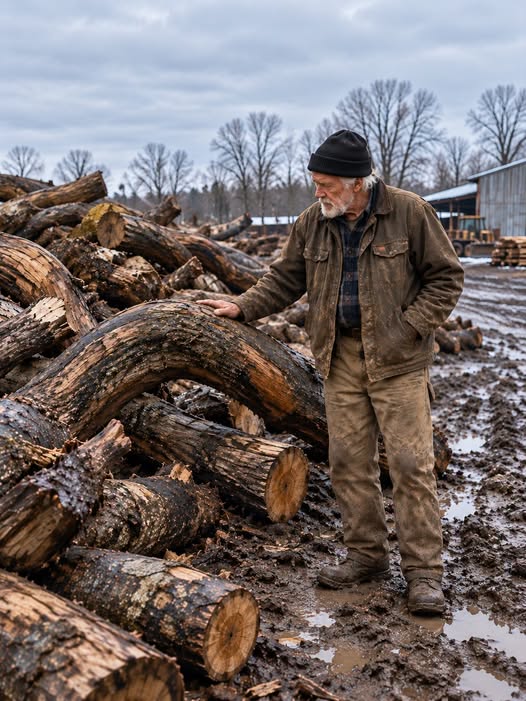
the sawmill threw 40 tons of crooked oak into the mud—then an old carpenter asked one question that saved a town’s forgotten history
Part 1
The sawmill dumped forty tons of crooked oak at the far end of the yard, where the ground stayed wet even after three dry days.
Most men who drove past that pile saw firewood.
I suppose I did too, the first time.
The logs lay tangled together like the bones of some enormous animal—bent trunks, sweeping limbs, twisted beams blackened by age, pieces too short or too crooked for the mill’s ordinary work. Mud had splashed halfway up them. Rainwater stood in the old mortise holes. One timber had sunk so deep into the muck that only its curved back showed.
Nothing about the pile said treasure.
Nothing about it even said lumber.
It looked like waste.
That was why I drove past.
My name is Jack Mercer. I was seventy-three years old that winter, and by then I’d spent almost my whole life on the same hundred and twelve acres outside Briar County, Missouri.
Folks still called me Farmer Jack even though I hadn’t planted corn on more than twenty acres in years.
My knees had gone bad.
My right shoulder complained whenever the weather changed.
And after my wife, Ruth, died, I stopped keeping cattle because there wasn’t much sense in wrestling frozen water troughs at five in the morning when nobody was waiting inside with coffee.
The farm had grown quiet.
Too quiet sometimes.
I still had six hens, an old red tractor, a woodshop that smelled like linseed oil and sawdust, and a porch chair worn smooth by forty years of use.
That was enough.
Or I told myself it was.
The sawmill sat eleven miles from my place on County Road 6, and I passed it twice a week on my way to town.
The first time I saw the oak pile, I barely slowed down.
The second time, I looked longer.
On the third morning, frost lay silver across the fence lines and smoke rose straight from the mill’s boiler stack.
I passed the pile.
Then I drove another quarter mile.
Something bothered me.
I couldn’t have told you what.
So I stopped my truck in the shoulder, sat there with the engine idling, and looked at my hands around the steering wheel.
My father’s hands had looked almost exactly like mine by the end.
Wide palms.
Knuckles swollen from a lifetime of hammers, chisels, axes, and winter cold.
There are days when a memory comes back as a picture.
Other days it comes back as a voice.
That morning I heard my father’s voice.
Don’t call a thing useless, Jackie, until you know what it was made to do.
I shut off the engine.
“All right, Dad,” I muttered.
I turned around.
The mill foreman probably thought I’d lost my mind.
I parked near the office and walked toward the pile in rubber boots, my coat buttoned to my chin.
Up close, the oak looked worse.
Mud covered everything.
Some pieces were cracked.
Others were gray from decades of weather.
But then I noticed something.
A square opening cut into the side of one timber.
A mortise.
Not a machine-cut slot either.
This one bore the faint irregular marks of an old chisel.
I crouched, wiped mud away with my glove, and found a peg hole.
Then another.
I moved to the next timber.
Same thing.
On a heavy curved brace, I found a shoulder cut where it had once met another beam.
That changed everything.
These weren’t trees the mill had rejected.
These timbers had already lived a life.
I stood in the mud for nearly twenty minutes.
A forklift operator finally yelled, “You looking for firewood, Jack?”
“Maybe.”
“You’ll want the straight stuff over by the fence.”
“I ain’t sure I do.”
He laughed.
“Suit yourself.”
I kept looking.
One piece curved almost ninety degrees over its length. The grain followed the bend so perfectly that I stopped breathing for a second.
I’d seen wood like that only a handful of times since I was young.
Compass timber.
Natural knees.
Crooked oak.
My father had taught me about it when I was nine years old.
He’d been a carpenter, timberman, and sometime boat repairer before farming finally took all his hours.
One summer afternoon he’d put a curved oak knee across two sawhorses behind his shop.
“Look at the grain.”
I hadn’t understood.
“It’s crooked.”
“Exactly.”
He ran his finger along the curve.
“Most men want trees straight. Sawmills want them straight. Builders want boards straight. But sometimes the strongest piece of wood is the one that grew crooked.”
He showed me how the grain followed the curve.
“If you cut this shape from a straight board, you’d cut across the grain. Weakens it. But a tree that grew this way?”
He slapped the timber.
“Nature already did the engineering.”
I remembered that lesson more than sixty years later, standing ankle-deep in mud behind Briar County Sawmill.
And suddenly the pile looked different.
Not valuable in the way people usually mean valuable.
I wasn’t seeing dollar signs.
I was seeing curved braces.
Corner knees.
Heavy frames.
Pieces almost impossible to replace with modern lumber.
I climbed carefully over one log and found another hand-cut mortise.
That was when the second thing my father taught me came back.
Never take what isn’t yours.
Not even if somebody else calls it trash.
Especially then.
I could have asked what they wanted for the pile.
Instead, I went inside.
The mill office smelled of coffee, printer paper, grease, and damp work jackets.
A man named Ray Hollis sat behind the desk. I’d known him casually for fifteen years.
“Jack.”
“Ray.”
“You finally come to sell us that walnut tree?”
“No.”
“Then what brings you in?”
I pointed through the window.
“That oak pile.”
Ray glanced outside.
“What about it?”
“Who owns it?”
He stared at me.
“The crooked stuff?”
“Yes.”
“Mill does.”
“You sure?”
That got a smile.
“Jack, I handle the tickets.”
“Where’d it come from?”
Ray leaned back.
“Why?”
“Because those ain’t ordinary cull logs.”
“They’re crooked oak.”
“They were part of a building.”
His expression changed slightly.
“How do you know?”
“Mortises. Peg holes. Tool marks.”
Ray looked toward the yard again.
Then he stood.
“Give me a minute.”
He disappeared into the records room.
I waited with my cap in my hands.
It’s strange how sometimes you know you’re about to hear something important before anybody says it.
A clock ticked above the doorway.
Forklifts beeped outside.
Somebody dropped a chain.
And all the while I kept thinking about those old joints.
Who cut them?
What had they held?
How long had they held it?
Ray came back with a work order.
“Here.”
I read the location.
Then I read it again.
“No.”
“Afraid so.”
The oak had come from the old Briar Grange Hall.
I sat down.
The Grange Hall had stood at Miller’s Crossroads since 1884.
My parents had danced there.
Ruth and I had attended harvest suppers there.
I had cast my first local election ballot there when the schoolhouse was being renovated.
We’d gathered there after three floods, two tornadoes, and more funerals than I could count.
When Ruth died, women from the church had used its kitchen to prepare food for the family.
The old hall had been failing for years.
The roof sagged.
One corner foundation had settled.
Rain came through the north wall.
There’d been arguments about saving it, but repair estimates climbed higher every year.
Finally, the county condemned it.
I’d known it was torn down.
What I hadn’t known was where the timber went.
“All of that came from the Grange?”
“Most of the heavy oak,” Ray said. “Demolition contractor brought it in. We took the usable straight sections. That’s what was left.”
“Going where?”
“Chipper eventually.”
I looked at him.
Ray raised both hands.
“Don’t look at me like that, Jack. We can’t mill those curves. Half of them would bind a blade. The others wouldn’t yield enough board footage to pay labor.”
“I know.”
“And we’ve got no market for antique joints and bent beams.”
“I know.”
“I’d sell you some cheap for firewood.”
“Don’t burn it.”
Ray laughed.
“I’m serious.”
That stopped him.
I folded the work order carefully.
“Give me twenty-four hours.”
“For what?”
“I don’t know yet.”
Ray shook his head.
But he said, “All right.”
Outside, I climbed into my truck.
For several minutes I didn’t start it.
The Grange Hall was gone.
That couldn’t be undone.
But somehow its bones were still here.
And I knew one man who might understand what that meant.
His name was Wendell Price.
Wendell was forty-four and one of the last true timber framers in our part of the state.
He built barns and pavilions using mortise-and-tenon joints, oak pegs, broad axes, chisels, and methods older than the country.
Two years earlier, Wendell and the Briar County Historical Society had started restoring a smaller nineteenth-century meeting pavilion beside the county fairgrounds.
The frame was sound except for six major braces and three curved knees.
They couldn’t find replacements.
I’d heard Wendell complain about it over coffee.
“You can buy straight oak all day long,” he’d said. “Try ordering a naturally curved brace with uninterrupted grain.”
He had searched mills in Missouri, Arkansas, and Kentucky.
Nothing.
The restoration had stalled.
I took out my phone.
Wendell answered on the fourth ring.
“Jack?”
“You still need curved oak?”
There was silence.
“What kind of curved oak?”
“The kind you’ve been whining about for two years.”
“I have not been whining.”
“You have absolutely been whining.”
“Where are you?”
“At the mill.”
Another silence.
Then his voice changed.
“Jack.”
“Forty tons.”
“What?”
“Maybe less usable. But it’s old growth. Hand-hewn in places. Mortises, peg holes, natural knees.”
“Where did it come from?”
“The Grange Hall.”
I heard a chair scrape.
“Don’t move.”
“I wasn’t planning to carry forty tons home in my coat pocket.”
“I’m coming.”
He hung up.
Twenty-five minutes later, Wendell’s truck flew into the mill lot.
He barely shut the door before hurrying toward the pile.
He climbed over those timbers like a boy opening Christmas presents.
“This one.”
He scraped mud off a brace.
“Jack, look at this.”
“I’ve been looking.”
“No, look at the sweep.”
He pulled a tape measure.
Then he stood and stared at me.
“This is almost exactly what we need.”
“Almost?”
“Within two inches.”
He moved to another.
Then another.
After ten minutes his face had gone pale.
“Do you understand what this is?”
“Yes.”
“No. I mean do you understand how impossible this is?”
I smiled.
“Wendell, I called you.”
He sat down on an oak beam, muddy and speechless.
For the first time since Ruth died, I felt something inside me wake up.
Not happiness exactly.
Purpose.
There is a difference.
And purpose, I’ve learned, can pull an old man out of a quiet house faster than happiness ever will.
Part 2
Finding the timber was the easy part.
Saving it took the rest of the winter.
The first problem was ownership.
Ray had told me the mill owned the pile, but there were contracts attached to the Grange demolition, county records, insurance paperwork, and salvage provisions nobody remembered clearly.
Wendell wanted to start hauling wood that afternoon.
I stopped him.
“Not yet.”
“Ray said the mill owns it.”
“Ray said he thinks the mill owns it.”
“Jack—”
“My father would climb out of his grave and hit me with a framing hammer if we hauled this stuff before we’re certain.”
Wendell looked at the pile.
Then at me.
“You really think your father is monitoring timber law from heaven?”
“If he is, I don’t intend to disappoint him.”
So we did it properly.
That mattered.
People sometimes think doing the right thing means waiting until somebody tries to stop you.
It doesn’t.
Sometimes it means slowing down when nobody would have noticed if you’d rushed.
The mill checked its contract.
The demolition company signed a release.
The county administrator confirmed that salvage rights had transferred with the debris.
The historical society voted unanimously to accept the timber if the mill donated it.
And Ray, once he understood what Wendell intended to do, surprised us.
He didn’t ask for a dollar.
“Take it.”
Wendell blinked.
“All of it?”
“Every crooked stick.”
Ray smiled.
“You’re saving me disposal costs.”
I held out my hand.
“Thank you.”
He shook it.
“Just don’t come back complaining when you realize it’s forty tons of mud.”
That part, unfortunately, was accurate.
We needed machinery.
Trucks.
Storage.
Volunteers.
A place to inspect and dry the timbers.
And money for fuel, straps, chains, replacement pegs, stone foundation work, roofing, and a dozen other things nobody had budgeted for.
Opal Renner handled that side.
Opal was sixty-eight, sharp-eyed, silver-haired, and capable of making grown men feel irresponsible merely by looking at them over her glasses.
Her great-grandfather had helped raise the original Grange Hall.
When I called and told her where its timbers were, she said nothing for so long I thought we’d lost the connection.
“Opal?”
“I’m here.”
“You all right?”
“No.”
Then her voice broke.
“I watched them tear that building down, Jack.”
“I know.”
“I stood across the road like a fool.”
“You weren’t a fool.”
“I should’ve done more.”
“What could you have done?”
“I don’t know.”
“Then stop punishing yourself for not knowing.”
She breathed slowly.
“What are you asking me?”
“Help us save what’s left.”
That was enough.
Within two days, Opal had called every member of the historical society, the county paper, three churches, the high school agriculture teacher, and apparently half the population of Briar County.
Saturday morning, I arrived at the mill expecting twelve volunteers.
There were forty-seven.
Pickup trucks lined the road.
Teenagers stood beside retired farmers.
Two young women from the community college brought work gloves and thermoses.
Pastor Reed showed up with six men from his church.
Ray provided the mill loader for the heaviest pieces.
Even the county commissioner came.
The same commissioner people had blamed for allowing the Grange Hall demolition.
That caused some tension.
I heard a man behind me mutter, “Got a lot of nerve showing his face.”
I turned.
“Leave it.”
“But Jack—”
“The building was unsafe.”
“He signed the condemnation.”
“And if the roof had fallen during a supper, you’d blame him for not signing it.”
The man said nothing.
“There doesn’t have to be a villain every time something hurts.”
That was a lesson I’d learned late.
Maybe too late.
Loss makes people angry.
Anger likes a face.
But sometimes a roof rots because roofs rot.
Sometimes towns don’t have enough money.
Sometimes people delay decisions because every option is painful.
The commissioner spent six hours in the mud with the rest of us.
That counted for something.
We began with the smallest timbers.
Small was a relative word.
Most weighed several hundred pounds.
The larger ones required the loader.
Each piece came out of the pile dripping black mud and old leaves.
We hosed them down on the concrete pad.
Every cleaned timber revealed something.
A Roman numeral carved near a joint.
An axe mark.
A wooden peg still lodged in a mortise.
A square nail.
Smoke-darkening from the Grange kitchen.
One brace had initials cut into it.
E.H. 1912.
Opal touched the letters with two fingers.
“My grandmother’s brother was Ezra Hale.”
“You think that’s him?” Wendell asked.
“I don’t know.”
Her eyes filled.
“But I’d like to.”
We photographed everything.
Wendell numbered each piece.
The teenagers recorded measurements.
I mostly walked around telling people not to smash their fingers.
At noon, someone passed out chili and cornbread.
We ate sitting on tailgates.
A sixteen-year-old boy named Caleb Hart sat beside me.
“Mr. Mercer?”
“Jack.”
“My grandpa says you know old tools.”
“Your grandpa exaggerates.”
Caleb held up an iron object he’d found near one timber.
“What’s this?”
I took it.
A rusted square nail.
“Cut nail.”
“Old?”
“Probably.”
He turned it over.
“People really built whole buildings without screws?”
“People built cathedrals without cordless drills.”
He grinned.
“I mean, yeah, but—”
“Wendell can show you more than I can.”
“Mr. Price said I could help cut pegs.”
“Then pay attention.”
“I will.”
“That wasn’t advice.”
The boy laughed.
Something about that laugh stayed with me.
After Ruth died, I’d started believing the world behind me mattered more than the world ahead.
Old people can fall into that without noticing.
You wake up one morning and every story begins with used to.
We used to bale hay there.
We used to dance there.
We used to have Christmas dinner in that room.
We used to know everybody on this road.
You don’t mean to stop looking forward.
You just slowly run out of reasons.
But watching Caleb ask questions about cut nails and oak pegs reminded me that the past isn’t useful only because old people remember it.
It’s useful when somebody young decides to carry part of it forward.
By late afternoon, the barn we’d borrowed from Opal’s cousin held thirty-two cleaned timbers.
We had perhaps half the pile.
The temperature dropped.
Mud stiffened under our boots.
Wendell wanted to continue after dark.
I told him no.
“We’ve got lights.”
“We’ve got exhausted volunteers.”
“We’ve got weather coming tomorrow.”
“Exactly.”
A winter storm had moved into the forecast.
Rain first.
Then freezing rain.
Then snow.
If the mill yard froze solid, the remaining timbers could stay there for days.
Wendell looked toward the sky.
“We should finish.”
I understood him.
He had waited two years for wood like this.
Now that it was within reach, leaving any behind felt dangerous.
But older men learn something younger men don’t always like hearing.
Tired people make stupid mistakes.
“Nobody loses a hand saving old wood,” I said.
“Jack.”
“We stop.”
He clenched his jaw.
Then nodded.
“Fine.”
The storm arrived faster than predicted.
At three the next morning, sleet began tapping against my bedroom window.
I woke in the dark.
For a while I listened.
The farmhouse made its old winter noises—rafters shifting, furnace clicking, wind nudging the porch door.
Ruth had loved storms.
She’d make coffee and stand at the kitchen window.
“Weather makes a person remember he’s not in charge,” she’d say.
I got up.
Her blue mug still hung on a hook beside the sink.
Six years, and I still hadn’t moved it.
I made coffee.
By dawn, ice covered the pasture.
The county roads became dangerous.
We couldn’t haul timber.
For two days, freezing rain fell.
On the third, six inches of snow covered the ice.
The mill shut down.
The oak pile disappeared beneath white drifts.
I sat at home frustrated with myself for being frustrated.
Nothing urgent was happening.
The wood had survived a century.
It could survive another week.
But I couldn’t shake the feeling that time mattered.
Maybe because old men always know time matters.
On the fourth evening, Wendell called.
“Bad news.”
“What?”
“Ray says the chipper contractor is coming next Wednesday.”
“Then tell him to postpone.”
“He tried. Contractor’s booked solid after that.”
“How much timber is still there?”
“Maybe fifteen tons.”
“Usable?”
“Some of the best knees are on the bottom.”
I looked out at the snow.
“Road supposed to clear Monday.”
“Maybe.”
“Then Monday we work.”
“Jack, it’s going to be twelve degrees.”
“I’ve been cold before.”
“You’re seventy-three.”
“I was seventy-three Saturday.”
“That’s not the point.”
“It is to me.”
Monday morning dawned clear and viciously cold.
The kind of cold that tightened your nostrils when you breathed.
Only seventeen volunteers showed up.
I was proud of every one.
Ray used the loader to break frozen timbers out of the pile.
The mud had turned to concrete.
Chains stiffened.
Gloves froze.
We worked slowly.
At ten-thirty, Caleb slipped while guiding a brace.
I saw him fall.
The timber swung.
For half a second, every old fear in me came alive.
“Drop it!”
Men released the chain.
The brace hit the ground six inches from Caleb’s boot.
Nobody spoke.
I walked over.
“You hurt?”
He shook his head.
“Go warm up.”
“I’m fine.”
“That wasn’t a suggestion.”
His face reddened.
“I said I’m fine.”
“And I said go.”
He threw down his gloves and stalked toward the heated office.
Wendell came beside me.
“You embarrassed him.”
“Better embarrassed than crushed.”
“He’s sixteen.”
“Exactly.”
Twenty minutes later, I went inside.
Caleb sat alone with a paper cup.
He wouldn’t look at me.
I sat across from him.
“When I was seventeen, my father knocked me flat.”
That got his attention.
“What?”
“I was lifting a timber wrong. Told him I knew what I was doing.”
“What happened?”
“He slapped me so hard I landed in sawdust.”
Caleb tried not to smile.
“Different times.”
“Very.”
“You gonna hit me?”
“At my age? I’d break a wrist.”
He laughed.
I leaned forward.
“You didn’t do anything shameful out there.”
“I slipped.”
“Everybody slips.”
“I nearly ruined the job.”
“The job is wood. You’re a person. Get the order right.”
He looked down.
“My dad says I quit things too easy.”
“Your dad here?”
“No.”
“Then don’t work today to prove something to him.”
That quieted him.
“Work because you want to learn. And if you’re tired, say you’re tired.”
After a while, he nodded.
We went back outside together.
By sunset, we’d saved nearly everything worth saving.
The mill yard looked strange without the pile.
For weeks, forty tons of twisted oak had occupied that patch of mud.
Now there was only churned ground, wood chips, snow, and tire tracks.
Ray stood beside me.
“You happy?”
“No.”
“No?”
“Ask me when that pavilion is standing.”
He smiled.
“You carpenters are hard people to satisfy.”
“I’m a farmer.”
“Could’ve fooled me.”
I looked toward the last truck pulling away.
Maybe he was right.
Maybe the carpenter in me had only been sleeping.
Part 3
Saving old timber and using old timber are two different things.
By March, the barn smelled of drying oak.
Wendell had laid the braces on cribbing with air space between them. He tested moisture, checked cracks, examined old joints, and tapped suspicious sections with a mallet.
Some pieces were too damaged.
Powderpost beetles had eaten three.
One knee split near the heel.
Another carried rot deep inside a joint.
Wendell marked those with red chalk.
“Firewood?” Caleb asked.
“Not necessarily.”
“What can you do with them?”
“Smaller pieces. Benches. Display sections.”
Caleb nodded as though every scrap had suddenly become precious.
I liked that.
But Wendell also taught him the opposite lesson.
“Don’t worship old wood just because it’s old.”
He struck a rotten beam with his mallet.
A chunk fell away.
“This can’t safely hold a roof.”
Caleb looked disappointed.
“But it came from the Grange.”
“And?”
“And it’s historic.”
“History doesn’t change physics.”
That made me smile.
Preservation can become foolishness if you forget why buildings exist.
A pavilion had to hold people safely.
Memory didn’t excuse bad structure.
All spring, we worked.
We weren’t rebuilding the Grange Hall.
That mattered.
The old hall was gone.
Pretending otherwise would have cheapened both the loss and the new project.
Instead, Wendell’s pavilion had its own nineteenth-century frame salvaged from another property.
The Grange oak would supply the missing curved braces and knees.
Old wood helping old wood stand again.
There was poetry in that, though I rarely said words like poetry aloud.
We laid every candidate brace full-scale on the barn floor.
Wendell used chalk lines to compare natural curves against the pavilion drawings.
Some fit almost perfectly.
Others required trimming.
Whenever possible, he preserved the original mortises.
“Look at this,” he said one afternoon.
He placed an old brace over the plan.
The curve matched the needed geometry within an inch.
Caleb whistled.
“How?”
“The tree grew that way.”
“No. I mean how did the original builders know?”
“They looked.”
“That’s it?”
Wendell shrugged.
“They understood trees.”
That conversation carried me back seventy years.
My father had understood trees.
Not scientifically.
He couldn’t have explained cellulose structures or fiber angles.
But he knew how a red oak split.
He knew which side of a leaning tree held tension.
He knew which limb might yield a natural brace.
He could walk through a woods and see future rafters, handles, posts, pegs, bowls, and knees.
I’d spent half my life trying to become modern enough not to need that knowledge.
Now we were struggling to recover it.
One Thursday, I brought my father’s old framing chisels.
They had sat wrapped in an oily cloth for decades.
Wendell picked up the two-inch slick.
“You’ve had this?”
“Since 1979.”
“And you never told me?”
“You never asked.”
He examined the handle.
“Osage orange?”
“Made by my father.”
“Jack, this thing belongs in a museum.”
“No.”
He looked at me.
“It belongs in a hand.”
I gave it to Caleb.
The boy froze.
“Me?”
“For ten minutes.”
He held it as carefully as a newborn.
“Don’t drop it.”
“I won’t.”
“Don’t hit your thumb.”
“I won’t.”
“Don’t pry with it.”
“I won’t.”
“And sharpen it when you’re done.”
He frowned.
“I don’t know how.”
“Then today you learn.”
I showed him at a bench near the barn door.
Oilstone.
Angle.
Pressure.
Patience.
His first strokes were terrible.
He lifted the bevel.
Rolled the edge.
Pushed too hard.
I corrected him.
Again.
Again.
By the end, the chisel could shave hair.
He stared at the edge.
“I did that?”
“Mostly the stone.”
He grinned.
Around that time, people started visiting the barn just to see the timbers.
Opal created a photo display showing the Grange Hall through the decades.
Black-and-white photographs.
Harvest suppers.
War bond meetings.
Wedding dances.
Children in Christmas pageants.
Farm families standing beside Model T Fords.
The final photograph showed the hall leaning behind orange demolition fencing.
Visitors became quiet at that one.
Some cried.
Others told stories.
A woman named Mrs. Darlene Pike pointed at a photograph from 1957.
“That’s me.”
She was ninety-one.
Nobody believed her until she tapped a girl in a white dress near the edge.
“My sister made that dress.”
Opal pulled up a chair.
Mrs. Pike talked for forty minutes.
She told us where the piano stood.
Where young couples sneaked outside.
Where the stove smoked during winter meetings.
Where her father sat every Thursday.
Caleb recorded her on his phone.
That night, I understood something.
We thought we were saving timber.
But the timber was saving stories.
People need an object sometimes.
A piece of wood.
A building.
A photograph.
Something physical to unlock what memory has stored.
Without those things, stories disappear quietly.
Nobody decides to destroy them.
They simply stop being told.
Not everything went smoothly.
By April, money became a problem.
The foundation repair had cost more than expected.
Insurance required additional engineering.
Roofing prices increased.
The historical society account dropped dangerously low.
At a meeting in the church basement, Opal put the numbers on a folding table.
“We are eighteen thousand four hundred dollars short.”
Nobody spoke.
Wendell leaned back.
“Can we delay roofing?”
“No.”
“Reduce the deck?”
“Possibly.”
“Volunteer labor?”
“We’re already using volunteer labor.”
A board member named Earl Simmons cleared his throat.
“We need to be realistic.”
I knew that phrase.
Realistic is often what people say just before surrendering.
But Earl wasn’t wrong.
“We’ve saved the braces,” he continued. “They can be stored. Maybe the pavilion waits another year.”
Opal looked sick.
Another year could mean never.
Momentum matters in community projects.
Volunteers move.
People get sick.
Committees change.
Money gets redirected.
Wendell rubbed his forehead.
“We’ve already cut joinery.”
“I know.”
Nobody had eighteen thousand dollars.
I certainly didn’t.
My farm had value on paper, but land doesn’t pay bills unless you sell it.
I drove home troubled.
That evening, I sat alone at Ruth’s kitchen table.
Her chair remained on the other side.
I’d considered moving it after she died.
Never did.
A stack of unpaid project invoices sat in front of me because Opal had asked if I could spot any savings.
I found none.
Outside, rain tapped the windows.
The farmhouse clock ticked.
I could almost hear Ruth.
You’re staring, Jack.
“I’m thinking.”
Staring with more wrinkles.
I smiled despite myself.
Ruth had been better with money.
Better with people too.
I turned the invoices over.
Then I noticed a small wooden box on the shelf near the telephone.
Inside were papers from the sale of our cattle herd after Ruth died.
Most of the money had gone into savings.
Some I’d set aside for replacing the barn roof.
The roof still had another five years in it.
Maybe seven if I patched the west side.
I went to the bank the next morning.
Opal nearly killed me when she found out.
“You did what?”
“Donated six thousand.”
“Jack Mercer.”
“Don’t use my full name like I’m ten.”
“You need that money.”
“For what?”
“Your farm.”
“The farm is fine.”
“Your retirement.”
“I’ve been retired since nobody wants to hire me.”
“I’m serious.”
“So am I.”
She crossed her arms.
“You are not paying for this pavilion.”
“I paid for part of it.”
“Why?”
That question bothered me.
Not because I didn’t know.
Because I did.
“I spent six years after Ruth died trying not to need anything,” I said.
Opal’s expression softened.
I kept going.
“I stopped cattle because it was easier. Stopped church suppers because sitting alone felt awkward. Stopped building things because nobody needed another table. I told myself I was simplifying.”
“Jack.”
“Maybe I was disappearing.”
She said nothing.
“I don’t want to disappear yet.”
Opal looked down.
When she raised her eyes, they were wet.
“You stubborn old fool.”
“That’s more like it.”
My six thousand started something.
Pastor Reed mentioned the project Sunday.
A retired teacher donated five hundred.
The mill gave two thousand.
The county commissioner found a preservation grant matching local donations up to five thousand.
Caleb and his classmates held a Saturday pancake breakfast that raised twelve hundred and eighty-six dollars.
Earl Simmons, the man who’d suggested waiting, quietly wrote the final check needed to close the gap.
No speeches.
No miracle millionaire.
Just people.
Ten dollars.
Fifty.
Five hundred.
Labor.
Food.
Fuel.
A borrowed trailer.
A box of nails.
That is how rural communities have always built things.
Not because everybody has plenty.
Because enough people decide a thing matters.
By May, the foundation was ready.
The pavilion raising was scheduled for the first Saturday in June.
I hadn’t slept well for a week.
Wendell caught me rechecking drawings.
“Jack.”
“What?”
“Go home.”
“I’m checking brace four.”
“You checked it yesterday.”
“I could’ve been wrong yesterday.”
“You weren’t.”
“That’s a dangerous level of confidence.”
He took the drawing from me.
“Go home.”
I looked around the barn.
The finished frame lay organized in sections.
Posts.
Girts.
Tie beams.
Braces.
Old oak cleaned and fitted.
New pegs stacked in a crate.
My father’s chisel rested on the bench.
“Think it’ll stand?”
Wendell stared at me.
“Don’t insult me.”
I laughed.
But beneath the joke lived a deeper fear.
We had spent months rescuing the pieces of something lost.
Soon we’d find out whether we could actually make them carry weight again.
Part 4
The morning of the raising began before sunrise.
By five-thirty, trucks filled the grass beside the fairgrounds.
Mist hung low over the field.
The pavilion foundation waited in the gray light—stone piers, heavy sills, and neatly stacked frame sections.
People moved quietly at first.
Coffee steamed from paper cups.
Leather tool belts creaked.
Chains clinked.
Someone brought biscuits.
Someone else brought a first-aid kit large enough for a logging camp.
Wendell gathered the crew.
He had planned every lift.
“No heroics,” he said. “If something binds, stop. If you can’t see your hands, stop. If Jack tells you a story, ignore him and keep working.”
People laughed.
“I’ll remember that,” I said.
The first bent went up at seven-sixteen.
A bent is a complete cross-section of a timber frame—posts and connecting beam assembled flat, then raised upright.
Thirty people took positions along ropes and poles.
Wendell called.
“Ready?”
Voices answered.
“Lift!”
The frame rose slowly.
Boots dug into grass.
Ropes tightened.
Oak creaked.
For one awful second it seemed too heavy.
Then the geometry changed and the bent came upward.
Forty degrees.
Sixty.
Eighty.
“Easy!”
It settled upright.
People cheered.
I didn’t.
Not yet.
One bent wasn’t a building.
We braced it temporarily.
Then raised the second.
By midmorning, sweat soaked shirts despite the cool air.
Families watched behind a safety line.
Children sat on blankets.
Mrs. Pike, ninety-one years old, had been brought in a wheelchair.
Opal stayed beside her.
The third bent carried the first pair of reclaimed Grange braces.
When those curved pieces moved off the ground, the crowd grew silent.
Their surfaces still bore old axe marks.
Old peg holes remained visible beside the new joinery.
We had intentionally left them.
Not weakness.
Evidence.
Proof that the timber had lived before.
Caleb stood beside me holding a rope.
“Jack.”
“Yeah?”
“Look.”
He pointed.
On one brace, sunlight caught the carved initials.
E.H. 1912.
Opal saw them too.
She pressed a hand to her mouth.
The brace rose.
Higher.
Higher.
Until it stood above us once again.
Not in the building where it began.
But holding a roof line in the same county, beneath the same sky.
That was the moment I finally cried.
I turned away.
Old men develop techniques for crying unnoticed.
You cough.
Pretend there’s dust.
Study something far away.
Unfortunately, Caleb noticed.
“You okay?”
“Dust.”
“There isn’t any dust.”
“Then pollen.”
“It’s been raining.”
“Boy, do you want to keep holding that rope?”
He grinned.
“Yes, sir.”
At noon, clouds gathered.
The forecast had promised clear weather.
Forecasts lie.
Wendell looked west.
“We’ve got maybe two hours.”
We still needed the tie beams.
Without them, the structure couldn’t be left unsupported in wind.
The crew accelerated.
That worried me.
“Hurry slow!” I shouted.
Wendell nodded.
Rain started at one-twenty.
Light at first.
Then heavier.
The field turned slick.
We got the first tie beam seated.
Then the second.
The third jammed.
One tenon refused to enter its mortise.
Men pushed.
Nothing.
Wendell climbed the scaffold.
“Stop.”
He examined the joint.
“Swelling.”
The old oak had taken moisture.
“Can you shave it?” I asked.
“Maybe.”
Thunder rolled.
The wind increased.
Temporary braces groaned.
A younger volunteer looked nervous.
“We need to get down.”
He was right.
Wendell stared at the joint.
Months of work.
One stubborn tenon.
One approaching storm.
“We leave it,” I said.
“We can’t.”
“We can.”
“If that bent racks in the wind—”
“We brace it lower and leave.”
“Jack—”
“Wood ain’t worth a man.”
Those words again.
The order.
People first.
Project second.
Memory third.
Always.
Wendell looked toward the lightning.
Then made the call.
“Everybody down!”
We added temporary diagonal braces and evacuated the structure.
Ten minutes later, the storm hit hard.
Rain moved sideways.
People sheltered in vehicles and the fair barn.
I stood inside the barn doors watching the unfinished frame.
Wind pushed against it.
The old braces held.
But the unsupported top moved.
An inch maybe.
Then back.
Opal came beside me.
“Will it survive?”
“Ask Wendell.”
“I’m asking you.”
“I don’t know.”
She looked at the frame.
“If it falls—”
“We rebuild.”
“With what money?”
“Don’t know.”
“With what energy?”
“Don’t know.”
“With what time, Jack?”
I turned to her.
That was the real question.
Time.
At twenty, you think time is a road.
At seventy-three, it’s weather.
You work with whatever remains.
“We rebuild slower,” I said.
She shook her head.
“You make everything sound simple.”
“No. I make everything sound possible. Different thing.”
The storm lasted forty-three minutes.
It felt like three hours.
When rain eased, Wendell went outside first.
He examined every temporary brace.
Every joint.
Every base.
Finally he looked toward us and raised both hands.
It held.
The crowd cheered from the barn.
We could have stopped.
Instead, the clouds broke.
Sun appeared.
People came back out.
Shoes soaked.
Shirts muddy.
Nobody wanted to leave.
Wendell climbed the scaffold again.
Caleb carried up my father’s slick chisel.
I watched him pare the swollen tenon.
Thin curls of oak fell through the wet air.
Tap.
Check.
Tap.
Check.
No power saw.
No grinder.
Just a sharp edge and patience.
My father would have approved.
The beam seated at four-oh-eight.
A new oak peg went through.
Then another.
By sunset, the main frame stood.
Curved Grange braces locked its corners.
People gathered underneath even though no roof covered them yet.
They touched the wood.
Told stories.
Pointed at old mortises.
Mrs. Pike asked to be wheeled inside.
When Opal brought her beneath the frame, Mrs. Pike looked upward for a long time.
“I know that one,” she whispered.
Opal bent closer.
“What?”
“That beam.”
“You recognize it?”
Mrs. Pike nodded.
“Kitchen side.”
Nobody could verify that.
Maybe she was right.
Maybe memory was helping.
It didn’t matter.
She reached up, unable to touch it.
Caleb quietly brought a small salvaged offcut.
Mrs. Pike placed both palms against the wood.
Then she began to cry.
“My father hung lanterns from these.”
No one spoke.
Later, after almost everyone went home, I remained.
The new frame stood dark against a purple evening sky.
Wendell sat beside me on a stack of planks.
“We did it.”
“Roof ain’t on.”
“You’re impossible.”
“I’m accurate.”
He handed me a cup of coffee.
We sat quietly.
After a while he said, “Why didn’t you become a carpenter?”
I thought about that.
“I did.”
“You farmed.”
“Also true.”
“No, I mean professionally.”
“My father wanted me to.”
“What happened?”
“Land.”
Wendell waited.
“My grandfather got sick. Farm needed somebody. Dad was getting older. I stayed.”
“You regret it?”
“No.”
That answer surprised even me.
I had wondered before.
What if?
Every life has those roads.
But regret wasn’t the right word.
“I loved farming,” I said. “Loved Ruth. Loved raising my boys there.”
“You don’t talk about your sons much.”
That was another subject.
My oldest, Daniel, lived in Colorado.
My younger son, Mark, lived outside St. Louis.
Good men.
Busy men.
We weren’t estranged.
That would have been simpler.
We were merely distant.
Christmas calls.
Birthday texts.
Occasional visits.
No betrayal.
No great family wound.
Just miles and schedules and the gradual thinning of daily life.
“They’ve got their lives.”
Wendell nodded.
“That bother you?”
“Some days.”
“You ever tell them?”
“No.”
“Why?”
I stared at him.
“You forty-four-year-olds are getting awfully personal.”
He smiled.
“Maybe old wood makes people sentimental.”
That night I went home and called Daniel.
Not because of any emergency.
Not because I needed help.
Just because I wanted to hear my son’s voice.
He answered.
“Dad?”
“Yeah.”
“Everything okay?”
That question says a lot about how rarely old fathers call without a reason.
“Everything’s fine.”
A pause.
“Then what’s up?”
“We raised the pavilion frame today.”
“The wood from the Grange?”
“You remembered.”
“Of course.”
I smiled.
We talked for thirty-eight minutes.
Before hanging up, Daniel said, “Send pictures.”
“I don’t know how.”
“Dad.”
“I can text. Pictures are complicated.”
“They are not complicated.”
“They involve buttons.”
“Every function involves buttons.”
“That’s the problem.”
He laughed.
I hadn’t heard him laugh in months.
After we hung up, I sat alone in my kitchen.
But the house felt different.
Not less empty.
Emptiness is physical.
A chair either has somebody in it or it doesn’t.
But loneliness can shift even when the chair stays empty.
I looked at Ruth’s blue mug.
“We’re doing all right,” I told her.
For once, I believed it.
Part 5
The pavilion opened the following spring.
It took that long because good work almost always takes longer than people promise.
The roof went on.
Then the floor.
Then railings.
Electrical service.
Drainage.
Stone paths.
A small kitchen room.
Interpretive signs telling the history of the original pavilion and the salvaged Grange Hall timbers.
Opal insisted every major brace be documented.
Not polished into perfection.
Documented.
Old tool marks remained.
Unused mortises remained visible.
The E.H. initials stayed.
So did scorch marks on one beam.
Wendell said, “A restoration shouldn’t lie.”
I agreed.
New work should look like good new work.
Old work should be allowed to look old.
The dedication took place on a Saturday in May.
Nearly four hundred people came.
More than had attended most meetings at the original Grange Hall in its final years.
That made me laugh.
Humans are like that.
We don’t always understand what something means until we nearly lose it.
The county band played.
Church women served pies.
Children ran across the grass.
The mill workers came as a group.
Ray stood under one curved brace for ten minutes before finding me.
“You know what’s funny?”
“What?”
“I remember throwing this stuff in the mud.”
“You personally?”
“Loader operator did it. I signed the ticket.”
He looked overhead.
“Never occurred to me it could be useful.”
“Why would it?”
“You knew.”
“My father knew.”
Ray nodded.
“Still bothers me.”
“What?”
“That we almost chipped it.”
“Don’t.”
“Forty tons, Jack.”
“You run a sawmill.”
“So?”
“You need straight boards. That isn’t a moral failure.”
He looked unconvinced.
I put a hand on his shoulder.
“The whole point isn’t that you should’ve seen what I saw.”
“Then what is it?”
“That people see different things.”
He looked up.
“A mill sees waste. A timber framer sees braces. A historian sees a building. Mrs. Pike sees her father hanging lanterns.”
“And you?”
I thought about Ruth.
My father.
Caleb.
My sons.
The quiet farmhouse.
“I see time.”
Ray studied me.
“That’s an old man’s answer.”
“I worked hard for it.”
At eleven, Opal stepped to the microphone.
She told the story of the project.
Not dramatically.
Opal didn’t need drama.
She described the Grange Hall.
Its condemnation.
The demolition.
The salvaged timber.
The mill pile.
The phone calls.
The volunteers.
The storm.
The fundraising.
Then she called Wendell forward.
He refused at first.
The crowd insisted.
He said perhaps seventy words.
Most were about the volunteers.
Then Opal called Caleb.
He was seventeen now.
He wore a clean shirt and looked terrified.
“I didn’t prepare anything.”
“Good,” Opal said. “Prepared teenagers are suspicious.”
People laughed.
Caleb stepped up.
He held my father’s framing chisel.
I hadn’t known he’d brought it.
“This tool belongs to Jack Mercer,” he said.
I sat straighter.
“His father made the handle. Jack taught me how to sharpen it.”
He swallowed.
“I thought this project was about old people saving old stuff.”
The crowd laughed again.
“So did I, kind of. I didn’t really understand why anybody cared about some bent wood.”
He looked up at the braces.
“But Mr. Price taught me why the curves are strong. Jack taught me why you ask before taking something, even if somebody calls it trash. Mrs. Renner taught me that buildings can carry people’s stories.”
His voice steadied.
“And I guess I learned old doesn’t mean finished.”
That got quiet.
Caleb looked at me.
“Sometimes it just means somebody has to figure out what it’s still good for.”
I looked down quickly.
Dust again.
Terrible problem that spring.
Opal came back to the microphone.
“Jack?”
“No.”
“Jack Mercer.”
“No.”
People began clapping.
Traitors.
I walked forward.
Opal handed me the microphone.
I hated microphones.
They make ordinary men feel obligated to become philosophers.
I looked at the crowd.
Families.
Old farmers.
Children.
Mill workers.
People who had argued over the Grange Hall.
People who had mourned it.
People who barely remembered it.
Daniel stood near the back.
I hadn’t known he was coming.
Beside him was Mark.
Both my sons.
For a moment, I forgot the microphone.
Daniel raised one hand.
I swallowed.
Then I said the only thing worth saying.
“My father taught me two rules.”
The crowd settled.
“First, don’t take what isn’t yours.”
I looked at the pavilion.
“Second, don’t call something worthless until you know what it is.”
I pointed toward the curved braces overhead.
“That oak was worthless to a sawmill.”
Ray laughed.
I smiled.
“And the sawmill wasn’t wrong. Not for what they do. You can’t make efficient straight boards out of crooked timber.”
I looked at Wendell.
“But Wendell couldn’t build this frame without curves.”
Then at Opal.
“And Opal couldn’t give this county back a piece of its history without old wood.”
Then Caleb.
“And apparently Caleb couldn’t learn to sharpen a chisel without nearly ruining mine first.”
The crowd laughed.
Caleb turned red.
I continued.
“Sometimes usefulness depends on who’s looking.”
That was the lesson.
Not that everything discarded is secretly valuable.
Some things truly are worn out.
Some buildings cannot be saved.
Some tools break.
Some wood rots.
People grow old.
Bodies fail.
Time takes what it takes.
But worth and usefulness are not always the same thing.
A person can stop producing and still matter.
A building can stop serving its original purpose and still teach.
A scarred beam can carry a new roof.
An old man can still make a phone call.
A teenager can carry knowledge forward.
I looked toward my sons.
“And sometimes something you thought was finished is only waiting for the right question.”
I lowered the microphone.
Opal whispered, “What question?”
I smiled.
“Who owns it?”
People laughed.
I gave the microphone back.
After the ceremony, Daniel hugged me.
We aren’t a hugging family.
That made it awkward.
Which made it better.
Mark joined us.
“You’re famous now,” he said.
“I’d rather not be.”
“Mom would’ve loved this.”
That nearly undid me.
“Yes.”
Daniel looked around the pavilion.
“You really found all these braces in a trash pile?”
“Mud pile.”
“Difference?”
“About four months of labor.”
He smiled.
We sat together during lunch.
They asked about the farm.
Not casually.
Really asked.
Daniel wanted to bring his children for a week in summer.
Mark offered to help repair the barn roof.
I didn’t pretend not to care.
That’s another foolish habit men my age develop.
We act like wanting our children near us is weakness.
It isn’t.
“I’d like that,” I said.
So they came.
That summer my grandchildren slept in the same upstairs rooms their fathers had used.
The farmhouse became noisy again.
Shoes in the hallway.
Milk left out.
Cabinet doors open.
I complained constantly.
I loved every minute.
Caleb started working summers with Wendell.
By eighteen, he could cut a respectable mortise.
By nineteen, he could lay out simple frames.
When he graduated high school, he gave me back my father’s chisel.
“Keep it,” I said.
His face changed.
“No.”
“Why?”
“It’s yours.”
“Was my father’s.”
“Exactly.”
“He gave it to me so I’d use it.”
Caleb stared at the tool.
“You’re giving this to me?”
“I’m lending it.”
“For how long?”
“Until I ask for it back.”
“When will that be?”
“Probably never.”
He smiled.
“Then that’s giving.”
“Don’t argue with old people. We have more practice.”
He wrapped the chisel carefully.
“Jack?”
“Yeah?”
“I’ll take care of it.”
“I know.”
That mattered more than he understood.
The pavilion took on a life almost immediately.
A wedding happened there in June.
Church supper in July.
The county band performed on Independence Day.
Farmers held a seed exchange beneath the roof.
Schoolchildren came for history lessons.
A widow celebrated her eightieth birthday there surrounded by five generations.
One rainy afternoon, I found a young couple sitting under the braces with a baby stroller between them.
They had no idea who I was.
Good.
Buildings shouldn’t need their builders standing nearby explaining why they matter.
They should simply become useful.
Opal eventually had a small plaque installed near the entrance.
Not my idea.
I argued against it.
She ignored me.
The plaque listed the historical society, Wendell’s crew, the mill, county volunteers, donors, and dozens of names.
Mine appeared somewhere in the middle.
That was where it belonged.
I kept one piece of the Grange oak.
A twelve-inch offcut with a single peg hole through one end.
It sits on my fireplace mantel beside a photograph of Ruth.
People ask why I didn’t make something from it.
A bowl.
A box.
A picture frame.
I don’t want to.
Some things don’t need improvement.
That piece spent more than a century holding something together.
It earned retirement.
On winter evenings, I sometimes take it down.
The oak is dark.
Heavy.
One side still shows an axe mark from a man whose name nobody knows.
I fit my thumb into the old peg hole and think about hands.
The man who cut the tree.
The carpenter who hewed it.
The farmer who helped raise the Grange Hall.
The child who touched it during a Christmas pageant.
The demolition worker who loaded it.
The mill operator who dumped it.
Mine, wiping mud off.
Wendell’s, measuring the curve.
Caleb’s, guiding the chisel.
None of us owned the whole story.
We only carried it for a while.
That may be the truest definition of stewardship I’ve ever found.
The farm is quieter again now.
Grandchildren go home.
Summer ends.
Leaves fall.
Winter comes.
That is how life works.
But quiet doesn’t frighten me the way it once did.
Daniel calls most Sundays.
Mark visits when he can.
I still drink coffee alone many mornings, but alone and abandoned aren’t the same thing.
I learned that too.
Some mornings I drive past the mill.
The mud lot where the oak pile sat now holds pallets.
Nobody would know forty tons of history once lay there waiting for a chipper.
Ray usually waves if he sees my truck.
Sometimes I stop.
We talk weather.
Lumber prices.
His grandchildren.
Nothing important.
Everything important.
And every few weeks, I take County Road 14 past the fairgrounds.
I don’t always stop at the pavilion.
Usually I slow down.
That’s enough.
From the road, you can see the curved braces beneath the roof.
The crooked pieces.
The ones the mill couldn’t use.
The ones no supplier could manufacture.
The ones nobody wanted when they lay covered in mud.
They’re carrying the corners now.
That’s what gets me.
Not the straight beams.
Not the perfect boards.
The crooked pieces are doing the work only crooked pieces could do.
My father would have liked that.
He might have stood underneath them with his hands in his pockets and pretended not to be impressed.
Then he’d probably find a joint he thought Wendell cut wrong.
Men like him considered praise dangerous in large doses.
But eventually, maybe on the drive home, he would have said something quiet.
Good timber.
Coming from him, that would have meant everything.
I think about one particular morning often.
Cold.
Muddy.
Ordinary.
I could have driven home.
Nobody would have blamed me.
The mill would have chipped the oak.
The pavilion project might have stayed stalled.
Caleb might never have held my father’s chisel.
Mrs. Pike might never have touched a piece of her childhood again.
My sons might not have come to that dedication.
Nothing terrible would have happened.
That’s what troubles me.
We often imagine the important moments in life arrive loudly.
A doctor calls.
A storm comes.
A marriage begins.
A person dies.
But some turning points look like nothing.
A pile beside a road.
A phone number.
A conversation.
A question.
You can miss them without ever knowing what was lost.
I don’t tell this story because I think I did anything heroic.
I didn’t.
I saw something my father had taught me to recognize.
Then I asked permission.
That’s all.
Other people did the hard work.
Wendell understood the structure.
Opal organized the county.
Ray released the timber.
Volunteers hauled it.
Donors paid bills.
Caleb learned.
The community raised the frame.
Everyone carried a piece.
Maybe that’s why the pavilion feels right.
It wasn’t saved by one rich man writing a check.
It wasn’t saved by government alone.
It wasn’t saved by one craftsman.
It wasn’t even saved by nostalgia.
It was saved because enough people looked at what had been discarded and decided to ask one more question before letting it disappear.
That idea has stayed with me.
We throw away more than wood.
Old tools.
Old buildings.
Old skills.
Old stories.
Sometimes old people.
We live in a world that loves straight boards.
Fast workers.
New machines.
Perfect surfaces.
Anything efficient.
Anything easy to measure.
There is nothing wrong with efficiency.
Sawmills need straight logs.
Businesses need productivity.
Farmers need equipment that runs.
But life isn’t a sawmill.
And human worth isn’t board footage.
Some of the strongest things among us grew crooked.
They bent under weather.
Adjusted around damage.
Carried weight.
Survived storms.
Their scars follow the grain.
You cannot manufacture that afterward.
You can only recognize it.
That is what my father tried to teach me when I was nine years old.
It took me sixty-four years to understand he wasn’t only talking about trees.
So whenever I pass that pavilion and see those old oak curves holding the roof, I think of the question that started everything.
Not, “What’s it worth?”
Not, “Can I have it?”
Not even, “What can I make from it?”
The first question was simpler.
Who owns it?
Because asking that made us stop.
Stopping made us look.
Looking made us understand.
And understanding gave forty tons of crooked oak one more chance to do what it had always done best.
Hold something together.

