
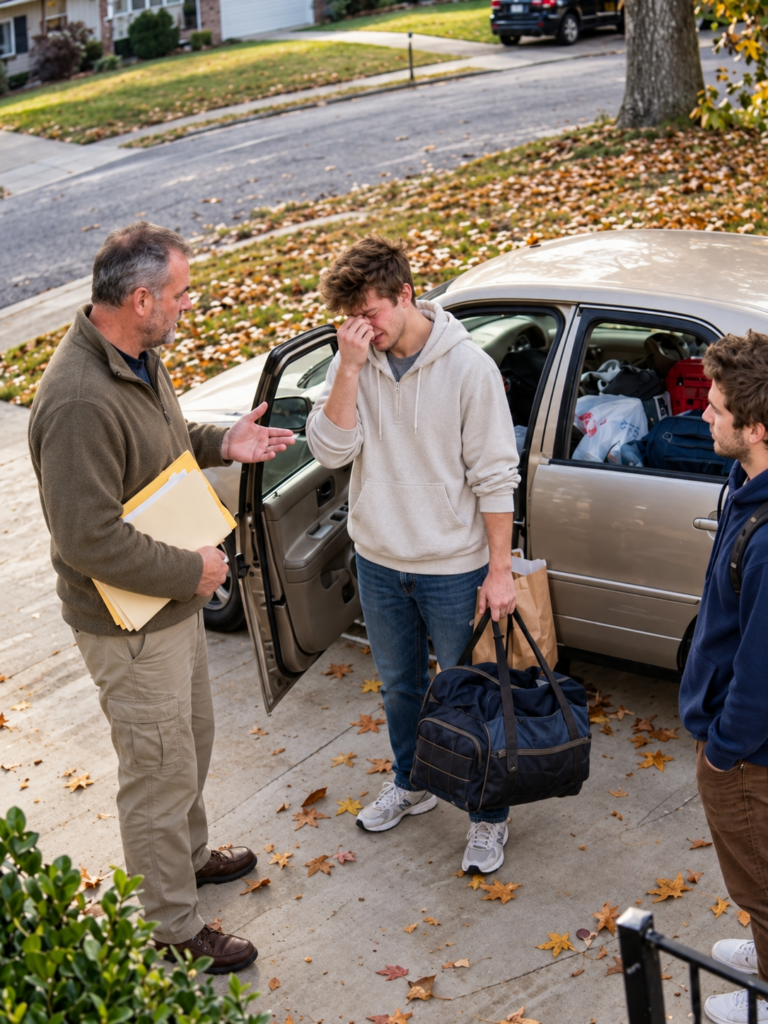
Part 1
The duffel bag was blue.
I remember that because I stared at it for almost a full minute before I understood why it was sitting beside my chair.
It was the old canvas bag my father used to take fishing when I was little. One zipper had been repaired with black thread. There was still a faint stain near the bottom from the summer he spilled coffee in the trunk.
My clothes were inside.
Not all of them.
Just enough to make a point.
My father, Mark Dalton, sat across from me at the kitchen table with both hands wrapped around a mug he wasn’t drinking from.
His wife, Cynthia, stood at the counter wearing a cream robe and stirring the same cup of coffee she’d been stirring when I came downstairs.
Her son Trevor sat near the window.
Trevor was nineteen, home from his first semester at a private college two states away, and wearing headphones around his neck that probably cost more than everything in that duffel bag.
Nobody had said happy birthday.
That wasn’t unusual enough to scare me.
The bag was.
“What’s going on?” I asked.
Dad cleared his throat.
“You’re eighteen.”
“I know.”
“And eighteen means you’re legally an adult.”
I looked at Cynthia.
Her eyes remained fixed on her coffee.
Then I looked back at him.
“I also have school today.”
“You can go.”
“And after school?”
Dad finally looked me in the eye.
“You need to make other arrangements.”
For a second, I thought I had misunderstood him.
“What other arrangements?”
“A place to stay.”
My chair creaked when I leaned back.
“You’re kicking me out?”
Cynthia turned around.
“No one is kicking anyone out.”
There are sentences people use when they want to do something cruel without accepting the name for it.
That was one.
She folded her arms.
“We’re encouraging you to start your adult life.”
I looked at my father again.
He nodded.
That hurt more than anything she could have said.
“You agreed to this?”
“Nate.”
“Dad.”
His jaw tightened.
“Don’t make this harder.”
I laughed once.
I couldn’t help it.
“Harder for who?”
Trevor shifted in his chair.
“Nate, maybe just—”
“Stay out of it.”
He immediately did.
Trevor and I had never been close, but we weren’t enemies either. He had simply entered the house at age eleven with a mother who knew how to occupy every room she walked into.
My mother had died when I was eight.
After that, Dad had gone quiet for a long time.
Then Cynthia arrived.
Within a year she had repainted the living room, replaced Mom’s photographs with landscape prints, turned my mother’s sewing room into Trevor’s gaming room, and begun referring to our house as “the place Mark and I built.”
They hadn’t built it.
My mother had helped pay for it.
I knew because I still had the old mortgage paperwork tucked inside a box of her things under my bed.
Or I had yesterday.
I stood suddenly.
“My room.”
Cynthia’s expression barely changed.
“Excuse me?”
“You packed my stuff.”
“Yes.”
“So you went through my room?”
“Nathan, calm down.”
I ran upstairs.
The closet door was open.
Half my clothes were gone.
The shelves had been cleared.
My backpack remained.
So did my schoolbooks.
The old wooden box containing my mother’s photographs was still under the bed.
But the metal cashbox beside it was gone.
My stomach tightened.
I dropped to my knees and reached farther under the bed as if it might somehow have slid backward.
Nothing.
I had been saving money since I was fifteen.
First from bagging groceries.
Then washing dishes at a diner on weekends.
Then stocking shelves at a hardware store during summer.
I had counted it three nights earlier.
Three thousand eight hundred and forty dollars.
That money was my community-college fund.
My emergency fund.
My escape fund, though I never admitted that part aloud.
I ran back downstairs.
“Where’s the cashbox?”
Dad closed his eyes.
Cynthia didn’t.
“What cashbox?”
“You know exactly what I’m talking about.”
“Nathan.”
I turned on my father.
“Where is it?”
He rubbed one hand over his face.
“We used some of that money.”
My chest went cold.
“How much?”
No answer.
“How much?”
“All of it,” Cynthia said.
I stared at her.
Trevor removed his headphones from around his neck.
“What?”
Cynthia’s eyes flicked toward him.
“It was household money.”
“No,” I said. “It was mine.”
“You earned that money while living here. We paid the electric bill. We paid insurance. Food. Heat. Gas when you borrowed the car before you bought your own.”
“I bought my own car with money from my job.”
“And who let you park it in our driveway?”
I actually thought she was joking.
She wasn’t.
I looked at Dad.
He had always been the weaker one in arguments with Cynthia.
That was a fact I had learned to live around.
But weakness has consequences.
Sometimes, if it continues long enough, it becomes a kind of participation.
“You took it?”
He swallowed.
“We needed it.”
“For what?”
Cynthia answered before he could.
“Trevor had expenses for school.”
Trevor stood up.
“No, I didn’t.”
Everyone looked at him.
His face had gone red.
“My tuition is covered until spring. Mom, you told me Grandpa Ray paid the housing deposit.”
Cynthia’s mouth hardened.
“This isn’t your concern.”
“You said you used Nate’s money for me.”
“I said family expenses.”
“No,” I snapped. “You said Trevor.”
Dad pushed his chair back.
“Enough.”
I looked at him.
There were moments growing up when I could still see the man he had been before Mom died.
The man who took me to Little League practice.
The man who once drove through a snowstorm because I left my science project at home.
The man who sat beside my hospital bed when I had my appendix out and refused to leave even though a nurse told him visitation was over.
I searched his face for that person.
I didn’t find him.
“You knew,” I said.
He looked down.
That was answer enough.
I went upstairs again.
This time I packed my own bag.
I added my mother’s photographs, two hoodies, underwear, socks, my school laptop, and the small wooden box that held her wedding ring.
When I came down, Trevor was gone.
Cynthia stood near the refrigerator.
Dad was by the front door.
He had my car keys in his palm.
I stopped.
“Give me those.”
“Insurance is still under my name.”
“The car is in mine.”
“I paid for part of the registration.”
“With money I gave you.”
“Nate.”
“Give me my keys.”
He held them for another second.
Then he dropped them into my hand.
I wish I could tell you I said something powerful before leaving.
I didn’t.
I walked past him.
That was all.
At the front door, Cynthia said, “Someday you may thank us for forcing you to grow up.”
I turned.
Trevor stood at the top of the stairs now.
He looked ashamed.
My father looked tired.
Cynthia looked satisfied.
“I don’t think that’s what I’ll remember,” I said.
Then I left.
For the first several hours, I pretended I wasn’t homeless.
I went to school.
That gave the day shape.
I sat through government class.
I took a chemistry quiz.
I ate lunch with my friends Daniel and Luis and told them my family had some relatives visiting, which was why I had a duffel bag in my car.
At three twenty, school ended.
Everyone else went somewhere.
That was when the truth became harder to avoid.
I drove to the public library and sat in the parking lot until dark.
Then I moved to a twenty-four-hour supermarket.
At midnight a security guard knocked on my window.
“You can’t sleep here.”
“Sorry.”
I drove away.
The second parking lot was behind a gym.
The third was beside a church.
I learned quickly.
Park under lights, but not the brightest ones.
Don’t stay in the same place too often.
Fold a sweatshirt against the window so people can’t see your face.
Keep your shoes on in case someone tells you to leave.
Never let the gas tank drop below a quarter.
That last rule lasted five days.
On my sixth morning, I showered at school.
The boys’ locker room opened early because the swim team practiced at six.
I waited until they left.
My gym teacher, Mr. Collins, saw me coming out with wet hair.
“You joining swimming?”
“Thinking about it.”
He smiled.
“You should. Keeps you out of trouble.”
“That’s the plan.”
I hated how easy lying became.
At lunch, I started saving half my food.
The school cafeteria gave free meals to students who qualified.
I qualified.
I had always been embarrassed by that.
Now I treated every apple like currency.
By the eighth night, the temperature dropped.
Not freezing, but cold enough that my breath fogged the inside of the windshield.
My car’s heater had worked badly for years.
That night it barely worked at all.
I woke before dawn with my neck locked, both feet numb, and my mother’s wedding ring pressed into my palm because I had fallen asleep holding it.
I nearly called my father.
I stared at his name on my phone.
My thumb hovered over it.
Then I remembered the empty space beneath my bed where my cashbox had been.
I turned the phone off.
The next afternoon, my car started coughing.
The fuel light had been on since morning.
I had nine dollars left after buying gas earlier that week.
I put five dollars in the tank.
It wasn’t enough.
At six thirty that evening, the car died behind a diner on the edge of town.
I coasted into an alley used by delivery trucks.
Then nothing.
I tried the ignition twice.
The engine clicked.
I hit the steering wheel.
Once.
Twice.
Then I rested my forehead against it.
The diner vent blew the smell of hamburgers and onions into the alley.
I had eaten half a peanut-butter sandwich since breakfast.
For twenty minutes, I sat there telling myself I was not going to dig through a restaurant trash bin.
At minute twenty-one, hunger won.
I climbed out.
There were three large dumpsters.
A cardboard box sat beside one.
Inside were unopened sleeves of crackers, probably discarded from damaged packaging.
I took two.
“Excuse me?”
I spun around so fast I nearly fell.
A man stood ten feet away.
Late fifties.
Gray suit.
Silver hair.
Briefcase.
He looked completely wrong for the alley.
“Yes?”
“Are you Nathan Dalton?”
Fear comes fast when nobody is supposed to know where you’re sleeping.
I stepped backward.
“Who’s asking?”
He reached slowly into his jacket.
Instead of a badge, he produced a business card.
Thomas Avery.
Avery, Collins & Pierce.
Attorneys at Law.
“I’ve been trying to locate you for nine days.”
My skin prickled.
“Why?”
“I’m the executor of an estate in which you are named.”
“I don’t know what that means.”
“It means someone left property to you.”
I stared at him.
“You have the wrong Nathan Dalton.”
“No.”
“My mom didn’t have money.”
“This isn’t your mother’s estate.”
“Then whose?”
He studied me.
“Samuel Dalton’s.”
The name meant almost nothing to me.
Almost.
“My grandfather?”
“Yes.”
“He’s dead.”
Thomas’s expression shifted.
“He is now.”
The crackers nearly slipped from my hand.
I frowned.
“My grandfather died before I was born.”
“No, Nathan.”
Thomas’s voice softened.
“He died twelve days ago.”
I didn’t answer.
Behind us, someone in the kitchen dropped a tray.
Metal crashed against tile.
I barely heard it.
“My dad said—”
“I know what your father said.”
“How?”
“Because your grandfather spent years trying to understand why his grandson never answered a single letter.”
I went completely still.
“What letters?”
Thomas looked at my dead car.
Then at my wrinkled shirt.
Then at the crackers in my hand.
Something in his face tightened.
“Perhaps,” he said, “we should start somewhere warm.”
I didn’t trust him.
But I followed him into the diner anyway.
He bought me a cheeseburger.
I told him I wasn’t hungry.
Then I ate it so quickly I burned the roof of my mouth.
Thomas never commented.
When I finished, he placed a thick envelope on the table.
My full name was handwritten across the front.
Nathan William Dalton.
I stared at the middle name.
William had been my mother’s father’s name.
Almost nobody used it.
“Open it.”
Inside was a photograph.
My father looked about twenty-five.
He stood beside a taller man in front of a redbrick office building.
The older man had my eyes.
Not similar eyes.
Mine.
Dark, narrow at the corners, with one eyebrow slightly higher than the other.
On the back were four words.
Mark and Nathan’s first Christmas.
My throat closed.
There was a baby in my father’s arms.
Me.
I looked at Thomas.
“This is fake.”
“It isn’t.”
“My father told me Samuel Dalton died in a construction accident before Mom got pregnant.”
Thomas opened his briefcase.
“He told several versions over the years.”
He removed a folder.
Inside were copies of envelopes.
Birthday cards.
Christmas cards.
Graduation notices from middle school.
One envelope had been addressed to the hardware store where I worked.
Another had gone to my high school guidance office.
“They were returned?” I asked.
“Some.”
“And the others?”
“Intercepted.”
“By who?”
Thomas hesitated just long enough to make the answer unbearable.
“Your father.”
He showed me photographs from a private investigator.
Dad taking mail from our box.
Dad speaking with a delivery driver.
Dad carrying a large envelope addressed to me.
Dad dropping shredded paper into a recycling bin behind his office.
I couldn’t stop staring.
“How long?”
“Samuel became suspicious seven years ago.”
“Seven?”
“He had written before then as well.”
“Why didn’t he just come to the house?”
“He did.”
I looked up.
“When?”
“Twice.”
I remembered one afternoon when I was twelve.
Dad had come home furious.
Cynthia had locked every downstairs window even though it was July.
When I asked why, she said someone unstable had been wandering the neighborhood.
I felt sick.
“That was him?”
Thomas nodded.
“Your father threatened him with a restraining order.”
“Why?”
“Money was part of it.”
“What’s the other part?”
“Pride.”
Thomas folded his hands.
“Your grandfather owned a regional construction-supply company. Your father worked there after college. They had a severe falling-out.”
“What kind?”
“Your father attempted to divert company funds into a private investment.”
I stared at him.
“He stole?”
“He called it borrowing.”
“Grandpa fired him?”
“Yes.”
“So Dad decided I couldn’t know him.”
“Apparently.”
“Why me?”
“Because Samuel refused to restore your father to the company. Years later he changed his estate plan.”
Thomas pulled another document from the folder.
I read the first line.
Then the second.
I stopped.
“No.”
“Yes.”
The number beside my name didn’t make sense.
Property.
Company shares.
Investment accounts.
A house.
Land.
An ownership percentage in Dalton Supply Group large enough that I reread it three times.
“This can’t be mine.”
“It isn’t yet.”
I looked at him.
Thomas removed a thinner document.
“Your grandfather included conditions.”
I almost laughed.
Of course he had.
“What do I have to do?”
“Thirty days.”
“For what?”
“Remain separate from your father and stepmother.”
“That won’t be difficult.”
“And demonstrate that you can maintain school or employment, manage ordinary expenses, and make decisions without accessing the estate.”
I leaned back.
“You’re telling me there’s money sitting somewhere, but I can’t use it while I’m sleeping in my car?”
“The estate can provide safe housing and emergency medical care. Nothing more until the period ends.”
I stared at him.
“That sounds cruel.”
Thomas looked uncomfortable.
“I argued with Samuel about it.”
That surprised me.
“You did?”
“Repeatedly.”
“Why didn’t he just help me when he found out what Dad was doing?”
Thomas took off his glasses.
“Because Samuel had a blind spot.”
“What kind?”
“He believed hardship revealed character.”
“Easy thing for a rich man to believe.”
Thomas gave me a tired smile.
“I told him something similar.”
That was the first moment I trusted him.
Not completely.
Enough.
“There is another reason for the thirty days,” he said.
“What?”
“It prevents your father from claiming you were manipulated immediately after Samuel’s death. Samuel anticipated litigation.”
“Dad already knows about the will?”
“He knows he was removed from it.”
My stomach tightened.
“But does he know I’m in it?”
“Yes.”
The diner suddenly felt colder.
Thomas continued.
“He does not know we found you.”
I thought of the duffel bag.
The stolen cash.
The urgency of Dad wanting me gone the exact morning I became a legal adult.
“He knew you’d come looking.”
Thomas said nothing.
He didn’t need to.
I stared through the window at my dead car.
“That money they took.”
“What money?”
“My savings.”
I explained.
Three thousand eight hundred and forty dollars.
Cash.
Gone.
Thomas’s face changed.
“What date did they take it?”
“This morning. Or last night.”
“And you can prove the money existed?”
“Pay stubs. Bank withdrawals. I kept most of it in cash because Dad used to say banks charge fees.”
Thomas closed the folder.
“I need you to write down everything you remember.”
“Why?”
“Because there is a clause involving interference, coercion, or theft of your property.”
I looked at him.
“What clause?”
“If your father knowingly took your assets to prevent your independence or interfere with Samuel’s estate plan, the consequences could extend beyond losing the inheritance.”
I felt no triumph.
Only exhaustion.
“What happens to him?”
“That depends on the evidence.”
I looked down at my hands.
My father had thrown me out.
My father had stolen from me.
My father had spent years making sure I believed my grandfather had never wanted me.
And somehow, that last part hurt worst.
Thomas slid a motel key card across the table.
I stared at it.
“You said I couldn’t use estate money.”
“This is from a nonprofit youth-transition program my firm already funds.”
“That’s convenient.”
“It became convenient about two hours after I found out you were sleeping in a vehicle.”
I looked at him.
His face remained serious.
“You are allowed to accept help, Nathan.”
That sentence nearly broke me.
Not because it was profound.
Because nobody had said anything like it in a very long time.
I picked up the key card.
Then Thomas reached into his briefcase one last time.
“This is yours as well.”
He placed a small black flash drive on the table.
“What is it?”
“A recording Samuel made during his final meeting with your father.”
I didn’t touch it.
“What did Dad say?”
Thomas’s eyes held mine.
“Enough that after you hear it, you may stop wondering whether what happened on your birthday was an accident.”
That was the moment the story changed.
Until then, I had believed my father had simply chosen Cynthia’s peace over mine.
Sitting in that diner, with the smell of coffee and fryer oil around me, I began to understand something much uglier.
My father had not thrown me out because I turned eighteen.
He had thrown me out because he was afraid someone would find me.
And they had.
Part 2
I didn’t listen to the recording that night.
Thomas drove me to a motel used by the youth-transition program.
The room had two beds, a humming air conditioner, and a television bolted to a dresser.
To anyone else, it would have looked depressing.
To me, it looked like a palace.
I took a shower.
Then another.
I ate the crackers I’d brought from the alley.
I placed my mother’s wooden box on the nightstand.
Only after midnight did I plug the flash drive into my laptop.
There was one video file.
SAMUEL_MARK_FINAL_MEETING.
I clicked it.
My grandfather appeared first.
He was thinner than in the photographs.
A nasal oxygen tube rested beneath his nose.
He sat at the end of a conference table, one hand trembling slightly beside a glass of water.
My father walked into frame.
Not the exhausted man from my birthday morning.
This version of him looked furious.
“You asked for me.”
Samuel nodded.
“Sit down, Mark.”
“I’d rather stand.”
“Of course you would.”
Even sick, my grandfather’s voice was steady.
Dad folded his arms.
“You changed the trust again.”
“Yes.”
“You cut me out completely.”
“Yes.”
“After everything I did for that company?”
Samuel looked almost amused.
“You mean before or after you attempted to move four hundred thousand dollars into an investment account I didn’t authorize?”
“I put it back.”
“After the auditors found it.”
My father began pacing.
“What about Cynthia?”
“What about her?”
“She spent years helping me rebuild my life.”
“That does not entitle her to my estate.”
“And Trevor?”
“Trevor is not my grandson.”
Dad stopped.
“Nathan doesn’t even know you.”
That sentence landed like a fist.
Samuel lowered his eyes.
“No. Because you made sure he didn’t.”
“I protected him.”
“You lied to him.”
“You would have poisoned him against me.”
Samuel looked up.
“You were afraid he would learn the truth.”
Dad leaned across the table.
“You think giving an eighteen-year-old millions of dollars proves anything?”
“No.”
“Then why him?”
“Because every report I’ve received says he works.”
Dad’s expression shifted.
Samuel continued.
“He works after school. His grades are excellent. He takes care of himself. He repaired that old car with YouTube videos because you refused to help him. He gives part of his lunch to a boy named Luis when Luis forgets money.”
My eyes filled.
He knew that?
Samuel knew that?
Dad laughed bitterly.
“You’ve been spying on my son.”
“I’ve been trying to know my grandson.”
“He doesn’t need you.”
“Neither did you, apparently. Yet you kept asking for my money.”
Dad slammed his hand on the table.
“If you leave him control of the company, he’ll destroy it.”
“Then the board will advise him.”
“He’s a child.”
“He is more responsible at seventeen than you were at thirty-five.”
The room on my laptop fell silent.
Then Dad said something I would remember for the rest of my life.
“If Nathan gets the estate, he’ll choose you over me.”
Samuel’s expression softened.
Not with sympathy.
With sadness.
“Mark, he has never been given that choice.”
Dad looked away.
Samuel leaned forward.
“You could still tell him.”
“Tell him what?”
“That I’m alive. That I’ve written. That the story you’ve told him for years isn’t true.”
Dad shook his head.
“No.”
“Why?”
“Because he’ll hate me.”
My grandfather sat back.
“There it is.”
Dad pointed at him.
“You did this.”
“No. You did.”
“If he finds out, he’ll leave.”
Samuel’s voice dropped.
“You mean he’ll become free enough to decide whether he wants a relationship with you.”
Dad stood there breathing hard.
Then he said, “Maybe he doesn’t need to find out.”
Samuel’s face changed.
“What does that mean?”
“It means he’s eighteen soon.”
“So?”
“So he can make his own life.”
“And you intend to do what?”
Dad never answered directly.
He only said, “You don’t control what happens in my house.”
The video ended.
I sat on the motel bed for a long time.
The worst part wasn’t hearing that my father was greedy.
I had already suspected that.
The worst part was hearing his fear.
He had not hidden my grandfather because he hated me.
He had hidden him because he was terrified I might discover I had choices.
For years, I had mistaken control for indifference.
Now I realized the two could live together.
The next morning I went to school.
Thomas wanted me to take several days off.
I refused.
If the thirty days were supposed to prove anything, I wanted them to prove I could finish what I started.
Life became strange.
At eight in the morning, I was Nathan Dalton, high-school senior, pretending to care about a debate on the electoral college.
At four in the afternoon, I was Nathan Dalton, hardware-store employee, stacking bags of fertilizer.
At seven at night, I sometimes met Thomas in his office and learned that my family history was almost entirely fictional.
Samuel had attended my mother’s funeral.
Dad had told me all four grandparents were already dead.
Samuel had stood across the cemetery because Dad threatened to call police if he approached me.
Samuel sent money for my education when I was ten.
Dad returned it.
Samuel sent a bicycle when I was twelve.
Dad sold it.
Samuel mailed me a letter when I turned sixteen asking whether I would meet him for lunch.
Dad shredded it.
Thomas showed me a copy.
Dear Nathan,
You do not know me, and I understand why that may make this letter unwelcome.
I am your father’s father.
There are mistakes between adults that children should never be forced to inherit.
If you ever want answers, I will give them honestly.
If you want nothing from me, I will respect that too.
I stared at the page until the words blurred.
“He didn’t demand anything,” I said.
“No.”
“He didn’t even ask me to forgive him.”
“No.”
“All he wanted was lunch.”
Thomas nodded.
I folded the copy carefully.
“Can I keep this?”
“Of course.”
My father called on day eleven.
I nearly dropped the phone.
I watched it ring.
MARK DALTON.
I let it stop.
Thirty seconds later, a text arrived.
Where are you?
Then another.
We need to talk.
Then:
Cynthia is willing to let you come home if you apologize.
I laughed out loud in the motel room.
Not because it was funny.
Because it was so perfectly Cynthia.
I typed nothing.
On day twelve, Trevor came to the hardware store.
He waited near the paint aisle until my shift ended.
“I’ve been looking for you.”
My body tensed.
“Did Dad send you?”
“No.”
“How did you find me?”
“You’ve worked here for two years.”
Fair point.
He shoved his hands into his coat pockets.
“I didn’t know they were going to kick you out.”
I said nothing.
“I woke up that morning and your stuff was already packed.”
“You sat at the table.”
“I didn’t know what to say.”
“Neither did I.”
He looked toward the parking lot.
“Mom’s been acting weird.”
“When isn’t she?”
“Nate.”
“Sorry.”
“No, you’re not.”
“No.”
For the first time in years, he almost smiled.
Then his expression turned serious.
“She and Mark keep talking in the garage because they don’t think I can hear them from my room.”
“What are they saying?”
“Your grandfather’s name.”
My pulse jumped.
Trevor watched me.
“You knew?”
I didn’t answer.
His face changed.
“Oh, God.”
“Trevor—”
“You knew he’s alive?”
“He isn’t. Not anymore.”
He went pale.
“He actually existed?”
“Yes.”
Trevor sat on a bench outside the store.
“My mom told me your dad didn’t have parents.”
“So did mine.”
He rubbed both hands over his face.
“There’s more.”
I waited.
“Mark asked me whether you ever told me about money.”
“What money?”
“He wouldn’t say.”
“When?”
“Two days after you left.”
“Anything else?”
Trevor nodded reluctantly.
“He asked if I’d seen a black flash drive.”
My stomach tightened.
“Why would he ask that?”
“I don’t know.”
I did.
Or I thought I did.
Trevor leaned forward.
“Is this about some inheritance?”
I studied him.
He had benefited from Cynthia’s favoritism for years.
Better clothes.
Better phone.
College tours.
A new laptop.
When Dad skipped one of my track meets to drive Trevor to a concert, Trevor never questioned it.
But he also hadn’t designed the arrangement.
Adults had.
Children had simply lived inside it.
“Yes,” I said.
His eyes widened.
“How much?”
“I don’t know.”
That was technically true.
I knew numbers.
I didn’t understand what they meant.
“Does Mom know?”
“She knows something.”
Trevor looked sick.
“She told Mark last night, ‘If he signs anything, it’s over.’”
I remembered Thomas explaining that before the thirty days ended, I could still formally disclaim portions of the estate.
“Did she say what she wanted me to sign?”
“No.”
“Would you tell me if you hear anything else?”
Trevor hesitated.
Then nodded.
“Yeah.”
“Why?”
He looked at me for a long moment.
“Because when you left, I went upstairs.”
“So?”
“Mom had put your birthday cards in the trash.”
I froze.
“What birthday cards?”
“Old ones. A lot.”
He swallowed.
“Some were still sealed.”
On day thirteen, Trevor brought them to me.
Twenty-one cards.
He had pulled them from two trash bags Cynthia stored in the garage before taking them to a shredding service.
Some had been opened.
Some hadn’t.
Samuel had signed every one.
At eighteen, I finally read the birthday messages I should have received at nine, ten, eleven, twelve.
The card from my thirteenth birthday was simple.
Nathan,
I hope someone tells you often that being quiet does not mean being weak.
It took me sixty-eight years to learn that.
I hope you learn sooner.
Grandpa Sam.
I read it three times.
Then I went into the motel bathroom and cried where Trevor couldn’t see me.
The conflict changed after that.
It was no longer about money.
The money was almost abstract.
The cards weren’t.
They were years.
Stolen years.
On day sixteen, my father came to school.
The secretary called me to the office.
He stood near the trophy case wearing his work jacket.
“Nate.”
I stopped ten feet away.
“You shouldn’t be here.”
“I’m your father.”
“You’re also the person who threw me out.”
He glanced at the secretary behind the glass.
“Can we speak privately?”
“No.”
His face tightened.
“I made a mistake.”
“Which one?”
“Nathan.”
“There are a lot to choose from.”
He lowered his voice.
“I was angry.”
“For eighteen years?”
His expression changed.
That told me he knew.
“You’ve been talking to Avery.”
“Yes.”
He closed his eyes.
“Son—”
“Don’t.”
“What has he told you?”
“The truth.”
“You think lawyers tell the truth?”
“I think photographs do.”
He went still.
“And letters.”
No response.
“And recordings.”
His face drained.
That was the first moment I knew the video mattered even more than Thomas had said.
Dad stepped closer.
“That recording was private.”
“Interesting thing to worry about.”
“He recorded me without permission.”
“Thomas says it was legal.”
Dad’s jaw worked.
“Nate, Samuel was manipulating you before you even met him.”
“He’s dead.”
“You know what I mean.”
“No. I don’t.”
He looked toward the office again.
“You cannot run a company.”
“I know.”
That surprised him.
“I don’t know anything about running a company,” I continued. “That’s why I’d learn.”
“He set you up to fail.”
“Maybe.”
“You should sign the estate back into professional management.”
There it was.
Not How are you?
Not Where have you been sleeping?
Not Did you have enough to eat?
Professional management.
“Whose?”
He hesitated.
“Mine.”
I laughed.
The school secretary looked up.
Dad’s face flushed.
“I know that company.”
“You tried to steal from that company.”
His eyes hardened.
“That’s what he told you?”
“That’s what the audit says.”
“You’re a child.”
“No.”
He flinched slightly.
I understood why.
Eighteen had mattered when he wanted me gone.
Now suddenly it made me a child again.
“You need me,” he said.
I held his gaze.
“I needed you nine days ago.”
His face softened.
For one dangerous second, I saw my father.
Not the liar.
Not the frightened man from Samuel’s video.
My father.
“I know,” he said.
The anger inside me moved.
Not away.
Just enough to hurt.
“You could have come home,” he whispered.
“You packed my bags.”
“I was scared.”
“Of Grandpa?”
“Of losing everything.”
“You did.”
His expression hardened again.
“This isn’t over.”
“No,” I said. “It isn’t.”
On day twenty-two, the motel manager called Thomas.
Someone had been asking for my room number.
Cynthia.
She claimed there was a family emergency.
The manager refused.
That evening, Trevor texted me.
DON’T GO HOME.
Then:
MOM HAS PAPERS FOR YOU.
I called him.
“What papers?”
“I don’t know. Mark said if they can get you to sign before the board meeting, they can challenge something.”
“Where are you?”
“In my car.”
“You okay?”
Silence.
Then he said, “I think my mom knew about the letters.”
I closed my eyes.
“How much did she know?”
“Everything.”
He told me what he had heard.
Cynthia had known Samuel was alive before she married Dad.
She had helped return packages.
She had once called Samuel personally and threatened harassment charges.
Worse, she had encouraged Dad to force me out before the estate could establish contact.
I felt strangely calm.
“Why are you telling me this?”
Trevor’s answer was quiet.
“Because she put my name on one of the papers.”
“What?”
“She wants me to claim you threatened me.”
I stood up.
“Did I?”
“No.”
“Then don’t sign it.”
“I didn’t.”
“Where is it?”
“With me.”
That document became the first piece of evidence Trevor provided voluntarily.
It wasn’t the last.
By day twenty-eight, Thomas had enough information to petition the court for preservation of records relating to my savings and Samuel’s correspondence.
The stolen cash had not paid for Trevor’s college.
It had paid a legal consultant helping Dad prepare a challenge to the estate.
The payment had been made the day before my eighteenth birthday.
My father’s fear finally had a price tag.
Three thousand eight hundred and forty dollars.
On the evening of day twenty-nine, Thomas called.
“We have a problem.”
I sat on the edge of the motel bed.
“What?”
“Your father filed an emergency petition.”
“For what?”
“To delay transfer of voting control.”
“Can he?”
“He can ask.”
“On what grounds?”
“That you are emotionally unstable, financially vulnerable, and being influenced by the firm.”
I almost laughed.
“He made me financially vulnerable.”
“I am aware of the irony.”
“What happens?”
“Tomorrow’s meeting still proceeds.”
“And then?”
“Then your father will attend.”
I looked at the birthday cards spread across my bed.
Twenty-one little pieces of a childhood I had been denied.
“Good,” I said.
Thomas paused.
“You’re not frightened?”
“Yes.”
“Then why good?”
Because for twenty-nine days, everyone had been talking about my father.
Samuel.
The board.
The trust.
The company.
The lawyers.
Tomorrow, for the first time, I would be in the room where the decisions were made.
And I was tired of other people deciding what I deserved to know.
“Because I want him to hear me this time.”
Part 3
The headquarters of Dalton Supply Group had twenty-seven floors.
I had driven past it hundreds of times without knowing my name was connected to it.
On the thirtieth morning, Thomas picked me up at seven.
I wore a navy blazer donated by the youth program.
The sleeves were a little long.
Thomas noticed me tugging at them.
“Leave them.”
“I look like I’m borrowing someone’s clothes.”
“You are.”
That made me smile.
“Comforting.”
“You’re eighteen. Everyone expects you to look eighteen.”
The boardroom was on the twenty-sixth floor.
Floor-to-ceiling windows overlooked the city.
Seven directors sat around a long walnut table.
I recognized two from documents.
One was Patricia Lowell, chief financial officer.
The other was Gerald Sims, who had worked with Samuel for thirty years.
At the head of the table sat Elaine Mercer, the independent chair.
She stood when I entered.
“Nathan.”
“Ms. Mercer.”
“Your grandfather talked about this meeting for six years.”
I swallowed.
“I wish he’d talked to me.”
Her expression softened.
“So did he.”
Thomas set two binders on the table.
I took the chair beside him.
Elaine began.
“Samuel’s estate plan transfers sixty-one percent of voting ownership into a trust for your benefit, with direct voting authority passing to you upon completion of the thirty-day independence provision.”
I nodded.
I’d heard the explanation before.
It still sounded like someone else’s life.
She continued.
“The board’s role today is not to determine whether you deserve the inheritance. Samuel already made that determination.”
The door opened.
My father entered.
Cynthia followed.
A lawyer I didn’t recognize walked beside them.
Trevor came last.
That surprised me.
Our eyes met.
He gave a small nod.
Cynthia saw it.
Her mouth tightened.
Dad looked older than he had thirty days earlier.
Not broken.
Not humbled.
Just worn down by the effort of controlling something that was moving beyond his reach.
He took a seat across from me.
“Nathan.”
“Dad.”
Elaine looked toward his lawyer.
“Mr. Dalton requested the opportunity to present his objections before voting authority transfers.”
The lawyer stood.
He talked for twelve minutes.
I knew because I watched the clock.
He said I was young.
True.
He said I had experienced severe emotional distress.
True.
He said Thomas’s firm had isolated me from my family.
False.
He said my father’s decision to make me leave home was an unfortunate domestic disagreement now being exploited in a multimillion-dollar succession dispute.
That one made my hands shake.
Not because it was convincing.
Because it reduced nine nights in a car to a phrase.
Domestic disagreement.
When he finished, Elaine turned toward Thomas.
“Response?”
Thomas opened the first binder.
“Bank records.”
He passed copies around.
“Mr. Nathan Dalton accumulated approximately three thousand eight hundred forty dollars in documented employment income. The day before his eighteenth birthday, Mark Dalton paid the same amount, in cash, to a consultant advising him on a potential estate challenge.”
Dad’s lawyer leaned forward.
“Coincidence.”
Thomas nodded.
“Perhaps.”
He opened another section.
“Mr. Dalton’s father admits he took Nathan’s money.”
The lawyer looked at Dad.
Dad’s face hardened.
Thomas continued.
“Second. Correspondence.”
He placed photographs of the intercepted letters on the table.
Cynthia looked straight ahead.
Elaine picked up one photograph.
“Is that you, Mark?”
Dad answered quietly.
“Yes.”
“Destroying mail addressed to your son?”
“I was protecting him.”
Gerald Sims laughed once.
Not kindly.
“From birthday cards?”
Dad ignored him.
Thomas opened another folder.
“Third. Testimony and documents relating to a proposed statement Mr. Dalton and Mrs. Dalton sought from Trevor Hayes.”
Cynthia turned sharply toward Trevor.
He stared at the table.
Thomas slid the unsigned document forward.
Dad’s lawyer read it.
His expression changed.
“What is this?”
Cynthia spoke quickly.
“That was never intended to be filed.”
Trevor looked up.
“You told me to sign it.”
“Trevor.”
“You said Nathan was dangerous.”
“I was trying to keep you out of this.”
“No. You were trying to put me in it.”
Cynthia’s face flushed.
“You don’t understand what’s at stake.”
Trevor finally looked at me.
“I think I do.”
Elaine folded her hands.
“Mr. Hayes, did Nathan threaten you?”
“No.”
“Ever?”
“No.”
“Did he ask you to provide information about your mother or stepfather?”
“No. I offered.”
Cynthia whispered his name.
He ignored her.
Thomas continued.
“Finally, we have Samuel Dalton’s recorded meeting with his son.”
Dad stood.
“I object to that being played.”
Elaine looked toward him.
“This isn’t a courtroom.”
“My conversation was private.”
“Samuel recorded a meeting in his own office under circumstances counsel has already determined were lawful.”
Dad looked at me.
“Nate.”
I held his gaze.
He seemed to know what I was about to do.
Maybe that was why his face changed.
“Please.”
That word landed heavily.
I had wanted to hear it for a month.
Now it sounded smaller than I expected.
I looked at Thomas.
“Play it.”
The screen at the end of the room lit up.
My grandfather appeared.
Then Dad.
Everyone watched.
Nobody interrupted.
When Dad’s recorded voice said, “If Nathan gets the estate, he’ll choose you over me,” Cynthia turned toward him.
When Samuel answered, “He has never been given that choice,” Trevor closed his eyes.
Then came the part Thomas had not shown me at the diner.
The recording continued beyond the section I had watched.
Samuel coughed and reached for water.
Dad stood near the window.
“You think he’ll forgive you because you leave him money?”
“No.”
“Then what exactly are you buying?”
“Nothing.”
“Don’t lie.”
Samuel looked at him for a long time.
“I am trying to return something.”
“What?”
“A choice.”
Dad scoffed.
Samuel continued.
“You took from him the right to decide who I was. I cannot give him those years back. I can only make sure you do not decide the rest of his life too.”
Dad’s face tightened.
“He’s my son.”
“Yes.”
Samuel’s voice broke slightly.
“That is what makes this so difficult to understand.”
The video ended.
Silence filled the boardroom.
My father remained standing.
For the first time since I was a child, I saw him with nowhere to hide.
Not behind Cynthia.
Not behind anger.
Not behind being my father.
Just a man in a room with evidence of his own choices.
Elaine turned toward me.
“Nathan, voting authority transfers today unless you disclaim it.”
My father looked at me.
“Nate, listen to me before you do anything.”
I waited.
His lawyer whispered something.
Dad ignored him.
“I was wrong.”
Nobody moved.
He swallowed.
“I should not have taken your money.”
I said nothing.
“I should not have thrown you out.”
My chest tightened.
“And Grandpa?”
His eyes dropped.
“I should have told you.”
“That’s not the same thing.”
He looked up.
“What do you want me to say?”
“The truth.”
“I was afraid.”
“I know.”
“No, you don’t.”
His voice cracked.
Suddenly, the anger disappeared.
“When Samuel fired me, I lost everything at once. My job. My reputation. Friends I’d known for years. Your mother was pregnant with you, and all I could think was that my father had decided I was worthless.”
That was new.
I waited.
“I told myself I’d build a life without him. Then your mother died, and I…” He rubbed his forehead. “I kept thinking if Samuel came back, you’d look at him and see someone stronger. Richer. More successful.”
“So you told me he was dead.”
“Yes.”
“For seventeen years.”
“Yes.”
“You destroyed letters.”
“Yes.”
“You sold things he sent me.”
Dad’s face twisted.
“Yes.”
“You took my savings.”
“Yes.”
“And you kicked me out because you knew the estate would look for me.”
He closed his eyes.
After several seconds, he whispered, “Yes.”
Cynthia turned toward him.
“Mark.”
He sat down.
She looked furious now.
Not ashamed.
Furious.
“You’re admitting everything?”
He didn’t answer.
She pushed back from the table.
“Do you have any idea what this does to us?”
Trevor stared at her.
“To us?”
“Yes, Trevor. To all of us.”
“No.”
His voice was surprisingly calm.
“It does something to you.”
Her face froze.
Trevor continued.
“You told me Nate’s money paid for my college. That wasn’t true.”
“I was trying to protect—”
“You keep using that word.”
Dad looked at him.
Trevor’s eyes filled.
“You made me think he hated me because I had more.”
I hadn’t known that.
Trevor turned toward me.
“I thought you resented me.”
“Sometimes I did.”
He nodded.
“I would’ve too.”
For one strange second, the boardroom, lawyers, money, company, all of it disappeared.
There were just two boys who had grown up in the same house while adults taught them to misunderstand each other.
Elaine finally spoke.
“We need to address governance.”
Dad’s lawyer whispered again.
Dad shook his head.
“No.”
The lawyer stopped.
Dad looked at me.
“Do what you’re going to do.”
I studied him.
A month earlier, I had imagined revenge in childish ways.
I imagined him begging.
I imagined Cynthia losing the house.
I imagined walking into the kitchen dressed in a suit and announcing I owned everything.
But sitting there, none of that appealed to me.
I had slept in a car.
I had eaten saved cafeteria food.
I had read birthday cards fifteen years too late.
Nothing I did in that room could return those nights or those years.
Justice was not going to feel like erasing pain.
It was going to feel like deciding what happened next.
I looked at Elaine.
“I accept the voting authority.”
She nodded.
“And the estate?”
“I accept it.”
My father looked down.
I continued.
“But I don’t want an executive position.”
Several board members exchanged glances.
Elaine asked, “Why not?”
“Because I’m eighteen.”
Gerald Sims almost smiled.
“I don’t know how to run this company.”
I looked around the table.
“My grandfather may have trusted my character. That doesn’t mean I magically know logistics, construction supply, payroll, or corporate law.”
Patricia Lowell nodded slowly.
“What do you propose?”
“I finish high school.”
Dad lifted his head.
“After that, I go to college or business school or work here in a position I’d actually qualify for.”
Gerald leaned back.
“And voting control?”
“I’ll keep it.”
That got a few smiles.
“I’ll appoint experienced directors. I’ll listen. I’ll learn. But I’m not pretending knowledge I don’t have.”
Elaine nodded.
“Samuel hoped you would say something very similar.”
That hurt in a completely different way.
I looked at Dad.
“There is one more issue.”
Thomas placed the documents relating to the stolen money in front of me.
The room became tense again.
The estate clause allowed me to seek removal of my father from any remaining advisory role and support civil claims involving financial interference.
Mark no longer held an executive position, but he had retained consulting relationships with two subsidiaries.
I looked at him.
“You’re done with the company.”
He nodded once.
“I figured.”
“And the money you took from me gets repaid.”
“Yes.”
“Not from estate funds.”
His mouth tightened.
“Understood.”
Thomas spoke.
“There are also possible claims concerning intercepted property and correspondence.”
I looked down at the papers.
This was the part everyone expected me to enjoy.
I didn’t.
“I won’t interfere with whatever legal review is already happening.”
Dad closed his eyes.
“But I’m not asking Thomas to destroy you either.”
He opened them.
“Why?”
“Because then I’d still be making my life about you.”
Nobody spoke.
I pushed the papers toward Thomas.
“Let the lawyers do what the law requires.”
Then I looked at Dad.
“You and I are not fixing this today.”
“I know.”
“Maybe not this year.”
He swallowed.
“I know.”
“And if we ever do, it won’t be because you tell me you’re my father.”
He nodded.
“It’ll be because you become someone I’d choose to know.”
For the first time that morning, he looked directly at me without trying to control the outcome.
“I understand.”
I believed that he wanted to.
That wasn’t the same as forgiveness.
It was enough for that day.
After the meeting, Thomas handed me one final envelope.
Samuel’s handwriting was on the front.
I took it to the stairwell instead of reading it in the boardroom.
The letter was short.
Nathan,
If you have reached this day, then you know more about me than I ever wanted you to learn from lawyers.
I failed your father in ways I understood too late.
That does not excuse what he did to you.
But I hope you will remember that families often pass wounds forward when no one is brave enough to name them.
Do not inherit mine.
Do not inherit his.
Take the company if you want it.
Sell it if you don’t.
Keep the money, give it away, build something new, or live quietly.
None of those choices will tell me what kind of man you are.
How you treat people when you have power will.
And Nathan—
I did not forget you.
Not once.
Grandpa Sam
I sat on the stairwell step and cried.
Not dramatically.
Quietly.
The way people cry when grief and relief arrive together.
Three months later, I graduated.
Thomas came.
So did Elaine.
Mr. Collins, my gym teacher, shook my hand so hard my wrist hurt.
Luis screamed my name when I crossed the stage.
Trevor sat with his girlfriend near the back.
My father wasn’t there.
He had asked.
I had said no.
That was one of the first boundaries I learned not to apologize for.
Cynthia and Dad separated that summer.
Trevor told me the marriage had been cracking long before I left.
I didn’t celebrate.
I had learned by then that someone else’s collapse does not automatically build you anything.
My father repaid the three thousand eight hundred and forty dollars in installments.
The first check arrived with a letter.
I did not answer.
The second came without one.
The third included only a receipt.
A year later, I agreed to meet him for coffee.
We talked for forty minutes.
He did not ask for money.
He did not ask about the company.
He apologized without using the word but.
That mattered.
I still didn’t forgive him that day.
Healing did not happen because he finally said the correct sentences.
It happened slowly because I stopped carrying his choices as explanations for my worth.
I kept my grandfather’s company.
Not because I believed blood entitled me to it.
Because I discovered I cared about what it could become.
I went to college thirty minutes from home and worked summers in warehouses, purchasing, accounts payable, and shipping.
Employees laughed when I asked basic questions.
Then they realized I was serious about learning the answers.
At twenty-two, I joined the board officially.
At twenty-five, I became vice chair.
I never became chief executive.
I hired someone better qualified.
That decision caused more gossip than anything else I did.
Apparently people understand inherited power better than voluntary restraint.
One project mattered most to me.
We created a fund for young workers and students facing sudden housing loss.
No speeches.
No giant plaque with my name.
Emergency motel rooms.
Transportation.
Meals.
Short-term rent assistance.
The kind of help that sounds small until you’re eighteen and sleeping with your shoes on because somebody might knock on the car window.
Every year on my birthday, I visit the diner where Thomas found me.
The owner eventually learned the story.
The first time I returned, he refused to charge me for my burger.
I paid anyway.
Then I left enough money behind to cover the next fifty meals for anyone who came in hungry and couldn’t pay.
Trevor sometimes joins me.
We never became brothers in the movie sense.
We did not suddenly discover we’d secretly been best friends all along.
We built something more believable.
Trust.
Piece by piece.
One ordinary choice at a time.
I still have the blue duffel bag my father packed.
It sits in the back of my closet.
For years, I thought keeping it meant I couldn’t move on.
Now I understand why it’s there.
The bag is not proof that my father threw me away.
It’s proof that everything I thought I needed fit into one small piece of luggage, and I still kept going.
The last time my father saw it, he was standing in my apartment doorway.
He stared at the torn zipper.
“You kept that?”
“Yes.”
“Why?”
I thought about the kitchen.
The parking lots.
The diner.
Samuel’s letters.
The boardroom.
All the things people had tried to decide for me.
Then I looked at him.
“Because for a long time, I thought that bag was everything I had left.”
He lowered his eyes.
“And now?”
I smiled.
“Now it’s just a bag.”
That was when I knew the past had finally become smaller than my life.

