
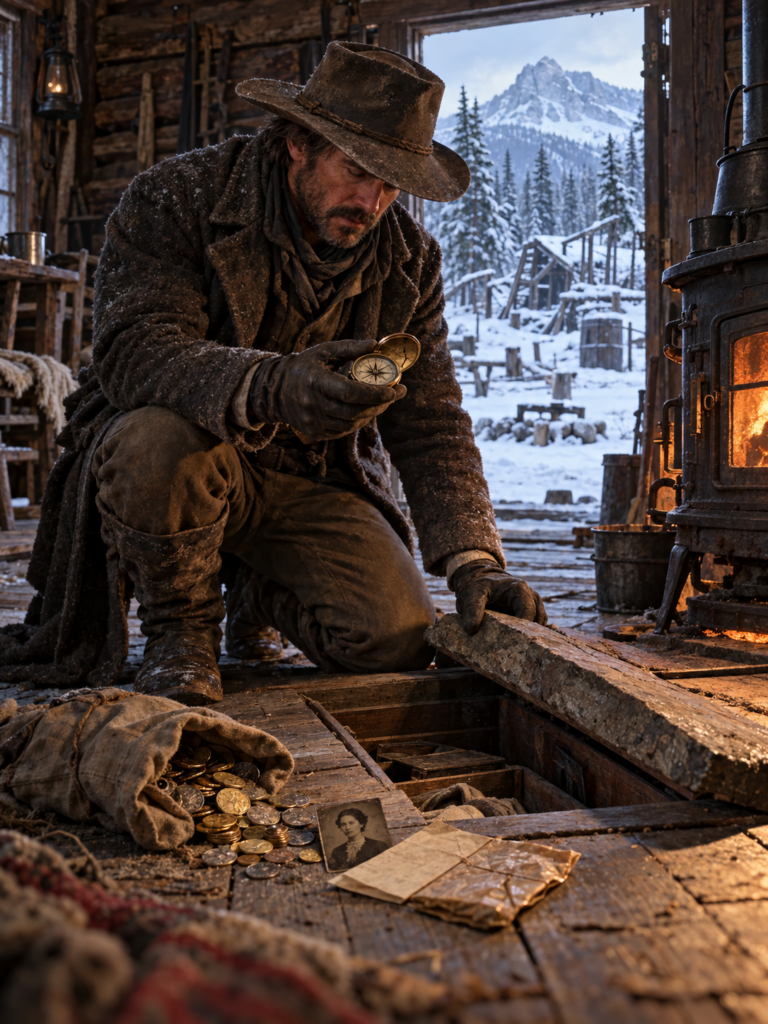
The shadow crossed the window again as William lifted the Winchester and stepped beside the door.
He did not aim it.
He held it low.
Outside, a horse snorted.
Then a man called from the yard.
“Anybody alive in there?”
William waited one breath before opening the door.
A lean rider of about sixty sat on a shaggy roan near the collapsed corral. He wore a fur cap and a coat patched at both elbows. A coil of trap chain hung behind his saddle.
The stranger’s hands were visible.
So was the old revolver holstered under his coat.
William stepped outside.
“Depends who’s asking.”
The rider looked past him at smoke curling from the chimney.
“Aught Bergen.”
The name meant nothing to William.
“Trap the North Fork.”
William lowered the rifle another inch.
Bergen nodded toward the cabin.
“Saw your smoke from the south ridge. Haven’t seen smoke here in eighteen years.”
“You’ve been here before?”
“Passed below it.”
“Why not come up?”
Bergen studied him.
“Wasn’t mine.”
That answer mattered.
William leaned the Winchester against the doorframe.
“Coffee?”
Bergen dismounted.
Inside, William deliberately reset the flagstone before the trapper entered.
He left the hidden compartment closed.
That was his first choice.
The second was deciding not to pretend he had found nothing.
Bergen sat on the three-legged stool while William poured coffee into the old tin cup from the shelf.
“You know what this place was?” William asked.
“Timber camp. Grazing camp after that. Shut down before I was born.”
“Why?”
Bergen blew across the coffee.
“Different answers depending on who’s drinking.”
William waited.
“One says fever.”
“Another?”
“Owner died.”
“Another?”
“Men walked because they weren’t paid.”
“And yours?”
Bergen glanced at the walls.
“I don’t collect stories I can’t prove.”
William liked him better for that.
“Ever hear of Amos Wheeler?”
The trapper’s cup stopped halfway to his mouth.
Only for a moment.
But William saw it.
“You have.”
Bergen drank.
“My grandfather mentioned him.”
“How?”
“Cook. Bookkeeper. Stayed after the others left.”
William felt the room shift.
“That part certain?”
“Certain as family memory gets.”
“Why did he stay?”
Bergen looked toward the stove.
“My grandfather said Wheeler was waiting for somebody.”
“For who?”
“Didn’t know.”
William considered the photograph under the flagstone.
Anne.
The dead boy.
Pa come home.
Maybe Amos had not been waiting for a living person at all.
Bergen set down the cup.
“You planning to winter here?”
William almost said no.
Then he looked around the repaired stove, the sound roof, the pine walls that had stood through forty winters without anyone claiming them.
He had nowhere else promised.
“No reason not to.”
“Pass closes in three weeks.”
“I’ve wintered higher.”
“You got flour?”
“No.”
“Salt pork?”
“No.”
“Lamp oil?”
“Some.”
“Second axe?”
William shook his head.
Bergen stood.
“Then there are four reasons.”
Despite himself, William smiled.
Bergen named a storekeeper in Elk Creek called Deacons and said the man would sell honest weight.
At the door, the trapper paused.
“You find what brought you?”
William’s expression changed before he could stop it.
Bergen noticed.
He did not ask what.
That silence earned something.
“Found enough to stay awhile,” William said.
The older man nodded and mounted.
William watched him disappear between the pines.
Only when the hoofbeats were gone did he return inside.
He lifted the flagstone.
The money remained.
So did Anne Wheeler’s photograph.
So did the child’s note.
William picked up Amos’s letter again and reread the line containing his father’s name.
Then he looked toward the door Bergen had just passed through.
The camp had not vanished because nobody knew it existed.
Some people knew.
They had simply chosen not to claim it.
William folded the letter, put the keepsakes back together, and returned all but sixty dollars of Amos Wheeler’s money to the compartment.
He slipped the sixty into his coat.
Tomorrow he would ride to Elk Creek for winter supplies.
Tonight he would do something else.
William took the tintype from the tin and set Anne Wheeler’s photograph upright on the shelf above the stove.
If Amos had spent his last years waiting beside her memory, William decided her face had been underground long enough.
He turned the photograph until the fading evening light touched it.
Then, with Bram’s compass in his pocket and his father’s name newly alive in his mind, William began making a list of what the forgotten camp would need if it was going to survive another winter.
The first thing William wrote was flour.
The second was lamp oil.
The third was another axe.
He stared at those three items and almost laughed.
A man could ride three days into forgotten country, uncover gold beneath a stove, find his dead father named in a stranger’s final letter—and still discover that survival depended on flour, lamp oil, and a good axe.
Bram would have approved.
William slept badly.
Not from fear.
From questions.
He had spent most of his life believing his father left behind very little.
A struggling lease.
Debts his mother never discussed.
A leaking barn.
Three children who learned early that hunger did not care whether a man had worked hard.
Yet Amos Wheeler had carried Hollis Cooper’s name for decades.
Kindness had outlived poverty.
That unsettled William more deeply than the coins.
At dawn he fed the bay, covered the compartment again, and rode down toward Elk Creek.
The town was smaller than memory suggested.
Six streets.
A schoolhouse.
A blacksmith.
A livery.
Two saloons.
A general store whose front window displayed boots, coffee tins, harness buckles, and a faded blue shirt.
DEACONS GENERAL MERCHANDISE was painted above the door.
Inside stood a bald man in a green apron.
“You Deacons?”
“I am unless somebody paid my debts overnight.”
“Aught Bergen sent me.”
That changed the man’s attention.
“From where?”
William could have lied.
“The old camp above the third fork.”
Deacons stopped moving.
Not dramatically.
He merely stopped tying the parcel in front of him.
“So somebody finally went back.”
William heard the word.
“Back?”
Deacons resumed the knot.
“Figure of speech.”
“No.”
The storekeeper looked up.
William said, “You knew somebody had.”
Deacons leaned both hands on the counter.
“My father did.”
William waited.
“He was a boy then. One of the last supply wagons went up before the place closed. Years later an old hand rode back.”
“The seventy-year-old?”
“You heard that story.”
“Part of it.”
Deacons studied him.
“What did you find?”
“My business.”
“Fair.”
The quick acceptance told William more than insistence would have.
He unfolded Bergen’s list.
Flour.
Salt pork.
Lamp oil.
Axe.
Beans.
Lard.
Coffee.
Matches.
Deacons added bacon without asking.
“I didn’t order that.”
“I did.”
“I’ll pay.”
“No.”
William’s eyes narrowed.
Deacons shrugged.
“Man riding into that country in October needs bacon more than my shelves do.”
William recognized the kind of argument that could waste half a day.
He let it stand.
At the end, he took one silver dollar from Amos Wheeler’s money.
The coin was old and dark.
Deacons saw it.
Again, the smallest hesitation.
“You know that coin?” William asked.
“No.”
“You looked at it like you did.”
“I look at money before I accept it.”
William held his gaze.
Deacons finally sighed.
“My father used to say Wheeler saved every old coin that came through his hands.”
William did not move.
“So you did know him.”
“My father knew him.”
“You could’ve said that.”
“You didn’t ask.”
William disliked the answer because it was technically true.
“Why does everybody in this town speak around that camp?”
Deacons took off his spectacles.
“Because nobody living owns the whole story.”
“Then tell me your piece.”
The shopkeeper glanced toward the empty doorway.
“The camp belonged to a timber concern out of Cheyenne. Work slowed. Wages started arriving late. Then influenza hit Elk Creek.”
William thought of Anne Wheeler.
“Amos’s wife.”
Deacons nodded.
“She died in town.”
“And his boy?”
“Following summer. Fever, I think.”
William looked down.
“After that?”
“Camp limped another season. Company folded. Men scattered. Amos stayed.”
“Why?”
“My father said he had nowhere he wanted to go.”
That was painfully believable.
William had spent years doing much the same thing, only while moving.
“What about the old man who came back decades later?”
“Name was Caleb Dyer.”
“What did he find?”
Deacons shook his head.
“Nobody knows. He wouldn’t say.”
William did.
Or thought he did.
Caleb Dyer had found the compartment.
Had read a dead man’s private grief.
Had understood it was not his to spend or display.
And had put everything back.
The knowledge changed the story.
The old man had not come out frightened.
He had come out carrying somebody else’s silence.
William paid.
Before leaving, he asked one more question.
“Hollis Cooper mean anything to you?”
Deacons frowned.
“Cattleman south country?”
“My father.”
“Then yes. My father mentioned him.”
William’s pulse shifted.
“What did he say?”
“That Hollis gave Wheeler a winter calf.”
William stared.
“A calf?”
“Something like that. Amos came through broke. Wife sick. Boy hungry. Hollis gave him an animal he could sell.”
William almost rejected it.
His father had never possessed enough cattle to give away easily.
That was exactly why the act struck so hard.
“Why?”
Deacons shrugged.
“Maybe because somebody needed one.”
On the ride back, William kept seeing his mother counting eggs at the kitchen table.
His father had given away value while his own household lived close to the edge.
For years William might have called that foolish.
At forty-three, carrying a dead man’s money bought with decades of remembrance, he was less certain.
By midafternoon he reached the third fork.
Smoke rose from the camp chimney.
William reined the bay sharply.
He had left no fire.
Someone was there.
He slid the Winchester free before entering the yard.
A mule stood tied near the bunkhouse.
A woman in a brown riding skirt and heavy coat was kneeling beside the cabin door, setting down a wooden crate.
She looked up.
About William’s age.
Dark hair streaked at the temples.
Steady eyes.
No visible alarm at his rifle.
“You William Cooper?”
“Who wants him?”
“Hedi Marsh.”
She nodded toward the crate.
“Hens.”
William lowered the rifle.
“That explains everything.”
“Usually does.”
He almost smiled.
Inside the crate, six hens complained softly.
Hedi stood.
“Deacons said you were wintering.”
“He talks fast.”
“He worries fast.”
“I didn’t ask him to.”
“No. That’s why he did.”
She pointed toward a cloth-wrapped jar.
“Sourdough starter. Keep it behind the stove, not too close.”
William looked at the supplies.
“How much?”
“Nothing.”
“I have money.”
“So do I.”
“Then why bring these?”
“My place is two miles downcreek. Too many hens. Too much starter.”
“That cheese too much?”
“Definitely.”
He looked at her.
She looked back without embarrassment.
William had spent enough years around hard country to recognize charity disguised as trade.
He also knew refusing could insult both giver and need.
“What do you want in return?”
“Spring comes, help my boy cut roof poles.”
“That I can do.”
“Then we’ve traded.”
That arrangement sat better.
Hedi remained only long enough to show him how she kept the starter alive through deep cold.
She noticed Anne Wheeler’s tintype on the shelf.
“Who’s that?”
“Anne Wheeler.”
Her expression changed.
“You know the name?”
“My grandmother did.”
William waited.
Hedi looked at the photograph.
“She said Anne used to sew shirts for ranch families when the camp wages went bad.”
“Was she living in town?”
“Yes.”
“Amos?”
“Up here mostly.”
William thought of the child’s note.
Pa come home.
Something painful settled into place.
Amos had worked while his family unraveled below.
Not because he did not love them.
Perhaps because love did not automatically tell a man when earning money had become less important than being present.
William knew that mistake.
Not with wife or child.
But with everyone else.
His sister in Oregon.
His brother somewhere on the railroad.
A schoolteacher in Casper who had once waited through a winter hoping William might ask her to stay.
He never had.
“What happened to the boy?” William asked.
Hedi’s face softened.
“Don’t know more than you probably do.”
She did not invent an answer.
William respected that.
Before leaving, she said, “My son Renick may ride up.”
“For what?”
“To see the camp.”
“Does everybody know now?”
“You lit the chimney.”
William looked toward the thin smoke.
A forgotten place stayed forgotten only while nobody tended the fire.
Three days later Renick Marsh arrived carrying a two-man saw.
They felled dead standing pine above the saw pit.
Renick worked hard and spoke little.
William liked him.
On the second visit, Bergen brought a drawknife and left it leaning beside the door.
No explanation.
Deacons sent nails.
Hedi sent another loaf.
William began repairing the bunkhouse.
He did not need it.
That was exactly why he repaired it.
One usable cabin was shelter.
Four standing buildings were a place.
He patched sod.
Replaced rotted poles.
Reset the cookhouse flue.
Salvaged square nails from the collapsed fourth cabin.
Every evening, Anne Wheeler’s tintype watched from the shelf.
Every few days, William lifted the flagstone and read Amos’s letter.
The line about Hollis Cooper never changed.
But William did.
By November, the pass narrowed under snow.
By December, it closed.
The camp became its own small world.
William rose before dawn.
Fed six hens.
Broke ice at the creek.
Made coffee.
Cut wood.
Repaired leather.
Wrote once to his sister in Oregon.
That letter took him three nights.
He told her where he was.
He told her about Amos Wheeler.
He told her what Deacons had said their father had done.
At the bottom, he wrote something he had never written to any family member before.
I think Pa had more than we knew.
Not money.
Something else.
Bergen carried the letter down on snowshoes.
In January he returned with an answer.
William recognized his sister’s handwriting before opening it.
He read the first page standing.
The second sitting.
She remembered the calf.
She had been old enough.
Their mother had been angry.
Their father had said the Wheeler family’s boy was hungry now, and their own children had food enough for the week.
His sister wrote that their mother stayed angry two days.
Then baked Amos bread for the road.
William lowered the letter.
The story had not been one man’s kindness.
It had been two struggling people deciding another struggling family could still be helped.
That mattered more.
He placed his sister’s letter beside Bram’s compass.
Then he lifted the flagstone.
For the first time, he counted the money left in Amos Wheeler’s sack.
One hundred twenty-four dollars remained after William’s supply trip.
Amos had left one hundred eighty-four.
William had used sixty.
He stared at the coins.
The letter had said they belonged to whoever found them.
He believed that.
But belief did not settle what he should do next.
He could keep every dollar.
He could use it to rebuild.
He could give it away.
He could bury it again.
For two days he considered.
On the third, William made his decision.
He carried the coin sack to the table.
Then he set Bram Whitfield’s compass beside it.
One inheritance had guided him here.
The other could decide whether the place became merely his refuge—or something larger.
William opened a blank page in an old tally book.
At the top he wrote a new name for the forgotten settlement.
COOPER’S CAMP.
He stared at it.
Then crossed out Cooper’s.
He wrote instead:
THIRD FORK CAMP.
No man, living or dead, needed to own its memory alone.
Below that, William began listing what would be needed by spring if travelers, riders, trappers, or working hands were ever going to use the place again.
By February, the list had become a plan.
Not a grand one.
William Cooper had never trusted grand plans.
They were usually made by men sitting somewhere weather could not reach them.
His was practical.
Repair the second bunkhouse wall.
Replace the cookhouse table.
Reopen the old skid road enough for a wagon.
Build a proper wood shelter.
Keep emergency flour, beans, salt, coffee, and blankets.
Leave one cabin unlocked for anyone caught by weather.
And beside that last line, William wrote:
No man turned away in winter.
He looked at the sentence a long time.
Maybe that was what Amos Wheeler had wanted when he wrote, I hope you make of it what I could not.
William had first assumed Amos meant the money.
Now he was not sure.
Maybe Amos had meant the camp.
Maybe himself.
Maybe both.
The old cook had spent twenty-two years in the high pines while his family lived below.
The child’s note said everything the formal letter did not.
Pa come home.
Amos had not.
Not soon enough.
Whatever kept him at the camp—wages, duty, shame, habit—had outlasted the people waiting for him.
Then the camp emptied.
And Amos remained with their photograph and the wages he no longer needed.
William understood men who stayed too long.
He had been drifting too long for the opposite reason.
Never remaining anywhere long enough to owe the place grief when it ended.
Those were different roads to the same loneliness.
Late one afternoon, he took Amos’s tobacco tin from beneath the flagstone.
He placed Anne’s hair, her photograph, and the child’s note on the table.
For months, the photograph had stood on the shelf.
The note had remained hidden.
William unfolded it again.
Pa come home.
Three words.
He imagined a boy gripping a pencil.
Imagined Anne keeping the paper.
Imagined Amos receiving it or perhaps finding it after both were gone.
No explanation survived.
Only consequence.
William refolded the note.
He placed it beneath Anne’s photograph.
Then he made a decision he had avoided since finding the compartment.
The keepsakes should not remain buried forever.
Not displayed carelessly.
Not passed around town.
But remembered.
When spring opened the pass, he would ask Deacons and Hedi whether anyone knew where Anne and the boy had been buried.
If their graves could be found, William would take the tin there.
Not to surrender it.
Amos had asked that the things be kept together.
William could honor that and still bring them into daylight.
For now, he returned them beneath the stone.
Winter held.
Then slowly loosened.
Icicles began dripping from the cookhouse eaves.
Snow collapsed away from south-facing walls.
The creek widened.
One morning a raven appeared on the corral rail.
Three days later William heard water moving under the ice all night.
Spring was coming.
With it came people.
Bergen arrived first without snowshoes.
Hedi came next with Renick.
Then Deacons rode up in a wagon once the lower trail dried enough to hold wheels.
He brought flour, nails, two panes of glass, and a used iron skillet William had not ordered.
“What’s that?”
“Cookhouse needs one.”
“I already have a skillet.”
“Bent handle.”
“Still cooks.”
Deacons set the new one down.
“Now you have two.”
William stopped arguing.
By May, the camp was no longer rumor.
Riders began coming deliberately.
Some had heard from Bergen.
Some from Deacons.
Some simply followed the wagon track.
A pair of cattlemen spent one night after losing daylight on the ridge.
A surveyor stayed two days.
A young preacher from Elk Creek came up because he wanted to see the place his grandfather had once spoken about.
Each man drank coffee.
Each asked some version of the same question.
“You own this?”
William never knew exactly how to answer.
The land itself belonged to a larger holding whose old corporate records had dissolved into confusion decades earlier.
Nobody had produced a current claim.
William had no deed.
No lease.
No written right to call the place his.
So he told the truth.
“I keep it.”
Most men accepted that more easily than legal language.
Keeping a place was something they understood.
In June, Hedi rode up alone.
William was repairing a gate.
She held up an envelope.
“From your sister.”
William wiped his hands and opened it.
His sister had written more about their father.
Not much.
Memory thinned with years.
But she remembered Amos Wheeler once coming to the Cooper place during a hard winter.
He had arrived on foot because his horse had gone lame.
Hollis gave him feed.
Sarah gave him bread.
The calf came later.
At the bottom of the page, she wrote:
You always thought Pa died with nothing.
Maybe nothing is not the same as leaving nothing.
William read that line twice.
Hedi waited nearby without asking.
Finally she said, “Good letter?”
“Hard one.”
“Those can be good.”
William folded it.
“You ever know your father?”
“Long enough to disagree with him.”
William looked at her.
She smiled slightly.
“People get kinder after they die. Memory sands the corners.”
“That happened with mine.”
“Doesn’t mean the kindness isn’t true.”
“No.”
“Just means it wasn’t the only truth.”
William liked that.
He had spent the winter turning Hollis Cooper into a symbol.
Maybe that was unfair too.
His father had been kind to Amos Wheeler.
He had also left Sarah Cooper with a leaking barn and children too young to carry what followed.
Both things could be true.
William’s respect did not need blindness.
That evening he added another thought to the tally book.
Remember people whole.
He nearly crossed it out as too sentimental.
Then left it.
The next problem was Amos’s grave.
Nobody knew where it was.
Deacons believed he had died at the camp.
Bergen’s grandfather claimed Amos was buried somewhere above the third fork.
Hedi remembered a story about two stones under lodgepole.
William searched.
Not obsessively.
Whenever work took him into the upper timber, he looked.
In July, Renick found them.
Two low stone markers beneath an old lodgepole where the ground rose beyond the saw pit.
Neither had writing.
One was larger.
Beside it lay a smaller one.
William stood over them.
“Could be anybody,” Renick said.
“Could.”
They did not pretend certainty.
That mattered.
There was enough truth without inventing the missing part.
William brought Amos’s tin anyway.
He did not bury it.
He sat beneath the lodgepole and opened it.
Anne’s photograph caught sunlight.
The lock of hair remained tied in blue thread.
The boy’s note rested beneath.
William read Amos’s letter once more.
Then he spoke aloud, though Renick had wisely gone back down the hill.
“Hollis Cooper’s people got your message.”
Wind moved through the pine needles.
William continued.
“My sister remembers you.”
He paused.
“Or enough.”
The words felt awkward.
He let them.
“He didn’t leave us much either.”
William looked toward the camp below.
“Turns out that may not be the measure.”
He closed the tin.
Then he carried it back to the foreman’s cabin.
Amos had asked that the keepsakes remain together.
William would not separate them for symbolism.
They belonged as they had been left.
By August, Third Fork Camp had four usable sleeping spaces.
The cookhouse chimney drew clean.
The old corral stood upright enough to hold horses again.
William spent almost all of Amos’s remaining money on materials.
Not extravagantly.
Nails.
Rope.
Glass.
Canvas.
Tools.
A better stove pipe.
Two wool blankets.
A heavy storage chest for emergency food.
He kept twenty dollars untouched.
Those coins went back beneath the flagstone.
Not because he needed a secret.
Because someone else might someday arrive with eleven dollars and nowhere else to go.
Inside the sack, William added a note of his own.
He did not explain Amos Wheeler.
That was not his story to condense.
He wrote only:
Use what you need.
Leave what you can.
Keep the firewood dry.
He signed it.
William Cooper.
Autumn returned.
This time, William was ready.
Bergen brought a marten pelt and stayed for supper.
Deacons came with wagon supplies before the pass closed.
Hedi sent cheese and a new crock.
Renick stacked wood.
The place that had once disappeared because everybody left was now surviving because people returned.
That difference moved William more than he admitted.
One cold evening, Hedi remained after the others rode down.
She stood in the doorway while William repaired a harness strap.
“You staying for good?”
William threaded the awl through leather.
“Probably.”
“That certain?”
“No.”
She laughed.
“That may be the most certain thing I’ve heard you say.”
William looked up.
He had known a schoolteacher in Casper years ago.
For one winter, he had almost believed he might build a different life.
Her father moved east.
William let distance make the decision.
He never followed.
He never asked.
That history remained what it was.
He would not turn Hedi’s kindness into a romance simply because loneliness made companionship valuable.
She had her own holding.
Her grown son.
Her own choices.
William respected that.
“You ever think about leaving yours?” he asked.
“My place?”
“Yes.”
“Every February.”
“Why February?”
“Goats.”
William smiled.
She pointed toward the shelf.
“Still keep Anne Wheeler up there.”
“Seems right.”
“You know, my grandmother used to say Anne laughed loudly.”
William glanced at the severe tintype.
“That woman?”
“Photographs lied about happiness back then.”
“How?”
“Nobody smiled because they had to sit still too long.”
He imagined Anne laughing.
It altered the room.
Not enough to erase tragedy.
Enough to give her a life larger than dying.
Hedi left before dark.
William watched her ride toward the lower creek until timber hid her mule.
That night, he moved Anne’s photograph from the shelf to a small niche beside Amos’s letter.
Still visible.
Still protected.
Over the next two winters, Third Fork Camp became known along the northern Elk Creek country.
Never famous.
That would have ruined it.
Useful.
A trapper could warm himself.
A rider could shelter a lame horse.
A ranch hand between jobs could sleep three nights without being asked for money.
William accepted help but kept boundaries.
Men who stayed longer worked.
Nobody drank hard liquor in the bunkhouse.
Nobody took Amos Wheeler’s keepsakes.
Nobody touched Bram Whitfield’s compass without asking.
The rules were simple because complicated rules usually meant somebody had failed to say the important thing early.
One October afternoon, a young cowboy arrived riding a poor horse.
His name was Daniel Price.
He had been dismissed from an outfit east of town.
He had seven dollars.
William almost laughed at the arithmetic.
Seven dollars.
A horse.
A bedroll.
Nowhere promised.
Daniel asked if he could stay one night.
William looked at the sky.
Snow coming.
“Three.”
“I can pay.”
“No.”
“I’ll work.”
“Yes.”
Daniel blinked.
William handed him an axe.
“Woodpile’s low.”
That night, the young man asked how William had come to own the camp.
“I don’t.”
“Everybody calls it yours.”
“People call weather theirs too when they complain.”
Daniel frowned.
William pointed toward the stove.
“I found it.”
“That’s all?”
“No.”
William considered the hidden compartment.
His father’s name.
Amos.
Bram.
Josiah Bell whispering directions four nights before death.
Caleb Dyer returning at seventy and choosing silence.
Bergen seeing smoke.
Hedi’s hens.
Deacons’s bacon.
Renick’s saw.
His sister’s letter.
“No,” William said again. “Not all.”
Daniel waited.
William did not give him the whole story.
Some truths were earned through time, not curiosity.
Instead he told him about the emergency money beneath the floor.
Twenty dollars.
Daniel stared.
“You tell everybody that?”
“No.”
“Why tell me?”
“Because if something happens to me this winter, somebody should know.”
The young cowboy looked suddenly uncomfortable.
William understood.
Being trusted could frighten a man more than being threatened.
“Don’t spend it unless it’s needed.”
“I won’t.”
“That’s the arrangement.”
Daniel stayed until spring.
Then took work near Casper.
Before leaving, he placed three silver dollars into the sack.
William found them after he was gone.
He did not chase him down.
Use what you need.
Leave what you can.
The camp had learned its own rule.
Years passed without William noticing exactly when the place stopped feeling borrowed.
Maybe it happened when the new glass went into the cookhouse.
Maybe when a second winter’s snow slid from the repaired bunkhouse roof.
Maybe the first time someone arrived saying, “Bergen told me I could find shelter here.”
Or maybe on the afternoon William looked around and realized no building was waiting for him to decide whether he belonged.
He already behaved like a man responsible for the place.
That was enough.
At fifty, William rode to Elk Creek and had a small brass plate made.
Not for himself.
For Amos Wheeler.
He mounted it inside the foreman’s cabin beneath the shelf.
The plate carried only a name and the years Amos had worked at the camp, as best anybody could determine.
Anne’s photograph stayed nearby.
The child’s note remained protected in the tin.
William did not turn their pain into decoration.
He recorded only enough that they would not vanish again.
Bram’s compass stayed on the table whenever William was home.
The crystal cracked further one winter.
He considered replacing it.
Then did not.
It still pointed north.
That was its work.
On a February afternoon years after his first arrival, William sat in the foreman’s cabin with the door open a hand’s width to the cold.
The bay he had ridden there was long gone.
Another horse stood in the lee of the bunkhouse.
Hens murmured from their boxes.
Smoke lifted cleanly from the chimney.
On the table lay Bram’s compass.
Beside it sat Amos Wheeler’s tobacco tin.
William’s sister’s letters were tied in a bundle.
He thought about Josiah Bell, dying in a bunkhouse and speaking one name.
About Caleb Dyer, who had found the hidden compartment decades earlier and apparently left it untouched.
About his father giving away a calf his family could scarcely spare.
About Sarah Cooper adding bread despite her anger.
About Amos saving money after the people he loved were gone.
About Anne laughing loudly in a life the tintype could not show.
About a boy writing three words.
Pa come home.
William looked around the cabin.
For most of his life, he had believed home was something a man either inherited or managed to afford.
Third Fork taught him otherwise.
Sometimes home was the place where somebody finally stopped leaving.
William rose.
He walked to the stove.
Lifted the flagstone.
The emergency sack had grown.
Twenty dollars became twenty-three.
Then thirty.
Then forty-six.
Men used some.
Others left more.
William never kept a ledger of names.
Need was enough.
He replaced the stone.
Outside, evening settled between the pines.
William stood in the yard.
The camp was no longer absent from memory.
People in Elk Creek knew it.
Riders knew it.
Young hands knew there would be dry blankets if weather turned.
Nobody had become rich because Amos Wheeler hid wages beneath a stove.
That had never been the true inheritance.
The money had rebuilt walls.
The letter had rebuilt something harder.
William Cooper had entered the pines at forty-three believing he was running out of country in which to lose himself.
Instead he had found a place where the lives of strangers, fathers, widows, old hands, forgotten workers, and one drifting cowboy intersected across forty years.
He had thought his father died poor.
He had been wrong only in the way that mattered.
Hollis Cooper had left no ranch.
No account.
No property.
But one act of kindness had crossed decades and reached his son when the son had almost nothing left.
William touched Bram’s compass through his shirt.
Then he looked at smoke rising from the chimney of a camp men had once chosen to forget.
The compass had brought him north.
Josiah’s whisper had brought him farther.
Amos’s letter had made him stop.
William turned toward the foreman’s cabin as the first snow began falling through the pines.
He went inside.
Not because he was hiding from the world.
Because after forty-three years of leaving one place after another, William Cooper finally had somewhere worth coming back to.

