Part 1
For a few seconds, nobody moved.
The only sound was the soft ticking of ice against the gutter above the porch and the engine of the black SUV idling at the curb.
My brother-in-law, Eric, stood beside his silver Mercedes with a travel mug in one hand and his phone in the other. He had spent most of breakfast explaining how difficult it was to run a consulting company without “a proper executive environment,” which apparently meant the bedroom Mark and I had shared for nine years.
Now his mouth was slightly open.
My sister, Vanessa, looked from the officer to me.
“Colonel?”
I did not answer her immediately.
The officer who had stepped from the lead vehicle was Captain Luis Ramirez, a man I had worked with twice overseas. He was normally relaxed enough to joke during twelve-hour planning sessions. That morning, there was nothing relaxed about him.
He held the salute until I returned it.
“Captain.”
“Ma’am.”
Behind him, two more personnel got out of the second vehicle. They did not rush. They did not posture. Their calm made the whole scene more serious.
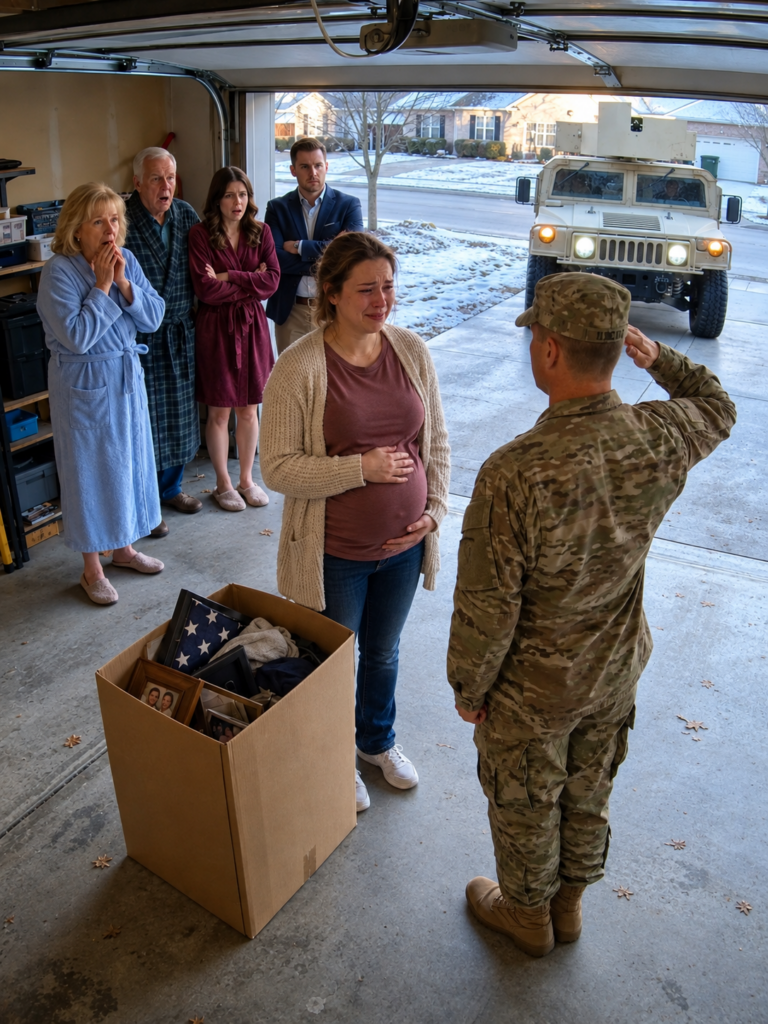
Ramirez glanced at the cardboard boxes stacked beside the garage.
“Are your secured materials inside the residence?”
“Yes.”
“Any medical concerns since last contact?”
“Some cramping. Nothing regular.”
His expression tightened.
“We have medical support waiting.”
My mother made a frightened noise.
“Medical support?”
I turned toward her.
She stood in the doorway in a quilted robe, one hand holding the collar shut at her throat. Twenty minutes earlier, she had been carrying my shoes to the garage because Vanessa said Eric needed the closet empty.
Now she looked as though I had become a stranger.
Ramirez lowered his voice.
“We need to collect the case and depart.”
I nodded.
“There’s a gray lockbox upstairs. Bedroom at the end of the hall. Also the green duffel in the closet.”
One of the soldiers approached the porch.
Then he stopped.
“Permission to enter the residence, ma’am?”
That question nearly undid me.
It should not have mattered.
It was routine.
Still, I looked past him into my own house and thought about the previous eight months.
My parents had arrived after Mark disappeared during an overseas operation and was presumed dead.
At first, I had been grateful.
My mother cooked. My father handled the yard. Vanessa came over almost every day.
I had been nauseated, exhausted, pregnant, and trapped in the strange waiting period where everyone else accepted Mark was gone while some part of me still expected his truck to pull into the driveway.
My family said they were taking care of me.
Slowly, taking care of me became taking over.
My mother rearranged the kitchen because she said Mark and I had never organized it properly.
My father started introducing the house to repairmen as “our place.”
Vanessa stored boxes in the guest room, then clothes in the downstairs closet, then half of Eric’s golf equipment in the mudroom.
Every change came wrapped in the same explanation.
You have enough to deal with.
So I stopped objecting.
That was my mistake.
Not because their behavior was my responsibility.
Because silence had taught them something false.
It had taught them that my boundaries were negotiable.
That morning, a stranger in uniform had stopped at my threshold and asked permission to enter.
My own family had stopped asking months ago.
“Permission granted,” I said.
The soldier stepped inside.
Vanessa came down the porch steps.
“What exactly is happening?”
Ramirez remained focused on me.
“Colonel, would you prefer to discuss the movement privately?”
“No.”
That got my father’s attention.
He folded the newspaper he had been holding.
“You really are a colonel?”
I looked at him.
“Yes.”
He laughed once, not because anything was funny.
“That’s ridiculous.”
“Dad.”
“No, Claire. You told us you handled logistics paperwork.”
“I told you I worked in defense logistics.”
“At a desk.”
“Sometimes.”
Vanessa stared at me.
“For how long?”
“Long enough.”
“How long?”
“Fourteen years.”
My mother sat down hard on the porch bench.
Eric looked at Vanessa.
“You told me she left the military before she married Mark.”
Vanessa blinked.
“She basically did.”
“No,” I said. “I didn’t.”
She turned on me.
“You never told us.”
“There were things I was not allowed to tell you.”
“That’s convenient.”
Ramirez shifted his weight slightly.
Not enough to interrupt.
Enough for me to remember that he was there because the morning was not supposed to become a family trial.
The soldier returned from upstairs with my secure case.
He carried it carefully, checked the seal with Ramirez, then headed toward the vehicle.
My father watched him.
“What’s in that?”
“Nothing you need to know.”
His eyebrows rose.
“That’s how you talk to your father?”
I almost laughed.
Not from humor.
From exhaustion.
There are moments when cruelty becomes so predictable it loses the power to shock you.
My father had just learned that the daughter he had been treating like an unstable widow possessed an entire professional life he had never understood, and his first instinct was not curiosity.
It was to reestablish rank inside the family.
I put one hand beneath my stomach.
The baby shifted.
“Captain, there’s also a box near the garage door. Brown cardboard. My name is written on one side.”
Vanessa looked toward it.
“That’s just personal stuff.”
“Yes.”
“I was going to move it into the storage unit.”
“No, you weren’t.”
She gave me a look I had known since childhood.
Vanessa was two years younger than me and had always possessed the strange confidence of someone who expected arguments to end in her favor.
When we were girls, she borrowed my clothes without permission and cried when I demanded them back.
My parents would say, Let her keep it tonight. You’re older.
Later, it became Give her the car. Her plans are more important.
Then, Come home from college this weekend. Vanessa needs help.
Then, Don’t make a scene at her wedding.
The sentences changed.
The lesson never did.
Peace was something I was expected to purchase.
Usually with my own comfort.
That morning, Vanessa had finally asked for more than comfort.
She had asked for the room where Mark’s shoes still sat beneath the chair.
Where his phone charger remained plugged into the wall.
Where I had spent months sleeping on one side of the mattress because turning toward his empty pillow still hurt.
And she had asked because Eric wanted a better background for video meetings.
The second soldier lifted the cardboard box.
A corner had split open.
Inside, I could see the edge of Mark’s folded field jacket and the yellow baby blanket he had bought during our last weekend together.
My mother followed my gaze.
“Claire—”
“No.”
“I was going to put those things somewhere safe.”
“The garage was twenty-nine degrees this morning.”
“We have heaters.”
“They weren’t on.”
Vanessa crossed her arms.
“It was only temporary.”
“How temporary?”
“Until Eric got his office set up.”
“In my bedroom.”
“You’re barely using it.”
The words fell into the cold air.
Even Eric looked uncomfortable.
Vanessa noticed and became defensive.
“What? She’s been sleeping all day anyway.”
Something in my chest went very still.
My husband had been buried less than twenty-four hours.
After months of uncertainty, the military had recovered enough remains to make a formal identification and hold a funeral.
I had spent the previous afternoon receiving a folded flag while our unborn daughter kicked beneath my black dress.
That morning, my sister had looked at the room where I had slept beside him for nine years and concluded I was not using it enough.
Eric cleared his throat.
“Vanessa said Claire offered it.”
I turned toward him.
“What?”
He looked directly at his wife.
“You said she offered us the room.”
Vanessa’s face changed.
Only slightly.
But I knew her too well.
“You said your parents had already spoken to her,” Eric continued. “You said Claire thought it made sense.”
My mother looked down.
My father stared toward the street.
There it was.
Not a misunderstanding.
A plan.
“You told him I agreed?” I asked.
Vanessa lifted both palms.
“I knew you would once we discussed it.”
“That is not the same thing.”
“You always say no first when you’re emotional.”
Eric’s jaw tightened.
“You told me the house belonged to your parents.”
This time even Ramirez looked toward her.
Vanessa answered too quickly.
“It’s the family house.”
“No,” I said.
Eric turned to me.
“Whose name is on it?”
“Mine.”
His eyes went to my father.
“And yours?”
My father unfolded the newspaper again though there was no reason to.
“This is a family matter.”
“That doesn’t answer the question.”
“No,” I said. “His name isn’t on the deed.”
Eric stared at Vanessa.
“What about yours?”
She said nothing.
I answered for her.
“No.”
“Your mother’s?”
“No.”
Eric closed his eyes briefly.
I could almost see him rebuilding the last several conversations he had had with his wife.
The office renovation.
The furniture he had ordered.
The internet upgrade.
The expensive desk scheduled to arrive Monday.
All based on a house his wife had led him to believe she had authority over.
Vanessa pointed at me.
“You are doing this deliberately.”
“Doing what?”
“Making me look like a liar.”
“I didn’t tell the lie.”
Eric set his coffee on the hood of his car.
“You told me your dad owned this place.”
“Practically.”
“There is no practically when it comes to owning a house.”
My father stepped off the porch.
“That’s enough.”
Eric ignored him.
“You told me Claire was moving out permanently.”
Vanessa’s voice sharpened.
“She will be.”
I looked at her.
“What did you just say?”
She hesitated.
Then my mother whispered, “Vanessa.”
Too late.
The entire morning rearranged itself in my mind.
The boxes.
The emptied closet.
The way my father had told me the garage would “give everyone breathing room.”
The storage-unit brochures on the counter.
They had not been moving me for a few days.
They had been moving me out.
Vanessa had simply said the quiet part too early.
“Why would I be moving out permanently?”
Nobody answered.
The baby shifted again.
This time the cramp across my back lasted longer.
Ramirez saw it.
“Ma’am?”
“I’m fine.”
He did not look convinced.
My father finally spoke.
“We thought you might be better somewhere smaller.”
I stared at him.
“Who is we?”
“Your mother and I.”
“And Vanessa?”
Silence.
“And what were you planning to do with my house?”
Vanessa scoffed.
“Stop saying it like that.”
“Like what?”
“Your house. Your room. Your rules. Everything is always yours.”
I could not believe what I was hearing.
“Yes,” I said slowly. “Because it is.”
My mother stood.
“We were only trying to make practical decisions while you recovered.”
“Recovered from what?”
She opened her mouth.
Then closed it.
My grief.
My pregnancy.
My supposed weakness.
All the excuses they had been using to turn my home into theirs.
Ramirez stepped closer.
“Colonel, we need to depart.”
This time I nodded immediately.
But before I moved, I opened my phone.
“What are you doing?” my father asked.
“Creating a record.”
I typed one message and sent it to all four of them.
My father’s phone buzzed first.
Then my mother’s.
Vanessa’s.
Eric’s.
I spoke while they read.
“Effective immediately, nobody has permission to move, dispose of, store, lend, sell, or relocate anything that belongs to me or Mark. No part of this residence may be used for commercial activity. Nobody may represent themselves as an owner or authorized manager of the property.”
My father looked up.
“You cannot issue orders to your family.”
“I’m not.”
I slid the phone into my pocket.
“I’m giving notice as the homeowner.”
Vanessa laughed bitterly.
“So what now? You send soldiers to throw us into the street?”
“No.”
Ramirez’s expression did not change, but I could feel his approval at that answer.
The military personnel were there for me.
Not my property dispute.
I would not misuse them simply because my family had humiliated me.
“My parents can remain temporarily while I begin the proper process. You and Eric can collect anything that belongs to you. Nobody is being dragged out.”
My father jabbed a finger toward me.
“After everything we did for you.”
I had heard those words many times.
Usually they worked.
That morning, they did not.
“What did you do for me, Dad?”
His face flushed.
“We came here when you needed us.”
“Yes.”
“We put our lives on hold.”
“I thanked you.”
“We cared for you.”
“You also tried to remove me from my own bedroom the day after my husband’s funeral.”
“That is not what happened.”
“I’m looking at my clothes in boxes.”
“That was Vanessa.”
My sister’s head snapped toward him.
“Dad!”
He had sacrificed her in less than a second.
Vanessa stared at him as if the betrayal surprised her.
For the first time, I almost felt sorry for her.
Almost.
Then Eric picked up his coffee.
“I’m going to a hotel.”
Vanessa spun around.
“What?”
“I’m not moving an office into a house you don’t own.”
“You already ordered the furniture.”
“I’ll cancel it.”
“Eric.”
He opened his car door.
“You need to tell me what else you’ve been lying about.”
She ran toward him.
“This is because of her.”
“No,” he said. “This is because I asked you three times whether Claire had agreed.”
He got into the car.
Vanessa slapped her palm against the window.
He lowered it halfway.
“She buried her husband yesterday,” he said quietly. “And I still went along with this because I believed you when you said it was settled. I should have known better.”
For once, she had no answer.
He drove away.
My father immediately turned on me.
“You satisfied?”
I looked at the empty place where the Mercedes had been.
“No.”
“You just damaged your sister’s marriage.”
“Vanessa lied to her husband.”
“You exposed her.”
“She exposed herself.”
My mother began crying.
Not loudly.
That somehow made it worse.
“Please,” she said. “Can we go inside and start over?”
I looked at her.
“Start over from when?”
She blinked.
“From this morning.”
“Why not eight months ago?”
Her face folded.
I wanted her to say something that would save us.
Something true.
Something that made sense of every moment I had mistaken control for care.
Instead she whispered, “We thought you needed us.”
I looked toward the boxes.
“No. You needed me to need you.”
Nobody spoke.
Ramirez opened the rear door of the SUV.
I walked toward it.
My father called after me.
“You think those people know you better than your own family?”
I stopped with one hand on the door.
I thought of Mark.
Of the folded flag.
Of the yellow blanket in the cardboard box.
Of a soldier asking permission before entering my home.
Then I looked back at my family.
“They know where their authority ends.”
I climbed inside.
And for the first time since Mark had disappeared, I left my house without wondering whether someone would be angry with me for doing it.
Part 2
The temporary apartment was so ordinary that I cried the first time I opened the refrigerator.
There were eggs.
Apples.
Plain yogurt.
Bottled water.
Ginger ale.
Crackers.
Nothing dramatic.
Nothing sentimental.
Just food someone had learned I could tolerate.
I stood with the refrigerator door open until cold air washed across my bare feet.
Mark used to do the same thing.
Before deployments, he would make lists on the back of junk mail.
Milk.
Coffee.
Bananas.
Gas.
Dog food when we still had our old Labrador, Pete.
He never said, I am taking care of you.
He just noticed what needed doing.
That was the difference I had forgotten.
Real care did not demand control as payment.
I sat on the kitchen floor and cried into both hands.
Not the quiet funeral tears that came when people hugged me.
Not the controlled tears of an officer who knew everyone was watching.
I cried until my ribs hurt.
Until the baby kicked.
Until I had to lie on my side against the cabinet and breathe slowly.
A medic checked me later.
Stress, she said.
Dehydration.
Rest.
When she left, my phone had twenty-three messages.
Eight from my mother.
Six from Vanessa.
Five from my father.
Three from Eric.
One from a number I did not recognize.
I opened Eric’s first.
I owe you an apology. I believed Vanessa, but I still heard what they were asking you to do and did not stop it. I’m sorry.
I read it twice.
Then I set it aside.
An apology did not erase what he had done.
But at least he had named it.
My father’s messages were easier to predict.
You humiliated this family.
Your mother is sick over what you did.
You are letting your position go to your head.
Nobody was stealing your house.
Call me immediately.
The last one simply said:
After everything.
I deleted none of them.
Documentation had become important to me.
Vanessa’s messages were different.
At first, furious.
You ruined my marriage.
Eric won’t answer me.
Do you have any idea what you caused?
Then pleading.
Please tell him I misunderstood.
Tell him you had discussed moving.
You don’t even have to lie. Just say there was confusion.
Then furious again.
You always do this.
You always make everyone choose you.
That sentence stayed with me.
You always make everyone choose you.
I thought about childhood birthday dinners where Vanessa chose the restaurant because she was picky.
My high-school graduation party that was moved because she had a dance recital rehearsal.
The year I came home from training and discovered my parents had given her the cedar chest our grandmother left me because, according to my mother, Vanessa actually had room for it.
Every time, I had been told not to make people choose.
Yet the choice had already been made.
I simply had not been allowed to name it.
My mother’s messages came last.
Please answer.
Your father didn’t mean what he said.
Vanessa is distraught.
We can put your room back exactly as it was.
Nothing has been thrown away.
We love you.
Please don’t make decisions while you’re upset.
The irony almost hurt.
They had spent months making decisions for me because I was upset.
Now the moment I made one myself, grief suddenly disqualified me.
I answered only once.
I will communicate in writing about the property. I will not discuss my work. I am taking medical advice seriously and need distance. Do not move anything.
My mother replied with a heart.
My father replied three minutes later.
Cold.
One word.
That was all.
The next week revealed how quickly a family can rewrite an event when the original version becomes embarrassing.
My mother said I had misunderstood the garage.
“There was a space heater.”
“It wasn’t plugged in.”
“We would have plugged it in.”
“You had already moved boxes in front of it.”
Silence.
Vanessa said the bedroom was only needed for one conference call.
“You ordered a desk.”
“That was Eric.”
“You measured the wall.”
“It didn’t mean anything.”
My father said nobody expected me to sleep in the garage.
“You told me the cot would fit beside the freezer.”
He paused.
“I was being practical.”
“You told me the house was crowded because my grief had taken over.”
“I was frustrated.”
Those conversations always ended the same way.
They wanted to debate intentions.
I kept returning to actions.
Who moved my clothes?
Who told Eric I had agreed?
Who said my parents owned the house?
Who purchased a folding cot?
Who stacked my things beside the garage?
The more specific the questions became, the less they wanted to answer.
Then my attorney called.
Mark and I had used the same lawyer for years, mostly for basic estate planning because of our work.
Her name was Natalie Cho, and she possessed the rare ability to make people feel calmer by sounding mildly irritated at everything.
“I reviewed the property file,” she said.
“And?”
“Title is clean. You are sole owner. Mark transferred his interest into the survivorship arrangement five years ago, exactly as planned.”
I closed my eyes.
“Good.”
“There’s something else.”
My stomach tightened.
“What?”
“Your father called my office.”
I sat straighter.
“When?”
“Yesterday.”
“What did he want?”
“He asked whether a family member could petition for temporary management of property if the owner was mentally or medically impaired.”
For several seconds, I forgot to breathe.
Natalie continued.
“He did not identify you by name at first.”
“At first?”
“When I asked whether he was calling about your property, he ended the conversation.”
My fingers went cold.
“You think he was planning to challenge me?”
“I think he was asking questions.”
“Those are different.”
“Yes.”
She paused.
“But Claire, protect yourself anyway.”
After the call, I stared at the wall for a long time.
All week, I had been telling myself the house conflict was simple entitlement.
My father liked control.
Vanessa liked getting her way.
My mother avoided confrontation.
Ugly, but familiar.
The call to my attorney introduced something else.
Preparation.
That evening, I went through my father’s messages again.
One stood out.
You are emotional and not thinking clearly.
Another:
No reasonable person makes major housing decisions this soon after bereavement.
Another:
Your condition is exactly why family should be handling practical matters.
They were not random insults.
They sounded almost like arguments being rehearsed.
I called Natalie again.
“Could he actually take control?”
“Not simply because he thinks you’re grieving.”
“What if he claims I’m unstable?”
“He can claim anything. Proving legal incapacity is another matter.”
“I’m pregnant.”
“That is not incapacity.”
“I’m in secure temporary housing.”
“Also not incapacity.”
“I’m being moved by the military.”
“Again, not incapacity.”
I exhaled.
Natalie softened.
“Your father may be looking for leverage rather than a real legal path.”
“That almost makes it worse.”
“I know.”
I spent that night awake.
At two in the morning, the baby moved hard enough to shift the blanket across my stomach.
I placed my palm there.
“Your grandfather is exhausting,” I whispered.
Then I started laughing.
The laugh turned into tears.
Mark should have been there.
He would have made some dry remark about my father discovering the internet.
He would have put his hand over mine.
For eight months, I had been fighting the wrong battle.
I thought grief meant surviving Mark’s absence.
But grief had also made me vulnerable to people who needed me quiet.
Mark had always balanced them.
When my father criticized my career, Mark redirected the conversation.
When Vanessa demanded something unreasonable, Mark was the one who said no before I could give in.
I used to think he was being overprotective.
Now I understood.
He had seen the pattern before I did.
Two days later, Eric called.
Not texted.
Called.
I nearly ignored it.
Something made me answer.
“Hello?”
“Claire.”
His voice sounded rough.
“I won’t keep you long.”
“All right.”
“I found something you need to know.”
My grip tightened on the phone.
“What?”
“Vanessa has been telling people your parents were going to keep the house.”
I closed my eyes.
“People?”
“Her friends. My mother. A realtor.”
I stood.
“A realtor?”
“She asked someone from my office network what the place might sell for after renovations.”
Every sound in the apartment disappeared.
“When?”
“September.”
Mark’s funeral had been in November.
“When did she think I was selling?”
“She didn’t say you were.”
I waited.
Eric breathed out.
“She said your parents would eventually have control because you weren’t going to be able to maintain the property alone.”
I felt sick.
“I was pregnant, not dying.”
“I know.”
“Did she say where I was supposed to go?”
He was quiet too long.
“Eric.”
“She said probably somewhere near a military hospital. Smaller condo. Maybe assisted support for a while.”
I actually laughed.
“Assisted support?”
“She made it sound like there had already been discussions.”
“There hadn’t.”
“I realize that now.”
I walked to the window.
Below, people crossed the parking lot carrying grocery bags and dry cleaning.
Ordinary lives.
Ordinary problems.
I wanted desperately to be one of them.
“Why are you telling me?”
“Because she lied to both of us.”
“That didn’t bother you when the lie benefited you.”
“I know.”
At least he did not defend himself.
He continued.
“I moved into a hotel. We’re talking through lawyers for now.”
“I’m sorry.”
“Don’t be. This isn’t your problem.”
That sentence caught me off guard.
Not your problem.
How many years had my family handed me their emotions as if every conflict eventually belonged in my lap?
Eric, of all people, was the first to tell me I did not have to carry his.
Before he hung up, he said one more thing.
“Check the hall cabinet in your house. Bottom drawer.”
“Why?”
“Vanessa kept paperwork there.”
“What kind?”
“I don’t know. I saw folders when I was looking for printer paper.”
The next afternoon, with approval to visit the house, I went back.
No convoy.
No spectacle.
Just Natalie with me and a security officer who remained outside.
My parents were at my aunt’s arranging temporary housing.
Vanessa had supposedly moved her things.
The house felt wrong without anyone in it.
Too quiet.
My own footsteps startled me.
I passed the dining table where Mark and I used to drink coffee on Saturday mornings.
The couch where he had fallen asleep during every movie longer than ninety minutes.
The scratch beside the doorway where we had dragged in a Christmas tree far too wide.
I stopped outside our bedroom.
The door was open.
My clothes had been put back.
The bed was made.
Someone had placed Mark’s photograph on the nightstand.
As though restoring the room could erase the intention behind emptying it.
Natalie touched my shoulder once.
“You don’t have to do this today.”
“Yes, I do.”
We went to the hall cabinet.
Bottom drawer.
Printer paper.
Warranty manuals.
Old coupons.
Then a blue folder.
Inside were printed real-estate estimates, mortgage calculators, and photographs of my house.
One page had handwritten notes.
Primary suite office conversion.
Nursery? Downstairs guest room maybe.
Claire relocation after delivery.
My knees weakened.
Natalie took the folder from me.
“Sit.”
I sat on the floor.
There was more.
A printed listing for a condominium complex twenty minutes from the base hospital.
Two bedrooms.
Elevator.
“Low-maintenance living.”
Across the top, Vanessa had written:
Good option for C after baby.
C.
Me.
They had planned my life so casually that my entire future had been reduced to an initial.
Natalie kept reading.
Then she stopped.
“What?”
Her expression changed.
“There’s a draft letter.”
She handed it to me.
It was unsigned.
Addressed to a physician.
It described me as emotionally unstable since Mark’s disappearance.
Withdrawn.
Confused.
Unable to manage routine responsibilities.
Dependent on family for meals, transportation, household management.
Some of it contained pieces of truth.
I had forgotten appointments.
I had gone three days without grocery shopping.
I had once left my car running in the driveway for forty minutes after receiving notice that new remains had been located.
Grief had made me scattered.
They had turned those moments into evidence.
At the bottom was a sentence that made my hands tremble.
We are concerned Claire may make impulsive financial or residential decisions that could endanger herself and the baby.
I looked at Natalie.
“Who wrote this?”
“No signature.”
I knew.
My father used the phrase financial or residential in messages.
He loved paired words like that.
Responsible and reasonable.
Orderly and appropriate.
Financial or residential.
I stood so quickly my vision blurred.
“He was building a case.”
“Possibly.”
“To take my house.”
“Claire—”
“He wasn’t helping me. He was documenting me.”
My voice cracked.
All those mornings my father had asked whether I remembered taking my vitamins.
The time he had insisted on driving me because I looked tired.
The notes he made about appointments.
I had thought he was worried.
Maybe some part of him had been.
That was almost worse.
Because caring and controlling were not always opposites.
Sometimes people used love to justify crossing every line.
My phone rang.
Vanessa.
I answered.
Natalie looked surprised.
“Claire?” Vanessa said.
“I found the folder.”
Nothing.
Then, “What folder?”
“The one in the hall cabinet.”
Still nothing.
“The condo listing.”
A breath.
“The valuation.”
Silence.
“The draft letter about my mental condition.”
She began crying immediately.
I felt no satisfaction.
“Was it Dad?”
“He was scared.”
“That is not what I asked.”
“Yes.”
The word was barely audible.
I closed my eyes.
“Did Mom know?”
“Some of it.”
“How much?”
“He told her he was making contingency plans.”
“For what?”
“In case you fell apart.”
My throat tightened.
“And you?”
“I thought…”
She stopped.
“Say it.”
“I thought eventually you’d realize the house was too much.”
“For me?”
“For anyone alone.”
“Then why was Eric moving his office into my bedroom?”
“That was separate.”
“No, Vanessa. It wasn’t.”
She cried harder.
“You don’t understand what it was like after Mark disappeared. Everything became about you.”
“My husband was missing.”
“I know.”
“I was pregnant.”
“I know.”
“Then what did you expect?”
“I expected there to be room for the rest of us!”
The sentence echoed through the empty hallway.
Finally.
The real thing.
Not the garage.
Not the office.
Not practicality.
Resentment.
I lowered myself onto the bench.
“Room for you where?”
“In Mom and Dad’s life. In every conversation. Every holiday. Every phone call. Claire is struggling. Claire needs help. Claire can’t be upset. Claire might get bad news. Claire’s pregnant. Claire’s husband is missing.”
Her voice cracked.
“I hated him for disappearing.”
I went cold.
“You hated Mark?”
“I hated what happened after.”
“That’s different.”
“I know.”
But she had not known then.
Maybe she still did not.
“I wanted something to be mine again,” she whispered. “Eric’s business was growing. Dad said the house had space. I thought if we made plans, life would feel normal.”
“So you gave away my bedroom.”
“I thought you’d let me.”
“Why?”
She answered through tears.
“Because you always do.”
There it was again.
The most honest thing she had ever said to me.
Not because she believed the room belonged to her.
Because she believed I could be pressured into surrendering it.
I spoke carefully.
“You mistook my love for permission.”
She said nothing.
“You mistook every time I chose peace for proof that you were entitled to the next thing.”
“I’m sorry.”
“I believe you’re sorry now.”
“That sounds horrible.”
“It’s true.”
“What do you want me to do?”
For once, I did not know.
Then I realized that was not a problem.
“I don’t know yet.”
She inhaled sharply.
“You can’t just leave me hanging.”
“Yes,” I said. “I can.”
And I ended the call.
That evening, my mother asked to meet me.
Alone.
My first instinct was no.
Then she sent one sentence.
There is something about your father you deserve to hear from me.
I agreed to meet her the following afternoon at the house.
When I arrived, my father was gone.
My mother stood in the kitchen beside three sealed moving boxes.
She looked smaller somehow.
Not physically.
More like someone who had spent months hiding behind another person’s certainty and had finally stepped out from it.
She held the spare key in her hand.
“I’m giving this back.”
I looked at the key.
Then at her.
“Why now?”
“Because your father told me not to.”
That was new.
She placed it on the table between us.
“He wanted me to keep it.”
“For what?”
“In case you changed your mind.”
“About what?”
“About making us leave.”
I remained standing.
My mother sat.
“Your father did write the letter.”
“I know.”
“He never sent it.”
“That does not make it harmless.”
“I know.”
I waited.
Her hands trembled.
“He was frightened after Mark disappeared. Not only for you.”
“What else?”
“For himself.”
I almost laughed.
“Of course.”
“No. Listen.”
She looked toward the hallway.
“Your father had spent his entire life believing he was the person everyone called when something went wrong. Then Mark disappeared, and officers came to the house who knew things he didn’t. People called you directly. Decisions were made without him. You spoke to lawyers, military representatives, investigators. He hated it.”
“So he decided I was incompetent?”
“He decided if you needed him, he still mattered.”
The truth settled heavily between us.
My mother continued.
“At first he really was helping. Then you thanked him. You let him handle repairs. You let me organize things. And he started acting as if that meant we were in charge.”
“And you?”
Her eyes filled.
“I liked it too.”
I had expected excuses.
Not that.
She looked down.
“I liked making your meals because you ate them. I liked driving you because you let me. I liked being needed by my grown daughter again.”
“That doesn’t explain the bedroom.”
“No.”
Her voice shook.
“The bedroom happened because we stopped seeing the difference between helping you and owning access to you.”
I looked away.
She continued.
“When Vanessa said Eric wanted the room, I knew it was wrong.”
“Then why did you carry my things downstairs?”
“Because your father had already agreed.”
“You could have said no.”
“Yes.”
“You could have stopped.”
“Yes.”
“You could have looked at me.”
She began crying.
“Yes.”
It was the first time my mother had answered without softening anything.
I sat across from her.
She wiped her face.
“Your father believes everything would have been fine if the soldiers never came.”
That statement chilled me more than the letter.
Because it was probably true.
If the vehicles had not arrived, what would I have done?
I pictured myself standing in the kitchen.
Pregnant.
Exhausted.
Outnumbered.
Would I have fought?
Or would I have carried a blanket into the garage because refusing felt harder?
I knew the answer.
And so did they.
That was why they had done it.
My mother pushed the key toward me.
“I’m leaving Friday.”
“And Dad?”
“With me.”
“Does he know?”
“Yes.”
“How did he take it?”
“He says you’ll regret this.”
“Do you?”
She considered the question.
“No.”
Then she added, “I regret that it took losing access to your house for me to understand I never had a right to your life.”
I closed my fingers around the key.
It was cold.
Small.
Ordinary.
But it felt heavier than the folded flag at Mark’s funeral.
One represented what had been taken from me.
The other represented something I was finally taking back.
Part 3
My father did not leave quietly.
He did, however, leave legally.
Natalie handled the paperwork.
We followed every requirement.
No dramatic eviction.
No soldiers.
No changed locks in the middle of the night.
No boxes thrown onto the curb.
I gave my parents time to find another place and arranged a neutral window for them to remove their belongings.
My father tried to turn every practical message into a moral argument.
You would not have this house without family support.
False.
Mark and I bought it ourselves.
Your mother sacrificed months caring for you.
True, but not ownership.
Families don’t serve notices to one another.
Families also do not prepare incapacity letters behind one another’s backs.
Every time he tried to move the conversation into guilt, I moved it back to facts.
Pickup Thursday between ten and two.
The garage remote must remain.
The dining set is mine.
The blue recliner is yours.
Please confirm receipt.
I discovered something important during those exchanges.
People who depend on emotional confusion often become furious when you communicate clearly.
My father called clarity cruelty.
I kept using it.
Vanessa did not contact me for nearly two weeks.
Then one evening, a padded envelope arrived at Natalie’s office.
Inside was a handwritten note and a flash drive.
The note was from Vanessa.
Claire,
I found Dad’s copies of the papers he collected about you. I am giving them to your lawyer because I should have done it earlier. I told myself I wasn’t involved in that part, but I benefited from him treating you like you could not decide things for yourself.
I also told Eric that Mom and Dad owned the house. I knew it wasn’t legally true. I thought it was close enough because they lived there and you never corrected anyone.
That was dishonest.
I am not asking you to fix my marriage.
I am not asking you to forgive me.
I’m staying away unless you contact me first.
Vanessa
I read the note three times.
Then I gave it back to Natalie.
“What’s on the drive?”
“Scans.”
She opened them on her laptop.
My father’s draft letter.
Notes about my missed appointments.
A list of household expenses he had paid.
Printed articles about guardianship.
Property values.
A handwritten timeline.
But halfway through, Natalie stopped.
“Well.”
“What?”
She turned the laptop toward me.
One document was titled Proposed Family Property Plan.
Beneath it were several bullet points.
Sell current residence eventually.
Purchase smaller residence for Claire near medical support.
Set aside funds for child.
Remaining proceeds to help parents secure permanent housing.
I stared at the screen.
There was the piece nobody had admitted.
My father had not merely planned to manage the house.
He had imagined benefiting from its sale.
“How much equity is in the house?” Natalie asked quietly.
“Enough.”
I felt strangely calm.
No anger.
No tears.
Just clarity.
He had probably told himself it was fair.
He had given up months to help me.
He was aging.
He and Mom had sold their condo before moving in because they believed they might remain indefinitely.
Perhaps, in his mind, using some future proceeds to establish housing for them seemed sensible.
That was how entitlement worked in families.
It rarely announced itself as theft.
It arrived disguised as fairness.
Sacrifice.
Practicality.
What everyone would eventually agree to.
“What do we do?” I asked.
“Legally?”
“Yes.”
“Nothing unless he acts.”
“He hasn’t?”
“No.”
Natalie closed the file.
“You still own the property. No transfer occurred. No petition was filed. These are plans and research.”
It should have comforted me.
Instead, I felt sad.
My father had not succeeded in taking anything.
But he had revealed how thoroughly he believed my future was his to organize.
The final moving day came on a bright December morning.
I returned to the house shortly before noon.
My parents’ rental truck was in the driveway.
For one second, seeing it made me feel cruel.
That old reflex.
Then I remembered the cot beside the freezer.
My father carried a lamp through the front door.
When he saw me, his mouth hardened.
“So you came to supervise.”
“I came home.”
He set the lamp in the truck.
“You’ve made your point.”
“This was never about making a point.”
“Of course it was.”
“No. It was about stopping something.”
He laughed.
“You think because you have lawyers and uniforms around you, you suddenly know better than everyone?”
“No.”
I stepped closer.
“I think because my name is on my life, I get to make decisions about it.”
He shook his head.
“You were a mess.”
“Yes.”
“You weren’t eating.”
“Sometimes.”
“You forgot things.”
“Yes.”
“You spent days in bed.”
“My husband was missing and presumed dead.”
“You needed us.”
“I did.”
His face changed.
Just slightly.
Because he had expected me to deny it.
I continued.
“I needed you. That never gave you ownership.”
He looked toward the house.
“We gave up our home for you.”
“You sold your condo because you wanted to.”
“To be close.”
“Then why did your property plan use money from selling my house to buy your next one?”
His head snapped toward me.
For the first time, my father looked frightened.
Not guilty.
Exposed.
“Where did you get that?”
“Does it matter?”
“That was brainstorming.”
“Without me.”
“We were considering every possibility.”
“For my property.”
“For the family.”
“There is the problem.”
My mother came outside carrying a box.
She froze.
My father pointed toward me.
“Tell her.”
Mom looked exhausted.
“No.”
His face went red.
“What?”
“I’m not telling her anything for you.”
He stared at her.
“Linda.”
“No.”
She placed the box beside the truck.
“I spent eight months telling Claire what you meant instead of listening to what you did.”
My father looked between us as though some private alliance had betrayed him.
“You two have decided I’m the villain.”
“No,” I said.
He turned toward me.
“I decided you were wrong.”
“That’s easy for you to say now.”
“It was hard for me to say for thirty-eight years.”
He stopped.
So did I.
The sentence had come from somewhere deeper than the house.
Childhood.
Vanessa.
Every peacekeeping dinner.
Every swallowed objection.
My mother looked at the ground.
My father seemed suddenly older.
Not defeated.
Just tired.
“I was trying to hold this family together,” he said.
“No. You were trying to make sure you were the one holding it.”
His jaw tightened.
“You’ll understand someday when your child grows up.”
I placed my hand over my stomach.
“I hope I understand the opposite.”
He flinched.
I regretted the sharpness immediately.
But I did not take it back.
Some truths hurt because they are weapons.
Others hurt because they arrive too late.
He climbed into the truck without saying goodbye.
My mother stayed.
She removed the house key from her pocket.
“I already gave you mine.”
“This is the extra.”
She placed it in my palm.
“Your father had it copied.”
I stared at her.
“He did what?”
“He made another one months ago.”
“Did you know?”
“Not until yesterday.”
I looked at the key.
Another hidden permission.
Another small assumption.
Another object that said access belonged to him.
My mother swallowed.
“I’m sorry.”
This time, I believed she understood what she was apologizing for.
Not everything.
Maybe never everything.
But something.
She hugged me only after asking.
Then she climbed into the passenger seat.
The truck pulled away.
I stood in the driveway until it disappeared.
There were no military vehicles.
No audience.
No neighbors gathered on porches.
No triumphant music.
Just me.
A cold driveway.
An empty house.
And two keys in my hand.
I went inside.
The living room had pale rectangles on the carpet where furniture had been.
The kitchen cabinets were half empty.
Someone had left a roll of paper towels on the counter.
I walked upstairs.
My bedroom door stood open.
For a long time, I could not enter.
Then I did.
The room smelled faintly of dust and Mark’s cedar hangers.
His boots were still beneath the chair.
I sat on the edge of the bed.
The mattress dipped beside me in the place where he used to sleep.
I pressed both hands over my face.
“I got the house back,” I whispered.
The words sounded terrible.
Because the person I wanted to tell was dead.
For months, I had imagined reclaiming the house would feel victorious.
Instead, the silence was enormous.
I cried until evening.
And then, because life keeps asking practical things from us even when our hearts are broken, I got up and ordered dinner.
I did not move back permanently.
Not yet.
The house was mine, but ownership and safety were no longer the same thing.
I remained in temporary quarters while my work status changed and my medical team monitored the pregnancy.
I visited the house gradually.
An hour at first.
Then an afternoon.
Eventually, I slept there.
The first night was awful.
At three in the morning, I woke convinced I had heard Mark downstairs.
I walked into the hallway before reality returned.
I sat on the stairs until sunrise.
Healing did not look like strength.
Most days, it looked like getting through breakfast.
Eric filed for separation from Vanessa.
I learned that from her, months later, in a letter.
She did not blame me.
That surprised me.
She wrote:
I blamed you at first because it was easier than admitting Eric saw something in me that I didn’t want to see. I lied because I wanted to look important to him. Then when the lie became inconvenient, I expected you to absorb the cost like you always had.
I don’t know if we will stay married.
I’m finally trying to understand why I needed your life to be smaller for mine to feel bigger.
I kept the letter.
I did not answer.
Not then.
My father sent nothing.
My mother sent one message every Sunday.
No questions.
No guilt.
Usually something simple.
Thinking of you.
Hope you’re comfortable.
No need to reply.
At first, the messages irritated me.
Then I realized why.
They gave me nothing to fight.
She was finally leaving the door unlocked instead of pushing through it.
Three months later, my daughter was born.
Six pounds, eleven ounces.
Dark hair.
Angry lungs.
Perfect fingers.
I named her Madeline Grace Bennett.
Grace had been Mark’s middle name in an odd family tradition he used to complain about as a boy and secretly loved as an adult.
When the nurse placed Maddie against my chest, I experienced the cruelest kind of joy.
The kind with an empty seat inside it.
I kissed the top of her head and whispered, “Your dad should be here.”
She opened one eye.
Then sneezed.
I laughed so loudly the nurse laughed too.
My mother met Maddie six weeks later.
Not at the hospital.
Not immediately.
When I was ready.
Before the visit, I sent rules.
Call before coming.
No surprise visitors.
No photographs posted anywhere.
No questions about my work.
No messages carried between me and Dad or Vanessa.
No criticism if the house looked messy.
No advice unless requested.
I stared at the list before sending it.
Part of me expected outrage.
My mother replied:
Understood. What time works for you?
That was all.
She arrived at one in the afternoon with groceries.
At the front door, she waited.
I realized she was waiting for me to invite her in.
“Come in.”
She stepped inside.
She placed the grocery bags on the counter.
Then she looked around.
“Where would you like me to sit?”
I almost cried.
Such a small question.
Where do you want me?
Not, Where should I move this?
Not, Why is that there?
Not, Wouldn’t it be better if—
Where would you like me to sit?
“The couch is fine.”
She sat.
I brought Maddie to her.
Mom did not reach out immediately.
“May I?”
I nodded.
Watching her hold my daughter was complicated.
Love does not disappear because trust does.
Sometimes that is the hardest part.
If I had hated my mother, everything would have been easier.
But I loved her.
I simply no longer believed love required unlimited access.
She visited twice more that month.
Never unannounced.
Never rearranged anything.
Never mentioned my father.
Then one afternoon, while Maddie slept, I found Mom kneeling beside the old cardboard box from the garage.
The same box my family had once filled with pieces of my bedroom.
The bottom had started to bow from being moved too many times.
Beside my mother was a package of archival sleeves and a new storage container.
She was not touching the box.
She looked up.
“I noticed the photographs might be getting damaged.”
I stiffened automatically.
She raised both hands.
“I didn’t open it.”
I believed her.
“I bought these,” she said, indicating the sleeves. “But they’re yours. If you don’t want them, I’ll take them home.”
I looked at the cardboard box.
Inside were Mark’s photographs.
His field jacket.
His old watch.
The yellow blanket he bought before we knew whether we were having a boy or girl.
His handwriting on scraps of paper.
A hospital ultrasound he had folded into his wallet.
Objects that had once been shoved toward a freezing garage because someone else wanted my bedroom.
Now they sat beside my daughter’s crib.
Not as clutter.
Not as grief that inconvenienced people.
As inheritance.
I sat on the floor beside my mother.
For a moment neither of us spoke.
Then she asked, “Would you like help?”
Months earlier, she would have opened the box while asking.
This time she waited.
I placed my hand on the lid.
“Yes.”
I lifted it myself.
The first photograph showed Mark and me standing beside an old military transport plane, both squinting into the sun, years before marriage and mortgages and funerals and babies.
My mother smiled through sudden tears.
“I’ve never seen that one.”
“I know.”
I slid the photograph toward her.
She picked up an archival sleeve.
Carefully.
As though handling something sacred.
Maybe that was the closest we would ever come to repairing what happened.
Not forgetting.
Not pretending.
Not calling cruelty a misunderstanding so everyone could enjoy Thanksgiving again.
Just a woman finally learning that love begins by asking permission.
Across the room, Maddie stirred in her crib.
My mother looked toward her, then back at me.
She waited.
I nodded.
“Go ahead.”
Only then did she stand.
And as I watched her walk toward my daughter, I realized the house no longer felt like the place where my family had tried to remove me.
It felt like mine again.
Not because their boxes were gone.
Not because my name was on the deed.
Not even because I had won.
It felt like mine because, at last, everyone who entered understood something I had taken far too long to learn myself.
A person can love you and still have no right to overrule you.
A family can worry about you and still be wrong.
And sometimes the most important thing you reclaim is not a room, a key, or a house.
It is the right to say where you belong—and to expect the people who love you to ask before they enter.