
Part 1
The man looked down at his wrist as though he had forgotten the tattoo was there.
Rain tapped against the front windows of Marlowe & Finch, turning the parking lot outside into streaks of silver beneath the streetlights.
My coworker Denise was counting the register. Trevor, our assistant manager, had already shut down two of the shampoo stations and was loudly reminding everyone that his babysitter charged by the half hour after seven.
The stranger stood just inside the door, dripping onto the black entry mat.
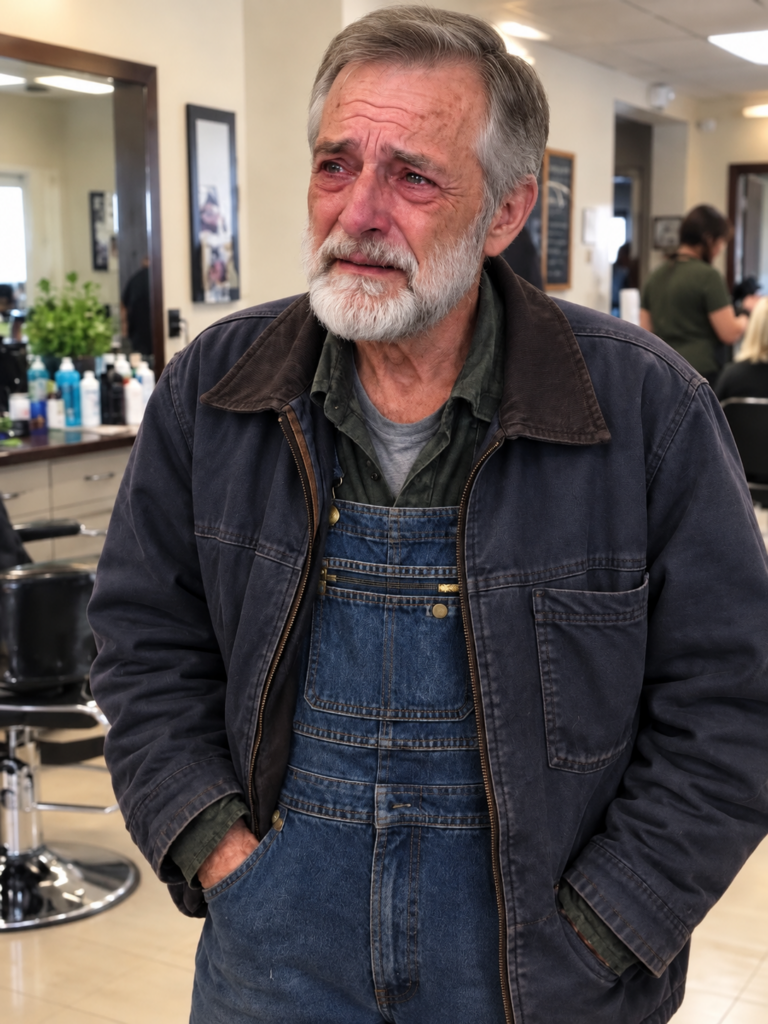
He was perhaps sixty-five, though hardship had a way of making age difficult to guess. His hair curled over his collar in uneven gray ropes. His beard was thick but patchy, almost white around his chin. One boot had been repaired with gray tape.
In his right hand, he held three one-dollar bills.
In his left, a folded piece of paper gone soft at the creases.
“I didn’t mean to cause trouble,” he said.
His voice was low, almost formal.
Trevor glanced at the clock.
“You’re not causing trouble. We’re just closed.”
“We close at seven,” I said.
Trevor looked at me.
“It’s six forty-seven.”
“That’s what I mean.”
He gave me the expression he usually reserved for clients who asked whether box dye could be removed in twenty minutes.
The stranger began backing toward the door.
“That’s all right. I’ll try someplace else tomorrow.”
Something about the way he said it stopped me.
Not disappointment.
Acceptance.
The kind of acceptance people learned after hearing no often enough.
I looked again at the little bird on his wrist.
My mother’s tattoo had been darker, but the shape was unmistakable: wings angled upward, tail split, head turned slightly left.
I had seen it every day of my childhood.
Mom never wore watches because she said they covered the only tattoo she had ever bothered to get.
When I was eight, I asked her what the bird meant.
“Freedom,” she said.
At twelve, she said it meant foolishness.
At seventeen, after I caught her staring at it while crying quietly at the kitchen sink, she said it meant nothing at all.
She died when I was twenty-four.
I was thirty-two now.
I still didn’t know which answer had been true.
“Sit down,” I told the man.
Trevor exhaled sharply.
“Mara.”
“I can do a basic cut in fifteen minutes.”
“He has three dollars.”
“I heard him.”
The stranger immediately shook his head.
“No. I don’t want you getting in trouble.”
“You won’t.”
That was not necessarily true.
Our owner, Pamela, had recently posted a memo in the break room reminding stylists that unauthorized discounts were considered “theft of salon resources.”
Apparently shampoo and electricity had become precious commodities.
Still, I pulled a cape from the drawer.
“Chair four.”
The man did not move.
He studied me.
“You always ignore your boss?”
“He isn’t my boss.”
Trevor lifted both palms.
“Please leave me out of this.”
For the first time, the stranger almost smiled.
He crossed the salon carefully.
As he lowered himself into my chair, he placed the three dollars and folded paper on the counter.
I noticed his hands.
They were rough, scarred across the knuckles, with dirt embedded so deeply around the nails that ordinary washing probably no longer helped.
“Name?” I asked.
“Eli.”
“I’m Mara.”
His eyes met mine in the mirror.
The reaction was so immediate that I nearly dropped the comb.
His mouth opened.
Then closed.
He stared.
“What?”
“Nothing.”
“That didn’t look like nothing.”
He lowered his eyes.
“You look like someone I used to know.”
There are sentences that mean very little until you are already afraid.
That one made the bird on his wrist feel suddenly enormous.
I touched the cape near his shoulder.
“Who?”
“An old friend.”
“My mother?”
His gaze snapped back to mine.
Behind me, Denise stopped counting twenties.
Trevor looked up from the computer.
Eli’s face changed in small stages.
Confusion first.
Then fear.
Then something much worse.
Recognition.
“What was her name?” he whispered.
I could hear the rain and the soft hum of the fluorescent lights.
“Caroline Mercer.”
He closed his eyes.
Denise said quietly, “Mara?”
I ignored her.
“How did you know my mother?”
Eli opened his eyes again.
They were pale green.
Not blue like mine.
Not brown like Mom’s.
But something about them felt familiar anyway.
“She told me you became a hairdresser.”
My stomach tightened.
“When?”
He looked toward the front door.
“I shouldn’t have come here.”
“You didn’t come here for me.”
“No.”
“You said you were trying to meet your daughter.”
His jaw moved.
“Yes.”
“Is that folded paper her address?”
He did not answer.
I picked up the clippers but did not turn them on.
“What does the tattoo mean?”
Eli looked at his wrist.
The salon seemed to shrink around us.
Finally, he said, “Your mother drew it.”
I put the clippers down.
Trevor stepped closer.
“Mara, do you want me to ask him to leave?”
“No.”
Eli slowly unfastened the cape.
“Yes. You probably should.”
He started to stand.
I put my hand on his shoulder.
Not hard.
But enough.
“Sit.”
He looked at me in the mirror.
“If you knew my mother, you don’t get to walk out now.”
His shoulders sank.
Then he sat back.
Denise locked the front door and flipped the sign to CLOSED.
Trevor stared at her.
“What are you doing?”
“Whatever this is,” she said, “doesn’t need an audience.”
Eli looked ashamed.
“I didn’t plan this.”
“Plan what?”
“Meeting you.”
My heartbeat seemed to move into my throat.
I had spent eight years learning how grief changes shape.
At first, after Mom died, everything reminded me of her.
A grocery store song.
A chipped coffee mug.
The smell of coconut hand lotion.
Later, grief became quieter. It stopped jumping out of closets and simply took a permanent seat somewhere inside me.
But now, hearing a stranger say he had not planned to meet me, grief stood up.
“Who are you?” I asked.
Eli rubbed his palms against his knees.
“My full name is Elijah Boone.”
Nothing.
The name meant absolutely nothing to me.
Apparently my face showed it.
“That’s good,” he said softly.
“What is?”
“She kept her promise.”
“To do what?”
He looked at me.
“Give you a life where you never had to hear my name.”
I took a step back.
Denise whispered, “Oh, God.”
I understood before he said it.
Maybe I understood the moment he entered.
Maybe I had understood the second I saw the swallow.
But understanding something and hearing it said aloud are different experiences.
“My daughter’s name,” Eli said, his voice breaking, “is Mara Caroline Mercer.”
The salon disappeared.
Not literally.
The mirrors remained.
The styling stations.
The rain.
Trevor leaning against the reception counter.
But none of it felt attached to me anymore.
I stared at Eli.
“No.”
He nodded once.
“No.”
“Mara—”
“My father’s name was Daniel.”
“That was your grandfather’s middle name.”
“Stop.”
“Your mother thought—”
“Stop talking.”
He did.
I walked to the shampoo sinks because I suddenly needed distance.
My mother had told me my father was a man named Daniel who had left before I was born.
She said he had moved west.
Once, when I was fifteen and angry, I accused her of chasing him away.
She slapped the kitchen counter—not me, never me—and shouted, “Some people leave because staying would destroy everyone around them.”
I did not speak to her for two days.
Years later I assumed she had meant drugs.
Or infidelity.
Or cowardice.
Something ordinary enough to explain silence.
But she had never told me his last name.
Never shown me a picture.
Never once described his face.
I gripped the porcelain sink.
“You have proof?”
Eli nodded.
“The paper.”
I returned to the station.
The folded piece beside his three dollars was not an address.
It was an envelope.
My name was written across the front.
Mara.
Just Mara.
I recognized the handwriting immediately.
Mom’s capital M always leaned too far to the right.
I reached for it, then stopped.
“When did she give you this?”
“Seventeen years ago.”
My hand froze.
“She was alive seventeen years ago.”
“Yes.”
“You saw her?”
“Yes.”
“Where?”
Eli stared at the floor.
“Southwest Correctional Center.”
Trevor muttered something under his breath.
I sat in the empty chair beside Eli.
“Why were you in prison?”
He did not soften the answer.
“Armed robbery.”
Denise covered her mouth.
I looked at the man’s scarred hands.
“How long?”
“Eighteen years total.”
“For one robbery?”
“No.”
He looked directly at me.
“That was the last crime. Not the first.”
My skin went cold.
“My mother took me away from you because you were a criminal.”
“Yes.”
“You used drugs?”
“Yes.”
“You hurt her?”
His face twisted.
“Not with my hands.”
“That isn’t what I asked.”
He breathed in slowly.
“I lied to her. Stole from her. Disappeared for days. Sold things that belonged to her. Promised I would stop and didn’t. I scared her more than once.”
“Did you hit her?”
“No.”
“Did you threaten her?”
“No.”
I wanted to believe that.
I hated myself for wanting to believe anything.
“How old was I?”
“Six months when I was arrested for the last time.”
“You knew me?”
Eli gave a strange, devastated smile.
“I knew the sound you made when you were hungry.”
That sentence hurt more than anything else he had said.
I looked away.
He continued carefully.
“You hated being swaddled. Caroline said babies liked it, but you fought blankets like you were escaping jail.”
Denise laughed once before realizing no one else was laughing.
Eli’s eyes shone.
“You had a red birthmark behind your right knee.”
I stopped breathing.
The mark had faded before I started school.
There was no reason a stranger would know it.
Unless Mom had told him.
Or unless—
I stood up.
“Finish the haircut.”
Eli blinked.
“What?”
“I said finish the haircut.”
He looked confused.
“You haven’t started.”
“Exactly.”
I picked up my comb.
“You came for a haircut. You’re getting one. Then you’re going to tell me why, after thirty-two years, my dead mother suddenly sent you into my salon.”
“She didn’t send me.”
“Then explain afterward.”
My hands were shaking.
I had cut hair during divorces, funerals, panic attacks, engagements, miscarriages, job losses, and once during a tornado warning.
Muscle memory took over.
I sprayed Eli’s hair.
Combed it back.
Trimmed around his ears.
Shaped the neckline.
He sat so still I wondered whether he was breathing.
When I moved to his left side, my fingers brushed the tattoo.
He flinched.
I stared at the bird.
“My mother said it meant freedom.”
“She used to change the story.”
My scissors paused.
“You know that?”
“She told me it meant luck the first time I asked.”
Despite myself, I smiled faintly.
“That sounds like her.”
“We got them in Pensacola when she was twenty.”
“I thought she lived in Tallahassee then.”
“She did. We drove three hours because she said nobody in Tallahassee needed to know everything she did.”
That sounded exactly like her too.
I finished his hair.
Then I trimmed his beard without asking.
When I spun the chair around, Eli stared into the mirror.
The difference was startling.
He still looked tired.
Poor.
Weathered.
But underneath the overgrown hair was a careful face, lean and angular.
A face with my cheekbones.
I noticed it then.
Not enough that a stranger would see.
Enough that a daughter would.
Eli touched the side of his head.
“That’s better than I deserve.”
I removed the cape.
“Don’t say things like that.”
He looked surprised.
“I’m angry at you. I haven’t decided anything else.”
He nodded.
“Fair.”
I picked up the envelope.
“Why now?”
Eli looked at the clock.
Six minutes past seven.
“My parole ended three weeks ago.”
“That’s it?”
“No.”
He swallowed.
“I also found out I have pancreatic cancer.”
Silence filled every corner of the salon.
Trevor looked away first.
Eli continued.
“Doctor says treatment might buy time. Might not.”
I felt something ugly rise in me.
“So you’re dying, and suddenly you want to be my father?”
“No.”
His answer came quickly.
“I wanted to find you nine years ago.”
“Then why didn’t you?”
“Because your mother told me not to.”
He pointed toward the envelope.
“She gave me rules.”
My fingers tightened around it.
“What rules?”
“You read hers first.”
I tore open the envelope.
Inside were four pages.
The first line nearly dropped me to my knees.
Mara,
If Elijah Boone is standing in front of you, then he has done something I once believed he might never do.
He has kept a promise.
Part 2
I read the letter sitting beneath the dryer where Mrs. Alvarez usually spent Wednesdays complaining about her daughter-in-law.
Denise brought me water.
Trevor left without saying much beyond, “Text me if you need anything.”
Eli waited near the front windows.
He did not try to watch me read.
That mattered.
I hated that it mattered.
My mother’s letter began with an apology.
Not for keeping Eli away.
For lying about his name.
She wrote that when I was little, truth had seemed too complicated. Later, when I became old enough to understand, telling me felt cruel because Eli was still in prison, still unpredictable, still drifting between recovery and relapse.
She had convinced herself she was protecting me.
Then protecting me became habit.
And habit became fear.
She wrote about meeting Eli when they were nineteen.
Not at a snow-cone stand or anything romantic enough to become family mythology.
At a laundromat.
Mom had overloaded a washer, and soap bubbled across the floor.
Eli helped mop it while teasing her about her “criminal misuse of detergent.”
They dated three weeks before she discovered he had no car and had been borrowing his cousin’s without permission.
Apparently warning signs had never been subtle.
Still, she loved him.
He was funny.
Restless.
Good with children.
He could repair anything with a motor.
He remembered birthdays.
He also carried something inside himself that he did not yet know how to control.
Mom described addiction without making it poetic.
There were pills after a construction injury.
Then pills bought from friends.
Then harder drugs.
Then lies.
She wrote:
I loved him, but I stopped trusting the version of him who came home promising tomorrow would be different.
When she got pregnant, Eli tried treatment.
He stayed sober almost seven months.
I was born during that stretch.
For a brief time, she wrote, they had been happy enough to believe trouble was behind them.
Then Eli disappeared for a weekend.
Then money vanished.
Then her grandmother’s bracelet.
Then a television.
Then a borrowed truck.
At six months old, I was asleep in my crib when police came to the apartment.
Mom took me to my grandparents before dawn.
She never returned to the home she had shared with him.
Eli’s robbery involved a pharmacy.
No one was shot.
But he had carried a gun.
He received a long sentence because of prior offenses.
Mom visited him twice.
The first time, she brought me.
The second time, she came alone and told him it would be the last.
Years passed.
Then, when I was fifteen, she heard through one of his cousins that he had spent nearly three years clean inside prison and was mentoring younger inmates in recovery.
She did nothing.
When I was seventeen, she heard he had relapsed after learning his mother had died.
Again she did nothing.
But months later, diagnosed with ovarian cancer herself, Mom apparently began reconsidering everything she had left unfinished.
She visited him.
She wrote the letter.
She gave him my full name and told him what city I lived in.
But she also established conditions.
He could not contact me while incarcerated.
He could not contact me immediately after release.
He had to stay sober.
Hold legitimate work.
Complete parole without violations.
And he had to accept that I might refuse him entirely.
Her final instruction was the hardest:
Do not approach Mara asking to be forgiven. Approach her prepared to tell the truth.
My vision blurred near the end.
Mom wrote:
I did not keep him from you because you were unwanted.
I kept him from you because wanting a child and being safe for a child are not the same thing.
If he gives you this letter, it means he finally understood that.
What you do next belongs to you.
I lowered the pages.
For several minutes, I could not look at Eli.
I was furious with both of them.
Mom for deciding the truth belonged to some imaginary future version of me.
Eli for being exactly the kind of man she had needed to protect me from.
Death for making every decision permanent.
“You knew she had cancer?” I asked.
Eli nodded.
“She looked sick when she visited.”
“She died eight months later.”
“I know.”
“How?”
“Obituary.”
That answer hurt.
“You read my mother’s obituary from prison.”
“Yes.”
“Did you cry?”
He looked at me like the question had surprised him.
“Every night for a while.”
I folded the letter.
“That doesn’t fix anything.”
“No.”
“You keep saying that.”
“Because I know.”
I stood.
“What daughter were you supposedly going to meet tonight?”
He glanced at me.
“You.”
My anger sharpened.
“You lied.”
“I panicked.”
“You said your daughter refused to see you for twenty-six years.”
“I said I needed to look respectable enough to meet the daughter who hadn’t seen me.”
“That’s not what you said.”
He almost smiled.
“You’re right.”
“You rehearsed this?”
“For months.”
“And then walked into my workplace pretending you needed a haircut?”
“No.”
For the first time, irritation entered his voice.
“I came here because I knew where you worked. I stood outside for almost an hour. I kept thinking I’d come back another day. Then the rain started, and I realized if I left, I might keep leaving.”
He nodded toward the three dollars.
“The haircut part was real. Three dollars was everything I had until Saturday.”
“You have a job?”
“Warehouse loading dock. Nights.”
“You live where?”
“Transition house on Pryor Street.”
“That place with the blue doors?”
“Yes.”
I had passed it a hundred times.
My father had apparently lived eleven minutes from me for months.
My stomach rolled.
I gathered my things.
“Come on.”
Eli stared.
“Where?”
“Dinner.”
Denise’s eyebrows rose.
I ignored her.
“You want answers?” I said to Eli. “So do I.”
We went to a diner two blocks away.
I chose a booth near the front.
Not because I was afraid of him, I told myself.
Because the lighting was better.
That was a lie.
Eli ordered coffee.
I ordered fries I never touched.
For the next two hours, I interrogated him.
I asked about prison.
He answered.
I asked when he last used drugs.
Nine years, four months, thirteen days earlier.
He did not sound proud when he said it.
He sounded vigilant.
I asked whether he had other children.
“No.”
“Wife?”
“No.”
“Girlfriends?”
“Not for a long time.”
“Why?”
He stirred his coffee.
“I spent too much of my life making other people carry me. I needed to learn how to carry myself.”
That sounded suspiciously polished.
“Recovery slogan?”
“No. My sponsor got tired of hearing me complain.”
I asked about Mom.
That changed him.
He remembered tiny things.
She hated wet socks.
She read the last page of mystery novels first.
She could not snap her fingers.
She put salt on watermelon.
She once drove eighty miles because someone told her there was a diner that served lemon pie “the correct way.”
I laughed before I meant to.
Eli heard it.
His expression softened.
I immediately became angry again.
“Don’t look at me like that.”
“Like what?”
“Like we’re having a nice father-daughter dinner.”
He lowered his eyes.
“You’re right.”
A waitress refilled his coffee.
I looked at his tattoo.
“Why the swallow?”
“Your mother said sailors used to get swallows because they represented traveling far and still finding your way home.”
“Was that true?”
“Probably not. Caroline made things up when reality wasn’t interesting enough.”
That was true.
When I was ten, she convinced me our apartment building had once housed a spy.
For years I believed it.
I looked at Eli.
“You loved her.”
“Yeah.”
“Then why did you do all that?”
His fingers tightened around the mug.
There it was.
The question people ask about addiction because they want an answer shaped like morality.
Why wasn’t love enough?
Why wasn’t the baby enough?
Why wasn’t fear enough?
Eli stared into his coffee.
“At first, because I was selfish.”
I expected excuses.
He did not offer them.
“Later, because I was sick and selfish. Then ashamed and sick and selfish. Every time I hurt her, getting high was easier than facing what I’d done. So I hurt her again.”
He looked at me.
“I can explain the machinery. I can’t make it noble.”
Something inside me shifted.
Not forgiveness.
Respect, perhaps, for the absence of performance.
We left after nine.
In the parking lot, Eli stopped beside my car.
“I won’t contact you again unless you want me to.”
I crossed my arms.
“You went through all this and you’re giving up after two hours?”
“No.”
“I thought addicts were supposed to be persistent.”
“Recovery also teaches us not to force ourselves into other people’s lives.”
I hated that answer because it left the choice with me.
Mom had done the same thing in her letter.
Two dead or dying parents handing me freedom as though freedom was easy.
“Do you have a phone?”
He showed me an old prepaid flip phone.
I laughed.
“You’re serious?”
“It makes calls.”
“So does a museum exhibit.”
He smiled.
That was the first time I saw it clearly.
My smile.
Not identical.
But close enough that I felt robbed.
I typed my number into his phone.
“Sunday.”
His smile vanished.
“What?”
“Lunch. One o’clock. The barbecue place near the river.”
He stared at me.
“That’s not forgiveness.”
“I know.”
“You say that a lot too.”
His eyes filled.
He nodded.
“I’ll be there.”
He arrived at twelve thirty.
That became his pattern.
Early.
Always early.
For three months, we had lunch every Sunday.
I learned he loved western movies but hated country music.
He learned I hated tomatoes and had been divorced for four years.
I told him about my ex-husband, Nathan, who decided after seven years of marriage that he “needed a more adventurous life,” which apparently meant a twenty-six-year-old cycling instructor.
Eli listened without insulting Nathan.
That irritated me.
“You’re allowed to call him an idiot.”
“I don’t think I’ve earned the right to judge another man for wrecking a family.”
There were days I could not stand his humility.
It felt like another form of control.
If he refused to defend himself, how was I supposed to fight with him?
Then one Sunday, I did.
We were eating sandwiches in a park when I noticed a little girl learning to ride a bicycle.
Her father jogged behind her holding the seat.
The girl shrieked every time he let go.
I watched too long.
Eli noticed.
“What?”
I turned on him.
“You missed mine.”
His face went still.
“My what?”
“Bike.”
He understood.
I kept going.
“You missed kindergarten. You missed when I broke my arm. You missed every school play. You missed prom. Graduation. My wedding.”
People nearby glanced toward us.
I did not care.
“You missed Mom getting sick. You missed me taking her to chemotherapy. You missed me sleeping in a chair beside her hospital bed. You missed the funeral.”
Eli’s eyes filled.
“You missed everything, and now I’m supposed to be grateful you show up thirty minutes early for barbecue?”
“No.”
I threw my sandwich into the bag.
“I don’t even know what I want you to say.”
He looked at his hands.
“I missed your first birthday.”
I stared at him.
“Your first day of school. Your first tooth falling out. Every Christmas morning.”
His voice trembled.
“I missed every bad boyfriend I should’ve hated. Every flat tire I should’ve changed. Every time Caroline was scared and needed someone beside her.”
He looked up.
“I missed the chance to become the person you might have called when your marriage fell apart.”
Tears ran down my face.
“I’m angry.”
“I know.”
“I might always be angry.”
“I know.”
“Stop saying you know.”
He nodded.
Then said, “Okay.”
I laughed through my tears.
He did not.
“I can’t give those years back,” he said. “And if I spend whatever time I have trying to make you tell me it’s okay, then I’m stealing from you again.”
That sentence stayed with me.
For the first time, I touched his hand.
Only for a second.
But he closed his eyes.
A week later, he called me from the hospital.
His cancer had spread to his liver.
Treatment might slow it.
Not stop it.
I sat beside his bed listening to an oncologist discuss months as though months were objects someone could count into a box.
Six, perhaps.
Nine if treatment worked well.
Twelve would be fortunate.
Eli asked questions about pain control.
Transportation.
Whether he could keep working.
He did not ask how long he had until the doctor was almost out the door.
Then he said, “Will I know when I’m near the end?”
The doctor paused.
“We’ll help you understand what’s happening.”
Eli nodded.
Afterward, I stared at him.
“That’s all you have to say?”
“What should I say?”
“You’re dying.”
“Eventually.”
“Soon.”
His mouth tightened.
“Probably.”
I stood so fast the visitor’s chair scraped the floor.
“This is so unfair.”
Eli looked almost confused.
“For you.”
I started crying.
“For me.”
He turned his face toward the window.
That was the first time I saw him cry because he was dying.
Not because he feared death.
Because leaving again would hurt me.
A month later, I learned he had been fired.
Not because of his criminal record.
Because he was missing shifts for chemotherapy.
Eli claimed the company had been understanding.
I did not believe him.
When I offered money, he refused.
When I offered my spare room, he refused harder.
“You need somewhere decent.”
“I have somewhere decent.”
“You share a room with two men.”
“They’re quiet.”
“One snores loud enough to register on weather satellites.”
Eli smiled.
“No.”
I slammed my hand on the diner table.
“Why?”
His smile disappeared.
“Because you are beginning to care about me.”
“That’s the point.”
“No. That is exactly why.”
He leaned forward.
“I came into your life owing you. I will not spend the last part of mine turning you into my nurse.”
“You don’t decide what I’m willing to do.”
The words landed between us.
He stared at me.
I stared back.
My mother’s daughter.
His too, apparently.
Finally he said, “You sound like Caroline.”
“Good.”
“She scared me.”
“So should I.”
Three days later, he moved into my spare room.
That should have been the beginning of healing.
Instead, it nearly destroyed everything.
Because one morning, while looking for his insurance paperwork, I found a second envelope.
It was hidden in the bottom of his duffel bag.
My mother’s handwriting was on that one too.
But the name across the front was not mine.
It said:
For Mara’s father, when she learns the truth.
The envelope was already open.
Part 3
I confronted Eli that evening.
He had spent the afternoon sleeping after chemotherapy.
When he came into the kitchen, wrapped in an old gray sweatshirt, I placed the envelope on the table.
His face changed instantly.
“You went through my things?”
“I was looking for your insurance card.”
He gripped the back of a chair.
“Mara.”
“You told me Mom gave you one letter.”
“I told you she gave me your letter.”
“What’s in this one?”
He said nothing.
I felt heat rise into my face.
“This is exactly what she did.”
“It’s not.”
“Secrets. Half-truths. Deciding what I can handle.”
“This letter isn’t about you.”
“My name is on the front.”
His eyes closed.
“Not like that.”
“Then read it.”
“I already did.”
“I can see that.”
“No.” His voice sharpened. “I mean I’m the one it was written for.”
I stared at him.
“Then why hide it?”
“Because it contains something your mother told me not to burden you with unless it became necessary.”
I laughed once.
“Congratulations. Necessary.”
He sank into the chair.
Cancer had changed him quickly.
His cheeks were thinner.
His wrists looked delicate.
Even the tattoo seemed too large for him now.
He pushed the envelope toward me.
“You’ll hate me.”
“Possibly.”
“Caroline too.”
“I’m already working on that.”
Despite everything, he smiled faintly.
Then I opened the letter.
Mom’s first sentence was blunt.
Elijah, if Mara knows who you are, then either I have failed to protect her from pain or you have finally become someone capable of sharing it honestly.
I looked at Eli.
“Sounds like Mom.”
“Yeah.”
The letter was dated six months before her death.
Mom wrote that my grandfather, Thomas Mercer, had known the truth about Eli.
That surprised me.
Grandpa had raised me alongside Mom.
He was the safest man I had ever known.
He packed my lunches through middle school and taught me to drive.
After Mom died, he lived another five years.
He never mentioned Eli.
But that was not the secret.
The secret was money.
Eli had inherited a modest amount after his mother died.
Because he was incarcerated and still struggling with sobriety, the money went into an account managed by his older brother.
Years later, once Eli was sober, he asked that part of it be transferred to my mother.
Not to him.
To her.
He wanted it used for my college education.
Mom refused at first.
Eventually, according to her letter, she accepted twelve thousand dollars under one condition: I could never be told it came from Eli unless he completed the requirements she set for future contact.
I lowered the page.
“My college fund?”
Eli nodded.
I remembered the account.
Mom told me Grandpa had saved it.
It paid for beauty school and helped me buy my first used car.
“There’s more,” Eli said.
I kept reading.
Near the bottom, Mom explained that Grandpa had hated the arrangement.
He believed accepting Eli’s money created an emotional debt.
Mom disagreed.
She wrote:
Mara owes you nothing for money. A parent providing for a child is not generosity. It is responsibility arriving late.
I swallowed.
That sounded painfully like her.
Then came the part Eli had feared.
After Mom died, Grandpa apparently wrote to him.
Not kindly.
He told Eli never to contact me.
He said Mom’s conditions had been sentimental nonsense and that people like Eli did not change.
Eli wrote back once.
Grandpa never replied.
I dropped the pages onto the table.
“You knew Grandpa didn’t want you near me.”
“Yes.”
“And you came anyway.”
“After he died.”
“You waited?”
He nodded.
“Your mother’s instructions mattered more to me. But I knew Thomas had raised you. I wasn’t going to disrespect him while he was alive.”
I thought of Grandpa sitting on the porch after Mom’s funeral, his hands folded between his knees.
“I promised your mother I’d keep you safe,” he had told me.
At the time, I thought he meant grief.
Now I understood he had meant Eli too.
I felt betrayed.
Then guilty for feeling betrayed.
Grandpa had loved me.
Mom had loved me.
Eli, in his fractured way, had loved me.
Apparently love did not prevent people from making terrible decisions on your behalf.
Sometimes it encouraged them.
“Why didn’t you tell me about the money?”
Eli looked confused.
“Because it changes nothing.”
“It changes something.”
“What?”
“You helped me.”
He leaned back.
“I should have helped you every month of your childhood.”
“But you did something.”
“Don’t turn scraps into a feast because you’re afraid I’m dying.”
The sentence stunned me.
He pointed toward the letter.
“I sent money because it belonged with you. Not because it bought me a place in your life.”
I started crying.
Eli looked away.
“Damn you.”
“I know.”
I laughed.
“Say it.”
“What?”
“You know.”
He smiled weakly.
“I know.”
That became the last serious argument we ever had.
Not because everything was resolved.
Because time changed the scale of things.
Over the next four months, Eli became less mobile.
I reduced my salon hours.
Denise covered Thursdays.
Trevor, to my surprise, organized a small fundraiser among staff without telling me.
Pamela, our owner, donated nothing but allowed a jar at reception, which was approximately as generous as Pamela knew how to be.
Clients contributed.
So did people from Eli’s recovery group.
And people from the transitional house.
I began meeting pieces of the man he had become before I knew him.
Marcus, his sponsor, told me Eli volunteered every Saturday repairing bicycles for kids.
A warehouse coworker named Luis said Eli spent two winters giving his spare coat to new men at the shelter.
A woman named Sherry told me that when her son relapsed, Eli drove two hours to sit with her outside a detox center.
None of this erased what he had done.
That was the strange thing.
The better I understood the man he had become, the more clearly I saw the damage caused by the man he had been.
Redemption did not rewrite the first chapter.
It simply meant there were later chapters.
One Sunday, Eli asked me to drive him to the coast.
The trip took three hours because we stopped twice for him to rest.
He directed me toward an old neighborhood near the water.
Most of it had changed.
Condominiums where little houses had been.
A brewery where a grocery store once stood.
Finally, he pointed toward a laundromat wedged between a pawn shop and a nail salon.
“That’s it.”
I laughed.
“That?”
“That’s where I met your mother.”
The sign had changed.
The windows were newer.
But according to Eli, the row of ancient washers near the back remained exactly where they had been.
We went inside.
A woman folding sheets looked suspiciously at us.
Eli stared at the tile floor.
“Your mother poured half a box of detergent into number seven.”
I checked.
Washer seven existed.
“Half a box?”
“She said the instructions were conservative.”
“That also sounds like her.”
We laughed.
Then Eli became quiet.
“I ruined the best thing that ever happened to me.”
I leaned against a folding table.
“You didn’t ruin me.”
His eyes lifted.
“No.”
“You lost me.”
He nodded.
“There’s a difference.”
Outside, we sat on a bench facing the parking lot.
I took his wrist.
Placed my thumb over the faded swallow.
“I’m getting one.”
He looked horrified.
“No.”
“Why?”
“Because tattoos are permanent.”
I stared at him.
He realized what he had said.
We both started laughing.
I got the swallow tattoo two weeks later.
Not identical.
Mine faced right.
His and Mom’s faced left.
When Eli saw it, his eyes filled.
“You did it backward.”
“On purpose.”
“Why?”
“Yours is about finding your way home.”
He waited.
“Mine is about leaving home without being afraid.”
He nodded slowly.
“Caroline would like that.”
I swallowed.
“I hope so.”
By early spring, hospice began visiting the house.
Eli’s world shrank.
First from the city to my home.
Then from my home to the living room.
Finally from the living room to the spare bedroom.
One morning, I found the three dollar bills from the salon tucked into the frame of my bathroom mirror.
I carried them into his room.
“What is this?”
He opened one eye.
“My haircut money.”
“I didn’t charge you.”
“That’s why I kept trying to pay.”
“Three dollars wouldn’t cover Trevor’s hair gel.”
Eli smiled.
“Then consider it a deposit.”
“For what?”
“My next cut.”
My throat tightened.
His hair barely needed cutting anymore.
Chemotherapy had thinned most of it.
Still, one Friday, he asked.
“You working tomorrow?”
“No.”
“Would you bring your scissors in here?”
I knew.
Not consciously.
But somewhere inside me, I knew.
I brought my kit.
He sat in the chair by the window wearing a towel around his shoulders because he refused the salon cape.
“Those things make me feel like a poodle.”
I combed what remained of his hair.
“You’re very demanding for someone paying three dollars.”
“Customer is always right.”
“Not in hair salons.”
I trimmed carefully.
Behind his ears.
Across the back.
A little around the sides.
Eli watched through a small hand mirror.
“You have Caroline’s concentration face.”
“What’s that?”
“Your mouth turns down when you focus.”
“No, it doesn’t.”
“It does.”
“You’re dying and still annoying.”
“Skill.”
Halfway through, I put the scissors down.
“What?”
“Nothing.”
“Mara.”
I pressed my lips together.
Tears came anyway.
He reached for my hand.
For months, I had been the one helping him stand.
Helping him eat.
Helping him manage medication.
Yet his grip still felt like a father’s.
Not because it was strong.
Because I had finally let it mean something.
“I’m sorry,” he said.
I shook my head.
“No speeches.”
“I need to say one thing.”
“No.”
“One.”
I looked at him.
He breathed carefully.
“Thank you for not pretending the past didn’t happen.”
That was not what I expected.
He continued.
“If you had forgiven me immediately, I would’ve wondered whether you were doing it because you felt sorry for me.”
I wiped my cheek.
“I did feel sorry for you.”
“Sometimes.”
“Mostly I thought you were irritating.”
“Fair.”
I smiled.
He looked toward the window.
“Your anger made what we had real.”
I sat on the edge of the bed.
“I’m still angry.”
“You’re allowed.”
“I know.”
He smiled.
Then I said the word I had resisted for nearly a year.
“Dad.”
His face changed.
He did not cry dramatically.
He simply closed his eyes.
One tear moved slowly toward his ear.
I finished the haircut.
When I held up the mirror, he turned his head left and right.
“Pretty good.”
“Pretty good?”
“Back’s crooked.”
I smacked his shoulder with the towel.
He laughed until coughing stopped him.
That night, I sat beside his bed.
He slept most of the time.
Near midnight, he woke and asked whether it was raining.
“No.”
“I thought I heard rain.”
I listened.
The house was quiet.
“It was raining the night you came into the salon.”
“I remember.”
“You almost left.”
“I almost did.”
“What made you come inside?”
He thought about it.
“Your mother.”
I frowned.
“How?”
He lifted his wrist weakly.
“Every time I was about to leave, I looked at this bird and heard Caroline saying, ‘For once in your life, Elijah, finish something hard.’”
I laughed softly.
“She would say that.”
“Yeah.”
A few minutes later, he whispered, “I’m tired.”
“Then sleep.”
“You staying?”
“Yes.”
His eyes closed.
“Good.”
Eli died before dawn.
I was holding his hand.
There was no miracle.
No sudden final confession.
No perfect sentence.
Just breathing that became slower.
Then quieter.
Then stopped.
For a long time, I stared at the swallow on his wrist beside the new one on mine.
Two birds facing opposite directions.
One coming home.
One leaving.
At the funeral, Marcus from recovery spoke.
So did Luis from the warehouse.
I did not.
I couldn’t.
Afterward, a woman I had never met approached me.
She was in her forties, wearing a navy coat.
“Are you Mara?”
“Yes.”
“My son knew Eli from prison.”
My body stiffened.
She took my hand.
“My son didn’t make it.”
I did not know what to say.
“But before he died, he wrote me that Eli Boone was the first man who ever told him becoming better didn’t mean pretending you’d never been worse.”
She squeezed my fingers.
“I thought you should know.”
I cried all the way home.
Months passed.
I returned to full-time work.
The spare room remained untouched longer than I care to admit.
One rainy Thursday in October, almost exactly a year after Eli first walked into the salon, a young man came through the door at six forty-nine.
Maybe twenty.
His hair was greasy.
His clothes smelled like wet pavement and cigarettes.
He looked toward reception.
“How much for a haircut?”
“Forty-eight,” Trevor said.
The young man’s face fell.
“Oh.”
He began turning away.
I looked at the clock.
Eleven minutes until closing.
“Mara,” Trevor warned.
I smiled.
“Chair four.”
The young man hesitated.
“I only have five dollars.”
“That’s more than my father had.”
Trevor laughed.
The young man did not understand.
He sat cautiously.
As I wrapped the cape around him, I caught sight of the framed three dollars beside my mirror.
After Eli died, I had placed the bills behind glass.
Beneath them, I had written a sentence from my mother’s letter:
Wanting someone and being safe for them are not the same thing.
Months later, I added another sentence beneath it.
But becoming safe still matters.
The young man stared at the frame.
“Your dad gave you that?”
“In a way.”
I began cutting.
He told me he had an interview the next morning.
Dishwasher position at a retirement home.
He had been sleeping in his cousin’s car.
His mother would not let him home until he stopped using pills.
The details were different.
The pattern was familiar.
I did not try to save him.
I had learned that lesson too.
I gave him a haircut.
A clean towel.
The phone number of the recovery center Marcus worked with.
And when he tried to hand me the five dollars, I closed his fingers around it.
“Buy breakfast before the interview.”
His eyes filled.
“Why are you helping me?”
I looked into the mirror.
At his frightened young face.
At my own face behind him.
At the little swallow on my wrist.
For most of my life, I thought families were made by the people who stayed.
Then I met a man who had left before I could remember him and spent the rest of his life learning what staying actually meant.
He did not earn back my childhood.
He did not undo my mother’s fear.
He did not become innocent because he became sorry.
What he earned was smaller and harder.
The right to be known honestly.
The chance to show up while there was still time.
And, eventually, one word I never expected to give him.
Dad.
I turned the chair so the young man could see the back of his haircut.
“You don’t have to understand tonight,” I told him.
Outside, rain moved softly across the windows, almost exactly as it had a year earlier.
I unlocked the door after everyone else left.
The young man stepped outside, then looked back.
“Thanks.”
I nodded.
He disappeared toward the bus stop.
For a moment, I stood alone beneath the salon lights.
Then I touched the bird on my wrist and thought about my mother, about Eli, about all the years between wanting to come home and finally becoming someone safe enough to knock.
I switched off the lights.
Chair four sat empty behind me.
Not abandoned.
Waiting.


