
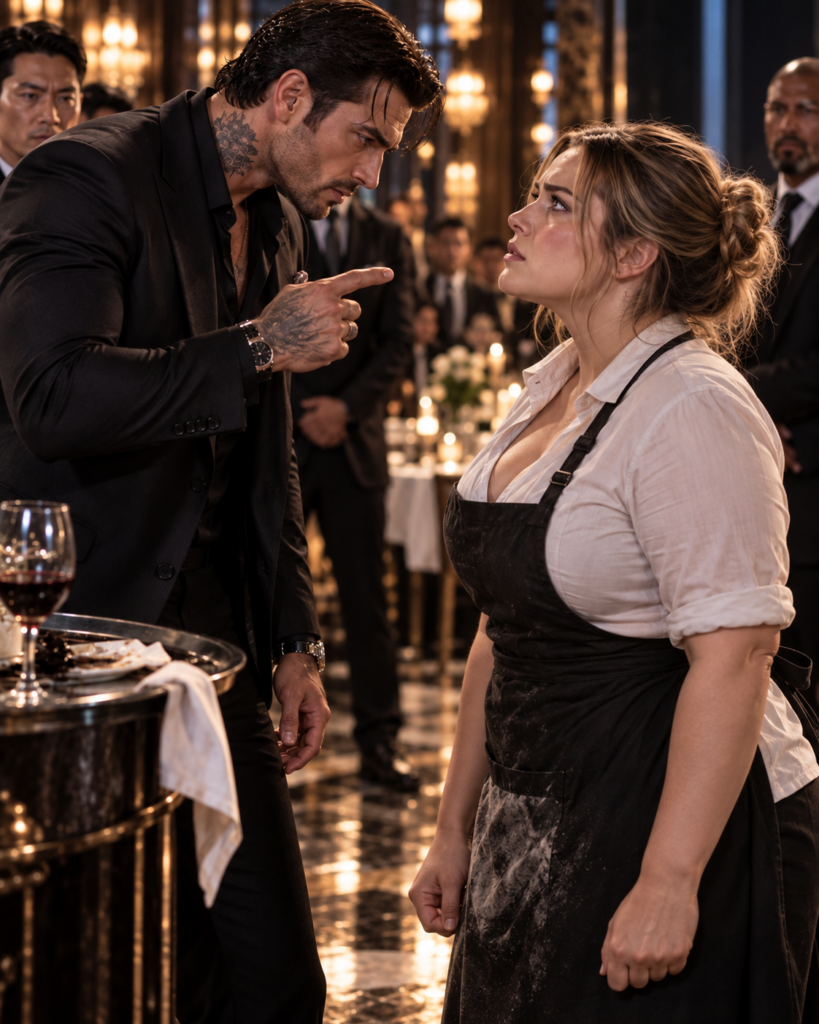
Vincent Steel watched the waitress pour his coffee and forgot the order that could start a citywide war.
Three hours later, his most dangerous rival sat in the same booth and told her he knew where she lived.
By midnight, Emma Thornton understood the truth: neither man wanted to hurt her—but both were capable of destroying her in the name of love.

PART 1 — THE WARNING IN BOOTH SEVEN
Rain streaked the windows of Malone’s Diner, turning the city lights into long rivers of red and gold. Emma Thornton moved between tables with a coffeepot in one hand and a tired smile on her face, her pale blue uniform smelling faintly of bacon grease and industrial detergent.
Vincent Steel sat alone in booth seven.
He wore a black suit without a tie. A scar crossed one knuckle, and the men waiting inside the SUV outside had the still posture of security professionals. Emma knew power when she saw it; she had once loved a man who disguised control as concern.
“More coffee?” she asked.
Vincent looked up.
For a second, the noise of the diner seemed to disappear.
“Yes.”
She filled his cup. “Rough morning?”
He had spent the morning settling a dispute with a man who had betrayed him, yet Emma’s question contained no suspicion. Only ordinary kindness.
“I’ve had better.”
“Haven’t we all?”
Her smile was brief, honest, and gone before he found an answer.
Vincent had returned every morning for nine days. He told himself the diner offered anonymity, but his untouched newspaper and the way he watched Emma made the lie obvious.
“Dinner,” he said as she turned away.
She stopped.
“There’s an Italian place on Madison. Tomorrow at seven.”
“That sounded like an order.”
His expression shifted. “Would you have dinner with me?”
Every instinct Emma had rebuilt after James warned her to refuse. Men who arrived in black SUVs did not bring peaceful lives.
“I don’t think that’s a good idea.”
Disappointment flickered across Vincent’s face.
“Fair enough.”
He left a modest tip and walked into the rain.
Two hours later, another man entered.
Angelo Rossi was older, silver beginning at his temples, his charcoal coat darkened by the weather. He selected Vincent’s booth and ordered coffee he barely touched.
“You’re Emma,” he said.
She tightened her grip on the pot. “My name tag solved the mystery.”
His mouth almost curved.
“I’ve watched you for a week. You treat everyone in this room with the same respect.”
“That’s my job.”
“No. It’s your nature.”
Unease crawled beneath her skin.
“I should check the kitchen.”
“I know about James Mercer.”
The pot struck the table hard enough to spill coffee.
Five years had passed since Emma escaped James—the isolation, the apologies, the hands gripping her wrists while he explained that fear proved she loved him. No stranger should have known his name.
Angelo’s eyes hardened with regret.
“He’s alive,” he said. “And he found you.”
Emma took a step backward. “Who are you?”
“Someone who knows Vincent Steel.”
The name meant nothing yet, but the way Angelo spoke it made the room feel colder.
“Vincent asked you to dinner because he wants something good close enough to touch,” Angelo continued. “That makes you dangerous to him—and makes him dangerous to you.”
“What do you want?”
“To warn you.”
“About Vincent?”
“About both of us.”
He placed cash beneath his cup and stood.
“If either of us begins calling control protection, leave. If we make decisions about your life without asking, disappear. And if James contacts you, do not meet him alone.”
Emma’s pulse hammered.
“How do you know where James is?”
Angelo looked toward the rain-streaked window.
“I don’t. But the Castellano family does.”
He walked out before she could stop him.
Her phone vibrated.
An unknown number had sent a photograph taken through the diner window. Emma stood beside booth seven, her face clearly visible.
Below the image was a message.
Vincent and Angelo think they found you first. They are wrong. Tell either man about this, and James will finish what he started.
Across the street, the black SUV’s brake lights flared.
Then it began moving toward the diner.
PART 2 — WHEN PROTECTION BECAME ANOTHER PRISON
Emma read the message twice before locking her phone.
The SUV stopped at the curb. Vincent stepped out beneath a black umbrella while one of his men remained behind the wheel.
She moved toward the kitchen.
Her manager, Tony Malone, glanced up from the register. He was sixty, round through the middle, and perpetually scented with coffee and peppermint.
“You okay, Em?”
“Fine.”
“You’re holding that coffeepot like it insulted your mother.”
She looked down. Her knuckles had gone white around the handle.
“Cover my tables for five minutes.”
Tony’s humor disappeared. “Do I need to call someone?”
“No.”
“Is it the guy in the expensive suit?”
Emma glanced toward the entrance.
Vincent had not come inside. He stood in the rain looking through the glass, giving her the illusion of choice while making it impossible to ignore his presence.
“I don’t know yet.”
She went out the side door into the alley.
Rain tapped against the metal trash bins. The air smelled of wet cardboard, fried onions, and exhaust from the avenue.
Vincent waited beneath the fire escape.
“You came back,” she said.
“I saw Rossi leave.”
“So?”
“He spoke to you.”
“He ordered coffee.”
“What else?”
The demand in his voice made her spine stiffen.
“You asked me to dinner, Vincent. You didn’t purchase my conversations.”
His face changed.
“You know my name.”
“Angelo told me.”
“He should not have approached you.”
“He also told me you would start calling control protection.”
Vincent’s jaw tightened. “Rossi poisons everything he cannot possess.”
“And what do you do?”
Rainwater moved from his dark hair along the edge of his cheek.
“I came to make sure he didn’t frighten you.”
“He did. So are you.”
A door opened behind them. One of Vincent’s men stepped into the alley, broad-shouldered and scarred across the left side of his face.
“Boss, we need to move.”
Vincent ignored him. “What did Rossi say?”
Emma slipped her phone deeper into her apron pocket.
If she revealed the message, she would be obeying the stranger who wanted her frightened and trusting the man she had met over coffee. Neither option belonged entirely to her.
“He warned me about James.”
Vincent became motionless.
The scarred man swore under his breath.
“You know him?” Emma asked.
Vincent looked toward his lieutenant. “Holloway, give us a minute.”
“Boss—”
“Now.”
Holloway returned to the SUV.
Vincent lowered his voice. “When did you last see James?”
“Five years ago.”
“Any calls? Letters? Someone following you?”
“No.”
That answer was no longer true, and they both seemed to know it.
“Emma, James Mercer is not merely an abusive former boyfriend. He worked as an intermediary for people who collect information on powerful organizations.”
“What organizations?”
“Mine. Rossi’s. Castellano’s.”
The names landed like locked doors.
“What exactly do you do?”
Vincent looked at her uniform, at the employee entrance behind her, then at the windows overlooking the alley.
“I own transportation companies, clubs, real estate, and other interests.”
“Other interests?”
“The kind that do not appear in annual reports.”
She laughed once, without humor. “Angelo called you dangerous.”
“He was being honest.”
“You’re admitting it?”
“Yes.”
“Are you a criminal?”
“Yes.”
The clean answer frightened her more than a polished denial.
She stepped backward.
Vincent did not follow.
“James found me because of you?”
“No. Rossi knew before I did.”
“So Angelo was watching me.”
“Yes.”
“And you’ve been coming to the diner every morning because—what? You enjoy the coffee?”
His gaze held hers.
“At first, I came because no one looked for me there.”
“And after?”
“After, I came because you were there.”
It was the sort of admission another woman might have found romantic. Emma heard the danger underneath it.
“You don’t know me.”
“I know you give the same patience to a homeless man that you give to a banker. I know you take your break at two and read by the back window. I know you walk three extra blocks after work because the park route has better lighting.”
Her stomach turned cold.
“That isn’t knowing me. That’s surveillance.”
Vincent seemed to hear the distinction.
“I did not order anyone to follow you until this morning.”
“Until this morning?”
“Rossi’s car was outside.”
“So you responded by putting another car outside.”
“To keep you safe.”
There it was.
Protection.
The word Angelo had predicted.
Emma removed her apron. “I’m going home.”
“Not alone.”
“You do not decide that.”
“The message on your phone may change your mind.”
Her hand stopped.
Vincent’s gaze dropped to her pocket.
“How do you know about it?”
“I don’t. But you have looked at that phone six times and lied once.”
The rain seemed suddenly louder.
He extended his hand.
“Show me.”
“No.”
“If James contacted you—”
“You asked for coffee, then dinner, and now my private messages. How long before you ask for my keys?”
His expression tightened with something close to shame.
“Keep the phone. Let Holloway drive behind you.”
“No.”
“Emma.”
“That tone worked on your employees. Try it on me again and this conversation ends permanently.”
Vincent inhaled slowly.
“Will you allow Holloway to remain three blocks behind you?”
“No.”
“Five?”
Despite her fear, she almost smiled at the absurd negotiation.
“No.”
“I am not good at this.”
“At what?”
“Wanting someone safe without controlling how they become safe.”
The sentence stopped her.
Not because it excused him.
Because he knew the flaw existed.
“I’ll take a cab,” she said. “I’ll text Tony when I’m home. Tony—not you.”
Vincent nodded.
“If you change your mind—”
“I know where you drink coffee.”
She returned to the diner.
When she looked through the window ten minutes later, the SUV was gone.
She did not see the gray sedan that pulled away from the opposite curb.
Her studio apartment occupied the third floor of a brick building above a laundromat. The hallway smelled of bleach, old carpet, and the cabbage soup her neighbor made every Thursday.
Emma locked the door behind her and slid the chain into place.
The apartment was exactly as she had left it: one lamp glowing beside the secondhand couch, library books stacked beneath the window, a blue mug in the sink.
Yet something felt wrong.
She stood without moving.
The framed photograph of her mother faced slightly left.
Emma always kept it straight.
She crossed the room and examined the frame. Dust beneath the wooden base had been disturbed.
Inside the frame was an old picture of Emma at sixteen, her mother beside her at a county fair. Nothing appeared missing.
A metallic sound came from the bedroom.
She picked up the pepper spray from her purse.
“Who’s there?”
Silence.
She pushed open the door.
The window stood open two inches. Rain had darkened the sill.
On her pillow lay a black envelope.
Emma did not touch it. She photographed it from several angles, then used kitchen tongs to lift the flap.
Inside was a single index card.
ASK VINCENT WHAT HAPPENED TO ROSA ROSSI. ASK ANGELO WHO GAVE JAMES YOUR ADDRESS.
A key fell onto the bedspread.
It was brass, small enough for a safe-deposit box.
Her phone rang.
Angelo.
Emma watched his name pulse across the screen before answering.
“How did you get my number?”
“Tony gave it to me.”
“He wouldn’t.”
“Not willingly.”
Her grip tightened. “Did you threaten my manager?”
“No. I told him James might have found you. He decided your safety mattered more than your privacy.”
“That wasn’t his decision.”
“No.”
Angelo sounded as if the word cost him.
“Why are you calling?”
“Because Vincent left the diner angry. He will assume I frightened you and respond.”
“Respond how?”
“By moving against my people.”
“This has nothing to do with me.”
“It should not.”
“But it does.”
“Yes.”
A faint sound came through his end of the call—men speaking, a door closing, papers shifting across a table.
“Where are you?” he asked.
“Home.”
“Leave.”
“Why?”
“Because James knows that address.”
Emma looked at the envelope on her bed.
“Who gave it to him?”
Silence.
The second question on the card.
“Angelo.”
“I did not give it to James.”
“That wasn’t what I asked.”
His voice lowered. “My organization kept a file on him after he disappeared. One of my people sold information to Castellano. Your address was included.”
The floor seemed to move.
“You knew.”
“I learned two days ago.”
“And watched me continue living here.”
“I placed people nearby.”
“Without telling me.”
“To protect you.”
She laughed, but no humor came.
“You warned me about this exact behavior.”
“I know.”
“You told me to leave if either of you controlled me in the name of safety.”
“I know that too.”
“Then why are we still talking?”
A knock sounded at her door.
Emma froze.
“Are you expecting someone?” Angelo asked.
“No.”
The knock came again.
“Emma,” Vincent called through the wood. “Open the door.”
Angelo heard him.
“Do not let him in.”
Vincent knocked harder. “The building is compromised. You need to leave.”
Two men, both insisting they alone understood the danger.
Emma placed the phone on speaker.
“Vincent, Angelo is on the line.”
Silence followed.
Then Vincent said, “Of course he is.”
Angelo’s voice sharpened. “Tell Steel to get away from that door. Castellano will expect him to move you.”
“You do not issue instructions in my territory,” Vincent replied.
“My apartment is not your territory,” Emma said.
Both men stopped.
She looked at the brass key.
“Does either of you know what happened to Rosa Rossi?”
The change was immediate.
Angelo’s breath caught.
Outside, Vincent became completely still.
“Who told you that name?” Angelo asked.
“Someone entered my apartment.”
The hallway erupted with movement.
Holloway ordered the building evacuated. Vincent struck the door near the lock.
“Emma, open this now.”
“Stop.”
“There may be a device inside.”
“Then kicking the door is a brilliant strategy.”
He went silent.
Angelo spoke through the phone. “The key. Did they leave a key?”
Emma stared at it.
“How did you know?”
“Because James used one before.”
“For what?”
“A locker beneath Central Station.”
Vincent’s voice came through the door. “Rossi, stop talking.”
“No,” Emma said. “Both of you start talking.”
Angelo exhaled.
“Rosa was my younger sister. She was killed when I was fifteen. James later claimed he had proof the men responsible were hired, not random.”
“By whom?”
“The Steel family.”
Vincent’s voice hardened. “That is a lie.”
“You never proved it,” Angelo said.
“Neither did you.”
Emma picked up the key with a towel.
“James is using Rosa to start a war.”
“He has been trying for years,” Vincent said.
“Why?”
“Because Castellano profits if Angelo and I destroy each other.”
“Then why not tell me any of this?”
Neither answered.
Emma closed her eyes.
They wanted her trust while deciding which truths she could endure.
She unlocked the door but left the chain in place.
Vincent stood outside with Holloway. His suit was wet, his expression controlled and furious.
“Step back,” she said.
He did.
She removed the chain.
Holloway entered first, checking the rooms and window. When he returned, he held a small object in a plastic bag.
“Transmitter beneath the bed.”
Emma felt suddenly sick.
Vincent turned toward her. “Pack a bag.”
“No.”
“This apartment is no longer safe.”
“I understand that. I am not going anywhere until I know where.”
“My penthouse.”
“No.”
“Then Rossi’s house?” Vincent asked with bitter disbelief.
“No.”
Angelo remained on speaker.
“I have a neutral location,” he said. “A hotel owned by neither organization.”
“And monitored by yours,” Emma replied.
“Security can be assigned jointly.”
“So I can be watched by both of you.”
Holloway cleared his throat.
“There is another option.”
Vincent looked at him.
“A protected residence run by an attorney who has handled witnesses before. Neither organization controls it.”
Emma studied the scarred lieutenant. “Why would you suggest that?”
“Because my boss is currently incapable of separating what keeps you safe from what keeps him calm.”
Vincent’s eyes narrowed.
Holloway did not apologize.
Angelo laughed softly through the phone. “I may finally like one of Steel’s men.”
Emma packed one overnight bag.
She took the brass key.
The safe residence stood above a closed accounting office in a quiet neighborhood. It had clean sheets, two exits, a basic kitchen, and no visible luxury.
Holloway gave Emma the keys.
“The deadbolt opens from both sides,” he said. “No cameras inside. One in the stairwell.”
“Who sees the feed?”
“A private attorney’s security contractor. Not Vincent.”
“Not Angelo?”
“No.”
“Not Castellano?”
Holloway’s mouth tightened. “That is the theory.”
He placed a prepaid phone on the counter.
“Emergency numbers. Mine is first.”
“Why yours?”
“Because the boss ordered me to stay away unless you call.”
“And Angelo?”
“Same agreement.”
Emma touched the brass key in her pocket. “Do they usually agree this easily?”
“No.”
“What happens now?”
“They blame each other until someone makes a mistake.”
“That someone being James?”
“Or us.”
For the first time, Holloway looked tired rather than dangerous.
“What did Vincent do to become the person he is?” Emma asked.
“That story belongs to him.”
“You know he’s in love with me.”
“He thinks he is.”
“You disagree?”
“I think men like Vincent experience tenderness as an emergency. Sometimes they mistake the first person who makes them feel it for a cure.”
The observation was too precise to dismiss.
“And Angelo?”
“He built an empire because he could not save his sister. Men who fail once often spend the rest of their lives rescuing people who never asked.”
Emma looked toward the rain-blurred window.
“They don’t love me.”
“I didn’t say that. I said love is not the only thing they feel.”
Holloway left.
For the first time that day, Emma stood in silence.
She should have felt safe.
Instead, the room’s neutrality made her understand how completely her life had been overtaken by other people’s secrets.
Her phone vibrated.
A message from the unknown number appeared.
Central Station. Locker 314. Midnight. Come alone if you want proof James never stopped watching you.
Attached was a photograph.
Emma sat on her old couch, five years earlier, her wrist bruised beneath the sleeve of a gray sweater.
The photograph had been taken through her apartment window the night before she escaped James.
He had not disappeared.
He had been watching all along.
Emma did not go alone.
She also did not tell Vincent or Angelo.
At eleven thirty, she called Holloway.
“I need transportation.”
“Where?”
“Central Station.”
“Does the boss know?”
“No.”
A pause.
“He will remove several layers of my skin when he finds out.”
“You said tenderness makes him treat everything like an emergency. Let’s see whether he can survive one.”
Holloway arrived in an ordinary sedan.
He wore jeans and a brown jacket rather than a suit. Without his usual uniform, he looked less like an enforcer and more like a tired former soldier.
“No backup?” Emma asked.
“Close enough to respond, far enough not to turn this into an invasion.”
“Did Vincent authorize that?”
“No.”
She nodded. “Good.”
Central Station’s underground concourse smelled of damp concrete, hot brakes, and old newspaper. Midnight travelers moved beneath harsh lights, pulling suitcases and avoiding eye contact.
Locker 314 stood near a maintenance corridor.
Emma inserted the brass key.
Inside was a red folder, a burner phone, and an old silver bracelet.
She recognized the bracelet.
James had given it to her on their first anniversary.
Her hand shook as she lifted the folder.
Holloway stood with his back to her, watching the corridor.
“Someone’s coming,” he said.
The maintenance door opened.
James walked through.
Five years had sharpened him. His hair was shorter, his cheeks leaner, but his smile remained exactly as Emma remembered—warm enough to make cruelty seem temporary.
“Em.”
Her body reacted before her mind did. Her lungs tightened. Her shoulders curled inward. For one terrible second, she was twenty-three again, apologizing for having friends.
Holloway moved between them.
James lifted both hands. “I came alone.”
“You came within ten feet of her,” Holloway said. “That was optimistic.”
Emma forced her feet to remain still.
“Why are you here?”
“To warn you.”
“You’ve done enough warning from a distance.”
James looked hurt.
It was the expression he used after frightening her, as if her pain had wounded him.
“Vincent and Angelo are using you.”
“And you aren’t?”
“I loved you.”
“You tracked me for five years.”
“To make sure you were safe.”
The phrase turned her stomach.
“From whom?”
“The Castellanos. They recruited me after I left. At first, I only collected information.”
“On me?”
“On Steel and Rossi. You were never supposed to become involved.”
“You photographed me before I ever knew them.”
James glanced toward Holloway.
“I can’t speak freely with him here.”
“He stays.”
“Emma—”
“He stays.”
James’s jaw tightened.
The old shift was subtle: disappointment becoming punishment.
Holloway noticed it too.
“What’s in the folder?” Emma asked.
“Evidence that Steel’s father ordered the attack that killed Rosa Rossi.”
“Vincent says it’s false.”
“Vincent says whatever preserves his power.”
“And Angelo?”
“Angelo knows more than he admits. He used your address as bait to track me.”
Her chest tightened.
“Why would he do that?”
“To force me into the open.”
“Did he know you were watching?”
“He suspected.”
Emma opened the folder.
Inside were payment records and photographs of men entering a Steel-owned warehouse twenty-seven years earlier. The evidence looked convincing but incomplete.
“This proves a meeting,” she said. “Not an order.”
“You always were smarter than people thought.”
The compliment carried the same poison it had years ago.
“Who is Marco Castellano?”
James looked toward the corridor.
“The man who sees the whole board.”
“Does he want Vincent and Angelo at war?”
“He wants their organizations weakened enough to absorb.”
“And me?”
James’s eyes softened.
“You are leverage.”
“At least that answer is honest.”
He stepped closer.
Holloway moved.
James stopped.
“Come with me,” he said. “I can get you out of the city.”
“No.”
“You don’t understand how dangerous they are.”
“I understand men who tell women they know better than we do.”
“This is different.”
“It always is.”
The burner phone rang inside the locker.
Emma answered.
A calm male voice spoke.
“Good evening, Ms. Thornton.”
“Marco?”
“James has become emotional. That limits his usefulness.”
James’s face drained of color.
“What do you want?” Emma asked.
“To prevent two powerful men from starting a war over a lie.”
“Then release the truth.”
“Truth without timing is merely another weapon.”
“You staged this meeting.”
“Yes.”
“You sent James.”
“Yes.”
“And now?”
“Now Vincent and Angelo are both moving toward Central Station despite being told you did not want them involved.”
Emma looked at Holloway.
He checked his phone.
“Steel’s convoy is two blocks east. Rossi’s is approaching from the river.”
“They tracked me.”
“Of course,” Marco said. “Men rarely surrender control simply because a woman names it.”
Emma’s anger burned through her fear.
“Then why tell me?”
“Because I want you to see them clearly before you choose which one deserves your trust.”
“I’m not choosing between them.”
Marco fell silent.
“That,” he said at last, “may be why you are more valuable than either of them understands.”
The call ended.
Alarms began ringing through the station.
Travelers looked upward.
Holloway checked the stairwell. “Someone triggered the evacuation system.”
James grabbed Emma’s wrist.
“We need to go.”
She tore free.
“Do not touch me.”
Security shutters descended over the main exits.
Through the glass doors, black vehicles stopped on both sides of the station.
Vincent entered from the east.
Angelo appeared from the west.
Each arrived surrounded by armed men.
Each saw the other.
And between them stood Emma, James, and the evidence capable of turning an old rivalry into war.
“Move away from her,” Vincent said.
His voice barely rose above the alarm, yet everyone heard it.
James backed toward the lockers.
Angelo’s attention fixed on the red folder in Emma’s hands.
“What did he give you?”
“Evidence about Rosa.”
Angelo’s face changed.
Vincent looked at him. “It’s fabricated.”
“You said that before seeing it.”
“Because the accusation is twenty-seven years old.”
“And still unanswered.”
Their men spread through the concourse.
Emma saw hands inside jackets, shoulders tightening, eyes calculating distance. A single misunderstanding could turn the station into a graveyard.
She stepped onto a bench.
“Everyone stop.”
No one moved.
She lifted the folder above her head.
“Marco wants you looking at each other instead of at him.”
Angelo’s gaze remained on Vincent. “That does not make the evidence false.”
“No. It makes the timing suspicious.”
Vincent took a step toward her. “Come here.”
The command ignited something fierce inside Emma.
“No.”
His eyes sharpened.
“You tracked me after agreeing not to.”
“You left a secure location at midnight.”
“That is not an answer.”
“I knew you were in danger.”
“You knew I made a choice you disliked.”
“I came to keep you alive.”
“And brought enough men to start the war Marco wanted.”
Vincent looked around as if seeing the concourse for the first time.
Emma turned to Angelo.
“You came too.”
“James is connected to my sister’s death.”
“You followed my phone.”
“I followed Steel.”
“And where did you think he was going?”
Angelo had no answer.
Emma climbed down from the bench.
“You both tell yourselves that your intentions matter more than my consent. Vincent calls it protection. Angelo calls it justice. James called it love.”
James’s face hardened. “Don’t compare me to them.”
“Why? You all entered my life through surveillance. You all collected information instead of asking questions. You all believed fear gave you special permission.”
The alarm stopped.
Silence rushed into the station.
Marco’s voice emerged from the burner phone on speaker.
“Well said.”
Emma looked down at it.
“Open the exits.”
“They were never locked,” Marco replied. “The shutters blocked the main concourse, not the service corridor behind you.”
Holloway checked.
The door opened.
“A test,” Emma said.
“An observation.”
“You wanted to see whether they would bring a war to save me from a meeting I chose.”
“Yes.”
“And they did.”
Marco’s voice remained calm. “Now you understand the problem.”
“I understood it before you manufactured a crisis.”
Vincent looked toward the phone. “Show yourself, Castellano.”
“In time.”
Angelo stepped toward James.
“Did you lie about Rosa?”
James’s composure cracked. “I delivered what I was given.”
“By Marco?”
“By someone in the Steel organization.”
Vincent turned toward Holloway.
The lieutenant’s face hardened.
Emma opened the folder again. One payment authorization bore a Steel company seal. Beneath it was an illegible signature.
Holloway took one look.
“That seal was retired before Rosa died.”
Angelo went still.
“You’re certain?”
“I designed the replacement.”
The evidence was false.
James began moving toward the service corridor.
Emma saw him first.
“He’s leaving.”
Holloway intercepted him.
James reached inside his coat, but Vincent’s men restrained him before he could draw anything. The weapon struck the floor and slid beneath a bench.
Angelo stared at the forged record.
For decades, he had built his hatred around a lie that had given his grief direction.
“Who killed Rosa?” he asked.
James looked toward the burner phone.
Marco answered for him.
“The men responsible died long ago. They belonged to neither organization. I preserved the uncertainty because conflict between Steel and Rossi protected Castellano territory.”
Angelo closed his eyes.
Vincent’s anger became terrifyingly quiet.
“You built ten years of war around a dead girl.”
“I inherited an opportunity,” Marco replied.
Emma picked up the phone.
“No. You inherited a tragedy and decided to keep it profitable.”
She ended the call.
Police sirens approached above ground.
James looked toward Vincent. “You called them?”
“No,” Emma said. “I did.”
Everyone turned.
Before leaving the secure apartment, she had sent the station address and James’s photograph to the attorney managing the residence. She had scheduled a second message to transmit if she did not cancel it before midnight.
“This is documentation,” she said. “Not a private execution. Not revenge. James answers in court.”
Vincent looked at her, then at James.
The old instinct moved across his face.
Control. Punishment. Certainty.
Emma waited.
After several seconds, Vincent stepped away.
Angelo did the same.
Holloway released James only when transit police entered the concourse.
For the first time, the two most powerful men in the city allowed the law to take something out of their hands.
Yet as James was escorted toward the stairs, he looked back at Emma and smiled.
“You still don’t understand,” he said. “Marco didn’t bring us here to start a war.”
“What did he want?”
“To find out which man you would run to.”
Emma felt the trap close.
She had run to neither.
And somewhere above the station, Marco Castellano was about to change his plan because of it.
PART 3 — THE WOMAN WHO REFUSED TO BE ANYONE’S REDEMPTION
James was charged with stalking, unlawful surveillance, illegal possession, conspiracy, and evidence fabrication. The weapon found beneath the bench linked him to two earlier intimidation cases.
He refused to identify Marco Castellano.
He did, however, request a private meeting with Emma.
She declined.
Vincent wanted to increase her security.
Angelo offered a house outside the city.
Emma rejected both offers and remained in the neutral apartment while the locks on her own home were replaced.
For four days, neither man came near her.
On the fifth morning, Vincent entered Malone’s Diner and sat in booth seven.
Emma was working.
She had returned because routine belonged to her, and she refused to let dangerous men turn ordinary life into something she needed their permission to reclaim.
She poured his coffee.
“You tracked me,” she said.
“Yes.”
“You broke the agreement.”
“Yes.”
“You brought armed men into a public station.”
“Yes.”
“Do you have an excuse?”
“No.”
The answer surprised her.
Vincent wrapped both hands around the cup but did not drink.
“I told myself your choices were acceptable only while they did not frighten me. That is not respect.”
“No.”
“I have withdrawn the team assigned to you.”
“How do I verify that?”
“Holloway gave the surveillance logs to your attorney.”
Emma looked toward the counter. Holloway sat there eating eggs, deliberately giving them privacy.
“You’re surrendering the records?”
“Yes.”
“Why?”
“Because asking you to trust me after secretly collecting evidence about your life would be another form of pressure.”
“You learned quickly.”
“I learned painfully.”
She placed the coffeepot on the table.
“Why me, Vincent?”
He looked toward the rainy window.
“Because you were kind to someone no one else saw.”
“That cannot be enough.”
“It wasn’t. It was the beginning.”
“And after the beginning?”
“I turned you into proof that I was still capable of being human.”
The honesty hurt.
“You made me responsible for your redemption.”
“Yes.”
“I won’t carry it.”
“You shouldn’t.”
“You don’t become good by loving one woman.”
“I know.”
“Do you?”
Vincent lifted his eyes.
“I have spent my life believing restraint made me moral. I ordered fewer cruel things than my father. I punished fewer innocent people. I called that improvement.” His fingers tightened around the cup. “Then you looked at me as if the standard should be more than being less terrible.”
The diner filled with morning sounds—silverware against plates, the grill hissing, Tony arguing with a supplier near the kitchen.
Emma remained standing.
“What are you going to do?”
“Move my operations into legal businesses. Release employees who want to leave. Cooperate where I can without creating danger for people who had no choices.”
“And therapy.”
Vincent’s expression suggested she had asked him to swim across the Atlantic.
“Yes.”
She almost smiled.
“This does not mean I forgive you.”
“I know.”
“It does not mean we are together.”
“I know that too.”
“Finish your coffee.”
He obeyed.
The moment was ordinary.
That made it meaningful.
Angelo came the following afternoon.
He did not enter the diner.
He waited on the bench outside, hands folded over the handle of a black umbrella. When Emma joined him during her break, he stood but made no move to touch her.
“I owe you an apology,” he said.
“Several.”
“Yes.”
Rain tapped against the awning.
“My sister’s death became the justification for every decision I wanted to make afterward,” Angelo continued. “Territory. Violence. Control. I said I was protecting other families from what happened to Rosa.”
“But?”
“I created more grieving families.”
Emma sat.
“Why did you warn me about Vincent?”
“Because I recognized myself in him.”
“And why did you know about James?”
“One of my people found him six months ago. We tracked him to identify his employer.”
“You used my address to draw him out.”
Angelo looked down.
“Yes.”
“You made me bait.”
“I placed security near you.”
“That does not change what you did.”
“No.”
“Why didn’t you tell me?”
“I believed the knowledge would frighten you.”
“So you decided ignorance was safer.”
“Yes.”
The simplicity of his confession left no room for argument.
Emma watched water move along the curb.
“James spent years convincing me I was incapable of understanding danger,” she said. “He told me which friends were bad influences, which clothes attracted attention, which streets were unsafe. By the end, every decision I made had to pass through his fear.”
Angelo’s face tightened.
“You and Vincent arrived promising safety, but both of you began rebuilding the same cage with better materials.”
“I see that now.”
“What will you do with what you see?”
“I have an appointment with a therapist tomorrow.”
Emma turned toward him.
Angelo gave a tired smile. “Apparently grief does not become wisdom merely because one carries it for twenty-seven years.”
“No.”
“I am also closing three operations that depend on coercion.”
“Because of me?”
“Because they were wrong before you knew they existed.”
That was the answer she needed.
She took the umbrella from him as her break ended.
“You’re stealing my umbrella,” he said.
“I’m establishing restitution.”
For the first time, they both laughed.
A month passed.
Vincent came to the diner twice a week. He asked before sitting in Emma’s section.
Angelo sent no guards and made no surprise appearances. They met for coffee in public places chosen by Emma.
Neither man asked her to choose.
That did not mean jealousy vanished.
One evening, Vincent saw Angelo leaving the diner as he arrived. His shoulders hardened. The old rivalry crossed his face like a shadow.
Emma noticed.
“Say it.”
“I dislike seeing him with you.”
“That feeling belongs to you.”
“I know.”
“What are you going to do with it?”
“Drink coffee and behave like an adult.”
“Ambitious.”
He sat in booth seven.
Angelo, standing near the door, almost smiled.
Small changes lacked the drama of declarations, but Emma trusted them more. Vincent learned to feel fear without issuing orders. Angelo learned that care did not require becoming a rescuer.
Then Marco Castellano sent her a letter.
It arrived through her attorney, sealed inside a plain white envelope.
Ms. Thornton,
You have achieved what neither man’s enemies could accomplish. You made them question themselves. Unfortunately, uncertainty makes powerful organizations unstable. I propose a meeting. Neutral ground. Your terms.
Emma read the letter at her kitchen table.
Her apartment had been repaired. The photograph of her mother stood straight again. The black envelope from James remained sealed inside an evidence box at her lawyer’s office.
She called Holloway.
“Does Vincent know?”
“No.”
“How did you know what I was calling about?”
“Marco sent copies to both organizations.”
“So this isn’t an invitation. It’s a performance.”
“Most things Marco does are.”
“What does he want?”
“A truce, possibly.”
“Or a new test.”
“Probably both.”
Emma looked at the old silver bracelet recovered from Central Station. She had almost thrown it away, but keeping it reminded her that familiar objects could carry dangerous meanings.
“Tell Vincent I’ll meet Marco.”
Holloway paused. “Where?”
“I’ll decide.”
“And security?”
“I’ll decide that too.”
“The boss will object.”
“He is allowed feelings.”
“I’m beginning to understand why he looks exhausted.”
The meeting took place in the public reading room of the city library.
Marco had suggested a private club. Emma selected a building with security cameras, uniformed guards, metal detectors, and dozens of witnesses.
He arrived alone.
At sixty, Marco Castellano looked more like a distinguished professor than the architect of a criminal empire. His silver hair was carefully cut, and he wore a navy coat over a gray suit.
Emma sat beneath a green-shaded lamp.
No Vincent.
No Angelo.
Holloway waited outside with her attorney, not as an enforcer but as a witness.
“You chose a library,” Marco said.
“Information should be discussed somewhere people are allowed to examine it.”
He sat opposite her.
“You refused both men’s protection.”
“I refused their control.”
“Yet Holloway is downstairs.”
“Because I asked him to be.”
Marco considered the distinction.
“What do you want?” Emma asked.
“Peace.”
“You preserved a lie about Rosa for decades.”
“I preserved balance. Steel and Rossi spent their energy on each other instead of my territory.”
“You used a murdered girl as infrastructure.”
His eyes cooled.
“You are direct.”
“Directness saves time.”
Marco folded his gloves on the table.
“James was meant to re-enter your life gradually. He would regain your trust and persuade you to leave the city. Your disappearance would destabilize both Vincent and Angelo.”
“So the message at the station—”
“James acted early. He believed he could control you because he had before.”
“Why stop him?”
“He would have failed. His obsession made him reckless.”
“You weren’t protecting me.”
“No.”
She appreciated the lack of performance.
“What changed?”
“You did not run to either man.”
“James said that mattered.”
“I expected you to choose Vincent, creating an open conflict with Angelo. Or Angelo, humiliating Vincent. Instead, you exposed the pattern they shared.”
“And now both organizations are restructuring.”
“Which presents an opportunity.”
“For you to absorb their illegal businesses.”
“For all three families to avoid a war.”
Emma leaned back.
“You want me to broker it.”
“Yes.”
“Why?”
“Vincent trusts you. Angelo respects you. Neither trusts me.”
“Reasonably.”
Marco’s mouth curved slightly. “You also possess something rare in our world. You can say no without needing to destroy the person who asked.”
“That doesn’t make me neutral. It makes me tired.”
“Name your conditions.”
Emma had prepared them.
“No operations involving coercion, trafficking, narcotics sold near schools, or businesses used to trap families in debt.”
Marco’s expression hardened. “You are asking crime organizations to become charitable associations.”
“I’m asking you to stop pretending peace means only fewer dead men.”
“Vincent and Angelo agreed to this?”
“They don’t know yet.”
A faint amusement entered his eyes.
“You are negotiating on their behalf without permission?”
“No. I’m telling you the only agreement I would help present. They remain free to reject it.”
“And if they do?”
“I walk away.”
“From them?”
“From all of you.”
Marco studied her for a long time.
“You know, Ms. Thornton, men have spent fortunes attempting to gain leverage over Vincent Steel.”
“I’m not leverage.”
“You are the one thing he is afraid to lose.”
“That fear is his to manage.”
“And Angelo?”
“His guilt is his to manage.”
“And your fear?”
“Mine.”
Marco’s smile faded.
For the first time, Emma saw something like respect without calculation.
“I will consider your conditions.”
“You have forty-eight hours.”
“You speak as though you hold power.”
“No. I hold my participation. People confuse the two when they are used to taking both.”
She stood.
Marco remained seated.
“James told me something before his arrest,” he said.
Emma stopped.
“He said you would eventually forgive him.”
“He was wrong.”
“He believed that because you forgave him many times before.”
“I survived him many times before. That is different.”
“Will you forgive Vincent?”
“That is none of your business.”
“What about Angelo?”
“Also none of your business.”
Marco nodded. “Then perhaps they are learning from the right woman.”
Emma walked away without accepting the compliment.
Vincent reacted badly to the proposal.
“No.”
They sat in the private dining room of a legitimate restaurant Vincent owned. Angelo occupied the far side of the table, and Holloway stood near the door.
Emma placed Marco’s terms in front of them.
“Read first. Defend later.”
Vincent’s eyes flashed, but he opened the document.
Angelo read more slowly.
“This requires shutting down half our existing revenue streams,” Vincent said.
“The illegal half,” Emma replied.
“The businesses are connected. Closing one affects employees in another.”
“Then separate them transparently.”
“That takes time.”
“Marco offered six months.”
“Marco offered six months because he expects to take the abandoned territory.”
Angelo turned a page. “The neutral-zone provision prevents that.”
Vincent looked at him. “You support this?”
“I support not spending another decade blaming you for my sister.”
“That is not the same as supporting Castellano.”
“No,” Emma said. “It is supporting rules none of you can secretly rewrite.”
Vincent pushed the document away.
“You do not understand what happens if I close those operations. Men inside my organization will see weakness.”
“They may see an exit.”
“They may see a chance to remove me.”
“That is the risk of building loyalty through fear.”
His face went cold.
The room tightened.
Emma watched him encounter the edge of his old self.
“You think one month of therapy has made you qualified to dismantle structures you don’t understand?” he asked.
Angelo looked up sharply.
Holloway lowered his gaze.
The words were calculated to reduce her, to return her to a waitress outside the real conversation.
Emma felt the old instinct to soften, apologize, and make an angry man comfortable.
She stood instead.
“You’re right about one thing. I do not understand every structure.”
Vincent’s expression shifted.
“But I understand this one,” she continued. “You feel threatened, so you attack my competence. James did the same thing whenever I challenged him.”
Regret entered Vincent’s eyes.
“Emma—”
“No. Sit with what you said.”
She gathered her coat.
“I did not come here to save your organization. I presented an option. Reject it if you want, but do not punish me because the choice frightens you.”
She walked toward the door.
“Wait.”
Vincent’s voice no longer carried command.
She turned.
“I’m sorry.”
“Not enough.”
“I know.”
“What happens next?”
“I leave. You decide whether your first instinct or your values make the next decision.”
She went home alone.
Vincent did not call that night.
He did not send flowers or guards.
At nine the next morning, Holloway delivered a handwritten letter.
You were right. I attacked the person instead of answering the argument. I will not ask you to accept an apology designed to end my discomfort. I have agreed to the six-month restructuring review. This is not for you. It is because I cannot keep defending a system I would never allow near your life.
Emma folded the letter.
At noon, Angelo called.
“He signed.”
“And you?”
“I signed last night.”
“Why?”
“Because I looked at the list of prohibited operations and realized I had spent years explaining why each one was necessary. When everything requires an excuse, the pattern is usually the truth.”
“And Marco?”
“Waiting.”
“Of course.”
They scheduled the truce negotiation for the following week.
Before it could happen, Holloway entered Malone’s Diner at closing time.
His face was grim.
Emma locked the register. “What happened?”
“The Castellanos took hostages at a restaurant in the financial district.”
Her hand stopped.
“How many?”
“Twenty-three.”
“What do they want?”
“You.”
The room seemed to lose sound.
Tony stood in the kitchen doorway.
“Absolutely not,” he said.
Holloway looked at Emma, not Tony.
“Marco gave an address. He says the hostages are released when you arrive.”
“Where are Vincent and Angelo?”
“Waiting for your decision.”
She stared at him.
“They aren’t sending men?”
“Vincent wanted to. Angelo stopped him. They agreed the choice belongs to you.”
The words should have reassured her.
Instead, they placed the full weight of twenty-three lives across her shoulders.
“What support are they offering?”
“Anything you request.”
Emma picked up her coat.
“Then request police negotiators, surveillance, and emergency teams. No private armies.”
“You’re going?”
“Yes.”
Tony caught her arm gently.
“Emma, you don’t owe strangers your life.”
“No. But Marco expects fear to make me predictable.”
“What if this is exactly what he wants?”
“It is.”
She looked at Holloway.
“Let’s go.”
The address led to an abandoned apartment building in the industrial district.
No restaurant stood nearby.
No ambulances.
No frightened families waited behind barricades.
Emma stepped from the car.
Armed men watched from the surrounding rooftops but made no move. Holloway remained beside the vehicle because she had asked him to.
Marco emerged from the building.
“You came.”
“Where are the hostages?”
“There are none.”
Fury surged through her.
“You threatened innocent people as a test?”
“I invented innocent people as a test.”
“That distinction does not improve you.”
“I needed to know whether Vincent and Angelo had changed.”
“You could have asked.”
“They would have lied.”
“So you lied first.”
Marco spread his hands. “They let you choose. Neither followed. Neither sent men into my territory.”
Emma glanced at the rooftops. “You sent yours.”
“This is my building.”
“Ownership does not make intimidation polite.”
Something almost amused moved through his expression.
“The result matters. They trusted you.”
“No. They transferred the emotional burden onto me and called it trust.”
Marco frowned.
“You wanted to see whether they could refrain from controlling me,” Emma said. “But real change is not proved by abandoning someone to a manufactured threat. It is proved by honest collaboration.”
“They offered support.”
“Based on your lie.”
“You are difficult to impress.”
“I’m not here to impress.”
Marco looked toward the car.
“Your lieutenant has not moved.”
“He is not my lieutenant.”
“Yet he obeys you.”
“He respects a boundary.”
“And that is different?”
“Yes.”
The answer came without hesitation.
Marco’s phone rang.
He checked the screen, and for the first time, his composure broke.
“What is it?” Emma asked.
He looked toward the rooftop.
One of his own men had disappeared.
Then a shot cracked through the night.
Glass broke above the doorway.
Holloway pulled Emma behind the car.
Marco’s guards moved in confusion.
“This is not part of the test,” Marco shouted.
A second shot struck the building’s brickwork.
From the darkness across the street, James stepped into view with a weapon held against the side of a young woman.
She had Marco’s dark eyes.
“My daughter,” he whispered.
James smiled.
“You spent years moving everyone like pieces,” he called. “Now let’s see what you sacrifice when the piece has your blood.”
The kidnapped woman’s face remained composed, but fear shone in her eyes.
“Alessandra,” Marco said.
Emma understood the final move.
James had escaped custody with inside help. He had used Marco’s false hostage story to gather everyone around a predictable location, then taken the one person Marco believed no enemy knew how to reach.
James tightened his grip on Alessandra.
“I want Emma,” he said. “Or Marco’s daughter goes where Rosa Rossi went.”
The three organizations had finally approached peace.
And one man’s obsession was about to force Emma to choose whether she would trade herself to preserve it.
“No,” Emma said.
James laughed from across the street. “You don’t have another option.”
“Men like you always say that after hiding the other options.”
Holloway remained crouched beside her. “Police teams are seven minutes out.”
“Too long.”
Marco lifted his hands. “James, take the car. Take money. Leave the women out of this.”
“You left Emma inside this for years.”
“I employed you. I did not order your obsession.”
“You told me to get close to her.”
“To observe.”
“You gave me permission.”
Emma heard the familiar structure in James’s defense: another man instructed, another situation forced him, another woman misunderstood.
He had built his life from borrowed responsibility.
“Alessandra,” Emma called. “Can you hear me?”
The woman’s eyes shifted toward her.
“Do not speak to her,” James snapped.
“You’re frightened she’ll make a choice.”
“She has no choice.”
“That is why you always needed isolated women. Choice exposes how small your power is.”
His face twisted.
“Walk toward me.”
“No.”
He pressed the weapon harder against Alessandra.
Marco’s guards tensed.
Emma raised one hand.
“If anyone moves, James panics. If he panics, Alessandra pays for decisions made by men around her.”
James smiled. “Finally learning.”
“No. Naming the pattern.”
Emma looked directly at Alessandra.
The woman’s right hand rested near the belt of her coat. Two fingers were curled inward. She was holding something.
A small metal object.
A key.
Emma remembered the industrial building’s security doors.
“James,” she said, “you want me because you think taking me proves I still belong to you.”
“You always did.”
“No. I survived you.”
“You came here.”
“For twenty-three people who never existed.”
“You still came.”
“Because I choose what kind of person I am. You don’t define it.”
His attention narrowed.
That was what she needed.
Alessandra drove the key backward into his thigh.
James shouted.
She dropped, rolled away, and slammed her palm against a red emergency switch on the wall.
Steel security shutters descended between James and the street.
Holloway crossed the distance before the shutter reached the pavement. He pulled Alessandra clear while Marco’s guards restrained James inside the entryway.
Emma ran toward them.
James struggled, shouting her name.
She stopped several feet away.
“You made me afraid for five years,” she said. “I won’t carry the sixth.”
Police sirens rose through the industrial district.
Marco looked ready to issue an order.
Emma stepped between him and James.
“No private justice.”
“He held my daughter.”
“And he answers for it publicly.”
“He will bargain again.”
“Then document everything. Testify. Let your daughter speak for herself.”
Marco looked toward Alessandra.
She stood beside Holloway, one hand pressed to a cut at her forehead.
“Dad,” she said, “she’s right.”
The word defeated him.
Marco lowered his hand.
When police arrived, James was alive, restrained, and surrounded by witnesses.
This time, no hidden deal returned him to the shadows.
Vincent and Angelo arrived after the police secured the scene.
Neither brought an army.
Vincent crossed the street quickly, then stopped several feet from Emma.
“Are you hurt?”
“No.”
His hands opened and closed at his sides, fighting the need to inspect her for himself.
“May I come closer?”
“Yes.”
He approached.
Angelo went to Alessandra first, helping her sit on the ambulance step before turning toward Emma.
“You chose the police,” he said.
“I chose consequences no one could privately rewrite.”
Marco stood beneath a streetlight, suddenly older.
“The truce meeting remains scheduled,” he said.
Emma looked at him. “Not under the old terms.”
“What has changed?”
“You used imaginary hostages to manipulate me. James used your daughter to manipulate you. If you still cannot understand why people are not tools, there is no truce.”
“What do you want?”
“Independent mediation. Written restrictions. Exit provisions for employees. Legitimate businesses separated from criminal operations. No retaliation for cooperation with law enforcement.”
“You are asking us to dismantle our own leverage.”
“Yes.”
“And if we refuse?”
“I leave.”
Vincent stood beside her. “I accept.”
Angelo nodded. “So do I.”
Marco looked at the two men who had spent a decade treating compromise as surrender.
They were not agreeing because Emma possessed them.
They were agreeing because, for once, they saw the cost of refusing.
Marco exhaled.
“Then we negotiate.”
Emma shook her head.
“Your attorneys negotiate. I am not becoming the unpaid conscience of three organizations.”
Vincent almost smiled.
Angelo did.
Even Alessandra laughed from the ambulance.
The sound cut through the sirens and broken glass with startling warmth.
Three months later, the formal agreement was signed in a private dining room.
The organizations established territorial boundaries, independent monitoring of legitimate companies, and a process allowing employees to leave without retaliation. Operations involving coercion and exploitation were dismantled.
It was not moral purity.
It was measurable reduction of harm.
Emma refused a seat at the negotiating table but reviewed the provisions affecting witnesses and families through an independent advocacy attorney.
She attended the final dinner as herself.
Not a prize.
Not a symbol.
Not neutral territory dressed in a blue uniform.
Vincent and Angelo shook hands beneath warm amber lights. Neither looked pleased, which made the agreement more credible.
Marco raised his glass.
“To peace.”
Emma did not raise hers.
“To accountability,” she corrected.
After a pause, all three men repeated it.
Across the room, Alessandra smiled.
The two women had become friends after the industrial-district attack. Alessandra understood what it meant to have powerful men translate love into decisions made over a woman’s head.
“Three months ago,” Alessandra said quietly, “those men wanted to destroy one another.”
“They still might on difficult mornings.”
“But they don’t.”
“They signed consequences for what happens if they do.”
Alessandra studied her. “You changed them.”
“No.”
“They changed because they wanted access to you.”
“At first. That isn’t enough to sustain change.”
Emma watched Vincent speak with a corporate auditor he once would have intimidated. Then she watched Angelo decline a drink and excuse himself early for his therapy appointment.
“They are doing the work now,” she said. “That belongs to them.”
“And you?”
“I’m doing mine.”
Emma dated Vincent carefully.
He did not buy her a home. He did not move guards onto her street. When he wanted to see her, he asked.
Sometimes she said no.
He learned that disappointment did not require punishment.
Their first real date took place in an ordinary neighborhood restaurant. No private room. No cleared tables. No men stationed visibly near the door.
Vincent wore a navy sweater instead of a suit.
“You look uncomfortable,” Emma said.
“I cannot identify everyone in the room.”
“That is how most people eat dinner.”
“It seems inefficient.”
“It is called existing.”
He smiled.
They spoke about books, childhood food, and the strange intimacy of knowing how another person takes coffee. Vincent told her about the apartment where he grew up, the stale-beer smell, and the father who used silence as a threat.
“My mother stayed,” he said. “I hated her for it.”
“You were a child.”
“I decided caring made people weak.”
“And then?”
“I became someone no one could leave without consequences.”
The admission hung between them.
“Did you hurt women who tried?”
“No physically. But I used money, reputation, and surveillance. I told myself it was less cruel.”
“Less cruel is not the same as safe.”
“I know.”
Emma touched the water glass, feeling condensation beneath her fingertips.
“What happens if I leave?”
Vincent answered without hesitation.
“I grieve. I call my therapist. I leave you alone.”
She believed he meant it.
Not because of his tone.
Because his recent behavior supported the words.
Her relationship with Angelo became something different.
They met every other Tuesday at a café near the university. He talked about Rosa, grief, and the shame of discovering how thoroughly Marco had used his pain.
Emma spoke about James only when she chose.
Angelo never asked whether she loved Vincent more.
One afternoon, he pushed a folded document across the table.
“What is this?”
“The dissolution order for two collection businesses.”
She scanned it. “Why show me?”
“I wanted you to know I followed through.”
“Do you need praise?”
Angelo considered the question.
“Yes.”
She smiled despite herself.
“Thank you for admitting it.”
“I’m learning.”
“You don’t receive a medal for no longer frightening people.”
“I know. Perhaps a biscuit?”
“One biscuit.”
Their intimacy was real but not romantic. Angelo became the person who understood why safety sometimes made Emma restless and why anger could arrive after danger ended.
He loved her.
She did not pretend otherwise.
But he no longer used love as a claim.
Six months after returning to Malone’s, Emma received a job offer from a nonprofit serving survivors of domestic coercion.
The office occupied a renovated brick building with sunlight, mismatched furniture, and a kitchen stocked with terrible coffee. They wanted Emma to coordinate support groups and help design financial-independence programs.
She accepted before telling either man.
That evening, she visited Vincent’s penthouse.
It had changed.
Plants stood near the windows. Books rested open instead of arranged for display. A framed photograph of Vincent and Holloway at a community-business opening hung beside the hallway.
“I took the job,” she said.
Vincent set down the document he was reading.
“When do you start?”
“Monday.”
“What security does the building have?”
She raised one eyebrow.
He exhaled.
“Old instinct.”
“Yes.”
“I’m happy for you.”
“You’re also afraid.”
“Extremely.”
“What will you do?”
“Ask whether you want me to review the building’s public security information.”
“I don’t.”
“Then I will not.”
“That simple?”
“Not internally.”
She sat beside him.
“I do not need you to stop feeling protective. I need you to stop turning the feeling into authority.”
“I understand.”
“And I need you to keep going to therapy.”
“I have an appointment Thursday.”
“Good.”
He took her hand.
“Emma, I love you.”
She had heard grander declarations. James had spoken beautifully after every cruelty. Angelo had once promised to burn the city for her.
Vincent’s words arrived without demand.
“I love you too,” she said. “But love does not suspend the rules.”
“No.”
“If you watch me secretly again, I leave.”
“Yes.”
“If you punish me for saying no, I leave.”
“Yes.”
“If you return to the man who thinks fear entitles him to control, I leave.”
His fingers tightened once, then relaxed.
“I know.”
That was the future she could consider.
Not guaranteed safety.
Not a perfect man.
A relationship with an unlocked door.
A year after Vincent first entered Malone’s Diner, Emma stood behind the same counter pouring black coffee into the same thick white cup.
She had kept one Saturday shift after starting at the nonprofit. The diner grounded her. It reminded her that her worth had never begun when powerful men noticed it.
Tony argued with a delivery driver.
Holloway read the sports section at the counter.
Vincent sat in booth seven without documents, guards, or an untouched newspaper.
Angelo arrived ten minutes later.
He paused when he saw Vincent.
Vincent looked at the empty seat across from him.
“Coffee?” he asked.
Angelo sat.
“Your taste remains terrible.”
“So does your timing.”
Emma approached with the pot.
“Should I come back after the territorial dispute?”
“We are behaving,” Angelo said.
“Under protest,” Vincent added.
She filled both cups.
No one asked her to sit.
No one assumed she would stay.
When her shift ended, Emma removed her apron and walked into the clear autumn afternoon. Vincent joined her outside after asking. Angelo remained at the window, raising his cup in farewell.
They walked three blocks toward her house.
It was small, painted pale green, and located in a neighborhood controlled by no organization. Emma had rented it with income from her new job. The lease carried only her name.
On the porch, Vincent stopped.
“I’ve been thinking about our future.”
Emma unlocked the door but did not open it.
“What about it?”
“I would like one.”
“That is broad.”
“With you.”
“Still broad.”
He smiled, then grew serious.
“I want ordinary mornings. I want arguments we finish without threats. I want to know your work matters to you even when it frightens me. I want to keep becoming someone you do not need to recover from.”
Emma’s throat tightened.
“What do you need from me?” he asked.
“Honesty before strategy.”
“Yes.”
“Therapy after success, not only after failure.”
“Yes.”
“Respect for my relationship with Angelo.”
Vincent’s jaw moved.
“Difficult,” he admitted.
“Honesty.”
“Yes. I will respect it.”
“And if I choose a life that does not include you?”
His answer came after a painful pause.
“I will not destroy it.”
That was the sentence that mattered.
Emma opened the door.
“You can come in for coffee.”
“Is that a metaphor?”
“It is coffee, Vincent.”
“Right.”
He followed her across the threshold only after she stepped aside.
That winter, Emma led her first survivor-support group.
Seven women sat in a circle beneath warm lamps. Snow pressed against the windows. A coffee urn clicked on a side table.
One woman wore sunglasses indoors. Another checked her phone each time footsteps passed the hall. A third apologized every time she spoke.
Emma recognized pieces of herself in all of them.
“You do not need to forgive anyone to heal,” she said. “You do not need to prove strength by staying near danger. And you do not owe access to anyone simply because they regret what they did.”
The woman in sunglasses began to cry silently.
Emma passed her a box of tissues without interrupting.
After the meeting, she found Vincent waiting outside in his car. He had not entered the building. He had not asked for names or details.
When she opened the passenger door, warm air carried the scent of coffee.
“How was it?” he asked.
“Hard.”
“Do you want to talk?”
“Not yet.”
He nodded and began driving.
No questions.
No solutions.
Only presence.
At her house, Emma found a small package on the porch.
For one moment, fear returned.
She stood motionless, every old instinct awake.
Vincent did not touch the package.
“Do you want me to check it?”
“Yes.”
He put on gloves and examined the label.
“It’s from the county evidence office.”
Inside was the silver bracelet James had left in the station locker. His case had ended with a long prison sentence after Alessandra, Emma, and several former associates testified.
Emma held the bracelet beneath the porch light.
Once, it had meant romance.
Later, it meant surveillance.
Now it was only metal.
She dropped it into the trash.
Vincent did not applaud.
He did not tell her she was finally free.
He understood freedom was not a dramatic moment someone else named for her.
Emma unlocked the front door.
The brass key turned smoothly.
Inside, a lamp glowed beside her couch, and the house smelled faintly of cedar, coffee, and the lemon soap she bought because she liked it—not because anyone had chosen it for her.
Vincent remained on the porch.
“Are you coming in?” she asked.
“Do you want me to?”
“Yes.”
He entered.
Emma closed the door, but she did not lock it immediately.
She stood with her hand on the deadbolt, feeling the weight of every room she had once been afraid to leave and every man who had mistaken her survival for consent.
Then she turned the lock herself.
Not because Vincent demanded it.
Not because Angelo warned her.
Not because Marco had staged another test.
Because the choice was hers.
Across the room, Vincent waited without asking what the gesture meant.
Emma smiled and went to make coffee.
Outside, snow began covering the street in clean, quiet layers. Booth seven stood empty across the city, ready for morning. Angelo was attending therapy. Marco’s agreement remained intact because consequences—not sentiment—held it together.
And Emma, once treated as the prize in a war between powerful men, had become the one person none of them could own.
If a controlling person genuinely changes, should love offer them another chance—or should freedom always matter more than redemption?

