
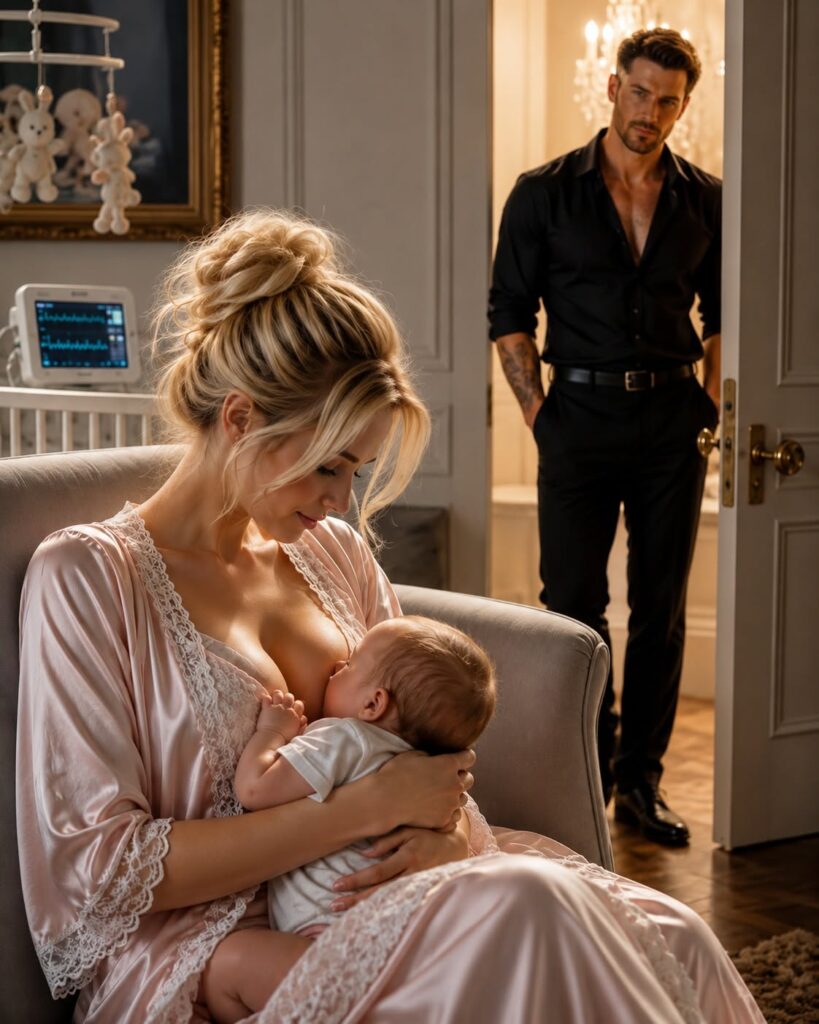
Because Leo had opened his eyes.
They were still unfocused, still shadowed by exhaustion, but they were open. For two weeks, I had watched those eyes remain closed while machines did the work his body could not. Now he was looking toward the woman holding him as if she were the only safe place in the world.
I placed the pistol on the nearest table and stepped back.
Hannah flinched anyway.
That reaction told me more than any explanation could have.
“Is he breathing properly?” I asked.
“He’s breathing,” Dr. Patel replied. “His color is improving.”
“Should she stop?”
“Not abruptly.”
My gaze snapped toward her. “What does that mean?”
“It means we need to let him finish this feeding under supervision. Then we’ll examine him and Hannah. We need to make sure he’s swallowing safely and that she’s healthy enough to provide milk.”
The words struck me with a strange force.
Provide milk.
As if this were something ordinary.
As if the woman standing in my son’s nursery had not just crossed every boundary in my house and, at the same time, possibly saved his life.
Hannah’s eyes stayed on Leo.
“I’m sorry,” she whispered.
I almost laughed, but there was nothing funny in the room.
“You’re sorry?”
“I knew I wasn’t supposed to come upstairs.”
“That is what concerns you?”
She swallowed. “I knew you’d be angry.”
“I am angry.”
Her arms tightened protectively around Leo.
The movement was small, but I saw it.
She expected anger to become something worse.
I took a slow breath.
“I’m angry that no one heard him before you did,” I said. “I’m angry that he was hungry and frightened while people were supposed to be watching him. I’m angry that I nearly made a decision I couldn’t undo.”
Hannah finally looked at me.
“And I’m angry,” she said softly, “that he had to cry twice before anyone came.”
Dr. Patel glanced toward the night nurse, who was now awake and standing near the wall, pale and trembling.
“I heard him,” the nurse said. “I thought the monitor alarm was—”
“You were asleep,” I said.
Her eyes filled with shame. “I’m sorry, Mr. Rossi.”
Dr. Patel raised one hand. “We’ll discuss staffing later. Right now, we focus on the baby.”
Her calmness was the only thing keeping the room from collapsing into chaos.
She guided Hannah into a chair beside the crib. A nurse brought a blanket and draped it around her shoulders, covering the open front of her uniform without disturbing Leo. Hannah looked embarrassed, but she never once tried to pull him away.
I stood several feet from them.
It was the first time in my life I had felt useless in my own home.
I could negotiate with judges, intimidate board members, and make entire companies reconsider their decisions. I could buy the best medical equipment in the country.
But I did not know how to help my son take a single breath.
Hannah did.
She lowered her eyes as Leo slowed.
“Is he finished?” she asked.
Dr. Patel watched him closely. “He may be. Don’t force him.”
Hannah nodded. She shifted him with careful familiarity, holding him against her shoulder while the nurse checked his airway and oxygen levels.
Leo gave a tiny sigh.
A real sigh.
His body relaxed.
I had not heard that sound since the day he was born.
The doctor examined him, then looked at me.
“His oxygen saturation is rising. His heart rate is much more stable.”
“Can we keep doing this?”
“We need consent from both of you, medical screening, and a proper feeding plan. But yes, possibly.”
“Possibly?”
“I’m not going to make promises based on one feeding.”
“One feeding that changed his condition.”
“One feeding that tells us we may have found something important,” she said. “That’s different.”
Hannah looked down at Leo. “I can do it again.”
The words came without hesitation.
Something in my chest tightened.
“You don’t have to,” I told her.
She looked at me, surprised.
“You don’t have to give him anything just because I’m asking,” I continued. “You don’t owe me this.”
“I know.”
“Then why?”
Her expression changed.
Not into fear this time.
Into something quieter.
“Because he was hungry.”
That answer stayed with me long after Dr. Patel took Leo for examination.
The nurses moved efficiently, wrapping him in a heated blanket and checking his weight. Hannah remained in the chair, her hands folded tightly in her lap. Without Leo in her arms, she looked suddenly smaller.
Too young to carry the grief in her eyes.
I had known almost nothing about her.
She had been hired through the household agency nine days earlier. Her references were clean. Her work history was modest. She arrived each morning before sunrise, kept her head down, and never complained.
I had barely spoken to her.
That had been intentional.
After Sophia died, conversation felt like an invitation for people to ask questions I didn’t want to answer. The staff had learned to move quietly around me. Hannah had seemed especially good at it.
Now I wondered how many things I had failed to notice.
Dr. Patel approached with a clipboard.
“I want to take a small blood sample from Hannah,” she said. “We’ll test for infections, medications, and anything that could affect Leo. We’ll also have a lactation specialist evaluate her.”
Hannah nodded immediately.
“Of course.”
“You can say no,” I reminded her.
She gave me a tired look. “You keep saying that.”
“Because you keep agreeing.”
“Maybe I’m agreeing because I want to.”
I had no answer.
The blood draw took place in the small sitting room beside the nursery. A nurse brought Hannah tea and a plate of toast, which she stared at as though she had forgotten food existed.
“When was the last time you ate?” I asked.
She picked up the cup. “Earlier.”
“That wasn’t my question.”
Her mouth tightened. “Yesterday afternoon.”
I turned toward the house manager. “Bring her a meal.”
“I don’t need—”
“You do,” I said.
The sharpness in my voice made her fall silent.
I regretted it at once.
“I’m not ordering you,” I said more gently. “You’ve been working all night. You need to eat.”
Her fingers curled around the tea.
“My daughter used to wake every three hours,” she said.
I didn’t know what to say.
Perhaps she had not meant to say it aloud. Perhaps exhaustion had loosened the door she had kept shut.
“What was her name?” I asked.
“Lily.”
The name rested between us.
“She was beautiful,” Hannah continued. “Everyone said babies weren’t supposed to have that much hair. She had a whole dark curl right here.”
She touched the side of her head.
“Lily was born early?”
“No.” Hannah looked into her tea. “She was due the week after Leo.”
I felt something inside me shift.
The connection was small, almost meaningless. Two babies, born within days of each other. Two mothers who had entered hospitals expecting to carry their children home.
But there was no comfort in coincidence.
“I’m sorry,” I said.
Hannah nodded, accepting the words without pretending they were enough.
“People keep saying that,” she murmured. “I know they mean well. But after a while, it sounds like they’re apologizing for making you uncomfortable.”
“I’m not uncomfortable.”
She looked at me.
I corrected myself. “I am. But not because of you.”
“That’s honest.”
“I’m trying.”
A faint, sad smile touched her lips.
The nurse returned with food. Hannah ate slowly, one bite at a time, while Dr. Patel reviewed the first readings from Leo’s examination.
“He’s stable,” the doctor said. “Not out of danger, but stable.”
My shoulders lowered for the first time.
“Could he have been reacting to the formula?”
“It’s possible. Some premature infants struggle with certain proteins or additives. Human milk contains components that can be easier to digest, but we need testing before we draw conclusions.”
“Why didn’t anyone suggest this?”
Dr. Patel hesitated.
“We discussed donor milk.”
“You told me donor milk wasn’t available.”
“We told you the supply was limited. The hospital had a small reserve, but Leo’s bloodwork suggested we needed to be cautious. There were concerns about his ability to tolerate any new feeding.”
“Why was I not told?”
“You were told.”
I stared at her.
She lowered the clipboard.
“You were in the corridor,” she said. “It was the night after the funeral. You were speaking with the security team. I explained that we could try donor milk under observation. You said you wanted every option from a private clinic first.”
The memory came back in fragments.
Phones ringing.
Men discussing the explosion.
A detective asking whether Sophia had enemies.
A doctor saying something about a milk bank while I stared through the nursery glass at Leo’s motionless body.
I had dismissed it.
Not because I didn’t care.
Because by then, every choice sounded like another way to lose him.
Dr. Patel continued, “Your private specialists believed the specialized formula was the most controlled option. It wasn’t unreasonable. It simply didn’t work.”
I looked at Hannah.
She had stopped eating.
“Does her milk have to be used?” I asked.
“No. There are other options. But given Leo’s response, it’s one we should evaluate.”
Hannah set down her fork.
“I’m willing,” she said.
Dr. Patel nodded. “Then we’ll proceed properly. No more improvising. A specialist will come in, and we’ll establish a schedule that protects both of you.”
Both of you.
Those words mattered.
Not just Leo.
Hannah too.
I walked to the window. Dawn was beginning to lighten the city, turning the glass towers pale gray. Somewhere below, cars were starting their morning journeys. People were buying coffee, arguing over taxis, rushing to work.
The world had continued while my son hovered between life and death.
Behind me, Hannah spoke quietly.
“Mr. Rossi?”
“Yes?”
“I understand if you don’t want me around after tonight.”
I turned.
She had finished half the toast. The blanket remained around her shoulders, and she looked exhausted but composed.
“Why wouldn’t I want you here?”
“Because I broke the rules.”
“You entered the nursery.”
“I held your son without permission.”
“You fed him.”
“I could have made things worse.”
“You could have,” I said.
Her chin lowered.
“But you didn’t.”
“That doesn’t mean I should stay.”
I studied her face. “Do you want to?”
She looked toward the nursery, where Dr. Patel was checking Leo again.
“Yes.”
The answer was nearly inaudible.
Then she straightened.
“I want to help him. But I won’t stay if you think I’m trying to replace someone.”
The room became very quiet.
“Replace whom?”
She looked at me with an expression so gentle it hurt.
“His mother.”
I had spent two weeks making sure no one said Sophia’s name in front of me.
I had instructed the staff to remove her photographs from the main hall. I had put her clothes in storage. I had stopped going into the room where she kept the nursery plans and paint samples.
Not because I had forgotten her.
Because remembering her made breathing difficult.
“No one could replace Sophia,” I said.
Hannah nodded. “I know.”
“You never met her.”
“No.”
“Then don’t speak as if you understand.”
The words came out harder than I intended.
Hannah accepted them without argument. She lowered her gaze and folded the blanket more tightly around herself.
I saw the mistake immediately.
“You’re right,” I said. “That was unfair.”
She looked up.
“I’m sorry.”
It was not a phrase I used often. In my world, apologies were usually transactions, offered only when they bought something.
Hannah seemed to recognize the difference.
“Thank you,” she said.
Before either of us could say more, the house manager appeared in the doorway with an envelope.
“Mr. Rossi, this was found in the library.”
“What is it?”
“I don’t know. It was tucked inside one of Mrs. Rossi’s charity folders.”
My heart stopped.
Sophia had dozens of folders. She managed a maternal health foundation, attended fundraising events, and spent long evenings reviewing applications from women who needed housing, medical care, or childcare.
I took the envelope.
My name was written across the front in Sophia’s handwriting.
Not Alessandro.
Sandro.
She had only used that name when she was teasing me or trying to soften me.
I opened it with unsteady fingers.
Inside was a single sheet of paper.
Sandro,
If you’re reading this, something has happened that I never wanted to imagine. Please don’t shut everyone out. Especially not the people who may need you to see them clearly.
There is a woman named Hannah Collins connected to the Lily House program. I met her through the foundation last month. She is expecting a baby and has been trying to leave a difficult situation. I promised her that our organization would help with temporary housing and work after the birth.
Please make sure that promise is kept.
Sophia
I read it twice.
Then a third time.
The room seemed to tilt.
“Hannah,” I said.
She looked at me.
“Did you know my wife?”
Her face went pale.
“No.”
I held out the letter.
She did not take it immediately. Her eyes moved over the page, stopping at the name.
When she finally reached for it, her hand began to shake.
“I know this foundation,” she whispered. “Lily House helped me pay for the hospital after Lily was born.”
I felt the air leave my lungs.
“You never mentioned it.”
“I didn’t know she was your wife.”
Hannah looked up from the letter, tears gathering in her eyes.
“She came to the support center once. She sat with us in a circle and listened. She didn’t act like a rich woman visiting poor people. She asked everyone’s name. She remembered Lily’s.”
My fingers tightened at my sides.
“What else did she tell you?”
Hannah stared at the letter.
“She said that if I ever needed help, I should call her directly.”
“Did you?”
“No.”
“Why?”
“Because the night Lily was born, I thought I could manage. Then everything changed, and I didn’t want to be a burden.”
Her voice faltered.
“She sent someone to check on me anyway. But by then I had already accepted the maid position. I thought working here would be safer than going back to where I’d been living.”
I looked through the open doorway toward the nursery.
Sophia had known Hannah.
Not well, perhaps. Not in the way I had known her. But she had seen her, remembered her, and made a promise.
And somehow, after Sophia was gone, Hannah had carried that promise into our home.
Dr. Patel stepped out of the nursery.
“Mr. Rossi, Leo is ready for another monitored feeding when Hannah is.”
Hannah slowly folded Sophia’s letter.
“I’m ready,” she said.
I looked at the handwriting again.
Please don’t shut everyone out.
Especially not the people who may need you to see them clearly.
For two weeks, I had believed the only way to protect my son was to control everything around him.
But Sophia had trusted people I never bothered to notice.
And now the woman she had tried to help was the only person who could give Leo what his body needed.
I returned the letter to Hannah.
“Keep it,” I said.
She shook her head. “It belongs to you.”
“It was written for me. But Sophia wrote your name.”
Hannah held it against her heart.
Then, from the nursery, Leo began to cry again.
This time, the sound was stronger.
And as Hannah rose to answer him, I noticed something written in the bottom corner of Sophia’s letter—an address, followed by a name I knew far too well.
It was the name of the private investigator who had been handling the explosion case.
The same investigator who had insisted Sophia’s death was an accident.
END OF PART 2.

