
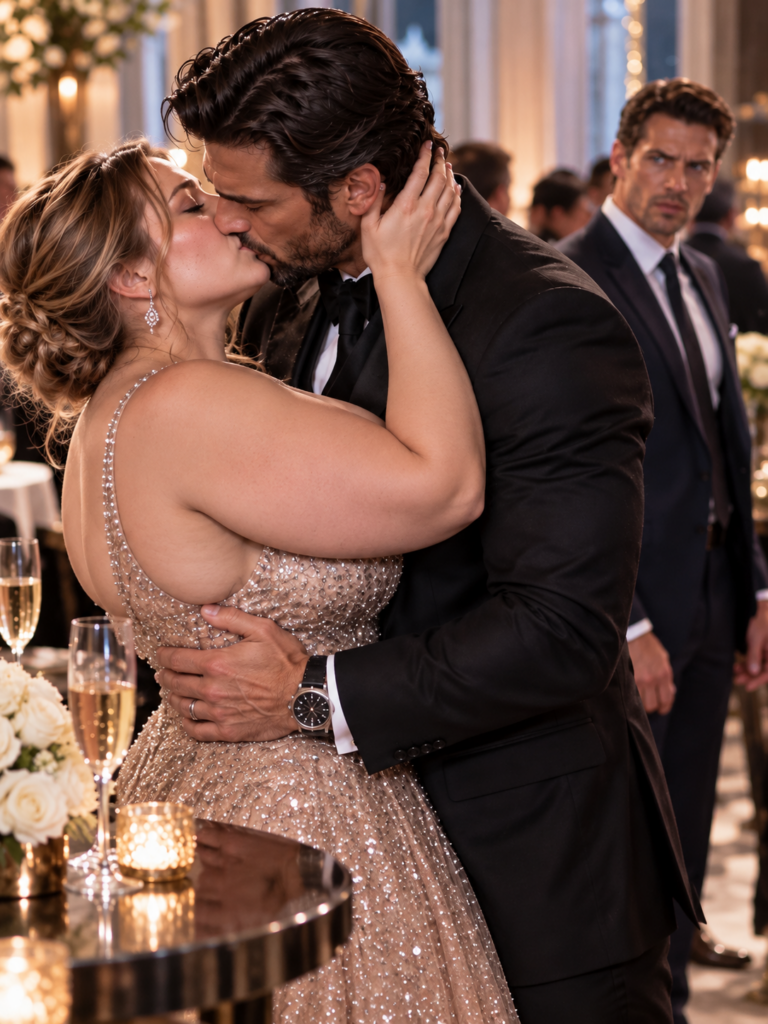
I kissed him to wound the man who had betrayed me.
I did not know the stranger was the most feared Russian in New York.
By sunrise, he had claimed me—and two criminal empires were preparing for blood.

PART 1 — THE KISS THAT COULD NOT BE UNDONE
Eight months after Trevor Ashford shattered my life, I walked into Maverick’s and found him celebrating.
The bar smelled of bourbon, citrus peel, and rain-soaked wool. Amber light gleamed over polished bottles, softening everyone except Trevor, who stood beneath it in a navy suit with one hand resting on Harper Lane’s waist.
My former boyfriend. My former best friend.
Together.
Harper saw me first. Her champagne glass paused halfway to her mouth, and something bright and cruel awakened in her face. She whispered to Trevor, who turned wearing the patient smile he used whenever he wanted me to feel unreasonable.
“Cammy,” he said. “I didn’t know you came to places like this.”
My fingernails cut into my palm.
Trevor had cheated with Harper after five years of promising me a future. Somehow, he still believed my humiliation belonged to him.
“I’m meeting someone,” I said.
Harper glanced behind me. “Who?”
I should have left. Instead, I looked toward the bar and saw the largest man in the room sitting alone.
He wore a black shirt with the sleeves rolled to his forearms. A pale scar crossed one eyebrow, and his profile had the severe stillness of something carved from winter. Everyone left an invisible circle around him.
I crossed the room before fear could catch me.
“Excuse me,” I said.
He turned.
His eyes were gray—not soft gray, but the color of steel beneath ice. They moved over my face, my trembling hands, and finally the table where Trevor watched us.
“Yes?”
His voice carried a Russian accent and the quiet authority of a man who had never needed to repeat himself.
“I need you to kiss me.”
One eyebrow lifted.
“Do you?”
“Please.”
He studied Trevor again. Understanding entered his eyes, followed by something darker.
“Is this what you want,” he asked, “or what you think will hurt him?”
“Both.”
He stood.
I was five feet four in heels. He towered over me, broad enough to block the room from view. Yet when his fingers touched my chin, they were unexpectedly gentle.
“You may change your mind,” he murmured.
“I won’t.”
His mouth covered mine.
It was not the polite kiss I had expected. His hand settled at my waist, drawing me against him as though he had been waiting for me. Heat swept through my body, violent enough to erase Trevor, Harper, and every wasted year between them.
When the stranger lifted his head, my fingers were twisted in his shirt.
Trevor was already approaching.
“What the hell are you doing, Camilla?”
The stranger shifted, placing himself between us.
“Walk away,” he said.
Trevor laughed, but the sound cracked. “This has nothing to do with you.”
“It does now.”
Harper hurried after him. “Camilla, are you seriously using some random thug to make Trevor jealous?”
The stranger’s expression did not change.
“You will speak to her with respect.”
“And who are you?” Trevor demanded.
The room seemed to hold its breath.
The stranger reached into his pocket, placed a black card on the bar, and pushed it toward Trevor.
Trevor read the name.
Every drop of color vanished from his face.
The stranger’s arm closed around my waist.
“My name is Adrian Markov,” he said. “And the woman you betrayed is under my protection now.”
Trevor stared at him, suddenly sober.
Then Adrian lowered his mouth to my ear.
“You chose a dangerous man to kiss, malaya,” he whispered. “And someone has already called my enemies.”
PART 2 — THE PRICE OF HIS PROTECTION
Trevor stepped back.
It was only half a step, but I knew him well enough to recognize fear. His eyes flicked from Adrian’s face to the black card on the bar, then toward the entrance as if calculating how quickly he could reach it without appearing to run.
Harper did not understand the warning. She folded her arms, the silk sleeve of her red dress whispering against itself.
“This is ridiculous,” she said. “Camilla walks in here, grabs the first criminal she sees, and suddenly we’re supposed to be intimidated?”
Adrian looked at her.
Nothing dramatic happened. He did not raise his voice or move toward her. Yet Harper’s chin lowered, and the hand holding her champagne glass began to shake.
“You betrayed her friendship,” Adrian said. “Do not test how little patience I have for your opinion.”
Trevor recovered enough to sneer. “You don’t know what happened between us.”
“I know she trembled before asking a stranger for kindness.” Adrian’s fingers tightened slightly at my waist. “That tells me what kind of man you were to her.”
My throat closed.
Trevor had always possessed a gift for making pain sound like a misunderstanding. He had called his affair a lapse in judgment, Harper’s betrayal a complicated situation, and my grief an exhausting refusal to move forward. In one sentence, Adrian had stripped away every excuse.
Trevor’s face hardened. “Camilla, come outside. We need to talk.”
“No.”
The word was small, but it belonged entirely to me.
His eyes narrowed. “You’re drunk.”
“I’ve had one vodka.”
“You don’t behave like this.”
A bitter laugh escaped me. “You mean I don’t embarrass you in public.”
“You’re embarrassing yourself.”
Adrian’s thumb moved once against my side. It was a quiet reminder that he was there, but it did not feel like restraint. It felt like permission.
“No,” I said. “I embarrassed myself when I begged you to explain why my best friend’s earring was in our bed. I embarrassed myself when I believed you the first time. I embarrassed myself every morning I woke beside a man who had taught me to distrust my own eyes.”
Harper set her glass down too hard. Champagne splashed over the rim.
“You said you forgave us.”
“I tried to forgive you. That was before I understood forgiveness doesn’t require me to remain available for further humiliation.”
Trevor glanced around. His colleagues had stopped pretending not to listen.
His cheeks darkened.
“This is exactly why it never worked,” he said. “Everything with you becomes a performance.”
Adrian moved.
He did not touch Trevor. He simply stepped forward, and Trevor retreated until the back of his legs struck a chair.
“The performance is over,” Adrian said. “You will leave.”
“You can’t order me out.”
Adrian looked toward the bartender.
The bartender was a heavyset man with tattooed knuckles. He had ignored two broken glasses and an argument near the pool table, but now he straightened immediately.
“Mr. Markov,” he said, “would you like them removed?”
Silence spread through the bar.
Trevor looked at the bartender, then at the door. The last of his arrogance drained away.
“This isn’t finished,” he told me.
“It is for her,” Adrian replied.
Trevor left with Harper and the others following. She glanced back only once. Beneath the resentment in her face, I saw something that surprised me.
Envy.
The door shut. Rain rattled against the windows, and the room slowly remembered how to breathe.
My knees weakened.
Adrian caught me before I could reach for the bar.
“Easy.”
“I’m fine.”
“No.” His gaze traveled over my face. “You have become very pale.”
“I’m having an adrenaline crash.”
“You have also not eaten.”
I blinked. “How could you know that?”
“Your vodka affected you too quickly. Your hands are cold, and your dress is loose at the waist in a way it was not designed to be.”
Heat rose to my face. “Do you inspect every woman this closely?”
“No.”
The single syllable carried more weight than flirtation should have.
He guided me back to his seat and ordered water. The bartender produced it with such speed that I almost laughed, but my hands shook when I lifted the glass.
Adrian watched without pretending not to.
“Who called your enemies?” I asked.
“One of Trevor’s companions sent a message when he recognized me.”
“Recognized you as what?”
His mouth curved without warmth. “You already know.”
“I know Google produced a great deal of vague information about shipping companies, property holdings, and charity boards. I also know half the men in this room looked ready to crawl beneath the tables when you said your name.”
“You researched me while we were standing here?”
“In the restroom.”
“That was sensible.”
“It wasn’t reassuring.”
“It was not meant to be.”
Rainwater streaked the window behind him. Under the amber lamps, the scar through his eyebrow appeared almost silver.
“Are you dangerous?” I asked.
“Yes.”
The answer was immediate.
“To me?”
His expression shifted. For one heartbeat, he looked offended.
“Never.”
That should not have reassured me. It did.
He reached for my coat, which I had thrown over the neighboring stool. “I am taking you home.”
“You don’t know where I live.”
“I have a driver. He knows where everything is.”
“That may be the most alarming sentence anyone has ever said to me.”
A low sound came from him. It took me a second to recognize it as laughter.
Outside, the rain had become a cold silver curtain. Adrian placed his jacket around my shoulders before I could object. It smelled faintly of cedar, tobacco, and winter air.
A black Mercedes waited at the curb.
The driver opened the rear door without being asked. He had a shaved head and a scar along his jaw, and he addressed Adrian in rapid Russian before looking at me with open curiosity.
Adrian replied sharply.
The driver’s expression became respectful. “Miss Baresi.”
“What did you tell him?”
“That you are under my protection.”
“You keep saying that.”
“Because it is true.”
The car pulled into wet Manhattan traffic. Neon signs bled across the windows while Adrian sat beside me, one knee angled toward mine.
“I didn’t agree to protection.”
“You asked me to kiss you publicly.”
“That was not a binding contract.”
“In my world, public gestures have consequences.”
“Your world sounds exhausting.”
“It is.”
For several blocks, we listened to the whisper of tires against rain-black pavement.
“Why did you help me?” I finally asked.
Adrian looked out the window. “You stood in front of me pretending not to be terrified.”
“That impressed you?”
“It interested me.”
“That isn’t an answer.”
“No.” He turned back. “It is the only one I have tonight.”
My apartment was on the fourth floor of a narrow building in Astoria. The hallway smelled of garlic, ginger, and whatever Mrs. Chen in 3C had simmering on her stove.
I fought with the lock while Adrian stood behind me.
“When did you last eat?” he asked.
“Lunch.”
“What kind of lunch?”
“Coffee.”
“That is not lunch.”
“There may have been a granola bar.”
The lock gave way. I opened the door and immediately saw the apartment through his eyes: the Murphy bed, the ancient refrigerator, the pile of unpaid bills on the table, and the single window facing a brick wall.
Adrian’s gaze passed over everything and stopped on the framed photograph above my shelf.
I was ten in the picture, standing beside my grandmother outside Baresi Bakery. Flour covered our aprons. Nonna’s head was thrown back in laughter, and I was looking at her instead of the camera.
“She looks like you,” Adrian said.
“Everyone says I have the Baresi face.”
“Your smile is the same.”
“Not anymore.”
He studied me. “It will be.”
The certainty in his voice hurt more than sympathy would have.
He asked about Nonna, and I told him she had died two years earlier. I did not tell him at first that I had missed her final week because Trevor’s company holiday events had seemed too important to abandon.
But silence had always made me confess things.
“I should have been there,” I said. “She kept asking for me, and I kept saying I’d visit after the party, after the dinner, after Trevor’s presentation. There was always something.”
Adrian stood very still.
“You loved him.”
“I thought I did.”
“That does not make you guilty of her death.”
“No. It only makes me guilty of choosing him while she was still alive.”
My voice cracked. I turned toward the kitchenette before he could see my face.
Adrian caught my wrist.
He waited until I looked at him. “Grief will offer you a knife and tell you to punish yourself in the name of the dead. Do not mistake that for devotion.”
I stared at him.
“Who taught you that?”
His eyes cooled, shuttering the answer away.
“Another story.”
He ordered dinner despite my protests. While we waited, he found the bottle of red wine above my stove and poured it into two mismatched glasses.
“To your health, Camilla Baresi,” he said. “And to the end of foolish men who do not deserve you.”
He had ordered enough food to feed my entire family: carbonara, chicken saltimbocca, caprese salad, bread still warm from the oven, and a tiramisu dusted with cocoa.
The smell filled the apartment. My stomach cramped with sudden hunger.
“Sit,” he said.
“That sounded like an order.”
“It was.”
“You’re very controlling.”
“You are very hungry.”
I sat.
He served me first, making certain my plate was full before taking a smaller portion for himself. Trevor had spent five years removing onions from food because he disliked them, even when I had cooked the meal. Adrian, a stranger whose name could empty a bar, noticed when my water glass needed refilling.
The contrast lodged painfully beneath my ribs.
We ate in quiet. Outside, water tapped the fire escape. Somewhere downstairs, a child practiced the same four notes on a piano.
When I finished my second helping, Adrian leaned back.
“Better.”
“What?”
“There is color in your face.”
I set down my fork. “You pay attention to everything.”
“It has kept me alive.”
“Is that what matters to you? Staying alive?”
His eyes lowered to the wine in his glass.
“For a long time, survival was enough. Then survival became power, and power became an empire.” He turned the stem slowly between his fingers. “Empires are cold things. They do not keep you warm at night.”
The loneliness in his voice made the room feel smaller.
“What happened to your family?”
He held my gaze long enough to make refusal clear. Then he surprised me.
“My parents died in a fire when I was sixteen. The landlord had ignored complaints about the wiring.”
“I’m sorry.”
“My sister had married and moved to America. I followed her.” His jaw tightened. “Five years ago, her husband owed money to men who collect debts with bullets. My sister became collateral damage.”
I stopped breathing.
“She had a daughter,” he continued. “Eight years old. My niece survived because she was at school.”
“Where is she now?”
“Switzerland. Safe. Educated. Watched by people I trust.”
The hard lines of his face had not changed, but his hand was closed so tightly around his glass that his knuckles had whitened.
I reached across the table and covered it.
He looked at our hands as if touch were a language he had forgotten.
“That’s why you built your empire,” I said.
“So no one I love will ever be helpless again.”
The word love remained between us.
My phone buzzed.
Trevor’s name flashed on the screen.
Adrian reached it first.
“You made a fool of yourself,” he read, his voice becoming unnaturally soft. “Call me tomorrow when you are sober and ready to apologize.”
I laughed. It sounded brittle.
“In Trevor’s world, I’m always the one who apologizes.”
Adrian typed a response.
“What are you doing?”
“Correcting him.”
He placed the phone facedown.
“What did you write?”
“That if he contacts you again, he will discover how much I dislike men who disrespect women under my protection.”
“I haven’t agreed to be yours.”
“Not yet.”
My pulse betrayed me.
Exhaustion reached me suddenly. The wine, food, rain, and old grief folded together until the room tilted.
The last thing I remembered was Adrian carrying me toward the Murphy bed.
“You don’t have to stay,” I murmured.
“Yes,” he said, removing my shoes. “I do.”
I woke beneath his jacket with sunlight crossing my face.
For one disorienting moment, I believed the night had been a dream. Then I smelled coffee and heard bacon crackling in my kitchenette.
Adrian stood at the stove with his sleeves rolled up. Morning stubble shadowed his jaw. In the unforgiving daylight, he looked less like a dream and more like a man who had survived things the world was never meant to know.
“You stayed.”
He glanced over. “You sound surprised.”
“You slept on that couch?”
“It has many admirable qualities.”
“It is five feet long.”
“One of its less admirable qualities.”
I sat up, still wearing my black dress. “You should have woken me.”
“You needed sleep.”
“You could have—”
“No.”
The word struck like a slammed door.
Adrian turned off the stove and faced me. “You were exhausted, emotional, and affected by wine. I am many things, Camilla, but I do not take what is not freely offered.”
Embarrassment warmed my face.
“When you come to my bed,” he added, “you will be sober, certain, and fully aware of whom you are choosing.”
“You are remarkably confident.”
“I am certain of what happened when I kissed you.”
“That was adrenaline.”
“Do not diminish it because it frightens you.”
I opened my mouth, then closed it.
He served eggs, bacon, and a bagel with cream cheese and lox. He had apparently visited the bodega before I woke.
We had barely begun eating when my phone buzzed.
Trevor again.
I reached to delete the message, but Adrian took the phone.
His face changed.
The warmth vanished from his eyes, leaving something cold enough to freeze the room.
“What did he say?”
Adrian showed me.
Tell your Russian thug I know people too. That stunt will cost him. And you’ll regret embarrassing me, Cammy. You were always too stupid to know when you were protected.
The bagel turned to paste in my mouth.
Adrian stood and called someone. His Russian was rapid and clipped, every syllable a command.
When he finished, he moved to the window.
“Stay here,” he said.
“What are you going to do?”
“Teach Trevor Ashford what happens when he threatens what is mine.”
“I am not—”
He crossed the apartment and held my face between his hands.
“Listen carefully. Trevor may be a fool, but his father is not. Robert Ashford has connections to the Costello family through his wife’s brother.”
The name Costello stirred an old unease.
“Why does that matter?”
“Because the Costellos and I maintain peace by keeping our businesses separate. Trevor’s threat means his father has begun asking questions. If those questions reach the wrong people, they will learn you are connected to me.”
“Connected because I kissed you?”
“In my world, appearance becomes truth very quickly.”
A knock sounded.
Adrian opened the door to a tall, scarred man carrying a metal case.
“Dmitri,” Adrian said. “Secure the apartment.”
Another man arrived ten minutes later and began installing sensors around my window. My tiny home transformed into a fortress while I sat on the edge of my bed wearing Adrian’s jacket.
“This is absurd,” I said. “Trevor sells investment products. He wears loafers without socks. He is not a mob threat.”
“His father has already contacted the Costellos.”
My family’s name pressed against the back of my teeth.
There were things I had spent years refusing to examine. Sunday dinners when Uncle Sal disappeared to take calls. Men who came into the bakery through the rear entrance. Conversations that stopped when I entered a room.
“I need to tell you something.”
Adrian waited.
“My uncle isn’t only a baker.”
His stare sharpened.
“Salvatore Baresi,” I said. “My mother’s brother. He’s a caporegime with the Moretti family.”
For the first time since meeting him, Adrian looked genuinely surprised.
“You are connected to the Morettis?”
“Distantly.”
“A caporegime is not distant.”
“I stayed away from that life.”
“But it did not stay away from you.”
My phone rang.
My mother’s name filled the screen.
I answered reluctantly. “Mama?”
“Camilla Francesca Baresi, what have you done?”
Her voice was loud enough that Adrian heard every word.
“Nothing.”
“Uncle Sal says some finance bastardo is asking the Costellos about you. He says you were seen with a Russian.”
I closed my eyes.
“Mama, I can explain.”
“You will explain tomorrow. Two o’clock. Bring the Russian.”
“Mama—”
“Wear something nice.”
She hung up.
Adrian’s mouth twitched.
“This is not funny.”
“I have faced worse things than an Italian mother.”
“You have absolutely no idea what you’re walking into. There will be three uncles, two aunts, seven cousins, and at least four people who aren’t related but have been attending so long nobody remembers why. They will question you about your job, your childhood, whether you attend church, and your intentions toward me.”
“My intentions are clear.”
“They are not clear to me.”
His expression became solemn.
“Then I will make them clear.”
He approached slowly. Construction sounds continued behind him—the turn of a screwdriver, the beep of a sensor, Dmitri muttering in Russian—but the apartment seemed to narrow around us.
“Trevor’s stupidity has drawn attention from the Costellos,” Adrian said. “When they learn you belong to a Moretti family and have been seen with me, some will view you as an opportunity.”
“I don’t belong to anyone.”
“No.” He lifted one hand to my cheek. “But you are already important to me.”
“You met me last night.”
“I know.”
“That should concern you.”
“It does.”
His honesty silenced me.
“What happens now?” I asked.
“I make it clear that anyone who threatens you threatens me.”
“How?”
“By claiming you publicly.”
I stepped back. “That sounds medieval.”
“It is effective.”
“And what does being claimed by you involve?”
“Protection. Loyalty. My name beside yours. No one in my organization touches you, frightens you, or approaches you without permission. Any harm done to you becomes an act against me.”
“And what do you receive?”
His gaze moved over my face.
“The chance to discover whether the woman who walked up to me in a bar was an accident or the first honest thing fate has offered me in years.”
The words struck somewhere deeper than desire.
“We don’t know each other.”
“I know you are brave enough to ask for what you need. Loyal enough to forgive what should not have been forgiven. Strong enough to leave when you finally remembered your worth.”
His thumb traced my lower lip.
“And I know I want to kiss you again when no one is watching.”
My hands found his shirt.
“This is insane.”
“Yes.”
“It could start a war.”
“Yes.”
“My mother will ask if you want children before the appetizers.”
A real smile broke across his face.
“I will survive.”
“You may not.”
“Then I will die having eaten well.”
I laughed, and the sound startled me.
Adrian bent his head, but he stopped before our mouths touched.
“Say yes.”
“To the kiss?”
“To trusting me.”
I thought of Trevor’s message. I thought of Nonna, who had trusted her instincts with a ferocity I had once mistaken for stubbornness. I thought of Adrian sleeping on a couch too small for him because I had been vulnerable, and of the grief he carried beneath his composure.
“Okay,” I whispered.
His eyes darkened.
“But you’re buying the cannoli.”
“I will buy you all the cannoli you want.”
He kissed me gently.
There was no audience now. No Trevor to punish, no Harper to shock, no room waiting to judge us. His mouth moved over mine with patience, and the tenderness frightened me more than his danger ever could.
A phone rang behind him.
Dmitri answered, listened, then spoke sharply in Russian.
Adrian lifted his head.
“What is it?” I asked.
He turned toward Dmitri. They exchanged several words too quickly for me to follow.
Then Adrian looked back at me.
“Trevor is missing,” he said.
Cold spread through my body.
“Missing?”
“His car was found abandoned near the East River.”
“You said you wouldn’t hurt him.”
“I did not.”
The certainty in his answer left room for a more terrifying possibility.
Adrian took my coat from its hook.
“Where are we going?”
“To find out who took him.”
“Why?”
His jaw tightened.
“Because whoever has Trevor does not want him.” Adrian opened the door, revealing two armed men waiting in the hallway. “They want you.”
PART 3 — WHEN TWO EMPIRES CAME FOR ME
The city looked deceptively ordinary from the back of Adrian’s Mercedes.
Parents pushed strollers beneath clear plastic covers. A delivery cyclist cursed at a taxi. Steam lifted from a street grate and dissolved into the pale morning.
Inside the car, Adrian sat rigid beside me.
Dmitri occupied the front passenger seat, speaking in low Russian into his phone. The driver took corners too quickly, but no one told him to slow down.
“Where was Trevor’s car found?” I asked.
“Near an old warehouse owned by a Costello holding company.”
“Then his father knows where he is.”
“Perhaps.”
“That doesn’t sound reassuring.”
“It was not meant to.”
Adrian’s hand covered mine. His palm was warm, but tension had hardened every muscle in his forearm.
“Tell me the truth,” I said. “All of it.”
His gaze remained on the window.
“The Costellos have wanted access to two of my waterfront routes for years. I refused. If they believe you matter to me, they may use Trevor to force a meeting.”
“But why take Trevor? He started this.”
“Because weak men often become tools for stronger ones.”
The words carried no sympathy.
“Is he alive?”
“For now.”
I pulled my hand away.
Adrian turned. “You are angry with me.”
“I am trying to understand how one kiss became kidnapping before breakfast.”
“The kiss did not cause this. Trevor’s entitlement did. His father’s arrogance did. The Costellos’ ambition did.”
“And your reputation?”
“My reputation may be the only reason no one has harmed you yet.”
The car stopped outside Baresi Bakery.
Its green awning was faded, and the gold lettering my grandfather had painted by hand had begun to crack. Warm air rushed through the open door carrying the smell of yeast, sugar, coffee, and orange zest.
For one breath, I was a child again.
Then I saw Uncle Sal waiting behind the counter.
He wore a white shirt with the sleeves folded neatly to his elbows. Flour dusted one shoulder, but the men stationed near the rear door made it clear he had not come to discuss pastries.
“Camilla.” He stepped around the counter and pulled me against his chest.
I had spent years pretending his protection offended me. That morning, I held on.
“You’re all right?”
“I think so.”
“You think so?”
“She is unharmed,” Adrian said. “And she will remain that way.”
Uncle Sal released me.
The warmth left his face when he looked at Adrian.
“Markov.”
“Baresi.”
They regarded each other across the glass display case. Between them sat rows of cannoli, sfogliatelle, and almond cookies, absurdly delicate beneath the threat filling the room.
“Trevor Ashford has been taken,” Adrian said.
“I heard.”
“By Costello men?”
“Probably.”
Adrian’s eyes narrowed. “Probably is not useful.”
Uncle Sal’s jaw flexed. “You walk into my family’s bakery, bring trouble to my niece, and criticize my information?”
“The trouble began before I knew her.”
“It became deadly after she met you.”
“Stop.”
Both men looked at me.
I folded my arms, though my hands wanted to shake.
“Trevor cheated on me, threatened me, and used his father’s connections because his pride was wounded. Neither of you created him. But standing here measuring whose fault is larger will not bring him back or keep me safe.”
Uncle Sal’s expression softened by a fraction.
“You sound like your grandmother.”
“That is either a compliment or a warning.”
“Both.”
He gestured toward the rear room.
The bakery kitchen was hot enough to fog the windows. Industrial mixers hummed beside marble worktops. My cousin Paolo stood near the oven holding a wooden peel like a weapon.
Uncle Sal spread a city map across the flour-dusted table.
“A man loyal to the Morettis saw two Costello cars leaving the warehouse at six this morning,” he said. “They drove south. One went toward Red Hook. The other crossed into Queens.”
“Decoys,” Dmitri said.
“Maybe.”
Adrian examined the map.
My attention caught on a ring of flour beneath Uncle Sal’s wrist. Nonna used to make the same mark when she rolled dough.
“What do they want?” I asked.
Uncle Sal exchanged a look with Adrian.
“An alliance,” he said.
“With whom?”
“Between Markov and the Morettis. Or proof that such an alliance does not exist.”
My stomach tightened. “There is no alliance.”
“Not officially,” Adrian said. “But if I publicly claim a Moretti caporegime’s niece, others will assume one.”
“So the Costellos want to know whether I’m a girlfriend or a treaty.”
Uncle Sal’s eyes hardened. “You are neither. You are family.”
“In their world, that makes me more valuable.”
Adrian looked at me. “Which is why you will remain here.”
“No.”
“Camilla.”
“You said they want me. That means I’m part of the negotiation whether you like it or not.”
“You are not attending any negotiation.”
“You do not get to claim me and then remove my voice.”
His face became still.
Uncle Sal coughed into his hand, poorly concealing approval.
Adrian glanced at him. “Do not encourage her.”
“My niece does not require encouragement.”
“Clearly.”
A telephone rang in the front shop.
Paolo answered. Seconds later, he appeared in the doorway.
“It’s for Camilla.”
Every man in the kitchen reached for a weapon.
I followed Paolo to the counter. The receiver of the old landline rested beside the register.
Adrian caught my arm. “Speaker.”
“The phone predates electricity,” I whispered.
He did not smile.
I lifted the receiver. “Hello?”
Trevor’s breathing came through first—ragged, wet, terrified.
“Cammy?”
I closed my eyes.
“Trevor.”
“I’m sorry.”
The words were so unfamiliar in his voice that for a moment I thought the caller must be someone else.
“They said they’d kill me.”
“Who?”
A blow sounded. Trevor cried out.
Then another man came onto the line.
“Miss Baresi.”
His voice was smooth and cultivated.
“Who are you?”
“A friend attempting to prevent unnecessary bloodshed. Tell Mr. Markov to come to Pier Forty-Seven at midnight. Alone.”
“That is not going to happen.”
Adrian stood close enough to hear.
The caller chuckled. “Then Mr. Ashford will be delivered to his father in pieces, and your family’s bakery will have a very unfortunate electrical fire.”
My gaze moved to the ovens, the framed photograph of Nonna, and the brass bell above the door.
“What do you want from me?”
“Nothing unreasonable. We want Mr. Markov’s signature on a shipping agreement. We also want reassurance that his sudden interest in a Moretti woman does not represent an alliance against us.”
“And if it does?”
The silence lasted half a second too long.
“Then you have become a liability.”
The line went dead.
Adrian took the receiver from my hand and set it down carefully.
Too carefully.
“Who was he?” I asked.
“Vincent Costello.”
Uncle Sal swore.
Adrian turned toward Dmitri. “Call everyone. Lock down the bakery, her parents’ house, and every Moretti property connected to the Baresis.”
“You’re not signing their agreement,” I said.
“No.”
“Then Trevor dies.”
“That is Trevor’s father’s problem.”
The coldness in his voice struck me.
“He is a selfish, faithless coward,” I said. “But he does not deserve to be dismembered.”
“He threatened you.”
“He hurt me. That does not mean I want his blood on my conscience.”
“It would not be on yours.”
“It would feel like it.”
Adrian looked away, and I understood then that this was the fault line between us. His world divided people into those he protected and those he destroyed. Mine was messier.
“If I ask you to save him,” I said, “will you?”
“Do not ask me.”
“Why?”
“Because I will do it.”
His voice had lowered.
“You barely know me,” I whispered.
“And still, I cannot deny you.”
Uncle Sal watched us with a troubled expression.
Adrian stepped closer.
“I will retrieve Trevor,” he said. “But you will remain under guard.”
“I need to go to my parents.”
“No.”
“They are in danger because of me.”
“They are being protected.”
“I need to see that.”
“Camilla.”
“Would you remain hidden if your niece were threatened?”
His face closed.
I had found the one argument he could not dismiss.
An hour later, we arrived at my parents’ house in Howard Beach.
My mother opened the door before we reached it. She wore a flowered apron and held a wooden spoon like a dagger.
“Inside,” she ordered.
“Mama—”
“Inside. Both of you.”
The house smelled of tomato sauce, rosemary, and furniture polish. Soccer commentary blared from the living room while two armed cousins pretended to care about the score.
My father stood near the dining table. His broad, weathered face changed when he saw me, and he pulled me into an embrace without speaking.
That silence frightened me more than Mama’s shouting.
“Are you hurt?” he asked.
“No.”
He looked at Adrian over my shoulder.
“You are the Russian.”
“Adrian Markov.”
“You brought men with guns to my street.”
“To protect your family.”
“My family needed no protection yesterday.”
The accusation landed.
Adrian did not defend himself. “No.”
My father’s eyes narrowed, perhaps surprised by the answer.
Mama slapped the wooden spoon against her palm.
“We will eat.”
“Mama, someone threatened to burn the bakery.”
“And starving will improve this?”
No one argued.
We sat around the long dining table where I had celebrated birthdays, graduations, and Nonna’s last Christmas. A bowl of pasta steamed between us. Candlelight warmed the old family photographs on the wall.
Adrian sat beside me, too large for the delicate chair. Mama filled his plate until the pasta formed a mountain.
“You eat,” she said.
“Yes, Mrs. Baresi.”
“You call me Lucia.”
“Yes, Lucia.”
She studied him. “You go to church?”
“Mama.”
“What? God should know where to find him.”
A surprised cough escaped my father.
Adrian considered the question seriously. “Not often.”
“Why?”
“I stopped believing God protected the innocent.”
The spoon in Mama’s hand became still.
Her eyes traveled to the scar in his eyebrow. Some maternal calculation occurred behind her face.
“God is sometimes late,” she said. “That does not mean He is absent.”
Adrian lowered his gaze. “Perhaps.”
She added another spoonful of sauce to his plate.
My phone vibrated beneath the table.
A message from Harper appeared.
I know where Trevor is. Meet me alone.
I stared at the screen.
Adrian noticed.
“Who?”
“No one.”
His gray eyes chilled. “You are a poor liar.”
I showed him.
“Delete it.”
“She may actually know.”
“She may be part of the trap.”
“Harper is selfish, not brave.”
“Fear makes selfish people useful.”
Another message arrived.
He called me before they took him. He said his father arranged the whole thing. Robert knew the Costellos would grab him. Please, Camilla. Trevor is going to die.
I pushed back my chair.
My father looked up. “Where are you going?”
“To call her.”
Adrian followed me into the hallway.
“You will not meet her.”
“I haven’t decided that.”
“I have.”
Anger flashed through me. “You promised protection, not imprisonment.”
“And you promised trust.”
“I promised to try.”
“Then try now.”
His voice remained quiet, but pain moved beneath it. Not anger—fear.
I had not believed a man like Adrian could be afraid. Seeing it changed the shape of my resistance.
“Come with me,” I said.
“Harper demanded you come alone.”
“Then we make her believe I did.”
He studied my face.
“You have been in my life thirty-six hours,” he murmured, “and already you are planning ambushes.”
“My grandmother believed women should always know where the exits are.”
“I would have liked her.”
“She would have interrogated you worse than Mama.”
“I still would have liked her.”
Harper chose a twenty-four-hour diner beneath the elevated train.
Rain had begun again, fine and cold. Fluorescent light made the chrome exterior look bleached and lonely.
I entered alone while Adrian and his men waited out of sight.
Harper sat in a rear booth wearing yesterday’s red dress beneath a beige coat. Her makeup had smeared under her eyes.
For the first time in years, she looked like the girl who used to sleep on my bedroom floor after fighting with her mother.
“Where is he?” I asked.
“I don’t know exactly.”
“Then why am I here?”
“Because his father planned it.”
She wrapped both hands around a cup of untouched coffee.
“Robert has been losing money for months. Trevor discovered it. He thought the Costellos would frighten your Russian into signing something and then release him.”
“Trevor agreed to be kidnapped?”
“He thought it would be staged.”
I stared at her.
Even after everything, Trevor’s stupidity found new depths.
“Why tell me?”
Harper’s mouth trembled. “Because Robert stopped answering, and Vincent Costello sent me a picture.”
She slid her phone across the table.
Trevor sat tied to a metal chair. Blood darkened his collar.
I looked away.
“Harper, why did you sleep with him?”
The question escaped before I could stop it.
Her face folded slightly.
“That doesn’t matter now.”
“It matters to me.”
A train thundered overhead. Cups rattled against saucers, and the light above us flickered.
Harper pressed her lips together.
“I wanted what you had.”
“You wanted Trevor?”
“I wanted someone to choose me the way I thought he chose you.”
I laughed once, without humor. “So you took him.”
“He told me you didn’t understand him. He said the relationship was already over.”
“And you believed him?”
“I wanted to.”
The honesty hurt more than another lie.
“You watched me grieve,” I said. “You came to my apartment. You held me while I cried.”
“I know.”
“You smelled like his cologne.”
Tears slipped over her cheeks.
“I know.”
For a moment, neither of us spoke. A waitress refilled a sugar container nearby, carefully avoiding our booth.
“Did you ever love me?” I asked.
Harper covered her mouth with one hand.
“Yes.”
“That makes it worse.”
“I know.”
I stood.
She caught my sleeve. “There’s more. Robert told the Costellos about your family before Trevor was taken. He gave them the bakery address, your parents’ address—everything.”
My skin went cold.
“He traded my family for his son?”
“No. He traded both of you for his debts.”
Movement reflected in the diner window.
A man in a gray coat entered through the front door. Another appeared near the kitchen.
Harper looked behind me, and terror widened her eyes.
“I didn’t call them.”
The man in gray reached inside his coat.
I dropped.
Glass exploded above us.
Adrian came through the side door like a force of nature.
The diner erupted in screams. He struck the first gunman before the weapon cleared the coat, driving him into the counter. Dmitri emerged from the kitchen and tackled the second man beneath a shower of plates.
Harper crawled under the table.
Adrian reached me in three strides.
“Are you hit?”
“No.”
His hands moved over my shoulders, arms, and face, searching for blood.
“I’m not hurt.”
He dragged me against him.
For several seconds, his entire body shook.
Then he pulled back, fury blazing in his eyes.
“You could have died.”
“So could Harper.”
“I do not care about Harper.”
“I do.”
The words surprised both of us.
I looked beneath the table. Harper’s cheek had been cut by flying glass. She pressed a napkin against it, staring at me as if she had forgotten how mercy worked.
“I don’t forgive her,” I told Adrian. “But I won’t become the kind of person who watches someone die because they failed me.”
Something in his face shifted.
Not agreement. Recognition.
Dmitri hauled one attacker upright. The man’s nose was broken, blood soaking the front of his coat.
“Where is Ashford?” Adrian asked.
The gunman smiled through red teeth.
Adrian gripped his injured nose.
The smile vanished.
“Red Hook,” the man gasped. “Warehouse twelve.”
Adrian released him.
Police sirens sounded in the distance.
“We move now,” he said.
He ordered Dmitri to take Harper somewhere secure. Then he turned to me.
“You are going home.”
“No.”
His expression hardened.
“Adrian, Vincent knows I matter to you. He thinks that makes me helpless. Let him continue believing it.”
“You will not be bait.”
“I already am.”
“I said no.”
“And I am saying you need me.”
The sirens grew louder.
Harper emerged from beneath the table. Blood streaked her cheek, but her voice was steady.
“She’s right. Vincent wants proof there is no alliance. Camilla can get close enough to distract him.”
Adrian looked at her as if she were something unpleasant on his shoe.
“You do not get to offer her life.”
“I’m not offering it,” Harper said. “I’m trying to save what’s left of mine.”
The police lights painted the diner windows blue and red.
Adrian took my face in his hands.
“If anything happens to you—”
“It won’t.”
“That is not a promise you can make.”
“No. But it’s the promise you made.”
His eyes closed briefly.
When they opened, the ruthless man from the bar had returned.
“Then you do exactly what I tell you.”
Warehouse twelve crouched beside the river beneath a sky the color of bruised metal.
Wind carried salt, diesel, and rotting wood. Waves slapped the pilings with a patient, hollow sound.
I wore a wire beneath my sweater and Adrian’s jacket over it.
“You stay near the entrance,” he said for the fourth time. “You keep Vincent talking. When the lights go out, you get to the floor.”
“And Trevor?”
“I will handle Trevor.”
“Alive.”
His jaw tightened. “Alive.”
He kissed my forehead.
It was the smallest kiss he had given me and the one that felt most intimate.
“Come back to me,” he said.
I entered alone.
The warehouse smelled of rust and cold river water. A row of work lamps threw harsh white circles across the concrete.
Trevor sat in the center, tied to a chair.
His face was swollen. One eye had closed completely. When he saw me, a sob broke from him.
“Cammy.”
Vincent Costello stood behind him in a camel-hair coat. He was silver-haired, elegant, and utterly calm.
“Miss Baresi,” he said. “You have caused considerable inconvenience.”
“You kidnapped the wrong man if you expected me to feel responsible for him.”
Trevor flinched.
Vincent smiled. “Yet you came.”
“I came for my family.”
“Of course. Blood has such power over people like us.”
“People like you, perhaps.”
His smile thinned.
“Where is Markov?”
“Watching.”
Several armed men shifted in the shadows.
Vincent’s eyes moved to Adrian’s jacket around my shoulders.
“He has claimed you, then.”
“He has protected me.”
“There is little difference.”
“There is every difference. One is possession. The other is a choice.”
Trevor began to cry.
“I’m sorry,” he said. “I didn’t know my dad would—”
“You knew enough.”
“I was angry.”
“You were always angry when the world refused to revolve around you.”
Vincent struck the back of Trevor’s head.
“Domestic closure is touching, but we have business.”
He held out a folder.
Inside was a shipping contract transferring control of two waterfront routes.
“Take this to Markov.”
“He won’t sign.”
“Then your former lover dies first. Your uncle second. Your parents will follow.”
The lights went out.
Gunfire erupted.
I dropped to the concrete as Adrian had instructed. Bullets tore through metal shelving, producing showers of sparks.
Someone seized the back of my jacket.
I drove my elbow behind me.
The man grunted but did not release me. His arm locked across my throat, dragging me upright.
Emergency lights flashed red.
Vincent held me against his chest with a pistol beneath my jaw.
“Enough!” he shouted.
The gunfire stopped.
Across the warehouse, Adrian stood behind a steel column. His weapon was raised, his face terrifyingly blank.
Vincent pressed the barrel harder into my skin.
“Drop it.”
Adrian did.
The pistol struck concrete.
Trevor made a strangled sound.
“On your knees,” Vincent ordered.
Adrian’s gaze met mine.
There was no fear in his face now. Only promise.
He lowered himself slowly.
Vincent laughed. “The great Adrian Markov brought down by a woman he met in a bar.”
“No,” I said.
Vincent’s grip tightened.
“No?”
“You were brought down by assuming love makes people weak.”
I drove the heel of my shoe down onto his foot and threw my head backward.
Bone cracked.
Vincent’s grip loosened.
I fell sideways.
Adrian moved before I hit the floor.
One shot split the darkness.
Vincent staggered.
His pistol clattered beside me, and blood bloomed across his coat.
For a moment, he seemed surprised.
Then he collapsed.
The warehouse filled with motion. Adrian’s men overwhelmed the remaining guards. Uncle Sal emerged from a side entrance with three Moretti soldiers, all of them armed.
So much for preventing an alliance.
Adrian reached me and dropped to his knees.
“Look at me.”
“I’m fine.”
“Camilla.”
“I’m fine.”
His hands found the red mark forming beneath my jaw. Violence flared in his eyes, but Vincent Costello was already dead.
I covered Adrian’s hand.
“You came back.”
“Always.”
Behind us, Uncle Sal cut Trevor free.
Trevor slid from the chair and crawled toward me.
“Cammy, please.”
Adrian rose.
Trevor stopped.
I stood carefully. My legs trembled, but I refused to let Trevor see me retreat.
“You arranged this,” I said.
“I thought they would scare him. I didn’t know—”
“You knew your father was using dangerous men. You gave him my name.”
“I was angry.”
“You keep saying that as if anger absolves you.”
Tears ran through the blood on his face.
“I loved you.”
“No. You loved being forgiven.”
The truth seemed to strike him harder than Vincent’s fists.
“I gave you five years,” I continued. “I gave you loyalty after you made loyalty look foolish. You mistook my mercy for permission.”
He stared at me.
“What happens now?”
I looked at Uncle Sal, then at Adrian.
“Now you live.”
Adrian’s eyebrows lifted slightly.
Trevor looked equally shocked.
“You live with the knowledge that the woman you called stupid saved your life. You tell the authorities everything about your father and Vincent Costello. You repay every person your family defrauded.”
“My father will destroy me.”
“No,” Adrian said. “He will not.”
Something in his tone ended that possibility.
Trevor began to shake.
I stepped closer one final time.
“And if you ever contact me again, Adrian will not need to teach you what fear tastes like.”
I leaned down until Trevor could hear me over the river.
“I will.”
Three months later, Robert Ashford accepted a federal plea agreement involving fraud, money laundering, and conspiracy. Trevor testified against him in exchange for protection and a reduced sentence.
Harper moved out of New York.
Before leaving, she sent me a letter. I did not open it for two weeks. When I finally did, it contained no excuses—only an apology and the brass key to my old apartment, which she had kept from the years when we trusted each other.
I never answered.
Forgiveness, I had learned, was not the same as reopening a door.
The Costello organization fractured after Vincent’s death. Uncle Sal and Adrian negotiated a peace that both men insisted was not an alliance, despite meeting every Thursday over espresso at the bakery.
My mother called it friendship.
They both denied this with suspicious intensity.
I moved out of the studio in Astoria, though I refused Adrian’s penthouse at first. We compromised on a brownstone with reinforced windows, a small garden, and a kitchen large enough for Sunday dinners.
He gave me my own keys.
Not keys to a room he owned. Keys to a home whose deed carried both our names.
On the first Sunday after we moved in, my family arrived before noon. Mama criticized the oven. Papa inspected the locks. My cousins discovered Adrian’s expensive sound system and nearly started an international incident arguing over the playlist.
Adrian stood in the kitchen rolling up his sleeves.
He had flour on his black shirt.
“You are doing that wrong,” I told him.
He looked down at the pastry dough beneath his hands. “Your uncle said the same thing.”
“Uncle Sal once burned water.”
“He has other talents.”
“So do you. Cannoli shells are not among them.”
Adrian caught me around the waist and pulled me against him.
The room was warm with afternoon light. Tomato sauce simmered on the stove, the windows misting at their edges. From the dining room came the rise and fall of my family’s voices.
“You are laughing,” he said.
“I laugh all the time.”
“You do now.”
His thumb brushed flour from my cheek.
The observation settled inside me with quiet force.
Eight months earlier, I had believed Trevor had taken something permanent from me. I had measured healing by how many mornings passed without crying, how many streets I could walk without remembering him.
But healing had not been the absence of pain.
It was this kitchen.
It was Mama shouting that the sauce needed stirring. It was Papa pretending not to admire the security system. It was Adrian, a man built from loss and winter, learning how to shape pastry dough because my grandmother once loved doing it.
“I missed Nonna’s last week,” I said.
The confession no longer felt sharp, but it remained heavy.
Adrian’s arms tightened.
“I know.”
“She would have hated Trevor.”
“Your uncle says she hated most men.”
“She had excellent judgment.”
“Would she have hated me?”
I studied him—the scar, the steel-gray eyes, the flour on his expensive shirt.
“At first.”
He nodded solemnly. “Reasonable.”
“Then she would have fed you.”
“Your family expresses affection through dangerous quantities of food.”
“She would have watched how you treated me.”
His face grew serious.
“And what would she have seen?”
I touched his cheek.
“A dangerous man trying very hard to be gentle.”
He turned his head and kissed my palm.
The doorbell rang.
Everyone in the dining room shouted conflicting instructions about who should answer it. Adrian smiled and went himself.
A deliveryman stood outside holding a white bakery box tied with green string.
“I did not order this,” Adrian said.
My uncle called from the dining room, “It’s Sunday. You always order cannoli.”
“Not from my own house.”
He carried the box to the table.
The room became strangely quiet as he untied the string.
Inside were twelve perfect cannoli and a sealed envelope.
Adrian opened it.
I watched the color leave his face.
Every conversation stopped.
“What is it?” Uncle Sal asked.
Adrian read the card twice. His eyes lifted to mine, filled not with fear but with an emotion I had never seen there before.
Wonder.
He handed me the note.
The handwriting was neat and unfamiliar.
Uncle Adrian,
School ends Friday. You said I could come home when you finally had a family again.
Is Camilla ready to meet me?
My eyes filled before I reached the signature.
—Nadia
Adrian stood perfectly still.
The man who had faced guns without blinking looked suddenly uncertain.
“I have not seen her in almost a year,” he said. “Only calls. Visits were dangerous before.”
“They aren’t now,” Uncle Sal said.
Mama wiped her eyes with the edge of her apron. “The girl comes here first. She is too thin in those photographs.”
“You have never seen a photograph of her,” I said.
“All girls at boarding school are too thin.”
Adrian looked at me.
He did not ask the question aloud. For all his certainty, all his power, he left this choice entirely in my hands.
I remembered the bar, the rain, and the reckless request that had changed both our lives.
I took his hand.
“Tell her to come home.”
His composure broke.
He pulled me against him while my family politely pretended not to notice the tears in his eyes. Around us, chairs scraped, wine was poured, and Mama began planning meals for a girl she had never met.
Adrian bent until his forehead rested against mine.
“You asked me for one kiss,” he whispered.
“And you gave me a war.”
“I gave you trouble.”
“You gave me a choice.”
Outside, winter sunlight touched the garden wall. Inside, the house rang with the fierce, ordinary noise of people making room for one more place at the table.
Adrian kissed me slowly.
Then he reached for his phone to call the last person in his world who still believed she had no family left.
And as the line began to ring, the most feared man in New York tightened his hand around mine—because the next person who answered would not meet Adrian Markov, the king of a criminal empire.
She would meet the man who had finally come home.

