
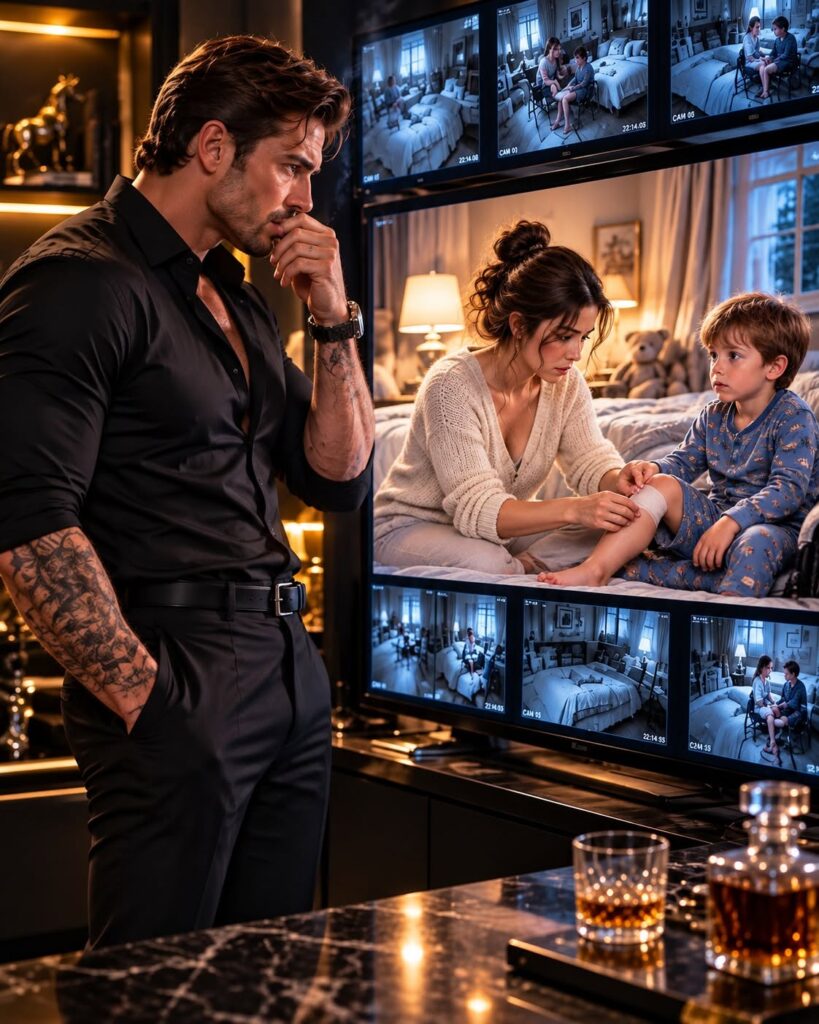
She looked toward the bedroom door, not the camera. She had no idea I was watching, but something in her expression told me she understood the weight of the word.
Then Matteo turned his head toward the window.
Not toward the photograph of his mother on the dresser.
Toward the rain-dark glass.
I pressed the intercom.
“Matteo?”
His eyes moved to the camera.
For one strange second, father and son looked directly at each other through the hidden lens.
Then his face closed.
The muscles around his mouth tightened, and he turned away.
“Matteo,” I said again.
Clara glanced at the ceiling, following the sound from the speaker.
“Give him a minute,” she said.
I released the button.
Dominic stood beside the doorway, silent.
“He spoke,” I said.
“Yes.”
“You heard him?”
“Everyone in the room heard him.”
I turned toward him sharply. “Get the speech therapist. Now.”
Dominic reached for his phone.
“No,” I said.
He paused.
I didn’t know why I’d stopped him. For fourteen months, I had begged doctors, therapists, specialists, and anyone with a medical opinion to give me some sign that my son was still inside himself. Now that he had spoken, every instinct told me to summon the entire world.
But through the monitor, I watched Clara gently lower Matteo’s leg.
“Not tonight,” I said. “Let him have this.”
Dominic frowned. “You just said—”
“I heard what I said.”
I left the control room before he could answer.
The corridor outside Matteo’s bedroom was dim, the wall sconces reflecting in the polished floor. Rain slid down the tall windows in crooked streams, making the estate seem surrounded by moving shadows.
I stopped with my hand on the doorknob.
A year ago, I would have entered without knocking. I had done it with doctors, guards, lawyers, and caretakers. I had treated every closed door as a possible threat.
But Clara had taught my son that choices still mattered.
So I knocked.
“Come in,” she said.
Matteo was lying beneath a gray blanket, his face turned toward the window. Clara sat in the chair beside the bed, one hand resting loosely on the mattress.
“Your father’s here,” she said.
“I can see that,” Matteo whispered.
The sound of his voice struck me harder than the first word.
It was deeper than I remembered. He had always had a clear, bright voice, even as a toddler, when he used to narrate everything he did. Now each syllable seemed to cost him effort.
I stepped inside.
“Hi, buddy.”
He didn’t look at me.
I moved to the foot of the bed and stood there, suddenly unsure what fathers were supposed to do when their children returned from a place they had been unable to reach.
“You said something,” I managed.
“So?”
I glanced at Clara.
She gave the slightest shake of her head.
Don’t make this about you.
The thought irritated me because it was true.
I pulled the nearby chair closer and sat.
“I’m glad you spoke.”
Matteo’s fingers curled against the blanket.
“Why?”
“Because I missed hearing you.”
“You heard me before.”
“Not for a long time.”
“You talked enough for both of us.”
Clara looked down, but I saw the corner of her mouth move.
A year ago, I might have corrected him. I might have told him I was doing everything for him, that he had no right to be angry, that I had lost his mother too.
Instead, I said, “You’re right.”
His eyes shifted toward me.
It was the first time he had looked at me since I entered.
“You don’t have to say that.”
“I know.”
“Then why did you?”
“Because it’s true.”
The rain tapped steadily against the glass.
Matteo’s gaze dropped to his hands. “I don’t want to talk anymore.”
“That’s okay.”
“You’re not going to call the therapist?”
“No.”
“Or the doctors?”
“Not tonight.”
He studied me with the weary suspicion of someone who had learned not to trust promises.
“Tomorrow?”
“Only if you want.”
His face tightened.
I understood then that every decision in his life had been made for him since the accident. When to wake, when to eat, when to be moved, when to stretch, when to take medication. Even his silence had become something adults discussed around him.
“I mean it,” I said. “You decide.”
His eyes flickered to Clara.
She nodded once.
Matteo relaxed by the smallest degree.
“Can I sleep?”
“Yes.”
I rose, but before I could leave, he spoke again.
“Dad?”
I turned.
He was looking at me now.
“Don’t fire her.”
The words were clearer than the first.
Something inside my chest shifted.
“I wasn’t going to.”
“You fire everybody.”
“I hired the wrong people.”
“She’s not wrong.”
Clara’s eyes met mine.
There was no triumph in them. Only caution, as if she understood that one emotional moment could not repair a year of distance.
“I know,” I said.
Matteo’s eyelids lowered.
After a minute, his breathing evened out.
Clara stood and adjusted the blanket around his shoulders. She moved with quiet efficiency, checking the position of his legs and the pressure points along his heels.
I watched her work.
“Where did you learn to do all that?” I asked when we stepped into the hallway.
She closed the door softly behind her.
“Experience.”
“That’s not an answer.”
“It’s the one I have.”
I leaned against the wall. “My son just spoke for the first time in fourteen months. You told him his father looks at him like he’s at a funeral, and somehow that helped.”
“I didn’t make him speak.”
“You gave him a reason to.”
“No. He gave himself one.”
The answer frustrated me because it left no one to praise and no one to blame.
Clara folded her arms. “He wasn’t waiting for a miracle, Mr. Rossi. He was waiting for permission to be angry.”
“He had permission.”
“From whom?”
I had no response.
She looked through the small glass panel in the bedroom door. “You love him.”
It wasn’t a question.
“More than anything.”
“Then stop loving him like he’s already gone.”
Her words were gentle, but they landed with the force of an accusation.
I looked down the corridor toward the portrait of Elena hanging above the staircase. My wife was smiling in the painting, one hand resting on Matteo’s shoulder. He was six years old in the portrait, missing a front tooth and holding a wooden sailboat.
I had commissioned it because I couldn’t bear the idea of the house without her face.
But I had placed it where Matteo could see it every time he left his room.
Perhaps I had been asking him to mourn every day because I didn’t know how to stop mourning myself.
“What do you know about grief?” I asked.
Clara’s expression changed.
Not dramatically. Just enough that I noticed.
“More than I want to.”
Before I could ask another question, Dominic appeared at the far end of the corridor.
He motioned for me.
I followed him toward the stairs.
“The therapist is available by video,” he said. “I told her there was no emergency.”
“Good.”
“And the cameras?”
“What about them?”
“Do you want me to archive tonight’s footage?”
I stopped.
For a year, I had collected everything. Every medication refusal. Every argument. Every moment a caretaker failed to turn Matteo properly or ignored his call bell. The recordings had become my evidence, my shield against being surprised again.
“Delete it,” I said.
Dominic stared.
“All of it?”
“Tonight’s footage.”
He hesitated. “You usually review—”
“Delete it.”
He nodded and walked away.
I stood alone beneath the staircase, listening to the storm.
Then I realized Clara was still at the bedroom door.
“You can go home,” I told her.
She glanced through the glass at Matteo.
“He may wake up disoriented.”
“We have a night nurse.”
“He doesn’t like the night nurse.”
“Neither do I.”
That earned the faintest smile.
“I’ll stay until he’s settled.”
“You’re off the clock.”
“I know.”
“Why?”
She looked at me.
“Because someone should.”
There was something in the way she said it that made the question return.
Where did you learn to do all that?
I waited until she came downstairs to the kitchen for coffee.
The kitchen was the warmest room in the house, though I rarely used it. A kettle hissed on the stove, and the windows fogged at the edges from the heat.
Clara sat at the island, both hands wrapped around a mug.
I poured myself coffee and remained standing.
“My wife,” I said.
Her gaze lifted.
“What about her?”
“You reacted when I asked what you know about grief.”
“I react to a lot of things.”
“You knew her?”
“No.”
The answer came too quickly.
I set the pot down.
“Have we met before?”
She looked toward the rain-streaked windows.
“Not that I remember.”
“That isn’t the same as no.”
“I’m tired, Mr. Rossi.”
“Vincent.”
Her eyes returned to mine.
I had insisted on being called Mr. Rossi by every employee in the house. Clara was the first person who looked as though she had been waiting for me to offer my name.
“Vincent,” she repeated.
The sound of it in her voice felt unexpectedly intimate.
“Why were you unemployed for two years?”
She lowered her mug.
“I wasn’t unemployed.”
“Your résumé says otherwise.”
“My résumé says I wasn’t employed by an agency.”
“So what were you doing?”
“Taking care of someone.”
“Who?”
“My brother.”
That explained the exhaustion in her face. The scuffed boots. The way she counted every medication and checked every lock without appearing to think about it.
“Is he ill?”
“He was.”
“Was?”
“He died.”
The kitchen seemed to grow quieter.
“I’m sorry.”
“Thank you.”
“When?”
“Eight months ago.”
“You’ve been caring for him since then?”
“For six years.”
I sat across from her.
“What happened?”
“An accident. He was twenty-six. Spinal injury. Complications afterward.” She traced a finger along the rim of her mug. “He came home eventually. Not because he was ready. Because the hospital had nowhere else to send him.”
Her voice remained calm, but I heard the old fatigue underneath it.
“Was he like Matteo?”
“No.” She gave a small, humorless smile. “No one is like Matteo. But he hated being helped. He thought needing assistance meant he had become someone else.”
“What did you tell him?”
“That needing help didn’t make him less himself.”
“That sounds familiar.”
“I’ve had practice.”
I looked at her hands. There were faint white marks across her knuckles, old scars perhaps, though nothing about her suggested violence. More likely years of lifting, catching, repairing, carrying.
“Why didn’t you become a nurse?”
She considered the question.
“Because I didn’t want to spend my life in hospitals. I wanted people to have a life outside them.”
That answer stayed with me.
For the first time, I understood why she had not tried to impress me during the interview. Clara had not come to manage my son’s condition. She had come to protect his life from being reduced to it.
“Did your brother speak?” I asked.
“Yes.”
“Until the end?”
“He spoke less toward the end.”
“Was he afraid?”
“Sometimes.”
“Were you?”
She looked at me over the mug.
“Every day.”
There was no shame in her answer.
I wondered if that was what courage actually looked like—not the absence of fear, but continuing to show up with it sitting beside you.
A faint sound came from the hall.
Clara stood immediately.
I followed her upstairs.
Matteo was awake, his eyes fixed on the ceiling. His breathing had quickened.
“What’s wrong?” I asked.
He looked at the door.
“Someone’s in the hall.”
Dominic appeared at the opposite end, speaking quietly with one of the guards. Their shadows moved across the wall.
“No one is coming in,” I said.
Matteo’s hands tightened.
“It smells like smoke.”
Clara crouched beside his bed.
“There’s a storm. The generator room is below this wing. Sometimes the vents carry the smell of diesel.”
“No,” Matteo said.
His voice shook.
“What does it smell like?” Clara asked.
He stared at the ceiling.
“Burned plastic.”
My body went cold.
The car bomb had burned through the front of the SUV. Matteo had been unconscious when we found him. The doctors had said he might not remember the explosion, only the moments before it.
I had never asked him what he remembered.
Not because I didn’t want to know.
Because I was terrified he did.
“Matteo,” I said, keeping my voice steady, “are you remembering the accident?”
His eyes darted toward me.
“I don’t know.”
“You’re safe,” Clara said. “You’re in your room. It’s raining outside. I’m right here.”
He gripped the blanket.
“Mom was driving.”
My breath stopped.
Elena had not been driving. I had been behind the wheel.
The official report was clear. I had taken the SUV that morning because there had been a threat against me. Elena and Matteo had been in the rear compartment with two guards. The blast came from beneath the vehicle, on the passenger side.
I had spent fourteen months believing Matteo remembered nothing.
“Matteo,” I said carefully, “your mother wasn’t driving.”
“She was.”
“No, buddy. I was.”
He shook his head.
“She moved me.”
“Moved you where?”
“Down.”
Clara looked at me.
I barely noticed.
Matteo’s eyes were squeezed shut now, tears collecting at the corners.
“She pushed me down and told me not to look.”
The room seemed to tilt.
I had been thrown from the vehicle when the blast struck. My ears had gone silent. I remembered glass, smoke, Dominic shouting, and the impossible sight of Elena lying across the back seat.
But I had never remembered seeing her move.
I had assumed she had been beside Matteo.
“Did she say anything else?” I asked.
Clara’s expression warned me not to press.
But Matteo opened his eyes.
“She said… the man who helps Dad… knows.”
My pulse began to pound.
“What man?”
Matteo turned his face toward me.
“The one with the bird.”
I stared at him.
“What bird?”
He looked frightened now, as if he regretted speaking.
“On his hand.”
No one in my security detail had a bird tattoo.
No one except one man.
A former driver named Peter Vale, who had worked for me for nine years before the bombing. Peter had been the person who recommended the route that morning. He had resigned three weeks afterward, claiming he couldn’t bear the memories.
I had never questioned him.
Because Peter had found me after the explosion.
Peter had pulled me from the wreckage.
Peter had been the one to tell me Elena was gone.
I reached for my phone.
Clara caught my wrist—not forcefully, but firmly enough to stop me.
“Not in front of him.”
I looked at her.
She nodded toward Matteo.
He was watching us, pale and exhausted.
I lowered the phone.
“You’re right.”
Matteo swallowed. “Don’t let him come back.”
“Who?”
“The man with the bird.”
Before I could ask anything else, he closed his eyes.
Clara placed one hand over his.
“Rest now,” she whispered. “You did enough.”
His fingers slowly loosened.
I stood beside the bed, unable to look away from my son.
After several minutes, when his breathing settled, Clara led me into the hallway.
She shut the door behind us.
“Why didn’t you tell me about Peter Vale?” she asked.
“Because I didn’t know there was anything to tell.”
“You didn’t know he had a tattoo?”
“I didn’t know Matteo saw it.”
“That’s not what I asked.”
I turned toward her. “What are you suggesting?”
“That you start asking questions before deciding you already know the answers.”
The words were familiar.
Too familiar.
“Have you heard the name Peter Vale before?”
Clara’s face went still.
It lasted only a second, but I saw it.
“You have,” I said.
She looked past me toward the staircase.
“Where?”
“Clara.”
She reached into the pocket of her coat and took out a small, worn photograph.
The edges were soft from years of handling.
She turned it around.
A young man stood beside an older woman outside a modest brick house. He was smiling, one arm around her shoulders. On the back of his right hand was a dark tattoo shaped like a bird with spread wings.
I recognized him immediately.
Peter Vale.
But the woman beside him was not a stranger.
She was Clara.
My stomach tightened.
“Who is he?” I asked, though I already knew.
“My brother,” she said.
The hallway seemed to narrow around us.
“Peter Vale is your brother?”
Clara nodded.
“And you came here knowing who I was?”
“I came here because I needed to know whether you were responsible for what happened.”
The words were quiet, not accusing.
Just wounded.
PART 3
I stared at the photograph, then at her.
“What do you mean, responsible?”
Clara’s eyes filled, but she did not look away.
“Peter died eight months ago. Before he did, he left me something.” She turned the photograph over and placed it in my hand.
On the back, beneath a faded date, four words had been written in blue ink.
Ask Vincent about Elena.
For several seconds, I couldn’t breathe properly.
The hallway remained exactly as it had been—the dim sconces, the rain tapping against the tall windows, the faint hum of the heating system—but everything familiar had shifted.
“Where did you get this?” I asked.
“From his apartment.”
“When?”
“After the funeral.”
“You knew Peter was my driver?”
“I knew he had worked for you. I didn’t know what kind of work until I saw your name in his old files.”
“What files?”
“The ones he kept in a locked metal box.”
I looked down at the photograph again. Peter was younger in it, perhaps twenty-four. His arm rested around Clara’s shoulders, and his smile was open, almost boyish. I had known him for nine years and had never seen that expression.
On his hand, the bird tattoo spread its wings beneath his knuckles.
“Why didn’t you show me this when you interviewed?”
“Would you have hired me if I had?”
“Yes.”
The answer came too quickly.
Clara gave me a tired look. “You barely hired me as it was.”
“You were the best candidate.”
“No. I was the only one who didn’t pretend to be impressed by you.”
“That may be the same thing.”
“It isn’t.”
I folded my fingers around the photograph.
“Did Peter tell you I was responsible?”
“No.”
“Then why come here?”
“Because he died with your name on his last note, and because the official story never made sense.”
“What part?”
“All of it.”
She glanced toward Matteo’s closed door.
“Peter came home three weeks after the bombing. He had a fractured shoulder and burns on his hands. He told me the vehicle had been sabotaged.”
I stiffened.
“The report said he had minor injuries.”
“The report was wrong.”
“Who told you that?”
“Peter.”
“Why didn’t he go to the police?”
“He said he had already tried.”
I searched her face. “When?”
“The day after the explosion. He went to a detective named Morris. Morris told him the investigation was ongoing and that Peter needed to stop making accusations without proof.”
“Which accusations?”
“That someone inside your organization had changed the route and disabled one of the vehicle’s safety systems.”
I thought of the official report. The bomb had been planted beneath the passenger side. The vehicle’s emergency communication unit had failed six minutes before the blast, but the investigators had blamed the storm.
At the time, I had been too consumed by Elena’s death and Matteo’s injuries to question every detail. Dominic had handled the security review. I had accepted his conclusions because I trusted him.
Or because I needed one less thing to carry.
“Peter told you all this eight months ago?”
“He told me pieces over the years. The rest came near the end.”
“What happened to him?”
“His heart failed.”
I said nothing.
“He had complications from his old injury,” she continued. “Not the kind that put him in a wheelchair, if that’s what you’re thinking. He could walk. He had chronic nerve damage and pain, but he worked through it. After the bombing, the pain got worse. He stopped sleeping. Eventually, his heart couldn’t keep up with everything else.”
She looked toward Matteo’s room again.
“He blamed himself for surviving.”
I knew that feeling. It had lived inside me since the day Elena died, though I had given it a different name.
Responsibility.
“Why did he leave me that message?”
“I don’t know.”
“You must have some idea.”
“I think he wanted me to ask you what Elena knew.”
“What Elena knew about what?”
“Peter never said.”
“Then this is all speculation.”
“Yes.”
The honesty unsettled me more than certainty would have.
I handed the photograph back. Clara didn’t take it.
“Keep it,” I said.
“I don’t want it.”
“You carried it here.”
“To remind myself why I came.”
“And now?”
“Now I’m not sure.”
The door behind us opened slightly.
Matteo’s voice drifted into the hallway.
“Dad?”
I turned immediately.
He was awake, his face pale against the pillow. Clara went to him, and I followed.
“Are you all right?” I asked.
He nodded, though his eyes remained fixed on the photograph in my hand.
“That’s him.”
“Peter?”
Matteo’s gaze moved to Clara.
“Uncle Peter.”
Clara went completely still.
I looked at her.
“You told him about Peter?”
“No.”
“Then how does he know him?”
Matteo frowned, as though the answer should have been obvious. “He came to our house.”
“When?”
“Before.”
“Before the accident?”
He nodded.
“What did he do?”
“He talked to Mom.”
“About what?”
Matteo’s breathing quickened.
Clara placed her hand over his.
“You don’t have to answer everything tonight.”
He looked at her, then back at me.
“Mom was scared.”
My throat tightened.
“Of Peter?”
“No. She said Peter was helping.”
“Helping with what?”
Matteo closed his eyes.
The question had taken more from him than he could give.
I sat on the edge of the bed, careful not to crowd him.
“Okay,” I said. “We’ll stop.”
His fingers moved beneath Clara’s hand.
“Dad?”
“I’m here.”
“Don’t be mad at Uncle Peter.”
“I’m not mad at him.”
“Don’t let them say he did it.”
The room became very quiet.
“Who says he did it?”
Matteo’s eyes opened.
“The men.”
“What men?”
“The men who came after.”
Clara glanced at me, but I could not move.
“After the accident?” I asked.
Matteo nodded.
“Where did they come?”
He looked toward the window.
“Hospital.”
My stomach turned.
“Did you see them?”
“No. I heard them.”
“What did they say?”
His lips parted, but no sound came out.
I forced myself to remain calm. “You don’t have to remember all of it.”
“They said Uncle Peter ran.”
“Ran where?”
“They said he left Mom.”
I looked at Clara.
She was studying Matteo with the careful attention of someone who understood how memory could fracture under pressure.
“Do you remember anyone else?” I asked.
Matteo stared at the ceiling.
“One had a ring.”
“What kind of ring?”
“A silver one. With a black stone.”
A cold awareness moved through me.
Dominic wore a silver ring with an onyx stone. He had worn it for as long as I had known him. His father had given it to him when he joined my organization.
But that meant nothing. Half the men I knew wore rings.
I stood.
“That’s enough for tonight.”
Matteo’s face tightened. “You’re leaving?”
“No. I’m right outside.”
“Don’t talk to the men.”
“I won’t.”
“Promise?”
I sat again and took his hand.
“I promise I won’t do anything without thinking first.”
It was not the sort of promise I would have made before Clara came into our lives. I would have promised action. Retaliation. Answers.
Matteo seemed satisfied with the difference.
His eyes closed.
Clara waited until his breathing slowed before stepping into the hall.
“You need to be careful,” she said.
“I know.”
“No, you don’t.”
I looked at her.
“You heard one detail and immediately connected it to someone you trust. That isn’t caution. That’s fear looking for a shape.”
“Dominic has been with me for fifteen years.”
“Peter worked for you for nine.”
“I’m not accusing anyone.”
“You’re already doing it in your head.”
She was right. I hated that.
“I need to review the security files from the bombing.”
“Then review them. Don’t confront anyone until you know what you’re looking at.”
“You’ve been investigating this?”
“I’ve been trying to understand what happened to my brother.”
“For eight months.”
“For six years, if you count the time I spent watching him live with the consequences.”
The words softened the anger in her voice.
“Why become Matteo’s caretaker?” I asked.
“Because the agency sent me the listing.”
“That’s not the whole answer.”
“No.”
She stepped closer to the bedroom door and lowered her voice.
“I read about the bombing when it happened. I knew Peter had worked for you. When I saw the caretaker position, I thought maybe I could learn what he had been protecting.”
“By watching my son?”
“By helping him.”
“Those aren’t the same thing.”
“I know.”
She looked through the glass panel at Matteo.
“I didn’t expect him to be kind.”
“He isn’t always.”
“He doesn’t have to be. He’s a child who lost the use of his legs and his mother in the same morning. He has earned the right to be difficult.”
My gaze moved to the closed door.
“He remembers more than we thought.”
“Maybe.”
“Maybe?”
“Memory isn’t a recording, Vincent. It changes when people are frightened. It fills in gaps. It protects itself.”
“He recognized Peter.”
“That may be real.”
“And the men at the hospital?”
“That may be real too.”
“Then you believe him.”
“I believe something happened that he has been carrying alone.”
The answer was measured, but it gave me no comfort.
I went downstairs to the control room with Clara behind me.
Dominic was standing at the central console, reviewing the camera feeds from the eastern grounds. When he saw us, he straightened.
“Is Matteo all right?”
“He’s resting,” I said.
Dominic’s eyes moved to Clara, then back to me. “Did something happen?”
“Pull the archive from the morning of the bombing.”
His expression changed slightly.
“Which archive?”
“All exterior and internal feeds from six a.m. until noon.”
“That footage was transferred to the investigators.”
“Then retrieve our copy.”
“There may not be one.”
“There is always a copy.”
“Not after the system overhaul.”
I looked at the console.
“Who authorized the overhaul?”
Dominic hesitated.
“I did.”
“When?”
“Two months after the bombing.”
“Why?”
“The system had been compromised. We replaced the storage array.”
“And the old drives?”
“Destroyed.”
The word settled between us.
Clara folded her arms. “Destroyed by whom?”
Dominic looked at her.
“By the disposal contractor.”
“Name?”
His jaw tightened. “I don’t have it memorized.”
“Then find it,” I said.
Dominic turned back to the console, but I stopped him.
“Before that, pull the security reports from the week before the bombing.”
“I can do that.”
“And Peter’s personnel file.”
Dominic’s hand paused above the keyboard.
“Why?”
“Because I asked.”
For the first time in fifteen years, Dominic looked at me not as his employer, but as a man whose judgment he questioned.
“Vincent,” he said quietly, “Peter was cleared by the investigation.”
“Then the file will confirm that.”
He held my gaze for another moment before opening the database.
Clara remained beside me.
“You trust him,” she said.
“I did.”
“That’s not what I asked.”
I watched Dominic work.
“I trust the history between us.”
“That’s different.”
“Yes.”
The personnel file appeared on the monitor. Employment records, driving certifications, background checks, medical forms. Everything looked ordinary until I noticed the date of Peter’s last security review.
Three days before the bombing.
I enlarged the document.
The review had been marked incomplete.
“Why was this never finished?” I asked.
Dominic leaned toward the screen.
“It was a routine update.”
“It says pending.”
“The threat level had increased. We were reviewing everyone.”
“Who conducted it?”
“Security compliance.”
“Who?”
He scrolled.
Then stopped.
“Martin Cole.”
Martin had been the head of internal security. He had resigned six months after the bombing and moved to Arizona. I had assumed he left because he disliked the pressure.
“Is Cole still alive?” I asked.
Dominic checked another database.
“According to this, yes.”
“Find him.”
“Tonight?”
“Now.”
Clara’s eyes stayed on the screen. “Look at the signature.”
I bent closer.
The signature at the bottom of the review was not Martin Cole’s.
It belonged to Dominic.
He stared at it.
“I didn’t sign that.”
“Your name is there.”
“It’s not my handwriting.”
“Could someone have copied it?”
“Anyone with access to the system.”
I turned to him. “Who had access?”
“Me. Martin. Peter. Elena.”
The last name made all three of us silent.
“Elena had access to the security files?” Clara asked.
“Limited access,” Dominic said. “She handled the family schedules and emergency contacts.”
“Could she have seen the review?”
“Yes.”
“Did she know it was incomplete?”
“I don’t know.”
I thought of Elena in the weeks before the bombing. Her distracted silences. The way she had started checking the locks twice before bed. I had assumed she was afraid because of the threats against me.
Perhaps she had been afraid of something more specific.
A new notification appeared on the screen.
Dominic clicked it.
An old scanned memo opened.
The date was eleven days before the explosion.
The sender was Elena.
The recipient was Peter Vale.
The subject line read: Route Change.
I read the message once, then again.
Peter—
Please don’t mention this to Vincent yet. I need to be certain before I worry him.
The route to the clinic has been altered three times this week, although I have not requested any changes. The last change came through Dominic’s office.
Can you check whether the original schedule still exists?
If I’m mistaken, I’ll apologize. If I’m not, I need your help keeping Matteo away from the main gate until we understand who is doing this.
—Elena
My vision blurred.
Clara read it over my shoulder.
“She suspected Dominic,” she whispered.
I shook my head. “This doesn’t prove anything.”
“No,” she said. “But it proves she was afraid.”
Dominic had stepped away from the console.
“I never saw that message.”
“Why would Elena send it to Peter instead of you?” I asked.
“I don’t know.”
“Did you alter the route?”
“No.”
“Did you have access to the scheduling system?”
“Yes, but so did three other people.”
“Who?”
“Martin Cole. Peter. Elena.”
“And the fourth?”
Dominic didn’t answer.
I turned back to the screen.
At the bottom of the memo, below Elena’s signature, was a line of text I had never seen.
Attachment: audio file—morning call.
“Open the attachment,” I said.
“There’s no file,” Dominic replied. “The archive only preserved the memo.”
“Then why does it say attachment?”
“Because the message was imported from another system.”
“Which system?”
Dominic looked at the date.
“Your wife’s personal account, maybe.”
“Maybe?”
He looked uneasy. “The household server was damaged in the explosion. We recovered some data, but not everything.”
Clara moved closer to the monitor.
“Can you recover it now?”
“Not from this workstation.”
“Where is it?”
Dominic hesitated.
I felt the answer before he gave it.
“The old server wasn’t destroyed,” he said. “It was placed in storage.”
“Where?”
“Below the west garage.”
“Take us there.”
Dominic looked at the clock. “It’s after midnight.”
“I’m aware.”
“Vincent, if the system was compromised—”
“Then you should want to know what’s on it.”
He said nothing.
The three of us crossed the estate through the underground passage. Rainwater hissed against the drains beneath the garage, and the concrete walls smelled of oil and dust. Dominic unlocked a steel storage room hidden behind a row of equipment cabinets.
Inside, old monitors and disconnected computer towers had been stacked beneath gray covers.
He removed one from a black server unit.
“This was never catalogued,” he said.
“Who told you to store it?”
“Martin.”
“Why?”
“He said the investigators might request it later.”
“And they never did?”
“Not that I know of.”
I knelt beside the server and examined the small label taped to its side.
Family Network—Rossi Residence.
The date written beneath it was two days before the bombing.
Dominic connected a portable power unit. The server gave a weak mechanical hum.
A single directory appeared on the monitor.
ELENA—PRIVATE.
Inside were dozens of audio files.
Most were labeled with dates.
The newest one had been created at 5:42 a.m. on the morning of the bombing.
Clara’s hand found the edge of the desk.
I clicked the file.
For several seconds, there was only the sound of movement and a door closing.
Then Elena spoke.
Her voice was quiet, hurried, and unmistakably afraid.
“Vincent, if you’re hearing this, Peter was right. The person changing our routes has access to the house, and I know who it is.”
A pause.
In the background, I heard the faint voice of a child.
Matteo.
Elena continued.
“I didn’t tell you because I was afraid you would confront him before I could prove it. But there’s something else you need to understand.”
Her breath caught.
“The threat was never meant for you.”
The recording crackled.
“It was meant for Matteo.”
I felt Clara turn toward me.
Then Elena said the words that changed everything.
“And the man helping them is not Peter. It’s the person you trust most.”
I stared at the photograph, then at her.
“What do you mean, responsible?”
Clara’s eyes filled, but she did not look away.
“Peter died eight months ago. Before he did, he left me something.” She turned the photograph over and placed it in my hand.
On the back, beneath a faded date, four words had been written in blue ink.
Ask Vincent about Elena.
PART 4 (THE END)
The recording ended in a burst of static.
No one moved.
The server continued humming beneath the desk, its small green light blinking steadily in the dim storage room. Outside, rainwater moved through the drains with a low, distant rush.
I stared at the frozen audio file.
“Play it again,” I said.
Dominic didn’t reach for the mouse.
“Vincent—”
“Play it again.”
He pressed the button.
Elena’s voice filled the room once more.
*The threat was never meant for you. It was meant for Matteo.*
A pause.
*And the man helping them is not Peter. It’s the person you trust most.*
Then the recording ended.
I closed my eyes.
For fourteen months, I had carried the belief that Elena’s death had been the unavoidable price of a threat aimed at me. Men had wanted to frighten me, weaken me, punish me. I had accepted that explanation because it gave the loss a shape I could understand.
But if Matteo had been the target, then every memory I had protected myself with was wrong.
The blast.
The route.
The guards.
The moment I woke in the wreckage and found my son alive.
None of it had been random.
Clara touched my arm. “Vincent.”
I opened my eyes.
Dominic stood on the other side of the server, pale and motionless.
“Say something,” I told him.
He swallowed.
“I don’t know who she meant.”
I looked at him.
“Your name was on the security review.”
“I told you, that signature was forged.”
“She said the person I trusted most.”
“You trust me.”
“I did.”
The words struck him harder than I intended. His shoulders dropped, and for a moment he looked older than I had ever seen him.
“I know,” he said.
Clara stepped between us—not to protect Dominic, but to slow the moment before it became something none of us could take back.
“Let’s listen to the other files.”
There were thirty-two recordings in the directory. Most were brief. Elena had recorded conversations with Peter, notes about changed schedules, and reminders to check the locks. She had never sounded hysterical. She was careful, organized, determined to prove what she suspected before bringing it to me.
The fourth file contained Peter’s voice.
“I checked the system,” he said. “The changes are coming through an administrator account.”
Elena answered, “Whose?”
“I can’t tell. The credentials are being copied.”
“Can Dominic trace it?”
“He can, if he knows what he’s looking for.”
“Should I tell Vincent?”
“Not yet.”
“Why not?”
“Because if the person inside the house knows you’ve found them, they’ll move faster.”
The recording ended.
Dominic rubbed both hands over his face.
“I remember that conversation,” he said. “Peter came to me two days later. He said the scheduling system had been accessed from the west garage terminal. I checked the terminal and found nothing.”
“Did you tell Elena?”
“No.”
“Why?”
“Because I thought Peter was mistaken.”
Clara looked at him. “You thought he was mistaken, or you didn’t want to believe the system had been compromised?”
“Both.”
He turned toward the server.
“I had been with Vincent since he was twenty-three. I handled his security, his staff, his travel. If someone had entered the system using my credentials, I assumed it was a technical error. I told myself that because the alternative meant someone had been working inside the estate.”
“And Martin Cole?” I asked.
“Martin insisted the changes were coming from an outside contractor. He said the scheduling software had a vulnerability.”
“Did you believe him?”
“Yes.”
The answer was quiet.
“And Peter?”
“Peter didn’t.”
Another file began playing automatically.
Peter’s voice sounded tired.
“Elena, I found something. Martin has been accessing the old route files at night. I don’t know why. I’m going to confront him tomorrow.”
Elena replied, “Don’t confront him alone.”
“I won’t.”
“You promised.”
“I promise.”
The recording ended with a click.
I turned to Dominic. “When did Martin resign?”
“Six months after the bombing.”
“Did he leave voluntarily?”
“He said the investigation had ruined his reputation.”
“Where did he go?”
“Arizona. Tucson, originally. Then he moved twice.”
“Can you find him?”
“I can try.”
“No. Find him.”
Dominic nodded and reached for his phone.
Clara remained beside me, her expression troubled.
“Peter knew,” she said.
“He knew Martin was involved.”
“He tried to stop him.”
I thought of Peter’s tattooed hand, the one Matteo remembered. He had not been the man who abandoned Elena. He had been the man who tried to warn her.
And yet he had carried the shame of surviving for six years.
“Why did Peter leave after the bombing?” I asked.
Dominic looked up from his phone.
“Because he believed he had failed.”
“Failed how?”
“He was supposed to be driving the second security vehicle that morning. At the last minute, Martin reassigned him to the lead vehicle. Peter objected, but Martin said it was a routine adjustment.”
My pulse slowed into something heavier.
“Martin put Peter in the car.”
“Yes.”
“And then the route changed.”
“Yes.”
“Did Peter know the vehicle had been tampered with?”
“Not until afterward.”
A notification appeared on Dominic’s phone.
He read it, then went still.
“What?”
“Martin is alive. He owns a small property outside Flagstaff. The address is current.”
“Call the authorities.”
Dominic looked at me.
“Federal?”
“Anyone who can investigate the bombing properly.”
He nodded and stepped away to make the call.
Clara turned to me.
“You need to tell Matteo.”
I looked toward the storage room door.
“He’s eight.”
“He’s also been carrying pieces of this for fourteen months.”
“I don’t want him frightened.”
“You don’t have to tell him everything. But he should know Peter wasn’t responsible.”
I thought of my son’s face when he had pleaded with me not to let anyone say Peter did it.
He had been protecting a dead man from a lie.
“Not tonight,” I said.
“Why not?”
“Because he needs sleep.”
Her expression softened. “That’s different from avoiding it.”
“I’m trying to learn the difference.”
She smiled faintly.
It was the first time that night either of us had managed one.
We left Dominic with the investigators and went upstairs.
Matteo was awake, though his eyes were heavy. Clara checked his position, adjusted the blanket, and made sure the call button rested near his hand.
“Did you find out about Uncle Peter?” he asked.
I sat beside him.
“We found out he was trying to help your mother.”
Matteo watched my face carefully.
“He didn’t leave her?”
“No.”
“Mom told him to help me.”
“I know.”
“Did he?”
“He tried.”
Matteo’s mouth trembled. “Why didn’t he come back?”
I had no easy answer.
“Because he thought he had failed,” I said. “Sometimes grown-ups make mistakes when they’re scared. Sometimes they blame themselves for things they couldn’t control.”
“Like you?”
The question went through me.
“Yes,” I said. “Like me.”
He considered that.
“Did you blame Uncle Peter?”
“I believed the wrong story.”
“Are you going to tell people?”
“Yes.”
“Everyone?”
“Everyone who needs to know.”
Matteo looked at Clara.
“She believed me.”
“She did.”
“You didn’t.”
“I didn’t ask you,” I said. “I should have.”
His eyes filled, but he didn’t cry.
“I tried to tell you.”
“I know.”
“No, you didn’t.”
The words were soft, but they left no room for defense.
I took his hand.
“You’re right. I didn’t listen because I was afraid of what you might remember.”
He stared at our joined hands.
“I remembered Mom pushing me down.”
“I know.”
“She told me not to look.”
“I know.”
“She was scared.”
I squeezed his fingers carefully.
“She was protecting you.”
“Did she know she was going to die?”
“I don’t think so.”
“Did she say goodbye?”
My throat tightened.
“No.”
Matteo nodded, as if that answer confirmed something he had already understood.
“I wanted her to.”
“I know.”
He turned his face toward the window.
For a moment, I thought the conversation was over.
Then he said, “Can I talk to the therapist tomorrow?”
I looked at Clara.
She didn’t answer for him.
“Only if you want to,” I said.
“I want to.”
“All right.”
“And I want to go outside.”
The request was so ordinary that it nearly broke me.
“Tomorrow morning,” I said.
“Not if it rains.”
“Even if it rains.”
“You hate rain.”
“I can survive it.”
Matteo glanced at me.
“Dad?”
“Yes?”
“Stop watching me all the time.”
Clara looked down.
I let out a breath that might have been a laugh.
“I’ll try.”
“No. Really stop.”
I looked toward the small black camera mounted near the ceiling. For the first time since installing it, I saw not a shield but a wall.
“I’ll take them down,” I said.
Matteo’s eyes widened.
“All of them?”
“All of them.”
“What if someone comes?”
“We’ll use the regular security system. You’ll have a call button, guards outside, and people who knock before entering.”
“And you won’t watch from the basement?”
“No.”
He thought about it.
“Okay.”
It wasn’t forgiveness.
But it was a door left open.
The investigation lasted several weeks.
Martin Cole was found in Arizona and agreed to speak through an attorney after federal investigators presented the recovered recordings and security records. He had not planted the bomb himself. He had sold information about the estate to men who wanted leverage over me, believing they intended to force a negotiation by taking Matteo briefly and frightening the family.
That distinction did not make him innocent.
He had altered routes, copied access credentials, and concealed the threat. When Peter discovered what he was doing, Martin moved the plan forward. The bomb had been arranged by people outside the estate, but Martin had provided the schedule and disabled the vehicle’s emergency system.
He had not expected Elena to be in the rear compartment.
He had not expected Peter to switch vehicles with another driver at the last minute.
He had not expected Matteo to survive.
And he had never understood that fear could destroy more lives than any plan accounted for.
The authorities confirmed that Dominic had not been involved. He had failed to investigate Peter’s warnings, and he had allowed Martin too much access, but he had not known what Martin intended.
That knowledge did not erase his guilt.
Dominic resigned two months later.
Before he left, he stood in my office with a small box in his hands.
“I should have listened to Peter,” he said.
“Yes.”
“I should have told you about Elena’s concerns.”
“Yes.”
“I don’t expect forgiveness.”
“I’m not ready to give it.”
He nodded.
“But I’m not asking you to stay angry forever,” I continued. “You served my family for a long time. You made a terrible mistake. Both things can be true.”
He looked down at the box.
Inside was the silver ring with the black stone.
“I’m giving this to the investigators,” he said. “Martin borrowed it once when he needed to access a restricted terminal. He claimed he had lost his own identification. I remembered it after Matteo described the ring.”
I stared at it.
Another small detail my son had carried alone.
“Thank you for telling me.”
Dominic placed the box on my desk.
Then he left.
I took the cameras down room by room.
The work took three days. Some had been hidden in light fixtures, others behind vents and smoke detectors. Each one had seemed necessary when I installed it. Together, they had turned the estate into a place where no one could be alone—not even with their own thoughts.
When the final camera came down from Matteo’s room, he watched from his wheelchair.
“Does it feel different?” I asked.
“The ceiling looks better.”
I laughed.
Clara stood beside the window, holding a box of equipment.
“You could paint over the holes,” she said.
“I’ll have it done.”
“Not everything needs a contractor.”
“Are you volunteering?”
“I’m suggesting you learn to use a screwdriver.”
Matteo smiled.
It was small and quick, but it was there.
His therapy continued. Some days were difficult. Some days he refused. Clara never made promises about miracles, and I stopped asking for them.
The therapist taught him new ways to transfer from the chair to the bed. He learned exercises that strengthened the muscles he could still control. He began speaking more, first in short sentences, then in longer ones when he forgot to be cautious.
One afternoon, he asked me to take him to the garden.
The coastal wind moved through the cypress trees, carrying the scent of salt and wet earth. Matteo’s chair rolled along the new stone path we had installed after he complained that the old one was too uneven.
Clara walked beside him.
I followed several steps behind.
“Dad,” Matteo called.
“Yes?”
“You’re doing it again.”
“Doing what?”
“Watching.”
I stopped.
He looked over his shoulder.
“Come beside me.”
So I did.
We reached the far end of the garden, where the land sloped toward the sea. Elena’s portrait had been moved from the staircase to a quieter room. In its place, I had hung a photograph of her laughing at the beach, wind tangling her hair while Matteo held a wooden sailboat against his chest.
I had not taken it down.
I had only stopped making it the center of every room.
Clara leaned against the garden wall.
“Peter loved the ocean,” she said.
I looked at her.
“He used to take me to the coast when we were children. Before the accident, before everything became appointments and medications. He said the water reminded him that a person could be carried without disappearing.”
Matteo listened.
“Would you like to tell me about him?” he asked.
Clara looked surprised.
“Maybe another day.”
“Okay.”
She smiled. “Another day.”
The three of us watched the waves for a while.
I thought about trust then—not as something given once and protected forever, but as something rebuilt through ordinary choices. A knock before entering. A question asked instead of assumed. A promise kept when no one was watching.
I had believed survival meant expecting betrayal before it arrived.
Matteo was teaching me something else.
Survival could also mean allowing people to stand beside you without demanding proof that they would never leave.
Clara reached into her coat and removed the old photograph of Peter.
She held it out to me.
“Keep it,” she said.
“I thought you didn’t want it.”
“I don’t need it to remember him anymore.”
I accepted it carefully.
“What will you do?” I asked.
“Stay through the end of the month.”
“That’s all?”
“I haven’t decided.”
Matteo turned toward us. “You should stay.”
Clara laughed softly. “That’s a strong recommendation.”
“You’re not wrong.”
She looked at me.
For once, neither of us needed to say more.
The next morning, I found Matteo in the garden before breakfast, positioned beside the ramp with his therapist and a cup of orange juice balanced on the armrest of his chair.
He was practicing the transfer on his own.
When he saw me, he didn’t stop.
“Good morning,” he said.
His voice was still quieter than it had been before the accident, but it no longer sounded like something borrowed.
“Good morning, buddy.”
He glanced toward the house.
“Are the cameras really gone?”
“All of them.”
“Good.”
He shifted his hands, leaned forward, and moved himself carefully toward the parallel bars.
Clara stood nearby, ready to help but waiting for him to ask.
Matteo gripped the bars.
His arms trembled.
For one second, his face tightened with frustration.
Then he steadied himself.
“I’m going with it,” he said.
I felt the old ache in my chest, but it was no longer the ache of mourning.
It was pride.
It was hope.
It was the painful, beautiful realization that my son had never been gone.
He had been waiting for us to see him clearly.
And this time, I did.

