
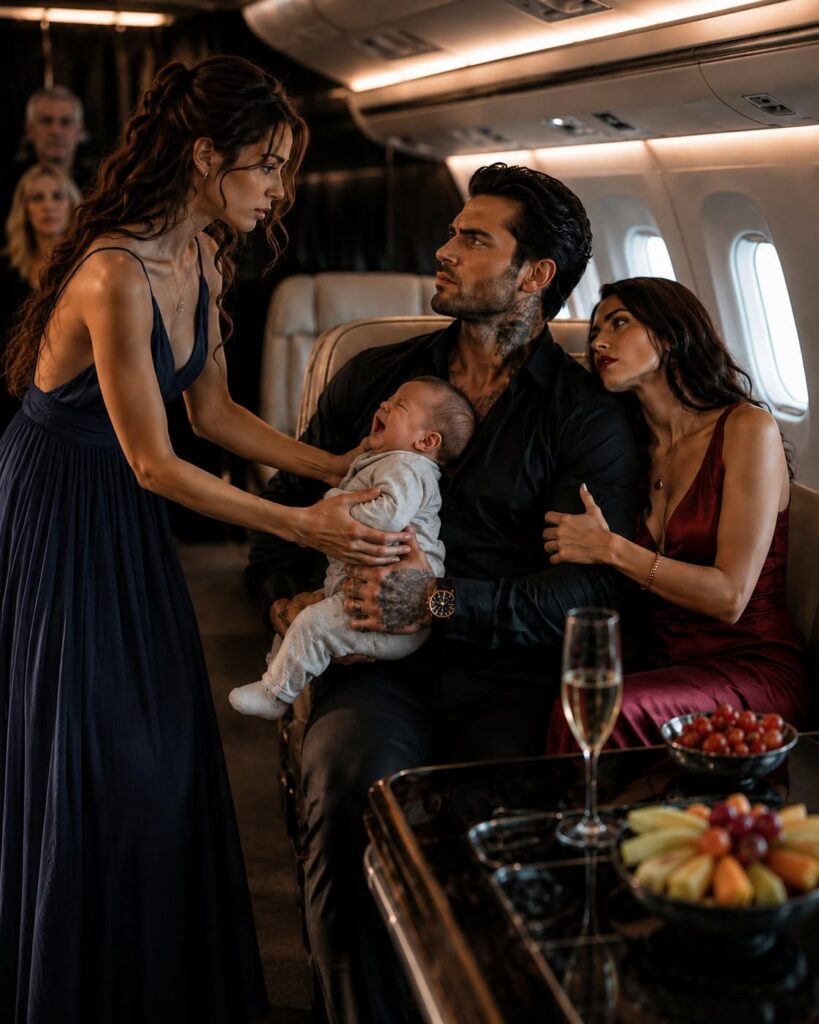
“I can feed him.”
For several seconds, no one moved.
The words seemed to hover in the quiet first-class cabin, fragile and impossible to retrieve.
The baby’s father stared at me.
The flight attendant stopped with one hand resting on the edge of a seat. The large man beside him—whom I had already decided was some combination of security guard, assistant, and professional worrier—blinked as though he wasn’t certain he’d heard me correctly.
I felt heat climb all the way to my ears.
“I mean nurse him,” I said quietly. “Breastfeed him. If you’re comfortable with that.”
The baby’s father looked down at the child trembling against his chest.
Another cry came, weaker than the last.
That decided something in him.
“Would it be safe?”
The question surprised me.
Not because it was unreasonable, but because beneath the expensive suit, the controlled voice, and the expression that had frightened half the cabin into avoiding eye contact, he suddenly sounded like what he was.
A worried father.
“Yes,” I said. “I’m healthy. I don’t smoke. I don’t take medication that would make nursing unsafe.”
His eyes returned to mine.
“You’re breastfeeding your daughter?”
“Not much anymore. Mostly bedtime when she’s unsettled. She’s almost weaned.”
I hesitated.
“I also pump for a milk bank at the hospital where I work. Or worked.”
That last word slipped out before I could stop it.
He noticed.
He didn’t ask.
Instead, he looked at his son again.
The baby’s cheek turned instinctively against his father’s shirt, mouth searching.
The man swallowed.
“My wife nursed him.”
Past tense.
Something inside me softened.
“Then he remembers,” I said.
The father’s jaw tightened, but this time I understood the expression differently.
Not anger.
Grief held very carefully in place.
The flight attendant stepped closer.
“We can give you privacy.”
The man nodded immediately.
“Please.”
The attendant moved efficiently. A curtain was drawn across the aisle. The passengers nearest us were politely redirected from staring. A blanket appeared, then a pillow, then a glass of water for me.
The large man remained standing.
I glanced at him.
He glanced at me.
Then the baby’s father said, “Owen.”
“Yes?”
“Turn around.”
Owen looked offended.
“I wasn’t—”
“Turn around.”
With the long-suffering dignity of a man whose job description clearly had not included this particular assignment, he faced the bulkhead.
Despite everything, I almost laughed.
That tiny impulse—the first I’d felt in days—startled me.
The baby’s father lowered himself into the seat across from me.
Up close, he looked younger than I’d thought. Early forties, perhaps. There were shadows beneath his eyes and the faint roughness of someone who had either forgotten to shave that morning or hadn’t cared enough to remember.
His shirt collar was open.
No tie.
No wedding ring.
But on a thin leather cord around his neck, half hidden by his shirt, there was a plain gold band.
He noticed me noticing.
Again, he offered no explanation.
I didn’t ask for one.
“What is his name?” I whispered.
“Leo.”
“Hi, Leo.”
The baby cried again.
I held out my arms.
His father didn’t immediately hand him over.
For one second, I saw the instinctive resistance.
This man might command boardrooms or companies or whatever world existed behind those cold gray eyes, but none of it mattered now. He was being asked to put his child into the arms of a stranger.
“I’ll stay right here,” I said.
Something changed in his expression.
He nodded.
Then he gave me his son.
Leo weighed almost nothing.
And yet the moment I held him, I understood how completely a baby could become the heaviest thing in someone’s life.
His little body was rigid from crying.
“Easy,” I murmured. “You’re all right.”
His forehead was damp. His breathing came in ragged little catches.
I positioned the blanket, turned slightly for privacy, and brought him close.
The change was immediate.
Not silence.
Not yet.
But recognition.
Leo froze.
His tiny face turned.
His mouth opened.
Then instinct took over.
His father made a sound beside me.
Barely a sound at all.
A breath, perhaps.
I looked up.
He was staring at his son.
Leo latched.
The crying stopped.
After eighty-seven minutes of noise, the silence felt enormous.
Not empty.
Sacred.
The hum of the aircraft engines returned to everyone’s awareness. Glasses clinked somewhere beyond the curtain. Someone cleared a throat.
Leo’s fists slowly opened.
One tiny hand came to rest against my blouse.
His father covered his eyes.
I pretended not to notice.
Sometimes kindness is giving someone comfort.
Sometimes it’s giving them privacy while they accept it.
I focused on Leo.
His breathing settled.
His eyelashes were ridiculously long. His dark hair curled slightly at the temples. Every few moments he made a small contented sound in his throat.
“Six months?” I asked softly.
“Five and a half.”
“He’s beautiful.”
His father’s hand lowered.
“His mother said that constantly.”
There it was again.
Past tense.
I waited.
After a long silence, he said, “She died seven weeks ago.”
My heart tightened.
“I’m sorry.”
“Thank you.”
Nothing dramatic followed.
He didn’t tell me how.
I didn’t ask.
He simply watched his son eat.
And somehow his restraint made the grief more visible than tears would have.
“My wife was Sofia,” he said after a while. “Leo was born in Boston.”
“Were you living there?”
“For part of the year.”
He hesitated.
“She was Italian.”
“Rome?”
His eyes lifted sharply.
I nodded toward the flight map displayed on the screen beside us.
“We’re going to Rome.”
“Right.”
For the first time, the corner of his mouth moved.
Not quite a smile.
“She would have laughed at me for that.”
“For what?”
“Assuming you had somehow investigated my entire life in the last four minutes.”
I smiled despite myself.
“I’ve been busy.”
His gaze dropped to Leo.
“Yes. You have.”
The curtain rustled.
Owen’s voice came from the other side.
“Is everything all right?”
“Yes,” Leo’s father said.
“Do you require anything?”
“No.”
A pause.
“Can I turn around?”
“No.”
I covered my mouth.
The father looked at me.
And there it was.
A real smile.
Brief.
Tired.
Human.
“My name is Gabriel,” he said.
“Elena.”
“Elena.”
Something about the way he repeated it made me realize he was committing it to memory rather than merely acknowledging it.
Behind us, Maya stirred.
My attention snapped toward the premium economy cabin.
“Mama?”
Her sleepy voice carried farther than it should have.
I began shifting Leo carefully.
“I should—”
Gabriel was already standing.
“Go.”
“But Leo—”
“I can hold him while you check on your daughter.”
I looked down.
Leo was still nursing.
“That could complicate things.”
Gabriel blinked.
I laughed before I could stop myself.
He stared at me for half a second, then actually laughed too.
It transformed him.
He wasn’t terrifying when he laughed.
He looked exhausted, slightly embarrassed, and almost ordinary.
“I see the problem,” he said.
The flight attendant appeared.
“Would you like me to bring your daughter?”
I hesitated.
Every instinct I’d developed over the last four days told me to keep Maya close.
Always know where she was.
Always be able to reach her.
“Yes, please.”
A minute later, Maya came padding through the curtain in socks, carrying her rabbit by one ear.
Her hair had escaped its braid entirely.
She stopped when she saw me holding Leo.
Her eyes widened.
“Mama.”
“Hi, sweetheart.”
“You got a baby.”
Gabriel looked away, possibly to hide another smile.
“No, honey. I’m helping feed him.”
Maya considered this.
“Is he hungry?”
“He was.”
“Is he nice?”
Leo continued nursing peacefully.
“So far.”
Maya approached with great seriousness.
Gabriel crouched slightly so he wasn’t towering above her.
“Hello.”
She studied him.
“Are you the baby’s daddy?”
“Yes.”
“What’s his name?”
“Leo.”
Maya looked at the baby.
Then at Gabriel.
Then back at the baby.
“He has your mad eyebrows.”
For one terrible second, I thought I might stop breathing.
Owen coughed behind us.
The flight attendant suddenly became extremely interested in arranging napkins.
Gabriel stared at Maya.
“My what?”
She pointed.
“Your eyebrows. They go like this.”
She pulled her own eyebrows together and produced a fierce scowl.
I closed my eyes.
“Maya.”
“What?”
“Maybe don’t comment on people’s eyebrows.”
Gabriel surprised me by lowering himself fully into the seat opposite her.
“What do your mother’s eyebrows do?”
Maya glanced at me.
“When she’s mad?”
“When she’s thinking.”
“Oh.”
Maya demonstrated by biting her lip dramatically.
“That.”
Gabriel nodded thoughtfully.
“Very informative.”
Maya climbed into the empty seat beside me.
“Can I touch him?”
“One finger,” I said. “On his foot.”
She gently touched Leo’s sock.
“Hi, Leo.”
Leo stopped nursing long enough to stare at her.
Maya whispered, “I have a rabbit.”
Leo responded by yawning.
“He likes you,” Gabriel said.
“How do you know?”
“He hasn’t screamed.”
Maya accepted this logic immediately.
“He can borrow Rabbit if he’s sad.”
Her fingers tightened unconsciously around the toy.
I knew what that rabbit meant to her.
She’d slept with it every night since she was eighteen months old.
Gabriel seemed to understand too.
“That is very generous,” he said. “But I think Leo will feel better knowing Rabbit is taking care of you.”
Maya nodded.
“Yes. Rabbit has a job.”
“I understand.”
There was something gentle in Gabriel’s voice now.
It made me look at him differently.
Not because kindness from a powerful-looking man should have been surprising.
Because he seemed practiced at speaking to children.
He wasn’t awkward.
He didn’t talk down to Maya.
He respected the importance of Rabbit.
That counted for more than most adults realized.
Leo finished eating twenty minutes later.
When I lifted him to my shoulder, he sighed.
A deep, satisfied sigh that seemed absurdly large for his tiny body.
Then he burped.
Maya giggled.
Gabriel looked as though someone had handed him the moon.
“May I?”
I passed Leo back.
His father settled him against his chest.
The baby immediately tucked his face beneath Gabriel’s chin.
“You might try keeping him like that awhile,” I said. “Skin-to-skin would be even better if you’re comfortable taking your shirt off later. He isn’t only missing breast milk. He’s missing familiarity.”
Gabriel nodded.
“He used to fall asleep on Sofia.”
“He remembers her heartbeat.”
His eyes closed briefly.
I wished I’d chosen different words.
But when he looked at me again, there was gratitude rather than pain.
“That makes sense.”
He touched Leo’s back.
“I’ve been trying to replace everything.”
“What do you mean?”
“Formula. Bottles. Blankets that smell like her. Her recordings. Every ridiculous imported device people recommend.”
He gave a small, exhausted shake of his head.
“As though if I acquire the correct object, he’ll stop knowing she’s gone.”
I understood more of that sentence than I wanted to.
“We do that when we’re scared,” I said. “We solve the things we can see.”
His gaze met mine.
“And ignore the ones we can’t?”
“Sometimes.”
For a moment, neither of us spoke.
Then Maya announced, “I’m hungry too.”
The spell broke.
Within minutes, the curtain reopened.
The first-class cabin had rearranged itself around the miracle of silence.
The retired actress was wearing headphones.
The senator had lowered his newspaper.
Several passengers gave me curious looks.
I ignored all of them.
The flight attendant brought Maya a plate of fruit and bread.
“We don’t usually move meals between cabins,” she said conspiratorially, “but I believe international aviation law permits exceptions for hungry three-year-olds.”
Maya accepted this solemnly.
“Thank you.”
Gabriel sat across from us, Leo asleep against him.
Owen finally turned around.
He looked at the baby.
Then at me.
Something in his expression softened.
“You weren’t wrong,” he said.
“High praise.”
His mouth twitched.
“Owen doesn’t give much of it,” Gabriel said.
“I conserve it.”
“For emergencies?”
“Exactly.”
The tension that had surrounded them before seemed almost absurd now.
Not gone.
Just altered.
I began seeing details I’d missed.
Owen wasn’t watching passengers because he expected trouble from everyone. He was monitoring Gabriel and Leo because he was worried about them.
Gabriel wasn’t cold because he enjoyed making people nervous.
He was running on grief and responsibility and almost no sleep.
Even his sharp reply to the actress seemed less like arrogance when I remembered that he’d been holding a screaming infant while strangers passed judgment from upholstered seats.
People were rarely what they appeared to be from several rows away.
I knew that better than anyone.
“Where in Rome are you staying?” Gabriel asked.
The question immediately stiffened something inside me.
He noticed.
“You don’t have to answer.”
“Trastevere,” I said after a moment. “With my cousin.”
“Family?”
“Distant family. But yes.”
Maya ate a grape.
“Aunt Lucia has a yellow door.”
Gabriel smiled.
“I’ve heard excellent things about yellow doors.”
“She has a cat named Parmesan.”
“That seems promising.”
“Parmesan bites.”
“Less promising.”
I looked at Maya.
“Only when people bother him.”
“I will inform Leo.”
For the next hour, the strangest thing happened.
Nothing.
Nothing frightening.
Nothing dramatic.
Nothing that demanded a decision.
We simply talked.
Gabriel told Maya that he had grown up between New York and Florence because his mother was American and his father Italian. Sofia had grown up near Rome. They had met at a charity concert seven years earlier after arguing over the last available taxi in the rain.
“Who got the taxi?” Maya asked.
“Your mother would ask the important question too,” Gabriel murmured to Leo.
Then to Maya, “Sofia did.”
“Because she won?”
“Because she stole it.”
Maya gasped delightedly.
Gabriel smiled.
“And then she made the driver stop two blocks later because she felt guilty.”
“Then what?”
“She let me in.”
“Then you got married?”
“Not immediately.”
“Why?”
I stepped in.
“Because grown-ups usually get to know each other first.”
Maya looked genuinely puzzled.
“Why?”
Gabriel met my eyes.
“I don’t know that either.”
I laughed.
He told us about Sofia’s refusal to follow recipes, her habit of buying books faster than she could read them, and how she had once attempted to grow tomatoes on a Manhattan balcony facing almost entirely north.
“She got three tomatoes,” he said.
“That’s not many,” Maya observed.
“They were the most expensive tomatoes in New York City.”
“Were they good?”
“Terrible.”
Maya laughed so hard a flight attendant glanced over.
And Gabriel laughed with her.
Yet every story carried another story beneath it.
He was bringing Sofia home.
Not her body.
Her memory.
Her son.
Leo’s maternal grandparents lived outside Rome. They had not seen him since shortly after his birth.
“They wanted to come to Boston,” Gabriel explained quietly when Maya returned to her movie, “but Sofia asked them not to.”
“Why?”
“She and her father had argued.”
“About you?”
He seemed surprised.
“No.”
Then he looked thoughtful.
“Perhaps partly. But not because he disliked me.”
He adjusted Leo’s blanket.
“Sofia had been offered a position directing a children’s literacy foundation in Rome. Her father believed she should take it. She believed he was using family obligation to tell her how to live.”
“And you?”
“I told her I would move anywhere she wanted.”
“That’s unusually diplomatic.”
“I was unusually frightened.”
“Of what?”
“That she’d ask me what I wanted.”
The answer caught me.
Gabriel stared toward the dark aircraft window.
“I loved our life in Boston. Sofia missed Rome. I knew both things were true.”
“So what happened?”
“We delayed deciding.”
He looked at Leo.
“Then there was no more time.”
No bitterness.
That was what struck me.
Only regret.
The quiet kind.
The kind built from choices never made rather than choices made badly.
“Her father thinks she stayed because of me,” Gabriel said.
“Does he blame you?”
“He has never said so.”
“That’s different from no.”
“Yes.”
“Does he know you’re bringing Leo?”
Gabriel hesitated.
“My mother-in-law does.”
“And her husband?”
“No.”
I stared at him.
“You’re showing up with his grandson without telling him?”
“When you phrase it that way, it sounds unwise.”
“Because it is unwise.”
Owen, seated across the aisle, murmured, “Thank you.”
Gabriel gave him a flat look.
Owen raised both hands.
“I have been saying this for twelve days.”
“You suggested sending an itinerary.”
“I suggested warning the man.”
I tried not to smile.
“Why haven’t you?”
Gabriel became serious.
“Because every letter I’ve written sounds like an argument.”
“Then don’t write an argument.”
His gaze returned to me.
“What should I write?”
“I don’t know him.”
“You apparently diagnose infants from four rows away.”
“That doesn’t qualify me for Italian fathers-in-law.”
“Few things do.”
I considered it.
“Write the one thing you actually want him to know.”
Gabriel’s expression changed.
He looked down at his sleeping son.
For a long moment, he said nothing.
Then he whispered, “That I don’t want Leo to inherit our unfinished conversations.”
The sentence settled between us.
I thought of my own unfinished conversations.
With my parents.
With Richard.
With myself.
Some needed answers.
Others needed distance.
For years, I had believed forgiveness meant returning to the place where something had gone wrong and trying harder.
I was beginning to understand that sometimes forgiveness meant refusing to carry the worst part of yesterday into tomorrow.
The aircraft lights dimmed.
Maya eventually fell asleep curled against my side.
Leo remained peacefully asleep with Gabriel.
Passengers settled around us.
I should have returned to my assigned seat.
I didn’t.
No one asked me to.
Perhaps everyone had decided the arrangement was working too well to disturb.
I must have drifted off, because the next thing I knew, someone was gently saying my name.
“Elena.”
My eyes opened.
Gabriel stood in the aisle holding Leo.
“We’re beginning our descent.”
I straightened.
Maya was still asleep.
For one confused second, panic raced through me.
Where were we?
What had happened?
Then memory returned.
Airplane.
Rome.
Safe.
I exhaled.
Gabriel pretended not to notice.
“We have about forty minutes.”
“Thank you.”
He handed me a bottle of water.
I drank half of it.
Outside the window, dawn had begun gathering along the horizon.
A thin gold line divided sea from sky.
Rome waited beyond it.
My entire future seemed to exist somewhere beneath those clouds.
€274.
One suitcase.
A yellow door.
A cousin I hadn’t seen in nine years.
No job.
No plan beyond staying long enough to figure out the next day.
Gabriel seemed to read some of that uncertainty on my face.
“What hospital did you work for?”
I told him.
He went still.
Not dramatically.
Just enough for me to notice.
“What?”
“Nothing.”
“That wasn’t nothing.”
He looked toward Owen.
Owen suddenly found the safety card fascinating.
“What?” I repeated.
Gabriel rubbed a hand over his jaw.
“I know the hospital.”
“Most people in Boston do.”
“Yes.”
“That’s not what you meant.”
“No.”
I waited.
One thing nursing had taught me was the usefulness of silence.
Eventually, people filled it.
Gabriel did.
“Sofia delivered there.”
I stared at him.
Hundreds of women had delivered at my hospital.
Thousands.
That didn’t mean anything.
Except something in Gabriel’s face said it did.
“When?”
“February twenty-eighth.”
My breathing slowed.
Leo.
Five and a half months old.
February twenty-eighth.
I knew that date.
Not because of him.
Because of another patient.
A complicated labor that had lasted nearly eighteen hours. A frightened first-time mother with dark curls and an Italian accent who had refused to let go of my hand during contractions.
A woman who had made jokes between pushes.
A woman who had cried when her baby finally made a sound.
A woman whose husband had arrived late because a snowstorm had shut down half the roads into Boston.
I remembered standing beside her bed while she held her newborn against her chest.
I remembered her laughing through tears.
I remembered what she’d said.
“My husband will pretend he knows everything. Don’t believe him. He is very impressive until someone hands him a baby.”
I stared at Gabriel.
“No.”
His brow furrowed.
“What?”
I looked at Leo.
Dark hair.
Long lashes.
The faint little crease above his nose.
I had seen him before.
Only minutes after he’d entered the world.
“Sofia,” I whispered.
Gabriel stopped breathing.
I could almost see him searching my face.
Then recognition came—not of me, but of what I was saying.
“You knew her?”
“I was there.”
His hand tightened around the seat.
“When?”
“When Leo was born.”
For several seconds, neither of us spoke.
Then I remembered something else.
Something Sofia had given me during the hours before her husband reached the hospital.
Not an object.
A message.
A sentence I’d assumed had become meaningless once Gabriel finally arrived and the room filled with joy.
But now, seven weeks after Sofia’s death, on an airplane descending toward the city she had wanted her son to know, I suddenly understood why she’d made me promise to remember it.
Gabriel watched my face.
“What is it?”
I looked at him.
“Sofia asked me to tell you something if she ever lost the courage to tell you herself.”
His face went very still.
Outside the window, the first light of morning spread across the clouds.
“What did my wife ask you to tell me?”
I remembered the room before I remembered the words.
Snow pressed against the hospital windows in thick white sheets.
Sofia had been sitting upright in bed, exhausted and radiant, with newborn Leo tucked against her chest.
Gabriel had not arrived yet.
Traffic across Boston had nearly stopped, and his calls kept dropping.
Every few minutes Sofia would look at the clock.
Then she’d look at her baby.
Then she’d tell herself she wasn’t worried.
She had been terrible at pretending.
“You promise?” she’d asked me.
At the time, I thought labor had simply made her emotional.
Women told nurses extraordinary things in the strange suspended hours around birth. We heard confessions, fears, jokes, prayers, apologies.
Most belonged to the room where they were spoken.
But Sofia had squeezed my hand.
“If I become a coward about it later, you tell him.”
I had smiled.
“You should probably tell him yourself.”
“I know.”
“Then tell him.”
“I will.”
She looked down at Leo.
Then she said something I hadn’t understood until now.
“Unless we keep thinking we have more time.”
Sitting beside Gabriel on the descending flight, I felt the weight of those words all over again.
“What did she say?” he asked.
His voice had changed.
Not demanding.
Almost afraid.
I glanced toward Maya.
She was awake now, quietly hugging Rabbit and watching the clouds through the window.
Leo slept against Gabriel’s chest.
There were some conversations children didn’t need to carry.
“Not here,” I said.
Gabriel’s eyes searched mine.
For a second, I worried he might insist.
Instead, he nodded.
“All right.”
That answer told me more about him than any of the expensive clothes or watch or guarded silences had.
He could wait.
The plane landed shortly after sunrise.
Rome appeared beneath us in pale gold and terracotta, roads curling through the landscape like lines drawn by hand.
Passengers applauded lightly when the wheels touched down.
Maya joined them enthusiastically.
“We made it!”
“We did.”
I said it more to myself than to her.
We made it.
Three words.
They shouldn’t have felt like an achievement.
They did.
The cabin filled with the usual choreography of arrival—seat belts clicking, phones waking, people stretching toward overhead compartments before the aircraft had fully stopped.
I stayed seated.
For the first time in four days, I wasn’t thinking about leaving.
I was thinking about arriving.
That distinction mattered.
Gabriel stood when the seat-belt sign disappeared.
Owen retrieved their bags.
A flight attendant approached me.
“Ms. Marini?”
I looked up.
It took me a moment to recognize my maiden name.
I had booked the tickets under it.
“Yes?”
She handed me a small folded card.
“Mr. Bellini asked me to give you this.”
Gabriel was several seats away, settling Leo into a carrier.
I opened the card.
A phone number was written inside.
Beneath it:
You helped my son before you knew my name. If you ever need a friend in Rome, call.
No offer of money.
No business card.
No promise to fix my life.
Just a phone number.
A friend.
I folded it carefully and slipped it into my wallet.
At baggage claim, our worlds separated naturally.
Gabriel and Owen moved toward a private-arrivals corridor.
Maya and I stood beneath a carousel waiting for our single suitcase.
Before leaving, Gabriel returned.
Leo was awake, staring solemnly from the carrier.
Gabriel looked at me.
“When may I hear the message?”
I thought about Sofia.
Then about the grandfather who didn’t know his grandson was arriving.
“After you speak to Sofia’s father.”
Gabriel frowned.
“You believe they’re connected?”
“I think Sofia did.”
That clearly wasn’t the answer he wanted.
But he respected it.
“What if the conversation goes badly?”
“Then you’ll still have had it.”
He looked toward the exit.
“My mother-in-law is expecting us at eleven.”
“What time does her husband find out?”
“When I ring the bell, apparently.”
I smiled.
“Still a terrible plan.”
“So I’ve heard.”
Owen, standing several feet away, nodded vigorously.
Gabriel almost smiled.
Then he looked at me more seriously.
“Will I see you again?”
The question was simple.
The answer unexpectedly wasn’t.
Four days earlier, every plan I’d made had been about reducing my life.
One suitcase.
One destination.
One safe room.
One day at a time.
Now a stranger was asking whether there might be a next conversation.
“Yes,” I said.
“I think so.”
Maya waved at Leo.
“Bye, baby!”
Leo kicked one foot.
Gabriel inclined his head.
“Goodbye, Maya.”
She pointed at him.
“Remember the eyebrows.”
“I’ll work on them.”
Then they disappeared into the crowd.
My suitcase arrived seven minutes later.
Lucia arrived twenty-three minutes after that.
I knew because I counted every minute while Maya sat on the suitcase eating crackers.
Then someone shouted, “Elena!”
I turned.
Lucia ran toward us.
She was shorter than I remembered, rounder in the face, and wearing a green scarf despite the August heat.
She embraced me so tightly that my cheek pressed against her sunglasses.
“You are here.”
“I’m here.”
She pulled back and held my face between both hands.
“You look tired.”
“Good morning to you too.”
“You always hated lying.”
Then she saw Maya.
Everything changed.
Lucia crouched.
“And you must be Maya.”
Maya hid behind my leg.
Lucia didn’t reach for her.
She simply sat back on her heels.
“I am Lucia. I have a cat who believes this apartment belongs to him.”
Maya peeked around me.
“Parmesan?”
Lucia put a hand over her heart.
“You know of him already.”
“He bites.”
“Only critics.”
Five minutes later, Maya was holding Lucia’s hand.
That was Lucia’s gift.
She never forced closeness.
She waited until people stepped toward her.
Her apartment in Trastevere was smaller than I’d imagined and warmer than I remembered.
The yellow door was real.
So was Parmesan.
He sat on the windowsill, orange and enormous, regarding us with the suspicion of a minor aristocrat whose servants had admitted unexpected guests.
Maya whispered, “He looks angry.”
“He is Italian,” Lucia said.
I laughed.
The sound surprised me again.
It kept happening.
There was a narrow bedroom for Maya and me.
Fresh sheets.
A vase containing three sunflowers.
A stack of children’s books in English and Italian.
On the pillow lay a handwritten note.
Stay as long as you need. No explanations required on the first day.
I sat on the edge of the bed.
For a moment, I couldn’t speak.
Lucia hovered near the doorway.
“I can remove the flowers if you hate them.”
“I don’t hate the flowers.”
“Good. They were expensive.”
I looked at her.
“Lucia.”
Her expression softened.
“I know.”
That was all.
No questions.
No examination of my choices.
No demand that I justify how I had arrived at her door with one child, one suitcase, and less money than a sensible person should admit.
She simply opened the shutters.
Morning flooded the room.
“Sleep,” she said.
“What about Maya?”
“I have six nieces and nephews.”
“You have one brother.”
“He is very productive.”
I smiled.
Lucia pointed toward the bed.
“Sleep.”
For six hours, I did.
When I woke, I smelled tomatoes, garlic, and basil.
Maya sat on the kitchen floor drawing pictures while Parmesan watched from a chair.
For the first time in days, I didn’t wake frightened.
I woke confused.
Then relieved.
It was nearly five in the afternoon when my phone buzzed.
Unknown number.
I stared at it.
Lucia glanced over from the stove.
“You don’t have to answer.”
That sentence, too, mattered.
Choice.
Such an ordinary thing.
I answered.
“Hello?”
“Elena.”
Gabriel.
Something in my shoulders relaxed.
“How did it go?”
A pause.
“I have been called an idiot in two languages.”
“Promising.”
“My mother-in-law cried.”
“Less promising.”
“She cries when she’s happy.”
“Ah.”
“Her husband did not.”
“What did he do?”
“Made coffee.”
I waited.
Gabriel seemed to be choosing the right words.
“Then he held Leo for forty-two minutes without speaking.”
I closed my eyes.
There it was.
Not reconciliation.
Not yet.
But an opening.
“That’s something.”
“Yes.”
“Did you talk?”
“Eventually.”
His voice lowered.
“He thought Sofia stayed in Boston because I wanted her there.”
“And?”
“I told him the truth.”
“What truth?”
“That she stayed because we were both afraid to decide.”
The kitchen sounds faded around me.
“That sounds closer to what she told me.”
Silence.
Then Gabriel said, “Will you come?”
“Where?”
“To their home. Tomorrow. For lunch.”
I looked at Lucia.
She was pretending not to listen with extraordinary intensity.
“Why?”
“Because Sofia’s father wants to meet you.”
My stomach tightened.
“He doesn’t know me.”
“He knows you were there when Leo was born.”
“That makes me one nurse among several.”
“No.”
Gabriel’s answer was immediate.
“He said Sofia wrote about you.”
I stood.
“What?”
Lucia stopped stirring the sauce.
Gabriel continued.
“In a journal.”
A strange chill moved through me.
Not fear.
Recognition without understanding.
“She kept a journal?”
“Apparently. Her mother found it this morning.”
I gripped the phone.
“What did she write?”
“I don’t know all of it.”
A pause.
“She mentioned the nurse who told her fear and love could exist in the same room.”
I remembered saying that.
Sofia had been terrified during a difficult stage of labor.
She’d apologized.
As if courage meant not being scared.
I’d told her fear wasn’t evidence that she couldn’t do something.
Only evidence that it mattered.
I had forgotten the conversation.
She hadn’t.
“Tomorrow,” Gabriel said gently. “One o’clock. Only if you want to.”
Choice again.
“I’ll come.”
The next day, Lucia drove us through Rome and into the hills southeast of the city.
Maya wore her best dress because she’d decided she was “visiting Leo’s grandma.”
Lucia came too.
“I was invited,” she said.
“You were not.”
“I am your emotional support cousin.”
“That’s not a thing.”
“It is now.”
Gabriel had texted the address.
The house belonged to Sofia’s parents, Carlo and Anna Moretti.
It stood behind an old stone wall covered in climbing jasmine.
Olive trees bordered the drive.
Nothing about it looked like the home of people awaiting a wealthy American son-in-law with an entourage.
Laundry moved gently on a line.
A bicycle leaned against the wall.
Someone had left gardening gloves on the front step.
Gabriel opened the door before we knocked.
His sleeves were rolled.
Leo rested on his shoulder.
Maya brightened immediately.
“Baby!”
Leo smiled.
A gummy, unmistakable smile.
Maya looked triumphant.
“He remembers me.”
“I believe he does,” Gabriel said.
Then he looked at me.
Something in his face was different.
Lighter.
Not healed.
Grief didn’t work on a twenty-four-hour schedule.
But he no longer looked as though he were carrying it alone.
Anna appeared behind him.
She was small, silver-haired, and unmistakably Sofia’s mother.
I knew because her eyes were the same.
She crossed the room and took both my hands.
“Elena.”
“Mrs. Moretti.”
“No.”
She kissed my cheeks.
“Anna.”
Carlo stood near the dining-room doorway.
He was taller than Gabriel and thin enough that his shirt hung loosely around his shoulders.
His gray hair was combed carefully back.
He didn’t smile.
But he came forward.
“You held my daughter’s hand when I could not.”
The words were not dramatic.
That made them harder to answer.
“I was doing my job.”
Carlo shook his head.
“No. Work is what we are paid to do. Kindness is what we choose after that.”
He extended his hand.
“Thank you.”
I took it.
Lunch lasted nearly three hours.
There was pasta with eggplant, bread still warm from the oven, roasted vegetables, and a lemon cake Maya declared “better than airplane grapes.”
Owen arrived halfway through carrying two bottles of wine and was immediately ordered by Anna to sit down.
“No work at table.”
“I am working.”
“Then stop.”
Gabriel looked delighted.
Owen surrendered.
I watched them carefully.
Families revealed themselves around tables.
Who interrupted whom.
Who passed bread without asking.
Who remembered another person’s water glass.
Who complained safely because affection wasn’t conditional on agreement.
Carlo and Gabriel were cautious with each other.
But they were trying.
That was visible too.
When Carlo insisted Leo needed a hat before going into the garden, Gabriel disagreed.
“He’ll be in the shade.”
“The sun moves.”
“So will Leo.”
“The baby cannot outrun the sun.”
“I hadn’t planned to make him.”
Anna slapped the table.
“Stop discussing the sun as though it is hunting the child.”
Lucia laughed so hard she nearly spilled her water.
Even Carlo smiled.
Later, while Maya and Lucia helped Anna water herbs, Carlo led Gabriel and me into Sofia’s old room.
It had not been preserved like a shrine.
That relieved me.
Books had been moved.
A sewing basket sat on the desk.
Some photographs remained.
Sofia at twelve.
Sofia graduating from university.
Sofia and Gabriel on a beach, both laughing at something outside the frame.
On the desk lay a blue clothbound journal.
Carlo rested one hand beside it.
“My daughter wrote when she could not decide what she thought.”
Gabriel picked it up carefully.
“You read it?”
“Some.”
Carlo looked ashamed.
“Anna said Sofia would forgive curiosity. I am not certain.”
Gabriel turned the journal in his hands.
“She would complain first.”
“Yes.”
“Then forgive you.”
“Yes.”
For the first time, the two men looked at each other without old assumptions between them.
Carlo nodded.
“There is a page marked for you.”
Gabriel opened the journal.
A ribbon rested between two pages.
He read silently.
His expression shifted.
Then he sat down.
I looked away.
Whatever Sofia had written belonged to him.
After several minutes, he said, “Elena.”
I turned.
His eyes were wet.
“She wrote about you here too.”
He offered me the journal.
I hesitated.
“Are you sure?”
“Yes.”
The handwriting was quick and slanted.
I recognized Sofia’s voice immediately despite having never seen her handwriting before.
She had written about Leo’s birth.
About the snow.
About being terrified.
About waiting for Gabriel.
Then:
The nurse, Elena, told me something today. She said fear and love can exist in the same room and neither cancels the other.
Below that:
I think I have been waiting to become certain before choosing Rome or Boston, work or family, old life or new life. Maybe certainty is the wrong requirement.
I continued reading.
I love Gabriel. I love my parents. I love Boston. I love Rome. Why have I been acting as though choosing one future means proving all the other loves false?
My throat tightened.
The next line had been underlined.
Perhaps a family does not need one permanent place. Perhaps it needs people willing to keep returning to one another.
I lowered the journal.
Carlo sat by the window.
Gabriel stared at the floor.
“So that’s the message?” he asked.
“No.”
He looked at me.
I remembered Sofia’s exact words now.
“She told me something after she wrote that.”
I sat opposite him.
“She said if she kept postponing the conversation with you, I should remind you of one sentence.”
Gabriel waited.
I gave it to him exactly as Sofia had given it to me.
“She said, ‘Tell Gabriel I don’t need him to choose Rome. I need him to help me stop treating love like a choice between people.’”
Gabriel closed his eyes.
Carlo turned toward the window.
The room stayed quiet.
Then Gabriel laughed softly.
Not because anything was funny.
Because sometimes grief met recognition in a place where tears were not enough.
“I spent seven years trying to give her whatever she wanted,” he said.
Carlo looked at him.
“So did I.”
The two men stared at each other.
And there it was.
The misunderstanding beneath everything.
Carlo had pushed Sofia toward Rome because he wanted her close.
Gabriel had refused to influence her because he wanted her free.
Both men had believed love required them to stand on opposite sides of her decision.
Sofia had wanted neither victory nor surrender.
She had wanted a family flexible enough to hold more than one home.
Carlo rubbed a hand across his face.
“I thought you kept her.”
Gabriel shook his head.
“I thought you were trying to take her.”
“And she thought we were both fools.”
“Almost certainly.”
Carlo gave a broken little smile.
“Yes.”
No grand apology followed.
No sudden transformation.
Instead, Carlo walked to the desk.
He opened a drawer.
Inside was a folded piece of paper.
“I made a list,” he said.
Gabriel stared at him.
“A list?”
“Things Leo should know about his mother.”
Gabriel stood.
Carlo unfolded it.
“She hated pears.”
“I know.”
“She lied about liking opera until she was twenty-six.”
“I did not know that.”
“She broke her arm falling out of an olive tree.”
“Sofia told me you pushed her.”
Carlo looked offended.
“She fell.”
A voice came from the hallway.
“He pushed her!”
Anna.
Carlo closed his eyes.
Gabriel laughed.
The sound filled Sofia’s old room.
For the first time since meeting him, I heard happiness in it without guilt.
I slipped out quietly.
Some conversations needed witnesses.
Others needed space.
In the garden, Maya and Leo lay on a blanket beneath the olive trees.
Anna sat beside them.
Lucia was trying to convince Owen to eat a third slice of cake.
“I cannot.”
“You can.”
“I physically cannot.”
“You are enormous.”
“That is not how digestion works.”
Maya saw me.
“Mama!”
I sat beside her.
She placed a leaf on my knee.
“This is your ticket.”
“To where?”
“Home.”
The word stopped me.
“What home?”
She looked confused.
“This one.”
I glanced at the house.
“We don’t live here, sweetheart.”
“No.”
She pointed toward Lucia.
“Home is the yellow door.”
Then toward Gabriel holding Leo by the terrace.
“Leo has this home.”
She thought.
“And the airplane was a home for a little bit.”
I smiled.
“An airplane isn’t a home.”
“It was when we were sleeping.”
Children made ridiculous arguments.
Children also occasionally walked straight through questions adults spent years complicating.
I kissed her hair.
“Maybe.”
That evening, after we returned to Lucia’s apartment, I took out the money from my wallet.
€274.
I counted it again.
Still €274.
For some reason, that reassured me.
No miracle had occurred.
I was still responsible for my next choice.
The following morning, I began making phone calls.
My nursing credentials wouldn’t transfer automatically.
There were forms.
Translations.
Language requirements.
Registration procedures.
More forms.
Lucia helped.
“Europe survives because of paperwork,” she said.
I found temporary work assisting an English-speaking maternal health nonprofit while I began the recognition process.
It paid modestly.
Enough to contribute rent.
Lucia refused.
I insisted.
We compromised on groceries.
Maya started at a small bilingual preschool nearby.
The first morning, she held my hand until the classroom door opened.
Then she saw a shelf full of paint.
“Bye, Mama.”
Apparently resilience sometimes looked like abandoning your mother for washable tempera.
Weeks passed.
Gabriel called occasionally.
Not every day.
That mattered.
He never turned gratitude into obligation.
Sometimes he asked a medical question about Leo.
Sometimes he sent a photograph.
Leo wearing a sun hat because Carlo had won that argument.
Leo asleep on Gabriel’s chest.
Leo attempting to eat a board book.
Once, he sent only a message:
He has started laughing when my father-in-law sneezes. Carlo now sneezes approximately forty times per day.
I replied:
Medical diagnosis: grandfatherhood.
He answered:
Prognosis?
Permanent.
By October, Gabriel and Leo divided their time between Rome and Boston.
Carlo complained that Boston was too cold.
Then bought a winter coat.
Anna claimed she would never tolerate a six-hour time difference.
Then began researching flights.
Families did not become simple.
They became willing.
That was different.
One afternoon, I was leaving the nonprofit clinic when Gabriel waited outside.
No Owen.
No car with dark windows.
Just Gabriel, Leo, and a stroller.
“You’re stalking nurses now?”
“I’ve narrowed my hobbies.”
Leo reached toward me.
I picked him up.
He immediately grabbed my necklace.
“You’re getting enormous.”
“He has inherited that from Owen.”
Gabriel took him back.
“Coffee?”
I almost said no automatically.
Then I stopped.
Old habits disguised themselves as caution.
Not every invitation was a demand.
Not every yes was a surrender.
“All right.”
We walked to a small café overlooking a narrow piazza.
Gabriel ordered espresso.
I ordered tea.
“You live in Rome and order tea,” he said.
“I contain multitudes.”
“Sofia would have liked you.”
The words no longer felt unbearably sad.
They felt like what they were.
A bridge between people who had known different parts of the same person.
“I liked her.”
“You knew her eighteen hours.”
“Labor hours count differently.”
He smiled.
Then he became serious.
“I’ve wanted to ask you something.”
I waited.
“Why Rome?”
I looked toward the piazza.
Children chased pigeons near a fountain.
A delivery bicycle rattled over the stones.
Maya would finish preschool in an hour.
For months, I’d answered that question with logistics.
Lucia.
Family.
A couch.
Distance.
But none of those were the whole truth.
“Because I needed somewhere that wasn’t connected to who I had been.”
Gabriel nodded.
He didn’t ask for details.
That made it possible to offer more.
“I spent a long time believing endurance and loyalty were the same thing.”
He listened.
“They aren’t,” I said.
“No.”
“I also thought leaving meant I’d failed at building a family.”
He looked at Leo.
“I think families fail in quieter ways than geography.”
I considered that.
“Maybe.”
He turned his cup.
“My father spent most of my childhood working. He provided everything. Schools. houses. trips. Security.”
“Except himself?”
Gabriel smiled faintly.
“Exactly.”
“Are you afraid of doing that to Leo?”
“Constantly.”
“That might help.”
“How?”
“People who worry about repeating a pattern tend to notice when they’re repeating it.”
He looked skeptical.
“Is that medical science?”
“Absolutely not.”
“Good.”
He drank his coffee.
Then said, “I was offered a reason to return permanently to New York.”
“Work?”
“Yes.”
“Do you want to?”
“I would have once.”
“And now?”
He looked across the square.
“I don’t know.”
I smiled.
“What?”
“Nothing.”
“You’re laughing at me.”
“A little.”
“Why?”
“Because Sofia’s message apparently didn’t solve you forever.”
He stared.
Then laughed.
“No.”
“That’s disappointing.”
“I had hoped one profound posthumous message would eliminate all future uncertainty.”
“Poor planning.”
“Yes.”
The question remained with me after we parted.
Not his question.
Mine.
What did I want?
For months, survival had been enough of an answer.
Then stability.
Then work.
But eventually, safety creates room for desire.
That can be frightening too.
By December, my Italian had improved enough that I stopped rehearsing every grocery-store sentence in advance.
Maya began correcting my pronunciation.
Parmesan accepted us as permanent household staff.
My credential application moved forward.
And one cold evening, Lucia came into the kitchen holding an envelope.
“This came.”
The return address belonged to the nursing board.
My hands shook as I opened it.
Recognition approved.
Additional supervised clinical hours required.
Not the finish line.
But a road.
I sat down.
Lucia read over my shoulder.
Then screamed.
Parmesan fled.
Maya ran from the bedroom.
“What happened?”
“Your mother can be a nurse in Italy.”
Maya looked at me.
“You already are a nurse.”
I laughed through tears.
Lucia kissed my forehead.
Children again.
They cared little for bureaucracy.
Perhaps that was wisdom.
Three months later, I began supervised work at a maternity hospital in Rome.
On my first day, I stood outside the entrance before sunrise.
Same nervousness.
Different city.
Different woman inside my skin.
My phone buzzed.
Gabriel.
First day. You’ll be excellent.
I smiled.
I had never told him the date.
Then I saw Lucia’s message underneath.
I told him. You require encouragement and refuse to admit it.
I typed:
Traitor.
She responded with six heart emojis.
That evening, Gabriel and Leo were waiting outside.
Leo was nearly walking.
He took four determined steps toward me and fell safely onto his padded bottom.
I clapped.
He looked delighted with himself.
Gabriel held out flowers.
Not roses.
Sunflowers.
“How did you know?”
“Lucia.”
“Of course.”
He handed them to me.
“Dinner?”
I looked at him.
This invitation felt different.
We both knew it.
A year earlier, that would have frightened me enough to say no.
Now I understood that caution and fear weren’t the same thing either.
“What kind?”
“Dinner where neither of us discusses lactation.”
“That eliminates most of my professional expertise.”
“I’ll risk it.”
“And Leo?”
“With Anna and Carlo.”
“Your famously forgiving father-in-law?”
“My aggressively involved father-in-law.”
“He still thinks Leo needs a hat?”
“He believes winter itself is a personal attack.”
I smiled.
“Yes.”
Gabriel became still.
“Yes?”
“Yes. Dinner.”
He smiled slowly.
Nothing happened quickly after that.
That was one of the things I loved most.
There was no sweeping rescue.
No instant replacement of one life with another.
Gabriel did not solve my problems.
I did not solve his grief.
We simply became part of each other’s ordinary days.
Coffee.
Preschool pickups.
Hospital schedules.
Leo’s first birthday.
Maya learning to ride a bicycle.
Carlo arguing about hats.
Anna sending food home with everyone regardless of whether they were hungry.
Owen becoming Maya’s preferred audience for elaborate puppet shows because he watched with the solemn attention of a diplomatic summit.
Lucia finally admitting she liked Gabriel after spending six months claiming she was “still evaluating.”
He laughed when I told him.
“She invited me to Christmas.”
“Evaluation continues.”
Two years after the flight, we stood in Sofia’s parents’ garden beneath the same olive trees where Maya had once handed me a leaf and called it a ticket home.
Leo was chasing bubbles.
Maya, now five, was producing them with extraordinary seriousness.
Gabriel stood beside me.
“You know what I remembered yesterday?”
“What?”
“The woman on the airplane.”
“What woman?”
“The actress.”
I stared at him.
“You mean the one who said certain people should fly private?”
“Yes.”
“I’d forgotten her.”
“So had I.”
He smiled.
“I spent years believing the important moments in life announced themselves.”
“And?”
“And the most important moment on that flight probably looked ridiculous from the outside.”
“A strange nurse offering to feed your screaming baby?”
“Exactly.”
“You did look terrified.”
“I was.”
“Of me?”
“Of everyone.”
I understood.
He took my hand.
Not dramatically.
No audience.
No speech.
Just fingers fitting between mine.
“I used to think gratitude was why I remembered that day.”
“And now?”
He watched Maya show Leo how to make a larger bubble.
“Now I think it was because you were the first person after Sofia died who didn’t treat me like I was either fragile or powerful.”
I thought about that.
“I thought you were terrifying.”
“Yes.”
“You told a famous actress you could purchase her opinion.”
“I was sleep deprived.”
“It was a terrible line.”
“Owen liked it.”
“Owen has questionable taste.”
Across the garden, Owen called, “I can hear you.”
Maya laughed.
Gabriel squeezed my hand.
“What did you think of me?”
“When?”
“On the plane.”
I considered pretending.
Then chose the truth.
“I thought you were another problem I couldn’t afford.”
He laughed.
“Romantic.”
“I wasn’t finished.”
“Please continue.”
“Then I realized you were a father who didn’t know how to help his baby.”
His smile faded into something softer.
“And now?”
I looked around.
Lucia and Anna were carrying plates toward the terrace.
Carlo was adjusting Leo’s hat despite perfectly mild weather.
Owen was helping Maya retrieve a bubble wand from beneath a chair.
My daughter was safe.
She was laughing.
I had work I loved.
A home I had chosen.
Friends who had become family.
And beside me stood a man who had never once asked me to become smaller so he could feel larger.
“Now,” I said, “I think you’re someone still learning.”
Gabriel nodded.
“So are you.”
“Yes.”
“Good.”
He looked relieved.
“Why good?”
“Because I don’t know what to do with people who think they’re finished.”
Neither did I.
That afternoon, Carlo brought out Sofia’s blue journal.
Once every year, on Leo’s birthday, they read one page.
Not always a serious one.
That year, Anna selected an entry about Sofia trying to cook Thanksgiving dinner for Gabriel’s American relatives.
Apparently she’d mistaken tablespoons for teaspoons while salting something.
Gabriel objected to the accuracy of the account.
Carlo insisted written evidence was final.
Everyone laughed.
Even grief had changed.
It had not disappeared.
It had become woven into memory instead of standing outside it.
Later, Leo fell asleep against Gabriel.
Maya leaned on me.
The garden grew golden as evening approached.
I thought again about that airplane.
About eighty-seven minutes of crying.
About the impossible decision to stand.
At the time, I believed I was walking forward because a baby needed something I could give.
I had no idea that the moment would give something back to me.
Not Gabriel.
Not money.
Not rescue.
Something quieter.
Proof that I still trusted myself.
For years, I had ignored the small inner voice telling me when something was wrong because listening would have required difficult choices.
On the plane, I listened.
A baby cried.
I knew something.
I stood.
That simple sequence became a beginning.
Eventually I understood that resilience wasn’t becoming fearless.
Sofia had been right.
Fear and love could exist in the same room.
So could grief and happiness.
Memory and new beginnings.
Rome and Boston.
A mother who was gone and a family still growing around her absence.
A woman who had once fled with one suitcase and a woman who later chose to stay.
None canceled the other.
That night, after everyone left, Maya fell asleep on the drive home.
Gabriel carried her upstairs while I carried Leo.
Lucia had gone to visit friends, so the apartment was quiet except for Parmesan complaining about his neglected dinner.
We tucked Maya into bed.
Rabbit beneath her arm.
Gabriel lingered in the doorway.
“She got taller.”
“Children do that.”
“I disapprove.”
“You and Carlo should form a committee.”
“We already meet Tuesdays.”
I smiled.
He brushed a strand of hair from Maya’s forehead.
Then we stepped into the hallway.
From the bedroom came a sleepy voice.
“Mama?”
I turned.
“Yes, sweetheart?”
Maya’s eyes remained closed.
“Are we home?”
I looked around Lucia’s apartment.
We no longer slept in the little spare room.
A year earlier, Lucia had moved upstairs when another apartment became available, leaving the yellow-door apartment to Maya and me.
Our books filled the shelves now.
My shoes sat beneath the bench.
Maya’s drawings covered the refrigerator.
A photograph of Sofia holding newborn Leo stood among the family pictures, because Leo visited often enough that Maya had declared he required “his own family corner.”
I looked at Gabriel.
Then at my daughter.
“Yes,” I said.
“We’re home.”
She sighed.
A few seconds later, she was sleeping again.
Gabriel and I stood quietly beneath the warm hallway light.
I thought of Sofia’s journal.
A family does not need one permanent place. It needs people willing to keep returning to one another.
For a long time, I had believed home was something you found.
Then I believed it was something you escaped.
Now I knew better.
Home was something built.
Not once.
Repeatedly.
In meals.
In boundaries.
In apologies.
In ordinary mornings.
In people who stayed because they chose to, not because leaving was impossible.
In grandparents willing to cross oceans.
In cousins with yellow doors.
In fathers learning lullabies.
In children offering rabbits to strangers.
In a nurse standing up on an airplane because somewhere beneath all her uncertainty, she still remembered how to trust what she knew.
Gabriel reached for my hand.
I took it.
No dramatic promise was necessary.
Tomorrow would contain decisions.
Next month would contain more.
There would be misunderstandings, schedules, distance, grief, work, school, flights, birthdays, and choices none of us could predict.
That was life.
Not certainty.
Not perfect endings.
Only people choosing, again and again, to return to one another.
And for the first time in a very long while, that was more than enough.

