
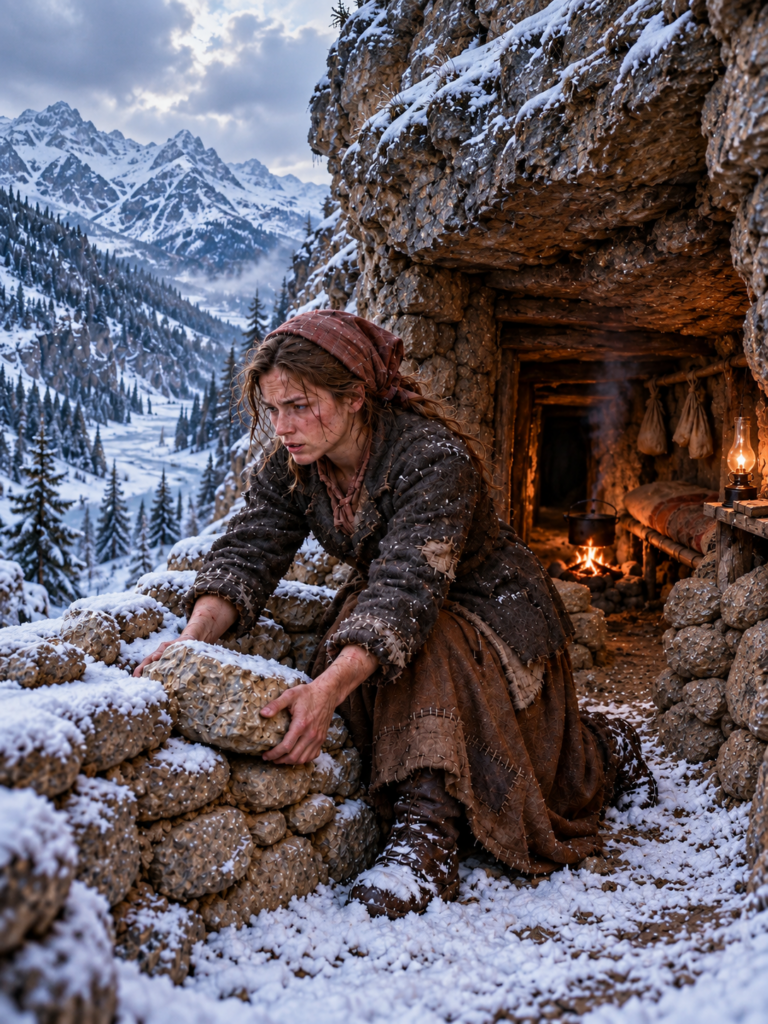
thrown out of her father’s farm with only what she could carry, she vanished into the mountains—then winter buried the only way out
Part 1
On the morning Mary Caldwell lost her home, the first snow of the season began falling over the Bitterroot foothills.
It was October 1894 in Montana Territory country, and the flakes came lightly at first, too thin to cover the wagon ruts leading from the barn.
Mary stood in the kitchen while a creditor named Silas Mercer waited beside the front door.
He did not remove his hat.
Outside, one of the two men he had brought with him led her father’s chestnut gelding from the barn.
The horse resisted at the gate.
Mary heard the scrape of iron shoes against frozen dirt.
That sound hurt worse than the papers.
Her father, Thomas Caldwell, had been dead almost a year.
Everything after his death had become arithmetic.
Feed.
Seed.
Taxes.
Interest.
Repairs.
Mary had sold eggs, taken sewing work from women in town, mended harness for neighbors, repaired fence alone, chopped her own winter wood, and planted every usable section of ground.
It had not been enough.
Thomas had borrowed against the farm during two difficult seasons.
Mary had known there was debt.
She had not understood how much.
Then spring flooding ruined part of the crop.
A milk cow died.
The wheat price dropped.
By September, the numbers had stopped pretending there was a way out.
Still, Mary had believed she had more time.
Silas Mercer had encouraged that belief.
“We’ll work something out,” he had told her in July.
In August he said, “Bring me what you can after harvest.”
In September he accepted another payment.
Then, on the first morning of October, he arrived with legal papers.
Mary held them with both hands.
“You said after winter.”
“I said we would discuss winter.”
“No. You said I could stay until spring.”
Silas’s expression tightened.
“I said I would try.”
“I paid you last month.”
“You paid interest.”
“I sold my mother’s silver for that.”
“I know.”
Mary looked toward the yard.
One of the men had opened the equipment shed.
“Stop him.”
Silas did not move.
“Mr. Mercer.”
“The order covers the property.”
“My father’s tools are in there.”
“The tools are listed with the estate.”
“He made half of them.”
“I’m sorry.”
“You’re not.”
His eyes dropped briefly.
That told Mary more than anger would have.
Silas was not enjoying this.
He was simply willing to do it.
To him, that made the difference acceptable.
Mary stepped closer.
“One more day.”
“I can’t.”
“One night.”
“No.”
“Then let me take Papa’s tool chest.”
“The order says personal belongings only.”
“It is personal.”
“It contains tools.”
“They were his.”
“And listed as farm property.”
Mary stared at him.
Snow touched the kitchen window and melted.
Silas cleared his throat.
“Take clothing. Food you can carry. Personal papers.”
“That’s all?”
“That’s all.”
Outside, the gelding whinnied.
Mary closed her eyes.
For twenty-four years, the Caldwell farm had been the shape of her world.
Her mother had died there.
Her father had taught her to swing an axe there.
She had learned letters at the kitchen table.
She knew which roof board creaked when snow became too heavy.
Which pasture corner stayed wet longest in spring.
Which apple tree ripened first.
Now a man with folded papers stood inside her kitchen and told her what part of her life qualified as personal.
Mary climbed the stairs.
She packed quickly because slowing down would make leaving impossible.
A wool blanket.
Two shirts.
Stockings.
A small knife.
Eleven matches in a tin.
A little flour wrapped in cloth.
Two pieces of salted meat.
Rope.
An oil lamp.
Half a flask of lamp oil.
Then she opened the drawer beside her father’s bed.
Thomas Caldwell’s notebook lay beneath an old Bible.
Mary took both.
She hesitated.
The Bible was heavy.
The notebook was not.
She put the Bible back.
“Sorry, Mama.”
In the shed, behind a loose wall board, she found a tin her father had used during hunting trips.
Beans.
Salt.
Cracked corn.
A small hammer.
Mary almost laughed.
Thomas had hidden supplies everywhere.
“Never put your last anything in the same place as the rest,” he used to say.
She took the tin.
From the kitchen she lifted the cast-iron pot.
Silas saw it.
“That stays.”
Mary’s head snapped toward him.
“It was my mother’s.”
“It’s kitchen equipment.”
“I’m taking the pot.”
“Miss Caldwell—”
“I am taking the pot.”
Something in her face ended the argument.
Silas stepped aside.
Mary tied the pot beneath her pack and slid the small axe through the rope.
The load was ridiculous.
Heavy.
Unbalanced.
Barely enough to keep a person alive.
She returned to her father’s notebook.
Thomas had written everything inside it.
Weather.
Fence measurements.
Traps.
Creek crossings.
Places where elk moved in winter.
On the final page was a line underlined twice.
Old Prospect Tunnel above Cedar Creek. Dry past first chamber. Wind weak from east. Eight miles into mountains.
Mary remembered the place vaguely.
Her father had mentioned prospectors cutting several useless tunnels into the mountain years before.
Most had collapsed.
One, he said, went farther than it looked.
She stared at the words.
Eight miles.
Snow was increasing.
Town lay five miles in the opposite direction.
Going there would be sensible.
There was a boarding house.
Perhaps work.
Perhaps charity.
Mary could already hear the conversations.
Poor Caldwell girl.
Lost the whole place.
Father left her buried in debt.
Somebody ought to take her in.
Mary closed the notebook.
No.
Not today.
She walked downstairs.
Silas stood near the door.
“Where will you go?”
Mary put on her coat.
“Not your concern anymore.”
“You should go into town.”
“Probably.”
“The weather’s turning.”
“I noticed.”
His mouth tightened.
“Mary.”
She looked at him.
For the first time, he seemed ashamed.
That almost made her angrier.
He could take the house, livestock, land, tools, and years of work.
He did not get to feel like a good man because he disliked doing it.
Mary opened the door.
Cold air entered.
Behind her stood the kitchen table her father had built.
The stove.
The chair where he had spent his final winter coughing into a handkerchief and insisting it was only the cold.
Mary did not say goodbye.
If she did, she might not leave.
She stepped into the snow.
The door closed behind her.
By the time she reached the far fence, one of Mercer’s men was leading the second horse away.
Mary turned once.
Then continued toward the mountains.
The pack began cutting into her shoulder within the first mile.
By the third, the cast-iron pot felt like an anchor.
She stopped beside the trail and untied it halfway.
Her father’s voice came back from years earlier.
In the mountains, you regret what you throw away faster than what you carry.
Mary swore under her breath.
Then tied the pot back on.
Cedar Creek appeared near late afternoon.
Snow had begun covering the ground.
Mary followed the water uphill.
The trail narrowed between pine and rock.
Wind erased old wagon marks almost as soon as she noticed them.
Twice she thought she had gone too far.
Then through the trees she saw pale stone.
A dark opening sat behind tangled brush.
The old prospect tunnel.
Mary stood before it breathing hard.
Part of the entrance had collapsed.
Frozen dirt and rock blocked nearly half the passage.
She lit one match.
The flame showed a low chamber.
Darkness continued beyond.
Animal tracks crossed the dust.
Water stains marked one wall.
Mary stared.
“This is it?”
Her father had called it dry.
He had not called it comfortable.
This was not a cabin.
It was a hole in a mountain.
But outside, evening was closing in.
She crawled across the fallen rock.
Dragged her supplies inside.
Gathered dead twigs near the entrance.
One match failed.
The second caught damp bark and died.
Mary’s jaw tightened.
Nine.
She tried again.
The third match produced flame.
Relief rushed through her.
Then smoke rolled backward.
Mary coughed.
Her eyes burned.
Within seconds the chamber filled with bitter gray air.
“No.”
She knocked the little fire apart and smothered it beneath the cast-iron pot.
Darkness returned.
Mary sat coughing beside her pack.
Eight matches remained.
Outside, snow thickened.
Inside the mountain she had found shelter from wind and snow.
But no safe heat.
The difference could kill her.
That first night Mary slept without fire.
She piled pine branches beneath herself.
Wrapped the wool blanket around her shoulders.
Pulled her knees against her chest.
The mountain made noises she could not identify.
Stone shifting.
Water somewhere deeper inside.
Tiny claws in darkness.
Mary slept for minutes at a time.
Each time she woke, she remembered the farm.
Then remembered she no longer had one.
Shortly before dawn she whispered into the darkness.
“You left me one good clue, Papa.”
Her teeth were chattering.
“I’d appreciate another.”
Morning eventually turned the tunnel entrance gray.
Mary sat up.
Fear had accomplished nothing during the night.
So she began studying.
Near the rear of the first chamber, something brushed her cheek.
Air.
Faint.
Cold.
She held still.
There it was again.
A draft.
Mary tore a narrow piece from the edge of an old paper in her father’s notebook.
She lit it.
Smoke drifted toward a crack above her.
Not strongly.
But steadily.
Mary stared upward.
Then toward the entrance.
Her father had written only a few words.
Dry past first chamber.
Wind weak from east.
Perhaps he had seen what she was only beginning to understand.
Mary collected stones.
Mixed dirt with enough water to make mud.
Then began building a crude hearth beneath the crack.
By midday her hands were black.
She placed a handful of dry bark inside.
Struck a match.
Seven.
Flame appeared.
Smoke rose.
Hesitated.
Then disappeared into the crack.
Mary added one branch.
Then another.
The fire held.
She almost cried.
A gust struck the tunnel mouth.
Cold air rushed straight through the chamber.
Heat vanished.
Mary stared at the entrance.
One problem solved.
Another revealed.
She spent the next two days building a stone wall that narrowed the opening.
She packed the gaps with mud and shaped the remaining passage at an angle so the wind could not strike directly inside.
The work was slow.
Her fingers split.
Her back ached.
She ate sparingly.
The mountain remained cold.
But the wind weakened.
Then Mary built a raised sleeping platform from branches.
A shelf.
Hooks.
A dry space for wood.
A drainage trench.
Each improvement was small.
Together they began turning a hole into shelter.
The matches worried her most.
Seven remained.
Each evening Mary banked the fire beneath ash.
Each morning she uncovered the coals and added tinder.
The first morning worked.
The second worked.
The third did not.
Mary stared at cold gray ash.
She opened the tin.
Seven matches.
She removed one.
Struck it.
Six remained.
As flame caught, she understood something with frightening clarity.
Nothing could be wasted anymore.
Not food.
Not fire.
Not daylight.
Not mistakes.
She opened her father’s notebook and wrote beneath his old entry.
Found the tunnel.
Then, after a moment:
Still alive.
For now.
Part 2
Survival became a collection of chores.
That was how Mary learned to endure it.
Not by thinking about winter.
Winter was too large.
Instead she thought about breakfast.
Then water.
Then firewood.
Then snares.
Then darkness.
Food became the first serious problem.
The salted meat would not last.
Neither would the flour.
Beans and cracked corn stretched farther, but even measured carefully, Mary understood the truth.
Weeks.
Not months.
She set rabbit snares near Cedar Creek.
The first morning, nothing.
Second morning, nothing.
Third.
Nothing.
On the fourth day Mary approached one snare and saw movement.
A rabbit.
She stood still.
Relief and pity struck at the same time.
Her father had taught her trapping.
He had also taught her never to pretend taking an animal’s life meant nothing.
Mary ended it quickly.
Back inside the tunnel, she cleaned the rabbit carefully.
Half went into the pot.
The rest she smoked above a low fire.
For the first time since leaving the farm, she ate until the sharpest edge of hunger disappeared.
She wanted to finish everything.
Instead she wrapped the remaining meat.
“Tomorrow.”
That word changed.
At the farm, tomorrow had always meant more work.
In the mountain, tomorrow became something she had to manufacture.
Then Cedar Creek froze.
Mary discovered it one morning beneath a white sky.
Ice stretched from bank to bank.
She struck it with the axe.
The blade bounced.
She tried again.
Nothing.
Snow seemed like an obvious solution.
She filled the cast-iron pot.
Carried it inside.
Placed it over the fire.
A full pot of snow collapsed into a pathetic amount of water.
Mary stared.
“That’s all?”
She repeated it.
More wood.
More snow.
Little water.
Every drink now required fuel.
The equation was terrible.
If she used firewood to melt snow, she shortened her warmth.
The next morning she searched the creek carefully.
Near a bend, current had thinned the ice.
Mary chopped there.
After several blows, dark water appeared.
She filled the pot.
Then covered the opening with branches to slow freezing.
Each morning afterward, she reopened the same hole.
The cast-iron pot she had nearly abandoned now carried water that kept her alive.
Mary thought about that often.
The mountain punished assumptions.
Heavy did not mean useless.
A bright day did not mean safe.
A familiar trail did not mean she could not become lost.
She learned that last lesson in November.
The sky was clear.
Snow sparkled.
For days Mary had seen deer tracks above Cedar Creek.
Fresh tracks meant animals.
Animals meant meat.
She followed them uphill.
Farther than usual.
Then farther.
The forest opened along a slope.
Mary found more tracks.
She continued.
The first snowflake touched her sleeve almost unnoticed.
Within fifteen minutes the sky changed.
Wind rose.
Snow began falling sideways.
Mary turned.
Her footprints were already disappearing.
She walked downhill.
Then stopped.
The slope looked wrong.
She changed direction.
That looked wrong too.
Fear rose fast.
Her breath shortened.
“No.”
Mary forced herself to stand still.
Running blindly would kill her.
She closed her eyes.
Think.
Cedar Creek lay below the tunnel.
Water always found the low ground.
If she moved downhill until she reached the drainage, she could follow it upstream.
Mary descended slowly.
Twice she slipped.
Then beneath the snow-muted forest, she heard something.
Water.
Faint beneath ice.
She found the creek.
Turned upstream.
Followed it.
Darkness was approaching when she recognized a split boulder near the tunnel.
Mary almost collapsed.
Inside, she sat beside the fire until her hands stopped trembling.
Then she opened the notebook.
Memory is not a map.
She underlined it.
The next morning Mary cut a tall pine pole.
She drove it high into the slope above the entrance.
Near its top she tied a strip of dark cloth.
Then she placed smaller markers along the route to Cedar Creek.
Rope connected important points.
From that day forward, Mary never trusted familiarity by itself.
December arrived.
Routine made life manageable.
Fire vent.
Food.
Water.
Wood.
Snares.
Return before dark.
Inspect everything.
Again.
Again.
Again.
Then one evening Mary entered the tunnel and saw white powder scattered across the floor.
Flour.
Her stomach dropped.
A mouse disappeared behind a stone.
Then another.
Mary grabbed the sack.
A hole had been chewed through one corner.
Droppings contaminated much of what had spilled.
Nearly a third of her flour was gone.
She sat staring at it.
A storm could be hated.
A creditor could be blamed.
A mouse did not care enough to be an enemy.
Yet those tiny teeth had destroyed meals she could never replace.
Mary felt tears building.
She fought them.
Then stopped fighting.
For five minutes she sat on the cold stone floor and cried.
About the flour.
The farm.
Her father.
The horses.
The kitchen.
Everything.
When she finished, nothing had improved.
But she could see again.
Mary moved all food.
Sacks hung from rope.
She built a crude wooden storage box.
Beans went in one container.
Corn in another.
Flour separately.
No single failure would take everything.
Her father had done the same with hunting supplies.
Never put your last anything in the same place as the rest.
Mary finally understood why.
She began keeping ration lines.
Flour.
Beans.
Corn.
Rabbit.
Roots.
Seeds.
Cooking fat.
Some days she ate twice.
Some days once.
On difficult nights she drank hot water and told herself breakfast would come faster if she slept.
Her body changed.
Her cheeks thinned.
Her belt tightened another hole.
Her hands hardened.
She learned how hunger arrived in stages.
First discomfort.
Then anger.
Then weakness.
Then a strange calm that frightened her most.
Whenever she reached that point, she forced herself to eat something.
A person who became too weak to collect food was already in a trap.
Weeks passed.
One afternoon Mary began clearing space for additional firewood.
Behind a pile of collapsed stones, cold air touched her face.
She stopped.
Another draft.
This one came from deeper inside.
Mary moved rocks carefully.
A narrow opening appeared.
Beyond it lay another chamber.
Low.
Dark.
Dry.
She widened the passage until she could crawl through.
The hidden space became storage.
Food divided between chambers.
Firewood too.
The tunnel was changing from one shelter into a system.
But cold air continued leaking through a seam at the back.
Mary examined it several times.
She could not understand its source.
January brought warmth.
Not true warmth.
But after months of cold, three days above freezing felt like spring.
Icicles dripped.
Snow softened.
Cedar Creek became audible beneath the ice.
Mary stood outside with sunlight on her face.
For the first time she imagined leaving.
Town.
Work.
A room.
Bread she had not trapped or rationed.
She reduced firewood gathering.
Spent an afternoon mending clothes.
Planned what she would carry when trails opened.
On the fourth morning the sky turned gray.
The wind changed.
East.
Mary froze.
She ran inside and opened Thomas Caldwell’s notebook.
Old Prospect Tunnel above Cedar Creek. Dry past first chamber. Wind weak from east.
Weak from east.
In autumn.
Not now.
Branches began moving violently.
By noon snow returned.
By sunset Mary could barely see beyond the entrance.
She carried every loose bundle of wood inside.
Filled water.
Checked food.
Reinforced the covering.
The storm continued through the night.
Then another day.
Then another.
Snow pressed higher against the doorway.
Each morning Mary pushed it back with a board, creating a narrow trench toward daylight.
Each evening the trench filled again.
On the third night she moved her bedding into the hidden chamber.
It was farther from the entrance.
Quieter.
Safer from wind.
Mary slept.
When she woke, the mountain was silent.
She sat up.
No wind.
No dripping.
Nothing.
The silence felt wrong.
Mary crawled toward the main chamber.
Usually dawn made the entrance gray.
There was no light.
She pushed the barrier.
Nothing.
Harder.
Nothing.
She slid her knife through a narrow gap.
The blade entered packed snow.
Stopped.
Mary’s heartbeat accelerated.
The entire entrance had been buried.
She was sealed inside the mountain.
Then she noticed the fire.
The flame looked wrong.
Small.
Yellow.
Smoke hung lower than usual.
Mary stared toward the ventilation crack.
The outlet emerged somewhere on the slope near the buried entrance.
The same drifting snow that covered the door was choking the vent.
Suddenly being trapped was not the worst problem.
Breathing was.
Part 3
Mary reduced the fire immediately.
That decision probably saved her.
Every instinct wanted more heat.
The chamber was growing colder.
But a larger fire with failing ventilation could fill the tunnel with smoke.
She pulled burning wood apart until only a small flame remained.
Then she opened every interior passage she could.
The smoke lifted slightly.
Not enough.
Mary went to the buried entrance.
She pushed.
Packed snow gave perhaps two inches.
She used the cast-iron pot like a shovel.
One scoop.
Then another.
But she had nowhere to throw the snow.
Everything she removed came into the tunnel.
It melted into dirty water.
Made the floor slick.
After two hours her knuckles bled.
She had gained almost nothing.
Mary stopped.
Not because she wanted to.
Because continuing the wrong solution was another kind of panic.
She sat beside the wall breathing hard.
“How deep?”
No answer.
The drift could be three feet.
Six.
Ten.
She did not know.
Digging straight out might exhaust her before she reached daylight.
The fire weakened.
Smoke lowered again.
Then Mary remembered the cold draft in the storage chamber.
She grabbed the oil lamp.
The flask was almost empty.
She carried the lamp deeper.
Moved food containers aside.
Cold air touched her face.
Still there.
Mary pressed her fingers along the stone seam.
One rock shifted.
She pulled.
The stone came loose.
Darkness waited behind it.
Mary removed another.
Then another.
The opening widened.
She reached through.
Empty space.
An old shaft angled upward.
Probably ventilation dug by prospectors decades earlier.
Mary stared into it.
If it reached the surface, it could save her.
If it ended beneath solid rock, she could waste the last of her strength digging nowhere.
The match tin felt light in her pocket.
Six remained.
Mary listened to her own breathing.
The air felt warmer.
Heavier.
She remembered something else her father had taught her while repairing a flooded ditch.
If one route fails, stop wishing it hadn’t.
Find another.
Mary placed the cast-iron pot inside the shaft.
Then crawled after it.
The passage barely accommodated her shoulders.
Frozen dirt filled sections.
Roots crossed others.
She used the hammer.
Knife.
Hands.
The pot became a scoop for pulling debris backward.
Progress came in inches.
Every few minutes Mary stopped and listened.
The higher she went, the colder the air became.
Cold was good.
Cold meant connection to outside.
She dug harder.
Then the ceiling above her collapsed.
Snow and dirt poured down.
Mary twisted.
The lamp vanished.
Darkness became absolute.
Weight pressed across her legs.
Her shoulder struck stone.
For several seconds she could not move.
Panic exploded.
Mary clawed backward.
Found space.
Dragged herself into the storage chamber.
Her shoulder burned.
Three fingers on her left hand felt numb.
She sat in complete darkness.
The fire in the main chamber gave almost no visible light from here.
Mary thought about stopping.
She could wait.
Maybe the storm would shift.
Maybe snow over the vent would settle.
Maybe digging at the main door later would work.
Maybe.
Her father hated that word.
Maybe was not a plan.
Mary felt for the lamp.
Found it.
Checked the oil.
Very little.
She opened the match tin.
Six.
Struck one.
Five.
The wick caught.
Mary looked at the shaft again.
This time she cut short pieces of wood to brace weak sections.
Slow.
Measure.
Support.
Dig.
Support.
Again.
Hours passed.
Mary lost track of time.
Then her hammer struck something hard.
A dull wooden sound.
Mary nearly cried anyway.
She scraped around it.
A pole emerged.
Rough cut.
Pine.
She touched it.
Then froze.
The marker.
The same tall marker she had driven above the entrance after becoming lost.
Mary laughed once.
It sounded almost hysterical.
The marker did not save her.
But it proved something.
She was digging toward the surface.
She leaned her forehead against the wood.
“Thank you.”
Whether she meant her father, herself, or the pole, she did not know.
Then she continued.
Higher.
The dirt grew colder.
Snow appeared.
At last a crack opened.
Air rushed downward.
Mary closed her eyes.
Fresh air.
She widened the gap.
A blade of gray daylight entered.
Mary pushed with both hands.
Snow broke apart above her.
Her arm emerged into the world.
Then her head.
Then shoulders.
She crawled onto the slope.
Wind struck her face.
Mary lay there laughing and crying at once.
Below her, the original entrance had disappeared completely beneath a massive white drift.
No sign remained.
If she had continued digging outward from inside, she might never have found the surface.
Mary stood.
Snow reached her thighs.
The landscape had become almost unrecognizable.
Roads were gone.
Trees bent under ice.
Travel to town would be dangerous.
Possibly impossible.
She looked toward the valley.
Freedom existed.
But not safe passage.
Mary could leave the tunnel and die trying to reach civilization.
Or return inside the mountain she had just escaped.
She chose the mountain.
Over the next several days, she transformed the ventilation shaft into a second entrance.
She widened it.
Added wooden supports.
Cut rough steps into steep sections.
Improved the opening so snow would be less likely to seal it entirely.
Immediately the tunnel changed.
The fire drafted better.
Smoke pulled upward.
Fresh air reached the storage chamber.
Mary could use the upper passage to bring in small bundles of wood and snow for water.
More important, she now had two ways out.
The disaster had changed something inside Mary too.
Early in winter every problem felt like an ambush.
Now she began looking for failures before they arrived.
She stored firewood in two locations.
Matches stayed sealed.
Food remained divided.
Two water containers.
Two exits.
Multiple markers.
Whenever possible, redundancy.
“One good day means nothing,” she wrote in the notebook.
Then below it:
One door means one way to die.
She stared at that sentence.
Harsh.
True.
The creditor had taken her farm through one legal order.
The mountain had nearly taken her life through one buried entrance.
Mary was finished building her survival around single points of failure.
Weeks passed.
The weather slowly softened again.
This time Mary did not trust it.
Water dripped from rock at midday.
Birds returned.
Cedar Creek broke through sections of ice.
Brown earth appeared on the south-facing slope.
Mary waited.
One day.
Two.
Five.
A week.
Only when the trail remained visible and nighttime freezing weakened did she begin packing.
She left the tunnel carefully.
Not abandoned.
Prepared.
The original entrance was cleared.
Ventilation checked.
Supports inspected.
Dry wood stacked.
Some beans.
Matches.
A blanket.
Then Mary lifted the cast-iron pot.
She held it.
Remembered standing beside the trail months earlier, nearly leaving it.
The pot had melted snow.
Carried creek water.
Cooked rabbit.
Moved snow.
Hauled dirt from the escape shaft.
Mary set it beside the hearth.
“You stay.”
If another person ever needed the tunnel, they would need it more than she did.
Mary stepped outside.
Spring wind moved through the pines.
She began walking toward town.
Her body was lighter than when she entered the mountain.
Her pack was nearly empty.
She herself felt heavier somehow.
Not physically.
Rooted.
People in town stared when Mary Caldwell appeared.
A shopkeeper dropped a broom.
“Mary?”
She stopped.
The man approached as if she might disappear.
“Good Lord.”
“What?”
“We thought you were dead.”
“Some days I agreed.”
News traveled immediately.
People came from stores.
Windows opened.
A boy ran toward the boarding house shouting Mary Caldwell’s name.
Some believed she had gone south.
Others had assumed her body lay somewhere beyond Cedar Creek.
Mary stood in the road wearing a patched coat.
Her hands were cracked.
Face thin.
Hair uneven from cutting it herself.
She was alive.
That seemed to offend everyone’s expectations.
Someone asked where she had been.
“In the mountains.”
“Doing what?”
“Mostly trying not to die.”
The answer became town gossip before supper.
Mary walked past the road leading toward the Caldwell farm.
She slowed.
The house remained visible in the distance.
Smoke came from the chimney.
Someone else lived there now.
For one terrible moment she wanted to walk back.
To stand in the kitchen.
Demand something.
Recognition.
Apology.
Justice.
Then Mary kept walking.
The house could not return what she had lost.
And she had nothing left to prove there.
Part 4
Mary found work at a repair shop owned by Gideon Shaw.
He was sixty-three, widowed, impatient, and suspicious of anyone who claimed competence too quickly.
Mary liked him almost immediately.
The first morning he handed her a broken axe handle.
“You ever fitted one?”
“Yes.”
“Show me.”
She did.
Gideon inspected the result.
“Hm.”
“That good or bad?”
“Means come back tomorrow.”
The wages were small.
But they belonged to her.
Mary sharpened tools.
Repaired handles.
Fixed hinges.
Helped replace wagon boards.
Her father had taught her more than she realized.
By summer, Gideon trusted her with paying work without inspection.
By autumn, people began asking specifically for Mary.
Then Silas Mercer entered the shop.
Mary was filing a drawknife.
She heard his voice behind her.
“Miss Caldwell.”
Her hand stopped.
Gideon looked between them.
“You know him?”
“Yes.”
Silas removed his hat this time.
“I wanted to speak with you.”
Mary resumed filing.
“You are.”
“I heard where you spent winter.”
“Most people did.”
“I’m glad you survived.”
The file moved against steel.
Silas shifted.
“The farm changed hands again.”
Mary stopped.
“What?”
“The buyer couldn’t make payments.”
A bitter laugh escaped her.
“That was quick.”
Silas looked uncomfortable.
“I thought you might want to know.”
“Why?”
“It was your family place.”
“No. It was your collateral.”
He accepted that.
Then said, “There may be an opportunity to purchase part of it back.”
Mary stared at him.
For months, some hidden part of her had imagined exactly this moment.
Return.
Recovery.
The old house.
The barn.
Her father’s land.
Silas named a price.
Mary almost laughed.
She had nowhere near that money.
Even if she did, something felt wrong.
He continued.
“I could arrange terms.”
There it was again.
Debt.
Terms.
One signature.
One lender.
One door.
Mary saw the mountain entrance disappearing beneath snow.
“No.”
Silas blinked.
“You haven’t considered it.”
“I have.”
“Your father—”
“My father is dead.”
He stopped.
Mary set down the tool.
“I loved that farm.”
“I know.”
“No. You know it was valuable.”
His face tightened.
“Mary, I followed the law.”
“I know.”
That surprised him.
“You did.”
Mary looked directly at him.
“That doesn’t mean I have to build my next life around owing you.”
Silas put his hat back on.
“I am sorry about how things happened.”
This time Mary believed he meant it.
That did not erase anything.
But she no longer needed him to suffer in order for her to move forward.
“I know.”
He left.
Gideon waited until the door closed.
“You turning down your father’s land?”
“Yes.”
“Hard thing.”
“Yes.”
“You regret it?”
Mary looked at her hands.
“No.”
That was not entirely true.
But it would become true.
Over the next several years she saved money.
Slowly.
Rented a room.
Then a small cottage.
Took additional repair work.
By twenty-nine, Mary purchased a narrow piece of land outside town.
Nothing grand.
Enough for a house.
Garden.
Small shed.
Some chickens.
The deed carried one name.
Mary Caldwell.
She read it repeatedly.
No creditor.
No father’s estate.
No inherited obligation.
Hers.
Construction happened piece by piece.
Mary did much of it herself.
Gideon helped frame the roof.
Neighbors raised one wall.
She paid everyone she could.
Accepted favors carefully.
Returned them later.
The house was small.
Mary loved every board.
But she never forgot Cedar Creek.
Each autumn before heavy snow, she climbed back into the mountains.
At first people thought this strange.
“Why return?”
Because someone else might need it.
Because shelters failed when nobody maintained them.
Because survival knowledge became useless if it disappeared with the survivor.
Mary checked supports.
Cleared the original entrance.
Cleared the upper shaft.
Repaired drainage.
Replaced rotted wood.
Left matches sealed in tin.
Dry food.
Blanket.
Firewood.
The cast-iron pot remained beside the hearth.
On her third autumn visit, Mary found footprints.
Human.
Inside, someone had used wood.
A portion of beans was gone.
The blanket had been moved.
Mary stood very still.
No note.
No name.
At first she felt anger.
Then she looked at the hearth.
Someone had needed the place.
That was why supplies were there.
Mary restocked everything.
Near the hidden chamber, she fixed a wooden sign to the wall.
IF YOU FOUND THIS PLACE, USE WHAT YOU NEED.
She paused.
Then added:
LEAVE SOMETHING FOR THE NEXT PERSON.
The following spring she returned.
A small sack of corn sat on the shelf.
Beside it were two candles.
Mary smiled.
The tunnel was no longer only hers.
Years passed.
Stories grew.
People said Mary had lived inside a mine all winter.
Some claimed wolves trapped her there.
Others insisted she discovered silver.
Children preferred the silver version.
Mary corrected them.
“I found dirt.”
“Nothing else?”
“Mice.”
They were disappointed.
One boy asked, “Weren’t you scared?”
“Yes.”
“All winter?”
“Not all winter.”
“When did you stop?”
Mary thought.
“I didn’t.”
The boy frowned.
“But you survived.”
“That doesn’t require not being scared.”
The answer followed him into adulthood.
So did others.
Mary became known in town as someone who prepared carefully.
Not because she expected disaster every morning.
Because she knew one could arrive without asking permission.
She stored supplies in separate places.
Kept water.
Maintained tools.
Never allowed the household to depend on a single source of heat.
People teased her gently.
Then came the winter of 1906.
A major storm closed roads for nearly a week.
Several families lost access to firewood.
Mary’s shed contained enough to share.
Her extra stove helped one elderly couple.
Stored beans fed another household.
Nobody teased her that spring.
Still, Mary resisted becoming fearful.
Preparation, she had learned, was meant to create freedom, not imprison a person inside imagined disasters.
She planted flowers.
Attended dances.
Eventually took over Gideon’s repair business when arthritis forced him to retire.
She laughed often.
She allowed herself ordinary happiness.
That was perhaps the hardest survival lesson.
Not every peaceful day needed to be treated as the hour before catastrophe.
One afternoon a young widower named Samuel Pike brought a broken wagon wheel into the shop.
He returned three days later.
Then again with a gate hinge that could easily have been repaired at home.
Mary noticed.
“So what did you break this time?”
Samuel looked embarrassed.
“Nothing.”
“Then I’m expensive company.”
“I brought coffee.”
“That improves your chances.”
Samuel had a daughter named Ruth.
Mary liked the girl before she admitted liking the father.
Marriage came slowly.
Carefully.
Samuel never asked Mary to sell her land.
Mary never asked him to surrender his.
They built a new house between the two properties.
Two wells.
Two stoves.
Two sets of winter supplies.
Samuel once laughed.
“You realize most married people consider one house enough security.”
Mary smiled.
“Most married people didn’t spend January inside a mountain.”
He stopped laughing.
“Fair point.”
Years later, when Ruth married, Mary gave her a small wooden box.
Inside were matches.
A knife.
Needle.
Thread.
Cord.
A few coins.
Ruth laughed.
“Is this your idea of romance?”
“No.”
Mary closed the lid.
“It’s my idea of never being completely helpless.”
Ruth kept it for the rest of her life.
Part 5
Mary was in her forties when she returned to the mountain one autumn and discovered someone waiting outside.
A young woman sat on a rock near Cedar Creek.
Beside her stood a boy of perhaps seven.
Their clothes were worn.
A small bundle rested between them.
Mary stopped.
The woman rose immediately.
“I’m sorry.”
“For what?”
“The shelter.”
Mary looked toward the tunnel.
“You used it?”
“Two nights.”
“That’s why it’s there.”
The woman’s face tightened.
“My husband left.”
Mary said nothing.
“He took the wagon.”
The boy stared at the ground.
“We were trying to reach my sister near Hamilton. Weather turned.”
Mary looked toward the clouds.
Early snow threatened.
“Your sister expecting you?”
“No.”
“Does she have room?”
“I think.”
Mary studied her.
Years earlier, Mary had walked toward a mountain because accepting charity in town felt worse than cold.
Now she understood how close pride had come to killing her.
“What’s your name?”
“Anna.”
“Anna, the trail gets worse tomorrow.”
“I know.”
“You and the boy are coming back with me.”
The woman stiffened.
“I don’t need—”
Mary almost laughed.
There it was.
The same sentence in a different voice.
“I didn’t say you were helpless.”
Anna looked at her.
“I said weather’s coming.”
The boy glanced up.
Mary pointed toward her mule.
“He can ride partway.”
Anna hesitated.
Mary softened.
“Someone helped me after I came out of this mountain.”
Not completely true.
Many people had.
Just not immediately.
“Consider this returning the favor late.”
Anna accepted.
They walked back together.
Years afterward, Anna worked in Mary’s shop.
The boy grew into a competent carpenter.
Neither forgot the tunnel.
Mary began bringing younger people with her during annual maintenance.
She taught them why the first fire had smoked.
Why food was divided.
Why markers mattered.
Why the second exit existed.
She showed them the original buried doorway.
Then the upward shaft.
“Every part of this place exists because something failed,” she said.
One young man asked, “So the shelter was badly built?”
“No.”
Mary touched the stone wall.
“It was unfinished.”
That distinction mattered.
She had once believed safety was something a person found.
Now she understood it was maintained.
Improved.
Questioned.
One generation inherited a solution.
The next inherited responsibility.
The creditor Silas Mercer died years later.
His son came to Mary’s shop after the funeral.
He carried a small box.
“My father wanted you to have this.”
Mary opened it.
Inside lay a folded document.
The old foreclosure order.
She stared at her own name.
Mary Caldwell.
Twenty-four years old.
Debt.
Property seizure.
Inventory.
House.
Barn.
Tools.
Livestock.
Land.
At the bottom was Silas Mercer’s signature.
Mary looked up.
“Why?”
His son hesitated.
“He kept it.”
“That doesn’t answer me.”
“He regretted it.”
Mary almost became angry.
Then she realized she was tired of carrying that particular anger.
“Your father followed the law.”
“He said that too.”
“And?”
“He said being allowed to do something wasn’t the same as being proud of it.”
Mary looked back at the paper.
For decades, part of her had wanted Silas to understand.
Apparently he had.
Too late to change anything.
But not meaningless.
She folded the order.
“Thank you.”
“What will you do with it?”
Mary considered burning it.
Instead she placed it in her father’s notebook.
Not as a wound.
As evidence.
One life had ended there.
Another had begun.
When Samuel died after twenty-two years of marriage, Mary returned alone to the tunnel.
She was older then.
Gray beginning at her temples.
The climb took longer.
At the entrance, she sat.
For a while she could not make herself go inside.
Losing Samuel awakened old feelings.
The farm being taken.
Her father’s death.
That first night underground.
The terrible sensation that safety could disappear without warning.
Mary finally entered.
The cast-iron pot still rested near the hearth.
Different blankets.
Newer supports.
Food replaced many times by many hands.
The sign remained.
USE WHAT YOU NEED.
LEAVE SOMETHING FOR THE NEXT PERSON.
Mary sat beside the cold hearth.
She thought about Samuel.
He had known all of her caution.
All her strange habits.
The water jars.
Extra matches.
Two ways to heat a house.
He had never mocked the fear underneath them.
Instead he had helped turn precautions into ordinary household habits.
Mary cried.
Not quietly.
There was no reason to.
Nobody was there.
When grief finally exhausted itself, she lit a small fire.
Smoke rose cleanly.
The ventilation held.
That pleased her.
Even grief could coexist with inspection.
Before leaving, Mary replaced an old support beam.
Because sorrow did not excuse neglect.
By the time she reached seventy, climbing to Cedar Creek had become difficult.
Ruth tried to stop her.
“You cannot keep going up there alone.”
“I know.”
“That sounded suspiciously easy.”
“I’m not going alone.”
Mary had arranged for four younger volunteers to accompany her.
Ruth stared.
“You planned this.”
“Of course.”
“You’re impossible.”
“Prepared.”
At the tunnel, Mary watched others perform work she had once done herself.
Clear entrance.
Inspect supports.
Replace food.
Test draft.
Check upper shaft.
A teenage boy asked why there were two exits.
Mary told him.
Not dramatically.
No embellishment.
The storm.
Buried door.
Failing vent.
Hidden draft.
Digging upward.
Collapse.
Marker pole.
Daylight.
The boy listened.
“So you escaped.”
“Yes.”
“And then you went back inside?”
“Yes.”
“Why?”
“The road wasn’t safe.”
He looked confused.
Mary smiled.
“Survival isn’t always moving forward.”
Sometimes it meant returning to the safest place available.
Even if pride wanted something else.
Before descending that year, Mary rested a hand against the marker pole.
Not the original.
That one had rotted long ago.
This was perhaps the fourth replacement.
Still, she remembered touching that first pole in darkness.
The moment she understood she had not been digging toward solid mountain.
The moment hope became direction.
Mary looked across the valley.
Somewhere beyond the ridge lay the farm she had lost as a young woman.
She had passed it many times over the decades.
Different owners.
Different fences.
The original barn eventually burned.
The house was expanded.
Most of Thomas Caldwell’s apple trees disappeared.
Mary had never bought it back.
She had stopped regretting that.
Her father’s true inheritance had not been the acreage.
It had been what he taught her to do when land, weather, tools, or plans failed.
Observe.
Repair.
Adapt.
Carry useful things.
Do not trust one supply.
Do not mistake memory for a map.
And when one door disappears, look for another.
On Mary’s final visit to the tunnel, she brought Thomas’s notebook.
The cover had nearly separated.
Pages were worn.
Her own writing filled the back half.
Ration counts.
Tunnel measurements.
Later maintenance notes.
Names of people who had helped.
Dates supplies were replaced.
She placed it inside a sealed metal box in the hidden chamber.
With it went a letter.
The letter did not tell whoever found it to admire her.
Mary had never understood monuments.
It explained the shelter.
The ventilation.
Drainage.
Weak support points.
Both exits.
What to inspect after heavy snow.
What not to assume.
At the bottom she wrote:
This place kept me alive because I changed it when it failed.
If something here is wrong, do not respect it because it is old.
Fix it.
Then she signed:
Mary Caldwell.
Years later, after Mary herself was gone, a severe winter trapped two ranch hands above Cedar Creek.
They found the marker.
Then the entrance.
Inside were dry wood, matches, food, blankets, a functioning vent, and the old cast-iron pot.
One of the men noticed the wooden sign.
USE WHAT YOU NEED.
LEAVE SOMETHING FOR THE NEXT PERSON.
They stayed three nights.
Before leaving, they replaced the wood they had burned.
Added coffee.
And hung two pairs of dry wool socks beside the shelf.
Spring came.
The mountain softened.
Cedar Creek opened.
Generations changed.
People forgot details.
Some remembered Mary as the woman who lived inside a mountain.
Others knew only that there was an emergency shelter above Cedar Creek and that everyone was expected to leave it better than they found it.
That would have satisfied her.
Because Mary Caldwell’s real victory had never been taking back the farm.
It had never been proving Silas Mercer wrong.
It was not surviving simply so people could admire how much suffering she endured.
Her victory was what came afterward.
She lost one home.
Then learned how a home was actually made.
Not from ownership alone.
Not from one roof, one road, one fire, one person, or one promise.
A home was knowledge.
Preparation.
Work.
Memory.
People willing to leave something useful behind.
And whenever winter returned to Montana and snow buried the mountains white, the old tunnel above Cedar Creek remained.
Inside waited dry wood.
A pot.
Matches.
A blanket.
Two exits.
And a sign left by a woman who had once been thrown out with almost nothing:
Use what you need.
Leave something for the next person.
Because Mary Caldwell had learned the hardest lesson of her life beneath tons of frozen earth.
When the only way out disappears, survival does not always mean waiting for someone to open the door.
Sometimes you build another one.

