
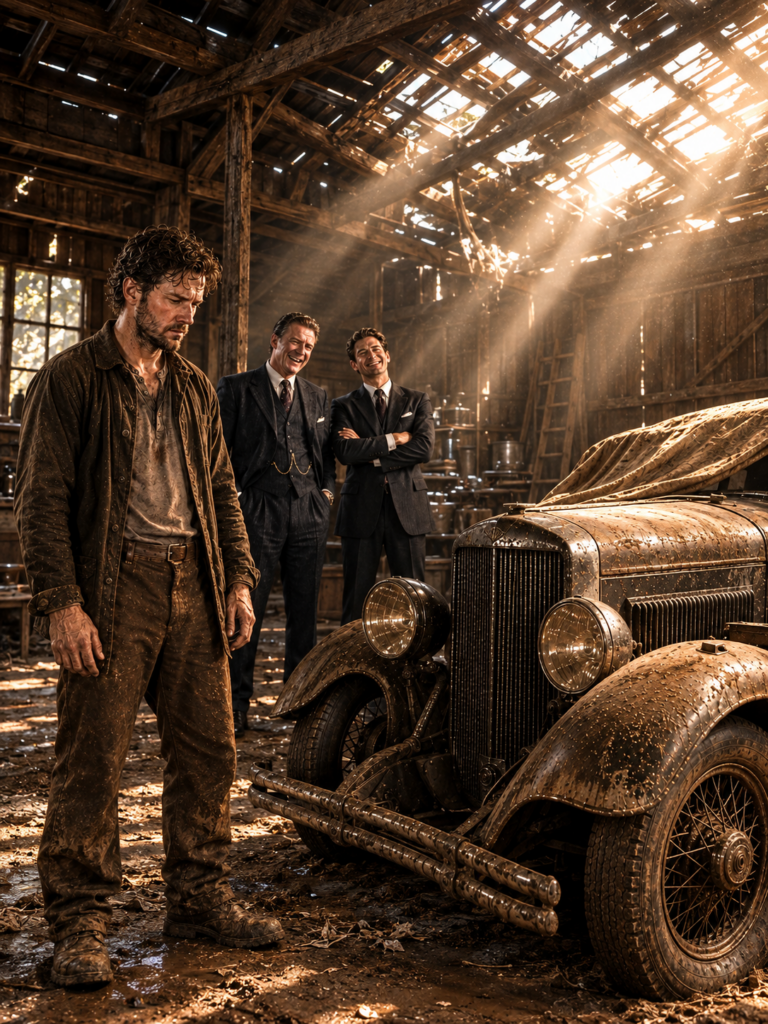
they laughed when he inherited a rusted 1937 duesenberg — then his father’s hidden letter revealed why he never sold it
Part 1
The laughter started before Abel Winslow had even closed his hand around the key.
It happened in a lawyer’s office in Richmond, Virginia, on a gray March afternoon when bare oak branches scratched against the third-floor windows and the room smelled of old paper, furniture polish, and money that had already begun changing hands.
Abel sat at one end of the long walnut table.
At thirty-one, he looked less like the son of a wealthy businessman than the mechanic he actually was. His dark suit was seven years old. Grease stains remained beneath two fingernails no matter how much he scrubbed them. His hands were broad and rough from engines, brakes, transmissions, and the thousand small repairs that had paid his rent since he walked away from the family company.
Across from him sat his brothers.
Chadwick, forty-two, wore a charcoal suit and a watch Abel knew cost more than his pickup truck.
Monroe, thirty-eight, had already poured himself a glass of champagne from the bottle he had brought because, as he told the lawyer, “Father hated wasting time on ceremonies.”
Their father, Gilbert Winslow, had been dead nineteen days.
Abel still woke some mornings thinking he needed to stop by the house and make soup.
Then he remembered.
The lawyer adjusted his glasses.
“To Chadwick Winslow, I leave my controlling interest in Winslow and Sons Parts Distribution, including all warehouse operations and company assets.”
Chadwick nodded once.
No surprise.
He had expected the company.
“To Monroe Winslow, I leave the residence on Church Hill, together with the investment accounts and the two rental properties listed in Schedule B.”
Monroe leaned back.
A small smile touched his face.
Abel stared at the table.
He had not come expecting a fortune.
He told himself that repeatedly.
Yet something inside him waited anyway.
Not for money.
For acknowledgment.
For some final proof that the last two years had meant something.
While Chadwick attended board meetings and expansion dinners, Abel had been the one who stopped at Gilbert’s house each evening.
Abel bought groceries.
Abel cooked.
Abel changed bedsheets when his father became too weak.
Abel sat beside him through coughing fits that left spots of blood on handkerchiefs.
He read newspaper stories aloud when Gilbert’s eyesight blurred.
He helped the old man walk through the garden one painful step at a time.
They had never spoken about the old argument between them.
Abel kept believing there would be time.
The lawyer turned a page.
“To my youngest son, Abel Winslow…”
Abel lifted his head.
“…I leave the automobile stored in the locked garage behind the Church Hill residence, together with its key.”
The lawyer paused.
“And nothing further.”
Silence held for perhaps two seconds.
Then Chadwick snorted.
Monroe laughed.
“The wreck?” Monroe said.
Chadwick covered his mouth, but not successfully.
“That rust bucket?”
Monroe looked at Abel.
“Good Lord. He left you the pile of scrap.”
Their father’s estate had given one brother a company.
Another received real estate and investments.
Abel received the locked garage’s forgotten car—the same machine the family had joked about for decades.
The lawyer slid an envelope across the table.
Inside lay one tarnished brass key attached to an old leather fob.
Abel lifted it.
The leather was worn smooth by his father’s thumb.
That tiny detail hurt more than the laughter.
He heard Chadwick say something about calling a junkyard.
Monroe raised his champagne.
“To inheritance.”
Abel closed his fist around the key.
A question had begun turning inside his chest.
Dad, what did I do wrong?
Seven years earlier, Abel and Gilbert had nearly stopped speaking.
Gilbert had built Winslow and Sons from almost nothing.
At sixteen he dropped out of school.
By twenty he was driving a used truck across Virginia buying discarded automotive parts and reselling them wherever he could.
He slept in parking lots.
Skipped meals.
Worked through illnesses.
By the time his sons were old enough to understand money, Gilbert had warehouses, employees, contracts, and the permanent fear that it could all disappear.
Chadwick and Monroe learned business from him.
Abel learned something else.
He learned machines.
He loved engines because engines were honest.
A bearing complained when it wore out.
A belt squealed before it failed.
A badly tuned motor shook.
Machines did not smile while resenting you.
They did not say one thing and mean another.
At twenty-four Abel told his father he was not joining Winslow and Sons.
He had taken a job at a small repair shop south of the James River instead.
Gilbert stared at him across the kitchen.
“You’re choosing twelve dollars an hour over an office?”
“I’m choosing work I like.”
“You have any idea how many years I worked so my sons wouldn’t crawl under cars for wages?”
Abel’s pride rose.
“So that’s what you think of me?”
“I think you’re wasting what I built.”
“And I think you only know how to measure things in dollars.”
Gilbert’s jaw tightened.
Abel continued before wisdom could catch him.
“All you ever see is the price of things. Have you ever once seen the worth of anything? Even your own sons?”
Gilbert went completely still.
Abel remembered that silence better than any shouting.
His father looked hurt.
Not angry.
Hurt.
Then Gilbert walked out.
For seven years they spoke politely.
Weather.
Football.
Work.
Never that argument.
Never forgiveness.
When Gilbert became sick, Abel began caring for him without being asked.
Neither man apologized.
Gilbert died one January night about an hour after Abel drove home.
Now Abel sat in a lawyer’s office with a brass key in his hand.
This was his father’s last answer.
A dead car.
He stood.
The lawyer said, “Mr. Winslow, there may be some documents—”
“I’m fine.”
Chadwick raised his glass.
“Want me to give you the number for a scrap dealer?”
Abel looked at him.
“No.”
He left before anger could make him say something he would regret for another seven years.
Three days later, he hired a tow truck.
The garage behind the Church Hill house had been locked for as long as Abel could remember.
As boys, they had been forbidden to enter.
Monroe picked the lock once at fifteen.
Gilbert discovered him and reacted with a fury none of the brothers ever forgot.
After that, the garage became family mythology.
Father’s useless car.
Father’s obsession.
Father’s strange locked room.
Abel inserted the brass key.
The lock resisted.
Then turned.
The door groaned upward.
Dust floated through the sunlight.
Beneath a gray canvas cover sat a long shape.
Abel pulled the tarp away.
The automobile looked terrible.
Paint had faded to a dead gray.
Rust marked the bumper.
Every tire was flat.
One mirror was cracked.
Mildew traced the bodywork.
The tow truck driver whistled.
“That it?”
Abel nodded.
“Mister, towing that thing might cost more than selling it.”
“I know.”
“You sure?”
Abel ran his fingers along the hood.
“I’m sure.”
Inside the car, the smell stopped him.
Old gasoline.
Rubber.
Dust.
And beneath everything else, faint but unmistakable—
cedarwood.
His father’s cheap aftershave.
Gilbert wore the same brand for forty years.
Abel sat behind the wheel.
The cracked leather gave beneath him.
He opened the glove compartment.
Inside he found a brittle road map, an old parking receipt, two rusted screws—
and a photograph.
Abel turned it over.
His mother.
Eleanor Winslow.
She had died when Abel was nine.
In the photograph she could not have been more than twenty-five.
She sat behind the wheel of the same automobile, wearing a simple white wedding dress, laughing at whoever held the camera.
Abel forgot to breathe.
On the back, Gilbert had written:
The day she said yes. The car knew before I did.
Abel lowered his head.
For the first time since the funeral, tears came.
Not many.
Just enough to blur his mother’s face.
That night he had the car towed behind his apartment building.
His elderly neighbor, Mrs. Culper, watched from the balcony.
“Your father leave you that?”
“Yes.”
She studied the car.
Then she said, “Treat it gentle.”
Abel looked up.
“It’s mostly rust.”
“I wasn’t talking about the car.”
He frowned.
Mrs. Culper pulled her robe tighter around herself.
“Grief makes people clumsy with things they’ll wish they’d handled more carefully.”
Then she disappeared inside.
Abel sat in the Duesenberg until midnight.
He placed the key in the ignition.
Turned it.
The engine rasped.
Coughed.
Died.
Abel tried again.
Nothing.
He rested his hands on the wheel.
“So this is it, Dad?”
The alley remained silent.
“A car that won’t start.”
He almost laughed.
Instead, he placed his mother’s photograph carefully on the passenger seat.
And for reasons he could not yet explain, Abel decided not to call the junkyard.
Part 2
Two weeks later, life began removing every excuse Abel had for keeping the car.
The repair shop where he had worked for seven years closed.
The owner, Mr. Keller, stood beside the lift one Friday afternoon and gathered the mechanics around him.
“I’m retiring.”
Nobody spoke.
Keller looked exhausted rather than happy.
“The property’s sold. Convenience store chain.”
Abel stared at the floor.
“When?”
“End of the month.”
Abel received his final paycheck in a thin envelope.
Three days later, his landlord raised the rent.
Then his truck’s fuel pump failed.
The plumbing under his kitchen sink started leaking.
By Friday evening Abel sat at his table with a pencil, three bills, and a page filled with arithmetic.
The numbers did not work.
His savings would last maybe six weeks.
On his phone was a webpage.
WE BUY CLASSIC JUNK CARS.
CASH SAME DAY.
Abel had already called.
The man offered him roughly the price of a used refrigerator.
“Car that old?” the buyer said. “Probably only worth the metal unless you got documentation.”
Abel did not.
“We can send a truck tomorrow.”
That evening Abel walked behind the building.
The Duesenberg sat beneath the yellow parking light.
Ugly.
Silent.
Worthless.
Abel held his phone.
“What do you want from me?”
He felt foolish talking to a car.
He did it anyway.
“I was there for you.”
His voice cracked.
“For two years. Every night.”
He looked through the windshield.
“I cooked. I drove you to appointments. I cleaned up after you. Chadwick came when lawyers were visiting. Monroe came on holidays.”
Abel wiped his mouth.
“And you leave me this?”
He laughed bitterly.
“A lesson? Is that what this is?”
His thumb hovered over the call button.
Then a breeze moved through the cracked driver’s window.
Cedarwood.
Very faint.
Abel closed his eyes.
Suddenly he was ten years old.
His bicycle chain had slipped.
He and Gilbert sat on the driveway in front of the locked garage.
His father rotated the pedal.
Click.
Click.
Click-clack.
“Close your eyes,” Gilbert said.
“Why?”
“Listen.”
Abel obeyed.
The chain clicked wrong at one point.
“Machines don’t know how to lie,” Gilbert said.
“People do?”
Gilbert smiled.
“People know how to hide. Machines tell you where they hurt if you listen.”
He had looked toward the locked garage.
Then added:
“There’s something in there older than people’s pride. Someday, when you’ve learned how to listen, I’ll introduce you.”
Abel opened his eyes.
The Duesenberg sat before him.
He lowered the phone.
“You stubborn old man.”
He grabbed a flashlight.
Until then Abel had examined the car like a son.
Now he examined it like a mechanic.
The difference became obvious within ten minutes.
The plumbing beneath the hood was strange.
Copper lines had been bent by hand.
Fasteners were nonstandard.
Some fittings displayed craftsmanship far beyond normal production work.
He crawled beneath the front.
His flashlight caught markings hidden near the chassis.
Numbers.
Letters.
Hand-stamped.
Not factory uniform.
Abel sat back on the pavement.
“What are you?”
The next morning he had the Duesenberg towed again.
This time to Hawthorne Restoration on Hull Street.
Dela Hawthorne came outside wiping her hands on a rag.
She was fifty-one and had spent thirty years restoring automobiles wealthy people treated like religious artifacts.
Abel knew her reputation.
He also knew he could barely afford her.
She stared at the car.
“Where’d you get that?”
“My father.”
“Know what it is?”
“I thought I did.”
Dela walked around it.
“Meaning?”
“I think something’s wrong.”
She looked at him.
“With the car?”
“With what everyone thinks the car is.”
That earned her attention.
She opened the hood.
Minutes passed.
Then she called into the shop.
“Miles.”
An elderly man emerged from behind a Packard.
Miles Overby was seventy-two, thin, stooped, and quiet.
Younger mechanics moved around him with unconscious respect.
Miles approached the car slowly.
He examined the firewall.
Crouched near the chassis.
Looked beneath the body with a mirror.
Then he stood.
“Huh.”
Dela folded her arms.
“That’s all?”
“Don’t want to frighten it.”
For the first time in weeks Abel smiled.
They moved the Duesenberg inside.
Dela traced one body line with her fingertip.
“See this crease?”
Abel nodded.
“Machines made on production lines don’t usually get this kind of attention.”
Miles slid beneath the front.
“Original components.”
He called for a mirror.
Then a light.
Then read a sequence of numbers.
Dela wrote them in a notebook.
The shop became quiet.
Abel asked, “What?”
Miles emerged.
“This sequence resembles an experimental run.”
Abel’s heart began beating harder.
“What experimental run?”
Miles glanced at Dela.
Dela answered.
“Late Duesenberg.”
Abel stared.
“It is a Duesenberg.”
“No. I mean very late.”
She touched the hood.
“Potentially something that was never supposed to survive.”
Abel almost laughed.
“That sounds dramatic.”
Miles said, “Old cars are dramatic. That’s why fools spend fortunes saving them.”
Dela pointed toward the rear seat.
“Take it out.”
“Why?”
“People hide paperwork in cars.”
The bolts fought them.
Dust filled the air.
When the seat finally lifted, an envelope slipped from between the springs.
It landed on the concrete.
Abel stopped.
His name was written across the front.
ABEL.
His father’s handwriting.
Dela handed it to him.
“Looks important.”
Abel stared at the envelope.
He could open it.
Right now.
Maybe everything would make sense.
But something held him back.
He remembered his father’s voice.
Listen.
Abel tucked the envelope inside his jacket.
Dela frowned.
“You’re not opening it?”
“Not yet.”
“Why?”
“I want to know what the car says first.”
Miles looked over his glasses.
A small smile appeared.
“All right, Gilbert’s boy.”
Verification took days.
The engine number was partially corroded.
An appraiser from Washington arrived and spent three hours studying the car.
When he finished, he removed his gloves.
“I’ll say this carefully.”
Everyone waited.
“This is unusual.”
Dela rolled her eyes.
“We knew that.”
“But unusual does not mean priceless.”
He looked at Abel.
“The vehicles from the experimental run you’re hoping this belongs to are documented as destroyed, dismantled, or otherwise accounted for.”
“So?”
“So a missing example sitting unnoticed in Richmond for decades is extremely unlikely.”
Abel felt the hope leave the room.
The appraiser continued.
“People often see what they need to see when money is involved.”
Abel disliked him immediately.
Not because he was cruel.
Because Abel feared he might be right.
That night, Abel sat in his apartment with the unopened letter on the table.
Bills beside it.
He considered tearing the envelope open.
His father would explain.
His father would tell him what to do.
Abel put a finger beneath the flap.
Then stopped.
All his life Gilbert had tried to teach through difficulty.
Sometimes badly.
Sometimes painfully.
But always indirectly.
If Abel opened the letter because he was afraid, he would turn his father’s final words into instructions.
He withdrew his hand.
“No.”
He would finish the job first.
On the fifth day, while helping Miles clean the engine bay, Abel suddenly stood.
“My father kept records.”
Miles looked up.
“What?”
“He recorded everything.”
Parts numbers.
Suppliers.
Receipts.
Inventory.
Gilbert could remember the price of a carburetor purchased twenty-three years earlier.
A man like that would never own a mysterious automobile without paperwork.
“The garage.”
They had removed the car.
Nobody had searched the building.
Abel drove to Church Hill.
For three hours he opened boxes, moved shelving, searched cabinets.
Nothing.
Then behind a rack of old tools he noticed one wall panel sat slightly uneven.
He removed it.
Inside was a rusted biscuit tin.
Abel’s hands trembled.
The tin contained oilcloth.
Inside the oilcloth were photographs.
Bills of sale.
Letters.
Maintenance records.
And one document recording the complete engine number.
Abel drove back to Hawthorne Restoration without stopping.
Miles placed the paper beside the surviving digits.
The old mechanic’s hands began trembling.
Dela noticed.
“Miles?”
He read the numbers again.
Then a third time.
He sat down.
“What?”
Miles looked at Abel.
“Son…”
Abel waited.
Miles exhaled.
“Call the museum.”
Part 3
Before the museum curator arrived, Dela insisted on doing something else.
“We wake it.”
The restoration crew had already spent most of the week preparing the engine.
Fresh fluids.
Cleaned lines.
New plugs.
Careful inspection.
Nothing cosmetic yet.
No paint.
No polished chrome.
Dela wanted the car’s heart running before anyone dressed up its body.
Saturday morning, every mechanic at the shop came in voluntarily.
Someone brought doughnuts.
Miles brewed coffee strong enough to strip paint.
Abel stood beside the driver’s door.
Dela held out the brass key.
“Your father’s.”
Abel took it.
“Your car,” she corrected.
That felt strange.
He sat behind the wheel.
The same worn seat.
The same cracked leather.
His mother’s photograph had been placed carefully on the dashboard.
The shop fell silent.
Abel closed his eyes.
Listen.
He turned the key.
The engine coughed.
Stopped.
He tried again.
A longer cough.
Dela raised one hand.
Wait.
Abel waited.
Turned the key a third time.
The starter groaned.
Something caught.
Then twelve cylinders came alive.
The sound filled the shop.
Deep.
Round.
Mechanical.
Alive.
Dust shook from the rafters.
Someone shouted.
The younger mechanics cheered.
Dela turned away and wiped her eyes with her sleeve.
Miles stood with his arms crossed, nodding.
Abel held the steering wheel.
The vibration traveled through his hands.
And suddenly he cried.
He had not cried at the funeral.
Not when his brothers laughed.
Not when he lost his job.
But now he lowered his forehead against the wheel and wept.
Because he understood something before anyone told him the value.
Gilbert had touched this wheel.
His mother had laughed in this seat.
His father had guarded the car behind a locked door for decades.
Whatever this machine was worth financially, it had never been scrap to Gilbert.
Which meant—
perhaps Abel had never been scrap either.
The museum curator arrived the following afternoon.
Edmund Farrah wore white cotton gloves and spoke very little.
He examined every document.
Every serial marking.
Every photograph.
Miles gave him the technical history.
Farrah circled the car twice.
Then removed his glasses.
“In my profession,” he said, “you can work forty years hoping to find one object like this.”
Abel waited.
Farrah rested his hand lightly on the bumper.
“This automobile appears to be one of the final experimental Duesenberg vehicles constructed in 1937.”
Dela smiled.
Miles stared at the floor.
Farrah continued.
“Records indicate this car was dismantled.”
Abel frowned.
“But it’s here.”
“Exactly.”
Farrah looked at him.
“Your father owned an automobile that, according to the surviving historical record, should not exist.”
Within days, reporters learned.
Collectors called.
Classic car magazines requested interviews.
A Florida buyer offered Abel a figure so large he thought he had misunderstood.
He asked the man to repeat it.
The number was still enormous.
Abel hung up.
That night, finally, he opened Gilbert’s letter.
Two pages.
His father’s handwriting remained firm near the beginning.
It weakened toward the end.
Abel read.
My son,
If you are reading this, then you did not sell the car immediately.
I bet everything on that.
Chadwick would have sold it within a week.
Monroe would have sold it within three days.
You, I believed, would sit in it first.
You would listen.
Because you are your mother’s son.
Abel stopped.
His eyes burned.
He continued.
Gilbert wrote that he had bought the Duesenberg when he was twenty-nine.
At the time, he had gone bankrupt.
Again.
He did not know what the vehicle truly was.
A salvage yard considered it scrap.
Gilbert bought it because he needed somewhere to sleep.
For four winter months, the car was his shelter.
He parked wherever nobody chased him away.
Wrapped himself in blankets.
Stored bread beneath the seat.
Woke with frost inside the windshield.
People saw rust.
Gilbert saw walls.
Years later, after tracing the automobile’s history, he learned what he possessed.
By then he could have sold it for enough money to transform his business.
He refused.
Not because he lacked greed.
Gilbert admitted he had plenty.
He kept the car because it carried the memory of survival.
And because it was the place where he proposed to Eleanor.
Your mother laughed before I finished asking.
If you found the photograph, you know what I mean.
Abel looked toward the photograph on his table.
Then came the apology.
You were right the day we fought.
I spent my life staring at price because poverty taught me to count everything.
Food.
Fuel.
Rent.
Hours.
Debt.
When you are hungry long enough, every object becomes a number.
I taught Chadwick and Monroe that lesson too well.
They learned to ask what something costs before asking what it means.
That is my fault.
Not theirs.
Abel covered his mouth.
He continued.
You walked away from a comfortable office because repairing machines made you happy.
I called you foolish.
The truth is uglier.
I was jealous.
You chose something because you loved it.
I never had the courage to do that.
Gilbert admitted that he had spent seven years wanting to apologize.
Pride kept stopping him.
Illness made him believe tomorrow would always arrive.
Then the tomorrows ended.
So I am apologizing this way.
I left your brothers the things they expected.
I left you the most precious object I owned.
But I hid its value beneath rust because if I had told you the price, I would have ruined the lesson.
I needed you to discover its worth before its value.
Abel’s tears fell onto the paper.
Then he read the final paragraph.
When your brothers lose their way—and I fear someday they will—do not punish them with pride.
Remember they are my sons too.
They learned what I taught them.
Teach them something better if they will let you.
I love you.
I never said that sentence enough.
Maybe never at all.
I am sorry.
Dad.
Abel read the letter twice.
Then a third time.
For seven years he had carried his own apology.
Now his father’s had arrived too late to answer.
No amount of money could repair that.
That night Abel made himself a promise.
Never again would he leave necessary words unsaid simply because tomorrow felt guaranteed.
Meanwhile, across Richmond, Chadwick Winslow sat in the executive office of Winslow and Sons staring at three screens filled with red numbers.
He had expanded aggressively after Gilbert became ill.
Borrowed heavily.
Dropped small long-term customers because their contracts were not profitable enough.
Laid off older employees.
Opened a new distribution route financed almost entirely through credit.
Now fuel costs had risen.
Two large clients left.
Tax notices arrived.
Interest swallowed cash flow.
Monroe entered holding his phone.
“You’ve seen this?”
Chadwick barely looked.
“I’m busy.”
“You need to see it.”
He placed the phone on the desk.
A photograph showed Abel’s car inside Hawthorne Restoration.
Headline:
THE GHOST FIND OF RICHMOND.
LOST 1937 EXPERIMENTAL DUESENBERG DISCOVERED.
Chadwick read.
Then read again.
The estimated value appeared near the bottom.
His face changed.
Monroe whispered, “We laughed at him.”
Chadwick placed the phone down.
The conservative estimate of Abel’s car exceeded the company’s current debt.
Monroe sat heavily.
“Dad knew.”
Chadwick poured whiskey.
“He knew us.”
“That’s worse.”
Chadwick drank.
Monroe looked out the window.
“Abel’s going to laugh in our faces.”
Chadwick stared at the red numbers.
For the first time in months, perhaps years, he said something with no excuse attached.
“We deserve it.”
Part 4
The museum made Abel an unusual proposal.
It wanted the Duesenberg on permanent exhibition.
Ownership would remain Abel’s.
The museum would pay a substantial monthly loan fee, cover preservation, security, and continued restoration, and allow Abel supervised access whenever requested.
The arrangement could make him comfortable for life.
Abel had only one condition.
“The plaque carries my father’s name.”
Farrah nodded.
“That’s reasonable.”
“And it tells the truth.”
“What truth?”
“That he slept in that car when he was broke.”
Farrah studied him.
“You understand most collectors prefer a glamorous provenance.”
“My father wasn’t glamorous.”
Abel smiled faintly.
“He was cold.”
Farrah shook his head, amused.
“You may be the first owner I’ve met who negotiated to make the story less impressive.”
“No.”
Abel looked at the Duesenberg.
“More honest.”
When the first museum payment arrived, Abel did not buy a house.
He bought a building.
The old repair shop where he had worked for seven years had stood empty since closing.
The convenience store deal had fallen through.
Abel purchased the property.
Over the entrance he hung a modest sign:
GILBERT’S GARAGE.
Below it:
REPAIRS — TRAINING — APPRENTICESHIPS.
He reopened the shop as both a working garage and a low-cost trade school for neighborhood teenagers.
Some kids arrived because their families could not afford technical programs.
Some were failing school.
Some simply liked engines.
Abel gave them broken bicycles first.
Then lawnmowers.
Then small engines.
Every new student heard the same lesson.
“Close your eyes.”
They usually laughed.
“Do it.”
Abel spun a damaged chain.
Click.
Click.
Click-clack.
“Machines don’t know how to lie. Where it hurts, that’s where it cries out.”
One rainy November afternoon, eight months after the reading of Gilbert’s will, a black sedan parked outside Gilbert’s Garage.
Chadwick stepped out.
His expensive suit was gone.
The one he wore now looked old.
Monroe followed.
Inside the shop, several teenagers stopped working.
Abel wiped his hands.
His brothers entered.
Nobody smiled.
Chadwick spoke first.
“We need help.”
Abel waited.
Monroe looked at the floor.
“The company’s gone.”
Abel’s expression did not change.
“Gone how?”
“Creditors.”
Chadwick’s jaw tightened.
“Tax debt. Loans. We tried restructuring.”
Monroe continued.
“My house is mortgaged.”
Chadwick looked toward the teenagers pretending not to listen.
“Can we talk privately?”
Abel led them into the small office.
He poured coffee into three chipped mugs.
They sat.
Rain hammered the metal roof.
Monroe wrapped both hands around his cup.
“We were wrong.”
Abel said nothing.
“About the will,” Monroe added. “About the car. About you.”
Chadwick looked irritated even by the apology.
“We don’t need to crawl.”
Abel looked at him.
“No one asked you to.”
“We came because Father told you something.”
Abel’s eyes narrowed.
“How do you know?”
“The museum story.”
Chadwick swallowed.
“People are saying there was a letter.”
“There was.”
“Did he leave instructions about the company?”
“No.”
Chadwick’s shoulders dropped.
For the first time Abel saw how frightened his eldest brother was.
Not poor yet.
But close enough to smell it.
Abel remembered Gilbert’s letter.
Do not punish them with pride.
He stood.
Opened a cabinet.
Removed several papers.
Placed them on the desk.
Chadwick looked down.
“What is this?”
“Work schedules.”
Monroe frowned.
“For what?”
“The garage.”
Chadwick stared.
“You’re hiring us?”
“I’m offering you work.”
Chadwick laughed sharply.
“You want me turning wrenches?”
“No.”
Abel took a drink of coffee.
“You’ll start with cleanup.”
Silence.
Monroe almost smiled from shock.
Chadwick pushed back his chair.
“I ran a company with fifty employees.”
“And you lost it.”
His brother’s face reddened.
“You think this is funny?”
“No.”
Abel’s voice remained calm.
“That’s the difference between us.”
Chadwick stood.
“You want me mopping floors for my baby brother?”
“I want to give you a place where what you do matters more than your title.”
Chadwick looked around the grease-stained office.
“This?”
“Yes.”
“For God’s sake, Abel.”
“You asked for help.”
“I asked for help rebuilding our lives.”
“That’s what I’m offering.”
Chadwick’s chair scraped violently across the floor.
“I’m not letting you humiliate me.”
Abel’s expression finally hardened.
“I’m not humiliating you, Chad.”
“You expect me to believe that?”
“Yes.”
“After what we did?”
Abel paused.
“Especially after what you did.”
Chadwick went still.
Abel continued.
“If I wanted revenge, I’d hand you cash.”
Monroe frowned.
“How is that revenge?”
“Because you’d spend it trying to become the same men again.”
No one spoke.
Abel tapped the work schedule.
“This gives you something money can’t.”
“What?”
“A chance to become different.”
Chadwick turned and walked out.
Monroe hesitated.
“Abel—”
“Go after him.”
Monroe did.
The sedan disappeared into the rain.
One of the teenage apprentices approached the office.
“They’re not coming back, are they?”
Abel looked through the wet glass.
“My father used to say people know how to hide.”
“What does that mean?”
“It means sometimes anger is just fear wearing a coat.”
Ten days later Abel arrived before sunrise.
The black sedan waited outside.
Chadwick sat on the front steps holding gas station coffee.
Monroe leaned against the hood.
Neither wore a suit.
Chadwick wore an old canvas jacket.
He stood.
Abel unlocked the door.
Chadwick cleared his throat.
“The floors.”
Abel looked at him.
“What?”
“Where do you want me to start?”
Abel opened the door.
“Mops are beside the bathroom.”
Monroe followed.
Abel added, “Coffee here is better.”
For the first month, his brothers were terrible.
Chadwick stripped bolt threads.
Monroe dropped tools.
Both complained about back pain until they realized the sixteen-year-olds beside them worked through the same discomfort without drama.
Abel did not mock them.
That irritated Chadwick more than mockery would have.
Gradually, something changed.
Monroe discovered he had an extraordinary mind for inventory.
Within six weeks he reorganized the parts system.
Dela Hawthorne visited, examined the shelves, and whistled.
“Who did this?”
Monroe raised a grease-stained hand.
Dela looked at Abel.
“Didn’t know fancy watches taught warehouse management.”
Monroe laughed.
“I don’t own that watch anymore.”
“Good.”
Chadwick changed slower.
He fought every lesson.
He hated asking teenagers where tools belonged.
Hated admitting he could not repair what they could.
Then one afternoon Abel walked past a bay and heard laughter.
Chadwick lay beneath an old Chevrolet with grease across his face.
A fifteen-year-old named Jamal had apparently made some joke Abel missed.
Chadwick was laughing hard enough he had to slide out from beneath the vehicle.
Abel stopped.
For a second he saw his brother not as the man from the lawyer’s office—
but as the boy who once built ramps for bicycles in their backyard.
Something old had returned.
That evening, after everyone left, Abel found Chadwick standing before two photographs on the garage wall.
One showed Gilbert as a young man beside his first used-parts stall.
The other showed the Duesenberg before restoration.
Chadwick spoke without turning.
“My whole life, I thought Dad loved the company most.”
Abel stepped beside him.
“So you fought for it.”
“I thought if I ran it bigger than he did, I’d finally…”
He stopped.
“Finally what?”
Chadwick looked embarrassed.
“Impress him.”
Abel understood.
Different sons.
Same hunger.
Chadwick pointed at the Duesenberg photograph.
“Turns out the thing he valued most, he hid.”
“Yes.”
“And the son he trusted with it…”
He looked at Abel.
“…wasn’t me.”
Abel remained silent.
Chadwick’s eyes lowered.
“I hated you for that.”
“I know.”
“I think I hated you before I even knew.”
Abel took the folded letter from the office drawer.
“Dad wrote about you.”
Chadwick looked frightened.
“What did he say?”
“That you learned the wrong lesson from him.”
Abel gave him the relevant page.
Chadwick read.
His face tightened.
He reached the sentence where Gilbert blamed himself.
His shoulders began shaking.
He turned toward the wall.
Abel put one hand on his brother’s shoulder.
No speech.
No victory.
Just two sons mourning a father who had loved them badly, stubbornly, imperfectly—
but loved them nonetheless.
Part 5
One year after the will reading, the museum invited the three Winslow brothers to an anniversary event.
They went together.
No limousines.
No expensive watches.
No champagne.
Chadwick wore a simple dark jacket.
Monroe had grease beneath one thumbnail.
Abel carried their father’s brass key in his pocket.
The museum hall glowed beneath soft lights.
At its center stood the restored Duesenberg.
Deep silver.
Perfect lines.
Chrome reflecting the visitors.
The wreck their family had mocked now looked almost unreal.
But Abel’s attention went to the plaque.
1937 experimental duesenberg
the gilbert winslow collection
Below it:
In the winter of 1966, Gilbert Winslow had lost nearly everything. For four months, he slept inside this automobile while rebuilding his life. Others saw rust. He saw shelter. He later discovered the car’s extraordinary history but refused to sell it.
True wealth is not always what can be counted.
Monroe read it twice.
“Dad would’ve liked that.”
Abel shook his head.
“Dad would’ve complained the lettering was too expensive.”
Chadwick laughed.
It was the first museum event any of them attended where they were not competing.
Farrah invited Abel to speak.
Abel had prepared nothing.
He stood behind the microphone.
Reporters waited.
Collectors waited.
Dela stood near Miles.
The teenagers from Gilbert’s Garage occupied two rows.
Abel looked at them.
Then at his brothers.
Then at the car.
“My father taught me something about machines when I was ten.”
He paused.
“He said machines don’t know how to lie. When something is broken, they tell you where it hurts.”
The room remained quiet.
“I spent years thinking that lesson was about engines.”
A few people smiled.
“It wasn’t.”
Abel looked toward Chadwick and Monroe.
“Families make noise when they’re breaking too.”
Chadwick lowered his eyes.
“Pride sounds like anger. Fear sounds like greed. Regret can sound like silence for seven years.”
Abel swallowed.
“My father and I wasted time because neither of us said what needed saying.”
He touched the brass key inside his pocket.
“So if there’s somebody you need to forgive, forgive them while they can hear it. If there’s somebody you love, tell them while the room still has their voice in it.”
Several people became very still.
“And if something in your life breaks…”
Abel smiled.
“…don’t ask what it’s worth before deciding whether it deserves to be repaired.”
His gaze moved toward his brothers.
“That’s true of cars.”
Chadwick looked at him.
“It’s true of families too.”
The applause came slowly.
Then filled the hall.
Later, after visitors left, the three brothers remained beside the display.
The polished body reflected them.
Three silhouettes.
For once, none seemed larger than the others.
Monroe slipped his hands into his pockets.
“I keep thinking about that day in the lawyer’s office.”
Abel nodded.
“I remember.”
“I wish I could take back laughing.”
“You can’t.”
Monroe winced.
Abel continued.
“But you came back to the shop.”
“That doesn’t erase it.”
“No.”
Abel looked at the car.
“Not everything needs erasing.”
Chadwick leaned against the railing.
“What does that mean?”
“It means scars are allowed.”
They stood together in silence.
Over the following years, Gilbert’s Garage became more than a repair shop.
Teenagers graduated from the apprenticeship program and found work.
Some opened garages.
Others joined dealerships.
One girl became an aircraft mechanic.
A boy who first arrived after being suspended from school eventually became Abel’s lead technician.
Monroe handled operations.
Not from a private office.
His desk sat behind the parts counter.
Chadwick became surprisingly good with customers.
The same man who once abandoned small accounts because they were not profitable enough now spent half an hour explaining repair options to elderly drivers who feared being cheated.
One winter morning, Abel heard him tell a young employee:
“Never treat somebody like their business doesn’t matter just because their wallet is thin.”
Abel pretended not to hear.
Some lessons needed no applause.
Mrs. Culper remained in the apartment building for several more years.
When Abel eventually bought a modest house, she attended the small gathering.
She looked around.
“No mansion?”
“No.”
“No fancy sports car?”
“No.”
She shook her head.
“What a disappointing rich man.”
Abel laughed.
“You were right.”
“About?”
“Grief making hands clumsy.”
Mrs. Culper nodded.
“Usually am.”
Miles Overby retired at seventy-eight.
Dela kept working because, according to her, retirement was “something people do when they’ve run out of engines.”
Every year Abel returned to the museum on the anniversary of the exhibit.
Sometimes alone.
Sometimes with his brothers.
Sometimes he brought students.
He never sold the Duesenberg.
Offers continued.
Some were absurd.
Collectors offered amounts large enough to buy estates, boats, aircraft.
Abel kept the museum agreement.
Eventually he amended his estate so ownership would pass to a charitable trust supporting vocational education.
The car would never again disappear behind a locked garage door.
One evening, years later, Abel stood alone in the museum after closing.
Farrah had allowed him a few minutes beside the car.
Abel opened the door.
Sat behind the wheel.
The leather had been carefully restored, but enough original material remained beneath his hands to remember.
He placed the brass key into the ignition but did not turn it.
He did not need to hear the engine.
He knew its voice.
From his wallet he removed a copy of his mother’s photograph.
Eleanor in her wedding dress.
Laughing.
Abel smiled.
“Hi, Mom.”
Then he looked at the passenger seat.
For years, when imagining his father, Abel remembered illness.
Thin shoulders.
Coughing.
Hospital sheets.
Now another image came more easily.
Gilbert at twenty-nine.
Broke.
Cold.
Sleeping inside this car.
A man counting coins because coins decided whether he ate.
A frightened young father who transformed fear into ambition and ambition into wealth—but never learned when to stop measuring.
Abel understood him more with age.
Understanding did not make every mistake acceptable.
It simply made forgiveness possible.
“I forgive you,” Abel said.
The museum was empty.
His voice sounded small.
“I should’ve said that sooner.”
He breathed.
“And I’m sorry too.”
Those words had waited decades.
There was no one alive to receive them.
Still, Abel spoke.
Then he closed his eyes.
For a moment he smelled cedarwood.
Perhaps imagination.
Perhaps memory.
It did not matter.
Years later, when Chadwick died first, Abel was beside him.
Cancer.
Different hospital.
Different generation.
But the same terrible knowledge that time was shrinking.
Chadwick could barely speak.
Abel sat with him.
No seven-year silence this time.
Chadwick whispered, “You know I love you?”
Abel smiled.
“Yeah.”
“I was awful to you.”
“Sometimes.”
“I mean before.”
“I know.”
“You forgive me?”
“I did years ago.”
Chadwick squeezed his hand.
“Good.”
Abel leaned closer.
“I love you too.”
Nothing remained unsaid.
After the funeral, Monroe and Abel drove to Gilbert’s Garage.
Neither wanted to go home.
They sat inside after dark drinking coffee from chipped mugs.
Monroe looked around at the tools.
“He gave us all the company.”
Abel nodded.
“We lost it.”
“He gave you one car.”
“Yes.”
Monroe smiled sadly.
“And somehow you built more from it than we ever built from everything else.”
Abel shook his head.
“The car didn’t do that.”
“What did?”
Abel considered.
“A second chance.”
Monroe looked toward the photograph of Gilbert.
“I wish people knew when they were getting one.”
“They usually don’t.”
Years later, when Abel himself became an old man, young mechanics knew him mostly as Mr. Winslow.
They knew his strange habit of making apprentices listen to machines before touching tools.
They knew he hated replacing a part that could be repaired.
They knew the museum car belonged to him.
Most did not know that he had once nearly sold it for scrap.
One apprentice finally asked.
“Is that true?”
Abel looked up from an old carburetor.
“What?”
“That you almost sold the Duesenberg to a junkyard.”
“Yes.”
“For how much?”
Abel told him.
The boy’s eyes widened.
“You would’ve lost millions.”
Abel laughed.
“That’s not what I almost lost.”
The boy waited.
Abel wiped his hands.
“I almost lost the last conversation I was ever going to have with my father.”
The apprentice frowned.
“But he was already dead.”
“Yes.”
Abel tapped his temple.
“People leave conversations behind sometimes.”
Then he touched his chest.
“You just have to be quiet enough to hear them.”
On Abel’s seventy-fifth birthday, Gilbert’s Garage closed early.
Former apprentices came from several states.
Some brought their children.
Dela’s daughter attended on her behalf.
Monroe, slower now and walking with a cane, sat beside Abel.
Someone wheeled out a cake shaped badly like a Duesenberg.
Abel laughed until his eyes watered.
Above the workbench remained Gilbert’s photograph.
Beside it was Eleanor laughing behind the wheel.
And beneath both photographs, mounted in a small wooden frame, were the words that had shaped nearly every decision Abel made after opening his father’s letter:
Know the worth before you ask the price.
That evening Abel remained after everyone left.
Monroe stood near the door.
“You coming?”
“In a minute.”
“All right.”
His brother left.
Abel walked slowly through the shop.
Workbenches scarred by decades.
Toolboxes.
Parts bins Monroe had organized years earlier.
A broom leaning in the corner where Chadwick started his first morning.
He touched the broom handle.
Smiled.
Then he switched off the lights.
The following week, Abel visited the museum.
He stood before the Duesenberg.
A little boy pressed both hands against the railing.
“Mister,” the boy asked, “how much is that car worth?”
The boy’s father looked embarrassed.
“Ethan—”
“It’s all right.”
Abel studied the automobile.
Once, the question would have been easy.
Collectors had numbers.
Museums had numbers.
Insurers had numbers.
Auction houses had numbers.
Abel bent slightly toward the child.
“Nobody knows.”
The boy frowned.
“But it has a price.”
“Oh, sure.”
Abel smiled.
“Everything has a price.”
“Then what do you mean?”
Abel looked through the polished glass.
He saw his mother laughing.
His father freezing inside the car.
His brothers drinking coffee after losing everything.
Teenagers learning how to repair bicycles.
Chadwick asking where to find the mop.
A letter written by a dying man who finally found the courage to say I love you.
“The important things,” Abel said, “usually become worth more than anybody can pay.”
The boy considered that.
Then returned his attention to the shining automobile.
Abel straightened.
His father had left Chadwick a company.
He left Monroe property and investments.
He left Abel what appeared to be rust.
For years, Abel thought that meant he had been valued least.
Only later did he understand.
Gilbert had given each son what he believed that son would recognize.
The older brothers recognized wealth.
Abel recognized things that could still be repaired.
And hidden beneath the rust was not merely an extraordinary automobile.
It was Gilbert’s confession.
His apology.
His history.
His trust.
His final attempt to teach his sons that money was useful but incomplete.
That survival could hide beneath damaged metal.
That love could survive years of silence.
That a family, like an engine, sometimes failed because no one listened when the first small noise began.
And that what looked worthless to impatient eyes might carry the very thing a person had spent a lifetime needing.
Abel stood beside the Duesenberg until the museum lights dimmed.
Then he slipped one hand into his pocket.
The old brass key was still there.
Tarnished.
Unpolished.
Exactly the way his father had left it.
Abel wrapped his fingers around it.
And smiled.

