
Part 1
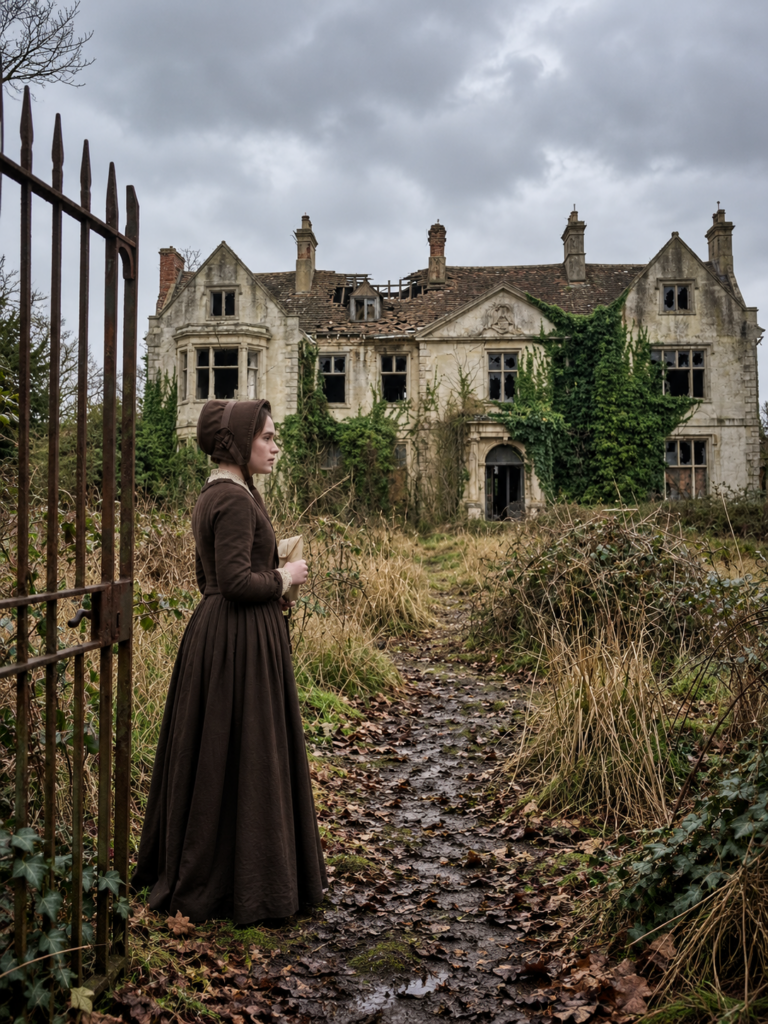
Charlotte Bennett had never expected to own land. At twenty-three she lived in two rented rooms above a dressmaker’s shop in a market town that smelled of wet wool and coal smoke. Her father had died three months earlier and left her a modest annuity, several boxes of books, and a collection of weathered notebooks filled with observations about soil, trees, drainage, and crops. He had spent most of his life as a horticultural steward for wealthy families. He was the man they called when a garden stopped producing, when an orchard weakened, or when a piece of ground seemed to have lost its value. Charlotte had grown up walking behind him with a spade over her shoulder. She had learned which soil held water too long, which trees could still recover if the dead wood was cut away, and that land could look worthless long before it actually became worthless. She had never imagined those lessons would decide whether she kept a roof over her head.
The solicitor arrived on a cold Tuesday morning with a leather case and the careful face of a man who delivered difficult news for a living. He set the documents on her small table and said, “Miss Bennett, your father was not the only person who left something to you.”
She frowned. He opened the first paper. “You have inherited Greyborne.”
She stared at him. “From whom?”
“From the Duke of Ashbourne.”
Charlotte almost laughed. She had never met the Duke. “Why would a Duke leave me an estate?”
The solicitor hesitated. “That is rather complicated.”
It was not complicated for long. Greyborne had belonged to the Duke’s family for generations, but the place had become expensive. The house needed repairs the Duke did not want to pay for. The gardens had failed. The agricultural land produced little. And the orchard, once known across the county for a particular russet apple, had been neglected for more than a decade. The Duke had two ordinary choices. He could spend a considerable fortune restoring the place, or he could sell it at a loss. Instead he chose a third. He gave it away, with one condition. Charlotte could keep the estate only if she accepted responsibility for all ordinary maintenance and expenses. There was no mortgage and no immediate debt attached to the gift. But the solicitor was clear.
“Miss Bennett, Greyborne may be technically valuable on paper, but maintaining a property of this size will cost considerably more than your annuity provides. I suspect His Grace believes you will eventually sell it.”
Charlotte folded the documents. “When can I see it?”
Greyborne stood almost twelve miles from the nearest market town, down a lane that turned to mud after rain. She arrived two days later in a hired cart with one trunk and her father’s notebooks. She knew immediately why the Duke had been eager to be rid of it. The iron gates were rusted half shut. The drive was almost invisible beneath weeds and fallen branches. The windows of the main house were cracked or boarded. Ivy climbed the western wall. Several sections of the roof sagged. The gardens had disappeared under brambles. And behind the house the orchard stretched across the lower ground—hundreds of old trees, most of them twisted, many dead, the survivors looking as if they had endured years of neglect through stubbornness alone.
A gray-haired man waited near the entrance. “Mr. Hargreaves,” he said. He had served Greyborne for thirty-one years. Charlotte asked how many servants remained.
“Three, technically. The cook still comes, Mrs. Bell, and myself. The stable boy comes twice a week.”
“That is all?”
“That is all.”
She took a slow breath and stepped inside. The entrance hall smelled of damp stone and dust. Wallpaper peeled in long strips. A chandelier hung crookedly. One corner of the drawing room was covered with buckets to catch rainwater. She walked through the rooms without speaking until she stopped.
“Which room leaks the least?”
Hargreaves stared at her. “The east bedroom.”
“Then that will be mine.”
The first weeks were not dramatic. They were exhausting. Charlotte had no money for grand renovations, so she began with what she could afford. One bedroom. One fireplace. A few windows. The kitchen roof. She sold two pieces of jewelry her father had left her. She used part of her annuity. She hired local tradesmen only when the work was beyond her. Everything else she learned to do herself. She cleared leaves from gutters. She patched a leaking pane with oilcloth until she could replace the glass. She learned which floorboards could still hold weight and which ones needed to be avoided until the roof above them was sound.
But the house was not her greatest concern. It was the land. Every morning she walked the grounds. She examined the soil with her hands. She checked the old vegetable beds. She studied the drainage lines that had once run between the fields. And eventually she began spending hours in the orchard, walking between the trees with her father’s notebooks open under one arm.
Part 2
One afternoon she stopped beside an ancient apple tree whose branches were tangled and covered in moss. She scraped the growth away with her knife. Underneath, the bark was still healthy. She examined the fruit that clung to a lower limb—small, rust-colored, strongly scented. Her heart quickened. She ran back to the house and spent hours searching through the notebooks until she found the page. Greyborne Russet. A variety her father had written about years earlier. Not common. Not fashionable. Exceptionally suited to the local soil and the long wet springs. He had noted that the trees recovered well from hard pruning and that the fruit stored longer than most other apples if it was picked at the right moment.
Charlotte returned to the orchard the next morning and counted the surviving trees. Thirty-seven. Only thirty-seven still showed green under the bark when she cut a small branch. But they were alive. That was enough.
She began pruning. She cleared the ground of brambles and fallen limbs. She removed the dead wood so light could reach the remaining branches. She reopened the old paths between the rows. The work was slow and her hands blistered and then callused. Hargreaves watched her from the kitchen window one morning.
“You really think those trees will produce anything?”
Charlotte kept working. “I don’t know. But I intend to find out.”
By late summer she had a different problem. She had improved the orchard, but improvement did not pay the bills. The roof still needed work. The servants’ rooms were unusable. The western wing was slowly deteriorating, and her annuity would not carry Greyborne through another winter. So she began writing letters. She wrote to merchants, fruit sellers, hotels, and grocers—anyone who might be willing to buy from a neglected estate. Most never replied. Some sent polite refusals. One merchant wrote that Greyborne’s reputation made it unlikely the orchard could produce anything worth purchasing.
Then, one afternoon, a reply arrived from Bath. A merchant named Mr. Whitmore wanted to inspect the orchard. He arrived three days later, a careful man who walked between the trees without speaking much. He tasted several of the russets. He asked questions about the soil and the pruning. Then he looked at Charlotte.
“If you can produce this quality consistently,” he said, “I would purchase the entire first crop.”
She stared at him. “The entire crop?”
“Yes.”
The amount was not enormous, but it was enough to repair part of the roof. For the first time since she had arrived at Greyborne, Charlotte allowed herself to believe the estate might survive.
Three days later a gentleman arrived in a dark traveling coat. He introduced himself as Mr. Pembroke, the Duke of Ashbourne’s steward. Charlotte met him in the orchard. His eyes moved slowly over the pruned trees, the repaired sections of the house, and the crates already waiting to be collected.
“I understand you have made your first sale,” he said.
“I have.”
“His Grace has heard about it.”
Charlotte said nothing. Pembroke adjusted his gloves. “He wishes to remind you that Greyborne remains a difficult property to maintain. One successful harvest does not alter its long-term position.”
She looked across the orchard. “No,” she said quietly. “But it may be the beginning of altering it.”
For the first time Pembroke looked directly at her. “I shall tell His Grace.”
He turned toward the house. Charlotte watched him leave through the gates. The Duke was watching. That changed things. Not because she was frightened of him. Because she now understood that Greyborne’s future was no longer something the Duke had forgotten about.
Part 3
The first harvest was small, but it was good. Mr. Whitmore purchased everything. Charlotte used the money carefully. Roof repairs came first. Then windows. Then tools. She hired two local laborers. She purchased seedlings. She repaired the old greenhouse enough that it could hold young trees through the winter. And despite the Duke’s warning, she planted six new Greyborne Russet trees in ground she had cleared and drained herself.
The estate was beginning to breathe again. Then something went wrong. Charlotte noticed it in the lower orchard. The leaves on several trees had begun turning yellow even though the weather had been dry. The ground remained wet days after rain. She dug into the soil with her hands. Water appeared almost immediately. At first she suspected disease. Then she remembered something her father had once written. An orchard can survive neglect. It cannot survive standing water.
She began searching the old maps and estate records. Nothing useful. Then she found one of her father’s sketches, a rough drawing of Greyborne’s lower grounds. At the bottom was a note in his hand. Control gate behind old greenhouse.
Charlotte stared at the words. She ran outside. Behind the greenhouse stood a wall almost completely covered in ivy. She began pulling. Beneath the roots was stone. Then iron. By sunset she had uncovered an old metal gate set into a stone channel. It was almost completely rusted shut. She called Hargreaves. Together they worked until their hands were raw. The gate moved perhaps an inch, then stopped.
The next morning the weather changed. Rain was expected. Heavy rain. Charlotte knew that if the drainage failed, the lower orchard could be destroyed in a single night. She returned to the gate and worked through the afternoon. Once. Twice. Again. Finally, with a violent metallic groan, the gate shifted. Water burst through the channel. It rushed past her boots and disappeared toward the lower fields. She stood there, soaked and exhausted, and laughed.
The drainage was working. But the storm arrived early. Rain hammered Greyborne before midnight. Wind tore branches from several trees. Water rushed through the lower grounds. By morning six trees had been lost. But the rest of the orchard remained. The old drainage system had saved it. And Charlotte had saved the drainage system.
Part 4
The following spring changed everything. The restored trees flowered heavily. The greenhouse produced early vegetables. The kitchen garden began supplying the house. The orchard produced more fruit than anyone at Greyborne had seen in years. Mr. Whitmore returned. This time he brought another merchant with him. Then another. Within weeks Charlotte had three buyers competing for the crop. A hotel in Bath wanted regular deliveries. A London supplier wanted to purchase Greyborne’s best fruit. Charlotte could have accepted the first offer. Instead she studied the numbers. She understood something now. Greyborne was no longer simply surviving. It was becoming valuable.
She refused to give one merchant exclusive rights. The money would be reinvested into the estate. That decision changed the pace of everything. The western wing was repaired. Broken windows were replaced. The old drive was cleared. The gardens were replanted. The servants’ quarters were cleaned. The greenhouse was restored properly. The orchard paths were rebuilt. And the main house slowly began to look less like a burden and more like a home.
Visitors noticed. At first they came because they were curious. Then they came because they wanted something. A neighboring estate asked Charlotte for advice about an orchard. Another requested cuttings from Greyborne’s trees. A third family asked whether she would consider leasing part of her agricultural land. Then three neighboring families approached her with lease proposals. A London supplier offered her an exclusive contract. Estate owners who had once ignored Greyborne began asking how she had managed it. Invitations began arriving from houses whose doors had once been closed to her.
Several weeks later Mr. Pembroke returned. This time he did not arrive with the same quiet confidence. He stood beside the restored orchard while Charlotte showed him the latest accounts. The London supplier had increased its order. Three neighboring families had asked about leasing portions of Greyborne’s land. And two estate owners had written to Charlotte asking how she had restored the orchard. Pembroke read the figures twice, then looked toward the house.
“I see,” he said.
Charlotte closed the ledger. “Do you?”
Pembroke did not answer immediately. When he finally spoke, his voice was different. “His Grace would like to speak with you.”
Charlotte already knew what that meant. The Duke had finally realized what he had given away, and now he wanted it back.
Part 5
The Duke did not come immediately. Instead Charlotte heard more reports. Greyborne’s orchard was being discussed in Bath. The estate’s fruit was appearing on tables in some of the finest houses in the county. The agricultural land was producing again. The gardens were attracting visitors, and the property itself had become desirable. A local land agent came to inspect it. He spent an entire afternoon walking the grounds. At the end he gave Charlotte an evaluation. She listened quietly. It was more than she had expected, far more. The value of Greyborne had risen dramatically since she had arrived, but the number itself was not what mattered. The change in the estate was visible everywhere. The broken windows were gone. The roof no longer leaked. The orchard was alive. The gardens had color again. People wanted to lease its land. Merchants wanted its produce. Families wanted to be associated with it. Greyborne was no longer an embarrassment. It had become one of the most desirable properties in the county.
Then, one autumn afternoon, the Duke of Ashbourne arrived. Charlotte was in the west garden when she saw his carriage approach. She did not go inside. She waited. The Duke stepped down. He looked older than she remembered from the portrait in the entrance hall. His eyes moved across the restored grounds, the cleared drive, the gardens, the orchard, the repaired house. Finally he looked at her.
“Miss Bennett.”
“Your Grace.”
“I have heard Greyborne has become productive again.”
“It has.”
“I have also heard that the property has increased considerably in value.”
Charlotte said nothing. The Duke looked toward the orchard. “You have done remarkably well.”
“Thank you.”
There was a pause. Then he said the words she had expected. “I believe I am prepared to make you an offer for Greyborne.”
Charlotte almost smiled. “An offer?”
“A very generous one.”
She looked at him. “Generous?”
The Duke’s expression tightened. “You understand that the circumstances have changed.”
“They have. When I gave you Greyborne, it was an unprofitable burden.”
Charlotte nodded. “You were quite clear about that.”
“I underestimated what could be done with it.”
“No,” Charlotte said quietly. “You underestimated what I could do with it.”
The Duke was silent. Charlotte looked across the grounds, at the restored orchard, at the house she had repaired one room at a time, at the land that had nearly drowned beneath years of neglect. Then she turned back to him.
“Greyborne is not for sale.”
The Duke frowned. “You would refuse an offer of this size?”
“Yes.”
“You could live comfortably for the rest of your life.”
Charlotte smiled faintly. “I already do.”
The Duke looked at her for several seconds. “You have become very confident.”
Charlotte shook her head. “No, Your Grace. I have simply stopped believing that you know what Greyborne is worth.”
The Duke said nothing. Charlotte continued. “I didn’t restore Greyborne so someone else could decide what it was worth.”
For the first time the Duke had no answer. He turned, walked back toward his carriage, and left.
After that, Greyborne changed again. Not because Charlotte suddenly became wealthy. She had already learned something more important than wealth. She understood the land. She understood its history. She understood what had been neglected and why. And she knew how to make people see its value. The orchard continued producing. The agricultural land was leased. The gardens became known across the county. The house, once described as a ruin, became one of the most admired country properties in the region. Three neighboring families secured leases. The London supplier continued asking for more produce. Estate owners continued seeking Charlotte’s advice. And invitations arrived regularly from houses that had once considered her insignificant.
Charlotte never forgot the day she first arrived. She remembered the rusted gates, the broken windows, the leaking roof, the dead branches, and the silence inside the house. She remembered being told, without anyone saying it directly, that Greyborne was too much for her. But her father had taught her something different. Neglected did not mean worthless. Sometimes it only meant that nobody had understood what they were looking at.
One evening she walked through the orchard alone. The sun was setting behind the trees. The branches were heavy with fruit. She placed one hand against the trunk of the oldest Greyborne Russet, the same tree she had discovered during her first weeks at the estate, the same tree everyone else had considered useless. She smiled. The Duke had given her Greyborne to humiliate her. Instead he had given her the one thing he could never have predicted. A chance to prove that value was not always visible to the person who owned something. By the time the Duke understood what Greyborne was worth, Charlotte was no longer the young woman who had arrived with one trunk, a modest annuity, and nowhere else to go. She was the woman everyone wanted something from. And Greyborne was no longer the ruined estate the Duke had tried to escape. It was the estate nobody wanted to lose.

