
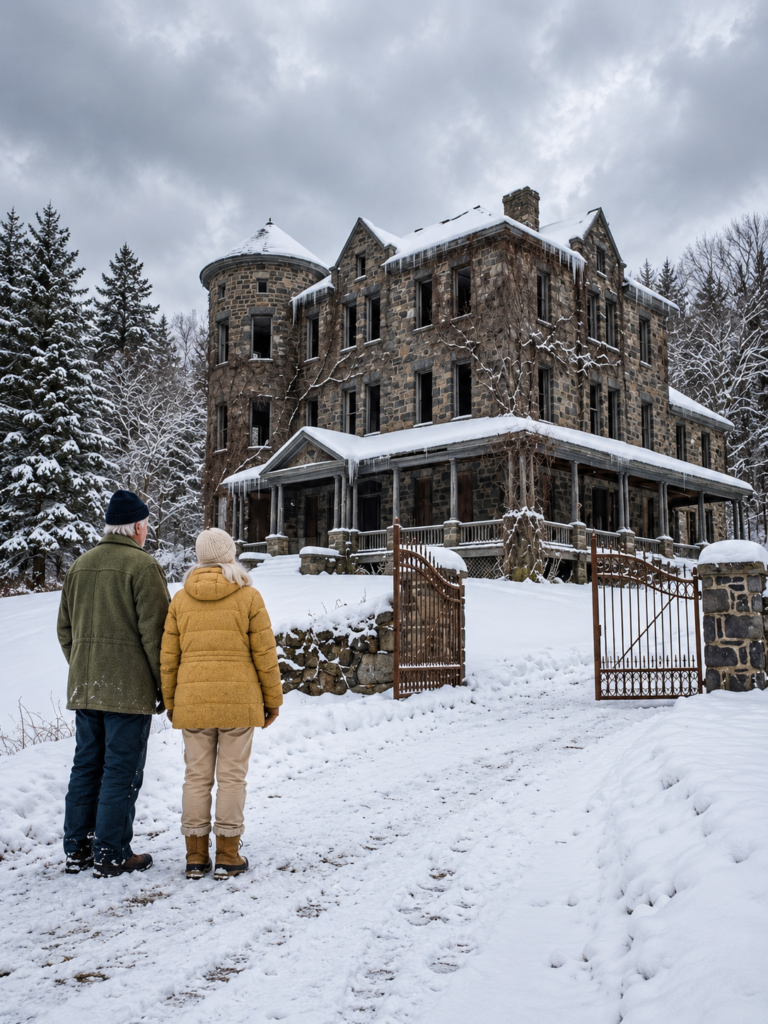
their son stole their home and sent them into a blizzard — then the frozen mansion they inherited revealed a $265 million secret
Part 1
The sound Thomas Miller remembered most was not his son shouting.
It was packing tape.
Long strips of clear tape ripping across cardboard boxes in the living room Thomas had built with his own hands.
Each pull made the same sharp tearing sound.
Thomas stood in the center of the room wearing thin socks and an old flannel shirt, staring at the hardwood floor beneath his feet.
He had installed that floor in the summer of 1988.
Three weeks after his fiftieth birthday.
He remembered Helen bringing lemonade while he worked.
He remembered their son, Greg, eight years old then, sliding across the unfinished boards in his socks and nearly crashing into a wall.
Thomas had laughed until his ribs hurt.
Thirty-eight years later, Greg walked across those same boards wearing expensive leather shoes and checking his watch.
“The van’s coming at noon, Dad.”
Thomas looked at him.
Greg did not look back.
“We need you and Mom ready. Linda has contractors coming tomorrow.”
At seventy-two, Thomas had learned that cruelty rarely announced itself as cruelty.
Sometimes it called itself practicality.
Sometimes it carried paperwork.
Sometimes it came from your own child and said it was doing this for your own good.
Helen sat on the floral sofa near the window.
Her hands rested in her lap.
She had stopped crying three days earlier.
That was when the bank transfer went through and the deed officially changed names.
Greg had told them it was a financial protection plan.
A way to shield the house from medical expenses.
A way to simplify their estate.
A way to keep them from “losing everything if one of you gets sick.”
Thomas had distrusted it.
Helen had asked questions.
Greg had become offended.
“After everything I do for you, you think I’m trying to steal from you?”
That sentence had worked.
Parents who love their children often become easy targets for guilt.
Thomas signed.
Helen signed.
Only later did they understand that they had not protected the house.
They had transferred it.
Entirely.
To Greg.
The eviction notice arrived four days afterward.
Their own son had legally taken possession of their home and arranged for them to enter a low-cost nursing facility called Shady Pines.
The brochure showed smiling elderly couples walking through a garden.
Thomas had driven past the actual place once.
The garden was a strip of grass beside the parking lot.
The building was gray concrete.
The windows barely opened.
“Long-term care,” Greg called it.
Helen called it what it was.
“Storage.”
Linda entered carrying a clipboard.
Greg’s wife did not greet them.
She looked toward the kitchen.
“I still think that wall should go.”
Greg nodded.
“Open concept.”
“Exactly. Buyers in this neighborhood want light.”
Thomas stared at his daughter-in-law.
“This house already has light.”
Neither answered.
Linda was discussing the wall separating the kitchen from the dining room.
A wall Thomas had built around plumbing and electrical lines.
A wall that had held up part of the second floor for nearly forty years.
He wanted to warn them.
Then stopped.
Let them learn something themselves.
Helen rose slowly.
Her knees had been bothering her since October.
She crossed to the fireplace mantel and picked up a framed photograph.
Greg at nine years old.
Gap-toothed.
Skinny.
Sitting on a red bicycle Thomas had repaired from three discarded bikes.
Greg had ridden it until the tires were bald.
Helen slipped the picture into her worn leather purse.
Greg finally looked up.
“Mom, you can’t take everything.”
Helen’s expression changed.
“I know.”
Two words.
Nothing more.
Thomas felt them like a hand closing around his heart.
They had been allowed four boxes each.
Greg had given them black trash bags for clothing that did not fit.
Forty-five years of marriage reduced to eight boxes, two suitcases, several garbage bags, and an old Honda Accord.
Thomas looked around the living room one last time.
Pencil marks remained on the pantry doorframe.
GREG — AGE 7.
GREG — AGE 10.
GREG — AGE 13.
Thomas remembered each line.
Every birthday.
Every school photograph.
Every fever.
Every football game.
Every time he had said, “My son will take care of us someday.”
He felt ashamed of that last memory.
Outside, November wind moved through the bare maple trees.
A vehicle was scheduled to take them to Shady Pines.
Greg followed them toward the front door.
“Dad, don’t make this harder.”
Thomas turned.
“Harder for who?”
Greg sighed.
“There you go again.”
“What does that mean?”
“It means you always make everything personal.”
Thomas almost laughed.
His son had taken his house and was frustrated that Thomas considered it personal.
Helen touched Thomas’s arm.
“Come on, Tom.”
They stepped outside.
The mail carrier pulled up.
A young man wearing headphones pushed envelopes into the mailbox and drove away without noticing that two elderly people were standing beside their belongings on the lawn.
Thomas opened the box out of habit.
Electric bill.
Advertisement.
Insurance notice.
Then a thick cream-colored envelope.
His name was written across the front.
THOMAS MILLER.
The return address belonged to a law firm in Portland, Maine.
Thomas frowned.
He opened it.
The first line made him stop breathing.
Re: Estate of Henry Miller.
Helen noticed.
“What is it?”
Thomas read the name again.
Henry.
His older brother.
They had not spoken in twenty-five years.
The argument had begun over a loan.
Or maybe over Thomas refusing one.
Even now he could not remember where the original disagreement ended and the pride began.
Henry accused Thomas of judging him.
Thomas accused Henry of always expecting rescue.
One ugly telephone call became six months of silence.
Six months became five years.
Five became twenty-five.
Henry moved north.
Never married.
Never had children.
Occasionally Thomas heard rumors through relatives.
Henry had bought land in Maine.
Henry lived alone.
Henry distrusted banks.
Henry had become strange.
Thomas always assumed there would eventually be time.
Apparently there had not been.
Henry had died two weeks earlier from a stroke.
Thomas swallowed.
The letter said that as his closest surviving relative, Thomas had inherited Henry’s estate.
Enclosed were two items.
A deed.
And a heavy brass key.
The property was called Iron Ridge Estate.
Somerset County, Maine.
Helen touched his sleeve.
“Tom?”
Greg honked from the driveway.
Once.
Impatiently.
Thomas raised his head.
His son sat behind the wheel of his SUV.
The Shady Pines brochure stuck from Helen’s purse.
Thomas looked at the deed.
Then at his wife.
Something in him changed.
Not dramatically.
No shouting.
No great speech.
Just one old man reaching the end of his willingness to surrender.
“Change of plans.”
Helen stared.
“What?”
Thomas walked toward their Honda.
Greg rolled down his window.
“Dad, what are you doing?”
Thomas opened the driver’s door.
“The facility needs you checked in before two.”
“Cancel it.”
Greg got out.
“What?”
“We’re not going.”
Greg looked from Thomas to Helen.
“Where exactly do you think you’re going?”
“Maine.”
“Maine?”
“I inherited a house.”
Greg stared.
Then laughed.
“From Uncle Henry?”
“Yes.”
“The crazy one?”
Thomas said nothing.
“Dad, listen to yourself. It’s November. You’re seventy-two. Mom gets pneumonia if somebody opens a freezer near her. You can’t drive into the woods because some dead relative left you a shack.”
Helen climbed into the passenger seat.
Greg’s voice sharpened.
“You don’t have money.”
Thomas stopped.
That hurt because Greg knew it was nearly true.
The transfer had left their account almost empty.
He looked at his son.
“We have enough gas.”
“That’s not what I meant.”
“I know.”
Thomas got behind the wheel.
Greg stepped closer.
“Be reasonable for once.”
Thomas started the Honda.
The engine coughed before catching.
He lowered the window.
For a moment he saw not the forty-six-year-old man who had deceived him, but the boy on the red bicycle.
That made what he said harder.
“You changed the locks on the house I built.”
Greg’s face stiffened.
“You’re not being thrown out. We arranged care.”
“You arranged for us to disappear.”
“Dad—”
“We have a house now.”
Thomas raised the window.
The Honda pulled away.
In the mirror he saw Greg standing in the driveway beside renovation plans for a home that had never truly belonged to him.
Helen remained silent for several miles.
Then she reached across the console and took Thomas’s hand.
“You have any idea what this place looks like?”
“No.”
“Do we know if it has heat?”
“No.”
“Electricity?”
“No.”
“A roof?”
“Probably.”
Helen looked ahead.
“That wasn’t convincing.”
Thomas almost smiled.
It was the first time he had wanted to smile in days.
By the time they crossed into Maine, snow had begun.
By Bangor, the Honda’s heater stopped working.
Not with a dramatic failure.
Warm air simply became less warm.
Then cold.
Thomas adjusted the controls.
Nothing.
Helen wrapped herself in blankets from the back seat.
“How far?”
Thomas checked the phone.
Twenty-five miles.
“Ten.”
Helen glanced at him.
“You’re a bad liar.”
“I know.”
The road narrowed.
Pines crowded both sides.
Snow thickened against the windshield.
Thomas leaned forward, fighting the worn wipers.
His back hurt.
His hands cramped around the steering wheel.
The adrenaline that carried him away from Greg was gone.
Fear took its place.
What had he done?
He was seventy-two.
His wife was seventy.
The fuel gauge sat below one-quarter.
No motel signs.
No streetlights.
No houses.
Only forest.
The GPS directed them onto an unmarked road.
Thomas turned.
The car slid sideways.
Helen gasped.
Thomas corrected.
The tires caught.
They continued at ten miles an hour.
Two miles later, the trees opened.
Headlights struck iron.
A massive gate stood crooked across the road.
Beyond it, on a rise beneath the storm, was a house.
Thomas stopped.
Helen leaned forward.
“That’s Henry’s?”
The building was enormous.
Three stories of dark stone.
A rounded turret.
Tall narrow windows.
A wraparound porch sagging beneath heavy snow.
Dead ivy covered the walls.
It did not look welcoming.
It looked like a place people disappeared inside.
Thomas whispered, “Apparently.”
The Honda climbed halfway up the drive before its tires spun.
Thomas shut off the engine.
Silence swallowed them.
The wind outside sounded like something alive.
“We walk,” he said.
Helen looked at the house.
Then at him.
“All right.”
They took one bag.
The storm struck the moment Thomas opened his door.
Snow reached their shins.
Thomas held Helen’s arm as they struggled uphill.
At the porch he dropped the brass key once.
Then again.
His fingers were numb.
Finally the key entered the lock.
Turned.
The oak door opened.
They stumbled inside.
The house was dark.
And nearly as cold as the outdoors.
Thomas tried a light switch.
Nothing.
His phone showed twelve percent battery.
No signal.
Helen’s teeth chattered.
“Tom…”
He swept the phone flashlight around.
A grand staircase.
Dusty Persian rugs.
Furniture covered in sheets.
To the left—
a fireplace.
Thomas saw stacked birch beside it.
“Sit down.”
He found newspapers.
Kindling.
Matches in a brass container.
His hands shook so hard it took three attempts.
Then flame caught.
Paper curled.
Wood began snapping.
Orange light filled the room.
Thomas dragged an old leather chair closer.
Helen sat.
For the first time that day, her shoulders loosened.
Outside, the blizzard screamed.
Inside they had no electricity.
No running water.
No telephone.
No idea what waited in the rest of the house.
But Helen reached for Thomas’s hand.
“We aren’t at Shady Pines.”
Thomas looked at her.
“No.”
And somehow, for that one night, it was enough.
Part 2
By the third morning, the firewood was almost gone.
The storm had not stopped.
Snow covered half the first-floor windows.
The Honda had vanished beneath a white mound.
Thomas established rules.
They lived in one room.
They closed every door possible.
They hung blankets over openings.
He found sealed cans in a pantry.
Beans.
Peaches.
Tomato soup.
He melted snow in a copper pot for water.
They ate sparingly.
The biggest problem was heat.
Iron Ridge was too large.
The fireplace warmed only the area directly around it.
Every hallway beyond the parlor felt like a meat locker.
Helen began coughing on the second night.
By the third morning, the cough sounded deeper.
Wet.
Thomas knew that sound.
Years earlier Helen had spent six days in the hospital with pneumonia.
He touched her forehead.
Warm.
Too warm.
“We need more wood.”
Helen opened her eyes.
“Don’t go outside.”
“I won’t.”
“Then where?”
Thomas looked toward the staircase.
“This house has enough furniture to burn until Easter.”
Helen almost protested.
Then coughed again.
“Burn the ugly stuff first.”
Thomas kissed her forehead.
“That narrows nothing down.”
She smiled weakly.
Thomas took the fireplace poker and climbed upstairs.
His knees complained with every step.
At the first guest room, he found a wooden chair.
He struck it.
The first blow cracked one leg.
The second broke it.
Thomas hated destroying something Henry had owned.
Then Helen coughed downstairs.
Sentiment became irrelevant.
He raised the poker again.
Crack.
As he gathered the broken pieces, he heard something.
A faint hum.
Thomas stopped.
Wind howled outside.
This sound was different.
Steady.
Mechanical.
He moved into the hallway.
Nothing.
Back into the guest room.
There.
Hum.
Hum.
Hum.
Thomas looked toward the ceiling.
Above them was an attic.
He had seen no stairway.
He moved around the room.
The sound grew louder near the closet.
Inside hung several old coats.
Thomas pushed them aside.
Wood paneling covered the rear wall.
Cold air leaked through a seam.
He pressed one panel.
Click.
The wall opened inward.
Behind it was a narrow staircase rising into darkness.
Thomas stared.
“Henry.”
His brother had always loved secrets.
As a boy, Henry buried coins in jars and forgot where he put them.
At twelve he built a locked box to protect three baseball cards.
At seventeen he accused the government of tracking citizens through driver’s licenses.
Maybe eccentricity had simply matured with him.
Thomas returned downstairs for a candle.
Helen stirred.
“Where are you going?”
“Found stairs.”
“Of course you did.”
“I’ll be back.”
“That’s what every fool says before walking into an attic.”
Thomas smiled.
“Love you too.”
He climbed.
The attic air was brutally cold.
At the top, he pushed open a trapdoor.
His candle illuminated an enormous space beneath the pitched roof.
Something immediately seemed wrong.
No dust.
The lower house had been untouched for years.
This attic floor looked swept.
In the center sat an industrial battery system connected to wiring.
A low electrical hum came from it.
Thomas stepped closer.
Then saw what stood behind it.
A vault.
Not a home safe.
A steel door nearly five feet tall.
Chrome wheel.
Electronic keypad.
Reinforced supports beneath the floor.
Thomas stared.
“What in God’s name were you doing?”
Beside the battery bank was a wooden crate.
On it lay a leather notebook.
Thomas opened it.
Henry’s handwriting.
The first page read:
THE GRID WILL FAIL.
BANKS WILL FREEZE.
PAPER IS A PROMISE MADE BY STRANGERS.
METAL DOESN’T LIE.
Thomas rolled his eyes.
“Still crazy.”
Then he turned the page.
His smile disappeared.
Dates.
Account numbers.
Property sales.
Investment liquidations.
Bullion purchases.
Transfer records.
Thomas read faster.
Henry had not been poor.
He had been hiding money.
An extraordinary amount.
At the final page, six numbers had been written in black marker.
Thomas looked at the keypad.
“No.”
He walked toward it.
Pressed 4.
A mechanical clunk echoed through the attic.
Green light.
UNLOCKED.
Thomas stepped backward.
For several seconds he simply stared.
Then he took the wheel with both hands.
It resisted.
He pulled harder.
The locking bolts retracted.
Thomas opened the door.
The candle flame shook.
Inside were rows of vacuum-sealed currency.
Shelves of gold bullion.
Documents.
Boxes.
Stacks extending almost to the ceiling.
Thomas’s knees weakened.
He sat on the floor.
For a full minute he could not think.
Greg.
Shady Pines.
Black trash bags.
The frozen Honda.
Helen coughing downstairs.
Then one practical realization cut through everything.
None of this could warm his wife.
From below came another cough.
Thomas stood immediately.
Money could wait.
Helen could not.
He took one gold bar only because he suspected it might help them once the storm broke.
Then locked the vault.
Returned to the guest room.
And destroyed nearly every piece of wooden furniture he could carry.
Chair.
Desk.
Bed frame.
A small table.
Thomas worked until sweat soaked his shirt.
He hauled the pieces downstairs.
Built the fire high.
Dragged a mattress near the hearth.
Boiled water.
Helen drank.
Thomas sat beside her.
“I found wood.”
She nodded with her eyes closed.
“You always do.”
Thomas touched the gold bar inside his coat.
The weight suddenly felt ridiculous.
His brother had hidden a fortune in an attic while the house below had no reliable heat.
Henry had prepared for governments collapsing.
Banks failing.
Civilization ending.
He had apparently forgotten to install a dependable furnace.
Thomas almost laughed.
Then Helen coughed again.
He held her hand until morning.
The blizzard finally weakened on the fifth day.
Thomas opened the front door.
A wall of snow confronted him.
He dug for four hours with a cracked shovel.
His chest hurt.
His back screamed.
He ignored both.
Eventually a county plow passed near the gate.
Thomas waved it down.
The driver stared at him.
“You folks been up there this whole storm?”
Thomas nodded.
“Jesus.”
Within two hours Thomas and Helen were sitting inside a heated tow truck.
Thomas asked to go directly to the nearest clinic.
Helen received fluids and antibiotics.
The doctor said they had arrived in time.
Those three words nearly collapsed Thomas.
While Helen slept, he walked down Main Street.
Found a hardware store.
“I need a generator.”
The owner looked at Thomas’s clothes.
“A portable one?”
“The biggest one you have.”
“Those aren’t cheap.”
“I also need heaters. Extension cables. Diesel. Delivery.”
“To where?”
“Iron Ridge.”
The man whistled.
“Henry Miller’s place?”
“Yes.”
“Road’s rough.”
“I know.”
The owner calculated.
Thomas took out the gold bar.
Placed it on the counter.
The sound it made changed the man’s expression completely.
Thomas said, “There must be somebody nearby who can verify that.”
The owner stared.
“You planning to pay for a generator with gold?”
“I’m planning to get my wife warm before dark.”
By nightfall, heaters glowed inside Iron Ridge.
Thomas bought groceries.
Medicine.
Coffee.
Fresh blankets.
He cooked chicken soup on a hot plate.
Helen sat in an armchair beneath an electric blanket.
Color had returned to her face.
She watched him.
“Tom.”
“Yes?”
“Where did you get the money?”
Thomas sat opposite her.
He had spent forty-five years working maintenance at a municipal transit garage.
He had worried about mortgage payments.
Dental bills.
Greg’s college.
Retirement.
Never once had he imagined explaining a hidden vault.
“Henry left more than the house.”
Helen raised one eyebrow.
“How much more?”
Thomas thought of the attic.
“I don’t know.”
“That expression means a lot.”
“It might.”
“How much?”
“I genuinely don’t know.”
Helen studied him.
Then sipped soup.
“All right.”
“That’s it?”
“I’m seventy years old and nearly froze to death this week. I don’t have enough energy to be shocked tonight.”
Thomas laughed.
The sound surprised him.
Helen smiled.
“Tomorrow.”
“All right.”
“Tomorrow I’ll be shocked.”
Part 3
The fortune took months to understand.
Henry’s attorney in Portland was named Arthur Bell.
He was a quiet gray-haired man who seemed entirely unsurprised by every bizarre thing Thomas described.
“You knew?”
“Not the exact location.”
“But you knew about the money?”
“I knew your brother had substantial assets.”
Thomas stared.
“Substantial?”
Bell adjusted his glasses.
“Henry disliked ordinary definitions.”
“So does everyone whenever money gets large.”
Bell almost smiled.
Accountants spent weeks tracing records.
Some wealth existed in cash.
Some in bullion.
Other portions remained in legally structured trusts and investment entities.
The final confirmed value came to approximately two hundred sixty-five million dollars.
Thomas read the number twice.
Helen read it once.
Then went outside.
Thomas followed.
She stood beside the greenhouse foundation contractors had begun preparing.
“You all right?”
“No.”
“Neither am I.”
Helen looked toward the woods.
“We spent forty years arguing about grocery prices.”
“I remember.”
“You once drove across town because coffee was seventy cents cheaper.”
“That was good coffee.”
“We have two hundred sixty-five million dollars.”
“Apparently.”
Helen began laughing.
Thomas laughed too.
Then, unexpectedly, she cried.
Thomas held her.
He knew what the tears were about.
Not money.
Their house.
Their son.
The humiliation.
The fact that security had arrived only after they learned someone they loved was willing to discard them.
Money solved many problems.
It could not make that painless.
They restored Iron Ridge slowly.
Thomas refused to turn it into a palace.
The stonework was repaired.
New heating installed.
Plumbing replaced.
Electrical wiring modernized.
The roof reinforced.
Windows restored.
Helen built a greenhouse on the south side.
Thomas bought a four-wheel-drive truck because the Honda had suffered enough.
They hired local people whenever possible.
Carpenters.
Electricians.
Stone masons.
A retired forester maintained the roads.
A widowed woman from Oak Haven came twice a week to help clean, though Helen often cleaned beside her and irritated the woman by refusing to behave like an employer.
Thomas learned the names of everyone who worked there.
He paid promptly.
He fed crews lunch.
More than one contractor quietly remarked that Henry Miller would have hated seeing so many people in the house.
Thomas always answered:
“Then it’s a good thing Henry isn’t running it anymore.”
One thing Thomas did not do was call Greg.
For weeks, he considered it.
Helen did too.
Neither wanted revenge.
But neither was ready to pretend nothing happened.
Greg had blocked both their numbers shortly after they left.
That simplified things.
Winter became spring.
At Iron Ridge, snow melted slowly.
Helen planted orchids.
Thomas repaired an old barn on the east side of the property.
For the first time in years, they lived without asking anyone’s permission.
Back in their former city, Greg’s life was collapsing.
He had planned to renovate his parents’ house quickly.
Remove walls.
Upgrade appliances.
Sell for nearly triple what remained on the mortgage.
Instead contractors found asbestos.
Then foundation damage.
Then structural problems beneath the kitchen wall Linda wanted removed.
City inspectors stopped the work.
Bridge financing tightened.
Greg had borrowed against his own home.
The interest accumulated.
Linda blamed the contractors.
Greg blamed the inspectors.
Neither blamed the decision that started everything.
Then Linda remembered Iron Ridge.
“You never checked.”
Greg looked up.
“Checked what?”
“Your parents.”
“They’re fine.”
“How do you know?”
Greg had no answer.
“Your uncle left them property.”
“A cabin.”
“You don’t know that.”
“What are you suggesting?”
“If they died up there, you’re next of kin.”
Greg stared at her.
Linda lowered her voice.
“I’m saying we need options.”
The following morning, Greg drove north.
He expected a shack.
Maybe forty acres of timber.
Perhaps something he could pressure Thomas into selling.
If his parents needed help, he told himself, he would offer it.
And if they had died—
he did not complete that thought.
The roads narrowed.
Cell service disappeared.
Greg cursed repeatedly.
Then he reached the Iron Ridge gate.
He stopped.
The gates had been restored.
Security cameras watched the road.
Beyond them, a paved driveway climbed through the trees.
At the top stood the estate.
Stone cleaned.
Roof repaired.
Smoke rising from a massive chimney.
A new pickup sat near the garage.
Greg stared.
“What the…”
He pressed the intercom.
“Hello?”
Static.
Then Thomas’s voice.
“The gate’s open, Greg.”
Heavy iron moved inward.
Greg drove slowly.
Thomas stood on the porch.
He looked different.
Same gray hair.
Same lined face.
But something had vanished.
The stoop.
The uncertainty.
Helen appeared behind him holding tea.
She looked healthier than Greg remembered.
Greg forced a smile.
“Dad.”
Thomas waited.
“Mom.”
Helen nodded.
Greg climbed the steps.
“Wow.”
His eyes traveled across the stonework.
“You guys really fixed this place up.”
Thomas said nothing.
Greg laughed nervously.
“I’ve been worried.”
“No, you haven’t.”
Thomas said it calmly.
That made it worse.
Greg put his hands in his coat pockets.
“Look, November got ugly.”
“Yes.”
“Linda was stressed.”
Thomas waited.
“I was stressed.”
“Yes.”
“I should’ve handled things differently.”
Helen asked, “Which things?”
Greg looked at her.
“What?”
“The stealing?”
His face flushed.
“Mom, I did not steal—”
“The lying?”
“It was an asset strategy.”
“The eviction?”
Greg exhaled.
“You needed care.”
“We needed our house.”
The words ended the argument.
Greg looked past them into the foyer.
Old Persian rugs had been cleaned.
Mahogany gleamed.
Warm light filled the hallway.
His mind began calculating automatically.
Land.
House.
Improvements.
Value.
Thomas watched him do it.
That hurt more than he expected.
Even now Greg could look at his parents and immediately see numbers.
Greg cleared his throat.
“I’m having some financial problems.”
Helen’s face revealed nothing.
“The renovation got complicated.”
Thomas almost smiled.
“Load-bearing wall?”
Greg looked startled.
“How’d you know?”
“I built it.”
Greg looked away.
“The city shut work down. It’s temporary. I just need liquidity.”
“How much?”
Greg hesitated.
“Couple hundred thousand.”
Helen actually laughed.
Greg’s face reddened.
“It’s a loan.”
“With what collateral?”
“The property.”
Thomas looked at him.
“The property you took from us?”
Greg’s jaw tightened.
“I said I handled that badly.”
“No. You said things got ugly.”
“What do you want me to say?”
Thomas answered quietly.
“The truth.”
Greg stared at him.
Wind moved through the pines.
Finally Greg said, “Fine.”
He swallowed.
“I wanted the house.”
Helen closed her eyes briefly.
Greg continued.
“I thought you two were getting old. You weren’t using it efficiently. The neighborhood was changing. Property values were climbing.”
Thomas listened.
“I thought if I moved you somewhere safe, renovated, sold it, everybody benefited.”
“Everybody?”
“I was still planning to help with your expenses.”
Thomas almost admired the ability to rewrite betrayal as planning.
Then Greg added:
“You weren’t going to live there forever anyway.”
Something in Helen changed.
She stepped closer.
“Neither are you.”
Greg blinked.
“What?”
“You aren’t going to live anywhere forever.”
Her voice remained quiet.
“That doesn’t give your children permission to take it before you’re finished.”
Greg looked down.
For several seconds no one spoke.
Thomas reached into his coat.
Pulled out a legal folder.
Greg frowned.
“What is that?”
“Your mortgage.”
Greg looked up sharply.
“The bank was preparing foreclosure.”
“How do you know?”
“I bought the note.”
Greg stared.
Thomas continued.
“I also purchased the private debt secured against the property.”
Greg unfolded the papers.
His hands began shaking.
“You paid everything?”
“Yes.”
Relief rushed over Greg’s face.
“Dad—”
Thomas raised one hand.
“Don’t.”
Greg stopped.
“The house is saved?”
Thomas looked toward the woods.
“No.”
“What does that mean?”
“It means the debt is mine.”
“Right, so we finish renovations, sell it, repay you—”
“No.”
Greg’s expression changed.
“What are you doing?”
Thomas had spent weeks deciding.
At first anger suggested demolition.
Destroy the house.
Erase everything.
Let Greg watch.
But every time Thomas pictured bulldozers crossing the yard, he remembered pencil marks on the pantry frame.
Helen bringing lemonade in 1988.
Greg learning to ride a bicycle.
Anger wanted ashes.
Memory wanted something better.
“The city has an affordable housing trust.”
Greg stared.
Thomas continued.
“We’re donating the property.”
“What?”
“After structural repairs.”
“No.”
“The first floor will be converted into two accessible apartments for elderly residents at risk of displacement. The upstairs will become temporary housing for caregivers and families.”
Greg’s face went white.
“You’re giving my house away?”
Thomas corrected him.
“Our house.”
“You signed it over!”
“And you borrowed against it until the bank took control. I bought the debt.”
Greg stepped forward.
“You can’t do this.”
“I already started.”
“That property is worth a fortune.”
Helen spoke.
“That seems to be the only thing you ever understood about it.”
Greg turned toward her.
“Mom, please.”
“No.”
It was the first time Helen had raised her voice.
“You do not get to say please now as though we owe you softness because you finally need something.”
Greg stood motionless.
Helen continued.
“You handed me black trash bags.”
His eyes dropped.
“You told your father he would hurt his back carrying his own possessions.”
Greg said nothing.
“You put that nursing-home brochure in my purse.”
Her voice broke once.
She steadied it.
“I still have it.”
Thomas looked at her.
He had not known.
Helen reached into the pocket of her cardigan.
The old folded pamphlet appeared.
Shady Pines.
The paper was worn at the creases.
“I kept it because whenever I started wondering whether I was being too hard on you, I looked at this.”
Greg’s face crumpled.
“Mom…”
Helen folded the paper again.
“I love you.”
Thomas looked at her sharply.
Greg did too.
“That’s what makes this hurt.”
Tears appeared in her eyes.
“But loving you does not require us to finance the man you became.”
Part 4
Greg left Iron Ridge without money.
Thomas watched the SUV disappear beyond the gate.
He expected satisfaction.
Instead he felt tired.
Helen stood beside him.
“You all right?”
“No.”
“Me neither.”
They returned inside.
That evening they sat near the fireplace.
The same fireplace that had kept them alive during the blizzard.
Thomas watched the flames.
“I wanted him to understand.”
Helen turned a page in her book.
“He might someday.”
“What if he doesn’t?”
“Then we still understand.”
Thomas looked at her.
She closed the book.
“You know what almost killed us?”
“The storm.”
“No.”
Thomas waited.
“Trusting someone who had stopped seeing us as people.”
Her expression softened.
“And you know what saved us?”
“Henry?”
“Partly.”
She reached for Thomas’s hand.
“You refusing to let somebody else decide when our life was finished.”
Thomas looked into the fire.
He thought about Henry.
Two brothers losing twenty-five years because neither called.
Thomas had escaped one regret too late.
He did not want another.
“I should call Greg.”
Helen considered.
“Not tonight.”
“No.”
“When?”
“When you can talk without wanting him to hurt.”
Thomas nodded.
That took longer than he expected.
Meanwhile, Thomas discovered more about Henry.
Among papers in the estate office were letters never mailed.
Several were addressed to Thomas.
One had been written seventeen years earlier.
Tom,
I almost called today.
Then I remembered what you said and got angry all over again.
Maybe tomorrow.
Another:
Saw a man fixing a bus on television. Thought of you.
Stupid reason to write.
Henry never sent either.
The final letter had been written months before his death.
Thomas read it alone.
Little brother,
If this reaches you, someone else mailed it because I probably lost my nerve again.
I was wrong about the money.
You were right that I always expected people to save me.
Then when I finally made enough that I needed nobody, I went too far the other way.
Turns out needing nobody is just another kind of poverty.
Thomas stopped reading.
For a long time he stared at the paper.
Then continued.
I kept thinking I would call after I had the right words.
There are no right words after twenty-five years.
Only late ones.
If you ever come to Iron Ridge, use the wood in the west shed first.
The birch burns cleaner.
Thomas laughed through tears.
“Idiot.”
Henry had left instructions about firewood in an apology letter.
Exactly like him.
Thomas folded it carefully.
Later that evening, he showed Helen.
She read it.
Then looked at her husband.
“Well?”
“Well what?”
“You planning to make the same mistake with Greg?”
Thomas did not answer.
The next morning he called.
Greg answered after four rings.
“Dad?”
“Yes.”
Silence.
Thomas could hear traffic.
“I didn’t expect you to call.”
“I know.”
“Is Mom okay?”
“Yes.”
Another silence.
Then Greg asked:
“Are you calling about the house?”
Thomas nearly hung up.
Instead he remembered Henry.
Late words.
“No.”
“Oh.”
“I’m calling because you’re my son.”
Greg said nothing.
Thomas continued.
“That doesn’t mean I’m giving you money.”
“I didn’t ask.”
“Not this time.”
Greg breathed out.
“I know.”
Thomas sat at Henry’s old desk.
“Are you all right?”
“No.”
The answer came so quickly that Thomas believed it.
Linda had left.
The SUV was being repossessed.
Greg’s consulting business had failed.
He was living in a weekly motel outside the city.
Thomas closed his eyes.
Part of him wanted to fix everything.
That was what fathers did.
But another part recognized danger.
Rescuing Greg financially might only teach him that consequences were temporary inconveniences someone richer would eventually remove.
Thomas asked:
“What do you need?”
Greg laughed bitterly.
“About a million dollars.”
Thomas remained silent.
“Sorry.”
“What do you actually need?”
A long pause.
“A job.”
Thomas nodded even though Greg could not see him.
“That I can help with.”
Greg did not respond.
Thomas knew what was coming.
“Not managing Iron Ridge.”
Greg gave a tired laugh.
“Okay.”
“There’s a restoration project in Oak Haven.”
“What kind?”
“Old community center. Roof, framing, plumbing, whatever they need.”
“I don’t know construction.”
“You know enough to learn.”
Greg was quiet.
Thomas added:
“It pays normal wages.”
“Normal wages.”
“Yes.”
“You have two hundred sixty-five million dollars.”
“And?”
“And you’re offering me twenty-five dollars an hour?”
“Twenty-seven.”
Greg laughed again.
This time there was something almost human in it.
“You really are enjoying this.”
“No.”
Thomas meant it.
“If I wanted you humiliated, I wouldn’t have called.”
Greg’s voice changed.
“Then why did you?”
Thomas looked at Henry’s letter.
“Because your uncle and I wasted twenty-five years waiting for pride to get tired.”
He paused.
“It never did.”
Greg arrived in Maine two weeks later.
He drove a used pickup.
His clothes came from a discount store.
He did not stay at Iron Ridge.
Thomas rented him a small apartment in Oak Haven.
Greg protested.
Thomas said, “I’m paying the first month. After that, you do.”
At the community center, Greg worked under a contractor named Ray Delgado.
Ray was sixty-one, broad-shouldered, and unimpressed by stories about former property investors.
On Greg’s first morning Ray handed him a demolition bar.
“Take down that drywall.”
Greg looked at the room.
“All of it?”
“All of it.”
“Any wiring?”
“Yes.”
“Where?”
Ray shrugged.
“Figure it out before you hit it.”
Greg stared.
Ray smiled.
“Welcome to work.”
The first months were ugly.
Greg complained.
His back hurt.
His hands blistered.
He resented Thomas.
He resented Oak Haven.
He resented Ray.
But rent arrived every month regardless of resentment.
So Greg returned.
Gradually the work changed him.
Or perhaps exhaustion stripped away performance.
He learned drywall.
Framing.
Basic electrical safety.
He learned that a seventy-year-old volunteer named Earl could outwork him before lunch.
He learned that people with very little money could still be generous.
One afternoon, an elderly woman brought sandwiches for the crew.
Greg thanked her.
She said:
“My husband used to come here for veterans’ meetings. Glad somebody’s saving the building.”
Saving.
Not flipping.
Not optimizing.
Not extracting value.
Saving.
The word stayed with him.
At Iron Ridge, Thomas and Helen used a fraction of Henry’s fortune to establish the Miller Haven Fund.
Its purpose was simple.
Help older homeowners who had been deceived, pressured, or financially exploited by relatives or predatory lenders.
Legal assistance.
Emergency housing.
Property counseling.
Heating repairs.
Transportation.
Thomas insisted the organization remain small enough to know the people it served.
“We’re not building another machine,” he told the board.
“We’re building doors people can walk through.”
Helen chose the first case personally.
An eighty-one-year-old widow whose grandson had convinced her to co-sign a loan and nearly cost her farmhouse.
When Thomas visited, the woman apologized repeatedly for being foolish.
Thomas finally stopped her.
“Trusting family is not foolish.”
She looked at him.
“What they do with that trust is on them.”
He knew he was also talking to himself.
One year after the blizzard, Greg visited Iron Ridge for Thanksgiving.
Thomas almost did not invite him.
Helen did.
Greg arrived carrying a pie.
Store-bought.
Slightly crushed.
Helen looked at it.
“You made this?”
“No.”
“Good. We can eat it safely.”
Greg smiled.
Dinner was awkward.
But not cruel.
Afterward Thomas found Greg standing in the foyer studying an old photograph of Henry.
“You look alike.”
Thomas nodded.
“He was uglier.”
Greg laughed.
Then became serious.
“Dad.”
Thomas waited.
“I knew what I was doing.”
Thomas said nothing.
“With the deed.”
Greg continued.
“I keep trying to find a version where I was confused or Linda pushed me or I thought it was best.”
He looked down.
“But I knew.”
Thomas’s throat tightened.
“I wanted the house.”
“I know.”
“I told myself you didn’t need it.”
Thomas waited.
Greg’s eyes filled.
“I was embarrassed by you getting older.”
That surprised him.
“What?”
“I don’t know how to explain it.”
Greg wiped his eyes angrily.
“You needed more help. Mom moved slower. You repeated stories. I’d come over and see things needing repair and think, this is what happens. People get old and everything starts falling apart.”
His voice broke.
“And instead of helping, I wanted to put it somewhere I didn’t have to look at it.”
Thomas felt the sentence deep inside.
Greg whispered:
“I’m sorry.”
Thomas wanted to say, I forgive you.
He could not yet.
But he remembered Henry’s letter.
Late words.
So he said the truest thing he could.
“I believe you’re sorry.”
Greg nodded.
It was enough for that night.
Part 5
Three years after Thomas and Helen drove into the blizzard, Iron Ridge no longer looked abandoned.
In winter, smoke rose from three chimneys.
The porch had been restored.
The greenhouse glowed warmly beneath snow.
The old barn housed equipment, supplies, and an emergency generator Thomas maintained obsessively.
Every November he inspected it twice.
Helen teased him.
“The grid is not collapsing, Henry.”
Thomas always answered:
“Tell that to the heater.”
The hidden attic vault remained.
Empty.
Thomas refused to remove it.
Not because he cared about the steel.
Because it reminded him of the strangest lesson of his life.
On the night he discovered two hundred sixty-five million dollars, the fortune had been useless compared with a pile of dry wood.
He sometimes brought visitors upstairs.
People expected to hear about wealth.
Instead Thomas told them:
“This room almost taught me the wrong lesson.”
They would stare.
“What lesson?”
“That money saved us.”
He would shake his head.
“Money helped later. Firewood saved us first.”
Miller Haven Fund expanded carefully.
It financed emergency repairs.
Stopped fraudulent transfers.
Helped elderly couples obtain independent legal reviews before signing property documents.
Thomas never put his photograph on brochures.
Helen did not permit anyone to call them philanthropists at dinner.
“We’re neighbors with paperwork,” she said.
Their former house became exactly what Thomas had planned.
The original structure was repaired rather than demolished.
The pencil marks on the pantry frame were preserved behind glass.
Thomas had almost told the contractors to paint over them.
Then changed his mind.
Two elderly women moved into the downstairs apartments first.
One had lost her rental after thirty years.
The other was recovering from financial abuse by a nephew.
Thomas visited once.
Standing in the kitchen felt strange.
Different cabinets.
New flooring.
But the light through the window looked the same.
He touched the old doorframe.
GREG — AGE 7.
GREG — AGE 10.
GREG — AGE 13.
Helen stood beside him.
“You glad we kept it?”
“Yes.”
“You still angry?”
Thomas thought.
“Sometimes.”
“That’s allowed.”
Outside, children from the neighborhood worked in a community garden built along the side lot.
Thomas watched them.
A boy chased another between raised beds.
Someone laughed.
Life had returned.
Not theirs.
That was the point.
The place no longer belonged to betrayal.
It belonged to usefulness.
Greg eventually completed the Oak Haven restoration project.
Then another.
Ray Delgado offered him a permanent job.
Greg accepted.
Two years later he became a project coordinator—not because his father bought him the position, but because Ray recommended him.
When Thomas heard, he called.
“Congratulations.”
Greg sounded proud.
Not boastful.
There was a difference.
“Ray says I’m less annoying now.”
“High praise.”
Greg laughed.
He repaid Thomas for the first month’s rent.
Thomas tried refusing.
Greg mailed the check anyway.
Thomas framed it.
Helen called that ridiculous.
Thomas agreed.
He still framed it.
Greg and Linda divorced.
There was no dramatic reconciliation.
Some marriages end because the people inside them discover that crisis did not create their problems.
It only removed the curtains.
Greg rented a small house.
Drove an older truck.
Visited Maine more often.
One summer he helped Thomas rebuild a section of stone wall near the greenhouse.
They worked for two hours before either spoke about anything important.
That was often how men like them communicated best.
Hands first.
Words later.
Greg set a stone badly.
Thomas shook his head.
“That’ll move.”
“It weighs sixty pounds.”
“Doesn’t matter.”
Greg adjusted it.
“You always this particular?”
“Yes.”
“No wonder Uncle Henry stopped speaking to you.”
Thomas stopped.
Greg froze.
“Sorry.”
Then Thomas laughed.
“No.”
He placed another stone.
“That might actually be why.”
Greg smiled.
They continued.
Later, sitting beneath the porch, Greg asked:
“Did you ever forgive Uncle Henry?”
Thomas looked toward the pines.
“Yes.”
“Before he died?”
“No.”
Greg was silent.
“That bother you?”
“Every day.”
Thomas looked at his son.
“That’s why you and I are sitting here.”
Greg nodded slowly.
A few months later, Helen developed pneumonia again.
This time they were ready.
The first cough sent Thomas into action.
Doctor.
Medication.
Warm room.
No stubborn waiting.
She recovered quickly.
But the scare changed Thomas.
He had always understood intellectually that money could not purchase time.
Now he felt it physically.
He began giving away more responsibility.
Spending fewer hours with lawyers.
More mornings drinking coffee with Helen in the greenhouse.
They traveled modestly.
Vermont in autumn.
Virginia in spring.
One year they drove past their old neighborhood.
Thomas asked whether Helen wanted to stop.
She shook her head.
“No.”
“Why?”
“I already said goodbye.”
Thomas understood.
At seventy-seven, Thomas finally threw away the Shady Pines pamphlet.
Or rather, tried to.
Helen caught him holding it over the fire.
“What are you doing?”
“Getting rid of this thing.”
She took it.
Thomas frowned.
“You want to keep it?”
“For one more day.”
“Why?”
Helen brought him to the office.
On the desk lay a draft brochure for Miller Haven Fund.
Across the front was a photograph of an elderly couple sitting safely at their own kitchen table.
The headline read:
YOUR AGE DOES NOT ERASE YOUR RIGHT TO CHOOSE WHERE AND HOW YOU LIVE.
Helen placed the Shady Pines brochure beside it.
“Now we can throw it away.”
Thomas looked at both pieces of paper.
One represented what had been decided for them.
The other represented what they were helping others decide for themselves.
He handed Helen a match.
“You do it.”
She lit the corner.
They watched the paper curl.
Neither spoke.
At eighty, Thomas needed a cane.
At seventy-eight, Helen finally allowed someone else to manage the greenhouse irrigation.
Greg visited every other weekend when work allowed.
One evening the three sat by the same fireplace where Thomas and Helen had nearly frozen years earlier.
Snow struck the windows.
Greg stared into the flames.
“I think about that day all the time.”
Thomas knew which day.
“You don’t have to.”
“I do.”
“Why?”
“Because I need to.”
Greg leaned forward.
“I changed the locks on you.”
“Yes.”
“I gave you trash bags.”
“Yes.”
“Dad, I don’t know how you ever looked at me again.”
Thomas remained quiet.
Then he said:
“Because you came back.”
Greg’s eyes filled.
“Not right away.”
“No.”
“I came back because I needed money.”
“At first.”
“I didn’t deserve another chance.”
Thomas looked at him.
“Probably not.”
Greg laughed weakly through tears.
Thomas continued.
“But deserving has very little to do with mercy.”
Helen reached across and took Greg’s hand.
Thomas watched them.
Then said the words he had resisted for years.
“I forgive you.”
Greg lowered his head.
His shoulders shook.
Thomas let him cry.
He did not rush to comfort him.
Forgiveness was not pretending nothing happened.
It was releasing the debt while remembering the lesson.
After several minutes, Greg wiped his face.
“Thank you.”
Thomas nodded.
“Don’t make me regret it.”
Greg laughed.
Helen slapped Thomas lightly on the arm.
Years later, after Thomas died peacefully at eighty-six, Greg found a letter waiting among his father’s papers.
Unlike Henry, Thomas had not hidden it.
The envelope said simply:
GREG — READ THIS BEFORE YOU START ARGUING WITH THE LAWYER.
Greg laughed before opening it.
Inside were several pages.
Son,
If you are reading this, I finally got the last word.
Enjoy it. It will never happen again.
Greg sat down.
The letter continued.
You already know where the money is going.
Most of it belongs to Miller Haven.
Your mother is protected.
You have enough from us to be secure, but not enough to stop working.
That is deliberate.
Greg smiled through tears.
Then came the part that mattered.
For a long time I thought the worst thing you ever did was take our house.
I was wrong.
The worst thing you did was decide our life was worth less because we were old.
Do not ever make that mistake again with another human being.
Not me.
Not your mother.
Not yourself.
Age changes what a person can carry.
It does not change whether the person matters.
Greg stopped reading.
The next paragraph was shorter.
I also need you to understand something.
The worst thing I ever did was spend too many years believing anger was the same as strength.
Your Uncle Henry and I lost twenty-five years because both of us waited for the other man to become humble first.
There is no prize for winning that contest.
Greg laughed softly.
The final lines read:
You hurt us.
You also changed.
Both things are true.
I was proud of the man you became after you stopped trying to prove you were worth more than everyone else.
Take care of your mother.
Fix what breaks when you can.
And when you cannot fix it, at least stay beside it.
Love,
Dad.
Greg folded the letter.
Outside, snow covered Iron Ridge.
He walked into the parlor.
Helen sat near the fire beneath a quilt.
She was eighty-four now.
Her hair was white.
Her hands trembled slightly when she lifted tea.
“Your father insult you from beyond the grave?”
“Yes.”
“Good.”
Greg sat beside her.
For a while they listened to the fire.
Later that winter, Greg climbed into the attic.
The old vault still stood there.
Door open.
Shelves empty.
He walked inside.
Once, it had held two hundred sixty-five million dollars.
Enough money to make strangers gasp.
Now there was nothing except a wooden plaque Thomas had mounted on the rear wall.
Greg read it.
WHEN THE STORM CAME, THE MONEY WAS UP HERE.
THE FIREWOOD WAS DOWNSTAIRS.
REMEMBER WHICH ONE KEPT US ALIVE.
Greg stood there for a long time.
Then he smiled.
His father had finally learned how to leave lessons too.
Years passed.
The story of Iron Ridge became local legend.
Some versions exaggerated.
People said Thomas discovered a billion dollars.
Others claimed the mansion contained secret tunnels.
Children in Oak Haven insisted Henry Miller’s ghost still guarded the attic.
The truth was less supernatural.
And more useful.
An elderly couple had been betrayed by the son they trusted most.
They drove into a blizzard because a dangerous unknown felt more dignified than a safe place where someone else had decided their usefulness was over.
They nearly froze.
They survived.
They found an unimaginable fortune.
But the fortune was never the most important thing waiting inside Iron Ridge.
The most important thing was choice.
Thomas and Helen regained the right to decide where they lived.
How they spent their days.
Who entered their home.
What happened to the money.
Whether Greg received another chance.
What kind of people they would become after betrayal.
They could have used Henry’s fortune to humiliate everyone who hurt them.
Instead they protected themselves first.
Then they built something that protected others.
That was the victory.
Not watching Greg suffer.
Not proving how rich they had become.
Not standing behind iron gates while the people who wronged them begged outside.
Their victory was waking each morning in a house nobody could take from them.
Helen with her orchids.
Thomas with his coffee.
Snow outside.
Fire inside.
Their own key in the lock.
Their own decision about when the door opened.
And whenever winter storms moved across Somerset County and buried the pines beneath white silence, Iron Ridge glowed warmly on the hill.
A generator waited in the barn.
Firewood filled the sheds.
Food lined the pantry.
The old vault stood empty upstairs.
And above the fireplace, Thomas had hung the one photograph Helen carried away in her purse on the morning their son threw them out.
Greg.
Nine years old.
Gap-toothed.
Laughing on a red bicycle his father had repaired from discarded parts.
Thomas never removed it.
Even after everything.
Especially after everything.
Because homes were not valuable because nobody had ever been hurt inside them.
Families were not meaningful because nobody had ever failed.
Some things mattered precisely because people had been willing to repair them after they broke.
Thomas learned that too late with his brother.
He learned it just in time with his son.
And in the end, the greatest inheritance Henry Miller left behind was not the mansion.
Not the gold.
Not two hundred sixty-five million dollars.
It was the chance for one stubborn old man to learn that survival meant more than staying alive.
Sometimes survival meant refusing to become cruel simply because someone else had been cruel first.
Sometimes it meant protecting your dignity without destroying another person’s chance to change.
And sometimes, after someone has changed the locks on the life you built, survival begins with finding another door—
and realizing the key has been in your hand all along.

