
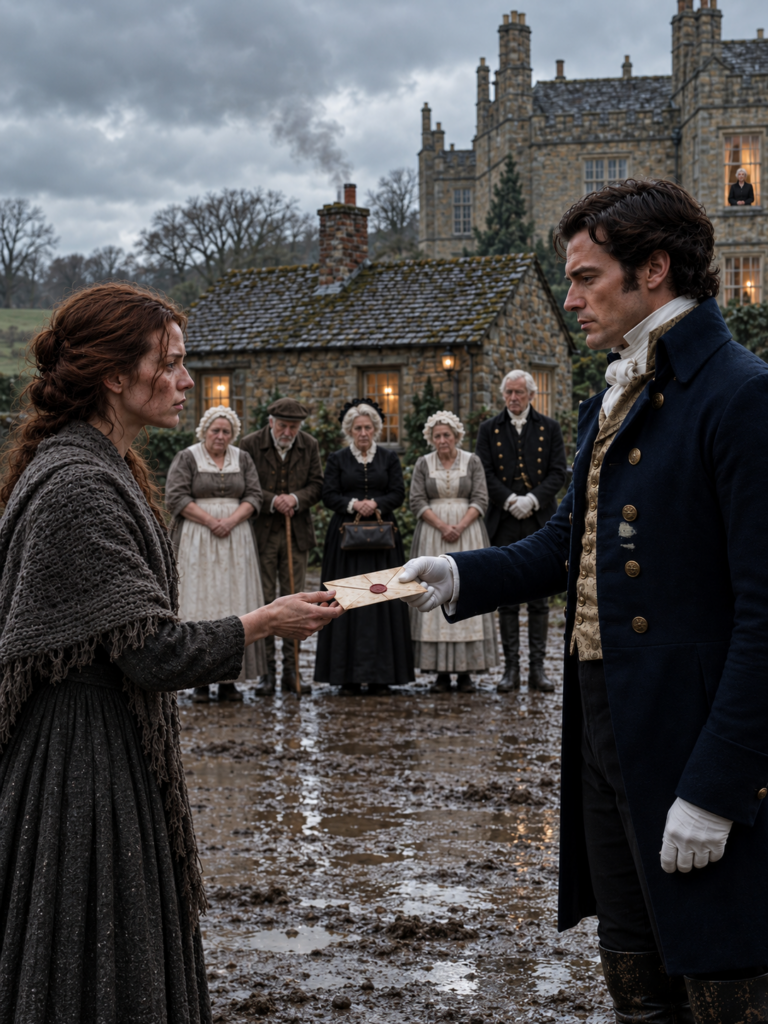
the wealthy heir dumped five aging workers on a grieving widow — by christmas his own mother refused to leave her little farmhouse
Part 1
The morning Thomas Caldwell decided five old people were no longer worth feeding, rain had been falling over Virginia’s Blue Ridge foothills since before dawn.
It was the kind of November rain that found every split in a barn roof and every worn seam in a coat. It turned the red clay lane below Caldwell House into a slick ribbon of mud and left the bare apple trees dripping like they were grieving too.
Kate Rowley knew something about grief.
Four days earlier, she had buried her husband, Samuel, beneath a white oak on the church hill outside Mill Creek.
Now, at forty-six years old, she stood at the rear steps of Caldwell House holding Samuel’s ring of gardening keys in one hand and wearing the same brown work boots she had worn to the cemetery. Clay from his grave still clung to the leather around the heels.
She had come to return the keys.
Instead, she found five elderly estate workers standing in the rain beside everything they owned.
Mrs. Ada Twigg, the seventy-two-year-old cook, had one dented tin trunk.
Walter Doggett, the old driver, leaned on a hickory cane beside two cardboard boxes tied with twine.
Martha Dole, who had cared for Mrs. Caldwell for nearly thirty years, held a faded leather suitcase against her chest.
Bess Turner, the laundress, carried a flour sack full of clothing.
And Eli Booker, once the tallest and strongest houseman on the estate, stood rigid beneath the rain with an old Army duffel bag at his feet.
All five had served the Caldwell family longer than Thomas Caldwell had been alive.
Now Thomas’s new estate manager, Charles Cheever, stood beneath the dry portico and read their dismissal from a sheet of cream-colored paper.
“Mr. Caldwell has decided to reorganize the household,” he said.
Mrs. Twigg stared at him.
“Reorganize?”
Cheever did not blink.
“Your positions have been eliminated.”
Walter lifted his face.
“The old Mr. Caldwell promised us pensions.”
“That arrangement was never formally executed.”
“He promised twelve dollars a month,” Bess said.
Cheever folded the paper.
“Mr. Caldwell is not responsible for informal promises made by his father.”
Mrs. Twigg’s mouth began to tremble.
She had baked Thomas Caldwell’s birthday cakes when he was a boy.
She had sat up with him through scarlet fever.
She had packed his lunches when he left for boarding school.
Now Cheever nudged her tin trunk toward the steps with his polished shoe.
The trunk slipped.
It struck the back of her knees.
Mrs. Twigg went down.
Kate dropped Samuel’s keys and caught her before the old woman’s head hit the stone.
The cook weighed almost nothing.
That frightened Kate more than the fall.
“Easy,” Kate whispered.
Mrs. Twigg grabbed her arm.
“I’m all right.”
She wasn’t.
None of them were.
The cruelty of the dismissal—and the way people who had spent decades serving the household were discarded as though they were broken furniture—formed the central injustice of what followed.
Kate looked up at Cheever.
“Where are they supposed to go?”
“That is no longer an estate matter.”
Walter laughed once.
It was a dry sound.
“I got a daughter in Ohio I ain’t heard from since Roosevelt’s first term.”
Bess lowered her eyes.
Martha Dole said nothing at all.
Kate glanced toward the upper windows of Caldwell House.
The place rose above the wet lawn like a stone courthouse, three stories of gray limestone, white columns and black shutters. Samuel had spent eighteen years keeping its gardens alive.
Thomas Caldwell had inherited the property eleven months earlier.
Since then, everything had changed.
Old workers disappeared.
New men arrived from Richmond.
The kitchen accounts were cut.
The tenant farmers complained that Thomas had raised rents.
Even his widowed mother, Eleanor Caldwell, was rarely seen anymore.
Kate picked up Samuel’s keys.
“I came to return these.”
Cheever glanced at them.
“Yes. The new grounds superintendent arrived yesterday.”
Kate swallowed.
Samuel had been dead four days.
His replacement had arrived yesterday.
Cheever reached inside his coat.
“There is one other matter.”
Kate almost laughed.
Of course there was.
He handed her another paper.
“The gardener’s house you occupied with your husband belongs to the estate. Mr. Bennett requires it immediately.”
“I know.”
“There is, however, the old orchard cottage.”
Kate stared at him.
Nobody had lived in the orchard cottage in at least ten years.
The roof sagged.
The well rope had rotted.
Samuel once said raccoons had probably inherited it.
Cheever continued.
“Mr. Caldwell is prepared to allow you to occupy it without rent.”
Kate looked past him at the five people standing in the rain.
She already understood.
Cheever smiled faintly.
“In exchange, you will assume responsibility for these individuals.”
Mrs. Twigg stiffened.
“We ain’t livestock.”
“No one suggested you were.”
“That’s exactly what you suggested.”
Kate unfolded the paper.
Five names.
Five liabilities removed from Thomas Caldwell’s books.
She looked at Cheever.
“You’re giving me a ruined cottage because you don’t want to feed five people who gave their lives to this place.”
Cheever’s face remained calm.
“Mrs. Rowley, you have no income, no children, and no legal right to remain in your present residence. I suggest you consider the generosity of the arrangement.”
The words struck exactly where he intended.
No income.
No children.
No right.
Four days after Samuel’s funeral, Kate had not yet allowed herself to consider what came next.
For eighteen years her life had been built around Samuel.
Morning coffee at five.
Garden rounds by six.
Beans and cornbread at noon.
Samuel whistling while sharpening pruning shears.
His boots beside hers at the kitchen door.
His hand resting on her back while they washed dishes.
They had wanted children.
Three pregnancies.
Three losses.
Eventually they stopped talking about it.
Samuel used to tell her, “Just because a house is quiet doesn’t mean it isn’t a home.”
Now even that quiet house was being taken.
Kate looked at the five people.
Then at the rain.
Then at Cheever.
“Give me the key.”
He almost smiled.
“I thought you might see reason.”
“No.”
Kate took the orchard cottage key from his palm.
“I saw five people in the rain.”
She turned away.
By noon, they were walking down the muddy lane.
Kate carried Mrs. Twigg’s trunk.
Eli carried two boxes.
Martha and Bess walked together.
Walter came last, leaning heavily on his cane.
Halfway down the hill, Kate stopped.
Her chest had tightened without warning.
She looked down.
Rain had softened the cemetery clay on her boots.
A thin brown stream ran from one heel into the road.
Suddenly she saw Samuel’s coffin again.
The rope lowering it.
The pastor’s mouth moving.
The first shovelful of earth.
Kate could not breathe.
She bent forward.
Nobody spoke.
Then Mrs. Twigg stepped beside her.
The old woman placed one hand on Kate’s arm.
Nothing more.
After a minute, Kate straightened.
“I’m all right.”
Mrs. Twigg nodded.
“I know, honey.”
Kate wiped her face even though she had not cried.
“Let’s keep moving.”
The orchard cottage appeared beyond an abandoned apple grove.
It was worse than Kate remembered.
The roof dipped in the center.
One shutter hung by a single hinge.
A front window was broken.
Moss covered the steps.
Inside, the smell of damp earth and mouse droppings filled every room.
Bess opened a cupboard.
Something small and gray ran across the shelf.
She slammed it shut.
“Well,” she said, “we’ve got company.”
Walter inspected the chimney.
Eli pressed one hand against the wall.
Mrs. Twigg opened the old iron stove.
A bird’s nest filled the flue.
Martha looked at Kate.
“We can leave.”
Kate stared at her.
“Where?”
Martha did not answer.
That evening they made one fire in the least damaged room.
Walter slept on an old cot they found in a shed because his back would not tolerate the floor.
Everyone else spread blankets over straw.
Rain dripped into two pots beside the wall.
Nobody had eaten since breakfast.
Mrs. Twigg found three potatoes in her trunk.
Kate had cornmeal.
Bess had half an onion.
Mrs. Twigg made soup so thin they could see the bottom of their bowls.
Still, she divided it evenly.
Afterward, one by one, the old workers went to sleep.
Kate lay awake.
The fire settled.
Rain tapped against the broken pane.
She reached into her coat and touched Samuel’s pocket watch.
He had wound it every night for twenty-one years.
Tick.
Tick.
Tick.
That tiny sound broke something inside her.
Kate rolled toward the wall and pressed her fist against her mouth.
She cried for Samuel.
For the babies they never raised.
For the home she had lost.
For the frightening emptiness ahead.
She cried as quietly as she could.
Then the straw beside her shifted.
Mrs. Twigg lowered herself painfully to the floor.
The old cook wrapped one arm around Kate.
Neither woman said anything.
Kate eventually slept.
At dawn, she woke to hammering.
She sat up.
Eli was already boarding the broken window.
Bess had hauled buckets from the creek.
Walter was repairing a chair.
Martha swept the floor.
Mrs. Twigg stood at the stove trying to clean twenty years of soot from the iron.
Kate stared at them.
Walter looked over.
“Morning.”
“What are you doing?”
He shrugged.
“Living.”
And for the first time since Samuel died, Kate got up because there was work waiting.
Part 2
The first thing Bess Turner repaired was the wash copper.
It sat inside a lean-to behind the kitchen, green with corrosion and filled with leaves, dead insects and one unfortunate mouse.
Bess rolled up her sleeves.
Her hands were swollen from forty years of scrubbing sheets, uniforms, tablecloths and linens for other people.
“Need vinegar,” she said.
Kate found half a bottle.
“Need ash.”
Eli brought some.
“Need sand.”
Walter gathered it from the creek.
Bess spent nearly two days scrubbing.
When she finished, the copper shone.
She stepped back with both hands on her hips.
“There.”
Mrs. Twigg grinned.
“There what?”
“There ain’t nobody calling me homeless while I got a clean wash pot.”
Kate laughed.
It surprised her.
The sound felt rusty.
But it was real.
They started repairing the cottage one problem at a time.
Eli patched the roof with salvaged tin and cedar shakes.
Walter repaired the well crank.
Martha sewed curtains from flour sacks.
Bess washed every blanket they owned.
Mrs. Twigg attacked the stove.
Kate worked outside.
Samuel had taught her nearly everything he knew.
How to judge soil by rolling it between finger and thumb.
How to prune an apple branch without inviting rot.
How to protect winter greens beneath straw.
How to sharpen a shovel until it sliced roots cleanly.
She dug until her shoulders burned.
The old orchard had gone wild, but beneath the weeds she found black soil.
Samuel had once planted there.
Kate could tell from the spacing.
“Still helping me,” she whispered.
She found seed packets in his coat.
Turnips.
Kale.
Mustard greens.
Winter onions.
His handwriting labeled each envelope.
Kate sat on the garden path holding them.
The grief came quietly this time.
Not like drowning.
Like rain.
She planted every seed.
A week later, Mrs. Twigg succeeded in cleaning the brick oven.
The first loaves came out one cold morning in late November.
Six of them.
Brown.
Crusted.
Hot enough to burn fingers.
The smell filled the cottage.
Kate closed her eyes.
Fresh bread.
Wood smoke.
Coffee.
For one brief second, it smelled like home.
Mrs. Twigg noticed.
“You all right?”
Kate nodded.
“Yes.”
The old cook cut the first loaf.
“No plates.”
Walter said, “Luxury makes people soft.”
They tore the bread with their hands.
Nobody said grace.
Nobody needed to.
Three days later, Kate went into Mill Creek for flour.
She had begun earning a few dollars washing linens with Bess and selling Mrs. Twigg’s bread.
The arrangement was barely enough to keep them fed.
Word had spread anyway.
People noticed things in small towns.
Especially things involving the rich.
Kate had nearly reached the general store when Louise Barber called from the porch of the Mill Creek Hotel.
“Well, look who’s here.”
Kate kept walking.
Louise raised her voice.
“How’s the old folks’ orphanage?”
Several men sitting outside turned.
One laughed.
Another said, “Heard Caldwell gave her five mouths and a leaky roof.”
Louise smiled.
“What do you feed them, Kate? Grass?”
More laughter.
Kate’s face burned.
She entered the store without answering.
Mr. Jenkins behind the counter said nothing about the laughter.
He simply placed an extra bag of flour beside her order.
“I didn’t ask for that.”
“I know.”
“I can’t pay for it.”
“I know that too.”
Kate looked at him.
He pretended to study an invoice.
“My wife says Mrs. Twigg’s bread is better than mine.”
From the back room, Mrs. Jenkins shouted, “I said no such thing.”
Mr. Jenkins lowered his voice.
“She did.”
Kate smiled.
She carried the flour home.
When she reached the orchard wall, she stopped.
Eli was on the roof.
Walter steadied the ladder.
Martha stood below holding nails in a coffee tin.
The damaged section had been completely replaced.
That night another storm came.
Rain hammered the roof.
Kate lay awake listening.
Not one drop entered.
At breakfast, Mrs. Twigg looked upward.
“Best sound I ever heard.”
“What?”
“Rain that stays outside.”
They laughed.
Two weeks passed.
Then one evening, just after dark, someone knocked.
Kate opened the door.
An elderly woman stood outside wearing a black wool coat.
Her gray hair had escaped its pins.
Mud covered her shoes.
Kate recognized her immediately.
Eleanor Caldwell.
Thomas Caldwell’s mother.
The seventy-three-year-old widow who had once presided over Caldwell House dinners for senators, judges and railroad executives now stood shivering on Kate’s doorstep.
Behind Kate, Martha gasped.
“Mrs. Caldwell.”
Eleanor looked past Kate.
“Martha?”
Martha’s sewing fell to the floor.
The two women stared at each other.
Eleanor entered.
Mrs. Twigg brought coffee.
Bess placed a blanket around her shoulders.
Eleanor noticed the patched walls.
The mismatched chairs.
Walter’s cot.
The straw mattress near the stove.
Then her eyes moved slowly from one face to another.
“I was told you had retired.”
Silence.
Eleanor looked at Martha.
“Thomas said pensions had been arranged.”
Martha lowered her eyes.
“No, ma’am.”
Eleanor went still.
“Your pension?”
“Stopped.”
“All of you?”
Mrs. Twigg nodded.
Eleanor looked horrified.
“My husband promised.”
Walter spoke from his chair.
“Promises aren’t worth much once the man who made them is underground.”
“Walter.”
“Sorry, ma’am.”
“No.”
Eleanor stared into the fire.
“Don’t apologize.”
She stayed two hours.
Before leaving, she took Kate aside.
“I have no money of my own anymore.”
Kate frowned.
Eleanor gave a humorless smile.
“Imagine that. I lived in that house forty-six years and apparently own nothing in it.”
“What happened?”
“Thomas handles the accounts.”
She looked toward the hill.
“My rooms were moved to the north wing. He says the main rooms are needed for guests.”
Kate understood.
“And your maid?”
“Dismissed.”
Eleanor looked at Martha.
“I thought she had chosen to leave.”
Martha’s eyes filled.
“I would never.”
“I know that now.”
Eleanor buttoned her coat.
“May I come again?”
Kate answered immediately.
“You don’t have to ask.”
After that, Eleanor came every Thursday.
She used an old garden path so Cheever would not see.
At first she sat formally.
Back straight.
Hands folded.
Within three weeks she was peeling potatoes.
Then shelling beans.
Then helping Martha mend shirts.
One evening Walter told a story about Eleanor’s late husband driving a Ford into a creek in 1904.
Eleanor laughed so hard she cried.
When she recovered, she wiped her eyes.
“Forty-six years at Caldwell House,” she said, “and nobody ever let me peel a potato.”
Mrs. Twigg handed her another.
“You’ve got forty-six years to make up for.”
The cottage changed.
Not because there was money.
There wasn’t.
But it became alive.
Neighbors began stopping.
Mr. Jenkins bought bread.
A farmer paid Walter to repair harnesses.
Bess took washing.
Martha did alterations.
Eli repaired chairs and farm tools.
Kate grew greens.
They put every dollar in a coffee tin on the mantel.
For the first time since Samuel died, Kate stopped measuring days by what she had lost.
Then Charles Cheever arrived.
He stood at the gate on a cold December morning.
“Mrs. Rowley.”
Kate continued splitting kindling.
“What?”
“Mr. Caldwell is aware his mother has been visiting.”
Kate raised the ax.
“Is visiting people against the law now?”
“He considers these walks unsafe.”
“She seems capable of choosing where she walks.”
Cheever’s mouth tightened.
“The garden gate will remain locked.”
Kate set another log on the stump.
“Anything else?”
Cheever glanced toward the woodpile.
Eli and Walter had spent weeks gathering dead branches.
“That timber belongs to the Caldwell estate.”
Kate stared at him.
“Deadfall?”
“Yes.”
“It was rotting.”
“Nevertheless.”
That afternoon, a truck came.
Two estate men loaded every piece of wood.
Walter watched silently.
Eli’s jaw flexed.
Kate stood at the gate as the truck drove away.
Mrs. Twigg came beside her.
“What kind of man takes firewood from old people in December?”
Kate looked toward Caldwell House.
“The kind who doesn’t have to feel the cold.”
Four nights later, the temperature dropped below fifteen degrees.
Walter’s cough worsened.
Bess’s hands split until they bled.
Eli woke unable to straighten his fingers.
The cottage consumed the last wood.
Kate stared at the dead stove.
Then she looked at Samuel’s watch.
She walked into Mill Creek the next morning.
A pawnshop gave her eleven dollars.
It was worth more than twice that.
Kate knew it.
She took the money anyway.
She bought coal.
Flour.
Medicine.
Hand salve.
When the wagon delivered the coal, Mrs. Twigg watched Kate.
“What did you sell?”
“Nothing important.”
Mrs. Twigg’s eyes moved to the empty nail above Kate’s bed.
“Oh, honey.”
Kate turned away.
Samuel’s watch was gone.
But that night six people slept warm.
And Kate told herself Samuel would understand.
Part 3
Snow began falling on December fifteenth.
At first it came lightly.
Then the wind shifted.
By sunset, the mountains disappeared.
By morning, drifts covered the fences.
By the third day, Mill Creek was almost completely cut off.
Kate shoveled a narrow path from the cottage to the well.
Eli cleared snow from the chimney.
Walter’s cough rattled.
Mrs. Twigg rationed flour.
They had enough coal for perhaps ten days.
They would make it.
Barely.
What worried Martha was Eleanor.
Thursday came.
She did not appear.
“She wouldn’t come through this,” Kate said.
Martha stood at the window.
“Maybe.”
Friday passed.
Saturday.
Martha became quieter.
On Sunday evening she said, “Her light’s out.”
Kate looked up.
“What?”
“Mrs. Caldwell always sleeps with a lamp.”
“How can you see from here?”
Martha pointed.
Through bare branches, a portion of Caldwell House was visible.
One upstairs window faced the cottage.
Dark.
“She has feared darkness since she was a girl,” Martha said. “Never sleeps without a lamp.”
Kate stared at the black window.
“How long?”
“Three nights.”
Walter looked up.
Nobody spoke.
Kate reached for her coat.
Martha stood.
“I’m coming.”
The snow reached Kate’s knees in places.
They carried a kerosene lantern.
The main garden gate was locked.
Cheever had kept his promise.
Martha led Kate around the wall.
“There’s an old laundry entrance.”
“You have a key?”
“I worked there thirty-one years.”
The door opened.
Inside, Caldwell House was colder than Kate expected.
Most of the household had traveled to Richmond with Thomas for the holidays.
Only three employees remained.
Apparently none had checked the north wing.
Kate and Martha climbed the back stairs.
The air became colder.
At Eleanor’s door, Martha knocked.
No answer.
She entered.
The fireplace was dead.
Ice had formed inside the water pitcher.
Eleanor lay beneath two blankets.
“Miz Caldwell?”
Martha hurried forward.
Eleanor’s eyes opened.
Barely.
Her face burned with fever.
“I rang,” she whispered.
Martha took her hand.
“When?”
“Yesterday.”
She looked confused.
“Or before.”
Kate touched Eleanor’s forehead.
Hot.
Far too hot.
“Where’s everybody?”
Eleanor’s lips trembled.
“Nobody comes.”
Kate felt anger rise in her chest.
She forced it down.
Anger could wait.
Survival couldn’t.
“We need to get her downstairs.”
Martha looked at Kate.
“How?”
Kate stared at Eleanor.
Then she remembered something Walter had mentioned.
The old carriage house.
The sedan chair.
A relic from Eleanor’s grandmother.
Kate turned.
“Stay with her.”
She ran.
Crossing the grounds took twenty minutes.
Twice she fell.
By the time she reached the cottage, her lungs felt torn.
Eli caught her at the door.
“What happened?”
“Mrs. Caldwell’s sick.”
The room went silent.
“She is alone up there.”
Walter pushed himself upright.
Mrs. Twigg removed her apron.
Kate said, “We need the old carrying chair from the carriage house.”
Walter grabbed his cane.
“I know where it is.”
“You can’t walk up that hill.”
“Watch me.”
“Walter—”
“I drove that woman around this county thirty-eight years.”
He pulled on his coat.
“You think I’m sitting here?”
Nobody stayed behind except Mrs. Twigg and Bess.
Mrs. Twigg filled a pot with broth.
Bess heated bricks.
Eli and Kate retrieved the old chair.
Snow had blown under the carriage-house door.
The chair was heavy oak with iron handles.
Eli lifted the front.
Kate took the rear.
Walter carried the lantern.
It took nearly an hour to reach the north wing.
Eleanor was barely conscious.
They wrapped her in blankets.
Martha whispered, “We’re taking you someplace warm.”
Eleanor murmured something.
“What?”
“My son…”
Kate thought she was asking for Thomas.
Then Eleanor opened her eyes.
“Don’t tell Thomas.”
Kate stared.
“Why?”
“He’ll make me stay.”
Kate looked at Martha.
Martha’s expression answered.
They carried Eleanor outside.
The trip downhill became the hardest physical thing Kate had ever done.
Snow dragged at her legs.
The chair pulled at her shoulders.
Her gloves soaked through.
Halfway down the terrace steps, her boot slipped.
She fell hard.
The chair lurched.
Eli held it.
“Kate!”
“Don’t drop her.”
“You hurt?”
“I said don’t drop her.”
Kate stood.
Pain shot from her knee to her hip.
She gripped the handles.
They continued.
Ahead, Walter stumbled.
He fell.
His lantern disappeared into the snow.
Eli shouted.
Walter rose before anyone reached him.
“Keep going.”
“You’re bleeding.”
“Keep going.”
His nose ran red over his lip.
He wiped it with his sleeve.
Every few steps he called toward the chair.
“Nearly there, Mrs. Caldwell.”
Then again.
“Nearly there.”
Finally Kate saw the cottage.
One window glowing.
Mrs. Twigg opened the door.
Heat rolled into the night.
Broth.
Coal smoke.
Bread.
They carried Eleanor inside.
They gave her Kate’s bed.
Bess packed heated bricks around her feet.
Martha changed her wet clothes.
Mrs. Twigg spooned broth between her lips.
Kate stayed beside the stove feeding coal carefully.
The fever worsened near midnight.
They had no doctor.
The road was blocked.
Walter said the county physician might reach them by morning if somebody could get to the telephone at Jenkins’s store.
“I’ll go,” Eli said.
Kate stopped him.
“You carried that chair.”
“So did you.”
“You’re seventy.”
“Sixty-eight.”
“That’s not helping your argument.”
Eli almost smiled.
Walter said, “I’ll—”
Five voices answered.
“No.”
Before dawn, the fever broke.
Eleanor finally slept.
Everyone else collapsed where they sat.
Kate woke near ten.
Sunlight filled the cottage.
The storm had passed.
Outside, snow covered the orchard.
Eleanor was awake.
She looked around.
At Mrs. Twigg.
Walter.
Martha.
Bess.
Eli.
Then Kate.
“What room is this?”
“Mine.”
“You carried me here.”
“We all did.”
Eleanor closed her eyes.
A tear moved toward her ear.
“I thought I was going to die in that room.”
Nobody answered.
She looked at Kate.
“I am not going back.”
Kate leaned closer.
“You needn’t decide anything today.”
“I have decided.”
“Thomas will object.”
Eleanor’s voice strengthened.
“Thomas has objected to most things I’ve enjoyed for the last year.”
Mrs. Twigg coughed into her hand to hide a laugh.
Eleanor looked toward her.
“You laugh, Ada. I deserve it.”
“No, ma’am.”
“Yes, you do.”
Eleanor pushed herself higher.
“If you will have me, Kate, I would like to stay.”
Kate stared at her.
“You understand there are already six people in three rooms.”
“I understand.”
“You’ll hear Walter cough.”
“Have for thirty years.”
“Eli snores.”
Eli looked offended.
Martha said, “He does.”
“Traitor.”
Eleanor smiled.
“And Mrs. Twigg orders everybody around.”
“I do not.”
Five people looked at her.
She sighed.
“Fine.”
Kate felt something warm inside her chest.
Not happiness exactly.
Something steadier.
Belonging.
“You can stay.”
Eleanor reached for her hand.
“Thank you.”
Three days later, an estate worker delivered one trunk containing Eleanor’s clothes, Bible, photographs and a framed portrait of her husband.
No message from Thomas.
Christmas Eve approached.
Inside the cottage, Mrs. Twigg started preparing a meal from whatever she could gather.
Mr. Jenkins sent a ham.
The Baptist church sent potatoes.
A farmer down the road brought apples.
Someone left coffee at the gate.
Louise Barber—the woman who had mocked Kate in town—sent a jar of preserves without a note.
Even shame, Kate thought, could sometimes become kindness if given time.
On December twenty-fourth, the sound of a motor came from the lane.
Walter looked through the window.
“Car.”
Martha went pale.
Kate already knew.
A black Packard stopped beyond the drift.
A tall man stepped out.
Thomas Caldwell.
He walked alone toward the cottage.
And for the first time since this began, he removed his hat before knocking.
Part 4
Kate opened the door.
Thomas Caldwell stood on the step holding his hat in both hands.
Snow melted across the shoulders of his expensive coat.
“Mrs. Rowley.”
“Mr. Caldwell.”
“I came for my mother.”
Kate said nothing.
Behind her, silverware stopped moving.
Everyone had heard.
Thomas looked past her.
“May I come inside?”
Kate stepped aside.
He entered.
The ceiling was so low he nearly struck his head.
For several seconds, Thomas simply stared.
The cottage he had considered worthless had changed.
The broken window held new glass.
The walls were whitewashed.
Copper pans shone near the stove.
Three stockings hung from a shelf because Mrs. Twigg had found red cloth somewhere and insisted Christmas required stockings even if the people receiving them were seventy years old.
The long table was set for dinner.
And at its head sat Eleanor Caldwell.
Her color had returned.
A knitted shawl covered her shoulders.
She looked warmer than Thomas had seen her in months.
“Mother.”
Eleanor continued buttering a biscuit.
“Thomas.”
“The car is outside.”
“I heard it.”
“I came to take you home.”
Eleanor looked around.
“I am home.”
Thomas’s jaw tightened.
“Mother.”
“Don’t use that tone with me.”
Kate saw the boy in his face then.
Not the landowner.
Not the man who signed papers.
A son being corrected by his mother.
Thomas lowered his voice.
“Your rooms are ready.”
“My rooms were ready before.”
He looked confused.
Eleanor set down her knife.
“I lay sick for three days in those rooms.”
Thomas’s expression changed.
“What?”
“I rang.”
He stared at Cheever’s former maid—Martha.
Martha met his gaze.
“No one came.”
“That isn’t possible.”
Eleanor’s eyes hardened.
“That sentence is why this happened.”
Thomas looked at her.
“You believe unpleasant things become impossible merely because you didn’t know about them.”
He opened his mouth.
She continued.
“You didn’t know Ada lost her pension.”
Thomas looked toward Mrs. Twigg.
“You didn’t know Walter had nowhere to live.”
His eyes moved.
“You didn’t know Bess’s hands were bleeding from cold.”
Bess folded them in her lap.
“You didn’t know Eli repaired this roof with scrap.”
Thomas stared at the ceiling.
“You didn’t know Kate sold her dead husband’s watch to buy coal after your manager took their wood.”
That struck him.
Thomas turned toward Kate.
“What?”
Kate said nothing.
Eleanor continued.
“You didn’t know I was cold.”
Thomas looked at his mother.
“That was Cheever’s responsibility.”
“No.”
The word cracked through the room.
“It was yours.”
Silence.
Thomas lowered his head.
For the first time, Kate saw embarrassment.
Real embarrassment.
Not anger at being challenged.
Shame.
He looked at Mrs. Twigg.
“I was told the household changes were necessary.”
Mrs. Twigg folded her hands.
Thomas swallowed.
“I should have asked what they meant.”
Nobody rescued him from the silence.
Finally Walter spoke.
“Your father would’ve asked.”
Thomas flinched.
Walter immediately looked down.
“Sorry.”
Thomas shook his head.
“No. You’re right.”
He walked toward the stove.
He held his hands near the heat.
Perhaps he was remembering the enormous fireplaces at Caldwell House.
Perhaps he was wondering why six people in a ruined cottage had managed to create warmth while his own mother nearly froze beneath his roof.
“I have made mistakes,” he said.
Kate’s voice remained calm.
“That’s a comfortable word.”
Thomas turned.
“What would you call them?”
“Choices.”
He nodded slowly.
“Fair enough.”
Mrs. Twigg placed a platter on the table.
“You staying?”
Everyone looked at her.
Thomas blinked.
“Excuse me?”
“Dinner.”
Eleanor almost smiled.
Thomas looked at Kate.
She shrugged.
“Your mother lives here. She can invite people.”
Eleanor said, “Sit down.”
There was only one seat left.
A low stool near the stove.
Thomas Caldwell, owner of thousands of acres, sat with his knees almost at his chest.
Walter stared at him.
Thomas stared back.
Walter began laughing.
Then Eli.
Then Bess.
Finally Eleanor.
Even Thomas smiled.
But the hardest conversation was still ahead.
After dinner, Thomas asked Kate to walk outside.
Snow reflected moonlight across the orchard.
For a while they stood beside the fence.
Thomas spoke first.
“I found out about the wood.”
Kate waited.
“Cheever told me he removed stolen property.”
“Dead branches.”
“Yes.”
Thomas exhaled.
“He has been dismissed.”
“That helps you.”
Thomas looked at her.
“You don’t believe people can change?”
“I believe people change when staying the same costs more.”
He absorbed that.
“Then perhaps this cost enough.”
Kate looked toward the cottage.
“What happens to them?”
“Pensions will be restored.”
“For how long?”
“For life.”
“Paper?”
He nodded.
“Paper.”
“And Eleanor?”
“My mother can live wherever she wishes.”
Kate studied him.
“You mean that?”
“I do.”
She looked back toward the cottage.
“Then tell her yourself.”
Thomas hesitated.
“There is another thing.”
“What?”
“My father kept an account book.”
Kate waited.
Thomas stared at the orchard.
“I found it this afternoon after asking the attorney about the pensions.”
“And?”
“He owed Samuel money.”
Kate’s breathing stopped.
“What?”
“Samuel paid for repairs to three tenant houses during the flood four years ago. My father intended to reimburse him after harvest.”
Kate remembered.
Samuel had emptied part of their savings.
He told her the tenants had children and couldn’t sleep beneath leaking roofs.
Later, when she asked whether Caldwell had repaid him, Samuel said, “We’ll settle eventually.”
Then the old Mr. Caldwell suffered a stroke.
Everyone forgot.
Everyone except Samuel.
“How much?”
Thomas told her.
Kate stared at him.
It was enough to have kept her in their original cottage for years.
“Why didn’t Samuel tell me?”
Thomas looked down.
“Perhaps he expected my father to keep his word.”
Kate laughed once.
A bitter sound.
“Promises again.”
Thomas reached inside his coat.
He held out an envelope.
Kate did not take it.
“What is that?”
“The debt. With interest.”
She stared at the envelope.
Then at him.
“This isn’t charity.”
“I know.”
“Don’t ever tell anyone you saved me.”
“I won’t.”
“Samuel earned that money.”
“Yes.”
Only then did she take it.
Her fingers trembled.
For a moment she could almost hear the watch ticking.
Samuel had not left her nothing.
He had left decency behind him.
A debt created because he helped families whose roofs leaked.
Even dead, the man was still bringing people shelter.
Kate looked away.
Thomas said quietly, “I’m sorry.”
This time she believed him.
Not because the words were different.
Because he no longer seemed to expect forgiveness in return.
From the cottage, Eleanor called.
“Thomas!”
He closed his eyes.
Kate almost smiled.
“You’d better go.”
“What?”
“Your mother.”
He looked toward the window.
“What does she want?”
“You’re forty-two years old. Figure it out.”
He laughed.
It might have been the first genuine laugh she had heard from him.
They went inside.
Eleanor handed her son a carving knife.
“You made a disgrace of the ham.”
“I’ve never carved a ham.”
“Obviously.”
Mrs. Twigg moved his hand.
“Against the grain.”
Thomas obeyed.
Nobody praised him.
Nobody needed to.
Sometimes becoming decent began with accepting instruction from people you once considered beneath you.
Later, after Thomas left for the night, Kate opened the envelope.
The amount made her sit down.
Martha looked over her shoulder.
“My goodness.”
Mrs. Twigg said, “You can go anywhere now.”
Kate looked around the cottage.
At Walter asleep beside the stove.
At Bess rubbing salve into her hands.
At Eli fixing a loose chair rung even on Christmas Eve.
At Eleanor reading her Bible near the window.
At Mrs. Twigg flouring a breadboard.
Go anywhere.
Kate realized the words no longer carried the freedom they once would have.
Because somewhere between grief and cold, between soup made from three potatoes and carrying Eleanor through a snowstorm, something had happened.
She had stopped living in a place somebody allowed her to occupy.
She had built a home.
“No,” Kate said.
Mrs. Twigg frowned.
“No what?”
“I’m not going anywhere.”
The cook smiled.
“Good.”
Part 5
Christmas morning broke clear and blue.
Sunlight struck the snow until the whole orchard glittered.
Smoke rose straight from the cottage chimney.
Inside, Mrs. Twigg had been awake since four.
By eight, the kitchen smelled of ham, biscuits, baked apples and coffee.
Walter had shaved.
Bess wore a blue dress Martha repaired for her.
Eli polished his shoes so thoroughly that Mrs. Twigg accused him of planning to propose marriage.
“To who?”
“You tell us.”
“Woman, I am sixty-eight years old.”
“That isn’t an answer.”
Eleanor sat in the warmest chair wearing a burgundy shawl.
Kate stood near the stove.
For the first time since Samuel died, she had worn the green dress he liked.
It felt strange.
She almost changed.
Then she imagined him saying, “Kate, grief doesn’t get to own all your good clothes.”
So she kept it on.
At ten, engines sounded outside.
Not one.
Three.
Walter went to the window.
“What in heaven?”
The first truck carried firewood.
The second carried coal.
The third held lumber, glass, roofing tin, insulation and paint.
Thomas arrived behind them.
Kate stepped onto the porch.
He approached.
“This is too much.”
“No.”
He handed her a folded document.
“This is yours.”
Kate opened it.
The orchard cottage.
Three acres.
The garden.
The well.
A strip of orchard reaching to the creek.
Deeded to Katherine Rowley.
She looked up.
“I didn’t ask for this.”
“I know.”
“Then why?”
Thomas glanced toward the cottage.
“Because my father taught me something I managed to forget.”
“What?”
“People who care for land become part of its history.”
Kate said nothing.
“And because,” he added, “nobody should be able to use your roof as leverage against your conscience again.”
That mattered more than the acreage.
Kate folded the deed.
“Thank you.”
Thomas nodded.
“There are also pension agreements for all five.”
Walter opened the door.
“You gonna stand there freezing or come inside?”
Thomas looked at Kate.
She stepped aside.
He entered.
At noon, they gathered around the table.
There were too many people now.
Mr. and Mrs. Jenkins arrived.
The pastor came.
Two tenant farmers brought pies.
Louise Barber appeared carrying preserves.
She avoided Kate’s eyes until finally approaching her near the stove.
“I behaved badly.”
Kate waited.
Louise twisted her gloves.
“I laughed because everybody else did.”
“I know.”
“That doesn’t make it better.”
“No.”
Louise looked embarrassed.
“My mother spent six years caring for my father after his stroke. People stopped visiting because being around sickness made them uncomfortable.”
Kate watched her.
“I should’ve known better.”
Kate took the jar.
“Come eat.”
Louise’s eyes filled.
“That’s it?”
“Would you rather I make a speech?”
Louise laughed.
“No.”
“Then come eat.”
By one o’clock, every chair was occupied.
Someone placed boards across crates to make benches.
Walter sat beside Eli.
Bess sat beside Martha.
Mrs. Twigg stood until Eleanor ordered her to sit.
Thomas took the low stool again.
Nobody offered him anything better.
He seemed to understand why.
Before they ate, Pastor Reynolds stood.
“I’d like to say grace.”
Mrs. Twigg whispered, “Food’s getting cold.”
The pastor smiled.
“I’ll be brief.”
Everyone bowed their heads.
Kate closed her eyes.
The prayer washed over her.
Thankfulness.
Shelter.
Mercy.
Those who were absent.
Those who had returned.
Those who had been given another chance.
Kate thought of Samuel.
She remembered his muddy boots beside the door.
His laugh.
The watch key turning every night.
The children they never held.
The ordinary mornings she had once believed would continue forever.
Grief came.
But this time grief did not empty the room.
It made the people around her more precious.
After dinner, Thomas stood.
He held a glass of cider.
Everyone quieted.
He looked at the five elderly workers.
“My father made each of you a promise.”
Walter watched him closely.
Thomas continued.
“I failed to honor it.”
He placed five envelopes on the table.
“These contain every missed payment, plus the first quarter of next year.”
Mrs. Twigg opened hers.
Her hands shook.
Bess covered her mouth.
Martha began crying.
Walter stared at the money without touching it.
Thomas looked at him.
“Mr. Doggett?”
Walter finally said, “Your daddy would be glad.”
Thomas swallowed.
“I hope so.”
Walter nodded.
“Don’t make him ashamed again.”
Thomas managed a small smile.
“No, sir.”
Then he turned to Kate.
“And Mrs. Rowley.”
Kate stiffened.
“I don’t need another envelope.”
“No.”
Thomas looked around the cottage.
“When I sent these people here, I believed I was getting rid of five obligations.”
Silence deepened.
“I was wrong.”
Mrs. Twigg nodded firmly.
“Yes, you were.”
A few people laughed.
Thomas smiled.
“I gave away the people who remembered my family before money made us forget ourselves.”
He looked toward Eleanor.
“I nearly lost my mother because I paid more attention to accounts than to her.”
Eleanor’s expression softened.
“And I treated Mrs. Rowley’s kindness as something useful rather than something honorable.”
Kate felt uncomfortable under everyone’s eyes.
Thomas raised his glass.
“To Kate Rowley.”
Mrs. Twigg raised hers.
“To Kate.”
Then Walter.
Bess.
Martha.
Eli.
Eleanor.
Soon every glass was raised.
Kate shook her head.
“Stop that.”
Mrs. Twigg smiled.
“Too late.”
Kate looked around.
She had entered autumn believing she was alone.
No husband.
No children.
No house.
No income.
No plan.
Now a dozen people crowded around her table.
Someone had tracked mud across her clean floor.
Walter was arguing politics with the pastor.
Bess was cutting another pie.
Eli had fallen asleep sitting upright.
Martha was helping Eleanor with her shawl.
Thomas was being instructed by Mrs. Twigg on how to slice bread properly.
Kate started laughing.
Mrs. Twigg looked at her.
“What?”
“Nothing.”
“That isn’t a nothing laugh.”
Kate wiped her eyes.
“I just realized Samuel would hate how many people are in this kitchen.”
Mrs. Twigg laughed.
“He liked quiet?”
“No. He hated people touching his tools.”
Eli woke.
“I haven’t touched his tools.”
“You’ve used every one.”
“Borrowing isn’t touching.”
Everyone laughed.
Later, when the visitors left and evening settled over the snow, Thomas prepared to walk back up the hill.
Eleanor remained in her chair.
He kissed her cheek.
“Tomorrow?”
“If the weather holds.”
“I’ll come down.”
“You don’t need to ask permission.”
Thomas glanced toward Kate.
“I think I do.”
Kate smiled.
“Just knock.”
After he left, Kate stepped outside.
The air was bitter.
Stars filled the sky.
The cottage glowed behind her.
For a moment, she stood alone beneath the bare apple trees.
She reached into her pocket.
Something small touched her fingers.
Kate frowned.
She pulled it out.
Samuel’s silver watch.
She gasped.
“Mrs. Twigg!”
The cook opened the door.
“What?”
Kate held up the watch.
“How?”
Mrs. Twigg smiled.
“Christmas.”
“Who bought it?”
“No idea.”
“Don’t lie.”
“I’m seventy-two. I’ve earned the right.”
Kate went inside.
Everyone suddenly became fascinated by unrelated objects.
Walter studied his shoe.
Bess rearranged cups.
Eli inspected the ceiling.
Martha folded a napkin.
Eleanor read the same line of her Bible repeatedly.
Kate looked at them.
“You all did this.”
Nobody answered.
She opened the watch.
Tick.
Tick.
Tick.
She pressed it to her ear.
Samuel’s sound.
Her knees nearly weakened.
Mrs. Twigg came beside her.
“We found the pawnshop.”
Kate shook her head.
“You need the money.”
“So do you.”
“I got Samuel’s debt back.”
Mrs. Twigg took Kate’s face between both hands.
“Money ain’t the same thing.”
Kate’s eyes filled.
“You shouldn’t have.”
“Probably.”
Walter said, “Too late now.”
Kate laughed through tears.
She closed her hand around the watch.
That evening they sat by the stove until the coal burned low.
Nobody rushed to bed.
Outside, snow covered the orchard cottage that Thomas Caldwell had once considered worthless.
Inside were people the world had nearly decided were worthless too.
An aging cook.
A coughing driver.
A laundress with damaged hands.
A lady’s maid nobody needed anymore.
A former houseman whose strength had faded.
A wealthy widow forgotten by her own household.
And a childless woman who had buried the person she loved most and believed, for one terrible week, that her useful life had ended with his.
But usefulness was never the measure.
That was the lesson Kate finally understood.
People were not tools to be kept while sharp and discarded when worn.
They were stories.
Promises.
Memories.
Hands that had carried children.
Hands that had baked bread.
Hands that had driven through storms.
Hands that had washed sheets, planted gardens, repaired roofs, buried husbands and lifted sick women through the snow.
Hands deserved somewhere to rest.
By spring, the orchard cottage became known around Mill Creek simply as Rowley House.
Thomas paid to add two bedrooms, though Kate made him sign a paper saying the house still belonged entirely to her.
Mrs. Twigg ran the kitchen.
Walter began teaching a neighbor boy how to repair harnesses.
Bess took in laundry until Kate convinced her to reduce the workload.
Martha remained with Eleanor.
Eli planted fruit trees.
Kate expanded Samuel’s garden.
The first spring morning she saw green shoots rising from soil he had once worked, she knelt beside them.
She touched the earth.
“Still here,” she whispered.
She meant Samuel.
But perhaps she meant herself too.
Eleanor lived in the cottage for six more years.
Thomas visited every Sunday.
At first he came because guilt brought him.
Later he came because he wanted to.
The low stool remained his seat.
Even after Kate bought another chair.
When Walter died two winters later, Thomas helped carry the coffin.
When Mrs. Twigg’s hands became too arthritic to knead bread, Thomas hired a young woman from Mill Creek to help her—but only after Mrs. Twigg interviewed the girl and declared her “barely acceptable.”
When Bess could no longer manage stairs, Eli built a rail.
When Martha’s eyesight faded, Eleanor read aloud to her.
Nobody was thrown away again.
Years later, after Eleanor died peacefully in the little upstairs room warmed by the kitchen stove, Thomas stood beneath the apple trees beside Kate.
He was no longer the proud man who had once handed her five human lives as though transferring an expense.
Gray showed at his temples.
“My mother was happier here than she ever was at Caldwell House,” he said.
Kate looked toward the cottage.
“She felt needed.”
Thomas nodded.
“So did they.”
Kate corrected him.
“So did we.”
He smiled.
“Yes.”
Inside the kitchen, Samuel’s watch hung above the stove.
Still running.
And every Christmas, no matter how many years passed, Kate set one extra place at the long wooden table.
Not for a ghost.
Not exactly.
It was there as a reminder.
A person did not have to be wealthy, young, strong or useful to deserve a chair near the fire.
Sometimes the people everyone else had finished with were the very people who knew how to rebuild a home.
And sometimes what looked like the end of one family was only the beginning of another.

