
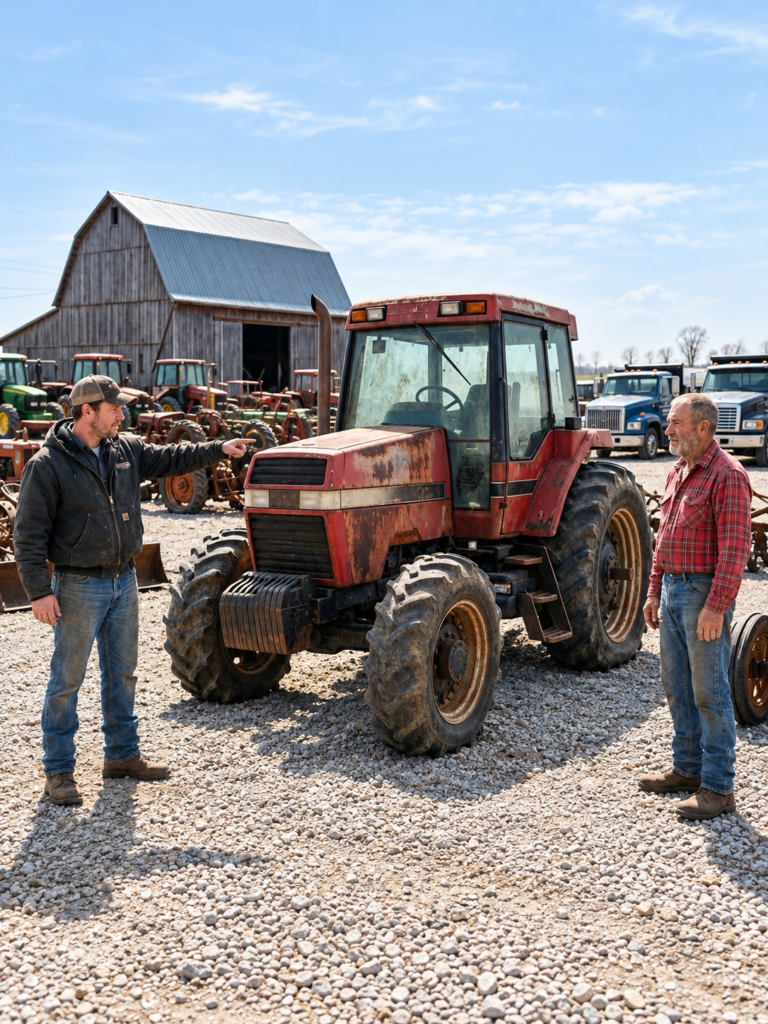
the rusted case ih magnum the dealer condemned for forty two thousand until a quiet kentucky farmer found the one note that told the whole truth
Part 1
The gravel lot behind the Harlan County auction barn sat under a gray March sky that never quite decided whether to rain. By nine-fifteen the serious buyers had already walked the rows, kicked the tires they meant to kick, and drifted toward the coffee urn inside the open shed. What remained outside was the machinery nobody had claimed in the first hour of looking.
At the far end of lot seven, set apart by thirty feet of crushed stone and the kind of unspoken agreement that keeps men from standing too close to trouble, sat a Case IH 7140 Magnum. Rust had bled down the hood past the grill and onto the front axle housing in thin orange fingers. The cab glass was fogged from the inside, the kind of trapped moisture that builds when a machine sits sealed and still for months. The left rear tire was low but not flat. Someone had wedged a piece of cardboard under the wiper blade: as is, no warranty, dealer inspected. The words looked less like information and more like a warning.
Dale Hutchens walked past it the first time without stopping. He was sixty-one, third-generation grain farmer, and he had been to enough auctions to know that the machines nobody stood near usually deserved the distance. His boots left wet prints on the gravel. He had come for a set of rear duals on a smaller John Deere that had already sold high, and for a grain cart he didn’t end up needing. He had cash in his pocket from last fall’s beans and no particular hunger for more work.
Still, something made him circle back. He stopped at the front of the tractor and looked at it the way a doctor looks at a patient—not at the obvious rust, but at what sat underneath it. The frame rails ran true. The front axle sat level. The rust was surface rust, the kind that comes from rain and neglect, not the kind that eats through steel until the machine folds. The hood, for all its corrosion on top, had not buckled or warped.
He stepped around to the driver’s side and climbed the two steps just high enough to peer through the cab door. The seat was cracked along the seam where the vinyl had dried. A water stain marked the headliner from a seal that had probably failed two winters ago. But the instrument cluster was intact. No cracked gauges. No missing switches. Everything sat where it belonged. Dale dropped back down onto the gravel and found the auction company’s field representative, a younger man in a Carhartt vest holding a clipboard and trying to look busy.
“What’s the story on the 7140?”
The rep didn’t look up right away. He found the sheet, scanned it, then read it like a sentence he had already said twenty times that morning. “Dealer inspected it six weeks ago. Transmission is gone. Hydraulics are failing. A control module keeps throwing fault codes they can’t clear. They quoted the owner forty-two thousand to do a full rebuild. Owner decided it wasn’t worth it, so here it is.”
Dale looked back at the tractor. Forty-two thousand. That was what the sheet said. As is, no warranty. Sold for parts or repair at buyer’s risk. The rep moved on. Dale stayed. He stood there for another two minutes, hands in his jacket pockets, just looking. A machine that a certified factory-trained dealership had looked at, diagnosed, priced, and effectively condemned. A machine that was about to sell for whatever a crowd of skeptical buyers would offer for scrap value and spare parts.
The bidding opened at four thousand. Three other bidders stayed in for a while, then dropped out without enthusiasm, the way bidding goes on something nobody really wants. Dale raised his card at six thousand. Nobody followed. Sixty-two hundred. Final. He owned it.
That was the moment everything changed, though he did not know it yet. He signed the paperwork, arranged a rented flatbed for that afternoon, and walked back to his truck with the title folded once and stuffed into his breast pocket. The wind picked up across the lot and carried the smell of diesel and wet metal. Somewhere behind him a man laughed at something the auctioneer said. Dale did not laugh. He stood by his truck and looked one more time at the Magnum sitting alone at the end of the row, and he thought of his father.
His father had taught him that a machine will tell you what is wrong with it if you are willing to be patient and honest about what you are seeing. On a farm that ran on margins thin enough to see through, calling a dealer was never a first move. It was a last resort, used only after everything else had failed, because every service call cost money the farm did not have in reserve. By the time Dale was in his thirties he had rebuilt two combine engines, not because he had formal training, but because he had factory service manuals, the right tools, and the stubbornness to read every page before he touched anything. He had rewired an entire grain dryer using a wiring diagram he had hand-copied from a manual at the county extension office. He had once diagnosed a hydraulic failure in a neighbor’s tractor that two separate dealerships had misidentified over the course of four months, each one recommending a more expensive repair than the last.
He did not distrust dealerships as a matter of principle. He distrusted bad diagnosis, regardless of who was delivering it. In his experience the problem with expensive quotes was rarely dishonesty. It was something more subtle and more common. A technician who had seen a long list of fault codes recognized the most expensive possibility on the list and stopped looking.
When the flatbed arrived late that afternoon, Dale helped the driver chain the Magnum down and followed it the twelve miles home along the county road. The tractor looked worse in motion, rocking slightly on the low tire, the fogged glass reflecting the gray sky. At the farm he backed it into the open end of the shop and shut off the truck. The Magnum sat there under the single row of shop lights, silent, the rust on the hood catching the light in dull patches. Dale stood with his hands on his hips and listened to the quiet. Outside, a dog barked once at something on the road and then stopped. He did not reach for a wrench. He did not start pulling panels or disconnecting lines. He climbed into the cab, turned the key to the run position, and sat quietly for a moment, listening to the systems cycle. Then he turned the key the rest of the way.
The engine turned over, rough, slightly reluctant, the idle uneven for the first thirty seconds, but it caught. It ran. The temperature gauge began to climb. Dale sat in the cracked seat and watched the gauges and said nothing, because a tractor with a genuinely failed powershift transmission and a dying control module does not usually start this cleanly. And that was the first thing, the very first thing, that did not add up.
Part 2
Dale spent the first two full days doing nothing but watching. No disassembly. No parts ordered. No conclusions reached. Just observation. The same kind of slow, methodical attention that his father had called letting the machine talk.
He ran the engine until operating temperature each morning. He engaged the PTO shaft and watched the response. He worked the hydraulic remotes through their full range. They were slow, unpredictable, surging in one detent position, weak in another, but they moved. The cylinders responded, sluggish and erratic, yes, but not dead. He put the tractor in gear. This was the moment the dealer’s diagnosis should have collapsed under its own weight. A powershift transmission that is gone, mechanically failed, clutch packs destroyed, internal components beyond use, does not move the machine. It slips and shudders and sits. What Dale experienced was different. The tractor crept forward in low range, ground harshly in mid ranges, refused to engage cleanly in the upper ranges, sluggish, grinding, miserable to operate, but it moved. That distinction between does not work and does not work correctly is the entire hinge of the story.
On the third day he pulled the diagnostic port cover from inside the cab and connected his code reader. It was an older unit, not dealership software, but it communicated with the Case IH system well enough to pull stored faults. He let it run through the full scan, writing each code on a yellow legal pad as it came up. Seventeen codes total. He numbered them and sat at his workbench with a Case IH diagnostic guide and went through them one by one.
Almost every fault on the list was a secondary fault, a downstream indicator, the kind of code that appears not because a component has catastrophically failed, but because a component is being deprived of something it needs to function. Pressure. Flow. Signal. Fluid. He circled four codes with a red pen. They were different codes, generated by different sensors in different parts of the system, but they all pointed, in different ways, to the same underlying variable: hydraulic pressure, specifically pressure in the transmission hydraulic circuit. He did not reach a conclusion. He just went and got a flashlight and opened the engine side panels.
The Case IH 7140 Magnum runs on a combined transmission and hydraulic system. A shared sump that feeds both the powershift transmission’s clutch packs and the external hydraulic circuit for the remotes, the hitch, and the steering assist. It is a common architecture in tractors of this era and it has one important implication. A problem anywhere in the shared fluid system can produce symptoms that appear to be coming from everywhere simultaneously.
Dale located the transmission/hydraulic fluid sight glass and checked the level. It was low. Not dramatically, not empty, but noticeably below the full mark. Approximately two quarts under specification. He noted it on his legal pad without drawing any conclusions because low fluid alone, two quarts low, does not account for seventeen fault codes. He drew a small sample from the sump using a clean baster and held the glass jar up to the light coming through the shop window. The color was wrong. Anyone who has worked with Case IH equipment for more than a few seasons knows what Hy-Tran fluid looks like. A specific amber red, almost translucent when clean, with a particular viscosity you can see when you tilt the jar. What Dale held up to the light was darker. Not drastically, not black, but unmistakably brownish with a murkiness that should not have been there and a faint surface sheen that caught the light in a way that fresh fluid never does.
He brought the jar to his nose. He set it down on the workbench. That was not Hy-Tran fluid. That was not any Case IH specified fluid. He couldn’t say yet exactly what it was, but he could say with certainty what it wasn’t. And what it wasn’t should have been the only thing in that sump.
The obvious move at this point is to say contaminated fluid. Pull it, flush it, refill it, see what happens. Dale resisted that move. Not because it was wrong, but because it was incomplete. He had learned, over the course of many years and many repairs, that contaminated fluid is always a symptom of a decision. Someone put something in that sump. The question that mattered was not just what was in there, but when it went in, how long it had been running through the system, and what it had done while it was there.
He pulled the transmission filter. The housing date stamp told him it had never been replaced. Not once in the life of this machine. On a tractor of this age with the hours showing on the dash, that was a serious lapse in maintenance by itself. But the filter media was the real document. The material caught in the filter was not just sediment or general contamination. At the bottom of the filter housing, in the accumulated material that had been captured over what appeared to be years of operation, there was a fine metallic residue, almost powdery, almost gray bronze, that Dale recognized immediately. Clutch material. Friction material from the powershift clutch packs, worn and suspended in the fluid as fine particles. The kind of debris that accumulates when clutch packs are slipping. Not slipping because they are mechanically destroyed, but slipping because they are not receiving the correct hydraulic pressure engagement or because the fluid surrounding them lacks the friction modifier chemistry needed for proper engagement and release.
Dale stood over that filter for a long time. He had the debris. He had the wrong fluid. He had the fault codes pointing to pressure. He had a transmission that moved but didn’t shift correctly. What he did not have yet was the explanation for how it got this way. A machine doesn’t fill its own sump with the wrong fluid. A machine doesn’t skip its own service intervals. Somewhere behind all of this was a series of human decisions. And he suspected the record of those decisions still existed somewhere.
He went back to the cab. The storage compartment behind the operator’s seat in an older 7140 is narrow and shallow. Just deep enough for a pair of gloves, a work light, a rain gauge, and whatever the operator wants within reach. Dale had opened it on day one. It was empty. He’d moved on. But on this second visit to the cab, something made him reach further. Not the compartment itself, but the corner of the compartment where the felt liner, the thin fabric covering the rear wall, had come loose from its adhesive and folded back on itself, creating a gap between the liner and the metal wall behind it. He reached into that gap. His fingers found the edge of something stiff. He worked it out carefully. A Manila envelope, standard size, slightly soft along one edge where moisture had reached it at some point. Not soaked, not destroyed, just touched by time. Inside, service records. Not dealership printouts, not digital logs, not anything official. These were handwritten records. A private operator’s maintenance log kept in a lined composition notebook that had been folded and tucked into the envelope along with several loose pages. The writing went back to 2009. Ten years of entries. Two distinct sets of handwriting that told, without meaning to, the story of a farm operation that had passed from one set of hands to another.
Dale sat down in that cracked seat in his dark shop, turned on the cab dome light, and read every single page.
Part 3
The first set of records was a portrait of a careful operator. Oil changes recorded to the hour. Transmission fluid changed on a strict interval with the correct Hy-Tran specification written out in full each time. Not abbreviated, not assumed, but written out as if the man keeping these records understood that someday someone else might read them and needed to know exactly what had been used. All filter replacements noted. Coolant checks. A 2013 entry about a replaced sensor. The same sensor code that appeared on Dale’s fault list. A 2014 note about unusual wear on the front drive shaft yoke. Inspected, greased, monitored. This was a man who treated a hundred-thousand-dollar piece of equipment like the investment it was.
Then, in the spring of 2016, the handwriting changed. The entries became shorter, less frequent. The time between recorded services stretched from three hundred hours to five hundred hours to, in one gap, over seven hundred hours with no recorded maintenance whatsoever. And then a single entry dated July 2016, written in the second hand, in handwriting that was hurried and slightly uncertain.
Fluid low on check. Added approximately three quarts. Used universal hydraulic. Didn’t have Hy-Tran on hand.
Three quarts of universal hydraulic fluid, not Hy-Tran. Not a Case IH approved equivalent. A generic universal fluid that lacks the specific friction modifier package that Hy-Tran contains. The chemistry that allows the wet clutch packs inside a powershift transmission to engage cleanly and release completely without glazing or slipping. Without those friction modifiers, wet clutches do exactly what Dale’s filter had already shown him. They begin to slip. The slipping generates heat. The heat degrades the fluid chemistry further. The degradation accelerates the slipping. The clutch material sheds into the fluid as fine particles. Those particles circulate through the entire shared hydraulic system, fouling valve bodies, contaminating solenoids, interfering with pressure sensor readings, triggering fault codes throughout the control module.
And the entries after July 2016 told the story of a machine in slow, progressive decline. Warm-up times getting longer. Notes like rough engagement in third and hitch acting up. Then, in the final entry from 2018, Dealer coming to look at it. Shifting bad in all ranges. Hydraulics not right. And that was where the records ended. Because the dealer came, connected their diagnostic software, read seventeen fault codes, assessed the worn clutch packs and contaminated fluid, and quoted forty-two thousand for a full transmission rebuild and hydraulic system overhaul. Nobody, not the new operator who had been running it, not the dealer’s technician, had traced the cascade of failures back to their actual origin point. A single maintenance entry. About a single decision made in thirty seconds on a hot July afternoon when the Hy-Tran wasn’t in the shed and the universal hydraulic was. Three quarts of the wrong fluid. Three years of slow destruction.
Dale sat in the cab with the notebook open across his knee and the dome light throwing a small circle of yellow onto the pages. Outside the shop the wind moved through the bare trees along the fence line. He could hear the soft ticking of the Magnum’s engine as it cooled. He thought of the careful first handwriting, the man who had written the full specification each time as if he expected someone else to read it someday. He thought of the second handwriting, hurried, the three quarts written down almost as an afterthought. He did not know either man. He did not need to. The pages told him what the machine had been trying to tell everyone else.
Once Dale understood what he was actually dealing with, the repair list assembled itself almost logically. He drained the entire transmission and hydraulic sump completely. Every drop of the contaminated mixture removed. He flushed the system twice with fresh Hy-Tran, running the engine briefly between flushes to circulate clean fluid through the lines and valve galleries, then draining again. Third fill with fresh fluid to operating level. Correct specification. New transmission filter. New hydraulic filter. Both housings cleaned and inspected before the new elements went in.
The valve body came out next. Under the bench light Dale could see varnish deposits. The kind of build-up that forms when degraded fluid bakes onto metal surfaces over time. He cleaned the valve body by hand, gallery by gallery, with the correct solvent and a set of small picks. No replacement needed. The aluminum was sound. Two solenoids from the transmission control circuit had been fouled by contaminated fluid. Their response times slow and inconsistent when Dale bench tested them. He cleaned both, tested them again, reinstalled them. Functioning correctly. One pressure sensor in the main hydraulic circuit had been sending erratic voltage readings, triggering three of the seventeen fault codes independently. The sensor itself, a small threaded unit that screws into the valve body, was available at the local dealership parts counter. And Dale almost appreciated the irony of walking into the same brand of dealership that had condemned the machine and buying a forty-seven-dollar part.
He reinstalled everything, checked fluid levels, cleared all stored fault codes. He climbed into the cab, settled into the cracked seat one more time, and turned the key. The engine came up clean. Temperature climbed smoothly. He let it warm up for ten minutes, watching the gauges, watching the transmission fluid temperature on the display. Then he put it in gear. The 7140 moved forward, cleanly, firmly, without grinding or hesitation. He shifted through the ranges. Every one engaged. Every one held. He took it out of the shop and drove it the length of his gravel lane in both directions, running through the full powershift range in both directions, working the hydraulic remotes against the loader bucket he’d hooked up for resistance. Everything worked.
Total parts, three hundred forty dollars. Fluid, two hundred ninety. Labor, his own time across twelve days. The dealership’s quote had been forty-two thousand.
Part 4
Dale Hutchens was not a man who made noise. He fixed the tractor. He put it to work. He planted that fall with it. And then he harvested. And the machine ran without complaint through both seasons. But farming communities are small, and word moves through them the way water moves through soil. Slowly, invisibly, and further than you expect. Someone saw the 7140 running in his east field in October and asked about it at the co-op. Dale told the story the way he told most stories. Plainly, without embellishment, focused on what had actually happened and why.
Within a month the story had reached three other farms in the county. Within two months at least three other farmers had gone back and looked carefully at their own situations. Equipment that had been quoted for major repairs, diagnoses they had accepted because they came from authority figures in branded uniforms holding expensive diagnostic computers. One found a fluid contamination issue in a skid steer that had been quoted for a new hydrostatic drive unit. The actual repair, fluid flush and filter replacement. One discovered that a combine feeder house hydraulic failure that had been diagnosed as a pump replacement was actually a collapsed suction line. A forty-dollar hose and two hours of labor. One pulled the service records on a grain cart hydraulic cylinder that had been failed beyond repair and found that the cylinder had never been serviced at all. The seals had simply dried out and cracked, and a seal kit brought it back completely.
None of this made the news. No dealership was publicly shamed. No regulatory action was taken. What changed was quieter and more durable than any of that. Farmers started asking different questions. Not how much, but what exactly is failing? How do you know that’s the cause? And what did you rule out before you got to that number? That shift in how people asked questions, one county, one auction lot, one manila envelope behind a felt liner, turned out to be the most consequential repair of all.
Dale kept the original service records in a plastic document sleeve now, tucked into the glove box alongside a new set of pages in his own handwriting. Every service since he bought the machine at auction for sixty-two hundred, recorded in the same careful way the first owner had recorded his. He replaced the cab glass the second winter. Reupholstered the seat with material he ordered online. Patched the headliner. The rust on the hood he mostly left. There was no structural reason to deal with it, and Dale had never been the kind of farmer who spends money on appearance when the machine underneath the appearance is sound.
When people asked him about the tractor, and they did ask, more than he expected, he didn’t talk about the dealer. He didn’t linger on the forty-two-thousand-dollar quote or what it said about the industry or the incentive structures of dealership service departments. He didn’t position himself as someone who outsmarted the system. What he said was simpler than any of that. That machine was telling the truth the whole time. Every code, every bad shift, every sluggish hydraulic, it was all connected, and it all traced back to one decision somebody made in thirty seconds on a summer afternoon. Three quarts of the wrong fluid. That was the beginning of all of it.
He would pause in the way that people pause when they’re choosing the right words. The machine wasn’t broken. The machine was being honest about what had been done to it. The problem was that nobody slowed down long enough to actually listen.
Part 5
There is something in that observation that extends far beyond tractors and service bays and rural Kentucky auction lots. The most expensive diagnosis is often not the one that requires the most sophisticated equipment. It’s the one delivered by someone who stopped asking questions too early. Who saw a complicated picture and chose the most expensive explanation rather than the most thorough investigation. Authority is not the same as accuracy. An expensive quote is not the same as a correct one. And sometimes the most important piece of evidence in a complex failure is not inside the machine at all. It’s folded inside a manila envelope behind a loose felt liner in the back of a dark cab on a cold morning waiting for someone with enough patience to reach for it.
The tractor runs. It ran last fall. It will run this spring. And every hour it logs is a record of what happens when someone decides that doesn’t add up is worth more than forty-two thousand dollars. Dale still drives it himself when the work is heavy. He sits in the seat he reupholstered and listens to the powershift range through cleanly under load. The gauges stay steady. The hydraulics answer when he asks. Sometimes, after a long day, he opens the glove box and looks at the old notebook for a moment before he closes it again. The first careful handwriting. The hurried entry from July. The pages he has added since. He does not need to read them every time. He already knows what they say. The machine was honest. The rest was just a matter of whether anyone was willing to listen long enough to hear it.

