
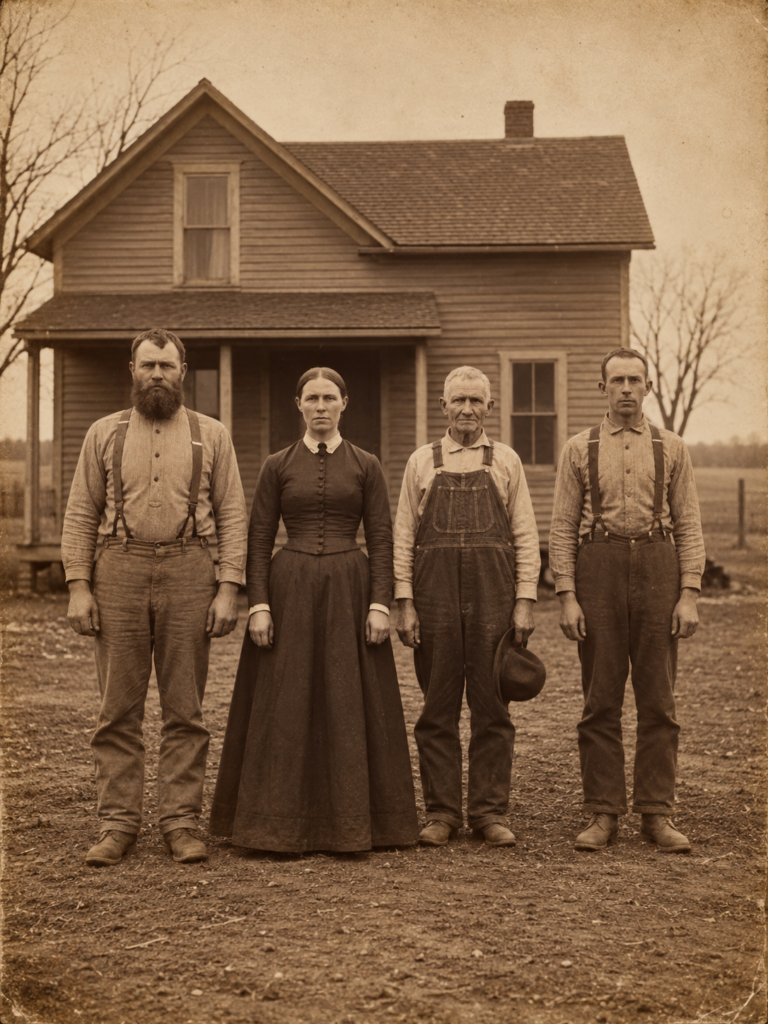
Part 1
On the morning of February 18, 1897, Sheriff Thomas Miller rode four miles northeast of Carthage, Missouri, to a farm that had become too quiet.
Silence was not unusual in winter. Snow softened the roads, sealed barns in white, and made even a working farm seem abandoned from a distance. But the Elwood place had never been silent in that way.
Neighbors had stopped seeing smoke from the chimney.
No one had heard the livestock.
Margaret Elwood had not collected her mail.
Jonathan Elwood had missed several of his usual trips into town.
Even William Daring, the elderly hired man who had worked the property for more than a decade, had not appeared at the general store.
The first person to complain formally was the postmaster, Edmund Hayes. Margaret had been expecting a letter from her sister in St. Louis and, according to Hayes, never allowed correspondence to sit uncollected.
When 3 days passed, Hayes sent word to the sheriff.
Miller arrived shortly before noon.
The front door of the farmhouse stood partly open.
A bitter wind moved it several inches at a time, then allowed it to drift back against the jamb.
There were no footprints in the new snow near the porch except those made by Miller and the neighbor who had accompanied him.
Inside, the house seemed to have been abandoned in the middle of an ordinary evening.
Four places were set at the dining table.
Four cups.
Four plates.
Food remained on them.
Nothing had been cleared away.
A chair rested several inches from the table as though someone had risen abruptly.
There was no sign of packing.
No trunks had been removed.
Margaret’s winter coat still hung near the door.
Jonathan’s better boots stood beside the stove.
William Daring’s small room in the attached annex contained his blanket, shaving things, and spare clothing.
Thomas Elwood’s belongings remained upstairs.
No one was there.
The Elwood household consisted of 4 adults.
Jonathan Elwood was 47, a farmer respected locally for the quality of his corn and for maintaining a property that produced more reliably than its size suggested it should.
His wife, Margaret, was 43.
Neighbors remembered her as quiet, generous, and particularly proud of her preserves, which she distributed after Sunday services at the Methodist church.
Jonathan’s younger brother, Thomas, was 41.
He had moved onto the farm in November 1896 after losing his position at the Carthage Mining Company.
The fourth member of the household was William Daring, 68, who lived in the annex and had worked the Elwood land for more than 10 years.
Nothing in their financial circumstances suggested sudden flight.
The 1896 harvest had been excellent, nearly 20 percent above previous yields according to county records.
Jonathan had purchased a new plow.
He had repaired storm damage to the barn.
Accounts at Holloway’s general store were current.
There were debts, as there were on most farms, but nothing approaching ruin.
The Carthage Evening Press initially treated the disappearance as voluntary abandonment.
Families left Missouri without notice.
Banks failed.
Crops failed.
Men received letters promising work farther west and sold what they could carry.
A farm found empty was not automatically a crime scene.
The February 20 edition suggested that the Elwoods might have left because of private financial trouble.
Sheriff Miller was inclined toward the same conclusion.
Then people began remembering things.
Reginald Pierce, who owned a hardware shop in Carthage, remembered Thomas Elwood visiting several times after moving to the farm.
Thomas had looked unsettled.
He often remained at the counter after completing his purchases, talking about nothing in particular, apparently reluctant to return home.
Once, Pierce said, Thomas mentioned noises at night.
“Rats in the walls,” he called them.
He laughed when he said it.
Pierce did not remember laughing with him.
Another neighbor, Abigail Thornton, recalled the night of November 12, 1896.
It was the first heavy snow of the season.
Sometime after dark, Mrs. Thornton heard a commotion from the direction of the Elwood farm.
At first she thought an animal had been injured.
Then the sound changed.
She described it later as wailing.
Not shouting.
Not cattle.
Not machinery.
Something prolonged and human enough to disturb her but strange enough that she could not identify a voice.
She urged her husband to investigate.
He refused.
The Elwoods were private people, and no good came from entering another man’s property at night without being invited.
By morning the farm was quiet.
Mrs. Thornton persuaded herself that she had heard wind moving around the barn.
Three days later, Margaret failed to attend church.
That had not happened in more than 5 years.
Reverend Howard Stevens noticed immediately.
Jonathan attended alone.
When Stevens asked after Margaret, Jonathan appeared startled by the question.
He said she was indisposed.
Nothing serious.
She would return the following Sunday.
She did not.
Jonathan left immediately after the service instead of remaining for the customary conversation outside the church.
At the time, none of these details seemed sufficient to justify intervention.
In retrospect they became the beginning of a pattern.
The first physical evidence appeared nearly 2 weeks after Sheriff Miller’s original visit.
Dr. James Whitfield, the county coroner, had been dissatisfied with the assumption that the family simply fled.
He returned to inspect the house.
On March 3 he noted several dark stains on the dining room floor.
They had been partly cleaned.
Whitfield believed they were consistent with blood and that their pattern suggested a forceful impact rather than ordinary spillage.
The discovery brought Sheriff Miller back with deputies.
This time the property was searched systematically.
The kitchen floor was inspected.
The attic was opened.
Walls were measured.
The barn was searched from loft to foundation.
Then the men entered the root cellar.
Near the eastern side of the cellar floor, the soil had been disturbed over an area roughly 6 feet long and 3 feet wide.
They dug.
At approximately 4 feet, a deputy’s shovel struck burlap.
The sack contained no body.
Inside were a work boot identified by Reginald Pierce as belonging to Thomas Elwood and a pocket watch bearing an initial believed to have belonged to William Daring.
No human remains were found.
That absence made the discovery stranger.
Someone had buried objects associated with 2 missing men beneath the house but had not buried the men themselves.
The investigators began reconstructing the months before the disappearance.
The reconstruction led repeatedly to November.
After the night Abigail Thornton heard wailing, Jonathan’s behavior changed.
Records from Holloway’s store showed unusual purchases.
On November 16 he bought 20 pounds of lime, a large quantity of lye soap, and new bed linens.
On November 23 he purchased 3 padlocks and substantial lumber.
On December 7 he traded a silver serving set that had belonged to Margaret’s mother for a revolver and ammunition.
Charles Holloway, the storekeeper, remembered Jonathan’s appearance.
His clothes were dirty.
His face was unshaven.
He looked exhausted.
The change was striking because Jonathan had always been meticulous about appearing respectable in town.
The post office records revealed another change.
Margaret’s sister in St. Louis wrote approximately every 2 weeks.
Before November, Margaret collected those letters herself.
Afterward, Jonathan collected them.
Around the same period Jonathan began mailing letters to Omaha, Nebraska.
No one in the family was known to have connections there.
The letters went weekly.
Then stopped abruptly in January.
The Nebraska address later proved to belong to a boarding house.
Its proprietor remembered no Elwood and had no record explaining the correspondence.
None of Jonathan’s letters was recovered.
For several weeks, that was the strongest evidence available.
Then Margaret’s sister arrived in Carthage.
Her name was Eleanor Winters.
She came from St. Louis carrying letters.
Margaret had been writing to her throughout the autumn and early winter.
The letters revealed a household deteriorating from within.
In October, before Thomas lost his mining job, Margaret wrote that her brother-in-law had become strange.
After moving to the farm, his behavior worsened.
He sometimes stood outside Jonathan and Margaret’s bedroom window at night.
He did not knock.
He did not speak.
He simply stared through the glass.
Margaret initially thought Thomas was emotionally disturbed after losing his work.
Then Jonathan changed.
He became secretive.
He spent hours alone in the barn.
He discouraged questions about Thomas.
He began listening when Thomas described the noises.
Margaret’s final surviving letter was dated December 2.
The opening pages concerned family matters.
Then the handwriting changed.
The lines narrowed.
Words were compressed close together as if she had been afraid of using too much paper.
“I fear something is terribly wrong with this house,” she wrote.
“The sounds from within the walls have grown louder, and Jay will not acknowledge them. Thomas speaks of them constantly, saying they are voices calling to him.”
Margaret had found Thomas in the root cellar digging.
When she asked what he was doing, he replied that he was making room.
Jonathan told her not to concern herself.
But she had begun to fear the way Jonathan watched Thomas.
Not hatred.
Not anger.
Fear.
William Daring had withdrawn as well.
Margaret wrote that she would leave the farm if she could.
The letter ended without explaining why she believed she could not.
That document triggered a third search.
Sheriff Miller, Dr. Whitfield, and several deputies spent 3 days examining the property.
They found that part of the eastern root-cellar wall had been dismantled and rebuilt.
The mortar was newer.
Behind the brickwork was a narrow cavity.
Inside lay a journal belonging to Thomas.
The early pages were ordinary.
Employment notes.
Mining shifts.
Money owed.
Complaints about supervisors.
Then, after his dismissal from the mining company, the entries became increasingly fragmented.
Thomas wrote about sounds.
At first scratching.
Then voices.
He believed something spoke from dark spaces inside the walls.
He referred repeatedly to “them.”
They were coming through.
They were waiting.
They knew the house.
They knew him.
Several pages contained no complete sentences.
The final page held a rough map of the Elwood property.
Three locations were marked.
The deputies excavated the first.
Nothing.
The second.
Nothing.
The third mark lay beneath the barn floor.
There they found a metal box.
Inside, several possessions had been arranged neatly.
Margaret’s wedding ring.
Jonathan’s pipe.
Thomas’s mining-company identification badge.
William Daring’s straight razor.
The items had been cleaned before being placed in the box.
No explanation accompanied them.
They looked less like concealed evidence than objects deliberately collected after their owners had ceased needing them.
A memorial.
Or an inventory.
The case had become impossible to fit within the original theory of voluntary flight.
Still, no bodies existed.
No witness had seen violence.
No one could say who placed the objects beneath the barn.
Then a cattle drover named Samuel Jenkins came forward.
On February 15, 3 days before authorities first entered the empty farmhouse, Jenkins had been at the Springfield railroad station approximately 70 miles from Carthage.
He remembered a man who strongly resembled Jonathan Elwood.
The man carried little.
He stood on the platform for nearly an hour.
Did not pace.
Did not smoke.
Did not speak with anyone.
He stared at the tracks.
When a westbound train arrived, the man boarded.
Before stepping inside the car, he turned and looked east.
Jenkins remembered the expression.
Not grief.
Not fear.
Empty.
“As if he’d left more than his home behind,” Jenkins later said.
Sheriff Miller sent inquiries westward.
No confirmed sighting followed.
By summer, the investigation weakened.
New cases came.
New crimes demanded manpower.
The Elwood disappearance entered the category in which so many difficult cases eventually settled.
Unresolved.
The last official notation made by Miller in June stated that investigators had exhausted available leads and found no conclusive evidence sufficient to establish criminal responsibility.
For official purposes, 4 adults had disappeared from a Missouri farm.
That should have been the end.
It was not.
The first reason was the property itself.
The second was William Daring.
And the third was that the Elwoods may not have been the first people to disappear from that ground.
Part 2
For almost 40 years after the Elwood disappearance, the abandoned farm existed in an uncomfortable space between private land and local warning.
The county could not easily sell it.
Potential buyers knew the story.
Some visited.
Most declined.
Neighbors reported little that could be separated confidently from folklore.
Animals resisted approaching certain fence lines.
Crops near the farmhouse foundations performed poorly in some seasons.
Farmers spoke of unusual silence around the property.
Such reports carried little evidentiary value.
A famous disappearance could change the way people interpreted ordinary events.
A horse balking at a scent became an animal sensing evil.
A mechanical failure became the property interfering with machinery.
A cold patch in shaded soil became something unnatural.
For decades, there was nothing new strong enough to reopen the case.
Then, in 1935, a state transportation survey crew found a metal container beneath an old oak approximately half a mile from the former Elwood house.
Inside was a journal.
It belonged to William Daring.
The entries began in October 1896 and continued almost to the date of the family’s disappearance.
Daring’s early observations were restrained.
He described Thomas returning from the mining company after dismissal.
Thomas could not sleep.
He walked through the house at night.
He listened to walls.
At first William assumed humiliation and unemployment had unsettled him.
Then Thomas began digging.
The final entry was dated February 17, 1897.
The day before the empty farm was reported.
“It’s taken Jay at last,” Daring wrote.
Jay was Jonathan.
William claimed that the same process had already happened to Thomas.
The change, he wrote, came gradually.
First the person began listening to something others could not hear.
Then came long periods of staring at walls.
Then digging.
Jonathan had resisted longer.
According to William, he had even locked Thomas in the root cellar for a period.
But eventually Jonathan began behaving the same way.
William and Margaret attempted to leave the farm approximately a week before the disappearance.
Jonathan followed them.
He brought them back.
He told them they had responsibilities.
That they had been chosen.
He burned their bags.
He took William’s boots.
That detail gave new meaning to the boot buried beneath the root cellar.
It may not have been removed from a corpse.
It may have been taken from a living man to keep him from leaving.
William’s final lines described hearing Jonathan, Thomas, and possibly someone else in the cellar.
They were digging.
They were speaking.
The voices, William wrote, did not sound like their own.
He hid the journal away from the house because he did not believe anything left inside would remain safe.
Then he wrote:
“If someone does find this, don’t come looking for us. By morning, I expect we’ll be gone. Not dead. Something worse. We’ll be part of whatever lives in the walls now.”
The journal was examined and treated as authentic to the period.
Yet the discovery came too late for a meaningful reopening.
Sheriff Miller was gone.
Most original witnesses were elderly or dead.
The farmhouse had deteriorated.
Evidence had been moved, contaminated, or lost.
Authorities filed the journal with existing material.
They did not excavate the property.
In 1951 the land was finally sold to Cooper Agricultural Corporation.
The company planned to clear the old buildings and return the acreage to production.
Demolition crews discovered modifications that had not been fully described in the 1897 searches.
There were false walls.
Narrow voids between floors.
Passages from the root cellar into surrounding earth.
Company records treated them as eccentric renovations.
That was reasonable.
Thomas and Jonathan had both been described as digging repeatedly.
Men convinced that voices existed behind walls might create new walls while searching for them.
A disturbed household did not require a supernatural explanation for architectural damage.
Yet the workers disliked the site.
During construction of grain silos in 1952, several laborers complained of headaches and nausea near one excavation.
Two reported hearing sounds beneath the soil.
The foreman, Victor Ramirez, suspected bad ventilation or trapped gas.
He relocated the foundation approximately 50 yards west.
Work resumed without comparable difficulty.
The decision became significant only years later, when researchers noticed that the abandoned excavation lay close to the original farmhouse site.
Before Cooper Agricultural took possession, several teenagers entered the old house on a dare.
The incident was remembered in a Carthage school newspaper.
They intended to spend the night.
They lasted less than 15 minutes.
The account might have remained ordinary teenage ghost lore if not for how closely certain descriptions resembled older ones.
The air inside felt heavy.
There were sounds in the walls.
Not normal creaking.
Something like whispers.
One boy claimed his flashlight revealed scratches across an interior bedroom wall.
The group fled.
No photographs survived.
No independent adult inspection confirmed the scratches.
Like most later evidence in the case, the account could be dismissed.
But it fit.
Another late witness emerged from an oral-history project.
Martha Coleman had lived near the Elwoods in 1896.
By the time she was interviewed, she was 87.
Memory at that age had to be treated cautiously, particularly when recalling events that had become local folklore.
Still, Coleman described a visit to Margaret approximately a week before the disappearance.
She brought applesauce.
Margaret admitted her only into the front room.
The house felt unusually cold despite the stove.
Margaret looked ill.
She repeatedly glanced at the walls.
When Coleman asked whether renovations were being made, Margaret answered:
“The house is changing.”
Coleman assumed she meant repairs.
Margaret shook her head.
“It’s making room for something else.”
Before Coleman left, Margaret gave her a small wrapped package.
She made Coleman promise not to open it until after Christmas.
In the confusion following the disappearance, Coleman forgot about it.
Months later she opened the package.
Inside was a faceless cloth doll.
There was also a note.
“It came from below. It speaks through the walls. If we are gone, burn this house.”
No copy of the original note survived with the interview.
That weakened its value considerably.
But by the 1960s the Elwood case had attracted several researchers who began searching beyond the 1897 investigation.
One was psychologist Richard Kaufman of Washington University in St. Louis.
Kaufman had no interest in supernatural explanations.
He studied mass hysteria and shared delusion.
The Elwood household appeared to him to be a classic case of psychological contagion in an isolated group.
Thomas, in Kaufman’s model, was the origin.
Loss of employment produced psychological instability.
He became obsessed with noises.
He interpreted normal structural sounds as voices.
Jonathan, already under economic and familial stress, gradually adopted the belief.
Margaret became frightened not necessarily because she heard anything herself but because the 2 men around her behaved as if the house were communicating with them.
William, isolated on the property, entered the same interpretive system.
The digging followed.
The false walls followed.
The entire family constructed physical responses to a shared delusion.
Kaufman called it environmental psychosis.
He allowed for contributing physical factors.
Mold.
Contaminated well water.
Poor ventilation.
Chemical exposure.
Any of those might induce headaches, sleep disruption, confusion, or perceptual disturbances.
The explanation was sober and coherent.
It also left problems.
The dining-room blood.
The personal objects hidden beneath the barn.
The extensive tunnels.
The buried boot and pocket watch.
Jonathan’s unexplained trip, if the Springfield sighting was accurate.
And William’s claim that Margaret attempted to escape.
Kaufman did not regard such contradictions as evidence against a psychological cause.
People acting under delusion still performed physical acts.
They could hide possessions.
Restrain one another.
Dig tunnels.
Commit violence.
What they believed about those acts did not establish the truth of the belief.
His view gained some academic acceptance.
Then the physical evidence became stranger.
In 1959 the Missouri State Archives received soil samples allegedly collected from the Elwood property nearly a decade earlier.
The donor remained anonymous.
Initial testing found nothing remarkable.
The samples were stored.
In 1963 a graduate student named Robert Chambers examined them while studying soil microorganisms.
One sample, labeled as having come from beneath the former residence, contained structures he could not classify confidently as normal fungal or bacterial material.
Under magnification they formed branching networks.
Chambers compared their appearance to neural pathways.
More unusual, repeated observation suggested the pattern changed slowly over time.
He recommended further study.
None was recorded.
Chambers later left graduate work and entered private industry.
His report did not establish anything extraordinary.
Soil microbiology in the early 1960s still contained many poorly described organisms.
Contamination was possible.
Misclassification was possible.
But the image of a branching network beneath the farm entered later interpretations of the case.
The same period produced an amateur historical investigation by Frederick Douglas, a retired postal worker whose great-uncle had participated in an early search of the Elwood place.
Douglas assembled newspaper reports, official documents, family stories, and private interviews.
His monograph, printed in a small edition in 1966, was called The Silence Beneath.
One interview concerned Dr. James Whitfield, the coroner who first insisted upon treating the Elwood house as more than an abandoned farm.
Whitfield’s widow told Douglas that her husband changed after examining the property.
He had spent years around violent deaths without apparent lasting effect.
After the Elwood case, he began checking the walls of their own house before bed.
He pressed his ear against plaster.
At night he sometimes woke shouting about voices under the floor.
Six months later he resigned.
The family moved to Colorado.
Whitfield never practiced medicine again.
That testimony, again, was retrospective.
Trauma alone could explain it.
A coroner might suffer delayed psychological consequences after a disturbing unresolved case.
The more consequential discovery in Douglas’s research involved the land itself.
The Elwoods had not been its first unusual occupants.
Land records from the 1830s indicated that a small religious separatist community led by Isaiah Thorne had settled the area.
They called themselves the Listeners.
Their doctrine centered on communication with divine presences they believed existed beneath the earth.
Official records stated that the community remained only 2 years before moving west.
A private letter from 1834 suggested another possibility.
A nearby farmer wrote that the settlement had emptied suddenly.
Cabins remained standing.
Meals had been left unfinished.
No obvious preparations for departure were found.
Neighbors reported strange sounds from the settlement the night before everyone vanished.
The local sheriff investigated, discovered no clear crime, and discouraged rumor.
The letter mentioned something being found beneath the group’s meeting house and rapidly covered again.
The resemblance to the Elwood disappearance was difficult to ignore.
An occupied property.
Reports of underground voices.
Digging.
Then an abrupt disappearance leaving meals behind.
More than 60 years separated the 2 incidents.
No continuous documentary chain connected them.
A family tragedy in 1897 did not prove that an 1830s sect vanished for the same reason.
Yet the recurrence shifted attention from the farmhouse to the ground.
If the Elwoods suffered from an environmental influence, perhaps the source predated their house.
Government interest briefly touched the area in the 1960s.
Unusual seismic readings produced concern about unauthorized underground activity.
A small investigative team found no evidence of human excavation.
Their report classified the anomaly as natural but unexplained.
Equipment proved unreliable at the site.
No further investigation was recommended.
At roughly the same time, geologists conducting a regional survey reported normal soil composition and no conventional cave system directly beneath the old farm.
One scientist privately complained that the measurements felt inconsistent.
The densities were ordinary.
The data still seemed incomplete.
His language was subjective.
It proved nothing.
Yet technical teams repeatedly experienced instrument trouble in the same area.
That pattern would become important later.
In 1967 a historical mapping project included a more detailed subsurface survey.
Preliminary notes described tubular voids extending beneath the former Elwood property.
They did not resemble conventional limestone caves.
Neither did they resemble ordinary mine tunnels.
The pattern appeared branching.
Almost organic.
Funding for deeper study was not provided.
The project leader, Dr. Evelyn Mercer, returned privately with graduate students the following year.
Their scans suggested that portions of the subsurface pattern might have changed between surveys.
Branches appeared to extend outward.
More disturbing, instruments recorded a recurring vibration approximately every 67 minutes.
Mercer published cautiously.
She did not claim discovery of an intelligent subterranean organism.
She suggested unknown geological activity or possibly an unusual slow-growing biological colony.
Her reputation suffered.
The scientific community had good reasons for skepticism.
Instrument error could produce apparent movement.
Different survey positions could create false differences.
Ground moisture changed readings.
And descriptions such as organic, architectural, or pulsing could seduce researchers into seeing intention where only structure existed.
Mercer nevertheless maintained that the data justified more work.
No institution agreed.
One graduate student from the expedition, Theodore Lancing, spoke publicly decades later.
He remembered the network as possessing a structure that seemed neither geological nor man-made.
Its regular vibrations suggested system-wide activity.
He refused to call it intelligence.
He only insisted that it deserved investigation.
By then another scientific clue existed.
A soil analysis performed during transfer of the property in 1969 detected an unidentified stable organic compound in elevated concentrations near the original farmhouse location.
Technicians assigned it the provisional label X42.
The compound appeared most concentrated in a roughly circular zone 200 feet across.
No known agricultural chemical matched it.
The laboratory recommended caution.
No follow-up study survives.
Taken separately, none of these findings proved the story told by Thomas Elwood or William Daring.
Fungal networks existed.
Soil chemistry varied.
Underground water moved.
Gas pockets produced sounds.
Old mines contained strange voids.
Equipment malfunctioned.
People subjected to fear interpreted ambiguity according to expectation.
But the pieces were beginning to produce 2 competing explanations.
In one, an ordinary environmental factor affected human minds.
A fungus, gas, toxin, vibration, or combination of conditions caused auditory experiences and paranoia.
Thomas was particularly vulnerable because of stress from the mine.
He brought that fear home.
The others gradually adopted it.
The second explanation was harder to phrase without slipping into folklore.
Something beneath the land interacted with people.
Not necessarily supernatural.
Not necessarily conscious in any human sense.
But active.
Responsive.
Growing.
The Elwoods heard it.
Then, according to William Daring, it began using them.
The decisive clue to that possibility would come from Thomas himself.
Years after the family vanished, a small notebook connected the Elwood farm to the Carthage mine where his trouble appeared to begin.
Part 3
In 1982, the Jasper County Historical Society received personal belongings that had once belonged to Thomas Elwood.
Among them was a leather notebook from his employment at the Carthage Mining Company.
Most pages were exactly what investigators expected from a working miner.
Measurements.
Shift notes.
Equipment complaints.
References to water seepage.
Sketches of tunnel supports.
Then, near the end, Thomas began drawing something else.
Tubular structures.
Branching forms exposed during excavation.
They did not resemble mine timbers.
They were not labeled as roots.
Thomas noted one location at approximately the 320-foot level of a north shaft.
Beside another sketch he wrote that the formations seemed to move when not watched directly.
A series of drawings attempted to document changes over 3 days.
The final page contained a single sentence.
“They are in the walls at home now, too.”
The notebook complicated the psychological explanation without destroying it.
Thomas may have encountered an unusual fungal or mineral formation in the mine.
It frightened him.
After losing his job, he carried the fixation home and began interpreting ordinary features of the farmhouse through the same idea.
That was entirely possible.
But there was another possibility.
The mine and the Elwood property might have intersected different portions of a broader subsurface system.
The distance was not necessarily prohibitive if the structures extended through Jasper County.
Later researchers searched for similar reports.
They found several.
Between 1895 and 1898, livestock disappeared inexplicably from farms within roughly 20 miles.
People reported unusual noises from wells and root cellars.
Five families abandoned rural properties suddenly during the same 3-year period.
Financial hardship explained most cases sufficiently.
But at least 3 included reports of behavior resembling the Elwoods’ final months.
Isolation.
Alterations to buildings.
Digging.
Complaints about sounds.
None was investigated deeply at the time.
A retired historian named Martin Weber assembled those incidents in the 1990s while attempting a more objective centennial review.
Weber resisted dramatic conclusions.
He considered weather.
The autumn of 1896 had been unusually wet.
Rainfall during September and October stood well above normal.
An early winter followed.
The first major snowfall arrived in mid-November, nearly the same moment witnesses remembered the Elwood household deteriorating.
A raised water table could have altered underground pressures.
Flooded mine passages could produce sound.
Moisture could stimulate fungal growth.
Gas might move through soil differently.
A natural system dormant in dry conditions might become active after prolonged rain.
Weber refused to choose among theories.
His conclusion was cautious.
Something extraordinary occurred at the farm.
Whether its cause was psychological, environmental, criminal, or natural but undiscovered remained unresolved.
That was the most responsible summary available.
The trouble was that people who investigated the Elwood property sometimes disappeared.
The first widely discussed example was true-crime writer Lawrence Pritchard.
In 1967 he began researching a book about Midwestern disappearances.
He regarded the Elwoods as a likely example of shared psychosis triggered by environmental contamination.
He visited Carthage.
Reviewed archives.
Interviewed residents.
Then vanished.
His car remained near the former farm.
No body was found.
Pritchard’s disappearance did not prove connection to the property.
Researchers disappeared for ordinary reasons.
Accidents happened.
People left voluntarily.
But the coincidence strengthened local folklore.
A second researcher, journalist Patricia Holloway, disappeared in 1973.
She had been preparing a book in which the Elwood case would form a major section.
Her editor received half the manuscript.
Then Holloway telephoned from Missouri.
She was excited and disturbed.
She believed she had discovered something important and needed several more days before submitting her remaining chapters.
No further communication came.
Her motel room appeared orderly.
Research papers remained on the desk.
Her rental car was nearby.
Among her belongings was a jar of soil labeled from the former Elwood property.
Testing found nothing exceptional.
Holloway was never located.
Her partial manuscript was published posthumously.
She had not endorsed supernatural explanations.
She considered gas, caves, a forgotten grave, contamination, and human violence.
Jonathan’s lime, lye, lumber, locks, and gun might have represented preparations to explore or seal an underground discovery.
Near the end of Holloway’s unfinished draft she mentioned a former Cooper Agricultural groundskeeper named Harold Fletcher.
According to her notes, Fletcher claimed that workers in 1951 had uncovered something beneath the old cellar.
The discovery was immediately reburied.
Fletcher reportedly described it as neither animal nor human.
He alleged that company officials then prohibited excavation deeper than 4 feet across the site.
Whether Holloway ever conducted her planned interview with Fletcher could not be established.
Company records confirmed that a man of that name had worked for Cooper Agricultural.
Later researchers could not find him.
He apparently left the area in the 1970s.
The pattern encouraged increasingly elaborate theories.
Some imagined an unknown subterranean animal.
Others a geological structure generating low-frequency sound capable of affecting perception.
Others a vast fungal organism.
A few returned to the Listeners of the 1830s and treated their belief in underground entities as evidence that people had experienced the same phenomenon long before the Elwoods.
The scientific evidence, incomplete though it was, gave the fungal hypothesis particular strength.
A 1991 soil study found an unusually dense mycorrhizal network in and around the former farm.
Such fungi were not themselves unusual.
They formed relationships with plant roots throughout healthy soils.
What stood out was concentration.
Researchers estimated the network density at approximately twice that found in comparable nearby soils.
They believed much of it could represent one interconnected organism.
That finding offered several ordinary explanations for parts of the mystery.
A large fungal network could influence plant productivity.
The Elwoods’ unusually successful crops might have benefited from enhanced nutrient exchange.
Fungal growth inside damp wooden structures could create sounds.
Spores or associated chemicals might influence susceptible people.
Combined with poor cellar ventilation, methane, carbon dioxide, mold toxins, or other factors, the effect might become neurological rather than merely structural.
Voices could arise from hallucination.
The idea of the walls changing might reflect visible fungal penetration through timber and plaster.
The digging could represent terrified attempts to trace a real biological intrusion interpreted as intelligent.
It was a compelling model.
But it did not answer everything.
William Daring described Jonathan preventing escape.
That implied human coercion.
Blood existed in the dining room.
Personal effects were deliberately arranged beneath the barn.
The root cellar had been rebuilt.
Margaret feared the household before it vanished.
Someone traveled, or appeared to travel, to Springfield.
If environmental influence was involved, it acted through human choices.
Perhaps that was enough.
The Elwood case did not require the ground itself to think.
A biological contaminant capable of disturbing 4 isolated people could generate nearly every frightening detail once paranoia and violence began.
Then came the 1996 investigation.
For the centennial of the disappearance, the landowner permitted a limited non-invasive study by a multidisciplinary team.
Ground-penetrating radar.
Thermal imaging.
Magnetic techniques.
Atmospheric sampling.
Acoustic monitoring.
The researchers confirmed an extensive network of tunnel-like structures beneath the property.
Some extended beyond the depth their equipment could resolve, estimated at more than 100 feet.
The network was densest near the original farmhouse.
From there it radiated outward.
The published description compared the pattern to both neural tissue and fungal mycelium.
No claim was made that the structures were nerves.
The comparison described geometry.
Imaging suggested movement of fluid within parts of the network.
Thermal scans revealed patches of soil several degrees warmer than surrounding ground even when ambient temperatures changed.
Those warmer zones corresponded closely with the densest portions of the subsurface pattern.
Air samples above them contained elevated carbon dioxide, methane, and several unidentified organic compounds.
Again, none of this required anything supernatural.
It suggested activity.
Geothermal.
Biological.
Chemical.
Perhaps several processes interacting.
The acoustic monitoring produced the most controversial result.
Sensitive instruments recorded vibrations from below.
Analysis suggested patterned variation.
Some changes appeared to correlate with human movement at the surface.
The report used cautious language.
Potentially non-random.
Possibly responsive.
No researcher claimed intelligent communication.
The authors concluded only that the property contained an unusual, potentially biogenic subsurface system interacting with its environment in ways not yet explained.
They recommended expanded research.
The landowner refused additional access, citing disruption to farming operations.
A funding proposal submitted elsewhere was denied as methodologically weak and overly speculative.
The case returned to silence.
That silence left later readers with a temptation.
To connect everything.
The Listeners in 1834.
The Elwoods in 1897.
The mining formations Thomas sketched.
The fungal networks.
The strange soil chemistry.
The tunnel-like voids.
The disappearances of later researchers.
The voices.
The mechanical failures.
The livestock.
The warm ground.
The recurring vibration.
The temptation was understandable.
But a responsible account had to resist turning resemblance into proof.
There was no continuous chain demonstrating that a single organism, entity, or geological system caused every event.
There was no recovered Elwood body showing a biological transformation.
No direct evidence established that Thomas’s mine formations were identical to structures beneath the farm.
No sample preserved from his notebook existed.
No recording captured the voices the family described.
No witness saw the family enter the ground.
No tunnel produced remains.
The strongest facts remained frustratingly human.
Four people disappeared.
They behaved increasingly strangely beforehand.
The house was physically altered.
Blood was found.
Possessions were buried.
William described coercion and psychological deterioration.
Thomas described underground phenomena at work and at home.
The land later produced unusual geological and biological readings.
Everything beyond that had to remain provisional.
Perhaps Jonathan murdered some or all of the others.
The blood would fit.
The lime and lye might fit.
The locks and lumber might fit.
His apparent appearance at Springfield might represent flight.
If so, where were the bodies?
Why hide personal objects but not recoverable remains?
Why did William’s journal expect disappearance rather than death?
Why did Jonathan himself never reappear?
Perhaps Thomas became violent first.
Perhaps Jonathan restrained him, then lost control.
Margaret and William attempted escape.
A confrontation occurred.
Then Jonathan fled.
That model required no extraordinary cause.
It also left the later underground evidence unrelated except by coincidence.
Perhaps shared psychosis was correct.
Thomas introduced the belief.
The others absorbed it.
Their behavior became increasingly irrational.
Margaret and William understood enough to fear the men but remained trapped within the household dynamic.
One or more acts of violence occurred.
The group then vanished through suicide, homicide, or flight.
Again, possible.
Perhaps environmental poisoning caused the psychosis.
Wet weather activated gases or biological processes.
That would explain the clustering of complaints during the winter.
It might explain similar cases in the region.
Perhaps the fungal network produced compounds capable of affecting cognition.
That possibility was scientifically imaginable even if unsupported in this specific case.
Or perhaps the phenomenon was something not yet categorized.
Not a haunting.
Not a demon.
Not voices in the spiritual sense.
A biological system underground.
Ancient.
Distributed.
Responsive to vibration or chemical signals.
Capable of extending through soil, wooden structures, mine tunnels, and root systems.
Thomas encountered it in the mine.
Then recognized related growth at home.
The family interpreted its effects according to the language available to them.
Voices.
Something listening.
Something making room.
That explanation remained speculative.
Yet it carried one unsettling advantage.
It did not require William’s words to be literally true in order for his fear to be justified.
He wrote that they would become part of whatever lived in the walls.
A fungal network could incorporate organic material.
So could countless ordinary ecological systems.
Death returned bodies to soil.
The line between metaphor and biology was thinner than it first appeared.
Perhaps the Elwoods became part of the land in the most ordinary way.
Perhaps that ordinary process, filtered through fear and hallucination, became the horror William described.
Or perhaps his wording meant something else.
No evidence resolved it.
Local folklore did what evidence could not.
Older farming families developed rules.
Do not dig deeply near the old property.
Do not speak personal plans aloud on certain patches of ground.
Keep children away after dark.
Some left small offerings at boundaries.
The ground was said to have ears.
Anthropologist Diane Mitchell later interpreted these practices as cultural adaptation to an environmental threat.
Communities often preserved useful behavior in superstitious form after forgetting the original reason.
A dangerous well acquired a ghost.
A poisonous marsh became cursed.
A landslide slope developed a story about spirits.
People did not need to understand geology to learn avoidance.
The Black Ridge families might have done something similar around the Elwood land.
But that interpretation carried its own assumption.
It presumed there had been a practical threat to adapt to.
The oral tradition could just as easily have developed from the famous disappearance itself.
Fear creates rules.
Rules create memory.
Memory creates geography.
The property remained under cultivation.
Machinery crossed it.
Crops grew.
Men worked there.
Most days nothing happened.
That ordinariness mattered.
If something extraordinary existed beneath the soil, it did not behave like the entities of sensational fiction.
It did not emerge visibly.
It did not attack everyone.
It did not make the land unusable.
The farm continued producing.
Whatever the explanation, the Elwood mystery survived because ordinary life continued above it.
One farmer, George Russell, asked for reassignment after working part of the land in 1963.
He said the ground felt hollow.
Sometimes at dusk he heard movement beneath it.
A deputy investigating unauthorized digging in 1968 found a narrow tunnel roughly 4 feet below the surface.
His public report was cautious.
Unsafe opening.
Approaching darkness.
No exploration.
The hole was filled.
After the deputy’s death, private notes surfaced.
He claimed the tunnel walls resembled hardened clay but did not look natural.
There was a faint glow.
An odor like copper and decay.
Most disturbing was a rhythmic vibration from deeper inside.
The deputy wrote that he experienced an overwhelming desire to enter.
He remembered beginning to crawl forward.
Then returning to awareness halfway inside.
At his vehicle, his watch had stopped.
Approximately 2 hours had passed.
He believed only minutes had gone by.
He never returned.
The account echoed Thomas.
It echoed William.
It echoed the later instrument readings.
But private testimony, especially testimony preserved after death, could not be independently tested.
The pattern remained suggestive rather than conclusive.
That was always the Elwood case.
Every promising line reached a point where certainty disappeared.
Margaret’s letters stopped.
Thomas’s journal became incoherent.
William’s final entry ended before the morning he feared.
Jonathan’s Omaha correspondence vanished.
Sheriff Miller closed the case.
Whitfield left Missouri.
The Listeners disappeared.
Pritchard disappeared.
Holloway disappeared.
Fletcher could not be found.
Scientific projects ended for lack of funds or access.
Each path approached the center and then stopped.
The most useful modern conclusion therefore came not from the most dramatic researcher but from Martin Weber.
After a century, he argued, the Elwood disappearance remained fundamentally unsolved.
That statement could sound disappointing.
It was not.
It preserved the difference between evidence and story.
Something happened at the farm during the winter of 1896 and 1897.
The household changed.
Fear increased.
The walls were opened.
The cellar was dug.
Doors were locked.
Objects were buried.
A woman attempted, or wished, to leave.
An elderly man believed the people around him were no longer fully themselves.
Then all 4 disappeared.
No bodies were recovered.
No legally sufficient proof identified a killer.
No geological survey established the existence of a conventional cave explaining the disappearance.
No scientific study demonstrated an organism capable of influencing human thought.
No supernatural claim could be proved.
That should be where the story remains.
Yet the final detail is difficult to dismiss emotionally even if it changes nothing evidentially.
The Elwoods had lived on productive ground.
Their best harvest came just before the household collapsed.
Later soil researchers found unusually dense fungal activity.
Subsurface surveys found branching structures.
Those structures appeared densest near the farmhouse.
Warm soil corresponded to the same areas.
The strongest underground vibrations appeared there as well.
If the network was biological, the Elwoods had built their home directly over its center.
If it was geological, the same was true.
If it was neither, there was no accepted category for what remained.
The house itself is gone.
The root cellar is gone.
The dining room where Whitfield found blood no longer exists.
The barn floor has been removed.
The room where Margaret wrote her letters disappeared under demolition equipment decades ago.
Nothing visible remains to visit except agricultural land.
That may be appropriate.
The Elwood mystery was never truly about a haunted house.
The house was temporary.
The ground was not.
Thomas had understood that before anyone else, or believed he did.
He first encountered the shapes underground at the mine.
Later he found them at home.
“They are in the walls at home now, too.”
The sentence contained no explanation.
Only recognition.
William came to a similar conclusion.
His final warning did not tell investigators to search the rooms.
He told them not to come looking at all.
Margaret’s remembered words to Martha Coleman were equally revealing.
“The house is changing.”
Then:
“It’s making room for something else.”
Perhaps those were the statements of terrified people living inside a collective delusion.
Perhaps they were metaphors for a family surrendering to madness.
Walls changed because frightened men tore them apart.
The house made room because Jonathan and Thomas dug tunnels into it.
Voices came through the walls because human perception under stress can transform ordinary sound into language.
Nothing more need be added.
But if that is the answer, the case remains a powerful record of how an idea can occupy a household until physical reality is rebuilt around it.
Thomas heard something.
Jonathan began listening.
Locks appeared.
Lumber was purchased.
Walls were opened.
A gun entered the house.
Margaret became afraid.
William lost his boots.
People tried to leave and were returned.
The belief became architecture.
Then the architecture consumed the family.
That explanation is terrible enough.
It requires no unknown life under Missouri soil.
And yet the later measurements remain.
The fungus.
The tubular voids.
The warm ground.
The gases.
The patterned vibration.
Perhaps they are unrelated.
Perhaps investigators looked harder at that land because of its history and therefore found anomalies that would have been ignored elsewhere.
Nearly any patch of earth, studied obsessively across a century, will yield unusual details.
Correlation accumulates easily when one knows where to search.
A responsible reader has to hold that possibility alongside everything else.
The Elwood property may be nothing more than ordinary farmland carrying an extraordinary story.
Or the story may have begun because the land was never entirely ordinary.
There is no final document capable of deciding between them.
Eleanor Winters, Margaret’s sister, understood that before the modern investigations began.
In May 1897 she wrote one last letter to Sheriff Miller before returning to St. Louis.
She did not accuse Jonathan.
She did not name Thomas.
She did not mention underground entities.
She wrote simply that she no longer believed anyone would discover what had happened to her sister.
That sentence aged better than the more elaborate theories that followed.
The Elwood family disappeared.
The mystery survived.
Everything after that became an attempt to fill an absence.
Some filled it with murder.
Some with madness.
Some with fungus.
Some with underground geology.
Some with stories of listening soil.
And some with the possibility that human beings occasionally encounter processes they do not yet possess the language to describe.
The soil offers no testimony.
It carries crops.
Water.
Roots.
Fungi.
Old foundations.
Perhaps tunnels.
Perhaps nothing more.
Still, people working the land continue to tell the same kind of story.
A machine fails.
An animal refuses a boundary.
A person alone at dusk hears something moving beneath the field.
Most dismiss it.
They should.
Land makes sounds.
Soil shifts.
Roots break.
Water moves underground.
Machines fail.
Fear remembers.
But William Daring’s warning remains in the record.
Not because it proves what frightened him.
Because it records what he believed in the final hours before 4 people vanished.
“If someone does find this, don’t come looking for us.”
Then the part that matters most:
“Not dead. Something worse.”
He believed the distinction was important.
No one knows whether it was.
The farmhouse no longer stands to answer.
The walls Thomas listened to are gone.
The cellar he dug into has been filled.
The barn where the family possessions were arranged disappeared long ago.
Only the ground remains.
And if there was ever anything beneath the Elwood farm capable of listening, nothing in the surviving record suggests it depended on the house.
Nothing suggests it left when the Elwoods did.
Nothing suggests it needed them at all.

