
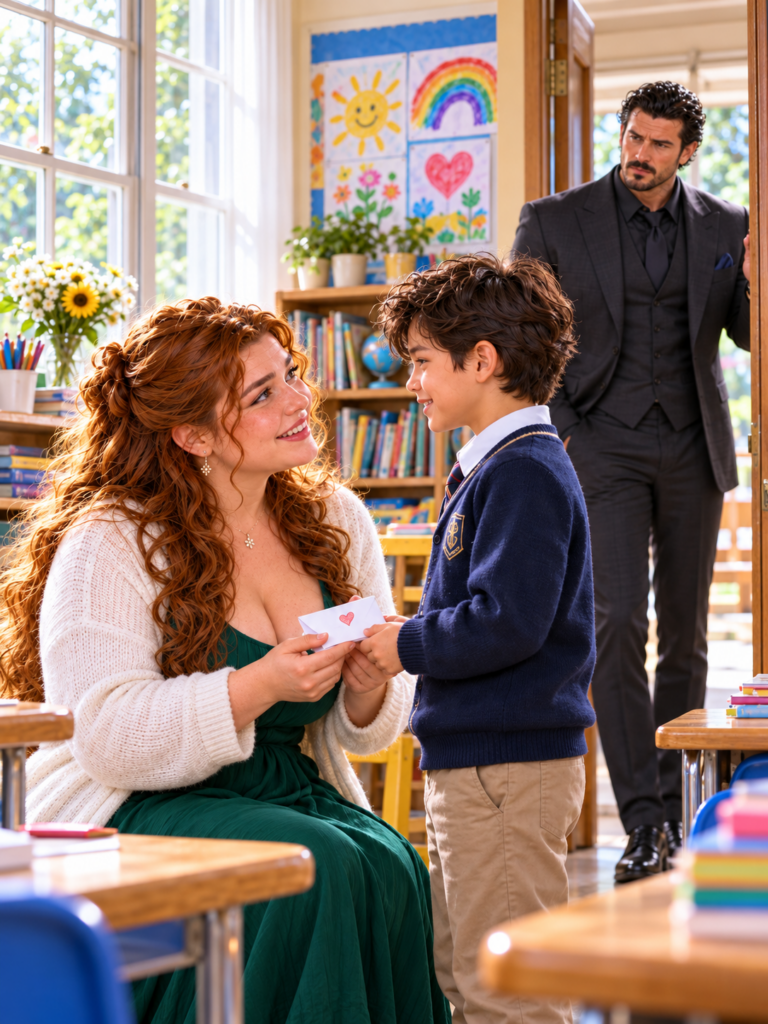
The Mafia Boss’s Son Secretly Sent His Curvy Teacher His Father’s Love Letters—Then She Walked Into His Mansion and Demanded the Truth
Part 1
Massimo Ferraro had spent fifteen years making certain every word that left his mouth was deliberate.
It was one of the reasons people feared him.
A careless man could be provoked.
A loud man could be read.
Massimo had survived because he was neither.
He spoke rarely, promised even less, and never said anything he did not mean.
The problem was that the words he meant most never left his mouth at all.
Those went into the bottom drawer of his desk after midnight, written in black ink on cream paper and addressed to a woman who had been dead for four years.
His wife, Clara.
His grief.
His confession.
His safest listener.
What Massimo did not know was that his eight-year-old son had discovered the drawer.
And for the past two months, Leo Ferraro had been using those private letters to make his second-grade teacher fall in love with his father.
Dela Brooks first noticed Leo because Leo worked very hard not to be noticed.
She had taught second grade at Hawthorne Elementary for six years, long enough to recognize the difference between shyness and disappearance.
Shy children wanted to speak but were frightened of the attention.
Leo seemed to have decided attention itself was dangerous.
He arrived in September wearing polished shoes, a navy sweater, and an expression far too controlled for an eight-year-old.
He always said please.
Always said thank you.
Never forgot homework.
Never mentioned home.
His emergency contact listed one name.
Massimo Ferraro.
Father.
Dela knew the surname.
Everyone in Bellarosa knew it.
Ferraro Shipping.
Ferraro Construction.
Ferraro Hotels.
Ferraro restaurants, foundations, warehouses, apartment buildings.
And the other things people discussed more quietly.
Dela made a point of not caring.
Every child in her classroom was simply a child.
The children of surgeons got the same stickers as the children of janitors.
The children of criminals still needed someone to remember their favorite books.
So she noticed Leo.
She noticed he never ate the apple slices packed in his lunch.
She noticed loud arguments in the hallway made his shoulders stiffen.
She noticed he stayed near the aquarium wall during their first field trip while the other children crowded the shark tank.
Dela stood beside him.
“You don’t have to go closer.”
“I’m not scared.”
“I didn’t say you were.”
Leo looked at her.
Dela smiled.
“I’m scared of geese.”
He frowned.
“Geese?”
“Terrifying animals.”
“They’re birds.”
“They know what they’ve done.”
Leo almost smiled.
They stood there eleven minutes.
By the end, Leo had moved three steps closer to the glass.
That evening Dela found a note in his blue homework folder.
The handwriting caught her attention first.
Dark.
Clean.
Precise.
Not decorative, but beautiful because nothing was wasted.
Miss Brooks,
Leo does not swim well. I know an aquarium is not the ocean, but water frightens him more than he admits.
Thank you for watching him.
M.F.
Dela read it twice.
Then she wrote beneath it.
He stayed at the shark tank for eleven minutes.
By minute eleven he was telling me I shouldn’t be afraid.
He is braver than he thinks.
I suspect his father may be too.
She hesitated over the final sentence.
Then closed the folder.
The reply came the next morning.
No one has said anything hopeful about me in a long time.
I’m going to pretend you meant it.
M.F.
Something warm turned over in her chest.
Dela had learned to mistrust that feeling.
At thirty-one, she had already spent too many years with a man named Dale who believed love meant correction.
Dale corrected the way she dressed.
Corrected what she ate.
Corrected how loudly she laughed.
Most often, he corrected the amount of space her body occupied.
Dela had always been a large woman.
Soft stomach.
Full hips.
Heavy breasts.
Thick thighs.
Copper-brown hair that refused discipline.
Freckles across her nose.
Dale had spent five years teaching her that every room judged her before she entered.
For a long time she believed him.
Then one night he told her she would be beautiful if she lost thirty pounds.
Dela had looked at him across their kitchen table and realized something astonishing.
She did not want to be beautiful to him anymore.
She moved out three weeks later.
Her apartment was small.
Her furniture mismatched.
Her bed belonged only to her.
And every doorway in her new life was wide enough for the whole of her.
She had not dated seriously since.
Loneliness was painful.
Shrinking had been worse.
So Dela should have recognized the danger of the letters.
She did recognize it.
She simply answered anyway.
At first they wrote about Leo.
Then about teaching.
Then about small things.
The kind of small things lonely people recognize as intimacy only after they have already become attached.
M.F. wrote that a large house sounded loudest at four in the morning.
Dela wrote that her houseplants were dying in what she considered an organized rebellion.
He wrote:
Maybe they’re not dying. Maybe they resent authority.
She replied:
Then they picked the wrong apartment. I teach seven-year-olds for a living. Rebellion is my specialty.
He wrote about music.
She wrote about books.
He confessed he drank his coffee black and often forgot it until it was cold.
She admitted she took hers with enough cream to offend serious coffee drinkers.
He wrote:
You spend your days carrying children toward things that scare them. That seems serious enough.
She kept that note in her coat pocket for a week.
What Dela could not know was that Massimo had written none of those notes to her.
Not yet.
Twenty minutes away, in a mansion protected by stone walls and armed guards, Massimo Ferraro maintained a different ritual.
He woke at five.
Worked out.
Read overnight security reports.
Had breakfast with Leo.
Conducted business.
Then, long after his son was asleep and his men stopped knocking on the study door, Massimo opened the bottom drawer.
Inside were hundreds of pages.
Dear Clara.
Sometimes he wrote those two words.
Sometimes he did not.
Four years earlier, Clara Ferraro had died on a rain-dark highway when another car crossed the median.
The investigation later proved the collision had not been random.
The target had been Massimo.
His wife had taken his place in the car because Leo had been sick and Massimo had remained home.
Massimo had built every year afterward around one conclusion.
Love made targets.
So he continued loving only one person.
Leo.
And even with Leo, love came disguised as security.
Armored cars.
Drivers.
Guards.
Background checks.
Private doctors.
Carefully controlled schedules.
Massimo hugged his son rarely.
He told himself this was restraint.
He knew better.
Every morning he placed one note in Leo’s lunchbox.
Be brave today.
Proud of you.
I saw your drawing.
Come straight home.
Three or four words.
Never more.
More created openings.
Openings got people killed.
Leo found the drawer in July while searching for tape.
He read one page.
Then another.
The father who barely spoke had filled hundreds of pages with things Leo had never heard.
Fear.
Love.
Regret.
Loneliness.
A sentence appeared more than once.
I want a house with the lights on when I come home.
Leo understood the sentence in the simple way children understand truths adults bury beneath complications.
His father was lonely.
Miss Brooks was lonely.
Miss Brooks was kind.
His father had kind things trapped in a drawer.
Therefore the solution was obvious.
Leo copied them.
Not the parts about Clara.
He understood enough not to do that.
He selected lines that sounded like something his father might say to someone new.
He practiced Massimo’s handwriting inside his math notebook.
He forged the initials M.F.
Then he placed the first note into his own homework folder.
When Dela answered, Leo nearly shouted during silent reading.
After that, he became strategic.
He memorized sentences from the drawer instead of removing pages.
He copied them at his desk.
He delivered them when Dela was distracted.
He kept every reply.
He told only Aaron Powell from his lunch table.
Aaron immediately asked, “Are they getting married?”
“Not yet.”
Leo had never conducted a criminal conspiracy.
But by October, he was objectively better at covert operations than several grown men employed by his father.
The operation continued successfully until Leo punched another child in the mouth.
It happened on a Tuesday.
A larger boy made a joke about Leo not having a mother.
Leo told him to stop.
The boy did not.
Leo hit him.
The other child hit back.
Nobody was seriously hurt.
But Leo ended up with a bleeding nose, a split lip, and the devastating knowledge that grief could apparently turn into anger faster than he knew how to control.
Dela cleaned his face.
Then called the emergency number listed in his school file.
The phone answered after one ring.
“Ferraro.”
Dela sat straighter.
The voice was nothing like the letters.
Low.
Cold.
The kind of voice a man might use before telling someone exactly how much trouble they were in.
“Mr. Ferraro, this is Dela Brooks. Leo’s teacher.”
Silence disappeared instantly.
“What happened?”
“He’s all right.”
“Is he hurt?”
“Bloody nose. Split lip. Nothing serious.”
“Who?”
Dela glanced at Leo.
“That isn’t the important question.”
Another silence.
This one colder.
She continued before she lost courage.
“There was a fight. School policy requires a parent in person.”
“I’ll send Bruno.”
“No drivers.”
“My attorney?”
“No attorneys.”
A pause.
“Me.”
“Yes.”
“I’m coming.”
The line went dead.
Dela stared at her phone.
Definitely better on paper.
Forty minutes later, the elementary school hallway became strangely quiet.
Teachers looked up.
The receptionist stopped typing.
A man in a charcoal suit walked toward Dela’s classroom accompanied by another man large enough to make the corridor feel narrower.
Dela stepped into the doorway.
Massimo Ferraro was not the person she had imagined.
The man in the letters lived in her mind as lean, thoughtful, perhaps slightly bookish.
Massimo looked like someone had taken a dangerous animal and taught it tailoring.
Broad shoulders.
Dark swept-back hair.
Close beard.
Hard mouth.
Ink visible above his collar and across one hand.
There was a pale scar cutting through his eyebrow.
His watch probably cost more than her yearly salary.
Then he saw Leo.
Everything about him changed.
Not dramatically.
That was what affected her.
He simply went still.
Then crossed the room and crouched.
“Look at me.”
Leo looked up.
Massimo examined the bloody lip.
“Are you hurt anywhere else?”
“No.”
“Why did you hit him?”
Leo’s chin trembled.
“He said Mom was dead because you’re bad.”
Massimo’s face emptied.
Dela looked away.
His hand rose.
Stopped for half a second.
Then settled against the back of Leo’s head.
“You don’t fight because someone says something cruel.”
Leo’s eyes filled.
“I know.”
“You come home and tell me.”
“You don’t talk.”
The words were tiny.
Massimo froze.
Dela pretended not to hear.
Leo wiped his face.
“You don’t talk about Mom.”
Massimo swallowed.
“We’ll talk tonight.”
“You promise?”
“Yes.”
Leo nodded.
Massimo stood.
Then turned.
His eyes met Dela’s.
She had two months of letters inside her heart.
So she smiled.
“MF.”
Massimo stopped.
Dela laughed softly.
“Finally.”
He stared.
“I was beginning to think you weren’t real.”
A flicker of confusion.
Then caution.
“I’m sorry?”
“The notes.”
Leo made a sound from behind him.
Massimo looked at his son.
Dela did not see the entire realization.
She saw enough.
Massimo’s gaze dropped to the blue homework folder on Leo’s desk.
Then back to Leo.
Leo looked like a defendant waiting for sentencing.
The truth assembled itself behind Massimo’s eyes.
His son had found the drawer.
His son had copied his letters.
His son had been sending them to his teacher.
And this woman was looking at Massimo as if she knew him.
Worse.
As if she liked what she knew.
Massimo had ended wars with fewer complications.
He could fix it with one sentence.
I did not write to you.
He opened his mouth.
Dela smiled at him.
Warm.
Unembarrassed.
“The aquarium note was my favorite until the one about carrying people toward the water.”
Massimo stopped breathing.
That sentence had been in the drawer.
He had written it after Clara died.
Not to Dela.
Not to anyone living.
Leo had taken it.
And this woman had held it.
Massimo should have been furious.
Instead he looked at Dela.
Curvy.
Copper-haired.
Soft around the edges in a world that had taught him softness was something predators noticed first.
Her cardigan was covered in tiny chalk marks.
There was blue marker on one finger.
Her eyes were green-brown and completely unafraid.
She looked like a house with the lights on.
Massimo heard himself say, “I do better on paper.”
Relief crossed her face.
“There you are.”
He had just made himself an accomplice to his eight-year-old son’s romantic fraud.
Massimo sat through the next twenty minutes in a chair designed for children.
It was humiliating.
It was also the first time in years he had wanted a conversation not to end.
Dela discussed Leo.
His reading.
His isolation.
His progress.
“He’s happier,” she said.
Massimo looked across the room where Leo colored at a small table.
“When he started here, he seemed like he was behind glass.”
The words hit harder than she knew.
“Lately he’s more present.”
Dela smiled.
“Whatever you’re doing at home, keep doing it.”
Massimo almost laughed.
At home he was doing nothing differently.
His son was secretly courting a teacher on his behalf.
Apparently that counted as family improvement.
In the car afterward, Massimo waited eight blocks.
Leo sat beside him, silent.
Bruno drove.
Finally Massimo held out his hand.
“Folder.”
Leo flinched.
Then slowly removed the blue homework folder from his backpack.
Inside were Dela’s letters.
Every one.
Massimo read them.
Leo waited for anger.
It never came.
Dela had answered him.
Not politely.
Not generically.
She had read the person beneath his sentences.
One note said:
You keep apologizing for being better on paper.
Maybe paper is simply where you let yourself slow down enough to be honest.
Take your time.
I’m not going anywhere.
Massimo read that one three times.
Then closed the folder.
Leo whispered, “Am I in trouble?”
Massimo looked at him.
“Yes.”
Leo’s face fell.
“For forging my handwriting.”
“Oh.”
“For opening a locked drawer.”
Leo looked at the floor.
“And for manipulating your teacher.”
“I was helping.”
“That defense is unlikely to improve your situation.”
Leo nodded miserably.
Massimo looked out the window.
“However.”
Leo looked up.
“Your teacher did not deserve to be embarrassed today.”
“No.”
“So I chose not to expose you in front of her.”
“Thank you.”
“You’re still grounded.”
“How long?”
“I haven’t decided.”
“Until they get married?” Bruno muttered from the front.
Massimo’s eyes lifted.
Bruno stared straight ahead.
Leo covered a smile.
That night Massimo sat in his study.
The drawer was open.
Dela’s letters rested beside it.
He intended to write an ending.
Instead he wrote:
Dela,
You told me paper is where I let myself slow down.
I think you may be the first person who has understood that without treating it as a defect.
Massimo stopped.
This one was not for Clara.
He stared at Dela’s name.
Then kept writing.
The next morning he deliberately left the letter on the desk where Leo could see it.
Leo said nothing.
Massimo said nothing.
The letter disappeared.
That afternoon a reply came home.
So the conspiracy changed.
It became mutual.
Father and son never discussed it.
Massimo wrote.
Leo delivered.
Dela answered.
Massimo began attending school events.
Curriculum night.
Parent conferences.
A Saturday library fundraiser.
Dela teased him mercilessly.
“You’re much scarier in person.”
“I’ve been told.”
“You also undersold your height.”
“I don’t remember discussing my height.”
“You didn’t. I made assumptions.”
“Dangerous habit.”
“I teach second grade. Assumptions are most of my workload.”
He looked at her.
Dela felt that look throughout her entire body.
Massimo never commented on her weight.
Never scanned her shape with the assessing eyes she knew too well.
But he noticed her.
The real things.
That she rubbed her thumb against her index finger when nervous.
That she ate the frosting off cupcakes last.
That she hated being photographed.
That she laughed with her whole body once she forgot to be self-conscious.
At the school fair, Massimo joined the cakewalk because Leo insisted.
Music played.
Parents and children moved around numbered circles taped to the gym floor.
Dela joined.
Massimo approached the game like a military operation.
When the music stopped, his polished shoe landed half an inch outside the winning number.
Dela laughed so hard she had to grip a folding chair.
Massimo stared.
“What?”
“You look offended by probability.”
“I dislike unclear rules.”
“It’s a cakewalk.”
“I was given inadequate tactical information.”
Her laughter grew.
Massimo watched her.
For one moment something opened in his face.
Dela’s heart stumbled.
Then she noticed a man near the children’s artwork.
Gray coat.
Expensive shoes.
No child.
He purchased one raffle ticket.
Never checked the number.
His eyes moved once toward Leo.
Then Dela.
Then Massimo.
He smiled.
Massimo went white.
The man left.
Three days later, the blue folder came home empty.
Again the next day.
Again the next.
On the fourth day, one final note appeared.
This was a mistake.
I allowed it to become something it should not have been.
You have been good to Leo, and I will always be grateful.
There can be no more letters.
Please do not answer.
M.F.
Dela read it twice.
Then locked her classroom.
She made it to her car before crying.
The humiliation was vicious.
She had done it again.
Built hope.
Trusted a man.
Allowed herself to imagine being wanted without having to become smaller first.
Then he disappeared.
That night Dale’s old voice returned in her head.
Of course.
What did you expect?
Men like that don’t choose women like you.
Dela stood in front of the bathroom mirror.
“No.”
She said it aloud.
That voice did not belong in her apartment anymore.
The letter hurt.
But something about it was wrong.
Dela noticed things.
That was what she did.
The message did not sound like a man who had stopped caring.
It sounded like a man cutting off his own hand because he feared it had touched something dangerous.
The next week proved her right.
Leo became silent again.
No smile.
No questions.
No color in his face.
Finally, after school on Thursday, he approached Dela’s desk carrying the blue folder.
“I have to tell you something.”
Dela looked up.
Leo’s chin was shaking.
“You’re going to be mad.”
“Okay.”
“My dad didn’t send the first letters.”
Silence.
Leo started crying.
“I did.”
Dela stared.
“He wrote them. But not to you. He wrote them in a drawer after Mom died. And I found them and they were beautiful and nobody ever got to read them.”
Dela could not move.
Leo sobbed harder.
“I thought if you read them you would like him because you’re nice and he’s sad and the house is always dark and he wrote that he wanted the lights on when he came home and I thought maybe you could be the lights.”
Dela’s heart broke.
“He didn’t know?”
“Not at first.”
“How long?”
“He found out after the fight.”
Her breath caught.
“So the later letters…”
“He wrote those for you.”
Humiliation struck first.
Then anger.
Then something else.
Every sentence was Massimo’s.
The lie had been delivery.
Not feeling.
Dela stood.
Leo recoiled.
She came around the desk and hugged him.
He buried his face against her.
“It was wrong,” she whispered.
“I know.”
“You cannot fix your father.”
“I know.”
“You are eight.”
“I know.”
“Your job is to be eight.”
His arms tightened.
Dela pulled back.
“But your father and I are going to have a conversation.”
Leo wiped his nose.
“Are you mad?”
“Yes.”
“At him?”
“Yes.”
“At me?”
“Yes.”
His face crumpled.
“And I still love you.”
Leo stared.
“Both things can be true?”
“Most important things are complicated.”
She picked up the blue folder.
“Where is your father?”
“At home.”
“Good.”
She grabbed her coat.
“Because he wrote me dozens of letters and then told me not to answer.”
Her eyes hardened.
“So I won’t.”
Leo blinked.
“What will you do?”
“I’m going to say it to his face.”
Part 2
Bruno made one attempt to refuse Dela Brooks.
It lasted fourteen seconds.
“Miss Brooks, Mr. Ferraro did not authorize—”
“I can walk.”
“It is four miles.”
“I own shoes.”
“It’s thirty-eight degrees.”
“I own a coat.”
Bruno stared.
Dela stared back.
He sighed.
“Please get in the car.”
Massimo was sitting alone in his dark study when Bruno appeared.
“Boss.”
“What?”
“There’s a situation.”
“Handle it.”
“I would prefer not to.”
Massimo looked up.
Bruno moved aside.
Dela walked into the room carrying the blue folder.
Massimo stood so quickly his chair fell backward.
“You can’t be here.”
Dela reached for the wall switch.
The room flooded with light.
Massimo flinched.
“That seems to be your favorite sentence.”
“Dela.”
“You told me not to write back.”
She placed the folder on his desk.
“I’m respecting your request.”
“You need to leave.”
“No.”
His jaw tightened.
“There is danger you don’t understand.”
“The man in the gray coat.”
Massimo went still.
Dela crossed her arms.
“Bought one raffle ticket. Didn’t check the number. Watched Leo too long. Smiled at you. You turned white.”
“You noticed him.”
“I notice children who don’t eat breakfast from across a crowded cafeteria.”
She stepped closer.
“You thought I wouldn’t notice a man looking at us like he’d just found a loaded weapon?”
Massimo cursed quietly.
“That’s why the letters stopped.”
“Yes.”
“You decided for me.”
“Yes.”
“Why?”
“Because Clara died.”
The name entered the room like another person.
Massimo turned away.
Dela’s anger softened but did not disappear.
“She died because of me.”
“No.”
“A car meant for me crossed a wet road and hit her.”
“That is not the same thing.”
“It feels exactly the same at a funeral.”
Dela said nothing.
Massimo’s control cracked.
“My world found the person I loved.”
His voice roughened.
“I spent four years making sure it could not happen again.”
“By never loving anyone?”
“By never letting anyone know.”
“What about Leo?”
“He has security.”
“That wasn’t my question.”
Massimo’s eyes flashed.
“You think I don’t love my son?”
“I think you love him so much you’ve turned love into surveillance because surveillance feels safer than saying you’re afraid.”
He stared at her.
Dela continued.
“Leo forged love letters because he had no idea how else to get you to say anything.”
“That does not excuse what he did.”
“No.”
“Then don’t use him against me.”
“I’m not.”
She moved closer.
“I’m telling you your silence has consequences too.”
Massimo dragged a hand across his face.
“You think this is about emotional health?”
“No.”
His voice sharpened.
“This is about people who know what school Leo attends.”
“I understand that.”
“No, you don’t.”
“Then explain it.”
“I am.”
“No.”
Dela shook her head.
“You’re issuing conclusions. That is different.”
Massimo stared at her.
Dela’s voice lowered.
“You don’t get to decide my safety matters more than my consent.”
His expression hardened.
“You have no idea what these men—”
“I know enough.”
“Dela.”
“My ex spent five years deciding what was best for me.”
Massimo stopped.
“He told me which clothes made me look acceptable. Which restaurants were too embarrassing because booths were tight. How much dessert was reasonable.”
Her throat tightened.
“He called control concern.”
Massimo’s face went cold.
“What was his name?”
Dela almost laughed.
“No.”
“What?”
“You do not get to redirect my story into a revenge assignment.”
His mouth closed.
“Dale is gone because I left.”
She stepped closer.
“I built a life where nobody decides how small I need to become to make them comfortable.”
Her eyes held his.
“So if your world is dangerous, tell me.”
“It is.”
“If being near you creates risk, tell me.”
“It does.”
“If you’re frightened, tell me.”
Massimo’s face changed.
She continued.
“But you do not erase yourself from my life and call that love.”
“I never said I loved you.”
“Exactly.”
The words landed.
Massimo went still.
Dela picked up the final cold note.
“This is what you do.”
She held it up.
“You hide behind paper when the truth is difficult.”
“I told you the truth.”
“No.”
“You want truth?”
“Yes.”
“Being near me can get you killed.”
“I believe you.”
“That should end this.”
“Why?”
His voice rose for the first time.
“Because I’ve buried a wife!”
The room shook with it.
Massimo immediately froze.
Dela did not.
She had never heard him shout.
Neither, apparently, had the guards outside.
Footsteps stopped in the hallway.
Massimo’s breathing turned rough.
“I know what happens when I love somebody.”
Dela’s anger finally broke open into grief for him.
“No.”
She moved closer.
“You know what happened once.”
“That is enough.”
“Not for me.”
He looked at her like she had become impossible.
Dela swallowed.
“Leo told me everything.”
Massimo closed his eyes.
“The drawer.”
“Yes.”
“He should never have opened it.”
“Probably not.”
“He violated Clara’s memory.”
“I don’t think so.”
Massimo looked at her sharply.
Dela touched the folder.
“He gave words written by a grieving man to the first person he believed would understand them.”
“That doesn’t make it right.”
“No.”
Her voice softened.
“But it makes it a child trying to save his father.”
Massimo looked away.
Dela stepped closer.
“You knew after the classroom.”
“Yes.”
“And kept writing.”
“Yes.”
“For me.”
A pause.
“Yes.”
The single word changed everything.
Dela’s heart beat hard.
“Then say the rest.”
Massimo’s eyes returned to her.
“What?”
“You told me you never say things you don’t mean.”
“I don’t.”
“Good.”
She stood directly in front of him.
“Look at me and tell me you feel nothing.”
His face emptied.
“I can’t.”
“Why?”
“Dela.”
“Say it.”
“I can’t.”
“Why?”
“Because it would be a lie.”
There.
The first brick fell.
Massimo turned away as if the admission physically hurt.
Dela waited.
He gripped the edge of his desk.
“You wanted it out loud.”
“Yes.”
“Fine.”
He faced her.
And Dela saw something she had never seen in Massimo Ferraro.
Fear without armor.
“You are the first person since Clara who makes the noise stop.”
Her eyes filled.
“I have read your letters so many times I know where you press harder with your pen when you’re irritated.”
His voice shook.
“I know you take too much cream in your coffee. I know you hate carnations. I know you pretend you don’t care about your birthday and secretly keep every drawing your students make for you.”
Dela could barely breathe.
“I know you laugh before you finish your own jokes.”
A broken smile crossed his mouth.
“I know you think I didn’t notice your body because the letters came before I saw you.”
Her stomach tightened.
Massimo stepped closer.
“I noticed.”
Dela’s old shame stirred automatically.
He saw it.
“No.”
His voice softened.
“That isn’t what I mean.”
His gaze moved over her slowly, but there was no judgment in it.
Only wonder.
“I noticed that when you entered Leo’s classroom, every child turned toward you because they knew exactly where safety was.”
Tears rose.
“I noticed the first time I saw you that you are soft in a world that has spent years trying to convince women softness is weakness.”
He swallowed.
“I noticed that I wanted to touch you before I knew whether I had any right to.”
Her breath caught.
“And that terrified me.”
“Because of Clara.”
“Because I wanted something after Clara.”
The confession seemed to strip him.
“I thought wanting again meant betraying her.”
Dela whispered, “It doesn’t.”
“I know that intellectually.”
“That isn’t where you live.”
“No.”
Massimo looked at her.
“The worst part is Leo was right.”
Dela almost smiled.
“He’ll be unbearable when he hears that.”
“He will never hear it.”
“He absolutely will.”
Massimo’s mouth twitched.
Then his expression hardened again.
“There’s still a man watching you.”
“Then we deal with that.”
“We?”
“Yes.”
“No.”
Dela raised an eyebrow.
Massimo cursed under his breath.
“You enjoy that.”
“Immensely.”
“Corsini’s people killed Clara.”
Dela absorbed the name.
“Vittorio Corsini?”
“You know it?”
“I read newspapers.”
Massimo nodded.
“His uncle ordered the attack. Vittorio runs the organization now.”
“And the gray-coat man?”
“A lieutenant.”
“What does Corsini want?”
“Territory. Leverage. To know whether I have something I’m afraid to lose.”
Dela looked toward the door.
“Now he knows.”
“Yes.”
“Leo too?”
Massimo’s silence answered.
Dela felt real fear then.
Not romantic danger.
Not abstract mafia glamour.
A child.
Her student.
Someone she loved.
“What do we do?”
Massimo looked surprised.
“You leave.”
“No.”
“Dela.”
“You said there is danger. Fine. Now we make decisions with the truth.”
His eyes narrowed.
“What are you suggesting?”
“You protect Leo.”
“I already do.”
“You protect me.”
“I will.”
“You stop attending school events until you know who is watching.”
A muscle moved in his jaw.
“And?”
“And I keep teaching.”
“No.”
Her expression changed.
Massimo corrected instantly.
“We discuss that.”
“Better.”
He exhaled.
Dela almost smiled.
They spent two hours building boundaries.
Dela would never travel alone from school.
No guards inside her classroom unless there was an immediate threat.
No armed men frightening children.
Massimo would tell her if risk increased.
No disappearing.
No pretending cruelty was protection.
Massimo argued with the final rule for eleven minutes.
He lost.
At the door, Dela turned.
“One more thing.”
Massimo looked at her.
“The letters.”
“What about them?”
“You can still write.”
He said nothing.
“But important things?”
She pointed at him.
“Out loud.”
His eyes darkened.
“That is unreasonable.”
“That is my condition.”
“Dela.”
“Good night, Massimo.”
She left.
He stood alone in the brightly lit study.
For the first time in four years, he did not turn the lights off.
The following month became the strangest courtship Dela had ever experienced.
Massimo sent no flowers.
He thought flowers left at schools were a security risk.
Instead he sent coffee.
The exact ridiculous amount of cream.
Once he sent lunch because she had casually mentioned forgetting to eat during parent conferences.
Dela called him.
“You cannot feed me every time I skip lunch.”
“You need food.”
“I am aware of biology.”
“You forgot.”
“Once.”
“Three times.”
“How do you know?”
Silence.
“Massimo.”
“I asked Leo.”
“Using my student as an informant is unethical.”
“He volunteered.”
Leo shouted from somewhere in the background, “You looked hungry Monday!”
Dela laughed.
Massimo went quiet.
“What?”
“Nothing.”
“You’re doing it.”
“What?”
“Listening when I laugh.”
Another pause.
“I like it.”
Dela’s heart warmed.
“Out loud?”
“Yes.”
“Good.”
Massimo began telling her things verbally.
Badly.
Painfully.
Sometimes hilariously.
One evening after dinner at his house, he stood in the kitchen while Dela washed a cup.
“I missed you Tuesday.”
She turned.
“What?”
“I missed you.”
He looked furious with himself.
Dela smiled.
“That almost killed you.”
“Nearly.”
“Again.”
“No.”
“Massimo.”
“I have completed the requirement.”
She laughed.
Leo entered carrying homework.
“Are you two married yet?”
“No,” they answered together.
Leo sighed.
At school, Dela protected their privacy carefully.
She remained Leo’s teacher first.
That boundary mattered.
Massimo respected it.
Then Dale appeared.
Dela had not seen her ex in almost three years.
He arrived outside Hawthorne Elementary during dismissal wearing the same expensive casual jacket, the same polished smile, the same expression that assumed he could still make her feel seventeen inches too large.
“Dela.”
Her stomach dropped.
“What are you doing here?”
“I heard you were seeing someone.”
“Not your concern.”
“A Ferraro?”
Her blood cooled.
“How did you hear that?”
Dale smiled.
“People talk.”
Dela looked across the street.
A gray sedan.
Too familiar.
“Who told you?”
Dale’s smile faltered.
“Does it matter?”
“Yes.”
He stepped closer.
“Look, I’m trying to help you.”
Dela almost laughed.
There it was.
The old phrase.
“I know men like Ferraro.”
“No, you don’t.”
“They use women.”
“So did you.”
His face hardened.
“That’s unfair.”
“No.”
“You really think a man like that is serious about you?”
There it was.
The blade aimed exactly where he remembered.
Dela refused to bleed for him.
“Yes.”
Dale blinked.
She continued.
“And even if he weren’t, that would still have nothing to do with my body.”
“I didn’t say—”
“You didn’t need to. You trained me to hear the sentence before you finished it.”
A black SUV stopped at the curb.
Massimo stepped out.
Dale went pale.
Massimo approached.
He did not touch Dela.
He looked at her.
“Do you want me here?”
The question was quiet.
Dela felt its significance.
“Yes.”
Only then did Massimo turn toward Dale.
“Who are you?”
Dale swallowed.
“Dale Mercer.”
Massimo’s eyes became colder.
He knew the name.
Dela had written about him once.
Very little.
Enough.
Dale attempted a smile.
“I was just talking to Dela.”
Massimo looked toward her.
“Were you finished?”
“I was.”
“Then we’re finished.”
Dale flushed.
“You can’t threaten me.”
Massimo’s expression barely moved.
“I didn’t.”
The absence of threat somehow frightened Dale more.
He walked away.
Dela watched him reach the gray sedan.
The passenger door opened.
The man inside wore a gray coat.
Massimo saw him too.
Everything changed.
“Inside.”
Dela stiffened.
Massimo immediately corrected.
“Please.”
She nodded.
They moved toward the school.
A phone rang in Massimo’s pocket.
He answered.
His face darkened.
“What?”
A pause.
Then he looked toward the playground.
“Where is Leo?”
Dela’s blood turned cold.
“He’s at chess club.”
Massimo ended the call.
“My driver never picked him up.”
They ran.
The chess room was empty.
On the table was Leo’s blue homework folder.
Inside was one sheet of paper.
Massimo recognized the handwriting.
Not Leo’s.
Not Dela’s.
Typed.
A house with the lights on is easy to find.
Beneath it was an address.
And a time.
Midnight.
Dela looked at Massimo.
All color had left his face.
“They took Leo.”
Part 3
The most dangerous moment in Massimo Ferraro’s life was not when his son disappeared.
It was thirty seconds later, when every instinct he had spent fifteen years sharpening told him to become exactly the monster his enemies expected.
Cars.
Guns.
Men.
Retaliation.
Blood.
Massimo reached for his phone.
Dela took it.
He looked at her.
“Give me that.”
“No.”
“Dela.”
“Think.”
“My son—”
“I know.”
His face twisted.
“You do not know.”
“I know he is my student.”
She stepped closer.
“I know he is eight.”
Massimo’s breathing became ragged.
“I know he is terrified.”
His eyes closed.
“And I know if you charge into whatever trap Corsini designed, Leo loses the one person he needs most.”
Massimo opened his eyes.
“He needs me there.”
“Yes.”
Her voice steadied.
“But he needs his father, not the version of you Corsini wants to provoke.”
That reached him.
Massimo looked at the address again.
An abandoned social club near the old river warehouses.
His territory.
His history.
“Why Dale?” Dela asked.
Massimo’s eyes sharpened.
“What?”
“Corsini used Dale.”
“He was near the school.”
“Dale knew about us.”
“Yes.”
“How?”
Massimo understood.
“Someone has been feeding them information.”
“Inside your organization.”
“Yes.”
Dela handed back the phone.
“Then don’t tell everyone where you’re going.”
Massimo stared.
“You think there’s a traitor.”
“I think an enemy who knows your son’s school schedule, my ex-boyfriend, and a sentence from private letters is getting information from somewhere.”
Massimo looked at the blue folder.
That final part bothered him most.
A house with the lights on.
Very few people knew those words.
Leo.
Dela.
Bruno.
And—
Massimo’s face hardened.
“Gabriel.”
“Who?”
“My cousin.”
Gabriel Ferraro had helped Massimo after Clara’s death.
He managed security logistics.
Vehicle schedules.
School routes.
And had entered Massimo’s study often enough over the years to know about the drawer.
Massimo called Bruno.
“Find Gabriel.”
“He left headquarters an hour ago.”
“Of course he did.”
Dela watched him.
“What now?”
Massimo’s expression became controlled again.
“Now we make him believe I’m doing exactly what he expects.”
At eleven thirty, Massimo drove toward the river warehouses alone.
At least, that was what anyone watching believed.
His car contained no visible weapons.
No escort.
No convoy.
Dela hated every second of the plan.
She was not in the car.
That had been Massimo’s one absolute condition.
She had argued.
He had refused.
Then, finally, he explained.
“If Leo sees you inside that building, he will think you were taken because of him.”
Dela stopped.
Massimo’s voice softened.
“He already carries too much responsibility for bringing us together.”
That was true.
So Dela agreed to remain with Bruno and a small trusted team several blocks away.
But she had contributed the most important piece.
Leo was not a passive child.
He was observant.
Organized.
A terrible forger.
A frighteningly good planner.
“What will he do when he’s scared?” Massimo asked before leaving.
Dela thought.
“He’ll turn the volume down.”
Massimo nodded.
“He’ll watch.”
“Yes.”
“What else?”
Dela looked at the folder.
Then she smiled.
“He’ll leave homework.”
Massimo understood.
At the warehouse, Corsini’s men searched him.
Then led him upstairs.
Leo sat in a chair beside Vittorio Corsini.
He was frightened.
But unhurt.
Massimo’s entire world narrowed to the sight of his son.
Leo looked at him.
Massimo forced his face to remain calm.
“Dad.”
“I’m here.”
Vittorio smiled.
“You always were predictable about family.”
Massimo looked at him.
“What do you want?”
“Three shipping terminals.”
“No.”
Corsini laughed.
“You haven’t heard the alternative.”
“I know the alternative.”
Massimo’s gaze stayed on Leo.
“And the answer remains no.”
Leo’s eyes widened.
Corsini frowned.
“You’d gamble with your son?”
“No.”
Massimo finally looked at him.
“I’m refusing because if I give you what you want tonight, you will understand taking my son works.”
His voice lowered.
“Then you will take him again.”
Corsini’s smile disappeared.
“So we need another arrangement.”
“And what exactly are you offering?”
“Evidence.”
Corsini laughed again.
“Against whom?”
“You.”
“Everyone has evidence against everyone.”
“Against Gabriel Ferraro.”
A door opened behind them.
Gabriel entered.
Massimo looked at his cousin.
No surprise.
Gabriel stopped.
Something flickered across his face.
Leo noticed.
Of course he did.
Massimo said, “Hello, Gabriel.”
Gabriel sighed.
“You always were difficult.”
“You used Dale.”
“He was easy.”
“You gave Corsini Dela’s name.”
Gabriel shrugged.
“You got distracted.”
“I got happy.”
“That was the distraction.”
Leo looked between them.
Massimo’s chest tightened.
Gabriel continued.
“Clara dies and you become cautious. Ruthless. Effective.”
Massimo’s face turned to stone.
“Then some schoolteacher starts writing you love notes and suddenly you’re attending cakewalks.”
Corsini laughed.
Leo interrupted.
“She didn’t start it.”
Every adult looked at him.
Leo swallowed.
“I did.”
Gabriel frowned.
Massimo almost smiled.
Even now.
Leo said, “Miss Brooks didn’t make Dad weak.”
“Quiet,” Corsini snapped.
Massimo moved one step.
Three guns lifted.
He stopped.
Leo’s hands were folded in his lap.
Dela had been right.
He was watching.
Then Massimo noticed something beside Leo’s chair.
A small torn square of blue paper.
Homework-folder blue.
Leo had dropped it.
Massimo glanced toward the stairwell.
Another scrap.
And another.
A trail.
His son had left homework.
Outside, Dela stood in a surveillance van watching Bruno trace the signal from the tiny emergency beacon hidden in Leo’s shoe.
She hated that Massimo’s world had required his child to wear one.
Tonight she was grateful.
Bruno whispered, “We have the room.”
“Police?”
“Not yet.”
“Why?”
“If the traitor controls officers—”
“Federal.”
Bruno looked at her.
“Massimo won’t like that.”
Dela stared.
“Massimo is currently negotiating with men who kidnapped an eight-year-old.”
She held out her hand.
“Give me the phone.”
Assistant U.S. Attorney Miriam Stone answered personally.
Dela explained everything.
Fast.
Precise.
School abduction.
Known criminal figure.
Child inside.
Location.
Possible armed suspects.
Stone asked, “How do you know?”
Dela looked at Bruno.
“Because I’m his teacher.”
There was a pause.
“That is not usually how teachers answer this question.”
“You’re having an unusual night.”
Stone almost laughed.
Then became serious.
“We’re moving.”
Inside, Corsini slid papers across the table.
“Sign.”
Massimo did not look down.
“No.”
Corsini grabbed Leo’s shoulder.
Massimo’s face changed.
Not explosively.
Worse.
“Take your hand off my son.”
Corsini smiled.
“Or?”
Massimo looked at Leo.
“Leo.”
His son met his eyes.
“Remember the shark tank?”
Leo blinked.
Then understood.
Eleven minutes.
Stand still.
Breathe.
Watch.
Massimo looked back at Corsini.
“Your problem is that you believe fear works the same way on everyone.”
“And yours is that you think you’re still in control.”
“No.”
Massimo almost smiled.
“I gave that up when I met a teacher who argues professionally.”
Corsini frowned.
Then the lights went out.
Leo moved.
Dela had taught every child in her classroom what to do during emergencies.
Get low.
Move away from windows.
Follow familiar voices.
Leo dropped from the chair.
Massimo crossed the room.
Gunshots cracked into the ceiling.
Men shouted.
Then another sound erupted outside.
Federal agents.
Doors slammed.
“FBI! Hands where we can see them!”
Chaos.
Massimo found Leo beneath the table.
“Dad.”
“I have you.”
He pulled him close.
Leo clung to him.
“I knew you’d come.”
Massimo’s throat closed.
“I will always come.”
Then he corrected himself.
“No.”
Leo looked confused.
“I will always tell you when I’m afraid too.”
Leo stared.
Massimo almost laughed despite everything.
“We’ll discuss the wording later.”
By sunrise, Corsini was in custody.
Gabriel too.
The investigation that followed opened doors Massimo had spent years keeping shut.
There were questions.
Accounts.
Businesses.
Old crimes.
Massimo had choices.
He could close ranks.
Threaten witnesses.
Buy silence.
Do what powerful men had always done.
Instead he went to Dela’s apartment.
She opened the door wearing pajamas and an enormous cardigan.
“You’re alive.”
“Yes.”
“Leo?”
“Sleeping at home with Bruno refusing to move more than six feet away.”
Dela exhaled.
Massimo entered.
He looked exhausted.
“What happens now?”
“Federal prosecutors want Gabriel.”
“Good.”
“And Corsini.”
“Also good.”
“They also want information I have.”
Dela understood.
“About your organization.”
“Yes.”
He looked toward her small living room.
“My father built our family into something ugly.”
Massimo’s voice was quiet.
“I inherited it and told myself I made it cleaner.”
“Did you?”
“Some.”
“That wasn’t my question.”
“No.”
He looked at her.
“I still used fear. Money. Corruption.”
Dela sat.
Massimo remained standing.
“If I cooperate fully, people go to prison.”
“Maybe you.”
“Yes.”
Her chest tightened.
“You’re considering it.”
“Yes.”
“Why?”
“Leo.”
She waited.
“And you.”
“Don’t make me your moral excuse.”
“I’m not.”
He sat opposite her.
“You told me important things need to be said out loud.”
Dela’s eyes filled.
“So here is one.”
He took a breath.
“I do not want to bring you into my world anymore.”
Her stomach dropped.
Massimo continued before she could speak.
“I want to leave enough of it that there’s a world I can bring you into honestly.”
Dela stared.
“That may cost me businesses.”
“Yes.”
“Money.”
“Yes.”
“Freedom.”
Her voice cracked.
“Yes.”
“Massimo.”
“I spent four years believing sacrifice was the same as love.”
He shook his head.
“I’m not doing this to punish myself.”
That mattered.
“I’m doing it because Leo should not grow up inheriting enemies and calling it family.”
Dela covered her mouth.
“And because if I ever ask you to stand beside me, I want the choice to be between me and no me.”
He looked around her apartment.
“Not between poverty and my mansion.”
Tears slipped down her cheeks.
“Not between danger and protection.”
His voice became rough.
“Just me.”
Dela crossed the space between them.
Massimo stood.
She put her hands on his face.
“You’re finally learning.”
“I’m slow.”
“Very.”
“I warned you.”
She kissed him.
For the first time.
Massimo froze.
Then every wall he had built for four years failed at once.
His hands came to her waist.
He kissed her slowly at first, almost cautiously.
Dela moved closer.
Permission.
His control broke.
Not violently.
Hungrily.
Tenderly.
Like a man discovering that wanting something and taking something were not the same act.
When they separated, his forehead rested against hers.
“I love you.”
Dela stopped.
Massimo’s eyes widened slightly.
He had said it.
No ink.
No drawer.
No letter.
Out loud.
He almost looked frightened by his own voice.
Dela smiled through tears.
“Again.”
His mouth curved.
“I love you.”
“Better.”
“I love you.”
“Showing off now.”
“Yes.”
She kissed him again.
The following year was brutal.
Massimo cooperated.
Several businesses were seized.
Others were sold.
He testified against Gabriel and Corsini.
He admitted financial crimes tied to companies he controlled.
Because he cooperated early and extensively, prosecutors negotiated a plea that spared him a long prison sentence but required substantial forfeitures, restrictions, and years of supervision.
Dela attended every public hearing she was legally allowed to attend.
That created its own scandal.
The curvy elementary-school teacher sitting beside the feared mafia boss.
Reporters waited outside the courthouse.
One afternoon, a woman shouted, “Miss Brooks, are you with Mr. Ferraro for his money?”
Dela stopped.
Massimo immediately stepped beside her.
Dela touched his arm.
Mine.
She faced the cameras.
“No.”
Another reporter called, “Do you excuse his crimes?”
“No.”
Massimo looked at her.
Dela continued.
“He is accountable for his choices.”
The cameras flashed.
“And he is also allowed to make better ones.”
Someone shouted, “Are you planning to marry him?”
Dela laughed.
“You’d have to ask him.”
Massimo’s head turned.
The crowd erupted.
In the car he stared at her.
“What?”
“You told them to ask me.”
“I did.”
“That sounded like permission.”
“It sounded like journalism.”
“Dela.”
“You’re better on paper. Draft something.”
Massimo narrowed his eyes.
She laughed.
He kissed her hand.
The greatest reversal came at Hawthorne Elementary’s winter fundraiser.
A year after the kidnapping.
Massimo had avoided public school events during the investigation.
Now he returned.
No entourage inside.
No enormous display of money.
Just Massimo.
Leo.
And Dela.
Some parents still whispered.
One woman approached Dela near the dessert table.
“I suppose some people will overlook anything for a billionaire.”
Dela stared.
Before she could answer, Massimo appeared.
The woman went pale.
Dela touched his hand.
He waited.
She smiled at the woman.
“I left a man who made me feel ashamed of my size when I had almost nothing.”
Her voice remained pleasant.
“I’m fairly confident I can walk away from one with money too.”
The woman flushed.
Dela continued.
“I stay because he listens when I say no.”
Massimo’s expression softened.
“And because he is trying to raise a son who knows power is not permission.”
She took Massimo’s hand.
“That’s worth more to me than his bank account.”
The woman left quickly.
Massimo looked at Dela.
“You didn’t need me.”
“No.”
“I liked that.”
“I know.”
“You still took my hand.”
“I wanted you.”
The distinction landed.
Massimo leaned down.
“Say that again.”
“No.”
“You’re cruel.”
“You’ll survive.”
Leo appeared between them.
“Are you getting married yet?”
Massimo closed his eyes.
Dela laughed.
Six months later, Leo finished second grade.
On the final day, he handed Dela one last blue folder.
“What’s this?”
“My retirement.”
Inside were every letter.
The forged ones.
The real ones.
Her replies.
Organized by date.
Dela stared.
“You kept all of these?”
Leo nodded.
“Dad said I’m not allowed to run romance operations anymore.”
“That seems reasonable.”
“I disagree.”
“Of course.”
He hugged her.
“I’m glad you answered.”
Dela closed her eyes.
“So am I.”
That evening she went to Massimo’s house.
Not the mansion.
He had sold it.
The new place was smaller.
Still beautiful.
But human.
Leo’s shoes sat crooked by the door.
A backpack lay across a chair.
Kitchen lights glowed.
Massimo stood at the island making Leo’s lunch for summer day camp.
Two little squares of paper rested near his hand.
Dela picked up one.
Leo,
Proud of the man you’re becoming.
Every day.
Dad.
Dela’s eyes filled.
Massimo cleared his throat.
“There’s another.”
She unfolded it.
Dela,
The lights are on.
You did that.
Stay.
She looked up.
Massimo was watching her.
He looked nervous.
This massive, scarred, once-feared man.
Nervous.
“You wrote it,” she said.
“Yes.”
“You know the rule.”
“I do.”
He came around the island.
Stopped in front of her.
“The lights are on.”
His voice roughened.
“You did that.”
Dela’s heart squeezed.
“Stay.”
She smiled.
“That’s cheating.”
“What?”
“You wrote it and said it.”
“I’m a criminal.”
“Former.”
“Technical distinction.”
Dela laughed.
Massimo reached for her hand.
Then paused.
He had learned that too.
She offered it.
His fingers closed around hers.
“Stay.”
“I’m staying.”
“For tonight?”
Dela narrowed her eyes.
“Massimo.”
“For longer?”
“Yes.”
He looked almost relieved.
Then his expression became suspiciously controlled.
Dela stared.
“What are you hiding?”
“Nothing.”
“You’re terrible at lying.”
“I was once considered excellent.”
“Not by me.”
Leo appeared in the doorway holding something behind his back.
Dela pointed.
“No.”
Leo froze.
Massimo closed his eyes.
“What did you two do?”
“Nothing,” Leo said.
“Leo.”
The child looked at his father.
Massimo sighed.
“Give it to her.”
Leo produced a small velvet box.
Dela stared.
“Absolutely not.”
Massimo looked offended.
“You haven’t even opened it.”
“You recruited your son into another romance operation.”
“He insisted.”
“I did,” Leo confirmed.
“You’re both impossible.”
Massimo took the box.
He did not kneel immediately.
That surprised her.
Instead he placed it on the counter.
“Dela.”
She looked at him.
“I don’t want you answering because Leo wants it.”
Leo nodded solemnly.
“I also don’t want you answering because we survived something together.”
Massimo’s voice softened.
“Or because I changed my businesses.”
He glanced toward the modest kitchen.
“Or because I have enough money left to make life easy.”
Dela’s eyes burned.
“I want an answer only if you would choose me without any of those things.”
Then he knelt.
Leo covered his mouth.
Massimo opened the box.
The ring was elegant, not extravagant.
“I spent most of my life believing love was something you protected by hiding it.”
He looked up.
“You taught me hidden love eventually becomes loneliness.”
Dela cried openly.
“You taught me that protection without choice is control.”
His hand trembled slightly.
“And my son taught me that sometimes a person has to be embarrassingly obvious.”
Leo whispered, “Correct.”
Massimo almost smiled.
“Dela Brooks.”
His eyes held hers.
“Marry me.”
She looked at Leo.
He was practically vibrating.
Dela looked back at Massimo.
“No.”
Leo gasped.
Massimo went completely still.
Dela smiled through tears.
“Not yet.”
Massimo blinked.
She crouched in front of him.
“I want one year.”
“Why?”
“Because Leo deserves a year where his teacher is just his father’s girlfriend and nobody is planning a wedding around him.”
Leo frowned.
“I’m okay with a wedding.”
Dela ignored him.
“And you deserve one year of learning who you are when there isn’t a crisis forcing you to transform overnight.”
Massimo looked at her for a long moment.
Then closed the ring box.
“All right.”
Leo groaned.
“Dad!”
Massimo stood.
“She said not yet.”
“You’re accepting that?”
“Yes.”
“But—”
Massimo looked at his son.
“Strength means accepting no.”
Dela laughed so hard she had to lean against the counter.
Massimo looked at her.
“Did I use that correctly?”
“Perfectly.”
One year later, he asked again.
No kidnapping.
No court hearing.
No enemies.
No dramatic confession.
Just a Sunday morning.
Leo making pancakes.
Dela drinking coffee.
Massimo reading the newspaper.
He folded it.
Reached into the drawer beside the kitchen table.
Dela eyed him.
“What?”
He placed the same velvet box between them.
Leo immediately stopped flipping pancakes.
Massimo looked at Dela.
“One year.”
She smiled.
“One year.”
He opened the box.
“Marry me?”
Dela pretended to think.
Massimo waited.
Leo did not.
“Miss Brooks.”
She laughed.
“Yes.”
Massimo closed his eyes.
Leo shouted so loudly a neighbor’s dog started barking.
Dela held out her hand.
Massimo slid the ring onto her finger.
Then she caught the front of his shirt and kissed him.
Their wedding happened in the Hawthorne Elementary courtyard during summer break.
Small.
Private.
Leo stood beside Massimo.
Dela wore a dress that hugged every curve she had once been taught to hide.
She did not wear sleeves to make herself look smaller.
Did not choose fabric designed to disguise anything.
When Massimo saw her, his face changed so visibly that Bruno whispered, “Boss, breathe.”
Massimo ignored him.
Dela reached the front.
“You’re staring.”
“Yes.”
“You could be subtle.”
“I spent fifteen years being subtle.”
His voice softened.
“I’m retired.”
Their vows were simple.
Dela promised to call him out when fear disguised itself as protection.
Massimo promised to listen the first time.
Leo whispered, “Good luck.”
Everyone laughed.
Massimo promised never to make decisions for Dela in the dark.
Dela promised never to read a mysterious love letter without first verifying the author’s age.
Leo looked offended.
Then Massimo’s expression turned serious.
“I spent years writing things I was too afraid to say.”
He took Dela’s hands.
“So I’m saying this where you can see me mean it.”
His voice shook.
“I love you.”
Dela cried.
Massimo did too.
Nobody mentioned it.
Years later, the blue folder lived in a glass case in Massimo’s study.
Not hidden.
Displayed.
Beside it rested one framed letter.
Dela’s first reply.
He is braver than he thinks.
I suspect his father may be too.
Leo grew into a tall teenager who was deeply embarrassed by the story of how he forged his father’s handwriting to get him a wife.
Massimo told it whenever possible.
“You committed fraud at eight.”
“I was matchmaking.”
“You forged legal-quality initials.”
“They weren’t legal documents.”
“Intent matters.”
Dela would listen from the kitchen and laugh.
The house changed slowly.
Homework on the table.
Shoes in the hallway.
Music.
Arguments.
Birthdays.
Leo’s friends eating everything in the refrigerator.
Dela grading papers at the kitchen counter.
Massimo learning to cook exactly three meals.
Badly.
The lights stayed on.
Massimo still wrote letters.
He always would.
Some thoughts needed paper first.
Dela never asked him to stop.
But the important ones no longer remained in drawers.
One ordinary morning, years after Leo’s scheme began, Dela found Massimo packing lunch.
He folded a small note.
She leaned against the counter.
“Who’s that for?”
“My wife.”
“You know she’s standing six feet away.”
“I do.”
“Seems inefficient.”
“I learned romance from an eight-year-old criminal. My techniques are imperfect.”
Dela laughed.
Massimo handed her the note.
She opened it.
You are still the first person I look for when I enter a room.
She looked up.
Massimo waited.
“Rule.”
He sighed.
Then stepped closer.
“You are still the first person I look for when I enter a room.”
Dela smiled.
“Better.”
He wrapped his arms around her.
From upstairs Leo shouted, “Are you two being weird again?”
Massimo called back, “Go to school.”
“I’m trying! Someone forgot to sign my form!”
Massimo froze.
Dela raised an eyebrow.
“The terrifying Massimo Ferraro defeated by a permission slip.”
He kissed her forehead.
“I have powerful enemies.”
She handed him a pen.
“Out loud?”
Massimo looked at her.
Always.
“Out loud.”
And in the house that had once existed only as a sentence hidden in a drawer, the lights stayed on.

