
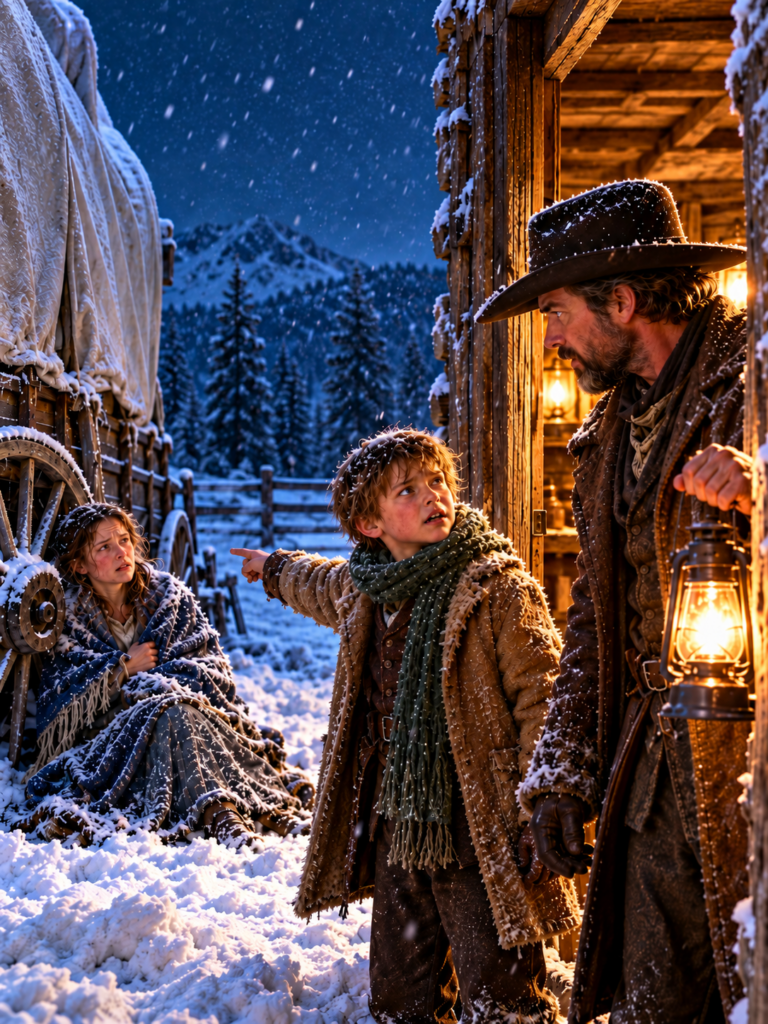
the hungry boy who knocked on a rancher’s door in a blizzard—and the promise that changed three lonely lives
Part 1
On a Wednesday evening in January of 1889, Nathan Ward was eating beans alone when somebody knocked on his ranch-house door.
Nobody knocked on Nathan’s door in January.
Not after dark.
Not with the wind screaming across the Nebraska prairie hard enough to make the chimney moan.
Nathan put down his spoon and listened.
Three knocks came again.
Small ones.
Not the heavy fist of a neighbor with a sick cow or a broken axle.
Nathan pushed back from the table.
At thirty-nine, he had lived long enough to recognize when something did not belong. The nearest town, Bell Creek, sat four miles east, and the county road disappeared under drifting snow whenever the north wind rose.
Tonight, the weather had been worsening since afternoon.
He crossed the kitchen, passed the coat his father used to wear, and opened the door.
A boy stood on the porch.
He could not have been more than eight.
Snow clung to his hair. His cheeks were red from cold. His coat was too large in the shoulders and too short in the sleeves, as if it had belonged to someone else first.
The boy looked at Nathan without crying.
“Mister,” he said, “do you have any bread?”
Nathan stared at him.
Then he looked past him.
Through the blowing snow, he could barely make out a wagon near the gate.
One rear wheel leaned crookedly.
A mule stood with its head lowered against the wind.
Beside the wagon was a woman in a thin brown coat.
She was trying to lift a bundle.
“Is that your mother?”
The boy nodded.
“She told me not to ask for her.”
Nathan looked at him again.
“Why?”
“She said I should eat first.”
Something tightened in Nathan’s chest.
He stepped onto the porch.
“What’s your name?”
“Eli.”
“Eli, get inside.”
The boy hesitated.
“My mama—”
“I’m going to get her.”
Nathan pulled on his coat and boots and hurried toward the wagon.
The woman heard him coming.
She turned.
For one instant she stood straight, one hand gripping the wagon bed.
Then her knees gave way.
Nathan reached her before she disappeared into the drift.
She was lighter than he expected.
Too light.
Her face looked pale beneath strands of wet brown hair.
“I’m all right,” she whispered.
“No, ma’am.”
“My son—”
“He’s inside.”
Her eyes closed briefly.
“Eli?”
“He’s safe.”
Only then did she stop fighting him.
Nathan lifted her and carried her toward the house.
Eli stood in the doorway.
“Mama!”
“I’m here,” she said weakly.
Nathan settled her beside the woodstove and wrapped his heaviest quilt around her shoulders.
He had learned something about exhaustion the previous year while caring for his father through the final months of consumption. You did not force food into someone too quickly. You did not crowd them with questions. You gave warmth first. Water next. Then food.
Nathan placed bread in Eli’s hands.
The boy stared at it.
“Eat.”
Eli tore off one bite.
Then another.
By the third, he was no longer pretending he was not starving.
Nathan turned away so the boy would not feel watched.
He gave the woman water.
“My name is Nathan Ward.”
She held the cup with both hands.
“Clara Hale.”
He glanced toward Eli.
“And that is trouble?”
For the first time, something almost like a smile crossed her face.
“That is Elijah.”
“I knew it was too quiet a name for him.”
Eli kept eating.
Nathan put beans into three bowls.
Clara protested.
“We can pay.”
“Eat first.”
“I have money.”
“I didn’t ask if you did.”
The firmness in his voice ended the argument.
After Clara had taken several slow bites, Nathan went back outside.
The wagon wheel had two cracked spokes.
He led the mule into his barn, gave it hay and water, covered the bundles with canvas, and carried a small sewing case into the house after Clara called through the doorway.
“Please,” she said. “That one matters.”
He placed it beside her.
Nathan expected jewelry.
Instead Clara opened the case and revealed needles, thread, pins, small scissors, chalk, buttons, and a carefully folded letter.
She handed it to him.
The letter came from Mrs. Abigail Avery, owner of a dress shop in Bell Creek.
She needed a seamstress for six weeks.
Steady wages.
Enough for Clara to rent a room and begin again.
There was one condition.
Clara had to report to the shop before noon Thursday.
Nathan looked at the wall clock.
Wednesday night.
“You came all this way for this?”
Clara nodded.
“My husband died two years ago. Fever.”
Nathan said nothing.
She continued.
“I have been sewing wherever anyone will hire me. Repairs. Children’s clothes. Hems. But some weeks…”
She glanced at Eli.
The boy was licking bean broth from his spoon.
“Some weeks are longer than the money.”
Nathan understood.
He understood the careful arithmetic of poor people.
One sack of flour instead of two.
A repaired boot instead of a new pair.
One more winter with a coat that should have been replaced three winters ago.
“How far did you come?”
“Thirty-one miles.”
“With that wagon?”
“When it had four good wheels.”
Eli looked up.
“Mama said Bell Creek has a school.”
“It does,” Nathan said.
“Do they let you go if you don’t know anybody?”
“They let almost anybody in.”
Eli narrowed his eyes.
“Almost?”
Nathan managed a smile.
“They let boys named Elijah in, but they keep an eye on them.”
The child grinned.
Clara looked down at her bowl.
For a moment Nathan saw how young she might have looked before worry became something permanent behind her eyes.
She was perhaps thirty-two.
Maybe thirty-three.
Nathan had expected older.
Hardship could add ten years without asking permission.
“What happened to the wheel?” he asked.
“Rut.”
“Road south of Jenkins Creek?”
“Yes.”
“I know it.”
“We lost most of the afternoon.”
“And the food?”
Clara’s expression changed.
She knew what he meant.
“I gave Eli the last of it this morning.”
Eli stopped eating.
Nathan regretted asking.
Clara lifted her chin.
“I had coins for a room in Bell Creek. If I spent them on food along the road, we might arrive with a job and nowhere to sleep.”
There was no self-pity in her voice.
Only an explanation.
Nathan set the letter down.
“If the road is passable in the morning, I’ll take you.”
Clara looked at him.
“You don’t owe us that.”
“No.”
“Then why?”
Nathan glanced toward the bedroom door.
His father’s old boots still sat beneath the bench.
Because last winter someone had needed help too.
Because Nathan had spent eleven months watching a proud man slowly become dependent on another human being for water, blankets, and dignity.
Because after the funeral, silence had become the loudest thing in Nathan’s life.
Instead he said, “Because Bell Creek is four miles away.”
Clara watched him for several seconds.
Then she nodded.
That night Nathan gave Clara and Eli his bedroom.
He slept near the stove.
Before the door closed, Eli came back carrying a green wool scarf.
“It was Papa’s,” he said.
Nathan looked at the worn fabric.
“Looks warm.”
“Papa tied it twice.”
“Smart man.”
“He said one knot comes loose when you run.”
Nathan smiled.
“Then you better use two.”
Eli disappeared into the bedroom.
Later, Nathan lay awake on the floor listening to the storm.
Wind hammered the walls.
Snow hissed against the glass.
His father used to say a winter storm always told the truth by morning.
Nathan hoped the old man had been wrong.
At dawn, he opened the door.
The world had vanished.
Fence posts had disappeared beneath white drifts.
The wagon was half buried.
Beyond the gate, there was no road.
Nathan saddled his strongest horse anyway.
He made it less than half a mile.
The horse plunged chest-deep into a drift and nearly went down.
Nathan turned back.
Clara stood at the window when he returned.
She did not ask.
She could see the answer on his face.
“What time is it?”
“Eight twenty.”
She looked toward the wall clock.
Three hours and forty minutes.
That was what remained between Clara Hale and the job that might change her son’s life.
Nathan went outside again at ten.
Nothing.
At eleven, the wind was still blowing.
Clara sat at the kitchen table repairing a loose button on Eli’s coat because doing something with her hands was easier than staring at the clock.
Nathan went to the woodpile.
He was gone perhaps four minutes.
When he returned, the front door stood open.
“Eli?”
No answer.
Clara came from the bedroom.
“What?”
Nathan saw the empty chair.
The green scarf was gone.
So was Mrs. Avery’s letter.
He ran outside.
Small footprints crossed the porch.
They headed toward the buried road.
Nathan did not bother with the horse.
He followed them on foot.
He found Eli beyond the broken wagon.
The boy was fighting through snow almost to his waist.
“Eli!”
The child turned.
He lost his footing.
Nathan caught him before he disappeared face-first into the drift.
“I can make it!”
“No, you cannot.”
“It’s only four miles!”
“In this snow, four miles might as well be forty.”
Eli struggled against him.
The letter was tucked beneath his coat.
“If Mrs. Avery gets it before noon, Mama can have the job!”
Nathan stared at him.
There it was.
A child’s understanding of poverty.
If he could walk fast enough, perhaps his mother would stop counting coins.
If he could carry one piece of paper through a blizzard, maybe she would stop crying quietly after he fell asleep.
Nathan lifted him.
Eli stopped fighting.
His small voice broke.
“I just wanted to fix it.”
Nathan held him tighter.
“Some things aren’t yours to fix, son.”
When Nathan carried him back into the house, Clara wrapped Eli in the quilt and removed his snow-filled boots.
She did not yell.
That made it worse.
“You frightened me.”
“I’m sorry.”
“You never go alone again.”
“I wanted Mrs. Avery to know.”
“I know.”
Eli looked toward the clock.
Nathan did too.
11:53.
Seven minutes.
Nobody said anything.
At noon, the clock struck once.
Then again.
Twelve times.
Clara sat very still.
The deadline passed.
Somewhere in Bell Creek, Mrs. Avery was now free to hire someone else.
Clara folded the letter carefully.
Eli watched her.
“Mama?”
She kissed his forehead.
“We’ll go when the road opens.”
“But the job—”
“We’ll ask.”
Nathan knew what she was doing.
She was refusing to let her son carry the weight of a door that had closed because of a storm.
That afternoon the weather finally began to weaken.
By evening the wind had fallen.
Nathan looked across the room at Clara sewing the torn cuff of his winter coat.
Eli slept beside the stove.
The green scarf hung drying from a chair.
“What will you do if the position is gone?” Nathan asked quietly.
Clara kept stitching.
“Find something else.”
“You make that sound simple.”
“It isn’t.”
She pushed the needle through heavy wool.
“But simple and necessary aren’t the same thing.”
Nathan looked at her hands.
Steady now.
Capable.
He thought of the empty bedroom.
The empty chair.
The empty years ahead of him.
And for the first time since his father died, Nathan realized loneliness was not the same thing as peace.
Part 2
Friday morning brought pale sunlight.
Nathan stepped outside before breakfast and found the world transformed.
The storm had scrubbed the sky clear, but its damage remained everywhere.
Snow banked against the barn.
Tree limbs bowed under ice.
The road appeared only where wind had stripped the highest drifts away.
Nathan walked nearly a mile before deciding a wagon could pass if driven carefully.
He returned and found Clara feeding the mule.
“You should be resting.”
“I rested yesterday.”
“You nearly froze Wednesday.”
“And today I can stand.”
Nathan recognized stubbornness because he owned plenty of it himself.
He went to the shed.
Two wagon spokes had cracked cleanly.
His father had taught him to shape replacements when Nathan was fourteen.
“Never repair a wheel for looks,” the old man had said. “Repair it for the hole you haven’t hit yet.”
Nathan selected dry ash.
Eli watched every movement.
“Can I help?”
“Can you stay where I tell you?”
“Yes.”
“That answer came too fast.”
“I really mean it.”
Nathan gave him sandpaper.
“Smooth that edge.”
Eli worked with great concentration.
Clara watched from the barn door.
By late morning, Nathan had fitted the spokes and tested the wheel.
He loaded Clara’s bundles.
“You ready?”
She nodded.
Eli climbed aboard.
The green scarf was tied twice.
The four miles to Bell Creek took nearly two hours.
Nathan drove slowly through frozen ruts.
Eli talked enough for three people.
Clara spoke very little.
When the church steeple finally appeared above the bare trees, her hands tightened around the sewing case.
Mrs. Avery’s dress shop occupied a narrow building beside the apothecary.
Clara stepped down.
“I’ll go with you,” Nathan said.
“No.”
She looked at him.
“Thank you. But I need to speak for myself.”
Nathan respected that.
He waited beside the wagon with Eli.
Ten minutes passed.
Then fifteen.
When Clara finally emerged, Nathan knew before she spoke.
Her face was composed.
Too composed.
Eli ran toward her.
“Mama?”
Clara knelt.
“Mrs. Avery hired another seamstress yesterday afternoon.”
Eli’s face fell.
“She couldn’t wait?”
“No.”
“It was the storm.”
“I know.”
“Did you tell her?”
“Yes.”
“Then she should—”
Clara placed a hand on his shoulder.
“She had work waiting. She needed someone there.”
Nathan saw the injustice.
He also saw that Clara refused to make Mrs. Avery a villain merely because circumstances had been cruel.
“What now?” Eli asked.
Clara stood.
“Now we find a room.”
Mrs. Pike’s boarding house sat near the school.
The room upstairs was narrow, with a bed for Clara and a low cot for Eli.
There was a washstand, a cracked mirror, and one window facing the alley.
The weekly price included meals.
Clara counted the coins from her purse.
Enough for one week.
Not two.
Nathan wanted to say he would pay.
Something stopped him.
Perhaps pride.
Perhaps respect.
Perhaps the understanding that helping someone was different from deciding what they were allowed to do for themselves.
Clara paid.
Mrs. Pike handed her a receipt.
Then she noticed the sewing case.
“You sew?”
“Yes.”
“What kind?”
“Whatever needs sewing.”
Mrs. Pike touched the shoulder of her winter coat.
The lining had pulled loose.
“What would you charge for this?”
Clara examined it.
She named a price.
Mrs. Pike raised an eyebrow.
“You didn’t give me a charity price.”
“I don’t do charity work unless I choose to.”
Mrs. Pike smiled.
“Good.”
That was Clara’s first customer in Bell Creek.
Nathan carried their belongings upstairs.
Before leaving, he placed two wool shirts and a canvas work apron on the table.
Clara looked at them.
“You planned this?”
“I planned on having elbows.”
Both shirts were worn through at the elbows.
She almost smiled.
“What’s your rate?”
She told him.
He paid half in advance.
“No,” she said.
“That how you work?”
“No.”
“Then I’ll pay when they’re finished.”
He put the coins away.
That mattered.
Clara noticed.
Nathan was not pretending to need work just to give her money.
He truly intended to be a customer.
Before he left, Eli followed him downstairs.
“Mr. Ward?”
Nathan turned.
“Thank you for finding me.”
Nathan looked at the boy.
“Next time you decide to walk four miles through a blizzard, at least wait until I’m too old to chase you.”
Eli grinned.
“I won’t do it again.”
“Good.”
Nathan climbed onto the wagon.
As he drove away, Eli stood beside the boarding house steps.
Clara came outside.
They watched until he turned the corner.
That evening Clara repaired Mrs. Pike’s coat.
She made the seam stronger than it had been when new.
Saturday morning Mrs. Pike tried it on.
She lifted her arm.
Rolled her shoulder.
“Better than before.”
She paid Clara.
Then she said, “My neighbor has three sons who can destroy clothing faster than any boys God ever made.”
By dinner, the neighbor arrived carrying three coats.
Two had torn pockets.
The third was badly worn beneath the collar.
“When do they leave?” Clara asked.
“Monday.”
Clara examined the worst coat.
“I can repair it.”
“Will the patch show?”
“Yes.”
The woman frowned.
Clara could have lied.
Instead she said, “If you want invisible, I can make it pretty and weak. If you want your son warm, you’ll see the patch.”
The woman looked at the coat.
“My youngest owns nothing else.”
“Then I’ll make it strong.”
“Do that.”
Clara worked most of Sunday.
Eli sorted buttons and threaded needles when asked.
The boarding house kitchen smelled of stew and coffee.
People passed through.
People saw Clara working.
People talked.
By Monday morning, the three coats were ready.
The neighbor inspected them.
She pulled hard at the patched collar.
It held.
“That’ll do.”
She paid.
Then she told two other women.
By Tuesday, Clara had four more repairs.
Wednesday brought a farmer with torn trousers.
Thursday, a teacher needed a dress taken in.
Friday morning, Clara paid Mrs. Pike for another week.
She counted the remaining coins twice.
They were hers.
Earned.
She bought thread.
She bought wool scraps.
She bought Eli a pencil.
That night she opened a small notebook.
Income on one side.
Expenses on the other.
Board.
Food.
Mule feed.
Thread.
Cloth.
She stared at the numbers.
They were not generous.
But they worked.
For the first time since her husband died, she saw something more powerful than hope.
Evidence.
They might survive.
Weeks passed.
January softened into February.
Eli started school.
At first he came home quiet.
By the second week, he had learned the names of three boys, one girl who could outrun all of them, and a teacher who insisted his handwriting looked like “chickens running through mud.”
Nathan came to town on Thursdays.
Sometimes he brought clothes for Clara.
Sometimes he had nothing.
He still stopped.
He asked about school.
He asked whether Clara needed wagon grease.
He asked Mrs. Pike if the mule was behaving.
One afternoon Eli ran from the schoolhouse carrying a paper.
“Mr. Ward!”
Nathan turned.
“I got eight right.”
“Out of?”
“Ten.”
Nathan frowned theatrically.
“Terrible.”
Eli’s face dropped.
“Means you have two left to learn.”
Eli smiled.
Nathan showed him how to examine grain in a piece of wood to see where it might split.
They sat beside the wagon.
Clara watched from the boarding-house window.
She told herself she was grateful.
Nothing more.
Nathan had saved their lives.
Friendship was natural.
Concern was natural.
What she refused to admit was that she had begun listening for his wagon on Thursdays too.
One afternoon, a boy from Eli’s class saw Nathan helping him tighten a wagon bolt.
“Is that your pa?”
Eli answered immediately.
“No.”
The other boy shrugged and ran away.
Eli became quiet.
That evening Clara found a drawing on his bed.
A wagon.
A mule.
Clara.
Eli.
And a fourth figure that had been rubbed so hard with an eraser that the paper was nearly torn.
Clara sat beside him.
“Who was there?”
Eli looked at his hands.
“Mr. Ward.”
“Why did you erase him?”
“Because Papa should be there.”
Clara swallowed.
“And if Mr. Ward is there?”
Eli’s eyes filled.
“Then maybe I’m forgetting Papa.”
Clara reached for the green scarf folded beside his pillow.
“Do you remember how your father sang while shaving?”
Eli nodded.
“Do you remember how badly?”
A small laugh.
“Yes.”
“Do you remember him carrying you when you cut your foot at the creek?”
“Yes.”
“Do you remember this scarf?”
Eli touched it.
“He tied it twice.”
“Can Mr. Ward take those memories?”
“No.”
“Can you?”
Eli shook his head.
“Then liking someone new does not erase someone you loved first.”
He looked toward the erased figure.
“Can I draw both?”
“You can draw as many people as your heart has room for.”
Eli folded the paper.
But he did not redraw Nathan.
Not yet.
Clara understood.
Healing could not be hurried simply because adults found waiting uncomfortable.
March arrived.
Snow withdrew from the streets.
Mud replaced ice.
Clara’s business grew.
Mrs. Pike began writing customer names on a slate.
One Monday a traveling shopkeeper named Silas Doran noticed Mrs. Pike’s repaired coat.
He examined the stitching.
“Who did this?”
“Mrs. Hale upstairs.”
Mr. Doran owned a dry-goods store in Grayford, nearly a day’s travel west.
He asked to see Clara’s work.
The next morning he returned carrying a written offer.
Six months of guaranteed wages.
A free room above his shop.
Work fitting and repairing the clothing he sold.
Grayford had a school for Eli.
Clara read the page twice.
“Why me?”
“Because good sewing is cheaper than returned clothing.”
Practical.
She liked that.
“You need my answer?”
“Monday.”
After he left, Clara placed the offer beside her notebook.
Guaranteed wages.
Free room.
No wondering whether customers would come.
No counting board money every Friday.
No fear of one slow week.
It was exactly the stability she had begged God for months earlier.
And yet she felt no relief.
Friday afternoon Nathan arrived.
Clara handed him the letter.
He read it slowly.
“This is respectable.”
“Yes.”
“Room included.”
“Yes.”
“Six months guaranteed.”
“Yes.”
Nathan handed it back.
“You’ve earned the right to choose.”
Clara stared at him.
That was all?
She hated herself for the disappointment.
“Would you want us to go?”
Nathan’s face changed.
He looked toward the yard, where Eli was carrying parcels for Mrs. Pike.
“I would miss you both.”
Clara waited.
“But I won’t ask you to turn down secure work because you think I’m lonely.”
Something inside her hardened.
“So you think I should go.”
“I didn’t say that.”
“You didn’t say stay.”
Nathan looked genuinely confused.
Clara immediately regretted the sharpness.
He removed his hat.
“I don’t want to make your life smaller so mine feels fuller.”
That answer was decent.
Generous.
Infuriating.
Clara folded the offer.
“Good afternoon, Nathan.”
He understood the dismissal.
“Good afternoon, Clara.”
She watched his wagon leave.
For the first time since the blizzard, she wished he had been selfish.
Part 3
Saturday morning Clara opened her notebook.
She calculated everything again.
Rent.
Food.
Mule feed.
Thread.
Repairs already promised.
Money saved.
Grayford remained the safer choice.
Bell Creek remained the life she had built herself.
She stared at the figures until they blurred.
“Mama?”
Eli stood in the doorway.
“What?”
“Do we have to go?”
“No.”
“But are we going?”
“I haven’t decided.”
He looked at Mr. Doran’s offer.
Then he touched his father’s scarf.
“If I want to stay because Mr. Ward is here, does that mean I don’t love Papa?”
There it was again.
Not merely a question about towns.
A child trying to understand whether the human heart obeyed the same rules as a room.
Whether making space required removing someone else.
Clara pulled him close.
“No.”
“I think about Mr. Ward when fathers come to school.”
Clara closed her eyes.
Eli continued.
“I wish he could come sometimes.”
“That’s all right.”
“Would Papa be mad?”
“No.”
“How do you know?”
Clara looked at the scarf.
Because her husband Thomas had been proud, stubborn, funny, impatient with broken tools, patient with frightened horses, and completely unable to carry a tune.
Because he had loved Eli more than himself.
Because love that demanded permanent loneliness after death was not love.
“I knew your father,” Clara said. “He would want you surrounded by good people.”
Eli thought about that.
“Would Mr. Ward mind if I talk about Papa?”
“I don’t know.”
Eli frowned.
“You said—”
“I said I think he wouldn’t. But that answer belongs to him.”
The next morning Clara harnessed the mule.
They drove to Nathan’s ranch.
He came out of the barn when he heard them.
Surprise crossed his face.
For one terrible second Clara realized he thought they had come to say goodbye.
“We haven’t decided,” she said.
Nathan nodded.
“All right.”
“Eli wanted to see you.”
Nathan looked at the boy.
“Well, that’s unfortunate. I planned on being unbearable today.”
Eli smiled.
They watered the mule together.
Then Eli became quiet.
He took out the folded drawing.
Nathan sat on an overturned bucket.
“What have you got?”
Eli unfolded it.
The erased figure was visible.
“That was you.”
Nathan studied the paper.
“I’ve looked better.”
Eli did not laugh.
“A boy thought you were my father.”
Nathan waited.
“I told him you weren’t.”
“That’s true.”
“But I like you.”
“I like you too.”
“And sometimes I wish you were there when the fathers come.”
Nathan’s expression softened.
Eli looked down.
“If I draw you with us, am I forgetting my papa?”
Nathan leaned forward.
“No.”
“How do you know?”
“I don’t know everything.”
That answer caught Eli’s attention.
Adults rarely admitted that.
Nathan continued.
“I never met your father. I can’t speak for him. But I know the way you talk about him.”
Eli touched the scarf.
“He tied this twice.”
“You showed me.”
“He could fix clocks.”
“I can’t.”
“He could whistle with two fingers.”
“Definitely can’t.”
A smile appeared.
Nathan held out his hand.
“Show me the knot.”
Eli removed the scarf.
He looped it once.
Then twice.
Nathan attempted it.
He did the second turn incorrectly.
Eli corrected him.
Nathan handed the scarf back.
“You can tell me about your father whenever you want. You can miss him while you’re sitting beside me. You can love him while you’re having a good day.”
Eli’s eyes filled.
“And the picture?”
“Put me wherever you want.”
Nathan tapped the erased space.
“But stop rubbing people out.”
Clara stood in the barn doorway.
She turned away before either saw her crying.
Later Eli went to inspect Nathan’s old wagon wheel.
Clara joined Nathan on the porch.
“Thank you.”
“For tying a scarf badly?”
“For understanding him.”
Nathan leaned against the railing.
“I almost didn’t.”
“What?”
“The first time he mentioned his father, during the storm. I thought saying nothing was respectful. Maybe it was. Maybe I was afraid.”
“Of what?”
“Stepping somewhere I had no right to step.”
Clara looked across the fields.
“The dead leave strange boundaries behind.”
Nathan nodded.
After a moment he said, “When you asked whether I wanted you to go to Grayford, I answered badly.”
Clara said nothing.
“I answered the part I thought was fair.”
“And the unfair part?”
He looked directly at her.
“I hope you stay.”
Her breath caught.
“I miss you between Thursdays.”
Nathan continued before courage abandoned him.
“I miss Eli asking impossible questions. I miss hearing about which customer brought you what impossible repair. I miss seeing your lamp when I drive past Mrs. Pike’s after dark.”
Clara’s eyes stung.
“You could have said that Friday.”
“I know.”
“I went upstairs convinced you barely cared.”
“I care enough not to use it against you.”
That silenced her.
Nathan removed his hat.
“If you stay, I would like to call on you properly.”
Clara smiled despite herself.
“Properly?”
“I am trying not to ruin this.”
“You’re doing poorly.”
“Then perhaps I should stop talking.”
“That might help.”
He laughed.
She had never heard him laugh like that.
Not politely.
Not briefly.
Fully.
“Yes,” Clara said.
Nathan grew serious.
“Yes?”
“You may call on me.”
He smiled.
Then Clara raised one finger.
“I still have to decide about Grayford.”
“I know.”
“And you are not deciding for me.”
“I know.”
“And if I leave—”
“I’ll miss you.”
The simple answer carried more weight than any plea.
That evening Clara opened the notebook once more.
This time she refused to include Nathan in the arithmetic.
She counted customers.
Confirmed work.
Savings.
Expenses.
The slow weeks she could survive.
Then she asked Eli what he liked about Bell Creek besides Nathan.
“My teacher.”
“What else?”
“Samuel.”
“Who is Samuel?”
“The boy who said my writing looks like fence wire.”
“Wonderful friend.”
“He shares his lunch.”
“Anything else?”
“The creek.”
“What creek?”
“The one behind the school.”
“Anything else?”
“Mrs. Pike lets me turn the pancake.”
Clara smiled.
She wrote her own list.
Customers.
Independence.
School.
Community.
The possibility of renting a dedicated sewing room.
Her own work.
Only after those came Nathan.
She looked at the Grayford offer.
Good wages.
Good room.
Good opportunity.
If Bell Creek had offered nothing except Nathan Ward, Clara would have gone.
She had learned too painfully what happened when a woman’s survival depended entirely upon one man remaining alive.
Thomas had never failed her.
Death had simply taken him.
She would never again build a life with only one foundation.
But Bell Creek had become hers.
Monday morning she declined Mr. Doran’s offer.
He accepted graciously.
“You’re certain?”
“Yes.”
“You know where to find me if business changes.”
“Thank you.”
Clara returned to Mrs. Pike’s and finished a coat.
That afternoon Nathan arrived.
“We’re staying.”
His smile came slowly.
“Why?”
She appreciated the question.
“My customers. Eli’s school. I think I can build something here.”
Nathan waited.
Clara let him.
“And because I’d like to see what happens when you call on me properly.”
Nathan removed his hat.
“I believe proper calling includes pie.”
“Whose pie?”
“I was hoping yours.”
“Then you understand courtship badly.”
He laughed.
Spring came.
Nathan visited.
Clara and Eli went to the ranch on Sundays.
He taught Eli which tools were safe.
Clara taught Nathan how not to destroy shirt buttons.
They walked after supper.
They argued about beans.
They talked about Thomas.
They talked about Nathan’s father.
One night Nathan admitted that after his father died, he sometimes left two coffee cups on the table by habit.
“I would notice halfway through pouring.”
“What did you do?”
“Put the second cup away.”
Clara touched his hand.
“I still turn when I hear someone whistle badly.”
“Thomas?”
“The worst.”
Nathan smiled.
“You miss him.”
“Yes.”
“Good.”
Clara looked at him.
“Good?”
“He deserves to be missed.”
That was when she knew she was in danger.
Not danger like the storm.
Something quieter.
Hope.
By May, Clara rented a small workroom near the school.
She paid the rent herself.
Nathan helped move her table.
He did not offer to pay.
That was one of the reasons she loved him.
She had not said the word.
Neither had he.
Then one Sunday Nathan walked her back from the barn.
Eli was feeding the mule.
Nathan stopped beside the porch.
“I have been trying to speak about practical things.”
“That sounds like you.”
“I’m afraid if I start with the larger thing, I’ll say it badly.”
“That also sounds like you.”
Nathan took her hand.
“If you came here, Eli could still attend school. You could keep the workroom. On bad-weather nights you could stay at Mrs. Pike’s. We could share the wagon.”
Clara’s heart began pounding.
“Nathan.”
“I have thought about every inconvenience because apparently that is easier than saying what I mean.”
“What do you mean?”
He looked terrified.
A man who had walked into a blizzard without hesitation was terrified.
“I love you.”
Clara said nothing.
“I love your stubbornness. I love the way you make people pay what your work is worth. I love hearing Eli come through that door. I love that you do not need me, because when you choose to be here, I know it is choice.”
He swallowed.
“I would like to marry you.”
Clara looked toward the barn.
Eli was talking to the mule.
She thought of Thomas.
She thought of the freezing wagon.
She thought of the noon deadline.
Mrs. Avery’s closed opportunity.
Her first earned dollar.
Her notebook.
The erased figure.
The man standing before her who had never once asked her to become smaller so he could feel larger.
“Yes.”
Nathan blinked.
“Yes?”
“Yes.”
He exhaled.
“I had several more things prepared.”
“You should have spoken faster.”
He kissed her.
Not like a rescuer.
Not like a man collecting gratitude.
Like someone asking and receiving.
Later they told Eli.
The boy listened seriously.
“Can I keep Papa’s name?”
“Yes,” Clara said.
Nathan answered at the same time.
“Of course.”
Eli touched his scarf.
“And this?”
Nathan frowned.
“I was planning to burn it immediately.”
Eli stared.
Nathan lasted two seconds before smiling.
The boy threw himself against him.
For the first time, Eli called him something besides Mr. Ward.
Not Father.
Not Pa.
“Nathan.”
It was enough.
Part 4
They planned a small wedding for the end of May.
Then trouble arrived.
Not dramatic trouble.
The kind that arrives carrying paperwork.
Nathan received a notice from the county bank.
His father had borrowed money three years earlier after losing cattle during a brutal winter.
Nathan knew about the loan.
He did not know the final payment was due that summer.
The number was larger than his cash reserve.
Clara found him at the kitchen table with the paper.
“What is it?”
“Nothing.”
She stared at him.
He sighed.
“Bad answer.”
“Terrible.”
He handed her the notice.
Clara read it.
“How short are you?”
Nathan told her.
Her stomach tightened.
“That much?”
“I can cover most after cattle sales.”
“Most isn’t all.”
“No.”
“What happens?”
“I refinance.”
“Can you?”
“Probably.”
Probably.
Clara had learned to fear that word.
Nathan leaned back.
“My father took the loan to keep the ranch alive. I knew he had debt. I thought he had paid down more.”
Clara sat opposite him.
“You saved us in January.”
Nathan’s eyes sharpened.
“No.”
“What?”
“Don’t.”
“I only meant—”
“Your savings are for you and Eli.”
“I have money now.”
“And you earned it.”
“So did you.”
“This ranch debt existed before you arrived.”
Clara became angry.
“So marriage means your problems remain yours?”
“No.”
“That sounds convenient.”
Nathan rubbed his forehead.
“I don’t want the first thing I do after asking you to marry me to be taking your savings.”
“You aren’t taking anything.”
“I know what it feels like to owe someone.”
Clara went quiet.
His father.
The final illness.
The loan.
The ranch.
Nathan had spent years measuring his worth in usefulness.
Accepting help frightened him more than offering it.
She softened.
“I am not paying your debt.”
“Good.”
“I am helping you examine it.”
He looked suspicious.
“There is a difference.”
“There is always a difference when you explain something.”
“Get your ledger.”
They spent two hours at the table.
Cattle.
Feed.
Repairs.
Expected sales.
Loan balance.
Interest.
Clara saw the problem.
Nathan was land-rich and cash-poor.
Selling enough cattle immediately would reduce his future herd.
Selling part of the ranch would weaken the whole operation.
Refinancing might solve the timing issue, but at worse terms.
“What about the south pasture?”
“What about it?”
“You barely use it.”
“Bad grass.”
“How many acres?”
“Twenty-three.”
“Could someone lease it?”
Nathan paused.
“To graze?”
“Or hay.”
“It floods.”
“Every year?”
“Some.”
Clara tapped the paper.
“Then stop thinking like your father.”
Nathan stiffened.
She immediately realized the cruelty.
“I’m sorry.”
“No. Finish.”
Clara chose her words carefully.
“Your father knew this ranch for the years he had it. You know it now. Keeping his land does not require making every decision he made.”
Nathan stared at the ledger.
The next week he asked neighbors.
A farmer north of Bell Creek wanted seasonal access to the south pasture despite flooding because his own grazing land was worse.
The lease would not erase the debt.
But it narrowed the gap.
Nathan also found unused equipment in the shed.
A second plow.
Old harness.
A hay rake he had not touched in four years.
His father had saved everything.
Nathan had mistaken possessions for legacy.
He sold what he did not need.
Clara contributed nothing financially.
Instead she helped him see.
That mattered more.
Then Clara faced trouble of her own.
A new seamstress arrived in Bell Creek.
Younger.
Faster.
Cheaper.
Within two weeks, three customers switched.
Clara pretended not to care.
Nathan noticed.
“How many orders?”
“Enough.”
“That was not a number.”
“I don’t remember appointing you bookkeeper.”
“No. You appointed yourself mine.”
She sighed.
“Fewer.”
“How many fewer?”
“Enough to matter.”
Nathan wanted to say he could support her after marriage.
He knew better.
“What will you do?”
“I’m thinking.”
The younger seamstress, Daisy Moore, was not cruel.
She was nineteen.
She supported two younger sisters.
She charged too little because she did not yet understand the cost of thread, needles, rent, and time.
Clara could have spread rumors.
She could have warned customers the girl was inexperienced.
Instead she invited Daisy for coffee.
“You’re undercharging.”
Daisy stared at her.
“I thought you were angry.”
“I am.”
“Oh.”
“That does not make your arithmetic better.”
Clara showed her the notebook.
Cost of materials.
Hours.
Repairs that failed and had to be redone.
Daisy looked horrified.
“I’m barely making anything.”
“I know.”
“Why are you telling me?”
“Because starving competition is still starving.”
Daisy raised her eyes.
Clara continued.
“There is enough torn clothing in this county for two women.”
They began referring work to one another.
Daisy was better at quick alterations.
Clara handled heavy coats, difficult fittings, and complicated repairs.
Their combined reputation brought customers from nearby farms.
Nathan watched Clara survive not by destroying a rival but by making the market bigger.
One evening he said, “You know you could have let her fail.”
“Yes.”
“Why didn’t you?”
“Because someone letting me fail would not make me stronger.”
Nathan thought about that for a long time.
The wedding approached.
Eli’s anxiety returned.
Not loudly.
He began sleeping with the green scarf beside him.
He asked whether his name would change.
He asked where Thomas’s photograph would go at the ranch.
He asked whether calling Nathan anything different would be required.
Clara answered each question.
Then one evening Eli disappeared.
Not into snow this time.
Nathan found him sitting behind the barn.
The boy had the scarf around his shoulders.
Nathan sat beside him.
“You planning another four-mile expedition?”
“No.”
“Good. My knees are older.”
Eli looked toward the house.
“After the wedding, are you going to be my father?”
Nathan considered.
“I’ll be your stepfather.”
“What does that mean?”
“Means I’ll be married to your mother, and responsible for helping take care of you.”
“Do I have to call you Pa?”
“No.”
“Would you like it?”
Nathan looked across the field.
“That’s a dangerous question.”
“Why?”
“Because the truthful answer could make you feel responsible for my feelings.”
Eli frowned.
Nathan tried again.
“I would be honored if someday you wanted to. But I do not want it if you say it because you think I need it.”
Eli picked grass.
“What should I call you?”
“Nathan works.”
“Mr. Ward?”
“If you’re angry.”
Eli smiled.
Then his face became serious.
“Sometimes I’m scared I’ll stop remembering Papa’s voice.”
Nathan understood that fear.
He was beginning to forget his own father’s voice.
Some mornings he could remember exact sentences but not their sound.
“You might forget pieces,” Nathan said.
Eli’s eyes widened.
Clara might have softened the answer.
Nathan did not.
“I don’t want to.”
“I know.”
“Then how do I stop it?”
Nathan thought.
“You tell stories.”
“What stories?”
“All of them.”
He pointed toward the house.
“You tell me how he tied the scarf. You tell your mother things she forgot. You write things down. When you remember something funny, you say it out loud.”
Eli stared at him.
“Would you listen?”
“Yes.”
“Even after the wedding?”
“Especially after.”
The next morning Eli brought his drawing.
He had redrawn Nathan.
Thomas was not in the picture.
Instead Eli had drawn a green scarf hanging from the wagon rail.
Nathan noticed.
He said nothing.
Some memories did not require a human figure.
Two days before the wedding, the bank approved Nathan’s revised repayment schedule based partly on the pasture lease and cattle-sale projection.
The ranch was secure.
Not because Clara rescued him.
Because she had helped him look differently at something fear had made him avoid.
That same week Clara signed a six-month lease on her sewing room.
Nathan read it.
“You’re committing through November.”
“Yes.”
“You’ll be living here.”
“Yes.”
“That means driving to town.”
“Yes.”
“Winter?”
“I stayed at Mrs. Pike’s during storms before.”
Nathan smiled.
“You planned this without asking permission.”
Clara looked offended.
“Were you expecting something else?”
“No.”
He folded the lease.
“I was hoping for exactly this.”
The wedding took place on the ranch on the final Sunday of May.
Mrs. Pike came.
Eli’s teacher came.
Daisy came with her sisters.
Neighbors brought pies, bread, ham, beans, and enough coffee for an army.
Clara wore a simple cream-colored dress she had made herself.
Nathan wore a coat whose cuff still carried her first repair.
Eli stood beside them.
He held the green scarf folded in his hands.
When the minister asked Nathan whether he accepted Clara, Nathan said yes before the sentence was fully finished.
People laughed.
When Clara answered, her voice remained steady until the final word.
Afterward, Nathan knelt in front of Eli.
“I believe you have something important.”
Eli looked at the scarf.
“I didn’t know where to put it.”
Nathan stood.
He opened the front door.
Inside, beside his own coat, he had installed a peg low enough for Eli to reach.
“Try there.”
Eli walked inside.
He hung Thomas’s scarf beside Nathan’s coat.
Nobody clapped.
Nobody made it symbolic.
They simply let the boy choose.
That evening, after the guests left, Clara carried her sewing case into the house.
Nathan carried nothing for her.
She had asked him not to.
“This is my first act as your wife,” she said, lifting the box onto the table.
“What is?”
“Carrying my own things.”
Nathan nodded solemnly.
“A strong marriage already.”
She laughed.
Outside, Eli opened his drawing.
He added one more line beneath the wagon.
Not a person.
Not a name.
A road.
It ran from Bell Creek to the ranch.
Part 5
Marriage did not transform Nathan’s ranch into a perfect home.
The roof still leaked beside the pantry in hard rain.
Nathan still left muddy boots in unacceptable places.
Clara still took on too much work.
Eli still forgot chores whenever something more interesting appeared.
They argued.
They apologized.
They learned.
That was the part no dramatic story ever bothered to explain.
A life could be saved in one night.
A family took longer.
Summer settled across the prairie.
Clara and Eli drove to Bell Creek most weekdays.
Nathan worked cattle and repaired fences.
Sometimes he met them for supper in town.
Sometimes Clara returned after dark and found him sleeping at the kitchen table with a lamp burning beside him.
One July afternoon Eli brought home a school composition.
The assignment asked students to write about “My Family.”
He did not show anyone immediately.
Clara found him sitting on the porch.
“What did you write?”
“Nothing yet.”
“Deadline?”
“Tomorrow.”
“That usually creates motivation.”
He frowned.
“There isn’t enough room.”
“For what?”
“The teacher gave us one page.”
Clara sat beside him.
Eli showed her the blank sheet.
“I have Papa.”
“Yes.”
“And you.”
“Yes.”
“And Nathan.”
“Yes.”
“And Grandpa Hale.”
“Yes.”
“And Mrs. Pike sort of.”
Clara smiled.
“And the mule probably.”
“Maybe.”
She put an arm around him.
“Then your problem is not that your family is broken.”
“What is it?”
“You need another page.”
The next day Eli turned in two.
Nathan pretended the extra paper represented reckless rebellion.
The teacher gave him full marks.
In August, Nathan made the final large payment required under the bank arrangement.
He returned from town holding the receipt.
Clara was sewing near the window.
“Done?”
“Not completely. But caught up.”
She read the receipt.
“You look disappointed.”
Nathan sat.
“I thought I would feel different.”
“How?”
“Like my father’s debt was finally off my shoulders.”
“Isn’t it?”
Nathan looked toward the barn.
“I think I’ve been angry with him.”
Clara waited.
“He borrowed money trying to save the ranch. Then he died and left the responsibility to me.”
“You can love him and still be angry.”
Nathan looked surprised.
“Can I?”
“Yes.”
“You make feelings sound inconveniently reasonable.”
“Practice.”
Nathan folded the receipt.
“I wish he had told me how frightened he was.”
“Maybe he didn’t know how.”
Nathan nodded.
That evening he took Eli into the shed.
He showed him the tools that had belonged to his father.
But for the first time, he did not describe the old man as if every decision had been wise.
“He was stubborn.”
Eli smiled.
“Like you?”
“Worse.”
“Impossible.”
Nathan laughed.
That honesty became another kind of inheritance.
By autumn, Clara’s sewing business had grown enough that she and Daisy hired a fourteen-year-old girl after school to organize buttons, sweep, and take customer names.
They paid her.
Clara insisted.
“No unpaid favors disguised as opportunity.”
Daisy agreed.
Mrs. Avery eventually entered Clara’s workroom.
The same Mrs. Avery whose missed deadline had once seemed like the end of everything.
She carried an evening dress.
“I have a difficult alteration.”
Clara recognized her immediately.
Mrs. Avery did too.
There was a moment of discomfort.
Then Mrs. Avery said, “I heard you do excellent structural work.”
“I do.”
Mrs. Avery placed the dress on the table.
“I am sorry about last January.”
Clara touched the fabric.
“You did what you needed to do.”
“I have wondered whether I should have waited.”
“You had customers.”
“Yes.”
“And I was not there.”
“The storm was not your fault.”
“No.”
Mrs. Avery looked around the workroom.
“You did well.”
Clara smiled.
“Yes.”
Not bitterly.
Not triumphantly.
Simply truthfully.
She had.
Mrs. Avery became a customer.
Not a symbol of defeat.
Not a villain redeemed.
A customer.
Winter returned.
The first heavy storm came in December.
Snow began before noon.
Clara saw it thickening beyond the workroom window.
Daisy looked outside.
“You’d better go.”
Clara nodded.
She closed early.
Eli, now nine, met her outside the schoolhouse.
They started for the ranch.
Halfway home the wind strengthened.
For one heartbeat Clara was back in the previous January.
Broken wheel.
Empty stomach.
Eli walking toward a stranger’s door.
She gripped the reins.
“Mama?”
“I’m all right.”
The road remained passable.
Thirty minutes later, a lantern appeared at the ranch gate.
Nathan had hung it there.
He stood beside the barn waiting.
Eli waved.
Nathan raised one hand.
Clara’s throat tightened.
Not because someone had rescued her.
Because she knew where home was.
That night snow buried the lane.
They sat beside the same stove where Nathan had once fed two strangers beans and bread.
Eli had grown enough that his feet nearly reached the floor from the chair.
Nathan repaired harness.
Clara sorted orders.
Wind struck the windows.
Eli looked toward the green scarf hanging from its peg.
“Do you remember the night I knocked?”
Nathan glanced up.
“I remember considering pretending I wasn’t home.”
“You did not.”
“Poor judgment.”
Clara smiled.
Eli became serious.
“I thought Mama was going to die.”
The room changed.
Nathan set down the harness.
Clara stopped writing.
Eli rarely spoke about that part.
“I knew she was hungry,” he continued. “She kept saying she wasn’t.”
Clara looked at him.
“I thought if I ate less, she could eat.”
Her eyes filled.
Eli stared at his hands.
“But then she kept giving me hers.”
Nathan said quietly, “Parents do foolish things.”
Clara gave him a look.
“Generous foolish things.”
Eli stood and took the scarf from the peg.
“I thought if I could get the letter to town, everything would be fixed.”
“You were eight,” Clara said.
“I know.”
He looked at Nathan.
“I remember what you told me.”
“What?”
“That some things weren’t mine to fix.”
Nathan nodded.
Eli draped the scarf around his shoulders.
“I think I understand now.”
Clara leaned back.
“What do you understand?”
“That you two fix different things.”
Nathan glanced at Clara.
Eli continued.
“Mama fixes clothes.”
“A profound observation,” Nathan said.
“You fix fences.”
“Also profound.”
“And sometimes people help fix things for each other.”
Nobody spoke for a moment.
Nathan looked at the fire.
“That sounds about right.”
The following morning, the storm had sealed the road again.
This time nobody had a deadline.
Nobody was starving.
Nobody needed to prove anything.
Nathan cooked breakfast badly.
Clara complained.
Eli ate everything.
Years passed.
Clara’s Bell Creek business became permanent.
Daisy eventually opened a second workroom in another town.
Mrs. Pike remained in their lives until old age.
Eli grew taller than Clara.
Then taller than Nathan.
At sixteen, he could repair a wagon wheel.
At eighteen, he still kept the green scarf.
He talked openly about Thomas.
He called Nathan by his name for years.
Then one autumn morning, shortly before leaving to study bookkeeping in Omaha, Eli stood beside the wagon.
Nathan was checking a strap.
“Pa?”
Nathan stopped.
He did not turn immediately.
Eli noticed.
“You heard me.”
Nathan cleared his throat.
“I did.”
“I can call you something else if—”
Nathan turned.
“No.”
His eyes were wet.
“No. That will do.”
Eli smiled.
He did not say it ceremonially again.
He simply began using it.
Clara heard the first time from the porch.
She pressed one hand against her mouth.
Thomas had not disappeared.
Nothing had been replaced.
The family had simply grown around the loss.
Years later, after Nathan’s hair had turned gray and Clara needed spectacles for close stitching, they still kept the first letter from Mrs. Avery.
The letter with the missed deadline.
Clara stored it inside her old sewing case.
Eli once asked why.
“That job was the reason we came.”
“But you never got it.”
“No.”
“Then why keep the letter?”
Clara looked toward the kitchen.
Nathan was complaining about a hinge.
She smiled.
“Because sometimes the thing you lose is not the same thing as the life you lose.”
Eli waited.
Clara unfolded the paper.
“I thought missing this appointment meant I had failed you.”
“You didn’t.”
“I know that now.”
She traced the old crease.
“If I had reached Bell Creek on time, perhaps I would have worked six weeks for Mrs. Avery. Perhaps I would have rented another room. Perhaps we still would have known Nathan. Perhaps not.”
Eli touched the green scarf he had brought from his room.
“So the storm was good?”
“No.”
Clara answered immediately.
“Hunger was not good. Fear was not good. Nearly freezing was not good.”
She looked at him.
“Never turn suffering into something beautiful just because something beautiful happened afterward.”
Eli absorbed that.
“What happened was that we survived it. Then we made choices.”
One honest choice after another.
Nathan opening the door.
Clara refusing to surrender after the lost job.
Eli learning that love was not betrayal.
Nathan learning that help did not diminish a man.
Clara learning that independence and love could occupy the same house.
None of those choices erased the storm.
They simply refused to let the storm write the ending.
Eventually Eli married.
When his first son was born, he brought the baby to the ranch.
Nathan held the child awkwardly.
“You’ve forgotten how,” Clara said.
“I never knew how.”
“You raised Eli.”
“He was eight. He could hold up his own head.”
Eli laughed.
On the wall behind them hung two framed photographs.
One of Thomas Hale.
One of Nathan’s father.
Neither had been hidden.
Neither had been turned into a shrine.
They belonged to the house because memory belonged to the living.
Before leaving that evening, Eli found his old childhood drawing in a drawer.
The wagon.
The mule.
Clara.
Himself.
Nathan beside them.
The green scarf drawn over the wagon rail.
The road stretching toward the ranch.
He showed it to Nathan.
“Remember?”
Nathan studied the faded pencil.
“I remember you nearly rubbed me through the paper.”
“I wasn’t sure where you belonged.”
Nathan looked at the drawing.
“And?”
Eli smiled.
“Turns out there was room.”
After Eli left, Nathan and Clara sat on the porch.
The fields were gold beneath the evening light.
The ranch had changed over the years.
New fencing.
A larger barn.
A better roof.
But the front door remained the same one Nathan had opened during the blizzard.
Clara rested her hand over his.
“Do you ever think about that night?”
“Every winter.”
“What do you remember first?”
Nathan considered.
“The knocking.”
Clara smiled.
“Not me collapsing dramatically into the snow?”
“You were very troublesome.”
“So I’ve been told.”
He squeezed her hand.
“I remember opening the door and seeing Eli.”
“What did you think?”
“That somebody needed bread.”
Clara looked across the land they had spent years building together.
“And then?”
Nathan smiled.
“Then I discovered he needed considerably more.”
“What?”
“A mother kept alive.”
Clara leaned against him.
“A wagon repaired.”
“Yes.”
“A place in school.”
“Yes.”
“A man taught how to tie a scarf.”
“Still impossible.”
She laughed.
Nathan looked toward the door.
He had opened it that night believing he was giving shelter to strangers.
For years people in Bell Creek told the story that way.
Nathan Ward rescued a starving widow and her child in a snowstorm.
Nathan never liked that version.
It gave him too much credit.
The truth was more complicated.
He gave them bread.
Clara brought purpose back into rooms that had gone silent.
Eli brought noise, questions, muddy boots, school papers, laughter, and eventually the word Pa.
Nathan had carried Clara from the snow.
But Clara and Eli had carried him out of a different kind of winter.
No single person saved the others.
They built something together.
And when another January storm rattled the windows many years later, an old Nathan rose from his chair and added wood to the stove.
Clara sat at the table repairing their grandson’s coat.
The boy had torn one pocket climbing a fence he had been specifically told not to climb.
“You charge family?” Nathan asked.
“Double.”
He smiled.
Outside, snow covered the lane.
Inside, the green scarf still hung on the low wooden peg.
The peg had never been raised.
Even after Eli grew tall.
Even after he moved away.
Even after he became a father himself.
Nathan once asked Clara whether they should move it.
She had said no.
Some things earned their place by remaining exactly where they had first been welcomed.
And so the scarf stayed beside Nathan’s coat.
A reminder of one frightened boy.
One freezing woman.
One lonely rancher.
One closed road.
One missed deadline.
And one door opened in a storm.
The door had seemed like the smallest choice Nathan made that winter.
Years later, surrounded by a family none of them could have imagined that night, they understood it had been the beginning of everything.

