
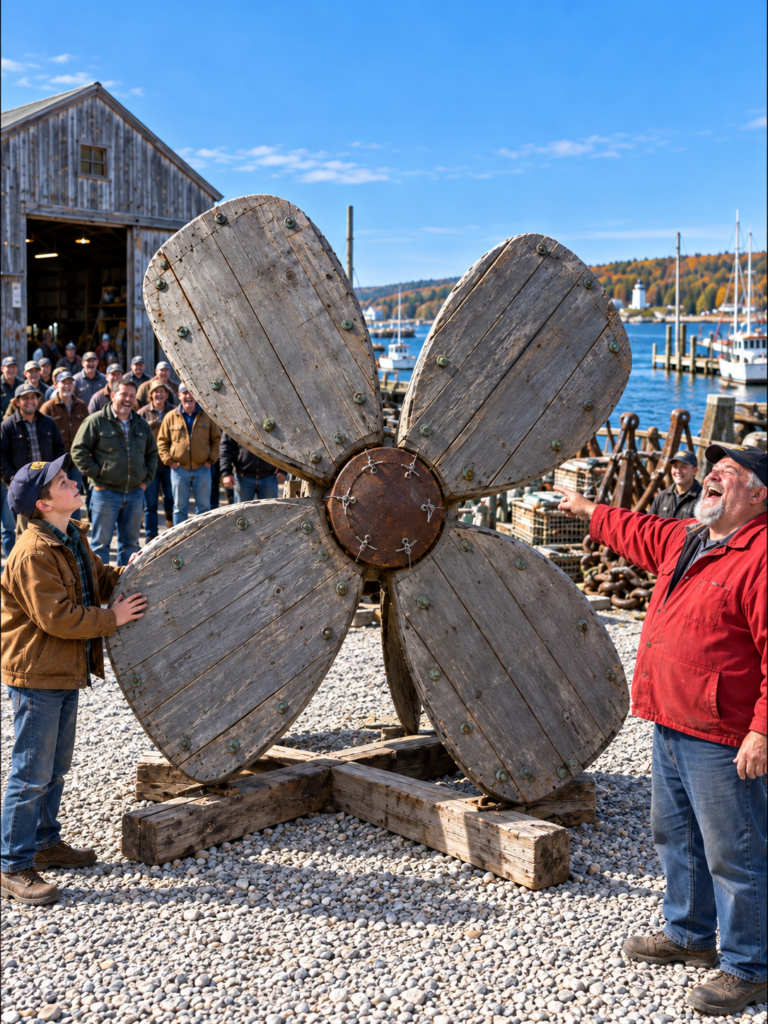
the boy who bought eight tons of boarded mystery for eighty dollars while the scrap man laughed and offered to haul it free until a ferry in finland paid one hundred fifty two thousand
Part 1
The auction yard on the Ostrander Bay waterfront had been emptying since midafternoon, but the cold stayed. Lake Superior wind came in low and steady across the gravel, rattling the last of the dry weeds and pushing at the boarded planks of lot 206. Royce Kettleman stood with one hand on those planks to steady himself, laughing so hard the sound carried past the coffee wagon and up to the road. He was a heavy man in a red canvas work jacket, the owner of Kettleman Iron and Metal out on the county road, and for thirty years he had bought nearly every pound of scrap that came up for sale along that stretch of shore. When Royce Kettleman called a thing junk, the town tended to agree with him.
“Son,” he called, loud enough for the whole yard to hear, “I’ll haul that thing off for you. Free. Won’t cost your mother a dime. Just tell me which ditch you want it in.”
Forty people laughed with him. Some of them were neighbors. Mrs. Halverson from church stood with her hands in her coat pockets, smiling. The two Puit brothers who ran the gas station leaned against each other and shook their heads. Mr. Dahl, who bought roses from the flower shop every Friday, looked down at his boots and then looked up again, still smiling. They were not cruel people, most of them. It was only that a twelve-year-old boy and eight tons of boards was the funniest thing they had seen all autumn, and Royce Kettleman was the man telling the joke.
Danny Kosky stood at the foot of the propeller with his hands in his jacket pockets and his heart going hard against his ribs. His eighty dollars of flower delivery money was already in the auctioneer’s cash box. The thing at his back was taller than the auction barn door, twelve feet across from tip to tip, four great blades curving out from the middle like the arms of a windmill that some giant hand had twisted. Every blade was boxed shut in gray planks, bolted through and through so that not one inch of the metal underneath showed anywhere. The hub in the center was capped with a rusty iron cover plate held on by a ring of bolts, and threaded through the bolt heads were small gray wire seals, each one crimped shut around a little stamped disc. Nobody alive could say where it had come from. Arvid Lund had traded ship’s iron on that waterfront for half a century and died in August with his yard still full. Whatever had once been stenciled on the planks had weathered away long ago.
Bev Linquist the auctioneer had opened the lot at one hundred dollars and heard nothing but the wind. She had dropped to fifty, then to twenty-five, and a hand in a brown canvas sleeve had gone up in the third row. Somebody in the back had run the boy up for a joke. When the joking stopped, he owned it for eighty dollars, which was every dollar he had in the world.
“Keeping it,” Kettleman said, wiping his eyes. “Well, you let us know when you get it in the house.”
Danny did not take the free haul. “No, thank you, Mr. Kettleman,” he said. “I’m keeping it.”
That brought a second laugh, bigger than the first. Walt Ojala stood beside him in the cold. Walt lived across the alley from the flower shop, a lean, white-haired man of seventy-four who had spent forty years rigging cargo on the ore docks. He had come for a set of chain hoists and had not expected Danny to buy anything bigger than a toolbox. Danny’s father was on the road all week driving a flatbed for the lumber yard, and his mother had three hundred white roses to wire for a wedding, so Danny had tagged along.
Walt looked up at the boarded blades and said quietly, “Well, you did it now.”
“You saw the bolts,” Danny said.
“I saw them.”
During the preview that morning, while the grown men walked past lot 206 without slowing down, Danny had walked all the way around it twice. He had noticed things. The planks were not slapped on. Each board had been cut to follow the twist of the blade underneath it, the way a good carpenter fits a stair to a crooked wall, and that was hours of careful work. Somebody had cared about what was inside. The bolts that held the boards were not rusty like everything else in that yard. They had gone green, a dull chalky green, and when Danny pointed at them Walt had grunted and said, “Bronze? Nobody wastes bronze bolts on junk.” Then there were the seals. Danny had crouched at the hub with his nose a few inches from the cover plate and counted eight of them. Small gray wire loops through the bolt heads, each one closed with a disc stamped with letters too worn to read. Somebody had sealed that cover so anyone would know if it had ever been opened. Not one seal was broken.
And there was the magnet. Danny kept a flat round magnet in his jacket pocket, the kind his father used to find old nails in reclaimed lumber. Near the bottom of one blade a board had split along the grain, leaving a gap as narrow as a pencil, and through it he could see a sliver of dark metal. He held the magnet to the gap. It slid off and fell into the weeds. Iron would have grabbed it. He had not pried or poked a screwdriver into the gap or tried a single bolt. He had just stood in the weeds with his heart going fast, and when the bidding started he had raised his hand.
The trouble with owning eight tons of anything is that you have to move it, and Royce Kettleman knew that better than anybody. “How you getting it home, son?” he asked loud again while the crowd was still milling around the coffee wagon. “Arvid’s crane sold this morning. The forklift went at noon. I’ve got the only boom truck in the county that’ll pick that up, and I already offered.” He spread his big hands wide, grinning. “Free.”
People laughed again. Walt took out his phone and stepped away along the fence to make two calls. The first brought Danny’s father, Pete Kosky, who pulled into the Lund yard at a quarter to six with the lumberyard’s flatbed still in his work coat. The second brought Arne Tovonen, an old friend of Walt’s from the docks, who ran a rotator wrecker that could lift a good deal more than eight tons. Pete was a big, quiet man with a short brown beard, and he did not laugh. He walked around the propeller once, the way his son had, and stopped at the green bolts, and then at the seals. Then he looked down at Danny.
“Eighty dollars,” he said.
“Yes, sir.”
“All of it?”
“All of it.”
Pete Kosky nodded slowly, as if a boy spending every cent he had on something he could not see was a thing that needed thinking about rather than shouting about. “Then I guess we’d better take it home,” he said.
Loading it took two hours and the last of the daylight. The three men did the rigging. Nylon slings under two of the boarded blades, the wrecker’s boom groaning, the flatbed’s springs settling as the weight came on. Danny stood well back by the fence, the way the men had told him to. Royce Kettleman watched the whole thing from the cab of his pickup with the heater running, and when Pete began chaining the load down he rolled his window down and called across the yard.
“Kosky’s Folly!” he shouted, and drove away laughing.
The name had stuck by Monday.
Part 2
They set it down that night in the gravel lot behind Kosky Flowers between the greenhouse and the alley on four railroad ties Walt had been saving in his garage for no reason he could ever explain. In the morning, when Ruth Kosky came to unlock the shop, it was standing there above her greenhouse roof, its boxed blades throwing a long cross-shaped shadow over her rows of potted mums. Ruth had run the flower shop for fourteen years, weddings and funerals and every prom in three townships, and she looked at problems the way she looked at a bouquet that had come in three stems short. She stood at the back window with her coffee for a long time.
“Daniel,” she said finally, “that is in my lot.”
“I know, Mom.”
“It is taller than my greenhouse.”
“I know.”
She looked at it a while longer. “Did you open it?”
“No.”
“Are you going to?”
“Not yet,” Danny said. “Not until somebody who really knows what it is can be standing right here. If I open it wrong, I might wreck the one thing that makes it worth anything.”
His mother looked at him over her coffee cup, and something in her face changed the way it did when a customer who had been short with her turned out to be grieving. “All right,” she said. “Then nobody touches it. Not you, not your father, not Walt.”
And nobody did. It stayed shut tight, every plank and every bolt and every seal exactly as Arvid Lund had left it. The town did plenty of talking, though. By Wednesday the story had been told at the Harbor Cafe so many times that the propeller had gained a few tons. Royce Kettleman told it best. Everybody agreed. He told it at the counter with his red jacket hung on the stool beside him, and he did the boy’s cracked voice saying “eighty,” and he did his own generous offer, and he always finished the same way. “I offered to haul it off for free,” he would say, shaking his head at the ceiling. “And the kid looked at me like I was trying to steal his lunch money.”
The Ostrander Bay Beacon ran a photograph on page three. The propeller looming over the greenhouse under the headline “Local boy buys 8 tons of mystery.” Somebody leaned a funeral wreath against one of the boxed blades as a joke with a card tucked into it that said “Rest in pieces.” Ruth carried the wreath inside, freshened it with new carnations, and sold it on Thursday for forty dollars. Customers teased her across the counter. “How’s the propeller business, Ruth?” She smiled and rang them up. When they had gone, she sometimes stood at the back window again.
Danny went to school and came home and checked the seals. Every afternoon, all eight of them still closed. On the second Saturday Royce Kettleman’s pickup pulled into the alley. He climbed down slowly and stood looking up at the propeller with his thumbs hooked in his red jacket. Danny came out of the greenhouse with a watering can. Across the alley Walt leaned in his garage doorway with his arms folded.
“I’ll tell you what I’ll do, son,” Kettleman said. He took out his wallet and counted off five twenty-dollar bills slow so everyone could see them. “One hundred. Your eighty back and twenty for your trouble, and I’ll haul it off Monday. Your mother gets her lot back. Nobody has to laugh at anybody anymore.” He held the money out. “That’s a good deal. That’s a better deal than you deserve.”
Danny looked at the money. One hundred dollars was more than he had ever held at one time in his life. “No, thank you, Mr. Kettleman,” he said.
The big man’s grin slipped just for a second. Then it came back. “Suit yourself,” he said, and put the bills away. “It’ll still be iron next week.”
He drove off. Walt watched the pickup turn the corner onto Front Street, and then he walked across the alley and stood beside the boy. “Funny thing,” Walt said. “A man who thinks something is worthless doesn’t usually drive across town to buy it back.”
That night the first hard frost came down off the lake. Danny and his father pulled a canvas tarp over the hub to keep snow off the seals and tied it down with rope and then stood together for a minute under the yellow alley lamp with their breath smoking. The propeller ticked softly as the cold settled into it. Inside the greenhouse the little heater hummed, and the mums glowed red and gold behind the fogged glass.
“Whatever it is,” Pete said, “it’s waited this long. It can wait for you to do it right.”
Part 3
The Ostrander Bay Public Library was two rooms over the old bank with knocking radiators and a librarian named Agnes Werta, who had once checked out books to Danny’s grandmother. Danny went there every day after school that week. On the iron cover plate, under flaking paint, he had found three raised letters cast into the metal, an H, a P, and a W, and below them a row of raised figures that he copied into his notebook and read as four, four, seven. Mrs. Werta peered at the notebook through her reading glasses, disappeared into the back room, and came out twenty minutes later with a dusty bound volume of Great Lakes trade directories and one finger holding a page.
“Hollander Propeller Works,” she read, “across the lake in Wisconsin. Bronze and iron propellers for tugs, ferries, and ore boats.” She turned a few more pages, then a few more, and then she went quiet. “Closed in 1964. A fire.”
On the library computer Danny found an old newspaper story about it. The foundry had burned on a February night with the whole town standing in the snow to watch. Nobody was hurt, but the pattern shop had gone up with everything in it, every carved wooden pattern for every propeller Hollander had ever poured, seventy-three years of them. Danny sat back in the hard library chair and thought about that for a long time. A foundry makes a propeller by pressing a wooden pattern into packed sand and pouring melted metal into the shape it leaves. If the pattern is gone, nobody can make that propeller again without carving a new one from nothing, which takes months and a great deal of money. So if the thing behind his mother’s shop was a Hollander propeller and 447 was a pattern number, there would never be another one quite like it. It was a guess. He knew it was a guess, but it was a better guess than iron.
That night he wrote to every shipyard and marine supply company on the Great Lakes whose address he could find, nineteen of them on his mother’s cream-colored florist cards. Each letter said the same thing. A boarded-up ship’s propeller, the letters HPW, and the figures 447. A hub sealed with small wire seals all still closed, and that he had never opened it and would not open it until someone who knew propellers could tell him how. He put the shop’s phone number at the bottom. Ruth paid for the stamps without a word.
For two weeks nothing came back. Then on a Tuesday afternoon, while Ruth was wiring a spray of white lilies, the shop phone rang.
“This is Karen Hog,” said a brisk voice. “I’m a marine surveyor in Sturgeon Bay. I appraise ship’s equipment and a shipyard you wrote to sent me your card. Is Daniel there?”
Ruth passed the phone across the counter to her son.
“Have you opened it?” was the first thing Karen Hog asked him.
“No, ma’am. All eight seals are still closed. I check them every day.”
There was a long breath on the line. “Good,” she said. “Now listen to me. Don’t. Not one bolt, not one board, not one seal until I’ve seen it. Do you know why? Because the boards are protecting it. Because those boards are blade guards. When a foundry finishes a propeller, the blade edges are as fine as a good knife. Drop one chain on a bare blade and you’ve ruined a month of hand work. So they box every blade in fitted timber before it leaves the shop. And those seals on the hub mean an inspector measured the bore—the hole the shaft goes through—and closed it up so the buyer would know nobody had touched it since. If those seals are still closed, that propeller has never been fitted to a ship.”
“It’s never been used,” Danny said.
“Pattern 447,” she said. “Give me a few days with some old order books and don’t let anybody near it.”
She came on Saturday in a dusty blue pickup. A woman in her fifties with short gray hair, wire glasses, and a dark blue work parka with a reflective stripe across the back. She shook Danny’s hand first, then his parents, and then she stood at the foot of the propeller with her hands on her hips and said nothing for almost a full minute. Then she went to work without opening anything at all. She ran a long steel tape across the boards from tip to tip. She studied the bronze bolts through a jeweler’s loupe. She crouched at the hub and examined all eight seals through a magnifying glass, turning the little stamped discs with the tip of a pen and photographed each one twice. She read the cover plate and nodded as if someone had just answered a hard question correctly.
Finally she pulled off her gloves and spoke quietly so that only Danny, his parents, and Walt could hear. “Pattern 447 was cast twice in the spring of 1956 for an island ferry built that year across the lake,” she said. “Left-hand, ice-strengthened bronze. One went on the boat. The other was the spare. The foundry finished it and boarded it for shipping, and then the ferry company ran short of money that winter and never came to collect. It stood in the Hollander yard for eight years. After the fire, a buyer from this side of the lake bought everything left in that yard by the ton.”
“Arvid Lund,” Walt said.
“Arvid Lund. And he stood it in his weeds and forgot what it was for sixty years.”
Danny’s mouth had gone dry. “Is it worth something?”
Karen looked at him for a long moment. “I’m fairly sure what it is,” she said. “But fairly sure isn’t an appraisal. When this comes open, it should come open once, in daylight, in front of people, with me holding the gauge. There is a ship on the other side of the world that needs exactly this, and people will want to know it was done properly.” She glanced toward the street where a cluster of onlookers had stopped pretending not to stare. “Who laughed at you?”
Danny thought about it. “Pretty much everybody.”
“Then invite them,” said Karen Hog.
Part 4
Royce Kettleman came back the next morning. This time he did not get out of his pickup. He rolled the window down in the alley, leaned his elbow on the door, and looked past Danny at the propeller under its tarp.
“Saw you had a visitor,” he said. “Some lady from out of town.”
“Yes, sir.”
“Lot of fuss over a dredge wheel.” He was not grinning now. Exactly. He was smiling, which was different. “Tell you what. I’ll go five hundred and I’ll still do the hauling. You’ll never see a deal like that again.”
Danny thought about the green bolts and the eight seals and the magnet dropping into the weeds. “No, thank you, Mr. Kettleman,” he said. “But I’d like you to come on Saturday at ten. We’re going to open it.”
Kettleman stared at him. Then he laughed, and it was very nearly the old laugh. “Oh, I’ll be there,” he said. “I wouldn’t miss the firewood coming off for anything.”
Danny wrote the invitations that night on more of his mother’s cream-colored cards. One to Bev Linquist, who had sold him the thing, one to Mrs. Werta, one to Mr. Dahl, one to the Puit brothers and Mrs. Halverson and the editor of the Beacon, and one in his very best handwriting to Royce Kettleman. Every card said the same words. You are invited to the opening of lot 206 Saturday at ten behind Kosky Flowers with a marine surveyor present.
Saturday came bright and cold with a hard blue sky over the lake and frost still white on the greenhouse roof. Pete borrowed two dozen folding chairs from the Lutheran church hall and set them in two rows on the frozen gravel facing the propeller. Ruth made coffee by the urn. They came. Every person he had invited came and a good many he hadn’t, until the borrowed chairs were full and people stood three deep along the alley fence stamping their feet. Bev Linquist sat in the front row with her clipboard in her lap out of pure habit. Royce Kettleman came last in his red jacket and stood at the end of the front row with a paper cup of Ruth’s coffee and his boots planted wide like a man waiting for the end of a joke he had already heard.
Karen Hog’s pickup pulled in at five minutes to ten, and a second person climbed out of the passenger side. A tall man in his sixties with a close white beard and a long charcoal wool coat who looked across the gravel at the propeller the way some people look at an old photograph. He took a seat at the end of the second row and said nothing to anyone.
Karen set her toolbox down and faced the chairs. “My name is Karen Hog,” she said. “I’m a marine surveyor and an accredited appraiser of marine equipment, and the owner has asked me to examine this object and put a value on it on the record in front of witnesses. The owner is Daniel Kosky. He bought it at the Lund auction for eighty dollars.”
A few people chuckled. She waited until they stopped.
“He has not opened it. Nobody has since 1956. We will open one blade guard and the hub cover. Nothing more, and I will tell you exactly what I find.”
She handed Danny leather work gloves and a pair of safety glasses. Then she and Walt picked up the wrenches. The first bronze nut was stiff with sixty years of weather, and it took Walt’s whole weight on the wrench to start it. Then it turned with a groan, and then the second, and the third. Karen worked the far side. Danny stood between them, taking each nut as it came off and dropping it into a coffee can, counting out loud without meaning to. Twenty-two. Twenty-three. Twenty-four. The last bolt came free. Walt and Karen each took an end of the outer plank, lifted it away together, and laid it on the gravel.
Underneath was gold. Not real gold, of course, but that was how it looked in the hard morning sun. A broad sweep of smooth golden-brown metal curving away from them like the inside of a seashell, without a scratch, without a speck of rust, without a single dent or scar. It had never touched water. It looked as if it had been poured and ground and polished the week before and boxed up that same afternoon.
Somebody in the second row said “Oh,” very softly.
Karen knelt at the hub, cut the eight wire seals one at a time with a small pair of snips, and dropped each one into an envelope. She and Walt unbolted the iron cover and lifted it off. Behind it was the bore, a smooth tapered hole through the heart of the hub, packed with old yellow grease and bright as the day it was machined. And around its rim, cast into the bronze, were raised words that Karen read aloud to the whole yard.
“Hollander Propeller Works. Pattern 447. Left hand. Ice class. Hull 42. 1956.”
Then she pressed a small gray gauge against the blade in six places, read it each time, and wrote the numbers down. When she stood up, the whole yard had gone quiet.
“This is a manganese bronze ship’s propeller,” she said, “cast as the spare for an ice-strengthened island ferry called the Lady Elsa. It has never been installed. It has never turned in water. Every blade is at its full thickness, and that matters more than anything else I’ll say this morning, because the strength of an ice-class propeller lives in the thickness of its blades. A propeller that has worked for years has been dressed and ground and repaired, and every repair takes metal away. Nobody on earth can put it back.”
She turned a page in her notebook. “In 1982 the Lady Elsa was sold to Finland. For forty-four years she has been the only winter link between the mainland and a small island in the Finnish archipelago. About two hundred people, a school, a store, and no bridge. They renamed her the Kaisla. This past March she struck a rock ledge under the ice and cracked a blade on her left-hand propeller. Her patterns burned in that fire. A new casting would take fourteen months and well over two hundred thousand dollars, and without a sound propeller she will not be allowed to break ice this winter. Her owners have spent seven months writing to every propeller shop in the world looking for this.”
She laid her hand flat on the golden blade. “As scrap,” she said, “eight tons of manganese bronze is worth about forty-one thousand dollars today.”
A sound went through the chairs. Royce Kettleman did not move. The paper cup had stopped halfway to his mouth.
“But this is not scrap,” said Karen Hog. “This is the only one there is. For insurance purposes, my appraisal of this propeller, as the matched, never-installed spare for the Kaisla, is one hundred sixty thousand dollars. I’ll sign that today.”
Nobody spoke. Bev Linquist had stopped writing. Mrs. Werta had both hands over her mouth. And at the end of the front row Royce Kettleman stood white as the frost on the greenhouse roof, staring at the bronze he had offered to haul away for free, and he said nothing at all.
Part 5
Then the tall man in the charcoal coat stood up. “My name is Lauri Neiman,” he said in careful, quiet English. “I am chief engineer of the Kaisla, twenty-two years.”
He walked across the gravel and stopped in front of the open blade, and for a moment he could not seem to say anything more. He touched the bronze with two fingers.
“Our island owns the ferry together,” he said at last. “Every family holds a share. In winter the Kaisla is the only way to the mainland for school, for the doctor, for everything.” He turned to Danny. “The families have voted. We would like to offer you one hundred fifty-two thousand dollars, and we will pay to carry it home. It is not the full appraisal. I know that. It is what we have.”
Danny looked at his mother, who had tears standing in her eyes and did not bother to wipe them. He looked at his father, who nodded once. He looked at Walt, who was grinning so wide his face might crack.
“Yes, sir,” Danny said. “It should go home.”
The propeller left Ostrander Bay nine days later, boxed again in its old fitted planks on a lowboy trailer with people lining Front Street to watch it go. It was lifted onto that trailer by the biggest boom truck in the county, which rolled into the alley at seven on a Monday morning with Kettleman Iron and Metal painted on its doors. Royce Kettleman ran the crane himself and did not make a single joke. When the load was chained down he climbed out of the cab and walked over to where Danny stood with Walt by the fence.
“No charge,” he said gruffly, not quite looking at the boy. “I said I’d haul it for free.”
In February a fat envelope with Finnish stamps came to the flower shop. Inside was a photograph of the Kaisla pushing through white ice under a low pink sun with a long row of children in bright snowsuits waving from her rail. On the back Lauri Neiman had written, “First crossing of the winter. Full speed. Thank you for keeping it closed.”
Ruth put it in the shop window between the roses and the mums, and the people who had laughed stopped on their way past to look at it, and most of them stayed a while. Danny stood behind the counter sometimes and watched them. He did not say much. He had already said the only thing that mattered when he told the man from Finland yes. The propeller was where it belonged, doing the work it had been poured to do sixty years earlier, and the boy who had kept the seals closed long enough for someone to notice was back at school with his pockets empty again and his mother smiling at him across the counter when the customers had gone. The town still told the story, but the way they told it had changed. They did not laugh when they came to the part about the eighty dollars. They just stood in front of the window a little longer and looked at the picture of the ferry moving through the ice, and then they went on down Front Street with their hands in their pockets against the cold.

