
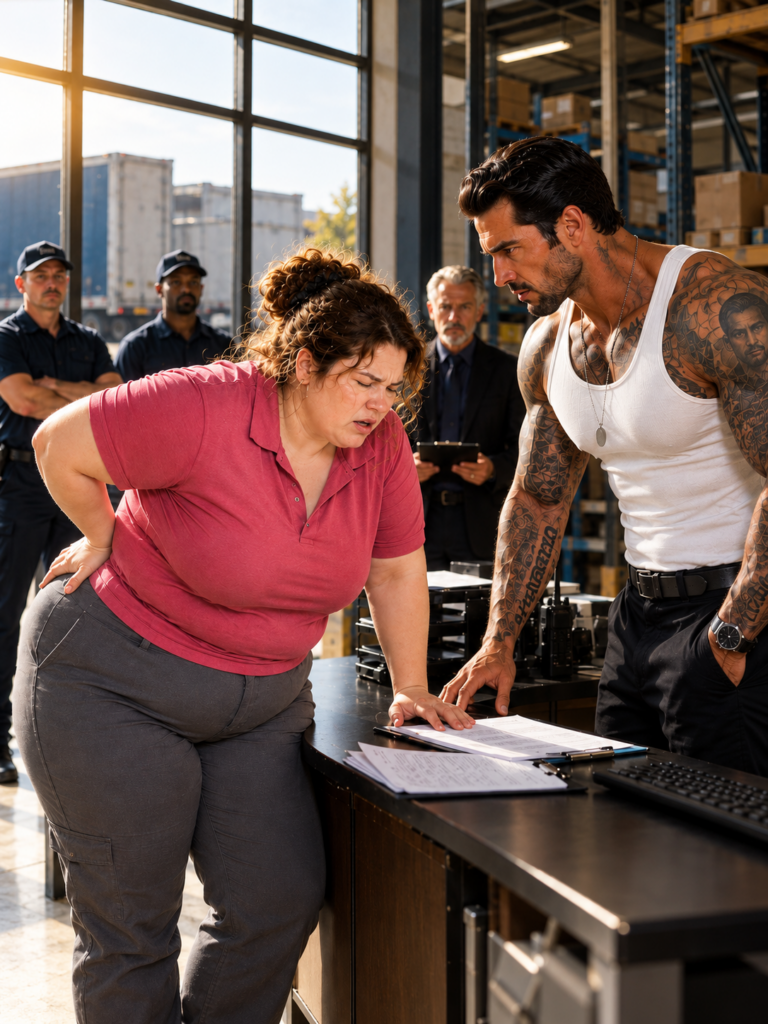
She Whispered, “I Can’t Sit”—Then the Mafia Boss Who Owned the Warehouse Discovered Someone Had Tried to Kill Her
Part 1
For twenty-one days, Madison Hayes did not sit down.
Not at lunch.
Not during shift meetings.
Not while filling out inventory reports.
Not even when her legs shook so badly beneath her that Daniel Ruiz quietly rolled an office chair toward her and pretended he had moved it by accident.
Madison looked at the chair.
For one treacherous second, longing crossed her face.
Then fear.
Then pain.
She pushed the chair away.
“I’m okay.”
Daniel frowned.
“You’ve been standing since six.”
“I know.”
“You were here before me.”
“I know.”
“It’s two in the morning.”
Madison managed a smile.
“Thank you for the time update.”
Daniel did not smile back.
Rain hammered the metal roof of DeLorenzo Logistics Center Seven hard enough to drown out the distant whine of forklifts.
The enormous Brooklyn waterfront warehouse never truly slept. Freight came through at all hours—legitimate imports, industrial equipment, medical supplies, electronics, foods from three continents.
And, according to whispers Madison had learned not to ask about, other things.
Things that arrived on manifests too clean to be trusted.
Things handled by men who did not wear company badges.
Everybody knew Gabriel DeLorenzo’s logistics empire had two faces.
One was respectable.
Boardrooms. Shipping contracts. Port leases. Political donations. Warehouses running from New York to Baltimore.
The other was whispered about in restaurants after midnight.
The DeLorenzo family.
Old power.
Old money.
Older blood.
Gabriel had inherited both worlds when his father died.
Unlike his father, he had spent fifteen years pulling the family’s legitimate businesses farther into daylight while keeping the violent machinery underneath hidden and controlled.
He was forty-one.
Unmarried.
Feared.
Rich enough to buy politicians and disciplined enough to prefer owning the people who bought them.
Madison had never met him.
People like her did not meet Gabriel DeLorenzo.
People like her handled night-shift shortages and missing pallet reports while men like him stood at charity galas with women whose gowns cost more than Madison earned in six months.
That suited her.
She wanted no part of his world.
Her only goal was to survive hers.
Tonight, survival required standing.
Her tailbone pulsed with every heartbeat.
Deep inside her pelvis, something burned.
She shifted her weight carefully from one leg to the other.
Daniel watched.
“You need a doctor.”
“I saw one.”
“A better one.”
Madison’s fingers tightened around her tablet.
“I’m fine.”
“You keep saying that.”
“Yes.”
“Which is usually what people say right before they collapse.”
She gave him a warning look.
Daniel leaned closer.
“What happened to you wasn’t normal.”
The words hit too close.
Madison’s breath caught.
Across the warehouse, a forklift beeped while reversing.
A steel loading door groaned upward.
She glanced toward the cameras instinctively.
Then lowered her voice.
“The report says I leaned against the safety railing improperly.”
Daniel swore.
“You’re the person who wrote half our safety procedures.”
“Apparently I ignored them.”
“You don’t believe that.”
“It doesn’t matter what I believe.”
“It should.”
Madison looked at him.
For three weeks, she had learned exactly how little belief mattered when powerful men had already purchased the official version.
“My insurance appeal was denied yesterday.”
Daniel’s expression softened.
“Madison…”
“My medical leave was denied too.”
“You shouldn’t even be here.”
“My rent doesn’t agree.”
Daniel looked furious.
She softened.
“Please.”
He understood the request.
Not now.
Not here.
Not where anyone could hear.
He nodded once and returned to the loading floor.
Madison waited until he was gone.
Then she placed one hand on a metal shelf and closed her eyes.
Twenty-one days earlier, she had still been able to sit.
She had still been able to sleep through the night.
She had still believed that rejecting an arrogant man was the end of an unpleasant conversation.
Blake Holloway had taught her otherwise.
He arrived at Center Seven wearing a navy suit and a senator’s surname.
Thirty years old.
Blond.
Handsome in the polished, expensive way magazine profiles called inevitable.
His father, Senator Richard Holloway, chaired the state transportation committee and was negotiating a massive public-private port modernization project involving DeLorenzo Logistics.
Blake appeared at the warehouse under the title of liaison.
Within three visits, he stopped pretending to care about freight.
“You work nights?”
“Yes.”
“That seems beneath you.”
Madison kept typing.
“I like nights.”
“Why?”
“Fewer politicians’ sons.”
He laughed as though she were flirting.
She had not been.
The flowers arrived the next day.
She returned them.
A reservation at an exclusive Manhattan restaurant appeared in her email.
She declined.
He waited beside her car one rainy morning.
“You keep saying no.”
Madison unlocked her door.
“That’s because you keep asking the same question.”
“Most women would be flattered.”
“I’m sure you’ll find one.”
His smile changed.
Not enough that another person might notice.
Enough that Madison did.
“You know who my father is?”
“Yes.”
“And Gabriel DeLorenzo values my father’s cooperation.”
“Yes.”
Blake stepped closer.
“People who know how this city works tend to be careful about insulting important friends.”
Madison looked at him.
“I said no to dinner.”
“That can feel like an insult.”
“That sounds like your problem.”
She got into her car.
Two weeks later, the railing gave way.
The call had come after midnight.
Missing inventory.
Upper inspection platform.
Madison climbed the stairs with her tablet.
There was no missing inventory.
Only a false alert.
She remembered leaning over the tablet.
The steel beneath her palm shifting.
Not bending.
Not failing gradually.
Letting go.
The entire railing section dropped outward.
Madison fell sixteen feet.
Her hip struck the corner of a pallet.
Then her lower back slammed against another.
Pain exploded white through her body.
She remembered screaming.
Then hearing small metallic objects bounce across concrete.
Bolts.
Several of them.
She remembered one warehouse assistant staring at the floor.
Then kicking something underneath a storage rack before anyone else reached her.
The next memory was fluorescent hospital light.
Dr. Alan Mercer barely looked at her.
“Soft tissue injury.”
“I can’t sit.”
“You took a significant fall.”
“The railing came loose.”
“We’ve been told you were leaning on it.”
“I rested one hand on it.”
“Workplace accidents happen.”
“The bolts—”
“You’re medicated.”
Then a company attorney arrived.
Then state safety inspector Howard Crane.
Then forms.
By morning, the accident had already been explained without her.
Employee negligence.
Improper use of safety barrier.
No structural defect.
No sabotage.
The camera footage disappeared.
Her prior maintenance complaint disappeared.
The assistant who called her upstairs quit.
Dr. Mercer’s notes described “moderate bruising.”
Moderate.
Madison nearly laughed whenever she thought about that word.
She couldn’t lower herself onto a toilet without crying.
She slept on her side surrounded by pillows.
She stood to eat.
She stood to work.
She stood because sitting felt like someone driving heated metal into her spine.
But according to every official record, she had suffered moderate bruising.
A sudden silence in the warehouse pulled Madison back to the present.
Forklift engines shut down one by one.
Workers began glancing toward the main entrance.
Daniel came toward her.
“Someone from corporate.”
Madison straightened automatically.
“Who?”
“No clue.”
A tall man in a black maintenance coat walked onto the floor.
No entourage.
No tailored suit.
No visible security.
Just dark trousers, work boots and a cap pulled low.
He spoke briefly to a floor manager.
The manager instantly became nervous.
Madison noticed that.
So did Daniel.
“Corporate inspector?” he murmured.
“Maybe.”
The stranger moved slowly through the warehouse.
He examined loading records.
Asked drivers questions.
Stopped beneath overhead beams.
Watched.
That was the thing Madison noticed.
He watched.
Not like an auditor searching for mistakes.
Like a hunter studying movement.
His gaze eventually found her.
Madison looked away.
Ten minutes later, he passed her station.
“Night supervisor?”
His voice was low.
Controlled.
“Yes.”
“Madison Hayes?”
“Yes.”
His gray eyes remained on her face a moment too long.
Not flirtatious.
Assessing.
“You’ve worked here how long?”
“Four years.”
“How many night-shift safety incidents in the last twelve months?”
“Before mine?”
His gaze sharpened.
“Yes.”
“Two minor injuries. Neither lost-time.”
“Your incident?”
“Officially?”
Something flickered in his eyes.
“Your answer.”
Madison’s throat tightened.
“One.”
He waited.
She did not elaborate.
The stranger nodded and continued walking.
Madison exhaled.
“Creepy,” Daniel muttered.
“No.”
She surprised herself.
Daniel looked over.
“No?”
“He listened.”
That should not have felt unusual.
It did.
For the next hour, Madison repeatedly caught the stranger observing her.
Not her body.
Her movements.
How slowly she turned.
How she braced against shelving.
How she avoided bending.
How she remained standing beside chairs.
Near four in the morning, Madison dropped her pen.
She stared at it.
A stupid little blue pen.
Six inches from her shoe.
She bent.
Pain tore through her pelvis.
Her vision went white.
A sound escaped her.
Before she could reach the pen, a large hand picked it up.
Madison straightened too fast.
She almost fell.
The stranger caught her elbow.
Only long enough to steady her.
Then immediately let go.
“You’re hurt.”
“I’m recovering.”
“No.”
The certainty angered her.
“You don’t know my medical history.”
“No.”
His eyes moved to the chair behind her.
“But I know people who are recovering.”
Madison said nothing.
“You’ve looked at that chair three times tonight.”
Heat rose into her face.
“So?”
“Like a thirsty person looking at water.”
Her lips parted.
He lowered his voice.
“Why can’t you sit?”
Every muscle in her body tightened.
“I can.”
“Then sit.”
Madison looked at the chair.
He waited.
Not mocking.
Not commanding.
Testing the lie she had offered him.
Her eyes burned.
“I can’t.”
The words were barely audible.
The stranger’s face changed.
Not pity.
Something colder.
“How long?”
“Three weeks.”
“And you’re working?”
“I need my paycheck.”
His jaw flexed.
“Who cleared you?”
“Dr. Mercer.”
“At which hospital?”
Madison frowned.
“Why?”
“What happened?”
“You read the report.”
“I asked what happened.”
Her heart stopped.
No one had done that.
Not really.
Every person with authority had said tell us what happened and then corrected her the moment she contradicted the paperwork.
This man stood in a noisy warehouse at four in the morning and asked like her answer might matter.
Madison’s composure cracked.
She looked away.
“I fell.”
His voice remained quiet.
“That isn’t what happened.”
Fear touched her.
“What do you mean?”
He nodded toward the repaired upper railing.
“I inspected that replacement.”
She stared.
“The anchors were changed.”
“So?”
“Companies don’t replace anchor assemblies after a simple employee fall unless someone is afraid of the original hardware.”
Madison’s pulse jumped.
He glanced toward Daniel.
“End the shift early.”
Daniel blinked.
“Sir?”
“Everyone goes home.”
The floor manager hurried over.
“You don’t have authority—”
The stranger removed his cap.
The manager stopped breathing.
Madison looked at his face.
Recognition came in pieces.
The photographs.
Business pages.
Television coverage.
A face usually surrounded by dark suits and microphones.
Gabriel DeLorenzo.
Owner of the company.
Head of the family people whispered about.
The most dangerous man in New York’s port system.
Daniel whispered, “Holy hell.”
Gabriel looked at the floor manager.
“Do I have authority now?”
“Yes, Mr. DeLorenzo.”
“Clear the building.”
Within fifteen minutes, the warehouse emptied.
Madison stood inside the supervisor’s office.
Gabriel closed the door.
She could hear rain beating against the high windows.
He removed his gloves.
Placed them neatly on the desk.
Then looked at her.
“What really happened?”
Madison’s throat closed.
He pulled out a chair.
She immediately stiffened.
Gabriel noticed.
Without comment, he moved it away.
Then remained standing too.
The gesture nearly broke her.
“You don’t have to stand.”
“Neither do you.”
“I do.”
“Then so will I.”
She stared at him.
“You own the company.”
“Yes.”
“Why are you here?”
“Because people lie upward.”
“What?”
“Executives tell owners what makes executives look competent.”
His expression hardened.
“So I visit without warning.”
Madison folded her arms.
“And what did you find tonight?”
“You.”
Her heartbeat changed.
Gabriel clarified.
“An employee with a serious untreated injury working because someone denied her leave.”
“Oh.”
Something unreadable crossed his face.
“Were you disappointed?”
“No.”
Embarrassment heated her cheeks.
She hated that she had even wondered.
Gabriel’s gaze remained steady.
“Tell me about the railing.”
So she did.
Blake.
The flowers.
The threats disguised as charm.
The false inventory call.
The falling steel.
The loose bolts.
The hospital.
The vanished records.
Gabriel did not interrupt once.
When she finished, tears had slipped down her face.
Madison wiped them angrily.
“I know how it sounds.”
“Do you?”
“Yes.”
“Tell me.”
She blinked.
“Paranoid.”
“No.”
“Convenient.”
“No.”
She laughed bitterly.
“I accused a senator’s son of sabotaging a warehouse railing because I wouldn’t date him.”
Gabriel’s gray eyes turned glacial.
“You said you suspect him.”
“Yes.”
“You didn’t claim proof.”
“No.”
“You separated what you know from what you believe.”
“Yes.”
“That is what honest witnesses do.”
Madison stared.
He stepped closer.
“Do you trust me?”
“No.”
The answer escaped instantly.
Gabriel almost smiled.
“Good.”
She frowned.
“That doesn’t offend you?”
“I’d be concerned if you trusted me after forty minutes.”
He picked up his coat.
“Come with me.”
“Where?”
“A doctor.”
“I already—”
“A real one.”
Madison crossed her arms.
“I cannot afford one.”
Gabriel looked at her.
“Your employer injured you.”
“My employer says I injured myself.”
“I am your employer.”
His expression hardened.
“And I say we are finding out.”
She hesitated.
Gabriel softened his voice.
“You decide.”
“You’re giving me a choice?”
“Always.”
Madison thought of Dr. Mercer.
Of forms pressed beneath her hand while she was medicated.
Of Blake asking why she kept saying no.
“Yes.”
Gabriel nodded.
One word.
“Good.”
The private clinic operated behind an unmarked entrance in Manhattan.
Dr. Eleanor Whitmore examined Madison for nearly five hours.
Advanced scans.
Ultrasound.
Blood tests.
Wound assessment.
Every new result made the doctor’s expression more severe.
Gabriel remained outside during examinations.
Madison noticed.
He could have ordered anything.
Instead he asked through the door whether she wanted him present.
She said no.
He stayed out.
Near noon, Dr. Whitmore called him inside.
Madison lay on her side beneath a blanket.
Her eyes were red from exhaustion.
Whitmore placed imaging on a monitor.
“Her pelvic ligaments are significantly torn.”
Gabriel’s jaw tightened.
“Her coccyx suffered more damage than recorded in the original report.”
Madison closed her eyes.
“There are also multiple embedded fragments in the lower tissue.”
“What kind?” Gabriel asked.
“Metal.”
Madison looked up.
Whitmore continued.
“And infection.”
Gabriel’s voice went dangerously quiet.
“How serious?”
“Treatable.”
“Because?”
“We caught it before it became systemic.”
Gabriel looked toward Madison.
She hated the fury in his face.
Not because it frightened her.
Because no one had ever been furious for her before.
Whitmore added, “She should never have returned to work.”
Madison stared at the blanket.
Gabriel said nothing.
“And whatever physician performed the first examination either missed obvious trauma…”
Whitmore paused.
“…or intentionally ignored it.”
Silence.
During the removal of one embedded fragment, Dr. Whitmore stopped.
Her instrument had struck metal.
Minutes later, she placed a small jagged object into an evidence tray.
Part of a bolt.
Madison stared.
Gabriel leaned closer.
One edge gleamed unusually smooth.
Whitmore turned it beneath the light.
“This did not break under load.”
Gabriel looked at her.
“No?”
“No.”
Her face hardened.
“This edge was mechanically cut before impact.”
Madison stopped breathing.
The room disappeared.
Three weeks of being told she was careless.
Dramatic.
Confused.
Wrong.
All of it collapsed beneath one tiny piece of steel that had been inside her body the entire time.
Her hands began shaking.
Gabriel saw.
He moved beside the bed but did not touch her.
“Madison.”
“They lied.”
“Yes.”
“I told them.”
“I know.”
“They made me sign—”
“I know.”
“I thought…”
Her voice broke.
Gabriel crouched until his eyes were level with hers.
“What?”
“I started wondering whether I remembered it wrong.”
His face changed.
That, more than the sabotage, seemed to enrage him.
“You didn’t.”
She looked at the fragment.
“How can you know?”
“Because metal doesn’t care who someone’s father is.”
A tear slipped free.
Gabriel lowered his voice.
“And neither do I.”
By nightfall, forensic engineer Victor Alvarez had inspected Center Seven.
His preliminary conclusion was devastating.
Multiple railing bolts had been deliberately loosened.
Others had tool marks.
One anchor had been partly cut.
The pattern was engineered so the barrier would appear stable until pressure hit a particular section.
“This was not negligence,” Alvarez told Gabriel.
“This was an attempted murder arranged to resemble an accident.”
Gabriel read the report twice.
Then looked through the clinic window at Madison.
She had finally been allowed to sit.
A specialized orthopedic cushion supported her carefully.
Even then, pain tightened her face.
But she was sitting.
For the first time in twenty-one days.
Something inside Gabriel shifted.
He had grown up around violence.
He understood it.
Direct violence almost offended him less than corruption.
A gun was honest about what it wanted.
This?
A damaged railing.
A frightened doctor.
A purchased inspector.
Missing records.
A woman convinced her own memory was unreliable.
This was cowardice wearing institutions as armor.
His phone rang.
Marcus Kane, his security chief.
“Boss.”
“What?”
“We found something.”
Gabriel listened.
Then his face went still.
Madison watched from across the room.
“What is it?”
Gabriel hung up.
“The assistant who called you upstairs.”
“Yes?”
“He didn’t leave New York.”
Her breath caught.
“Where is he?”
“Hospital.”
“Why?”
“He was beaten two days after your fall.”
Madison stared.
Gabriel continued.
“He told police it was a robbery.”
“You don’t believe that.”
“No.”
She swallowed.
“What happens now?”
Gabriel looked at her.
“My estate.”
“No.”
His eyebrows rose.
Madison surprised herself with the force of the answer.
“I am not being hidden.”
“You have someone capable of engineering an industrial accident and corrupting a hospital.”
“I understand.”
“You don’t.”
His voice sharpened.
Madison stiffened.
Gabriel immediately corrected himself.
“You understand the danger. I understand what the Holloways can mobilize.”
“Then explain it.”
That checked him.
He looked at her for a long moment.
Then nodded.
“Fair.”
He told her enough.
The senator’s connections.
The safety office.
The hospital board.
Two judges known to owe him favors.
A political machine spread across agencies.
Madison’s fear grew.
Gabriel did not soften the truth.
When he finished, she asked, “What happens if I go home?”
“I put security outside.”
“Visible?”
“Yes.”
“That tells them where I am.”
“Yes.”
“Your estate?”
“Private perimeter. Medical care onsite. People I trust.”
She looked at him.
“And if I say no?”
His jaw tightened.
“I hate it.”
“That wasn’t my question.”
Gabriel exhaled.
“I respect it.”
Madison studied him.
Every powerful man in this story had tried to decide for her.
Blake decided her no was not final.
Dr. Mercer decided her pain was not real.
The inspector decided her fall was negligence.
Gabriel DeLorenzo stood in front of her looking like the sort of man who had never accepted refusal easily in his life.
And gave it to her anyway.
She nodded.
“I’ll go.”
Relief flashed across his face.
“Good.”
“For three days.”
His expression darkened.
“Madison.”
“Then we reassess.”
He sighed.
“Negotiator.”
“I supervise truckers.”
“Same skill set.”
She almost smiled.
Gabriel’s estate stood north of the city behind stone walls and black iron gates.
Madison expected ostentation.
Instead she found something almost severe.
Old stone.
Dark wood.
Books.
Quiet corridors.
A garden turned gold by autumn.
Her suite had enormous windows overlooking a pond.
A medical bed had been installed before she arrived.
She stared at it.
Gabriel stood near the door.
“You arranged this in four hours.”
“Yes.”
“How?”
“People answer my calls.”
“Terrifying.”
“So I’ve been told.”
Madison eased onto the supported mattress.
She still could not sit normally.
Gabriel watched the pain cross her face.
His hands curled.
She noticed.
“You don’t like feeling helpless.”
His eyes lifted.
“No.”
“Neither do I.”
Something passed between them.
Recognition.
The next two days created an intimacy neither expected.
Dr. Whitmore came every morning.
Gabriel never entered without knocking.
Madison discovered he drank coffee without sugar and forgot to eat when angry.
Gabriel discovered Madison apologized every time someone helped her.
“Stop.”
She looked up from the tray he had carried into the conservatory.
“What?”
“Apologizing.”
“I didn’t.”
“You said sorry because I moved a chair.”
“It was inconvenient.”
“I own seven warehouses.”
“So?”
“I can survive moving furniture.”
She smiled.
“Show-off.”
Gabriel sat across from her.
She remained reclined on a medical chaise.
“Why do you do that?”
“Do what?”
“Act as though needing anything is a moral failure.”
Madison looked toward the windows.
“Because when you’re fat, people notice everything you need.”
His face hardened.
“What does that mean?”
She wished she hadn’t started.
Gabriel waited.
Madison sighed.
“It means asking for more room on a plane gets noticed.”
His jaw flexed.
“Eating gets noticed.”
She stared at her hands.
“Getting tired gets noticed. Being injured gets interpreted through your weight. Doctors ask whether losing twenty pounds might help before they ask what actually hurts.”
Gabriel said nothing.
“So you learn to be easy.”
Her smile was sad.
“Useful. Pleasant. Low maintenance.”
“You’re not low maintenance.”
Madison stared.
Then laughed.
Gabriel’s mouth moved.
“You reorganized my household medication cabinet yesterday.”
“It was chaos.”
“You interrogated my chef about food waste.”
“He throws out enough produce to feed thirty people.”
“You made Marcus change the guard rotation because one man looked tired.”
“He did.”
Gabriel leaned back.
“Nothing about you is small.”
The words could have hurt.
Instead, because of the way he said them, they didn’t.
“You say that like a compliment.”
“It is.”
Her heartbeat changed.
Gabriel looked away first.
That scared her more.
On the third night, estate sensors triggered.
Marcus found Gabriel in the security room.
“Four intruders. North wall.”
Gabriel’s expression did not change.
“Target?”
Marcus switched camera angles.
Men in dark clothing moved toward the east wing.
Madison’s wing.
Gabriel’s blood went cold.
“They’re here for her.”
The attack lasted less than three minutes.
Gabriel’s people had anticipated possible entry routes.
Doors sealed.
Lights changed.
Security teams intercepted the intruders.
Two escaped into woods.
One was captured.
Madison woke to alarms and tried to get out of bed.
Pain cut through her.
The door opened.
Gabriel entered.
No jacket.
Gun at his side.
He stopped before coming closer.
“It’s me.”
“I know.”
Her breath was ragged.
“What happened?”
“People breached the north wall.”
Her face drained.
“Why?”
“We captured one.”
“You think they’re Holloway’s?”
“I don’t think anything yet.”
“Is everyone okay?”
The question surprised him.
“My people?”
“Yes.”
“One minor injury.”
She closed her eyes with relief.
Gabriel stared.
Someone had come to kill her, and she asked first whether his guards were safe.
Something dangerous deepened inside him.
Not possession.
Not yet.
Something worse.
Love beginning before permission.
Marcus called twenty minutes later.
The captured man’s phone had been unlocked.
One recovered message read:
DO NOT LET HER APPEAR IN COURT.
Gabriel looked at it.
Then at Madison.
She had become the center of a conspiracy powerful enough to tamper with doctors, state inspectors and company records.
Now killers had entered his home.
Gabriel had spent most of his life believing attachments made men vulnerable.
He had seen rivals destroyed by wives, brothers, children, lovers.
He kept people at a distance because distance was clean.
Then Madison Hayes walked into his attention by being unable to sit.
And now every instinct he possessed wanted one thing.
Keep her.
Safe.
Close.
Untouchable.
Madison saw the thought happen on his face.
“No.”
Gabriel frowned.
“I didn’t say anything.”
“You were about to.”
“What?”
“Something controlling.”
His mouth tightened.
Despite everything, she almost smiled.
“Tell me the plan.”
His eyes sharpened.
“The real one.”
Gabriel looked at the message again.
Then at her.
“The people behind this believe you’re the problem.”
“I am.”
“No. You’re the witness.”
“Same difference to them.”
He did not like hearing it.
Madison continued.
“They won’t stop while they think I can testify.”
Gabriel went very still.
She saw understanding arrive.
“If they thought I couldn’t…”
“No.”
“I haven’t even said it.”
“No.”
“Gabriel.”
His eyes flashed.
“You are not dying for a trap.”
“I didn’t say actually dying.”
Silence.
Madison slowly smiled.
Gabriel stared.
“You’re frightening when you make that face.”
“So are you.”
“What are you thinking?”
She looked at the message.
“Let them think they won.”
Gabriel’s expression turned lethal.
And somewhere in Manhattan, Senator Richard Holloway poured himself a drink, unaware that the injured warehouse supervisor he had dismissed as disposable had just conceived the trap that would destroy him.
Part 2
Gabriel hated Madison’s plan.
That was how she knew it was probably good.
“No.”
“You keep saying that.”
“Because every time you explain another detail, it becomes worse.”
Madison reclined in an armchair near the library fire with a medical support beneath her.
She could tolerate sitting now for ten minutes.
Dr. Whitmore considered it progress.
Gabriel considered ten minutes insufficient and behaved as though chairs had personally offended him.
“We don’t announce a death,” Madison said.
“No.”
“We leak deterioration.”
“No.”
“We let them believe infection—”
“No.”
She sighed.
“You are being unreasonable.”
“I run a criminal organization.”
“And?”
“Reasonableness has never been mandatory.”
Madison laughed despite herself.
Gabriel hated how much he liked making her laugh.
He stood near the fireplace, sleeves rolled to his forearms.
Without the suit jacket, he looked less like the untouchable Gabriel DeLorenzo from newspapers.
More dangerous somehow.
More human.
Madison had learned things about him over the past week.
His mother died when he was twenty.
His father believed affection made heirs soft.
Gabriel studied architecture before family violence forced him into the business.
He still drew buildings sometimes.
Never showed anyone.
He hated olives.
Loved old jazz.
Slept four hours on a good night.
And carried every problem as though sharing weight were a form of incompetence.
They had more in common than either liked.
Madison folded her hands.
“If they think I’m alive, they continue hiding evidence.”
“Yes.”
“If they think I’m dead, they clean up.”
Gabriel said nothing.
“And cleaning up creates evidence.”
“I understand the logic.”
“You dislike the emotional component.”
“I dislike a rumor that you’re dead.”
Her heart stumbled.
He looked toward the fire.
Madison went quiet.
“Why?”
Gabriel’s jaw hardened.
“What?”
“Why does that bother you more than everything else?”
“It’s distasteful.”
“Gabriel.”
He turned.
She waited.
His face closed.
There he was.
Mafia king.
Control restored.
“We proceed only if federal prosecutors approve.”
It was an evasion.
Madison let him have it.
For now.
Assistant U.S. Attorney Rebecca Collins arrived the next morning.
Gabriel did not usually invite federal prosecutors into his home.
Rebecca knew it.
“You’ve had more of my colleagues try to indict you than invite you to lunch.”
Gabriel poured coffee.
“None succeeded.”
“Don’t sound proud.”
“I was being factual.”
Madison liked Rebecca immediately.
Sharp.
Calm.
Immune to Gabriel’s intimidation.
They reviewed evidence.
The bolt.
Engineering report.
Hospital file discrepancies.
Intruder’s phone.
Payments to witnesses.
Rebecca’s expression hardened page by page.
“This is no longer attempted murder.”
Madison swallowed.
Rebecca looked at her.
“It is conspiracy. Obstruction. Witness tampering. Potential public corruption.”
“And Dr. Mercer?”
“Possibly falsification of medical records and conspiracy if we prove intent.”
Madison thought of how he had looked away when she begged him to examine her properly.
“What do you need?”
Rebecca answered.
“Acts after knowledge.”
Gabriel leaned forward.
“Meaning?”
“If the conspirators believe Madison is gone and then destroy evidence, stop payments, threaten witnesses, or coordinate stories, those actions become powerful proof of consciousness of guilt.”
Madison looked at Gabriel.
He did not look pleased.
Rebecca noticed.
“This was her idea?”
“Yes,” Gabriel said darkly.
Rebecca smiled slightly.
“I like her.”
“So do I.”
The words slipped out.
Everyone went silent.
Gabriel’s expression did not change.
Madison’s face warmed.
Rebecca looked between them.
Then returned to the file with the professionalism of a woman enjoying herself privately.
The operation began.
A whisper reached a compromised insurance representative.
Then a hospital employee.
Madison’s condition had worsened.
Severe infection.
Possible organ complications.
A journalist friendly with Holloway heard she had been transferred somewhere private.
Then that she had died.
No official statement appeared.
Gabriel refused comment.
Silence made the rumor stronger.
Madison remained inside the estate.
Alive.
Recovering.
Angry that people were discussing her imaginary death on cable television.
Daniel Ruiz sent seventeen texts.
She was forbidden to answer.
That hurt.
Gabriel found her staring at the messages in the conservatory.
“He thinks I’m dead.”
“For another forty-eight hours.”
“He has kids.”
“I know.”
“He came to the hospital after I fell.”
Gabriel sat opposite.
“I know.”
“I hate this.”
“I know.”
Madison looked up.
“You really hate saying nothing.”
“Yes.”
“Why?”
“Because it is usually useless.”
She smiled faintly.
“I mean about us.”
Gabriel stilled.
There.
She had finally done it.
For days something had been gathering between them.
The pauses.
His hand hovering near her back when she moved.
The way she watched him enter rooms.
The night he slept in the chair outside her door after the attack because he claimed he was “reviewing security.”
She knew better.
“So there is an us?” he asked.
Madison’s breath caught.
“That depends.”
“On?”
“Whether you answer.”
Gabriel leaned back.
“What would you like answered?”
“Why my fake death bothered you.”
He went silent.
Madison waited.
The room dimmed around them.
Finally Gabriel said, “My brother died at nineteen.”
She had not known he had one.
“He was younger?”
“Three years.”
“What happened?”
“A car bomb intended for my father.”
Madison’s chest tightened.
Gabriel’s gaze remained on the dark window.
“I was supposed to ride with him.”
“Gabriel.”
“I changed plans.”
His mouth hardened.
“My father told me grief was indulgent. There was business to handle.”
“That’s horrible.”
“He was correct about business.”
“He was wrong about grief.”
Gabriel glanced at her.
“Yes.”
A long pause.
“I learned that loving something publicly gave people coordinates.”
Madison understood.
“So you stopped.”
“I tried.”
Her heart beat harder.
He looked at her.
“It apparently didn’t work.”
Silence.
Madison whispered, “What didn’t?”
Gabriel’s expression turned almost annoyed.
“Do not make me say this while you know exactly what I mean.”
A laugh escaped her.
“I genuinely don’t.”
“Yes, you do.”
“Maybe I want to hear it.”
Gabriel looked at the ceiling as if seeking divine patience.
Then back at her.
“I care about you.”
Her smile faded.
“How much?”
“Dangerous question.”
“Answer.”
His eyes held hers.
“Enough that a fabricated report of your death made me want to tear apart every institution involved before Rebecca reminded me arrests require paperwork.”
Madison laughed through sudden tears.
“That is not romantic.”
“It is the best I have.”
“It needs work.”
“I’ve been busy.”
Her eyes lowered.
“What do you see when you look at me?”
Gabriel immediately knew what she was asking beneath the question.
Not employee.
Not victim.
Not witness.
Woman.
He stood.
Walked closer.
Stopped.
“Permission?”
“For what?”
“To touch you.”
Her breath hitched.
“Yes.”
Gabriel crouched beside her chair and took her hand.
Nothing more.
His thumb moved across her knuckles.
“When I first saw you, I noticed you were injured.”
Madison waited.
“Then I noticed you were lying about it to protect everyone from inconvenience.”
“That sounds unflattering.”
“It is.”
She smiled.
“I noticed that every employee knew your name.”
His eyes softened.
“That the forklift driver with the sick daughter got the easier schedule because you quietly changed it.”
Madison blinked.
“How do you know that?”
“I ask questions.”
“Of course.”
“I noticed that you thank staff members nobody else sees.”
His thumb moved slowly over her hand.
“And yes.”
Gabriel’s gaze lowered.
“I noticed that you’re beautiful.”
Madison went still.
He looked directly at her.
“Not despite anything.”
Her eyes filled.
“I know what men have said to you.”
“You don’t know all of it.”
“No.”
His jaw tightened.
“But I know enough to understand why praise can feel like a trap.”
He lifted her hand.
Kissed her knuckles.
“So I’ll tell you things that have nothing to do with what I want from you.”
Madison could barely breathe.
“You are beautiful when you’re angry.”
Another kiss.
“When you’re exhausted.”
Another.
“When you’re wearing a warehouse jacket two sizes too large.”
Her mouth trembled.
“And when you’re sitting here trying to decide whether I’m lying.”
“Are you?”
“No.”
Madison reached for his face.
Gabriel froze.
She touched his cheek.
His beard rough beneath her fingertips.
“You ask permission a lot for a mafia boss.”
His brows rose.
“You know?”
She smiled.
“I’m not stupid.”
“No.”
“You didn’t deny it.”
“There seemed little point.”
“Should I be terrified?”
“Probably.”
“But?”
“Are you?”
Madison studied him.
The man who owned docks.
Who frightened politicians.
Who likely had more violence behind him than she wanted to know.
“No.”
Something vulnerable crossed Gabriel’s face.
She leaned forward.
Pain pulled at her hip.
He immediately moved to help.
Madison stopped him with one hand.
“Stay.”
He went still.
“I’m choosing this.”
Then she kissed him.
Soft.
Brief.
Enough to change everything.
Gabriel did not chase when she pulled back.
That mattered.
He looked at her like restraint physically hurt.
“You are recovering.”
“Yes.”
“You are emotionally vulnerable.”
“Yes.”
“I am technically your employer.”
“You’re doing an excellent job ruining the moment.”
His mouth twitched.
“I want no confusion later.”
Madison touched his tie.
“There isn’t.”
“Good.”
He kissed her.
Slowly.
No urgency.
No ownership.
Just a man who had apparently spent years denying himself tenderness learning what it felt like to receive it.
Madison’s fingers curled into his shirt.
His hand settled at her waist.
Gentle.
Careful of bruises.
When they parted, her forehead rested against his.
“That was better.”
Gabriel’s voice was rough.
“I learn quickly.”
The investigation accelerated.
Thinking Madison dead, the conspirators relaxed.
Howard Crane retrieved hidden surveillance drives from a storage unit and personally destroyed them.
Federal cameras recorded everything.
A warehouse manager burned original inspection reports.
Recorded.
Former employees received final payments.
Tracked.
A political adviser rehearsed false testimony with witnesses.
Recorded.
Hospital administrators exchanged messages about “closing Mercer’s file permanently.”
Recovered.
And Blake Holloway?
Blake celebrated.
At a private club, recorded under court authorization, he told a friend Madison had “finally stopped being a problem.”
Then he said something worse.
“I only wanted to scare her.”
Rebecca played the recording at Gabriel’s estate.
Madison sat frozen.
Blake’s voice continued.
“The railing wasn’t supposed to kill her. Just teach her that embarrassing people has consequences.”
Gabriel stood so abruptly his chair hit the wall.
Madison caught his wrist.
“Don’t.”
His gray eyes turned almost black.
“He ordered it.”
“Yes.”
“He admits it.”
“Yes.”
“I can reach him in thirty minutes.”
“No.”
“Madison.”
“No.”
She stood carefully.
Still painful.
Still healing.
But standing by choice.
“You told Rebecca we’d let the evidence finish this.”
“I told Rebecca many things before hearing that.”
“He wants you angry.”
“I don’t care.”
“I do.”
Gabriel stared.
Madison stepped closer.
“If you kill him now, what happens?”
“He dies.”
“Then Senator Holloway cries persecution.”
“I can solve—”
“No.”
Her voice sharpened.
“You don’t get to turn my case into a mafia revenge story.”
That stopped him.
“This is my truth.”
Madison pressed a hand to her chest.
“My testimony.”
Her eyes burned.
“My life he tried to erase.”
Gabriel slowly exhaled.
She continued.
“I want him in a courtroom.”
“Prison is too kind.”
“Maybe.”
She lifted her chin.
“But I want him to hear me speak where his father can’t interrupt, where Dr. Mercer can’t change the file, where Howard Crane can’t rewrite the report.”
Gabriel’s anger shifted.
Not gone.
Focused.
Madison whispered, “Let me win.”
Silence.
Then Gabriel took her hand.
“You already did.”
She shook her head.
“Not yet.”
Arrests came three mornings later.
Simultaneous federal raids.
Senator Holloway.
Blake.
Howard Crane.
Two hospital administrators.
Dr. Mercer.
Warehouse management.
Political aides.
People Madison had never met.
The television showed Blake being escorted down courthouse steps in handcuffs.
Madison stood in Gabriel’s library watching.
Her body trembled.
Not from pain this time.
Gabriel moved behind her.
Stopped.
“May I?”
She leaned back into him.
His arms closed carefully around her.
No words.
The case dominated New York for weeks.
Senator’s Son Charged in Warehouse Sabotage.
Federal Corruption Probe Expands.
Hospital Accused of Altering Injury Records.
Gabriel kept the DeLorenzo criminal organization out of the story with brutal discipline.
No threats to witnesses.
No vanished defendants.
No mysterious accidents.
Madison knew it cost him.
One evening she found him on the terrace.
“You’re behaving.”
He looked offended.
“I often behave.”
“No.”
“Sometimes.”
She smiled.
He pulled his coat around her shoulders.
“Cold?”
“A little.”
“Inside.”
“Bossy.”
“Yes.”
Madison looked over the estate lights.
“The trial is in three weeks.”
“I know.”
“I’m scared.”
Gabriel immediately turned.
It was the first time she had admitted it.
“Of him?”
“Of all of it.”
She hugged the coat closer.
“What if they make me look stupid?”
“They won’t.”
“You don’t know that.”
“No.”
He corrected himself.
“What if I freeze?”
“Then you breathe.”
“What if I cry?”
“Then you cry.”
“What if I can’t sit through testimony?”
“We request accommodation.”
“What if they say that proves I’m dramatic?”
Gabriel’s face hardened.
“Then they discover I have limits.”
Madison gave him a look.
He sighed.
“Legal limits.”
“Better.”
He touched her cheek.
“You don’t have to perform strength.”
The words hit.
Madison looked away.
“I’ve been performing it my entire life.”
“I know.”
“People like women who are easy.”
“I don’t.”
She smiled faintly.
“I’ve noticed.”
Gabriel stepped closer.
“Madison.”
“Yes?”
“I want something.”
Her pulse jumped.
“What?”
“You.”
She stopped breathing.
He continued before she misunderstood.
“Not because of this case.”
His voice deepened.
“Not because you’re vulnerable.”
Her eyes filled.
“I want mornings with you when no one is trying to kill anyone.”
She laughed.
“I want to know what you read when you’re not reading safety reports.”
“Mysteries.”
“Of course.”
“I want to learn which side of the bed you sleep on.”
Her cheeks heated.
“Gabriel.”
“I want your shoes by my door.”
She stared.
“I want you arguing with my chef about vegetables.”
“That one is guaranteed.”
“And I want to give you every opportunity to choose me when fear isn’t making the decision for either of us.”
Tears gathered.
“That sounds dangerously like a relationship.”
“I was afraid you’d notice.”
Madison smiled.
Then grew serious.
“After the trial.”
His expression tightened.
“Why?”
“Because I need to know I can stand in that courtroom as myself.”
“You think being with me makes you less yourself?”
“No.”
She touched his chest.
“But right now the world already thinks you rescued me.”
Gabriel’s jaw tightened.
“I helped.”
“You did more than help.”
She smiled sadly.
“But I need to finish this part myself.”
He looked at her for a long time.
Then nodded.
“After the trial.”
Relief warmed her.
He lifted her hand.
“However…”
“What?”
“I intend to court you aggressively afterward.”
She laughed.
“That sounds ominous.”
“It should.”
Three weeks later, Madison took the witness stand.
Blake Holloway sat twenty feet away.
For the first time since the fall, he could not approach her.
Could not send flowers.
Could not wait beside her car.
Could not turn her no into negotiation.
He had lawyers now.
And she had the truth.
The prosecutor asked Madison to describe the evening.
She did.
Quietly.
Precisely.
Blake’s attorney tried to imply she had mistaken wear for sabotage.
The engineering report answered.
He suggested medication had distorted memory.
The bolt fragment answered.
He suggested she had developed feelings for Gabriel and benefited financially.
Madison looked toward Gabriel.
He sat in the gallery.
Not beside the prosecutor.
Not controlling anything.
Just there.
Then she looked back at the attorney.
“My medical bills were covered because I was injured at a DeLorenzo facility.”
“Yes.”
“My salary continued because company policy was corrected after my leave was wrongfully denied.”
“Yes.”
“And Mr. DeLorenzo offered you residence.”
“For security after armed men entered the property trying to kill me.”
A murmur moved through the courtroom.
The attorney shifted.
“You became close.”
Madison understood.
There it was.
Discredit the woman through romance.
She smiled slightly.
“Yes.”
Gabriel went still.
“How close?”
“Close enough that he asked permission before touching me.”
Silence.
Madison looked directly at Blake.
“Which was memorable.”
Blake’s face changed.
The attorney moved on.
The verdict took four days.
Guilty on conspiracy.
Attempted murder.
Obstruction.
Witness tampering.
Evidence destruction.
Multiple public corruption counts.
Blake Holloway stood as the verdicts were read.
For the first time since Madison had known him, he looked small.
His father looked older.
Dr. Mercer cried.
Madison felt nothing triumphant.
Only tired.
Outside the courthouse, reporters surged.
Questions flew.
“Ms. Hayes!”
“Madison!”
“Did you expect the verdict?”
“Do you believe justice was served?”
“What role did Gabriel DeLorenzo play?”
Then someone shouted:
“Are you and Mr. DeLorenzo romantically involved?”
Gabriel, several steps behind her, stopped.
Madison looked back.
He would let her answer.
Of course he would.
A strange peace settled through her.
Not yet.
She faced the cameras.
“This case was never about my relationship with Mr. DeLorenzo.”
She paused.
“It was about what happens when powerful people believe an ordinary woman’s no doesn’t matter.”
The crowd quieted.
“And what happens when institutions value influence more than truth.”
She looked directly into the cameras.
“For twenty-one days, people asked why I wouldn’t sit down.”
Her voice steadied.
“No one asked why I couldn’t.”
Behind her, Gabriel closed his eyes.
The sentence went everywhere.
By evening, every major network had repeated it.
Madison should have felt finished.
Instead, that night, she returned to the estate and found Gabriel gone.
Marcus met her at the door.
“Where is he?”
“Warehouse Seven.”
Her heart tightened.
“Why?”
Marcus hesitated.
“He found something.”
“What?”
“A letter.”
Madison’s pulse changed.
“From whom?”
Marcus looked grim.
“Blake.”
Part 3
The letter waited on the upper walkway where Madison had fallen.
Gabriel stood beneath the repaired railing, holding it inside an evidence sleeve.
Madison arrived with Marcus twenty minutes later.
Gabriel turned sharply.
“You should not be here.”
She stopped.
There it was again.
Fear disguised as command.
“Try again.”
His jaw tightened.
“You’ve had a long day.”
“Better.”
“You need rest.”
“True.”
“I would prefer you not come onto the platform where someone tried to kill you.”
Madison nodded.
“Excellent.”
Gabriel frowned.
She remained at the bottom of the stairs.
“I’ll stay here.”
His shoulders lowered.
Progress.
“What does the letter say?”
Gabriel came down.
Handed her the evidence sleeve.
The handwriting belonged to Blake.
Madison recognized it from the cards attached to unwanted flowers.
If you’re reading this, you finally figured out she matters.
Ask your own uncle who gave my father access to your internal inspection schedules.
Madison looked up.
Gabriel’s face was stone.
“Your uncle?”
“Salvatore.”
She had heard the name.
His father’s younger brother.
Senior figure in the DeLorenzo family.
A man Gabriel trusted enough to manage political relationships.
“Blake wrote this before the arrest?”
“Two weeks before.”
“Why leave it here?”
“To hurt me if he lost.”
Madison studied the letter.
“Or to split your family.”
Gabriel looked at her.
“You don’t assume it’s true.”
“No.”
“Why?”
“Because Blake is vindictive.”
She tapped the sleeve.
“But vindictive people sometimes use truth because truth cuts better.”
Gabriel almost smiled.
“You would have made a terrifying consigliere.”
“I prefer health insurance.”
He laughed once.
Then sobered.
“If Salvatore helped Holloway, this goes deeper.”
Madison saw something in his face.
Not only betrayal.
Old pain.
“How close are you?”
“He taught me to drive.”
“Oh.”
“He stood beside me at my mother’s funeral.”
Gabriel looked up at the railing.
“When my father died, Salvatore was the first man to support my leadership.”
Madison understood the vulnerability.
Everyone thought Gabriel feared enemies.
Enemies were simple.
Family could destroy him differently.
“What do you want to do?”
“Confront him.”
“Now?”
“Yes.”
“Angry?”
“Yes.”
“Then no.”
Gabriel slowly turned his head.
Madison folded her arms.
“You taught me evidence before action.”
“I taught you?”
“You model it occasionally.”
His eyes narrowed.
“You are enjoying this.”
“A little.”
Then her expression softened.
“Gabriel.”
He looked away.
“Don’t become your father because your uncle may have become his brother.”
The sentence hit.
“What do you know about my father?”
“Enough.”
Silence.
Gabriel’s mouth hardened.
“My father believed betrayal justified everything after it.”
“Do you?”
He looked at her.
“No.”
“Good.”
She held out her hand.
“Then we investigate.”
He stared at her hand.
Not rescue.
Partnership.
Gabriel placed his in hers.
“We investigate.”
Salvatore DeLorenzo had indeed betrayed him.
Not because of Blake.
Because of power.
The Holloway transportation project would have granted Salvatore access to state contracts and port development rights Gabriel intended to keep under legitimate corporate control.
Salvatore wanted old methods.
Bribes.
Kickbacks.
Family-controlled subcontractors.
Gabriel refused.
So Salvatore quietly helped Senator Holloway place loyal people inside DeLorenzo logistics operations.
Maintenance schedules.
Inspection access.
Security credentials.
He had not ordered Madison’s death.
But he gave Blake the map that made sabotage possible.
Then, after the fall, Salvatore helped suppress internal records to protect the political alliance.
Gabriel read the final report in silence.
Madison sat across from him.
She could now manage thirty minutes in a chair with support.
Progress had become measured in ordinary things.
Thirty minutes sitting.
Walking down stairs.
Sleeping without waking from pain.
Each felt miraculous.
Gabriel closed the file.
“He says he didn’t know Blake would touch you.”
Madison’s stomach twisted.
“Do you believe him?”
“Yes.”
“That doesn’t make him innocent.”
“No.”
“What happens in your world to men who betray the boss?”
Gabriel’s face became unreadable.
“You don’t want that answer.”
“I asked.”
He looked at her.
“Usually, they disappear.”
Madison absorbed it.
“And what do you want?”
Gabriel stared at the file.
“I want my uncle back.”
Her heart hurt.
“But he doesn’t exist.”
“No.”
That was the wound.
Madison came around the desk carefully.
Gabriel started to rise to help.
She waved him down.
“I have it.”
She lowered herself onto the edge beside him, moving slowly.
Pain.
Breath.
Then settled.
Gabriel watched with ridiculous attention.
“I’m okay.”
“I know.”
“You look like you’re planning to attack the furniture.”
“It has offended me for months.”
She smiled.
Then took his hand.
“You don’t have to kill him to prove betrayal matters.”
His gaze lifted.
“And I don’t get to tell you what justice looks like in your family.”
“You already are.”
“No.”
She squeezed his hand.
“I’m reminding you there are choices.”
Gabriel studied her.
“What would you choose?”
Madison thought.
“I’d remove everything he betrayed you to get.”
“Position.”
“Yes.”
“Money?”
“Enough that he can’t buy influence.”
“Access.”
“All of it.”
Gabriel’s mouth slowly curved.
“Cruel.”
“Efficient.”
“You supervise truckers.”
“Exactly.”
Salvatore was removed from every DeLorenzo company and family role within forty-eight hours.
His political networks were dismantled.
His controlling interests were purchased at terms that left him comfortable but powerless.
He was moved to a DeLorenzo property in Sicily, not as a prisoner, but as a man no longer welcome near the center.
No blood.
No body.
A living consequence.
Some members of the old family called Gabriel weak.
Then they saw what happened to the next man who tested his authority in business.
Nobody repeated it.
Madison learned something about him.
Mercy did not make Gabriel soft.
It made his choices harder to predict.
The city understood violence.
Restraint frightened it.
Two months after the trial, Madison returned to Center Seven.
The warehouse had changed.
New management.
Independent safety audits.
Anonymous employee reporting.
Every compromised supervisor removed.
Daniel waited near the entrance.
When he saw her, his face crumpled.
“You’re alive.”
Madison froze.
Then remembered.
The rumor.
She laughed and cried at the same time.
Daniel hugged her carefully.
“I’m sorry.”
“For what?”
“I believed the news.”
“You were supposed to.”
“You couldn’t text one man?”
“Federal operation.”
“You’ve become very dramatic.”
“Occupational hazard.”
Workers gathered.
Applause started somewhere near receiving.
Madison hated being the center of attention.
Then something changed.
She let herself have it.
They were not applauding because she had been hurt.
They were applauding because she had come back.
Daniel wiped his eyes.
“Can you sit?”
Madison looked toward the breakroom.
The same scarred wooden table.
The same chairs.
Fear moved through her body.
Not rational.
Real.
Her physical therapist said she could sit normally for short periods now.
Madison had done it at the clinic.
At Gabriel’s house.
In court with support.
But never here.
Never in the building where she learned chairs were impossible.
Daniel saw hesitation.
“You don’t have to.”
For twenty-one days, everyone had asked why she would not sit.
Now someone gave her permission not to.
That made it possible.
Madison walked to the chair.
Lowered herself slowly.
Pain?
A little.
Manageable.
Nothing like before.
She sat.
Daniel started crying harder.
Madison laughed.
“You are ruining your reputation.”
“I drive a forklift.”
“Exactly.”
Behind the glass office wall, Gabriel watched.
He had arrived without announcing himself.
Madison noticed him.
Their eyes met.
He did not come rescue the moment.
Did not make it about him.
He simply smiled.
Small.
Proud.
Madison realized suddenly that she loved him.
Not because he believed her.
Though he had.
Not because he protected her.
Though he had.
Not because he could destroy her enemies.
He had proved capable of not doing that.
She loved him because he could stand back while she reclaimed something herself.
That evening, Madison found him in the warehouse office.
“You were spying.”
“Observing.”
“You could have said hello.”
“You were busy.”
She closed the door.
Gabriel looked at her.
Something in her face made him straighten.
“What?”
“You said after the trial.”
His eyes darkened.
“Yes.”
“You intended to court me aggressively.”
“I did.”
“You’ve sent flowers twice.”
“Three times.”
“The orchids don’t count.”
“They were flowers.”
“They looked corporate.”
“I asked the florist for sophisticated.”
“You got boardroom.”
Gabriel sighed.
“I’ll improve.”
Madison walked closer.
“What else?”
“Dinner tomorrow.”
“Where?”
“Private room at Perla.”
“Too formal.”
“Friday?”
“Maybe.”
“Saturday.”
She smiled.
“You’re bad at this.”
“I warned you.”
Madison stopped inches from him.
“Maybe start smaller.”
Gabriel’s gaze dropped to her mouth.
“What did you have in mind?”
“Ask me to stay for dinner tonight.”
He went still.
“At my house?”
“Yes.”
“Madison.”
“What?”
“You know what I want.”
“I hope so.”
His restraint visibly strained.
She touched his tie.
“I’ve spent months recovering from people making choices about my body.”
His expression sobered instantly.
“I know.”
“So hear me clearly.”
Her heart pounded.
“I am choosing you.”
Gabriel’s breath changed.
“Not because you saved me.”
She moved closer.
“Not because I owe you.”
His hand hovered near her waist.
“Not because I’m afraid.”
She smiled.
“I want you.”
Gabriel closed his eyes.
“Madison.”
“Ask.”
He opened them.
“Stay with me tonight.”
“Yes.”
He kissed her.
Slowly at first.
Then with months of restraint breaking carefully rather than violently.
His hands settled on her waist.
Warm.
Steady.
He treated every scar as belonging to her, not to the men who caused it.
Every touch waited for permission.
Every pause let her choose again.
There was no rush.
No taking.
Only discovery.
For Madison, that mattered more than passion.
The next morning, she woke in Gabriel’s bed with sunlight over the sheets and his arm resting loosely around her.
Not trapping.
She could leave.
She stayed.
Gabriel woke.
His eyes opened immediately alert.
Then found her.
The vigilance softened.
“Morning.”
Madison smiled.
“Morning.”
“Pain?”
“A little.”
He sat up instantly.
She laughed.
“Relax.”
“I am relaxed.”
“You look prepared to sue the mattress.”
“I own the mattress.”
“Of course you do.”
He leaned down and kissed her forehead.
No glamour.
No danger.
Just morning.
Madison had not known tenderness could feel so ordinary.
That made it precious.
Months passed.
Madison refused Gabriel’s offer to never work again.
He was offended.
“I can afford—”
“I know.”
“You could do anything.”
“Exactly.”
She accepted a new role.
Not at DeLorenzo Logistics.
That distinction mattered.
She became executive director of a foundation created with settlement money, corporate contributions and court-ordered restitution.
The DeLorenzo Foundation for Workplace Safety and Witness Protection.
Independent medical reviews.
Emergency legal assistance.
Whistleblower funds.
Safety engineering.
Short-term housing.
Madison insisted on all of it.
Gabriel quietly funded twice the amount she requested.
She found out.
They fought.
“You promised no controlling through money.”
“It was an anonymous grant.”
“From a shell foundation with your mother’s initials.”
He stared.
“How did you—”
“I investigate things now.”
Gabriel looked almost proud.
“Keep half.”
“No.”
“Seventy-five percent.”
“No.”
“Negotiation.”
“You taught me too well.”
She kept sixty.
The foundation launch drew politicians, workers, reporters and corporate executives.
Gabriel hated public speeches.
Madison knew.
She put him onstage anyway.
“You built the funding.”
“You built the organization.”
“Speak.”
“Yes, ma’am.”
The auditorium overlooked the East River.
Madison sat in the front row.
Actually sat.
No cushion.
No fear.
Gabriel stepped to the microphone.
He looked across the crowd.
Workers in uniforms.
Doctors.
Engineers.
Attorneys.
Families.
Then at Madison.
“One year ago, people at one of my facilities kept asking why a young supervisor refused to sit.”
The room quieted.
“They saw behavior.”
His gray eyes remained on Madison.
“They did not ask about pain.”
Her throat tightened.
“They saw inconvenience.”
He paused.
“They did not ask what had been taken from her.”
Gabriel’s voice lowered.
“That failure belonged to more than one corrupt official.”
Madison watched executives shift.
“It belonged to a culture that finds it easier to judge suffering than investigate it.”
Silence.
Gabriel looked directly at her.
“The entire city kept asking why Madison Hayes wouldn’t sit.”
His voice broke slightly.
“No one asked why she couldn’t.”
Madison’s eyes filled.
For a moment, neither moved.
Then Gabriel stepped away from the podium.
He walked down the aisle.
Stopped before her.
The whole audience watched.
Madison whispered, “What are you doing?”
“Something aggressively romantic.”
Her eyes widened.
“Gabriel.”
He took her hand.
“Not a proposal.”
She exhaled.
“Good.”
He looked mildly offended.
“Eventually.”
She laughed through tears.
He helped her stand.
Then did something no one expected.
Gabriel DeLorenzo, mafia boss, billionaire, feared king of New York’s docks, turned toward the audience with Madison beside him.
“This foundation is hers.”
Applause began.
Madison stared at him.
He continued.
“My money helped build walls.”
His eyes found hers.
“She built the purpose.”
The applause grew.
Madison’s chest tightened.
For years, she had tried to make herself smaller.
Less trouble.
Less need.
Less visible.
Tonight, Gabriel moved half a step back.
Not placing her behind him.
Placing her forward.
The stage became hers.
Madison stepped toward the microphone.
She looked at hundreds of people.
Then spoke.
“For a long time, I thought being believed was something another person gave you.”
Gabriel watched.
“I was wrong.”
Her voice strengthened.
“The truth existed before anyone believed me.”
Silence.
“I survived before anyone validated what I survived.”
Her eyes filled.
“And if you’re here because something happened to you that powerful people insist did not happen…”
She paused.
“You are not required to become quiet simply because they became comfortable with their lie.”
The audience rose.
Madison stood inside the applause.
Not hiding.
Not apologizing.
Taking up space.
Gabriel watched her like a man seeing sunrise after years underground.
That evening, after everyone left, he drove her to Center Seven.
Madison frowned.
“Why are we here?”
“Come.”
The warehouse was empty.
He led her upstairs.
Not to the broken railing.
Past it.
Into a renovated observation room overlooking the loading floor.
The room had once been storage.
Now it contained drafting tables.
Windows.
Bookshelves.
Architectural models.
Madison stopped.
“What is this?”
Gabriel looked unexpectedly nervous.
“My old drawings.”
She turned.
On the wall were sketches.
Buildings.
Public spaces.
A rehabilitation center.
Low-income apartments.
Training facilities.
A headquarters for the foundation.
Madison’s eyes widened.
“You drew these?”
“Yes.”
“All of them?”
“Yes.”
“When?”
“Some when I was twenty.”
She looked at him.
“Some recently.”
Her chest tightened.
Gabriel approached a drafting table.
One blueprint lay beneath glass.
A building with wide halls.
Medical rooms.
Legal offices.
Daycare.
Training classrooms.
Private interview spaces.
A central garden.
At the bottom:
HAYES CENTER FOR WORKER JUSTICE.
Madison stared.
“No.”
Gabriel blinked.
“No?”
“You are not naming it after me.”
“Why?”
“Because I will never hear the end of it.”
“It is deserved.”
“Name it after everyone.”
“That is difficult to fit on signage.”
She laughed.
Gabriel smiled.
Then became serious.
“I wanted to show you before construction.”
“You want to build this?”
“I already own the land.”
She gave him a look.
“Of course.”
“Madison.”
She touched the plans.
“You started drawing again.”
“Yes.”
“Because of the foundation?”
“Because of you.”
Her eyes burned.
Gabriel stepped closer.
“My father told me DeLorenzos took.”
She remembered.
“He was wrong.”
Gabriel nodded toward the blueprint.
“I would like to build.”
Madison turned.
He reached into his coat.
Her heart stopped.
“Gabriel.”
“This part is a proposal.”
“Oh.”
He removed a dark velvet box.
Madison immediately began crying.
“That seems unfair.”
“What?”
“I had a speech.”
“You still can.”
“You’re crying early.”
“I almost died. I am allowed emotional efficiency.”
Gabriel laughed.
Then lowered himself to one knee.
Madison stared at him.
The most feared man she had ever met looked genuinely terrified.
She loved that too.
“Madison Hayes.”
“Yes?”
“I have spent most of my life believing protection meant control.”
Her smile trembled.
“You corrected me.”
“Frequently.”
“Yes.”
He opened the box.
A warm gold ring with an oval diamond surrounded by tiny emeralds.
Not enormous.
Beautiful.
“I believed loving someone meant giving enemies something to aim at.”
His eyes held hers.
“You taught me that the answer is not to love less.”
Madison covered her mouth.
“It is to trust the person beside you enough to face danger together.”
Tears spilled.
Gabriel continued.
“I do not want to save you.”
Her breath caught.
“You never needed a savior.”
His voice deepened.
“I want to stand beside you while you save yourself when you can, hold you when you cannot, argue when you are stubborn, apologize when I am worse, and spend the rest of my life being reminded that you do not require my permission to be powerful.”
Madison laughed through tears.
Gabriel’s thumb moved over her fingers.
“I want your shoes near my door.”
Her smile broke.
“Your reports on my table.”
She cried harder.
“Your terrible mystery novels on my nightstand.”
“They are excellent.”
“They are predictable.”
“You proposed badly.”
“I am not finished.”
“Sorry.”
“I want every ordinary thing I thought men like me were not allowed to want.”
His expression softened.
“Breakfast.”
Her throat closed.
“Arguments about furniture.”
She laughed.
“Your family, if you’ll allow me to become part of it.”
Madison had little family left.
The words mattered.
“And one day, if you want, children who are forbidden from entering the logistics business.”
She laughed harder.
Gabriel smiled.
“But most of all…”
His voice roughened.
“I want you to choose me when you no longer need me.”
Madison went still.
There.
That was the heart of it.
Not rescue.
Not debt.
Not fear.
Choice.
She knelt carefully in front of him.
Gabriel immediately frowned.
“Your back.”
“Quiet.”
“Madison—”
“I’m proposing too.”
His brows rose.
She took his face in both hands.
“I choose you.”
Gabriel closed his eyes.
“Not because you believed me.”
She kissed his forehead.
“Not because you protected me.”
His breathing shook.
“Not because you frightened men who deserved frightening.”
His mouth almost curved.
“I choose the man who asks before touching me.”
She kissed his cheek.
“The man who learned that standing beside me is different from standing in front.”
Another kiss.
“The man who built something instead of taking.”
His eyes shone.
“And the ridiculous man who wants to attack chairs when they hurt me.”
“That remains reasonable.”
Madison laughed.
“Yes.”
Gabriel stared.
“Yes?”
“Yes, I’ll marry you.”
Relief broke through him.
He stood too fast.
Madison laughed as he caught her.
Carefully.
Always carefully.
Then he kissed her.
The ring went on her finger.
The warehouse below remained empty and quiet.
A year earlier, Madison had fallen through a sabotaged railing in that building while powerful men tried to make her pain disappear.
Tonight she stood above the same floor wearing the ring of a man feared throughout the city.
But that was not the victory.
The victory was that Gabriel’s power had never replaced her own.
He had not made her worthy.
He had recognized what was already there.
They married in autumn.
Not at the DeLorenzo mansion.
Madison chose the foundation’s garden courtyard.
Workers attended beside judges.
Nurses beside warehouse employees.
Daniel Ruiz cried more than anyone.
Dr. Whitmore walked Madison down the aisle because, as Madison told reporters later, “She was the first doctor who treated my body like evidence worth protecting rather than an inconvenience to explain away.”
Rebecca Collins attended.
Marcus stood as Gabriel’s best man.
No senator came.
No society page mattered.
Madison wore ivory.
Soft fabric over her curves.
No shapewear.
No hiding.
Gabriel saw her and forgot every word of the vows he had memorized.
Madison smiled.
“Architect?”
He blinked.
“What?”
“You look like your building fell down.”
The guests laughed.
Gabriel recovered.
“Cruel woman.”
“Your woman.”
His eyes softened.
“By choice.”
“Always.”
Their vows were private enough to belong to them and public enough to mean something.
Gabriel promised not to confuse protection with possession.
Madison promised not to confuse independence with refusing care.
He promised to tell the truth before fear turned into control.
She promised to say when she hurt instead of smiling until she collapsed.
Then Madison added one condition.
“If I ever say I can’t sit—”
Gabriel’s eyes immediately darkened.
She smiled.
“You ask why.”
His face broke.
“Always.”
They kissed beneath golden leaves.
Two years later, the Hayes Center opened.
Madison cut the ribbon.
Gabriel stood beside her.
Not in front.
The building offered independent medical evaluations, legal aid, whistleblower protection, emergency housing, workplace engineering review, trauma counseling and financial assistance.
On the wall inside the entrance was one sentence.
ASK WHY BEFORE YOU JUDGE.
Madison had chosen it.
One rainy evening after closing, she found Gabriel in the conference room with architectural plans spread across the table.
“You’re late.”
He looked up.
“So are you.”
“I work here.”
“I built here.”
“You are impossible.”
“Yes.”
Madison put down her bag.
Her body still carried reminders.
Cold weather sometimes brought aches.
Long flights required support.
Too many hours at a desk made her tailbone complain.
Recovery had not erased history.
It had simply stopped history from deciding everything that came next.
Gabriel watched her lower herself into a chair.
Easy.
Natural.
No fear.
He still noticed every time.
Madison caught him.
“Stop.”
“What?”
“That look.”
“What look?”
“The one where you’re emotionally overwhelmed by furniture.”
“I am not.”
“You absolutely are.”
Gabriel smiled.
She leaned back comfortably.
“Come here.”
He crossed the room.
Madison pulled him down into the chair beside her.
“What are you drawing?”
He opened the page.
A new community clinic.
She studied it.
“Bathrooms too far from the waiting room.”
Gabriel sighed.
“I knew you would say that.”
“Then why haven’t you fixed it?”
“I wanted to be sure.”
“You use me for free consulting.”
“You married into the firm.”
“I knew there was a catch.”
He kissed her temple.
Madison rested her head against his shoulder.
Rain moved against the windows.
For several minutes, neither spoke.
Then Gabriel asked, “Pain?”
“A little.”
“Need to stand?”
“No.”
“Walk?”
“No.”
“Home?”
“In a minute.”
He waited.
That was love now.
Not deciding what she needed.
Asking.
Madison closed her eyes.
Three years earlier, everyone around her had seen a woman refusing to sit and decided they understood.
Lazy.
Dramatic.
Difficult.
Careless.
Attention-seeking.
Gabriel had seen the same thing and asked a different question.
Why?
That one question uncovered a cut bolt.
Then a corrupted hospital.
Then a purchased inspector.
Then a senator protecting his son.
Then a family betrayal.
It toppled powerful men.
Changed workplace laws.
Built a foundation.
And, somewhere along the way, changed two people who had spent their lives mistaking endurance for strength.
Madison learned she did not have to earn care by becoming easy.
Gabriel learned love was not safer when locked behind walls.
He remained dangerous.
The city still whispered his name.
Rivals still measured their words around him.
Men who betrayed DeLorenzo interests still discovered consequences could arrive in many forms.
But the man Madison knew came home and removed his jacket in the kitchen.
He drew buildings.
He listened when she disagreed.
He occasionally lost negotiations over pantry shelving.
He asked before assuming.
And when fear made him controlling, she said his full name in a certain tone and he knew he had approximately three seconds to rethink his life choices.
Madison never became delicate.
She did not need to.
She remained soft-bodied, sharp-minded, stubborn, compassionate and gloriously unwilling to shrink herself for rooms designed by smaller imaginations.
At Commission dinners, men who once might have dismissed her now stood when she entered.
Not because she was Gabriel DeLorenzo’s wife.
Because many of them had learned exactly what happened when Madison Hayes DeLorenzo found something wrong in a system.
Gabriel loved watching the realization reach new faces.
One evening, an old capo asked quietly, “Your wife always this dangerous?”
Gabriel looked across the room.
Madison was correcting a multimillion-dollar development proposal while balancing a slice of cake in one hand.
His mouth curved.
“No.”
The capo raised an eyebrow.
Gabriel lifted his glass toward her.
“She used to apologize first.”
Across the room, Madison caught him staring.
“What?”
“Nothing.”
“That means something.”
Gabriel walked to her.
The entire room watched him approach.
Years ago, the sight of Gabriel DeLorenzo moving toward someone might have emptied the space around them.
Madison simply handed him her plate.
“Hold this.”
He took it.
The capo nearly choked.
Gabriel looked amused.
Madison finished adjusting the document.
Then took her cake back.
“Thank you.”
“Any time.”
She kissed his cheek.
Public.
Unashamed.
He slipped an arm around her waist.
Not claiming.
Standing beside.
And Madison thought, not for the first time, about the woman she had been in Warehouse Seven.
Standing beside a vending machine because sitting hurt too much.
Trying to smile before anyone noticed.
Convinced that survival meant making her suffering convenient.
She wished she could reach backward through time.
Not to warn herself.
Not even to prevent the fall.
She would change that if she could, of course.
But that woman deserved something simpler.
Someone saying:
I believe you.
You do not have to apologize.
You are allowed to need help.
Your body is not an inconvenience.
Your no is a complete answer.
Your pain deserves investigation.
Your truth does not become less true because powerful people dislike it.
Madison could not go back.
So she built those words into the foundation.
Into policies.
Into medical partnerships.
Into emergency grants.
Into every employee training manual.
Into the lives of people she might never meet.
That became the final defeat of Blake Holloway.
He had tried to teach Madison that saying no had consequences.
Instead, his crime helped create an institution where thousands of other people were given the power to say it safely.
He tried to make her smaller.
She became impossible to erase.
And Gabriel?
The feared mafia king had entered a warehouse looking for inefficiency.
He found a woman who could not sit.
He noticed the pain everyone else dismissed.
He believed her before proof made belief easy.
Then, when the proof came, he did something even harder than revenge.
He let her choose what justice would look like.
Years later, that remained the thing Madison loved most.
Not that Gabriel could destroy people for her.
That he had learned he did not always need to.
And if anyone in New York still wondered why Gabriel DeLorenzo, the coldest man in the harbor, looked at his curvy wife as though she were the one person capable of bringing a king to his knees, the answer was simple.
He had seen her when the world called her weak.
He had watched her stand through unbearable pain.
He had watched her confront men richer than her, stronger than her, more connected than her.
He had watched her refuse to let fear become cruelty.
He had watched her reclaim the chair, the warehouse, her name, her body and her future.
Gabriel did not make Madison powerful.
He was simply the first powerful man who cared enough to notice she already was.
And every evening after that, when they came home from separate offices in the building they had created together, Madison sat wherever she wanted.
Sometimes at the kitchen island.
Sometimes curled into the deep chair beside Gabriel’s drafting table.
Sometimes on the terrace with her feet tucked beneath her.
And every once in a while, Gabriel would catch her lowering herself into a chair without thinking.
No pain.
No fear.
Just sitting.
He would become very quiet.
Madison would notice.
Then she would smile and hold out her hand.
Gabriel would take it.
Because the whole city once asked why she would not sit.
He had been the one man who asked why she couldn’t.
And she had become the woman who taught him that the most powerful thing he could ever do with the answer was not own it, avenge it, or speak over it.
It was believe her.
Stand beside her.
And stay.

