
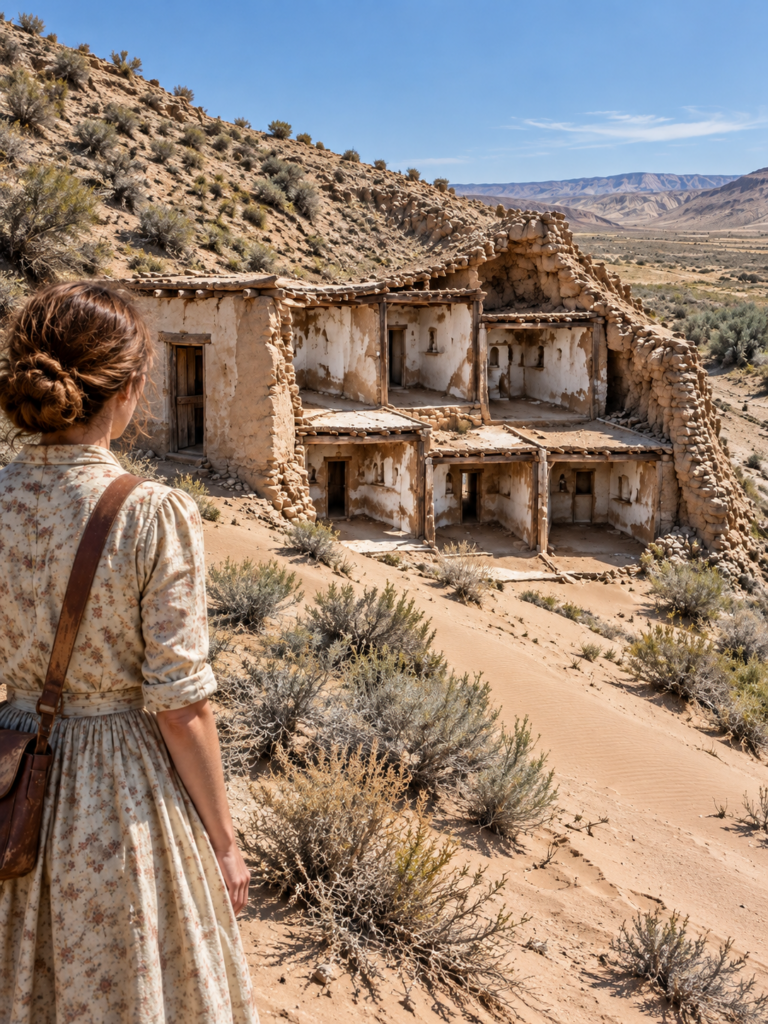
she thought the abandoned mountain shack had only one room then found eight more behind the rock wall and the letters that proved she had been loved all along
Part 1
Charlotte Fletcher was twenty years old and she had been turned out of the only home she had ever known. With no family left to claim her and no money to speak of, just a tin whistle her grandmother had carved her name into and seven dollars folded into the lining of her coat. After three days on a cold mountain trail and a snowstorm that cut the path behind her, she came to shelter in an abandoned one-room shack above the little settlement of Pine Hollow. The place sat so forgotten by the maps that even the men who ran mules through the valley had stopped mentioning its name. What nobody in Pine Hollow knew, and what Charlotte herself did not yet know on the evening she pushed the warped door open and set her bundle down on the dusty plank floor, was that beneath that single visible room there were eight more rooms hidden behind a wall of fallen rock. Inside those rooms were ledgers and letters and small carefully wrapped belongings that would overturn everything she had been told about who she was and where she came from, and tie her own quiet name to a crime the frontier had buried on purpose decades before she was born.
To understand what Charlotte walked into that night you have to understand the country she walked through to get there. Pine Hollow sits in a shallow bend between two ridges on the western slope of a range most travelers avoid in winter. Nine miles from the nearest wagon road and twenty-two from the nearest telegraph wire, with timber pressing close on three sides and a creek running thin and dark along the fourth. The settlement itself in those years was not more than a cluster of twelve or fourteen standing structures: a trading post with a sagging porch, a smithy, a one-room school that doubled as a meeting hall on Sundays, and a scatter of homesteads laid along the creek like beads on a loose string. The people who stayed there stayed because they could not afford to leave, or because they had come looking for a kind of silence the busier towns no longer offered. They knew each other’s business the way neighbors in such places always do. But they did not pry, and they did not take in strangers lightly.
The shack where Charlotte took shelter was not in Pine Hollow proper but above it, perhaps a mile and a half higher up the mountain, on a shoulder of ground where the pines gave way to a stand of aspens and the trail narrowed to a footpath that even the deer seemed reluctant to follow in deep weather. It had been built, as near as anyone in the valley could remember, by a man who had come through many years back and asked for nothing from the town but the loan of a crosscut saw, which he returned sharpened and oiled, and then had vanished so completely that the few who recalled him could no longer agree on his first name. The shack he left behind was a plain thing to look at. A single room, perhaps twelve feet by fourteen, built of squared pine logs chinked with a pale gray mortar, with a saw-and-shingle roof that had held up surprisingly well against the weight of so many winters, and a single small window of real glass set beside the door. That was a detail that would have struck anyone who knew the cost of hauling glass up a mountain in those years, though no one in Pine Hollow seemed to have remarked on it at the time. The stove pipe leaned a little. The step was rotted at one corner. A hand-forged iron latch, blackened by time, held the door closed against the wind.
Charlotte did not know any of this history as she stood in front of it that evening, with the snow coming down in slow heavy flakes and the light already draining out of the sky behind her. She knew only that she had walked beyond her strength, that her boots had cracked open along the inner seam, that she had not eaten anything but a strip of dried apple and a handful of oats boiled in creek water since the morning before, and that she could not go another step without a wall between herself and the wind. She saw the shack through a thinning of trees and she stopped where she was and simply looked at it for a long moment, the way a person looks at something they are afraid to want. Then she walked up to the door and tried the latch and the latch gave and she stepped inside and the first thing she did was close the door behind her so the warmth of her own body would not be stolen by the air coming in off the ridge.
Inside there was almost nothing. A rough plank floor swept clean by the wind that found its way through the gaps. A small cast-iron stove in the far corner with a few pieces of split pine stacked beside it, dry enough that whoever had last been there had left them where the roof would not drip on them. A narrow rope bed built into one wall with no mattress, only a folded square of oiled canvas laid across the slats. A single shelf running the length of the back wall at the height of her shoulder, bearing a tin cup, a tin plate, and a small sewing tin with the lid rusted shut. On the wall opposite the door, where a person coming in would see it last, was a rough fireplace of stacked stone, dry-laid, no mortar, built into a shallow alcove in what seemed to be the natural face of the mountain itself, because the shack had been raised with its back set against a low outcrop of pale granite, and the fireplace used that granite as part of its chimney.
She set her bundle down on the floor beside the bed. She unwound her shawl from her shoulders, where it had grown stiff with ice at the fringe, and hung it on a wooden peg that had been driven into the chinking beside the door. She knelt at the stove and opened the little door and found inside a nest of old ash and the brittle papery remains of something that might once have been a letter, long since turned to flakes by time. She laid a few splinters of pine on the ash and struck her flint against the small folding steel she carried in a pouch at her waist. Because her hands were almost too cold to feel the motion she had to try four times before a spark caught. But when it caught she tended it the way her grandmother had taught her to tend such things, breathing on it slowly, feeding it one piece of kindling at a time, until a small living flame stood up inside the stove and the first faint warmth began to push back into the room.
Only then did she sit down on the edge of the rope bed and allow herself to understand that she was not going to die that night. She did not cry. She had not cried in Elkridge when the lawyer had read the paper to her, and she had not cried on the trail when the snow had closed the pass behind her, and she did not cry now. She simply sat with her hands on her knees and her eyes on the small flame and waited for the feeling to come back into her fingers. Outside the snow kept falling, patient and steady, the way snow falls on a mountain that has nowhere else to be. The light failed by inches. The wind rose along the ridge and then settled again, as though it had come up to look at her and found her not worth the trouble. Somewhere above the shack, in the dark stone that she could not yet see for what it was, the mountain held its old secret and waited, as it had been waiting for a very long time, for the right person to come inside and find it.
Charlotte, for her part, knew only that she had a stove and a roof and a door that would latch, and that for the first time in nine days she was warm. She leaned her head back against the log wall behind her and she closed her eyes and the tin whistle in the inside pocket of her coat pressed gently against her ribs and she said out loud and to no one the small sentence she had learned to say in the worst moments of her life. It was something her grandmother had taught her, something she had been told to say when she could not think of anything else. “Thank you for the day I have been given.” She said it twice and then she opened her eyes again because there was still work to be done before she could sleep. She rose and crossed to the stove and set the tin cup on the top of it with a measure of snow scooped from just outside the door and she sat again on the edge of the bed and watched the snow slump down into itself as it melted. The smell of the warming tin mingled with the smell of the pine burning in the small stove. And for a few minutes she was only a young woman in a small warm room on the side of a mountain, with no past pulling at her and no future she had to answer to.
That stillness would not last. Within three days she would be prying at the stones of that back wall with her bare hands and the broken shaft of a shovel. And within a week she would be reading by lantern light in a room no living person in Pine Hollow knew existed, the carefully written confession of a woman who had died long before Charlotte was born. But that night she did not know any of that. That night she only knew the warmth and the whistle at her ribs and the small sentence she had been taught to say.
To understand how she came to be there at all, alone and twenty years old on a mountain road no one had told her to take, we have to go back a little way, back to the valley she had left behind and the house she had grown up in and the woman who had raised her and the papers that had with such quiet efficiency undone her life.
Charlotte Fletcher had been born in the valley east of the mountains, in a settled country of fenced pasture and oat fields and small white churches, in a town called Elkridge that sat where two creeks met and where the stage road came through twice a week with its mail and its passengers and its patient dusty horses. Her mother had died of a fever when Charlotte was two years old, before she could hold the shape of her face in memory, and her father, a man she knew only through a daguerreotype on a parlor shelf and through other people’s careful half-finished sentences, had gone west three months later to work a timber claim and had not come back. There had been a letter, Charlotte was told, and then another, and then a long silence, and then word, carried by a traveler through two counties, that there had been a failed tree and a slipped chain and a man who did not get up. Charlotte did not remember being told any of this. She had always known it the way a child knows the color of the kitchen floor and the sound the back door makes when it swings.
What she did remember, and what she had carried with her every day of her life since, was her grandmother. Her grandmother on her mother’s side had come to the house in Elkridge the week the fever took her daughter and she had never left. She had buried her son-in-law in absence and her daughter in person and had then, without any discussion anyone could later recall, folded a two-year-old child into her life and raised her. And she had done it the way she did everything, which was quietly, thoroughly, and with no visible self-pity. She was a tall bony woman with hair that had gone white early and a voice that was lower than most men’s. She wore the same gray wool dress six days a week and a dark blue one on Sunday and she kept her sleeves rolled to the elbow year round because she said cuffs got into the work. She was known in Elkridge as a woman who could set a bone, start a fire in the rain, bake bread without a thermometer and without failure, and read a loan agreement with more care than the men who had signed it. People came to her door with their small troubles and their larger ones and she gave them tea and listened and told them as often as not exactly what she thought they should do.
She did not spoil Charlotte. That was not in her nature and she did not confuse love with ease. From the time Charlotte was four years old she was given work to do, small work at first and then larger, and she was expected to do it well. She learned to knead dough standing on an overturned apple crate at the kitchen table. And she learned to carry wood in bundled armloads so that the bark did not scratch her chin. And she learned to say good morning to adults by their names and to look them in the eye when she did it. By the time she was seven she could pluck a chicken and gut a trout and sweep a stove hearth clean of ash without raising a cloud. And by the time she was ten she could sit at her grandmother’s elbow in the evenings and read aloud from the newspaper the stage brought in, stumbling over the long words at first and then not stumbling, while her grandmother knitted or mended or shelled peas into a tin bowl between her knees.
The fire-making had come in the winter Charlotte was eight. Her grandmother had taken her out behind the woodshed on a cold afternoon with a folding steel and a piece of worked flint and a small carefully built nest of dry grass and birch bark. And she had set the whole arrangement in Charlotte’s lap and said in that low voice of hers, “You will do this until you can do it in the rain and in the dark and with your hands numb, because one day you may need to, and no one will be there to help you.” Charlotte had struck sparks for the better part of an hour before the first threat of smoke rose out of the nest, and she had cried briefly and quietly out of frustration and cold. And her grandmother had not comforted her and had not scolded her but had only said, “Again. Try.” Within a month Charlotte could coax a flame on the first strike as often as not, and within a year she could do it in a wind strong enough to lay the grass flat, and by the time she was twelve she carried the folding steel and flint in a small oiled leather pouch at her waist as a matter of course, the way other girls carried handkerchiefs. She had the same pouch at her waist now in the shack on the mountain, and the steel in it had opened a bed of coals in the stove not an hour before.
Her grandmother had taught her other things, less obviously useful but no less kept. She had taught her to notice weather in the way crows flew, and to read a trail for whether another person had walked it recently, and to tell a safe mushroom from a hungry one, and to render fat clean, and to sew a seam that would hold under weight, and to count change twice before leaving a counter, and to speak the small sentence of thanks every morning, no matter what the morning had brought. “Thank you for the day I have been given.” Her grandmother had said it was a sentence her own mother had taught her, and that her own mother had taught it to her, and that it was neither a prayer exactly nor not a prayer, and that it did not matter whether God heard it so long as the person saying it did. Charlotte had said it at the breakfast table every morning of her childhood and she said it still, and she had said it twice in the shack as the snow slumped down into the tin cup on the stove.
The whistle had been her ninth birthday. Her grandmother had carved it herself out of a length of close-grained alder from a tree that had fallen in the pasture the autumn before. And she had bored the finger holes with a heated wire and tuned them by ear over the course of a week of evenings. And she had wrapped the finished whistle in a square of blue cotton and set it on Charlotte’s plate at breakfast with no card and no ribbon. The whistle was about the length of Charlotte’s hand, pale wood that had darkened a little over the years with the oil from her fingers, and along its underside her grandmother had carved in small deliberate letters Charlotte. Only the name. Her grandmother had never been one for inscriptions longer than were strictly necessary. Charlotte had learned to play simple tunes on it and then more complicated ones, and she had played it in the kitchen in the long winter evenings while her grandmother worked, and sometimes her grandmother had hummed along in that low voice, and those evenings were the warmest memories Charlotte had of anything. She carried the whistle now in an inner pocket of her coat, next to her ribs, where she could feel it against her when she breathed.
Her grandmother had died in the summer. Charlotte was nineteen, of nothing dramatic. She had come in from the garden with a basket of beans one afternoon and sat down in the kitchen chair and said she was tired and she had not gotten up again. She had lingered for eleven days, growing lighter and quieter, and she had used those eleven days to tell Charlotte in short practical conversations what she needed to know: where the money was in the house, which was very little; which neighbors could be trusted and which could not; how to turn the mattress and when to change the stove pipe and how often to oil the latch on the garden gate. She had told Charlotte that the house and the small piece of land under it were held in a life interest only, which Charlotte had not fully understood at the time, and that there were papers in the lawyer’s office in town about it, and that she, her grandmother, had done her best over the years to see the papers altered in Charlotte’s favor and had not, in the end, been able to do it. She had held Charlotte’s hand with her own thin dry hand and had said, “You are capable, child. You will be all right.” And Charlotte, who had never once cried in front of her grandmother in all the years she had been alive, had not cried then either, because she understood that it was being asked of her not to.
The lawyer had come to the house two weeks after the burial. He was a thin tidy man from Elkridge named Mr. Pruitt with ink stains on the second knuckle of his right hand, and he had sat at the kitchen table with his hat on his knee and had explained the situation in careful well-rehearsed sentences. The house and the quarter acre it sat on had belonged, entitled, to Charlotte’s grandfather, a man dead some thirty years, whom Charlotte had never known. On his death the property had passed by the terms of his will to his nearest male relative at the time of his widow’s death, and his widow was Charlotte’s grandmother, and his nearest male relative now was a second cousin twice removed, a cattle buyer named Mr. Hollister, who lived in a larger town two counties over and whom Charlotte had seen once in her life at a funeral she had been too young to remember. Mr. Pruitt had been apologetic. He had spoken of life estates and of remainder interests and of the care with which Charlotte’s grandmother had tried over a period of years to have the terms modified. He had said that Mr. Hollister had been written to and that Mr. Hollister had replied and that Mr. Hollister intended to take possession of the property for the purposes of sale and that the sale was already in motion and that Charlotte was welcome to remain in the house for a period of thirty days from the date of the letter, after which she would be required to vacate.
Charlotte had understood, sitting at that table with her hands folded in her lap, that there was nothing in any of this that could be argued with. The papers were in order. Her grandmother had warned her. Mr. Pruitt was not a cruel man and was in fact plainly embarrassed by what he was obliged to say, and he had not met her eye for most of the conversation. When he left he had pressed a folded five-dollar note into her hand at the door and had said, from his own pocket, “Miss Fletcher, with my regrets.” And she had taken it because refusing it would have embarrassed him further. That five dollars, together with two silver dollars she had earned the previous autumn mending shirts for a widower down the road, made the seven dollars she now carried folded into the lining of her coat.
She had spent the thirty days quietly. She had sold what little could be sold and had given away what could not be carried. And she had chosen out of a lifetime of her grandmother’s belongings only the shawl and the whistle and the folding steel and flint. She had written one letter to a schoolmistress in a neighboring valley whom her grandmother had known, asking whether there was any work to be had, and the schoolmistress had written back regretfully that there was not. On the morning of the thirtieth day she had closed the door of the house behind her and she had not looked back, because her grandmother had taught her that looking back was a kind of asking, and she was not a woman who asked. She had walked west out of Elkridge up into the foothills with the vague and not entirely reasoned intention of reaching a place she had heard spoken of only once or twice in her life, a small settlement on the western slope of the range where she had been told as a child her father had once meant to go. That place was Pine Hollow. And three days later, with her boots split and the snow closing the pass behind her, she had reached the abandoned shack above it. And that was how a twenty-year-old woman came to be sitting on the edge of a rope bed in a twelve-by-fourteen-foot room on the side of a mountain with a tin cup of melting snow on the top of a small iron stove, waiting for the water to come to warmth enough to drink.
Part 2
The letter from Mr. Pruitt had come to the house on a Tuesday, nine days after the burial, carried up the lane by a boy from the livery who held it out at arm’s length as though it might be hot. Charlotte had taken it from him at the kitchen door with flour still on her hands and had thanked him and had given him a piece of the bread she had just taken from the oven, because her grandmother had taught her that no boy who ran errands in weather like that went away empty-handed if there was bread in the house. She had read the letter standing at the kitchen table with the loaf cooling on a folded cloth beside it, and she had read it twice, and then she had folded it again along the lines Mr. Pruitt had folded it and had set it under the sugar tin on the shelf and had gone back to the bread because the bread was still warm and the butter was in the crock and there was no profit in standing still over a piece of paper that would still say what it said in an hour.
The letter had asked her in Mr. Pruitt’s careful hand to come to his office in Elkridge on the following Monday at ten o’clock for a matter concerning the estate. It had been civil and it had been short and it had not said what the matter was. And Charlotte had understood from the shortness of it that the matter was not a kind one, because kind matters were generally written out at some length and unkind ones were generally held back for a room with a door that closed. She had walked into Elkridge on Monday morning with her grandmother’s shawl pinned at her throat and her hair combed back and tied with a strip of black ribbon she had cut from the lining of an old hat. And she had arrived at Mr. Pruitt’s office at a quarter before ten and had waited on the bench outside until he opened the inner door and asked her to come in.
His office was a small square room above the dry goods store with two chairs and a table and a shelf of leather-bound books and a window that looked down into the street. And the window was open an inch at the bottom so that the smell of the cold street and of the horses tied at the rail came in and mingled with the smell of ink and paper and of the small pot of glue he used for mending bindings. He asked her to sit and she sat and he closed the door. And he did not sit at once but stood for a moment at the window with his back to her. And she understood from his back that he was arranging in his mind the order in which he would say the things he had to say. He turned and he sat down across from her and he placed his hand flat on a packet of papers tied with a thin red cord and he said that he was sorry to be the one to speak of it so soon and that he would be as plain as he could because he thought plainness was the kindest thing he had to offer her that morning.
He untied the red cord. He laid the papers out in three small stacks on the table between them. And he turned the top sheet of the first stack so that she could read it right side up if she wished. And he said that the house she had been born in and had lived in all of her life had not, in point of law, ever belonged to her grandmother. It had belonged to her grandfather, who had died about thirty years earlier, and his will, drawn up some years before that, had given his wife a life interest in the house and in the quarter acre of ground under it, and had given the house itself upon her death to his nearest surviving male relative. That man was a second cousin twice removed by the name of Hollister, a cattle buyer in a town two counties away, whom Charlotte had seen once at a funeral when she was a child of five or six, and whom she did not remember. Mr. Pruitt said the name slowly, as though to give her time to place it, and when she did not place it he nodded once and went on. He said that Mr. Hollister had been notified by post of the grandmother’s death and had replied within the week. He said that Mr. Hollister intended to take possession of the house and the ground and to sell both at the first reasonable offer, and that Mr. Hollister had instructed him, as the attorney of record for the estate, to inform the present occupant, by which was meant Charlotte, that she might remain in the house for a period of thirty days from the date of his letter, which date was the previous Thursday, and that at the end of those thirty days she must be gone and the key must be returned to Mr. Pruitt’s office.
He said all of this with his eyes on the papers rather than on her face. And when he had finished he lifted his eyes and he waited. Charlotte sat very still with her hands folded in her lap over the shawl and she did not weep and she did not speak at once. She looked at the top paper, at the signature at the bottom, which was a signature she did not know and would never know. And she looked at the date and she counted in her head from the date and she arrived at a day near the end of the following month and she fixed that day in her mind. Then she asked, in a voice that was quieter than her usual voice but not unsteady, whether her grandmother had known. Mr. Pruitt said that her grandmother had known and had come to him in the spring to see whether anything could be done and he had looked into it carefully and nothing could be done because the will was old and clean and had been properly recorded and no court in the territory would set it aside for the sake of a granddaughter who was not named in it and whose claim rested only on affection and on labor. He said he had told her grandmother this in June, and her grandmother had thanked him and had paid him his fee out of a small purse she kept in the pocket of her gray dress, and had walked out of the office without saying another word about it, and he had admired her for that, and he said so now. Charlotte nodded. She said that she understood. She asked whether there was anything that needed her signature, and Mr. Pruitt said there was not, that it was not that sort of document and that her leaving in thirty days was itself the only thing required of her. She stood then and she said thank you and she offered her hand across the table and he took it and he held it a moment longer than was usual. And he reached into the inner pocket of his coat and he took from it a folded five-dollar note and he laid it on the table in front of her. And he said that it was not from the estate and was not a loan and was not a kindness she needed to answer for, and that he would be obliged if she would take it and say nothing of it to anyone. She looked at the note and she looked at him and she took it and she folded it smaller and she put it into the lining of her coat where she had already sewn over the years a small pocket for keeping things and she said “Thank you” a second time in a voice that was no different from the first. And she went out of the office and down the stairs and into the street.
She did not go home at once. She walked the length of the street and back again slowly past the dry goods store and the smithy and the little whitewashed church where her grandmother had been buried nine days before. And she looked at each building as she passed it, not to say goodbye, for she did not yet think in those words, but to fix it, to put it down somewhere in her mind where she could find it later if she ever needed it. Then she turned and walked up the lane to the house and she went inside and she put the five-dollar note together with the two silver dollars she had earned the previous autumn into a small square of oiled cloth. And she folded the cloth and she set it on the table and she stood a moment in the center of the kitchen and she said aloud to no one, “Thank you for the day I have been given.” And then she went to the shelf and took down the sugar tin and put the letter back under it. And she began to think in a steady and orderly way about what the next thirty days would require of her.
What they required of her, she soon understood, was a quiet dismantling. She went through the house room by room with a small pencil and a sheet of brown paper and she wrote down what could be sold and what could be given away and what she would try to carry, and the carrying list was the shortest list by far. She sold the two chairs and the pine table and the stoneware crocks to a neighbor’s wife for less than they were worth, because the woman had been kind to her grandmother in the last illness and because Charlotte did not have the strength to haggle. She sold the heavy quilts and the second kettle and the washing tub to the trader who came through once a month in a canvas wagon. And he counted the coins into her hands slowly and told her that times were hard and she said that she knew. She gave the hens to the boy who had brought Mr. Pruitt’s letter because he had come back twice to see whether she needed anything carried. And she gave the laying box to his mother. And she gave her grandmother’s gray wool dress, the everyday one, to a woman at the far end of the lane whose own dress had worn through at the elbows and who had no money to replace it. And she gave the dark blue Sunday dress to the church to be made over for whoever might need it. She kept the shawl because the shawl had been around her grandmother’s shoulders every evening of Charlotte’s life. She kept the whistle because her name was on it. She kept the folding steel and the flint and the small oiled leather pouch she carried them in because without fire she would not live.
She wrote one letter in those thirty days, to the schoolmistress in the next valley over, a woman her grandmother had known in girlhood, asking whether there might be a place for her as a kitchen help or a sewing hand or anything at all. And the reply came back ten days later in a careful round hand, saying that the writer was very sorry to hear of her loss and was more sorry still to have no work to offer, as her own household had been reduced that spring and she herself was living on what little the school paid. Charlotte read the letter once and folded it and put it into the stove and watched it burn, not because she was angry at the woman, for she was not, but because she did not wish to carry a kindness she could not use. On the twenty-ninth day she swept the house, every room, and she washed the floors with water from the well and she wiped down the shelves and the sills and the inside of the stove. And she did it all the way her grandmother had taught her, with the same cloths and the same corners and the same slow passes, because a house that had held her for twenty years deserved to be left clean, whatever the law said about who it belonged to. On the thirtieth morning she rose before the sun and she dressed and she pinned the shawl at her throat and she put the bundle together and she stood a moment at the kitchen door and she said the sentence a third time that week aloud to the empty room and then she stepped out and she closed the door behind her and she set the key on the sill under a flat stone where Mr. Pruitt would find it when he came up the lane and she walked west out of Elkridge without looking back.
Charlotte walked west out of Elkridge on the road that followed the south fork of the creek and she did not look back, not once, though she knew the shape of the town behind her the way she knew the shape of her own hands. The whitewashed church with its bell rope frayed at the low end. The dry goods store with its false front painted two shades of brown. The smithy whose smoke she could smell for half a mile on a still morning. She had lived twenty years inside that view and she gave it up in the length of a single road, and the road itself was nothing much. Two ruts and a horse path and a line of fence posts leaning west. And the fence posts were the last of the fenced country. And beyond them the land began to rise and the houses stopped and the grass went from green to gray to the pale combed yellow of dry autumn. And Charlotte walked into that yellow with her bundle on her back and her boots already going soft at the seams and she set her pace the way her grandmother had taught her to set a kitchen fire. Small at first and steady afterward so that it would last the day.
She had counted the money every night for thirty nights and she counted it again now, without stopping, without breaking stride, the small flat bundle of oiled cloth sewn into the lining of her coat over her heart. So familiar she could feel the shape of the folded note and the two silver dollars through the cloth and the wool and the cotton beneath. And she knew exactly what it was, which was seven dollars. And she knew exactly what it was for, which was nothing yet, because a person who cannot work cannot eat and a person without money cannot reach a place where work is. The first day she walked eleven miles and passed two farm gates and one wagon going east with a load of shingles, and the man on the wagon raised his hand and Charlotte raised hers and neither of them stopped. At dusk she came to a bridge of hewn planks laid over a culvert. And under the bridge the creek ran and she climbed down the bank and made a small fire with her flint and folding steel and dry grass and the inner bark of a fallen birch. And she boiled water and ate the heel of the loaf she had carried out of Elkridge on the last morning. And she slept with her back against the stone of the culvert abutment and the shawl wrapped twice around her head and she woke three times in the dark because she heard something and each time it was only the creek.
The second day the country changed. The road thinned and then it stopped being a road and became a trail of braided switchbacks cut into the east slope of the range and the trail was old, worn knee-deep in places by hooves. And Charlotte understood after a mile of it that she was walking something used by men who drove sheep up in the summer and brought them down in the fall, and that no wagon had ever come this way and never would. The trees closed over her. First yellow pine and then lodgepole and then the black ragged spires of spruce, and the air grew thin and cold and smelled of moss and iron and old snow. And she stopped twice to climb a knoll and look back, not for the sake of the looking but to fix the shape of the valley in her memory in case she ever needed to name where she had been. From the second knoll she could not see Elkridge at all. Only the gray fold of the hills and one thin thread of smoke that might have been a homestead and might have been nothing. And she stood there long enough for her hands to go numb and then she went on up because going back was a thing that had no door in it.
That night she slept above the timberline in a windfall, in the bowl of a blown-down spruce whose roots had come up with the earth still clinging to them. And she had wood all around her and no water. And she ate the last of the oats raw, a handful at a time, dry, and she was cold in a way she had not known a person could be cold and still be alive. And she said the sentence to herself, the one her grandmother had said every morning of her life. “Thank you for the day I have been given.” And she said it twice. And the second time she said it for the windfall and the spruce and the small space the tree had made for her when it fell because it seemed to her that something had.
On the morning of the third day she found the pass. It was not a notch, not a gateway, nothing that a person would point at from below and call a door. It was only a saddle of bare rock between two shoulders of mountain with a cairn of stacked stones at its crown that had been built by somebody long dead and had never been improved on since. The stones gray and lichen and settled. And Charlotte stopped at that cairn and put her hand flat on the topmost stone the way a person puts a hand on a table before they sit down. And she looked west and there the whole western slope opened below her. Twenty miles of it. Fold after fold of dark timber and pale grass falling away into a haze that was not cloud and not dust but simply distance, and a creek shining in the bottom of it like a wet cord, and far off and down at the edge of what she could see in a bowl between two ridges a scatter of roofs. She counted what she could count of them. Twelve, perhaps fourteen, small and brown and scattered. And there was a thin gray thread of smoke coming up from one of them and a blacker shape she took for a smithy and a square pale one she took for something built by a town and not by a man. And that was Pine Hollow, the place her father had once meant to come to, the place he had named in the only letter of his that had survived, the one her grandmother had kept in a tin and never read aloud.
She could have been down in it by dark. She thought about it while she stood at the cairn with her hand on the stone and the thinking was short and plain. She had seven dollars and a bundle and no people there and no letter of introduction and no name that would be recognized by anyone living in that bowl. And she knew what a stranger looks like when she comes into a settlement with nothing, because she had watched it happen twice in Elkridge. The way doors get careful and voices get kind and everybody watches to see if the person will ask. Charlotte had decided thirty days before that she would not ask. She would come into that place when she could come with her hands busy and her own roof over her or she would not come into it at all. And she turned off the trail before it started its descent and took the shoulder of the ridge northward instead because from the saddle she had seen something up there through the timber, a gray patch that was not rock and not a blowdown, and she wanted to know what it was before she went down into the valley and had to knock on a door.
She found it an hour before dark and the snow found her on the way. It came in from the west the way snow comes in mountains, without ceremony. First a few flakes the size of flies and then a steady going over of the whole sky. And the trail she was on went from a trail to a suggestion. And Charlotte followed the suggestion through pines and aspen. And the aspen still had a few leaves and they turned in the wind and made a sound like small dry paper. And then the trees opened and there was the patch of gray she had seen from the saddle. And the patch of gray was a clearing and the clearing held a shack and the shack was standing and had a roof on it. She stood in the falling snow and looked at it for the length of a hundred breaths. It was low and small and dark, squared pine logs with pale gray mortar in the chinks, a sod roof gone mossy and silvered on top and sagging a little between the poles. And there was a window in it and the window had real glass in it, streaky but whole. And the glass was the thing that told her it had been a person’s and not a sheep herder’s, because a man who drives sheep does not pay for glass. The door was closed and warped and set crooked in its frame and the snow was already beginning to lie in the cleared ground around the step and the step was rotted through in the middle. And Charlotte stood there with the snow getting into the folds of her shawl and thought of the nine days she had gone without being warm and the two nights she had slept in the open and the way her boots had split that morning along the inner seams so that her stockings were wet from the ankle down and had been wet all day. And she did not think about whether the place belonged to anybody. She thought about whether the door would open and she went up the rotted step and put her hand on the latch. It was black iron, hand-forged, worn smooth by palms, and it lifted easily. And the door swung in on a room that was dark and smelled of cold ash and old dry pine and dust that had settled for years without being disturbed. And Charlotte stepped in over the sill and closed the door behind her against the snow and stood still a moment in the black and let her eyes find what light there was from the little glass window and reached up and found a wooden peg by feel and hung her shawl on it and set her bundle down beside a rope bed built into the wall and said the sentence aloud to the empty room. “Thank you for the day I have been given.”
The stove was a small cast-iron one set on a bed of flat stones. And beside it was a basket of split pine that had been there so long the pitch had cured in it and the wood had gone light as cork and there was old ash in the firebox with something half burned in it that had been paper once and was now only a curl of black that broke at a touch. And Charlotte crouched at that stove with cold hands and worked her flint and folding steel over dry grass and the fine shaved inner wood of the oldest splits and it did not catch the first time or the second or the third. And she did not hurry and she did not swear. She only changed the angle of her strike and the looseness of the tinder the way her grandmother had showed her on a wet morning when Charlotte was eight years old. And on the fourth try it caught, a thin thread of fire running up into the pine. And she fed it small and slow and the iron began to take the heat and the room began to change. And she filled the tin cup from a shelf with snow pressed into it through the open door and set the cup on the stovetop and sat down on the edge of the rope bed with her hands held out to the warmth. Outside the snow laid itself over the clearing and over the shoulder of the ridge and over the pass she had come across that morning, filling the cairn stone by stone until the crown of it was gone. Closing the trail behind her the way a page closes over a line of writing. And she had not known when she crossed it that she would not be able to go back that way until spring. And it would be three days yet before she understood what that meant. And a week before she understood the rest. The tin cup began to show a ring of clear water around the packed snow. And the water rose and the room was small and the fire was small and the warmth was small and it was the first warmth she had felt in nine days and the whistle her grandmother had carved for her ninth birthday lay in the pocket by her ribs. Pale alderwood, the letters of her own name cut into its underside, and she put her hand flat over it through the cloth of her coat and sat listening to the snow come down and waiting for the water to grow warm enough to drink.
She drank the water in slow swallows, cup held in both hands, and when it was gone she packed the cup again and set it back on the stove and let herself look for the first time at the room that had taken her in. She had seen it on entering only as shelter, which is to say she had seen the stove and the bed and the door she could latch and not much else. And now with the fire steady and the iron warm and her hands come back to themselves she looked at the shack the way her grandmother had taught her to look at a thing, slowly from one corner to the next, naming what was there. The room was twelve feet across the front wall and fourteen feet along the side, as near as she could pace it later, and the logs were squared pine laid six courses to the window and eight courses to the ridge beam, chinked with a pale gray mortar that had been mixed with wood ash and had powdered out in places and held in others, and the inside faces of the logs had been adzed roughly smooth so that the long shallow bite marks of the adze ran across them in overlapping arcs. Someone had taken the trouble to make the inside walls fit for a hand to touch. The man who had built the place, whoever he had been, had worked for comfort as well as weather.
The floor was rough plank, three boards wide along the length of the room and butted end to end down the middle. Each board perhaps ten inches across and worn pale by use in the center and dark along the edges where the broom had not reached. The boards were pegged to joists, not nailed, and in two places the pegs had worked proud of the surface and been hammered flat again with something heavy and the hammer marks around them were old and softened by dust. Under the bed the boards were darker and at the far corner of the room where the stacked stone fireplace stood in its alcove one board had warped so that its end rose a quarter of an inch above the next, making a small lip Charlotte would catch her toe on twice before she learned it. The stove sat on three flat stones set directly on the planks. And it was a small square-bodied cast-iron box about the size of a bread crate with a single round lid on top, a short hinged door on the front, and the maker’s name cast in a half circle on the door. The letters worn almost smooth but still readable to a careful finger: F O S T E R and part of a word that might have been B R O S. The stove pipe rose from the back of the firebox in a single joint of blackened tin elbowed through the roof and leaned perhaps six degrees off true, held in place at the ceiling by a square of thin metal nailed in a ragged crescent of flat-headed nails. Beside the stove in the angle of the wall lay a wire-handled wooden basket half full of split pine. The pieces no longer than her forearm, dry enough to click when she lifted one. And under the basket a scrap of old blue flour sack that had been laid down to catch the pitch.
The bed was built into the long wall opposite the stove, framed of four peeled poles mortised and pegged to the logs themselves, with a lacing of rope strung back and forth across the frame in a diamond pattern and knotted off at each end. The rope was braided hemp, the thickness of her little finger, grayed by time but still sound when she pressed it with her palm. There was no mattress. A folded square of oiled canvas lay across the slats of rope, stiff with cold, dark with old use. And when she unfolded it she found it to be about four feet by six, enough to lie on with her knees drawn up, and the oil in it still faintly smelling of pine tar. Someone had taken care before he left to leave the bed usable to whoever might come after. Above the bed at shoulder height when she stood a single shelf ran the length of the wall. A plank perhaps six inches wide braced on two forged iron pegs driven into the logs. The pegs bent slightly downward from years of weight. On the shelf, pushed to the far end, stood the tin cup she had already used, a tin plate dulled gray and dented at the rim, and a small round sewing tin the size of her palm, its lid rusted shut, which rattled when she tilted it and which she sat back down and did not try to open that night. Behind the tin, almost hidden, lay a short stub of candle in a saucer of its own hardened wax. The wick blackened and curled, perhaps half an inch of tallow left. She did not light it. She would need it later more than she needed it now.
The door was a single slab made of three vertical planks held together by two cross-battens on the inside, pegged not nailed, with the pegs showing on the outer face as pale blunt dots in the weathered gray wood. The latch was hand-forged iron, a thumb piece on the outside lifting a hooked bar on the inside, blackened by years of hands and a little rough along the hook where the file had left its last stroke. The whole door had warped so that it stood a hair proud at the upper hinge. And when she drew it closed the bar fell into its iron keeper with a soft dull sound she would come to recognize in her sleep. There was no lock. There was no lock anywhere in the room. Whoever had built the shack had expected no one to come or had trusted whoever did. The window was set in the wall to the right of the door. A single pane of real glass about the size of a large book set in a frame of thin milled wood that had been puttied once and had lost most of the putty along the lower edge. The glass was wavy in the way old glass is wavy, bubbled in two places near the top, and the view through it was presently nothing but gray-white falling snow. A folded square of what had been muslin, now the color of weak tea, hung from a nail above the frame, meant perhaps for a curtain, and she left it where it was.
The fireplace was the strange thing. It stood in a shallow alcove at the back of the room, built against what she first took to be the inside face of the shack’s own log wall and then saw when she carried her tin cup closer was not a log wall at all but pale veined granite. The natural face of the mountain itself, which the builder had used as the back of his hearth. The chimney, insofar as there was one, rose only to a short tin hood above the alcove and then ducked out through the roof under its own flashing so that smoke from the fireplace and smoke from the stove left by two separate paths. The hearth was dry-laid stacked stone, no mortar, courses of flat granite pieces about the size of her two hands held together, chinked here and there with smaller shards wedged in by thumb pressure. The front of the hearth made a shallow horseshoe perhaps three feet across and two deep. Inside it lay nothing, no ash, no andiron, no hook. It looked as though it had never been used or had been swept so thoroughly before the man left that no trace of a fire remained. At the back of the horseshoe the pale granite of the mountain ran down to meet the floor planks and against that pale granite leaned a wall of darker loose stones stacked higher than the hearth proper. Stacked, Charlotte thought, in the slow lanternless way of someone who was still mostly thinking of warmth, in a different hand than the one that had laid the hearth. The hearthstones were flat and chosen. These were rougher and more varied. River stones and broken flakes mixed, some fist-sized, some larger than her head, and the stack of them filled the alcove from floor to ceiling behind the dry-laid horseshoe as though the builder had used that corner for an interior rock pile and never carried the stones back out. In the firelight they looked like the inside of a dry creek bed set on end. She did not touch them that night. She noted them and moved on because her feet were cold and her stockings were wet to the ankle and the shelf of her shoulder blades was still clenched against a cold that had been nine days in getting into her. And she had other work.
She pulled the warped door open an inch, scooped more snow into the tin cup, latched the door again, set the cup back on the stove, and only then did she sit down on the oiled canvas on the rope bed and unlace her boots. The seams had split along the inner curve of each boot where the ball of the foot bent and the stocking under the right boot was wet gray to the ankle and stiff to the shin and the stocking under the left was wet through to the heel. She wrung them one at a time over the plate from the shelf and hung them from the shelf’s iron peg nearest the stove where they would stiffen before they softened. And she set the boots on the three flat stones beside the stove with their splits turned toward the heat. Her feet bare on the plank floor were the color of skimmed milk and did not feel like her own. She stood again and paced the room because standing still would be worse than moving. And in pacing she took the measure of what she had been given. A stove and dry pine, a bed and a canvas, a door that latched, a window of real glass, a shelf and a cup and a plate and a stub of candle. A fireplace that had never, so far as she could tell, held a fire. Pale granite at the back of the room where the mountain itself came into the house. A loose stack of darker stones piled against that granite in the alcove, waiting for a purpose she did not yet know. No lamp, no lantern, no oil, no food, no pot larger than the tin cup, no axe inside the room, though a notch in the step outside suggested one had once lived there. No chair. It was less than she would have had in her grandmother’s kitchen at any hour of her life. It was more by every measure that mattered that night than she had reasonably expected to find on a mountain in a snowstorm with split boots and seven dollars.
She drank the second cup of water and refilled it a third time and let the stove burn low because she had only the one basket of split pine and did not know yet where the rest of the wood had been kept or whether there was any at all. She lay down on the oiled canvas in her coat with her shawl drawn to her chin and her bare feet tucked against the inside of the opposite calf. And she turned her face toward the stove and looked at the alcove at the back of the room at the pale granite and the loose dark stack against it. And she thought in the drifting half-thought of someone warm for the first time in nine days that in the morning she would see what was behind those stones. She slept harder than she had meant to. When she opened her eyes the stove was gray and the window was pale and the snow outside had settled into a quieter kind of falling, small flakes drifting past the glass instead of rushing it. Her feet were warm against her own calf. Her boots on the stove stones had dried stiff and bent in the shape of her walking. She sat up slowly because every part of her was sore in the particular way of a body that had held itself tight for too many days. And she set her feet on the cold plank floor and said the sentence her grandmother had taught her quietly into the room. “Thank you for the day I have been given.” She said it once and meant it. And then she looked across the room at the alcove at the back and the loose dark stones piled against the pale granite and she stood up and went to see what was behind them.
She knelt on the hearth of flat granite pieces and set her palm against the stack. The stones were cold and dry and did not shift. They had been laid without mortar but with care. Each one chosen for a particular hollow. Each smaller stone wedged to hold the larger ones in place the way a person who understood dry walls would build if they wanted the wall to hold a long time without ever being noticed as a wall. She lifted the first stone from the top of the pile. It came away easily. She set it on the floor beside her knee. She lifted the second and the third and by the fourth stone she could feel cold air moving against her wrist from somewhere behind the pile, air that was not the air of the room but older air, the air of a place that had been closed for a long time, dry and faintly mineral and smelling of nothing living. She stopped and sat back on her heels and looked at the hole she had opened, which was no larger than her fist, and she thought about what it meant that there was a space behind the stones at all. She did not stop long. She worked slowly because she did not want to bring the whole stack down on her hands and she stacked each stone she removed in a neat course along the hearth so that she could, if she wished, put them back exactly as they had been. By the time the sun had moved enough to brighten the window she had cleared a gap in the stack as wide as her shoulders and as high as her chin and she could see in the dimness beyond it that the pale granite of the mountain did not continue flat behind the wall but opened in a seam, a natural cleft about two feet wide where the rock had split sometime before any person had ever come to this slope, and the cleft went back further than the morning light could show her.
She fetched the candle stub from the shelf and lit it from a sliver she kindled at the stove. And she carried it carefully through the gap she had made, ducking her head and stepping sideways through the stones, holding the small flame close against her palm so the moving air would not take it. The cleft went back about four feet and then opened. She lifted the candle. The light touched a wall of fitted stone and then another wall and then a low timber ceiling. And she understood that she was no longer in a seam of the mountain but inside a room, a room built into the mountain by human hands, with walls dressed and squared and mortared and a floor of planed boards swept clean and above her a ceiling of close-set pine beams blackened by old lamp smoke. She stood in the center of it and turned once slowly with the candle held up. The room was perhaps eight feet by ten. At the far end a doorway framed in squared timber led into darkness. And when she carried the candle to it she saw another room beyond and past that a third. And when she counted the doorways she could make out along the dim corridor she counted eight, each opening into another, each cut from the body of the mountain and finished with the care of a man who had expected to live in them. She stood a long time in the first doorway, breathing the dry air, listening to the deep silence of stone, and she did not move further in because the candle was short and she did not know what she would find and she wanted to come back with better light. She went back through the cleft into the shack and sat on the edge of the bed with her hands on her knees and did not do anything for a while. Then she stood up and built the stove fire properly and set the cup of snow on it and dressed her feet in her dried stockings and her stiff boots and went out into the snow with the broken shovel shaft she had seen leaning against the outer wall. And she walked the perimeter of the shack and found under a drift against the north side a small lean-to of stacked split pine covered in canvas and tarp paper, enough wood for weeks if she was careful. And under a second drift a heavy iron axe with its head sunk into a round of fir and under a third a tin lantern with a sound wick and a stoppered flask of lamp oil inside its base, wrapped in oiled paper against the damp. She carried the lantern inside and set it on the shelf and did not light it yet. She ate a palmful of snow and drank a cup of hot water and sat on the bed and waited for her hands to stop shaking, which they were doing not from cold but from something else she did not have a name for.
In the afternoon she lit the lantern and carried it through the cleft and into the first room and she walked the eight rooms one by one slowly, touching nothing at first, only looking. The first room was empty but for a small writing table of pine, a stool, a tin inkpot stopped with a cork, and a straight wooden pen with a steel nib still fitted. The second room held a narrow bed frame, a straw tick folded on top of the slats, two heavy wool blankets wrapped in oiled cloth, and a pair of men’s boots standing beneath the bed, their leather soft and intact. The third room was a kitchen with a smaller iron stove, a cast pot, a kettle, a stack of tin plates, a crock of salt sealed with wax, and a tin box of hard crackers that rattled when she tipped it. The fourth room was a larder with cured meat wrapped in paper hanging from pegs, three stone jars of lard, a bin half full of oats, and a sack of dried beans tied at the neck. The fifth room was a workroom with a bench and a vise, a row of hand tools on wooden pegs, a coil of new rope, a bolt of unused canvas, and a crate of nails sorted by size into tin cans. The sixth room was shelves from floor to ceiling along both long walls. And on the shelves were ledgers, dozens of them, bound in black cloth and brown leather, each with a year written in ink on its spine, the earliest more than forty years before the year Charlotte had been born. The seventh room held a trunk of men’s clothing folded and layered with cedar shavings, a smaller trunk of women’s clothing done the same way, and against the far wall a tall standing cabinet with glass doors behind which were books, perhaps sixty of them, their spines faded but their lettering legible. The eighth room at the end of the corridor held nothing but a single ironbound chest set in the center of the floor, locked with a key hanging from a leather thong on a nail in the wall beside it. She stood a long time in that eighth room with the lantern raised and did not take the key down. She went back instead to the sixth room to the ledgers and she pulled one at random from a middle shelf and carried it to the writing table in the first room and sat down on the stool and opened it.
The handwriting was a woman’s, small and even, formed with the care of someone who had been taught to write by someone who cared that she wrote well. The ledger was a record of accounts. Flour so many pounds, so much paid, from whom. Powder and shot, cloth by the yard, nails by the keg, horses boarded, horses sold, names along the margins and columns and dates and figures totaled at the foot of each page in a thin firm hand. She turned pages slowly. The names meant nothing to her at first. Then on a page near the back of the book she saw written out in the same careful hand the name Fletcher and beside it the figure of a sum paid and a date and a note in the margin that read for the widow do not enter in the public book. She closed the ledger. She sat with her hand flat on its cover. She did not open another that day. On the writing table, propped against the inkpot in a position where no one entering the room could fail to see it, was an envelope of heavy brown paper, unsealed, with writing on the front. The writing said “To whoever finds this room.” She had not seen it when she first entered because the candle had been low and her eyes had been on the walls. She saw it now. She lifted it and sat down with it in her lap and did not open it for a long moment because she understood from the weight of it and from the careful hand of the address that whatever was inside had been placed there by a person who had expected to be dead a long time before anyone read it and she wanted to be ready.
She opened the envelope. Inside were several folded sheets of paper and a smaller sealed envelope and a flat tin that rattled softly when she tilted it. She set the tin and the small envelope aside and unfolded the sheets and smoothed them on the table and read. “My name is Hannah Mercer,” the letter began. “I was born in the year the territory was opened and I have lived in this valley for forty-one years. I built the house above and the rooms below with my husband who died in the second winter. And I kept the rooms after him because I had nowhere else to go and no one left to go to. I kept a trading post out of the upper room for travelers who crossed the pass. And I kept the lower rooms as my own. And I kept the books you will find on the shelves as an honest record of what I bought and sold and of what I was asked to hide. If you are reading this I am dead and the rooms are yours. And so is what I leave in them. And so is what is in the chest at the end of the corridor, the key to which hangs on the wall beside it. I ask only that you read the books before you spend the money because the money is not clean and you should know whose it was before you make it yours.”
Charlotte stopped reading. She looked up at the lantern burning on the table and at the pale stone walls and at her own hands flat on the paper and she understood that she had come, by three days of walking and a snowstorm and the choice to turn north instead of down, into a story that had been waiting for someone to come into it for longer than she had been alive. She looked at the name Fletcher as she had seen it in the ledger and she thought of her father who had set out for Pine Hollow and never arrived and of her grandmother who had kept his one letter in a tin and never read it aloud. And she thought that she had better keep reading. She bent her head over the paper and she read on. She read until the lantern wick needed trimming and then she trimmed it with the small bone-handled knife she had taken from the workroom bench and she read until her neck ached and the oil in the flask was lower than it had been that morning. And when she climbed back through the cleft and into the shack above the sky through the real glass window had gone from gray to the slow violet of a mountain evening. She was not finished reading. She understood that she would not be finished reading for a long time. She stacked the removed stones along the hearth in the order she had taken them so that she might someday replace them. And she built the stove fire low and she ate three of the hard crackers from the tin box in the kitchen room and drank a cup of hot water with a pinch of salt stirred into it. And she lay down on the oiled canvas and slept without dreaming until the window was pale again.
Part 3
In the morning she began the work of making the place livable in the way that a person who intends to stay makes a place livable, which is different from the way a person makes a place livable who is only waiting out a storm. She lit the lantern first and carried it down into the second room and lifted the folded straw tick out onto the plank floor and beat it with the flat of her hand to loosen the straw. And she unwrapped the two heavy wool blankets from their oiled cloth and shook them out and found them sound and smelling of cedar. And she carried the tick and the blankets up through the cleft and laid them on the rope bed in the shack above, because she had decided that she would sleep in the upper room where the window was and the latchable door was and anyone who approached would find a woman already awake rather than a woman hidden below in the dark. The soft leather boots she sat beside her own split pair on the warm stones of the stove and she measured the leather boots against her foot and found them a man’s size and too long by two fingers and she set them aside for a future use she could not yet name.
She addressed the step first because the step was the first thing a visitor would touch and because her grandmother had taught her that the first repair in any house is the one that keeps a stranger from falling. She took the heavy iron axe from where she had leaned it against the outer wall and she split a dry round of fir into four thick wedges and she pried out what remained of the rotted step with the broken shovel shaft. And she set two of the wedges as new stringers and nailed a split half-round across them with four of the flat-headed nails sorted into tin cans in the workroom. The nails were old and square-cut and bit the fir with a dry squeak. She stepped on the new step three times to be sure it held and it held and she said nothing but she nodded once at the step before she went back inside. She turned to the stove pipe next. The pipe had been leaning six degrees off true since before she had arrived and the thin metal square at the ceiling was ragged where the nails had worked loose and she knew from her grandmother that a leaning pipe is a slow fire waiting to begin. She climbed onto the three-legged stool she had carried up from the writing room and she pried out the old nails one by one with the claw of a small hammer taken from the workroom pegs. And she cut a fresh square from the bolt of tin she found rolled in a corner of the kitchen room and she tapped new nails through the fresh tin into sound ceiling wood and set the pipe upright and plumb against the chalk line she drew on the beam with a bit of soft charcoal from the stove. When she stepped down the pipe stood as true as a well-set fence post and the stove drew cleaner and the room smelled less of pitch.
On the fourth morning she went down the mountain. She had not meant to go so soon but the snow had settled hard overnight and the sky was blue and still and she had decided that she would rather be seen on her own feet by the people of Pine Hollow than discovered by them later. And so she pinned her grandmother’s shawl at her throat and put on the dried stockings and the stiff boots and tied an oiled cloth bundle at her waist that held one of Hannah Mercer’s smaller black cloth ledgers because she had decided she would not read the ledgers only underground. She walked the mile and a half down through the pines and the aspens with her hand sometimes on a trunk for balance. And she came out at the edge of Pine Hollow in the mid-morning when the smoke from twelve or fourteen chimneys stood straight up in the cold air. The first person she spoke to was a woman of about sixty with iron-gray hair pinned under a knitted cap who was carrying an armload of split kindling along the frozen rut of the road. The woman set the kindling down on a stump without taking her eyes off Charlotte. And she asked Charlotte her name and Charlotte said it plainly, Charlotte Fletcher. And the woman considered the name without surprise and said that her own was Mrs. Ida Bram and that she had kept the trading post in Pine Hollow for twenty-nine years and that she had known a man named Fletcher once but it had been a long time ago. She asked Charlotte where she was lodging and Charlotte said she had taken shelter in the empty shack above the settlement and Mrs. Bram said that the shack had been empty for longer than Charlotte had been alive and that no one in Pine Hollow had ever claimed it and that Charlotte was welcome to it so far as she, Mrs. Bram, had any say in the matter, which was none. Then she picked up her kindling and said that Charlotte should come to the trading post before she went back up because the walk down was easier than the walk up and a person going up should carry something.
At the trading post Charlotte traded one of her two silver dollars for a small sack of coarse flour, a twist of brown paper holding tea, a tin of Lucifer matches, a half pound of lard in a stone jar, and a used but mended wool skirt that Mrs. Bram took from a shelf without asking and folded into the pile. Mrs. Bram counted change back onto the counter in coppers and set a round of cheese the size of Charlotte’s fist on top of the pile and said that the cheese was not on the bill. She asked whether Charlotte had an axe and Charlotte said she had found one. And Mrs. Bram said that was good because an axe without a woman behind it was no use to anyone. Charlotte carried the bundle up the mountain that afternoon with the mended skirt wrapped over the flour so that the flour would not scatter if she fell and she did not fall.
The second person she met was a man named Owen Petri who was fifty-four and a blacksmith and who had a short gray beard and a left eye that watered in the cold. He came up to the shack three days after Charlotte had been down in a wagon drawn by a thick-legged bay horse and he unloaded without being asked a bundle of twelve new square-cut nails, a short length of stovepipe wire, and a pair of hinged iron brackets that would mend the warped upper door. He said Mrs. Bram had told him the step wanted doing and Charlotte said the step was done and he looked at the step and nodded and said it was done well. He stayed an hour and helped her hang the door true on its hinges and he refused the coin she offered him and said that he had been owed a favor by Hannah Mercer forty years before and had never had the chance to pay it and that this would do. He did not ask how Charlotte had come to know Hannah Mercer’s name. He drove his wagon back down the mountain in the blue cold of late afternoon and the bay horse’s bells could be heard for a long time after the wagon was out of sight.
In the days that followed others came. A woman of thirty-eight named Ruth Haden who kept the one-room school in the Sunday meeting hall walked up on a Saturday carrying a covered iron pot of beans and salt pork and a loaf of brown bread wrapped in a cloth. And she sat on the mended step and ate with Charlotte without going inside because, she said, a woman alone had the right to decide who crossed her threshold. She told Charlotte that there were eleven children in the school and that two of them were orphans boarded with aunts and that a third was the son of a widow who sewed. She said if Charlotte could read aloud without stumbling she would be useful on Sunday afternoons when Ruth’s throat was tired. And Charlotte said she could and Ruth said she would send word. A boy of eleven named Jem Allard came up twice that first week with a sled, dragging it empty up and loaded down with cut rounds of fir and lodgepole that his father, a trapper, had set aside and sent, and he refused payment and ate three crackers at the stove and left again without speaking much. His father, Harland Allard, who was forty-six and had a face browned to leather above a pale forehead, came up on the second visit and walked the clearing with Charlotte and showed her where a spring ran under the snow at the north edge, marked by a flat stone he had set there himself years before when he had used the shack for a night during a storm. He said the spring had never frozen in his memory and that she should break the ice crust at the stone with the back of her axe and not with the blade. And Charlotte said she would remember.
In the evenings Charlotte read ledgers at the writing table in the first underground room and she took notes on brown paper in a small careful hand that was not yet steady because her fingers remembered the cold. She read backward from the latest book to the earliest and she began to see the pattern that Hannah Mercer had been both an honest trader and an unwilling bank for men who could not keep their money in the open. And she saw that the name Fletcher appeared four times across the ledgers in three different hands. And she saw other names besides. She did not spend any of the money in the chest because she had not yet opened the chest and because Hannah had asked her to read first and because her seven dollars, minus one silver dollar now broken into coppers at Mrs. Bram’s post, were enough to buy flour for a long time if she was careful. She mended the oiled curtain at the window with small even stitches taken from the rusted sewing tin which she had finally pried open with the blade of a kitchen knife heated on the stove. And she found inside it a card of mother-of-pearl buttons, three steel needles, a thimble worn through at the point, and a small spool of black thread still waxed and sound. She hemmed the mended skirt to her own length and set it on the shelf for a day she might need it. She swept the plank floor each morning with a stub broom she wove from the dry grass of last year’s clearing, bound with a strip of canvas. She said the sentence her grandmother had taught her every morning and sometimes at night. She did not yet weep. She had not wept since the morning she had closed the door in Elkridge and she did not weep now because the work was close around her and the work did not leave room.
On the ninth day since she had come down to the trading post Mrs. Ida Bram climbed the mile and a half herself, slowly, with a tin of lard and a small square paper of white sugar and a folded letter in her apron pocket. And she sat on the step and said that there was a thing she had not told Charlotte on the first morning because she had not been sure and that she was sure now and that Charlotte should sit down. Charlotte sat down on the mended step beside her because Mrs. Bram had the look of a person who had carried a thing uphill in her apron and did not mean to carry it back down. Mrs. Bram did not open the letter yet. She set the tin of lard and the small paper of sugar on the plank beside her, folded her hands over her apron, and looked out at the clearing where the spring Harland Allard had shown Charlotte lay under its flat stone and where the sled runners of Jem Allard’s two visits had left pale double tracks curving into the pines. And she said that a man named Fletcher had come through Pine Hollow in the late autumn twenty years before and had stayed at Hannah Mercer’s upper room for seven nights and had worked at Owen Petri’s forge for his keep because the timber camp he meant to reach lay another thirty miles beyond the pass and could not be reached before the first heavy snow. She said that she had been thirty-nine then and already seven years in the trading post and that she remembered him because he had come in on a Thursday with a thin wool coat and a daguerreotype of a woman in a tin case which he had shown her when she asked after his family and because he had asked after mail that would never arrive and had left two letters with her to be carried eastward by the next wagon, one of which she herself had folded into the saddlebag of a drover going down to the stage road at Elkridge and the other of which she said she had never been sure had been sent because Hannah Mercer had taken it.
Charlotte did not interrupt her. The afternoon light fell slantwise through the aspens and made the tin of lard shine along its rim. And Mrs. Bram said that the man Fletcher had gone up to the camp with a pack mule on the first day of December and that in the first week of February a man from that camp had come down into Pine Hollow on snowshoes with a broken rib and a story of a felled tree and a slipped chain and three men dead in a single afternoon on a frozen cut above the river and that one of those men had been Fletcher and that his body had been left under cairned rock because the ground would not take a shovel until April. She said that she had written the letter herself to Elkridge in her own hand because the camp foreman could not write a letter fit to send to a widow and that she had been nearly certain since the first morning Charlotte stood in her trading post and said her name that the woman she had written to that February had been Charlotte’s mother and that the child the mother had been raising at the time had been Charlotte, two years old and already motherless by then, though Mrs. Bram had not known the mother was already dead when she wrote. She had been sure of it when Charlotte came down the second time with the ledger under her arm and asked without quite asking about a name. Then she took the folded letter from her apron pocket and gave it to Charlotte. It was the letter she had not been certain had been sent. It was in a man’s hand, written in pencil on a sheet torn from a timber account book, and it was addressed on its outside to Charlotte’s mother at the house in Elkridge and it had never been opened and Hannah Mercer had kept it pressed flat in the back of the ledger for that year where Mrs. Bram had found it two nights earlier when she had gone up into the loft of her trading post and taken down an old box of papers to look for a name.
Charlotte did not open the letter on the step. She put it inside her coat in the inner pocket beside the alder whistle her grandmother had carved for her ninth birthday and she thanked Mrs. Bram for climbing the mile and a half and she asked her to come inside and warm herself before going down and Mrs. Bram did come inside and she sat on the three-legged stool from the workroom which Charlotte had brought up and sat beside the stove and she drank a cup of hot water with a shaving of the cheese she had herself given Charlotte on the first day. And she looked at the straightened stove pipe and the hung door and the folded straw tick on the rope bed and the two heavy wool blankets wrapped at its foot and the oiled curtain mended with small even stitches and she said that it was Hannah Mercer’s house again and that Hannah would have been glad. Then she went down the mile and a half slowly with her shawl drawn up and her boots careful on the thawing path. And Charlotte stood in the open door and watched her go until the trees took her. And then Charlotte closed the door and sat on the bed and took the letter out of her coat and read it twice by the light of the window and once more by the lantern on the shelf. And the letter, which was short, said what she had already known in outline and what she had not known in particulars, that her father had reached Pine Hollow on a Thursday and had worked at a forge for his keep and that he would go up to the camp the next week and that he had thought of his wife and the child daily and that he hoped by spring to send money enough for the three of them to live without borrowing and that he had not forgotten his wife’s hands or the way the child laughed when he lifted her and that he was her husband and would be her husband while he lived. He had signed it with his first name, which was Thomas, and which Charlotte had not known. She folded the letter along the creases Hannah Mercer had pressed into it and placed it in the flat tin from the first underground room where Hannah’s own letter also lay. And she set the tin on the shelf beside the candle stub and the lantern. And she sat for a while without doing anything at all, which was the first time she had sat without doing anything since Elkridge. And then she stood up and built the stove fire higher and began the evening work.
Part 4
In the weeks that followed Pine Hollow took her in without saying that it was taking her in. Mrs. Ida Bram, who was sixty, began to send small things up the mountain with whoever was going that way. A paper of needles, a square of beeswax, a slip of newspaper from a wagon that had come through the pass, a jar of pickled cabbage put up the autumn before. And she began to say when a traveler asked after lodging in Pine Hollow and the trading post had no bed that there was a woman named Charlotte Fletcher who kept the old Mercer place above the settlement and who sometimes took a boarder for a night in exchange for a coin or a day’s work. And twice in the first month a man came up with a letter from Mrs. Bram folded against his coat and slept on the straw tick in the second underground room which Charlotte had made ready with the folded wool blankets and a tin basin and the candle stub set in a saucer of fresh tallow rendered from the lard. And twice Charlotte took a quarter dollar for the night and once took a half day’s splitting of pine against the night and a breakfast of oats.
Owen Petri, fifty-four, with his short gray beard and his left eye that watered in the cold, came up again in the second week with a length of new stove pipe and a small iron trivet he had made at the forge in an idle hour. And he looked at the step and the door and the straightened pipe and said that she had done the pipe better than he could have done it himself in that light. And he refused tea and drank water and went down again before dark. Ruth Haden, thirty-eight, who kept the one-room school, began to send a child up with a slate on Friday afternoons carrying a bundle of papers to be read which Charlotte read aloud in the evenings in the first underground room by lantern light, correcting the spelling on brown paper with the straight pen fitted with the steel nib and the inkpot which she had unstopped and found still liquid. And in return Ruth sent down each week a cloth-wrapped loaf of brown bread and once a jar of honey that a trapper had traded to her for a slate and chalk. On the first Sunday of the second month Charlotte walked down the mile and a half in the mended skirt and her grandmother’s shawl and sat on the back bench of the one-room school where the Sunday meeting was held. And Ruth Haden stood at the front with a worn book and asked whether anyone would read the morning passage. And Charlotte stood and read without stumbling a passage about a man who had built his house upon a rock. And she sat down again and no one said anything about her reading at the time. But on the walk out Harland Allard, forty-six, with his trapper’s broad hat in his hands, said that it was a good voice for a schoolroom and his son Jem, eleven, with the sled rope still looped at his waist from the Saturday hauling, nodded without speaking and from the next Sunday forward Ruth Haden marked a passage for Charlotte to read each week with a small square of folded paper and the children in the first row began to turn around when she stood up. And after the fourth Sunday Mrs. Bram took to walking back up the hill with her as far as the trading post and sometimes a little past it before turning back.
Small rituals formed, as small rituals do, without being named. On Monday Charlotte went down to the post with any letters she had written over the week. She wrote three letters that month, one to Mr. Pruitt in Elkridge which she did not know whether she would send, one to the schoolmistress in the next valley whose earlier reply she had burned, and one to no one which she folded and placed in the tin on the shelf beside her father’s letter and Hannah’s letter. And she carried down any small thing Mrs. Bram had asked after and she carried up whatever Mrs. Bram set aside for her: flour by the half sack, tea in brown paper, Lucifer matches in their tin, now and then a small square of soap. On Wednesday afternoons Jem Allard came up with the sled if the snow was holding and hauled a load of split pine from the lean-to around to the kitchen door of the lower rooms where Charlotte had cleared a space along the inner wall and laid the pine in neat ricks four feet high. And in exchange Charlotte gave Jem a tin cup of hot water with a shaving of sugar and a slice of brown bread with lard. And twice she gave him a book from the standing cabinet with glass doors in the seventh underground room, a small volume of Frontier Tales with a cracked spine and a map in the front page, which he carried home inside his coat and brought back on the next Wednesday with his thumb marking a page where a word had defeated him. On Friday evenings after she had read Ruth Haden’s papers and corrected them Charlotte opened one of Hannah Mercer’s ledgers and read backward through it slowly, taking notes on brown paper with the straight pen, and after four weeks she had worked her way back twelve years and had learned the names of nineteen men who had come through Hannah Mercer’s upper room with money they could not keep openly and she had learned which of those names were still spoken in Pine Hollow and which had been forgotten and which were marked in the margin with a small cross in a different ink. On Saturday mornings she heated water on the kitchen stove in the third underground room and washed her clothes in a cast tin tub she had carried up from the workroom and she dried them on a rope strung between two pegs along the warmest wall. And she scrubbed the plank floor of the upper shack with a stiff brush and lye in ash water and she dusted the shelf with a square of flannel and set the tin cup and the tin plate and the sewing tin and the candle stub and the lantern and the tin of letters each back in its place. On Sunday nights after walking back up from the meeting hall with Mrs. Bram as far as the trading post and alone the rest of the way she lit the lantern and sat at the writing table in the first underground room with the tin of letters open beside her and read in turn Hannah Mercer’s letter and her father’s letter and she did not read them aloud but she said at the end of each the sentence her grandmother had taught her because the day had been given to her and because the dead who had written these letters had each wanted a day to be given to someone.
By the end of the second month the shack above Pine Hollow was known in the settlement as Fletcher’s place, not Mercer’s and not the empty place and not the shack above the trees. And when a drover came through from the stage road and asked at the trading post whether there was lodging to be had for a night in the mountain and Mrs. Bram sent him up with a scrap of folded paper the paper said in her thin ink hand go to Charlotte Fletcher’s mile and a half above mended step straight door. Pay her a quarter dollar. And the drover came up and paid his quarter dollar and slept on the straw tick in the second room and went down again in the morning and told the next drover. And the quarter dollars gathered slowly in a small tin in the first underground room beside the inkpot. And Charlotte did not open the eighth room chest because Hannah had asked her to read first and because she had come to understand that what she was building with her own hands and her own hours was a thing she wanted to have built with her own hands and her own hours. And the chest whose key still hung from its leather thong on the nail in the eighth room would wait as long as she asked it to wait.
On a clear afternoon late in the third month when the snow had settled into a hard crust that would carry a sled without breaking and the light came in through the real glass window pale and level and found the pine floorboards in the one upper room and the folded straw tick on the rope bed and the two heavy wool blankets folded at its foot and the oiled canvas smoothed over the top Charlotte sat on the mended step of her own door with her grandmother’s shawl around her shoulders and the alder whistle in her hand. She had taken it from the inner pocket of her coat and laid it across her palm and she turned it slowly so the sun caught the pale wood. And she ran her thumb across the underside where her name was carved in the small careful letters her grandmother had cut with a heated wire. And she thought for the first time in many weeks about the kitchen in Elkridge and the sugar tin on the shelf and the letter folded beneath it and the key she had left on the sill under a flat stone. And she thought about Mr. Pruitt with his inked second knuckle and his folded five-dollar note. And she thought about Mr. Hollister whom she still could not remember who had written from two counties away in a hand she had not been shown and who had taken a house he had not lived in and did not need and she found that she could think of these things now without any heat under them as a person might remember the weather of a week long past.
She set the whistle on the step beside her hip and went inside and brought out the flat tin from the shelf above the rope bed. And she opened it on her knees and lifted out the three letters it contained: Hannah Mercer’s letter in the heavy brown paper envelope, the letter her father had written and Hannah had kept pressed flat in the ledger for twenty years, and the letter Charlotte had written to no one in her second week at Pine Hollow and folded into the tin because it had nowhere else to go. And she laid them in a row on her lap and she set the whistle at the end of the row and she looked at the four objects and understood that the row was a sentence of its own kind written across years she had not lived and years she had and signed by hands she had never held. A thin blue thread of smoke rose from the straightened stove pipe over the shack’s shingle-and-saw roof and leaned eastward and dissolved in the clear air. And down the slope the pines stood in their dark green ranks with the aspens bare and silver among them and farther down where the valley widened and the thin dark creek ran in its stone channel the roofs of Pine Hollow lay in their small pattern around the whitewashed square of the one-room school and the smoke of Owen Petri’s forge rose steady and gray from the smithy and Charlotte could see if she looked for it the trading post with its railed porch and Mrs. Bram’s chimney and she could follow with her eye the path she had walked that morning and would walk again on Monday. And the whole of the settlement looked small and knowable from the shoulder of the mountain and it was her settlement now in a way that Elkridge after twenty years had never quite been.
She had learned in the keeping of the house that the people who had cast her out had not understood what they were casting her toward. Mr. Pruitt had thought he was doing a kindness with his five dollars from his own pocket and in a plain accounting he had been and Charlotte did not take that back from him. But Mr. Hollister who had never seen the kitchen in Elkridge in his life and had never eaten bread baked in its oven and had never sat at its table while her grandmother shelled peas and listened to the newspaper read aloud had taken a house that was only wood and nails and a quarter acre of ground and he had not taken, because he had not known to look for them, the folding steel and the flint and the alder whistle and the sentence her grandmother had taught her at the age of eight on a wet morning in the yard and the way of making a fire catch on the fourth try with shaved inner wood and dry grass and birch bark and the habit of examining a room slowly before judging it and the knowledge that a stacked wall of dark stones against pale granite was a thing worth kneeling to and the willingness to walk nine miles beyond the nearest wagon road and twenty-two beyond the nearest telegraph wire into a settlement where no one knew her name. He had taken in the end the smaller inheritance and he had not known there was a larger one and Charlotte did not have to tell him. She would not write to him and she had decided this plainly without any bitterness as she had decided other things since arriving at the shack that the people who had not asked for her would not be answered.
She picked up Hannah Mercer’s letter and turned it between her fingers. The paper was heavy and the brown of it had darkened only a little in the dry air of the room where it had waited. Hannah had written in a small even woman’s hand that was not unlike her grandmother’s though her grandmother had written larger and with a thicker nib and Hannah had signed her name across the bottom of the last sheet without flourish and had asked only that whoever found the rooms read the ledgers before spending the money in the chest because the money was not clean and because the men who had put it there should be known. Charlotte had read the ledgers for nine weeks now backward from the last entry and she had identified by name or initial or notation nineteen men who had kept money with Hannah Mercer that could not be kept openly. And she had understood that Hannah had been a woman who kept an honest record of dishonest things because she had believed as Charlotte’s grandmother had believed that the writing down of a thing was a kind of refusing to let it be lost. The confession Charlotte had read in her first week by lantern light in the fifth-year ledger she had not spoken of to anyone in Pine Hollow. And she would not yet because Hannah had kept it for forty-one years and could keep it longer and because the dead who were named in it were mostly dead themselves now and the living who were named in it were old. And Charlotte had not come to Pine Hollow to be a bringer of old troubles. She had come because her father had intended to come and because her grandmother had kept his letter in a tin without reading it aloud and because the mountain had closed the pass behind her and chosen the matter.
She picked up her father’s letter next. Thomas, he had signed it, and she had not known the name until Mrs. Bram had brought the folded paper up the slope in her apron pocket and now she knew it and she knew the hand that had written it and she knew that he had thought daily of her in the week before he went to the camp and that he had hoped by spring to send enough money for the three of them to live without borrowing not knowing that her mother had already been three months in the ground when he wrote not knowing that the chain would slip in February not knowing that his daughter at two would be raised by her grandmother to the age of nineteen and then be put out of the house in which she had been born by a cousin twice removed and would walk west three days to the shoulder of the mountain where he had meant to be. He had written in pencil on paper torn from a timber account book and the pencil had held for twenty years and Charlotte had read the letter three times and would read it many times more. And she had understood on the first reading that she had been loved by two people she could not remember. And this had not made her weep because her grandmother had taught her to work rather than weep. But it had made her sit still for the length of a cup of water with her palms flat on the planed boards of the writing table in the first underground room. And that was its own kind of weeping and Charlotte knew it.
She picked up her own letter last. She had written it in her second week to no one because there was no one, because the schoolmistress in the next valley had written back that she had no work and the single sheet of her reply had already been burned in the kitchen stove in Elkridge and because her grandmother was in the ground and her father in his cairned place above the river thirty miles beyond the pass and her mother in the churchyard at Elkridge and the house in Elkridge in the hands of a man she could not remember. She had written only “I am at Pine Hollow and the shack is warm and I have found the rooms and I thank you for the day I have been given.” And she had folded it and put it in the tin and had not opened it since. She did not open it now. It had been written to all of them at once, to her grandmother and her father and her mother and to Hannah Mercer whom she had not yet known by name, and it had been received in the way that such letters are received by being written. She put the three letters back into the tin and laid the alder whistle across them and closed the lid. She would carry the tin inside and set it on the shelf above the rope bed between the candle stub and the tin lantern where it belonged. And she would come out again and split wood for the evening fire with the heavy iron axe that had been under the drift on the first morning and she would heat water on the Foster Brothers stove and eat bread Ruth Haden had sent on Friday with lard from the stone jar Mrs. Bram had carried up in her apron pocket. And she would read after supper in the sixth underground room by the trimmed wick of the tin lantern the ledger for the year that was two years earlier than her birth. And she would set down in brown paper with the straight pen and the steel nib and the still liquid ink in the closed tin pot the names she found there.
She had not opened the chest in the eighth room. The key still hung from its leather thong on the nail beside the door and she had passed it that morning and had not looked at it. And this had become easy. She would open it when she had read the last ledger and not before and she had come to think that this might be another winter yet and perhaps a part of the one after and the chest did not mind and neither did she. Below her the smoke of Pine Hollow rose in its separate threads from twelve or fourteen chimneys and above her the pines stood in their dark ranks and the mountain stood behind pale granite under thin snow and the alder whistle in the tin on her lap carried her name on its underside in her grandmother’s cut. And in the tin beside it lay the letter of Hannah Mercer who had lived forty-one years in the valley and had left what she had to whoever came. And these two women who had never met who had each loved a child they had not been given long enough to see grow had each written their love down in a form that could be found. Charlotte Fletcher was twenty years old and she had been told in a small square office above a dry goods store that she had no home. She had seven dollars folded into the lining of her coat and a whistle in her inner pocket and a folding steel and flint at her waist. And she had walked west three days with these and she had not spent the seven dollars on the shack above Pine Hollow because the shack had not been for sale and no one had asked her to pay for it. But she had spent them in a truer accounting on the walk that had brought her to it on the oats and the heel of bread and the nights in open country and the choice at the pass to turn north rather than down. And it was the best seven dollars she had ever spent or ever would.
Part 5
She rose from the mended step at last because the light had changed and the stove inside wanted feeding. And she carried the closed tin inside and set it on the shelf between the candle stub in its saucer of hardened wax and the tin lantern with its wick trimmed to a clean black line and she put her palm against the tin for a moment and left it. The three letters inside did not need to be read again that night. They had done their work already and they would be there in the morning and in the mornings after that which was what letters were for. She fed the stove two pieces of split pine from the rick inside the kitchen door and she heard the fire take them with that small soft breath the stove gives when it is well drafted and the wood is dry. And she went out again with the heavy iron axe over her shoulder the one that had been under the drift that first morning with its head sunk in a round of fir. And she split the evening’s wood at the chopping block beside the lean-to while the light went blue and then purple over the ridge and she carried the split pieces in two armloads to the inner rick and stacked them bark-side down with the ends alternating as her grandmother had taught her a dozen winters earlier in the woodshed behind the Elkridge kitchen. She broke the ice crust at the spring with the back of the axe and not the blade because that was how Harland Allard had told her to break it. And she filled the cast kettle and the smaller tin and she walked back up the shallow rise to the shack with her breath showing white in front of her and the smoke of her own chimney came down to meet her halfway and she went inside and she latched the door.
The bread Ruth Haden had sent on Friday was wrapped in a square of flour-sack cloth and she unwrapped it on the plank table she had carried up from the kitchen of the lower rooms during her sixth week and she cut two slices with the bone-handled knife from the workroom bench and she spread each with a thin layer of lard from the stone jar Mrs. Bram had carried uphill in her apron pocket and she sat on the three-legged stool with her back to the stove and ate her supper slowly the way her grandmother had always eaten which was neither hungry nor indifferent but attentive because food was work made edible and deserved the small courtesy of being noticed. When she had finished she drank a cup of hot water with a shaving of cheese the last of the fist-sized round and she thought that she would walk down to the trading post on Monday and that she would ask Mrs. Bram in a tone that admitted nothing how the cheese had been made and whether it could be made at the shack with the milk a drover sometimes carried in a tin can from the valley and she thought Mrs. Bram would answer this question seriously and would send her home with a scrap of paper on which the method was written in the same careful hand that kept the trading post accounts. She thought about these things in the ordinary way one thinks about work that is coming without excitement or dread which was a kind of thinking she had almost forgotten in the thirty days before leaving Elkridge when every thought had been about losing and she noticed the difference without naming it. And she washed her plate and cup and knife in a tin basin of warm water and set them to dry on the shelf.
Then she took the tin lantern down and lit its trimmed wick from a sliver kindled at the stove. And she carried it to the back of the alcove and stepped sideways through the gap in the dark stones which she had passed through so many evenings now that her shoulders had learned the shape of the cleft without being told. And she went to the sixth underground room and took down the ledger from the shelf marked with the year two years before her birth. She set it on the writing table in the first room and sat on the stool and opened it to the first page. And the small even woman’s hand of Hannah Mercer rose up to meet her from the paper as it had risen now for weeks. And Charlotte uncorked the inkpot and dipped the steel nib and began on a fresh sheet of brown paper to copy the names and dates and sums and small careful notations in the margins. She wrote the name Fletcher when it appeared and she did not flinch at it because her father Thomas had been a Fletcher before her and her grandfather had been a Fletcher. And the Fletcher who was mentioned in Hannah’s hand with a sum paid and the note for the widow was the same father who had thought of her daily during his week at Pine Hollow and had hoped by spring to send enough money that the three of them might live without borrowing. He had sent what he could before he went to the camp. Hannah had kept it in the only way she knew how to keep anything that was not clean which was to record it honestly and hide it from the public book. And the money had sat in the chest in the eighth underground room through all the years that Charlotte had been growing up two valleys away and all the years after her grandmother had buried a daughter and raised a granddaughter and tried quietly in the spring of her last year to change a will she could not change. Charlotte wrote the names and she did not open the chest and the key stayed on its leather thong on its nail beside the door of the eighth room where it would stay for as long as she needed it to stay. She worked until the stove above her in the shack would have been low and she climbed back through the cleft and fed it. And she climbed down again and she worked another hour and then she trimmed the lantern wick with the bone-handled knife and closed the ledger and set it back on its shelf in the order it had come from. She came up a last time through the cleft and stacked the loose dark stones she had set aside earlier back into the mouth of the gap. Not all of them only enough to keep the heat of the upper room from going down and the cold of the lower rooms from coming up which was the arrangement she had settled on in the second month and had not changed since. She blew out the lantern and set it on the shelf between the candle stub. She undressed to her shift and she pulled the two heavy wool blankets up over the straw tick and she lay down on her side facing the stove and she tucked her bare feet together under the lower blanket. And she said the sentence her grandmother had taught her when she was eight years old in the kitchen in Elkridge on a wet morning when the kindling would not catch. And her grandmother had said that fire like most things worth having came on the fourth try if it came at all and the sentence had been given to her then with the fire and the two had always since gone together. She said it once and she said it twice and the stove ticked as it cooled and the wind came off the ridge and found the shingle-and-saw roof and could not come inside and Charlotte Fletcher slept.
The seasons would turn as seasons do. The snow would hold on the north face of the mountain into April and would be gone from the clearing by the second week of May. And the aspens would come green and shivering and the creek in Pine Hollow would run brown with the melt and Charlotte would open the warped door and prop it with a wedge of fir and air the upper room until the smell of winter wood smoke was replaced by the smell of thawed earth and new grass. Jem Allard would come up with a packet of seed from his mother who was named Mary and whose age is not stated here because Charlotte never asked. And Charlotte would turn a patch of ground on the south side of the shack with a hoe borrowed from Harland and would plant turnips and onions and a short row of peas and the deer would come at dusk and she would learn to string old tin plates on a wire to clatter in the wind. Owen Petri would send up a short-handled trowel he had made from a broken file and Ruth Haden would send up a packet of sage cuttings wrapped in damp cloth and Mrs. Bram would send up a crock of yeast with a note explaining how to feed it. Travelers would come through the pass again and some of them would sleep on the straw tick in the second underground room and leave a quarter dollar in the small tin beside the inkpot. And some of them would carry word down the far side of the mountain that there was a woman at the old Mercer place above Pine Hollow who read letters for people who could not read and would not cheat and kept a true account of what she was owed.
In the second year Charlotte would finish the ledgers and would open the chest in the eighth room and would do with its contents what Hannah had asked which was to know first and spend afterward and what she did with it and whose names were restored and whose descendants were quietly found is a story for another winter and it would be told eventually by other mouths than this one. For now she slept in the shack above Pine Hollow. And the fire in the stove held through the night at the slow ember it was built to hold. And the alder whistle lay in the flat tin on the shelf with her name turned toward the ceiling in her grandmother’s cut. And the letter of Hannah Mercer lay beside it. And the letter of Thomas Fletcher. And the letter she had written to no one and sent to the four of them in her mind. And below the floorboards eight rooms waited patiently in the mountain where they had waited forty-one years already and could wait longer. And above her the pines stood in their dark ranks under the stars and the mountain stood behind. She had been told she had no home and she had walked three days west with seven dollars and a whistle and a flint and she had turned north at the pass rather than down. And the thing she had found on the other side of a wall of dark stacked stones was not only a cache and a letter and a chest of money that was not clean but the quiet late knowledge that she had been loved from two directions she had never counted on and that love written down survives the people who wrote it and that a house is not a thing of wood and nails and a quarter acre of ground but a place where your name is spoken without being questioned and your work is received without being measured. She had that now above Pine Hollow nine miles from the nearest wagon road and twenty-two from the nearest telegraph wire and it was hers for as long as she chose to tend it which she intended to be a long time.

