Part 1
The afternoon Mary Gray nearly died, she had eleven dollars in her pocket, a dead mother’s bone comb in her satchel, and sixty days to save a ranch that three generations of her family had called home.
She was eighteen years old.
And according to the men who controlled Dry Creek County, she was about to lose everything.
The trouble had begun long before the county notice arrived.
Mary’s grandfather, Thomas Gray, had settled the valley when the country was still mostly wilderness. He built a small log cabin beside a creek, cleared enough land for cattle, and spent four winters hauling stones from the riverbed to build a proper chimney.
His wife, Ivy, had planted vegetables in the rocky soil and raised their daughter, Adeline, to believe that a person could survive almost anything with willing hands and a little common sense.
Adeline, whom everyone called Addie, became Mary’s mother.
She knew how to mend a fence in freezing weather, deliver a calf in darkness, preserve food through winter, and keep a household alive when money was scarce.
Mary learned those skills before most children learned to write properly.
But the Gray family’s greatest treasure wasn’t the cabin, the cattle, or the farmland.
It was the spring.
High on a rocky hillside beyond the north pasture, clear water flowed from a narrow opening between iron-stained stones.
Even during the worst drought, the spring never failed.
Mary could place a bucket beneath it, count slowly to forty, and lift away a full bucket of cold water.
Her mother had always said, “As long as that spring keeps running, this family has a chance.”
Mary believed her.
Until her mother died.
Addie had been sick for months, growing thinner while a stubborn cough stole her strength. Mary was fifteen when she stood beside her mother’s bed and realized that there would be no miraculous recovery.
Her father, Russell Gray, had already disappeared.
He had gone east years earlier, claiming he could find work and send money home. Three letters arrived. Then nothing.
Mary stopped expecting him.
On her final afternoon, Addie reached for her daughter’s hand.
“Don’t let the fire go out under those beans,” she whispered. “They’re the last good ones.”
Mary nodded through tears.
Her mother closed her eyes.
By evening, she was gone.
For the next three years, Mary ran the ranch alone.
She milked their old cow, Peg, repaired fences, grew what vegetables the land permitted, and sold cattle whenever the bills became impossible to ignore.
Some mornings her hands were so stiff she struggled to button her dress.
Some evenings she sat beside the stove listening to the wind move around the cabin, wishing someone would come through the door and ask whether she had eaten.
Nobody came.
She survived because stopping had never been an option.
Then the tax notice arrived.
Two hundred and forty dollars.
That was the amount demanded to settle the outstanding assessment and debt against the property.
Mary possessed eleven dollars in bills and another dollar and forty cents in coins.
She read the notice three times.
The number refused to change.
At Mallister’s general store, she asked whether there had been a mistake.
Hobart Mallister, an aging shopkeeper who kept the town’s accounts in a thick black ledger, studied the paper.
“I’m afraid not, Mary.”
“But I’ve paid what I could every year.”
“I know.”
“Then why now?”
Mallister hesitated.
“Your father’s old obligations were never properly cleared. And somebody has acquired the claim.”
“Who?”
He looked away.
“Ruf Bell.”
Mary’s stomach tightened.
Bell owned the largest cattle operation south of the creek. For years he had tried to purchase the Gray ranch.
Every offer came with the same explanation.
A young woman shouldn’t be struggling alone on so much land.
She would be happier somewhere else.
He could relieve her of the burden.
Mary understood that he wanted the spring.
Every rancher in Dry Creek understood what permanent water was worth.
She left the store without buying the coffee she had come for.
That evening, she wrote to her aunt Prudence in Ashland.
Prudence was her mother’s older sister, married to a prosperous druggist. She lived in a comfortable house with polished furniture, lace curtains, and a piano in the parlor.
Mary had visited once as a child.
She still remembered being told not to touch anything.
Nevertheless, she wrote respectfully, explaining the debt and asking for a loan. She promised to repay every penny, with interest.
Ten days later, the answer arrived.
Prudence regretted the situation but had no money available for such purposes.
She also suggested that a young woman living alone in such a remote place should consider finding respectable employment elsewhere.
That was all.
Mary folded the letter and placed it beside the stove.
She did not burn it.
She simply returned to work.
Three days later, the storm came.
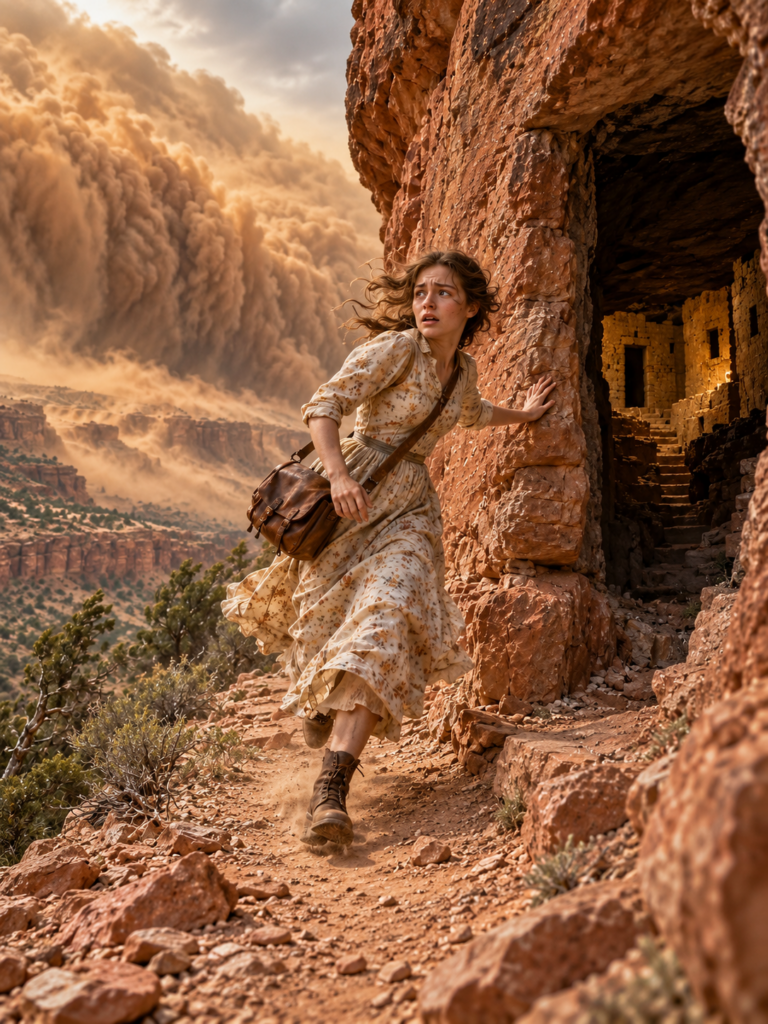
Mary was carrying two empty buckets toward the spring when she noticed the northern horizon disappear.
At first, she thought clouds had gathered above the ridge.
Then the brown wall began moving.
It rose higher than the hills, swallowing the sky as it advanced.
Mary had seen dust storms before.
Nothing resembled this.
The air changed.
Birds flew low across the valley.
The horses gathered near the fence, restless and frightened.
Then the wind arrived.
Mary dropped the buckets.
She couldn’t reach the cabin in time.
A mile of exposed ground separated her from its shelter.
But above the spring stood a narrow opening in the hillside.
She had seen it since childhood.
She had never ventured far inside.
Now it was her only chance.
She pulled her skirt above her knees and ran.
Sand struck her face like needles.
Her eyes streamed.
She could barely breathe.
Behind her, the valley disappeared beneath a wall of moving earth.
Mary reached the black opening and threw herself onto her hands and knees.
She crawled inside.
The passage was narrow enough to scrape her shoulders.
She kept moving until the roar of the wind began to soften.
Then something unexpected happened.
The passage widened.
Mary extended one trembling hand.
Her fingers touched a wall.
Not rough, natural rock.
Flat stones.
Carefully stacked stones.
She moved her hand downward and discovered a level floor.
Someone had built something inside this hill.
She was sitting in complete darkness, with a deadly storm raging outside and a strange man-made passage stretching deeper into the mountain.
For the first time that afternoon, Mary forgot about the dust.
She listened.
Beyond the wind, she thought she heard something else.
A faint hollow sound.
Like air traveling through a distant room.
She drew her knees to her chest and whispered the words her mother always used during storms.
“The wind will get tired before we do.”
Then she waited.
She had no idea that the opening she had crawled through was connected to a secret that had been waiting for her longer than she had been alive.
Part 2
By morning, the storm had passed.
Mary crawled toward daylight with dust in her hair, her mouth, and the seams of her dress.
Outside, the valley looked like a different country.
The familiar grass had disappeared beneath gray-brown drifts.
One bucket was buried beside the spring.
The other had been blown several yards downhill.
The old leaning fence post near the north pasture stood at a sharper angle.
Not a single bird sang.
Mary collected her buckets and hurried toward the cabin.
Peg and the four steers were alive, though frightened and thirsty.
The roof had survived.
So had the chimney.
Then Mary noticed the paper wedged above the door latch.
It bore the county seal.
She unfolded it and began reading.
Before reaching the bottom, she felt the strength leave her legs.
Ruf Bell had acquired the outstanding claim against the ranch.
Proceedings had advanced.
The property was being transferred through the county’s foreclosure process.
Mary was ordered to remove herself, her belongings, and her livestock before November first.
She sat on the front step.
The paper trembled between her fingers.
There was something peculiar about the property description.
One hundred and fifty-six acres.
Her grandfather had always called it a hundred-and-sixty-acre place.
Her mother had used the same number.
Mary read the description again.
Four acres were missing.
She had no survey map, no lawyer, and no money to investigate.
Still, she remembered that difference.
Inside the cabin, she found another envelope.
Her aunt Prudence had written again.
This time, the message was colder.
Mary must not arrive at the Ashland house unannounced. There was no room for her.
However, Prudence knew a family seeking a domestic servant.
The position paid twelve dollars a month, with room and board.
Mary stared at the letter.
Twelve dollars a month.
Three generations had worked the Gray ranch, and now her aunt was offering to arrange employment cleaning somebody else’s house.
Mary placed both letters beneath the flour tin.
Then she went outside to milk Peg.
She kept working until sundown.
It was the only way she knew to remain standing.
Two days later, she visited Mallister’s store.
The old shopkeeper opened his ledger and showed her the entries.
There was her father’s name.
There was the unpaid obligation.
And there was Ruf Bell’s signature beside the assignment.
“The papers are in order,” Mallister said quietly.
Mary studied the ledger.
“Does that make it right?”
He didn’t answer.
Outside, Ruf Bell waited beside her wagon.
He was a broad-shouldered man with expensive boots and an easy smile.
“Mary,” he greeted her. “I’ve been hoping we’d talk.”
She remained silent.
“I know this has been difficult. But that place is more work than a girl ought to handle.”
“It was my mother’s place.”
“Certainly. And nobody respects your mother more than I do.”
Mary knew that wasn’t entirely true.
Bell had barely visited while Addie was dying.
He rested one polished boot against the wagon wheel.
“Here’s what I’ll do. I’ll buy your cattle at a fair price. And you can stay in the cabin through winter.”
Mary looked at him.
“Stay?”
“Keep house for me. Tend the animals. Do the cooking. Five dollars a month, plus your keep.”
She understood.
He wanted her to become a servant in the house her grandfather had built.
“No, thank you.”
Bell’s smile thinned.
“Don’t be stubborn. You have nowhere else to go.”
“Then I’ll find somewhere.”
“A girl your age ought to recognize a generous offer.”
Mary climbed onto the wagon.
“Good afternoon, Mr. Bell.”
She drove away before he could answer.
For the next week, she packed her life into the wagon.
Her mother’s blankets.
Two sacks of seed potatoes.
The flour and salt.
The remaining coffee.
Cooking utensils.
Her mother’s wooden carrying yoke.
And the tools left to her by Hyram Deakons.
Hyram had been an old well digger who lived alone above the North Fork.
He had lost one hand in a machinery accident long before Mary was born.
When she was little, she followed him through the fields, watching him read the land.
He taught her how to recognize ground that held moisture, how to set a fence post so frost wouldn’t push it crooked, and how to sharpen a saw without wasting steel.
He had died when she was thirteen.
His tools became some of her most valuable possessions.
Mary wrapped the chisels, auger, saw, and hand axe in straw.
She repaired a crack beneath the wagon with wet rawhide and allowed it to dry tight.
On her last evening, she sat beside the cabin chimney.
The stones still held the day’s warmth.
Her grandfather had carried those stones by hand.
Her mother had cooked beside them.
Mary rested her palm against the masonry.
“I’m sorry,” she whispered.
There was no one to hear her.
Before sunrise, she hitched the horses.
Peg followed behind the wagon.
The steers moved slowly ahead.
As Mary passed the road fence, Neta Puit, the town washerwoman, approached carrying a jar of preserves.
She placed it in the wagon.
“Made too many,” Neta said.
Mary looked at the jar.
“Thank you.”
Neta touched her arm.
“Your mother was a good woman.”
Mary swallowed.
“Yes, ma’am.”
Then she drove away.
At the rise above Dry Creek, the road divided.
East led toward Ashland.
Toward her aunt’s house and the servant’s position.
South led toward the county seat.
Mary stopped the team.
A steady wind moved through the brittle grass.
She thought about the storm.
And the strange stone passage above the spring.
Then she remembered something Hyram used to say whenever they worked near the north hillside.
“That hill holds water like a jug.”
She had always believed he meant the spring.
Now she wondered whether the old man had known something more.
Mary turned the horses northwest.
Off the road.
Across the rough pasture.
Toward the hill.
The wagon rocked violently over stones and dried channels.
Twice she had to climb down and guide the team around deep washouts.
Once a wheel sank nearly to its hub.
Mary pushed against the wagon while the horses strained forward.
The repaired wooden beam held.
By late afternoon, she reached the spring.
She drank first, then watered the animals.
Afterward, she made camp beside a low shelf of rock.
She spread two blankets on the ground and built a small fire.
The valley lay dark beneath her.
Somewhere beyond the ridge stood the home that was no longer hers.
Mary ate bread and preserves.
Then she removed her mother’s comb from the satchel.
It had been carved from yellow bone, with one tooth broken near the left edge.
Her grandfather had made it for her grandmother.
Her grandmother had given it to Addie.
Addie had given it to Mary.
Now it was almost all that remained of three generations.
Mary held it until the fire burned low.
“Well, Mama,” she whispered, “I haven’t found a home yet.”
Above her, the cave entrance was a black opening in the hillside.
Tomorrow, she decided, she would find out what lay beyond it.
Part 3
Mary entered the cave shortly after sunrise.
She carried a lantern, a hand axe, and a length of rope.
The opening forced her to crawl, but several feet inside, the stone floor began rising gently and the ceiling lifted enough for her to stand.
She held the lantern high.
The walls were carefully built from flat gray stones, fitted together with narrow lines of mortar.
She recognized the workmanship immediately.
It reminded her of her grandfather’s chimney.
Farther inside, the passage turned left, then right.
Mary stopped.
Those turns weren’t accidental.
They kept the wind from blowing directly into whatever lay beyond.
At the final corner, she discovered the remains of a wooden doorframe.
Rusty hinges hung against the stone.
The door itself was missing.
She stepped through.
And found a room.
Three wooden sleeping bunks stood against one wall.
Their supports were fitted into stone sockets.
A canvas mattress rested on the lowest bunk.
Wooden pegs lined the wall above them.
Someone had lived here.
Someone had taken considerable trouble to make the place comfortable.
Mary continued through a second opening.
This room was larger.
A cast-iron stove stood on a slate hearth.
A sturdy pine table occupied one side.
Two benches rested beneath it.
There were tin plates, cups, horn spoons, a coffee pot, and shelves holding empty jars.
Two old lanterns stood on an upper shelf.
Mary touched the table.
It was coated with dust, but the wood beneath remained sound.
A third room opened beyond the kitchen.
It was smaller, cooler, and set below the level of the others.
A storage cellar.
Three stoneware crocks sat against the wall.
An empty barrel stood in the corner.
Mary stared around her.
“Good Lord.”
Her voice sounded unfamiliar in the quiet room.
She examined the ceiling and found a ventilation shaft leading upward.
Near the stove, a stone-lined flue carried smoke toward the hillside.
Whoever built this place understood drainage, airflow, and winter shelter.
Mary lowered herself onto a bench.
She had entered the cave expecting a hole.
Instead, she had found a house.
The discovery should have made her happy.
But happiness required energy, and the previous weeks had left very little.
She thought of the county paper.
November first.
Bell would take the cabin.
The ranch would change hands.
She might remain in these rooms for a while, but she had almost no money, little food, and a long winter approaching.
She sat alone in the dim light.
Then she got up.
Worry couldn’t repair a roof or feed a cow.
She returned outside and began hauling her belongings uphill.
The first trip carried blankets and cooking utensils.
The second brought a sack of flour and the remaining coffee.
The third brought Hyram’s tools.
Every trip required climbing the steep slope.
By noon, her arms shook from exhaustion.
She rested on a rock while Peg watched from below.
“Don’t look at me like that,” Mary told the cow. “You aren’t helping.”
Peg chewed slowly.
Mary laughed.
It was the first time she had laughed in days.
She continued working.
Over the following week, she made the cave livable.
She swept the rooms, removed rotted straw from the old mattress, and scrubbed the table.
She checked the stove, repaired a damaged pipe joint, and tested the flue with a small fire before trusting it with a larger one.
Warm air began spreading through the stone rooms.
For the first time since leaving the ranch, Mary slept without a blanket pulled over her head.
She built a simple shelter for Peg and the steers beneath an overhanging shelf.
The horses stayed near the pasture below.
She moved water in buckets and searched the hillside for usable grass.
The labor was heavy.
Food was limited.
And the nights grew colder.
One afternoon, while carrying firewood into the first room, Mary noticed four loose stones near the wall.
They had fallen outward, leaving a dark gap.
She set down the wood and brought her lantern closer.
A narrow passage ran behind the wall.
Ten feet inside, the ceiling had collapsed.
Mary could see the edge of another chamber beyond the rubble.
Her heart quickened.
She went for Hyram’s chisels.
For two days, whenever her regular chores allowed, she worked at the fallen stone.
She loosened smaller pieces first.
Larger slabs required a wooden lever.
Dust coated her sleeves.
One stone slipped and struck her ankle.
She sat in the passage holding her leg, fighting tears of pain and frustration.
For a moment, she wanted to throw the chisel away.
What was she doing?
Digging through a strange hill while someone else took the home her mother had died trying to preserve?
She leaned against the wall.
The lantern flame fluttered.
Then she remembered Hyram’s voice.
“One stone at a time, girl. You don’t move a hill by getting angry at it.”
Mary waited until the pain eased.
Then she picked up the chisel.
By evening, the opening was large enough to crawl through.
The hidden chamber was small.
Its ceiling was low and supported by heavy timber.
Against the back wall stood a wooden chest.
The hinges were rusty, but the lid remained closed.
Mary knelt beside it.
There was no lock.
She lifted the lid.
Inside lay a folded gray wool blanket, a wooden box with a sliding lid, and a small metal tin.
The tin felt unusually heavy.
Mary opened it.
Inside were coins.
Silver coins, tightly wrapped in old paper.
Some gold pieces.
And folded banknotes that had been carefully protected from moisture.
Mary stared.
She lifted one packet, then another.
Her fingers trembled as she unfolded the paper.
Money.
More money than she had ever held.
She began counting, then stopped.
She couldn’t trust her arithmetic while her heart beat so hard.
She closed the tin and carried it to the kitchen table.
There, beneath the steady lantern light, she counted everything twice.
One hundred and sixty-nine dollars and sixty cents.
Mary sat motionless.
The amount was not enough to settle the entire debt.
But it was more than thirteen times the money she had possessed when she fled the storm.
Someone had hidden a considerable sum inside the mountain.
Someone who apparently never returned for it.
She turned toward the wooden box.
Inside were small personal belongings: a worn horn thimble, fishhooks, a whetstone, and a carpenter’s pencil.
Beneath them lay a narrow notebook.
Its pages were yellow.
The handwriting was small, square, and deliberate.
On the first page was a name.
Emmett Rowe.
Mary had never heard it.
She opened the book.
The earliest entries described hauling stone, cutting timber, and digging into the hillside.
There were measurements for the rooms.
Notes about the stove.
Calculations for drainage and air passages.
The writer had evidently spent years building the place.
Mary read slowly.
Some pages described ordinary work.
Others mentioned hunger, illness, and loneliness.
She learned that Emmett had once possessed a wife and a son.
Both had died.
Afterward, he came west with the money and tools he still owned.
He had lost a hand years before and had learned to work with the one that remained.
Mary looked at the carefully joined table.
The shaped doorframe.
The stone chimney.
All that patient work, done by a man who had been forced to relearn nearly everything.
She turned another page.
Emmett had written about the valley.
About the spring.
About the Gray family.
And about a woman named Adeline.
Mary caught her breath.
Her mother’s name appeared again on the next page.
Emmett described watching Addie carry water to the cabin.
He remembered her sharing bread with a hungry traveler.
He wrote about her small daughter, who followed a one-handed well digger around the fields.
Mary closed her eyes.
Hyram.
The old man who had taught her to read the land.
Could he have known Emmett?
Could he have known about these rooms?
She looked down at the notebook.
A sentence near the bottom of the page caught her attention.
Emmett had written that there was something wrong with the county’s survey.
Four acres wrong.
And the spring stood inside those missing acres.
Mary read the sentence three times.
Then she hurried to her satchel and pulled out the county foreclosure notice.
One hundred and fifty-six acres.
She placed the paper beside the notebook.
Her hands were shaking again.
The missing four acres might not have been a mistake.
They might have been an entirely separate piece of property.
And that meant Ruf Bell’s claim might not include the spring.
For the first time since her mother’s death, Mary felt something stronger than the fear of losing everything.
She felt the possibility that the story wasn’t finished.
Part 4
The following morning, Mary spread the papers across the kitchen table.
The county notice described the ranch as one hundred and fifty-six acres.
Emmett Rowe’s notebook referred repeatedly to four acres along the northern boundary.
A spring lay between the old surveyed line and the stone boundary marker.
The details seemed connected.
But Mary understood the difference between a suspicion and something a county official would accept.
She needed proof.
She continued reading.
Emmett’s entries described a visit to the county seat many years earlier.
He had examined old survey notes and discovered that the marked boundary differed from the official plat.
A surveyor’s stone had been placed farther north than the line shown on the map.
The difference contained the spring.
Emmett had investigated the ownership of that ground.
Later entries suggested that he had acquired a separate claim to the disputed acreage.
But the notebook didn’t explain everything.
Mary searched the chest.
There was no obvious deed.
No current survey.
No official document she could present.
Only the notebook and the carefully hidden money.
She looked through the chest again, then checked the shelves.
Nothing.
Outside, the weather worsened.
Cold winds swept down from the hills.
At night, frost whitened the grass.
Mary worked to keep the livestock sheltered and fed.
Her stores of flour diminished.
The steers required more grazing than the hillside readily provided.
One afternoon, a horse broke loose and wandered toward the old north pasture.
Mary spent hours retrieving it.
She returned near dark, limping from a blister that had opened inside her boot.
The cave felt warm when she entered.
She sat beside the stove and held her hands near the iron.
Then she cried.
Not loudly.
Not dramatically.
Just a few exhausted tears that fell onto her skirt.
She missed her mother.
She missed the cabin.
She missed having someone to tell her whether she was making a terrible mistake.
The next morning, she rode into Dry Creek.
Mallister looked surprised when she entered his store.
“I heard you’d gone toward Ashland.”
“No, sir.”
“Where have you been staying?”
“Up by the spring.”
He frowned.
“That ground is disputed.”
“I know. That’s why I’ve come.”
She showed him the notebook’s description of the four acres.
Mallister read the passage carefully.
“Emmett Rowe,” he murmured.
“You knew him?”
“Only by name. Quiet fellow. Didn’t come into town often.”
“Did he own land?”
Mallister considered.
“He may have. I can’t tell you from this ledger.”
“Who could?”
“The county recorder.”
Mary stared down at the worn notebook.
“Would they let me examine the old records?”
“They should.”
“Would they charge?”
“For copies, likely. For a search, perhaps not.”
Mary thanked him.
Before she left, Mallister said, “Mary, be careful. Bell believes that spring belongs with the ranch.”
“So did I.”
“People become unreasonable over water.”
Mary looked him in the eye.
“So do people who lose their homes.”
She drove toward the county seat.
The journey took most of the day.
By the time she reached the courthouse, her clothes were coated in dust.
Inside, the recorder’s office smelled of ink, old paper, and coal smoke.
A clerk named Elias Mercer listened while Mary explained the boundary discrepancy.
He examined the notebook.
“Where did you obtain this?”
“From a house in the hillside.”
“A house?”
“Rooms built into the rock.”
The clerk studied her face as though deciding whether she was joking.
Mary didn’t smile.
Finally, he brought out an old index volume.
They searched for Emmett Rowe.
There were entries.
A land patent.
A recorded instrument.
References to the four acres near the northern boundary.
But the records had been entered under an older survey description, and retrieving the complete file would require searching the archived books.
“The recorder isn’t here today,” Mercer explained. “And I can’t certify the legal description myself.”
Mary’s hope faltered.
“Can you tell me whether the water belongs to Ruf Bell?”
“Not from this page alone.”
“But the entry exists?”
“Yes.”
He turned the index so she could see.
There was Emmett’s name.
Written in faded ink.
Mary memorized the reference number.
“Thank you.”
On the road home, she passed a rider heading south.
Ruf Bell.
He slowed his horse.
“Still hanging around, Mary?”
She stopped the wagon.
“I’m getting by.”
“Winter’s coming.”
“I’ve noticed.”
“People say you’ve been asking about old county papers.”
Mary said nothing.
Bell leaned forward.
“That ranch is mine now. You’ll only make yourself miserable fighting what’s settled.”
“I haven’t been fighting.”
“Then what are you doing?”
“Checking something.”
He looked toward the northern hills.
“You aren’t planning to interfere with the spring, are you?”
“No, sir.”
“Good. I’d hate for this to turn unpleasant.”
He rode away.
Mary remained still until the sound of his horse faded.
For the first time, she wondered whether Bell knew about the four acres.
Or whether he merely feared that she knew something he didn’t.
That night, she reopened Emmett’s notebook.
She read every surviving page in order.
The later entries grew shorter.
The handwriting weakened.
Emmett described being tired.
He wrote about the winter approaching.
He mentioned leaving his tools and belongings for whoever might someday find the rooms.
And then Mary found a passage she had overlooked.
The writer had referred to a gray wool blanket on the upper shelf.
There was something beneath it.
Mary looked up.
The blanket she had found in the chest was lying near her bed, where she had placed it after carrying it out of the hidden chamber.
But another folded gray blanket remained on the highest shelf of the kitchen.
It had been there when she first entered.
She had assumed it was ordinary bedding.
Mary rose slowly.
She reached for the blanket.
It felt heavier than wool alone.
Inside was a tightly rolled packet tied with waxed thread.
She carried it to the table but did not open it immediately.
The lantern flame moved softly against the walls.
Outside, the wind began rising.
Mary remembered the first night she had crouched in darkness while dust scraped across the hillside.
She remembered the county notice.
Her aunt’s letter.
Bell’s offer.
Her mother’s hands.
Then she placed the packet beneath the lantern.
Whatever lay inside might be the only chance she had left.
Part 5
Mary untied the thread.
Three folded sheets lay inside.
Two were written in Emmett Rowe’s familiar hand.
The third carried a county recording notation and an old official seal.
Mary began reading.
Emmett had acquired the separate four-acre tract identified by the discrepancy between the marked boundary and the old county plat.
Those four acres included the spring.
The document went further.
It established that Emmett held the property in trust for the child of Adeline Gray.
Upon his death, the beneficial ownership was intended to pass to that child.
Mary read her mother’s name again.
Then her own relationship to it became impossible to ignore.
She was Adeline Gray’s daughter.
The spring had been set aside for her.
Years before her mother died.
Years before Ruf Bell acquired the debt.
Years before Mary learned that anybody had ever claimed the four acres separately.
At the bottom of the document, Emmett had written a simple sentence.
It is hers. She does not know it.
Mary covered her mouth.
She sat motionless for a long time.
Then she opened the notebook to its final written page.
Emmett’s last message explained that he had built the rooms for whoever the wind might bring inside.
He had hidden money in the chest.
And he had left the land papers where someone searching carefully could find them.
If that person was Adeline Gray’s child, the property was meant for her.
If not, Emmett hoped the finder would help locate the rightful heir.
Mary laid the notebook beside the deed.
Now she understood.
The hill had not merely sheltered her from a storm.
A lonely man, long dead, had left behind a place where someone in desperate need might find safety.
And he had remembered a mother and daughter whom the rest of the county had nearly forgotten.
Mary cried then.
Not from defeat.
From the terrible relief of learning that someone had once cared enough to think about her future.
The next morning, she returned to the county seat.
This time, she carried the original instrument, the recording reference, Emmett’s notebook, and the foreclosure notice.
The recorder examined the documents.
The old files were brought from storage.
Entries were compared.
A legal description was checked.
And the separate four-acre tract was confirmed.
The county’s old plat had obscured the boundary, but the spring had not been part of the parcel Ruf Bell acquired through the foreclosure.
Emmett’s recorded trust arrangement supported Mary’s claim.
The matter still required formal recognition and correction of the county’s boundary records.
But Mary no longer stood before the officials with nothing except a girl’s word.
She had written evidence.
She had a recorded interest.
And she had a reason to keep fighting.
The county surveyor was instructed to examine the disputed line.
Meanwhile, Mary faced a different problem.
The ranch cabin, pasture, and other improvements remained under Bell’s claim.
The spring was hers, but the family home was not.
She could live in the stone rooms and survive.
She could refuse Bell access to the water.
But that would mean watching her grandfather’s cabin become somebody else’s property.
Mary looked at the money Emmett had left.
One hundred and sixty-nine dollars and sixty cents.
It was not enough by itself.
She sold two steers.
She sold a portion of her remaining equipment that could be replaced.
She accepted payment for work repairing a neighbor’s fence.
And she counted every dollar with the same care her mother had taught her.
When she finally approached Bell, she came not to beg but to make an offer.
They met outside Mallister’s store on a cold Wednesday morning.
Bell looked puzzled when she told him what she wanted.
“Buy back the ranch?”
“Yes, sir.”
“That property cost me money.”
“I know.”
“And it’s worth more with the spring.”
“The spring isn’t part of it.”
Bell’s expression changed.
Mary handed him a certified copy of the recorded instrument.
He read it.
Then he read it again.
“Where did you get this?”
“From its owner.”
“Emmett Rowe is dead.”
“Yes. And he left the property to my mother’s child.”
Bell examined the legal description.
Mary waited.
She understood what this meant to him.
Without the spring, the ranch was still useful ground, but it lacked the permanent water that had made it especially valuable to his cattle operation.
He could challenge the boundary.
He could spend money fighting the records.
Or he could accept what the documents showed.
“You’re telling me I bought dry ground?” he asked.
“I’m telling you the spring wasn’t included.”
Bell looked toward the hills.
After a long silence, he asked how much she could pay to recover the parcel he had acquired.
Mary named the figure she had gathered, with the remaining amount to be covered under terms they could record properly.
Bell laughed once without amusement.
“You’re a hard girl, Mary Gray.”
“No, sir. Just tired of losing things.”
He studied her for another moment.
Then they began discussing the terms.
There was no grand apology.
No sudden transformation.
Bell had wanted the water, and the legal evidence had changed what his investment was worth.
At last, they reached an agreement.
The transfer was documented.
The obligations were settled.
And Mary returned to Mallister’s store with a receipt that proved the family ranch was hers again.
Mallister opened his ledger.
He found the Gray account.
Then he took out his pencil and wrote a single word beside her name.
Clear.
Mary stared at it.
For years that account had carried her father’s unpaid debt.
Her mother’s struggle.
Her own fear of losing the land.
Now the obligation was finished.
“Would you like anything from the store?” Mallister asked.
Mary thought for a moment.
“Coffee,” she said.
He smiled.
“How much?”
“A full pound.”
She paid in cash.
That afternoon, Mary returned to the cabin.
She unlocked the door.
The room smelled of dust and old wood.
The stove stood exactly where her grandfather had installed it.
The stone chimney remained straight.
Mary ran her fingers along the table where her mother had prepared so many meals.
She was home.
But something had changed.
The stone rooms above the spring had become home too.
She could not abandon them.
She cleaned the cabin, repaired the remaining fences, and continued living in the hill while she prepared the property for winter.
The spring now belonged to her beyond reasonable dispute, and the old ranch was back in her hands.
She had obtained more than she dared hope for on the day she ran into the storm.
Still, the story did not end with the signed papers.
It ended with what Mary decided to do next.
When the following dry season arrived, neighboring ranchers began worrying about water.
The creek shrank.
Wells ran low.
Bell’s cattle suffered along the southern benches.
One morning, he rode up toward Mary’s hillside with an empty canteen.
He stopped below the spring.
For several moments, neither spoke.
Then Bell removed his hat.
“Mary, I know I haven’t given you much reason to welcome me here.”
“No, sir.”
He accepted the answer.
“My cattle need water.”
Mary looked past him toward the dusty valley.
She remembered the county notice.
The offer to employ her in her own mother’s cabin.
The humiliation of packing everything she owned into a wagon.
She could turn him away.
The law was on her side now.
Instead, she said, “You can fill your canteen.”
Bell looked up.
“And the cattle?”
“They can use the overflow below the rocks. But they can’t stand in the spring or tear up its banks.”
He nodded slowly.
“Fair enough.”
“And nobody owns the water just because they have more cattle than their neighbors.”
Bell looked at her for a moment.
Then he nodded again.
“I understand.”
After that, the spring became something new.
Not simply Mary’s private treasure.
A gathering place.
Neta Puit brought her washing kettle and worked near the overflow on Mondays.
Children came with buckets during summer.
A local schoolteacher brought her students and explained why the water mattered to the valley.
An elderly woman named Hester helped Mary establish beehives among the flowering plants above the spring.
Mary kept a tin drinking cup hanging beside the path for travelers.
There were rules.
No livestock fouling the source.
No damaging the banks.
Everyone waited their turn.
Nobody was turned away thirsty.
The county surveyor eventually corrected the old boundary discrepancy in the official records, making the four-acre tract visible on the maps as well as in the deed books.
Mary placed the corrected survey beside Emmett’s papers in the metal tin.
Years passed.
She planted potatoes, beans, and turnips in a sheltered patch below the spring.
Peg raised calves.
The herd slowly grew.
The stone rooms acquired a proper wooden door, repaired shutters, clean bedding, and a table polished by ordinary use.
Mary kept the old cabin too.
Sometimes she spent a night there just to hear the wind against the chimney her grandfather had built.
Other nights she preferred the hill, where the stove drew cleanly and the stone walls held steady against winter weather.
She never became wealthy.
She worked too hard and worried too much for that.
But she was secure.
And in Dry Creek, security was a kind of richness few people understood until they had lost it.
On a rainy Sunday evening, two years after the storm, Mary sat at the pine table inside the hill.
Before her lay three objects.
Her mother’s yellow bone comb.
Emmett Rowe’s worn horn thimble.
And the notebook he had kept while building the rooms.
Mary had learned much about Emmett from his writing.
He had buried his wife and son.
He had worked with one hand.
He had built a home of stone when loneliness might have persuaded another man to abandon the world entirely.
He had seen a struggling family and quietly arranged for a child to inherit something she might someday need.
Mary would never know why he chose them.
Perhaps her mother’s kindness had moved him.
Perhaps he recognized in Addie the stubborn courage of his lost wife.
Perhaps he simply believed that people who worked hard deserved a fair chance.
Whatever his reasons, he had not waited for praise.
He had done the work.
And left it behind.
Mary thought about Hyram Deakons too.
Another one-handed man.
Another patient teacher.
She wondered whether he had known more about the hill than he ever said.
It was possible.
It was also possible that he had simply understood the land better than anyone else.
Either way, his tools had helped her build the life she now possessed.
She thought of her grandfather, hauling stones through four winters.
Her grandmother, planting the first garden.
Her mother, keeping the beans warm even as her strength failed.
And the woman from town who had quietly left a jar of preserves in a departing girl’s wagon.
So many people had given Mary small things.
Tools.
Food.
Knowledge.
A few kind words.
And one man had given her a home.
She opened the notebook to its final blank pages.
For two years, she had been adding her own entries beneath Emmett’s.
Repairs completed.
Seeds planted.
Calves born.
Fences mended.
She sharpened the carpenter’s pencil and wrote about the day’s work.
Then she paused.
Rain tapped softly beyond the cave entrance.
The spring ran beneath the hill, steady and cold.
Mary looked at the two small keepsakes beside the book.
She remembered herself at eighteen, crouched against a stone wall while the world outside seemed to be coming apart.
She remembered believing that eleven dollars and a broken comb were all she possessed.
She had been wrong.
She had inherited skills, endurance, memories, and the unseen kindness of people who had lived before her.
And she had finally found a place where those things could become a future.
Beneath the day’s entry, Mary wrote three words.
The hill holds.
She closed the notebook.
Then she turned down the lantern and listened to the rain.
Outside, the valley slept.
The ranch belonged to her again.
The spring continued running.
And inside the hillside, in rooms carved by a forgotten man, Mary Gray was no longer a girl who had been driven from her home.
She was a woman who had built one.
The wind could come again.
The hard winters could return.
There would be fences to mend, animals to feed, and difficult days that no amount of money could prevent.
But she knew now what her mother had been trying to teach her all those years.
A home was more than land recorded under a name.
It was the work left by those who loved you.
The kindness you chose to return.
And the courage to keep the fire burning when the rest of the world had gone cold.
Mary placed another log in the stove.
The flames rose.
And the hill held.