
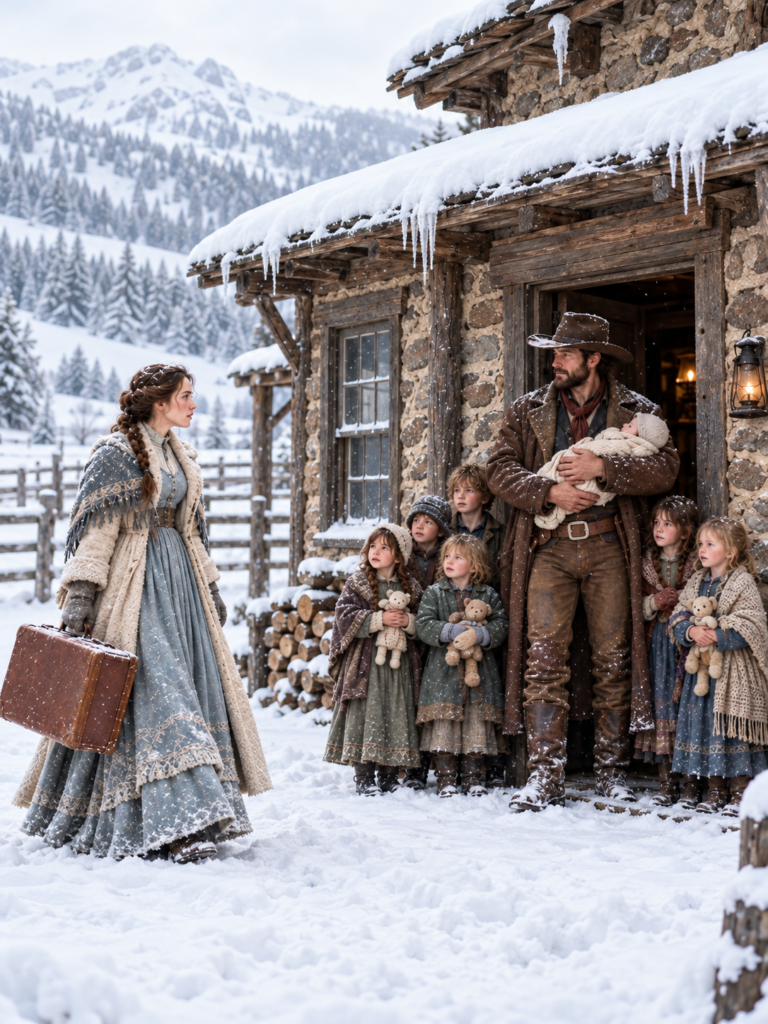
she came home after burying her mother to find a stranger and five children already living in her house — he whispered they would leave if she wanted
Part 1
The wagon jarred hard over a frozen rut and Martha Cordell caught the seat board with both hands. She did not curse. She breathed through her teeth and kept her eyes on the trail. Four months. That was how long she had been gone—four months of borrowed cots in Cheyenne, of compresses changed at two in the morning, of the rattle that had grown thinner until it stopped one Tuesday before dawn. She had buried her mother in cold ground, settled what little remained, and pointed the mare north.
Home. She turned the word over the way a person turns a river stone, testing its weight. It did not feel like much of anything. The Wyoming sky was the particular gray of late November, flat and heavy, pressing down like a lid. Cottonwoods along the creek stood bare and skeletal. Ice had locked the wheel ruts solid. Every jolt ran up through the bench and into her spine. The old dun mare, Bessie, moved without complaint. Martha appreciated that. No noise. Just forward motion.
A letter from Ned Colter had reached her in Cheyenne, brief and plain the way Ned always wrote. Thomas had broken a young stallion on the third of October. The horse threw him. He did not last the night. Ranch is standing. Livestock are fed. Come home when you are able. Thomas, her husband of eleven years, dead in the same dirt he had worked his whole life. She had sat with the news a long time before she cried, and when the tears came they were not pure grief. Something more complicated sat underneath, harder to name, and she was still working out what to call it.
She topped the last long rise and the valley opened. The Broken Wheel Ranch sat low and quiet in its shallow bowl of land, the main house and outbuildings small against all that open country. Gray smoke rose from the chimney. Martha pulled the mare to a stop. Smoke. A thin curl of it. Ned would not be inside. Ned had the Colter place three miles east and was not the type to make himself at home in another man’s house. She had no hired hand wintering over. She had no one.
Boot prints in the snow. Big ones, and beside them smaller ones, much smaller. She counted without meaning to. Several sets of small feet, different sizes, coming up the porch steps. Martha reached under the bench and pulled out the Winchester. She checked the chamber by feel, working the lever quiet, then set the mare moving again. Slow. Deliberate. She tied Bessie at the far fence post and came at the house from the side, keeping the woodpile between herself and the front window. Her boots made no sound on the packed snow. The smoke above the chimney cap was steady, which meant whoever was inside had gotten a real fire going. They had been here a while.
She stepped onto the porch, put her hand on the door, and went through it hard. The door swung wide. She came in behind the rifle, sweeping the room in one motion. Orange light from the fireplace crossed the walls. The smell of boiled cornmeal and damp wool hit her at once. A man stood at her dry sink. He was tall—taller than Thomas had been, and Thomas was not short. He wore a Union Army overcoat so faded it was more gray than blue, buttoned wrong at the top as if he had fastened it in a hurry. His arms were crossed over his chest. In the next second she understood why. An infant was tucked inside the coat, small enough to disappear entirely against his breastbone.
Behind him, pressed against the far wall beside the dry sink, were four children. A girl of about fourteen, dark-eyed and rigid, standing in front of the younger ones with her arms spread wide. A boy of maybe eleven with a split across his lower lip and dried blood on his chin. A girl of eight or so, perfectly silent, holding a small wooden figure in both hands. A boy who could not have been more than five, clutching the back of the older girl’s dress and staring at Martha with round dark eyes. They were thin. All of them. The kind of thin that does not come from missing a meal or two.
The man had not moved. He turned slowly, no sudden motion, keeping his body between Martha and the infant. He looked at the rifle barrel without flinching. He had a gaunt face, deep-set eyes, the weathered look of a man who had spent years outdoors in hard weather. His jaw was dark with a few days of growth. Shadows under his eyes looked like bruises. He was exhausted, bone-tired in a way that went past the body and into something deeper. He exhaled. In the cold air that still held near the door the breath came out white and faint.
“I know who you are, Mrs. Cordell,” he said. His voice was low and even. Not nervous. Not aggressive. Just tired and steady. “We came on account of an old man’s letter.” He paused. His eyes went briefly to the children behind him, then came back to her. “But if this roof can’t hold us, just say the word and we’ll leave tonight.”
Martha did not lower the rifle. She looked at him for a long moment, then past him to the boy with the split lip, who stood straight with his chin up, doing his level best not to look scared. She looked at the infant—just the crown of a wool-capped head visible above the coat buttons. She looked at the little boy in the back who had pressed his whole face into the older girl’s spine. She looked at the baby’s lips. Pale. Not right. She lowered the rifle slowly. She kept her finger near the guard but pointed it at the floor.
“Sit down,” she said. “All of you.”
Nobody moved right away.
“I’m not going to shoot anybody,” she said. “Sit down.”
The older girl led. The children moved toward the bench along the wall. The tall man stayed where he was. He watched Martha the whole time—not staring her down, just watching, alert, like a man who had learned the hard way to keep track of where the doors were.
“That baby sick?” Martha asked.
“Getting there,” he said. Plain. No drama. “She took a chill two days out of Laramie. I’ve kept her against my chest since then.”
“How long have you been in this house?”
“Three days.”
“You eat anything?”
A pause. The older girl looked at the man’s back with something Martha recognized—the same look she had worn herself at fourteen, watching the adults in a room, trying to calculate which version of the truth was the safest one to tell.
“We had what we brought,” the man said.
Martha looked at the pot on the stove. Her pot. It had been scrubbed clean and set back properly on the iron. She looked at her wood box. It had been filled. She looked at the floor. It had been swept. She hung the rifle on the rack by the door. She did not lock it away. She just hung it where she could reach it easy, and she let him see her do it.
“I’ve got salt pork and dried corn,” she said. “Enough for tonight.” She moved to the kitchen side of the room and started working without looking at them again. “While I cook, you’re going to tell me who you are and what letter you’re talking about.”
She heard him settle onto the bench near the fire. The young boy immediately climbed up next to him, and without thinking about it the man shifted his arm to make room.
“My name is Gideon Thorn,” he said. “Thomas Cordell was my half-brother. Same father, different mothers. I was the one they didn’t put in the family Bible.”
Martha set the salt pork in the skillet without turning around. “The letter,” she said.
“Came to me in August. A solicitor’s clerk in Laramie said Thomas had passed and left a legal document behind. Signed in front of two witnesses. Stating I had a right to put forward a claim on this property.” He was quiet a moment. “I wasn’t planning to come. Didn’t feel like my place. But my wife passed in September. Fever.” He paused, not for effect, just because it was a hard thing to say. “I had five children and no work after the railroad shut down its western line. By October I had eight dollars and the letter.”
Martha set the lid on the skillet. “So you broke into my house.”
“I didn’t break anything. Your back window latch was loose. I fixed it.” He said it without apology, without pride either. Just a fact. “The baby needed warmth. I would have slept in the barn myself, but I couldn’t put Mercy in the cold.”
Mercy. That was the baby’s name. Martha turned around. “How old is she?”
“Ten months.”
She nodded once and turned back to the stove. She cooked without talking for a while, and he let her. The children were quiet too, except for the little boy who whispered something to the older girl and was hushed gently. When she put the food on the table she set out six bowls, then caught herself looking at the line of them on the bench and added a seventh for herself. She brought the pot and ladled it out. The little boy reached for his bowl with both hands, then stopped and looked at the man first. The man nodded, just barely, and the boy picked it up and started eating with focused determination, like a small creature that had learned to take nothing for granted. The older girl fed the silent eight-year-old first, then the baby, then herself, taking the smallest portion without announcing it.
Gideon Thorn did not eat right away. He set the baby on the older girl’s lap and stood up. “Before I sit down to your table,” he said, “I want to be straight with you about something.”
Martha looked up at him.
“The Thorn children may be cold,” he said, “but they don’t eat off pity. I’ll rehang your hayloft door and split three cords of firewood by sunrise to square this meal.” He said it quietly. No bluster. A man stating terms, not making threats. There was a particular kind of dignity in it, the sort that does not need volume to land.
Martha held his gaze for a moment, then looked back down at her bowl. “Hayloft door’s been dragging since September,” she said. “Sit down and eat.”
He sat. The fire crackled. Outside the wind had started to build, pushing at the corners of the house, whistling thin and high through some gap she had not found yet. Inside it was warm and strange. Six people and a baby at a table that had been set for one, or for none, for longer than Martha cared to admit. She ate without tasting much of it. She watched them without appearing to watch them. The man ate carefully. He worked through the broth portion of his bowl first, going slow, and when the meat was gone she noticed there was not much meat in his bowl to begin with. She looked at the children’s bowls. The meat was there. He had split what they had and given his share away. He was doing it quietly enough that the children did not seem to notice, or maybe they had learned not to notice, which was its own kind of understanding.
After supper, while the older girl settled the younger children on the floor near the fire with the only two blankets they seemed to own, Martha took her lamp and went back to the far side of the house. She stopped at the end of the hall. There was a door there, painted yellow. Butter yellow. She had painted it herself ten years ago on a warm spring afternoon full of a particular kind of hope that had nowhere to go after that. The room behind it was small and square and still had the little crib Thomas had built in the corner, white with a carved rail along the top. She had not opened the door in three years. She stood in the dark hall with her lamp and looked at the door for a long time. Then she heard the baby cough—a small, thin sound from the other room—and then Gideon’s voice, very low, saying something she could not make out. Something private. The kind of murmur a person uses when they are talking to someone who cannot answer back yet.
Martha turned around and went to her room. She sat on the edge of her bed in the dark for a while. She thought about Thomas. She thought about eight dollars and a letter and five children and nine hundred miles of hard Wyoming road. She thought about that man’s eyes when he had looked at her rifle barrel—not scared, not angry, just waiting. Waiting to see what kind of person she was going to turn out to be. She thought about pale lips on a ten-month-old baby. She would tell them in the morning they could have the east barn. Three days until the circuit judge came through. Ned had mentioned it in a postscript. Three days to look at whatever papers this man claimed to have, and then she would figure out what came next. That was enough deciding for one night.
She lay back on the bed without undressing and pulled the quilt up and stared at the dark ceiling. The wind pushed at the windows. The fire in the main room settled into itself. Somewhere in the house a board creaked once, then was still. She closed her eyes. Tomorrow, she thought. Tomorrow is soon enough. Outside the snow started again, slow and quiet and steady, covering the wagon tracks and the boot prints and the small footprints alike, laying a clean white sheet across the whole frozen yard. The Broken Wheel Ranch held its breath in the dark and waited to see what morning would make of them all.
Morning came in gray and grudging the way Wyoming mornings do in late November. The light did not so much arrive as it seeped, pale and thin through the frost that had built up overnight on the east-facing windows. Martha was up before it. She had slept in her clothes and woke with the particular alertness of someone whose mind had kept working while the rest of her rested. She lay still for exactly one minute, listening. The house was quiet. She got up, put her boots on, and went to the window.
The barn. The east barn. The smaller one she used for hay and equipment and the two plow horses that were not Bessie. There was a thin line of light under the door. They were already awake. She built the kitchen fire back up from coals and put the coffee on, then she went to the barn. She did not knock. It was her barn. She lifted the latch and pushed the door open and stood in the entrance with the cold at her back.
Gideon was standing at the workbench along the far wall. He had found her spare lantern and lit it, and in its circle of yellow light she could see he had rearranged the loose hay in the corner into a rough sleeping area using the horse blankets from the stall rail. The children were still there, most of them asleep in a pile. The older girl sat up with the baby against her shoulder, rocking slowly without making a sound. Gideon turned when she came in. He had a leather harness in his hands—one of hers—and he was working a cracked section of the stitching with an awl and a length of waxed thread. He set it down.
“Mrs. Cordell.”
“You found the harness repair kit.”
“It was on the bench. Stitching was going on the left trace. Figured I’d get to it while there was light.” He paused. “I hope that sits right with you.”
She looked at the harness. He had already done three or four inches of tight, even stitching. Better than she would have done herself. “The circuit judge comes through Thursday,” she said. “That’s three days until I see whatever papers you’re carrying. I can’t have strangers in my house.”
He nodded once. No argument.
“But this barn’s drafty and the baby’s cough is worse than it was last night.” She kept her voice matter-of-fact, working through the problem the same way she would approach a frozen pump or a sprung fence rail. “There’s a second stove in here. The small one in the back corner. Flue needs to be checked before you light it. There’s a stack of cedar splits on the north wall.”
“I’ll check the flue.”
“There are extra quilts in the cedar chest in the tack room. Top shelf. I’ll bring food out at midday.”
She turned to go and then stopped. “The older girl. What’s her name?”
“Prudence.”
The girl looked up from across the barn. Dark eyes, careful and measuring. Martha had the impression of a fourteen-year-old who had spent the last several months being responsible for things she should not have had to be responsible for yet.
“Prudence,” Martha said. “If the baby gets worse before midday, you come to the house and knock. Don’t wait.”
Prudence held her gaze for a moment, then gave a single slow nod. The kind that means I hear you and I’m deciding whether to trust you at the same time.
Martha went back to the house and started cooking. She made cornmeal mush, which she had plenty of, and added the last of the dried beef she had brought back from Cheyenne, shredding it into the pot with her fingers and letting it simmer until the whole thing was thick and hot. It was not elegant food. It was the food you made when the temperature dropped and bodies needed fuel and there was not time to be particular about it. She carried it out at midday in the cast-iron pot nested in a folded grain sack to keep the heat in. She brought a ladle and six tin bowls and a small crock of the blackstrap molasses she kept for baking. She set everything on the workbench and stepped back.
Gideon had gotten the back stove going. The flue must have been clear because there was real heat coming off it now, and the barn felt twenty degrees better than it had that morning. The children were up and gathered near the warmth. The little boy—Jonas, she would later learn his name—had found a curry comb somewhere and was attempting to groom one of the plow horses with the focused intensity of someone who has decided that this is now his job. The horse appeared to be tolerating it.
Gideon looked at the pot. He looked at Martha. “That’s a full pot.”
“It is, Mrs. Cordell.” He paused, and she could see him choosing his words carefully. Not because he was unsure of himself, but because he was very sure and wanted to say it right. “The Thorn children may be cold, but they don’t eat off pity. I’ll rehang your hayloft door and split three cords of firewood by sunrise to square this meal.”
She looked at him. She thought about pointing out that he was in no shape to be splitting three cords of anything. He was gaunt and he had not slept enough, and his hands, she could see from here, had the slightly stiff movement of someone fighting off the first stages of cold damage. She thought about saying just eat the food, there are no terms attached, it is just cornmeal and dried beef. She did not say any of that because she understood, standing there in the cold barn with the smell of cedar smoke and horse and something like desperation in the air, that what he was offering was not labor. It was the only currency he had right now that was not charity. He was telling her he was not a man who took without giving back, and that mattered to him in a way that went down to the bone. You do not take that from a person. You just do not.
“Hayloft door’s been dragging since September,” she said. “Split what you can manage. Two cords is fine.”
He held her gaze. Then he pulled two of the tin bowls toward the younger children and started ladling without further discussion. Martha turned to go, then turned back because she had thought of something. “The molasses,” she said. “The children can put it on the mush. It’s sweet.”
Jonas looked up from the horse with enormous eyes. “Sweet?” he repeated, like it was a word from another language.
“Sweet,” Martha confirmed, and left them to it.
She went back to the house and stood at the kitchen window for a while, looking out at the barn. The door was closed. The smoke was rising steady from the flue pipe. She could hear, faintly, the sound of Jonas laughing at something—high and surprised, like he had forgotten for a moment that the world was hard. She made herself a cup of coffee and sat at the table. The house was very quiet. It had been quiet for a long time. When Thomas was alive it had still been quiet in a particular way, a silence full of things not being said, grief that did not have a name they agreed on, hope that kept getting deferred and eventually stopped being mentioned. After Thomas died it just became ordinary quiet. Emptiness maintaining itself. She looked down the hall at the yellow door. She had painted it on a Saturday in April ten years ago. Thomas had been in town. She had bought the paint herself at the mercantile—a soft yellow she had seen in a lady’s catalogue—and spent the whole afternoon getting it right. Two coats, painting around the hinges with a small brush. She had stood back when she was done and felt something she could only describe as readiness. Like a room you clean and make up with fresh linens when you are expecting company. Like a welcome prepared in advance. The company never came. After the third year she had stopped painting it fresh when the paint chipped. After the fifth year she had stopped going into the room. By the seventh year the door just existed at the end of the hall like an old wound she had learned to walk past without touching.
She finished her coffee. That afternoon she heard the axe. It started around two o’clock, a steady rhythm coming from behind the barn where she kept the splitting rounds. She went to the side window and looked. Gideon had found the axe in the equipment lean-to and was working through the stacked rounds she had been meaning to split all fall. He was not rushing it. He had found a pace that he could sustain—smooth and even, lift and swing and step and reset. He worked with his coat off despite the cold, which told her he was generating enough heat to manage without it. She watched him for a moment, then looked past him through the barn wall with her imagination to where she knew Prudence was sitting with the baby. She went to the tack room and pulled out the extra quilts she had mentioned. She brought them to the barn and left them inside the door without interrupting. She went back to the house and got a small tin of the chest salve she kept for winter coughs and left that too, along with a clean rag. She did not announce it. She just left it where Prudence could find it.
By four o’clock the light was going and Gideon finally stopped. He had split, by her rough count from the window, close to a cord and a half. She did not know what that had cost him and she was not going to ask. She cooked supper—salt pork again with dried beans she had soaked since morning and a pan of cornbread. She put it all on a tray and carried it to the barn. She knocked this time. Gideon opened the door with a towel in his hands, which meant he had found the water basin and washed up. The children were arranged around the small stove. The two youngest were asleep already. The boy with the split lip sat on an upturned bucket reading something, which surprised her.
“He reads,” she said before she thought better of it.
“Prudence taught him,” Gideon said, taking the tray. “She taught herself first off a land company broadside, then taught the others. She’s a good teacher. Better than some of the schoolmasters I’ve seen.”
Martha looked at Prudence, who was pretending not to have heard that. Her mouth had gone just slightly less tight, though. Just barely. “Thursday,” Martha said to Gideon. “Judge Sterling usually comes through before noon. If your papers are in order, we’ll talk about next steps.”
“They’re in order,” he said. No boasting. Just a statement of fact.
“We’ll see Thursday,” she said, and went back inside.
The second day passed. Gideon rehung the hayloft door in the morning, working the hinges off and resetting them straight so the door swung clean and easy. Martha watched him do it from the yard. He did not do it the way someone does a job they have been assigned. He did it the way someone does a job they have decided matters—working slow and careful, testing the swing three times before he was satisfied. The silent girl, the eight-year-old whose name she had learned was Susanna, sat on a fence post nearby the whole time and watched him work. She had a small piece of pine in her hands and a little folding knife and was carving something with small patient strokes. She did not speak. She had not spoken once since Martha had arrived.
Martha brought out a mid-morning cup of coffee for Gideon and stopped near the fence post. Susanna looked at her. Not alarmed. Not welcoming. Just watching. On the fence post beside her was a small finished figure. A horse, Martha realized after a moment. A very good small horse, standing square on four legs with its head raised.
“You make that?” Martha asked.
Susanna looked at the figure, then she looked at Martha. She picked the horse up and held it out.
“That’s yours,” Martha said. “You keep it.”
Susanna put it back on the post. She went back to the piece she was working on. Martha left the coffee with Gideon and went back to her kitchen. She stood at the stove for a while, not cooking anything, just standing there. She was thinking about an eight-year-old who had stopped talking and replaced words with small carved figures. She was thinking about what kind of grief does that to a child. What kind of loss goes so deep that language stops feeling useful. She knew something about that. Not exactly the same, but she knew the territory. She went and got her old primer, the one she had used to teach herself to read better back in Missouri, and that afternoon she left it inside the barn door without explanation. Prudence found it. Martha saw through the window that she held it for a long moment, turning it over in her hands, and then looked toward the house. Martha had already moved away from the window.
Wednesday night the temperature dropped hard. Martha lay in her bed and listened to the wind work at the house, finding the seams, whistling in the corners. She got up at midnight and put more wood on the fire. She stood in the main room and looked out at the barn. The line of light under the door was still there. She pulled her coat on over her nightgown and crossed the yard. She did not go in. She stood outside the barn door and listened. She could hear, faintly, Gideon’s voice—low and steady, not words she could make out, just a murmur, a rhythm. He was talking to the baby, she realized. Or singing something in between. The baby was not crying. Martha stood there in the dark and the cold for a moment, listening to a man sing something quiet and shapeless to a ten-month-old in a drafty barn in the middle of a Wyoming winter, and she felt something move in her that she did not have a name for and did not try to find one. She went back inside and put another log on and went to bed.
Thursday morning was clear and brittle and cold. The sky a hard blue with no cloud in it. Martha was up early. She made a real breakfast—fried eggs and cornbread and coffee—and brought the whole thing out to the barn on two trips. Gideon was already up, already dressed, and he had combed his hair, which struck her as something. His coat was brushed as clean as it was going to get. His boots had been polished with something—bear grease, maybe, or the neat’s-foot oil from the tack room. The children were all up, and Prudence had somehow gotten all four of them into cleaner clothes. The younger ones’ faces scrubbed, their hair flattened into order. They looked, Martha realized, like people who understood that today was important, who had prepared for it accordingly without being told.
She set the food down and looked at Gideon. “You know your papers are solid,” she said. It was not a question.
“Yes,” he said.
“And you’re not here to take the ranch.”
He met her eyes directly. “I’m here because I had nowhere else to take my children that wasn’t worse. I’m not interested in what’s yours. The letter said there was a legitimate claim. I thought it meant there might be a legitimate conversation.” He paused. “That’s all I came for. A conversation between people.”
Martha nodded slowly. She went back to the house and set the kitchen table with her good tin cups instead of the cracked ones. She put the coffee pot where it would stay warm on the back of the stove. She swept the floor even though she had swept it yesterday. She was not sure what she was preparing for exactly. She stood at the end of the hall and looked at the yellow door. She walked down the hall. She put her hand on the door handle. The metal was cold. The same as it had always been. She stood there with her hand on it for a long moment. Then she heard wheels on the frozen road. A wagon moving at the steady trot of a horse that knew the route. That would be Judge Sterling. She let go of the handle. Not today, she told herself. Not yet. She turned around and went to put fresh coffee on and to be standing at her own table in her own house when the judge knocked on her door. Whatever came next she would face it on her feet. That much she was sure of.
Outside the sun was climbing in that cold blue sky, throwing long thin shadows across the yard, and the smoke from the barn stove was rising straight and steady in the still morning air. Gideon Thorn was standing in the barn doorway watching the wagon come up the road, one hand resting on the door frame, five children ranged around him like they had been orbiting him all their lives. Which, Martha supposed, they had. She watched them through the window for just a moment, then she turned away and got to work.
Part 2
Judge Alister Sterling was a small man who took up a lot of room. He was not tall. He was not broad. He had a neat white beard trimmed close and wore a black coat that had seen better decades but was kept impeccably clean, and he carried himself with the particular self-possession of someone who had long ago stopped needing to prove anything to anybody. He came through Sweetwater Valley four times a year on the circuit, and Martha had met him twice before—once when she and Thomas had filed a water rights dispute with the county, once at a neighbor’s probate hearing. He was fair. That was his reputation, and Martha had seen nothing to contradict it. He pulled his wagon up in the yard and climbed down with a grunt and a hand on his lower back, and he looked at the barn and then at the house and then at Martha standing on the porch and he said, “Mrs. Cordell. I was sorry to hear about Thomas and your mother.”
“Thank you, Judge. I understand you have a matter requiring examination.”
“I do. Come in out of the cold.”
She brought Gideon in from the barn. She left the children with Prudence, who seemed to understand without being told that this was an adult conversation held in a particular kind of room—the kind where children sitting quietly in corners could sometimes do more harm than good by simply existing and reminding everyone of the stakes. Gideon came in and stood at the kitchen table and did not take a seat until Martha indicated he should. Judge Sterling sat across from him and set his leather satchel on the table and opened it with the brisk efficiency of a man who had done this several thousand times.
“Documents,” the judge said.
Gideon reached inside his coat and brought out a folded envelope. Heavy paper. The kind that costs something. He set it on the table and smoothed it flat with one hand. The judge put on his spectacles and read. Martha stood near the stove and watched. She had made coffee and she poured two cups without asking and set them where they could be reached. Her own hands were steady. She had made a decision the night before, somewhere between midnight and the gray edge of sleep, that she was going to approach this the way she approached every difficult thing—straight on, with her eyes open, prepared to deal with whatever she actually found rather than whatever she feared.
The judge read for a long time. He turned pages. He held one sheet up toward the window light and examined it closely. He set it down. “This is a Wells Fargo notarized bequest document,” he said. “Filed in Laramie in September of this year. Witnessed by two parties whose signatures I recognize.” He looked at Gideon over his spectacles. “You have a physical token accompanying this. The document references one.”
Gideon reached into the breast pocket of his coat and set it on the table. A pocket watch. Silver, worn smooth at the edges from years of handling. The judge picked it up and turned it over, and Martha moved a step closer without meaning to because she could see from where she stood that there was an engraving on the back. A wheel. A broken wheel. Same as the brand she had used on every head of cattle she and Thomas had run on this ranch for eleven years. The Cordell family crest, such as it was. Thomas had showed it to her once in a different watch—his own, the one he had worn on their wedding day. She had not known there were two watches engraved with the Cordell family mark.
“Judge Sterling,” the judge said to no one in particular. He was documenting out loud the way she had seen him do before, saying the facts plainly so they existed in the room as spoken things and not just thoughts. “Consistent with established family property as registered in the Sweetwater County records.” He set it down. He looked at Gideon. “You are the eldest son of Robert Cordell, born of a prior relationship before his marriage to the Cordell family.”
“Yes, sir.”
“Born out of wedlock.”
“Yes, sir.”
“And you have no intent to contest the primary deed of title to this property. You are presenting a claim to a minority share as documented in this bequest, which would require either a legal buyout from the estate or a negotiated arrangement with the surviving party.” He looked at Martha. “That being Mrs. Cordell.”
Martha looked at the watch on the table. “What percentage?”
“Forty percent,” the judge said, “as specified.”
The room was quiet. The coffee steamed. Martha pulled out the chair at the end of the table and sat down. She looked at the watch for a moment longer, then she looked at Gideon. His face told her nothing. He was not pressing her. He was not watching for her reaction with any kind of calculation behind his eyes. He was just sitting there, letting the facts sit in the room, waiting for her to do whatever she was going to do with them.
“I’d like to look at Thomas’s papers,” she said, “before we go any further.”
“That’s entirely appropriate,” the judge said.
She excused herself and went to the bedroom. In the corner under the window was a cedar chest Thomas had brought from his family’s house in Ohio. He had kept the key on his watch chain. The watch chain that was buried with him. She had broken the lock with a chisel the week after his funeral, intending to organize his affairs. She had found insurance documents and the ranch deed and a bundle of correspondence from the bank, and she had organized all of it into the leather folder she kept in the sideboard, and she had closed the chest and not looked in it again. She had not gone through everything. She carried the chest to the kitchen table and set it between the two men without ceremony. The broken latch swung loose. She lifted the lid.
Thomas’s things. A folded flag. A small tintype photograph she had never seen of a woman who must have been his mother. The insurance papers she had already found. A land survey she knew about. Loose letters from the bank. And below all of that, tied with a piece of waxed string, a bundle of letters she had not found before, or had not gotten to, or had closed the chest before she reached. She took them out. The string was knotted tight and she worked it loose with her thumbnail. The top letter was on a doctor’s letterhead. A medical practice in Omaha, Nebraska. The date was eight years ago. August. She read it standing up. She read it twice. Then she sat down.
The judge said, “Mrs. Cordell.”
She did not answer him. She was reading the second letter. Same letterhead. Three months later. A follow-up to prior correspondence confirming the diagnosis, using words she had to read carefully because they were medical and precise and she had had no reason before today to know what they meant, but the plain meaning was clear enough. The language of the letters was the careful formal language doctors used when they were delivering permanent news. The kind that does not get better. Thomas had contracted mumps as an adult. The letter said the complications had been severe. The result was permanent. Irreversible. The doctor had informed his patient of this in person and had followed up in writing per the patient’s request. The patient. Her husband. Thomas Cordell.
There was a third letter. Shorter. From Thomas to the doctor. She recognized his handwriting. Cramped and careful. The same handwriting as the note he had left her when he rode into town. She read it. He was asking for absolute discretion. He was requesting that the correspondence be kept in the strictest confidence. He explained that he was a man of standing in his community. That he had a wife. That there were expectations. He used the phrase “preserve the dignity of my household” twice in four short paragraphs.
Martha set the letters down on the table. The kitchen was very still. The fire in the stove made small ticking sounds as the iron expanded. Outside someone was opening the barn door. One of the children, probably. The hinges swung smooth and silent now. Judge Sterling had taken his spectacles off. He was looking at her with an expression she did not have the energy to interpret. Gideon was looking at the letters on the table. His jaw had gone tight.
Martha looked at the wall above the stove. There was a small crack in the plaster she had been meaning to fill since spring. She looked at that crack for a long moment. Ten years. She had spent ten years believing her body had failed at the one thing a woman on the frontier was most expected to do. She had spent ten years carrying the weight of her neighbors’ careful sympathy and her mother-in-law’s pointed silences and the Sunday morning prayers offered on her behalf by women who meant well and still made her feel like a specimen in a jar. She had spent ten years apologizing in a hundred small wordless ways for a condition that was not hers. It had never been hers. Thomas had known for eight of those ten years. He had known and tied the letters up with waxed string and locked them in the cedar chest under the flag and the tintype photograph of his mother, and he had gone on letting her carry the weight of it because setting it down would have required him to pick it up himself.
She pressed her hands flat on the table.
“Mrs. Cordell,” Judge Sterling said carefully. “If you require time—”
“I don’t.” Her voice came out level. She was surprised by that. She had expected it to shake. “I want to understand what I’m looking at legally. Thomas left a bequest to this man’s father’s son. Forty percent interest. That’s the legal position.”
“That’s correct.”
“And the contents of this chest, including these letters, are estate materials.”
“They are.”
She looked at Gideon. He was still watching her, and she could see he had read the situation clearly because he was that kind of man—the kind who paid attention and understood what things meant. His expression had not changed exactly, but there was something in it now. Not pity. She would have stood up and left the room if she had seen pity. It was more the look of a man who has seen an injustice he can name and is choosing very carefully whether to speak. He spoke.
“A man who hides behind a woman’s shame just to save his pride isn’t fit for this country.” His voice was quiet. Not gentle exactly. More the way a surgeon is precise, cutting straight to the thing that needs to be said without extra motion. “You were never broken, Maddie. You were just living in a cage built out of someone else’s lies.”
She looked at him. Nobody had called her Maddie since her mother died. She looked back at the letters. She thought about what to do with anger this large. There was not really a procedure for it. You could not take it outside and split it into cords. You could not put a fence around it. It was just there, big and hot and clarifying, burning away everything that was not absolutely true. What was true: the ranch was hers. Her sweat was in every fence post. Her decisions had kept the cattle alive through three hard winters. Thomas was dead, and whatever conversation she might have had with him about these letters was never going to happen. What was also true: there were five children in her barn and a man at her kitchen table who had come nine hundred miles with eight dollars and a letter because he had nowhere else to go, and the letter said he had a legal right to be here, and the judge had confirmed it, and the papers were in order.
She straightened the letters and set them aside. Carefully. Not because she was done with them, but because they were not for the table right now. “All right,” she said. “Here’s what I want to know. The forty percent—is it transferable? Can it be bought out?”
“With agreement from both parties,” the judge said, “and a fair appraisal of the property’s value. Yes. And if we can’t agree on terms, then the interest stands as a legal partition and either party may apply to the county court for formal division, which, given the nature of ranch property, would likely result in a forced sale.” He said it without apology. He was telling her the facts. “That outcome benefits neither of you.”
Martha nodded slowly. She looked at Gideon. He was quiet. He was not pressing her toward anything. She understood, looking at him, that he had meant what he said the first night. He had not come to take from her. He had come because he had children who needed a roof and a letter that said there might be one available, and he was out of other options, and he was sitting at her table in a faded Union coat with polished boots and repaired harness stitching and two cords of split firewood behind the barn, and he had given his meat to his children and sung a baby to sleep in a cold barn, and he had looked down the barrel of her rifle without flinching and told her she could send him away if she needed to. She did not fully trust him. It was too soon for that. But she did not distrust him either, and in her experience that was a more meaningful place to start.
“I’m not going to make a decision today,” she said to the judge. “I need time to look at the ranch accounts and understand what a forty percent appraisal would actually mean in real numbers.” She paused. “But I’m also not going to send this family back out into the cold while I’m thinking about it.”
Judge Sterling looked at her. Then he looked at Gideon. Then he put his spectacles back on and pulled a fresh sheet of paper from his satchel. “I’ll draft a temporary residence agreement,” he said. “Thirty days. Gideon Thorn and his children may remain on the Broken Wheel property as working guests while the parties negotiate terms. No legal claims may be pressed or acted upon during this period. Both parties sign. Both parties are bound.” He looked up. “Acceptable?”
“Yes,” Martha said.
“Yes,” Gideon said.
The judge wrote. The clock on the mantel ticked. The fire in the stove settled. Martha looked at the silver pocket watch still sitting on the table. She reached out and picked it up. It was heavier than she expected. Solid and real in her palm. She turned it over. The broken wheel engraved on the back was the same design as the brand she pressed into her cattle. The same mark on the sign over the ranch gate. Two watches. Same mark. Two brothers who had never formally been brothers. One buried in the cold ground and one sitting at her kitchen table because a letter and a child’s need for warmth had brought him here. She set the watch down in front of Gideon. He did not pick it up immediately. He looked at it. Then he looked at her.
“Judge Sterling will need it as part of the documented evidence,” she said. “You can have it back after.”
He nodded. The judge finished writing. He blotted the page and turned it around, and each of them signed where he indicated. Martha with her own pen from the sideboard drawer. Gideon with the pen the judge offered. Sterling folded his copy carefully and tucked it into his satchel. He left the second copy on the table. “I’ll be back through in January,” he said, standing and collecting his coat. “I’d encourage you both to have a clear proposal by then. The county court is not a process that benefits small ranchers. Either of you.” He looked at them over his spectacles one last time. “Work it out between yourselves if you’re able. People who’ve done honest work on honest land generally can.”
He let himself out. Martha and Gideon sat at the table after he had gone. The wagon sounds in the yard faded. A log shifted in the stove. She picked up Thomas’s letters again. She untied the waxed string fully this time and spread them out flat and read through all three of them one more time, slowly, because she had learned years ago that it is better to understand a hard thing completely than to understand it halfway. Half understanding leaves gaps where old stories can creep back in. Gideon did not say anything. He drank his coffee. He waited.
When she finished she stacked the letters and looked at them sitting there on the table. Three letters. Eight years of a weight she had carried for nothing. She thought about the yellow door at the end of the hall. She had painted it with hope. A room waiting for a life that was never going to arrive. Not the way she had imagined it. But she had painted it, and it was there, and the paint was old and chipped now, and the room behind it had been cold and still for years. Things that have been shut up for too long needed air. She pushed her chair back and stood up.
“The children can have the bedroom at the end of the hall,” she said. “It’s small but it’s warmer than the barn. There’s a crib in there.” She paused. “For Mercy.”
Gideon looked up at her. She held his gaze for a moment. “We’ll talk about the ranch accounts tomorrow,” she said. “Tonight, bring your family inside.”
She picked up Thomas’s letters and walked to the fireplace and held them there for a moment. Then she set them in the fire. She watched them go. They caught quickly. The dry old paper, the careful doctor’s handwriting, and the cramped apologetic handwriting of her dead husband—all of it going to ash in a clean bright flare. It lasted about four seconds and was over. She turned around. Gideon was still at the table, watching her with an expression she could not fully read and did not try to.
“I’ll start dinner,” she said. “Tell Prudence there are two rooms upstairs and a small one at the back of the hall. They can sort themselves out.”
She went to the stove. Behind her she heard Gideon’s chair scrape back. She heard him stand. She heard him walk to the door and open it and then stop.
“Mrs. Cordell,” he said.
She did not turn around.
“Thank you,” he said. It was a plain enough thing to say. Two words she had heard a thousand times in her life, and they had meant varying amounts depending on who was saying them and what had preceded them. These two words on this particular afternoon meant something she did not have a name for yet.
“Go get your children,” she said. “It’s cold.”
The door opened and closed and she heard his boots cross the porch and go down the steps, and then his voice in the yard calling to Prudence, and then the sound of small feet coming across frozen ground. Martha stood at the stove and listened to all of it and kept her face very still and her hands very busy, and she let the thing she did not have a name for exist quietly in the room around her while she figured out what to cook for dinner. The yellow door was going to need a fresh coat of paint.
The yellow door opened on a Wednesday morning. Martha did it herself, early, before the children were up. She carried a bucket of warm water and a rag and she went down the hall and turned the handle and pushed the door back on its hinges. The air inside was cold and still. The smell of old wood and something faintly floral from a dried sachet on the windowsill that had long since lost its scent. She stood in the doorway for a moment. The crib was still in the corner. Thomas had built it from pine boards sanded smooth with a carved rail along the top edge. She ran her hand along the rail. The wood was good. Solid. It had been waiting in here for a decade and it was still solid. She cleaned the room without sentiment. Wiped the windowsills. Swept the floor. Shook out the small braided rug and hung it over the porch rail to air. She moved the crib to the warmest corner, closest to the interior wall where the chimney ran up through the house and kept the plaster warm. She brought a folded quilt from the cedar chest and lined the bottom of the crib with it. When she was done she stood in the doorway again and looked at the room. It looked like what it was now. A room for children. Not a monument to something lost. Just a room. Warm and plain and ready.
She went to the barn and told Prudence. Prudence came and stood in the doorway the same way Martha had, looking at everything carefully. Then she carried Mercy in and laid her in the crib and stood over her for a moment, watching the baby breathe. Mercy’s cough was better. Three days of real warmth and Martha’s chest salve and Prudence’s patient attention had knocked the worst of it back. The baby’s lips had color in them now. She slept with her fist curled under her chin and her chest rising and falling steady and even. Prudence looked at Martha.
“She’s going to be all right,” Martha said.
Prudence nodded. Her eyes were bright but she did not cry. She was fourteen and she had spent the last several months being the person who handled things, and she had gotten very good at not crying in front of people who needed her to be steady. Martha recognized that particular skill. She had learned it herself at about the same age. “The two upstairs rooms are yours to sort as you see fit,” Martha said. “There are extra blankets in the trunk at the top of the stairs.”
She left Prudence to it. By that afternoon the children had migrated from barn to house with the natural efficiency of people who had learned to move quickly when conditions improved. Jonas had claimed a spot near the main room fireplace as his personal territory and was spending a significant portion of his day simply sitting there absorbing heat with the focused dedication of a lizard on a warm rock. Enoch had found a loose board on the back porch and fixed it without being asked, using the hammer and nails from the lean-to with enough competence that Martha suspected Gideon had taught him early. Susanna moved quietly through the house, her pine figurine always in her hand or her pocket, leaving small carved objects on windowsills and tabletops the way some children leave muddy footprints. A bird on the kitchen windowsill. A small dog on the bottom stair. Martha picked up the dog and looked at it. The work was clean. Better than clean. Susanna carved the way some people talked—fluently and without hesitation, putting into wood what she apparently could not put into words. Martha set it back where she had found it.
That evening after dinner she and Gideon sat at the kitchen table with the ranch ledgers spread between them. The lamp threw a warm circle of light across the pages. Outside the temperature had dropped again and the wind was making itself known at the north window. Martha had been keeping the books herself since Thomas died. Before that she had been keeping them alongside Thomas, and before that she had been keeping them instead of Thomas while he signed his name at the bottom. Numbers were something she had always been comfortable with. They told the truth without negotiation. She walked Gideon through the current position. The land. The cattle. The equipment. The bank note Thomas had taken out three years ago to buy the additional quarter section to the east. The interest accruing on that note. The operating costs through winter. The cash on hand, which was not enough for comfort but enough for survival if nothing unexpected happened. Gideon listened without interrupting. He asked two questions, both precise and practical, about the cattle count and the spring market price per head. When she answered he did the arithmetic in his head, and she could see by his expression when he arrived at the same number she already had.
“The note is the problem,” he said.
“The note is the problem,” she agreed. “When’s it due?”
“April. The bank in town has been carrying it since Thomas died. I have until April to either pay it down substantially or renegotiate.”
Gideon leaned back in his chair and looked at the ceiling for a moment. He had the look of a man sorting through possibilities, running through what he knew and what could be done with it. “I can work,” he said. “I spent six years with the Union Pacific. I know timber. Heavy construction. Land grading. The railroad is pushing its secondary line through the valley in spring. I can hire on as foreman for the grading crew. The pay is good and it’s regular. You’d be gone during calving?”
“Prudence can manage the younger ones, and I can be here for the difficult births. The railroad works six days, not seven.” He paused. “And there’s the forty percent to settle. I’ve been thinking about it.”
“So have I.”
“I don’t want a piece of land,” he said. “I want my children to have a roof, and I want to earn my keep under it. If you’re willing to let us stay on through the spring, and I put my railroad wages against the bank note, we can talk about a different kind of arrangement. Labor equity instead of land partition.”
Martha looked at him. “Meaning what exactly?”
“Meaning I work this ranch as a full partner in the operations. Not hired help. A partner with a voice in decisions. In return the forty percent claim converts to a working arrangement instead of a property interest. I don’t hold title. I don’t have a legal stake in the deed. But my family has a home here for as long as we’re useful to it and you’re willing to have us.”
She studied the ledger page in front of her without seeing it. She was listening to what he had actually said, which was that he was offering to give up the one legal protection he had in exchange for something that depended entirely on her continued willingness to honor it. “That’s a lot of trust to put in a handshake,” she said.
“I know it. You’d have no legal recourse if I changed my mind.”
“I know that too,” he said. It simply. No drama in it. “But a piece of paper that gives me forty percent of a ranch I’m not capable of running alone doesn’t help my children much if the ranch goes under from the bank note. Working beside someone who knows the land and keeps the books honestly does.” He met her eyes. “I’ve read people for twenty years, Mrs. Cordell. You’re not dishonest.”
She was quiet for a moment. “Equal say in decisions,” she said. “Not final say.”
“Equal.”
“Equal,” he said. “I handle the books, the supplies, the trading accounts, and the children’s education. You handle the cattle, the timber, and the heavy repair and construction.”
“Agreed. And either of us can call a halt to this arrangement with thirty days’ notice. No court required.”
He nodded. “We’ll try it through spring,” she said. “If it works, we revisit it in June.” She put out her hand across the ledger. He looked at it for just a beat, then he shook it. His hand was rough and large, and he shook firmly once, the way a man shakes when he means it. They divided up the ledger pages and spent the next hour going through costs and plans, and Martha wrote things down as they talked, and Gideon read the numbers upside down across the table without difficulty, which told her he was more comfortable with accounts than he had let on. She filed that away.
Enoch came home from town the next afternoon with a split lip and dried blood on his chin and his coat sleeve torn at the shoulder seam. He walked in the back door and went straight for the water basin, moving efficiently and quietly, trying to get himself cleaned up before anyone saw. He might have managed it if Jonas had not been sitting on the kitchen floor building something complicated out of kindling sticks and had not looked up and said at full volume, “Enoch, your face is all blood.”
Martha came in from the main room. She looked at Enoch. He looked back at her, chin up, jaw set, exactly the expression of a boy who has decided that the best defense is not to appear to need one.
“Sit down,” she said.
“I’m fine.”
“I didn’t ask if you were fine. Sit down.”
He sat. She got the tin of medical salve and a clean rag and pulled her chair around beside him. The split in his lip was clean and not deep. He had the beginning of a bruise along his left cheekbone. His knuckles, when she looked, were scraped.
“Other boy looks worse?” she asked.
Enoch glanced at her sideways. “Maybe.”
“What started it?”
He was quiet for a moment. His jaw worked once. “They said my father wore a beggar’s boots and came to steal a widow woman’s land.”
Martha pressed the damp cloth to his lip. He did not flinch. “Who said it?”
“Harlan Cross’s boy and two others.”
Cross. She noted the name and kept her face neutral. “Did you win?” Jonas asked from the floor, deeply interested.
“Jonas,” Martha said.
“Sorry.”
She finished cleaning the cut and applied the salve. Enoch submitted to it with the stoic resignation of someone who has learned that fighting the doctoring takes longer than just letting it happen. Martha sat back and looked at him. He was eleven, this boy. He had his father’s bone structure and his father’s way of holding himself—that careful controlled stillness that was always just one layer above something more turbulent underneath. He had been fighting the world with his fists since before he arrived here. She could see that. He was good at it, and it was not helping him.
“Let me tell you something,” she said, “about fists.” He looked at her warily. “Balling your fists only shows them where it hurts,” she said. It plainly. Not as a lecture. Just as a thing she knew. “Your honor isn’t measured by a clean coat. It’s proven by whether your hands are clean of malice when you protect your own.”
Enoch stared at her. “They were saying things about my father.”
“I know. Bad things.”
“I know that too.” She held his gaze. “And your father is a man who fixed a stranger’s harness at midnight in a cold barn because he didn’t want to owe a debt he hadn’t settled. Your father is a man who gave his dinner to his children and called it enough. What Harlan Cross’s boy says about his boots doesn’t change any of that. It just says something about the Cross family.” She paused. “You understand the difference?”
Enoch looked at the table. His jaw was still tight, but something in the set of his shoulders had shifted. A degree less rigid. “They’ll say it again,” he said.
“Probably.”
“So what do I do?”
“You look them in the eye and you don’t look away and you say nothing and you walk on.” She folded the rag in her lap. “That’s harder than throwing a punch. A lot harder. But it lands heavier and it lasts longer.”
He thought about that. He was the kind of boy who actually processed things. She could see it. The gears turning behind those dark eyes. “My father’s boots aren’t that bad,” he said finally.
“No,” Martha agreed. “They’re not. He polished them before Judge Sterling came.”
Enoch looked up. He had not known that. She watched him absorb it—what it meant that his father had polished his boots before a formal meeting. The quiet message in that kind of preparation. “Go wash up properly,” she said. “Supper’s in an hour.”
He pushed back his chair and went upstairs without another word, but the set of his back was different than when he had come in. Martha rinsed the rag in the basin. Jonas had abandoned his kindling construction and was watching her with great seriousness. “Is Enoch in trouble?” he asked.
“No.”
“Is he gonna do it again?”
“Probably.”
Jonas considered this. “Is that okay?”
“It’s something we’ll keep working on,” Martha said. “That’s what you do with things that matter.”
She started supper. Gideon came in from the north pasture at dusk, stamping snow from his boots on the porch. He had spent the afternoon reinforcing the fence line along the creek bank where the ice had heaved two posts loose. Martha could tell by his hands how cold it had been out there. He went to the basin and washed without commenting on the temperature of the water.
“Enoch was in a fight in town,” she said.
He stilled. “He’s fine. Split lip. The other boy said things about you.” She kept her voice even, stirring the pot. “I talked to him.”
Gideon turned around. He leaned against the dry sink and folded his arms and looked at her. She could see him working out whether to be angry, whether to go find Enoch, what the right move was. “What did you tell him?” he asked.
She told him plain and brief what she had said. Gideon listened. When she finished he was quiet for a moment, looking at the floor. “That’s better than what I would have said,” he said finally.
“What would you have said?”
“Something about pride.” He shifted his weight. “Which would have been right, but not useful.”
“Pride is useful when it’s grounded,” she said. “It needs something to stand on besides anger.”
“Yes,” he said. It like he was agreeing with something he had known a long time but had not heard stated that simply before. She handed him a plate to take to the table and he took it and set it without asking which chair was whose, which she found she did not mind. There was a practicality to the way he moved in her house. No performance to it. He was just a person who saw what needed doing and did it and did not wait to be shown where things went after the first time.
That evening after the children were upstairs she spread the ranch map on the table. It was a survey map from six years ago, hand-drawn by the county assessor, showing the property lines and the creek and the timber sections to the north. She put her finger on the north timber. “Thomas never touched this section,” she said. “Forty acres of good lodgepole pine. I’ve had two logging outfits come through wanting to buy cutting rights. I always said no because I didn’t want to negotiate alone and I didn’t trust the figures they quoted me.”
Gideon bent over the map. He studied the timber section for a moment. “Lodgepole is worth something to the railroad. They use it for ties and trestle work.” He traced the creek line with one finger. “If we cut it right and float the logs down to the junction in spring thaw, we cut out the middleman entirely and sell direct to the railroad purchasing agent.”
“You know the purchasing agent?”
“I know three of them.” She looked at him. “Six years on the railroad,” he said. “You learn who signs the checks.”
Martha sat back in her chair. She was looking at the map but she was calculating something else—the shape of what this arrangement could actually be. A woman who knew the land and kept the books, and a man who knew the labor and knew the buyers. Two different sets of knowledge. Two different networks sitting across from each other at the same table, looking at the same map and arriving at the same conclusion. “We’d need to file a timber plan with the county,” she said.
“I can draft one. I did it twice for the railroad.”
“It would need my signature as deed holder. Of course.” She folded the map along its existing creases. “I’ll write to the county land office tomorrow. We’ll need the application approved before spring thaw.”
“I’ll have a draft ready by Friday,” he said.
She put the map in the sideboard drawer and pushed it closed. “This is going to work or it isn’t,” she said. “I don’t know which yet.”
“Neither do I,” he said. “But the alternative is worse for both of us.”
“Yes.” She picked up the lamp. “That’s why we’re trying it.”
She went to her room. She set the lamp on the nightstand and sat on the edge of the bed and looked at her hands in the lamplight. Work hands. Calloused at the base of every finger. Rough at the knuckles. Nails cut short and practical. Eleven years of ranch work written into the skin. She thought about Thomas. Not with anger exactly. The anger had gone with the letters into the fire. What was left was something quieter and harder to categorize. A long accounting. A rereading of years she thought she had understood. She thought about what Gideon had said. You were never broken, Maddie. You were just living in a cage built out of someone else’s lies. She turned that over for a while. She had been told in a hundred small ways and a few large ones that the emptiness in that yellow room was hers to own. That it was evidence of some deficit in her. Some failure of her body or her prayers or her worth. She had believed it. Not completely. Never completely. But enough. Enough that it had shaped how she moved through the world—careful and apologetic and a little smaller than she might have been. The letters were ash. The cage was open. She was thirty-four years old and she had a ranch that needed saving and a partnership she had not planned on and five children sleeping under her roof, making small sounds of sleep in the rooms above her. She blew out the lamp. Outside the wind had softened. The cold was still there but the fury had gone out of it, and the silence that settled over the valley was the clean kind. The kind that comes after a hard thing has been said out loud and the saying of it has cleared the air. Martha lay back on her bed and looked at the dark ceiling. Tomorrow she would write to the county land office. She would start the children’s lessons at the long dining table. She would check the north fence line and look at the timber survey and calculate the spring cattle count. She had a great deal to do. She closed her eyes. Down the hall, behind a door that was no longer yellow but would be again once she found the right paint, a baby breathed in and out in a pine crib, steady and even and warm. That was enough for one night.
The first week of December brought a cold that had teeth in it. It came down from the north in the night, and by morning the water in the horse trough had frozen solid despite the fact that Martha had broken it twice the evening before. The thermometer on the porch post read fourteen degrees at sunrise. By midday it had climbed to twenty-one and stopped there, as if it had decided that was far enough and was not going to argue about it. Inside the house life had organized itself into something that resembled routine, which surprised Martha. She had not expected routine to come this quickly. She had expected friction and adjustment and the long awkward process of strangers learning each other’s edges. There was some of that, but there was also, underneath it, a practical rhythm that seemed to emerge on its own from the simple requirements of keeping seven people fed and warm and functional in a Wyoming winter.
Mornings belonged to chores. Gideon was up before light, checking the cattle and breaking ice on the water troughs and doing the heavy outdoor work before the temperature dropped again in the late afternoon. Prudence handled the younger children and helped Martha in the kitchen. Enoch worked alongside Gideon without being asked, which was its own kind of conversation between them—the silent ongoing negotiation of a boy figuring out how to become a man by watching one up close. Afternoons belonged to school. Martha had cleared the long dining table and set it up with slates and chalk and the three primers she owned. She taught all five children together, which required some creativity since their levels ranged from Jonas, who was just beginning his letters, to Prudence, who could read better than most adults Martha knew and was now working through a volume of American territorial law that Martha had found in Thomas’s bookshelf and never touched herself. Susanna sat at the end of the table and did her lessons on paper instead of slate, writing her letters and numbers in a careful neat hand that suggested she had no difficulty with language itself, just with speaking it aloud. She would pass her paper to Martha when she was done, and Martha would look at it and nod or make a small correction, and Susanna would take it back and fix it without expression. They had worked out this system without discussing it. It simply appeared, the way practical arrangements tend to when two people are paying attention.
The morning Bartholomew Cross came to the Broken Wheel the temperature had climbed back to the mid-thirties and the sky had gone a pale washed-out blue with high thin clouds that meant more weather was building somewhere to the northwest, still a day or two out. Martha heard the horses before she saw them. Not one horse. Several. She was at the kitchen window and she looked out and counted four riders coming up the ranch road at a collected trot. The horses were too good for ordinary cowhands. Big and well kept with expensive tack that caught the light. The riders sat them with the ease of men who spent serious money on horseflesh and knew it. The man in front was heavyset and rode like he was used to people watching him do it. He wore a wool coat, dark gray, the kind that came from an actual tailor and not the dry goods store in town. His hat was black and new. He had a thick brown mustache going silver at the edges and the broad confident face of a man who had not heard the word no in quite some time. Martha had seen him once before at the county land auction two years ago. She had not been introduced, but she had heard the name from three different ranchers in the same afternoon. Bartholomew Cross.
She dried her hands on her apron and went to the front porch before they made the yard. She wanted to be standing on her own porch when they arrived, not coming out after them. There was a difference, and she understood it. Gideon had come in from the north pasture at noon and he was at the woodpile when Cross and his riders came into the yard. He set the axe down and stood where he was, which put him about thirty feet to the left and slightly behind Martha. He did not come forward. He did not retreat. He just stood there with his arms loose at his sides, watching.
Cross pulled up and looked at Martha. He took his time about it. The kind of slow appraisal that is designed to establish something. Then he looked at Gideon. Something moved across his face—quick and calculating, gone before it finished forming. “Mrs. Cordell,” he said. His voice big. The voice of a man who had found that volume and confidence together saved a lot of arguing. “I’m Bartholomew Cross. Cross Ranch up the valley. I don’t believe we’ve been formally introduced.”
“I know who you are,” Martha said. “What brings you to the Broken Wheel?”
He smiled. It was a good smile. The kind that had been used to good effect many times before. “Business, ma’am. The straightforward kind. May I step down?”
She did not say yes. She did not say no. She just waited. He took that as permission and swung down from his horse and handed the reins to one of his men without looking at them. He came to the foot of the porch steps and stopped there. He did not come up. He was making a show of respecting the boundary, which meant he had thought about this visit and planned his approach. That told her something.
“I’ll come to the point,” Cross said. “Thomas Cordell was carrying agricultural notes at First Territorial Bank in town. Three of them. I’ve acquired those notes from the bank.” He paused to let that land. “Total outstanding balance is four hundred and sixty dollars plus accrued interest through April.”
Martha kept her face neutral. She had not known he had bought the notes. She had known about the debt. She had not known it had changed hands. “The bank sold Thomas’s notes to a private buyer,” she said, “without notifying the estate.”
“Within their legal right to do so, I’m afraid.” He did not sound particularly afraid. “I’m prepared to offer you a clean settlement, Mrs. Cordell. The Broken Wheel main house, outbuildings, and all three sections. Fair market value as assessed by my own man, which I think you’ll find is more than generous. You’d walk away clear of the debt and with enough to relocate comfortably.”
“And your man’s assessment,” Martha said, “that would be fair, would it?”
“I stand behind it.”
“I’m sure you do.” She kept her voice even. “Is that the business?”
He looked past her at the house, then at Gideon, who had not moved. Cross’s expression did that calculating thing again. Brief and deliberate. “There’s another matter,” he said. “A more personal one. I say this with respect, Mrs. Cordell, and only because I think you deserve plain talk.” He shifted his weight. “A widow woman living under one roof with a laborer and five children. The congregation at First Methodist has noticed. The Ladies Auxiliary has noticed. In a territory that’s trying to establish itself as a civilized place, appearances carry weight.” He let that sit for a moment. “If you sell and relocate, those conversations stop. Fresh start in a new town. Nobody knows your situation there.”
The yard was very quiet. Martha was aware of Gideon behind her and to her left, still and watchful. She was aware of the curtain moving slightly at the main room window, which meant Prudence was listening. She was aware of how cold her hands were in the December air and how steady her voice had been so far and how important it was that it stay that way. She looked at Bartholomew Cross. She thought about four hundred and sixty dollars of debt that had just moved into the hands of a man who was standing in her yard offering to fix her reputation for her. She thought about the word relocate and what it meant when applied to eleven years of her life and every fence post she had ever set.
“Every fence post on this section was set with my own sweat,” she said. “I don’t need a land speculator buying up my reputation with dirty money.”
Cross’s smile did not disappear, but it went flatter. “Mrs. Cordell—”
“I think you have your answer,” she said. “Have a safe ride back.”
She turned around and went inside and closed the door. She stood in the main room with her back against the door and listened to the sounds in the yard. Boots on frozen ground. Horses shifting. A murmured exchange she could not make out. Then hoofbeats moving away, controlled and deliberate. Four horses at a collected walk. She let out a slow breath. After a moment she heard Gideon’s boots on the porch steps. He knocked, which he had started doing since the family moved inside, which she appreciated.
“Come in,” she said.
He came in and closed the door behind him. He looked at her without asking questions, which was something she had come to notice about him. He did not fill silences with noise. He waited for the information that mattered. “He bought Thomas’s bank notes,” she said. “I heard. Four hundred and sixty. I knew about the debt. I didn’t know the bank had sold it.”
Gideon pulled out the kitchen chair and sat down. He put his elbows on the table. He was thinking. She could see it. Working through the implications the same way she was. “A private debt holder has different options than a bank,” he said. “A bank has procedures and timelines and regulators looking at how they handle foreclosures. A private party can move faster and with less scrutiny.”
“He wants to push us to April,” Martha said, “or before. If we can’t pay by the note’s due date he can call it and file for seizure.”
“Then we need to move on the timber before spring,” Gideon said. “Sooner than we planned.”
Martha sat down across from him. She pulled the ledger toward her and opened it to the page she had been working through that morning. The numbers were the same numbers they had been an hour ago. They just had more urgency attached to them now. “If I write to your railroad purchasing contact this week,” she said, “how fast can we get a response on the timber price per tie?”
“Two weeks by post. Faster if I ride to the junction and send it by telegraph.”
“Ride to the junction then.”
He nodded. From upstairs she heard Jonas’s voice and Prudence’s quieter one answering him, and then footsteps overhead moving from one room to another. The ordinary sounds of the house carrying on. She looked at Gideon. “The congregation,” she said.
He looked at her steadily. “He’ll use it,” she said. “Whether we fight him on the debt or not. He’ll use the gossip as a separate pressure.”
“I know.”
“Does it concern you?”
Gideon was quiet for a moment. “I spent six years in an army where men from every state and circumstance slept ten to a tent and ate from the same pot and judged each other by what they did under fire, not by what their fathers owned or what church they attended.” He paused. “What Bartholomew Cross tells the Ladies Auxiliary doesn’t concern me much. What the bank note does in April concerns me a great deal.”
Martha looked at him. She thought about the women in the congregation who were, most of them, decent people navigating a hard country with limited information and strong opinions. She thought about the ones who were not decent, who would take whatever Cross handed them and use it with genuine enthusiasm. “I’ll write to Judge Sterling,” she said, “about the note transfer. I want to know if there are any procedural irregularities and how the bank handled the sale.”
“Good.”
She pulled a fresh sheet of paper toward her. They worked at the table for another hour. Martha writing letters and Gideon going over the timber survey calculations, the two of them occupying opposite ends of the same problem with the lamp between them. It was comfortable in a way she had not expected. Not the comfort of familiarity exactly. More the comfort of competence. Two people who were both good at what they were doing, working in the same direction.
That afternoon the children did their lessons and Martha taught Enoch and Prudence together on territorial property law, which she had been reading from the same volume Prudence had been working through. It was dry material. The kind of thing that sounds like it should not matter until suddenly it matters enormously. “Every homesteader in this territory needs to understand these statutes,” Martha told them, tapping the page. “The law doesn’t always favor the small rancher, but it has provisions, and those provisions exist precisely because this territory was built by people like us, not people like Cross. Knowing the law is the same as knowing the land. You don’t survive either one by being ignorant of it.”
Prudence read the relevant section aloud, slowly, working through the legal phrasing with the methodical care she brought to everything. Enoch listened with the focused expression of a boy who has recently learned that knowledge can be a tool as useful as any other and more portable than most. Evening came early as it did in December, the light failing by four o’clock and the temperature dropping fast behind it. Martha made a large pot of venison stew from the hind quarter Ned Colter had brought by earlier in the week. She made cornbread. She set the table for seven. Gideon came in from securing the cattle for the night. He washed up and sat down, and Jonas immediately climbed into the chair beside him with the air of someone who has established a reservation system and will defend it.
They were halfway through supper when the wind changed. Martha felt it before she heard it. A shift in the pressure. The way the house bonded to wind from different directions. The north window quieting and the east one beginning to rattle. She looked at Gideon. He had felt it too. He was looking at the east window. “What direction was that weather building from this morning?” she asked.
“Northwest,” he said. He pushed back his chair and went to the east window and looked out. The last gray light was going. What he could see of the sky in that direction was dark. Not night dark. Storm dark. “Early,” he said quietly.
“How early?”
“Could be tonight.”
She looked at the children around the table. Jonas was eating with both hands, fully absorbed. Prudence had gone still, reading the room. Susanna was looking at the window. “The cattle,” Martha said.
“I’ll move the herd toward the north draw after supper,” Gideon said. “There’s natural shelter in the rock formation up there. If I start now I can get them boxed in before the worst of it hits.”
“I’ll bank the fires in the main barn and get the horses in,” Martha said. “Take Enoch.”
“I’ll take Enoch.”
They finished supper quickly and without discussion. Prudence cleared the table and put the younger children in the main room near the fire without being asked. She had read the situation and responded to it the way she always did, by identifying what needed doing and doing it. Gideon pulled on his heavy coat and his hat and took the extra length of rope from the peg by the back door. He looked at Martha once before he went out. “Don’t go out in it if it gets bad,” he said. “The cattle can survive a night in the draw. You and the children can’t survive a whiteout.”
“Same goes for you,” she said.
He went out. The wind was already building when she and Enoch crossed to the main barn to bank the fires and bring the last two horses in from the paddock. The temperature had dropped another ten degrees in the last hour. She could feel it in her lungs when she breathed. That particular burn of air that has gone past cold into something harder. She got the horses in and Enoch helped her fork fresh bedding into the stalls while she checked the barn walls for any gaps that had opened in the November freeze. There was one along the north wall she had not seen before. She packed it with rags and told Enoch to remember where it was so they could fix it properly in the morning.
“Storm’s going to be bad,” Enoch said. He was not asking.
“Might be,” she said.
“Should we go in?”
She looked at the barn door. The wind outside was picking up fast now. She could hear it in the roof joists. A low persistent stress that meant real velocity behind it. “Let’s check the hay storage in the loft and then go in,” she said. “Make sure it’s dry and we’ve got access tomorrow no matter what drifts.”
They went up the loft ladder. She was near the top when she smelled it. Smoke. Not chimney smoke. Not stove smoke. Something sharper. Hotter. She came up through the loft opening and turned toward the east wall and her stomach dropped. The far corner of the hay barn, the one they used for the bulk winter supply, was lit from inside. She could see the orange glow through the boards. The way fire looks when it is already past the stage where you can pretend it is contained. The hay was going. Dry as bone. Stacked floor to ceiling. And the east wall was already beginning to take it.
“Enoch,” she said. Her voice came out flat and sharp. “Get down that ladder. Go to the house. Get Prudence and all the children into the stone storm cellar. Now. You don’t stop. You don’t ask questions. You go.”
He went. She heard him hit the barn floor below and run. She stood in the loft for exactly two seconds, calculating. The horses were already in the main barn. The hay barn was connected to the main barn by a breezeway, and if that connection went, the horses went. She had one length of rope and a blindfold she kept on the tack peg for exactly this kind of emergency. A horse that will not lead in a crisis. She went down the ladder at a speed she had not moved at in years. Outside the storm had arrived. The wind hit the barn door so hard it bowed inward. Martha threw her shoulder against it and forced it open far enough to get through, and the storm took her breath clean away. Not figuratively. Literally. The cold sucked the air out of her lungs and replaced it with something that burned, and for two full seconds she stood on the threshold unable to inhale properly while the wind drove ice crystals sideways into her face. She pulled her coat collar up and got moving.
The hay barn was thirty feet to her right. She could see the glow now without going up into the loft. A warm terrible orange light bleeding through the east wall boards and flickering at the roof line. The wind was pushing the fire hard from the east, which meant it was moving west toward the breezeway, toward the main barn, toward her horses. She went back inside and grabbed the blindfold rope from the tack peg. She took the lead shanks for both horses off their hooks and went to the first stall. The big roan gelding was already moving. Ears flat. Whites showing at the edges of his eyes. Horses smell fire before people do, and they have the sense to be terrified by it.
“Easy,” she said, and she meant it as a command, not a comfort. Her voice came out calm and low and firm. “Easy.” She got the blindfold on him in one motion, looped and tied, and the roan stopped throwing his head immediately. It sounds counterintuitive, blocking a frightened horse’s vision, but a horse that cannot see the fire cannot be commanded by it. He has to rely on the person holding his lead. That is the idea. Take away the thing that is making him irrational and give him something steady to follow instead. People work the same way mostly. They just do not admit it. She led the roan out the side door into the storm, tied him to the far fence post, and went back for the second horse. The bay mare was calmer by nature and she went with just the lead shank and Martha’s hand on her neck. Outside Martha tied her beside the roan and turned back to the barn.
The hay barn roof caught while she was standing there. She watched it go. A section of old cedar shingles, dry as paper after a summer and fall with below-average rain, and the fire ate through them in about twenty seconds, and the wind took what the fire left. Sparks and burning fragments went up and east, and some of them came back down in the yard between the barns. The breezeway. She ran for it. The connection between the two barns was a covered open-sided structure, ten feet of it, and the south wall was already getting sparks on it. She grabbed the water barrel she kept at the breezeway entrance, the one she filled every week for exactly this kind of emergency, and she found it had developed a slow leak at the seam and was half empty. She used what she had, throwing it at the wall in two buckets’ worth, soaking the boards as high as she could reach. It was not enough. She knew it was not enough. She started pulling the loose straw and hay that had drifted into the breezeway floor during the season, throwing it out into the yard away from the buildings, clearing the fuel from the path the fire would want to take.
She did not hear Ned Colter arrive because the storm was too loud. She did not see him until he was beside her with a grain sack in both hands, beating at a burning ember that had landed on the main barn roof. She straightened up. “Ned.”
“Saw the glow from the ridge,” he said. He did not stop working. “Where’s Thorn?”
“North draw. Moving the cattle.”
Ned looked at the hay barn. Most of the roof was gone now. The walls were going. The storm was doing complicated things with the fire, gusting it and then pulling back, unpredictable the way a bad wind makes fire worse because it never lets it settle into a pattern you can anticipate. “Main barn’s going to get sparks on the north face,” Ned said. He was seventy years old, built like a railroad tie, and he assessed a burning building with the same calm he brought to everything. “We need a snow break.”
“Show me.”
Snow breaks were exactly what the name said. You packed snow against the threatened wall to cool the boards and deny the fire purchase if sparks landed. It was cold wet slow work, and in a gale wind with the temperature at twenty degrees it was also miserable work. They did it anyway. Ned showed her the technique, packing the snow tight against the base of the north wall and building it up in layers, using a grain shovel to move volume fast. She worked beside him, shoveling and packing, her hands going numb inside her gloves inside of ten minutes. She kept working. The hay barn collapsed inward around forty minutes after she had first smelled the smoke. It went all at once the way old structures do. Not gradually but suddenly. The walls giving in sequence and then the whole thing folding down into itself with a sound she felt in her chest. The fire changed shape after that. Lower and wider. Feeding on the rubble rather than climbing toward the sky. Without walls to channel it the wind scattered it instead of concentrating it, which was actually better for the main barn. Ned’s snowbreak held.
By midnight the hay barn was rubble and embers and the main barn was standing. Martha stood in the yard in the howling dark with her shovel still in her hand and looked at what was left of the hay storage. A season’s worth of hay. The equipment she had kept in the east corner. The spare harness. Two sets of fence tools. Gone. Ned put a hand on her shoulder briefly. He did not say anything. Ned never said things that did not need to be said, which was one of the reasons she trusted him for eleven years. She went and checked on the horses. The roan and the bay were standing at the fence post where she had tied them, snow-crusted and irritable but unharmed. She led them back into the main barn and got them settled, pulling the blindfold off the roan, and he stood still while she checked his legs and face for any burn damage. Nothing. She ran her hands over the bay the same way. She was closing the main barn door when she heard the children. She crossed to the storm cellar at a run.
The cellar was built into the low rise behind the house, stone-lined and deep, the door set at an angle in the ground like a root cellar. She pulled it open and the lamp inside threw warm yellow light up the steps. Prudence was sitting on the bottom step with Mercy on her lap, and behind her Jonas was asleep on a folded wool blanket, and beside Jonas was Susanna with her knees pulled up and her figurine in her hands and her eyes wide open. Enoch was on his feet at the base of the steps, which told Martha he had been the one keeping watch down here, the one maintaining order.
“Everyone whole?” Martha asked.
“Yes,” Prudence said. Her voice was steady. “Is it out?”
“Hay barn’s gone. Main barn held.” Martha looked at each child in turn. “You all did right. Come up now. Storm’s still bad but the fire’s done.”
She got them into the house and got the stove built back up and stood the wet coats by the fire to dry. Jonas woke up long enough to ask if they were going to die, and Martha told him no, and he accepted this and went back to sleep on the bench near the fire with the simple trust of a five-year-old who has decided that certain adults can be taken at their word. Ned came in and she poured him coffee and he sat at the table and did not mention the roads being bad or that he was a seventy-year-old man who just spent an hour shoveling snow in a blizzard. She poured herself coffee and sat across from him.
“East wall of the hay barn,” Ned said. “Where do you think it started?”
She looked at him. “Where do you think?”
“Wrong place for it to start natural,” he said. “Storm came from the northwest. No lightning in a snow blizzard. No lantern in that barn tonight because I saw your lanterns in the main barn when I came in. It started in the east corner.” She said, “Where the least hay was. Where the fire would have had the most trouble starting on its own.”
“Yes.” Ned wrapped his hands around his coffee cup. “And started early enough that it had real size by the time you smelled it.”
Martha looked at the table. She was very tired and very cold and her hands hurt. She was working through the implications of what Ned was telling her. “I need proof before I say anything to anybody,” she said.
“Understood. Tomorrow when the rubble’s cooled enough to go through.”
Ned nodded. She heard the back door about an hour before dawn. She was still at the kitchen table, too wired to sleep and too tired to do much else, when the latch lifted and Gideon came in. He was crusted in ice. His hat brim white with it. His coat stiff. He stood in the doorway for a second and she could see him taking in the room. The children by the fire. Ned at the table. Her sitting across from Ned. The storm still going outside. His eyes went to the window. He could see the glow of embers where the hay barn had been. He looked at Martha.
“Everyone’s whole,” she said. “Horses are in the main barn. Hay barn is gone.”
He stood there for a moment. Just stood there. Something moved through his face. A fast sequence of things. Relief, and then the delayed impact of what it would have meant if her answer had been different, and then the controlled settling of a man who is disciplined about not showing too much in front of an audience. He looked at Prudence first. She met his eyes and nodded, meaning I’m fine and the children are fine and I handled it. He looked at Enoch, who was awake again, sitting up near the fire. Enoch gave him a small tight nod. He looked at Susanna, who looked back at him steadily. He looked at Jonas, asleep again, and something in his face went very quiet. He looked at Martha.
“The cattle are in the Limestone Canyon,” he said. “Boxed in on three sides. They’ll come through.”
“Sit down,” she said. “You’re frozen.”
He pulled out the chair beside Ned and sat, and Ned reached across and poured him coffee without asking, and Gideon took it with both hands the way you take something when your hands are shaking slightly inside the control you are keeping on them. “Cattle make it clean?” Ned asked. “Lost one to a drift on the north end. Rest are sheltered.”
“That’s good,” Gideon said. “That’s a good count in a storm like this.”
They sat for a while. The storm outside was beginning to ease slightly. Not stopping, but pulling back from its peak. The wind dropping from sustained howl to something more intermittent. The fire in the stove was good and hot and the room was warm. Martha set a pot of water on to heat. When it was warm enough she found an old basin and poured it in and set it on the floor in front of Gideon’s chair. He looked at her.
“Your boots,” she said.
He looked at her for another moment, then he bent and worked his laces loose with fingers that were not fully cooperating yet. She waited. He got the first boot off and she could see the sock was wet through, which in this cold meant frostbite was a real question. The second boot. She knelt in front of the basin and pulled his socks off carefully and she put his feet in the warm water. He drew a sharp breath at the temperature change. Not pain exactly. The particular sensation of circulation coming back into tissue that had been compressed by cold. She got the tin of liniment from the shelf and waited until the water had done its initial work, then she lifted one foot from the basin and started working the liniment in with her thumbs, slow and firm, starting at the arch and moving toward the toes. Ned found something to look at on the table. Prudence quietly moved the younger children upstairs. Gideon sat in the kitchen chair with his coffee in both hands and his eyes somewhere in the middle distance and said nothing at all. There was nothing to say. She was doing what needed to be done and he was letting her do it. That was the whole of it. She finished and set his feet back in the cooling water and stood up.
“Any blisters?”
“Don’t think so.”
“They’ll hurt more tomorrow than tonight. That’s normal. Come find me if the color doesn’t look right in the morning.”
He nodded. They sat in the kitchen until the sky began to lighten outside, gray and exhausted after the storm had done its work. Ned dozed in his chair. Martha made more coffee. Gideon dried his feet on an old flour sack and found his spare socks in the bag he kept by the back door. At first light they went out to look at the rubble. The hay barn was a low black rectangle in the snow. The walls collapsed inward. The mass of it still steaming gently in the cold air where the heat was still working its way out. The snow around it had melted back five or six feet and then frozen again in a perimeter ring of dirty ice. Ned went around the east side and crouched in the snow. He stayed there for a long moment looking at something in the rubble, then he reached in and picked it up with a rag the way you pick up something you do not want to touch directly. He brought it over to where Martha and Gideon were standing. It was a pair of hoof nippers. Heavy steel. A farrier’s tool. The kind used to trim and shape horse hooves before nailing on a shoe. They were scorched but not destroyed. The steel had survived the fire mostly intact, and on the handle, stamped into the metal in a maker’s mark, were two letters and a symbol. B.C. with a cross brand beneath it. Cross Ranch.
Ned turned it over in the rag so they could both see clearly. The yard was quiet except for the melt dripping off the porch eaves and the distant sound of the cattle in the canyon making morning noises. Gideon looked at the hoof nippers. His jaw was tight. His eyes were steady and cold in a way Martha had not seen before. “Someone dropped those in a hurry,” Ned said. “East corner. Under where the east wall came down. If the fire had burned hotter or the collapse had been different, they’d have been buried past finding.”
Martha looked at the stamped mark. She thought about Bartholomew Cross on her porch yesterday afternoon. Smooth and planned and carefully reasonable. She thought about his offer and his warning about the congregation. She thought about the specific calculation of a man who had decided that if he could not buy the Broken Wheel he would remove the people standing in his way by other means. She thought about Jonas asleep in the storm cellar. Susanna with her figurine clutched in both hands. Prudence on the bottom step with the baby on her lap, steady and silent, doing the job she had been doing for months because there was no one else to do it. She thought about Mercy’s ten-month-old face in the firelight last night, pink-cheeked and unaware. Something moved through her that was past anger. Anger has heat in it, and this was colder than that. This was the kind of clarity that comes when you are done being pushed and you have decided what you are going to do about it.
“Ned,” she said. “Can you keep those somewhere safe?”
“Already planning on it.” He wrapped the hoof nippers in the rag and tucked them inside his coat. “I need to write to Judge Sterling today,” she said, “about Cross buying Thomas’s bank notes and now this.” She paused. “There are territorial statutes on destruction of homestead property. I read them with the children last week.”
Ned looked at her. He had the expression of an old man who has lived long enough to watch the wrong people win too many times and has been waiting patiently for the right people to get organized about it. “I know a land surveyor in Laramie,” he said. “Does work for the Federal Land Office. If Cross has been doing other things in this valley that he shouldn’t be doing, a surveyor is the kind of person who’d find them.”
“Set that up,” Martha said.
Ned nodded. She looked at Gideon. He was still looking at the rubble. At the black rectangle in the snow where her winter hay supply used to be. He was working through something. She could see it. Calculating not just what had been lost but what it meant for the spring, for the cattle, for the note due in April. “We’ll need to buy hay,” he said.
“I know. Which means cash we don’t have.”
“I know that too.” She stood beside him looking at the same thing. “The timber deal. Can you telegraph your contact today?”
“Roads will be bad until noon.”
“Noon then.” He looked at her sideways. “We’re not done,” she said. It was not defiant. It was just a fact stated plainly. “He burned our hay and he moved on Thomas’s debt and he stood on my porch and told me to leave. That’s not three separate problems. That’s one problem with a name on it.” She looked at the hoof nippers tucked inside Ned’s coat. “And now we have something with his name on it too.”
Ned smiled at that. Slow and satisfied. The smile of a man who has been around long enough to understand that evidence is the most democratic thing in the world. It does not care how much money you have or how many riders you employ. Gideon said nothing, but when they turned back toward the house he walked close enough that his arm brushed hers once in the snow, and neither of them acknowledged it, and it meant what it meant.
Inside, Prudence had the children at breakfast. Jonas was explaining to Susanna with great authority and minimal accuracy exactly how fires worked. Susanna was listening with the expression of someone who knows more than the speaker but is too polite to say so. Enoch looked up when they came in. He looked at Martha first, then at his father. He read something in the both of them and nodded once. The small tight nod of a boy who is old enough to understand that the adults have a plan and young enough to be relieved by it. Martha hung her coat and went to the stove.
“Breakfast is on,” Prudence said.
“I can see that,” Martha said. “Sit down and eat your own portion for once instead of splitting it up for everyone else.”
Prudence blinked. Then she sat down. Martha made two more plates and brought them to the table and sat at her end, and they ate. All of them. In the gray morning light coming through the kitchen window. The storm gone and the cold still fierce outside, and the black rubble of the hay barn visible through the glass if you turned your head to look at it. Nobody turned their head to look at it. They ate and they were warm and they were whole, and that was the accounting that mattered this morning. The rest of it could wait until noon.
Three days after the fire the weather broke. Not warm. Wyoming in December does not do warm. But the storm cleared out and left behind a clean hard cold with no wind in it. The kind where you can see for twenty miles in any direction and the sky is that particular deep blue that has nothing between you and the edge of the atmosphere. The mountains to the west stood up sharp and white against it. The valley floor glittered. Martha spent the first clear morning doing the accounting on the hay barn. She walked the perimeter of the rubble, measuring and noting. The structure itself was a loss. The tools inside were a loss. The hay was the number that mattered most though, and she calculated it against the cattle count and the weeks remaining until spring grass and arrived at a figure she did not like but could work with. Barely. If they bought hay from two ranchers to the south who she knew had surplus and would deal fairly.
She wrote four letters that morning. One to the hay suppliers. One to Judge Sterling laying out the sequence of events from Cross buying the bank notes to the fire to the stamped hoof nippers now in Ned Colter’s possession. One to the county land office following up on the timber plan application. And one to the First Methodist Congregation’s Deacon board, which she almost did not write and then wrote anyway because she had decided sometime in the last seventy-two hours that she was done letting other people’s conversations about her life proceed without her participation. She told the Deacon board plainly and without apology that she had a family working her ranch through the winter under a legal arrangement reviewed by Circuit Judge Sterling, and that she welcomed any member of the congregation who had questions to come to the Broken Wheel and ask them directly rather than answering them for themselves in the absence of facts. She folded that letter and sealed it before she could reconsider it. Then she went and set up school.
The dining table was long enough to seat all five children with room between them to work. She put slates at four places and paper and pencil at Prudence’s place because Prudence had outgrown slate work some time ago. She set the primer at Jonas’s spot open to the page they had left off at and put a stub of chalk on each slate. She had been teaching them for nearly two weeks now, fitting the lessons in where they could, but the fire and the storm had broken the rhythm. Today she was going to establish something more deliberate. A real schedule. Not because schedules were ends in themselves, but because children learn better when they know what is coming next, and these particular children had spent months not knowing what was coming next. She rang the small bell she kept on the kitchen shelf. They came without much complaint, which still surprised her. Jonas arrived first because he was always first to whatever was being offered. Enoch came down from the repair work he had been doing on the porch railing, wiping his hands on his pants. Susanna materialized from somewhere. She had a talent for moving through the house without announcing herself and took her seat at the end of the table and arranged her paper and pencil with careful precision. Prudence came last with Mercy balanced on her hip.
Martha looked at Prudence. “Put the baby in the crib. You need both hands for this.”
Prudence raised an eyebrow. “She’ll cry.”
“Let her cry a little. She’s ten months old, not made of glass.”
Prudence looked uncertain, then went and put Mercy down. Mercy expressed her opinion about this. Prudence came back to the table and sat, and Mercy’s opinion gradually diminished to a murmur and then stopped. Prudence looked at the ceiling, then at Martha. “She’s fine,” Martha said. “She found her fist.”
Prudence let out a breath and picked up her pencil. Martha taught Jonas his letters first, going through the morning primer lesson at his end of the table while the others worked on their own tasks. He was at the stage where reading was starting to shift from an impossible thing to an almost possible thing. That narrow window where a child begins to see that the marks on the page have a logic, that they are not arbitrary, that they mean something consistent every time. When that connection happens there is a specific look on a child’s face. Martha had been watching for it. She saw it that morning about thirty minutes in when Jonas sounded out a three-letter word for the third time and then looked up at her with his eyes wide.
“It says the same thing,” he said. “Every time.”
“Every time,” she said.
He looked back at the page with the particular expression of someone who has just been handed a key and is still figuring out the size of what it unlocks. She moved up the table to Enoch. He was working through arithmetic. Long multiplication with a grudging confidence that told her he was better at numbers than he wanted to admit. He had gotten an answer wrong and was erasing it, pressing too hard, nearly breaking the chalk.
“Ease up on the slate,” she said.
“I know how to hold chalk.”
“Then show me, because right now you’re fighting it.”
He looked at her. Did the problem again. Got it right. She did not make a remark about it. She just moved on, which was the right response. Enoch did not need praise. He needed to know the standard and be left to meet it in his own way. Prudence was working through a section of territorial civic law on water rights, making notes in the margin of her paper in a neat precise hand. Martha stopped behind her and read over her shoulder.
“What’s your question?” Martha asked.
“Section four,” Prudence said without looking up. “It says upstream diversion for agricultural use is permitted provided it doesn’t materially reduce downstream flow. Who decides what materially means?”
Martha pulled out the chair beside her and sat. “That’s the right question,” she said. “And the answer is that right now it’s decided by whichever party has the money to bring it before a court. The law as written depends on measurement and documentation to have any force. You need a surveyor who can measure the flow before and after the diversion. You need that measurement on record.”
Prudence looked at her notes. “So the law protects you if you can prove it. If you can’t prove it, it’s just a paragraph.”
“That’s most of the law,” Martha said. “Which is why documentation matters. Numbers on paper, dated and witnessed, are worth more in a courtroom than any number of people saying what they saw.”
Prudence wrote that down. Not as an assigned note. As something she wanted to remember. Martha moved to Susanna. Susanna had finished the arithmetic assigned and had turned her paper over and was writing something on the back. Not a lesson. Martha looked at it without touching it. Words. A paragraph. Neat and complete. In handwriting significantly better than children twice her age. Martha read it. It was a description of the valley the way it looked after the storm. The blue sky and the white ground and the mountains to the west. Four sentences. Each one precise and particular. Nothing wasted. Martha looked at Susanna. Susanna looked back at her, waiting.
“This is good writing,” Martha said.
Susanna looked at the paper.
“The third sentence,” Martha said. “You wrote that the snow was like salt on a clean table. That’s an image. Do you know what I mean by that?”
Susanna shook her head slightly.
“It means you made me see the thing you were describing by comparing it to something else. That’s harder than it sounds. Most people just say what something looks like. You said what it felt like to look at it.” Martha paused. “Keep doing that.”
She went back to the head of the table and let them work. After the lesson she was washing the noon dishes when Susanna came into the kitchen and stood by the table. Martha turned around. Susanna was holding something out. A small carved figure. Pine. Pale and smooth. Worked down to a clean shape. A woman standing straight, holding something in both hands that resolved when Martha looked at it closely into a rifle held at rest across the front of the body. The figure’s feet were planted. The posture was solid. Around the woman, barely suggested by a few carved lines, was a flock. Sheep, or maybe cattle. Small shapes ranged around the standing figure. Martha looked at it for a long time. She took it carefully from Susanna’s palm.
“This is me,” she said.
Susanna looked at the figure.
“You made me a shepherd,” Martha said.
Susanna looked up. Her eyes were dark and serious, and something in them said yes, that is right. I thought you should know that is what I see. Martha wrapped her hand around the small carved woman and held it. “Thank you,” she said. “I’ll keep this.”
Susanna went back to the main room without a word, which was the same as a full conversation with anybody else. Martha set the figure on the kitchen windowsill where the morning light would hit it. That afternoon Ned Colter arrived on horseback from the east road. He came into the kitchen with cold in his coat and a specific expression on his face. The one he wore when he had information he had been sitting with long enough to be sure of it. He sat down. Martha put coffee in front of him.
“I rode the creek this morning,” he said. “Up through the north timber section and past it. Up to where the Sweetwater comes down off the public land.” And Ned wrapped his hands around the cup. “There’s a dam up there. A real one. Not a beaver dam. Not a natural blockage. Stone and timber construction. Deliberate work. Probably put in last summer judging by how it’s settled.” He paused. “Built on federal public land, which means no private party has the right to put it there. And it’s not a small structure. The water it’s holding back would be the primary feed to the creek that runs through four ranches in this valley, including yours.”
Martha sat down. She thought about the creek level she had noticed in August. That the flow seemed lower than usual, but she had attributed it to a dry summer. She thought about two ranchers to the south who had mentioned their cattle were not getting enough water and they could not figure the reason. She thought about Bartholomew Cross standing in her yard in his tailored coat explaining that he had bought Thomas’s bank notes. “He built it last summer,” she said, “while the drought was already hurting everyone. So the smaller ranches would already be struggling before the dam’s full effect came through.”
“That’s how I read it,” Ned said. “And come spring when the snowmelt should be flooding those creek beds, the water goes where his land is. Due east of the dam site. The diversion outlet points east.” Ned’s voice was flat. “His pastures get the melt. Everyone downstream gets a trickle.”
Martha looked at the table. This was the shape of it then. Not just opportunistic. Not just buying up bank notes after a man died. Planned. Cross had spent months, maybe longer, building the conditions that would force the smaller ranches to fail. Using water as the mechanism because water in Wyoming was life itself. You could survive bad prices. You could survive a hard winter. You could not survive no water. “It’s federal land,” she said. “That dam is a federal violation.”
“Yes,” Ned said. “Which is why I want to go back up there with a proper survey. Document the location. The construction. The diversion outlet. Get it on paper with measurements and coordinates that a federal marshal can act on.”
“When?”
“Tomorrow. If Gideon will come. I need someone who can read survey coordinates and help me with the measuring chain, and I need a witness. Two people’s documentation carries more weight than one.”
“I’ll tell him tonight,” Martha said.
Ned finished his coffee and stood. At the door he stopped. “Maddie. Cross is not going to sit still once he figures out we’re looking at that dam. He has people watching the valley roads.”
“I know. You should keep the rifle accessible.”
“It already is,” she said.
He left. She stood at the window and watched him ride back east until the road curved and he was gone. The afternoon light was going flat and gold the way it does in December when the sun drops early and takes most of its warmth with it. She thought about the valley. The four ranches downstream of that dam. The families on those ranches. The Harmon place and the Weaver place and old Mrs. Pitman who ran sixty head of cattle by herself since her husband’s back gave out two years ago. People who had no idea that what they thought was a dry summer was actually a dam someone had built on public land to take their water. She thought about the creek through the Broken Wheel’s north pasture. Low since August. Lower than it should have been. She went and found Gideon in the back of the main barn where he was repairing the stall divider that the roan had kicked loose the previous morning. He listened while she told him. He kept working while she talked, fitting a board back into the frame, but she could tell he was tracking every word because his movements slowed and his questions when he asked them were exactly the right ones.
“How high is the dam?” he asked.
“Ned didn’t say. He said stone and timber.”
“Stone and timber on a creek that size. Built last summer. That’s several weeks of work and at minimum four or five laborers.” He fitted the board and held it. “He didn’t build that quietly. People would have seen crews moving through that country.”
“People who work for him,” Martha said, “or people too scared to say anything. Or people who didn’t know what they were looking at.”
He reached for a nail. “Railroad work teaches you that people notice construction crews. They don’t always understand what the construction means. Can you survey it?”
“I have my old transit level and measuring chain in my gear. Haven’t touched them since the railroad.” He hammered the nail. “Yes. I can survey it. Ned wants to go tomorrow before dawn. Come back by midday.”
Gideon looked at her. “Before dawn means we’re going in dark. Which also means no one on the roads to see us leave.” He was quiet for a moment, thinking it through. “I’ll need to show Prudence how to work the stove damper in case the fire needs adjusting while we’re out.”
“I’ll show her,” Martha said. “And Enoch stays close to the house.”
“I’ll tell him.”
Gideon nodded. She started to go and then stopped. “Ned said Cross has people watching the valley roads.”
“I know he does.” Gideon went back to the stall work. “I’ve seen the same rider at the north end of the road three mornings running. Different horse each time, but the same seat and same hat.”
Martha looked at him. “You didn’t mention it.”
“I didn’t have anything actionable yet. Information without a use is just noise.” He lined up the next board. “Now it has a use.”
She left him to it. That evening after supper she showed Prudence the stove management, walking her through the damper adjustment and the coal-to-wood ratio for overnight banking and what to watch for if the draft went wrong. Prudence absorbed all of it with her characteristic seriousness, asking two specific questions and remembering the answers without writing them down. “We’ll be back by noon,” Martha told her. “If anything goes wrong that you can’t handle, Ned’s place is three miles east on the main road.”
“I know where Ned’s place is.”
“You do. I’m saying it anyway.”
Prudence looked at her. “How long have you been doing this alone?”
The question came out of nowhere, or seemed to. Martha recognized it as the kind of question a fourteen-year-old asks when they have been watching someone for a few weeks and have arrived at a conclusion they want confirmed. “A long time,” Martha said.
“Does it get easier?”
Martha thought about that. “It gets more manageable,” she said. “Which isn’t the same as easier. But manageable is enough.”
Prudence looked at the stove. “My mother died in September,” she said. She said it factually. Not as an appeal for sympathy. “I’ve been doing what you do. Managing.”
“I know,” Martha said. “You’ve been doing it well. It’s very tiring.”
“Yes,” Martha said. “It is.”
They looked at each other across the kitchen. The woman and the girl who had both been carrying weight that should have been distributed differently, and something passed between them that did not need to be named. An acknowledgment. A recognition. “Go to bed at a reasonable hour,” Martha said. “You don’t have to wait up.”
Prudence went upstairs. Martha banked the kitchen fire and set out her heavy coat and gloves for the morning. She laid the Winchester near the door, loaded and ready. Not in a way the children would stumble over it, but accessible. She went over Ned’s description of the dam location in her mind, mapping it against the survey map she knew well from years of working the north section. She thought about Bartholomew Cross’s careful smile on her porch and the hoof nippers in Ned’s coat and the low creek in August and four families downstream who did not know yet why their water had been disappearing. She thought about water rights law and what Prudence had said at the table. The law protects you if you can prove it. Tomorrow they were going to do the proving. She went to bed without lighting the bedroom lamp, lying in the dark with the cold pressing at the window and the house quiet around her. Upstairs Enoch’s footstep crossed the floor once and was still. Mercy made a small sound in her crib and settled. Outside the night was clear and deep and absolutely silent the way Wyoming nights are when the storms are gone and the cold has locked everything down and the stars are out in their full uncountable numbers above the black line of the mountains. Martha closed her eyes. Four hours until before dawn. She would be ready.
The survey took most of the morning. Gideon and Ned left the Broken Wheel two hours before dawn, moving north on foot through the timber rather than on the road, which added time but avoided the rider Gideon had been watching for three mornings running. They reached the dam site as the sky was turning from black to gray. That particular pre-dawn hour when shapes emerge from darkness before color does. The dam was bigger than Ned’s description had prepared either of them for. It ran bank to bank across the Sweetwater’s upper channel. Stone-faced on the upstream side with a timber core behind it. Built into the natural narrowing of the canyon where the creek walls came close together. Whoever had planned it had chosen the site carefully. The canyon walls anchored the structure on both ends, which meant it did not need to be as massive as a freestanding dam would have to be. Efficient engineering. Someone with experience had drawn this up.
Gideon set his transit level on its tripod and worked methodically, measuring the dam’s height, its length across the channel, the elevation difference between the impounded water upstream and the dry creek bed downstream. Ned operated the measuring chain, moving from point to point at Gideon’s direction and reading off the numbers while Gideon wrote them in the small leather notebook he had carried since his railroad days. The diversion outlet was exactly where Ned had said. A timber sluice built into the east bank, currently closed with a gate, pointed toward Cross’s land. In spring when the snowmelt came down off the mountains, the operator of that gate would decide where it went. Gideon documented the sluice dimensions and orientation. He sketched the overall structure in the notebook. Not an artist’s drawing. An engineer’s drawing with measurements marked at every relevant point. He noted the construction materials, the approximate age based on how the mortar between the stones had cured, the evidence of the labor required. He also noted the federal survey marker. A brass pin set in a rock outcropping on the north bank, which established unambiguously that they were standing on public land administered by the federal government and not on any private holding.
They were back at the Broken Wheel before noon. Martha spread the notebook on the kitchen table and read every page while Gideon ate the lunch Prudence had kept warm on the back of the stove. She read it twice. She asked three questions. Two about the measurement methodology and one about the sluice gate mechanism, and Gideon answered them between bites. “This is enough,” she said.
“It’s enough for a federal complaint,” Gideon said. “Whether it moves fast enough to matter before April is a different question. Judge Sterling will know the right federal office to contact.”
She was already pulling paper from the sideboard drawer. “I’ll write to him today with a copy of these measurements.”
“Make two copies,” Gideon said. “Keep one here.”
She made three. The days that followed were the kind that build on each other quietly. Gideon rode to the railroad junction and sent the telegraph to his purchasing contact about the timber. The response came back in four days. A price per railroad tie that was better than Martha had hoped. They filed the timber plan with the county. The hay arrived from the southern ranches, stacked in the main barn under a canvas tarp, and the cattle came through the Limestone Canyon with only the one loss Gideon had mentioned the morning after the storm. The school table ran every afternoon. Susanna left a new carved figure on the kitchen windowsill every few days. A small accumulating population of pine shapes that Martha arranged in a row without comment. Jonas mastered his letters and moved to three-letter words with the intensity of a small person who has recently discovered that effort produces results, which was a lesson worth learning at five and worth relearning at every age after that. Cross’s riders stopped appearing on the north road. That absence was louder than his presence had been. Gideon mentioned it to Martha one evening at the kitchen table. Not as an alarm. Just as a fact to note. She wrote it down in the margin of her log. The date and the observation. Because she had learned that the things people stop doing are sometimes more informative than the things they start.
The morning Cross intercepted Gideon was a Tuesday in late December. Clear and cold. Gideon had ridden to town to pick up supplies from the mercantile and collect the mail. A routine errand he had made twice already since arriving at the Broken Wheel. He was coming back on the main road, the wagon loaded with flour and lamp oil and a letter from Judge Sterling that he had not opened because it was addressed to Martha, when Cross’s riders appeared from the side road that branched east toward the Cross ranch. Four of them. Same four as before. Cross in front in the gray wool coat. They did not block the road exactly. They positioned themselves alongside it, which amounted to the same thing without being legally obstructable. Gideon pulled the wagon to a stop and waited. He had learned in the army that making someone else initiate the conversation put you at an advantage, however small, and he held that patience now.
Cross rode up alongside the wagon. He looked at the supplies in the back. He looked at Gideon with the expression of a man who has recently made a decision and is now executing it. “Thorn,” he said. “I’ve been wanting a word.”
“You’re having one,” Gideon said.
Cross reached into his coat and produced a leather pouch. He held it out. Gideon looked at it. He did not take it. “Gold double eagles,” Cross said. “Forty of them. I had them counted and pouched this morning.” He set the pouch on the wagon seat beside Gideon’s leg. “That’s enough to buy a good piece of land in California. Good grazing country out there. Water that doesn’t freeze. Better climate for children.”
Gideon looked at the pouch sitting on the seat. He did not touch it. “What does the money require?” he said.
“Simple terms. You and your children take that pouch and head west. You withdraw any inheritance claim on the Cordell property. You remove yourself from whatever arrangement you’ve made with the widow.” Cross paused. “The bank note comes due in April. Without your railroad income and without whatever surveying mischief you’ve been conducting on the public land, Mrs. Cordell won’t be able to service it. The ranch goes to foreclosure. She walks away with something. Not much, but something.” He said it as if this were a reasonable outcome. A tidy resolution that everyone might be satisfied with. “With that gold you go to California and your children have a future. Without it you stay here and fight a man who has considerably more resources than you do, and eventually you lose anyway.”
Gideon sat on the wagon seat. He looked at the mountains to the west. They were white and sharp and enormous against the blue sky. The kind of view that reminds a person how small a single moment is in the context of a landscape that has been there for ten thousand years and will be there for ten thousand more. He thought about California. He had been through it once years ago, before the railroad work, before the war. Good land. Good climate. He had thought about it since, in the way a man thinks about things that are not happening but could have. He thought about Mercy in the pine crib. Jonas with his letters. Susanna’s carved figures on the windowsill. Enoch standing up straighter than he had a month ago. Prudence sitting at the school table with territorial law open in front of her and a pencil in her hand. He thought about a woman who had stood on her own porch and told a cattle baron that every fence post on her section was set with her own sweat and had gone back inside and closed the door. He picked up the reins.
“I’ll think on it,” he said, which was not a yes, and Cross heard the distinction but could not object to it. Gideon clicked the horse forward and drove back to the Broken Wheel. He put the wagon away and unhitched the horse and carried the supplies into the kitchen. He set the mail on the table, including the letter from Judge Sterling. He went to the back of the house and found the gun belt he had hung on the peg in the tack room. The one he had worn through six years of railroad work in country where claim jumpers and labor disputes sometimes ended badly. He had not worn it since arriving at the Broken Wheel because he had made a point of establishing from the first night that he had not come to this place armed and aggressive. He brought the gun belt to the kitchen. He set the leather pouch of gold on the table. He laid the gun belt beside it. Then he sat down in his chair and waited.
Martha came in from the garden side where she had been pulling the last of the root vegetables from the storage mound before the ground froze completely solid. She stamped the dirt from her boots at the door and came into the kitchen and stopped. She looked at the table. The pouch. The gun belt. Gideon sitting at the end. She pulled off her gloves and hung her coat on the peg and came to the table and sat down. She looked at the pouch.
“Cross,” she said. “On the road from town.”
He told her the offer plain and complete. The same way he reported everything. No editorializing. Just the facts in order. She listened without interrupting. When he finished the kitchen was quiet. The stove ticked. Somewhere upstairs Jonas was singing something to himself. A nonsense song he had invented. The words unclear through the ceiling but the melody carrying down. Gideon looked at her.
“That gold buys my kids a ranch in the valleys out west,” he said, “and it’s enough to pay off your bank note if I leave.” He held her gaze. “The choice is yours, Maddie. Do you want me to ride out with the gold and leave you in peace, or do you want me to keep that holster strapped on and fight for this valley beside you?”
The question sat in the room between them. Martha looked at the leather pouch. She thought about forty gold double eagles, which was a serious sum of money. The kind that solved real problems. She thought about California, which she had never seen and which Gideon had, and she thought about what it would mean to watch this family load a wagon and drive west because she had said she wanted peace. She thought about what peace would look like in this house without the school table running every afternoon and without Susanna’s carved figures appearing on the windowsill and without Jonas at the hearth and without Enoch getting incrementally less angry and without Prudence sitting with territorial law and asking exactly the right questions. She thought about what Cross would do with the valley once the Broken Wheel went to foreclosure. She thought about Ned Colter’s face when he described the dam. She thought about the four ranches downstream. She thought about a man who had walked onto her porch in a faded Union coat with five children and eight dollars and looked down the barrel of her rifle without flinching and told her she could send him away if she needed to. She leaned forward and shoved the leather pouch to the far end of the table. She picked up the gun belt and held it out to him.
“This valley doesn’t need Cross’s gold,” she said. “It needs men who know what an honest roof is worth.”
He looked at the gun belt in her hand. He took it. He held it for a moment, his hands on the worn leather, and neither of them said anything because the room already held more than enough. Then he stood and buckled it on, and the shape of the thing was settled. Martha opened the letter from Judge Sterling. Sterling had received her documentation on the dam survey. He had forwarded it to the Federal Land Office in Cheyenne with a formal complaint filed under his authority as circuit magistrate. He expected a response within two weeks. He also noted in his careful legal handwriting that Cross’s acquisition of Thomas’s bank notes was procedurally irregular, that the bank had failed to notify the estate as required under territorial statute, and that he intended to raise this in the county court at the January session. He recommended Martha prepare a full accounting of the estate’s liabilities and assets to present at that session. He ended the letter with a single sentence that was as close to plain speaking as Judge Sterling ever got. The law moves slowly, Mrs. Cordell, but it moves. Keep your documentation in order and stay on your property.
She folded the letter and set it beside the ledger. Gideon read it over her shoulder, which he had started doing in the last two weeks without either of them making a formal arrangement about it. She had noticed and said nothing because it was useful and because it was also something else she had not named. “Two weeks for the federal response,” he said, “and January for the county court session. Cross knows about the dam survey. He wouldn’t have offered that gold if he didn’t. Which means he’s moving faster now than he was before.”
She looked at the calendar on the wall. “We have three to four weeks before things come to a head one way or another.”
“Then we use three to four weeks.”
He went back to the barn to finish the evening chores and she stayed at the table with the ledger and the letter and the leather pouch at the far end of the table untouched. That evening she called the children to the table early, before supper was ready, which was unusual enough that they came in quietly and sat down without the normal arrangement of elbows and negotiations about seating. She looked at them. “Something has happened today that I want to tell you about,” she said, “because this is your home too and you’re old enough to understand what’s at stake.”
She told them about Cross’s offer. She told them about the bank note and the dam and Judge Sterling’s letter. She told them plainly and without softening it because these children had already survived things that did not get softened, and treating them as if honesty was too much for them would have been an insult. Prudence listened with her hands flat on the table. Enoch’s jaw went tight. Jonas did not fully understand the financial part and she could see it on his face, but he understood the tone and he sat straight. Susanna watched her without expression. When she finished Enoch said, “What do we do?”
“We document everything,” Martha said. “We know the law and we use it. We don’t give Cross anything he can use against us. We don’t react to provocation the way he wants us to.” She looked at Enoch specifically for that last part. He received it without argument. “And we don’t leave.”
“We’re not leaving,” Prudence said. It was not a question.
“No,” Martha said. “We’re not.”
Susanna reached into her pocket and put a small carved figure on the table. Martha looked at it. It was a house. Four walls and a roof. Very simple but unmistakably a house. And in front of it were two shapes that were people standing together. The table was quiet. Jonas pointed at the figure. “Is that us?”
“Yes,” Martha said. “That’s us.”
She reached over and put the little house at the center of the table in the middle of all of them and left it there while she got up to finish supper. Later, after the children were in bed, she stood at the kitchen window with a cup of coffee going cold in her hands. The valley was dark and still outside. The snow on the ground catching enough starlight to glow faintly. The mountains were invisible. Just a different quality of darkness to the west. She thought about the gold pouch still sitting at the end of the table. She would need to do something with it. Return it, which required seeing Cross, or give it to Ned to hold as evidence of the offer, which was probably the smarter move. She heard Gideon step on the back porch. The door opened and he came in, bringing cold air with him. His last check of the barn and cattle before sleep. He saw the pouch still on the table. He looked at her.
“Ned should hold that,” she said. “Same as the hoof nippers. I’ll take it to him in the morning.”
He poured himself the last of the coffee and stood at the other end of the table. Both of them standing at their respective ends of the same long surface that had held ledgers and lessons and legal documents and for one afternoon forty gold double eagles and a gun belt. “California,” she said.
He looked at her. “Did you think about it? On the wagon before you came back?”
A pause. “For about thirty seconds.” And he looked at his coffee cup. “And I thought about what I’d be driving away from.”
She looked at the little house Susanna had carved, still at the center of the table. The two figures in front of it. “Go to sleep,” she said. “We have work tomorrow.”
“We do,” he said. He rinsed his cup and put it on the shelf and went to the door of the back room that had become his sleeping place. The small one off the kitchen that had been Thomas’s study. He stopped with his hand on the door frame. “Maddie.”
She waited.
“Thank you for not taking the easy answer.”
She looked at the window. At the dark valley outside. “Easy answers on this kind of land don’t stay easy very long.”
“No,” he said. “They don’t.”
He went in and closed the door quietly. She stood at the window for a while longer. The coffee was cold now but she held the cup anyway. The stars were out in full over the valley. The kind of sky you only see when the air is completely clear and dry and cold. Every star sharp and distinct. The Milky Way a visible river across the middle of it. This valley was worth fighting for. She had known that for eleven years. She just had someone to fight alongside her now, and that was a different thing entirely, and she was still learning the shape of it. She rinsed her cup and put it on the shelf beside his and banked the fire and went to bed. The gold sat at the end of the table in the dark, untouched, waiting to be returned to the man who had thought it was enough to buy what it turned out was not for sale.
Part 3
The Community Meeting Hall in Sweetwater Valley was a rectangular building made of squared logs, built twelve years ago by the original homesteaders as a place for town meetings and church services and the occasional wedding. It had a potbelly stove at each end and six rows of benches and a raised platform at the front where the speaker stood. It smelled of old wood and lamp oil and the particular accumulated atmosphere of a building that has held a lot of human argument over the years. On the second Thursday of January it was full. Martha had known the meeting was coming. Judge Sterling had called it in his capacity as circuit magistrate. A formal session to address two matters of public record in Sweetwater County. The first was the status of the Broken Wheel Ranch’s outstanding debt obligations. The second was a registered complaint filed against Bartholomew Cross regarding unauthorized construction on federal public land. Word traveled fast in a valley this size. By the time the notice went up at the mercantile and the post office everyone in the county knew the bones of it. A widow’s ranch. A debt. A dam. The name Cross on one side and Cordell on the other. People came because they were curious and because some of them were afraid and because a few of them understood that what happened today would affect every small rancher in the valley, not just the Broken Wheel.
Martha arrived with Gideon and Ned. The children left at home in Prudence’s charge. She had considered leaving Gideon at the ranch too, keeping a simpler face on things, but that thought lasted about thirty seconds. He had as much standing in this room as she did, and appearing without him would have suggested she thought otherwise. She wore her good wool dress, the dark blue one, and her boots were clean. She had pinned her hair up properly. She looked like what she was. A landowner who took her property seriously and herself seriously and had come to conduct a business. Cross was already inside when they arrived. He had positioned himself at the front right side of the room, near enough to the platform to suggest authority without being presumptuous about it. He had four men with him. The same four riders from the ranch visit, now in indoor clothes but still carrying themselves with the particular deliberate looseness of men who had been told to be visible and ready. He had also brought a county deputy. A young man named Garrett whom Martha recognized from the land office. Thin and uncertain-looking. Standing beside Cross’s group with his badge on his coat and the expression of someone who has recently agreed to something and is beginning to wonder about it.
The room filled behind them. Martha found a place on the left side, three rows back. Gideon stood at the end of the row. Ned sat on her other side. Around them the valley’s homesteaders settled in. The Harmon family and the Weaver family and old Mrs. Pitman who drove herself three miles in the cold because nobody told Alma Pitman that the weather was a reason to stay home. Judge Sterling took the platform at ten o’clock exactly. He was the same small self-possessed man he always was. Same trimmed beard. Same worn black coat. Same complete absence of theatrics. He set his papers on the lectern and looked out at the room over his spectacles until the noise settled.
“This session is called under Territorial Statute Chapter 4 Section 12 concerning disputes of homestead title, debt obligation, and land use on registered property in Sweetwater County,” he said. It the way he said everything. Plainly and at a pace that assumed the listener was paying attention. “I will hear both matters in sequence. There will be no interruption of speakers. Anyone who cannot conduct themselves accordingly will be removed. Are we understood?”
The room indicated that it was. “First matter. The outstanding debt obligation on the Broken Wheel Ranch property currently held by Mr. Bartholomew Cross following his acquisition of said notes from First Territorial Bank.”
Cross stood. He was smooth about it. Measured. The performance of a man who had stood in rooms like this before and knew how to occupy them. He presented the notes. Three of them. Neat and legal and in order. He presented his acquisition documents from the bank. He stated the outstanding balance and the April due date and the terms of default. Then he looked at Martha. “Mrs. Cordell has been unable to service this debt for two consecutive quarters,” he said. “Given the operational difficulties of her ranch over the past months, including the unfortunate loss of her hay storage in December, I am prepared to offer a structured settlement that would allow her to retire the debt in full through a property transfer at a valuation that I believe is fair.” He paused. “This protects her from the difficulties of a public foreclosure proceeding and ensures continuity for the land.”
He sat down. Sterling looked at Martha. “Mrs. Cordell.”
She stood. She had been preparing for this since the night after Cross’s offer on the road. She had been over the statutes with Prudence, who had read them more carefully than Martha had and had flagged two provisions that Martha had then spent three evenings with. She had written out what she intended to say and she had spoken it aloud twice in the empty kitchen the night before. She did not use notes. “Under Territorial Homestead Statute Chapter 7 Section 3,” she said, “a widow in possession of a registered homestead holds protected equity against debt instruments acquired by private parties within six months of the original holder’s death.” She looked at Sterling. “Thomas Cordell died in October. The bank transferred these notes to Mr. Cross in November. That transfer occurred within the six-month protection window.”
The room was quiet. Sterling looked at his papers. He already knew this. She could see it on his face. He had flagged it in his letter to her. But it needed to be said here, in this room, on the record, by the person whose right it was. “The transfer is procedurally irregular,” Sterling said. “The bank failed to notify the estate as required. I have so notified the Territorial Banking Commission.” He looked at Cross. “Mr. Cross, the debt instruments you hold are under formal review. Enforcement action prior to resolution of that review would be premature and potentially unlawful.”
Cross’s expression did not change significantly, but the deputy beside him shifted his weight, and that was its own kind of answer. Cross stood again. “Judge Sterling, with respect, the review timeline is at the discretion of this court and the Banking Commission—”
“Sit down, Mr. Cross,” Sterling said.
Cross sat. Sterling moved to the second matter. He presented Gideon’s survey documentation. He read the key measurements aloud. The dam’s location on federal public land. Its dimensions. Its diversion sluice oriented toward Cross’s property. He presented the Federal Land Office’s preliminary response, received four days ago, which confirmed that no construction permit had been issued for any structure on the identified parcel and that a formal investigation had been opened. The room had changed temperature. Not literally. But Martha could feel the people around her understanding in sequence what the dam meant for them. She could hear it in the small sounds that pass through a crowd when information reorganizes what people thought they knew. Mrs. Pitman three rows back said quietly to the woman beside her, “So that’s why the creek was low.”
Cross was on his feet before Sterling finished. “Those measurements were obtained by trespass,” he said. “The survey was conducted without authorization and the documentation is inadmissible.”
“Federal land is public land,” Gideon said from the end of the row.
Cross looked at him. It was the first time they had been in the same room since the road, and Cross’s gaze carried the particular calculation of a man reassessing an opponent he had underestimated. “No private citizen requires authorization to access federal land,” Gideon continued. He spoke to the room as much as to Cross. His voice carrying easily. The voice of a man who directed work crews in open country and knew how to be heard without shouting. “The survey measurements were taken on public land using standard engineering methodology by a certified railroad surveyor. The Federal Land Office has accepted them as valid for the purposes of the investigation.”
Cross turned to the deputy. A small motion. Barely visible. But Martha saw it. The deputy moved forward. “By order of enforcement pending resolution of this matter,” the deputy said, his voice strained with the effort of sounding official, “the court is asked to suspend proceedings and allow the debt holder to—”
Gideon stepped forward into the aisle. He reached into his coat and brought out the scorched hoof nippers and set them on the rail of the front bench where everyone in the room could see them. The Cross brand was visible from ten feet away in the lamplight, stamped clear and black on the handle. “You tried to burn women and children in their beds because you couldn’t buy their pride,” Gideon said. He was looking at Cross now, and his voice had gone very quiet, which made it carry better than it had when it was loud. “Wyoming has a law for homesteaders, Cross, and it doesn’t belong to your pocketbook.”
The room was absolutely still. Cross looked at the hoof nippers. Something shifted in his face. Fast and controlled. But it was there. “Those could belong to any farrier in the valley,” he said.
“They could,” Ned Colter said from his seat beside Martha. He stood slowly. The movement of a man in no hurry because he has everything he needs. “Except that I pulled them from the east corner of the burned hay barn myself the morning after the fire, and I’ve had them in my possession since. And the Cross Ranch farrier marks his tools in a specific pattern that any working blacksmith in this territory can identify.” He looked at the deputy. “I’m a working blacksmith. I can identify them.”
The deputy had stopped moving forward. Cross said, “I’ll have your deed in court before spring, Bartholomew Cross—”
The voice came from the back of the room. Everyone turned. Judge Sterling had produced a document from his satchel. He held it up. “I have in hand a territorial warrant issued yesterday by the federal marshals’ office in Cheyenne authorizing the investigation and temporary injunction of all Cross Ranch operations pending resolution of the federal land violation complaint.” He looked at Cross over his spectacles. “This includes a freeze on all debt enforcement actions associated with notes in your possession. You are further required to present yourself to the federal marshals’ office in Laramie within fourteen days.”
The room broke. Not into chaos. Into noise, which is different. People talking at once. The homesteaders to each other. The Harmon family turning to the Weavers. Mrs. Pitman saying something decisive to no one in particular that Martha could not make out but that caused the two people nearest her to nod firmly. Cross turned to his men. The hired gun on his left, a broad man with a flat expression who had been still and quiet through the entire proceeding, moved his hand toward his coat. The motion was small. Most of the room did not see it. Martha saw it. Gideon saw it. Ned saw it. And then something happened that nobody in Sweetwater Valley’s community hall would stop talking about for the next twenty years.
From the second row, where she had been standing unnoticed for the past several minutes because she was small and still and nobody had been paying attention to a child, Susanna Thorn threw her arms around Martha’s waist. She pressed her face hard against Martha’s side and she screamed, “Mama!”
The sound of it went through the room like a stone through glass. High and desperate and absolutely certain. The voice of a child who has been silent for months pouring everything she had into two words and the arm she had locked around a person she had decided was hers. The hired gun’s hand stopped moving. Every head in the room turned toward the sound. The human reflex toward a child’s cry being older and faster than any other instinct in the catalogue. And in that pause, in the two or three seconds when every person in the room was looking at a small girl with her arms around a woman’s waist and her face buried in blue wool, something reorganized itself in the room that could not be unorganized again.
Mrs. Pitman stood up. She walked forward from the third row and she stood at the end of the front bench and she looked at Cross’s hired gun and she said, in the voice she used for cattle that were being difficult, “You put that hand back where it came from right now.”
Jeb Harmon stood up behind her. Then Will Weaver. Then two railroad workers Martha recognized from the junction. Then the postmaster and the schoolteacher from town and a family she did not know by name who ran sheep on the east side of the valley and had been losing creek water since August. They came forward. Not running. Not shouting. Walking. Forming up in the way that people who work the same land and drink from the same creek and survive the same winters form up when they finally decide that someone has gone far enough. Cross’s four men looked at each other. The hired gun’s hand came away from his coat. Cross himself stood very still for a long moment looking at the room. He was calculating. She could see it. Running numbers the same way he always ran numbers. Assessing whether what he had was enough for what faced him. He was a man who had built his power on people staying separate. Each ranch dealing with its difficulties alone. Each family too stretched and too tired to look up from its own problems long enough to see the larger pattern. He had, in the process of eliminating what he thought was his main obstacle, accidentally shown everyone in the valley what the pattern looked like. That was the cost of moving too hard, too fast, against people who had more connection to this place than you did. You reminded them of it.
Sterling’s gavel came down. “Bartholomew Cross, you are hereby served with the federal warrant. Deputy, you are relieved of any enforcement obligation on behalf of Mr. Cross pending review of your involvement in this matter.” Sterling looked at the deputy, who had gone the color of old chalk. “I suggest you reconsider who signs your orders going forward.”
The federal marshals came through the side door. There were two of them. Big men in long coats. And they had been waiting outside since before the meeting started because Sterling had arranged it and said nothing to anyone except Ned, who had said nothing to anyone except Martha, who had said nothing to Gideon until that morning over coffee because she had learned from him that information held close serves better than information spread wide. Cross went without resistance. He was too smart for the alternative and he knew it. He looked at Martha once across the room as the marshals escorted him toward the door. His expression was not the calculated performance she had seen on her porch. It was something more unguarded than that. Something that looked almost like recognition. A man understanding a few weeks too late the exact nature of what he had been dealing with. She looked back at him. She did not say anything. There was nothing she needed to say. The door opened and he was gone.
Susanna still had her arms around Martha’s waist. She had not loosened them. Martha had her hand on the back of the girl’s head and she became aware of this without knowing exactly when she had put it there. Susanna’s face was still pressed against her side and Martha could feel her breathing a little fast, coming down from the intensity of whatever had propelled those two words out of her after months of silence. “You’re all right,” Martha said quietly. “You’re all right.”
Susanna loosened her grip slightly but did not let go. The room was moving around them. People talking and the marshals at the door and Sterling calling for order on the secondary motions. But for a moment it was just this. A woman and a child who had been quiet for different reasons—for grief and guarding and the long habit of keeping themselves contained—standing in the middle of a crowded room in the full noise of consequence, holding on. Gideon came and crouched in front of Susanna. He put his hands on her arms gently and looked at her face. She looked back at him and Martha could see the tracks on her cheeks from crying that nobody had seen start. He said something to her very quietly. Martha could not hear it and did not try to. It was between them. Susanna nodded. She slowly released Martha’s waist and took a step back. She put her hand in her pocket and took out her pine figurine, the one she always carried, and held it. Then she looked up at Martha with red eyes and an expression that was absolutely clear. She had said the thing she had been holding since September and it had come out exactly right and she knew it.
“Yes,” Martha said to what was not spoken. “You are.”
Ned appeared beside them. “Sterling wants a word before he wraps the session,” he said to Martha. “About the debt review timeline.”
“I’ll be right there.” Martha looked at Gideon. He nodded. “Take your time. I have her.”
She went forward to the platform where Sterling was organizing his papers with the methodical care he brought to every conclusion. He looked up when she came. “The debt review will take sixty days,” he said quietly, “during which time no enforcement action can proceed. That takes you well past April and into spring. And the federal investigation on the dam—slower, federal processes always are—but the injunction on Cross’s operations is immediate and it holds. The dam will come down. It’s a question of when, not whether.”
She let that sit for a moment. When, not whether. After months of everything being uncertain, a sentence with that kind of weight in it was something to hold carefully. “Thank you, Judge,” she said.
“You did the work, Mrs. Cordell,” he said. It without sentimentality. Just as a factual accounting. “The law is only as useful as the people who understand it and insist on it. You understood it. You insisted.”
He went back to his papers. She walked back through the room, which was still full of people and conversation. The valley’s homesteaders talking in the way people talk when they have been through something together and are still sorting out what it means. Will Weaver stopped her and said he would be willing to join a ranchers’ cooperative for the spring cattle drive, which was the most words she had ever heard him say at once. Mrs. Pitman told her she had been watching that creek level since July and had wondered. Jeb Harmon shook her hand. She found Gideon near the back wall with Susanna beside him and Ned on his other side. She stood with them and looked at the room and at the people in it and she thought about eleven years on land in this valley and what it meant to have people stand up in a room on your behalf because they decided your fight was also their fight. That was something you did not build in a meeting hall. You built it in small pieces every year through honest dealing and showing up and keeping your word. It accumulated quietly and you did not always know it was there until the moment you needed it.
“Let’s go home,” she said.
Outside the air was sharp and clean and the sky was the deep blue of a clear January day. The mountains white and enormous to the west. Their breath came out in visible clouds and the wagon horse stamped its feet on the cold ground. Gideon helped her up to the wagon seat. She did not need the help. He did not do it because she needed it. She understood the difference and she accepted the hand. Ned rode beside them on the road home and they were mostly quiet, the three of them, because the morning had held a great deal and some things needed to travel in silence before they were ready to be talked about. Halfway home Ned said, “Susanna.”
“I know,” Gideon said.
“First words in how long?”
“Four months,” Gideon said.
Ned was quiet for a while. “Good two words to start back with.”
Nobody argued with that. The ranch came into view around the last bend. The main house and the rebuilt barn outline and the smoke from the chimney going straight up in the still cold air. Prudence would have a fire going and lunch ready and Jonas would want a complete account of everything that had happened in a form simple enough for a five-year-old to follow. Martha looked at it. Her land. Her roof. Her people inside it. She had fought for less and been less sure it was worth it. She was very sure now.
The dam came down on a Saturday in March. Federal engineers arrived from Cheyenne with a work crew of twelve and a set of demolition tools that made Gideon watch with professional interest from the creek bank above. It took them most of the day. The stone facing had to be broken apart piece by piece. The timber core dismantled and hauled out. The diversion sluice removed and the east bank channel packed back to natural grade. By four o’clock in the afternoon the Sweetwater ran clear and free through its original channel for the first time since the previous summer. Gideon stood on the bank and watched the water come through. It came tentatively at first, feeling its way into the dry creek bed downstream, dark against the pale gravel, then more, then the full volume of it running strong and cold over the rocks, filling the channel bank to bank, and the sound of it built from nothing to a steady rush that you could hear twenty yards away. He stood there until it was too cold to stand still and then he went home. Martha was at the kitchen table with the ledger when he came in. She looked up. He did not say anything. She read it on his face and looked back down at the ledger and said quietly, “Good.”
The cooperative cattle drive happened in early April. Seven ranches pooling their herds and their labor for the three-day drive to the rail junction at Laramie. Gideon and Enoch rode with the Harmon and Weaver men. Martha having negotiated the combined contract with the railroad purchasing agent two weeks before at a price per head that was better than any of them had gotten individually in three years. The bank note was paid in full on April ninth, eight days before its due date. Martha stood at the bank teller’s window and watched him write the receipt and stamp it and slide it across the counter. She folded it in half and put it in her coat pocket and walked out into the April street, and the sun was out and the mud was drying and the cottonwoods along the creek were showing the first pale green of new leaves. She stood on the boardwalk for a moment with her hand on the receipt in her pocket, then she went to the mercantile and bought yellow paint.
Spring moved through the valley the way it always did, in waves. The snow retreating up the mountain slopes week by week as the temperatures climbed. The brown grass greening from the creek outward. The meadowlarks arriving with their particular insistence that winter was a thing of the past and the world intended to be warm again. The Broken Wheel came alive in it. Calving started in late March and ran through April, and during the peak of it Martha and Gideon worked in rotating shifts, checking the herd through the night, intervening when needed, and the losses were fewer than the previous two years under Thomas. Enoch handled three difficult births on his own by the end of the season, working with a steadiness that surprised the cattle and did not surprise Martha at all. Susanna talked. Not constantly. Not the way Jonas talked, which was as close to constantly as a human being could manage while also eating and sleeping. But she talked. She asked questions at the school table and answered questions when she was called on, and one morning at breakfast she told Prudence that the eggs were overcooked with the directness of someone who had opinions she had been holding for some time and was relieved to finally have use of them. Prudence told her to cook them herself then. Susanna did, competently, and ate them with visible satisfaction. The school table ran every afternoon through spring, even during calving when everyone was tired, because Martha had decided that the consistency of it mattered more than any individual lesson. She added geography in March and territorial history in April, and by May she was running the older three through basic accounting because she had the view that a person who could not read their own ledger was at the mercy of anyone who could. Prudence absorbed the accounting like she absorbed everything—completely and quickly—and then began asking questions that went past what Martha had taught her. “If the timber sale comes through in June,” she said one afternoon, “and we clear the amount you projected, would it cover the cost of a second hay barn before next winter?”
Martha looked at her across the table. “Run the numbers,” she said.
Prudence ran them. She got the answer right. “Yes,” Martha said. “It would.”
Prudence wrote that down. The wedding was Ned’s idea, which surprised everyone including Ned. He brought it up in May, standing in the yard watching Gideon and Martha disagree across the fence line about the best place to run the new north pasture rail, both of them pointing in different directions with the focused precision of two people who knew what they knew and were not going to pretend otherwise. He stood there watching them for a while, then he went inside and told Prudence, who already knew and had been waiting for someone else to say it. Gideon asked Martha on a Tuesday evening in late May. The children were in bed and they were at the kitchen table, the lamp between them and the ledger open and the ranch map to one side. He waited until she had finished the calculation she was working through and set her pencil down. She looked at him.
“I think you know what I’m going to say,” he said.
She did. She said, “Say it anyway.”
He did. She was quiet for a long moment after. She looked at the lamp and the ledger and the map and the kitchen that had been hers alone for a long time before it stopped being hers alone. She looked at the window, dark outside with the spring night. “Yes,” she said. Then she picked up her pencil and went back to the calculation, and he went back to the map, and they stayed at the table another hour working through the spring accounts together, which was, she thought, as good a rehearsal as any for what came after.
The wedding was set for a Friday morning in early June under the large cottonwood at the south edge of the yard. The cottonwood was old. Older than the ranch. Older than anyone in the valley. And it had put out its new leaves in the first week of May and by June was in full dense shade, the light coming through it in shifting pieces. Prudence and Martha made the clothes together. Martha had a piece of good gray wool she had been keeping for several years, bought in Cheyenne and packed home with no particular plan for it. She cut and sewed her own dress at the kitchen table over three evenings while Prudence sat across from her working on a white shirt for Gideon. Susanna hemmed Jonas’s pants, which was a task that required patience and Jonas’s cooperation, the latter being the harder requirement. Enoch refused to be fitted more than once, stood still for exactly as long as was needed, and declared the whole enterprise finished. His shirt fit fine. Mercy wore a dress Martha had sewn from a piece of pale blue cotton, cut small and practical, with buttons down the back that were just big enough for a ten-month-old to resist pulling off. She managed three of the five during the ceremony before Prudence quietly took her other hand.
Judge Sterling arrived Thursday evening and stayed the night at Ned’s place. He came up the road Friday morning with Ned beside him on horseback, both of them in their best clothes, which in Ned’s case meant the coat he had owned for twenty years and kept in paper because it only came out for occasions that warranted it. The valley had been told. Not formally, but in the way news travels in small communities—through the feed store and the post office and two conversations outside the mercantile. A number of people came without being invited, understanding that this was the kind of event where appearing was its own expression of something. The Harmon family. The Weavers. Mrs. Pitman in a black dress and a hat with a dried flower on it that she wore to every formal event regardless of season. Several of the railroad workers who had stood up in the community hall in January. They gathered under the cottonwood and along the fence line and in the yard. Not crowding the space but filling it the way people fill a room when they want to be present without making themselves the point.
Martha came out of the house at ten o’clock. She wore the gray wool dress. Her hair was up, pinned properly. A small piece of the blue cotton left over from Mercy’s dress worked into the pin. She carried no flowers. She had thought about it and decided her hands should be free. She walked across the yard to the cottonwood. Gideon was already there, standing straight. The white shirt clean and pressed and his coat brushed and his boots polished to the standard he had maintained since the morning Judge Sterling first came to the ranch. He looked at her coming across the yard the way a man looks at something he had thought might not happen and is now watching happen. Careful and present and very still. The children stood in a line beside him. Prudence with Mercy on her hip. Enoch with his hands at his sides and his chin up. Susanna with her hands folded in front of her and her eyes on Martha. Jonas standing very straight because someone had told him this was important and he had decided to rise to it, his small face entirely serious for approximately the first thirty seconds.
Martha took her place in front of Gideon. Sterling opened his record book. A cottonwood moved overhead in a small warm breeze and the light through the leaves shifted, and the meadowlarks were going in the pasture grass beyond the fence. The ceremony was short. Sterling read the legal portion and asked the questions and they answered them plainly without stumbling. Then Sterling looked at Gideon and said, “If you’ve prepared words.”
Gideon took her hand. He held it the way he had shaken it across the ledger six months ago. Firmly and with full attention. And he looked at her. “I walked onto your porch looking for nothing more than four walls to keep my children from freezing,” he said. His voice was steady. He had prepared the words and they came out the way prepared words do when the person saying them also means them. Without performance. Just clear. “You showed me that a house is just logs and mortar, but honor, patience, and choosing each other every day is what makes a home.”
The yard was very quiet. Martha looked at him. She had thought about what she would say. She had written something down and read it back to herself and decided it was not quite right and started again. She had done that three times. In the end she had put the paper away and trusted what she actually knew. “I thought my heart was meant to stay as empty as a dry winter pasture,” she said. “I know now it was only kept waiting for the family that needed it most.”
Susanna made a small sound. Jonas whispered something to Enoch that Enoch ignored without looking down. Sterling said the words that needed to be said. Gideon put a silver band on her hand. Plain and smooth and sized right, which meant Prudence had measured her finger with a thread two weeks ago and said nothing about it. Martha looked at the ring on her work-worn hand and then looked up at Gideon. Ned started clapping from the fence line and everyone else followed. Jonas understood that this was the moment and threw both arms up. The children converged without coordination. Not in any planned way. Just because the space between them and the adults at the front had stopped being necessary and they all seemed to understand it at the same moment. Jonas arrived first because Jonas always arrived first. Mercy reached for Martha’s collar with both hands and grabbed it with the purposeful grip of someone staking a claim. Susanna put her hand in Martha’s free hand and stood close. Enoch stood a foot back, which was approximately the same as standing right there for Enoch. Prudence looked at her father and then at Martha and her chin went up in the particular way it did when she was keeping her composure. Martha caught her eye and Prudence looked away at the mountains, which was what she did when she needed a moment she was not going to admit to needing. Martha let her have it.
The neighbors came forward after. Handshakes and brief words, and Mrs. Pitman who took both of Martha’s hands and said, “Thomas was a decent man but he didn’t deserve you,” which was the most accurate and least comfortable thing anyone said all morning, and Martha received it the way you receive a true thing. Without argument. Ned had arranged a table outside and there was food, people having brought things from their own kitchens the way the valley did for occasions without being organized about it. Everyone just bringing what they had. The afternoon went long and easy in the June warmth and the children ran with the Harmon children in the pasture grass and Jonas fell down twice and did not care. Sterling left in the late afternoon. He shook Gideon’s hand and then Martha’s and he said to both of them, “Good work,” by which he meant the legal matters and perhaps also the rest of it, in the economical way he always managed to mean more than one thing with a small number of words. Ned was last to go, as he always was. He stood at the gate in the long evening light and looked at the ranch with the expression of a man who has been watching a piece of land for many years and has his own feelings about what it deserves.
“Thomas would have liked him,” he said to Martha.
She thought about that. “Maybe,” she said. “Thomas was complicated. Most people are.”
Ned put his hat on. “The ranch looks good, Maddie. It looks like people live here.”
He rode east on the home road and the dust settled after him, and she stood at the gate until he was gone and then stood there a little longer looking at the valley in the last of the day’s light. The grass was green all the way to the creek bank. The cottonwood threw a long shadow east across the yard. The mountains to the west held theirs. No snow in the high places but everything below treeline was clear. The slopes dark with pine. The foothills yellow-green with new growth. The creek ran visible from here, catching the light, the sound of it reaching the yard as a low steady murmur. The sound it had always been meant to make.
Fifteen years later, on a June morning nearly the same as that one, Martha stood at the newly whitewashed paddock fence and watched two children chase a colt across the south pasture. They were small and quick and the colt was quicker, and the whole enterprise was going to end the same way it always ended, with the colt in the far corner and the children triumphant for about four seconds before it decided to be somewhere else. She watched them without intervening because they were learning something that only repeated failure teaches, which is patience applied to a living creature, and you cannot shortcut that lesson. Gideon came and stood beside her at the fence. He was grayer at the temples than he had been fifteen years ago. The lines in his face deeper. His hands the same rough practical hands they had always been. He leaned on the fence and watched the children and the colt.
Prudence ran the valley’s first accredited school now, out of the building the homesteaders had put up at the east edge of town three years ago. She taught forty children from seven families in four grade levels and she had sent two letters to the Territorial Education Office about curriculum standards, both of which had been acknowledged and one of which had produced actual results. She was twenty-nine and she conducted herself with the authority of someone twice that age and the energy of someone half it. Enoch had the smithy and mechanics shop at the junction, the one Ned had helped him apprentice into at sixteen and that he had bought a partnership in at twenty and taken over entirely when Ned retired. He was methodical and precise and fair in his pricing, and people drove long distances to have him work on equipment because he did not cut corners and everyone knew it. Susanna’s carved work was in three territorial capitals and in a gallery in Denver that had written to her twice asking for additional pieces. She carved large now as well as small—figures and animals and abstract forms in wood that people spent real money on. She lived in a small house at the north edge of the Broken Wheel property and she talked when she had something to say and was quiet when she did not, and she had decided long ago that this was a perfectly reasonable way to move through the world. Jonas ran cattle on the east section with his wife and managed the Broken Wheel’s trail operations with the natural ease of someone who had grown up watching how it was done and absorbed it without noticing he was. He was twenty years old and still arrived first to everything. Mercy was fifteen and already taller than Prudence and had Gideon’s bone structure and Martha’s way of looking at a problem from three angles before she spoke, and she was going to be formidable and everyone who knew her could see it coming.
The colt broke from the corner and the two grandchildren scattered laughing across the grass, and the dog who had been pretending to sleep by the gate gave one performative bark and went back to sleep. Martha leaned her arms on the fence rail. The morning was warm and still. The kind of June morning that makes Wyoming look like an argument for paradise. The sky its best blue. The mountains white-capped and sharp. The grass in the south pasture thick and green all the way to the creek bank. The cottonwood was in full summer leaf, enormous now, throwing shade across half the yard. Gideon looked at the mountains, then at the pasture, then at her. She looked back at him. There was not anything that needed to be said, which was its own kind of conversation. One they had been having for fifteen years in small quiet moments just like this one. The ongoing accounting of two people who had chosen each other in a cold winter and kept choosing in every season after. The colt came back across the pasture at a canter, tail up, and the children reversed direction with the unsinkable optimism of the very young. The creek ran clear through the valley. The meadowlarks went in the grass. The mountains stood in their old indifferent permanence above all of it. And below them the green Wyoming morning stretched out in every direction, and the Broken Wheel Ranch sat in its shallow bowl of land under the endless frontier sky, full of people and noise and the ordinary irreplaceable life of a home that had been worth fighting for. It still was.

