
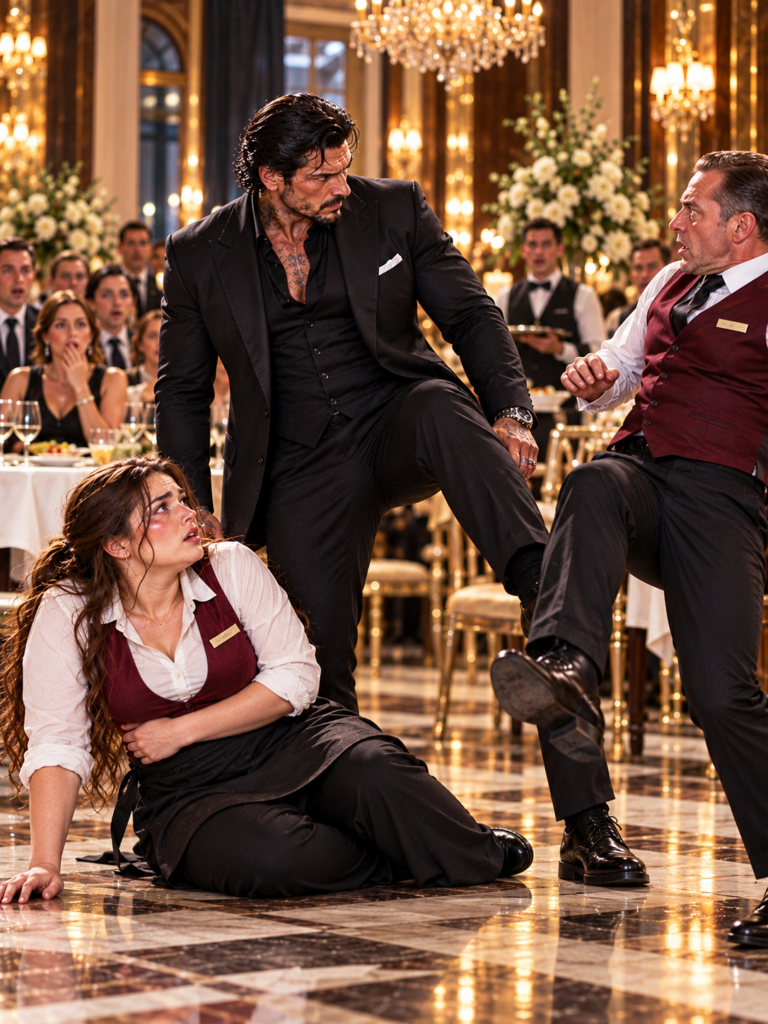
“Please Don’t Kick Me, I’m Already Hurt,” the Curvy Waitress Begged—Then the Most Feared Mafia Boss in the City Stood Up and Changed Her Life Forever
Part 1
“Please… don’t kick me. I’m already hurt.”
The words escaped Jean Lewis’s trembling lips as she knelt on the cold marble floor of one of the most expensive restaurants in the city.
A broken wineglass lay beside her. Red wine soaked into her white blouse, and a sharp pain traveled from her bruised wrist to her shoulder.
Above her stood Richard Hail, a wealthy real estate developer whose reputation was almost as expensive as his suits.
His polished Italian shoe hovered inches from her body.
“You clumsy, useless woman,” he snarled. “Do you have any idea how much this suit costs?”
Jean raised one shaking hand.
“I’m sorry, sir. It was an accident. Please, I have a little boy waiting for me at home. I just need this job.”
Richard looked down at her with disgust.
“Then perhaps you should have thought about that before spilling wine on someone important.”
Fifty wealthy customers watched.
Not one intervened.
Some looked away. Others pretended to study their dinner plates. A woman near the window covered her mouth, but remained seated.
Then, from the darkest booth in the restaurant, came the slow scrape of a chair against marble.
The sound was quiet.
Yet somehow, it silenced the entire room.
A tall man in a perfectly tailored charcoal suit rose from table twelve.
His dark hair was touched with silver at the temples. A faint scar crossed his strong jaw, and intricate tattoos disappeared beneath the cuffs of his expensive shirt.
He moved with the unhurried confidence of someone who had never needed to raise his voice to be obeyed.
Thomas Dinaro.
Forty-three years old.
Billionaire businessman.
And the most feared mafia boss in the city.
When Thomas looked at Richard Hail, the developer’s expression changed.
“Take your foot away from her,” Thomas said.
Richard swallowed.
“Mr. Dinaro, this is just a misunderstanding—”
“Now.”
Richard immediately lowered his foot.
Thomas walked toward him, his dark eyes never leaving the man’s face.
“You were going to kick a woman who was already on the ground?”
Richard tried to laugh.
“She ruined my suit. Surely you understand—”
“No.”
One word.
Cold enough to freeze the room.
Thomas stopped directly in front of Richard.
“I understand accidents. I understand anger. What I don’t understand is why a grown man needs to frighten a defenseless woman to feel powerful.”
Richard’s face reddened.
“Do you know who I am?”
Thomas tilted his head.
“Unfortunately.”
A nervous murmur moved through the restaurant.
Jean remained on her knees, barely able to understand what was happening.
She had heard the name Thomas Dinaro before.
Everyone had.
People whispered about his wealth, his connections, the mysterious disappearances of men who crossed him. His legitimate holdings included luxury hotels, shipping companies, and commercial real estate.
But the city knew there was another empire beneath the polished surface.
An empire built on secrets.
Fear.
And absolute loyalty.
Now that man was standing between her and someone who had almost kicked her.
Thomas turned toward Jean.
The change in his expression was startling.
The coldness disappeared.
He lowered himself onto one knee, ignoring the wine staining his expensive trousers.
“Miss,” he said gently, “may I help you?”
Jean stared at him.
Up close, she noticed things she hadn’t seen from across the restaurant.
The small scar beneath his eyebrow.
The exhaustion hidden behind those dark eyes.
And the surprising warmth in the hand he extended.
For a moment, she couldn’t move.
Then she slowly placed her trembling fingers in his palm.
Thomas helped her stand, careful not to touch her injured wrist.
When her knees buckled, his free hand hovered near her back.
“May I?”
She nodded.
Only then did he steady her.
“Are you hurt?”
Jean shook her head automatically.
It was a familiar lie.
She had been telling people she was fine for years.
Thomas noticed the purple marks forming around her wrist.
His jaw tightened.
“That’s not what your hand says.”
Jean lowered her eyes.
“It’s nothing.”
“No,” Thomas answered quietly. “It isn’t.”
He turned toward Richard.
“Apologize.”
Richard blinked.
“Excuse me?”
“To her.”
“This is ridiculous.”
Thomas took one measured step forward.
Richard took two backward.
“An apology,” Thomas said, “is the only thing I’m asking from you tonight. I suggest you don’t make me reconsider.”
The restaurant went silent again.
Richard’s confidence finally collapsed.
He turned toward Jean.
“I… apologize.”
Thomas didn’t move.
“Try speaking to her like she’s a person.”
Richard swallowed.
“I’m sorry, Miss Lewis. I shouldn’t have grabbed you. I was wrong.”
Jean stood motionless.
No one had ever forced a wealthy customer to apologize to her.
Not once in eleven years of waiting tables.
Thomas looked at her.
“Is that enough for you?”
The question caught her off guard.
He was asking what she wanted.
Jean nodded slowly.
“Yes.”
Thomas turned to the restaurant manager.
“Mr. Vincent, please make sure Miss Lewis receives medical attention. Preserve the security footage. And if Mr. Hail ever returns here, he will not be served.”
Richard opened his mouth.
Thomas looked at him.
The protest died instantly.
Two men who had been sitting quietly near the entrance approached Richard.
Neither touched him.
Neither needed to.
Within seconds, the millionaire was escorted from the restaurant.
Thomas watched him leave.
Then he turned to the room.
“Dinner is on me tonight.”
A few customers exchanged stunned glances.
“But understand something,” he continued. “The people serving your meals are not beneath you. If you cannot treat them with respect, eat somewhere else.”
Nobody laughed.
Nobody argued.
Thomas returned his attention to Jean.
“Get some ice for your wrist. Have a doctor examine it.”
“I can’t afford—”
“I’ll cover it.”
Jean stiffened.
“I don’t need charity, sir.”
Something almost like a smile crossed his face.
“Good. Then consider it compensation for having to work in a room full of cowards.”
For the first time that evening, Jean almost smiled.
Thomas nodded once and walked back to table twelve.
Within minutes, he was eating his steak as though nothing extraordinary had happened.
But Jean knew her life had just changed.
She simply didn’t know how much.
Jean Lewis was thirty-one years old, a single mother, and a woman who had spent most of her adult life being underestimated.
She was curvy, with a full figure, a soft waist, generous hips, and a naturally beautiful face framed by thick chestnut curls.
Her warm brown eyes had once sparkled with confidence.
These days, exhaustion lived behind them.
She wore simple clothes, rarely bought makeup, and kept her hair pinned back during her long restaurant shifts.
Her body had changed after having her son, Marcus, and years of financial stress had done little to improve her confidence.
She wasn’t ashamed of her curves.
But people had taught her that women who looked like her were supposed to be grateful for whatever attention, kindness, or opportunities they received.
Her former boyfriend, Daniel, had made sure she learned that lesson.
Eight years earlier, when Jean told him she was pregnant, he had stared at her expanding waist and said something she had never forgotten.
“You think I’m going to stay with you when you already look like that?”
He disappeared before Marcus was born.
No child support.
No birthday cards.
Not even a phone call.
Jean had raised her son alone ever since.
She cleaned offices in the morning, worked restaurant shifts in the evening, and occasionally helped a local bakery on weekends.
Her apartment was small.
Her bank account was smaller.
And her greatest fear was failing the little boy who believed she could fix anything.
Marcus was eight, with messy dark curls and the kind of bright, curious eyes that made strangers smile.
He thought his mother was beautiful.
He told her so almost every day.
And somehow, those words kept her going.
That Saturday night, after the confrontation with Richard Hail, Jean finished her shift despite Vincent’s nervous insistence that she go home.
She needed the money.
Rent was due in three days.
When midnight arrived, she changed into faded jeans, a thick sweater, and an old brown coat.
Outside, November rain had turned the alley behind Lavella into a cold tunnel of reflected streetlights.
Jean leaned against the brick wall.
For several moments, she simply stood there.
Then the tears came.
Not because of Richard’s insults.
Not because of her bruised wrist.
But because someone had finally looked at her and decided she was worth defending.
“Rough night?”
The deep voice came from behind her.
Jean turned sharply.
Thomas Dinaro stood beneath a flickering streetlamp, his hands tucked into his coat pockets.
He was alone.
That somehow made him more intimidating.
“Mr. Dinaro.”
“Thomas.”
She wiped her cheeks quickly.
“Thank you for what you did.”
“You’ve already thanked me.”
“I know. I just…”
Her voice faded.
Thomas waited.
Finally, she asked the question that had been tormenting her for hours.
“Why?”
His eyes studied her face.
“Why what?”
“Why did you help me? You don’t know me.”
Thomas was quiet.
Then he said, “Actually, Jean, I think I do.”
Her heart skipped.
“How do you know my name?”
“Do you remember Angelo’s Café? On Ninth Street?”
Jean frowned.
“Of course. I worked there years ago.”
“Six years ago, to be exact.”
She studied him cautiously.
“Were you a customer?”
“No.”
He looked toward the distant traffic.
“My mother was.”
Jean felt a strange tightening in her chest.
Thomas continued.
“She used to go there on Thursday mornings. She wore an old gray coat, even when I offered to buy her a new one.”
Jean’s lips parted.
“A gray coat?”
“She always ordered minestrone.”
Suddenly, Jean remembered.
A cold December morning.
An elderly woman sitting alone at the counter.
Thin hands.
Tired eyes.
A handful of coins that wasn’t enough to pay for lunch.
Jean had been struggling financially herself that morning. Marcus had been two, and his daycare bill was overdue.
Still, when she saw the woman counting pennies, she had quietly brought her a bowl of soup and warm bread.
The woman had protested.
Jean had smiled.
“It’s already paid for, ma’am.”
It hadn’t been.
Jean had paid for it herself.
She remembered the woman crying as she ate.
And before leaving, the woman had squeezed Jean’s hand.
“Don’t ever let this world take your kindness away, sweetheart.”
Jean pressed a hand to her mouth.
“Oh my God.”
Thomas’s expression changed.
“That was my mother, Eleanor Dinaro.”
Jean stared at him.
“She was your mother?”
He nodded.
“She was going through the worst period of her life. She’d walked away from my father’s world, and she’d spent months refusing help from anyone connected to us.”
His voice grew quieter.
“She came home the night you fed her.”
Jean listened without moving.
“She told me she’d met a young waitress with a little boy. Said the waitress looked exhausted, but still found a reason to smile at a stranger.”
Thomas looked directly at her.
“She told me you reminded her that there were still good people in the world.”
Tears filled Jean’s eyes.
“I didn’t do anything special.”
“You gave her kindness when she needed it most.”
Thomas looked away.
“She died a week later.”
Jean’s breath caught.
“I’m so sorry.”
“For years, I wanted to find the woman she told me about. I knew her first name, and I knew she had a little boy. But Angelo’s closed soon afterward.”
He paused.
“Three weeks ago, I saw you serving tables at Lavella.”
Jean’s voice was barely audible.
“You recognized me?”
“Not immediately. Then I heard someone call you Jean.”
He gave a faint, sorrowful smile.
“I watched you offer your lunch to a dishwasher who hadn’t eaten all day. That’s when I knew.”
Jean lowered her head.
She didn’t know what to say.
Thomas stepped closer, stopping at a respectful distance.
“My mother spent much of her life surrounded by powerful men. Yet the thing she remembered at the end wasn’t money or influence.”
He looked at her steadily.
“It was a bowl of soup from a waitress who had almost nothing.”
Jean began crying again.
Thomas took a clean handkerchief from his coat.
“May I?”
She accepted it.
For several moments, they stood silently beneath the rain-darkened fire escape.
Then Jean whispered, “You don’t owe me anything.”
“I know.”
“Kindness isn’t supposed to be a transaction.”
A genuine smile touched his face.
“That’s exactly what she’d have said.”
Jean looked up.
And for the first time, she saw the man beneath the reputation.
Not a billionaire.
Not a crime boss.
Just a son who missed his mother.
By Monday morning, the confrontation at Lavella had become an international sensation.
Someone had filmed the entire incident.
The video showed Richard standing over Jean, his foot raised, before Thomas Dinaro emerged from the shadows.
Millions watched it.
News outlets replayed it.
Commentators debated whether Thomas was a monster, a hero, or a criminal seeking positive publicity.
Jean watched it once.
Then she turned off her phone.
Seeing herself on the floor was unbearable.
Her curvy body was awkwardly curled beneath the table, her hair loose around her face, her expression frozen in humiliation.
Strangers criticized everything.
Her appearance.
Her weight.
Her clothes.
Even the way she cried.
One particularly cruel comment read, Of course the mafia boss helped her. Who else would want a woman like that?
Jean deleted the app.
But the attention didn’t disappear.
By Tuesday, reporters were waiting outside her apartment building.
By Wednesday, a tabloid had published photographs of Marcus.
His school.
His name.
His age.
Jean stared at the article in horror.
The headline suggested that her connection to Thomas Dinaro might put her son in danger.
She called the number Thomas had given her.
He answered immediately.
“Jean?”
“They published my son’s picture.”
Thomas became silent.
“They found his school,” she continued, panic rising in her voice. “They know where he goes every day.”
“I’ve seen it.”
“Then do something!”
“I am.”
“How?”
He paused.
“I’ve asked an attorney to contact the publisher. The school has also been alerted.”
Jean squeezed her eyes shut.
“I never asked for this. I never asked to be involved with your world.”
“I know.”
“Marcus is everything to me, Thomas.”
His response came without hesitation.
“Then he’s my first concern.”
Jean went silent.
Nobody had ever said anything like that to her.
Not about Marcus.
Not about her.
That afternoon, a woman named Nora Voss arrived at Jean’s apartment.
She was a sharply dressed attorney in her forties, with intelligent eyes and a calm, direct manner.
“Mr. Dinaro asked me to help you protect your privacy,” she explained.
Jean crossed her arms.
“I’m not signing anything I don’t understand.”
Nora smiled.
“Good. You shouldn’t.”
For two hours, the attorney explained Jean’s options concerning the photographs, the threatening messages, and the restaurant’s security footage.
Jean was impressed despite herself.
Nora treated her like an intelligent woman capable of making her own decisions.
Before leaving, the attorney handed her a sealed envelope.
“Mr. Dinaro would also like to meet you tomorrow evening.”
Jean frowned.
“Why?”
“He has a business proposal.”
Lavella was closed when Jean arrived.
Only the chandeliers above the dining room were illuminated.
Thomas sat at table twelve, wearing a black shirt beneath his charcoal jacket.
Two cups of coffee waited on the white tablecloth.
He rose when she approached.
“Thank you for coming.”
Jean remained standing.
“I have forty minutes. My neighbor is watching Marcus.”
“Then I’ll be brief.”
She sat opposite him.
Thomas folded his hands.
“The owner of Lavella is retiring. His children don’t want the business, and the property is being offered for sale.”
Jean stared at him.
“Okay?”
“I’m buying it.”
She glanced around the empty restaurant.
“Congratulations.”
“And I want you to run it.”
Silence.
Jean blinked.
Then she laughed.
He didn’t.
“You’re serious?”
“Completely.”
“Thomas, I’m a waitress.”
“You’ve worked in restaurants for more than a decade.”
“That doesn’t make me qualified to own one.”
“No. But it gives you knowledge that most owners never develop.”
He leaned forward.
“You know what employees need because you’ve been one. You know what customers value. You understand the difference between hospitality and humiliation.”
Jean shook her head.
“You can’t give me a restaurant because I gave your mother soup.”
“I’m not giving you one.”
He slid a folder across the table.
Inside were preliminary business plans, financing arrangements, training proposals, and an outline of a partnership that would eventually give Jean full operational control.
“You’d spend three months learning management, procurement, payroll, and financial planning. You’ll have professional advisers, but every major decision will require your approval.”
Jean turned another page.
“What do you get?”
“A return on my investment, if the business succeeds.”
“And if it fails?”
“Then I’ve made a poor investment.”
Jean gave him a skeptical look.
“Men like you don’t become rich by making decisions based on sentiment.”
“No,” Thomas admitted. “But men like me can spend an entire lifetime becoming rich and still realize we’ve built nothing worth leaving behind.”
His voice softened.
“My mother wanted me to create something decent.”
Jean looked around the room.
She remembered the marble floor.
The humiliation.
The people who had watched and done nothing.
“What kind of restaurant?” she asked.
“That’s your decision.”
Jean considered it.
“What if I wanted to change everything?”
“Then change everything.”
“No more employees depending entirely on tips to survive.”
Thomas nodded.
“No problem.”
“Proper wages. Health insurance. Paid sick leave.”
“Fine.”
“And if a rich customer harasses a waitress, that customer leaves. It doesn’t matter how much money he has.”
A faint smile appeared on Thomas’s face.
“I rather like that rule.”
Jean leaned back.
Her heart pounded.
For years, she’d dreamed of owning a small restaurant.
A warm place where struggling families could eat without shame.
Where tired workers were treated with dignity.
Where nobody had to kneel on the floor and beg for mercy.
But this?
This was impossible.
“What would we call it?” she asked quietly.
Thomas hesitated.
Then he reached into his jacket and placed a small photograph on the table.
It showed an elderly woman standing outside a modest café.
She wore a gray coat.
Her smile was unmistakable.
Jean felt tears sting her eyes.
“Eleanor’s Table,” Thomas said.
Jean looked at the photograph for a long time.
Then she looked at him.
“I have conditions.”
“Name them.”
“Marcus comes first. Always. If your world puts him in danger, we’re done.”
“Agreed.”
“I have real authority. Not pretend authority.”
“Agreed.”
“And I want everything documented by an independent attorney. No hidden ownership arrangements. No illegal money. No employees with secret obligations to you.”
Thomas was quiet.
Then he nodded.
“You’ll have full access to the books. Nora can recommend independent counsel, or you can choose someone yourself.”
Jean studied him carefully.
“And you don’t get to make decisions about my life simply because you’re paying for the restaurant.”
For the first time, Thomas looked almost amused.
“I suspect I’d have a difficult time trying.”
Jean smiled.
It was small.
But real.
“I’ll think about it.”
Thomas stood when she did.
At the entrance, she paused.
“Why do I feel like saying yes to you could ruin my life?”
His expression grew serious.
“Because being associated with me carries risks. I won’t lie to you about that.”
“And you still want me involved?”
“I want you to have a choice.”
Jean looked at him for several seconds.
Then she walked out into the cold evening.
At home, Marcus sat at the kitchen table building a small spaceship from plastic blocks.
“Mom!”
He jumped up and hugged her around the waist.
Jean bent to kiss his forehead.
“Hey, baby.”
“Mrs. Garcia says you’re famous!”
Jean groaned softly.
“Is that so?”
“She says a really scary man helped you.”
Jean paused.
Marcus looked up.
“Was he scary?”
She thought of Thomas kneeling on the marble floor.
Of his scarred hand offered without hesitation.
Of the photograph of his mother.
“A little,” she admitted.
“Was he nice to you?”
Jean smiled.
“Yes, sweetheart.”
Marcus nodded, satisfied.
“Then maybe he’s not that scary.”
Later, after Marcus fell asleep, Jean sat beside his bed.
She thought about the woman she had been before Daniel abandoned her.
The young mother who had once dreamed of opening a neighborhood café.
The woman who had believed she could build something wonderful.
Somewhere along the way, survival had replaced ambition.
Perhaps Thomas was offering her more than a restaurant.
Perhaps he was offering her a chance to become that woman again.
The next morning, Jean called him.
“I’ll do it.”
Thomas was silent for a moment.
Then she heard him exhale.
“Welcome to Eleanor’s Table, Jean.”
Before she could answer, her phone vibrated with another notification.
An unfamiliar number had sent her a photograph.
Marcus.
Standing outside his school.
Taken that morning.
Beneath the image was a message.
The mafia boss can protect you inside his restaurant.
But can he protect your son everywhere else?
Jean’s blood turned cold.
And for the first time, she understood that accepting Thomas Dinaro’s offer hadn’t simply changed her future.
It had made her part of a war she knew nothing about.
Part 2
The first thing Thomas Dinaro did after seeing the photograph of Marcus was become completely still.
Jean had expected anger.
Perhaps shouting.
Perhaps threats.
Instead, Thomas studied the photograph on her phone, his face turning so expressionless that she felt the temperature in the room drop.
“Who sent this?” he asked.
“I don’t know.”
“Has Marcus left school?”
“No. He’s still there.”
Thomas reached for his phone.
“Marco. I need you at Westbridge Elementary. Coordinate with the principal. No one approaches the boy without his mother’s authorization.”
Jean grabbed his arm.
“Wait.”
He looked down at her hand.
She released him immediately.
“I don’t want armed men frightening my son.”
“Neither do I.”
“Then don’t turn his school into some kind of military operation.”
Thomas studied her.
“You’re right.”
Jean blinked.
“What?”
“Your son needs to feel safe, not watched. We’ll work with the school and its existing security procedures.”
He put his phone away.
“Would you like to speak to the principal yourself?”
Jean nodded.
Together, they contacted the school.
Marcus was safe.
The principal confirmed that someone had been photographing children near the entrance, and that security footage would be reviewed.
For the first time since receiving the message, Jean could breathe.
Thomas waited until she finished speaking before saying anything else.
“You need to know something.”
Jean looked at him.
“People have noticed that I’m changing the way I run my businesses. Some of them dislike it.”
“What people?”
“Men who benefited from the old arrangements.”
Jean folded her arms.
“Are you telling me someone threatened my child because you’re opening a restaurant?”
“Not because of the restaurant.”
“Then why?”
“Because of what it represents.”
Thomas paused.
“My father believed fear was the only form of loyalty that mattered. Some men still agree with him. They see Eleanor’s Table as proof I’m abandoning what he built.”
Jean stared at him.
“And they’re willing to threaten an eight-year-old over that?”
His expression darkened.
“They’re willing to do worse.”
Jean stood.
“Then maybe this is a mistake.”
Thomas didn’t argue.
He simply said, “If you walk away, I’ll understand. But the threat against Marcus needs to be addressed either way.”
Jean looked toward the window.
Outside, the city moved without concern for her terror.
Cars passed.
People hurried to work.
Parents walked children to school.
Ordinary life continued.
She wanted to return to that life.
But she remembered Richard Hail.
The way he’d raised his foot.
The way fifty people had allowed it.
And suddenly she understood something.
She could spend the rest of her life hiding from powerful men.
Or she could learn how to stop being afraid of them.
Jean turned back.
“I’m not quitting.”
Thomas regarded her silently.
“But we do this my way,” she continued. “No threats in my name. No treating Marcus like property. If you’re serious about building something good, then start acting like it.”
For a moment, Thomas said nothing.
Then an unfamiliar expression crossed his face.
Admiration.
“Understood.”
Three months later, Eleanor’s Table was beginning to take shape.
The old Lavella had disappeared behind renovation barriers.
Gone were the cold marble floors and intimidating chandeliers.
Jean had chosen warm wooden flooring, exposed brick, soft amber lighting, and comfortable burgundy booths.
The open kitchen allowed diners to see the cooks preparing their meals.
A large wooden board near the entrance would let customers purchase meals for people who couldn’t afford them.
Jean called it the Kindness Board.
Thomas had suggested something more elegant.
Jean had rejected it immediately.
“People don’t need elegant kindness,” she’d told him. “They need kindness they can understand.”
He hadn’t argued.
In fact, he rarely argued about the restaurant.
Jean was learning faster than anyone expected.
She spent mornings studying inventory management and payroll.
Afternoons were devoted to staff interviews.
Evenings often found her sitting at the unfinished bar, surrounded by supplier proposals and budget sheets.
She had hired thirty employees, including several single parents, former foster children, and workers who had been dismissed from other restaurants after challenging abusive managers.
One of them was a twenty-three-year-old waitress named Sophia Bennett.
Sophia had spent six months homeless after escaping a violent relationship.
During her interview, her hands shook so badly that she spilled coffee onto the table.
She immediately apologized.
Jean handed her a napkin.
“It’s coffee, sweetheart. Not a crime.”
Sophia looked stunned.
Jean smiled.
“Can you show up on time? Work hard? Treat people well?”
“Yes, ma’am.”
“Then we’ll teach you the rest.”
Sophia began crying.
Jean hired her that afternoon.
When Thomas visited later, he found Jean reviewing another stack of applications.
“You hired six people today,” he observed.
“Seven.”
“Seven?”
“One was a dishwasher.”
Thomas raised an eyebrow.
“How’s the budget?”
“Healthy, according to the accountant you insisted I hire.”
“I insisted you hire an accountant. You chose which one.”
Jean smiled.
“You’re learning.”
He leaned against the bar.
Thomas had taken to visiting every Thursday.
Always in a dark suit.
Always with that quiet, commanding presence.
He never seemed entirely comfortable in the cheerful chaos of the renovation.
But he came anyway.
Sometimes he brought coffee.
Sometimes dinner.
Once, when Jean mentioned that Marcus loved astronomy, Thomas arrived with an expensive telescope.
Jean immediately refused it.
“He’s eight, Thomas.”
“He likes stars.”
“He also likes dinosaurs. Are you planning to buy him a museum?”
Thomas considered that.
Jean pointed a finger at him.
“Don’t.”
He laughed.
It was the first time she’d heard him laugh properly.
The sound startled her.
And, embarrassingly, made her stomach flutter.
Jean didn’t know when she began looking forward to his visits.
Perhaps it happened the afternoon he arrived with takeout after discovering she’d forgotten lunch.
Or the night he stayed until midnight helping her compare kitchen equipment prices.
Or the rainy Thursday when Marcus came to the restaurant and spent an hour explaining the solar system to a man who controlled millions of dollars in investments.
Thomas listened to every word.
When Marcus asked him whether black holes were dangerous, Thomas answered with the seriousness of a professor.
“Very dangerous.”
Marcus nodded thoughtfully.
“Like you?”
Jean froze.
Thomas turned toward the boy.
“Who told you I was dangerous?”
“Kids at school.”
Jean felt sick.
But Thomas didn’t seem angry.
He knelt beside Marcus.
“Some people have reasons to be afraid of me.”
Marcus studied him.
“Should my mom be afraid?”
Thomas looked across the room at Jean.
“No,” he said quietly. “Your mother should never have to be afraid of me.”
Marcus considered the answer.
Then he held out a plastic dinosaur.
“Okay. You can borrow my T. rex.”
Thomas accepted it with both hands.
“An honor.”
Jean turned away before either of them could see her smile.
That evening, she found the dinosaur sitting on Thomas’s desk beside an antique fountain pen.
He had taken it home.
One Friday, Thomas invited Jean to a charity gala at the Grand Belmont Hotel.
She refused immediately.
“I don’t belong at galas.”
“Why not?”
“Because my evening wardrobe consists of work trousers and three dresses from a discount store.”
“I can arrange—”
“No.”
Thomas stopped.
Jean sighed.
“I’m not interested in becoming someone’s Cinderella project.”
He studied her.
“Jean, I’m inviting you because I enjoy your company. Not because I think you need to be transformed.”
Her heart gave an unexpected thump.
“Your company?”
“Yes.”
“Just my company?”
His eyes held hers.
“Would you prefer me to admit that I also find you beautiful?”
Jean’s cheeks burned.
For once, she had absolutely nothing to say.
Thomas smiled slightly.
“Friday. Seven o’clock. You can say no.”
He left before she could recover.
Jean stood alone in the office, staring at the doorway.
Beautiful.
He had called her beautiful.
Not brave.
Not kind.
Not hardworking.
Beautiful.
It had been years since a man had said that without immediately making her feel he expected something in return.
On Friday evening, Jean stood in front of her bedroom mirror wearing a midnight-blue velvet gown.
She had bought it herself.
The dress embraced her curvy figure beautifully, with a fitted waist, a graceful neckline, and fabric that flowed over her full hips.
Her chestnut curls fell in soft waves over her shoulders.
For the first time in years, she had put on red lipstick.
Marcus sat on her bed, watching.
“Mom?”
“Yes, baby?”
“You look like a queen.”
Jean laughed.
“A queen?”
“Yeah. A pretty one.”
She bent down and kissed his cheek.
“Thank you, Your Majesty.”
When Thomas arrived, Jean opened the door herself.
He stopped.
Actually stopped.
His eyes traveled from her softly curled hair to her face, then back to her eyes.
For several seconds, he didn’t speak.
Jean shifted nervously.
“Is something wrong?”
“No.”
His voice sounded different.
Rougher.
“Nothing is wrong.”
She glanced down.
“It’s a little more fitted than what I usually wear.”
“Jean.”
She looked up.
“You are breathtaking.”
Her throat tightened.
He held out a small velvet box.
Jean narrowed her eyes.
“Thomas.”
“Before you say no, it’s borrowed jewelry. From my mother’s collection.”
Inside lay a delicate silver necklace with a single sapphire pendant.
Jean stared at it.
“I can’t wear your mother’s necklace.”
“She would have loved seeing it on you.”
Jean’s eyes softened.
Finally, she nodded.
Thomas stepped behind her.
“May I?”
She lifted her hair.
His fingers brushed the back of her neck as he fastened the necklace.
The contact lasted barely a second.
Yet Jean felt it everywhere.
When their eyes met in the mirror, something silent and dangerous passed between them.
Thomas was the first to step away.
“Ready?”
Jean swallowed.
“As I’ll ever be.”
The ballroom at the Grand Belmont glittered with crystal chandeliers and expensive jewelry.
Politicians, celebrities, and business executives mingled around tables decorated with white roses.
Jean felt every curious glance.
People recognized Thomas immediately.
Conversations stopped as he entered.
And then the attention shifted toward her.
A curvy woman in a blue velvet gown walking beside the city’s most feared man.
The whispers began.
“Isn’t that the waitress?”
“The one from the video?”
“I thought she was just some charity case.”
Jean kept her shoulders straight.
Thomas noticed her discomfort.
“You want to leave?”
“No.”
“Good.”
He offered his arm.
“Then let’s disappoint everyone who’s waiting for you to run.”
Jean slipped her hand through his elbow.
Together, they crossed the ballroom.
For the first time in her life, she didn’t lower her eyes when wealthy strangers stared.
Thomas introduced her to investors, chefs, philanthropists, and hotel executives.
Not once did he call her his employee.
Instead, he said the same thing each time.
“This is Jean Lewis, the owner and managing director of Eleanor’s Table.”
Some people seemed impressed.
Others looked confused.
Then Richard Hail appeared.
He stood near the champagne fountain, holding a glass of whiskey.
The instant he recognized Jean, his face hardened.
“Well, well,” Richard said loudly. “Look who moved up in the world.”
Jean stopped.
Thomas became still beside her.
Richard’s eyes swept over her dress.
“A little velvet and expensive jewelry. Amazing what the right man’s money can do.”
Jean felt the old shame begin rising.
Richard smiled.
“Tell me, Miss Lewis, are you still serving tables? Or does Mr. Dinaro have you performing more personal services now?”
Several people gasped.
Jean’s fingers tightened around Thomas’s arm.
She felt him preparing to move.
But before he could speak, Jean stepped forward.
“No, Mr. Hail.”
Richard blinked.
She smiled politely.
“I own a restaurant now.”
He laughed.
“Because your boyfriend bought it for you?”
“Because someone recognized my qualifications instead of treating me like dirt.”
The surrounding conversations faded.
Jean continued.
“I’m building a place where customers are expected to behave like decent human beings. You probably wouldn’t enjoy it.”
Someone nearby coughed to hide a laugh.
Richard’s face reddened.
“You arrogant little—”
Thomas took one step forward.
“Finish that sentence carefully.”
Richard stiffened.
Thomas’s voice remained quiet.
“You humiliated her once. You won’t do it again.”
Jean turned toward him.
“I can handle this.”
Thomas looked at her.
Then, slowly, he stepped back.
The gesture was almost invisible.
But Jean understood what it meant.
He trusted her.
She faced Richard again.
“Mr. Hail, when you grabbed me that night, you thought nobody important would care. You were wrong.”
Richard looked around at the watching guests.
Jean lifted her chin.
“And for the record, I was important before Thomas Dinaro ever learned my name.”
A woman near the champagne fountain began clapping.
Another joined.
Within seconds, a ripple of applause spread through the small crowd.
Richard’s face turned purple.
Thomas looked at Jean with unmistakable pride.
And when Richard stormed away, Thomas leaned closer.
“That,” he murmured, “was magnificent.”
Jean smiled.
“I learned from watching someone rather frightening.”
“I hope you’re not referring to me.”
“Oh, definitely you.”
Thomas laughed softly.
Then he offered her his hand.
“Dance with me?”
Jean looked toward the ballroom floor.
“I haven’t danced in years.”
“Neither have I.”
“You’re lying.”
“Terribly.”
She placed her hand in his.
And under the glittering chandeliers, the curvy waitress who had once begged for mercy in front of strangers danced in the arms of the most powerful man in the city.
He held her carefully.
Not as though she were fragile.
But as though being allowed to hold her was a privilege.
When the music slowed, Jean became aware of his hand resting at her waist.
His touch was warm.
Steady.
Respectful.
“You don’t have to be afraid of being seen,” he whispered.
Jean looked up.
“I’m not afraid of being seen.”
“Then what frightens you?”
She hesitated.
“Being seen clearly… and still not being enough.”
Thomas’s expression softened.
“Jean.”
His voice was almost unbearably gentle.
“You were enough long before you walked into this ballroom.”
For one suspended moment, she thought he might kiss her.
She wanted him to.
But the music ended.
Thomas released her hand.
And the moment passed.
Across the ballroom, another man had watched the entire exchange.
Luca Moretti.
Forty years old.
Ambitious.
Ruthless.
And once Thomas Dinaro’s closest lieutenant.
Luca had inherited his position from a father who’d served the Dinaro family for decades.
He believed loyalty was a form of ownership.
And he believed Thomas’s empire should remain exactly what it had always been.
When Richard Hail approached him, Luca was standing beside the terrace doors.
“She’s humiliating me,” Richard hissed.
Luca watched Jean laugh at something Thomas said.
“No,” he replied. “She’s making him weak.”
Richard swallowed his drink.
“What do you want me to do?”
Luca’s smile was cold.
“Nothing yet.”
He adjusted his cufflinks.
“We need to understand just how much she means to him.”
Two weeks after the gala, Jean received a visitor at Eleanor’s Table.
A beautiful woman named Celeste Caruso.
Tall, elegant, and impeccably dressed, Celeste had the effortless confidence of someone raised among private jets and family fortunes.
Jean recognized her immediately.
Years earlier, society magazines had described Celeste as Thomas Dinaro’s future wife.
The engagement had never happened.
But the rumors had never disappeared.
Celeste looked around the unfinished restaurant.
“So this is what Thomas has been spending his time on.”
Jean offered a professional smile.
“Can I help you?”
Celeste’s gaze swept over her curvy figure.
“You must be Jean.”
“Yes.”
“Of course.”
The other woman smiled thinly.
“I’ve known Thomas since we were children. He’s always had a weakness for unusual projects.”
Jean felt the intended insult.
But she kept her expression neutral.
“Eleanor’s Table is a legitimate business, Ms. Caruso.”
“How sweet.”
Celeste stepped closer.
“Let me give you some advice. Men like Thomas don’t marry women from your world. They protect them. They spoil them. Sometimes they even fall in love with them.”
She paused.
“But in the end, they marry women who understand the rules.”
Jean looked directly at her.
“Then it’s fortunate I’m not interviewing for the position of his wife.”
Celeste’s smile faltered.
Jean picked up her clipboard.
“Now, if you’ll excuse me, I have a restaurant to finish.”
Celeste departed without another word.
But her warning lingered.
That evening, when Thomas arrived, Jean was quieter than usual.
He noticed immediately.
“Something happened.”
“No.”
“Jean.”
She sighed.
“Celeste Caruso came by.”
His expression darkened.
“What did she say?”
“Nothing I haven’t heard before.”
Thomas was silent.
Jean set down her pen.
“Were you going to marry her?”
“No.”
“Did you love her?”
“No.”
“Then why did everyone think you would?”
“Because my father wanted an alliance with her family.”
Jean studied him.
“And what did you want?”
Thomas looked toward the unfinished dining room.
“At the time? I wanted to survive my father without becoming him.”
Jean’s anger softened.
Thomas continued.
“Celeste was never my choice. And I was never hers.”
“But you belong to the same world.”
“Yes.”
“And I don’t.”
He turned toward her.
“Is that what she told you?”
Jean looked away.
“Something like that.”
Thomas approached slowly.
“Jean, you think I want a woman who knows which fork to use at a state dinner?”
Despite herself, she smiled.
“Don’t you?”
“No.”
He stopped close enough that she could smell his cologne.
“I want a woman who isn’t afraid to tell me when I’m wrong.”
Her heart pounded.
“A woman who cares more about feeding hungry people than impressing rich ones.”
He lifted his hand, then paused.
“May I?”
Jean nodded.
His fingers gently moved a loose curl away from her cheek.
“A woman who sees someone broken and thinks about how to help instead of what she can gain.”
Jean’s eyes filled.
“Thomas…”
“I’ve spent most of my life surrounded by people who wanted something from me.”
His voice dropped.
“You’re the first person in years who’s asked me to become someone better.”
Jean looked at him.
The distance between them felt impossibly small.
But then Thomas stepped away.
“Good night, Jean.”
He turned toward the door.
“Why do you always do that?” she asked.
He stopped.
“Do what?”
“Walk away whenever things become…”
She searched for the word.
“Personal.”
Thomas looked at her.
For the first time, his composure seemed to crack.
“Because I know what my world can do to someone I love.”
Silence filled the room.
Jean’s breath caught.
Thomas seemed to realize what he’d said.
He looked away.
“Good night.”
And then he was gone.
The following Thursday, Jean found Thomas alone at table twelve.
The restaurant was nearly finished.
Rain traced silver lines down the windows.
He sat with an old photograph in his hands.
Jean approached quietly.
“Your mother?”
Thomas nodded.
Jean sat opposite him.
“She looks happy.”
“She was. That was before my father took everything decent out of our lives.”
Jean waited.
Thomas rarely spoke about his childhood.
“My father believed love was a weakness,” he said. “He used people. Controlled them. Threatened anyone who disagreed.”
His fingers tightened around the photograph.
“When I was seventeen, my mother told me that power without mercy was nothing but cruelty.”
Jean listened.
“I promised her I’d remember.”
Thomas gave a bitter smile.
“Then I spent years doing exactly what my father taught me.”
“You were young.”
“I stopped being young a long time ago.”
Jean reached across the table.
Her fingers covered his.
Thomas looked down at their joined hands.
“I’ve hurt people, Jean.”
“I know.”
“I’ve made decisions I regret.”
“I know.”
“Then why are you still here?”
Jean considered the question.
“Because I don’t think a person’s worst decisions have to be the last decisions they make.”
Thomas closed his eyes.
For a moment, he looked almost overwhelmed.
Then he turned his hand beneath hers, their fingers intertwining.
“I don’t deserve the way you look at me.”
Jean shook her head.
“Don’t decide that for me.”
He looked up.
She smiled faintly.
“I’m a grown woman, Thomas. I can make my own choices.”
Something changed in his expression.
He lifted her hand and pressed a gentle kiss against her knuckles.
Jean’s breath caught.
Outside, thunder rolled over the city.
Inside, neither moved away.
Finally, Thomas whispered, “If I kiss you, I’m not sure I’ll be able to pretend this is only business anymore.”
Jean’s heart hammered.
“Then don’t pretend.”
He searched her eyes.
“Are you certain?”
Jean leaned closer.
“Yes.”
Thomas kissed her.
Slowly.
Tenderly.
Nothing like the dangerous man the city feared.
His hand rose to her cheek while hers rested against his chest.
And when he finally pulled back, his forehead rested gently against hers.
“I’ve wanted to do that for months,” he admitted.
Jean laughed softly.
“You’re a very patient man.”
“Not usually.”
“Then I must be special.”
Thomas looked into her eyes.
“You have no idea.”
For the first time in years, Jean allowed herself to imagine being loved.
Not despite her curves.
Not because a powerful man wanted to rescue her.
But because someone had seen her heart and wanted to stand beside it.
The happiness lasted eleven days.
Then Jean discovered the first irregularity.
She was reviewing supplier invoices when she noticed that one construction company had charged for equipment that had never arrived.
The company’s name was Hail Commercial Services.
Jean frowned.
Richard Hail.
She checked the original contract.
The supplier had been approved before she took control of the renovation.
Its paperwork carried Vincent’s signature.
The former Lavella manager.
Jean felt a knot form in her stomach.
She called the accountant.
“Can you review these invoices?”
“Of course. Is something wrong?”
“I think someone is using the restaurant to move money that doesn’t belong here.”
An hour later, the accountant called back.
“Jean, you need to speak with your attorney.”
Nora arrived that afternoon.
Together, they reviewed the documents.
Several invoices appeared to have been altered.
A security subcontractor had been paid without authorization.
And someone had tried to obtain copies of employee records.
Nora’s expression grew increasingly serious.
“Jean, this may be more than sloppy bookkeeping.”
Jean looked up.
“Richard?”
“Possibly. But someone inside the project gave him access.”
Jean immediately thought of Vincent.
She remembered how he’d smiled when Richard grabbed her wrist.
How he’d stood behind the bar, doing nothing.
How quickly he’d changed his attitude when Thomas intervened.
Jean felt cold.
That evening, she confronted Thomas.
He listened without interrupting.
When she finished, he said one name.
“Luca.”
Jean frowned.
“Who?”
“Luca Moretti. He oversees several investments connected to Richard Hail.”
“Why would he care about my restaurant?”
Thomas looked grim.
“Because I’ve been removing his influence from my businesses.”
Jean stood.
“Thomas, did you know Richard had connections to this project?”
“I knew he had business dealings with Luca. I didn’t know about these invoices.”
“But you knew there was a possibility.”
Thomas didn’t answer quickly enough.
Jean’s eyes filled with anger.
“You promised me this restaurant would be clean.”
“It is.”
“Then why am I finding suspicious invoices in my office?”
“Because someone wants to undermine it.”
“And you didn’t warn me?”
“I didn’t have proof.”
Jean shook her head.
“You keep deciding which dangers I need to know about.”
Thomas stood.
“I was trying to protect you.”
“By keeping me ignorant?”
His face tightened.
“Jean—”
“No.”
She stepped back.
“I spent eight years being told I couldn’t handle things on my own. Daniel decided I wasn’t worth staying for. My managers decided I wasn’t worth defending. And now you’re deciding I can’t handle the truth.”
Thomas looked stricken.
“That’s not what I think.”
“Then stop treating me like it is.”
Silence.
Jean took a breath.
“I love what we’re building here. And I care about you more than I ever expected.”
Thomas’s eyes lifted.
“But I won’t become another person who has to obey you just because you’re powerful.”
His expression changed.
“Jean, I’ve never wanted your obedience.”
“Then prove it.”
He stepped closer.
“What do you need?”
“The truth. All of it.”
Thomas held her gaze for a long moment.
Then he nodded.
“Luca Moretti believes my family owes him power. Richard Hail owes Luca money. And both of them are angry that I’m moving legitimate businesses away from their influence.”
Jean felt her stomach drop.
“How far will they go?”
“I don’t know.”
“That’s not good enough.”
“I know.”
Thomas reached toward her.
She stepped away.
The rejection hurt them both.
“I need space,” Jean whispered.
He lowered his hand.
“Take whatever you need.”
Then he left.
On a bitter Tuesday night in March, Jean stayed late to review the final menu before the restaurant’s planned opening.
Marcus was spending the evening with Mrs. Garcia at a temporary apartment Thomas had arranged after the threats.
Jean had argued about the apartment initially.
But she had eventually agreed that her son deserved a safe place to sleep.
The restaurant was quiet.
Only her office lamp remained on.
She had just finished comparing soup recipes when she heard something shatter.
Jean froze.
Glass.
From the dining room.
She reached for her phone.
Then footsteps sounded in the corridor.
Three men entered her office.
The leader had a pale scar cutting through his left eyebrow.
“Jean Lewis,” he said pleasantly.
She stepped backward.
“Who are you?”
“Grady Cross.”
The name meant nothing to her.
But the man’s smile made her skin crawl.
“We’ve been waiting to meet you.”
Jean glanced toward the panic button beneath her desk.
“What do you want?”
“To remind Thomas Dinaro of something.”
Grady moved closer.
“Men like him don’t get to abandon their obligations because they’ve fallen in love.”
Jean’s heart slammed against her ribs.
“I don’t know anything about his business.”
“Oh, sweetheart.”
Grady smiled.
“You’re the reason his business is changing.”
One of the other men searched her desk.
Another examined the cabinet containing supplier records.
Jean realized with sudden clarity what they wanted.
The invoices.
The evidence Nora had helped her gather.
“You’re working for Luca,” she said.
Grady’s smile disappeared.
“Careful.”
Jean forced herself to keep speaking.
“If those documents mean so much to you, perhaps you should have used an accountant who knew how to forge an invoice properly.”
One of the men laughed.
Grady didn’t.
He stepped closer.
“You think being Dinaro’s favorite makes you untouchable?”
Jean backed toward the desk.
“No.”
Her fingers found the panic button.
She pressed it.
“I think threatening a woman in an empty restaurant makes you a coward.”
Grady’s face hardened.
He grabbed her arm.
Jean cried out.
The old terror rushed back.
Richard’s hand around her wrist.
The marble floor.
The raised shoe.
But this time, Jean refused to collapse.
She drove her elbow backward and pulled free.
Grady stumbled.
“You little—”
A deafening crash interrupted him.
The side window shattered.
Thomas Dinaro appeared through the broken opening with blood spreading across his shoulder.
“Get away from her.”
His voice was terrifyingly calm.
The three intruders froze.
Thomas held a handgun pointed toward the floor, ready but controlled.
Two security officers arrived seconds later through the damaged entrance.
Grady looked between them.
Then he smiled.
“You really have gone soft, Dinaro.”
Thomas’s eyes narrowed.
“You threatened her.”
“Luca says you aren’t the man you used to be.”
“No,” Thomas answered. “I’m not.”
He stepped forward.
“The man I used to be would have made you regret being born before asking why you were here.”
Grady’s smile vanished.
Thomas looked toward the security officers.
“Secure the room. The police are already on their way.”
Grady laughed bitterly.
“You’re calling the police now?”
“Yes.”
Thomas’s expression never changed.
“I’m tired of solving every problem with another crime.”
One of the intruders tried to flee.
The security officers intercepted him.
Grady realized there was no escape.
When the police arrived, Thomas lowered his weapon and followed their instructions.
Jean stood against the wall, trembling.
Only when the immediate danger had passed did she notice the blood on his jacket.
“Thomas?”
He turned.
She rushed toward him.
“Your shoulder!”
“It’s a graze.”
“You’re bleeding!”
“Jean—”
“You could have died!”
Her voice broke.
Thomas looked at her.
“So could you.”
Jean pressed a clean towel against his wound while a paramedic hurried inside.
She was furious.
Terrified.
And desperately relieved.
Thomas covered her hand gently.
“I’m here.”
Jean looked into his eyes.
For a moment, the room seemed to disappear.
“I thought I was going to lose you,” she whispered.
Thomas’s expression softened.
“You haven’t.”
She shook her head.
“You don’t understand. I spent so many years being afraid of needing someone. And now…”
Her voice cracked.
Thomas drew her carefully into his uninjured arm.
Jean rested her face against his chest.
He held her without speaking.
Then she whispered the words that had started everything.
“Please don’t hurt me. I’m already hurt.”
Thomas went still.
Jean looked up at him.
“Not physically. I mean… I’ve been hurt before. By people who promised to stay. By people who made me feel like loving someone was a mistake.”
His eyes filled with emotion.
“Jean…”
“I can’t survive loving someone who keeps shutting me out.”
Thomas closed his eyes.
Then he kissed her forehead.
“I don’t want to be another wound in your life.”
“Then let me stand beside you.”
He nodded.
“No more secrets.”
For one beautiful moment, Jean believed they might finally find their way through the darkness together.
Then her phone rang.
Mrs. Garcia.
Jean answered immediately.
“Hello?”
The older woman’s voice was shaking.
“Jean, sweetheart, I’m so sorry.”
Jean’s blood ran cold.
“What happened?”
“A man came to the apartment. He said he worked with Thomas. He knew Marcus’s name. He knew about the restaurant.”
Jean gripped the phone.
“Where’s Marcus?”
Mrs. Garcia began crying.
“He took him.”
The room tilted.
Jean barely heard Thomas asking what was wrong.
Then another voice came through the phone.
A man’s voice.
Smooth.
Amused.
Luca Moretti.
“Good evening, Jean.”
She stopped breathing.
“Where is my son?”
“Safe. For now.”
Thomas took one step closer.
Luca continued.
“Tell Thomas that his little experiment in becoming a good man is over.”
Jean could barely speak.
“If you hurt Marcus—”
“Then convince your boyfriend to remember who he is.”
The line went silent for a moment.
Then Luca delivered his final message.
“Come to the old Dinaro warehouse before midnight. Bring the original records from Eleanor’s Table.”
Jean’s fingers went numb.
“And Jean?”
She closed her eyes.
“Don’t make Thomas choose between his empire and your little boy.”
The call ended.
Jean looked at Thomas.
His face had gone white.
And for the first time since meeting him, she saw something in his eyes that frightened her more than anger.
Helplessness.
Because the one person he had promised to protect above all others was now in the hands of his greatest enemy.
Part 3
For three seconds, Jean Lewis couldn’t move.
Her phone slipped from her fingers and struck the restaurant floor.
Marcus was gone.
Her little boy.
The child who slept with a stuffed dinosaur beneath his arm.
The boy who still believed his mother could make everything better.
Someone had taken him.
“Jean.”
Thomas’s voice sounded far away.
She shook her head.
“No.”
He caught her before her knees gave out.
“Look at me.”
“No, no, no…”
“Jean, listen to me.”
Her tear-filled eyes found his.
“We’re going to bring Marcus home.”
She gripped his jacket.
“You promised me!”
The accusation hit him harder than the bullet wound.
“You promised he’d be safe!”
Thomas didn’t defend himself.
“I know.”
Jean began sobbing.
“He’s only eight, Thomas. He doesn’t understand any of this. He doesn’t even understand why people are afraid of you.”
Thomas pulled her close.
“I know.”
Behind them, the paramedic stepped away to contact the police officer overseeing the restaurant incident.
Thomas’s phone rang.
Marco.
Thomas answered.
“Find out everything you can about Luca’s location. Coordinate with the police. No one does anything until I say so.”
Jean pulled away.
“No.”
Thomas looked at her.
“We need to act quickly.”
“Not like this.”
“Jean—”
“Listen to me!”
Her voice echoed through the damaged restaurant.
Thomas fell silent.
Jean wiped her tears with shaking hands.
“For three months, I’ve watched you try to become a different man. You told me your mother wanted you to use your power for something good.”
Her voice broke.
“If you go after Luca like your father would have, he’ll win even if you get Marcus back.”
Thomas’s jaw tightened.
“He has your son.”
“I know exactly what he has.”
Jean stepped closer.
“And that’s why we’re going to think instead of giving him what he wants.”
Thomas stared at her.
The frightened waitress from Lavella was gone.
In her place stood a mother whose entire world had just been threatened.
And she was not going to surrender it.
Nora Voss arrived twenty minutes later.
By then, Jean had explained everything to the police.
Detectives were coordinating with the officers already investigating the attack at Eleanor’s Table.
Thomas had wanted to go directly to the warehouse.
Jean refused.
“That’s exactly what Luca expects,” she said.
Nora spread documents across Jean’s office desk.
“The invoices you found weren’t simply an attempt to steal money,” the attorney explained. “They establish financial connections between Richard Hail, Luca Moretti, and several fraudulent businesses.”
Jean looked at the papers.
“Is that why he wants the originals?”
“Most likely. He may believe they’re the only evidence linking him to the transactions.”
“But they’re not.”
Nora shook her head.
“The copies and supporting records are already secured.”
Jean glanced at Thomas.
“Then we have something he doesn’t know.”
Thomas studied her.
“What are you thinking?”
“Luca believes I’m just a waitress who got lucky. He thinks I’ll be so frightened that I’ll hand over anything he asks for.”
“And?”
Jean took a steadying breath.
“Let him keep believing that.”
Thomas immediately shook his head.
“No.”
“You haven’t even heard my idea.”
“I know where it’s going.”
“Thomas—”
“I’m not sending you into a warehouse full of armed men.”
Jean looked at him.
“Luca specifically asked for me.”
“He’s using you.”
“Then we need to change what he thinks he can get.”
Thomas stared at her.
For a moment, she could see the battle taking place behind his eyes.
Every instinct he possessed demanded that he take control.
Make threats.
Use force.
But Jean was asking him to do something he had almost never done.
Trust someone else’s judgment when everything important was at stake.
Nora spoke carefully.
“If the investigators agree, we can arrange a controlled exchange. But Jean, no one can guarantee it will be safe.”
Jean nodded.
“I understand.”
Thomas turned away, his hands clenched.
“I can’t lose you.”
The words were barely audible.
Jean approached him.
“You don’t have me yet, Thomas.”
He looked at her sharply.
She continued.
“Not completely. Not until you understand that loving me doesn’t mean making all my decisions.”
His expression crumpled.
Jean placed a hand against his chest.
“I need you beside me. Not in front of me, and not behind me.”
Thomas closed his eyes.
Then he covered her hand with his.
“Beside you,” he whispered.
The old Dinaro warehouse stood beside an abandoned industrial waterfront.
Years earlier, it had been part of Thomas’s father’s shipping operations.
Now its enormous windows were dark, and the surrounding docks had fallen into disrepair.
Jean arrived shortly before midnight.
Thomas was beside her.
Their approach had been coordinated with the authorities, who remained out of sight.
Jean wore dark jeans, a thick coat, and the same silver necklace Thomas had given her for the gala.
She had insisted on wearing it.
When Thomas noticed, his expression softened.
“My mother’s necklace.”
Jean touched the sapphire.
“She was brave.”
“Yes.”
“Then perhaps she’ll lend me a little courage tonight.”
Thomas looked at her.
“You don’t need to borrow courage from anyone.”
The warehouse doors opened.
Luca Moretti stood beneath a hanging industrial light.
He wore an immaculate black coat and a confident smile.
“Thomas.”
His gaze moved toward Jean.
“And the famous waitress.”
Jean ignored the insult.
“Where’s my son?”
Luca sighed.
“No greeting? No polite conversation?”
“Where is Marcus?”
Her voice echoed through the warehouse.
Luca gestured toward a small office behind him.
A door opened.
Marcus emerged, held by a broad-shouldered man.
His face was pale.
His cheeks were wet with tears.
But he was alive.
“Mom!”
Jean’s heart shattered.
“Baby!”
She moved instinctively, but Luca raised a hand.
“Not so quickly.”
Thomas went rigid beside her.
Luca smiled.
“Look at that. The great Thomas Dinaro, brought to heel by a single mother and her child.”
Thomas spoke softly.
“Release the boy.”
“Give me what I want.”
Jean held up a folder.
“The documents?”
Luca’s smile widened.
“Very good.”
Jean took a breath.
“Before I hand them over, I want Marcus standing beside me.”
Luca laughed.
“You don’t negotiate with me.”
Jean looked straight into his eyes.
“Then I suppose we have nothing to discuss.”
His smile disappeared.
Thomas glanced at her.
Jean didn’t look away from Luca.
“You need these documents badly enough to kidnap a child,” she continued. “Which means you’re frightened of what they contain.”
Luca’s expression hardened.
“You know nothing about my business.”
“I know you’ve been stealing money through companies Richard Hail controls.”
Silence.
“I know Vincent gave your people access to restaurant records.”
Luca’s eyes narrowed.
“And I know you tried to use a legitimate restaurant to hide transactions Thomas would never approve.”
Thomas turned toward Luca.
For the first time, genuine surprise crossed his face.
Luca laughed.
“Oh, come on, Thomas. Don’t look so offended. Your father would have admired the arrangement.”
“My father is dead.”
“But his empire isn’t.”
Luca stepped forward.
“You inherited everything he built. The money, the influence, the loyalty. And now you’re throwing it away because a waitress made you feel guilty.”
Jean felt Thomas tense.
Luca continued.
“You were a king, Thomas. People feared your name.”
Thomas looked at Marcus.
Then at Jean.
“They still do.”
Luca smiled.
“Then act like one.”
For one terrible moment, Jean feared Thomas might reach for a weapon.
Instead, he spoke quietly.
“My mother spent her life trying to escape the kind of man my father was.”
His gaze remained on Luca.
“And I spent too many years becoming him.”
Luca sneered.
“So this is your redemption speech?”
“No.”
Thomas’s expression hardened.
“This is me telling you that I’m finished letting men like you decide what my family becomes.”
Luca’s smile vanished.
Jean felt the word family settle between them.
But there was no time to examine it.
She lifted the folder.
“Marcus first.”
Luca looked at his accomplice.
Then he nodded.
The man released Marcus.
The little boy ran.
Jean dropped to her knees and caught him in her arms.
“Mommy!”
She held him so tightly that he squeaked.
“Oh, baby. Oh, my sweet boy.”
Marcus buried his face in her shoulder.
“I was scared.”
“I know, sweetheart.”
“They said you weren’t coming.”
Jean pulled back and held his tear-streaked face.
“Look at me.”
He obeyed.
“I will always come for you.”
Marcus began crying again.
Jean kissed his forehead.
Then she guided him behind her, toward Thomas.
The mafia boss knelt beside the child.
“Marcus.”
The boy looked up.
“Mr. Thomas?”
“Yes?”
“Are we going home?”
Thomas’s voice trembled.
“Yes, son. We are.”
Luca cleared his throat.
“How touching. Now the documents.”
Jean stood.
She looked at him.
“No.”
The warehouse went silent.
Luca stared.
“What?”
“You heard me.”
His expression twisted.
“Woman, you have no idea who you’re dealing with.”
Jean’s heartbeat thundered.
But she didn’t move.
“Actually, I do.”
She lifted the folder.
“Copies of these records have already been given to the authorities. Taking this folder won’t make them disappear.”
Luca’s face drained of color.
Jean continued.
“You kidnapped my child because you thought I was helpless. You threatened my business because you thought Thomas wouldn’t protect it. And you assumed that because I used to wait tables, I wasn’t intelligent enough to understand what you were doing.”
She stepped closer.
“You were wrong about all three.”
Luca lunged toward her.
Thomas moved immediately, placing himself between them.
But Luca’s accomplice grabbed for Marcus.
The little boy screamed.
Jean reacted before she could think.
She pulled Marcus away from the man’s reaching hand, stumbling into a stack of wooden crates.
Thomas intercepted the attacker.
A loud crash echoed through the warehouse.
Then police officers surged through the entrances, shouting commands.
For several terrifying seconds, chaos erupted.
Luca attempted to flee through a side door.
He didn’t get far.
Officers intercepted him outside.
Inside, Jean crouched over Marcus, shielding him as the remaining suspects were taken into custody.
Then a familiar voice reached her.
“Jean.”
She looked up.
Thomas stood several feet away.
His injured shoulder was bleeding again.
But he was alive.
She rose slowly.
Marcus clung to her hand.
Thomas approached.
He looked at the boy.
Then at Jean.
“It’s over.”
Jean’s face crumpled.
Thomas opened his arms.
She walked into them.
Marcus wrapped his arms around both adults.
And in the center of a cold warehouse that had once symbolized everything cruel about Thomas Dinaro’s empire, the three of them held one another.
Not because Thomas had defeated every enemy through fear.
But because he had finally trusted the woman he loved to fight beside him.
The arrests sent shock waves through the city.
Luca Moretti faced charges connected to kidnapping, extortion, conspiracy, and financial fraud.
Richard Hail was investigated after records and witness statements connected him to the fraudulent companies.
Vincent, the former Lavella manager, was arrested for his role in supplying information and access to the conspirators.
The man who had once stood above Jean with a raised shoe now appeared on television being escorted into a courthouse.
For Jean, the sight brought no satisfaction.
Only exhaustion.
She had expected revenge to feel wonderful.
Instead, all she wanted was to go home, make Marcus pancakes, and hear him laugh.
Thomas understood.
He sent flowers once.
Then stopped.
He called to check on Marcus, but never demanded to see Jean.
He understood that she needed time.
For the first time in his life, he was learning that protecting someone sometimes meant giving them space.
Three weeks after the warehouse incident, Thomas arrived at Eleanor’s Table.
Jean was reviewing final inspection documents.
The restaurant had survived.
Its opening had been delayed, but its finances had passed an independent review, and the legitimate investment arrangements remained intact.
Thomas stood in the doorway.
“May I come in?”
Jean looked up.
She hadn’t seen him in person since the police interviews.
He looked different.
Tired.
Older.
There was no expensive watch on his wrist.
No security entourage behind him.
Just Thomas.
“Of course,” she said.
He entered.
For a long moment, neither spoke.
Then he handed her an envelope.
Jean frowned.
“What’s this?”
“Documentation from my attorneys.”
She opened it.
Inside were formal notices concerning the restructuring and divestment of his businesses.
Jean looked up.
“Thomas?”
“I’ve begun dismantling the operations my father left behind.”
She stared at him.
“You’re giving up the empire?”
“The parts that should never have existed.”
His voice was steady.
“My attorneys are cooperating with the authorities. There will be investigations, penalties, and consequences. I don’t know how long it will take to make things right.”
Jean said nothing.
Thomas continued.
“I’ve spent twenty years telling myself I was different from my father because I had rules.”
He looked around the unfinished restaurant.
“But rules don’t mean much if they only make cruelty more organized.”
Jean felt tears gathering.
“My mother knew that,” he said. “You knew it the first time you stood up to me.”
Thomas approached slowly.
“I don’t expect you to forgive everything I’ve done. And I’m not asking you to stay out of gratitude.”
Jean swallowed.
“Then what are you asking?”
“Nothing.”
His expression softened.
“I just wanted you to know that I’ve made my choice.”
Jean looked down at the documents.
“You’ll lose money.”
“Yes.”
“Power.”
“Probably.”
“Some of the people who used to respect you.”
Thomas gave a faint smile.
“Most of them feared me. There’s a difference.”
Jean studied him.
“Why?”
His eyes met hers.
“Because I love you.”
The room became silent.
Thomas took another step toward her.
“I loved you when you told me kindness wasn’t a debt. I loved you when you refused to let me buy your son an entire astronomy museum.”
Jean laughed through her tears.
“I never said an entire museum.”
“You strongly implied it.”
She covered her mouth.
Thomas smiled.
Then his expression grew serious.
“I loved you when you stood up to Richard Hail without needing me to rescue you. And when you told me I had to stop hiding the truth from you.”
His voice cracked.
“But the night Luca took Marcus, I finally understood something.”
Jean could barely breathe.
“What?”
“I could own every building in this city. I could have a thousand men who answered my calls. I could make the world afraid of my name.”
He shook his head.
“And none of it would mean anything if the people I loved couldn’t feel safe standing beside me.”
A tear rolled down Jean’s cheek.
Thomas reached for her hand.
“Jean, I don’t want you because you make me feel powerful.”
He lifted her fingers to his lips.
“I want you because you make me want to be worthy of the life I still have.”
Jean began crying openly.
“I was so afraid,” she whispered.
“I know.”
“I thought loving you would mean losing myself.”
Thomas shook his head.
“I love the woman who refuses to disappear.”
Jean looked into his eyes.
For a moment, she remembered herself on the marble floor of Lavella.
Frightened.
Humiliated.
Begging a stranger not to hurt her.
She remembered all the years she’d spent believing she was too poor, too ordinary, too curvy, too much trouble for anyone to love.
Then she looked at Thomas.
This dangerous, complicated man who had seen her at her lowest and never once treated her as less.
“I love you too,” she whispered.
Thomas went completely still.
Jean smiled through her tears.
“But if we’re going to do this, we do it properly.”
His lips curved.
“Your way?”
“Our way.”
She stepped closer.
“No secrets. No controlling my choices. No making Marcus feel like he has to be brave all the time.”
“Agreed.”
“And when we fight, you don’t disappear behind that terrifying silence of yours.”
Thomas nodded solemnly.
“I’ll make a considerable effort.”
Jean laughed.
Then she reached up and kissed him.
Thomas wrapped his arms around her, holding her as though he’d spent his entire life waiting for this moment.
When they finally separated, he rested his forehead against hers.
“I love you, Jean Lewis.”
She smiled.
“I love you, Thomas Dinaro.”
For once, neither was afraid of what came next.
Eleanor’s Table opened on a beautiful Friday evening in late spring.
The grand opening was unlike anything the city had seen.
There were no intimidating chandeliers.
No staff members forced to smile through humiliation.
No invisible hierarchy separating wealthy customers from the people serving them.
Instead, the restaurant glowed with soft amber lights.
Comfortable burgundy booths lined the exposed brick walls.
Fresh flowers stood on every table.
The kitchen was open, allowing diners to watch the chefs at work.
And beside the entrance stood the Kindness Board.
Customers could purchase meals for strangers.
Families in need could request help without explaining their circumstances publicly.
Every employee earned a living wage, beginning at twenty-two dollars per hour, along with health insurance, paid sick leave, and childcare assistance.
Jean had written one rule into the employee handbook herself.
No employee will be required to tolerate abuse as a condition of employment.
It was the first policy everyone signed.
The opening night was packed.
Families.
Nurses.
Construction workers.
Local business owners.
Elderly couples.
People who couldn’t afford a meal anywhere else.
And people wealthy enough to eat anywhere they wanted.
For once, they all sat together.
Jean moved through the dining room wearing a beautiful black wrap dress that embraced her curvy figure.
Her chestnut curls framed her face.
Her eyes shone.
She no longer tried to hide herself in oversized clothes or apologize for taking up space.
She looked confident.
Happy.
At home.
Thomas watched her from table twelve.
He wore a dark suit without a tie.
His shoulder had healed, though a faint scar remained.
He had become a quieter presence in the restaurant.
Still respected.
Still unmistakably powerful.
But no longer seeking to command every room he entered.
Marcus sat beside him, explaining a school project.
“Mr. Thomas, did you know Jupiter has ninety-five officially recognized moons?”
Thomas listened intently.
“Is that right?”
“Yes!”
“That’s considerably more than I expected.”
Marcus nodded.
“Space is complicated.”
Thomas glanced toward Jean.
“I’m learning that most worthwhile things are.”
Marcus grinned.
Then he leaned closer.
“Do you love my mom?”
Thomas went still.
He turned toward the boy.
“Yes.”
Marcus considered the answer.
“A lot?”
“More than I know how to explain.”
The boy nodded thoughtfully.
“Good.”
Thomas smiled.
“Good?”
“Because she smiles all the time now.”
The words hit Thomas somewhere deep in his chest.
He looked across the restaurant.
Jean was laughing with Sophia near the kitchen.
Her face was bright with happiness.
For a moment, Thomas remembered his mother.
The way Eleanor used to smile when she saw someone being kind.
And he silently promised himself that he would never stop trying to be the kind of man who deserved that smile.
Around nine o’clock, an older woman entered the restaurant.
Her coat was worn.
Her shoes had seen better days.
She stood near the Kindness Board, reading the colorful cards.
Jean approached.
“Good evening. Can I help you?”
The woman turned.
Her eyes were red-rimmed.
“I saw the sign outside.”
Jean smiled.
“Are you hungry?”
The woman looked embarrassed.
“I haven’t eaten properly in two days.”
Jean’s heart tightened.
“My name’s Patricia,” the woman continued. “I lost my job last month. I thought I could manage, but…”
Her voice broke.
Jean gently touched her shoulder.
“Patricia, would you like to sit down?”
The woman nodded.
Jean guided her to a warm booth.
“Order anything you like.”
“I can’t pay.”
“You don’t need to.”
Patricia stared.
“But why?”
Jean smiled.
“Because someone once gave a hungry woman a bowl of soup when she needed it most.”
Tears filled Patricia’s eyes.
Jean handed her a menu.
“And because everyone deserves to eat without feeling ashamed.”
Across the room, Thomas watched.
He remembered the December morning his mother had described six years earlier.
A struggling waitress.
A bowl of minestrone.
A simple kindness.
And now here was Jean, offering the same kindness to another stranger.
He felt something tighten painfully in his chest.
His mother had been right.
One small act of mercy could change more than anyone imagined.
A year later, Eleanor’s Table had become one of the city’s most beloved restaurants.
Food critics praised its atmosphere.
Local newspapers celebrated its community programs.
And thousands of meals had been given to people who needed them.
The restaurant employed thirty-seven people.
Three former servers had been promoted to management.
Two former kitchen employees had opened their own food businesses with support from Jean’s mentorship program.
Marcus, now nine, had become the unofficial restaurant mascot.
He often did his homework in Jean’s office after school, occasionally helping Thomas choose books for the restaurant’s small children’s corner.
Thomas’s legal and business restructuring continued under professional oversight.
He had lost substantial portions of his old empire.
He had also gained something money had never been able to buy.
A peaceful place to belong.
And a woman who loved him without fearing him.
But Jean’s greatest achievement was something less visible.
She had learned to love herself again.
She no longer looked in the mirror and saw a woman who had been abandoned.
She saw a mother.
A business owner.
A survivor.
A beautiful curvy woman who had built an extraordinary life with her own courage and intelligence.
And she never allowed anyone to make her feel small again.
On a quiet Tuesday afternoon, a wealthy businessman entered Eleanor’s Table.
Jean was reviewing invoices near the bar.
Sophia approached his table with a pitcher of water.
“Good afternoon, sir.”
The man barely looked at her.
“Water. No ice.”
“Of course.”
As Sophia poured, a few drops splashed onto the tablecloth.
The man’s face darkened.
“Are you incompetent?”
Sophia froze.
“I’m sorry, sir.”
He grabbed her wrist.
“Maybe you should find a job you’re actually qualified to do.”
The restaurant fell silent.
Jean slowly set down her pen.
She recognized the posture.
The contempt.
The way Sophia’s shoulders curled inward.
A terrible memory flashed before her.
Marble beneath her knees.
A raised shoe.
A room full of silent strangers.
But this time, Jean wasn’t the frightened waitress.
She was the owner.
She walked across the dining room.
“Sir.”
The man looked up.
“What?”
Jean’s voice was calm.
“Release my employee.”
He scoffed.
“She spilled water on me.”
“She made a small mistake.”
“I am a paying customer.”
“And she’s a human being.”
The man stared.
“Do you know who I am?”
Jean smiled politely.
“No. And it doesn’t matter.”
Several customers turned to watch.
She continued.
“In this restaurant, everyone is treated with dignity. You may apologize to Sophia, or you may leave.”
The man laughed.
“Lady, I could buy this entire building.”
Jean’s expression didn’t change.
“It’s not for sale.”
He started to rise.
“You arrogant—”
A chair scraped against the floor.
Every head turned toward table twelve.
Thomas Dinaro stood.
He didn’t approach.
He didn’t speak.
He simply looked at the man’s hand around Sophia’s wrist.
The businessman recognized him instantly.
His face went pale.
He released Sophia.
“I… apologize.”
Jean remained still.
“To her, please.”
The man looked at Sophia.
“I’m sorry. I shouldn’t have grabbed you.”
Sophia nodded shakily.
Jean placed a reassuring hand on the young woman’s shoulder.
“Thank you for apologizing. You may leave now.”
The businessman stared.
“But—”
“Your meal is complimentary,” Jean continued. “However, you will not be returning.”
He left without another word.
For a moment, the room was silent.
Then applause broke out.
Sophia began crying.
Jean hugged her.
“You didn’t deserve that.”
Sophia nodded through her tears.
“I thought I was going to lose my job.”
Jean pulled back.
“Never apologize for another person’s cruelty.”
From table twelve, Thomas watched with a quiet smile.
He had stood up.
But Jean hadn’t needed him to speak.
She had found her own voice.
And that was the greatest victory of all.
That evening, after the restaurant closed, Jean found Thomas waiting at his usual table.
Two cups of coffee sat between them.
She slid into the booth opposite him.
“You didn’t have to stand up today.”
Thomas smiled.
“I know.”
“Then why did you?”
He considered the question.
“Old habits.”
Jean laughed.
“Some things never change.”
Thomas reached across the table and took her hand.
“Some things do.”
She looked at him.
His eyes were warm.
There was no darkness in them tonight.
Only love.
“Jean,” he said, “there’s something I’ve wanted to ask you.”
Her smile faded.
“What is it?”
Thomas stood.
Then, to her astonishment, he lowered himself onto one knee.
Jean’s breath caught.
It was the same man who had knelt beside her on the marble floor of Lavella.
The same scarred hand.
The same dark eyes.
But everything else had changed.
Thomas reached into his jacket and opened a small velvet box.
Inside was a beautiful sapphire ring.
Jean covered her mouth.
“Thomas…”
He looked up at her.
“The first time I knelt before you, you were frightened. You’d been hurt, and you didn’t know whether you could trust me.”
Jean’s eyes filled with tears.
“I wanted to protect you that night.”
He smiled softly.
“But somewhere along the way, you became the person who saved me.”
A tear slipped down her cheek.
“You taught me that strength doesn’t have to be cruel. That love doesn’t have to demand obedience. And that the most powerful thing a man can do is choose to become better.”
He took a breath.
“I’m not asking you to be my wife because I want to protect you from the world.”
His voice trembled.
“I’m asking because I want to share the world with you. As your partner. As your equal. For every ordinary morning, every difficult day, every argument about dinosaur museums, and every beautiful moment we haven’t lived yet.”
Jean began laughing and crying at the same time.
Thomas smiled.
“Jean Lewis, will you marry me?”
She stared at him.
This man.
This impossible man.
She thought about Daniel abandoning her.
About the nights she had cried over unpaid bills.
About the humiliation at Lavella.
About the stranger who had offered his hand without asking for anything in return.
And then she thought of Marcus.
Of Eleanor.
Of the restaurant they had built.
Of the life she had never believed she deserved.
“Yes,” she whispered.
Thomas blinked.
Jean laughed.
“Yes, Thomas. I’ll marry you.”
He rose and swept her into his arms.
Jean kissed him, laughing through her tears.
For a long moment, the world outside Eleanor’s Table ceased to exist.
There was only the warmth of his embrace.
The sound of their laughter.
And a love neither had expected to find.
Then someone cleared his throat.
They turned.
Marcus stood near the kitchen doors wearing his favorite dinosaur sweatshirt.
Beside him stood Nora, Marco, Sophia, and several smiling employees.
Marcus folded his arms dramatically.
“About time.”
Jean burst out laughing.
Thomas raised an eyebrow.
“You knew?”
Marcus grinned.
“I helped pick the ring.”
Jean stared.
“You did?”
“Yep. Mr. Thomas showed me three.”
Thomas nodded solemnly.
“Your son has excellent taste.”
Marcus ran toward them.
Jean knelt to hug him.
Thomas joined them.
For a moment, the three held one another in the warm glow of the restaurant lights.
Then Marcus looked up.
“Does this mean I can call you Dad?”
Thomas went completely still.
Jean’s eyes filled.
Thomas looked at the little boy whose life had become as precious to him as his own.
His voice broke.
“Only if you want to, Marcus.”
The boy grinned.
“Okay, Dad.”
Thomas closed his eyes.
And the man who had once terrified an entire city began to cry.
They married four months later.
Not in a cathedral filled with politicians.
Not in a ballroom surrounded by billionaires.
But in the garden behind Eleanor’s Table.
White roses decorated the wooden arch.
Soft music drifted through the spring air.
Marcus carried the rings.
Sophia stood beside Jean as her maid of honor.
Nora, Marco, and the restaurant employees filled the front rows.
There were no reporters.
No cameras broadcasting the ceremony.
No powerful men demanding recognition.
Just the people who mattered.
Jean wore an ivory gown designed to celebrate her beautiful curvy figure, with delicate lace sleeves, a fitted bodice, and a flowing skirt.
Her chestnut curls fell over her shoulders.
The sapphire necklace Eleanor Dinaro had once worn rested against her collarbone.
Thomas waited beneath the arch.
For once, he looked nervous.
When Jean appeared, his breath caught.
She walked toward him with her head high.
Not as a woman being rescued.
Not as a poor waitress marrying a billionaire.
But as a woman choosing the man she loved.
When she reached him, Thomas took her hands.
“You look beautiful,” he whispered.
Jean smiled.
“So do you.”
He laughed.
The ceremony was simple.
Their promises were not.
“I promise never to mistake protecting you for controlling you,” Thomas said.
“I promise to stand beside you even when the world becomes difficult,” Jean answered.
“I promise to tell you the truth.”
“I promise to listen.”
“And I promise,” Thomas continued, his voice trembling, “to spend every day becoming someone worthy of the trust you’ve given me.”
Jean squeezed his hands.
“You already know what kind of man you can be,” she whispered. “I promise to remind you when you forget.”
When they kissed, Marcus cheered so loudly that everyone laughed.
And for the first time in his adult life, Thomas Dinaro felt no need to control the future.
He simply wanted to live it.
With Jean.
With Marcus.
With the family they had chosen to become.
Late that evening, after the guests had gone and the last candles flickered beneath the garden lights, Jean and Thomas sat together at table twelve.
Her wedding dress spilled across the burgundy booth.
His jacket hung over the chair beside him.
On the table stood two bowls of minestrone.
Eleanor’s recipe.
Jean lifted her spoon.
“Do you ever think about how strange this all is?”
Thomas smiled.
“Every day.”
“One bowl of soup.”
“One extraordinary woman.”
Jean shook her head.
“I wasn’t extraordinary.”
Thomas looked at her.
“You were kind when you had every reason to be bitter.”
She smiled softly.
“So was your mother.”
He nodded.
Outside, spring rain began tapping against the windows.
Jean looked around the restaurant.
At the Kindness Board covered with colorful cards.
At the kitchen where employees had found second chances.
At the little corner where Marcus kept his astronomy books.
At the warm dining room where nobody was invisible.
Then she turned back to her husband.
“Do you remember what I said that night at Lavella?”
Thomas’s expression softened.
“I remember every word.”
Jean looked down at her hands.
“Please don’t kick me. I’m already hurt.”
He reached across the table.
She placed her hand in his.
“Back then,” she whispered, “I thought being hurt meant something was wrong with me. That I wasn’t strong enough. Pretty enough. Important enough.”
Thomas’s fingers tightened gently around hers.
Jean smiled.
“But I was wrong.”
“Yes,” he said quietly. “You were.”
She looked into his eyes.
“I didn’t need someone to make me worthy of love.”
Thomas lifted her hand and kissed it.
“You were always worthy.”
Jean leaned closer.
“And you didn’t need someone to make you powerful.”
He smiled.
“No?”
“You needed someone to remind you what power was for.”
For a long moment, they simply looked at each other.
Then Thomas stood, walked around the table, and offered his hand.
Jean laughed.
“What are you doing?”
“Dancing with my wife.”
“There’s no music.”
Thomas smiled.
“Then we’ll make our own.”
Jean slipped into his arms.
They moved slowly beneath the warm restaurant lights.
Her cheek rested against his chest.
His arms held her with quiet tenderness.
Outside, the city continued its endless rhythm.
There would always be cruelty.
There would always be people who confused wealth with worth and fear with respect.
But inside Eleanor’s Table, a different story had taken root.
A story about a struggling curvy waitress who learned that she never needed to shrink herself to deserve love.
A story about a feared mafia boss who discovered that genuine strength could be gentle.
And a story about how one small act of kindness could cross years, change lives, and build a family.
Thomas pressed a kiss into Jean’s curls.
“What are you thinking about?” he whispered.
She looked up with a smile.
“Your mother.”
His expression softened.
“What about her?”
“I wish she could see what we’ve built.”
Thomas looked around the restaurant.
Then he drew Jean closer.
“I think she’d love it.”
Jean rested her head against his heart.
For once, she didn’t feel frightened.
She didn’t feel invisible.
And she didn’t feel like a woman waiting for someone else to decide her worth.
She felt loved.
She felt safe.
Most importantly, she felt free.
Thomas held her as the final candles burned low, and somewhere in the quiet warmth of Eleanor’s Table, the kindness of a woman who had once been given a simple bowl of soup continued to live on.
Because Jean Lewis had finally learned the truth that changed everything.
She had never needed a powerful man to give her value. She had needed someone who could recognize the value she’d possessed all along.

