
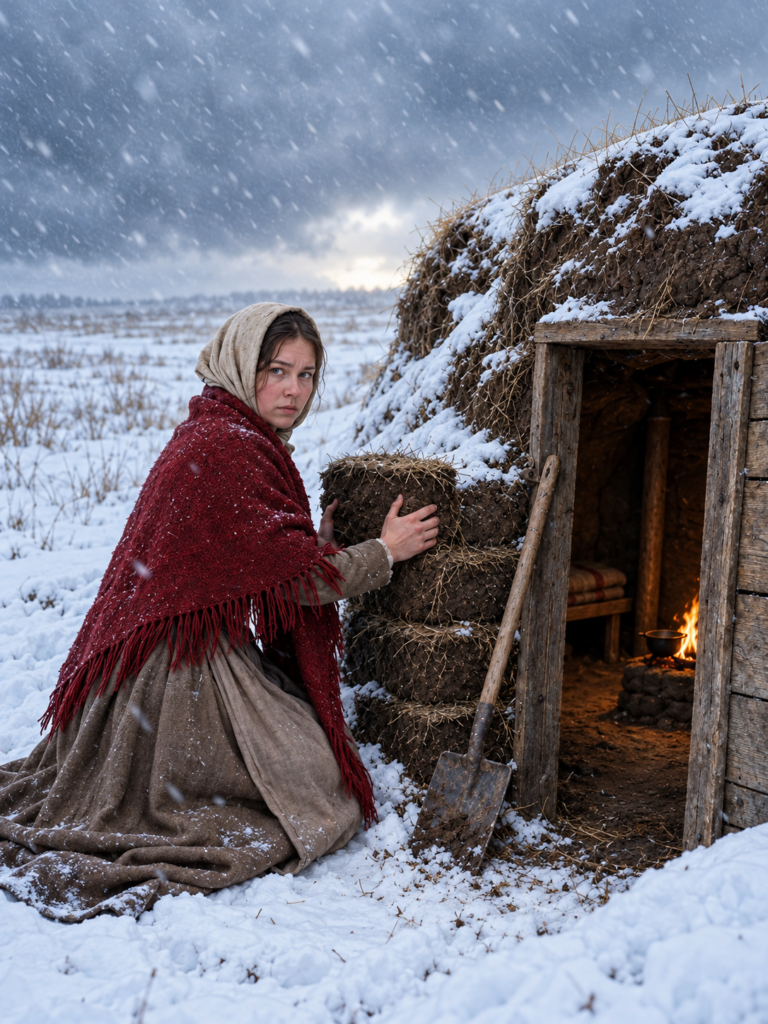
at nineteen, her husband’s family threw her out with nothing but a spade—then a twelve-day blizzard buried their farmhouse and forced them to beg at the door she dug beneath the prairie
Part 1
The morning they took Ingrid Pruitt’s home away, her mother-in-law was making bread.
That was what Ingrid remembered most clearly afterward.
Not the paper Amos laid on the kitchen table. Not the cold satisfaction in his voice. Not even the terrible realization that the seven months she had spent caring for that family had bought her nothing.
It was the smell of bread rising beside the stove.
She had mixed that dough herself before sunrise, kneading it with hands still rough from washing her dead husband’s clothes. The kitchen was warm. A kettle whispered over the fire. Beyond the window, September wind moved through the Dakota wheat stubble beneath a sky the color of old pewter.
Everything looked ordinary.
Then Amos Pruitt told her she had to leave.
“You understand, don’t you?” he asked.
Ingrid stood beside the table with flour on her apron.
Amos was thirty-two, broad through the shoulders, with the same brown eyes as his younger brother Elias. Those eyes had once made Ingrid feel safe. Now they watched her with the impatience of a man explaining something obvious to a child.
“The claim belonged to Elias,” he continued. “And Elias is gone.”
“I know he’s gone.”
Her voice came out smaller than she intended.
Amos tapped the paper before him.
“The land office has rules about these things. Family inheritance. Proper heirs. Mother and I can’t have you staying here indefinitely.”
Ingrid looked toward her mother-in-law.
Mrs. Pruitt stood at the stove, turning a loaf onto a wooden board. Her gray hair was pinned so tightly that it pulled at the corners of her eyes.
She did not look around.
“Is that what you want?” Ingrid asked her.
The older woman brushed flour from the bread.
“Amos knows what’s best.”
Four words.
That was all.
Ingrid had washed this woman’s bedding, rubbed liniment into her aching hands, carried water when her knees were swollen, and sat beside her through nights when she could not sleep.
Now Mrs. Pruitt would not even meet her eyes.
Amos folded the document.
“There’s work in Sioux Falls. Cooking. Laundry. A widow your age can start over.”
“A widow my age?”
He shifted uncomfortably.
Ingrid was nineteen.
She had been married seven months and widowed for eighteen days.
Her husband lay beneath a newly turned patch of prairie earth, marked by a wooden cross she had helped carve. His boots still stood beside their bed. His coat hung from a nail near the door.
And already his family spoke about her as though she were an inconvenience left behind by a departing tenant.
“I helped Elias break this ground,” she said.
“No one’s disputing that.”
“I planted beside him. I cooked for all of you. I worked from morning until dark.”
“Working on a farm doesn’t make it yours.”
He said it gently, which somehow made it worse.
Ingrid looked at the paper again.
She could recognize a few words in English. Her parents had been Norwegian immigrants, and she had left school at nine when her father became ill. She could read a little, enough to follow a hymn or a simple letter if she took her time.
But the language of land offices was another matter.
Amos knew that.
She would remember the way his thumb rested over the upper portion of the document long after she forgot almost everything else about that morning.
“Will you at least read the whole thing to me?” she asked.
“I’ve explained what it says.”
“Please.”
For the first time, anger entered his face.
“Don’t make this harder than it needs to be.”
Mrs. Pruitt opened the oven.
“Ingrid, the bread will burn.”
That was the end of the discussion.
No raised voices. No slammed fists. No accusations that could later be repeated with satisfaction.
Just a woman being quietly pushed out of a home she had believed was hers.
Ingrid had come to Dakota Territory that spring as a bride.
Elias Pruitt was twenty-four, awkward with compliments and hopeless at remembering where he had put his tools. He had met her in Minnesota while helping a cousin bring timber downriver.
On their second walk together, he told her about the prairie.
“Land as far as you can see,” he said. “Good soil. Room to build something that belongs to us.”
“Does it have trees?”
“Some.”
“How many?”
He grinned.
“Enough to look at if you squint.”
She laughed then.
Her mother had been dead nearly three years. Her father was buried beside her. Ingrid had spent much of her childhood working in other people’s houses, learning how quickly kindness could turn into obligation.
Elias offered something different.
Not wealth. Certainly not comfort.
He offered a place where her labor might build a future instead of merely earning another night’s bed.
His claim covered 160 acres of open prairie near the Big Sioux River. The farmhouse was modest, its boards uneven and its roof patched with tarred cloth where the previous winter had found weaknesses.
His mother and older brother lived there too.
“Only until Amos gets himself established,” Elias assured her.
Ingrid believed him.
She believed almost everything Elias said, because he had never given her a reason not to.
They worked together through the spring.
Elias guided the plow while Ingrid walked behind with a sack of seed. When the oxen balked, she learned to speak to them in a low voice. She hauled water from the well, repaired torn shirts, saved bacon grease, and washed the dust from the windows whenever the wind allowed.
At night, Elias told her what he planned to build.
A proper barn. A larger kitchen. An orchard if they could find trees hardy enough. A bedroom facing east so the morning sun would wake her before the rooster.
“What if there isn’t enough money?” she asked once.
“Then we build it slowly.”
“And if the crops fail?”
“We try again.”
“And if winter comes early?”
He reached across the table and took her hand.
“Then we’ll keep each other warm.”
In June, he gave her a spade.
It was not a romantic gift. The blade was dark iron, the wooden handle polished by another man’s hands, and the edge had been sharpened so many times that it was shorter than a new one.
Elias presented it with exaggerated ceremony.
“Every farm wife ought to own one tool nobody can take away from her.”
Ingrid laughed.
“What am I supposed to do with it?”
“Whatever needs doing.”
She leaned against him.
“And what if nothing needs doing?”
“On a farm? I’d like to see that day.”
For years afterward, she would remember that moment with painful clarity.
The sunlight through the doorway.
The smell of cut grass.
His hand resting over hers on the spade handle.
She had not known she was being given the instrument that would save her life.
On August 22, Elias helped a neighbor free a wagon stuck near the Big Sioux River.
One wheel had slipped into a muddy washout, and the horses had become frightened. Elias waded into the water to unhook a trace chain, soaking himself almost to the shoulders.
By the time he came home, his lips were blue.
Ingrid made him change clothes and sit beside the stove.
He smiled at her concern.
“It’s August, sweetheart. I’m not going to freeze.”
That evening, he coughed through supper.
By morning, he had a fever.
On the third day, his breathing sounded like paper being crumpled inside his chest.
Ingrid sat beside him, changing damp cloths, warming broth, and begging him to swallow a few spoonfuls. A neighbor rode for the doctor, but the roads were poor and the distance long.
When the doctor finally arrived, he listened to Elias’s lungs, gave what treatment he could, and stayed until dark.
His face told Ingrid what his words would not.
For twelve days she barely slept.
Sometimes Elias recognized her. Sometimes he called for his father, dead years before. Once, just before dawn, he gripped her wrist so tightly that his fingernails left marks.
“The east window,” he whispered.
“What?”
“In our room. Don’t forget.”
“I won’t.”
“You promise?”
“I promise.”
He died on September 3.
Ingrid washed his face herself.
She could not bear the thought of someone else touching him.
When the men carried him to the grave, the earth was so dry that the clods struck the coffin like stones.
Afterward, she continued setting four places at the supper table because she did not know how to set three.
The first time she noticed her mistake, she carried his plate into the pantry and cried against the shelves until her knees hurt.
No one came looking.
For two weeks, Amos and his mother said little about what would happen next.
Then the land office paper arrived.
And the silence ended.
On September 21, Ingrid packed what she could carry.
She owned no trunk large enough for a proper departure.
There were two blankets, a cast-iron skillet that had belonged to her mother, a kitchen knife, a crock of lard, a small jar of sourdough starter, a tin of matches, and an old lamp with a little oil remaining.
She took a hatchet with a split handle and a wooden box containing her mother’s letters, a worn Bible, and a piece of blue ribbon Elias had once tied around a bunch of prairie flowers.
In the hem of her skirt, she sewed two silver dollars.
Her last money.
She wrapped her red wool shawl around her shoulders.
It was the shawl she had worn on her wedding day, chosen because her mother had always said a little bright color could make even the hardest winter look less lonely.
The spade came last.
Amos watched her carry it outside.
“You’re taking that old thing?”
“Elias gave it to me.”
He shrugged.
“Suit yourself.”
Mrs. Pruitt stood in the doorway.
For a moment, Ingrid thought the older woman might speak. Perhaps she would offer a little flour, a place to stay until the first snow, or even a simple acknowledgment that the past seven months had mattered.
Instead, she said, “There’s no sense lingering.”
Ingrid lifted her belongings.
“Goodbye, Mrs. Pruitt.”
The woman pressed her lips together.
“Good luck.”
Then she closed the door.
Not angrily.
Not loudly.
Just a small, decisive click.
Ingrid stood in the yard, looking at the boards Elias had repaired, the step he had promised to replace, and the narrow window of the bedroom they had shared.
Inside, the family was preparing supper.
Outside, she had nowhere to go.
She started walking.
The road to Sioux Falls lay east.
Ingrid went west.
For the first half mile, she walked with anger keeping her back straight. Then the anger began to fade, and the weight of her belongings settled into her shoulders.
By noon, the wind was sharp enough to sting her cheeks.
She stopped at a fence post, drank from her water flask, and looked back toward the farmhouse.
The roof stood above the grass, a dark shape against the horizon.
She could turn around.
She could beg.
Perhaps Mrs. Pruitt would let her sleep in the shed until winter. Perhaps Amos would give her a corner of the barn in exchange for more labor.
She imagined herself standing on the porch while he decided whether she was worth admitting.
Then she remembered Elias’s voice.
Every farm wife ought to own one tool nobody can take away from her.
Ingrid tightened her grip on the spade.
“No,” she whispered.
She continued walking.
A mile and a half southwest of the farm, she reached a dry creek.
Spring floods had cut a channel through the prairie, leaving a steep earthen bank on one side. The exposed wall rose nearly ten feet above the creek bed, with thick roots hanging from its upper edge like dark fingers.
The place was sheltered from the worst of the northwest wind.
The bank faced south.
Ingrid stood there for a long time.
She remembered the Norwegian families of her childhood in Minnesota. Families who had arrived with little money and fewer building materials. Some had lived through their first winters in homes dug into hillsides or cut into the prairie sod.
Her mother had once taken her to visit a widow who lived in one.
The house had seemed strange to a little girl.
Its doorway was low, its walls were earth, and grass grew over part of the roof.
But inside it had been warm.
Warmer than the drafty wooden houses where wind pushed beneath doors and ice gathered around window frames.
“The earth remembers summer,” the old widow had told her.
Ingrid had never forgotten those words.
Now she looked at the cut bank.
The soil was firm below the roots. The creek bed was dry. There were scattered cottonwoods farther downstream and enough grass on the flats to cut into sod.
She did not own lumber.
She did not own a wagon.
She had no horse, no oxen, and no one to help lift heavy beams.
But she had a spade.
And winter had not arrived yet.
Ingrid set her mother’s box on the ground.
She pulled the spade from her bundle, chose a place near the base of the bank, and pushed the blade into the soil.
It sank only a few inches.
She pressed harder.
The roots resisted.
She brought her foot down on the blade until a narrow line opened in the earth.
Then she lifted the first shovel of dirt.
She had no idea how close she had just come to killing herself.
And she had no idea that, four months later, the people who had turned her out would kneel in the snow above that same bank, begging her to let them inside.
Part 2
The first two days nearly broke her.
Prairie sod was nothing like the soft garden soil Ingrid remembered from Minnesota.
Its roots grew together in a dense mat, tangled so tightly that the spade often bounced back against her boot. Every square foot demanded repeated cuts. Beneath the grass lay stubborn earth that clung to the blade in heavy clumps.
By sunset on September 22, her back burned from bending.
The next morning, blisters opened across both palms.
She tore narrow strips from an old petticoat and wrapped them around her hands, but the cloth soon turned dark with blood.
She worked anyway.
At first, her idea was simple.
She would dig a room into the bank, use the earth itself for three walls, and close the front with stacked sod. The hill would shelter her from the wind, and the roof would be low enough that heavy beams might not be necessary.
She had seen homes built that way.
But seeing something done and doing it alone were two very different things.
The bank looked solid.
That was her first mistake.
Rather than cutting back the upper face, she began tunneling inward beneath the overhanging earth. The work was easier there. The soil came away in manageable pieces, and she could imagine the room taking shape.
By the afternoon of the third day, she had cleared a shallow hollow large enough to sit inside.
She was kneeling near the back, scraping dirt into a pile, when she heard a sound above her.
A faint crack.
Like a dry branch breaking.
Ingrid lifted her head.
A thin line appeared in the packed soil overhead.
She stared at it, trying to understand what she was seeing.
Then the ceiling fell.
There was no time to move.
A slab of earth struck her shoulder and knocked her sideways. More soil followed, pouring down with a dull rushing sound.
Her lamp toppled.
The spade disappeared.
Something heavy slammed against her legs.
For several seconds, she could not breathe.
The air filled with dust, and the world became a choking darkness.
When she finally opened her eyes, she was lying on her side with both legs pinned beneath fallen earth.
Her left foot was numb.
She tried to pull it free.
Pain shot up her shin.
“Help!”
The word burst out before she could stop it.
No answer came.
She screamed again.
Only the dry creek and the open prairie heard her.
The nearest occupied house was more than a mile away, and nobody there had any reason to come looking.
She thought of Elias.
Not as he had been at the end, pale and struggling for breath, but standing behind the plow in June, wiping sweat from his forehead with his sleeve.
Whatever needs doing, he had said.
Ingrid shut her eyes.
Then she began digging.
Without the spade, she used her hands.
She scraped the loose soil away from her knees, throwing handfuls behind her. When she reached heavier clods, she broke them apart with her fingers.
Every movement sent pain through her trapped leg.
At one point, the bank made another small settling sound, and she froze, certain the rest would come down.
She waited.
Nothing moved.
She started again.
The sun shifted across the opening.
Dust stuck to the sweat on her face.
Blood ran beneath her fingernails.
By the time she freed one knee, her arms were shaking uncontrollably.
“Come on,” she whispered.
She said it again.
And again.
When her left leg finally came free, she crawled backward until she reached open air.
Then she rolled onto her back and stared at the sky.
She lay there until the light began to fade.
Her shin was scraped raw from knee to ankle. The skin had swollen badly, and she could barely put weight on the foot.
She had escaped.
But the room she had begun was ruined.
That night, Ingrid cried harder than she had since Elias’s funeral.
She sat beneath a cottonwood with her injured leg stretched before her, holding a piece of cloth against the swelling.
Her hands throbbed.
Her shoulders ached.
Her provisions were already smaller than she had hoped.
And the first frost had silvered the grass that morning.
She imagined the winter ahead.
The wind sweeping across an empty field.
Snow filling the creek.
Her own body lying beneath the bank where no one would find it until spring.
For a few minutes, she genuinely considered walking to the railroad.
Amos might have been right about Sioux Falls.
There would be work there.
A boardinghouse, perhaps. A kitchen. Someone willing to pay her a little for washing clothes.
She could survive among other people.
But the thought of that journey brought no comfort.
She had spent nearly her entire life serving households that were not hers. Someone else decided when she rose, what she ate, and whether her work was satisfactory.
For seven months, she had believed that life had ended.
Going to Sioux Falls would mean beginning it again.
And there was something else.
If she left, Amos’s version of events would become the only version anyone knew.
The young widow had gone away.
The rightful family had remained.
Elias’s farm would continue without her, as though she had never planted a single seed.
Ingrid touched the red shawl around her shoulders.
“My mother didn’t raise me to crawl,” she whispered.
She wiped her eyes.
The following morning, she dragged herself upright.
She studied the collapsed bank carefully.
Then she remembered a detail from the Norwegian dugout she had visited as a child.
The entrance had not been carved beneath a hanging wall.
The earth above it had been cut back in steps.
The old widow’s husband had shaped the bank before digging the room, so that no unsupported shelf of soil remained overhead.
Ingrid looked at the damage before her.
Her mistake was suddenly obvious.
The earth had not betrayed her.
She had asked it to hold more weight than it could bear.
For the next five days, working slowly because of her injured leg, she reshaped the face of the bank.
She cut the upper soil back in stages, lowering the dangerous overhang and forming a safer slope above the entrance. She learned to slice through prairie roots in long, straight lines, then lever up thick blocks of sod that held together like coarse woven cloth.
Each block was heavy.
She dragged them on a piece of old sacking, stacking them where they would later become walls.
Her injured leg stiffened every morning, but gradually the swelling eased.
By early October, the room began taking shape.
Ten feet deep.
Eight feet wide.
Not large enough for a family.
Barely large enough for a bed, a stove corner, and her belongings.
But it would belong to her.
The walls came first.
Ingrid stacked sod across the open front, fitting each slab tightly against the next. She turned the grassy surfaces inward where the roots could help bind the layers together.
The dark blocks were irregular. Some crumbled when lifted. Others had to be trimmed with her knife.
She filled the gaps with damp earth and pressed it smooth with the flat of her hand.
Then she worked on the fireplace.
She cut a shallow hearth into the rear section of the bank and shaped a flue upward through the earth, taking care to leave enough supporting soil around it.
She remembered the old dugout in Minnesota and the faint smell of smoke that always lingered inside.
A fire without a way for its smoke to escape was worse than no fire at all.
She used sod blocks to raise a short chimney above the surface and covered the most exposed edges with clay-rich earth.
The work frightened her.
Every time she cut into a wall, she remembered the collapse.
She inspected the soil constantly, testing for cracks, refusing to rush.
On October 1, she found something that felt almost like a gift.
Half buried in the creek gravel lay the broken tailgate of an old wagon.
It was made of oak, weathered gray, with iron fittings still attached.
The wood was too heavy to carry far, but she did not need to.
She dragged it upstream inch by inch, resting whenever her arms failed.
By evening, the tailgate stood against the entrance.
It was wider than she needed.
She trimmed one edge with the hatchet, then fashioned rough hinges from leather straps cut from her mother’s old box.
When she finally hung it in place, the door swung inward with a deep wooden scrape.
Ingrid stepped outside.
She closed it.
Then opened it again.
A door.
A real door.
For the first time since September 21, she stood before an entrance that another person could not simply order her to leave.
She pressed her palm against the oak.
“Well, Elias,” she said softly, “it’s not the east window.”
A painful smile touched her face.
“But it’s a start.”
The roof was worse than everything that had come before.
Trees were scarce on the open prairie. The nearest usable cottonwoods stood downstream, roughly a quarter mile away.
She had no saw.
Only the small hatchet with the split handle.
The first day she worked on the trees, she managed to cut one suitable pole.
Getting it back nearly exhausted her.
The second day, she cut two more.
By the fourth, her hands were so swollen that she could not fully close her fingers around the hatchet.
She sat in the grass, staring at the tool.
Then she tore another strip from her petticoat.
She wrapped it around the handle and tied her hand to the wood.
It was clumsy.
It hurt.
But she could swing again.
Morning after morning, she returned to the cottonwoods.
She cut the straighter saplings, trimmed the branches, and dragged the poles along the creek bed.
Her shoes wore thin.
Her stockings tore.
The red shawl gathered burrs and bits of grass until it looked more like a field blanket than the garment she had worn at her wedding.
Sometimes she spoke aloud just to hear a human voice.
“One more.”
Or, “Not that one. Too crooked.”
Once, when a stubborn branch struck her across the cheek, she shouted something so improper that Elias would have laughed himself breathless.
She stood there afterward, surprised by the sound of her own laughter.
Then the silence returned.
By October 14, the roof poles lay across the room.
They were not yet covered with sod.
The shelter remained dangerously unfinished.
That evening, Ingrid noticed the birds.
A flock of geese passed high overhead, flying fast and low beneath the cloud cover.
The cattle on the distant prairie had gathered near a fence line.
The wind shifted.
It carried a bitter smell unlike the ordinary chill of autumn.
She looked northwest.
A dark wall was moving toward her.
The first blizzard arrived on October 15.
The wind hit before the snow.
It rushed down the creek with enough force to make the cottonwoods bend and groan. Grass flattened along the banks.
Ingrid had only a short time to prepare.
She carried her supplies into the unfinished room, wrapped both blankets around her belongings, and gathered armfuls of dry willow brush to keep herself off the bare ground.
She could not trust the roof to protect her.
So she took the oak tailgate off its hinges and leaned it into the back corner as a crude shield.
Then she crawled beneath it.
Snow blew through the openings overhead.
The first night, it drifted into the room in white ribbons.
Ingrid stuffed dry grass between her dress and her underclothes. She wrapped the shawl around her head and shoulders, leaving only enough space to breathe.
She kept the crock of lard close to her body so it would remain soft enough to eat.
There was no supper to cook.
No safe fire in that exposed corner.
She ate small spoonfuls of fat and pieces of cold bread, trying to ignore the sickness that came from fear and hunger.
The ground stole warmth from her whenever she shifted off the willow branches.
Her toes ached.
Then they became numb.
She moved them inside her shoes, rubbing her feet together until sensation returned.
Wind screamed across the opening.
Once, in the middle of the night, a heavy thump shook the poles above her.
She held her breath.
A roof pole had shifted.
For a terrible moment, she expected the entire structure to collapse.
But it held.
She spent the next hours listening to every creak.
On the second night, she began speaking to Elias.
Not because she believed he could hear.
Because silence frightened her more than the storm.
“I should’ve gone east,” she whispered.
The wind answered with a long, hollow whistle.
“I could’ve found work.”
She drew the blankets tighter.
“You told me we’d build a house.”
Her throat closed.
“You said we’d build it together.”
She waited as though he might answer from somewhere beyond the dark.
At last, she whispered, “I’m trying.”
The storm lasted three nights.
On the morning of October 18, Ingrid woke to silence.
For several minutes, she was afraid to move.
Then sunlight appeared through the gaps between the roof poles.
She crawled from beneath the tailgate.
The creek bed had changed completely.
Snow covered the grass, filled the shallow hollows, and clung to the branches of the cottonwoods.
Her footprints were gone.
The unfinished house looked smaller than she remembered, but it was still standing.
She brushed the snow from the poles.
Then she began covering the roof.
One sod block at a time.
She worked until her hands were too stiff to hold the spade. She went inside, warmed them against her body, and came out again.
By nightfall, much of the roof was sealed.
The following day, she continued.
She fitted the thick slabs carefully, overlapping them and packing soil between their edges. Every opening she closed made the interior darker.
And warmer.
Not warm enough to feel comfortable.
But enough that her breath no longer seemed to freeze the instant it left her mouth.
Near the rear of the roof, where it met the prairie surface, she built something unusual.
A second entrance.
She framed a narrow opening between doubled roof poles, large enough for her shoulders to pass through. Above it she fitted a lid of woven willow and light wood, held in place by two removable wooden pegs.
Inside, she constructed a low platform.
Standing on it, she could reach the pegs.
Pull them, and the lid would fall inward.
It was not a door meant for visitors.
It was a way out if drifting snow buried the ordinary entrance.
The Norwegian settlers had understood such dangers.
Ingrid had listened as a child when others laughed at their strange houses.
Now every remembered detail mattered.
By the end of October, the room was enclosed.
Its earthen walls held the warmth of a small fire surprisingly well. The roof was thick with sod, and the oak door shut tightly enough to keep out most of the wind.
Ingrid laid willow branches beneath her blankets.
She arranged her skillet, lamp, crock, matches, and little box on a dry shelf cut into the wall.
She set the spade beside the door.
Then she stepped back and examined her home.
The floor was uneven.
The ceiling was low.
The walls smelled of damp soil.
There were no proper windows, and the little fireplace blackened the earth above it.
But the room was hers.
That evening, Ingrid lit a small fire.
She watched the smoke climb through the flue.
For the first time in weeks, she could sit without the wind touching her face.
She held her hands toward the flames.
And finally, alone beneath the prairie, she let herself believe she might survive.
She did not yet understand that building a home was only the beginning.
Winter would soon demand more than walls.
It would demand food, fuel, water, judgment, and the ability to make a terrible choice while frightened enough to die.
And somewhere on the rise to the northeast, Amos Pruitt was laughing at the story of his young sister-in-law who had chosen to live in a hole.
Part 3
By November 1, Ingrid had learned that a house could keep out the wind and still leave its owner hungry.
Her savings were gone.
The two silver dollars she had sewn into her skirt had lasted only until her first trip to the railroad siding, seven miles away.
She walked there carrying a canvas sack over one shoulder and returned with flour, dried beans, salt, a little lard, and lamp oil.
The storekeeper, a gray-bearded man named Mr. Keller, studied her purchases.
“That isn’t much for a winter.”
“It’s what I can afford.”
“Where are you staying?”
“Southwest of the Pruitt place.”
He looked up.
“With relatives?”
“No, sir.”
Something in her face discouraged further questions.
He weighed the flour, added a small handful more, and tied the sack shut.
Then he reached beneath the counter.
“Ever set a rabbit snare?”
“My father showed me.”
He handed her a coil of thin wire.
“Take this. I’ve got more.”
“I can’t pay—”
“Didn’t ask you to.”
She hesitated.
Mr. Keller pushed it toward her.
“Winter doesn’t care much for pride, miss.”
Ingrid took the wire.
“Thank you.”
Outside, she stood beside the railroad tracks for several minutes.
An engine hissed near the water tower. Men loaded crates onto a freight car. Farther down the platform, a woman wearing a fur-trimmed coat helped two children into a passenger carriage.
For one wild moment, Ingrid wanted to buy a ticket.
She imagined going somewhere no one knew her name.
Somewhere she could rent a little room, work in a kitchen, and hear other people’s footsteps beyond the wall at night.
Then the station bell rang.
The train began moving.
Ingrid watched until the last car disappeared.
Afterward, she adjusted the sack on her shoulder and started the long walk home.
Home.
The word still surprised her.
Fuel became her greatest concern.
The handful of cottonwood branches she had gathered during construction would never last through winter.
Trees were too scarce, and her hatchet too small, to supply a steady wood fire.
She turned instead to what the prairie offered.
Dried cattle dung lay scattered across the grazing flats above the creek. Old settlers called the pieces buffalo chips or cow chips, depending on the animals that had left them.
When thoroughly dry, they could be burned for fuel.
It was dirty work.
Ingrid spent hours gathering the flat, sun-hardened pieces into sacks, carrying them back to the dugout, and stacking them where snow could not reach them.
The first time she burned one, the smell made her wrinkle her nose.
The second time, she barely noticed.
By the third day, she was grateful for every piece.
But the chips would not be enough.
So she began twisting hay.
She cut long prairie grass, gathered it into bundles, and twisted each bundle tightly upon itself. Then she folded it and twisted again until it formed a hard rope thick as her forearm.
A single twist burned quickly.
It was poor fuel compared with seasoned wood.
But it was fuel she could make with her own hands.
Every afternoon, Ingrid sat near the entrance with dry grass across her lap.
Twist.
Fold.
Twist again.
Tie.
Stack.
At first, her fingers grew sore after twenty.
Then she managed thirty.
Eventually, she could work for hours without stopping.
She built a shelf along the rear wall for the twists, keeping them away from the hearth.
Some evenings she looked at the growing stack and felt almost wealthy.
Other evenings she counted the bundles and realized how quickly a long winter might consume them.
She tried not to think about how many nights remained before spring.
On the first morning of November, Ingrid baked her first proper loaf of bread in the dugout.
She had kept the sourdough starter alive through the cold by wrapping its jar inside her blankets. Now she mixed a little flour and water into dough, let it rise in the warmest corner, and baked it in the cast-iron skillet beneath a scavenged iron lid.
The loaf came out uneven.
One side was too brown. The middle was slightly dense.
It was the best bread she had ever tasted.
She tore off a piece while it was still hot.
Steam rose against her face.
For an instant, she remembered her mother’s kitchen.
Her mother had always tested a loaf by tapping its bottom, listening for the hollow sound that meant the bread was done.
“Good bread forgives a hard day,” she used to say.
Ingrid stood with the warm loaf in both hands.
She thought of all the kitchens where she had baked bread for other people.
Bread served to employers before she was allowed to eat.
Bread placed before Amos while he complained that the crust was too thick.
Bread Elias had praised even when it was burned.
Now she had baked something for herself.
She took another bite.
Then she began to cry.
Not the wild sobbing of grief.
Just a few quiet tears falling onto the crust.
That night, she slept for almost four hours without waking.
Her little home acquired routines.
She rose when the darkness began to thin around the edges of the door.
She checked the chimney draft and made certain fresh air could enter the room.
She melted snow or carried water when the creek offered any unfrozen pools, boiled what she intended to drink, and washed her skillet carefully before putting it away.
She set snares along the brushy creek edges.
Sometimes she caught a rabbit.
Sometimes she found the wire empty, or broken, or buried in snow.
On days when she brought something home, she saved every useful part. The meat became stew. The bones flavored broth. The hide could be dried and put aside.
She learned to mend her shoes with thread pulled from worn fabric. She patched her dress with pieces cut from the inner lining of her mother’s box.
Her life shrank to tasks that could not be neglected.
Keep the shelter dry.
Keep the flue clear.
Save the matches.
Gather fuel.
Protect the food from mice.
Watch the sky.
No one praised her work.
No one thanked her.
Yet every morning she woke alive was proof that the previous day’s decisions had mattered.
There were lonely evenings when she could hardly bear the silence.
Sometimes she took Elias’s blue ribbon from the box and held it against her cheek.
She remembered him coming through the farmhouse door with his boots muddy and his smile apologetic.
“I tracked dirt again.”
“You always track dirt.”
“Married a farmer, Ingrid. Terrible judgment on your part.”
She could almost hear his laugh.
She missed him so fiercely that her chest hurt.
But increasingly, she also found herself angry.
Not at Elias.
At the unfairness of having loved a man, helped him build a life, and then been treated as though her existence had no connection to the land he left behind.
On those nights, she would take out the little Bible and try to read a passage.
Sometimes she understood the words.
Sometimes she did not.
It was enough to hold something her mother had held.
One afternoon in late November, Ingrid nearly disappeared into the prairie.
The morning had been still and gray.
She needed more fuel and had climbed from the creek bed onto the open grazing flat, following familiar patches of grass where dried chips could be found.
There was snow on the ground, but not much.
She kept the dugout behind her and walked farther than usual.
Then the fog arrived.
It came low across the frozen prairie, rolling in from the creek bottoms.
Within minutes, the horizon vanished.
Ingrid stopped gathering chips and turned toward home.
There was nothing to see.
No cottonwoods.
No creek bank.
No distant farmhouse.
Only gray-white air and pale ground.
She walked in what she believed was the right direction.
After a hundred steps, she paused.
Something felt wrong.
The wind was striking her cheek from the opposite side.
Or had it shifted?
She turned again.
The fog looked exactly the same.
Suddenly she understood the danger.
She could walk for another mile and never know she had passed within fifty feet of the dugout.
She could wander until nightfall.
The temperature was already dropping.
Panic surged through her.
She wanted to run.
Instead, she remembered something her father had told her years ago.
When a snowstorm hid the trail, a person could die from walking in circles.
“If you lose your bearings,” he had said, “don’t let fear choose your direction.”
Ingrid forced herself to stand still.
Her breath came in quick clouds.
She stamped her feet and rubbed her arms.
Every few minutes she listened for something that might guide her.
A crow.
A cow.
Water beneath ice.
Anything.
The fog swallowed every sound.
She waited nearly three hours.
By the time the air began to clear, the light was fading.
The first thing she recognized was a fence post.
Then the distant rise of the Pruitt farm.
Her stomach dropped.
The farmhouse was in the wrong direction.
She had wandered a quarter mile away from her own shelter and was facing almost directly opposite the way she believed she had been traveling.
Had she continued walking, she might have gone miles into the open country.
She reached the dugout near dusk.
Inside, she sat beside the cold hearth with her hands shaking.
That experience changed her.
The shelter could keep her alive only if she could find it.
The following morning, Ingrid took down her red shawl.
She spread it across her blanket and smoothed the wool with both hands.
It was one of the last beautiful things she owned.
Her mother had chosen the yarn years before, spinning part of it herself. Ingrid had repaired the fringe twice and worn it on her wedding day.
She had promised herself she would keep it forever.
Now she took her knife and cut the long fringe away.
The first cut hurt more than she expected.
She sat for a moment with the scarlet threads in her lap.
Then she kept cutting.
Outside, she drove willow stakes into the frozen ground at regular intervals, roughly twenty paces apart, from the dugout toward the places where she gathered fuel.
She tied strips of red wool near the top of each stake.
The cloth moved brightly against the white prairie.
A person could follow one to the next even when visibility began to fail.
It was not a perfect guide.
A true blizzard could hide everything.
But it gave her a better chance.
Ingrid stood at the farthest stake and looked back toward home.
Little red marks crossed the snow.
They looked like a trail of tiny flags leading to a place no one else considered worth finding.
She smiled.
“Mother,” she whispered, “I hope you don’t mind.”
Amos came in December.
Ingrid heard the horse before she saw him.
She was sitting outside the entrance, twisting hay in the weak afternoon sunlight, when hoofbeats sounded from the creek crossing.
Amos rode down the bank far enough to look at the dugout.
He wore a thick wool coat and leather gloves.
His horse snorted steam.
For a while, neither spoke.
Amos studied the sod roof, the rough oak door, the chimney protruding through the earth, and the red strips of wool marking a path across the snow.
Then he shook his head.
“Good Lord, Ingrid.”
She continued twisting.
“What?”
“You’re actually living in that thing?”
“Yes.”
He gave a short laugh.
“It looks like a badger hole.”
Ingrid tied the hay twist and laid it on the pile.
“It’s dry.”
“For now.”
“It’s warmer than it looks.”
“That’s what people say right before the roof falls on them.”
She looked up.
There was no concern in his expression.
Only the uneasy satisfaction of a man pleased that someone who defied him appeared to be suffering.
“Was there something you needed?” she asked.
Amos shifted in the saddle.
“Mother sent me.”
Ingrid waited.
“She says the offer still stands. You can go to Sioux Falls. There’s no sense dying out here just to prove a point.”
“I haven’t decided to die.”
“You know what I mean.”
He gestured toward the earthen walls.
“Elias would be ashamed to see you living like this.”
The words struck exactly where he intended.
For a moment, Ingrid could not speak.
She remembered Elias lying on the bed, promising he would get well.
She remembered the east-facing window he had wanted to build.
She remembered the grave, the wooden cross, and the farmhouse door closing behind her.
Then she looked at Amos.
“Did Elias ever tell you he gave me this spade?”
Amos frowned.
“What?”
“He said I ought to own one tool nobody could take away.”
“What’s that got to do with anything?”
“Nothing, I suppose.”
She reached for another handful of grass.
Amos watched her.
“You’re stubborn.”
“Maybe.”
“By February, you’ll wish you’d listened.”
“Maybe.”
He waited for an argument.
She gave him none.
At last he turned his horse.
“Mother says to tell you she’s praying for you.”
Ingrid lowered her eyes to the grass in her hands.
“Tell her thank you.”
Amos rode away.
She listened to the hoofbeats grow faint.
Only when she could no longer hear them did she allow herself to wipe the tears from her face.
The snow deepened through December.
Farther north, rail service became increasingly uncertain. Settlers spoke of drifts swallowing fences, broken supply lines, and livestock dying where they stood.
The winter of 1880–1881 would be remembered as one of the harshest the northern plains had endured.
But Ingrid knew nothing of history.
She knew only the cold.
Every morning, she scraped frost from the entrance and inspected her roof.
She packed loose soil around gaps. She reinforced sections where the sod had shifted. She kept extra poles inside in case something broke.
Most importantly, she improved the ventilation.
She had noticed how quickly a little room could fill with smoke when the draft changed.
The fireplace flue carried smoke upward, but fresh air needed a way in. She made a separate air passage using a hollow section of cottonwood, arranged so that it could be cleared and adjusted without standing directly in the doorway.
She kept its opening protected from drifting snow and checked that air could pass through it.
Even then, she knew fire inside an enclosed earthen room could kill.
The old settlers had warned about smoke and poisoned air.
She treated every change in the flame, every unusual smell, and every headache as a possible warning.
By the second week of January, she had stacked 480 hay twists along the rear wall.
Three sacks of dried chips stood near the hearth.
Her flour was nearly gone.
The beans would last a little longer if she ate them sparingly.
She had two blankets, one red shawl without its fringe, a few rabbit bones saved for broth, and the stubborn hope that the worst of winter might soon pass.
On the evening of January 10, Ingrid sat beside the fire counting her fuel again.
She touched each row of hay twists with a finger.
Four hundred and eighty.
Enough for eight nights if she burned sixty each night.
Perhaps longer if she was careful.
She looked toward the door.
Outside, the sky was clear.
The stars glittered sharply.
Ingrid pulled the shawl around her shoulders.
“Eight nights,” she said to herself.
She could not know that the storm approaching Dakota Territory would last longer than her fuel.
Nor that the man who had mocked her shelter was about to learn what happened when a proud wooden house faced a winter it could not withstand.
Part 4
On January 11, just after noon, the sky changed.
Ingrid had been outside gathering the last dry grass she could reach when she noticed the northwest horizon turning dark.
At first, the clouds were purple-gray.
Then they became a strange, almost greenish black.
There was no gentle approach.
The wind arrived in one tremendous blow.
Snow lifted from the prairie and swept across the ground so violently that Ingrid could no longer distinguish falling flakes from those being driven upward.
She dropped her bundle of grass.
The pieces scattered.
She ran for the dugout.
By the time she reached the creek bank, she could barely see the entrance.
She stumbled down the slope, pulled the oak door shut, and wedged the spade against it.
The whole structure trembled.
Dirt sifted from a seam in the ceiling.
Ingrid stood motionless, listening.
The roof held.
She moved to the fireplace and checked the draft.
The fire was burning steadily.
Fresh air entered through the separate passage.
She put a small pot of water near the flames and sat down to wait.
She expected the storm to last a day.
Perhaps two.
She had already survived October’s blizzard.
She knew how to ration.
She knew how to keep herself warm enough to endure.
Outside, the wind screamed.
Inside, the earthen walls held their warmth.
For the first time since September, Ingrid felt almost pleased with herself.
Then the second morning came.
And the door would not open.
Snow had packed against the entrance during the night.
Ingrid pushed the oak panel.
It moved less than an inch.
She shoved harder.
Nothing.
She could hear the wind driving snow against the bank.
She pressed her shoulder to the door and felt it flex beneath a weight far greater than anything she could move.
The creek bed was filling.
She went to the rear of the room and looked up at the hatch.
It was her only other exit.
She could open it if she had to.
But not while the storm was raging.
She would lose precious heat, and drifting snow might pour into the room.
She left it closed.
At the fireplace, she fed another hay twist into the flames.
The dry grass flared, burned brightly, and collapsed into ash.
She watched how quickly it disappeared.
Then she looked at the stack against the wall.
Four hundred and eighty had seemed like a mountain.
Now she wondered whether it was enough.
The third day brought a danger she could not see.
Ingrid woke before dawn with a pounding headache.
The room smelled wrong.
Not like the familiar dry smoke of a small fire.
Something heavier.
Something bitter.
The flame in her lamp had become weak and smoky.
When she lifted her head, dizziness swept over her so violently that she nearly fell from her bedding.
For a moment, she thought she was sick.
Then she noticed smoke hanging beneath the ceiling.
The chimney had stopped drawing.
Snow had buried the opening above.
The fumes had nowhere to go.
Her mother had once warned her about men who went to sleep in poorly ventilated cabins and never woke.
Ingrid knew enough to fear the invisible gases produced by a struggling fire, not merely the smoke she could smell.
She crawled toward the fresh-air passage.
Her hands felt clumsy.
Twice she lost her grip on the protective plug.
At last she pulled it free.
A stream of bitterly cold air entered the room.
She gasped.
Then she returned to the hearth.
Using the spade, she spread the burning material apart and smothered the coals with earth.
She would rather freeze than keep burning a fire whose fumes were poisoning her.
The room grew darker.
Her headache continued pounding.
She forced herself to stay low and breathe near the fresh-air opening.
After a while, when she could think more clearly, she fetched the longest spare cottonwood pole.
She worked it up through the flue, pushing against the packed snow above.
The pole struck something solid.
She pushed again.
Nothing.
She withdrew it and tried a different angle.
Snow fell into the fireplace.
A little.
Then more.
Her shoulders burned from the effort.
She kept working until her hands slipped against the wood.
Finally, the obstruction gave way.
A rush of air came down the chimney, followed by a distant roar of wind.
The trapped smoke began moving toward the opening.
Ingrid stayed beside the air passage, waiting and watching.
Only after the smoke had cleared and the draft appeared steady did she cautiously relight a very small fire.
Her hands shook so badly that she nearly dropped the match.
She knew the danger could return at any moment.
From then on, she checked both air passages repeatedly.
Even during the night, she woke to inspect them.
Sleep became a series of brief, frightened intervals.
She had built a home beneath the earth.
Now she was learning that a safe shelter required constant attention, and one missed warning could undo months of work.
The fourth day passed.
Then the fifth.
Then the sixth.
Outside, the blizzard never seemed to end.
Sometimes the wind weakened for an hour, and Ingrid thought the storm was breaking.
Then another front swept across the plains with fresh snow and colder air.
She could hear the pressure change inside the dugout.
The door creaked.
The chimney moaned.
The earth itself seemed to hum.
Food became another problem.
She began by eating half a loaf of bread each day.
Then she reduced her portion to a third.
She boiled a rabbit bone until the water took on the faintest taste of meat. She used that broth for several meals, adding a few beans whenever she could spare them.
Hunger made her irritable.
Small difficulties became enormous.
A dropped spoon.
A match that broke.
A knot in a hay twist she could not untie with cold fingers.
Once, in frustration, she threw a piece of wood across the room.
It struck the wall and fell harmlessly to the floor.
Immediately she felt ashamed.
There was no one there to witness her temper.
Yet she apologized aloud.
“Forgive me.”
She did not know whether she was speaking to God, Elias, or herself.
At night, she counted the days by placing one spent match in a tin cup each morning.
One.
Two.
Three.
Four.
By January 17, the seventh morning, six nights had passed.
She counted the hay twists.
Then she counted them again.
One hundred and twenty.
She had entered the storm with 480.
Three hundred and sixty were gone.
At the old rate, she had enough for only two more nights.
And the storm showed no sign of ending.
Ingrid stood before the stack, unable to move.
She had worked weeks preparing those twists.
Her fingers had blistered and healed.
She had gathered hay through freezing winds and dragged sacks of fuel across the prairie.
She had believed she was ready.
Now the simple arithmetic of survival stood before her.
Two nights.
After that, darkness.
She looked at the blankets.
At the shawl.
At the thick earthen walls.
Then she made a decision.
Twenty twists a night.
No more.
She would burn just enough to keep the cold from becoming unbearable.
By day, she would let the fire die and wrap herself in every piece of cloth she owned.
There would be no comfort.
Only survival.
The seventh night was miserable.
Without a steady fire, the dugout grew cold enough that Ingrid could see her breath in the lamplight.
Her feet ached.
Her hands stiffened.
She sat with both blankets over her shoulders, pulling her knees close and trying to conserve warmth.
Yet when she touched the water jar, it had not frozen solid.
The earth surrounding the room still held some warmth beneath the frozen surface.
Her dugout was not warm in the way a proper home should be.
But its thick walls slowed the loss of heat.
The same soil that had nearly buried her in September was helping to keep her alive.
She thought of Amos’s farmhouse.
The tall walls.
The exposed roof.
The windows facing every direction.
She remembered how the wind had rattled the panes even on ordinary winter nights.
For the first time, she wondered whether the house on the rise was as safe as Amos believed.
Then she felt guilty.
Whatever he had done, she did not want him dead.
Nor his mother.
She pulled the blankets tighter.
“Keep them safe,” she whispered.
The prayer surprised her.
She had spent months trying not to think about those two people.
But hatred, she was discovering, required warmth she could no longer afford.
On the eighth day, Ingrid began hearing things.
At first, she thought someone was calling outside the door.
She struggled upright.
“Elias?”
The voice vanished.
Only the wind remained.
Later, she heard what sounded like footsteps crossing the sod roof.
She held her breath.
No person could have been walking there in such weather.
She knew that.
Yet she listened until her neck hurt.
The darkness, hunger, and interrupted sleep were wearing down her judgment.
She forced herself to work through simple routines.
Count the food.
Check the air passage.
Move the blankets away from the fire.
Inspect the roof poles.
Drink water.
Sit.
Wait.
She repeated those tasks until they became a kind of prayer.
On the ninth day, most of the cow chips were gone.
She had used them not only for cooking but also to melt snow for drinking water.
Now she began feeding pieces of spare wood into the hearth.
First the shorter scraps.
Then one of the roof poles she had saved.
She kept the longest pole untouched.
She needed it to clear the chimney.
If the flue became blocked again, the fire would become dangerous, and she could not afford to lose her only reliable means of clearing it.
Every choice now had consequences.
Burn a pole, and she gained a little warmth.
Save it, and she retained a tool that might prevent suffocation.
Eat more beans, and her stomach stopped hurting.
Save them, and she might still have food tomorrow.
Her world had become a series of small, merciless bargains.
By January 20, only sixty hay twists remained.
That night was colder than the others.
The wind struck the prairie with a deep, continuous roar.
Ingrid burned thirty twists.
She tried to burn fewer, but her hands had become so stiff that she struggled to hold the cup containing her water.
She feared losing the use of her fingers.
Halfway through the night, she heard a sound beneath the wind.
A long, low groan.
It seemed to come from far beyond the creek, toward the northeast.
At first she thought it was thunder.
Then came a muffled, cracking sound.
Something heavy had given way.
Ingrid sat very still.
She knew the noise of wood under strain.
She had heard it when cutting cottonwood poles.
She had heard it when the roof of her first excavation collapsed.
This was larger.
Much larger.
She looked toward the invisible farmhouse a mile and a half away.
“Please,” she whispered.
She waited for another sound.
But the wind swallowed everything.
That night, Ingrid put two extra twists on the fire.
She did not know why.
Perhaps she needed to see something bright.
Perhaps she was trying to push back a darkness greater than the cold.
The eleventh night came with almost no fuel remaining.
She burned twenty-eight twists.
When the final flames died, two small bundles remained on the shelf, too little to carry her through another long night.
The room grew silent except for the movement of air through the chimney.
Ingrid sat against the earth wall.
She could no longer remember what it felt like to be properly warm.
Her stomach was empty.
Her lips were cracked.
When she tried to straighten her legs, painful cramps seized her calves.
She thought of the day she arrived on the prairie with Elias.
He had lifted her down from the wagon and turned her toward the endless fields.
“There’s our future,” he had said.
How young they had both been.
How certain.
She wondered whether he would have recognized the woman sitting beneath the ground now.
Her dress was patched.
Her hands were scarred.
Her cheeks had hollowed from hunger.
The beautiful red shawl had lost its fringe.
And still she was alive.
“You’d better be proud of me,” she whispered.
Her voice cracked.
“Because I don’t know how much more I’ve got.”
She rested her head against the wall.
For the first time in months, she allowed herself to imagine that she might not survive.
Perhaps the storm would continue.
Perhaps the chimney would block again.
Perhaps she would fall asleep and never wake.
She closed her eyes.
Then she heard her mother’s voice in memory.
Not clearly.
Just the familiar words spoken during the hardest winters of her childhood.
Morning first, Ingrid. You only have to get to morning.
She opened her eyes.
“Morning first,” she repeated.
She pulled the blankets over her head and waited.
On January 22, the twelfth morning, Ingrid woke to a sound she had almost forgotten.
Silence.
Not the muffled quiet between gusts.
True silence.
She lay still.
No wind screamed through the chimney.
No snow hissed against the door.
She heard a drop of water fall from one of the roof poles.
Then another.
The storm had stopped.
She sat up too quickly.
The room spun around her.
She caught herself against the wall and waited for the dizziness to pass.
When she finally stood, her knees trembled.
The hay pile was empty except for the two pitiful twists she had saved.
There was barely anything left to cook.
If she could not get outside and find more fuel, she might freeze the following night.
She went to the front door.
It remained buried.
She pushed.
Nothing.
She tried the edge with her knife.
Packed snow filled every gap.
She stepped back.
Then she looked toward the roof.
The hatch.
The strange little second doorway she had built months before.
She had almost forgotten how much she had feared it would be useless.
Now it was her only chance.
Ingrid dragged herself onto the wooden platform.
She reached overhead.
Her fingers would barely bend.
She rubbed them together until she could grasp the first peg.
It came free.
The second was stubborn.
She pulled.
Twisted.
Pulled again.
At last it slipped loose.
The willow lid dropped inward.
A load of snow fell with it, striking her shoulders and filling the platform.
Ingrid staggered backward.
Above her, the opening was plugged with tightly packed snow.
There was no light.
She fetched the spade.
Then she began digging upward.
The shaft was narrow.
She had to work with the handle at an awkward angle, cutting the snow loose and letting it fall behind her.
Her shoulders burned.
Her legs shook.
Several times she had to climb down and rest.
Once, she sat on the floor so long that she wondered whether she would ever stand again.
Then she looked at the spade beside her.
The dark iron blade.
The polished wooden handle.
Elias’s last gift.
She rose.
“One more,” she whispered.
She dug again.
Higher.
The snow was harder near the top, compressed by days of wind.
She chipped at it with the edge of the blade.
A crack appeared.
Then another.
Suddenly, a thin line of white light opened overhead.
Ingrid pushed the spade through.
The snow broke apart.
Sunlight poured down into the shaft.
It was so bright that she turned her face away.
For a moment, she could not see.
Then she climbed.
Her shoulders squeezed against the snow walls.
Her skirt caught on a rough edge.
She pulled herself upward inch by inch.
Finally, her hands reached the surface.
She dragged herself onto the roof of her own house.
And stopped.
The prairie had disappeared.
Everything was white.
Snow filled the creek almost to the top of the bank. Familiar dips and hollows had vanished beneath smooth drifts. Fence lines were buried. The cottonwoods stood half swallowed.
The world she had known was gone.
Ingrid turned slowly.
To the northeast, she could just make out the rise where Elias’s farmhouse stood.
She narrowed her eyes.
Something was wrong.
The house looked shorter.
Its familiar roofline had disappeared.
Then she understood.
Half the roof was lying in the snow beside the building.
Ingrid stared at the wreckage.
The sound she had heard in the storm.
The great groan of breaking timber.
It had come from the farmhouse.
She pressed a hand against her mouth.
Amos and his mother had been inside when the roof failed.
She did not know whether they were alive.
She could not go to them.
She could barely stand.
Then a movement caught her eye.
A strip of red wool fluttered above the snow.
One of her markers.
Farther away, another.
The little trail she had made from her mother’s shawl was still there.
Most of the stakes had vanished beneath the drifts, but a few remained visible along the wind-scoured grazing flat.
Ingrid looked at them.
Then at the broken house.
Then at the hidden roof beneath her feet.
Months earlier, Amos had called it a badger hole.
Now his proud farmhouse lay broken beneath the same winter that had passed over her little earthen home.
But Ingrid could not afford to stand there thinking about justice.
Her fire was dead.
Her food was nearly gone.
She picked up her spade.
And followed the red marks into the snow.
Part 5
By sunset on January 22, Ingrid had gathered two sacks of dried cattle chips.
It took her nearly the whole afternoon.
Each step across the wind-scoured prairie hurt. Her legs felt weak beneath her, and twice she had to sit on the snow beside a willow stake until her breathing steadied.
She followed the red strips from one visible marker to another, never wandering farther than she could safely return.
When she finally reached the dugout, she lowered the sacks through the roof hatch and climbed down after them.
She shut the opening carefully.
Then she knelt beside the hearth.
A match scraped against the side of its tin.
The first one broke.
The second caught.
The little flame trembled between her fingers.
She touched it to a handful of dry grass.
A thin orange light spread across the hearth.
Ingrid fed in a few chips, slowly, checking that both air passages were clear and the chimney was drawing properly.
When the fire finally began to burn steadily, she sat on the floor and watched it.
She had never seen anything so beautiful.
Not Elias’s wedding ring.
Not the spring sunrise over his wheat field.
Not the bright red shawl her mother had made.
Just a small fire in a room beneath the earth.
She held her hands toward it.
And cried.
For the first time in twelve days, Ingrid allowed herself to think beyond the next hour.
She had survived the storm.
The dugout had held.
Her hidden home was still standing.
But a mile and a half away, the farmhouse where her husband had died was broken.
She thought about going there.
Then she looked at her hands.
Her knuckles were swollen. Her feet hurt when she stood. She had barely enough strength to carry another sack of fuel.
She could not make the journey that evening.
And she did not know whether anyone remained alive to find.
She whispered a prayer for the Pruitts.
Then she ate a few softened beans and lay down beneath her blankets.
They came two days later.
Ingrid was outside clearing snow from the air passage when she saw movement on the northern rise.
At first, she thought it was an animal.
Two dark shapes moved slowly across the white prairie.
The first was taller and walked with a crooked, lurching gait.
The second followed several paces behind, stopping frequently.
Ingrid shaded her eyes.
Then she recognized Amos.
Behind him came his mother.
The older woman was wrapped in two quilts, with a dark scarf tied around her head. She walked as though every step required an enormous decision.
Amos was breaking a trail through the snow with a shovel.
Even from a distance, Ingrid could see how badly he was struggling.
She stood beside the hatch and watched them approach.
There was no horse.
No wagon.
No supplies.
Only two people moving across a prairie that had stripped nearly everything from them.
They had not come to laugh.
They had come because they had nowhere else to go.
Ingrid felt an unexpected tightness in her chest.
For a moment, September returned so vividly that she could almost smell the bread beside the farmhouse stove.
She remembered the closed door.
Amos’s hand covering the paper.
Mrs. Pruitt saying there was no sense lingering.
Now both of them were walking toward the home they had mocked.
Ingrid could have gone inside.
She could have shut the hatch.
She could have let them stand in the snow and wonder whether anyone was there.
No one would have blamed her.
Perhaps Amos would finally have understood what he had done.
Instead, she went to the hearth.
She added more fuel.
Then she put the last of her beans in a pot of water.
By the time Amos reached the bank, he was breathing so hard that he could barely speak.
He stopped when he saw Ingrid standing in the opening above her roof.
For several seconds, he simply stared.
She wore her patched dress and red shawl. Her cheeks were hollow, her hands damaged from work, and snow clung to the hem of her skirt.
Yet she was standing upright.
Behind her, smoke rose gently from the chimney.
Amos looked at the smoke.
Then at the thick roof of sod.
Then at the oak door buried beneath the snow.
“You’re alive,” he said.
Ingrid nodded.
“So are you.”
His face changed.
The arrogance she remembered was gone.
He looked older than he had in December.
His cheeks were raw. His lips were split. One side of his coat had been repaired with rough stitching, and his gloves were wrapped in strips of cloth.
He swallowed.
“The roof went on the tenth night.”
Ingrid said nothing.
“One of the main supports broke. We heard it crack, but there wasn’t time to get clear.”
He looked down at his boots.
“The whole east side came in.”
“Where did you go?”
“Root cellar.”
He spoke slowly, as though the words were difficult to bring out.
“We got into the root cellar before the rest fell. Stayed there while the storm went on.”
He paused.
“Ran out of proper firewood. Burned the chairs. Then the shelves.”
His mouth trembled.
“On the last night, I broke up the kitchen table.”
Ingrid looked at him.
That table had stood in the farmhouse since before she arrived.
Elias had once carved his initials beneath its edge when he was a boy.
She remembered kneading bread on it.
She remembered the land office paper lying on its surface.
Now it was ashes.
Amos looked over his shoulder.
“Mother’s hands are bad.”
Mrs. Pruitt stood a few steps behind him.
Her face was pale beneath the scarf.
Both hands were wrapped in dirty cloth and held close to her chest.
Ingrid recognized the stiff, unnatural way the older woman held her fingers.
Cold injury.
Possibly serious.
Mrs. Pruitt raised her eyes.
For the first time since September, she looked directly at Ingrid.
There was something in that expression Ingrid had never seen before.
Fear.
And beneath it, shame.
No apology came.
The older woman stood waiting, as though she expected Ingrid to say the same words they had once said to her.
There’s no sense lingering.
Ingrid looked from one face to the other.
The decision before her was simple.
Not easy.
Simple.
If she turned them away, they might die.
If she let them in, she would have to share what little she possessed with the people who had taken nearly everything from her.
She thought of Elias.
His clumsy smile.
His promises.
His hand over hers on the spade.
Then she moved aside.
“Come down,” she said.
Her voice was quiet.
“Mind the step.”
Amos climbed through the hatch first, helping his mother after him.
Mrs. Pruitt descended so slowly that Ingrid feared she might fall.
When the older woman’s feet finally touched the earthen floor, she stood motionless.
Her eyes traveled around the room.
The stacked sod walls.
The narrow bed.
The shelf of food.
The wood and fuel carefully arranged beside the hearth.
The little air passage.
The oak wagon tailgate serving as a front door.
Everything was handmade.
Everything had been measured against necessity.
Nothing was decorative.
Yet the room was dry.
And a fire burned.
Mrs. Pruitt looked toward Ingrid.
“You built all this?”
Ingrid nodded.
“By yourself?”
“Yes.”
The older woman closed her eyes.
For a moment, she seemed unable to speak.
Amos helped her sit beside the hearth.
Ingrid brought a basin of cool water and carefully examined the woman’s hands.
The fingers were badly swollen and discolored in places. Some of the skin looked damaged from the cold.
Ingrid had no doctor and little medicine.
She knew enough not to rub frozen flesh harshly or hold injured hands directly against a flame.
She warmed the woman gradually, kept the hands protected, and watched anxiously for signs that the damage was worsening.
Mrs. Pruitt winced as Ingrid adjusted the cloth around her fingers.
“Sorry,” Ingrid whispered.
The older woman stared at her.
She seemed astonished that Ingrid was the one apologizing.
They stayed nine days.
Three people in a room ten feet deep and eight feet wide.
The space had seemed small when Ingrid lived alone.
Now it was crowded beyond comfort.
Amos slept near the door with his coat folded beneath his head.
Mrs. Pruitt lay on Ingrid’s bedding beside the warmest wall.
Ingrid slept curled beneath her remaining blanket, close enough to the hearth to tend it whenever the draft changed.
There was never quite enough bread.
Never enough hot water.
Never enough room to move without stepping around someone.
But the room held.
Amos learned to twist hay.
The first time he tried, the bundle came apart in his hands.
Ingrid watched him struggle.
“You’re twisting against the grain.”
He frowned.
“Grass has a grain?”
“Everything has a way it wants to bend.”
She showed him.
He tried again.
The second bundle was crooked.
The third fell apart.
By the end of the afternoon, he could make a serviceable twist.
Ingrid collected the finished pieces and stacked them beside the hearth.
Amos stared at the pile.
“How many of these did you make?”
“Before the storm?”
“Yes.”
“Four hundred and eighty.”
He looked at her.
“You counted them?”
“Every one.”
He slowly examined the damaged skin across her palms.
Then he looked down at his own hands.
He said nothing.
The next morning, he asked where she gathered the grass.
Whenever the weather allowed, Amos walked to the ruined farmhouse.
He brought back whatever could be salvaged.
First, loose boards from the fallen roof.
Then broken shelves.
Then pieces of framing timber.
The first time he carried two long planks into the dugout, Ingrid recognized them immediately.
They had once supported the ceiling over her bedroom.
She ran her fingers along one edge.
A familiar notch marked the place where Elias had used a dull saw.
“He cut this,” she whispered.
Amos stopped.
“Who?”
“Elias.”
Amos looked at the wood.
For a long time, neither spoke.
Then he put the planks down beside the hearth.
“Thought it might burn well.”
“It will.”
He picked up the hatchet.
The same small hatchet Ingrid had used until her hands bled.
He balanced the first plank on a stone and began cutting it into shorter lengths.
Ingrid listened to the blows.
Wood against iron.
A sound that had accompanied the building of the farmhouse.
Now it accompanied its destruction.
She had spent months believing the house on the rise represented everything she had lost.
Yet here were pieces of that house becoming fuel for the home she had built without it.
The proud farmhouse was keeping the hidden dugout warm.
The thought brought no pleasure.
Only a strange, sorrowful peace.
Mrs. Pruitt recovered slowly.
Some swelling eased.
Color returned to much of her skin, although several fingers remained painful for weeks.
Ingrid kept the older woman’s hands clean and protected.
She prepared thin soup when there was nothing else.
She helped her sit up.
She listened when the woman spoke of the long days in the root cellar.
At first, their conversations were painfully awkward.
Mrs. Pruitt would ask for water.
Ingrid would bring it.
The older woman would look as though she wanted to say something.
Then silence would fall.
On the sixth evening, Ingrid came back from gathering snow for water and found the red shawl missing from its usual place.
She searched the bedding.
Then she saw it.
Mrs. Pruitt had folded the shawl neatly and laid it at the head of Ingrid’s blanket.
Not carelessly.
Not in the hurried way someone folds a garment to clear a chair.
The edges were matched.
The corners were tucked beneath.
The wool lay in a small, careful rectangle.
Exactly as Ingrid’s mother had folded it when Ingrid was a girl.
She stood looking at it.
Mrs. Pruitt sat beside the fire, her bandaged hands resting in her lap.
“Your shawl was getting damp,” she said.
Ingrid touched the wool.
“Thank you.”
The older woman nodded.
Then she looked away.
She did not say she was sorry.
She did not thank Ingrid for saving her life.
Not in words.
But from that evening onward, something changed between them.
When Ingrid rose to tend the fire, Mrs. Pruitt tried to help.
When there was only a little bread remaining, she pushed her portion toward Ingrid.
And when Amos complained one morning about the cramped room, his mother interrupted him.
“Your sister-in-law built this with her own hands.”
Amos fell silent.
Mrs. Pruitt looked around the dugout.
“It kept us alive.”
That was the closest she could come to admitting what they had done.
For Ingrid, it was enough to begin.
Not enough to erase the past.
But enough to know that the truth had finally entered the room.
The hardest moment came on the final morning.
The weather had improved.
Amos believed the remaining farmhouse structure could be repaired sufficiently to make one or two rooms usable again.
He planned to return with his mother.
Their belongings were gathered near the hatch.
Mrs. Pruitt stood in her borrowed quilt, looking around as though she wanted to memorize everything.
Amos approached Ingrid.
“I suppose you’ll stay here.”
“Yes.”
He glanced at the earthen walls.
“Even after what happened?”
Ingrid almost laughed.
“Especially after what happened.”
He lowered his eyes.
“You could come back with us.”
The offer hung between them.
Four months earlier, those words might have meant everything.
A roof.
A familiar bed.
A place at the table.
Now Ingrid imagined returning to the farmhouse.
She pictured herself walking through its damaged rooms, repairing its walls, cooking for Amos and his mother, waiting for another decision to be made without her.
The thought exhausted her.
“This is my home,” she said.
Amos looked at her.
For once, he did not argue.
He only nodded.
“Then I’ll bring you more wood.”
Ingrid studied his face.
“You’re welcome to bring wood, Amos.”
He waited.
“But that doesn’t mean you get to tell me what to do with it.”
A faint, embarrassed smile crossed his face.
“No,” he said. “I suppose it doesn’t.”
They climbed out through the hatch.
Ingrid watched them walk toward the broken farmhouse.
She did not feel triumphant.
She felt older than nineteen.
She felt tired.
But when she went back inside, the room was quiet again.
And the silence no longer frightened her.
Spring came slowly.
Then all at once.
By April, the snow began disappearing from the fields in dirty patches. Water rushed through the creek channels, carrying broken branches and chunks of ice.
The Big Sioux swelled dangerously.
Bridges were damaged.
Roads turned to mud.
The prairie that had seemed lifeless for months began to show its first green blades.
Ingrid watched the thaw with a feeling she could scarcely describe.
She had survived.
Not because someone rescued her.
Not because she had money or powerful relatives.
Not because the winter had been merciful.
She survived because she had learned, worked, made mistakes, corrected them, and refused to surrender.
But one question still troubled her.
The land.
The paper Amos had refused to read.
The claim Elias had filed.
And the strange certainty with which his brother had told her she had no right to remain.
Ingrid had thought about it through the winter.
Now that roads were passable, she decided to find out the truth.
She washed her dress, combed her hair, packed a little bread, and took the spade with her.
Then she walked toward Sioux Falls.
The land office smelled of paper, damp wool, and stove smoke.
A clerk sat behind a wooden counter, writing in a ledger.
He was middle-aged, with round spectacles and ink on the side of his hand.
Ingrid waited until he looked up.
“Can I help you, miss?”
“I’m here about a land claim.”
“Name?”
“Pruitt. Elias Pruitt.”
The clerk opened a large book.
“Relationship?”
“He was my husband.”
The clerk glanced up.
“Was?”
“He died last September.”
The man nodded sympathetically.
“I’m sorry.”
Ingrid looked down at her hands.
“His brother told me the claim belonged to the family after Elias died.”
The clerk continued searching.
“His brother?”
“Amos Pruitt.”
“And what did he tell you?”
“That there were rules about heirs. He said I had to leave.”
The clerk stopped turning pages.
He looked at her more carefully.
“Did your husband leave children?”
“No.”
“Did he leave a widow?”
Ingrid frowned.
“That’s me.”
The clerk held her gaze.
“Then I think we’d better look at the actual entry.”
He pulled out the relevant papers.
He read them slowly.
Then he took off his spectacles.
“Mrs. Pruitt, under the applicable homestead provisions, a surviving widow may have the right to continue her husband’s claim.”
Ingrid stared.
“I’m sorry?”
The clerk turned the document so she could see it.
He pointed to a line above the one Amos had emphasized months earlier.
“Here. The widow’s position comes before the other heirs in this situation. There are procedures to follow, but your husband’s death did not automatically mean you had to give up the claim.”
The room seemed to tilt.
Ingrid looked at the paper.
She recognized the word Amos had read aloud.
Heirs.
Then she looked above it.
Another word.
One she had not understood that September morning.
Widow.
“Are you saying,” she whispered, “that he had no right to make me leave?”
The clerk chose his words carefully.
“I’m saying the law did not require you to surrender your place simply because your husband died. There may be details we need to review, but you had rights he did not explain.”
Ingrid sat down.
For several moments she could not speak.
She saw the farmhouse kitchen again.
The bread rising beside the stove.
Mrs. Pruitt turning toward the oven.
Amos’s thumb covering the upper portion of the paper.
He had known.
Perhaps he had not understood every provision.
But he had understood enough to hide the part that mattered.
Seven months of marriage.
A winter of fear.
A house dug with bleeding hands.
All because he wanted control of the land and believed she would not challenge him.
The clerk cleared his throat gently.
“Mrs. Pruitt?”
She looked up.
“You still have choices. We can discuss the claim and what steps are available.”
Ingrid wiped her eyes.
“Yes,” she said.
Her voice grew steadier.
“I’d like to know all of them.”
She returned to the Pruitt farmhouse two days later.
Amos was repairing a section of wall when she arrived.
He set down his hammer.
“Ingrid?”
“I went to the land office.”
The color left his face.
For a moment, neither moved.
Then he looked toward the house.
“Mother’s inside.”
“I came to see you.”
Amos wiped his hands against his trousers.
“What did they say?”
Ingrid held up the papers.
“They told me a widow could continue her husband’s claim.”
His jaw tightened.
“It’s not that simple.”
“No,” Ingrid agreed. “It isn’t.”
She stepped closer.
“But it’s not what you told me, either.”
He looked away.
“That farm needed someone who could manage it.”
“I managed it when Elias was alive.”
“That was different.”
“Because he was standing beside me?”
Amos said nothing.
Ingrid felt anger rising.
Four months of it.
She wanted to shout.
She wanted to tell him about being buried beneath the bank, about tearing her hands open, about lying beneath an unfinished roof while snow blew through her clothes.
She wanted him to know what his selfishness had cost.
But his silence told her he already knew enough.
She lowered the papers.
“You didn’t think I could survive without you.”
He stared at the ground.
“No,” he said at last.
The admission came so quietly that Ingrid almost missed it.
Then he added, “I thought you’d go to Sioux Falls. Find work. Marry again, maybe.”
“And then the land would be yours.”
He did not answer.
That was answer enough.
Ingrid looked toward the farmhouse.
Elias had dreamed of building a life there.
She had loved him in those rooms.
She had grieved him there too.
Part of her wanted to claim every inch of the ground simply to prove she could.
But she understood something now that she had not understood in September.
She no longer wanted her future to depend on what Amos or his mother thought she deserved.
She wanted a home that belonged to her because she had chosen it.
Not because someone permitted her to stay.
“The clerk is helping me understand the claim and how to settle everything properly,” she said. “I won’t have you speaking for me again.”
Amos nodded.
“And when it’s settled, I intend to secure the land around my creek bank.”
He looked at her.
“You’d rather keep that dugout than come back here?”
Ingrid thought about the question.
Then she smiled faintly.
“I’d rather keep the home that kept its roof.”
Amos lowered his head.
He did not smile.
But he did not argue.
The paperwork took time.
There were records to examine, rights to clarify, and questions about the neighboring land surrounding the creek bank.
Ingrid returned to the office whenever necessary.
She learned to ask for explanations when she did not understand.
She refused to sign anything she could not read or have read accurately.
She did not surrender the rights connected to Elias’s claim merely because Amos expected her to.
Eventually, she made her own arrangements, and when the law permitted, she filed on the land that included her dugout.
The earth around the creek was finally hers in more than spirit.
The first time she received written confirmation of her claim, Ingrid held the paper with both hands.
It was ordinary government paper.
Black ink.
Formal words.
Nothing beautiful about it.
Yet she understood what it meant.
No one could now point to her lack of a husband and declare that she did not belong.
No one could close a door and erase the months of labor behind it.
She carried the paper home inside her mother’s Bible.
And when she reached the dugout, she took it out and read her own name.
Slowly.
Carefully.
Twice.
Summer returned.
The grass grew tall above the creek.
Ingrid planted a small garden where the soil was deep enough and built a sturdier shelf for her supplies. With help from neighbors who had come to admire her survival, she improved the shelter, reinforced its roof, and made the entrance easier to use.
She added a proper window where the southern light could reach the room.
It was small.
Barely wider than a dinner plate.
But when morning came, sunlight entered.
And Ingrid remembered Elias.
The east window. Don’t forget.
She had not forgotten.
Her window faced a little south of east, where the land allowed it.
She thought Elias would have forgiven the difference.
Amos continued bringing wood.
Sometimes he brought flour or a sack of potatoes too.
He no longer arrived on horseback simply to criticize her work.
If he wanted to offer advice, he asked first.
Mrs. Pruitt came occasionally when the weather was mild.
The relationship between them never became the easy affection of mother and daughter.
Too much had happened.
There were things that could not be undone.
But sometimes they sat outside together, drinking weak coffee and watching the sun lower over the grass.
Mrs. Pruitt would mend a piece of clothing while Ingrid worked in the garden.
They did not speak much.
They did not need to.
The silence between them had changed.
Years passed.
There were other difficult winters.
Storms that buried fences.
Springs that flooded the creek.
Summers when grasshoppers stripped the fields and farmers watched their work disappear.
Ingrid survived them.
She built an addition to the dugout, raised chickens, planted trees where she could, and stored more food than she had ever been able to afford during her first winter.
She never forgot the twelve days beneath the snow.
Every autumn, she inspected the hatch.
Every winter, she kept the entrance and ventilation clear.
She stored extra fuel and made certain that people traveling through the area knew where shelter could be found.
In time, others learned the value of her unusual home.
A neighbor caught out in a snowstorm once stumbled down the bank with his face nearly frozen.
Ingrid let him inside.
Another year, a young couple whose wagon broke during a bitter cold snap found refuge there until the road became passable.
A family with two frightened children spent a night beside her hearth after losing their way in drifting snow.
Every visitor asked the same question.
“How did you build a place like this?”
And Ingrid would show them the walls.
The roof.
The hatch.
The little window.
She explained what she had done wrong, especially the dangerous excavation that nearly killed her, and why safe construction, proper support, and ventilation mattered.
She never pretended that surviving had been easy.
It had been cold.
Lonely.
Painful.
And often frightening beyond anything she could describe.
But it had also taught her something no one could take away.
She was capable of more than the people around her had believed.
More, sometimes, than she had believed herself.
One autumn evening, many years after the great blizzard, Ingrid stood outside the dugout watching the sun sink beyond the prairie.
She was older now.
There were lines beside her eyes and white threads in her hair.
The little red shawl, carefully repaired but still missing much of its original fringe, rested over her shoulders.
Near the door leaned the spade Elias had given her.
Its handle had been replaced once.
The iron blade had worn thinner.
But she had kept it.
A young woman from a nearby farm had come to visit that afternoon.
She had heard stories about Ingrid’s first winter and wanted to see the home beneath the earth.
Now she stood beside the old spade, looking from the roof to the open prairie.
“Mrs. Pruitt,” she said, “is it true your husband’s family left you with almost nothing?”
Ingrid looked toward the northern rise.
The old farmhouse was still visible in the distance.
Its roof had been repaired.
Its walls had been strengthened.
Amos had grown old there.
His mother had passed away years before, and in her final illness Ingrid had visited often, carrying soup and clean linens.
The young woman followed her gaze.
“People say they treated you terribly.”
Ingrid was quiet for a moment.
“Yes,” she said.
“They did.”
“And you saved them anyway?”
“Yes.”
The girl considered that.
“Why?”
Ingrid rested her hand on the spade handle.
She could have offered a grand answer about forgiveness.
She could have spoken of God or duty or love.
All those things had mattered.
But none fully explained the choice she had made that cold January morning.
At last, she said, “Because they were standing outside my door, and I knew what that felt like.”
The young woman lowered her eyes.
Ingrid looked out across the grass.
When she had been nineteen, she believed losing a home meant losing everything.
She had thought a proper life required someone to choose her.
A husband.
A family.
A person who would say she belonged.
The winter taught her otherwise.
A home was not always the building with the highest walls or the finest roof.
Sometimes it was the place you made after the world had turned you away.
Sometimes it was a small room beneath the earth, built from sod and salvaged timber, where a forgotten widow discovered that her own hands were enough to begin again.
The young woman touched the spade.
“Do you ever wish they’d let you stay in the farmhouse?”
Ingrid smiled.
“Sometimes I wonder what life might’ve been.”
She watched a bird settle on the grass-covered roof.
“But I don’t wish it back.”
“Not even a little?”
Ingrid shook her head.
“That house belonged to the life I thought I was going to have.”
She turned toward the dugout.
“This one belongs to the life I made.”
A breeze stirred the loose threads of her red shawl.
Somewhere down the creek, water moved gently over stones.
The evening was growing cold.
Ingrid opened the oak door and glanced back at her visitor.
“Come inside,” she said. “There’s coffee on the fire.”
Then she added, with a small smile, “Mind the step.”
The young woman followed her down.
The door closed behind them.
And beneath the wide Dakota prairie, the little home remained warm.
No one ever persuaded Ingrid to fill it in.
Not when she had enough money to build aboveground.
Not when neighbors told her that a respectable woman ought to live in a proper farmhouse.
Not even when her joints grew stiff and climbing through the old roof hatch became difficult.
She maintained the shelter because it represented more than survival.
It was the record of a promise she had made to herself on the day she was turned away.
That she would not disappear.
That she would not let someone else’s judgment determine the worth of her life.
And that whatever happened, she would always try to leave a door open for someone who had nowhere else to go.
Ingrid Pruitt had been left on the prairie at nineteen with a spade, a red shawl, and almost no money.
The family that rejected her believed she would be gone before winter ended.
Instead, she carved a place for herself into the earth.
When the twelve-day blizzard came, the proud farmhouse broke beneath the weight of the storm.
Her little shelter endured.
And when the people who had abandoned her stood outside begging for warmth, she gave them something they had refused to give her.
A place to belong.
Because in the end, the strongest thing Ingrid built was not the roof above her head.
It was the dignity no one could ever take from her again.

