
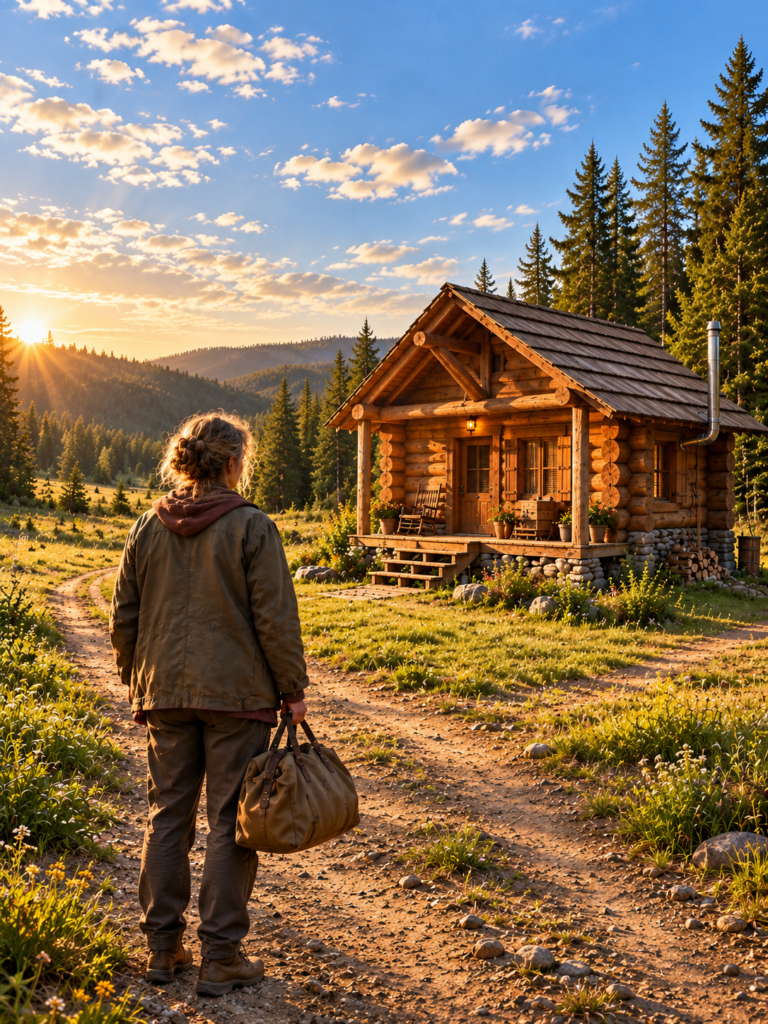
all her family said she deserved was a $50 ruined cabin in the west virginia hills—then they saw what had been hidden beneath it for a century
Part 1
When the county auction page loaded on Ellen Mercer’s laptop, she thought someone had forgotten three zeroes.
The listing read:
LOG CABIN — THREE-QUARTER ACRE — SOUTHERN WEST VIRGINIA.
Minimum bid: $50.
Not fifty thousand.
Fifty dollars.
The single photograph beneath the description showed a structure sagging into a wooded hillside. The porch had collapsed entirely. The roof dipped in the middle. Vines swallowed part of the rear wall, and the path leading to the place looked as though nobody had walked it in years.
Ellen stared at the photograph for almost five minutes.
At forty-two, she had developed a habit of hesitating before wanting anything.
Wanting things had become expensive.
She worked from a laptop doing freelance bookkeeping for a scattering of small businesses—an auto-parts shop, two restaurants, a plumbing contractor, and a retired dentist who owned several rental houses.
She made enough to survive.
Not enough to feel secure.
For two years, Ellen had rented a single room in a house she shared with three strangers because one-bedroom apartments in the nearest decent town had climbed beyond twelve hundred dollars a month.
Her room held a bed, a desk, three plastic storage bins, and a small dresser she had owned since college.
There was no yard.
No porch.
No place where she could leave a pair of muddy boots without somebody complaining.
She had once owned more.
A marriage.
A two-story house in Ohio.
A dining table chosen together.
A savings account that felt respectable.
Then her husband, David, had walked out after fourteen years.
He had not left for some dramatic younger woman.
Ellen sometimes thought that would have been easier.
He simply told her that he was tired of being responsible for everything.
The irony nearly made her laugh.
By then Ellen had spent years doing his business books, helping care for his mother, working part-time jobs whenever money grew tight, and postponing her own plans because “next year” always sounded reasonable.
When the divorce ended, David kept the house by refinancing.
Ellen received enough cash to pay debts and start over.
Not enough to buy another home.
Her older sister, Rebecca, called that outcome fair.
“You didn’t want that mortgage anyway.”
Ellen remembered staring at the phone.
“I wanted the house.”
“Well, you couldn’t have afforded it alone.”
That sentence stayed with her.
Couldn’t afford.
Couldn’t manage.
Couldn’t maintain.
Couldn’t start over.
For two years, Ellen heard variations of the same judgment.
Usually disguised as concern.
So when she found the $50 cabin, she sent the listing to Rebecca almost as a joke.
The response came thirty seconds later.
ARE YOU SERIOUS?
Ellen wrote:
Maybe.
Rebecca called immediately.
“Ellen.”
“What?”
“You cannot buy that.”
“It’s fifty dollars.”
“It’s fifty dollars because nobody wants it.”
“Probably.”
“There’s not even a porch.”
“I saw.”
“The roof is collapsing.”
“It looks repairable.”
“You know that from one photograph?”
“No.”
Rebecca sighed.
Then came the sentence Ellen would remember for years.
“Well, maybe that’s fitting.”
“What is?”
Rebecca laughed lightly.
“All you deserve is a fifty-dollar cabin.”
Silence.
Rebecca seemed to realize too late how it sounded.
“I mean after David and everything. Maybe you need to stop dreaming so big.”
Ellen stared at the laptop.
Her sister continued.
“You always get these ideas. You’re going to move somewhere rural, grow vegetables, work from a porch, become self-sufficient. You’re forty-two, Ell.”
“And?”
“And you’re not twenty-two.”
Ellen ended the call shortly afterward.
That Sunday their mother invited everyone to dinner.
Rebecca repeated the story.
Her husband, Mark, laughed.
“A fifty-dollar cabin?”
“Apparently.”
Mark shook his head.
“That property is probably sitting over an old mine. Half that country is undermined. Could have drainage, subsidence, contaminated water. County might just be unloading liability.”
Their mother looked worried.
“Is there even a road?”
“Technically.”
That answer made Mark laugh harder.
Ellen ate her potatoes.
Nobody asked why she wanted it.
Nobody asked what rent was costing her.
Nobody asked what it felt like to spend forty hours each week balancing other people’s money and then close her laptop in a bedroom that would never be hers.
Rebecca leaned toward her.
“I’m serious. Please don’t waste whatever little savings you have left.”
Ellen put down her fork.
“How much do you think I have?”
“That’s not the point.”
“It seems relevant if you’re advising me how to spend it.”
Their mother said softly, “Girls.”
Rebecca’s expression hardened.
“I’m trying to keep you from making another bad decision.”
Another.
There it was.
The divorce.
As though Ellen had chosen to be abandoned.
As though ending up without the house had proven something about her judgment.
Ellen did not argue.
That was a change.
Years earlier she would have defended herself until everyone became exhausted.
Now she simply stood.
“Thank you for dinner, Mom.”
Rebecca frowned.
“You’re leaving?”
“Yes.”
“We’re trying to help.”
“I know.”
Outside, cold October air met Ellen in the driveway.
She sat behind the wheel of her fourteen-year-old Subaru for several minutes.
Then she opened the auction page on her phone.
The bidding closed Tuesday.
Current bid:
$50.
No competition.
Ellen entered sixty dollars.
Then stopped.
Why bid more if nobody else wanted it?
She deleted the number.
Fifty.
Confirm.
Two days later, an email arrived.
CONGRATULATIONS. YOU ARE THE SUCCESSFUL BIDDER.
Purchase price: $50.
Ellen read it three times.
Then she began laughing.
Not because it was funny.
Because for fifty dollars she had done something nobody in her family believed she should.
She owned land.
Barely.
Three-quarters of an acre.
A condemned cabin.
A seasonal road.
A legal description she had to look up on a map.
But the deed would carry her name.
The following Saturday she drove into southern West Virginia.
The road became narrower with every mile.
Pavement ended.
Gravel began.
Then the grade increased.
The last two miles required low gear in places.
Drainage ditches bordered the road.
Water had washed away finer gravel, leaving loose stone and ruts.
Ellen understood why the county described access as seasonal.
At the bottom of a wooded ridge, she parked.
A footpath climbed toward the property.
It had once been a wagon track.
Now leaves covered most of it.
She carried gloves, a pry bar, flashlight, measuring tape, notebook, water, and a first-aid kit.
Through bare trees, she saw the roof before the walls.
The cabin was smaller than she imagined.
Approximately six hundred square feet.
One story.
Hand-hewn logs.
The porch was not merely damaged.
It was gone.
Rotten posts had failed where they met the ground, and the deck had collapsed to one side.
The roof sagged toward the middle.
Vines climbed the back wall.
Ellen stood in front of it.
“This is stupid.”
The forest did not disagree.
She stepped carefully through the doorway.
A section of floor near the front had rotted through where rain entered from above.
She could see earth beneath.
But farther inside, the boards appeared solid.
Ellen tested them.
One step.
Then another.
No movement.
She examined the walls.
The logs were dark from age.
Some looked nearly black.
But when she pushed at the corners, nothing shifted.
The dovetail joints remained tight.
At the rear wall she placed both palms against the wood and pushed hard.
Solid.
Ellen looked toward the roof.
Maybe the family had been right.
Maybe this was worth exactly fifty dollars.
Then she looked again.
The roof was failing.
The walls were not.
There was a difference.
A building with failed walls was a demolition.
A building with a failed roof might be a repair.
Ellen opened her notebook.
Roof ridge sagging.
Front floor damaged approximately six feet.
Walls solid.
Rear corners surprisingly good.
She spent two hours measuring.
By the time she returned to the car, her hands were dirty and her jeans torn at one knee.
But she felt something she had not felt in years.
Interested.
The next weekend she returned with a machete and loppers.
Brush surrounded the cabin.
Kudzu.
Wild grape.
Virginia creeper.
Young tulip poplars.
The growth held moisture against the old logs.
Ellen started at the front.
She cleared one wall.
Then another.
On her third visit, she worked around the back.
A heavy curtain of kudzu covered what looked like the hillside itself.
Ellen pulled at the vines.
A stone appeared.
Then another.
Straight.
Not random.
She cut more aggressively.
A wall emerged.
Not part of the cabin.
Something extended into the hill.
Ellen stepped backward.
A low doorway appeared beneath the vegetation.
Four feet high, perhaps.
Framed in cut sandstone.
A heavy timber lintel crossed the top.
It was still solid.
Her pulse changed.
She crouched.
Turned on her flashlight.
Then entered.
The room beyond was roughly twelve feet wide and sixteen feet deep.
Dry-stacked sandstone walls.
Flagstone floor.
Earth surrounding three sides.
The temperature dropped immediately.
Cool.
Still.
Stable.
Along the back wall were stone shelves.
And on those shelves sat jar after jar after jar.
Ellen slowly raised the light.
Dozens.
Then more.
Old glass jars with zinc lids.
Wire-bail closures.
Some clear.
Some faintly blue.
The contents had long since darkened.
She did not touch them.
She counted.
One hundred twenty-three.
Ellen stood in the middle of the underground room.
Fifty dollars.
She thought of Rebecca.
All you deserve is a fifty-dollar cabin.
Then Ellen noticed a narrow trench along the floor.
It followed the base of the walls toward the entrance.
Water management.
Gravity drainage.
Someone had built this carefully.
Very carefully.
Ellen touched the sandstone.
The cabin above might have looked abandoned.
But beneath it was a structure that had quietly survived perhaps a century.
And for the first time, Ellen wondered whether the real mistake everyone had made was looking only at what was broken.
Part 2
Ellen did not tell Rebecca about the cellar.
Not immediately.
She wanted facts before excitement.
Years of bookkeeping had trained her to distrust numbers that made her happy.
So she measured everything.
Room dimensions.
Wall thickness where visible.
Drainage slope.
Temperature.
On three separate weekends the cellar remained between fifty-one and fifty-four degrees.
Even as outside temperatures changed.
Ellen began researching traditional Appalachian root cellars.
The more she learned, the more impressed she became.
This was not a crude hole under a cabin.
Whoever built it understood the hill.
Earth insulated three sides and the roof.
The stone moderated humidity.
The drainage trench carried seepage toward the doorway.
No electricity.
No pump.
No machine to fail.
The system simply used the ground.
One evening Ellen sat in her rented room surrounded by notes.
Her housemate was watching television loudly downstairs.
Somebody had left dishes in the sink again.
Ellen looked at a photograph of the cellar.
For the first time, she did not see ruin.
She saw infrastructure.
The jars themselves had value.
She photographed manufacturer marks and closures.
Some appeared collectible.
A dealer told her certain pieces might sell for twenty, fifty, perhaps even more depending on rarity and color.
Taken together, the jars could easily be worth many times the price of the land.
But Ellen did not sell them.
Not yet.
They belonged to the story of the place.
The logs became another surprise.
A local sawmill owner named Earl Timmons agreed to visit after Ellen showed him photographs.
He was sixty-eight and had spent most of his life working with Appalachian hardwood.
He stood outside the cabin, ran one hand over the dark wall, and said nothing.
“What?”
He scraped a tiny weathered section with his pocketknife.
Fresh wood appeared beneath.
Reddish brown.
Straight grain.
Earl looked at her.
“Chestnut.”
Ellen blinked.
“American chestnut?”
“Yes.”
“I thought those were basically gone.”
“The trees are.”
He walked toward the corner joint.
“This cabin went up before the blight took most of them.”
He explained.
American chestnut had once dominated large parts of Appalachian forests.
Strong.
Straight-grained.
Rot-resistant.
Used for barns, houses, fences, furniture.
Then blight swept through.
Billions of trees died.
Today, old chestnut lumber usually came from reclaimed structures.
You did not walk into a modern lumber yard and order fresh chestnut logs like these.
Ellen touched the wall.
“So this is valuable?”
“As lumber?”
“Yes.”
“Very.”
“How valuable?”
Earl frowned.
“Don’t get ideas.”
She laughed.
“I’m not tearing it down.”
“Good.”
He looked around the room.
“Because that would be like melting your grandmother’s wedding ring to sell the gold.”
That was the moment Ellen decided.
She would save the cabin.
Not flip it.
Not strip the old material.
Save it.
The next question was whether she could afford to.
Earl helped estimate the roof.
The central ridge beam had deflected over decades.
Several rafters needed replacement.
The log walls were sound.
“You’ve got bones,” Earl said.
“What does that mean?”
“It means ugly isn’t dead.”
That phrase went into Ellen’s notebook.
She created a budget.
Not fantasy.
Actual numbers.
Roof structure.
Metal roofing.
Floor repair.
Door.
Stove.
Water.
Power.
Hardware.
Gasoline.
Unexpected costs.
The total frightened her.
Even doing most work herself, she would need thousands.
Her savings were thin.
Rebecca called that week.
“Did you go back?”
“Yes.”
“You’re actually working on it?”
“Yes.”
Mark’s voice came in the background.
“Ask if she found the toxic mine.”
Rebecca laughed.
Ellen said, “Tell Mark the hill hasn’t swallowed me yet.”
“Ellen, seriously.”
“What?”
“How much money are you putting into this?”
“I’m tracking it.”
“That isn’t an answer.”
“Enough.”
Rebecca sighed.
“You could save that money toward a real place.”
Ellen looked around her rented room.
“A real place.”
“You know what I mean.”
“Yes.”
That was becoming the problem.
Ellen knew exactly what everyone meant.
Real meant conventional.
Financed.
Inspected by people wearing clean shoes.
Close to stores.
Easy to explain at dinner.
Nobody cared whether it actually suited her.
Rebecca continued.
“You’ve had a rough couple years. Maybe this is you trying to prove something.”
Ellen’s hand tightened around the phone.
Perhaps it was.
But proving that she could still make decisions did not seem like the worst reason to begin.
“I have to go.”
“You always say that when you don’t want to hear something.”
“No. I say that when I’m done hearing it.”
She ended the call.
That weekend Ellen removed part of the damaged roof.
The work was harder than she expected.
Everything took longer alone.
A board that two people could move casually became a logistical problem.
Tools fell where she could not reach them.
A sudden rain shower forced her to throw a tarp over half-finished work.
She slipped once and bruised her hip badly enough to limp for two days.
That night in her rented room, Ellen woke at two in the morning with a thought that felt like truth.
You cannot do this.
She stared at the ceiling.
Maybe Rebecca was right.
Maybe David had been right too.
During their last year together he often said Ellen turned simple things into projects.
“You always need something to fix.”
Perhaps this was simply a bigger broken thing.
A cabin instead of a marriage.
Ellen nearly laughed at the cruelty of the thought.
The following morning she considered listing the property.
She had paid fifty dollars.
Surely somebody would give her a few hundred.
She opened the photographs.
Stopped at one.
The cellar.
Stone shelves.
Flagstone.
Work performed by somebody long gone.
Whoever built that room had cut into a hillside by hand or with primitive equipment.
Moved stone.
Fitted corners.
Cut drainage.
They had not known whether the cabin would stand a century.
They had simply built carefully.
Ellen closed the listing site.
Saturday morning she returned.
The roof came first.
Earl’s sawmill sold her a new ridge beam and eight rafters for six hundred dollars.
He helped load them.
“You got somebody meeting you up there?”
“No.”
He stared.
“No.”
“Earl—”
“No.”
“I have a come-along.”
“You have one spine too.”
He eventually agreed to help place the ridge beam in exchange for Ellen cleaning up six months of bookkeeping records for the sawmill.
That was the first trade.
More followed.
A barn owner ten miles down the valley was demolishing an old structure and gave Ellen salvaged oak flooring if she hauled it herself.
A retired roofer sold her leftover metal panels at a discount.
A Habitat for Humanity resale store had a six-panel door for fifteen dollars.
Somebody online sold a used wood stove for one hundred fifty.
Ellen learned to ask.
That was unexpectedly difficult.
After the divorce, independence had become almost aggressive.
She hated owing anyone.
But rural work exposed the stupidity of pretending one person needed nobody.
When Earl helped raise the ridge beam, Ellen provided bookkeeping.
When a neighbor named June brought her lunch, Ellen helped June set up a spreadsheet for farm expenses.
When a young mechanic hauled the stove, Ellen prepared his quarterly tax numbers.
Nobody treated help as humiliation.
Only Ellen had been doing that.
By December, the roof was straight.
Metal covered it.
Rain no longer entered.
The rotten floor section had been removed.
Salvaged oak waited to replace it.
Ellen stood inside while rain struck the new roof.
No dripping.
She listened.
For almost a full minute.
Then she sat on the floor and cried.
Not dramatically.
Just enough that she was glad nobody else was there.
For years, every repair in Ellen’s life had felt temporary.
Rental room.
Borrowed furniture.
Temporary work arrangements.
Temporary address.
Now rain struck a roof she had repaired on land carrying her name.
The sound felt different.
The following week, Ellen discovered water.
She had been clearing deeper behind the root cellar when she heard dripping.
At first she assumed runoff.
Then she found a fracture in the sandstone.
Water emerged steadily.
Someone had once lined the area beneath it with flat stones to form a small catchment basin.
A spring.
Not large.
But persistent.
Ellen watched it for weeks.
Measured approximate flow.
Enough, potentially, for conservative household use.
The spring sat uphill from the cabin.
Higher elevation meant gravity.
Her notebook began filling.
Storage tank.
Pipe.
Faucet.
Utility sink.
No pump.
She felt the old excitement again.
Not just a cabin.
A system.
Roof.
Stone cellar.
Spring.
Slope.
Wood stove.
Every useful thing seemed to depend less on buying technology and more on understanding what the place already provided.
For years Ellen had measured security in monthly income.
Now she began measuring it differently.
How much water without electricity?
How much food could the cellar hold?
How much heat would one stove produce?
How much debt would she avoid by doing the work herself?
Nobody in her family knew that yet.
And Ellen discovered she enjoyed the silence.
Part 3
January slowed the work.
The seasonal road became unreliable.
Several times Ellen left the Subaru at the bottom and walked supplies uphill.
She did not sleep at the cabin during the worst weather.
Not yet.
The building still lacked enough insulation between roof and interior, and the stove installation was unfinished.
So she worked weekends and returned to her rented room at night.
That arrangement became increasingly unbearable.
Not because the room changed.
Because Ellen did.
She had begun noticing how little she owned where she lived.
She could not plant anything.
Could not paint the walls.
Could not change a broken fixture without asking.
Could not leave tools by the door.
The cabin was colder, rougher, and harder.
Yet every repaired inch belonged to a future she chose.
By February, Ellen installed the water system.
A food-grade storage tank sat near the spring, roughly fifteen vertical feet above the cabin floor.
Black polyethylene pipe ran downhill.
She drilled through the rear wall.
Installed a simple utility sink.
Connected a faucet.
Then opened the valve.
Nothing.
Ellen stared.
“Of course.”
She walked uphill.
Airlock.
She adjusted the line.
Returned.
Opened the faucet.
A cough.
Another.
Then water.
Clear.
Steady.
No pump.
No electric bill.
Ellen held both hands beneath the stream.
Cold water flowed across her fingers.
She laughed alone inside the cabin.
That evening she called her mother.
“How are you?”
Her mother sounded cautious.
“Good.”
“Still working on the cabin?”
“Yes.”
A pause.
“Rebecca says you’re spending everything.”
“Rebecca doesn’t know what I’m spending.”
“Are you okay?”
“Yes, Mom.”
“I worry.”
“I know.”
“I just don’t want you ending up with nothing.”
Ellen looked at the running faucet.
“I’m not.”
Her mother seemed ready to ask more.
Ellen changed the subject.
By March, a small solar setup powered lights, her phone, and laptop charging.
One panel.
Charge controller.
Deep-cycle battery.
Small inverter.
Nothing impressive.
Nothing capable of running air conditioning, electric heat, or a dozen appliances.
Ellen did not care.
She needed bookkeeping software.
Internet through her phone connection.
Lights.
Occasionally a small fan.
The system matched the life.
That concept became important.
For years Ellen had felt poor because she compared herself to people with larger houses, newer cars, and two salaries.
At the cabin, she stopped asking how much a normal house should have.
She asked what she actually needed.
The answer was smaller.
That did not mean easy.
One March night, Ellen tried sleeping at the cabin for the first time.
The temperature dropped lower than forecast.
Wind moved across the ridge.
She fed the stove.
At midnight she woke sweating.
At two, cold.
The tiny cabin heated unevenly.
She opened the stove too far.
Fire burned aggressively.
Then too low.
Smoke threatened when she opened the door.
By dawn, Ellen felt as if she had spent the night negotiating with a metal box.
Her coffee tasted terrible.
She stood on the rebuilt porch watching light enter the valley.
“I have no idea what I’m doing.”
June, the neighboring woman, came by later with eggs.
Ellen told her about the stove.
June laughed.
“What?”
“You’re burning it like a fireplace.”
“What does that mean?”
“Means you’re feeding it for flames instead of heat.”
She showed Ellen how to establish a hot clean burn, build a proper coal bed, control airflow, and choose wood size.
Simple knowledge.
The next cold night went better.
Again, the cabin changed Ellen’s relationship with competence.
She had once assumed capable people already knew things.
Now she understood that capable people often simply learned without being ashamed of not knowing.
That realization reached farther than stoves.
By April, she had spent $2,900.
Her notebook recorded every purchase.
Every gallon of fuel used for trips.
Every screw.
Every pipe fitting.
Every tool.
She knew the total because numbers still mattered.
But for the first time, they were building something instead of warning her what she could not afford.
She planted a garden behind the cabin.
Potatoes.
Onions.
Green beans.
Tomatoes.
Squash.
The root cellar received fresh shelving.
Ellen removed the old jars one by one.
She discarded their ancient contents carefully but cleaned and saved the glass.
Some rare jars she sold.
The proceeds paid for insulation and part of the porch lumber.
Others remained.
She liked seeing them.
Physical evidence that another household had once stored winter inside the hill.
Then came a letter from the county.
Ellen opened it expecting taxes.
Instead, it was a notice regarding the condemned status of the cabin.
The county wanted updated information before the structure could legally be occupied full-time.
Inspection.
Documentation.
Repairs.
For one terrible minute Ellen imagined losing everything.
Not again.
A house being declared beyond her reach by paperwork.
Her hands began shaking.
Then she stopped.
Read the notice again.
It did not say demolition.
It did not say seizure.
It said documentation required.
Ellen called.
Asked questions.
Took notes.
She needed to demonstrate that structural hazards had been corrected.
Roof.
Floor.
Chimney.
Safe stove clearances.
Sanitation plan.
Water.
Nothing impossible.
Still, the inspection became a deadline.
Ellen worked harder.
She completed the floor.
Built a proper stone hearth.
Installed shielding.
Reinforced part of the porch.
Added smoke and carbon monoxide detectors.
Organized receipts.
Photographed every repair.
The inspector arrived on a wet morning in May.
His name was Carl Deavers.
He walked around the cabin without showing emotion.
Ellen followed.
He inspected the roof framing.
Floors.
Walls.
Stove.
Water.
Then she showed him the root cellar.
Carl stopped.
“Well.”
Ellen waited.
He walked inside.
Ran his light across the stonework.
“Where’d you find this?”
“Under the kudzu.”
“That’s usually where the good architecture hides.”
She laughed nervously.
He inspected the drainage trench.
The ceiling.
The entrance.
Then returned outside.
“Cabin walls are older than my grandfather.”
“Chestnut.”
“I noticed.”
“Is that bad?”
“No.”
Carl looked toward the structure.
“Lady, most new cabins I inspect aren’t put together this well.”
Ellen’s shoulders dropped.
He signed the paperwork with several minor corrections required.
Not condemnation.
Not failure.
Approval pending simple fixes.
Ellen watched his truck disappear down the road.
Then sat on the porch.
Her entire body felt weak.
For months she had imagined the cabin becoming a home.
Now, officially, it could.
That evening Rebecca called.
“Mom says you’re moving there.”
“Yes.”
“Full-time?”
“Yes.”
There was silence.
“Ellen, that road isn’t maintained in winter.”
“I know.”
“What if you get snowed in?”
“I prepare.”
“What if the power goes out?”
“I make my own.”
“You have electricity?”
“Some.”
“What about water?”
“Yes.”
“How?”
“Gravity.”
Rebecca paused.
“What are you talking about?”
Ellen smiled.
“You’ll see.”
Her sister disliked not knowing.
“When?”
“Come in June.”
“You actually want us there?”
“Yes.”
“Mark too?”
“Yes.”
Ellen looked around the cabin.
Clean chestnut walls.
Finished floor.
Straight roof.
New door.
Small stove.
Simple sink.
Sunset beginning outside.
She realized something.
She did want them to see.
Not because she needed Rebecca humiliated.
That fantasy had existed earlier.
Now it felt small.
She wanted her family to understand that they had mistaken damage for worthlessness.
And Ellen had done the same thing to herself.
Part 4
The week before her family arrived, Ellen almost canceled.
Not because the cabin was unfinished.
It would probably always be unfinished in some way.
Because she did not know what she wanted from their reaction.
An apology?
Admiration?
Silence?
She kept remembering Rebecca’s words.
All you deserve is a fifty-dollar cabin.
Ellen had replayed that sentence during difficult days.
While hauling lumber uphill.
While repairing the floor.
While sitting in mud beside the water line.
Sometimes it motivated her.
Sometimes it hurt.
Neither felt healthy anymore.
Friday evening, she opened her expense notebook.
Total investment so far:
$3,420.
Including purchase price.
Roof.
Floor.
Metal panels.
Water.
Solar.
Stove.
Hardware.
Tools.
Gasoline.
Everything.
Three thousand four hundred twenty dollars.
Less than three months of rent for a basic apartment in many places.
Ellen closed the notebook.
Saturday morning, she heard engines below the ridge.
Two cars.
Her mother had come with Rebecca and Mark.
They walked the final stretch.
Rebecca appeared first around the bend.
Then stopped.
Mark nearly walked into her.
Nobody spoke.
The porch stood straight across the front.
Four new posts rested on proper concrete blocks.
The railing Ellen had built from locust branches followed the edge.
New metal roofing reflected morning sun.
The salvaged front door, sanded and resealed, looked as though it belonged there.
Her mother slowly climbed the steps.
“You did this?”
“Yes.”
“All of it?”
“With help.”
Rebecca looked around.
“This is the same place?”
“Yes.”
Mark studied the roof.
“You replaced the ridge?”
“And eight rafters.”
He looked at her.
“You?”
“Earl helped with the beam.”
Inside, the reaction became quieter.
Ellen had scrubbed the chestnut logs and treated them with linseed oil.
Their color had deepened to reddish brown.
Original axe marks remained visible.
The oak floor patches blended imperfectly with older boards.
Ellen liked that.
Nothing pretended to be new.
Her mother touched the wall.
“This wood is beautiful.”
“American chestnut.”
Mark turned.
“No.”
“Yes.”
“Chestnut chestnut?”
Ellen nodded.
He approached the logs.
“You sure?”
“A sawmill owner identified it.”
Mark ran his hand along the grain.
His earlier jokes about contamination and abandoned mines seemed very far away.
Rebecca remained near the center of the room.
She looked at the stove.
The sink.
The small solar meter.
Bookshelves Ellen had built.
A table beneath the window where she worked.
“You live here now?”
“Yes.”
“Full-time?”
“Yes.”
“Does the internet work?”
Ellen laughed.
“Of course that’s your first practical question.”
“You work online.”
“Phone-based connection with an external antenna.”
Rebecca looked out the window.
“Okay.”
Mark said, “Where’s the cellar?”
Ellen stared.
“How do you know about the cellar?”
“Mom told me you mentioned something underground.”
Her mother looked guilty.
Ellen sighed.
“Come on.”
They walked behind the cabin.
The root-cellar doorway remained deliberately modest.
Ellen had rebuilt the frame but kept the old stone exposed.
Mark ducked inside with his flashlight.
Rebecca followed.
Then their mother.
The cellar shelves now held canned tomatoes, green beans, apple butter, potatoes, onions, garlic, and empty vintage jars waiting for use.
Cool air surrounded them.
Mark inspected the walls.
“How old?”
“Probably close to the cabin.”
“No mortar?”
“Dry stacked.”
He examined the drainage channel.
Then the flagstone.
He stayed quiet for an unusually long time.
Finally he said three words.
“This is solid.”
Ellen almost smiled.
From Mark, it was practically a speech.
Rebecca touched one of the shelves.
“You found this after buying?”
“Third visit.”
“So you didn’t know?”
“No.”
“And those jars?”
“One hundred twenty-three originally.”
Rebecca looked at her.
“What were they worth?”
“Some had collector value. I sold enough to help pay for improvements.”
“How much is this cellar worth?”
“To build today?”
Rebecca nodded.
“Several thousand at minimum.”
Rebecca went still.
Mark looked toward the stonework.
“Could be more.”
Ellen said nothing.
They returned outside.
Then Ellen showed them the spring.
The tank.
Gravity line.
Solar panel.
Her mother listened carefully.
When they came back around the cabin, she sat on the porch.
Ellen handed her coffee.
Her mother looked across the ridge.
The valley dropped away beneath spring green.
For several minutes nobody spoke.
Then her mother said quietly, “This is yours.”
The words struck Ellen harder than she expected.
“Yes.”
“All yours?”
“Yes.”
“No mortgage?”
“No.”
Her mother’s eyes filled.
“I worried because after David…”
She stopped.
Ellen waited.
“I thought you were falling apart.”
“Maybe I was.”
“And this…”
Her mother looked around.
“This doesn’t look like falling apart.”
Rebecca stood near the railing.
Her face had become unreadable.
Ellen expected some joke.
None came.
Finally Rebecca said, “I was cruel.”
Their mother looked over.
Rebecca stared toward the trees.
“What?”
Ellen knew exactly what she meant.
Rebecca continued.
“The fifty-dollar cabin thing.”
Mark shifted uncomfortably.
Ellen said nothing.
“I thought you were making some desperate decision because you were embarrassed about the divorce.”
“I was embarrassed.”
“I know.”
“No. You don’t.”
Rebecca looked at her.
Ellen’s voice remained calm.
“I lost my house. My marriage. Half the people we knew stayed David’s friends. Then every conversation with you became advice about being realistic.”
Rebecca’s eyes dropped.
“I thought I was helping.”
“You kept reminding me how little I could afford.”
“I’m sorry.”
Ellen breathed slowly.
She had imagined this apology.
In fantasy, she had delivered some perfect response.
Something sharp enough to make Rebecca understand exactly how much those words had hurt.
Now her sister stood on a porch Ellen had rebuilt with her own hands.
Ellen no longer needed the perfect line.
“I know you were scared for me.”
Rebecca nodded.
“That doesn’t make what you said okay.”
“I know.”
“But I don’t want to spend the rest of my life proving you wrong.”
Rebecca looked up.
“Good.”
A fragile smile passed between them.
Not complete reconciliation.
Something better.
Honest ground.
That afternoon, Ellen made lunch.
Her mother picked beans from the garden.
Mark measured the porch without permission and suggested a brace.
Rebecca helped wash dishes at the utility sink.
At one point she turned on the faucet.
“No pump?”
“No.”
“Still weird.”
“Gravity is very old technology.”
Rebecca laughed.
The tension loosened.
Before leaving, Mark stood beside the cabin.
“You know the logs alone are worth a ridiculous amount.”
“I know.”
“You ever think of selling?”
“No.”
“Not even for the right number?”
Ellen looked at the cabin.
“No.”
Mark nodded.
This time he did not argue.
Several weeks later the county reassessment arrived.
Ellen opened it at the kitchen table.
Improved assessed value:
$38,000.
She stared.
Then laughed so loudly a bird lifted from the porch railing.
Fifty dollars had become thirty-eight thousand on paper.
But even that figure felt incomplete.
The appraisal counted structures.
Improvements.
Land.
It did not count what mattered most.
No landlord.
No mortgage lender.
No one who could decide at the end of a lease that she needed to leave.
For the first time since her marriage ended, Ellen had a home nobody had allowed her to have.
She had built her way into it.
Part 5
The first full winter tested every romantic idea Ellen had about mountain living.
November rain turned the access road slick.
December brought ice.
January brought seventeen inches of snow in two days.
Her Subaru remained at the bottom of the ridge for nearly a week.
She had prepared.
Firewood stacked beneath cover.
Potatoes and onions in the cellar.
Canned tomatoes.
Beans.
Rice.
Coffee.
Extra solar battery.
Water tank full.
Ellen worked from her laptop while snow covered the valley.
At night she fed the stove carefully and listened to wind around the chestnut walls.
The cabin creaked.
It did not shake.
One evening Rebecca called.
“You snowed in?”
“Technically.”
“That sounds alarming.”
“I have food.”
“Water?”
“Yes.”
“Heat?”
“I’m standing beside it.”
“What if you need something?”
“I’ll call.”
A pause.
“Do you?”
“Do I what?”
“Need anything?”
Ellen smiled.
“No.”
Rebecca exhaled.
“Okay.”
Then added, “I hate admitting this.”
“What?”
“You’re better prepared than we are.”
“That’s going in writing.”
“Absolutely not.”
Their relationship improved slowly.
Not because the cabin magically healed old wounds.
Because both women stopped pretending the wounds had never existed.
Rebecca came more often.
Sometimes alone.
Once after an argument with Mark, she drove up and sat on Ellen’s porch for three hours without explaining herself.
Ellen did not pry.
Eventually Rebecca said, “I understand why you wanted this.”
“What?”
“A place where nobody is talking at you.”
Ellen handed her more coffee.
“Expensive lesson.”
“Fifty dollars.”
“Three thousand four hundred twenty.”
Rebecca laughed.
The cabin became useful beyond Ellen.
Her mother stayed there for two weeks one summer after knee surgery because the small layout was easier than stairs at home.
Mark repaired part of the seasonal road with two neighbors after heavy rain washed a section out.
June stored apples temporarily in Ellen’s cellar during an unusually warm autumn.
A hunter caught in freezing rain once knocked at Ellen’s door after dark.
She let him warm by the stove and sleep on the floor.
The house everyone had called worthless developed a habit of sheltering people.
Ellen liked that.
Three years after purchase, a developer contacted her.
He had acquired nearby acreage for vacation cabins.
He offered $62,000.
Ellen declined.
He returned with $75,000.
Rebecca heard about it.
“You said no?”
“Yes.”
“Seventy-five thousand dollars.”
“Yes.”
“For something you bought for fifty.”
“Yes.”
Rebecca leaned back.
“I’m trying very hard to respect personal growth right now.”
Ellen laughed.
The truth was she could have used the money.
Seventy-five thousand dollars would have created savings.
A newer car.
Travel.
Security of another kind.
But selling would mean returning to rent or buying something else with debt.
More importantly, the developer did not want the cabin.
He wanted the site.
“What would happen to the house?” Ellen had asked.
“We’d probably remove it.”
“Remove?”
“Clear the structure.”
That ended the discussion.
The cabin’s value was not that somebody else would pay more.
Its value was that it worked.
That lesson expanded into Ellen’s life.
She stopped measuring herself by the normal sequence she believed she had failed to maintain.
Marriage.
House.
Career ladder.
Retirement plan.
She had some of those things.
Not others.
Her life was not a ruined version of somebody else’s plan.
It was simply built differently.
At forty-six, Ellen hired a part-time assistant for her bookkeeping business.
At forty-seven, she stopped taking clients who paid late or treated her badly.
At forty-eight, she began offering bookkeeping workshops for local farmers and tradespeople who understood their businesses but hated paperwork.
One winter evening Earl Timmons attended.
He sat in the back and complained loudly that spreadsheets were invented by people who disliked humanity.
Ellen reminded him that he had once failed to categorize forty-three fuel purchases.
“That was private information.”
“You handed me the receipts in a grocery bag.”
“I trusted you.”
The room laughed.
Ellen looked around.
She knew everyone there.
Not because she had grown up in the valley.
Because she had built relationships through exchange.
Work for work.
Knowledge for knowledge.
Help given.
Help received.
The independence she once wanted had changed definition.
It no longer meant needing nobody.
It meant not being trapped because one person, employer, landlord, spouse, or creditor controlled everything.
The cabin itself continued revealing history.
Under one floorboard Ellen found a hand-forged spoon.
A local historian dated it tentatively to the early twentieth century.
Old county records suggested the first known owner was a coal-camp carpenter named Samuel Vance.
He and his wife, Ida, may have built the cabin around 1911.
The root cellar probably came shortly afterward.
Ellen found census records listing six children.
Suddenly the one hundred twenty-three jars made sense.
This had not been somebody’s rustic retreat.
It had been survival infrastructure for a working family.
Chestnut walls.
Spring.
Cellar.
Garden.
Wood heat.
Every part responded to a need.
Ellen framed a copy of the Vance family record and hung it near the door.
Not because she believed the cabin belonged to them more than her.
Because ownership did not erase history.
She was simply one person in a longer line of caretakers.
At fifty, Ellen replaced part of the porch she had first rebuilt.
A decade of weather had begun showing.
Rebecca helped.
They worked side by side removing boards.
At one point Rebecca sat back and rubbed her shoulder.
“I’m too old for this.”
“You’re fifty-three.”
“Exactly.”
Ellen handed her water.
Rebecca looked toward the cabin.
“Do you ever think about that dinner?”
“Yes.”
“So do I.”
Ellen waited.
“I really said you deserved this.”
“You did.”
Rebecca shook her head.
“I thought price meant value.”
Ellen looked at the chestnut wall.
“So did everybody.”
Rebecca smiled slightly.
“Not you.”
“Yes, me too.”
“What?”
“When I first saw it, I almost left.”
“You never told me that.”
“Several times.”
Rebecca seemed genuinely surprised.
“I thought you knew immediately.”
“No.”
Ellen looked toward the root cellar doorway.
“I just kept checking what was actually there.”
That was the important distinction.
Courage had not looked like certainty.
It had looked like investigation.
Push the wall.
Measure the beam.
Check the floor.
Find the water.
Research the wood.
Track the expenses.
Ask for help.
Correct mistakes.
Decide again.
Years later, when Ellen’s mother died, the family gathered at the cabin after the funeral.
Her mother had requested it.
Not the formal reception hall Rebecca suggested.
Ellen’s porch.
The same porch where their mother had once held a cup of coffee and whispered, This is yours.
People filled the cabin.
Food covered the table.
Children ran down the path.
Mark stood beside the stove telling someone the story of the original roof as though he had personally reconstructed every rafter.
Rebecca caught Ellen listening.
“He’s rewritten history.”
“I noticed.”
“Give him ten more years and he’ll have bought the place.”
They laughed.
Then Rebecca’s expression changed.
“Mom loved coming here.”
“I know.”
“She said it felt quiet.”
Ellen looked toward the chair where their mother usually sat.
“I know.”
Grief entered the cabin too.
And was held there like everything else.
The root cellar continued doing what its builders intended.
Summer after summer, Ellen canned tomatoes.
Beans.
Peaches.
Apple butter.
Fermented cabbage.
Stored potatoes.
Garlic.
Winter squash.
The original stone drainage remained functional.
The spring continued flowing.
The solar system grew larger over time, but Ellen kept it modest.
She eventually added better batteries and a small refrigerator.
No sprawling array.
No obsession with turning the cabin into a technological showcase.
Every improvement answered a real need.
That principle became almost moral.
Do not add simply because you can.
Do not replace what still works.
Do not mistake new for better.
Do not mistake old for worthless.
One autumn afternoon, a young woman named Cassie drove up the road.
She was thirty-two, recently divorced, and had found Ellen through one of her bookkeeping workshops.
Cassie stood on the porch looking exhausted.
“I need advice.”
“Financial?”
“Life.”
“More expensive.”
Cassie laughed weakly.
She had been offered a small, badly neglected farmhouse by an aunt.
Everyone in her family told her to sell immediately.
The roof leaked.
Barn leaned.
Heating system was ancient.
“It’s probably a terrible idea,” Cassie said.
Ellen made coffee.
“Maybe.”
Cassie looked surprised.
“You’re supposed to tell me to follow my dream.”
“No.”
“Why not?”
“Dreams can have rotten foundations.”
Cassie smiled.
“So what do I do?”
Ellen pointed toward the cabin wall.
“Find out what you actually have.”
Not what the photograph suggested.
Not what relatives feared.
Not what nostalgia wanted.
What was there.
Foundation.
Roof.
Water.
Access.
Taxes.
Repairs.
Skills.
Money.
Time.
“Then decide.”
Cassie looked around.
“Is that what you did?”
“Eventually.”
“What made you buy this place before you knew?”
Ellen smiled.
“Spite.”
Cassie laughed.
“Seriously?”
“Fifty percent spite. Fifty percent desperation.”
“That makes me feel better.”
“It shouldn’t.”
They sat on the porch until sunset.
When Cassie left, Ellen realized she had become the sort of person she once needed.
Not someone who promised everything would work.
Someone who taught others how to look.
That winter, Ellen found the old auction screenshot saved on an external drive.
She opened it.
The photograph almost shocked her.
Collapsed porch.
Sagging roof.
Brush.
Dark doorway.
Minimum bid: $50.
She printed it.
Then framed it beside a current photograph.
Not as a before-and-after boast.
As a reminder.
One picture showed condition.
The other showed possibility realized through work.
Neither picture alone told the whole truth.
By the time Ellen turned sixty, the cabin had lasted more than a century.
She had lived there almost eighteen years.
Longer than she had lived in the house she once lost during divorce.
One evening Rebecca visited.
They sat on the porch as fog settled low in the valley.
Rebecca’s hair had gone mostly gray.
Mark was recovering from surgery and had stayed home.
Neither sister spoke for a while.
Then Rebecca said, “You know something embarrassing?”
“Many things.”
“I used to think this place was proof you’d hit bottom.”
Ellen smiled.
“And now?”
Rebecca looked at the cabin.
“Now I think losing everything might’ve been the first time you got to choose something without asking anybody.”
Ellen considered that.
It was not entirely true.
But it was close.
The divorce had taken a home.
The rental room had stripped life down.
The $50 cabin had not rescued her.
That would make too simple a story.
Ellen rescued the cabin.
The work rescued parts of her in return.
There was dignity in that exchange.
Nothing magical.
Nothing free.
A neglected building did not become valuable simply because somebody believed in it.
It became valuable because the walls were sound.
The cellar worked.
The spring flowed.
The roof could be repaired.
And because one woman was willing to learn what those facts meant.
Ellen rose.
“Cold.”
Rebecca followed her inside.
The stove held a low fire.
Chestnut walls glowed under lamplight.
Near the kitchen area sat shelves of preserved food.
Beneath the hill, the root cellar remained cool and steady.
Outside, the spring continued running through sandstone exactly as it had before Ellen was born.
Rebecca touched the old log beside the door.
The axe marks were still visible.
“Imagine the person who cut this tree.”
Ellen nodded.
“Probably never imagined us.”
“Probably not.”
Rebecca looked around.
Then smiled.
“Still can’t believe it was fifty dollars.”
Ellen laughed.
“That was only the price.”
“What’s the difference?”
Ellen thought about David.
The rented bedroom.
The county auction.
Earl raising the ridge beam.
The first water from the gravity-fed faucet.
Her mother on the porch.
Rebecca apologizing.
The family gathering after their mother’s funeral.
All the winters inside these walls.
“Price is what somebody asks you to pay.”
She rested her hand on the chestnut log.
“Worth is what’s actually there.”
Rebecca nodded.
Neither said anything more.
Years later, when Ellen finally placed the property into a trust so it would remain intact after she was gone, she included one unusual condition.
The cabin could be repaired.
Improved carefully.
Used.
Lived in.
But the chestnut walls could not be dismantled for resale.
The root cellar could not be filled.
The spring could not be diverted solely for commercial development.
Whoever came next would be free to make the place theirs.
But not by destroying what had survived long enough to reach them.
Inside the root cellar, Ellen hung a small wooden sign.
It did not mention the auction price.
It did not mention the county’s later assessment.
It did not boast about how wrong her family had been.
It said:
LOOK AT WHAT IS STILL STANDING BEFORE YOU DECIDE WHAT IS LOST.
That was the lesson.
Not that every ruined house hid treasure.
Most did not.
Not that buying neglected land for fifty dollars was a sensible financial strategy.
Usually it was not.
The lesson was smaller.
And harder.
People were quick to measure worth by visible damage.
A broken marriage.
An empty bank account.
A collapsed porch.
A sagging roof.
A middle-aged woman living in a rented bedroom.
A property nobody wanted.
They saw what had failed and assumed everything beneath it had failed too.
But sometimes the walls were still holding.
Sometimes the old joints had tightened with age.
Sometimes clear water still moved beneath the hill.
Sometimes a cellar built by forgotten hands remained dry a hundred years later.
And sometimes a life that looked ruined from the road still had good bones.
Ellen Mercer had paid fifty dollars for the right to find out.
The rest she built herself.

