
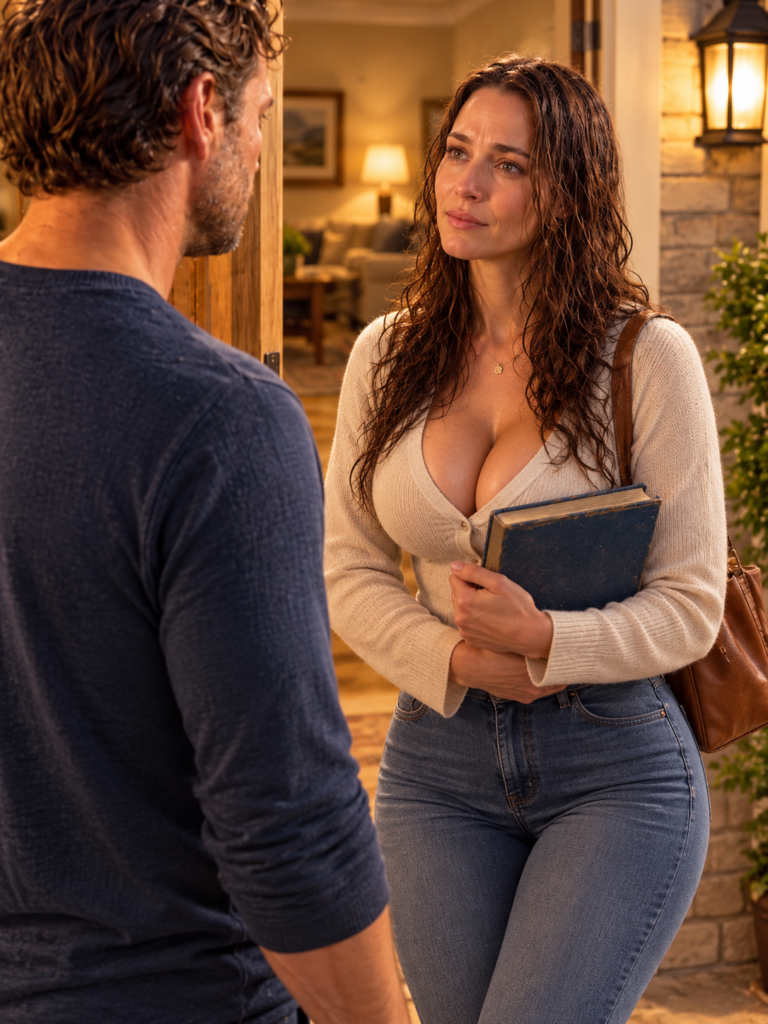
A year after my best friend died, his widow appeared at my door holding a blue envelope he had forbidden her to give me sooner—inside was a brass key to something I never knew existed…
Part 1
The knock came at 8:17 on a cold November evening.
I know the exact time because I had been staring at the clock above my kitchen doorway, trying to decide whether eight o’clock was too early for a thirty-eight-year-old man to give up on the day.
It was one year and three days after I buried my best friend.
Caleb Morgan.
For twelve months, I had been learning how to live inside the strange silence a person leaves behind.
It wasn’t the dramatic kind.
No one warned me that grief was mostly ordinary.
It was reaching for my phone when something ridiculous happened and remembering there was no reason to text Caleb.
It was ordering breakfast and automatically thinking he’d complain that I put hot sauce on everything.
It was seeing an empty passenger seat and remembering every argument we’d ever had about music.
It was Sunday mornings without him showing up forty minutes late and insisting he was “basically on time.”
The knock came again.
I considered ignoring it.
My lights were on, so pretending I wasn’t home would have been ambitious.
I crossed the living room of my small house outside Asheville, North Carolina, and opened the door.
Rebecca Morgan stood beneath the porch light.
Caleb’s widow.
She held a weathered blue envelope against her chest with both hands.
Her eyes were swollen.
Not freshly crying.
The kind of swollen that suggested she had been crying, stopping, deciding something, crying again and driving somewhere before she could change her mind.
“Rebecca?”
“Hi, Daniel.”
Nobody called me Daniel unless something was serious.
My friends called me Dan.
Caleb had called me Bennett half the time because he’d decided in college that using last names made us sound like detectives.
Rebecca looked at the envelope.
Then at me.
“Can I come in?”
I stepped aside.
“Of course.”
She entered without removing her coat.
For a moment we just stood there.
Rebecca had always been one of those people who made a room seem warmer.
When Caleb was alive, she laughed easily, hugged people without making it awkward and remembered names after meeting someone once.
That evening, she looked smaller.
I hated noticing that.
“I’ll make coffee.”
“You don’t have to.”
“I know.”
I made it anyway.
Neither of us drank it.
Rebecca sat at the edge of my couch with the blue envelope on her lap.
I sat opposite her.
The furnace clicked.
Caleb had always hated that sound.
“Your house sounds like an old ship trying to survive a storm,” he’d once told me.
I almost smiled.
Almost.
Rebecca followed my gaze toward the vent.
“He hated that furnace.”
I looked at her.
“You remember that?”
“He complained about it every time we came here.”
“He complained about everything.”
“Mostly things that belonged to other people.”
That did make me smile.
It disappeared quickly.
Rebecca lowered her eyes toward the envelope.
“I didn’t come because of the anniversary.”
“I figured.”
She took a breath.
“Caleb left this for you.”
For several seconds, the sentence made no sense.
“What?”
“He gave it to me before the trip.”
“What trip?”
She looked at me.
The work assignment he’d never returned from.
The one that ended in a hospital corridor and a doctor saying words I still heard in my sleep.
“Oh.”
“He told me something very specific.”
Rebecca’s fingers tightened around the envelope.
“He said if anything happened to him, I wasn’t supposed to give this to you right away.”
My chest tightened.
“Why?”
“He said you wouldn’t be ready.”
I stared at her.
“For what?”
“He made me promise to wait a year.”
The room suddenly felt too warm.
“Rebecca.”
“I know.”
“No, I don’t think you do.”
I stood and walked toward the kitchen, though I didn’t need anything.
“One year?”
“He was very clear.”
“So you’ve had something from him for a year?”
“Yes.”
“And you never told me?”
Her face changed.
Not anger.
Pain.
“Do you think that was easy?”
I stopped.
Rebecca looked down.
“For a year, I had something in my closet that had his handwriting on it. Every time I opened that door, I knew it was there.”
The guilt arrived immediately.
“I’m sorry.”
“I wanted to give it to you after the funeral.”
“Why didn’t you?”
“Because I promised him.”
Her voice broke slightly.
“And after he died, keeping promises started feeling like one of the only things I could still do for him.”
I sat back down.
Rebecca held the envelope toward me.
My name was written across the front.
DANIEL BENNETT.
Caleb’s handwriting.
Slightly crooked.
All capital letters because he claimed lowercase letters were inefficient.
My hands didn’t move.
Rebecca waited.
“You don’t have to open it tonight.”
“Yes, I do.”
I took it.
The paper felt absurdly ordinary.
That was what hurt.
Caleb had touched this.
Folded it.
Written my name.
Then gone to work believing he would probably come home.
I opened the flap carefully.
Inside was a folded sheet of paper.
And a small brass key tied to a piece of red string.
I picked up the key.
“What is this?”
Rebecca didn’t answer.
“Rebecca?”
“Read the letter.”
I unfolded it.
Dan,
If Rebecca is giving you this, then either something happened to me or she finally got tired of me leaving mysterious instructions around the house.
I stopped.
A laugh escaped me.
One broken sound.
Of course he’d started with a joke.
I continued.
I know you.
That means I know you’re going to tell everyone you’re fine long after you stop being fine.
I also know you think the last few years prove something about you.
They don’t.
Your business failed.
You lost money.
You made mistakes.
None of that means you became a failure.
I looked away from the page.
Rebecca remained silent.
She knew.
Of course she knew.
My business had collapsed eleven months before Caleb died.
A small custom-renovation company I’d started with savings, two borrowed trucks and more confidence than experience.
For two years it survived.
Then material prices jumped.
One large client refused final payment over a dispute.
I took another contract to cover the first.
That project ran behind.
A supplier demanded money I didn’t have.
I used credit cards.
Then a personal loan.
Then money I should never have risked.
When the company finally closed, I owed enough to make every trip to the mailbox feel dangerous.
I sold one truck.
Then the other.
I laid off three men who had trusted me.
One of them, Luis Ortega, had a newborn at home.
I still remembered the way he nodded when I told him I couldn’t make payroll.
No anger.
That somehow made it worse.
Caleb knew some of it.
Not all.
I had hidden the worst parts.
He asked whether I was okay.
I said yes.
He asked again.
I said I was handling it.
Then he died.
And the business stopped being the worst thing that had happened to me.
I looked back at the letter.
You have always been good with your hands, even when your head gets in the way.
You fix things.
People too, although you pretend you don’t.
There’s something I started that I don’t think I’ll ever finish alone.
If you’re reading this, maybe that sentence means something different now.
The key is for a workshop outside Weaverville.
Rebecca knows where.
Go look.
Don’t decide anything before you do.
And Dan?
This is not charity.
If you ever call it charity, I will come back and haunt you specifically.
I laughed again.
Then covered my eyes with one hand.
For several seconds, I couldn’t breathe normally.
Rebecca moved to the chair beside me.
She didn’t touch me.
I appreciated that.
“What workshop?”
“He rented it almost two years ago.”
“He what?”
“He went there on Saturdays.”
“I thought he was working.”
“Sometimes he was.”
“You knew?”
“Yes.”
“And he never told me?”
“He planned to.”
“When?”
Rebecca’s silence answered.
I looked at the key again.
“Why me?”
“He said you’d ask that.”
“Of course he did.”
“He said I wasn’t allowed to answer.”
I looked at her.
“Seriously?”
“He was extremely annoying even while planning his own mysterious future.”
That sounded so much like Caleb that my throat tightened again.
The next morning, Rebecca picked me up at eight.
The sky hung low over the Blue Ridge Mountains.
Bare trees lined the road.
We drove north without much conversation.
Twenty-five minutes outside Asheville, Rebecca turned down a narrow road beside an old farmhouse.
Behind it stood a small white building.
Peeling paint.
Metal roof.
One crooked wooden sign above the door.
MORGAN WORKSHOP.
I stared.
“He named it?”
“He tried three names.”
“What were the others?”
“Second Chance Woodworks.”
“Terrible.”
“I told him.”
“And?”
“Caleb’s Very Serious Lumber Operation.”
I looked at her.
“That one was better.”
“I know.”
She smiled.
For the first time since arriving at my house, she looked briefly like the Rebecca I remembered.
I got out.
The brass key slid into the lock.
For a moment, I couldn’t turn it.
Rebecca stood behind me.
“You okay?”
“No.”
“Do you want to leave?”
“No.”
I opened the door.
The smell hit first.
Wood.
Dust.
Oil.
Something faintly metallic.
Then light from the windows revealed the room.
Tools lined the walls.
Hand saws.
Clamps.
A table saw.
Sanders.
Drills.
Shelves of hardware labeled in Caleb’s handwriting.
Stacks of lumber sat along one wall.
Architectural drawings covered another.
In the center stood a large workbench scarred from use.
On it were half-finished wooden toys.
A small truck.
A rocking horse.
Blocks shaped like houses.
Beside them lay sketches of bookshelves, benches, kitchen tables and desks.
I stepped inside.
“What was he doing?”
Rebecca entered behind me.
“Something he never had enough time for.”
She walked toward a cabinet.
“Caleb kept meeting people through work. Families moving into apartments with almost nothing. Community centers that needed shelves. Churches helping people after fires. Shelters.”
She touched one of the drawings.
“He wanted to build things for them.”
“Free?”
“When people couldn’t pay.”
“How was he funding this?”
“He wasn’t doing much yet.”
She looked around.
“He saved money from freelance design work. Bought used tools. Collected leftover materials.”
I walked toward a cardboard box beneath the workbench.
Inside were dozens of index cards.
Names.
Addresses.
Notes.
TERESA HALL — dining table repair. Husband laid off. Table belonged to her parents.
MORRIS FAMILY — kids need desks for school.
ST. LUKE’S COMMUNITY ROOM — shelving.
KEVIN ROSS — maybe job? Good with engines. Ask Dan?
I froze.
“Ask Dan?”
Rebecca came closer.
Another card.
SHELTER ON HAWTHORNE — storage benches. Daniel would know easiest design.
Another.
BENNETT — stop pretending he doesn’t know how to build things.
I sat down hard on a wooden stool.
Rebecca crouched beside the box.
“He talked about you here.”
“He was planning this while my business was collapsing.”
“Yes.”
“And I was too busy hiding from him to know.”
Rebecca’s expression sharpened.
“Don’t do that.”
“What?”
“Turn his kindness into evidence against yourself.”
I looked at her.
“You think Caleb didn’t hide things from people?”
“He didn’t owe anyone money.”
“No. But he spent years pretending he wasn’t terrified of becoming like his father.”
I knew that story.
Caleb’s father had worked construction until an injury ended his career.
Afterward came pain pills.
Then alcohol.
Then years of disappearing and returning.
Caleb rarely spoke about it.
Rebecca continued.
“He had fears you couldn’t fix either.”
I looked around again.
“What exactly did he want me to do?”
Rebecca stood.
“Take it.”
I laughed once.
“No.”
“Dan.”
“No. Absolutely not.”
“He paid the lease eighteen months in advance.”
“That doesn’t make this less insane.”
“There’s enough material to start.”
“I don’t know how to run whatever this is.”
“You ran a renovation company.”
“I drove it into the ground.”
“You also employed people for two years.”
“And then fired them.”
“Because a business failed.”
“That distinction doesn’t help the men I couldn’t pay.”
Rebecca sighed.
“Caleb knew you’d say all of this.”
“Then Caleb should have left a better plan.”
“He left you.”
I stared at her.
She softened.
“He didn’t ask you to become him.”
“I don’t even build furniture.”
“You know construction.”
“Not like this.”
“So learn.”
I laughed bitterly.
“That’s your solution?”
“No.”
Rebecca looked around the workshop.
“His solution was probably that you’d show up long enough for something else to happen.”
I stood.
“I can’t.”
“You don’t have to decide today.”
“I already decided.”
“Dan.”
“This is too much.”
I placed the key on the workbench.
Rebecca looked at it.
Then at me.
“I can’t be responsible for his unfinished life.”
Her face changed.
The sentence hurt her.
I knew it immediately.
“Rebecca—”
“No.”
She nodded once.
“You’re right.”
“That isn’t what I meant.”
“You are not responsible for his unfinished life.”
She picked up the key.
“But don’t confuse that with being incapable of having your own.”
We drove back to Asheville in silence.
For four days, I didn’t return.
On the fifth, I got a collections notice.
On the sixth, the grocery store where I’d been working part-time cut my weekend hours.
My manager, Teresa—not the Teresa from Caleb’s note—looked embarrassed when she told me.
“Corporate changed staffing targets.”
“How many hours?”
“Twelve instead of twenty.”
I did the calculation before she finished speaking.
Rent.
Electricity.
Loan payment.
Car insurance.
Food.
Twelve hours didn’t work.
“I can cover closings if someone calls out.”
“I know.”
She lowered her voice.
“I’ll put you first.”
“Thanks.”
On Friday night, I sat at my kitchen table with my bank account open.
$1,846.
Two automatic payments due Monday.
I stared at the number until it stopped feeling real.
Then I noticed Caleb’s letter beside the microwave.
I had read it every night.
One sentence bothered me.
You fix things.
I hated that he had written it as if it were still true.
Saturday morning, I drove to the workshop.
Rebecca’s car wasn’t there.
The key was beneath a flowerpot.
Of course it was.
I opened the door.
The place looked exactly as we’d left it.
I stood in the center.
“Fine,” I said aloud.
My voice echoed slightly.
“One day.”
I picked up the card marked TERESA HALL.
Dining table repair.
There was a phone number.
I called.
A woman answered.
“Hello?”
“Hi. Is this Teresa Hall?”
“Yes.”
“My name is Daniel Bennett.”
Silence.
“I’m calling about a table.”
Another pause.
“Caleb?”
The way she said his name told me she’d known.
“My friend Caleb Morgan left a note about you.”
“Oh.”
“He passed away last year.”
“I heard.”
“I’m sorry I didn’t call sooner.”
I looked at the workshop around me.
“I think I can help with your table.”
Part 2
Teresa Hall arrived two hours later in a dented minivan.
Her dining table was strapped badly to the roof.
I went outside immediately.
“Please tell me you didn’t drive far like that.”
“Eleven miles.”
“You’re lucky the table arrived before you did.”
She laughed nervously.
Teresa was in her early fifties, wearing a grocery-store uniform beneath an old winter coat.
We carried the table inside.
It was oak.
Heavy.
One leg had split.
The top was badly scratched.
Two joints were loose.
“It’s not valuable,” Teresa said quickly.
“Okay.”
“I mean financially.”
“I understood.”
“It belonged to my parents.”
Her hand rested against the damaged edge.
“My husband lost his job in September. We’ve been selling things.”
She looked embarrassed.
“I almost put this online for twenty dollars.”
I understood that expression.
It was the face of someone explaining too much because needing help made them feel as if they had to justify existing.
“What did Caleb tell you?”
“That he might know someone who could repair it.”
I looked at the card.
Apparently that someone had been me before I knew it.
“I’ll see what I can do.”
“How much?”
“I don’t know yet.”
She immediately stiffened.
“I can’t do more than maybe fifty.”
“Let’s fix it first.”
“I don’t want charity.”
The word hit me.
Caleb’s letter.
If you ever call it charity, I will come back and haunt you specifically.
I smiled despite myself.
“Neither do I.”
Teresa left.
I spent six hours ruining the table.
Not permanently.
But impressively.
The replacement joint I cut was wrong.
I sanded one section too aggressively.
I dropped a clamp.
Then I nicked my finger with a chisel.
I stood in the middle of the workshop holding a paper towel around my hand.
“This was a stupid idea.”
“Depends.”
I spun.
An older man stood in the doorway.
Gray beard.
Work boots.
Carhartt jacket.
“Door was open,” he said.
“Who are you?”
“Harold Pritchard.”
He looked past me.
“Caleb’s friend.”
Of course.
“Did everyone know about this place except me?”
“Pretty much.”
I stared.
Harold smiled.
“Caleb said you’d be dramatic.”
“He said that?”
“No. But I’m enjoying pretending.”
Harold walked toward the table.
“That’s Teresa Hall’s.”
“You know her?”
“Small town.”
He inspected my repair.
Then grimaced.
“What?”
“You want honesty?”
“No.”
“Good, because that’s ugly.”
I laughed for the first time that day.
Harold removed his jacket.
“Move.”
“Excuse me?”
“You cut that tenon wrong.”
“I know.”
“Do you know why?”
“No.”
“Then move.”
Harold had retired from finish carpentry four years earlier after arthritis made full-time work difficult.
He stayed until five.
He showed me how to repair the joint.
How to match the old finish without making half the table look new.
How to reinforce the damaged leg instead of replacing it.
When he left, he pointed toward a shelf.
“Caleb kept coffee somewhere.”
“I haven’t found it.”
“Top cabinet.”
I opened it.
Coffee.
Of course.
“You coming back tomorrow?” Harold asked.
“I don’t know.”
“Good.”
“Why good?”
“If you’d said yes too quickly, I’d know you were lying.”
He left.
I came back Sunday.
Then Tuesday after work.
Then Thursday.
A week later, Teresa returned.
The table wasn’t perfect.
But it was solid.
The top had been cleaned and refinished lightly enough to preserve its age.
She walked around it once.
Then touched the surface.
“My father built this.”
I looked at her.
“I thought you said it belonged to your parents.”
“He made it before he married my mother.”
Her eyes filled.
“He wasn’t a carpenter. He was terrible at most things with tools.”
“That actually makes me feel better.”
She laughed through tears.
“My kids ate every Thanksgiving dinner at this table.”
She ran her hand over one repaired corner.
“How much?”
I had spent thirty-eight dollars on materials.
I could have used the money.
Badly.
But something stopped me.
“Thirty-eight.”
She looked at me.
“Exactly?”
“Materials.”
“And labor?”
“First one is free.”
“I don’t want—”
“Not charity.”
I leaned against the workbench.
“I’m practicing.”
That allowed her dignity.
She took out two twenties.
“Keep the change.”
I did.
The next Saturday, she returned with a tray of biscuits.
“I overpaid,” I told her.
“Interest.”
Harold started coming regularly.
Then Grace Holloway appeared.
She taught fourth grade at a nearby elementary school.
Caleb had designed an addition for the school two years earlier.
She arrived with three boxes of leftover paint, construction paper and classroom storage bins.
“I heard the workshop was open again.”
“Apparently news travels.”
“Rebecca told me.”
Of course.
Grace looked around.
“What exactly are you doing here?”
“Excellent question.”
“What should I tell people?”
“That I make poor decisions around lumber.”
She smiled.
“Caleb said you were funny.”
“He exaggerated.”
Grace became useful almost immediately.
She knew families.
A lot of them.
Not dramatic poverty.
Ordinary difficulty.
A father sleeping on a sofa because his daughters needed the bedrooms.
A grandmother raising two grandchildren after their mother entered treatment.
A family who moved after an apartment fire and had almost no furniture.
Kids doing homework on floors.
One Thursday, Grace showed me a photograph.
Two brothers, eight and ten, sitting on milk crates beside their beds.
“They need desks.”
I looked at Caleb’s sketches.
There was a simple design.
Plywood top.
Sturdy legs.
Small shelf.
“How many?”
“Two.”
“How much can the family pay?”
“Nothing.”
I checked the materials.
About seventy dollars if we used what Caleb already had.
I looked at my bank account.
$1,127.
“Okay.”
Grace noticed my hesitation.
“You don’t have to.”
“I know.”
That sentence kept appearing in my life.
You don’t have to.
Strangely, it made choosing easier.
We built two desks.
Harold corrected everything I did.
Grace painted them dark blue.
A church volunteer named Nathan Briggs arrived because Harold apparently had no respect for privacy.
Nathan was forty-two, built like he had spent his life moving refrigerators, and brought sandwiches every Saturday.
“Why?” I asked.
“Because Harold said nobody here remembers lunch.”
“He’s been here three weeks.”
“He notices things.”
Nathan volunteered with a church food pantry.
He also owned a small delivery company.
Soon, he was moving finished pieces for us.
Then requests increased.
A bookshelf for a community reading room.
A repaired crib.
Two benches for a shelter.
A dresser with broken drawers.
I started keeping records.
Costs.
Hours.
Materials.
Donations.
That habit came from my failed business.
At first, opening a spreadsheet made my stomach tighten.
Then something changed.
This wasn’t the same.
No payroll.
No supplier credit.
No growth target.
No desperate promises made to cover previous promises.
If we couldn’t afford something, we waited.
When someone could pay, they did.
When someone couldn’t, someone else often covered materials.
A contractor donated scrap lumber.
A hardware store agreed to give us damaged-but-usable stock.
A woman whose bookshelf we repaired mailed a check for two hundred dollars with a note:
For the next person.
Rebecca came occasionally.
Never for long.
The first time she saw five volunteers working, she stood in the doorway without speaking.
I walked over.
“You okay?”
She nodded.
Then shook her head.
Then laughed at herself.
“I don’t know.”
I looked back at the room.
“You knew he’d planned all this?”
“Not this.”
“What do you mean?”
“He had drawings. Lists. Ideas.”
She watched Harold teach Nathan’s teenage son how to sand properly.
“But this…”
Her voice broke.
“This is bigger than what he had.”
For once, the grief didn’t feel like a wall between us.
We stood inside it together.
Rebecca’s daughter, Sophie, began coming too.
She was eight when Caleb died.
Nine now.
The first months after his death, she barely spoke to me.
I understood.
I looked too much like memories.
One Saturday, she sat at the workbench painting wheels on toy cars.
“Uncle Dan?”
Caleb had insisted she call me that.
“Yeah?”
“Did Dad make these?”
“Some.”
“Are mine better?”
I inspected her paint job.
“Your father had no artistic discipline.”
She grinned.
“Mom says he was messy.”
“Your mother is finally telling the truth.”
Rebecca, across the room, gave me a look.
Sophie laughed.
Then became serious.
“Do you miss him here?”
I stopped sanding.
“Yes.”
“Me too.”
No speech.
No lesson.
She returned to painting.
That was enough.
My financial problems did not magically disappear because I became useful.
That would have been easier.
The grocery store cut another four hours in January.
My car needed new brakes.
One credit card company offered a settlement that would save money if I could pay a lump sum I didn’t have.
I began doing small repair jobs in the evenings.
Leaky faucets.
Trim work.
Door repairs.
Nothing large.
I refused large contracts.
I didn’t trust myself yet.
Some nights, I would leave the workshop at nine, drive home, open my bills and wonder whether spending unpaid hours repairing furniture for strangers was stupid.
One Friday, I nearly quit.
My power bill was past due.
Not shutoff-level past due.
But close enough to create a warning notice.
At the workshop, I opened the donation box.
There was $612.
I stared at it.
Nobody would know.
The money had no legal structure.
No board.
No accountant.
Just an envelope where people put whatever they could.
I needed $184.
For perhaps thirty seconds, I considered borrowing it.
I would replace it.
That was what desperate people always told themselves.
My stomach turned.
I closed the box.
Harold arrived ten minutes later.
He looked at me.
“You look terrible.”
“Thank you.”
“Money?”
I frowned.
“How did you know?”
“I was poor for thirty years.”
He poured himself coffee.
“Different face than grief.”
I sat on the stool.
“My hours got cut.”
He nodded.
“Power bill.”
Another nod.
“I thought about taking money from the workshop.”
Harold looked at me.
“But you didn’t.”
“No.”
“Good.”
“I don’t feel good.”
“Didn’t say you should.”
He drank his coffee.
Then reached into his jacket.
“No.”
“I haven’t offered anything.”
“You were going to.”
“I was going to offer you work.”
I stopped.
“My neighbor needs a deck repaired.”
“I don’t do decks.”
“You did renovations.”
“I don’t want another business.”
“Nobody asked you to start one.”
Harold took out a folded piece of paper.
“Three-day job. Cash.”
I looked at the address.
“How much?”
“Eight hundred labor.”
I looked at him.
“Why didn’t you take it?”
“My knees have opinions.”
Three days later, I paid the power bill.
Then brakes.
Then half of one credit card settlement.
I started accepting small jobs.
Only what I could handle.
No employees.
No loans.
No promises beyond capacity.
Grace helped me build a simple website.
Bennett Repair & Restoration.
Not ambitious.
Reliable.
Within two months, I was earning more than the grocery store paid.
I reduced my shifts.
Then one Tuesday afternoon, my manager called me into the office.
My stomach tightened automatically.
She closed the door.
“I’m losing another twenty hours from the department next month.”
I nodded.
“You’re cutting me.”
“Probably.”
She looked miserable.
“I’m sorry.”
A year earlier, that conversation would have felt like another collapse.
This time, I surprised myself.
“It’s okay.”
She looked at me.
“Are you sure?”
“No.”
I smiled.
“But I think I’ll be okay.”
That evening, I gave notice.
For the first time since my company failed, I worked for myself again.
Carefully.
The workshop continued separately.
I paid myself nothing from it.
In fact, I still contributed when I could.
By spring, our Saturday crew had grown to twelve people.
Not every week.
People came when they could.
Nathan delivered.
Grace coordinated family requests.
Harold supervised everyone while insisting he wasn’t in charge.
Sophie painted toys.
Rebecca managed donations because she was far better organized than any of us.
Then came the request that almost broke us.
A transitional housing program outside Asheville needed twenty desks.
Not two.
Twenty.
For families moving out of temporary shelters.
Grace placed the proposal on the workbench.
“We can’t.”
Nathan looked at the materials list.
“We definitely can’t.”
Harold said, “Could.”
We all looked at him.
“With what money?” I asked.
“Didn’t say afford.”
The materials would cost nearly three thousand dollars even with donations.
Labor would take weeks.
I wanted to say no.
Then I remembered the milk-crate desks.
The two brothers.
We had delivered their desks ourselves.
The younger boy sat down immediately, opened a dinosaur notebook and began writing his name.
His mother cried in the kitchen where her sons couldn’t see.
“Give me a week,” I said.
I called local contractors.
Most declined politely.
A few offered scrap.
Then one offered discounted plywood.
Nathan convinced a supplier to donate hardware.
Grace organized a fundraiser at the school.
A child gave three dollars in quarters.
A retired couple wrote a five-hundred-dollar check.
My old employee Luis saw a social media post.
He called me.
I almost didn’t answer.
“Bennett?”
“Luis.”
“You building desks now?”
“Apparently.”
“I can help Sunday.”
I closed my eyes.
“You don’t owe me anything.”
“I know.”
After a pause, he added, “You don’t owe me forever either.”
The words hit harder than he intended.
Luis came Sunday.
So did two other men from my old company.
I apologized.
Not dramatically.
Not to make myself feel better.
“I should’ve shut down earlier. I kept taking jobs because I thought one more contract could fix it.”
Luis nodded.
“We knew.”
“I hurt you.”
“Yes.”
There was no instant forgiveness.
I appreciated that.
Then he picked up a drill.
“Show me the desk design.”
For two weeks, the workshop stayed busy until late evening.
Twenty desks stood in rows by the final Saturday.
Not identical.
Close enough.
Each sturdy.
Each real.
When we delivered them, one little girl ran her hand across the top and asked, “This is mine?”
“Yes,” I told her.
“For school?”
“For whatever you want.”
She looked at her mother.
“Can I draw on it?”
Her mother looked horrified.
I laughed.
“Maybe use paper first.”
The girl nodded solemnly.
On the drive home, I realized I had not thought about my failed business for almost an entire day.
That had never happened.
A week later, Rebecca arrived at the workshop carrying another envelope.
I froze.
“What is that?”
She looked confused.
“An envelope?”
“From Caleb?”
“No.”
My shoulders dropped.
She noticed.
“Oh.”
“Don’t ever do that again.”
For the first time in months, Rebecca laughed so hard she had to set the envelope down.
“I’m sorry.”
“You absolutely are not.”
Inside was a photograph.
The three of us at a summer barbecue six years earlier.
Caleb in the middle.
Head thrown back.
Rebecca holding a paper plate.
Me pointing at something outside the frame.
I turned it over.
Caleb’s handwriting.
A good life isn’t measured only by how long someone gets to stay. Sometimes it’s measured by how much kindness is still moving after they leave.
I stared at the words.
Rebecca sat beside me.
“I found it behind a cabinet.”
“Of course you did.”
“He hid important things badly.”
“Consistently.”
My eyes blurred.
For a year, I had cried because Caleb was gone.
That afternoon, I cried because something of him wasn’t.
Six months after I opened the workshop, we received a letter from the property owner.
The lease would expire in another year.
The building had been included in an estate sale.
The new owner planned to renovate the farmhouse and either convert the workshop or tear it down.
I read the letter twice.
Then a third time.
Harold looked over my shoulder.
“Well.”
“No.”
“Dan.”
“No.”
Grace entered.
“What happened?”
I handed her the letter.
Nathan read it next.
Nobody spoke.
The workshop had become crowded.
Messy.
Alive.
And suddenly it had an expiration date.
Rebecca arrived twenty minutes later.
She read the letter.
Her face went pale.
“This was Caleb’s place.”
“I know.”
“We have to stop them.”
“With what?”
“I don’t know.”
“The property is worth hundreds of thousands.”
“Then we find another place.”
“It isn’t that simple.”
“Why?”
“Because we barely cover materials.”
My voice rose.
“We’re not a real nonprofit. We don’t have reserves. We don’t have grants. We have a donation box and Nathan’s truck.”
Nathan lifted a hand.
“Reliable truck.”
I ignored him.
Rebecca stared at me.
“So that’s it?”
“What do you want me to do?”
“Fight.”
“I tried that once.”
“For the workshop?”
“For everything!”
The room became silent.
I knew immediately this argument wasn’t about a building.
Rebecca did too.
I continued anyway.
“I fought to save a business long after I should’ve stopped. I borrowed money. Lied to myself. Hurt people.”
“This isn’t the same.”
“It always feels different while you’re inside it.”
Rebecca’s eyes filled.
“Caleb trusted you with this.”
There it was.
The sentence I’d been afraid of.
I stepped backward.
“Don’t.”
“He did.”
“That doesn’t mean I can save it.”
“No.”
She wiped at her eyes angrily.
“But I think he’d expect you to try.”
I looked around.
The workbench.
The cards.
The toys Sophie painted.
The repaired chairs waiting for pickup.
The marks on the floor from months of work.
I wanted to run.
Instead, I said, “Give me thirty days.”
The next morning, Grace helped file paperwork to create a nonprofit.
Nathan contacted churches.
Harold called every contractor he’d known in forty years.
Rebecca built a list of donors.
I met with the property owner.
He was not cruel.
That almost made it harder.
A developer named Marcus Ellison.
Forty-five.
Practical.
He toured the building with me while I explained what we did.
He listened.
Then said, “I respect it.”
Hope rose.
“But I can’t donate the property.”
Hope disappeared.
“I wasn’t asking you to.”
“You were going to.”
He smiled faintly.
“Eventually.”
“What are our options?”
“Buy the parcel.”
I almost laughed.
“How much?”
He named a number.
Two hundred eighty-five thousand dollars.
Impossible.
Marcus saw my expression.
“Or sign a commercial lease.”
“How much?”
Also impossible.
I nodded.
“Thanks for your time.”
As I turned away, he said, “Mr. Bennett.”
I stopped.
“How many people have you helped?”
“I don’t know.”
“Find out.”
I frowned.
“Why?”
“Because nobody funds a story they can’t measure.”
I hated the sentence.
Because he was right.
We started counting.
Furniture repaired: 63 pieces.
Desks built: 28.
Shelving projects: 11.
Families receiving direct assistance: 47.
Volunteer hours: more than 1,900.
People who had paid something forward after being helped: 31.
Grace created a presentation.
I hated that too.
Then something unexpected happened.
The local newspaper ran a short article.
Then a television station called.
I refused the first interview.
Rebecca found out.
“Why?”
“I don’t want this to become about me.”
“It isn’t.”
“They want the dead-friend story.”
“Yes.”
“I hate that.”
“Then tell them about the work.”
The interview aired on a Wednesday evening.
I talked for four minutes.
Caleb’s name.
The workshop.
The families.
The possibility we’d lose the building.
No dramatic plea.
Just the truth.
By Friday, donations totaled $8,400.
The following week: $21,000.
A local foundation requested documents.
A construction company offered materials.
Still nowhere near enough.
Then, one afternoon, I received an email.
The Blue Ridge Community Foundation wanted a meeting.
I assumed it meant another application.
Instead, three people sat across from me.
One woman opened a folder.
“We’ve reviewed your financials.”
“That sounds ominous.”
She smiled.
“They’re disorganized.”
“Less ominous than expected.”
“But transparent.”
She asked about my failed company.
I answered.
Every ugly part.
Loans.
Late payroll.
Bad decisions.
She didn’t rescue me from any of it.
Then she asked, “Why should anyone trust you with a larger organization?”
I sat quietly.
A year earlier, I would have defended myself.
Instead, I said, “They shouldn’t trust me alone.”
She waited.
“So don’t.”
I gestured toward the folder.
“Require a board. Require financial controls. Require reporting. Require me not to touch donations without another signature.”
Her expression changed.
“I learned what happens when I believe determination can replace structure.”
I looked at the three of them.
“I won’t do that again.”
Two weeks later, the foundation offered a matching grant.
Not enough to buy the property outright.
Enough to make survival possible.
If we raised seventy-five thousand dollars, they would match it.
The deadline was eight weeks.
The workshop had never felt more alive.
Or more fragile.
On the final weekend, we were twelve thousand dollars short.
I stood alone late Saturday night.
The donation total was written on a whiteboard.
$63,114.
Harold had gone home.
Rebecca had taken Sophie to bed.
Nathan had an early delivery.
I sat at Caleb’s workbench.
The brass key lay in front of me.
I had carried it on my key ring for months.
For the first time, I wondered whether Rebecca had been wrong.
Maybe I couldn’t save this.
Maybe the lesson was supposed to be learning when to let go.
My phone buzzed.
A message from Luis.
Check account.
I opened the workshop’s banking app.
A deposit had arrived.
$4,800.
Memo:
Bennett crew.
I called him immediately.
“What did you do?”
“Collected.”
“From who?”
“Guys who worked for you. Suppliers. Couple clients.”
“Luis.”
“You gave us jobs when things were good.”
“And then I failed you.”
“Yeah.”
He was quiet.
“Both things can be true.”
I couldn’t speak.
“Don’t make this weird, Bennett.”
The call ended.
Sunday morning, the final fundraiser opened at ten.
At four-thirty, we were still $2,300 short.
At five, Grace announced a $500 online donation.
At five-fifteen, an elderly man whose chair Harold had repaired months earlier brought $40 cash.
At five-thirty, a little boy handed Sophie a jar containing $22.61.
At five-forty-seven, the total reached $74,983.
Seventeen dollars short.
Everyone laughed.
Nathan reached for his wallet.
Rebecca stopped him.
“Wait.”
Sophie stood beside the donation table.
She held something in her hand.
Her allowance envelope.
Rebecca looked at her.
“Honey, you don’t have to.”
“I know.”
The sentence hit me again.
You don’t have to.
Sophie pulled out a twenty-dollar bill.
“My dad started it.”
She put the money in the box.
“I want it to stay.”
Final total:
$75,003.
For the first time in my life, three dollars felt like a fortune.
Part 3
The grant went through.
But the story did not end with someone handing us a building.
Real life was more complicated.
There were inspections.
Legal fees.
Paperwork.
A title issue involving an old access easement.
A bank that required three additional documents after telling us twice the file was complete.
I came close to losing my mind over insurance forms.
Rebecca found that deeply satisfying.
“You wanted to run something again.”
“I have made a terrible mistake.”
“You seem happier.”
“I am filling out Form 1023.”
“Still happier.”
Marcus Ellison agreed to sell the workshop parcel separately from the farmhouse.
Not at a charitable price.
At a fair one.
The matching grant, community donations and a small nonprofit loan covered it.
When the closing attorney slid the final document toward me, my hand trembled.
Rebecca sat beside me.
Harold sat behind us because nobody could convince him a closing did not require a carpenter.
Nathan wore a tie.
Poorly.
Grace had taken the afternoon off school.
The attorney smiled.
“Sign here.”
I did.
Then here.
Then here.
Twenty-four signatures later, she handed me a small stack of documents.
“Congratulations.”
I stared.
“For what?”
She laughed.
“You own the property.”
I looked at Rebecca.
Her eyes filled.
“No.”
She shook her head.
“We do.”
The nonprofit did.
That distinction mattered.
The workshop would never belong to one person’s bad decisions.
Not mine.
Not anyone else’s.
Outside the attorney’s office, Harold slapped my shoulder.
“Caleb would’ve hated the paperwork.”
“He’d have disappeared halfway through closing.”
Rebecca laughed.
Then cried.
We all pretended not to notice until she was ready.
The organization received an official name.
Caleb’s Workshop Foundation.
I argued against it.
Rebecca won.
Our mission was simple:
Repair what can be repaired.
Build what is needed.
Help people keep their dignity while they rebuild.
We did not become enormous.
That mattered too.
No viral celebrity arrived with a million-dollar check.
No corporation built us a new headquarters.
Growth came slowly.
A local furniture store donated discontinued inventory.
A technical college sent students twice a month.
Retired tradespeople volunteered.
People who received help began returning to help others.
Teresa Hall became one of them.
Her husband found work again.
One Saturday, she arrived carrying two gallons of stain and a check for seventy-five dollars.
“For someone else.”
I recognized the cycle.
A father named Kevin Ross came because Caleb’s old note had mentioned him.
Maybe job? Good with engines. Ask Dan?
Kevin had struggled after a divorce and job loss.
Nathan eventually hired him as a driver.
On Saturdays, Kevin repaired donated lawn equipment that we sold to raise material funds.
Grace created a student volunteer program for older teenagers.
Sophie became unofficial director of toy paint colors.
She took the job extremely seriously.
My own repair business grew too.
Not quickly.
That was intentional.
I refused jobs when the schedule was full.
I required deposits.
No credit-card financing of materials.
No borrowing money to make payroll because there was no payroll to make.
When I needed help, I subcontracted.
Sometimes to Luis.
One afternoon, after we completed a porch restoration together, we sat on the tailgate of his truck eating sandwiches.
“You’re different,” he said.
“That sounds threatening.”
“You used to think every problem meant work harder.”
I looked at him.
“I thought that was good.”
“It is until the problem is you’re working on the wrong thing.”
I nodded.
“I’m sorry.”
“You already said that.”
“I know.”
“You don’t have to say it every six months.”
“I probably will.”
Luis laughed.
“You were a bad boss near the end.”
“I know.”
“You were a good one before.”
I looked at him.
He shrugged.
“Both things can be true.”
Again.
That sentence became one of the foundations of my second life.
Good people could fail.
Kind people could hurt someone.
Strong people could need help.
Grief could contain laughter without betraying the dead.
Moving forward did not require pretending nothing had happened.
Rebecca changed too.
For a long time, I had thought of her only through Caleb.
Caleb’s widow.
Caleb’s wife.
Sophie’s mother.
At the workshop, I began seeing the parts of her identity grief had temporarily buried.
She was a brilliant organizer.
Terrible with power tools.
Extremely good at convincing donors to return phone calls.
She took a part-time position with a local housing nonprofit and eventually moved into full-time community outreach.
One evening, almost two years after Caleb died, we sat outside the workshop after everyone had gone.
Sophie was at a friend’s house.
Rebecca held two cups of coffee.
“You know what’s strange?”
“Only one thing?”
She ignored me.
“I used to be afraid of forgetting him.”
I looked toward Caleb’s photograph above the workbench.
“Me too.”
“I thought healing meant details disappearing.”
“What details?”
“The way he walked through the kitchen while brushing his teeth.”
I laughed.
“That was disgusting.”
“He always lost one sock.”
“His entire adult life.”
“He hated tomatoes but liked tomato sauce.”
“Still irrational.”
Rebecca smiled.
“Now I don’t remember everything every day.”
She looked guilty saying it.
I understood.
“That scared me at first.”
“What changed?”
She looked through the workshop window.
“Maybe remembering him doesn’t have to mean holding every detail at the same volume forever.”
I thought about that.
“Some things get quieter.”
“Yes.”
She leaned back.
“But they don’t disappear.”
We sat there until the November cold pushed us inside.
The first anniversary gathering for the reopened workshop happened one year after Rebecca came to my door with the blue envelope.
We kept it simple.
No stage.
No dramatic speeches.
Tables of food.
Coffee.
Kids running between adults.
Finished projects displayed along the wall.
Families we’d helped.
Volunteers.
Neighbors.
People who never met Caleb.
Above the original workbench hung his photograph.
The one from the barbecue.
He was laughing.
Of course.
At some point, Grace tapped a spoon against a mug.
“No.”
Everyone looked at me.
“I am not making a speech.”
“You run the organization,” she said.
“I repair things.”
“You’re making a speech.”
Harold shouted from the back, “Make it short.”
I stood beside the workbench.
For several seconds, I didn’t know what to say.
Then I looked at Sophie.
Rebecca.
Luis.
Teresa.
Nathan.
Grace.
Harold.
The workshop was full.
A year earlier, it had been empty except for tools, dust and the unfinished plans of a dead man.
“I thought the key to this place was the gift.”
I held up the brass key.
“It wasn’t.”
The room became quiet.
“I also thought Caleb wanted me to finish something he started.”
I looked at his photograph.
“I don’t think that’s right anymore.”
Rebecca’s eyes filled.
“Because this doesn’t look anything like what he planned.”
A few people smiled.
“He had drawings. Lists. Ideas.”
I laughed.
“A disturbing number of lists.”
“But there were only so many things one person could build.”
I looked around.
“What he actually left was permission.”
I paused.
“Permission to start badly.”
Harold nodded vigorously.
“Very badly.”
Everyone laughed.
“Thank you, Harold.”
“Truth matters.”
I continued.
“To ask for help. To repair something instead of throwing it away. To admit when you don’t know what you’re doing.”
I looked at Luis.
“To apologize when you’ve failed people.”
Then Teresa.
“To let somebody help without turning that help into shame.”
Then Sophie.
“And to understand that sometimes what we pass forward matters more than what we manage to keep.”
I stopped.
Anything longer would have turned into a sermon.
Caleb hated sermons.
“So eat before Nathan takes all the biscuits.”
Nathan immediately picked up three.
Everyone laughed.
That night, after the last person left, I swept the floor.
Rebecca and Sophie drove home.
Harold had turned off half the lights.
The workshop became quiet.
I locked the tool cabinets.
Checked the back door.
Turned toward the entrance.
For a moment, I imagined Caleb standing beside the workbench.
Not as a ghost.
Nothing supernatural.
Just memory doing what memory sometimes does when a place holds enough of someone.
He would have criticized the shelves.
He would have asked why the donation box looked cheap.
He would have pretended his original plans were better.
Then he probably would have looked around and become emotional before insulting me so nobody noticed.
I smiled.
My phone buzzed.
A text from Rebecca.
Sophie forgot her jacket. Please bring it tomorrow.
I found the jacket draped over a chair.
Underneath it sat a small wooden truck Sophie had painted.
One wheel was crooked.
I almost fixed it.
Then stopped.
Caleb’s first wooden truck had the same problem.
I left it.
Not everything imperfect needed correcting.
Outside, the mountains were dark against the cloudy sky.
Cold air smelled like rain.
I locked the door.
The brass key felt warm from my hand.
Two years earlier, I had believed my life had narrowed to a list of things I had lost.
My company.
My confidence.
My best friend.
The version of myself I thought I was supposed to become.
Caleb had not rescued me from any of those losses.
He couldn’t.
He had not left enough money to erase my debt.
He had not magically restored my business.
He had not given me some perfect second life.
He left a key.
A dusty workshop.
Some tools.
A few unfinished pieces of furniture.
And a ridiculous amount of faith in a man who had stopped having much faith in himself.
That had been enough to begin.
The following Saturday, I arrived at seven-thirty.
Harold was already there.
“You’re late.”
“We open at eight.”
“Lazy.”
I unlocked the door.
Grace arrived next with three teenagers.
Nathan brought breakfast.
Luis showed up to help repair a set of porch chairs.
Rebecca dropped Sophie off.
Then a woman I had never met entered carrying a small wooden dresser.
One drawer hung crooked.
She looked embarrassed.
“I’m sorry. I don’t know if this is something you do.”
I smiled.
“Let’s take a look.”
“It belonged to my grandmother.”
She touched the top.
“I don’t have much money.”
“That doesn’t decide whether we look at it.”
Her shoulders relaxed slightly.
I lifted one end.
“Harold?”
He came over.
“Ugly dresser.”
The woman looked alarmed.
“He says that about everything,” I explained.
“Usually correct.”
Together, we carried it inside.
Sophie walked beside us.
“Can we fix it?”
Harold inspected the damaged rail.
“Probably.”
Sophie looked at me.
I nodded.
“We can try.”
The woman smiled.
And just like that, another piece of broken furniture entered the workshop.
Another story.
Another person who thought something meaningful might have to be thrown away simply because repairing it felt impossible.
I understood that feeling.
Better than most.
I no longer believed every broken thing could be restored exactly as it was.
Some couldn’t.
Caleb couldn’t come back.
My old company would never exist again.
The years Rebecca expected to spend with her husband were gone.
Sophie’s childhood would always contain a chair at certain events that should have been filled.
No amount of woodworking could repair that.
But loss was not the same as uselessness.
A damaged table could carry another Thanksgiving.
A scratched desk could hold a child’s homework.
A failed businessman could build something smaller and healthier.
A widow could laugh without betraying her husband.
A daughter could grow up knowing her father’s kindness through people he never met.
And a brass key meant for one door could open another.
That afternoon, I hung Sophie’s crooked wooden truck on a shelf above the workbench.
Beside it, I placed the original brass key Caleb had left me.
We no longer needed it.
The lock had been replaced during renovation.
For practical purposes, the key was useless.
I kept it anyway.
Not because it opened the workshop.
Because it reminded me of the night Rebecca stood beneath my porch light holding a blue envelope and told me my best friend had left something behind.
At the time, I thought Caleb had left me a responsibility.
Later, I thought he’d left me a mission.
Eventually, I understood.
He had left me a beginning.
And every Saturday morning, when the door opened and ordinary people entered carrying scratched tables, broken chairs, donated lumber, unpaid bills, tired faces, coffee, bad jokes, new ideas and small acts of generosity, that beginning happened again.
Not because Caleb had somehow defeated death.
He hadn’t.
But because kindness does not need someone to remain alive in order to keep moving.
Sometimes it survives in a workshop.
Sometimes in a repaired table.
Sometimes in twenty desks.
Sometimes in seventeen missing dollars and a child deciding to give twenty.
And sometimes it survives because one person believes in another long enough for that person to believe in himself again.
I touched the old brass key once.
Then turned back toward the sound of saws, laughter and people calling my name.
For a year after Caleb died, I had believed grief was a door closing.
I finally understood what he had been trying to tell me.
Sometimes the people we lose leave us a key.
We still have to choose to open the door.

