Part 1
At exactly 3:04 on the afternoon of her wedding, Marintella gathered twelve thousand dollars’ worth of ivory silk in both hands, pushed through a service door, and ran.
Gravel scattered beneath her expensive bridal shoes. Her veil caught on the doorframe and nearly tore free. Behind her, somewhere inside the sprawling vineyard estate, two hundred guests were waiting for a wedding that was never going to happen.
She had no suitcase, no phone in her hand, and no idea where she intended to go.
All she knew was that if she stayed another nine minutes, she would lose everything her father had left her.
A black Nissan stood near the edge of the courtyard, its engine running.
Marintella didn’t hesitate.
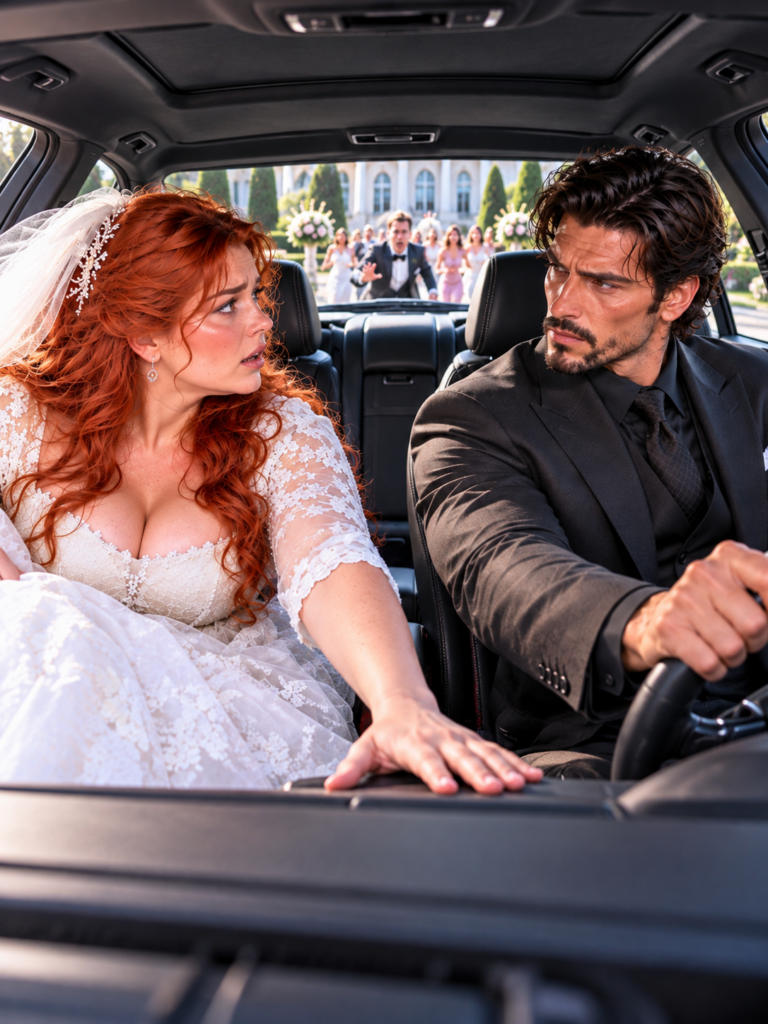
She pulled open the passenger-side door, threw herself inside, and landed in a spectacular avalanche of silk and lace.
“Get me out of here.”
The man behind the steering wheel slowly turned his head.
He was large, dark-haired, and dressed in a charcoal suit that looked expensive enough to pay for her wedding twice. His face was striking, but not in the polished, pleasant way of the man she had almost married. There was something immovable about him, something cold and disciplined, as though the entire world had learned to accommodate his silence.
Marintella barely registered any of it.
“Please,” she gasped. “Just drive. Don’t ask questions. I’ll pay you whatever you want.”
For a moment, the man simply studied her.
Then he shifted the car into drive.
And the most dangerous man in the state drove away with a runaway bride who had absolutely no idea who he was.
Ninety seconds earlier, Marintella had still believed she was getting married.
Not because she was in love.
That was something she had stopped expecting long before she met Bennett Thorne.
At twenty-nine, Marintella understood how to behave. She knew when to smile, when to lower her voice, how to make disagreements disappear before they embarrassed anyone important.
She had spent her childhood in a house where her father made decisions, her mother softened their consequences, and their daughter was praised for being agreeable.
Her father had loved her, in the complicated way some powerful men loved their children. He had wanted to protect her from everything difficult, including responsibility. When she asked questions about his business, he promised there would be time to explain when she was older.
There never was.
After his death, her uncle Gerald assumed control of the family trust and the distillery her father had built from nothing.
Teller Spirits was not a vast corporation. It was a modest, respected distillery in the valley, employing forty people whose livelihoods depended on its survival.
To Marintella, it was also the last tangible piece of her father.
Gerald reminded her constantly that running it required experience she didn’t possess.
He always delivered his opinions kindly.
That was what made them so effective.
“You’ve never had to concern yourself with these things, sweetheart,” he would say. “Your father made certain of that. Let me carry the burden.”
Eventually, she stopped asking about the accounts.
Then Gerald introduced her to Bennett Thorne.
Bennett was handsome, impeccably mannered, and descended from the sort of family whose name opened doors without anyone touching the handle.
He remembered birthdays. He ordered excellent wine. He sent extravagant flowers and complimented Marintella’s dresses.
He also spoke about their future with the smooth confidence of a man describing property he had already purchased.
For eight months, she told herself that affection could become love.
During the dress fittings, when her curvy figure was wrapped in expensive silk and everyone assured her she looked beautiful, she smiled and tried to quiet the uneasiness in her stomach.
She told herself every bride was nervous.
She told herself a practical marriage could still be happy.
Most importantly, she told herself Gerald knew what was best.
Then, on her wedding day, while waiting in a reception corridor for the photographer, she heard her uncle’s voice through a partially open door.
“We only need her signature.”
Marintella stopped.
Gerald was speaking to Royston Thorne, Bennett’s father.
“Once she’s married, the trust moves into the spousal arrangement. Her birthday becomes irrelevant.”
Royston’s response was too low to distinguish.
Gerald continued.
“She turns thirty in three weeks, Royston. Three weeks. After that, everything passes directly into her control. She’ll be entitled to examine every account, every transaction. We can’t allow that.”
Marintella felt the first cold thread of fear.
“Today,” Gerald said, “the loan is forgiven. You take the company, I remain protected, and the entire problem disappears. We need her to say yes before she begins asking questions.”
A brief silence followed.
Then Royston laughed.
“Girls like her don’t ask questions, Gerald. That’s precisely why we chose her.”
Marintella stared at the door.
For a moment, the words refused to form a coherent meaning.
Then she understood.
The marriage was not about Bennett.
It was not about companionship or combining two distinguished families.
It was a transaction.
Her inheritance would transfer fully into her control when she turned thirty, and her uncle intended to arrange her marriage before that could happen.
Her father’s distillery was the payment.
And she was the signature.
Marintella looked down at the ivory silk covering her body.
She had spent twenty-nine years learning to say yes.
For the first time, she realized that obedience had a price.
Then she turned and ran.
Now, inside the black Nissan, that decision was carrying her away from the vineyard at a speed that made the passing scenery blur.
The driver hadn’t asked her name.
He hadn’t demanded an explanation.
He had simply obeyed.
This was remarkable for several reasons, none of which Marintella yet understood.
The man’s name was Ivo Dante.
For two years, Ivo had been investigating the financial activities of Thorne Holdings, a corporate operation that acquired legitimate businesses, restructured questionable loans, and moved enormous sums of money through companies that often didn’t understand what they were being used for.
Someone powerful was laundering money through Royston Thorne’s network.
Someone Ivo wanted to identify.
He had come to the wedding venue personally, against the advice of practically everyone who worked for him, hoping to observe which influential guests Royston treated as superiors.
Instead, a frightened woman in a wedding dress had opened his car door and ordered him to leave.
Ivo should have told her she was making a serious mistake.
He had intended to.
But when she looked at him, there was no recognition in her expression.
No calculation.
No fear of what he might do.
She looked at him as though he were an ordinary man capable of doing an ordinary kindness.
And she needed that kindness desperately.
It had been a very long time since anyone had looked at Ivo Dante that way.
In the front passenger seat, Bino, who had worked for Ivo for eleven years, turned slowly toward his employer.
He looked at the runaway bride.
He looked at Ivo.
Then he looked at the road.
After a moment of careful consideration, he decided that remaining silent was the safest professional decision available.
They had traveled nearly two miles before Marintella’s breathing settled.
“I’m so sorry,” she said.
Ivo kept his attention on the road.
“For what?”
“For all of this. Getting into your car. Telling you what to do. Making you drive away from a wedding when you were probably there for your own reasons.”
“You were in a hurry.”
“Yes. Well. That’s putting it mildly.”
She tried to smooth her dress, but the fabric occupied an unreasonable amount of space.
“I should explain that I’m not normally like this. Usually I’m very polite.”
Ivo glanced at her.
“You don’t seem particularly polite.”
Despite herself, she gave a startled laugh.
“No. I suppose I don’t. I’m trying something different today. So far, I can’t recommend it.”
Then she looked through the rear window.
Her laughter disappeared.
Three vehicles had emerged from the vineyard road.
At the front was a white limousine she knew intimately. Behind it, a dark-gray sedan was closing the distance.
“Oh, no.”
Ivo noticed her expression in the mirror.
“People you know?”
“My uncle. The gray car belongs to him. And the limousine…”
She swallowed.
“That belongs to Bennett.”
“Your husband?”
“Not quite.”
“Then?”
“My almost-husband.”
Ivo considered that.
“An important distinction.”
“There are two hundred people back there,” she whispered. “Two hundred guests. An entire wedding. I left him standing there.”
“Did you want to marry him?”
“No.”
“Then you saved him considerable trouble.”
Marintella stared at him.
He had said it without comfort or judgment, as simply as a man observing that the road was wet.
Something in her chest loosened.
Then the gray sedan accelerated.
“Can you lose them?”
Ivo looked at the mirror again.
“Yes.”
“Please do.”
He waited.
Marintella squeezed her hands together.
“If they catch me, I’ll go back. I know I will. My uncle will speak to me, and I’ll apologize, and somehow I’ll end up married before sunset because that’s what always happens.”
Her voice trembled.
“I need a little time before they find me. Just enough time to understand what I’ve heard. Enough time to count.”
“Count?”
She shook her head.
“It’s complicated.”
“I have a full tank of gas.”
He took the next bend without slowing.
The tires gripped the pavement. The vineyard wall vanished behind them, and the pursuers began to fall back.
Marintella watched the road unfold ahead.
Then something familiar caught her attention.
“Left,” she said suddenly.
Ivo turned his head slightly.
“Left?”
“At the old barn. There’s a narrow road beside it. It leads down to the river. No surveillance cameras, and it’s too narrow for another car to pass you.”
Ivo made the turn.
Bino glanced over his shoulder, his expression changing from professional disbelief to genuine interest.
“How do you know that road has no cameras?”
“I grew up here.”
She leaned forward, watching the landscape.
“I know every road in this valley. When you spend your entire childhood being driven wherever someone else decides you should go, you learn the routes.”
“Next junction?” Ivo asked.
“Right. Then stay close to the river. The vines block the view for almost a mile.”
He followed her instructions precisely.
At the junction behind them, the pursuing vehicles chose the main road.
The gray sedan disappeared toward the highway.
Marintella watched until the last trace of it was gone.
She released a breath that seemed to have been trapped inside her for years.
“You’re good at this,” Ivo said.
“Escaping?”
“Knowing where to go.”
“I used to plan escape routes when I was little,” she admitted. “Not because I thought I’d use them. Just because I liked knowing there was a way out.”
She looked down at her trembling hands.
“Today I actually opened a door. Unfortunately, it was the wrong car door.”
From the front seat, Bino made a small sound.
Ivo spoke before he could say anything.
“No.”
Bino turned.
“Boss?”
“Whatever you’re about to say, don’t.”
“I was going to offer the lady some water.”
A long silence followed.
Then Bino reached for a bottle and passed it back.
Marintella accepted it with both hands.
“Thank you.”
“You’re very welcome, miss.”
The simple kindness nearly undid her.
She had endured months of instructions disguised as affection and an entire morning of people adjusting her dress, her hair, her schedule, and her future.
But a stranger offering her water without asking for anything in return made her eyes fill with tears.
She turned toward the window so neither man would see.
Ivo saw anyway.
For several miles, he said nothing.
The valley spread around them in the amber light of late afternoon. Vines ran in neat lines over the hillsides. The river flashed silver between the trees.
Inside the car, the silence gradually stopped feeling threatening.
Eventually, Marintella asked, “Why did you drive?”
Ivo glanced at her through the mirror.
“You asked me to.”
“That can’t be the entire reason.”
“It was an interesting request.”
“I was a complete stranger. You could have told me to get out.”
“Yes.”
“But you didn’t.”
“No.”
She waited.
Ivo was not accustomed to explaining himself. In his world, explanations were either unnecessary or dangerous.
Yet this woman had asked him a question without even knowing what answering it might cost.
“Most people who enter my car know who I am,” he said at last. “They know what they’re expected to say. They ask permission before sitting down.”
Marintella frowned.
“That sounds exhausting.”
“It is predictable.”
“Those aren’t necessarily the same thing.”
An almost-smile touched his mouth.
“No. I suppose they aren’t.”
He drove another few seconds before continuing.
“You weren’t afraid of me. You didn’t try to impress me or negotiate with me. You needed help, and you assumed I might give it.”
She watched him carefully.
“And you liked that?”
“I’d forgotten what it felt like to be useful to someone who wasn’t afraid of me.”
The honesty unsettled her more than a threatening answer would have.
“That sounds lonely.”
Ivo looked at her in the mirror.
“It is.”
Neither spoke for a while.
Then Marintella began noticing things.
The glass in the windows was unusually thick.
The doors were heavier than ordinary car doors.
Bino paid close attention to side roads and approaching vehicles, though he did it so discreetly that she nearly missed it.
Ivo wore a watch worth more than her entire honeymoon.
When a police vehicle passed in the opposite direction, neither man looked remotely concerned.
And there was something else.
The stillness around Ivo was not the quiet patience of a chauffeur.
It was the authority of someone accustomed to having other people move when he entered a room.
Marintella studied his reflection.
“You aren’t a driver.”
“No.”
She looked at Bino.
“And he’s not just your friend.”
Bino seemed to find the windshield suddenly fascinating.
“I’m an employee, miss.”
“An employee who watches every intersection like someone might attack us.”
“An attentive employee.”
She turned back to Ivo.
“Who are you?”
“Ivo Dante.”
The name meant little to her at first.
“Why were you outside my wedding?”
“I was watching Royston Thorne.”
“Why?”
“Our interests overlap.”
“What sort of interests?”
“The sort that makes men very careful when they speak to me.”
Marintella stared at him.
She thought about the armored car, the expensive suit, the absolute absence of fear.
“You’re involved in organized crime.”
“Yes.”
Her mouth opened.
Then closed.
“You’re a Mafia boss.”
Ivo didn’t deny it.
For several seconds, she could only look at him.
Of all the cars outside her wedding, she had chosen the one containing a man even Royston Thorne might fear.
She pressed the heels of her hands over her eyes.
“Of course,” she murmured.
Bino looked at her.
“Miss?”
“Of course this would happen to me. Two hundred cars, and somehow I choose the Mafia boss.”
“Technically,” Bino offered, “there were fewer cars than guests.”
Ivo gave him a warning glance.
Bino faced forward again.
Marintella let out a shaky, disbelieving laugh.
“I should be terrified.”
“Most people are,” Ivo replied.
“That’s not helping.”
“I wasn’t attempting to.”
She looked at the door.
Then at the road ahead.
She could ask him to stop. She could get out, find a telephone, and try to piece together her life alone.
But the man had already helped her without demanding an explanation.
And he had been watching Royston Thorne.
A thought began to form.
“Can I tell you something?”
Ivo’s expression grew attentive.
“Yes.”
“I think the reason you were watching my almost-father-in-law might be the same reason I ran away from his son.”
And then she told him.
She told him about Teller Spirits, the little distillery her father had built and loved.
She told him about Gerald’s control of the trust, about the birthday three weeks away, and about the marriage arrangements that suddenly made terrible sense.
She repeated the conversation she had overheard.
The signature.
The transfer.
The promise that Royston would receive the distillery once she became Bennett’s wife.
Then she told Ivo about the loan.
“My uncle borrowed money against the company after my father died. He said the business needed it. Thorne Holdings owns the debt.”
Ivo’s expression changed.
Marintella didn’t notice.
“Gerald told me that if I didn’t marry Bennett, the Thornes could demand immediate repayment. We’d never survive it. The distillery would be liquidated.”
She twisted the wedding ring that had never been placed on her finger, rubbing the bare skin instead.
“Forty people work there, Ivo. Forty families depend on that company. If I refuse the marriage, I don’t just lose my inheritance. They could lose everything.”
She looked at him helplessly.
“That was the choice they gave me. Marry Bennett and save the business, or save myself and destroy what my father built.”
Ivo was silent.
Then he spoke in a voice so quiet that Bino turned slightly in his seat.
“Thorne Holdings.”
He repeated the name as though testing a lock.
“The loans. The acquisitions. The companies that become dependent on them.”
He looked at Marintella.
“Your father’s distillery is part of the mechanism I’ve been investigating.”
She went still.
“What mechanism?”
“Royston Thorne acquires legitimate businesses with clean accounts. He creates debts they can’t escape, takes control, and uses those companies to move money that should never enter the banking system in the first place.”
Marintella felt cold.
“My father’s company?”
“That’s what it appears to be.”
She shook her head.
“But it’s small.”
“That makes it useful. A respectable little business is easier to hide behind than an openly criminal one.”
Ivo leaned forward slightly.
“You weren’t being married into the Thorne family, Marintella. You were being used to complete another acquisition. Your uncle arranged the paperwork. Royston arranged the financial pressure. Bennett was the instrument that would make it look legitimate.”
She thought about the wedding guests, the flowers, the beautiful dress, and eight months of polite courtship.
All of it arranged to make her surrender the one thing she had never been permitted to understand.
For the first time since leaving the vineyard, she stopped shaking.
A colder emotion had taken fear’s place.
Anger.
“They thought I wouldn’t notice.”
Ivo watched her.
“Yes.”
“They thought I couldn’t understand.”
“They were counting on it.”
Marintella looked at her hands.
She had been afraid of numbers all her life because the men around her had told her numbers were complicated, burdensome, unsuitable things.
But now she understood the simplest calculation of all.
Her inheritance.
Their debt.
Her marriage.
Their profit.
She raised her eyes.
“Then they’re going to discover something about me.”
“What?”
Her voice was still quiet.
“I can learn to count.”
Part 2
The house Ivo Dante brought her to was almost as unsettling as the car.
It stood behind a long, quiet driveway, surrounded by trees and bordered by walls that offered privacy without appearing particularly defensive.
The house itself was elegant, spacious, and strangely impersonal.
There were expensive furnishings, wide windows, and carefully chosen works of art. But nothing suggested anyone actually lived there.
No photographs.
No books abandoned beside a favorite chair.
No shoes by the door.
Marintella stood in the entrance hall, still wearing her enormous wedding dress, and looked around.
“Do you live here?”
“Sometimes.”
“That’s a very expensive way to say no.”
Ivo glanced at her.
“It’s one of several places I use.”
She nodded slowly.
“Of course it is.”
Bino appeared carrying a tray.
“I’ve arranged some coffee, miss. And I’ll have suitable clothes brought here.”
Marintella looked down at her dress.
“Thank you. I think I’ll keep this on.”
Bino hesitated.
“Miss, with respect, the hem appears to have collected half the vineyard.”
“I know.”
“It’s also rather difficult to walk in.”
“I know that too.”
He glanced at Ivo, who gave a barely perceptible shrug.
“Very good, miss.”
When Bino left, Ivo gestured toward the sitting room.
“Come. We need to talk about the loan.”
Marintella followed him.
Her dress whispered against the polished floor as she walked into a room with pale walls, tall windows, and furniture arranged with almost mathematical precision.
She lowered herself carefully onto a sofa.
Ivo took the chair opposite her.
For the first time since they met, she had an opportunity to study him without the distraction of danger.
He was handsome, certainly, but there was nothing inviting about his appearance.
His dark suit was immaculate. His movements were controlled. Even while seated, he seemed prepared to rise and deal with a threat before anyone else noticed it existed.
His face revealed very little.
She wondered how many people had sat across from him feeling afraid.
Then he began speaking.
“Here’s what will happen. Tonight, I’ll acquire the debt Thorne Holdings holds against your distillery.”
Marintella blinked.
“What?”
“Royston’s companies are overextended. They’ll sell the note if approached correctly. Particularly to someone they’re reluctant to refuse.”
She understood what he meant.
He continued.
“Once I own it, I’ll release the debt. There will be no financial claim against Teller Spirits. Your uncle will lose his leverage, and the Thornes will have no reason to threaten the company.”
He spoke calmly, as though he were discussing a routine business expense.
“In three weeks, you’ll turn thirty. The trust will transfer. You can hire your own attorneys, examine the accounts, and decide what to do with the business.”
He leaned back.
“It’s a straightforward solution.”
Marintella stared at him.
“You can do that?”
“Yes.”
“Just buy the loan?”
“Yes.”
“And forgive it?”
“Yes.”
“How much money are we talking about?”
“It isn’t important.”
“It sounds important.”
“Not to me.”
The casualness of his answer made her chest tighten.
He could solve the nightmare that had controlled her life for eight months with a telephone call and an amount of money he wouldn’t miss.
For one extraordinary second, she felt the temptation to accept.
She imagined returning to the distillery, safe from Gerald and the Thornes. She imagined the forty employees continuing their ordinary lives, unaware of how close everything had come to disaster.
She imagined finally sleeping without fear.
Then she imagined another powerful man making the arrangements.
Another man deciding what would happen to her.
Another debt of gratitude she could never quite repay.
“Why?” she asked.
Ivo frowned slightly.
“Why what?”
“Why would you do that for me?”
“Because I can.”
“That isn’t a reason.”
“The Thornes are already my concern. Damaging their financial operations serves my interests.”
He paused.
Then added, more quietly, “And because you asked me to get you out of there.”
Marintella looked at him for a long moment.
He met her gaze without moving.
Finally, she said, “That’s the kindest thing anyone has ever offered to buy for me.”
Something in his expression eased.
“Then we’ll proceed.”
“No.”
The word settled between them.
Ivo didn’t move.
“Excuse me?”
“I can’t let you do it like that.”
“Like what?”
“Take over. Fix everything. Hand me the finished result.”
His brow furrowed.
“Marintella, you don’t understand the danger.”
She laughed softly, though there was no amusement in it.
“Do you know how many times I’ve heard that sentence?”
He said nothing.
“My father said it when I wanted to know about the distillery. Gerald said it whenever I asked about the trust. Bennett said it when I asked why we needed to marry before my birthday.”
She looked around the beautiful, impersonal room.
“Every man in my life has told me I didn’t understand something. Then he offered to handle it for me.”
“This isn’t the same situation.”
“I know. That’s what makes it difficult.”
She clasped her hands in her lap.
“You aren’t trying to hurt me. You genuinely want to help. But if I let you arrange my future without my participation, what changes?”
“The Thornes lose their control.”
“And someone else takes responsibility for my life.”
Ivo’s eyes narrowed, not in anger, but concentration.
She continued.
“All my life, men have made decisions for me and called it protection. Some meant well. Some didn’t. But the result was always the same.”
Her voice strengthened.
“I became a woman who didn’t know how to make a choice without asking permission.”
“You made one today.”
“I ran away.”
“You saved yourself.”
“For a few hours.”
She looked directly at him.
“If you make all the decisions now, I’ll still be the same person tomorrow. Just in a prettier cage.”
Ivo remained silent.
She had expected an argument.
Perhaps he would tell her she was being foolish, that pride was dangerous, that she ought to be grateful.
Instead, he seemed to be examining an idea he had never encountered before.
“You’re refusing because you want to do it yourself,” he said slowly.
“Yes.”
“Even if doing it yourself costs you more?”
“Yes.”
“Even if it’s more difficult?”
“Especially then.”
“Why?”
Marintella considered the question.
“Because surviving something isn’t the same as being free of it.”
The words surprised her.
She had never said anything like them aloud.
But once spoken, they felt unmistakably true.
“If you remove every obstacle and deliver my life back to me, I’ll be grateful. I’ll be safe. But I won’t know whether I could have stood up to Gerald.”
She drew a breath.
“I need to know.”
Ivo watched her for several seconds.
Then he asked a question no one had asked her all day.
“What do you want me to do?”
Her throat tightened.
Not what should be done.
Not what’s best for you.
What did she want?
She took her time answering.
“I want to go back.”
He straightened.
“To the wedding?”
“Yes.”
“Your uncle will be there.”
“I know.”
“So will Royston Thorne.”
“I know that too.”
“They may try to intimidate you.”
“I’m certain they will.”
“Then why return?”
Marintella looked at the dirt staining the hem of her wedding dress.
“Because I ran without telling them why.”
“That’s not a crime.”
“No. But they’ve spent my entire life speaking for me.”
She raised her head.
“Gerald will tell everyone I was overwhelmed. Bennett will tell them I became hysterical. They’ll decide I was confused, frightened, incapable of understanding my own feelings.”
She swallowed.
“And some part of me will believe them.”
Ivo’s expression grew very still.
“I need to stand in front of those people and tell them exactly what I know. I need Gerald to hear me refuse him where everyone else can hear it too.”
“You want a public confrontation.”
“I want my own decision to be impossible to misunderstand.”
He considered her words.
“And the loan?”
“That’s where I need help.”
She leaned forward.
“I can face them. I can say no. I can live without Bennett, without Gerald, without anyone telling me who I’m supposed to be.”
Her eyes filled with sudden tears.
“But I can’t let forty innocent people lose their jobs because I decided to become brave.”
She wiped her cheek impatiently.
“So yes, I need you to remove the loan. But I need to be the one who goes back and refuses the marriage.”
Her voice steadied.
“Clear the obstacle. Then stand aside and let me walk.”
Ivo looked at her as though she had just proposed something far more dangerous than confronting the Thorne family.
He knew how to purchase obedience.
He knew how to reward loyalty and punish betrayal.
He had built an empire in which every favor created an obligation.
Even kindness had a price, whether anyone admitted it or not.
Now this woman was asking him to help her without using that help to claim any part of her life.
He could not remember the last time anyone had demanded something so difficult.
Finally, he nodded.
“Very well.”
Marintella hardly dared breathe.
“I’ll acquire the loan and have it discharged. Your employees won’t be used as leverage. Your uncle won’t be able to threaten the distillery with that debt.”
He paused.
“What happens afterward will be your decision.”
She stared at him.
“Really?”
“Really.”
“And you won’t interfere?”
“Unless you ask me to.”
She smiled faintly.
“I may be terrible at this.”
“Probably.”
Her smile disappeared.
“That’s supposed to be reassuring?”
“I’ve never been particularly skilled at reassurance.”
A laugh escaped her before she could stop it.
Ivo studied her, visibly surprised.
Then, for the first time, she saw him almost smile.
“I’ll take you back myself,” he said.
“You don’t have to.”
“I know.”
“Why, then?”
“Because when you enter that room, there should be at least one person present because you chose him to be there.”
Marintella looked down.
She had spent the morning surrounded by people selected by Gerald, invited by Royston, approved by Bennett, and organized around a future that had never truly belonged to her.
One man, dangerous though he was, was offering to stand where she asked him to stand.
Not in front of her.
Not above her.
Behind her.
“Thank you,” she whispered.
Ivo nodded once.
Then he reached for his telephone.
“Bino. We need the Thorne note.”
The hours that followed were unlike any Marintella had experienced.
Bino was sent to arrange the acquisition and obtain the documents. He called periodically with updates delivered in the grave tone of a man directing a military operation.
“The note is being transferred, boss.”
Later:
“Thorne’s attorney attempted to object.”
Ivo asked, “And?”
“He became more cooperative after learning who was requesting the purchase.”
Then:
“Gerald has made several calls to the wedding venue asking whether the bride has returned.”
Marintella, still wearing her dusty dress, said, “Let him wonder.”
Bino paused.
“Very good, miss.”
She found that she enjoyed saying such things.
It was an unfamiliar pleasure.
While they waited, Ivo and Marintella sat opposite each other in the quiet sitting room.
Two untouched cups of coffee rested on the table.
At first, they spoke about the practical arrangements. Then the conversation shifted toward things neither had expected to reveal.
“You could have bought the note without telling me,” Marintella said.
“Yes.”
“Why didn’t you?”
Ivo looked into his coffee.
“Habit made me offer a solution. You refused it. That forced me to consider why you were refusing.”
“And?”
He turned the cup slowly between his fingers.
“I realized that almost everything I’ve ever given anyone has carried a condition.”
Marintella listened.
“I provide protection. I receive loyalty. I forgive a debt. I acquire influence. I offer money. Someone becomes obligated to me.”
He set the cup down.
“I was about to do the same thing to you without even recognizing it.”
“You weren’t asking for anything.”
“Not openly.”
She waited.
Ivo met her eyes.
“I wanted you to trust me. Perhaps to depend on me. And because I’m accustomed to receiving what I want, I assumed giving you what you needed would be enough.”
Marintella felt a quiet ache beneath her ribs.
“You noticed.”
“You made it difficult not to.”
“My father never noticed,” she said.
Ivo waited.
“He loved me. I know he did. But he made choices about everything. What I studied. Where I went. What I was allowed to know.”
She looked toward the windows.
“He wanted a daughter who was safe. He never noticed that he was making me helpless.”
“And your uncle?”
“He discovered helplessness was convenient.”
Ivo’s face hardened.
Marintella shook her head.
“Don’t look like that. You promised.”
“I haven’t done anything.”
“You’re thinking about doing something.”
“That isn’t prohibited by our agreement.”
She laughed.
“No, I suppose it isn’t.”
The laughter faded.
“What about you?” she asked.
“What about me?”
“Have you always been the man who decides everything?”
Ivo leaned back.
For a long time, he said nothing.
Then he replied, “I was born into a family where my future had already been determined.”
Marintella studied him.
“The organization?”
“Yes.”
“You inherited it?”
“A name. An empire. Expectations. Rules I was required to follow long before I was old enough to understand them.”
He looked at her.
“People assume power means freedom.”
“Doesn’t it?”
“Sometimes it means responsibility you can’t abandon without destroying everything attached to you.”
His voice remained composed, but she heard something underneath it.
Fatigue.
“Your cage came with rules about obedience,” he said. “Mine came with authority. People don’t call it a cage when everyone inside addresses you as king.”
Marintella gazed at him.
“And have you ever tried to leave?”
“No.”
“Why?”
“Because I stopped believing it was possible.”
The admission lingered between them.
“Maybe it isn’t too late,” she said.
“For me, the exits aren’t so simple.”
He did not sound bitter.
Only certain.
“But I can do something different with the power I have.”
“What?”
He looked at her.
“I can open a door for someone else without expecting them to remain attached to me afterward.”
Marintella felt an unfamiliar warmth.
Not gratitude.
Not the frightened dependence she had felt toward her father.
Something quieter and more dangerous.
She wanted to be near Ivo Dante because, for the first time in her adult life, she understood that she was allowed to want something.
She did not have to act on that desire.
She did not have to surrender anything to it.
She could simply recognize it as her own.
The realization frightened her almost as much as the wedding had.
“I have to tell you something,” she said.
Ivo waited.
“When we go back, I might lose my courage.”
“You won’t.”
“You can’t know that.”
“I can make an informed assessment.”
She shook her head.
“You don’t understand what Gerald is like. He only has to say my name a certain way. Sometimes that’s enough to make me feel eleven years old again.”
Her hands tightened.
“He’ll tell me I’m embarrassing myself. That I’m tired. That I’ll regret making a scene.”
She looked at Ivo.
“And a part of me will want to apologize, climb into the limousine, and marry Bennett just to make everyone stop looking at me.”
Ivo studied her with complete seriousness.
“Marintella, the woman your uncle trained to obey would never have directed a stranger through a camera-free route to escape her own wedding.”
She looked up.
“She wouldn’t have questioned the finances.”
He continued.
“She wouldn’t have refused the easiest rescue I could offer.”
“I nearly accepted.”
“But you didn’t.”
He leaned forward.
“You’ve spent years wearing the personality other people chose for you. Today, you discovered it doesn’t fit anymore.”
Her eyes shone.
“What if I forget?”
“Then remember what you did in the car. You gave directions. You made decisions. You changed the outcome.”
He paused.
“Your uncle doesn’t know who is coming back into that room.”
Before she could answer, Bino appeared in the doorway.
His telephone was in one hand.
For the first time that afternoon, he was smiling.
“Boss. The note is ours. Transfer completed. The release is arranged.”
Ivo gave a single nod.
“Good.”
Bino looked at Marintella.
“Thorne Holdings no longer has a claim against the distillery, miss.”
She closed her eyes.
Forty employees.
Forty jobs.
A business her father had devoted his life to building.
Safe.
She allowed herself one long breath.
Then she stood.
The silk of her wedding dress settled around her.
“Then we’re going back.”
Ivo rose.
“You can still choose not to.”
“I know.”
“There’s no obligation.”
“I know that too.”
She lifted her chin.
“That’s why I’m going.”
On the return drive, the sky had begun to darken over the vineyards.
Marintella watched familiar hills appear beyond the windshield.
Her hands started trembling again.
She hid them in the folds of her dress.
Ivo noticed but didn’t comment.
Eventually, she broke the silence.
“You really are terrible at comforting people.”
“So I’ve been told.”
“Try.”
He glanced at her.
“Try what?”
“Comforting me. I’m about to do the most frightening thing I’ve ever done, and I would appreciate one encouraging sentence from the dangerous man who got me into this situation.”
“You entered my car.”
“Details, Ivo.”
Bino coughed into his fist.
Ivo considered her request with the concentration of a man reviewing a complicated contract.
Then he spoke.
“You’ve already done the thing they feared.”
Marintella looked at him.
“What thing?”
“You counted.”
He returned his gaze to the road.
“You examined the situation and recognized what they were trying to take from you. That’s why they needed you to remain obedient.”
The vineyard gates came into view.
“Everything that happens now is simply you telling them what you’ve learned.”
Marintella sat very still.
Then she nodded.
The reassurance wasn’t gentle.
It wasn’t romantic.
It didn’t promise that everything would feel easy.
But it was true.
And somehow that made it the kindest reassurance she’d ever received.
As the Nissan approached the estate, Marintella straightened her veil, smoothed the wrinkled silk, and drew a steadying breath.
This time, she was not entering the building as a bride being delivered to her future.
She was entering as the woman who intended to take that future back.
Part 3
By the time Marintella returned to the vineyard, the wedding had become a scandal.
The ceremony was long overdue. The musicians had stopped playing. Waiters moved uneasily between tables crowded with untouched champagne.
Two hundred guests remained inside the grand ballroom, uncertain whether they were waiting for a marriage, an explanation, or an announcement that the entire event had been canceled.
Most had spent the afternoon whispering.
Some believed the bride had suffered a nervous collapse.
Others thought she had run away with another man.
No one knew the truth.
Then the ballroom doors opened.
Marintella walked inside.
Her wedding dress was still magnificent, but its hem was streaked with dirt. Her veil hung imperfectly. Strands of hair had escaped the elaborate arrangement that had taken a stylist nearly two hours to create.
She did not look like the flawless bride who had arrived that morning.
She looked like someone who had survived something.
Conversations faded around her.
At the far end of the room, Gerald turned.
His face moved through relief, disbelief, and anger before settling into the familiar expression of affectionate concern he had used on her for years.
“Marin, sweetheart.”
He started toward her.
She stopped walking.
“Uncle Gerald.”
Something in her tone made him hesitate.
Bennett rose from a table near the front. His expensive suit was immaculate, but his expression was tight with humiliation.
Beside him, Royston Thorne watched with the stillness of a man attempting to determine whether an investment had gone disastrously wrong.
Marintella felt everyone’s attention settle on her.
Her stomach twisted.
For a terrifying second, she wanted to disappear.
Then she remembered the black car.
The river road.
The loan documents.
The strange, powerful man who had promised to stand behind her.
She did not turn to look for him.
She already knew he was there.
“I owe everyone an explanation,” she began.
Her voice carried farther than she expected.
She steadied it.
“There isn’t going to be a wedding today.”
A murmur moved through the crowd.
Gerald lifted a hand.
“Marin, let’s discuss this privately.”
“No.”
One word.
Not shouted.
Not apologized for.
Gerald stopped.
Marintella looked around the ballroom.
“I discovered this afternoon that my marriage to Bennett wasn’t arranged because our families believed we’d be happy together.”
She glanced at Bennett.
“It was arranged because my uncle and his father wanted control of my father’s distillery.”
Royston’s expression went cold.
Gerald tried to interrupt.
“That’s an outrageous misunderstanding.”
Marintella continued.
“I turn thirty in three weeks. At that point, the family trust passes directly into my control. My uncle arranged for me to marry before that happened.”
Guests exchanged uneasy looks.
“The marriage would have placed my father’s company under the financial control of the Thorne family. In return, a loan that Thorne Holdings holds against our business would have been forgiven.”
She looked directly at Gerald.
“You arranged for me to give away my inheritance without telling me what I was signing.”
His expression hardened.
“Marin, you’re upset. You don’t understand the legal structure.”
For twenty-nine years, that sentence would have ended the conversation.
This time, Marintella simply shook her head.
“I understand it quite well.”
She took another breath.
“Thorne Holdings owns a loan secured against Teller Spirits. If I refused to marry Bennett, the loan could be called in. The distillery would be forced into liquidation.”
Gerald said nothing.
“Forty people work there. You made their livelihoods dependent on my willingness to marry a man I don’t love.”
Her voice shook, but she continued.
“You gave me a choice between my freedom and the survival of my father’s company.”
She allowed the room to absorb that.
“Then you made certain I believed those were my only options.”
Royston finally spoke.
“You have no understanding of how these arrangements work.”
“Perhaps I didn’t this morning.”
She faced him.
“But I understand something you don’t know yet.”
A faint uneasiness passed across his features.
Marintella’s hands were trembling.
She clasped them together.
“Thorne Holdings no longer owns that loan.”
Royston went completely still.
“What?”
“It was sold this evening. The purchaser has discharged the debt.”
Gerald stared at her.
“No.”
“Yes.”
“That isn’t possible.”
“It has already happened.”
Royston’s eyes narrowed.
Then his gaze shifted toward the back of the ballroom.
A tall man in a charcoal suit stood near the wall, his hands relaxed at his sides.
Ivo Dante.
He wasn’t smiling.
He wasn’t threatening anyone.
He was simply watching.
Royston recognized him immediately.
And in that instant, the businessman understood that the disappearing loan was the least of his problems.
The man who had been quietly investigating his operations now possessed a direct connection to one of the companies inside his financial network.
Ivo met Royston’s gaze.
Neither spoke.
Nothing needed to be said.
Marintella continued.
“The distillery is no longer being held hostage by that debt. In three weeks, the trust becomes mine, and I’m going to examine every account.”
She looked at her uncle.
“With an attorney I choose.”
Gerald’s face drained of color.
“Every payment. Every transfer. Every document you signed while managing my father’s company.”
Her voice grew firmer.
“I’ll learn exactly what happened to the money.”
For a moment, no one moved.
Then Gerald attempted the one maneuver that had always worked.
His voice softened.
“Marin, darling, look at yourself.”
She felt her stomach clench.
“You’re exhausted. Your dress is filthy. You’ve humiliated yourself in front of everyone we know.”
He approached carefully.
“Come with me. We’ll find somewhere quiet. You can rest, and tomorrow we’ll discuss all of this when you’re calmer.”
She knew the voice.
She knew the disappointment hidden inside its gentleness.
Every childhood disagreement had ended this way.
Every attempt at independence had dissolved beneath his patient insistence that she wasn’t ready.
“Please,” he continued. “Don’t do something you can’t take back.”
And there it was.
The sentence that had governed her life.
Marintella felt the old instinct rise within her.
Apologize.
Agree.
Stop making trouble.
She could almost hear herself saying it.
I’m sorry, Uncle Gerald. I was confused. You’re right.
But beneath that familiar voice was something stronger.
Her own.
“You’ve said that to me my entire life,” she replied.
Gerald blinked.
“What?”
“Don’t do anything you can’t take back. Don’t make a decision you’ll regret. Don’t question something you don’t understand.”
She took one step closer.
“You taught me to fear every choice that might have a permanent consequence.”
He opened his mouth.
She didn’t let him interrupt.
“But those are the choices that matter, aren’t they?”
Her voice was clear now.
“I could have married Bennett and lost ten years of my life before admitting it was a mistake. I could have signed away my father’s company and spent the rest of my life wondering why.”
She looked around the room.
“But if I say no here, where everyone can hear me, you can’t pretend I never said it.”
Gerald’s expression shifted.
For the first time, she saw something beneath his confidence.
Fear.
“I’m not marrying Bennett,” she said.
Then, after a deliberate pause:
“No.”
The word seemed to settle into every corner of the ballroom.
She hadn’t screamed.
She hadn’t collapsed.
She hadn’t asked anyone’s permission.
She had simply decided.
And the world did not end.
Bennett, who had been standing rigidly near his father’s table, finally stepped forward.
“Do you have any idea how you’ve made me look?”
Marintella turned toward him.
He gestured at the guests.
“I stood at that altar waiting for you. I defended you. I told everyone you were nervous, that you’d be back.”
“I know.”
“Then you return and accuse my family of stealing your company?”
“I’m telling the truth.”
“You’ve embarrassed me in front of everyone I know!”
Marintella studied him.
For eight months, she had tried to convince herself that he was a good match.
She had admired his appearance, his manners, his certainty about the future.
But now, when their marriage was falling apart, Bennett’s greatest concern was how it would affect his reputation.
“I am sorry I embarrassed you,” she said.
He appeared momentarily satisfied.
Then she continued.
“But I’m not sorry I left.”
His expression changed.
“You thought you were marrying a woman who would fit into the life your father arranged,” she told him. “And today you discovered that woman might want to make decisions of her own.”
“That’s unfair.”
“Perhaps.”
She looked at him with unexpected sadness.
“But you were about to marry someone who didn’t love you, Bennett. Someone who would have spent years growing resentful because neither of us was honest enough to stop this.”
He looked away.
“I hope you find someone who wants the same life you do,” she said. “Someone who chooses you without being persuaded by a financial arrangement.”
She hesitated.
“And I hope you learn to choose her for the same reason.”
Bennett had no answer.
He glanced toward the back of the ballroom.
Something about the man standing near the wall persuaded him not to argue further.
Within an hour, the grand wedding had begun to unravel.
Gerald left with his attorney, looking like a man who had suddenly realized that three weeks was not nearly enough time to prepare for an honest examination of his accounts.
Royston departed even sooner.
He had more urgent matters to consider than his son’s canceled marriage.
Bennett remained longest, nursing his wounded pride until he finally accepted that no one intended to restore the afternoon to the way he wanted it.
The guests gradually disappeared.
The waiters cleared abandoned glasses.
The musicians packed their instruments.
Eventually, Marintella stood alone in the enormous ballroom.
Her wedding had ended.
Her uncle had lost his control over her.
The Thornes had lost their leverage.
And not one terrible thing she had imagined had come true.
The ceiling remained above her.
The floor remained beneath her.
She was still breathing.
She was free.
Then she turned.
Ivo was standing exactly where she had asked him to stand.
Near the back wall.
Behind her.
He had not approached Gerald.
He had not threatened Bennett.
He had not interrupted a single sentence.
Marintella walked toward him.
“You didn’t move.”
“No.”
“Not once.”
“You asked me not to.”
She smiled through sudden tears.
“That must have been difficult.”
Ivo looked at her.
“Marintella, I’ve ordered men to do terrible things with less effort than it took to stand here and keep my hands in my pockets.”
She laughed.
He seemed faintly pleased.
“Thank you,” she whispered.
“For what?”
“For the loan. For coming back with me.”
She paused.
“And for letting me do it.”
Ivo’s expression softened.
“It had to be yours.”
She nodded.
“I know that now.”
They stood together in the emptied ballroom.
For a moment, Marintella wanted to step closer.
She wanted to ask where he would take her next, whether she might see him tomorrow, whether the strange warmth between them meant what she suspected it meant.
Then she remembered what she had promised herself.
Freedom first.
She drew a breath.
“I think I need to be alone for a while.”
Ivo went very still.
She hurried to explain.
“I don’t mean I don’t want to see you. I just spent my entire life with someone deciding what I should do. My father, Gerald, Bennett…”
She looked at him.
“And you could very easily become another powerful man whose world I enter instead of building my own.”
His jaw remained relaxed, but his eyes darkened.
“I know.”
“I need to discover who I am when no one is directing me.”
“That sounds sensible.”
She gave a shaky laugh.
“You don’t sound pleased.”
“I’m not.”
He paused.
“It’s the wisest thing I’ve heard in years, and I dislike it immensely.”
She smiled.
Ivo reached inside his jacket.
For one startled second, she wondered whether he had changed his mind about letting her walk away.
Instead, he removed a card.
He turned it over, wrote a telephone number on the back, and offered it to her.
Marintella accepted it.
“What’s this?”
“A way to find me.”
She looked up.
“Go home,” he said. “Examine the accounts. Run the business. Make mistakes. Decide what sort of life you want.”
He glanced at the card.
“And if, after you’ve done all that, you discover that one of your choices is a man who isn’t particularly good at comforting people…”
Her eyes filled.
“…then you know where to find me.”
“Will you be waiting?”
“I won’t be waiting to rescue you.”
He paused.
“But if you choose to call, I’ll answer.”
Marintella held the card carefully.
Then she smiled.
“Do you know something strange?”
“Tell me.”
“When I ran out of the wedding, there was a limousine parked closer to the door than your car.”
Ivo waited.
“It would have been the obvious choice. Comfortable. Familiar. Safe.”
She glanced down at the card.
“But something in me chose the other car.”
“The dangerous one.”
“The wrong one.”
He inclined his head.
“Apparently.”
She smiled through her tears.
“And it turned out to be the first right choice I’d made in a very long time.”
Ivo looked at her steadily.
“Then make another.”
“I will.”
“And another.”
She nodded.
“A thousand of them.”
Her smile widened.
“And when I’ve made enough to know they’re really mine, I might come looking for you.”
Ivo’s expression changed almost imperceptibly.
“Then choose carefully, Marintella.”
He stepped aside.
She walked past him.
And for the first time in her life, walking away from a man did not mean losing something.
It meant keeping herself.
A year passed.
Not the sort of year in which everything became effortless.
Marintella’s first months at Teller Spirits were exhausting.
There were financial records to review, decisions she had never been taught to make, and questions she sometimes felt embarrassed to ask.
But she asked them anyway.
With an attorney she had selected herself, she examined the accounts Gerald had controlled.
She learned what the numbers meant.
She challenged transactions that didn’t make sense.
She discovered that understanding a business was not a mysterious gift possessed only by men in expensive suits.
It was work.
And she could do the work.
Gerald was gone from the company.
The books had been examined, the irregularities addressed, and the business was hers without question.
All forty employees still had their jobs.
The distillery continued operating.
And Marintella discovered that she was exceptionally good at managing something she genuinely cared about.
She made mistakes.
She corrected them.
She learned to trust her judgment.
Most importantly, she never allowed another person to make a decision simply because he was more comfortable being in charge.
She had earned her freedom.
Then one evening, after closing the last account book on her desk, she opened a drawer.
Inside lay a small card.
She turned it over.
The telephone number was still there.
Marintella smiled.
She picked up her phone and dialed.
The call was answered almost immediately.
“Dante.”
She could hear the quiet authority in his voice.
“Hello, Ivo.”
Silence.
Then:
“Marintella.”
For the first time, he sounded genuinely surprised.
She looked out across the hills, where the evening sun was settling over the vineyards.
“I’ve finished counting,” she said.
Another brief silence followed.
“Are you satisfied with the numbers?”
“Yes.”
“And the distillery?”
“Mine.”
“Good.”
She smiled.
“There’s something else I’ve decided.”
“What?”
She took a breath.
“Come to dinner.”
The man who had faced threats, betrayals, and enemies without visible concern went quiet for several seconds.
Then he said, very softly, “I’d like that.”
Ivo arrived at the distillery that evening.
He was still large, impeccably dressed, and frighteningly bad at making casual conversation.
But when Marintella opened the door, he smiled.
Not the careful expression he used during negotiations.
A real smile.
She invited him inside.
He followed.
And for once in his life, Ivo Dante entered a room without expecting anyone to owe him anything.
In the months that followed, they learned each other slowly.
Ivo learned to ask before offering solutions.
Marintella learned that accepting affection did not require surrendering her independence.
He could protect without possessing.
She could love without obeying.
Bino began visiting the distillery on Thursdays.
Before long, he developed strong opinions about whiskey production, particularly the importance of oak barrels.
He also started referring to the forty employees as “our people.”
Marintella corrected him several times.
Eventually, she stopped.
Bino still called her “miss,” despite her repeated invitations to use her name.
And he still handed her things with extraordinary care, as though she were made of delicate glass.
Once, in a moment of unexpected honesty, he told her that in eleven years of working for Ivo, he had never seen his employer truly learn from another person.
“Then you arrived, miss,” he said solemnly. “And he learned something important.”
“What?”
Bino hesitated.
“That a person can choose to stay without being made to.”
He immediately seemed horrified by his own emotional disclosure.
Marintella pretended not to notice.
Much later, when Ivo and Marintella finally married, the ceremony was small.
It took place at the distillery, on the hillside overlooking the valley.
Forty employees attended.
No ambitious relatives arranged the guest list.
No financial agreements waited behind the vows.
No one stood to gain control of a company.
Marintella wore a dress she had chosen herself.
She walked down an aisle she had chosen herself.
And at the end stood a man she had chosen freely, with no debt, no obligation, and no fear that saying yes meant surrendering her life.
Ivo waited for her with an expression no one in his criminal empire would have recognized.
He looked happy.
When she reached him, he offered his hand.
He did not pull her forward.
He simply waited until she chose to take it.
And when the moment came to speak her vows, Marintella remembered another wedding.
An enormous ballroom.
A twelve-thousand-dollar dress.
A terrible secret behind a half-open door.
And a black Nissan waiting outside.
She remembered the three desperate words that had begun everything.
Get me out.
Then she looked at the man standing before her.
This time, she did not want to escape.
This time, she was exactly where she had decided to be.
“I do,” she said.
Slowly.
Clearly.
Loud enough for everyone to hear.
And Ivo smiled, because the words belonged entirely to her.
A curvy bride had climbed into the wrong car without knowing the man behind the wheel was a Mafia boss.
But that was never the whole story.
The real story was about a woman who had been taught that obedience was love, and a man who had been taught that control was power.
She had needed someone to help her escape.
He had needed someone to remind him that being needed was not the same as being feared.
And somewhere along a narrow road beside a river, they had begun teaching each other something neither had learned before.
The greatest gift you can offer someone is not a perfect future chosen on their behalf.
It is the freedom to choose that future for themselves.
Ivo Dante could clear a thousand roads for the woman he loved.
He could remove obstacles, confront enemies, and stand beside her through every storm.
But he had learned never to take the steering wheel from her.
Because Marintella had spent twenty-nine years being told where to go.
Now, at last, the rest of her life was hers to drive.