
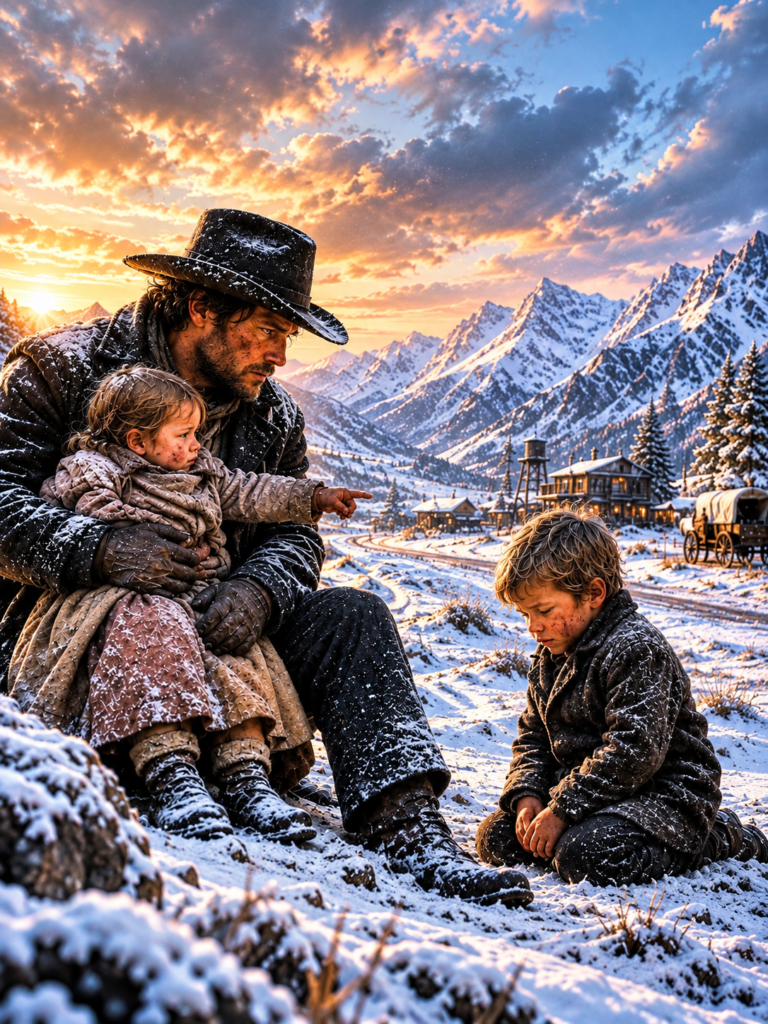
“Daddy, how much does a boy cost?”
Caleb Thornton’s boots stopped dead in the snow.
His daughter, Rosie, was pointing at something behind the livestock pen. He turned, and his chest caved in.
A boy, maybe nine years old, stood on a wooden crate with a rope around his waist. No coat, no shoes, blood frozen on his face.
A man in a black coat held the rope like a leash and was shouting prices to a crowd that watched and did nothing.
Caleb’s hand went to his revolver. His daughter was already running toward the boy.
December 14th, 1887. Burden Creek, Colorado.
“Rosie, stop!”
Caleb caught her arm before she got ten feet.
“Stop right now.”
“But Daddy, they’re hurting him.”
“I know, but you stay behind me. You hear me? Behind me.”
She nodded, her chin shaking.
Caleb pulled her close and moved through the crowd. His bad leg burned with every step. That old Antietam souvenir reminding him that heroes were just fools who hadn’t died yet.
The man in the black coat was still talking. Smooth voice. The kind that sold snake oil and salvation with the same smile.
“Strong boy, good worker. Been with me three years, eats nothing, complains less. Who will start at fifteen dollars? Fifteen dollars for a child?”
The crowd shuffled. Some looked away. Most didn’t.
“Twenty,” someone called from the back.
A rancher Caleb didn’t recognize. Thick neck, mean eyes.
“Twenty dollars. Fine start. Do I hear twenty-five?”
Caleb stopped six feet from the crate.
The boy stood there shaking, his eyes fixed on a point somewhere past the crowd. The same eyes he’d seen in the field hospitals after Antietam. Men who’d already left their bodies and were just waiting for permission to die.
“Thirty,” Caleb said.
The crowd turned.
The man in the black coat looked at him. Up close, Caleb could see a scar running down the man’s left cheek, pale and thick, like someone had tried to open his face with a knife years back.
“Thirty dollars from the gentleman. Do I hear thirty-five?”
“I ain’t buying him.” Caleb’s voice carried across the square. “I’m asking you to take that rope off him before I do it myself.”
The silence that followed was the kind that comes before gunfire.
The scarred man smiled.
“This boy is my legal ward, friend. Got papers signed by Judge Harlon in Denver. I’m his guardian, and I decide what happens to him.”
“Guardians don’t sell children in the street like cattle.”
“Who says I’m selling? I’m finding him proper placement. A work home. Good, honest labor for a boy who’d otherwise starve.”
“He’s already starving.”
Caleb nodded at the boy.
“When’s the last time you fed him?”
“The boy eats fine.”
Rosie stepped out from behind Caleb. He grabbed for her and missed.
She walked straight up to the crate, pulled the peppermint stick from her coat pocket, the one she’d been saving all week, and held it up to the boy.
“Here, it’s peppermint. It’s really good.”
The boy looked down at her.
Something moved behind those empty eyes, just barely, like a candle flame in a room everyone thought was dark.
His hand crept forward, slow, trembling, fingers raw and cracked.
He took the candy and held it like it might explode.
“Rosie.” Caleb’s voice was tight. “Come back here.”
“He’s cold, Daddy. He doesn’t have a coat.”
“I know, baby. Come back here.”
She didn’t move.
Instead, she looked up at the scarred man with her mother’s gray eyes, and her voice came out clear as a church bell in the frozen air.
“You’re mean to him. I can tell. He’s scared of you.”
The scarred man’s smile disappeared.
“Little girl, you should teach your daughter some manners, McKenzie.”
“How do you know my name?”
“Small town. I know everybody’s name.”
The man wound the rope tighter around his fist.
“Now, unless you’re here to bid, step aside. I’ve got business.”
“Your business is over.”
“Says who?”
“Says me.”
Caleb unfastened the leather strap on his holster, not drawing, not yet, but making sure everyone saw.
“You going to shoot me over a stray?” The man laughed. “In front of your little girl, in front of this whole town?”
“I’m going to ask you one more time to take that rope off the boy. After that, I stop asking.”
The rancher in the back called out.
“Just let him have the kid, mister. Ain’t worth the trouble.”
“Shut up,” Caleb said without turning around.
The scarred man studied Caleb. His eyes went to the holster, to Caleb’s hand resting near the grip, to the limp that meant a war wound, to the look in Caleb’s eyes that said this was a man who’d killed before and hadn’t enjoyed it, but hadn’t hesitated either.
“Name’s Morai Slade.” The man’s voice dropped low, just for Caleb. “Remember it, because you’re going to hear it again.”
He unwound the rope from his fist and let it drop.
The boy swayed on the crate, almost fell. Caleb caught him with one arm.
The child weighed nothing. Bones wrapped in skin and held together by something too stubborn to be called hope.
“I’ll be back for what’s mine, McKenzie.”
Slade turned and walked toward the edge of the square, where two men waited on horses. One tall and thin, one short and heavy, both armed.
Caleb watched them ride out.
Then he looked down at the boy in his arm.
Up close, it was worse.
Bruises layered on bruises. Cuts that had scarred over and been cut again.
And around his neck, finger-shaped bruises, purple and fresh.
Someone had choked this child within the last few days.
“Daddy.”
Rosie tugged his coat.
“Daddy, can we take him home?”
“Rosie, it ain’t that simple.”
“Why not?”
“Because…”
He stopped.
“Because why?”
Because it was dangerous. Because Slade would come for the boy. Because Caleb had spent five years building walls around his heart after Martha died, and this child was about to walk straight through them.
“Because I got one good coat, and now it’s on him,” Caleb said. “And I’m freezing. So let’s get inside before we all turn to ice.”
Rosie smiled.
The boy didn’t.
Clara Jennings had the door open before they reached the porch.
Fifty years old, arms like a blacksmith, heart like a cathedral.
“Saw the whole thing from my window.”
She pulled them inside.
“Caleb Thornton, you are either the bravest man in Colorado or the dumbest, and I ain’t decided which.”
“Can I decide after I get warm?”
“Sit him by the stove. Rosie, blankets, top shelf, the wool ones.”
Rosie ran.
Clara was already heating broth.
Caleb set the boy in the chair by the stove.
The child sat rigid, his hands gripping the seat like he expected someone to rip it away.
“You got a name, son?”
Nothing.
The boy stared at the floor.
“He don’t have to talk,” Clara said from the stove. “Give him time.”
“Time’s the one thing we might not have. Slade said he’s coming back.”
“Morai Slade is a snake in a suit. Been hearing things about that mine of his for two years. Children going in, not coming out. But he’s got money and papers and friends in Denver, so nobody says a word.”
“Somebody’s saying a word now.”
Clara looked at him hard.
“You got a seven-year-old daughter, Caleb. You think about that before you go picking fights with men like Slade.”
“I’m thinking about her.”
Caleb nodded toward Rosie, who was dragging a blanket twice her size across the room.
“What kind of father would I be if I taught her to look the other way when a child’s being sold in the street?”
Clara’s mouth opened, then closed.
She turned back to the stove and stirred the broth harder than necessary.
Rosie draped the blanket around the boy’s shoulders.
“There, that’s better, right?”
The boy’s fingers curled into the wool.
His whole body was shaking. Not from cold anymore, from something deeper.
The trembling of a body that hadn’t felt safe in so long it had forgotten how.
“I’m Rosie. I’m seven. That’s my daddy. His name is Caleb, but everyone calls him Mr. Thornton. Except me and Clara and Doc Whitfield and Reverend Callaway. We have a ranch with horses and chickens and a dog named Biscuit. He’s old and fat and he sleeps on your feet.”
The boy stared at her like she was speaking a language from a country he’d never visited.
“Do you like dogs?” Rosie asked.
A pause.
Then, so quiet it was almost nothing.
“Never met one.”
“Never met a dog?”
Rosie’s eyes went wide.
“Daddy, he’s never met a dog.”
“I heard him.”
“We have to fix that. Biscuit is the best dog in the whole world. He’ll love you. He loves everybody except the mailman.”
Something happened in the boy’s face.
A crack, tiny, like ice breaking on a pond in early spring.
Not a smile, not close to a smile, but the ghost of something that might have been one a long time ago.
Clara brought the broth, set it down in front of the boy.
“Drink it slow. Your stomach ain’t used to food. Drink too fast and it’ll all come back up.”
The boy lifted the cup with both hands, shaking so hard the broth sloshed.
He took one sip and his eyes closed just for a second.
And in that second, the emptiness left his face and was replaced by something so raw and desperate that Caleb had to look away.
“What’s your name, son?”
He tried again.
The boy opened his eyes, looked at Caleb, then at Rosie, then at Clara.
Measuring, calculating, running the math that every abused child runs.
Is this real? Will it last? What’s the price?
“Noah.”
Barely a whisper.
“Noah Ward.”
“Noah. That’s a good name.”
“Mister.”
Noah’s hand tightened on the cup.
“That man, Mr. Slade, he’ll come for me. He always does. He’s got papers, legal papers. Says he owns me.”
“Nobody owns you.”
“The judge says different.”
“Then the judge is wrong.”
Noah shook his head.
“You don’t understand. He’s got twenty-two other kids up there. If you make him angry, he takes it out on them. On my…”
He stopped, swallowed.
His eyes went to the floor.
“He takes it out on the others.”
Caleb heard the catch. The word Noah had almost said and pulled back.
My…
My what?
My brother, my sister, my friend.
Someone specific. Someone Noah was protecting even now. Even here. Even while he bled and starved.
“Noah, who’s still up there?”
The boy’s jaw locked.
His knuckles went white around the cup.
“I can’t. If I tell you and he finds out, they’ll get hurt worse.”
“All right.”
Caleb held up his hands.
“All right. You don’t have to tell me. Not now.”
Clara caught his eye across the room and shook her head slightly.
Don’t push. Let it come.
The front door opened, and Dr. Agnes Whitfield walked in.
Silver hair, sharp eyes, medical bag in hand.
She took one look at Noah and her mouth pressed into a thin, hard line.
“Clara sent Rosie’s friend Tommy running to my office five minutes ago.”
She set her bag on the table.
“Let me see him.”
“Doc, he’s scared. Go easy.”
“I’ve been going easy on scared children since before you could shave, Caleb Thornton. Don’t tell me my business.”
Agnes pulled a chair close to Noah.
She didn’t touch him, just sat there, hands visible, voice low.
“I’m Dr. Whitfield. I’m going to check if you’re hurt. I won’t do anything you don’t want me to do. You say stop, I stop. Understand?”
Noah nodded, barely.
The examination took fifteen minutes.
Agnes was thorough but gentle, and with every inch of skin she uncovered, her expression went darker.
Caleb stood by the window.
Rosie sat on Clara’s lap, her face buried in Clara’s shoulder.
When Agnes finished, she helped Noah back into his shirt and pulled Caleb outside.
“How bad?”
Agnes’s voice was ice.
“Three ribs cracked and healed wrong. Rope burns scarred over on both wrists. Lash marks across his back. I counted thirty-seven. Burns on his feet. And Caleb, someone choked that boy hard enough to leave handprints within the last week.”
“Can you document it?”
“I’ve been documenting it since I walked in the door. Every scar, every fracture, every mark. Twelve pages by the time I’m done. If this goes in front of any judge with half a conscience, Slade’s finished.”
“What if the judge doesn’t have half a conscience?”
Agnes looked at him.
“Then God help us all.”
They went back inside.
Noah had finished the broth.
Rosie had escaped Clara’s lap and was sitting beside him again, talking about Biscuit, about the ranch, about Christmas coming.
“Do you know about Christmas?” Rosie asked.
“I know what it is.”
“Do you know about presents?”
“No.”
“Daddy gets me one every year. Last year I got a book about horses. And Clara made me a dress, and Reverend Callaway gave me a Bible with my name on it. This year I’m going to ask for something different.”
“What?”
Rosie looked at her father, then back at Noah.
“A brother.”
The room went quiet.
Clara’s hand stopped stirring.
Agnes looked up from her notes.
Caleb felt something crack inside his chest.
Not break, crack. The way ice cracks before the river starts flowing again.
Noah stared at Rosie.
“You don’t want me as a brother. I’m trouble. Mr. Slade says I’m trouble. Says nobody wants me. Says that’s why my ma died and my pa left, because I wasn’t worth staying for.”
“Mr. Slade is a liar,” Rosie said. “And liars are bad. Daddy says so.”
“Your daddy doesn’t know.”
“My daddy knows everything. Right, Daddy?”
Caleb looked at his daughter, seven years old, with Martha’s fierce heart and Martha’s stubborn jaw.
Then he looked at Noah, this broken child who’d been sold in the street like livestock an hour ago.
And he felt the war inside himself, the one he’d been fighting since Martha died.
Stay safe. Stay small. Don’t love anyone else because everyone you love dies or disappears.
But Martha’s voice was in his head.
The same thing she’d said the night before Rosie was born, when Caleb had confessed he was terrified of being a father.
“You don’t have to be perfect, Caleb. You just have to show up.”
“No,” Caleb said quietly. “I don’t know everything, but I know you’re not trouble, Noah. And I know that man had no right to do what he did to you. And I know you’re coming home with us tonight.”
Noah’s cup clattered against the table.
“What?”
“You heard me.”
“But Slade…”
“Let me worry about Slade.”
“He’s got men. He’s got guns. He’s got the law.”
“And I’ve got a spare bed and a dog that sleeps on your feet.”
Caleb held out his hand.
“That enough for now?”
Noah looked at the hand.
Caleb could see the calculation running behind those dark eyes.
Every adult who’d ever reached for him had hurt him. Every hand that had been offered had been a trap. Every promise had been a lie.
Rosie put her hand on top of Caleb’s.
“We’re nice. I promise. Daddy burns the biscuits sometimes and Clara yells at him for it, but we’re nice.”
“I don’t burn them that often,” Caleb said.
“You burned them yesterday.”
“That was one time.”
“And Tuesday?”
“The stove runs hot.”
Clara snorted from across the room.
“The stove runs fine. You just can’t cook.”
Something happened then.
Small, almost invisible.
The corner of Noah’s mouth twitched.
Not a smile, not even close, but a movement.
A fracture in the wall. A single brick shifting in a fortress that had taken four years to build.
He reached out and put his hand in Caleb’s.
The boy’s fingers were ice cold, raw, trembling.
Caleb closed his hand around them gently, felt the fragile bones, the roughened skin, the pulse hammering fast as a rabbit’s heartbeat.
“All right then,” Caleb said. “Let’s go home.”
Clara had already packed a bundle. Coat, boots, hat, gloves, all pulled from the donation trunk she kept for folks in need.
She dressed Noah with quick, practical hands while she talked.
“This coat belonged to Mrs. Henderson’s boy before he outgrew it. Good wool. Keep you warm through anything. Boots might be a half size big, but we’ll stuff the toes with cloth. Better too big than too small.”
Noah took each item like it was made of gold.
When Clara buttoned the coat and pulled the hat down over his ears, the boy’s eyes filled.
He blinked hard, fighting it.
“Nobody’s ever…”
His voice broke.
“Well, somebody is now.”
Clara straightened the coat collar.
“And if that snake Slade shows up at my door, he’ll get a faceful of cast-iron skillet. You tell him I said so.”
Agnes handed Caleb a folded paper.
“Preliminary findings. I’ll have the full report by morning. Caleb, what you’re doing is right, but it’s going to get ugly.”
“It’s already ugly.”
“It’s going to get worse. Slade won’t let this go.”
“Neither will I.”
They walked out into the cold.
Snow was falling again, thick and steady, covering the tracks where Slade had stood an hour ago.
Caleb lifted Rosie into the wagon, then turned to Noah.
The boy stood on Clara’s porch, wrapped in his new coat, staring at the wagon like it was a ship sailing to a country he’d only heard about in stories.
A country where people were kind and beds were warm and nobody tied ropes around your waist.
“Can you climb up?”
Noah tried.
His legs buckled on the second step.
Caleb caught him, lifted him, set him on the bench beside Rosie.
The boy weighed almost nothing.
Rosie pulled the blanket across both their laps.
“Biscuit’s going to love you so much, Noah. He’s fat and he smells bad after it rains, but he’s the best.”
“I’ve never had a dog.”
“You have one now.”
Caleb climbed up, took the reins, clicked his tongue.
The horses started forward.
Burden Creek fell away behind them.
The prairie stretched ahead, white and wide and silent under the falling snow.
They rode without talking for a while.
Rosie leaned against Caleb’s arm.
Noah sat rigid, his eyes scanning the horizon the way a hunted animal watches for movement.
“Noah.”
“Yes, sir.”
“You don’t have to call me sir.”
“What do I call you?”
Caleb thought about that.
“Caleb works for now.”
“Yes, sir. Caleb.”
“Better.”
More silence.
The snow thickened.
The wagon creaked through drifts.
“Caleb.”
“Yeah?”
“That man Slade. He’s going to come.”
“I know.”
“He won’t come alone.”
“I know that, too.”
“And he’s got legal papers. A judge signed them. You can’t fight papers.”
“Watch me.”
Noah went quiet, his hands twisted in his lap, working at the edge of the blanket.
Then, barely audible over the creak of the wagon and the wind:
“I have a brother.”
Caleb’s hands tightened on the reins.
“Tell me.”
“His name’s Eli. He’s thirteen. He’s still up there at the mine.”
“We’ll get him out.”
“You can’t promise that.”
“I just did.”
“But…”
“Noah.”
Caleb turned to look at the boy.
Snow in his hair, tears on his cheeks, fear in every line of his thin body.
“I lost people I should have fought for a long time ago. I swore I’d never let that happen again. Your brother’s coming home. You’ve got my word.”
Noah held his gaze, searching for the lie. The trap. The betrayal that always came.
He didn’t find it.
The boy turned back to the road.
His hand crept across the bench and found Rosie’s.
She took it without a word, laced her fingers through his like they’d been doing this their whole lives.
They rode on through the snow, three people bound together by a choice made in the span of a heartbeat.
Behind them, Burden Creek disappeared into the white.
Ahead, the ranch waited, and somewhere in the mountains to the west, in a mineshaft where children worked in darkness, a thirteen-year-old boy named Eli was still alive.
Caleb didn’t know if he could keep his promise.
Didn’t know if the law would help or destroy them.
Didn’t know if Slade would come with lawyers or guns or both.
But his daughter was holding a stranger’s hand like he was already family.
And a boy who’d forgotten how to hope had just trusted him with a name.
That was enough to start.
The ranch came into view just as the last light bled out of the sky.
Caleb pulled the wagon to a stop and helped Rosie down first.
She hit the ground running, calling for Biscuit, her voice cutting through the cold air like a bell.
The old hound came lumbering around the side of the cabin, fat, slow, ears dragging, tail going like a metronome.
He headed straight for Rosie, then caught a new scent and changed course.
He planted himself in front of the wagon and looked up at Noah with the serious expression of a dog conducting official business.
Noah hadn’t moved from the bench.
He was staring at the cabin, at the barn, at the smoke curling from the chimney where the banked fire still held.
Staring like a man dying of thirst who’d been shown a river and didn’t believe it was real.
“That’s Biscuit,” Rosie said. “He won’t bite. He doesn’t even have enough teeth left to bite.”
“He’s got plenty of teeth,” Caleb said. “He just doesn’t use them on people.”
“He tried to eat a pine cone last week.”
“That’s between him and the pine cone.”
Caleb reached up.
“Come on, son. Before we all freeze solid.”
Noah climbed down.
His legs buckled when he hit the ground, and Caleb steadied him.
Biscuit waddled over and shoved his nose into Noah’s hand.
The boy flinched, then froze, then slowly, his fingers uncurled and touched the dog’s head.
Biscuit licked his wrist.
Noah pulled his hand back like he’d been burned.
“He licked me.”
“That means he likes you,” Rosie said.
“Why?”
“Because you’re likable. Come on, I’ll show you inside.”
She grabbed his hand and pulled him toward the cabin.
Caleb watched them go.
Rosie was half Noah’s height and twice his confidence, dragging this broken boy into her world like it was the most natural thing she’d ever done.
Martha’s daughter through and through.
He unhitched the horses, fed them, and checked the barn.
Moved slow on purpose, giving Noah time to breathe before Caleb came in with his questions and his worry and his useless need to fix everything at once.
When he finally stepped inside, the cabin was warm.
Rosie had built the fire back up, something Caleb had taught her last winter when the fever laid him flat for three days, and she’d had to keep them both alive.
She was sitting on the floor with Biscuit’s head in her lap, talking to Noah, who stood in the middle of the room turning slow circles.
“That’s Daddy’s chair. That’s my chair. You can have Mama’s chair if you want. She’s in heaven, so she doesn’t need it anymore.”
Noah stopped turning.
“Your mama died?”
“When I was born. Daddy says she was the best person he ever knew.”
“My mama died, too. Fever. I was five.”
Rosie nodded. Serious.
Like they’d just discovered they belonged to the same terrible club.
“Does it hurt?”
“I don’t remember her enough for it to hurt.”
“That’s worse, I think.”
“Yeah.”
Rosie scratched Biscuit’s ear.
“I don’t remember mine either, but Daddy tells me stories about her. He says she laughed really loud and burned cornbread worse than he burns biscuits.”
“I heard that,” Caleb said from the doorway.
“It’s true, Daddy.”
“Your mama was a wonderful cook.”
“Clara says she burned everything.”
“Clara talks too much.”
Caleb hung his coat and moved to the stove.
“Noah, you hungry?”
The boy’s eyes snapped to him.
That automatic alertness, the flinch before the question was even finished.
“I don’t need much. I can eat whatever’s left over, or I don’t have to eat. I ate at the lady’s house.”
“That was broth. That ain’t a meal.”
Caleb pulled out the skillet.
“I’m making eggs and bacon. You’re eating. That’s not a question.”
“Yes, sir.”
“What’d I say about sir?”
“Sorry. Yes, Caleb.”
“Better.”
Rosie set the table.
Three plates.
Three plates.
Rosie scrambled up, counting on her fingers.
“One for Daddy, one for me, one for Noah. That’s three. We’ve never had three before.”
The words sat in the air.
Caleb cracked eggs into the pan and didn’t turn around.
His throat was too tight for talking.
They ate at the table together.
Noah sat in Martha’s chair, and something about that felt right and wrong at the same time.
The boy ate the way he’d eaten at Clara’s, slow, deliberate, each bite calculated, like he was storing fuel for a journey he might have to make at any moment.
“You don’t have to eat slow,” Rosie said. “There’s more. There’s always more. Daddy has chickens. They make eggs every day.”
Noah looked at Caleb.
“Every day?”
“Every day.”
Something shifted in the boy’s face.
A tiny recalculation.
A world where food came daily was a world he’d stopped believing in.
“Noah.”
Caleb set his fork down.
“I’m not going to push you tonight. You’re tired and you’re hurt and you’ve had enough for one day. But I need you to know something. Whatever you tell me, whenever you’re ready to tell it, I’m going to believe you and I’m going to help. That’s not going to change.”
Noah’s hands stilled on his plate.
He looked at Caleb for a long time.
Then he nodded once and went back to eating.
After supper, Rosie showed Noah the loft.
Caleb listened to her footsteps above. Her voice explaining the blankets, the pillow, the spot near the chimney where the warmth collected.
“If you get scared at night, just call for Daddy. He always comes.”
“I don’t get scared.”
“Everybody gets scared. Daddy gets scared.”
“No, he doesn’t.”
“He does. He just doesn’t show it. Clara told me that’s what brave means. Being scared and doing stuff anyway.”
Silence.
Then Noah’s voice, stripped down to nothing.
“I’m scared all the time.”
“That’s okay. You’re the bravest person I ever met.”
Then Caleb sat at the kitchen table and pressed his palms against his eyes.
His daughter was seven years old, and she understood things he’d spent thirty-eight years trying to learn.
He checked the rifle above the door.
Loaded.
He checked the revolver on the table.
Loaded.
He checked the shutters, the door bolt, the back window.
Then he poured himself whiskey and sat in the dark, listening to the children breathe.
Slade would come.
Not tonight, probably.
He’d go back to his mine, regroup, figure his legal options.
A man like Slade didn’t operate on rage. He operated on calculation.
That made him more dangerous, not less.
Caleb needed help. Real help.
A lawyer, a marshal, witnesses.
He needed Agnes’s medical report and Reverend Callaway’s testimony.
And Clara’s willingness to stand up in public and say what everyone in town already whispered in private.
He needed all of it, and he needed it fast.
He finished the whiskey, checked the locks one more time.
Then he climbed the ladder to the loft.
Noah was in the corner, curled in a ball, exactly the way Caleb had found him behind the water trough, eyes open, watching.
“Can’t sleep?”
“Don’t usually sleep much.”
“Mind if I sit?”
Noah shrugged.
Caleb lowered himself to the floor, his bad leg protesting.
Rosie slept three feet away, sprawled out like a starfish, Biscuit at her feet.
“She always sleep like that?” Noah asked.
“Since she was a baby. Takes up the whole bed. Don’t know how something that small can take up that much space.”
The ghost of that almost smile again.
Gone before it fully formed.
“Caleb.”
“Yeah?”
“What if Slade brings the sheriff?”
“Then we deal with the sheriff.”
“What if the sheriff’s on his side?”
“Then we go above the sheriff.”
“What if everybody’s on his side?”
Caleb looked at the boy.
“Then it’s just us, and that’s enough.”
“How can you say that? You don’t know what he’s like. You don’t know what he does.”
“Then tell me.”
Noah went quiet.
His fingers worked at the edge of the blanket.
The same nervous habit Caleb had noticed on the wagon.
A self-soothing gesture.
Something the boy did when the memories pressed too close.
“Not tonight,” Noah whispered. “I can’t tonight.”
“All right. Not tonight.”
“But Caleb…”
“Yeah?”
“My brother Eli, he’s the reason I got out. He started a fight with the biggest guard. Took a beating so I could slip through the fence. I heard them breaking his ribs. I heard him screaming, and I just kept running.”
Caleb’s chest compressed.
“You did what he wanted you to do.”
“I left him.”
“You survived. That’s what he was fighting for.”
“What if he’s dead?”
“What if he’s alive and waiting for somebody to come get him?”
Noah’s breath hitched.
He pulled the blanket tighter around himself.
“He’s tough. Tougher than me. He once went three days in the hole and came out singing just to make Slade mad. Eli never let Slade see him break. That’s why Slade hated him. Couldn’t break him no matter what he did.”
“Sounds like someone I’d want on my side.”
“He’s the best person I know. He gave me his food when I was too sick to work. Took my shifts in the tunnel when I couldn’t stand up. Four years he kept me alive.”
“Then we owe him, and I pay my debts.”
Noah looked at him in the dark.
Two brown eyes still guarded, still calculating, but with something new underneath.
A crack in the armor, a sliver of light leaking through.
“Nobody ever came for us before. We waited. First year we thought somebody would notice, somebody would care. Nobody did.”
“I care.”
“Why? We’re just kids nobody wanted.”
“My sister Annabelle was a kid nobody wanted.”
The words came out before Caleb could stop them.
He hadn’t talked about Annabelle in years, decades.
“Our father sold her to a man when she was ten. Sold her like livestock. I was twelve and too small to stop it. I looked for her for fifteen years. Never found her.”
Noah went still.
“Is she dead?”
“I don’t know. That’s the worst part. Not knowing. I wake up some nights and I think maybe she’s alive somewhere. Maybe she grew up. Maybe she’s got a family. Or maybe she didn’t survive whatever that man did to her. And I’ll never know because I was too small and too scared to save her.”
“You were twelve. Old enough to try.”
They sat in silence.
The fire crackled below.
Wind pressed against the cabin walls.
“Is that why you helped me?” Noah asked. “Because of her?”
“Because of her. Because of Martha. Because of a lot of people I couldn’t save.”
Caleb paused.
“And because my daughter looked at me with her mother’s eyes and asked me to bring you home. I couldn’t say no to Martha either.”
“You must have loved her a lot.”
“More than anything except Rosie. And some days the missing her feels like it’s going to split me in two.”
“Does it get better?”
“No. But you get stronger. Strong enough to carry it.”
Noah was quiet for a long time.
Then he pulled the blanket up to his chin and closed his eyes.
“Caleb.”
“Yeah?”
“Thank you for the coat and the food and the bed.”
“You don’t have to thank me for things you should have always had.”
“I know, but nobody else gave them to me, so thank you.”
Caleb sat there until Noah’s breathing evened out.
Then he climbed down the ladder, his legs screaming, and went back to his chair by the cold stove.
He didn’t sleep.
Dawn came gray and bitter.
Caleb had the fire rebuilt and coffee boiling before the first light crept through the windows.
He was frying bacon when he heard hoofbeats.
His hand went to the rifle.
One rider coming from town, not from the west.
He relaxed slightly when he recognized the horse.
Reverend James Callaway dismounted in the yard, sixty years old, white hair, straight back.
He’d been a Union soldier before he was a preacher, and some days the soldier still showed through.
“Morning, James.”
“Morning, Caleb. Heard you had quite a day yesterday.”
“News travels fast.”
“Clara sent her boy to my house before sundown. Told me everything.”
Callaway tied his horse and followed Caleb inside.
“Where’s the child?”
“Sleeping. First real sleep he’s had in years, from the look of it.”
Callaway accepted coffee and sat at the table.
His eyes were serious.
The eyes of a man who’d seen Antietam and Fredericksburg and the worst things people could do to each other and still chose to believe in God.
“Caleb, do you know what you’ve started?”
“I know Slade’s got connections in Denver. Judge Harlon signed those guardianship papers.”
“If Slade pushes this legally, you could lose. You could go to jail for kidnapping.”
“He was selling the boy in the street, James. Rope around his waist, calling out prices.”
Callaway’s cup stopped halfway to his mouth.
“Selling like a horse at auction?”
“Thirty people standing there watching. Nobody doing a damn thing.”
The reverend set the cup down slowly.
“Who were the witnesses?”
“Half the town.”
“Would they testify?”
“Would they want to get on the wrong side of a man with money and guns?”
“Some might, if they were asked the right way.”
“By who?”
“By their pastor.”
Callaway’s jaw set.
“I’ll talk to them, every last one, and I’ll write a letter to Federal Marshal Wade Prescott in Denver. I served with his father at Fredericksburg. He’ll listen.”
“What about the judge, Harlon?”
“Harlon’s a politician on a bench. He goes where the wind blows. If we can get enough pressure, enough evidence, enough noise, the wind might blow our way.”
Footsteps on the ladder.
Noah climbed down wearing the clothes Clara had given him, his hair sticking up, his face still carrying sleep.
He saw Callaway and froze.
“Easy,” Caleb said. “This is Reverend Callaway. He’s a friend.”
Callaway didn’t stand, didn’t move toward the boy, just nodded from his seat.
“Morning, Noah. I hear you’re staying with Caleb and Rosie for a while.”
Noah looked at Caleb.
Caleb nodded.
The boy inched toward the table and sat down.
His eyes never left the reverend.
“Are you a real preacher?” Noah asked.
“Thirty years now.”
“We had a preacher come to the mine once. Mr. Slade brought him to show we were being treated right. The preacher looked at us and said we were blessed to have someone providing for us. Said hard work was God’s way of building character.”
Callaway’s face went hard.
“That man wasn’t a preacher. He was a liar using God’s name.”
“How do I know you’re different?”
“You don’t. Not yet. But I’ll prove it. Same way Caleb’s proving it. One day at a time.”
Noah considered this.
Then he reached for the bacon on the table and took a piece.
Caleb noticed the boy’s hands weren’t shaking as much as yesterday.
Rosie thundered down the ladder, Biscuit somehow ahead of her, and the cabin filled with noise and motion.
She hugged Caleb, waved at Callaway, and sat down next to Noah like he’d always been there.
“Did you sleep good?”
“Better than I have in a long time.”
“See, I told you the loft was warm.”
“It is warm.”
“Did Biscuit snore? He snores really loud.”
“I didn’t hear him.”
“Then you slept really good because Biscuit snores louder than Daddy.”
“I don’t snore,” Caleb said.
“You do, Daddy. The walls shake.”
Callaway hid a smile behind his coffee cup.
Noah watched this exchange like a man watching a play in a language he was slowly learning to understand.
The teasing, the warmth, the easy back and forth of people who loved each other and showed it through small daily mockery.
After breakfast, Callaway pulled Caleb aside on the porch.
“I’ll ride to Denver this week, talk to Marshal Prescott personally, but Caleb, you need to be ready. Slade won’t wait for legal channels.”
“I know.”
“Keep your rifle loaded and your eyes open.”
“Been doing that since 1862.”
“One more thing.”
Callaway hesitated.
“The boy. He’s holding something back. I could see it in his eyes.”
“His brother Eli’s still at the mine.”
“There’s more than that. Something he’s not ready to say. Don’t push him. But be ready when it comes. Whatever it is, it’s big.”
Callaway rode out.
Caleb watched him go, then turned back to the cabin.
Through the window, he could see Rosie teaching Noah to play checkers with bottle caps on a board Caleb had carved two winters ago.
The boy was listening with the concentration of someone learning something far more important than a game.
Agnes arrived at noon.
She came in without knocking, set her bag on the table, and handed Caleb a sealed envelope.
“Full report, twelve pages. I’ve documented everything. Thirty-seven lash marks, three rib fractures, rope burns, thermal burns on both feet, strangulation bruises, malnutrition consistent with prolonged starvation. This is the worst case of child abuse I’ve seen in fifteen years of practice. And I once treated a boy whose father tried to set him on fire.”
“Will it hold up in court?”
“It’ll hold up in any court with a judge who has eyes.”
“What if the judge is blind?”
“Then I’ll make him see.”
Agnes looked toward where Noah sat with Rosie.
“Caleb, that boy’s carrying more than physical scars. He flinches at raised voices. He doesn’t turn his back to doors. He eats like every meal is his last. Those are survival patterns from prolonged captivity. He needs time, patience, consistency.”
“He’ll get it. And when Slade comes, he’ll get something different.”
Agnes studied him.
“Martha always said you were the most stubborn man in Colorado.”
“Second most stubborn. She was first.”
Agnes almost smiled.
Almost.
“I’ll be back day after tomorrow to check his ribs. Make sure he’s eating. Small meals, frequent. His stomach needs to relearn how to handle real food.”
She left.
Caleb put the medical report in a strongbox under the floorboard.
Eighty-three dollars, a deed to the ranch, and now twelve pages that could save a boy’s life or start a war.
The day passed quiet.
Noah helped with chores without being asked, moving with a careful efficiency that spoke of years spent avoiding punishment by being useful.
He fed the chickens and stood there watching them peck and scratch with an expression Caleb couldn’t read.
“You ever had chickens before?” Caleb asked.
“No. They’re funny.”
“They don’t know they’re funny, but they are. That’s what makes them funny.”
Noah’s mouth twitched.
That almost smile again, getting closer each time.
Late afternoon, Rosie dragged Noah to the barn to meet the horses.
Caleb followed, leaning on the corral fence, watching his daughter introduce Noah to each animal by name and personality.
“This is Copper. He’s Daddy’s horse. He’s old and cranky. This is Penny. She’s mine, but she’s too big for me, so Daddy rides her sometimes. And this is Ghost. She’s white and she doesn’t like strangers, but she’ll like you.”
Noah held out his hand to Ghost the way he’d held out his hand to Biscuit.
Careful, ready to pull back.
The mare sniffed his fingers and blew warm air across his palm.
“She likes you,” Rosie beamed. “See, animals always know.”
“Know what?”
“If you’re good, animals can tell.”
Noah stroked Ghost’s nose.
His hand was steady, no trembling.
Something about the horse’s warmth, the simple trust of an animal that only knew kindness or cruelty, and nothing in between, reached a place in the boy that words hadn’t touched yet.
“Caleb,” Noah said without turning around.
“Yeah?”
“There’s something I didn’t tell you.”
Caleb’s stomach tightened.
He kept his voice level.
“All right.”
“The kids at the mine, some of them are really little. Six, seven years old. They use them for the narrowest tunnels. The ones where even kids my size can’t fit.”
Noah’s hand kept stroking Ghost’s nose.
His voice stayed flat, controlled.
“One of them is a girl. Her name is Sadie. She’s seven, same age as Rosie.”
Rosie went still.
“Eli looks after her like he looked after me. She calls him big brother.”
Noah’s hand stopped moving.
“If Slade finds out I talked, he won’t punish me. He’ll punish them. That’s how he keeps us quiet. He hurts the people you love.”
The corral was silent except for the horses breathing.
“Noah,” Caleb said. “Look at me.”
The boy turned.
His eyes were dry.
Beyond tears, in a place where crying couldn’t reach.
“We’re going to get them out. Eli, Sadie, every last one of those kids. That’s not a hope. That’s a plan.”
“You’re one man with a limp and a rifle.”
“I’m one man with a limp and a rifle and a whole lot of people who are about to get very angry when they hear what you just told me.”
Noah held his gaze, searching, weighing, running the same calculation he always ran.
“Okay,” he said finally. “Okay.”
That night, after the children were in the loft, Caleb sat at the table with a pen and paper.
He wrote three letters.
One to Marshal Prescott, backing up whatever Callaway would say in person.
One to a lawyer in Denver named Samuel Graves, whose name Agnes had given him.
And one to Clara Jennings, asking her to start talking to every person in Burden Creek who’d been at that market square, every person who’d watched Slade try to sell a child and done nothing.
He sealed the letters and set them by the door.
Tomorrow he’d ride to town and send them.
Tomorrow the fight would begin in earnest.
He checked the locks, checked the rifle, poured whiskey he didn’t drink.
Then he heard it, soft, almost nothing, coming from the loft.
Crying.
Not Rosie.
Noah.
The boy was crying in his sleep.
Small, broken sounds that he was trying to swallow, even unconscious.
Even in dreams, he was hiding his pain.
Caleb climbed the ladder.
Noah was curled tight, arms wrapped around his knees, whimpering.
Rosie was awake beside him, her hand on his back, rubbing small circles the way Caleb rubbed her back when she had nightmares.
“He keeps saying a name,” Rosie whispered. “Eli. He keeps saying Eli.”
Caleb sat down on the other side of Noah and put his hand on the boy’s shoulder.
The crying eased.
The whimpering faded.
Noah’s body slowly unclenched, his breathing deepening, his face going slack.
“Daddy,” Rosie whispered.
“Yeah, baby?”
“We have to get his brother.”
“We will.”
“Promise?”
“Promise.”
“Good.”
She lay back down, her hand still on Noah’s back.
“Because he cries every night, Daddy. He tries to be quiet, but I can hear him. And I think the only thing that’ll make it stop is if Eli comes home.”
Caleb sat in the dark between his daughter and this boy who was becoming his son, listening to them breathe, feeling the weight of every promise he’d made pressing down like the Colorado snow on the cabin roof.
Somewhere in the mountains, in a mineshaft where children worked in darkness, Eli Ward was waiting.
Caleb just had to reach him in time.
Three days passed before Slade made his move.
Caleb was splitting wood behind the cabin when he heard them coming.
Not hoofbeats this time.
Wagon wheels, heavy ones, the sound of something official.
He set the axe down and reached for the rifle leaning against the woodpile.
“Noah, Rosie, inside.”
Noah was at the well, hauling water with arms that were getting stronger every day.
He dropped the bucket and grabbed Rosie’s hand.
The two of them disappeared into the cabin without a word.
No argument, no hesitation.
Noah had been running from danger his whole life, and he knew the sound of it coming.
Caleb walked around to the front of the cabin.
Two wagons coming up the road.
The first carried three men, Slade in the middle, wearing that black coat, his scar pale in the winter light.
Virgil Hobbs on his left, tall and thin, carrying a rifle across his knees.
Dutch Perry on his right, fat and red-faced, a pistol on each hip.
The second wagon carried a man Caleb didn’t recognize.
Small, neat, wearing a suit that had no business being on a dirt road in December.
He held a leather case on his lap and looked like he’d rather be anywhere else.
Slade climbed down first, slow, making a show of it.
“Morning, McKenzie.”
“Get off my land.”
“Now, that’s no way to greet a man who’s come to settle things peaceful.”
Slade gestured to the suited man.
“This here is Mr. Leland Cross, attorney at law. He’s got papers from Judge Harlon in Denver. Legal custody order. You can read them yourself if you like.”
The lawyer stepped down and approached Caleb with the leather case.
His hands were shaking.
“Mr. McKenzie, I have a court order requiring you to surrender the minor child, Noah Ward, to his legal guardian, Mr. Morai Slade. Failure to comply constitutes kidnapping under Colorado territorial law and is punishable by—”
“I know what it’s punishable by.”
“Then you understand I’m required to—”
“I understand you’re standing on my property with a man who beats children. I understand you drove forty miles in the cold to take a nine-year-old boy back to a mineshaft where he’s been tortured for four years. I understand all of that. Now you understand something.”
Caleb’s voice dropped.
“That boy is not leaving this ranch.”
Slade smiled, that smooth, calculated smile.
“You hear that, Mr. Cross? The man just said he’s going to defy a court order in front of witnesses. I believe that’s a crime.”
“Mr. McKenzie.” The lawyer’s voice cracked. “Please, I don’t want trouble. Just hand over the boy and we can—”
“You don’t want trouble? Then why’d you ride out here with a man who puts children in holes in the ground? With a man who whips nine-year-olds until their backs look like butcher meat?”
The lawyer went pale.
He looked at Slade.
Slade’s smile didn’t waver.
“The boy has an active imagination,” Slade said. “Kids make up stories. You know how it is.”
“I’ve seen the scars.”
“Kids get hurt on a working operation. It’s the nature of the business.”
“Your business is slavery.”
“My business is legal, signed and sanctioned by the territorial court, which is more than I can say for whatever you think you’re doing here.”
The cabin door opened.
Caleb didn’t turn, but he heard the footsteps.
Small ones.
Noah’s.
“Noah, get back inside.”
“No.”
The boy’s voice was thin but steady.
He walked past Caleb and stood between him and Slade.
His whole body was shaking, but his chin was up.
“I’m not going back, Mr. Slade.”
Slade’s smile turned into something else, something cold and sharp.
“Is that so, boy?”
“I told them what you did. I told them about Samuel, about Daniel, about the hole, about all of it.”
“You told them lies.”
“I told them the truth, and I’ll tell a judge the same thing.”
Slade took a step forward.
Caleb moved between them, the rifle across his chest.
“Close enough.”
“You’re making a mistake, McKenzie. A big one. I’ve got the law. I’ve got witnesses. I’ve got a judge in Denver who’ll have you in chains by Christmas.”
“And I’ve got a doctor’s report with thirty-seven lash marks documented on a nine-year-old boy’s back. I’ve got a reverend riding to Denver right now to talk to a federal marshal. And I’ve got a town full of people who watched you try to sell a child in the street three days ago.”
Something flickered across Slade’s face.
The first crack in the smooth facade.
He recovered fast.
“Nobody’s going to testify against me.”
“You sure about that?”
“People in this town know better.”
“People in this town watched you put a rope on a child and call out prices. You think they’ll forget that? You think their wives will let them forget?”
Virgil Hobbs shifted on the wagon.
His hand moved toward his rifle.
Caleb tracked the movement.
“Tell your man to keep his hands where I can see them.”
“Virgil’s just getting comfortable.”
“Virgil can get comfortable with his hands on his knees, or he can get comfortable in the dirt. His choice.”
Hobbs looked at Slade.
Slade gave a tiny nod.
Hobbs put his hands on his knees.
The lawyer cleared his throat.
“Mr. McKenzie, regardless of any allegations, the current court order is valid. If you have evidence of abuse, the proper course is to file a counterpetition with—”
“Already done.”
The lawyer blinked.
“Pardon?”
“I said it’s already done. Filed yesterday. Counterpetition for emergency custody supported by medical evidence, eyewitness testimony, and a request for federal investigation. You want to see the copies? I’ve got them inside.”
That was a bluff.
Caleb had written the letters, but they hadn’t been filed yet.
Callaway was still on the road to Denver.
The letters were still sitting on the table, sealed and waiting.
But Slade didn’t know that, and the lawyer definitely didn’t know that.
Slade studied Caleb.
The calculation was visible, the weighing of options, the assessment of risk.
This wasn’t the simple rancher he’d expected.
This was a man who’d been a soldier.
A man who planned ahead.
“Let me make this simple,” Slade said. “I came here peaceful today. Papers, lawyers, everything by the book. You want to fight this in court? Fine. We’ll fight it in court. But understand something.”
He leaned forward slightly.
“I’ve been operating that mine for six years. I’ve had people ask questions before. Marshals, reporters, do-gooders. They all went away. Every single one. Some changed their minds. Some got persuaded. Some just disappeared.”
“That a threat?”
“That’s history. I’m telling you how this works.”
“Let me tell you how this works.”
Caleb stepped forward until he was close enough to see the individual threads of Slade’s scar.
“You’ve got twenty-two children in that mine. I know it. Doc Whitfield knows it. Reverend Callaway knows it. A federal marshal is going to know it by the end of the week. You can threaten me. You can bring lawyers. You can bring guns, but you’re not getting this boy. Not today. Not ever.”
“You’re one man.”
“I’m one man who doesn’t have anything to lose. You want to think about how dangerous that makes me?”
Slade’s jaw tightened.
For a long moment, they stood there, two men in the snow, measuring each other.
Then Slade turned to his lawyer.
“Mr. Cross, please note that Mr. McKenzie has refused to comply with a valid court order. Note the date and time.”
“Noted,” the lawyer said quickly.
Slade looked at Noah.
The boy hadn’t moved, still standing there with his fists clenched and his chin up.
“I’ll see you soon, boy. Real soon.”
Noah’s voice came out steady, stronger than Caleb had ever heard it.
“You don’t scare me anymore.”
Something ugly moved across Slade’s face just for a second.
Then the mask was back.
He climbed onto the wagon, Hobbs and Perry flanking him.
The lawyer scrambled onto the second wagon, nearly dropping his case.
“One week, McKenzie,” Slade called over his shoulder. “Judge Harlon set a hearing for December 21st, one week from today. You show up with that boy or I’ll come get him myself, and next time I won’t bring a lawyer.”
The wagons pulled away.
Caleb stood watching until they were specks on the white horizon.
Then he lowered the rifle and let out a breath he’d been holding for ten minutes.
Noah was still standing where he’d been.
His fists were still clenched, but his whole body was vibrating now, the adrenaline draining out, leaving him hollow.
“You shouldn’t have come outside,” Caleb said.
“I had to.”
“Why?”
“Because if I hid from him, I’d always be hiding from him, and I’m done hiding.”
Caleb looked at this boy, nine years old and talking like a man who’d decided where to plant his flag.
“That was brave, son.”
“Didn’t feel brave. Felt like I was going to throw up.”
“That’s what brave feels like.”
The cabin door opened and Rosie flew out.
She grabbed Noah and held on.
“I heard everything. He’s horrible. He’s the most horrible man in the whole world.”
“He’s coming back,” Noah said.
“Then we’ll be ready.”
Noah looked at Caleb over Rosie’s head.
“One week. That’s not much time.”
“Then we better not waste it.”
Caleb rode to town that afternoon, left Noah and Rosie with a loaded rifle and instructions he hoped they wouldn’t need.
At the telegraph office, he sent two messages.
One to Callaway in Denver, one to Samuel Graves, the lawyer Agnes had recommended.
The telegraph operator read them back with wide eyes.
“You really going after Morai Slade?”
“I’m really going after Morai Slade.”
“He’s got friends everywhere.”
“So do I.”
He stopped at Clara’s next.
She was waiting for him on the porch like she’d known he was coming.
“He showed up this morning,” Caleb said. “Brought a lawyer and a court order.”
“I heard. Morrison saw the wagons heading your direction.”
Clara folded her arms.
“What do you need?”
“Witnesses. Everyone who was at that market when Slade had Noah on the crate. Every person who saw the rope, heard the prices, watched it happen and did nothing. I need them to stop doing nothing.”
“Some won’t talk. They’re scared.”
“They should be scared. Scared of what happens if Slade keeps doing this. There’s a seven-year-old girl in that mine, Clara. Same age as Rosie.”
Clara’s face changed.
“What?”
“Noah told me. Her name’s Sadie. She works the narrow tunnels, the ones too small for the bigger kids.”
Clara’s hands gripped the porch railing until her knuckles went white.
“I’ll get you your witnesses. Every last one. And God help anyone who says no.”
Agnes was at her office when Caleb knocked.
She let him in without a word and poured coffee that tasted like turpentine.
“Slade came to the ranch.”
“I know. Three people came to tell me before noon.”
“I need your testimony in person in front of Judge Harlon in Denver.”
“When?”
“December 21st.”
Agnes didn’t hesitate.
“I’ll be there. And Caleb, I’ve been doing some research. Slade’s mine has been operating for six years. In that time, not a single child has ever been seen leaving that operation. They go in, they don’t come out. Either he’s keeping them indefinitely or…”
“Or they’re buried up there.”
“I want to examine the site. If there are graves, I can document them. Medical evidence of death combined with evidence of abuse would be enough to override any guardianship paper ever signed.”
“You’d have to get past Slade’s men.”
“Then get me past them.”
Caleb stared at her.
This fifty-five-year-old woman with silver hair and steady hands, ready to ride into a guarded mining camp in December to dig up children’s graves.
“Martha would have liked you.”
“Martha did like me. We had tea every Thursday until the consumption took her.”
Agnes set her cup down.
“You didn’t know that?”
“She never said.”
“She said a lot of things she never told you. That’s what women do, Caleb. We carry the parts you can’t handle.”
He rode home in the dark.
The cold bit through his coat and his leg throbbed with every stride.
But his mind was working, planning, counting the days until the hearing and the things that needed to happen in between.
He was a mile from the ranch when he saw the fire.
Not the cabin.
Thank God.
Not the cabin.
The barn.
Orange light against the black sky.
Flames licking up the north wall.
Smoke pouring into the winter night.
Caleb kicked his horse hard.
The animal surged forward, hooves pounding through the snow.
He could hear the horses screaming inside the barn.
Could hear Rosie’s voice, high and terrified, calling his name.
He was off the horse before it stopped.
“Rosie! Noah!”
“Daddy!”
Rosie appeared at the cabin door.
“Daddy, the barn’s on fire! Noah’s in there! He went to get the horses out.”
Caleb’s heart stopped.
“He’s inside?”
“He said he had to save them. I tried to stop him, Daddy. I tried.”
Caleb ran.
The heat hit him twenty feet from the barn door.
Inside, he could hear Noah coughing.
Could hear the horses thrashing.
He pulled his bandana over his mouth and went in.
The smoke was thick.
He couldn’t see.
He could hear Copper screaming in his stall.
Penny kicking.
Ghost somewhere in the back.
And Noah’s voice, hoarse and desperate.
“Come on. Come on, girl. Move.”
Caleb followed the voice.
Found Noah in Ghost’s stall, trying to pull the terrified mare toward the door.
The boy had the halter in both hands and was leaning back with everything he had, which wasn’t much.
Ghost was wild-eyed, planted, refusing to move.
“Noah, get out! I’ve got this.”
“She won’t move!”
“I said get out!”
“I’m not leaving her!”
There wasn’t time to argue.
Caleb grabbed Ghost’s halter above Noah’s hands and pulled.
The mare fought him.
He pulled harder.
His bad leg screamed.
A beam cracked overhead and Noah threw himself over Ghost’s neck, shielding the horse with his body.
“Move, girl, please.”
Ghost moved.
Whether it was Caleb’s strength or Noah’s plea, or the beam falling where she’d been standing a second before, the mare lurched forward.
They stumbled through the smoke, Noah clinging to the halter, Caleb pushing from behind until they burst through the barn door into the freezing air.
Copper and Penny were already out.
Rosie had opened their stalls while Noah went for Ghost.
Seven years old, and she’d walked into a burning barn to save two horses.
Martha’s daughter.
They stood in the yard watching the barn burn.
Nothing to be done.
No water close enough, no way to fight it.
The structure collapsed in on itself, sending sparks spiraling into the black sky.
Noah was on his knees, coughing.
Caleb knelt beside him.
“You all right?”
“Yeah.”
The boy’s voice was raw from smoke.
“Yeah. The horses?”
“All three out, thanks to you. And Rosie. She got Copper and Penny.”
“I know.”
Caleb put his hand on the boy’s back.
“That was stupid, Noah. Running into a burning building.”
“You did the same thing.”
“I’m allowed. I’m a grown man.”
“That don’t make it less stupid.”
Caleb almost laughed.
Almost.
Then he saw something in the snow.
Bootprints, two sets leading from the barn to the road and heading south toward town, toward the trail that led west.
“Noah, I see them.”
“This wasn’t an accident.”
“No.”
Rosie was standing by the horses, her arms around Penny’s neck.
“Daddy, somebody did this on purpose.”
“Yeah, baby. Somebody did.”
“Mr. Slade.”
Caleb didn’t answer.
He didn’t need to.
They all knew.
Noah stood up.
The firelight caught his face.
And what Caleb saw there wasn’t fear.
It was rage.
Cold, focused, ancient rage.
The kind that builds in a child who’s been beaten and starved and buried and burned and has finally, finally found a place worth fighting for.
“He thinks he can scare us into giving up,” Noah said.
“He’s wrong.”
“He burned your barn.”
“I’ll build another one.”
“What if he comes back? What if next time it’s the cabin?”
“Then he’ll find me waiting.”
Caleb straightened up.
“Noah, listen to me. This is what Slade does. He pushes until people break. He takes what you care about and destroys it until you’ve got nothing left and you give him what he wants. That’s his whole game. It worked before on everybody. It’s not going to work on me.”
“How do you know?”
“Because I’ve already lost everything once. My wife, my sister, my best friend. I’ve been at the bottom, son. I’ve been where there’s nothing left to take. And I’m still standing. Slade can burn every building I own. He can take every dollar. He can bring the whole damn territory down on my head. But he can’t make me quit.”
Noah looked at him.
The rage was still there, but something else was growing beside it.
Something that looked like belief.
“Caleb.”
“Yeah?”
“I want to tell you something about the mine. Something I haven’t told anyone.”
“I’m listening.”
“There’s a tunnel. The deepest one, shaft seven, they call it. Slade keeps his records there. Ledgers. Names of every kid that’s come through the operation. Dates. What happened to them.”
Noah’s voice dropped.
“And where he buried the ones who died.”
Caleb went still.
“You’re sure?”
“I’ve seen the books. Eli showed me once. He snuck in there at night and found them. Names and dates going back six years. Dozens of names, Caleb. Dozens.”
“If we could get those ledgers…”
“No judge could ignore them, not even Harlon.”
They stood there in the dying light of the fire, the snow falling around them, the horses stamping and blowing in the cold.
Three people who should have been broken but weren’t.
Three people who’d found each other in the wreckage and decided to fight.
Rosie walked over and took Noah’s hand.
Then she took Caleb’s.
“Daddy.”
“Yeah, baby?”
“We’re going to that mine, aren’t we?”
Caleb looked at his daughter, seven years old.
Martha’s eyes, Martha’s heart, Martha’s iron spine.
“Yeah,” he said. “We are.”
Caleb left before dawn.
He kissed Rosie’s forehead while she slept, pulled the blanket up around Noah’s thin shoulders, checked the rifle he’d left loaded by the door, and the revolver he’d placed on the table within Clara’s reach.
Clara had come out from town the night before carrying a shotgun and a basket of biscuits and a look that said she’d shoot first and cook breakfast second.
“You come back alive, Caleb Thornton,” Clara said from Martha’s chair. “Those children need you.”
“I plan to.”
“Planning and doing are different things. I’ve buried two husbands. Don’t make me bury you, too.”
He rode out into the dark.
The snow had stopped, but the cold hadn’t.
The kind of cold that got inside your bones and stayed there.
The kind that killed men who stopped moving.
Marshal Wade Prescott was waiting at the crossroads two miles south of town.
Callaway had done his work.
The marshal had ridden from Denver in three days, pushing hard, and he brought four deputies with him.
Five men and badges.
Five men and the law.
“McKenzie.”
Prescott dismounted and shook Caleb’s hand.
Forty-four years old, square jaw, eyes that looked like they’d seen the inside of every lie ever told and hadn’t been impressed.
“Callaway told me what you’ve got. The reverend’s a hard man to say no to.”

