
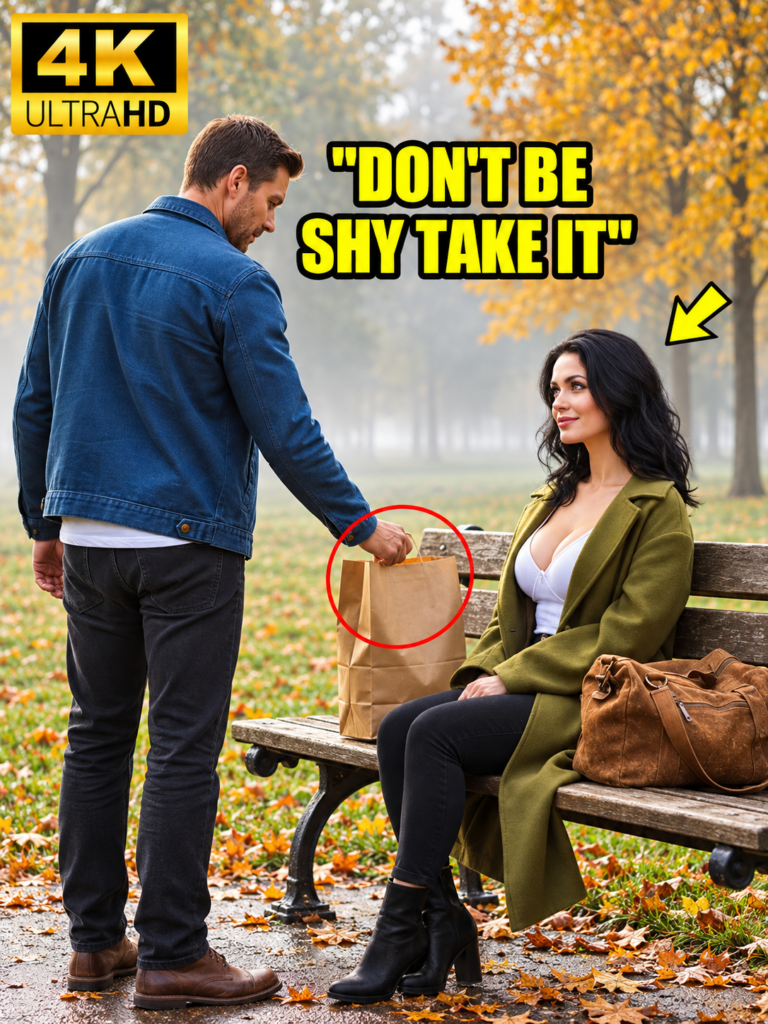
Every morning at exactly 6:10, Silas Walker left a small brown paper bag on the same cracked bench in Whitmore Park where a quiet homeless woman sat alone.
He never asked her name.
He never stayed long enough to hear her story.
For weeks, that was all there was between them.
Then, one January morning, 3 black SUVs arrived at the park. Men in dark suits stepped out. Behind them came lawyers, bodyguards, and documents. The woman Silas had been helping every day stood from the bench calm and composed, and suddenly everyone seemed to be looking at Silas as though he were the one who did not belong.
Silas was 38 years old and had learned early that life rarely offered soft landings.
He lived with his 7-year-old daughter, Lily, in a 2-bedroom apartment on the east side of Columbus, Ohio. The building’s heat worked just well enough for the tenants to complain about it, and the elevator had been broken for 11 months.
Silas paid the rent on the first of every month without fail.
Not because doing so was easy.
Because Lily depended on him to make life appear easier than it actually was.
She had her mother’s wide brown eyes and her father’s stubborn silence. She noticed things adults routinely missed: the neighbor’s cat that had not appeared for 4 days, the way Silas’s shoulders sagged when he believed nobody was watching.
Lily was small, serious, and unusually patient for 7.
That patience was either a gift or quiet evidence of how much she had already learned about the limits of the world around her.
Silas worked 2 jobs.
During the day, he wore a fluorescent yellow vest and drove a city sanitation truck along a fixed route through midtown Columbus.
The work was not glamorous.
Most people either failed to see him or looked through him, and Silas had stopped expecting acknowledgment.
3 nights each week, he worked for a delivery service.
Groceries.
Takeout.
Pharmacy orders.
He drove through neighborhoods that smelled of money and ease while Lily stayed with Mrs. Randolph downstairs, a 70-year-old retired schoolteacher who watched her in exchange for occasional help carrying groceries up 4 flights of stairs.
Silas first noticed the woman in Whitmore Park on a Tuesday in late October.
The park was a narrow strip of green between 2 blocks of commercial buildings, kept active mostly by pigeons and the occasional jogger.
Near the iron gate stood an old wooden bench.
Its boards were dark with age.
1 slat had warped.
The woman sat at the far end with a canvas bag between her feet and an old olive-colored jacket pulled tightly around her shoulders.
She looked approximately 30, perhaps younger.
It was difficult to tell beneath the exhaustion shadowing her face.
Her dark hair was tangled at the ends, not with the carelessness of someone who had never cared about herself, but as though keeping it neat had once mattered and then gradually stopped being a priority.
She carried no sign.
Asked for nothing.
She sat with her hands folded in her lap and stared into the middle distance.
The expression on her face did not look defeated.
It was something more complicated.
Silas did not stop that first morning.
He slowed.
Thought about it.
Then continued walking.
That evening, while making Lily’s lunch for the following day, he prepared 2 extra sandwiches.
He placed them in a brown paper bag with a small container of apple juice and a packet of crackers.
The next morning, he placed the bag on the bench beside the woman without speaking.
She nodded once.
Silas walked on.
That became the beginning.
By the second week, the brown bag had become routine.
The contents changed depending on what Silas could manage.
A hard-boiled egg.
A granola bar.
A slice of banana bread Lily had helped him bake on Sunday afternoon.
When November arrived and temperatures dropped into the low 40s, Silas brought coffee in a thermos he had owned since his 20s.
There was a small dent in its side from an old job site.
The woman accepted it with both hands, the way a person held something warm after warmth had become rare.
Lily noticed the extra food almost immediately.
“Who’s the extra sandwich for?”
Silas looked up from the bag.
“A woman in the park.”
“What woman?”
“She sits on a bench.”
Lily considered that.
“Is she sad?”
“I don’t know.”
Silas answered honestly.
“I think she’s just waiting.”
“For what?”
He zipped the bag shut.
“I’m not sure she knows yet.”
A few days later, Lily slipped a folded sheet of paper into the bag without asking.
Silas did not discover it until after he had already given the bag away.
The drawing showed a woman sitting on a bench beneath a yellow sun.
A small bird rested on her shoulder.
Above the picture, in Lily’s careful 7-year-old handwriting, were 3 words:
You are seen.
The next morning, Silas noticed something about the woman he had missed before.
Her eyes were not empty.
They were alert.
Precise.
Watchful in a way that seemed deliberate.
When she unfolded Lily’s drawing, she became completely still.
Then she folded it again with remarkable care and placed it inside her coat near her chest.
The first time she spoke directly to Silas was approximately 2½ weeks after he began leaving the bags.
It was a Wednesday.
He had brought coffee and a biscuit from a diner 2 blocks away, spending $3.40 he probably should have saved.
She looked at the food.
Then at him.
“You shouldn’t waste this on me.”
Her voice surprised him.
Low.
Clear.
Measured.
Not broken.
Silas shrugged.
“It’s not a waste if someone needs it.”
She held his gaze slightly longer than normal.
Then looked away.
Silas continued toward work.
Something between them had changed.
Both seemed to know it.
The following week, he saw the book.
He was later than usual because Lily had awakened with a scratchy throat, and he had spent 20 minutes trying to decide whether she needed to stay home from school.
When Silas reached the park, the woman was reading.
The book’s cover had nearly worn smooth.
Its spine was cracked in several places, the kind of damage caused by repeated use rather than neglect.
The title remained legible.
Property Law and Equitable Remedies, Third Edition.
Silas placed the bag beside her without comment.
He walked away more slowly than usual.
At work, people had begun noticing what he was doing.
They also had opinions about it.
Marcus, who drove a sanitation route 2 sections north of Silas, raised the subject one morning in the break room.
“Heard you’ve been leaving food for somebody in Whitmore Park.”
“Yeah.”
“Every day?”
“Most days.”
Marcus stirred his coffee.
“You know how those situations go. You start feeding somebody, they start expecting it. Next thing, they’re waiting on you.”
He looked at Silas.
“You’ve got enough on your plate.”
Silas did not argue.
Marcus probably meant well.
But Silas had learned that “enough on your plate” was something people often said when they wanted someone to stop thinking about another person’s empty one.
The criticism eventually reached management.
Derek Paulson, the shift supervisor, pulled Silas aside near the end of a Thursday route.
Paulson had earned most of his authority by outlasting the people around him and did not wear that authority gracefully.
“I’m hearing you’re spending time in the park during your shift.”
“I drop something off before my shift starts.”
“You’re in a city uniform.”
“Not at 6:10.”
Silas kept his tone even.
“I clock in at 7:00.”
Paulson looked at him as though searching for a legitimate reason to penalize him and failing to find one.
“You want to be careful about the associations you’re building.”
He paused.
“People notice what you involve yourself with.”
Silas nodded politely.
That evening, he went home.
Made a ham sandwich.
Filled the thermos with tea.
Placed both inside another brown paper bag for the following morning.
That same week, Lily asked a question he could not answer quickly.
They were walking home from the library on a Saturday afternoon. Lily’s hand rested inside his, and a small backpack filled with borrowed books bounced against her back.
“Daddy, why doesn’t anyone else help her?”
Silas thought about the joggers who passed through Whitmore Park every morning with earbuds in.
The office workers cutting across the park toward public transit.
The street vendor who set up near the corner and had probably seen the woman dozens of times.
“I don’t know, bug.”
“But you do.”
“I do.”
They walked another block.
Then Lily asked, “Is it because you were sad once, too?”
Silas kept walking.
He did not answer immediately.
Lily understood silence well enough not to press him.
He thought about the 18 months after Lily’s mother left.
He rarely discussed that period.
Lily had been 4.
Silas had been 31.
The apartment felt like somewhere to survive rather than somewhere to live.
The distance between where he was and where he needed to be had seemed impossible to cross.
Someone helped him then.
A neighbor.
Almost a stranger.
Small things.
A meal left outside his door once.
A kind sentence from the woman at the corner store who never asked him to explain his circumstances, but told him one Tuesday that he looked like he was doing the best he could.
“Maybe.”
Silas finally answered Lily.
“Something like that.”
The situation changed on a Thursday in December.
The morning arrived beneath steel-gray skies with rain that shifted between drizzle and downpour.
Silas checked the park anyway.
The bench was empty.
The brown paper bag from the previous morning remained there.
Slightly damp.
Unopened.
Silas left a fresh one and went to work.
The following morning, the woman had returned.
There was a bandage wrapped around the knuckles of her right hand.
She moved while sitting as though she had slept on something hard.
Silas noticed immediately.
“What happened?”
“Nothing serious.”
“That doesn’t answer the question.”
She looked directly at him.
“I slipped.”
A pause.
“Near the overpass.”
“You were at the overpass?”
He looked at the weather around them.
“In that rain?”
“I had to move.”
Silas placed the bag down.
Then crouched slightly so they were closer to eye level.
“Listen, if you need to go somewhere—a shelter, a clinic—I can drive you. It’s not a problem.”
She shook her head.
Firmly.
Not dismissively.
“I can’t do that.”
“Why not?”
She remained quiet for several seconds.
“Because some people are looking for me.”
The words settled between them in the cold morning air.
Silas straightened.
For the first time, he looked at her not simply as a woman without a home, but as someone whose circumstances might be more complicated than he understood.
What he saw was not exactly fear.
It was caution.
Sustained and disciplined.
The kind of caution learned over time.
“Are you in danger?”
She considered the question almost academically, as if the word danger needed a precise definition before she could answer.
“Not the kind you’re thinking of.”
Silas walked toward his truck with more questions than answers.
For the first time since he began bringing food, the park felt genuinely unsettled.
3 days later, Lily finished another drawing.
She spent most of an evening at the kitchen table working on it with complete concentration, her tongue pressed lightly against her upper lip.
The picture showed a woman on a bench in Lily’s unmistakable style: oversized head, round face, dots for eyes, careful smile.
Around the figure, Lily had drawn thin gold lines spreading outward like light from a lamp.
Silas folded the drawing once and placed it inside the paper bag.
When the woman opened it the following morning, she looked at the picture for a long time.
Her jaw tightened.
Her lips pressed together.
Her eyes brightened with something that might have been cold and might have been emotion.
“That’s from my daughter.”
The woman nodded.
Then asked a question as though she had been carrying it for days.
“What’s her name?”
“Lily.”
“She’s perceptive.”
The woman looked at the drawing again.
“Most people don’t notice when someone is being invisible on purpose.”
Silas stopped.
“On purpose?”
He did not press further.
Instead, she looked at him.
“My name is Eleanor.”
A pause.
“Eleanor Hayes.”
The name was offered carefully, as though she were giving him something valuable.
Silas treated it that way.
“Silas.”
She almost smiled.
“I know.”
He blinked.
“How?”
“Your name tag. You wore it the first week.”
He had forgotten.
Then Eleanor asked him something else.
“Why do you keep coming back?”
There was no accusation in her voice.
No trap.
Only genuine curiosity from someone who had apparently decided she trusted his answer.
Silas thought carefully.
“Because someone should.”
Eleanor said nothing.
But she held the answer the way she had held Lily’s drawings.
Carefully.
As though it were something fragile.
Part 2
January 14 arrived cold and bright.
The sidewalks still carried the crystalline residue of the previous night’s hard freeze.
Silas was 2 minutes early.
Unusual for him.
He had brought an extra coffee that morning.
When he left the apartment, Lily had stood in the kitchen window and given him a solemn thumbs-up.
Silas was approximately 30 ft from the bench when he heard engines.
More than 1.
Heavy vehicles moving slowly and without urgency, the way vehicles moved when the people inside expected to be noticed.
He turned.
3 black SUVs rolled toward the park.
They stopped near the iron gate in smooth coordination.
The doors opened almost simultaneously.
Several men stepped out wearing dark suits that looked more expensive than Silas’s monthly salary.
2 of them were unusually large.
Not casually large.
Professionally large.
They positioned themselves slightly apart from the others and scanned the area without expression.
Behind them came 2 men carrying leather briefcases.
Between those men walked another man who appeared to be in charge.
Silver hair.
Deliberate movements.
Reading glasses pushed onto his forehead.
The group moved directly toward Eleanor.
Silas stopped.
The paper bag remained in his hand.
Eleanor had seen the vehicles before he did.
She was already standing when the group reached the bench.
Something about her had changed.
Not her face.
Not her body.
The quality of her stillness.
The same quiet woman who had accepted sandwiches, coffee, and a child’s drawings still stood there.
But another version of Eleanor was suddenly visible through her.
Composed.
Controlled.
Someone accustomed to being the person a room became quiet for.
The silver-haired man stopped several feet away.
“Miss Hayes.”
It sounded less like a greeting than a confirmation.
“Robert.”
The man glanced behind him.
His attention settled on Silas.
He did not appear surprised.
He looked appraising.
“Is this him?”
The question was addressed to Eleanor.
But it was aimed at Silas.
“Yes.”
Robert crossed the distance between them at the measured pace of a man accustomed to delivering consequential information.
He extended his hand.
Silas shook it.
“Mr. Walker. My name is Robert Ellison. I’m chief legal counsel for Hayes Industries.”
He paused long enough for the title to register.
“I understand you’ve been providing assistance to Miss Hayes for the past several weeks.”
Around them, the park seemed to develop its own stillness.
A jogger slowed.
Then changed direction.
A man walking a dog crossed toward the opposite side of the path.
“I leave her food.”
Silas chose his words carefully.
“In the mornings.”
“Every morning.”
It was not quite a question.
“Most mornings.”
Ellison studied him with the concentrated patience of someone who spent a career evaluating people.
“We’d like to speak with you, Mr. Walker.”
There were matters involving Silas’s account of the previous 2 months.
“In a professional capacity.”
The bodyguards remained where they were.
Eleanor watched Silas from the bench.
There was no apology in her expression.
No triumph.
Only waiting.
Silas suddenly recognized it as the same expression she had worn on the first morning he saw her.
Waiting to see what a person would do.
He looked at the lawyers.
Then Eleanor.
Then the bag in his hand.
He placed it carefully on the bench.
They spoke inside the back of the largest SUV.
It was warmer than Silas expected.
The interior smelled faintly of leather and sandalwood.
Robert Ellison sat opposite him with a yellow legal pad across his knee.
A younger lawyer beside him typed quietly into a slim laptop.
Eleanor sat next to Silas.
He had not expected that.
The explanation came in fragments.
Not dramatically.
In the precise, economical language of people who had spent months containing something volatile.
Eleanor Hayes was 32 years old.
She was the sole heir to Hayes Industries.
The company was privately held.
It operated in 14 states across logistics and property holdings.
According to a document Ellison briefly showed Silas, its assets were valued at slightly more than $400 million.
Eleanor’s father, William Hayes, had died unexpectedly 11 months earlier after suffering a cardiac event during a business trip.
In the weeks after his death, a faction within the company board moved aggressively to challenge the validity of his will.
The faction was led by 2 long-serving executives who had expected to inherit control of Hayes Industries.
They argued that William Hayes had been mentally compromised when he signed the will.
The dispute did not remain confined to lawyers.
Threats followed.
Eleanor’s personal assistant was coerced into providing information to the opposing faction.
Someone entered Eleanor’s home once while she was away.
She had been followed on at least 2 occasions.
Eventually, Eleanor made a decision.
It was not impulsive.
It was calculated.
Trust around her had been dismantled so systematically that she concluded disappearing was the only logical response.
She withdrew completely.
Took nothing easily traceable.
Used no account connected directly to her name.
Then disappeared into an environment she believed offered the least exposure.
A city she knew only slightly.
A public park where people passed strangers every day without looking closely at them.
“I wasn’t hiding indefinitely.”
Her voice sounded exactly as Silas remembered it from the bench.
Clear.
Low.
Controlled.
“I was gathering evidence.”
There were things a person could observe while appearing invisible that could not be observed from inside a protected corporate life.
“People behave differently when they believe they’re unobserved.”
Silas looked at her.
“You were watching people.”
“I was studying them.”
She glanced sideways.
“Including me?”
“Especially you.”
Silas had no immediate answer.
Eleanor continued before he decided what to make of it.
“Because you were the only one who kept showing up.”
Ellison cleared his throat softly.
The legal team had finally secured the evidence it needed over the previous 3 weeks.
48 hours earlier, the challenge to the board had been formally withdrawn.
Eleanor could resume public life.
She could return to governance of Hayes Industries.
Ellison placed the legal pad aside.
Silas’s consistent presence during her time in Whitmore Park was relevant to the case record.
He might be asked to provide a brief statement confirming the timeline of his interactions with Eleanor.
Then Ellison paused again.
There was another reason they had all come to the park together that morning.
Eleanor had requested it.
She wanted to address something personally.
Silas turned toward her.
For the first time, Eleanor faced him completely.
During the previous weeks, she had nearly always angled herself slightly away.
Maintained distance.
Now she did not.
“In 6 months of watching people pass that bench, you were the only one who stopped.”
Silas said nothing.
“Not once.”
Her eyes remained on him.
“Every single morning.”
Then she told him what mattered.
“I need you to know that what you did mattered.”
Not to the case.
Not to Hayes Industries.
“To me.”
Through the SUV’s tinted window, Silas could see the bench in the cold winter light.
The same bench.
Still ordinary.
The public announcement of the Hayes Industries board dispute spread quickly through professional circles.
Robert Ellison prepared an official statement.
Eleanor insisted that it contain 1 particular line.
It acknowledged a private citizen who had provided daily care during her time in Whitmore Park.
His full name was not released without permission.
That distinction did not protect Silas for long within the smaller world of the Columbus Sanitation Department.
Marcus heard the story by Friday.
Derek Paulson learned by Monday morning.
Silas arrived at the depot at his normal time and found the atmosphere changed.
Not openly hostile.
Uncertain.
People were recalibrating.
Marcus said little.
He handed Silas a coffee.
Looked at the floor.
Paulson appeared beside the truck bay at approximately 7:30.
He approached with exaggerated casualness.
“Walker.”
“Morning.”
Paulson rubbed the back of his neck.
There was clearly something he wanted to say.
The effort of figuring out how was visible.
“Heard you’ve been in the news.”
“Not really in the news.”
Paulson nodded.
Opened his mouth.
Closed it.
Nodded again.
Then walked away.
It was as close to an apology as Silas expected from him.
That was enough.
The moment Silas returned to later happened that same afternoon.
Eleanor requested another meeting.
This time, at a quiet restaurant near the park district office.
She arrived with Ellison.
After they ordered, she asked him to move to another table.
What she wanted to discuss was between Silas and her.
Eleanor looked very different from the woman on the bench.
She wore a fitted charcoal coat.
Her hair was pulled back.
There was a composed professional quality to her presence that made the olive jacket and cracked bench seem part of another life.
Her eyes had not changed.
“I want to offer you something.”
She folded her hands in front of her.
“And I want to be honest about why.”
Silas waited.
“Lily should have every resource available to her.”
Eleanor wanted to establish an educational trust in Lily’s name.
Fully funded.
Independent of any future condition or relationship between herself and Silas.
The trust would pay for Lily’s education through university.
Whatever Lily eventually chose.
Then Eleanor made a second offer.
A position at Hayes Industries.
Asset coordination.
Something that used the skills Silas already possessed.
A job paying him accordingly.
He looked at her.
“Why?”
“Because it’s the right thing to do.”
Silas started to answer.
“I didn’t help you because I expected—”
“I know.”
Eleanor stopped him gently.
“That’s exactly why I’m doing it.”
Silas drove home slowly.
Without deciding to, he took the longer route through the park district.
January had emptied most streets.
Apartment windows glowed warmly against the dark.
He reached his building but did not immediately go inside.
He sat behind the steering wheel with the engine off and both hands in his lap.
The offers felt heavy.
Not because he did not want them.
Because Silas had spent approximately 10 years constructing a particular relationship with self-sufficiency.
Maintaining it required work.
And a deliberate suspicion of offers that came with conditions.
He had learned through experience that accepting help from the wrong person could compromise the identity someone was trying to protect.
Eleanor’s offer felt different.
He knew it was different.
That made deciding harder rather than easier.
Upstairs, Lily was still awake.
She was curled on the sofa with a library book across her knees.
Her eyes were half closed.
When Silas entered, she looked up.
“How was the meeting?”
He had already explained the situation in the simplest terms.
“Strange.”
He sat beside her.
“Good, maybe. I’m not sure.”
Lily closed the book around 1 finger to save her place.
“What did she want?”
Silas explained.
Carefully.
The educational trust.
The job.
His uncertainty.
He gave Lily the actual truth rather than a version designed to keep her uninvolved.
She listened without interruption.
When he finished, she looked toward the ceiling.
She wore the expression she used whenever thinking seriously.
“Why don’t you want to say yes?”
Silas thought.
“Because I don’t want our life to change in a way that changes who we are.”
Lily considered this.
“But what if it doesn’t?”
Silas looked at her.
“What if we can say yes and still be us?”
She paused.
“We’re not going to forget how to be us just because something good happens.”
Her eyes were her mother’s.
The stubbornness was Silas’s.
“Can we say yes?”
Then, carefully:
“Just this time?”
The apartment remained quiet.
The heat clicked inside the walls.
Outside, a car passed with music neither of them recognized.
Silas placed an arm around his daughter.
He stared at the wall for a long moment.
“Yeah.”
His voice was soft.
“We can say yes.”
He called Eleanor that night.
They would accept.
With 1 condition.
Silas did not want the position at Hayes Industries publicly described as gratitude.
Or reward.
He wanted a real job.
Real work.
Evaluated on actual merit.
If he turned out to be incapable of doing it, he wanted to be told plainly.
Eleanor was silent for a moment.
Then she said it was the most reasonable thing anyone had said to her in approximately 8 months.
Part 3
The weeks that followed felt like a familiar life being rebuilt into a different shape without losing all of its original materials.
Lily transferred to a school across town.
It had a music program.
A garden project.
A library filled with actual new books rather than sun-faded hand-me-downs from an underfunded system.
She adjusted with the practical flexibility common in children who had already learned the world could surprise them.
Silas began working at Hayes Industries in early February.
The office occupied a downtown building smelling of polished concrete and climate control.
It was far removed from the recycling routes that had shaped his mornings for years.
He wore a jacket instead of a fluorescent vest.
He attended meetings with people who used terminology he occasionally had to look up afterward.
The fear that he would be hopelessly out of place turned out to be wrong.
Silas was good at logistics.
He had always been good at logistics.
The difference was that he finally worked in an environment where that ability could be demonstrated and valued.
He kept the brown paper bag.
There was no practical reason to keep it.
It sat on a shelf above his desk.
Slightly creased.
A small anchor to something he did not want to forget.
His assistant was a young man named Trevor.
Trevor had excellent organizational instincts and visible confusion regarding some of Silas’s habits.
He noticed the old paper bag during the second week.
He asked nothing.
That was the correct response.
One Friday morning in late March, Silas woke before his alarm.
Lily remained asleep.
The apartment felt different now.
Not larger.
More settled.
As though the pressure in the rooms had changed.
Silas moved quietly through the kitchen.
Made coffee.
Stood at the window and watched Columbus slowly become visible in the morning light.
Then he put on his coat.
And walked toward Whitmore Park.
The bench remained exactly where it had always been.
Same warped slat.
Same iron gate.
Same particular quiet before the city developed its full voice.
Pigeons had returned with the changing season.
They moved along the path with absolute confidence, as if every public space had been built specifically for them.
Silas sat on the bench.
Not at the far end where Eleanor had always sat.
In the middle.
Leaving space on both sides.
He stayed there approximately 10 minutes drinking coffee.
Watching light pass between the trees.
Thinking about nothing in particular.
And almost everything.
Then he heard footsteps.
Unhurried.
Familiar.
Not the hurried stride of someone running late.
Not the measured movement of someone trying to remain cautious.
Only a person walking at her own pace toward somewhere she had apparently already decided to go.
Eleanor Hayes came through the iron gate.
She stopped when she saw him.
There was no corporate entourage.
No bodyguards.
No briefcase.
She wore a plain dark coat.
Her hair was down.
She looked like someone who had arrived somewhere without entirely planning to, only to realize upon arriving that perhaps she had meant to come there all along.
Eleanor looked at the bench.
Then at Silas.
She sat down.
Not at the far end.
In the space beside him.
For a while, neither spoke.
Whitmore Park continued around them.
A distant jogger.
The low murmur of Columbus beyond the tree line.
1 bird moving among branches overhead.
Ordinary sounds.
The world carrying on with its work.
“I didn’t know you’d be here.”
Silas looked toward the park.
“I didn’t know either.”
Eleanor nodded.
“I do that too sometimes.”
“Do what?”
“Walk without deciding where.”
A pause followed.
“I used to come here every morning for 6 months.”
“I know.”
Silas looked at her.
“I was there.”
Eleanor smiled.
Not the careful expression she used around lawyers or executives.
Something less controlled.
Quieter.
It changed her face.
She looked like someone who had finally arrived after spending a long time in transit.
“I missed it.”
“The bench?”
She looked at the weathered boards.
Then ahead.
“The bench.”
Another pause.
“And I miss the only person who didn’t need to know who I was before deciding whether to be kind.”
Silas looked at her.
In the low morning light, Eleanor was not the sole heir to a $400 million company.
Silas was not a sanitation worker with an extra sandwich.
They were simply 2 people sitting together on the same bench where the story had begun.
Watching the same slow morning move across the sky.
“You could have just said you wanted coffee.”
Eleanor laughed.
A real laugh.
Brief.
Uncontrolled.
The sound of relief.
Silas reached inside his coat.
He removed the old thermos.
The same one he had carried years before.
The same dent along its side.
Eleanor looked at it.
Then at him.
She said nothing.
She simply held out her hand.
Silas poured.

