
Chapter 1: The Names That Break Her
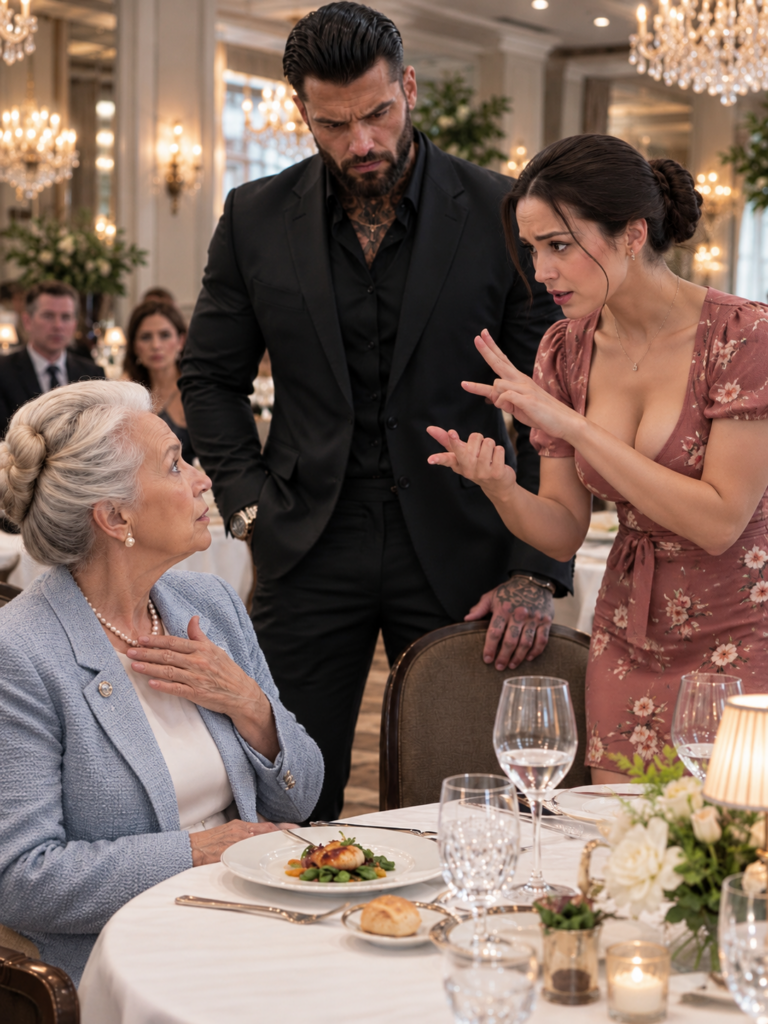
The silence between his last words and her next heartbeat lasted an eternity.
Names like O’Malley. Or Flanagan.
He hadn’t said them by accident. He’d chosen them, dropped them onto the white tablecloth between them like stones into still water, and now he was watching the ripples move across her face with the patience of a man who already knew how this would end.
Grace Bellamy sat very still, her hands folded in her lap so he wouldn’t see them shake.
svg
“I don’t know what you’re talking about,” she said again, because it was the only sentence she had left, worn thin from repetition, no longer convincing even to her.
image
“Don’t you?” Adrian Moretti leaned back in his chair, unhurried, a man who had never once in his life needed to raise his voice to be obeyed. “A waitress who speaks fluent Italian sign language — not the common dialect, the rare one, the one used in maybe three families in this entire city. A waitress who tenses like a struck wire every time my associate Russo walks through that door. A waitress with a Boston vowel that slips out whenever she forgets to perform being someone else.”
He said it all so calmly. That was the worst part. Not the accusation — the calm underneath it, like he was reading a weather report instead of dismantling her entire life in six sentences.
“You’ve been watching me,” she said. It wasn’t a denial anymore. She didn’t have one left.
“I watch everyone,” Adrian said. “It’s the only reason I’m still breathing at thirty-four in a business that kills men for asking the wrong questions at dinner.” His eyes didn’t leave her face. “But you, Grace Bellamy — or should I use your real name — you’re different. You’ve been different since the first night my mother reached for you and you were the only person in this entire restaurant who reached back.”
Something in Grace’s chest cracked open at that, a hairline fracture spreading fast. She thought of Isabella’s hands moving through the air like a woman finally, finally being heard, and she thought — absurdly, in the middle of her own unraveling — that she didn’t regret it. Whatever this cost her, she didn’t regret giving that woman five minutes of being seen.
“My name,” she said quietly, “used to be Cara O’Malley.”
Saying it out loud felt like removing a splinter she’d been carrying so long the wound had grown around it. It hurt worse coming out than it ever had staying in.
Adrian didn’t react the way she expected. No triumph. No cold satisfaction at having cracked her open. If anything, something in his shoulders eased, like a man setting down a weight he’d been carrying carefully so it wouldn’t break.
“Patrick O’Malley’s daughter,” he said. “The one who disappeared two years ago rather than marry into the Whelan family to seal an alliance. Chicago’s underworld talked about you for months. And then — nothing. You were just gone.”
“I am gone,” Grace said, and hated how her voice shook on the word. “I left that life behind. I’m not part of my family’s business. I never wanted to be.”
“No one ever truly leaves,” Adrian said, and there was something almost gentle in it, almost sad, like he was speaking from some private, bitter knowledge of his own. “Especially not an O’Malley. Especially not the daughter of a man whose hatred for my family runs back three generations, older than either of us.”
Outside the window, the rain that had been threatening all evening finally broke, streaking the glass in long silver lines, blurring the city lights into something soft and formless — matching, Grace thought distantly, the way her entire carefully built reality was blurring right now, the lines between the safe life she’d made and the dangerous one she’d run from washing away with every sentence he spoke.
“My father disowned me,” she said. “Two years ago. As far as he’s concerned, I don’t exist anymore.”
“That’s not entirely true.” Something flickered behind Adrian’s eyes — recognition, maybe respect, maybe something colder. “Your youngest brother, Danny. He’s safe. In college, in Vermont. My people have had eyes on him for months.”
Grace’s head came up sharply. “You’ve been watching Danny? Why — ”
“Initially, to find you.” Adrian didn’t flinch from the admission. “But that changed three months ago. Your father’s right-hand man — Colm Whelan — made a move against your brother. We intervened before it went further.”
The restaurant seemed to shrink around her, the air thinning until she could barely draw breath.
“Colm wouldn’t,” she started, and even as she said it, some old, buried part of her — the part that had grown up in that world, that had learned to read danger the way other children learned to read — already knew the protest was hollow.
“He’s been loyal to your father for thirty years,” Adrian said. “Loyalty changes when power shifts. There’s talk that your father’s grip is slipping. That Whelan has been making deals with the Russians behind his back.”
Outside, a black SUV eased to the curb, its windows tinted, its engine idling like something waiting.
Adrian glanced at it once, briefly, then back to her.
“Your family is coming apart, Grace. And what happens next is going to be catastrophic for everyone standing near it when it breaks.”
She stared at him, this man in his impossible suit with his careful, terrible knowledge, and felt something twist violently inside her chest — not just fear anymore, but the unbearable shape of a question she hadn’t let herself ask in two years.
“Why,” she whispered, “are you telling me any of this?”
Adrian Moretti didn’t answer right away. He looked past her, toward the window, toward the rain, toward the black car she hadn’t noticed had been parked there for the last twenty minutes.
“Because we don’t have much time,” he said instead. “And what I’m about to ask of you is going to feel impossible.”
Chapter 2: The Envelope We Cannot Open
“There’s a man at the bar,” a passing waitress whispered, sliding a dessert menu across their table like a magician’s misdirection, “asking questions about you. Showed a photo to the bartender. Irish accent. Scar over his right eye.”
Grace felt every drop of blood leave her face.
“Rourke,” she breathed.
She knew that name the way you know a childhood nightmare — instantly, completely, in the marrow. Rourke was her father’s most efficient instrument, the man who had broken her cousin’s kneecaps for skimming collection money, who specialized in problems that needed to disappear and stay disappeared. If Rourke was in this restaurant, it wasn’t a coincidence. It was an execution warrant with her name written somewhere on it.
svg
Adrian’s expression didn’t change, but Grace saw the subtle shift in his posture — coiled now, ready.
“There’s a service corridor through the kitchen,” he said, low and fast. “Connects to the building next door. Staff use it for smoke breaks.”
Her whole carefully constructed life flashed behind her eyes in one terrible, compressed second — the linguistics scholarship she’d fought for on scraps of sleep, the roommate who knew nothing of who she used to be, the half-finished paper glowing on her laptop back in an apartment that suddenly felt like it belonged to a stranger.
“How did they find me,” she managed.
“The same way I did,” Adrian said. “Following the thread of a very unusual talent. How many people in this city speak that specific dialect fluently? Your kindness to my mother didn’t just win her heart, Grace. It painted a target on your back.”
He slid a phone across the table — sleek, unmarked, clearly untraceable.
“Take this. My driver will meet you at the back entrance in five minutes. He’ll take you somewhere safe while we work out what happens next.”
Panic rose in her chest, sharp and physical. “My roommate. My classes. I can’t just — people will notice.”
“Your roommate will be told there’s a family emergency. Your professors will get emails requesting extensions.” His efficiency was somehow both reassuring and deeply frightening, evidence of a man who had done this before, more than once. “But if you walk out that front door tonight, Grace, Whelan’s men will make sure you never walk anywhere again.”
She stared at the phone like it was a loaded weapon, because in a way, it was.
“Why would you risk this,” she asked, “for me? I’m nothing to you. I’m worse than nothing — I’m an O’Malley.”
Something shifted in Adrian’s face, some wall coming down half an inch.
“Because I’ve spent two months watching you study until dawn on your breaks. Watching you give away half your tips to a shelter three blocks from here. Watching you treat my mother with more dignity in five minutes than most of the men who work for me manage in a lifetime.” His voice dropped, roughened at the edges. “You deserve better than being collateral damage in Whelan’s grab for power.”
Before she could find words for the thing tightening in her throat, his phone buzzed. His face went hard and flat as he read it.
“They’re moving. Go now. Through the kitchen, down the hall, last door on the left. Marco’s waiting with the car.”
Grace rose on legs that didn’t feel entirely like her own, the phone clutched in her palm like a lifeline thrown across water she couldn’t see the bottom of.
“What about you? Won’t they recognize you leaving?”
Adrian’s smile was thin, almost predatory, and for one unguarded moment she saw exactly who he was underneath the tailored wool and careful manners — a man who had survived worse rooms than this one.
“Let me worry about myself,” he said. “I’ve handled worse than Whelan’s errand boys.”
Three weeks later, Grace stood at the window of a lakeside cabin at dawn, watching mist lift off water the color of unpolished silver.
The house belonged to generations of Morettis — a place, Isabella had explained with her hands moving slow and reverent, where the family had always come to remember they were people first and a name second.
“He was different from the beginning,” Isabella signed now, seated at the rustic table, her eyes bright with old memory. “His father wanted him cruel. Adrian found ways to be merciful without ever looking weak. It is a very difficult balance, in our world.”
Our world. Grace turned the phrase over silently, wondering when it had started to feel less like a threat and more like an invitation.
The burner phone buzzed against the windowsill.
It’s time. Be ready in ten.
Grace’s stomach clenched — fear and something else, something she didn’t yet have a name for, tangled together.
She showed the message to Isabella, whose expression softened into something almost maternal, almost knowing.
“He will protect you,” Isabella signed. “My son sees in you what I see. A kindred spirit, trying to outrun a legacy neither of you chose.”
Tires crunched on gravel outside. Adrian entered alone, his usually immaculate composure disheveled — a cut above one eyebrow, knuckles bruised, but his eyes burning with something like grim, hard-won satisfaction.
“We found it,” he said without preamble, setting a laptop on the table. “Financial records. Communications with the Russians. Orders for hits on your brothers.” His jaw tightened. “Whelan has been dismantling your father’s empire from the inside for over a year.”
Grace stared at the screen, nausea climbing her throat as she scrolled through the calculated architecture of a betrayal thirty years in the making.
“My father trusted him,” she whispered. “They grew up together. How could he do this?”
And then her eyes caught on a single message buried in the thread — a conversation between Whelan and an unknown contact.
The girl who got away.
Her throat closed. They were talking about her. Planning, this whole time, to use her as leverage the moment her father found out about the betrayal that had been growing in his own house for years.
Chapter 3: What the Warehouse Remembers
“He sent men to my university,” Grace whispered, her finger frozen over a timestamp two months old. “They were in my literature seminar. My coffee shop. Everywhere. Watching. Waiting for the right moment to use me.”
Adrian’s hand settled on her shoulder — steady, warm, grounding her before she drifted entirely into the vertigo of it.
“But they didn’t get to you,” he said. “And now we’re ten steps ahead of whatever they were planning.”
svg
Isabella crossed the room with three cups of tea, her movements unhurried despite the tension crackling through the cabin. She signed to Grace, her expression gentle but unflinching.
“My son rarely brings anyone here. This place has been our sanctuary since he was a boy — the only place his father’s violence never reached.”
“Power corrupts even the oldest loyalties,” Adrian said quietly, without judgment, only weariness. “But we have a more immediate problem. Whelan knows we have this evidence now. He’s called for a sit-down with your father tonight.”
Grace’s head snapped up, understanding crashing through her like cold water.
“It’s a trap. He’s going to kill my father and pin it on your family. Start a war that burns both of us to the ground.”
“Exactly.” Adrian’s expression turned to granite as he pulled a gun from somewhere inside his jacket, checking it with the calm, terrible efficiency of long practice before settling it into his shoulder holster. “Which is why we’re going to be there to stop it.”
Isabella’s hands flew up in protest, sharp and fast. “You cannot ask her to walk into that room. They will kill her on sight for what they’ll call betrayal.”
“You’re not asking,” Grace said, and found, to her own surprise, that the words came out steady. Something in her had finally stopped shaking. “Those are my brothers in there. My family, what’s left of it. I ran once already. I am not running again.”
The warehouse on the docks had been neutral ground for three generations of families settling disputes that couldn’t be settled anywhere else. Grace’s heart slammed against her ribs as she sat in the passenger seat of Adrian’s car, watching shapes shift through shadow near the loading doors.
“Your father arrived ten minutes ago,” Adrian said, eyes on his phone, reading updates from men positioned invisibly around the perimeter. “Minimal security. Whelan’s inside with six men — more than a peaceful sit-down requires.”
Grace nodded, mouth dry, checking the small pistol in her hand that felt both foreign and horribly familiar, muscle memory from a childhood she’d tried for two years to forget she’d ever had.
“I need to speak to my father alone first,” she said. “If I can get him to see the evidence before Whelan can spin it, we might avoid bodies on the floor tonight.”
The plan was simple in the way that dangerous things are always simple — Adrian’s men would seal the exits while Grace confronted her father directly, and Adrian himself would stay hidden nearby, close enough to intervene, far enough not to escalate a room that would explode the second his presence was noticed.
“Be careful,” Adrian said as they prepared to separate, his hand lingering on her arm one beat longer than necessary. “He may not believe you. Thirty years of loyalty doesn’t unravel just because of a flash drive.”
“I know,” Grace said, and her voice held steadier than she felt. “But he deserves the chance to know the truth. To choose, the same way I chose, when I left.”
The warehouse interior smelled of salt water and old fish, lit in dim amber pools that left most of the vast space in shadow. Grace slipped through a side door, the flash drive gripped in her palm like something holy.
Memory rose up around her uninvited as she moved through the familiar dark — summers learning the family business at her father’s side, his big hand guiding hers as he taught her to count shipments, to spot quality by feel, to tell friend from enemy by the smallest, subtlest signs. The gun pressed cold against her lower back, a reminder of the violence she’d once rejected and now, willingly, carried back into her own hands to protect what was left of her blood.
The irony wasn’t lost on her. How far she’d run, only to circle all the way back to where she started.
Hidden in alcoves along the warehouse walls, she recognized Adrian’s men by their stillness, their watching eyes, the strategic geometry of their positions. Among them stood Marco, Adrian’s most trusted lieutenant, who had spent recent weeks teaching Grace how to defend herself while telling her, quietly, story after story of how Adrian had slowly, deliberately reshaped what his father’s organization used to be.
And then, near the main entrance — her younger brother.
Connor. Taller than she remembered. Harder. His eyes scanning constantly for threats, a young man who had grown into someone she barely recognized in the two years she’d been gone. Her chest ached, a grief with no name, wondering if he would know her face or put a bullet in it, mistaking her for the traitor everyone would soon be calling her.
Through a crack in the office door, she saw her father — older, the lines in his face carved deeper than memory, his once-powerful frame stooped just slightly with the weight of years and empire.
Facing him, pouring drinks with a smile that didn’t reach his eyes, stood Colm Whelan.
“Patrick,” Whelan was saying, his voice thick with the lilt of the homeland they’d both left behind, “we’ve known each other too long for secrets. The Italians are moving. Tonight’s meeting is a distraction while they go after your children.”
Grace watched, frozen, as Whelan slid a glass toward her father — the exact glass she’d just seen him tip something into while her father’s attention was elsewhere.
There was no more time to hesitate.
She pushed the door open.
“Don’t drink that, Da. He’s trying to kill you.”
Chapter 4: The Truth on the Table
The room froze into a single, held breath.
Her father’s face collapsed into shock. Whelan’s expression twisted into fury. Guards along the walls reached for weapons in the same instant, the air suddenly thick with the electric charge of violence about to break loose.
“Grace?” Her father’s voice cracked, all thirty years of composure gone in a single word. “My God, girl — where have you been — ”
“She’s with the Morettis now, Patrick.” Whelan’s voice cut across the room like a blade, his hand drifting toward the gun at his waist. “Sleeping with the enemy. Can’t you see this is their trap? She’s led them straight to your door.”
svg
Grace stepped forward anyway, sliding the flash drive across the table until it stopped in front of her father’s shaking hand.
“Check the files, Da. Bank transfers to the Russians. Orders for hits on Danny. On Connor. Communications planning your murder — tonight, in this room.” Her voice didn’t waver, even though everything inside her was shaking. “He’s been selling you out for years.”
What happened next unfolded in a blur that Grace would spend years trying to untangle in memory — Whelan lunging for the drive before it could be plugged in, guards drawing weapons in a chaotic tangle of shouted orders, her father’s roar of pure animal rage as he knocked the poisoned glass from the table, sending it shattering across the concrete floor.
And then Adrian was there.
He seemed to materialize from shadow she hadn’t known concealed him, his gun already leveled, already steady, already trained precisely on Colm Whelan’s chest.
“It’s over, Colm,” her father said, his voice gone deadly calm as one of his own men produced a second laptop, confirming the evidence line by damning line. When he finally raised his eyes to Grace, they held a fury she remembered from childhood — cold, exact, and promising a reckoning that would not be gentle.
But underneath the fury, something else. Something that looked, unmistakably, like relief.
“You came back,” he said quietly, so only she could hear it. “After everything. You came back for us.”
“I never really left,” Grace said, and understood, saying it, that it was true. “I just needed to become someone strong enough to come back on my own terms.”
What happened to Colm Whelan after that night was never spoken of directly in either family, though Grace understood — with the particular, unsentimental clarity of someone raised inside these walls — that some betrayals in her world could only be answered in one language.
Her father did not press charges. There were no charges to press, not in this world. There was only silence, and the slow, careful redrawing of territory that followed any war narrowly avoided.
In the weeks after, Patrick Bellamy — no, she corrected herself gently, O’Malley, the name she had spent two years trying to bury — began the quiet, unglamorous work of stepping back. Leadership passed to Connor, older now in every way that mattered, with a single standing order pressed hard into every conversation: the peace with the Morettis was to be maintained, whatever the cost, whatever old pride demanded otherwise.
Grace visited her father twice before he left for Ireland, each visit shorter and quieter than the last, each one closing a door that had been open, aching, for two years.
“I was wrong,” he told her the second time, standing at the edge of the lake house dock, watching the water instead of her face, the way men of his generation confessed things without ever quite looking at what they were confessing to. “About the Sullivans. About the marriage. About all of it. I built you a cage and called it love, and you had more courage at nineteen than I’ve had in forty years running this family.”
Grace didn’t know what to say to that, so she said nothing, and let the silence between them do the forgiving that words couldn’t manage.
Chapter 5: What the Roses Remember
Six months later, Grace stood in the garden of the Moretti family estate, watching Isabella kneel among her roses with the unhurried devotion of a woman tending something sacred.
The world had reshaped itself in the aftermath of that night at the warehouse. Her father had retired quietly to Ireland, a small house near the coast, letters arriving every few weeks in handwriting that grew steadier with each one. Connor ran what remained of the family’s legitimate businesses with a caution his father had never possessed, the fragile new peace with the Morettis holding, month after month, like a bridge built by people who had finally grown tired of watching each other burn.
svg
Colm Whelan’s name was never mentioned again by anyone who valued their safety. Officially, he had simply disappeared. Grace had made her peace with not asking further than that — had learned, in the hardest way possible, that survival sometimes demanded silences you carried rather than answers you sought.
“You’re pensive today,” Adrian said, appearing beside her with two cups of coffee, his free hand finding hers with an ease that had taken months to earn and now felt as natural as breathing.
“Just thinking about how different everything might have been,” Grace said, watching Isabella straighten from the rosebushes and turn toward a small group of Adrian’s associates gathered near the terrace — men in expensive suits, watching with unmistakable concentration as Isabella’s hands moved through the shapes of a language most of them were only just beginning to learn.
It had been her idea, six weeks ago, floated almost shyly over breakfast — that the organization might be a little more inclusive, a little more human, if the people who ran it could actually speak to the woman who’d raised the man at its center.
Adrian had agreed before she’d finished the sentence.
He followed her gaze now, his expression softening in the particular way it only ever did around his mother. “Different,” he agreed, “but not better. Sometimes the paths we never chose are exactly the ones that bring us where we needed to be.” He pressed a kiss to her temple, lingering there a moment longer than the gesture required. “No regrets?”
Grace turned to face him fully — this man who had unraveled every careful lie she’d built to survive, and then, instead of using the wreckage against her, had helped her build something sturdier in its place. A man who had taught her that some inheritances could be rewritten, if you were brave enough to hold the pen.
“No regrets,” she said, and meant it completely, for the first time in longer than she could remember.
Behind them, Isabella’s hands were still moving — patient, graceful, teaching a room full of dangerous men the oldest lesson she knew: that real strength was never about how loudly you could speak, but about who was willing to stop, and listen, and answer back.
The late afternoon light caught the roses in gold, and for one long, suspended moment, Grace let herself simply stand there — not hiding, not running, not performing a name that wasn’t hers.
Just present. Just seen. Just home.
THE END

