
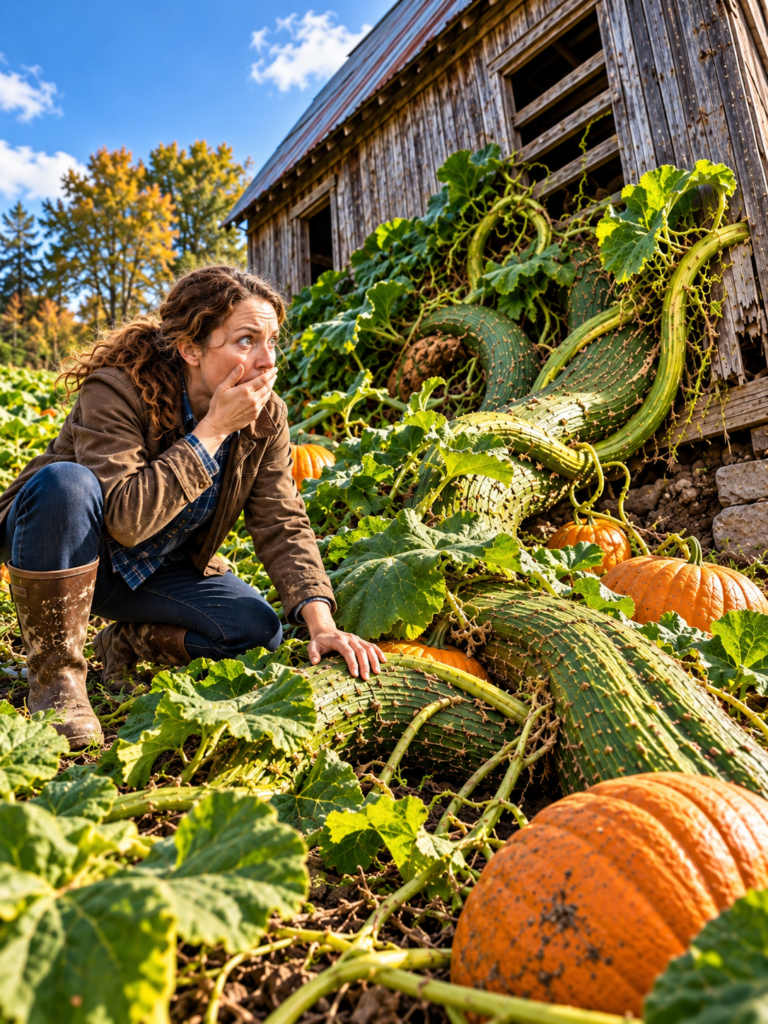
everyone laughed at the poor farmer’s runaway pumpkin vine—until it reached a forgotten barn and uncovered the secret buried beneath her land
Part 1
For twenty-one mornings in a row, Ren Callaway woke before sunrise, pulled on the same mud-stiff boots beside her kitchen door, and went outside to measure a pumpkin vine that refused to behave like a pumpkin vine.
At first she had measured it because she was amused.
Then because she was curious.
By the third week, she measured it because something about the plant had begun to bother her.
Every night it seemed to gain ground.
Not inches.
Feet.
It crawled behind the farmhouse, crossed the neglected strip beside the well shed, passed beneath the lower wire of the east fence, and continued in one stubborn direction toward a long-abandoned barn on the rise beyond the drainage ditch.
The barn had been empty longer than Ren had lived in Lancaster County.
Its roof sagged in the middle.
Silver-gray boards leaned out from the frame.
One door hung lower than the other.
From a distance, it resembled an old animal that had lain down in the field thirty years earlier and simply never risen.
Ren had never given it much thought.
Everybody said it belonged to the Weatherbee family.
That answer usually ended questions in that part of Pennsylvania.
The Weatherbees owned enough land that people sometimes described directions using their name.
Turn left after the Weatherbee soybean field.
Take the road beside the Weatherbee bins.
The creek behind Weatherbee north pasture.
Their green-and-white signs marked fields for miles.
Ren’s farm was different.
Twelve acres.
A farmhouse that leaned slightly south.
A tired well pump.
An old Ford tractor she had rebuilt twice.
A barn with three different shades of roof tin.
A strip of pasture too small to interest serious cattlemen.
A garden.
Thirty laying hens.
Six goats.
And debts that fit inside a kitchen drawer but somehow felt larger than the property itself.
She had bought the place four years earlier after her divorce.
There had been no screaming match, no affair, no dramatic courtroom war.
Her marriage had simply emptied out.
For years Ren and Michael had lived carefully around each other.
Separate work schedules.
Separate interests.
Eventually separate bedrooms.
Their daughter Rowan had gone to college, and with no child at the dinner table to hide behind, Ren and Michael finally admitted that companionship had become politeness and politeness had become distance.
They sold the suburban house.
Michael moved west.
Ren took what remained of her share and bought the old Hendricks place because she had spent her childhood on rented farms and had promised herself that once in her life she wanted to put her hands into ground nobody could tell her to leave.
She was forty-six when she signed the deed.
Forty-seven when she learned the roof over the mudroom leaked.
Forty-eight when the transmission on the tractor failed.
Forty-nine when the price of feed rose and the price she received for produce did not.
Now fifty, Ren had become very good at answering the question, “How’s the farm doing?”
“Getting there.”
That was what she always said.
Getting there.
It meant nothing.
It also prevented people from asking whether she was still making her equipment payment on time.
Across the road, Preston Weatherbee never appeared to wonder how he would make a payment.
He was forty-five, broad-shouldered, clean-shaven, and wore work clothes that somehow always looked expensive.
His family operated thousands of acres.
Their combines were newer than Ren’s farmhouse wiring.
Their trucks were washed regularly.
Their irrigation systems ran with mathematical precision.
Preston passed Ren’s place most mornings.
He always slowed slightly.
Always lifted two fingers from the steering wheel.
Ren always waved back.
She had been raised to wave on country roads.
That did not mean she liked the way he looked at her farm.
Patiently.
Almost sympathetically.
As though he were waiting for the day the FOR SALE sign appeared.
That spring, at the county growers’ association meeting, Preston gave an eleven-minute talk about agricultural consolidation.
He spoke calmly.
He used numbers.
He said farms under fifty acres could no longer compete effectively without specialization, outside income, or cooperative purchasing.
None of that was entirely false.
That made it worse.
“Sentiment doesn’t service debt,” he said.
Several men nodded.
“Small parcels are going to be absorbed. Maybe not tomorrow. Maybe not next year. But capital wins eventually.”
Ren sat near the back with a paper cup of weak coffee.
Nobody looked directly at her.
Nobody needed to.
She owned the smallest working farm represented in the room.
After the meeting, Preston caught her beside the coat rack.
“Don’t take any of that personally.”
Ren put on her jacket.
“I didn’t.”
“I mean it. You’re working hard.”
“Thank you.”
“You’ve done more with Hendricks than most people expected.”
That sentence told her more than he intended.
“Most people expected me to fail?”
He smiled.
“Most people thought twelve acres was ambitious.”
“You mean insufficient.”
“I mean difficult.”
Ren zipped her coat.
“That’s a polite word.”
“Politeness matters.”
“So does land.”
She walked away before he could answer.
A week later, while trying not to think about equipment debt, Ren began cleaning the storage shed behind the farmhouse.
Her father, Samuel, had died three years earlier.
He had never owned more than an acre in his life.
He had farmed leased ground, worked other men’s machinery, and saved seeds in coffee cans even after seed companies convinced everyone else to buy new every spring.
After his death, Ren had taken several boxes from his rented house without sorting them.
She found one that Saturday.
Bent hand tools.
Old catalogs.
A cloudy carpenter’s level.
Baling twine saved for no reason anyone could remember.
At the bottom of a metal bread box lay a small paper envelope.
Five seeds rattled inside.
Pumpkin seeds.
The envelope was old enough that the paper had gone yellow.
Across the front, someone had written:
Autumn Crown.
East Row.
Not Samuel’s handwriting.
Ren turned it over.
Nothing.
No company.
No date.
No variety information.
She almost tossed it into the trash.
Instead she took it outside.
Behind the house was a strip of ground so exhausted that even weeds seemed disappointed by it.
Ren had tried beans there.
Failure.
Sweet corn.
Embarrassing.
Sunflowers.
Short and pale.
She pushed three old pumpkin seeds into the earth mostly because planting them required less emotional energy than throwing away something her father had kept.
Two never germinated.
The third emerged nine days later.
By the end of its second week, its leaves were broader than Ren’s hand.
By the fourth, the stem had thickened into something closer to green rope.
But vigor was not what disturbed her.
Direction was.
The best sunlight lay south.
The vine went east.
Ren rotated the growing tip toward the open field.
Four days later, new growth curved east.
She tried again.
Same result.
Finally she left it alone.
“Fine,” she muttered. “Be stupid.”
The pumpkin kept going.
Gideon Price saw it in June.
Gideon was sixty-seven and retired from the state agriculture department, where he had spent more than two decades evaluating vegetable varieties.
He came to Ren’s place to look at a broken gate latch.
He never reached the gate.
Halfway across the yard he stopped.
“What is that?”
“Pumpkin.”
“I can see it’s a pumpkin.”
“Then why’d you ask?”
Gideon ignored her.
He crouched beside a leaf.
Turned it over.
Measured the stem between nodes with two fingers.
Counted lobes.
Walked several yards along the runner.
“Where did you buy the seed?”
“Didn’t.”
He looked at her.
Ren explained the bread box.
The envelope.
Her father’s things.
“What was written on it?”
“Autumn Crown. East Row.”
Gideon’s expression changed.
“You know it?”
“No.”
“You looked like you did.”
“I looked like I’ve heard something.”
“Same difference.”
“No. It isn’t.”
He stood.
“Don’t cut this.”
“I wasn’t planning to.”
“Don’t spray anything new on it either.”
“Why?”
“I want to think.”
Then Gideon drove away without ever examining the gate.
Ren stood in the yard watching his truck disappear.
That was the first moment she wondered whether the pumpkin might be something other than strange.
Preston Weatherbee arrived two weeks later with two other growers.
He walked beside the vine smiling.
“Remarkable.”
Ren kept working.
“Didn’t know you were coming.”
“We were nearby.”
Nobody was ever accidentally nearby on her road.
Preston crouched.
“What are you feeding this?”
“Nothing.”
“Come on.”
“Water twice.”
He stood.
One of the men laughed.
Preston smiled.
“Well, if vegetables stop working out, you may have an attraction.”
Ren looked at him.
“An attraction?”
“Charge admission. Biggest pumpkin vine in Lancaster County.”
The other man laughed harder than necessary.
Preston reached into his pocket.
“I’ll give you five hundred dollars.”
“For what?”
“Cut it.”
Ren thought he was joking.
He was not.
“Why?”
“Because I would enjoy never hearing another conversation about the Callaway miracle squash.”
“Five hundred dollars bothers you that little?”
His smile held.
“Consider it entertainment money.”
Ren looked at the vine.
Five hundred dollars could buy feed.
Make part of a loan payment.
Replace the hydraulic hose she had been avoiding.
She looked back at Preston.
“No.”
“Why?”
“I want to see where it goes.”
Preston returned his wallet to his pocket.
“Curiosity is expensive.”
Ren shrugged.
“So are combines.”
One of the men coughed into his hand to hide a laugh.
For the first time, Preston stopped smiling.
By July, the vine crossed Ren’s fence.
Then the ditch.
Then Weatherbee ground.
At least, ground everyone assumed belonged to Weatherbee.
The old barn stood about one hundred fifty yards beyond.
Ren began asking questions.
Caleb Finch remembered Silas Bell.
Caleb operated a repair shop outside town and knew the history of nearly every piece of land within twenty miles because he had spent sixty-one years listening to old men talk while waiting for machinery parts.
“Silas grew vegetables out there,” Caleb said.
“Commercially?”
“Depends what you mean.”
“Sold them?”
“Sure.”
“A lot?”
“No.”
“Then what made him special?”
Caleb wiped grease from his hands.
“He could grow when other people couldn’t.”
“Meaning?”
“Dry years.”
Caleb pointed with the wrench in his hand.
“Summer of ’83, everybody’s beans curled up. Corn was shoulder high and done. Silas Bell had squash you couldn’t carry alone.”
“Why?”
“Nobody knew.”
“Fertilizer?”
“Man had less money than your goats.”
Ren smiled despite herself.
Caleb continued.
“He bred plants.”
“Professionally?”
“Not officially. Crossed everything with everything. Kept records. Paper bags over blossoms. Little tags. Drove folks crazy.”
“What happened?”
“Died.”
“Family?”
“None I remember.”
“And the land?”
“Weatherbees bought most of it.”
“The barn?”
Caleb shrugged.
“Been locked forever.”
Four days later Preston drove to Ren’s farm alone.
No audience.
No jokes.
He stood beside his truck.
“I heard you’ve been asking about Bell’s barn.”
Ren folded her arms.
“Small town.”
“Very.”
“Caleb told me Silas bred vegetables.”
“Caleb tells stories.”
“Is the barn yours?”
“My family’s company controls that parcel.”
“Controls?”
“Owns.”
“Then why say controls?”
Preston’s mouth tightened.
“You should stay off that land.”
“I haven’t been on it.”
“Good.”
“My pumpkin has.”
“That isn’t funny.”
“I wasn’t joking.”
He stepped closer.
“The building isn’t safe.”
“I didn’t say I was going inside.”
“Then we’re clear.”
Ren watched him.
People repeated themselves when they needed to convince someone.
Or themselves.
Nine days later, a letter arrived from Evelyn Weatherbee, Preston’s older sister and the attorney who handled most of the family’s property matters.
Trespass.
Liability.
Interference with private property.
Possible civil action.
Professional language.
No mention of the vine.
That omission frightened Ren more than the threat.
Then Gideon returned carrying a cardboard archive box.
He set it on Ren’s kitchen table.
“You made coffee?”
“Always.”
“Good.”
“What did you find?”
He removed photocopies.
State agricultural trial bulletins.
Old photographs.
Typed tables.
Then he placed one page in front of her.
Experimental Vegetable Trials — 1984.
Halfway down the list:
Bell Autumn Crown.
Ren stared.
“Silas Bell?”
“Almost certainly.”
“Why isn’t it in any seed catalog?”
“That is what concerns me.”
Gideon tapped the page.
“It appears in trial documents for a few years and then disappears.”
“Bad variety?”
“Maybe.”
“You don’t believe that.”
“No.”
“Why?”
“Because I’ve seen your plant.”
That night Ren locked the farmhouse.
She checked the window above the sink twice.
Around two in the morning, a noise woke her.
A dull metallic sound.
She sat up.
Listened.
Nothing.
At sunrise she walked outside.
Twenty feet of pumpkin vine lay dead in the grass.
A lateral branch had been cut cleanly near its base.
Not bitten.
Not torn.
Cut.
Ren knelt.
The severed stem was nearly as thick as her wrist.
Someone had walked onto her farm in darkness carrying a blade.
But they had not destroyed the plant.
The main runner remained untouched.
That was almost worse.
Whoever had come did not want to kill it.
They wanted something else.
Ren stood slowly.
Across the road, far beyond the ditch, the abandoned barn waited in the morning haze.
And for the first time she wondered whether the vine was not the mystery at all.
Maybe the mystery was what someone was afraid it would reach.
Part 2
The deputy who came out that morning was polite.
That almost made Ren angrier.
He photographed the cut.
Walked around.
Asked whether she had seen anyone.
“No.”
“Heard anything?”
“Maybe.”
“What?”
“If I knew, I’d tell you.”
He nodded.
“Any disputes with neighbors?”
Ren looked toward the Weatherbee fields.
The deputy followed her gaze.
“Ren.”
“I didn’t say anything.”
“You didn’t have to.”
“I got a legal letter last week.”
“That’s not proof someone cut your plant.”
“I know.”
“Do you?”
She looked at him.
“Yes.”
He softened.
“I’m not saying nothing happened. I’m saying don’t make yourself easy to dismiss.”
That advice stayed with her.
Easy to dismiss.
Single woman.
Small farm.
Financial trouble.
Giant pumpkin.
Rich neighbors.
Secret barn.
She could hear how it sounded.
That afternoon she bought a cheap trail camera.
She mounted it beside the east fence.
For eleven nights it recorded raccoons, a possum, wind, deer, and darkness.
On the sixth night, shortly before midnight, it caught part of a white pickup moving along the township road.
Green door decal.
Weatherbee Agricultural Holdings used white pickups with green decals.
Nine of them.
The road was public.
Gideon watched the video twice.
“It proves nothing.”
“I know.”
“You’re disappointed.”
“I wanted proof.”
“No.”
Ren frowned.
Gideon closed the laptop.
“You wanted certainty.”
“That too.”
“Those are different crops.”
She sighed.
“Do retired plant breeders all talk like this?”
“Only the attractive ones.”
Ren laughed.
It felt good.
She had not done enough of it that summer.
Meanwhile Preston returned to treating the entire situation as a joke.
He brought visitors.
Called the vine a county landmark.
Once, in front of a produce buyer, he said, “Ren’s discovered the secret to farming twelve acres. Grow one plant over all twelve.”
She kept her mouth shut.
Every time he mocked it publicly, she became more convinced his private concern was real.
The vine kept moving.
By late August Gideon stopped calling its growth merely unusual.
He brought soil probes.
Tape measures.
A field notebook.
One afternoon he stood with Ren near the ditch.
“This is wrong.”
“Helpful.”
“I mean the growth pattern.”
“All right.”
“A pumpkin doesn’t choose a destination.”
“I know.”
“It branches. Explores. The strongest laterals dominate.”
“This isn’t.”
“No.”
The vine had created something like a green road.
Most side branches pointing north or south weakened quickly.
Growth east remained vigorous.
“So what is it following?” Ren asked.
“Plants don’t follow things.”
“Mine does.”
“Don’t make it mystical.”
“I didn’t.”
“You were thinking it.”
“I was thinking you’re avoiding answering.”
Gideon smiled slightly.
“Dig.”
Ren stared.
“What?”
“Your father farmed, didn’t he?”
“Rented ground.”
“What did he teach you when plants behaved strangely?”
Ren remembered.
Look under them.
So she dug.
For four evenings she took soil samples along the path of the vine.
Near the farmhouse.
At the fence.
Beside the ditch.
Across the rise.
She weighed wet soil.
Dried samples on trays near the stove.
Weighed again.
Gideon repeated the measurements.
A narrow band running east contained more moisture than surrounding ground.
The difference increased toward the old barn.
“But that makes no sense,” Ren said.
“The slope runs west.”
“Exactly.”
“Water shouldn’t be getting wetter uphill.”
“No.”
They stared toward the barn.
On September eleventh, the vine reached it.
Ren found the growing tip at dawn pressed beneath the rotten west wall.
She lay down in wet grass with a flashlight.
Three inches below the boards she saw brick.
Not a foundation.
The bricks curved.
A narrow course disappeared into darkness beneath the building.
Ren backed away.
Gideon arrived an hour later.
He lay down.
Looked.
Then sat in the grass.
“What?”
“Old drain maybe.”
“Curved?”
“Irrigation line.”
“Underground?”
“Possibly.”
“From where?”
He turned toward the barn.
“That’s the question.”
The lock on the barn door was older than Rowan.
Ren owned bolt cutters.
For several minutes she stood beside her truck looking at them.
She imagined walking across the field.
Cutting the chain.
Opening the door.
Finding whatever had made Preston nervous.
Then she imagined Evelyn Weatherbee in court.
Mrs. Callaway trespassed.
Mrs. Callaway forced entry.
Mrs. Callaway removed materials.
Mrs. Callaway had financial motivation.
Ren put the bolt cutters away.
She drove to the county courthouse.
The recorder’s office was in the basement.
Fluorescent lights.
Metal shelves.
Old maps.
A woman named Marjorie had worked there twenty-six years and seemed to possess an internal map of every deed filed since the Clinton administration.
Ren explained.
Marjorie pulled the current parcel map.
The drainage ditch formed the boundary.
Barn on Weatherbee land.
“That’s what everyone says.”
Marjorie studied her.
“Everyone is usually wrong about something.”
She disappeared into storage.
Twenty minutes later she returned with an older survey.
The boundary was not the ditch.
It followed iron pins east of it.
Ren stared at the old plat.
The barn appeared almost entirely on what had become the Hendricks parcel.
Her parcel.
“Could the old survey be wrong?”
“Certainly.”
“Could the digital map be wrong?”
“Certainly.”
“You’re extremely comforting.”
Marjorie smiled.
“Hire a surveyor.”
The price was eighteen hundred dollars.
Ren sat in her truck outside the surveyor’s office holding the estimate.
Her credit card was nearly paid off.
She had promised herself she would never run it up again.
Eighteen hundred dollars could become two thousand quickly with interest.
She called Rowan.
Her daughter answered from campus.
“Mom?”
“Hey.”
“You okay?”
“Yes.”
That automatic lie came too easily.
Ren closed her eyes.
“No.”
There was silence.
Then Rowan said, “Tell me.”
Ren explained everything.
The vine.
The barn.
The old survey.
The money.
The debt.
When she finished, Rowan said, “Do you think it’s worth it?”
“I don’t know.”
“Do you think you’ll spend the next ten years wondering if you don’t?”
Ren looked at the courthouse.
“Yes.”
“Then pay the surveyor.”
“That’s terrible financial advice.”
“You sent me to college for environmental science. Bad financial decisions are our family tradition.”
Ren laughed.
“You sound like Grandpa.”
“I’ll take that.”
Ren paid.
Five weeks later, two surveyors arrived.
They found the first iron pin under four inches of sod.
Exactly where the 1978 plat indicated.
The second appeared that afternoon.
When the final survey was filed, there was no ambiguity.
Most of the abandoned barn stood on Ren Callaway’s property.
Always had.
The drainage ditch was not the boundary.
Somewhere during decades of map conversion and casual assumption, a visible landmark had replaced an invisible legal line.
Not corruption.
Not theft.
A clerical simplification repeated long enough to become truth.
Ren almost wished it had been conspiracy.
Conspiracy provided a villain.
A mapping error meant thirty years of people had simply failed to look closely.
Preston called the day after the survey was recorded.
“You’re spending a lot of money proving you own rotten lumber.”
“Apparently.”
“What’s in there?”
Ren went silent.
Preston realized what he had asked.
She leaned against the kitchen counter.
“I don’t know.”
“Then this is pointless.”
“Maybe.”
“Ren.”
“Yes?”
“Sell me the disputed strip.”
“Why?”
“It cleans up the boundary.”
“How much?”
“Twenty thousand.”
Her pulse jumped.
Twenty thousand dollars would erase her equipment debt.
Preston continued.
“For five acres including the structure.”
The barn itself occupied a fraction of an acre.
“Yesterday you called it rotten lumber.”
“It is.”
“Expensive rotten lumber.”
“It’s not about the barn.”
“No?”
“Parcel geometry.”
Ren looked through the window toward the east rise.
“Good night, Preston.”
She hung up.
Opening day became almost ceremonial.
Ren wanted witnesses.
Gideon came.
Caleb came.
A county representative came with the survey.
Marjorie told a reporter from the weekly paper.
Ren had not invited Preston.
He parked along the road anyway.
Evelyn stood beside his truck.
The old lock took eleven minutes to cut.
Caleb pulled on one door.
It groaned.
Dropped.
They lifted together.
Cold October sunlight entered a room that had been dark for decades.
Dust floated.
Old wood.
Broken shelves.
Three workbenches.
A rusted stove.
Empty jars.
Four gray metal cabinets.
No gold.
No vintage tractor.
No sacks of money.
Ren stood in the doorway.
Her stomach dropped.
She heard laughter from the road.
Preston.
Of course.
Months of obsession.
Eighteen hundred dollars.
Rumors.
Threatening letters.
One enormous pumpkin vine.
And inside the secret barn:
Dust.
For several terrible seconds she felt foolish.
Then Gideon spoke.
“Ren.”
His voice had changed.
He stood beside the second cabinet.
Faded white letters had been painted across its front.
BELL SEED PROJECT.
Gideon put on cotton gloves.
He pulled the handle.
The cabinet opened.
Inside were hundreds of paper envelopes.
Rows upon rows.
Each labeled by hand.
And the handwriting was the same handwriting from the envelope Ren had found in her father’s bread box.
Her humiliation disappeared so quickly that she almost felt dizzy.
Gideon removed a ledger.
Opened it.
Dates.
Pollinations.
Parent lines.
Yield.
Disease.
Rainfall.
Fruit weight.
He turned pages carefully.
Then stopped.
Ren stepped closer.
At the top of the page, underlined twice:
AUTUMN CROWN.
Summer 1983.
Nobody laughed from the road anymore.
Part 3
They spent three weeks understanding what Silas Bell had left behind.
The story was less magical than Ren had imagined.
It was also far more remarkable.
Silas had farmed poor ground.
Like Ren.
He could not afford irrigation equipment.
He did not have a pond.
His water rights were limited.
So beginning in 1979, he built his own system.
By hand.
The curved brick beneath the barn was part of it.
He had collected runoff from the barn roof and upper slope, then directed it through a shallow underground channel extending west across the field.
Brick.
Cinders.
Straw.
Manure.
Leaves.
Anything that improved drainage while storing moisture.
Every autumn he reopened sections and replenished organic matter.
For years the buried corridor acted as both drainage system and compost trench.
Then Silas died.
The system clogged.
Bricks collapsed.
Nobody maintained it.
But the soil remained different.
Looser.
Darker.
Deeper.
Able to hold water.
Ren had planted her pumpkin almost directly over its western end.
The vine did not know a barn existed.
It had no mysterious destination.
At every node pumpkin vines formed feeder roots.
Roots along the north and south branches encountered Ren’s exhausted ground.
Roots along the east runner encountered Silas Bell’s buried corridor.
Moisture.
Nitrogen.
Organic matter.
The plant invested where resources existed.
Again.
Again.
Again.
Ren sat at her kitchen table with Gideon while he explained.
“So every time I turned it south—”
“You changed the tip.”
“Not the roots.”
“Exactly.”
“And it just sent another branch from the good soil.”
“Yes.”
She laughed.
“I spent months thinking this plant was determined.”
“It was.”
“You just said plants don’t know things.”
“Determination doesn’t require philosophy.”
Gideon poured coffee.
“It did what living things do. It invested where survival rewarded it.”
Ren looked out the window.
Something about that sentence felt personal.
She had done the same thing.
Marriage stopped giving anything back.
She left.
Suburban life no longer fit.
She found land.
The farm nearly broke her.
Yet every time someone treated her as temporary, she drove another root down.
Perhaps survival did not always look noble.
Sometimes it simply kept choosing the place where there was enough moisture to continue.
The Autumn Crown records were even more important.
Silas had spent years stabilizing the variety.
He selected for yield on poor ground.
Drought tolerance.
Storage life.
Resistance to powdery mildew.
In one drought trial, Autumn Crown produced when most surrounding squash failed.
Gideon sat back after reading the figures.
“If these numbers are accurate…”
“What?”
“This was excellent work.”
“How excellent?”
“Potentially important.”
“For pumpkins?”
“For small growers.”
Ren looked at the boxes.
“Then why did it disappear?”
They found that answer in the final ledger.
Silas had planned something called the Open Row Program.
Increase the seed himself.
Distribute it free to farms under one hundred acres.
Growers would return a portion of seed after harvest.
No company ownership.
No exclusive control.
A community-maintained variety.
There were letters.
Three local families had agreed to participate.
Silas died before distribution began.
On his final page, with visibly weaker handwriting, he wrote that Autumn Crown had been developed without corporate money and should remain available to ordinary growers.
The paragraph was witnessed.
Signed by a neighbor.
Caleb saw the surname.
“Finch.”
Ren looked at him.
“Family?”
“My father.”
Silence filled the barn.
Caleb removed his cap.
“He never told me.”
“Maybe he thought Silas would.”
Caleb looked around the dusty room.
“They were always arguing.”
“About what?”
“Everything.”
He smiled sadly.
“That was friendship back then.”
The county paper published the story.
Two photographs.
Ren beside the open barn.
Gideon holding the ledger.
The article described the old variety and the property survey.
Eight days later, Evelyn Weatherbee sent a new letter.
This one contained an offer.
Two hundred fifty thousand dollars.
Ren read the number four times.
Purchase included:
The barn.
Five acres.
All seed.
All breeding records.
All rights and interests associated with materials found inside.
Confidentiality.
Assignment provisions.
Ren began laughing.
Not because the amount was small.
Because it was enormous.
In June, Preston had offered five hundred dollars to kill the vine.
Now the Weatherbees were offering five hundred times as much to own whatever the vine had revealed.
Evelyn visited in November.
She sat at Ren’s kitchen table in an immaculate wool coat.
“I assume you understand this is a serious offer.”
“Yes.”
“You have equipment debt.”
“Yes.”
“Credit-card debt.”
“Some.”
“Your daughter is in college.”
“Yes.”
“You need roof work.”
Ren smiled.
“Did Preston give you a list?”
“I reviewed available financial filings.”
“That’s comforting.”
Evelyn ignored it.
“Maintaining a seed variety is expensive.”
“I know.”
“You’ll need isolation.”
“I know.”
“Testing.”
“Yes.”
“Storage.”
“Yes.”
“Labor.”
“Yes.”
“You have twelve acres.”
“Yes.”
Evelyn leaned forward.
“My family has infrastructure.”
“Your family has twelve thousand acres.”
“Approximately.”
“And you want my seed.”
“We want an asset that could be developed efficiently.”
Ren looked at her.
“Silas specifically didn’t want that.”
“Silas died almost forty years ago.”
“His work didn’t.”
“Intent is complicated.”
“Your offer has a confidentiality clause.”
“That is standard.”
“No.”
Evelyn’s eyes narrowed slightly.
Ren continued.
“If this is just old seed in a dirty barn, why does my silence cost part of a quarter-million-dollar deal?”
“Ren.”
“No.”
“You haven’t heard the revised number.”
“I don’t need to.”
Evelyn’s voice softened.
“Pride is expensive.”
Ren thought of Preston saying curiosity was expensive.
Apparently the Weatherbees believed every human principle eventually came with a price tag.
“This isn’t pride.”
“What is it?”
Ren looked toward the barn.
“I don’t know yet.”
Evelyn stood.
“Then you’re refusing financial security for an idea you can’t even name.”
“Maybe.”
“For your daughter’s sake, think carefully.”
That irritated Ren.
“My daughter knows.”
“And?”
“She told me not to sell.”
For the first time, Evelyn seemed genuinely surprised.
That night Ren called Rowan.
“They offered two-fifty.”
“I know. You texted me twelve exclamation points.”
“I could pay everything.”
“Yes.”
“Your tuition.”
“I have loans.”
“I hate that sentence.”
“Mom.”
“What?”
“If Grandpa kept those seeds, maybe he wanted you to find them.”
Ren stared at the old envelope on the table.
“We don’t know how he got them.”
“Then figure it out.”
Another question.
Ren had become tired of questions.
She was also learning they were the only reason her life had changed.
Caleb eventually supplied the missing piece.
His father had been one of Silas Bell’s cooperating growers.
So had Samuel Callaway.
Ren’s father.
The Autumn Crown envelope had not reached Samuel by accident.
Among the letters in the barn was one addressed to him.
Ren recognized his name immediately.
Sam,
Put these aside until I get the increase done.
East row performed best.
Don’t plant unless I tell you.
I want enough seed that nobody can buy the whole thing out from under us.
—Silas.
Ren read it twice.
Her father had kept the envelope almost forty years.
He had obeyed the instruction too well.
Never planted it.
Never threw it away.
After Silas died, Samuel apparently stored the seeds with his catalogs and forgot them.
Ren pressed the paper flat.
Gideon sat across from her.
“You all right?”
“No.”
He waited.
“My father rented land his whole life.”
“I know.”
“He never had anything.”
“That isn’t true.”
Ren looked up.
Gideon gestured toward the letter.
“He had custody.”
“Of five seeds?”
“Of trust.”
Ren’s eyes filled.
Her father had died believing he owned almost nothing.
Yet sitting before her was evidence that another poor farmer had trusted him with something no money could replace.
Ren turned away.
“I wish he’d told me.”
“Maybe he forgot.”
“That’s not comforting.”
“Truth rarely is.”
She laughed through tears.
The next eighteen months were slow.
No dramatic check.
No miracle.
Ren partnered with the state university.
Researchers tested surviving seed.
Germination remained surprisingly high.
Plants matched historical descriptions.
Genetic work indicated the stored samples represented the same breeding line documented by Silas.
An agricultural nonprofit reviewed the Open Row material.
The old documents were not magic legal armor, but they were sufficient to establish Silas’s explicit intent and guide an open distribution agreement designed to prevent exclusive control.
Ren turned one field into an increase block.
Gideon supervised selection.
Two families descended from Silas’s original cooperators grew additional plots.
The first season produced enough seed for thirty-one small farms.
Ren stood in the restored barn that February filling paper packets.
She wrote each name by hand.
Caleb came inside carrying coffee.
“You know machines print labels.”
“I know.”
“You know pens existed after 1987.”
“I know.”
He watched her continue.
“Then why?”
Ren looked at the shelves.
“Feels right.”
Caleb nodded.
That answer satisfied him.
The program brought almost no money.
By design.
The seed was free.
Growers agreed to return seed.
That was all.
Yet something unexpected happened.
People started driving down Ren’s gravel road.
They came for packets.
Then bought eggs.
Pumpkins.
Squash.
Honey from a neighbor whose hives Ren allowed near the orchard.
Fall produce.
School groups visited.
The barn became known.
Not famous.
Useful.
Ren preferred useful.
By the second spring, the equipment loan was gone.
She cut her paid-off credit card in half at the kitchen table.
Rowan laughed over video call.
“You know you can just close the account.”
“I wanted ceremony.”
“You’re weird.”
“Runs in the family.”
Part 4
The growers’ association meeting took place in the same Grange Hall basement where Preston had once explained why farms like Ren’s could not survive.
Same folding chairs.
Same weak coffee.
Same smell of wet coats.
This time Ren stood at the front.
Sixty farmers listened while she explained the Autumn Crown distribution rules.
One packet.
Grow it.
Keep what you need.
Return seed if the crop succeeds.
No exclusive agreements.
No restrictions on saving your own seed.
No one had to applaud.
The sound of pens writing was enough.
Afterward, three growers who had laughed at her vine approached the table.
One cleared his throat.
“You got any packets left?”
Ren checked the box.
“How many acres?”
“Thirty-six.”
“One.”
He nodded.
“Fair.”
The soybean farmer who had once asked whether she intended to sell tickets leaned toward Caleb.
“Seems like somebody here told her to chop that vine down last summer.”
The room went quiet.
Preston sat near the back.
For nine months Ren had imagined this moment.
She had prepared sentences.
Sharp ones.
She could remind everyone of the five hundred dollars.
Mention the quarter-million-dollar offer.
Repeat Preston’s jokes.
Humiliate him.
She looked at him.
He looked down.
Ren felt the old anger rise.
Then something unexpected happened.
It bored her.
The revenge she had rehearsed seemed smaller than the work on the table.
She walked to the front.
Placed one dense, deeply ribbed Autumn Crown pumpkin beside the seed packets.
Then returned to her chair.
No speech.
The silence did better.
Afterward Preston waited outside.
Ren nearly walked past.
“Ren.”
She stopped.
He stood beside his truck.
“I suppose you enjoyed that.”
“Not particularly.”
“No?”
“No.”
He looked toward the building.
“People change sides quickly.”
“They didn’t change sides.”
“What would you call it?”
“They saw results.”
Preston laughed softly.
“That’s farming.”
“Yes.”
For once they agreed.
He studied her.
“You could have taken the money.”
“I know.”
“Probably should have.”
“Maybe.”
“You’ll never make two hundred fifty thousand from those seeds.”
“Probably not.”
“Then economically, my offer was better.”
Ren smiled.
“That was always your mistake.”
“What?”
“Thinking I didn’t understand the arithmetic.”
Preston’s expression tightened.
“I understood it perfectly.”
“Then why refuse?”
“Because not everything that has value should become inventory.”
He looked away.
The enormous Weatherbee grain bins were visible beyond the road.
Ren continued.
“You weren’t wrong about small farms.”
That surprised him.
“You need scale for commodity production. Capital matters. Equipment matters.”
“Exactly.”
“But you thought that meant small ground had no purpose.”
“I didn’t say no purpose.”
“You said it would be absorbed.”
“Most of it will.”
“Maybe.”
She put her hands in her coat pockets.
“But twelve acres can keep something alive.”
Preston did not answer.
Ren walked away.
The relationship between them never became friendly.
It also never became openly hostile.
Preston stopped slowing when he passed her farm.
Ren considered that progress.
The restored barn received a new roof.
Not shiny new tin.
Caleb found salvaged sheets from three demolished buildings and matched the weathered appearance as closely as possible.
“You spent twice as long making new roofing look old,” Ren told him.
“Historical integrity.”
“You’re impossible.”
“Free labor has opinions.”
Inside, the original benches were repaired.
The metal seed cabinets remained.
Ren built a small research library along the north wall.
Old county seed catalogs.
Trial records.
Photographs.
Silas’s copied ledgers.
Researchers occasionally visited.
So did farmers.
Ren rejected two proposals to turn the barn into a formal heritage attraction.
No paved parking lot.
No gift shop.
No polished museum displays.
“What do you want it to be?” Rowan asked.
“A barn.”
“That people drive across the state to visit.”
“They can drive carefully.”
Rowan completed her environmental science degree and returned home for the summer.
She stood in the east field one morning looking over the Autumn Crown rows.
“You’ve changed the soil.”
Ren glanced up.
“Compost.”
“No.”
Rowan dug with her hand.
“Structure’s better.”
“That’s usually what compost does.”
“I mean across the strip.”
Ren smiled.
“We reopened part of Silas’s trench.”
“You did?”
“Gideon wanted to test it.”
“Mom.”
“What?”
“You realize this is actual regenerative water management.”
“Your grandfather would have called it putting manure where water runs.”
“Same concept.”
“You paid tuition to rename manure.”
Rowan threw dirt at her.
They laughed.
The following summer brought drought.
Not catastrophic.
Bad enough.
Creeks dropped.
Pastures browned.
Weatherbee irrigation ran nearly around the clock.
Ren’s Autumn Crown field survived.
Not untouched.
Leaves wilted at midday.
Fruit set dropped.
But the plants lived.
So did the crops on cooperating farms.
The story spread farther.
A regional grocery company contacted Ren.
They wanted Autumn Crown pumpkins.
Forty thousand pounds the first season.
Ren almost declined.
Gideon stopped her.
“Why?”
“Because Silas didn’t want corporations owning it.”
“They aren’t buying the seed rights.”
“They’ll want control.”
“Then don’t give it.”
The contract specified fruit only.
Growers remained free.
Seed remained open.
Eight neighboring farms joined.
Ren coordinated volume.
For the first time, Autumn Crown generated meaningful income without violating the principle that saved it.
She hired two seasonal workers.
Repaired the south wall of her barn.
Replaced the well pump before it failed instead of after.
That last one felt wealthy.
Not a new truck.
Not a vacation.
Replacing something before emergency.
The next year brought another change.
The Weatherbee company requested seed.
The email came from an agronomist, not Preston.
Ren read it three times.
Rowan looked over her shoulder.
“You’re smiling.”
“They want a packet.”
“Are you giving it to them?”
Ren considered.
Part of her wanted to say no.
The satisfying answer.
Let them buy pumpkins from someone else.
Let Preston remember five hundred dollars.
Then she opened Silas’s ledger.
Any grower under one hundred acres.
Weatherbee obviously did not qualify.
But the updated cooperative agreement allowed research trials.
She called Gideon.
“What would Silas do?”
“How should I know?”
“You’ve spent three years telling everyone what Silas intended.”
“Intent isn’t resurrection.”
“Helpful.”
Gideon paused.
“What do you want to do?”
“Say no.”
“Then say no.”
“But it feels petty.”
“Then don’t.”
She sighed.
“I hate when you make me answer myself.”
“Retirement hobby.”
Ren approved a limited research sample under the same no-exclusive-control conditions as everybody else.
Preston drove over two days later.
Ren met him beside the road.
“I didn’t ask you to approve that.”
“I know.”
“My agronomist did.”
“I know.”
“You could’ve refused.”
“Yes.”
“Why didn’t you?”
Ren looked across at his fields.
“Because Silas built it for farmers who needed it.”
“We don’t need charity.”
“Good.”
She handed him the packet.
“Then return enough seed after trialing it that somebody else benefits.”
Preston stared at the envelope.
“That the deal?”
“That’s the deal.”
He accepted it.
For a second, Ren saw something in his face she had never seen.
Embarrassment.
Not humiliation.
Something quieter.
“What?”
He shook his head.
“My grandfather knew Silas.”
Ren waited.
“He hated him.”
“Why?”
“Silas thought big farms would eventually control seed.”
“He wasn’t entirely wrong.”
“No.”
Preston looked toward the old barn.
“My grandfather thought Bell was wasting his life.”
“People thought the same about my father.”
Preston turned the packet in his fingers.
“Maybe our families spent too much time deciding which lives counted.”
Ren had no clever answer.
He drove away.
That autumn Weatherbee’s trial plot produced well on marginal ground.
Their agronomist returned more seed than required.
No press release.
No public apology.
Ren accepted both facts.
She had begun learning that justice rarely arrived in the shape people imagined.
Sometimes the man who laughed at your farm did not lose his farm.
Sometimes he remained richer.
More powerful.
Better connected.
The universe did not redistribute acreage because someone had behaved arrogantly.
What changed was smaller.
And perhaps more meaningful.
Preston could no longer look across the road and see a temporary woman waiting to fail.
Ren had become part of the landscape.
The small grower representatives at county meetings now called her before decisions.
The university invited her to speak about community seed preservation.
Young farmers visited Bell’s barn.
Older farmers brought boxes from attics.
Bean seed.
Corn.
Melon.
Tomatoes.
Old varieties whose names existed nowhere online.
Ren never promised they were important.
Most were not.
That was not the point.
They were examined before being discarded.
Questions came first now.
That was Silas’s real inheritance.
Not merely Autumn Crown.
Attention.
One afternoon an eighty-two-year-old man named Harold drove up carrying a coffee can.
“My wife wants this junk gone.”
Inside were beans.
Purple and cream.
He could not remember the variety name.
His mother had grown them.
Ren took three photographs.
Recorded his story.
Gideon examined them.
Nothing rare, as far as he could tell.
Ren returned most of the seed and kept a sample with Harold’s permission.
The old man looked almost disappointed.
“So they’re not special?”
Ren leaned against the workbench.
“Did your mother grow them?”
“Forty years.”
“Then they’re special to somebody.”
Harold stared at her.
A minute later he wiped his eyes with a red handkerchief.
After he left, Gideon said, “You’re becoming dangerous.”
“How?”
“You’ve started sounding wise.”
“Don’t spread it around.”
Part 5
The fourth generation of revived Autumn Crown went into Ren’s east strip on a foggy May morning.
She planted it herself.
Not because she needed to.
Rowan was home.
Two seasonal workers were available.
A small precision seeder could have done the job faster.
But Ren carried the seed in her pocket and pressed each one into the earth with her thumb.
The same way she had planted three forgotten seeds years earlier.
The field had changed since then.
Compost.
Cover crops.
Rest.
The reconstructed section of Silas’s underground water corridor.
Earthworms appeared where Ren had once found almost none.
The ground smelled alive after rain.
She finished at sunrise.
Weeks passed.
The first runner emerged.
One Thursday morning Ren walked outside with coffee.
Mist lay along the drainage ditch.
A young Autumn Crown vine stretched across wet soil.
Its growing tip had turned east.
Toward the rise.
Ren laughed.
Of course.
Gideon arrived later.
“Moved it yet?”
“No.”
“Good.”
“You would have yelled.”
“I don’t yell.”
“You absolutely yell.”
“I speak firmly.”
“At unreasonable volume.”
They stood beside the plant.
The restored Bell barn sat beyond the ditch.
Its old boards silver in morning light.
The gap beneath the west wall remained open.
Ren had deliberately refused to repair that section.
Visitors occasionally asked why.
Because a vine went through there once.
That was all she usually said.
The fuller answer was harder.
That gap reminded her that overlooked things often entered history through small openings.
An old seed envelope.
An exhausted patch of soil.
A mapping error.
A stubborn question.
Ren’s farm was profitable now.
Not rich.
Profitable.
There was an important difference.
The bills were paid.
A reserve account existed.
Rowan teased her because Ren checked the balance twice a week.
The farmhouse still leaned south.
Ren had been told fixing it properly would cost an absurd amount.
She decided the house had leaned this long without falling and therefore possessed seniority over the contractor.
Her old Ford tractor remained too.
Caleb kept it alive mostly through stubbornness.
One Saturday Rowan found Ren replacing a hydraulic line.
“You could afford another tractor.”
“I can afford this hose.”
“That wasn’t my point.”
“I know.”
“You’re becoming Grandpa.”
Ren smiled.
“Could do worse.”
The annual growers meeting took place the following March.
Ren no longer sat at the back.
She also did not sit at the front.
Middle row.
She liked it there.
Preston gave a presentation about water efficiency across large operations.
It was excellent.
Ren told him so afterward.
He looked suspicious.
“That sounded sincere.”
“It was.”
“Are you feeling well?”
“Don’t ruin it.”
He laughed.
Their relationship had become something neither would call friendship.
Respect was probably closer.
Preston had never publicly apologized.
Ren stopped needing him to.
His actions changed.
That mattered more.
He supported the county’s small-acreage seed trial grant.
Weatherbee equipment occasionally plowed snow from Ren’s road after storms.
No invoice ever came.
Ren never thanked Preston directly.
He never mentioned it.
Rural peace was often built from gestures nobody admitted making.
Evelyn remained more difficult.
At a county land-use hearing, she and Ren opposed each other over development near a creek corridor.
They argued for forty minutes.
Afterward Evelyn handed Ren a cup of coffee.
“You’re becoming extremely inconvenient.”
“Thank you.”
“That was not praise.”
“I’m taking it anyway.”
Evelyn almost smiled.
Years earlier Ren would have viewed that interaction as victory.
Now she simply viewed it as citizenship.
People disagreed.
Then they continued living beside each other.
Bell’s barn became busiest every February.
Packets lined the repaired shelves.
Volunteers came to count seeds.
The four metal cabinets remained along the north wall.
One held the original collection in controlled storage containers.
Copies of Silas’s ledgers were available for handling.
Originals had been archived at the university.
Above the workbench hung a photograph of Silas Bell.
Small man.
Work shirt.
Suspicious expression.
Beside it hung one of Samuel Callaway holding Ren when she was six.
Ren had resisted putting her father’s photograph there.
“This was Silas’s project,” she told Rowan.
Rowan disagreed.
“Grandpa kept the seed.”
“By forgetting it.”
“Still kept it.”
Eventually Ren surrendered.
Under Samuel’s photograph she placed the original envelope.
Autumn Crown.
East Row.
Protected behind glass.
One afternoon a group of agricultural students toured the barn.
A young man raised his hand.
“So if you hadn’t planted those exact seeds in that exact place, none of this would’ve happened?”
Ren considered.
“Probably not this way.”
“That’s insane.”
“It feels that way.”
“Do you think it was fate?”
Gideon, sitting nearby, rolled his eyes so dramatically several students laughed.
Ren smiled.
“No.”
The student seemed disappointed.
“What do you think it was?”
“Chance.”
“That’s less exciting.”
“Is it?”
She leaned against the bench.
“My father happened to keep an old envelope. I happened to find it. One seed happened to germinate. I happened to plant it near an old buried soil corridor. The vine happened to grow dramatically enough to make me ask questions.”
She looked around the barn.
“Chance puts things in front of you all the time.”
She pointed toward the cabinets.
“What matters is whether you notice.”
That answer stayed with her too.
Years earlier Ren had thought her life depended on surviving by calculation.
Expenses.
Revenue.
Loan balances.
Feed costs.
Fuel.
Yield per acre.
Preston had not been wrong when he said arithmetic mattered.
Arithmetic kept farms alive.
But Ren had learned another truth.
Numbers could tell you whether a thing was profitable.
They could not always tell you whether it was worth keeping.
Silas Bell had spent years developing a seed line he gave away.
Economically foolish.
Samuel Callaway had farmed rented land and preserved an envelope nobody valued.
Economically irrelevant.
Ren had spent eighteen hundred dollars she did not have surveying a rotting barn.
Financially irresponsible.
Thirty-one growers received free seed.
Terrible business model.
Yet those choices created value none of them could have entered cleanly on a balance sheet.
Soil knowledge.
Genetics.
Community.
Memory.
Resilience.
A reason for small farmers to speak to one another again.
A future.
That October, drought hit harder than expected.
The county lost much of its late squash crop.
Autumn Crown suffered too.
No miracle plant escaped weather entirely.
But across cooperating farms, enough survived.
The seed pool remained secure.
At Ren’s place, one pumpkin grew beside the original route of the first vine.
Large.
Dark orange.
Deep ribs.
She left it until the first frost warning.
Rowan helped carry it.
“Where are we putting this?”
“Truck.”
“It’s enormous.”
“You have a college degree. Apply technique.”
“Environmental science does not cover lifting your mother’s prehistoric pumpkin.”
They managed.
Ren drove into town.
At the Grange Hall she placed the pumpkin on the front table before the annual fall supper.
Nobody had asked her to.
She had done the same years earlier during the meeting when Preston sat silent.
This time there was no point to prove.
People simply admired it.
Harold came over.
“Good-looking fruit.”
“You want seed?”
“Wife says we’re too old for pumpkins.”
“What do you say?”
“I’ve been married fifty-eight years. I say yes, dear.”
Ren laughed.
“Smart.”
Then Harold leaned closer.
“Save me ten seeds.”
“I thought—”
“Don’t tell her.”
“I refuse to participate in marital dishonesty.”
“Twenty seeds.”
“Deal.”
Across the room, Preston was talking with young farmers about irrigation.
Evelyn was arguing with someone about zoning.
Caleb sat with Gideon.
Rowan carried plates.
Ren stood for a moment and listened.
Years ago this room had made her feel small.
The woman with twelve acres.
The failed city transplant.
The temporary farmer.
Now no one called her the woman who bought Hendricks place.
It was Callaway Farm.
That simple change had taken years.
After supper, Ren drove home alone.
Night settled over the fields.
Weatherbee grain bins blinked red aircraft lights in the distance.
Ren turned down her gravel road.
The headlights caught the east fence.
The ditch.
The path the first pumpkin vine had taken.
At the farmhouse she did not go inside immediately.
She walked toward the barn.
Moonlight silvered the roof.
She opened one door.
The familiar smells met her.
Paper.
Wood.
Dust.
Dry seed.
She turned on a single hanging light.
On the workbench lay packets ready for mailing.
Nebraska.
Virginia.
Ohio.
Kentucky.
Places Silas Bell never visited.
Places Samuel never imagined the seeds would reach.
Ren sat on the stool.
For years she had thought the greatest thing a person could leave behind was property.
Perhaps because her father never owned any.
Ownership had become sacred to her.
My land.
My house.
My barn.
But Silas had owned land and still chosen to give away his most valuable work.
Samuel had owned almost nothing and still preserved another man’s future.
Maybe legacy was less about keeping than passing.
Ren opened one drawer.
Inside was the first trail-camera photograph.
White Weatherbee pickup.
Blurry.
Useless.
She had kept it.
Not as evidence.
As a reminder.
She still did not know who cut the lateral vine that night.
Maybe an employee.
Maybe a bored teenager.
Maybe someone unrelated to Weatherbee.
Preston never admitted anything.
Ren eventually stopped trying to solve it.
Some questions mattered because their answers changed what came next.
Others simply kept anger alive.
She tore the photograph in half.
Then again.
Dropped it into the trash.
Outside, wind moved through the east field.
Ren turned off the barn light.
As she closed the door, she noticed something near the west wall.
A volunteer pumpkin vine.
Probably grown from seed dropped during cleaning.
It had emerged beside the old brick trench.
One thin runner extended through the grass.
East.
Ren crouched.
“You all really have one idea, don’t you?”
The leaves shifted in the wind.
She smiled.
Then left it alone.
The next Sunday Rowan called.
She had accepted a job with a watershed conservation organization two counties north.
“I won’t be home as much.”
“I know.”
“You sound sad.”
“I am.”
“I can turn it down.”
“No.”
“Mom.”
“Absolutely not.”
Ren stood on the porch looking over the farm.
“You grow where there’s room.”
Rowan went quiet.
“Was that Grandpa?”
“No.”
“Silas?”
“No.”
“Gideon?”
“No.”
“Wow. Yours?”
“Apparently.”
“You’re becoming unbearable.”
“Runs in the family.”
After the call, Ren walked behind the house.
The volunteer vine had gained nearly two feet.
She remembered the first year.
Her exhaustion.
Preston’s jokes.
The cut vine.
Evelyn’s threats.
The survey bill.
Standing inside the barn convinced she had made a fool of herself.
She remembered Gideon saying her name.
The cabinet opening.
Rows of envelopes.
Her father’s letter.
The first seed packets leaving Bell’s barn.
None of it had made her wealthy in the way Preston understood wealth.
His family still controlled more land.
More machinery.
More money.
Ren had stopped caring.
She had something she valued more than beating him.
A place that would still matter when she was gone.
The following spring, a young woman named Marissa stopped at Ren’s farm.
Twenty-eight years old.
Two children.
Recently divorced.
She had bought seven acres outside town.
Everybody was telling her it was too small.
Ren made coffee.
Marissa sat at the kitchen table with a notebook.
“I don’t know what I’m doing.”
“Neither did I.”
“You did.”
“No.”
“You grew up farming.”
“On rented ground.”
“Still.”
Ren shook her head.
“Knowing soil doesn’t teach you how to be scared about a mortgage.”
Marissa looked relieved.
“I keep thinking I made a mistake.”
“You might have.”
Her face fell.
Ren continued.
“That’s allowed.”
“What?”
“You can make a mistake and still build something from it.”
Marissa stared at her.
“What would you plant?”
Ren considered the seven acres.
The soil description.
Water access.
Market.
Then she walked to a cabinet and took out a small brown packet.
AUTUMN CROWN.
Marissa read it.
“Pumpkins?”
“Start with six plants.”
“Only six?”
“Trust me.”
“What if they go crazy?”
Ren smiled.
“Then pay attention to where they’re going.”
Years passed.
Not many.
Enough.
Gideon finally stopped driving himself and allowed Ren to collect him for seed-cleaning days.
Caleb complained about his knees but continued repairing things nobody asked him to repair.
Preston’s hair went gray at the temples.
Evelyn became county planning board chair, to everyone’s irritation and eventual benefit.
Rowan married a hydrologist who talked too much about culverts.
Ren liked him immediately.
One October morning, she stood at the edge of her east field surrounded by Autumn Crown pumpkins.
Children from a local school wandered between rows.
Their teacher explained how roots sought moisture.
How soil stored history.
How old varieties could disappear.
One boy pointed toward Bell’s barn.
“Did the pumpkin really find the barn?”
The teacher hesitated.
Ren answered.
“No.”
The child frowned.
“But everyone says it did.”
Ren crouched to his height.
“The pumpkin found good soil.”
“That’s boring.”
“It found soil somebody improved forty years before the pumpkin existed.”
He considered that.
“Still kind of boring.”
Ren laughed.
“Fair.”
The boy pointed at the pumpkin.
“Then what’s the cool part?”
Ren looked over the field.
At the restored barn.
At the old Weatherbee acreage beyond.
At her farmhouse roof.
At the gravel road down which farmers now came to collect seed.
She thought of Silas digging bricks into dirt.
Samuel storing five seeds.
Herself refusing five hundred dollars.
Then refusing two hundred fifty thousand.
Gideon searching dusty archives.
Caleb remembering names.
Rowan telling her to pay for the survey.
The old clerk finding a forgotten plat.
Dozens of small events.
None understood while happening.
“The cool part,” Ren said, “is that people kept looking.”
The boy nodded as though that made more sense.
Then he ran after his class.
Ren remained.
She bent and turned one leaf over.
A habit Gideon had taught her.
Healthy underside.
No mildew.
Good.
The morning fog was lifting.
Sunlight touched the old barn.
On its west wall, beneath weathered boards, remained the opening where the original vine had slipped into darkness.
Ren could have repaired it years ago.
She never did.
Some openings deserved to remain.
Not because something magical had happened there.
The opposite.
Because nothing magical had been required.
A plant found water.
A woman asked why.
A buried line of bricks led to a forgotten survey.
A forgotten survey opened a barn.
A barn preserved a dead man’s work.
A dead man’s work saved itself through people willing to share it.
That was enough.
More than enough.
Ren walked back toward the farmhouse.
Behind her, the Autumn Crown vines spread through the field in every direction now.
Not one straight highway.
The soil had improved too much for that.
They no longer needed to chase the old buried trench.
Water and fertility existed throughout the field.
Ren liked that most of all.
At first, survival had required one narrow path.
Now there were many.
She reached the porch.
A truck was coming up the road.
An old pickup.
Someone looking for seed.
Ren held the door open.
The kitchen coffee was still hot.
On the barn shelves waited dozens of brown envelopes.
And beneath the glass frame beside her father’s photograph were four handwritten words that had once meant nothing to her.
Autumn Crown.
East Row.
For almost forty years, five seeds had waited in darkness for somebody curious enough not to throw them away.
Ren understood now that the most important opportunities rarely announced themselves properly.
Sometimes they looked like poor soil.
Debt.
A broken barn.
An old envelope.
A plant growing the wrong direction.
Sometimes everyone around you would call the thing worthless.
Sometimes they would laugh.
Sometimes they would offer money just to make you stop asking questions.
And sometimes the difference between losing something forever and giving it another generation was no greater than one tired woman standing in a field and saying:
No.
Leave it.
I want to see where it goes.

