
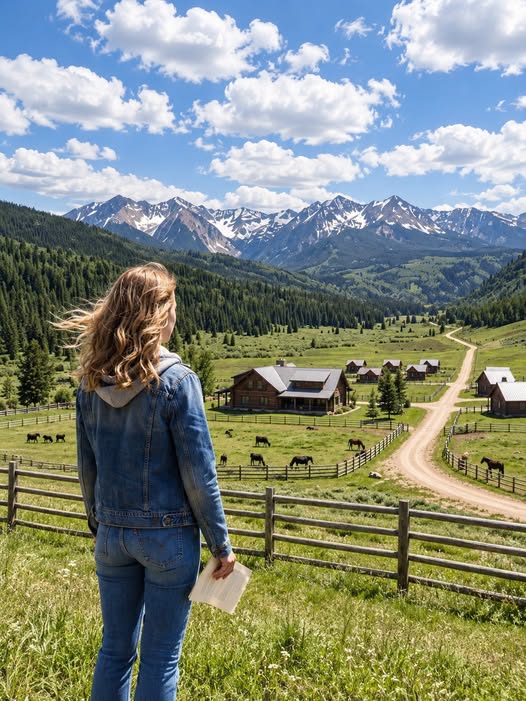
homeless at eighteen, she believed her father left her nothing—until an old brass key led her to the farm he had spent his life protecting for her
Part 1
On the morning Dileia Ror turned eighteen years and eight days old, the only home she could remember closed its door behind her.
Not slammed.
That would have required anger.
Sandra simply shut it.
The lock clicked.
Dileia stood on the narrow concrete landing of the duplex with a faded duffel bag over one shoulder, a battered cardboard shoebox tucked under her arm, nineteen dollars in her sock, and an old brass key hanging from a leather cord around her neck.
It was late October.
Cold rain had begun sometime before sunrise, turning the parking lot below into a sheet of dull gray water.
Dileia stared at the door for a few seconds.
She wondered whether Sandra might open it again.
Maybe she would say she had gone too far.
Maybe she would hand Dileia twenty dollars.
Maybe she would at least say goodbye.
Nothing happened.
Dileia walked downstairs.
Her father, Elias Ror, had died when she was eleven.
Everything she knew about him afterward came from other people.
Mostly Sandra.
He had been careless.
Too generous.
Bad with money.
The sort of man who helped everyone except his own family.
He had worked himself poor and died with medical bills, debts, worn-out tools, and nothing worth inheriting.
Sandra had repeated the story so many times that Dileia eventually stopped asking questions.
She remembered little enough to argue.
A pair of large hands lifting her onto a kitchen counter.
The smell of sawdust.
Grass crushed under boots.
A man humming badly while fixing something.
A porch.
Maybe.
Sometimes she wondered whether she had invented the porch.
The only physical thing left of him was the key.
He had tied it around her neck when she was five or six.
“This opens somewhere good,” he had told her.
She remembered that sentence clearly.
She remembered being small enough to believe adults meant what they said.
After Elias died, Dileia went to live full-time with Sandra. Years passed. Photographs disappeared. Stories about Elias became shorter and harsher.
Then, one week after Dileia’s eighteenth birthday, Sandra stood in the kitchen smoking over the sink and said, “The state money stopped.”
Dileia had already half packed.
She had seen the ending coming.
“Where am I supposed to go?”
Sandra tapped ash into a chipped coffee cup.
“You’re grown.”
“That doesn’t answer me.”
“You’re smart. Figure it out.”
Dileia looked around the kitchen where she had eaten thousands of meals without ever feeling completely welcome.
Sandra finally met her eyes.
“I did more than I agreed to do.”
“I know.”
“No, you don’t. I gave up years.”
Dileia felt the familiar instinct to apologize.
She swallowed it.
Sandra turned toward the window.
“Your father left both of us with nothing. I survived it. You will too.”
Dileia put on her coat.
She had reached the door when Sandra called after her.
“Wait.”
She disappeared into the hall closet and returned carrying a shoebox bound with an old rubber band.
“These were his.”
Dileia stared at it.
“You had them?”
“They’ve been taking up space.”
“For seven years?”
Sandra’s jaw tightened.
“Take them or they’re going in the trash.”
Dileia took the box.
Sandra closed the door behind her.
Three nights later, Dileia understood how quickly a person could disappear while still being alive.
The first night she slept sitting upright on a metal bench outside a bus terminal, both arms threaded through the straps of her duffel bag.
At three in the morning, a maintenance worker told her she had to move.
So she moved.
That became the first rule.
Move before someone makes you.
The second night she found a women’s shelter.
They gave her a narrow cot, a thin gray blanket, and coffee so burned it tasted bitter even after three packets of sugar.
She was grateful for all of it.
The woman in the next cot looked around sixty. Her suitcase was held shut by a green bungee cord.
Near dawn she leaned toward Dileia.
“First night?”
Dileia nodded.
“Keep your bag through your arms. Back against the wall if you can.”
“I know.”
The woman studied her.
“You got family?”
Dileia almost laughed.
“No.”
It was the most honest word she had spoken in months.
The woman dug inside her suitcase and handed her a crushed granola bar.
“Eat slow.”
“I can’t pay you.”
“Didn’t ask.”
Dileia hesitated.
The woman lowered her voice.
“Whatever put you here, don’t let anybody convince you this is where your story ends.”
Dileia kept the wrapper afterward.
She did not know why.
By the third day, she had seventeen dollars and change left.
That afternoon the rain came down hard enough to drive her inside a diner near the interstate.
She bought bottomless coffee for a dollar and a quarter and sat in the back booth with her belongings against the wall.
The shoebox rested beside her.
She had avoided opening it.
Part of her feared there would be nothing inside but receipts.
Another part feared there would be something.
Something that proved Sandra right.
Something small and sad belonging to a dead man who had never managed to leave his daughter anything useful.
Eventually Dileia pulled the rubber band loose.
It snapped.
Inside were photographs.
Real ones, printed on glossy paper, curled at the edges.
A younger Elias sat on porch steps holding a furious red-faced baby.
On the back, written in pencil:
Dileia. Three weeks old. First morning home.
Dileia stopped breathing for a moment.
Home?
She turned over another.
Elias kneeling beside an older man in a garden.
Another showed Elias with one arm around a skinny teenage boy.
Another showed a blue-gray dog mid-bark.
There was a red barn.
An apple orchard.
A farmhouse.
Images of a life no one had ever told her existed.
At the bottom lay an old harmonica and a yellowed envelope from a law office in a town called Cordell.
The envelope had Dileia’s name on it.
The postmark was six years old.
It had never been opened.
Her hands began shaking.
Inside was a letter stating that the estate of Elias Ror had established a property trust naming his daughter as sole beneficiary when she turned eighteen.
The property was listed as Bellweather Farm.
One hundred forty acres.
House.
Barns.
Outbuildings.
Water rights.
Woodland.
Orchard.
Dileia read the page twice before understanding it.
Then she found the second letter.
This one was handwritten.
Baby girl,
If you’re reading this, then you made it to grown.
I am sorry I’m not standing there to see it.
People may tell you I left you nothing.
Let them.
The nothing is on purpose.
What I left you isn’t money because money can be spent, stolen, gambled away, or used up paying people who never loved you.
I left you a place.
Bring the key.
You’ll know the door.
I love you more than the whole one hundred forty acres, and that’s saying something.
Dad.
The waitress approached with the coffee pot, saw Dileia’s expression, and quietly filled her cup without asking anything.
Dileia looked at the brass key in her palm.
All her life she had believed she came from a man who failed.
Now a dead man was telling her there had been a plan.
She did not know whether to believe him.
She searched Bellweather Farm on her old phone using the diner’s Wi-Fi.
Cordell was two counties away.
The bus fare was fourteen dollars.
That would leave her almost nothing.
No ticket back.
No safety.
No plan if the farm no longer existed.
Dileia studied the photograph of her father holding the baby.
Then the handwritten letter.
Then the key.
“All right,” she whispered. “I’ll come see.”
The next morning she bought the ticket.
The bus carried her away from the city through miles of strip malls, warehouses, subdivisions, and finally open farmland.
Dileia sat by the window with the letter on her lap.
She refused to call what she felt hope.
Hope had disappointed her too many times.
She called it curiosity.
That felt safer.
By early afternoon she stepped off the bus in Cordell.
The town consisted of a brick Main Street, a grain elevator, a church steeple, one gas station, and a feed store with a faded sign.
The bus drove away.
Silence settled behind it.
Dileia had never heard silence that large.
She walked toward the feed store because a gray-haired woman outside was sweeping leaves from the steps.
“Excuse me.”
The woman looked up.
“I’m trying to find Bellweather Farm.”
The broom stopped.
Dileia continued.
“It belonged to Elias Ror.”
The woman’s face changed.
“Who are you?”
“Dileia.”
The broom fell against the wall.
The woman stared at her eyes, her jaw, and finally the key hanging at her throat.
“Oh, Lord.”
Dileia instinctively stepped backward.
The woman covered her mouth.
“You’re Elias’s girl.”
Dileia said nothing.
The woman wiped suddenly wet eyes.
“I’m Odessa.”
Then, almost as though recognizing hunger before Dileia herself had admitted it, Odessa picked up the duffel bag.
“Come inside.”
“I don’t have much money.”
“Good thing I didn’t ask for any.”
The feed store had a lunch counter in back.
Odessa put eggs, bacon, toast, and coffee in front of her.
“Around here,” she said, “we feed people before we interrogate them.”
Dileia ate too quickly.
Odessa turned away and pretended to clean the griddle.
When the plate was empty, she leaned on the counter.
“How much did they tell you?”
“About what?”
“Your father.”
Dileia looked at her coffee.
“That he died broke.”
Odessa’s expression hardened.
“He did die without much cash.”
“They said he was foolish.”
“He was foolish about some things.”
“Like what?”
“Thinking a roof should stay over a widow’s head whether she could pay him or not. Thinking hungry kids ought to eat. Thinking a man’s bank account wasn’t the best way to measure him.”
Dileia looked up.
Odessa continued.
“The winter my husband died, snow collapsed half my roof. Elias came with tools and one of his boys. Worked two days. Wouldn’t take a dime.”
“One of his boys?”
Odessa paused.
“I don’t have brothers.”
“No.”
“Then who?”
The older woman removed her apron.
“That is something you need to see, not hear from me.”
Dileia’s stomach tightened.
“Is the farm real?”
Odessa nodded.
“Is it gone?”
“No.”
“Empty?”
Odessa gave a strange little smile.
“Definitely not.”
Twenty minutes later, Odessa was driving her down a narrow county road in an old truck with cracked vinyl seats and a heater that roared like farm machinery.
Five miles outside town, she turned onto gravel.
At the entrance stood a cedar post.
Nailed to it was a weathered wooden sign.
BELLWEATHER FARM.
Dileia gripped the door handle.
Odessa stopped.
“Why are we stopping?”
“You walk from here.”
“Why?”
“Because some doors ought to be reached on your own feet.”
Dileia stared ahead.
The lane curved uphill through leafless trees.
“I’ll wait until you get there,” Odessa said. “Go.”
Dileia stepped out.
The cold smelled different here.
Wet soil.
Hay.
Smoke.
Wood.
She touched her father’s sign.
Then she began walking.
At the crest of the hill, the trees opened.
Dileia stopped.
The farm was not ruined.
Smoke rose from the farmhouse chimney.
A barn door stood open under warm yellow light.
Chickens scratched near a fence.
Firewood was stacked shoulder-high against a shed.
A goat watched her from atop an overturned trough.
Someone had kept this place alive.
Her heart dropped.
Of course.
Of course there was a catch.
Someone else lived here.
Someone else had inherited the life she had only just discovered.
Dileia turned halfway toward Odessa’s truck.
Then an old dog came running from the porch.
Blue-gray.
White around the muzzle.
One back leg stiff.
Dileia froze.
The dog did not bark.
He rushed straight to her, pressed his head into her hands, and made a high broken sound deep in his throat.
“What—”
The dog pushed against her knees.
His nose found the leather cord.
The key.
His whole body began trembling.
Dileia dropped to the gravel and wrapped her arms around him.
“Bishop?”
She had read the name written on the back of one photograph.
The dog whined.
A voice came from the porch.
“Bishop?”
Dileia looked up.
An old man stood there in a canvas coat, a shotgun hanging loosely toward the ground.
He stared at the dog.
Then at Dileia.
“Who are you?”
Dileia slowly stood.
She lifted the cord over her head.
Held up the brass key.
The old man’s face collapsed.
The shotgun slipped from his fingers onto the porch boards.
He sat hard on the steps.
“Oh.”
Dileia did not move.
The old man covered his mouth.
“Oh, God.”
He looked at her again.
“You came.”
Part 2
His name was Booker Hale.
He had been waiting six years.
That was the first thing he told her after he could speak.
“Your daddy made me promise.”
Dileia stood at the bottom of the porch steps with Bishop pressed against her leg.
“Promise what?”
“To keep the place.”
“For me?”
Booker nodded.
“To keep the roof patched. Animals fed. Taxes paid if I could. Light in the window.”
He wiped his eyes with the back of his hand.
“Elias kept saying, ‘She’ll come when she’s grown. You make sure she can find home when she does.’”
Dileia felt anger before comfort.
“You knew where I was?”
“No.”
“You never looked?”
“We did.”
“Not very hard.”
Booker absorbed that without defending himself.
“Maybe not hard enough.”
She appreciated that more than an excuse.
“My stepmother had a letter for six years.”
Booker’s expression changed.
“She never gave it to you?”
“Yesterday.”
He looked toward the road, jaw working.
Then back at Dileia.
“Come inside.”
The farmhouse smelled of woodsmoke, coffee, wool, and something cooking.
Boots stood beside the door in different sizes.
The kitchen table was scarred with decades of use.
The stairs creaked.
A rocker sat near the stone fireplace.
Nothing looked preserved like a museum.
It looked used.
Loved.
Waiting.
Bishop limped upstairs and looked back.
“He wants you to follow,” Booker said.
The dog led her to a small room painted pale green.
Inside stood a disassembled crib.
Children’s books.
A rocking chair.
A yellow quilt.
And on the windowsill, another photograph of Elias holding the same angry baby.
Dileia picked it up.
Written beneath the picture:
First morning home.
She sat in the rocker.
“This was mine?”
“You were born upstairs.”
“I thought—”
Her voice failed.
Booker remained in the hallway.
“You thought what?”
“I don’t know.”
She stared at the picture.
“No one ever told me I lived here.”
“You did.”
“For how long?”
“Almost four years.”
“I don’t remember.”
“You were little.”
“Why did I leave?”
Booker looked away.
“That answer belongs downstairs.”
He gave her time.
Dileia sat alone.
For eighteen years she had believed she had no place behind her.
Now the missing years of her life seemed to exist physically around her.
The rocking chair where she had slept.
The porch in the photograph.
The window.
The barn.
The orchard.
The father she had been taught to dismiss.
She pressed the photograph against her chest and cried quietly enough that Booker could pretend not to hear from downstairs.
Later he put a wooden box on the kitchen table.
Inside were birthday letters.
Seven of them.
One for every birthday Elias knew he would miss.
Beneath them lay a cloth-bound ledger.
Dileia opened it.
On the first page, in Elias’s handwriting:
Bellweather Book.
People who arrived needing somewhere to stand.
Below that:
Dileia Ror — born here. First one that mattered.
Then pages of names.
Booker Hale.
Arrived sixteen. Half starved. Stayed.
Raina Mercer.
Arrived fifteen. Wouldn’t speak. Stayed two winters. Became a nurse.
Caleb and Jonas Moore.
Brothers separated by county services. Got them back together.
Dozens followed.
Some stayed weeks.
Others years.
Some returned to parents.
Some joined the military.
One became a teacher.
One a mechanic.
One entry ended:
Didn’t make it. We tried. He mattered anyway.
Dileia closed the book.
“My father took in kids?”
Booker nodded.
“Mostly older ones.”
“Foster kids?”
“Some. Runaways. Boys sleeping in grain elevators. Girls whose homes weren’t safe. Kids everybody thought were too old to save.”
“And they lived here?”
“At one time or another.”
“All these people?”
“All of them.”
Dileia stared at her own name.
“If he saved strangers, why didn’t he save me?”
Booker went silent.
The question had been waiting inside her since she saw the ledger.
“If this place was here, why was I with Sandra?”
Booker pulled one birthday letter from the bundle.
“This one.”
She opened it.
Elias had written it shortly after learning his illness was terminal.
He explained that his medical debts were growing.
Sandra had legal custody.
The farm was vulnerable.
If he transferred assets normally, creditors and probate could consume them.
If Sandra controlled the land while Dileia was a minor, Elias feared she would sell.
So he had placed Bellweather in a protected trust.
The property could not pass to Dileia until adulthood.
To make the arrangement harder to challenge, he made himself appear nearly penniless outside the trust.
They will tell you I left nothing, the letter said.
That is the price.
I’m sorry.
I can protect the place or protect what people think of me.
I can’t do both.
So I’ll protect the place.
Dileia put the letter down.
“He knew.”
“Yes.”
“He knew I’d think he abandoned me.”
Booker’s voice grew rough.
“That near killed him worse than the cancer.”
She walked to the kitchen window.
Outside, dusk settled over the pasture.
“He saved the farm.”
“For you.”
“But not me.”
Booker did not contradict her.
That mattered.
After a while he said, “A dying man doesn’t always get to choose which tragedy he can prevent.”
Dileia turned.
Booker looked older than he had an hour earlier.
“He couldn’t raise you. He could make sure there was somewhere for you to return to when nobody else owned you.”
Dileia hated how much the explanation hurt.
She wanted Elias to have been entirely heroic.
She also wanted permission to be angry.
Booker seemed to understand both.
“You can love him and still be mad.”
She laughed once through tears.
“That’s allowed?”
“Most worthwhile love requires it.”
That night Dileia slept under the yellow quilt.
It was the first full night of sleep she could remember in months.
At dawn she woke to frost along the window.
For five seconds she forgot where she was.
Then she heard Bishop’s claws in the hallway.
She smiled.
Downstairs Booker had eggs on the stove.
His face was grim.
“Before you start thinking this is a fairy tale,” he said, “we need to talk.”
Dileia sat.
“About what?”
“Money.”
Her stomach tightened.
Of course.
The trust had once contained enough cash to cover property taxes.
It had run out.
Booker had paid what he could afterward.
Last year he fell short.
This year he could pay nothing.
“How much?”
“Eleven thousand and some change.”
Dileia stopped eating.
“And if we don’t pay?”
“Tax auction.”
“When?”
“Three weeks.”
Dileia looked toward the window.
Three weeks.
She had owned Bellweather for less than twenty-four hours.
“There’s a developer buying land through the valley,” Booker continued. “Industrial project, maybe distribution warehouses. Nobody knows exactly. Fellow named Malcolm Drey. He’s already offered for this parcel twice.”
“Why this one?”
“Road access. Creek. Flat acreage.”
“And he knows about the taxes.”
“Yes.”
“So he’s waiting.”
“Yes.”
Dileia stared down at her hands.
Booker leaned back.
“There’s more.”
She almost laughed.
“Of course there is.”
“My heart isn’t good.”
Her eyes lifted.
“Bad valve.”
“How bad?”
“Bad enough the doctor doesn’t like me carrying feed sacks.”
“You carried one yesterday.”
“He doesn’t live here.”
“Booker.”
He smiled faintly.
Then his expression sobered.
“You need to know what you’ve inherited. This farm isn’t a treasure chest. It’s work. Debt. Roofs. Animals. Winter. Taxes. Me getting old.”
Dileia sat very still.
For most of her childhood, hard truths had been used against her.
This one was different.
Booker wasn’t trying to frighten her away.
He was giving her the dignity of choosing with open eyes.
Dileia stood.
“Show me the farm.”
“Now?”
“Now.”
He studied her.
“All right.”
They started at the orchard.
Thirty-eight old apple trees grew beyond the barn.
“Your daddy planted the first row the year you were born.”
Dileia touched a trunk.
“He was sick already?”
“Starting to be.”
“Then why plant trees that take years to produce?”
Booker gave her a long look.
“He said not everything a man plants is supposed to feed him.”
The words followed her all morning.
They inspected fences, tools, a leaning equipment shed, the well pump, garden beds, chickens, goats, and three elderly horses kept mostly because Booker could not bear to sell them.
Dileia’s practical side kept counting problems.
Broken gate.
Roof flashing.
Feed costs.
Taxes.
Wood.
Winter.
But something else was happening beneath the fear.
The ground felt familiar.
She knelt in the garden and rubbed soil between her fingers.
“I know this.”
“Know what?”
“The dirt.”
Booker chuckled.
“That’s a start.”
At noon Bishop began growling at the lane.
A sedan approached.
Dileia recognized it.
Sandra stepped out.
She wore her good coat.
The coat she put on when she wanted the world to think everything in her life was under control.
Her eyes moved over the farmhouse.
Barn.
Land.
She was calculating.
Dileia felt the old shrinking feeling.
Booker appeared behind her.
“That’s her?”
“Yes.”
“The woman who hid the letter?”
“Yes.”
Booker’s mouth became a line.
“I’ve wanted—”
“No.”
He looked at Dileia.
“I’ll handle it.”
Sandra stopped near the porch.
“So this is what he hid.”
Dileia said nothing.
Sandra’s voice sharpened.
“I called the lawyer.”
“Of course you did.”
“He said there was a trust.”
“Yes.”
“I was Elias’s wife.”
“Stepmother.”
“I raised you.”
Dileia felt her hands grow cold.
Sandra continued.
“If he owned all this while I paid for you, then somebody owes me an explanation.”
Dileia surprised herself.
“Come inside.”
Sandra blinked.
“What?”
“I’ll explain everything.”
At the kitchen table Dileia placed the tax statement in front of her.
“Eleven thousand dollars.”
Sandra frowned.
“What is this?”
“Back taxes.”
Then the auction notice.
“Three weeks.”
Sandra’s face changed.
Dileia opened the ledger.
“This is what the farm was.”
Sandra barely looked.
Dileia placed Elias’s letter on top.
“And this is what Dad said about you.”
Sandra went pale.
“I don’t want—”
“Read it.”
“No.”
“Read it.”
Sandra finally took the page.
Dileia watched her reach the sentence.
Sandra is tired. She never wanted the farm or another woman’s child. I don’t hate her for that. Tired people make hard choices when they feel trapped.
Sandra’s hand started trembling.
“He wasn’t cruel to you,” Dileia said.
Sandra put the paper down.
“No.”
“You were cruel to him.”
“Yes.”
“And me.”
Sandra looked toward the floor.
The room grew silent.
Finally she said, “I knew the letter mattered.”
Dileia stopped breathing.
Sandra continued.
“I told myself it was another bill.”
“You knew.”
“I suspected.”
“You hid it for six years.”
“Yes.”
“Why?”
Sandra stood abruptly and walked toward the window.
When she turned back, the hardness was gone.
“I was jealous.”
Dileia almost preferred anger.
Sandra’s voice broke.
“He kept finding ways to love you after he died.”
She pressed one hand against her chest.
“And I had you alive in my house every day, needing something from me I didn’t know how to give.”
Dileia could not speak.
“I saw that envelope. His name. Your name. And I hated him.”
Sandra began crying.
Not beautifully.
Not quietly.
Her face simply gave way.
“I hated that a dead man could still be better at loving you than I was.”
Booker stood by the pantry doorway, expression unreadable.
Sandra opened her purse.
She removed another envelope.
“He wrote me one too.”
Dileia stared.
“I read the first line and stopped.”
“Why?”
“Because he thanked me for taking care of you.”
Sandra laughed bitterly.
“I didn’t deserve the thanks.”
She placed the envelope on the table.
“I came here thinking maybe there was money.”
Dileia did not look away.
“I know.”
“There isn’t.”
“No.”
Sandra nodded.
“Good.”
Dileia frowned.
Sandra looked around the kitchen.
“Because if there had been, I might have spent another ten years convincing myself I was entitled to it.”
She put on her coat.
At the door she stopped.
“You always forget to eat when you’re frightened.”
Dileia stared at her.
It was the closest thing to tenderness Sandra had offered in years.
Then Sandra left.
Her car disappeared down the lane.
Dileia stood at the window until it was gone.
Booker said nothing.
Finally Dileia turned.
“I’m not selling.”
Booker raised an eyebrow.
“Not one acre.”
“Eleven thousand dollars.”
“I heard you.”
“Three weeks.”
“I heard that too.”
“You’ve got seventeen dollars.”
“Three dollars now.”
Booker almost smiled.
Dileia placed both hands on the ledger.
“My father kept this place alive long enough for me to find it.”
She looked around the room.
“I can fail trying.”
Her voice steadied.
“But I’m not going to lose it because I walked away.”
Part 3
The first person Odessa called was Raina Mercer.
She arrived the next afternoon wearing hospital scrubs under a winter jacket.
Dileia was standing on a ladder in the orchard when Raina got out of her truck.
“You’re Dileia?”
“Yes.”
Raina stared at her.
Then suddenly covered her eyes.
“Sorry.”
“What?”
“You look like him.”
Dileia had already heard it several times, but each time the words landed differently.
Raina walked closer.
“I came here when I was fifteen.”
She pointed toward the farmhouse.
“I didn’t speak for nearly six weeks.”
“Why?”
Raina shrugged.
“Because everybody who asked me questions before that used the answers against me.”
Dileia climbed down.
“Dad helped you?”
“He gave me breakfast.”
“That’s it?”
“At first.”
Raina smiled.
“Sometimes breakfast is a beginning.”
By evening two more people arrived.
Caleb Moore owned a repair shop.
His sister Joanna handled the books.
Their childhood names appeared together in Elias’s ledger.
The next day came Marcus Reed, a retired Army sergeant who had lived at Bellweather during his last two years of high school.
Odessa showed up with three casseroles and enough coffee to supply the county.
They gathered around the kitchen table.
Dileia explained the debt.
Nobody looked surprised.
Booker had apparently been hiding the farm’s condition from everyone for years.
Raina glared at him.
“You stubborn old mule.”
“I didn’t ask because it wasn’t your debt.”
Marcus leaned forward.
“You spent thirty years teaching us help isn’t humiliation.”
“That was different.”
“How?”
Booker had no answer.
Dileia opened the ledger.
“I don’t want anyone paying because they think they owe my father.”
Raina looked at her.
“Good.”
Dileia hesitated.
“Good?”
“Because we don’t.”
She tapped the ledger.
“Your father never kept score.”
“Then why are you here?”
Raina smiled.
“Because he taught us what to do when somebody is standing out in the cold.”
The orchard became their first plan.
The apples were late-season varieties.
Hundreds still hung on the trees.
Within two days, word spread.
People came after work.
Teenagers from the high school filled crates.
The church sold pies.
Odessa turned one corner of the feed store into a produce stand.
Caleb repaired cars on Saturday and donated labor charges.
Joanna set up an account for the tax fund.
Marcus contacted everyone from the ledger he could find.
Money arrived in twenty-dollar bills.
Fifty-dollar checks.
Loose change.
No miracle donor came.
Dileia liked that.
Every dollar had fingerprints on it.
She worked until her shoulders cramped.
She learned to sort apples.
Repair fencing.
Stack wood.
Feed horses.
Patch broken hinges.
Booker taught her how to listen to the well pump.
“How do you hear anything?”
“You stop talking.”
She looked at him.
“Funny.”
“Machine talks plenty. People mostly don’t listen.”
He showed her the difference between a healthy motor hum and a bearing beginning to fail.
He taught her to sharpen tools.
He showed her which wood burned hot and which burned long.
Dileia discovered that competence quieted fear.
At night, however, fear returned.
She would lie upstairs calculating.
Eleven thousand.
Three weeks.
Food.
Heating.
Feed.
Repairs.
Booker’s medicine.
One night she woke near two and found him sitting alone in the kitchen.
“You should be sleeping.”
“So should you.”
He was studying an old photograph of Elias.
Dileia poured water.
“Were you really sixteen when he found you?”
“Fifteen and eleven months.”
“Where?”
“Grain elevator.”
“Why were you there?”
Booker looked toward the stove.
“My old man drank.”
Dileia waited.
“One night he hit my mother. I hit him with a shovel.”
“Did you hurt him?”
“Enough.”
“What happened?”
“I ran.”
Booker folded his hands.
“I was convinced I’d ruined my whole life.”
“And Dad found you?”
“Your daddy found me stealing eggs.”
Dileia laughed.
“Seriously?”
“Seriously. He caught me with six of them shoved in my coat.”
“What did he do?”
“Asked how I planned to cook them.”
“What?”
“I thought he was making fun of me. So I told him to go to hell.”
“That sounds smart.”
“I was very impressive.”
She smiled.
“What happened?”
“He made breakfast.”
Dileia’s smile disappeared.
Booker nodded.
“See a pattern?”
“He didn’t call police?”
“No.”
“Didn’t ask about your parents?”
“Not first.”
“What did he ask?”
Booker stared into the dark window.
“Whether I wanted toast.”
Dileia sat quietly.
“He let me sleep in the barn for three nights because I wouldn’t enter the house. Fourth morning he said the temperature was dropping and he’d leave the mudroom unlocked.”
“Did you go in?”
“At three in the morning.”
“Then?”
“Then I never really left.”
Dileia looked at the kitchen.
Her father had been dead seven years, yet she kept discovering his habits living inside other people.
Feed first.
Questions later.
Leave the door unlocked.
Give dignity before advice.
“What was he afraid of?” she asked.
“Your father?”
“Yes.”
Booker thought.
“Failing you.”
The answer hurt more than expected.
“He did fail me.”
“Yes.”
Dileia looked sharply at him.
Booker did not retreat.
“He failed you in some ways.”
She waited.
“And saved something for you in others.”
He leaned forward.
“If I tell you Elias was perfect, then I turn him into another lie.”
Dileia looked down.
“He should’ve found another way.”
“Maybe.”
“I shouldn’t have spent years thinking no one wanted me.”
“No.”
“He should have done better.”
“Yes.”
She wiped her eyes angrily.
Booker continued.
“And he loved you.”
Dileia nodded.
Both truths sat there together.
For the first time, she allowed them.
By the end of the second week, they had raised just over eight thousand dollars.
Three thousand short.
Four days remained.
The orchard was nearly empty.
Everyone who could donate already had.
Marcus studied the numbers twice.
“Maybe I can borrow—”
“No,” Dileia said.
“Dileia.”
“No one is taking personal debt.”
“We’re running out of options.”
“Then we run out honestly.”
That night she sat on the porch.
Bishop leaned against her.
The cold had sharpened.
Stars appeared over the barn.
Dileia buried her face in the dog’s fur.
“I knew better.”
Bishop sighed.
“I knew better than to want something.”
She thought about the bus station.
Sandra’s door.
The shelter.
All the years she had survived by needing less.
Want less, lose less.
It had worked.
Until Bellweather.
Now she wanted the farm so fiercely that losing it felt unbearable.
She cried into Bishop’s neck.
Then she remembered the old woman at the shelter.
Whatever put you here isn’t the end of you.
The next morning Dileia went to the county tax office.
Raina came with her but waited by the door.
Dileia carried copies of the trust, the ledger, and the auction notice.
Behind the counter sat a woman named Mrs. Palmer.
“What can I do for you?”
Dileia almost said nothing.
The instinct to retreat was powerful.
Instead she told the truth.
She told Mrs. Palmer about Elias.
The farm.
The children.
The trust.
The unpaid taxes.
The three thousand dollars.
When she finished, Mrs. Palmer removed her glasses.
“I knew your father.”
Dileia blinked.
“Apparently everybody did.”
Mrs. Palmer smiled.
“Seems that way.”
She opened a drawer.
“About twenty years ago, an elderly farmer came in here owing taxes.”
Dileia waited.
“Your father paid them.”
“What?”
“Cash.”
“Why?”
“He said the man shouldn’t lose a place his family had worked for fifty years over one bad season.”
Mrs. Palmer’s eyes softened.
“He made me promise not to tell.”
“You just broke it.”
“He’s been dead seven years. I’ll risk his anger.”
Then she pulled out a form.
“There is a hardship extension.”
Dileia leaned forward.
“How long?”
“Nine days.”
“Does it stop the sale?”
“Temporarily.”
Dileia took the pen.
Nine days was not three thousand dollars.
But it was nine days.
She signed.
Raina sent the story to a small county newspaper.
Dileia hated the idea.
“I don’t want strangers pitying me.”
“They aren’t pitying you.”
“What do you call it?”
“Knowing.”
The article appeared two days later.
FARM THAT SHELTERED FORGOTTEN CHILDREN FIGHTS TO SURVIVE.
A picture showed Dileia standing beneath the orchard trees.
Then money began arriving.
Forty dollars from a man who had slept in the barn one winter in 1998.
A hundred from a woman in Ohio.
Twenty-five from a former teacher.
Coins from schoolchildren.
The cider press paid extra for the last fruit.
Odessa’s jar filled twice.
Then came a plain envelope.
Inside were eighty dollars.
No return address.
One sentence.
Toward the taxes. From somebody who owes more than money.
Dileia recognized Sandra’s handwriting.
She folded the note.
Said nothing.
Added the money.
The evening before the deadline, they gathered at Bellweather.
The table was covered with checks, bills, coins, receipts, coffee cups, and cold pie.
Joanna counted.
Then counted again.
Nobody spoke.
Finally she looked up.
“Eleven thousand, two hundred seventeen dollars.”
Dileia stared.
Booker began laughing.
Raina cried.
Marcus pounded the table once.
Odessa said, “Well, Elias, you stubborn fool.”
Dileia did not cheer.
She covered her mouth.
The feeling was too large.
She had spent her life believing nobody came when you needed them.
Yet here sat a kitchen full of evidence that she had been wrong.
Part 4
The next morning Dileia and Raina drove to the courthouse.
A man in a camel-colored coat stood across the lobby holding a leather folder.
Malcolm Drey.
Dileia knew immediately.
He watched them approach the tax counter.
Mrs. Palmer accepted the payment.
Stamped the paperwork.
Then slid the receipt across.
“Clear.”
Dileia held the paper.
“That’s it?”
“That’s it.”
“No auction?”
“No auction.”
She stared at the stamp.
For once in her life, a piece of the world had decided to remain hers.
Across the lobby, Malcolm closed his folder.
He gave Dileia a polite nod.
Then walked away.
There was no confrontation.
No threat.
No grand speech.
He was simply a businessman who had expected to buy distressed property.
Today he couldn’t.
Dileia appreciated the ordinariness of it.
Not every enemy needed to be evil.
Sometimes survival meant becoming inconvenient to someone else’s plan.
When they returned home, Booker sat wrapped in a blanket on the porch.
He read the result on Dileia’s face.
Still, she wanted to say the words.
“Paid.”
Booker’s eyes closed.
“All of it?”
“All.”
He lowered himself into the rocker.
Dileia sat beside him.
For several minutes he cried.
She did not interrupt.
Finally he whispered, “I can stop doing arithmetic at night.”
“What?”
“Every night.”
He looked toward the barn.
“I’d lie there adding what I had, subtracting what we owed, wondering what I could sell without breaking Elias’s promise.”
Dileia’s throat tightened.
“You should’ve told people sooner.”
“I know.”
“You nearly killed yourself.”
“I know.”
“You’re stubborn.”
“That too.”
She leaned against the porch post.
“You’re not allowed to die now.”
Booker smiled.
“That’s not usually how hearts work.”
Winter came.
The farm did not become easy just because the taxes were paid.
A water pipe froze.
Two chickens died.
The old tractor refused to start on the coldest morning of December.
Dileia split wood until blisters opened and hardened into calluses.
She learned that owning land mostly meant fixing what weather tried to destroy.
Yet hardship felt different when it belonged to a life she had chosen.
By March, she had gained weight.
Her shoulders strengthened.
Her face held more color.
She stopped checking the bedroom door twice before sleeping.
People kept visiting.
Raina came after hospital shifts.
Marcus brought his children.
Caleb taught Dileia welding.
Odessa arrived every Sunday with too much food.
The farm that had seemed enormous and lonely began feeling full.
Booker’s health worsened slowly.
Some days he could walk to the orchard.
Other days the porch exhausted him.
So Dileia became his hands.
“Cut that branch.”
“This one?”
“Other one.”
“That’s half the tree.”
“Exactly.”
“You’re destroying it.”
“Pruning.”
“It looks violent.”
Booker laughed.
“You can’t be sentimental with fruit trees.”
He showed her how to remove dead wood so healthy branches received light.
“Cut hard,” he said. “Comes back stronger.”
Dileia looked at the pile beneath the tree.
“Dad say that?”
“Constantly.”
“About trees?”
“People too.”
She stood quietly.
Then said, “I want to reopen Bellweather.”
Booker stopped.
“For what?”
“For what he did.”
The wind moved through bare orchard branches.
“There are kids turning eighteen right now with nowhere to go.”
“Yes.”
“I know what that feels like.”
Booker’s eyes filled.
“I have rooms.”
“Yes.”
“Land.”
“Yes.”
“People who know how this works.”
“Yes.”
Dileia looked toward the farmhouse.
“I don’t want this to just be where Dad’s work ended.”
Booker lowered himself onto a bucket.
“What are you saying?”
“I want it licensed.”
“For foster care?”
“Maybe transitional housing. Older teens. Kids aging out. Whatever we can legally do.”
Booker stared at her.
Then smiled.
“You’d better get the ledger.”
Making Bellweather legitimate took months.
Raina helped navigate county health requirements.
Marcus handled paperwork.
A retired social worker named Evelyn Ward, another name from Elias’s ledger, became their advisor.
They installed smoke detectors.
Repaired bedroom windows.
Updated wiring.
Added handrails.
Passed inspections.
Failed one.
Fixed the problems.
Passed again.
Dileia discovered bureaucracy could be its own weather system.
She kept going.
By late summer, Bellweather Farm was officially approved to provide transitional housing for vulnerable older teenagers.
Not dozens.
Only a few.
But a beginning.
The first arrived in September.
A county vehicle stopped at the entrance.
Dileia saw it from the garden.
She wiped dirt from her hands and walked down the lane.
A sixteen-year-old boy stepped from the back seat.
His name was Noah.
He carried a black garbage bag filled with clothing.
His shoulders were sharp.
His face was harder than a sixteen-year-old’s face ought to be.
He looked at Dileia with suspicion.
She recognized it immediately.
The expectation that kindness had a price.
“You Noah?”
He nodded.
“You hungry?”
A small shrug.
“Odessa made chicken and biscuits.”
Nothing.
Dileia took his bag.
He grabbed it back.
She released it immediately.
“Okay.”
Noah looked surprised.
“You can carry it.”
He studied the house.
“How long am I here?”
“As long as the placement says. We’ll explain all that after dinner.”
“What do I gotta do?”
“Right now?”
“Yeah.”
“Walk up the hill.”
His eyes narrowed.
“That’s it?”
“That’s enough for today.”
They began walking.
Halfway up, Bishop came down from the porch.
Older now.
Slower.
He approached Noah.
The boy froze.
“Does he bite?”
“Only sandwiches.”
Bishop pressed his head against Noah’s thigh.
The boy reluctantly touched his ears.
Dileia looked away because suddenly she was standing at the bottom of that lane again, eighteen years old, frightened, with an old dog telling her what no person had yet managed to say.
You’re expected.
That evening Noah sat at the table with one arm hooked protectively around his plate.
Nobody commented.
After supper he stood beside the sink.
“What chores?”
Dileia looked at him.
“Breakfast dishes tomorrow.”
“And?”
“And what?”
“What else do I owe?”
“You ate dinner.”
“Yeah.”
“So tomorrow you help clean breakfast.”
He waited.
“That’s all?”
“That’s all.”
He clearly did not believe her.
Dileia handed him a dish towel.
“Bellweather rule.”
“What?”
“You don’t pay kindness backward.”
He frowned.
“You pass it forward when you can.”
“That sounds fake.”
“Thought so too.”
Two months later, another placement arrived.
A brother and sister.
Then a seventeen-year-old girl named Mia.
The farmhouse grew noisy.
Doors closed too hard.
Boots collected near the entrance.
Someone always drank the last milk.
Arguments happened over bathroom time.
One night Noah shouted that he didn’t need anybody and walked a mile down the road before returning in the rain.
Dileia did not lecture him.
She left the porch light on.
When he came back, she handed him a towel.
“You hungry?”
He stared at her.
“That’s all you’re gonna say?”
“For tonight.”
His eyes filled.
He looked away.
Dileia understood then why her father had started with meals.
Food asked nothing.
It gave a frightened person enough time to decide whether they wanted to remain.
In October, a postcard came from Sandra.
On the front was a photograph of maple trees turning red.
On the back:
Saw these and thought maybe your trees look like this.
I’m doing okay.
I hope the kids you’re helping are kinder to themselves than you had to be.
Sandra.
Beneath the signature was a scratched-out word.
Dileia held the card closer.
Sorry.
Sandra had written it.
Then crossed it out.
Dileia put the postcard on the mantel beside Elias’s photograph.
She did not forgive everything.
She no longer needed to.
Sometimes truth was enough to begin.
Booker made it to the first snow.
By then he rarely climbed the stairs.
Dileia moved a bed into the front room beside the fire.
The teenagers learned to lower their voices near him.
Noah brought him tea without being asked.
Mia read newspaper articles aloud.
Bishop slept beneath the bed.
One afternoon Booker asked Dileia to wheel him toward the window.
Outside, snow covered the orchard.
Bare branches stood dark against white ground.
“See those trees?”
“Yes.”
“Your father never ate one apple from the first row.”
Dileia pulled the blanket higher around him.
“I know.”
“He planted anyway.”
Booker breathed slowly.
“That’s what you need to remember.”
She looked at him.
“A good life isn’t only what you get to harvest.”
He reached for her hand.
“Sometimes it’s what you plant knowing somebody else will sit in the shade.”
Dileia squeezed his fingers.
Booker smiled faintly.
“You’re his apple tree.”
“That’s corny.”
“I’m dying. I’m allowed.”
She laughed and cried at the same time.
“You aren’t dying today.”
“No.”
He closed his eyes.
“Today I’m watching snow.”
Part 5
Booker died before Christmas.
Quietly.
Before dawn.
Bishop lying beside his bed.
Dileia woke because the house felt different.
She walked downstairs and understood before reaching him.
His hands rested peacefully over the blanket.
For a long time she simply sat.
No screaming.
No panic.
She held his hand and watched darkness outside the window soften toward morning.
Noah came downstairs first.
He saw Dileia.
Then Booker.
The boy stopped.
“Is he—”
“Yes.”
Noah’s face crumpled.
Dileia stood and opened her arms.
He hesitated only a second.
Then stepped into them.
The others woke one by one.
No one went to school that day.
Odessa arrived before sunrise.
Raina came straight from the hospital.
Marcus.
Caleb.
Joanna.
By noon, Bellweather’s kitchen was full.
Exactly the way Booker would have wanted.
His funeral was held in the little church outside Cordell.
People stood along the back wall because the pews filled.
Some had known Booker as an old farmer.
Others remembered the frightened sixteen-year-old Elias found stealing eggs.
Dileia spoke last.
She did not make a long speech.
“He spent most of his life keeping a light on for people who weren’t sure they were coming home.”
She looked toward the coffin.
“He kept one on for me six years.”
Her voice nearly failed.
“So I intend to keep it on for somebody else.”
That winter was hard.
Grief made small tasks heavier.
Dileia sometimes reached for Booker’s advice before remembering.
She would stand beside a broken fence and think, Ask Booker.
Then silence.
Ask Booker which medicine Bishop needs.
Silence.
Ask Booker whether the north field floods in spring.
Silence.
She began understanding something she had once heard him say.
People hand themselves down in pieces.
She found his pieces everywhere.
In the sharpened tools.
In the repaired roof.
In Noah remembering to bring firewood inside before a storm.
In Mia leaving toast for the younger girl who couldn’t eat when anxious.
In Raina showing up after a twelve-hour shift because nobody should sit alone after bad news.
Dileia found Elias the same way.
Not through memory.
Through habits preserved in other people.
Feed first.
Ask later.
Leave the light on.
Don’t keep score.
Spring returned.
The orchard blossomed.
White petals covered branches her father had planted nearly two decades earlier.
One morning Dileia stood among them listening to bees.
Noah appeared carrying pruning shears.
“You’re doing that wrong,” he said.
She looked at him.
“Excuse me?”
“Booker said you cut too timid.”
Dileia laughed.
“He tell you that?”
“Like fifty times.”
“Traitor.”
Noah handed her the shears.
“You gotta cut hard so it comes back strong.”
Dileia stared at him.
Then at the tree.
“Yeah.”
She cut.
By the second year, Bellweather housed six young people at a time.
Not everyone stayed.
One boy ran away.
One girl reunited with an aunt.
Noah finished high school.
Mia enrolled in nursing classes after spending too much time around Raina.
There were arguments.
Failures.
County inspections.
Broken equipment.
Months when money barely covered expenses.
Nothing became easy.
That was not the promise.
The promise was that difficulty did not have to be endured alone.
One rainy October evening, nearly three years after Dileia first walked up the lane, she sat at the kitchen table with Elias’s ledger.
Its old pages ended near the middle.
Booker’s handwriting had filled several later entries.
Now Dileia had begun adding her own.
Noah Raines.
Arrived September with one garbage bag.
Expected a catch.
There wasn’t one.
Stayed.
Graduated.
Learning diesel repair from Caleb.
She smiled.
Below his name were others.
Mia.
Jackson and Lily.
Terrence.
Ava.
Some entries had happy endings.
Some remained unfinished.
One had only three lines because the boy left after four days.
Dileia resisted the temptation to rewrite it into something better.
Her father hadn’t done that.
People mattered even when they could not be saved.
The porch light glowed beyond the window.
A truck approached slowly along the lane.
Dileia stood.
Another placement.
She went outside.
Rain misted under the light.
A county worker stepped from the truck.
Then a girl.
Seventeen.
Small.
Wet hair.
Backpack held tightly against her chest.
Her eyes moved over the farmhouse as though searching for danger.
Dileia knew the expression.
She had worn it on bus benches.
Shelter cots.
At Odessa’s counter.
At the bottom of this exact lane.
“You must be Kayla,” Dileia said.
The girl nodded.
“I’m Dileia.”
Silence.
“You eat yet?”
Another small shake of the head.
Dileia looked toward the house.
“We’ve got soup.”
The girl remained beside the truck.
“What do I have to do?”
“Tonight?”
“Yes.”
“Eat.”
“And after that?”
“Sleep, preferably.”
The girl frowned.
“What’s the catch?”
There it was.
Dileia almost smiled.
“No catch.”
“Everybody says that.”
“I know.”
“How long can I stay?”
“We’ll figure that out tomorrow.”
The girl looked past her toward the porch.
Near the door hung an old brass key.
Years earlier, Dileia had finally taken it from around her neck.
She had worn it through every locked door of her childhood.
Through shelters.
Bus stations.
Cold nights.
Fear.
Once Bellweather became home, she no longer needed to carry proof that somewhere good existed.
She drove a nail beside the front door and hung the key there.
At eye level.
Where every frightened teenager walking inside could see it.
Kayla pointed.
“What’s that?”
“My father’s key.”
“To this house?”
Dileia thought about the question.
“Sort of.”
The girl looked confused.
Dileia opened the door.
Warm light spilled onto the porch.
Behind them, rain whispered across the fields.
Inside, Noah—home for the weekend—was arguing with Mia about biscuits.
Someone laughed.
A pot rattled.
Bishop had been gone a year now, but a young rescue dog named June lifted her head beside the stove.
Dileia stepped aside.
“You’ll understand later.”
Kayla hesitated.
Then crossed the threshold.
Dileia followed.
After dinner the girl carried her own bowl toward the sink.
“What chores do I owe?”
Dileia leaned against the counter.
“Breakfast dishes.”
“And?”
“That’s enough.”
Kayla waited.
“You don’t pay for dinner here.”
The girl looked suspicious.
“Then why do people work?”
“Because everybody helps.”
“Same thing.”
“No.”
Dileia picked up a towel.
“Debt says somebody owns part of you because they helped you.”
She handed Kayla the towel.
“Family says you help the next person because you remember what it felt like when somebody helped you.”
Kayla studied her.
“I don’t have family.”
Dileia remembered saying the same thing at eighteen.
She remembered believing it.
“You don’t have to call us that.”
Kayla’s face tightened.
“I won’t.”
“That’s fine.”
Dileia turned toward the dishes.
“You don’t have to call this home either.”
The girl said nothing.
“But your room is upstairs.”
Dileia pointed toward the hallway.
“Second door on the left.”
“Mine?”
“As long as you’re here.”
“What if I leave?”
“Then someone washes the sheets.”
Kayla almost smiled.
“What if I mess up?”
“Then tomorrow will probably be annoying.”
The smile appeared for real.
Small.
Gone quickly.
But real.
Later, after everyone went upstairs, Dileia remained at the kitchen table.
She opened the ledger.
The fireplace had burned down to red coals.
Rain tapped the windows.
She wrote:
Kayla Monroe.
Arrived in October believing every kindness had a price.
Then she stopped.
It was too early to write the rest.
Elias had taught her that too.
Do not decide someone’s ending before they have lived it.
Dileia closed the book.
On the mantel stood three things.
The photograph of Elias holding his baby daughter.
Sandra’s postcard.
A picture of Booker sitting beneath the apple trees during his last spring.
Dileia walked to the porch.
The rain had stopped.
Clouds were breaking over the pasture.
Stars appeared one by one.
Bellweather spread around her in darkness.
One hundred forty acres.
The same number that had once sounded like a fortune.
She knew better now.
Land was not wealth simply because a deed said you owned it.
Land demanded.
Fences broke.
Taxes came due.
Roofs leaked.
Animals got sick.
Trees failed.
Winter arrived whether you were ready or not.
Bellweather had nearly been lost for eleven thousand dollars.
Its true value had never been in the acreage.
The value lived in the lighted windows.
The names in the ledger.
The people who kept returning.
The teenagers sleeping upstairs.
The promise that a person who had been thrown away somewhere else would not be thrown away here.
Dileia touched the brass key beside the door.
For years she had believed her father had died leaving her nothing.
She finally understood how wrong that sentence was.
Elias Ror had died without money.
That part was true.
He had spent too much helping other people.
He had repaired roofs he wasn’t paid to repair.
Fed teenagers who couldn’t pay him back.
Taught work to boys other men called trouble.
Made bedrooms for girls who no longer trusted locked doors.
Protected a farm his daughter wouldn’t inherit for years.
Planted apple trees whose fruit he would never taste.
The world had called that poverty.
Dileia no longer did.
Her father had been wealthy in the only currency that kept multiplying after death.
People.
The people he helped had returned when the farm needed saving.
Booker had kept the light burning.
Odessa had fed a hungry girl.
Raina had opened doors at the county office.
Marcus had organized people.
Caleb had fixed machinery.
Sandra, imperfect and late, had finally told the truth.
And now Dileia stood at the same door.
Another link in a chain that had begun long before she understood it.
She looked toward the dark road.
Somewhere beyond those fields, someone else was probably sleeping on a bench.
Someone else had just turned eighteen.
Someone else had a garbage bag of clothes and no idea where morning would find them.
Dileia could not save all of them.
Her father never could either.
That had not stopped him.
She reached for the porch switch.
Then stopped.
No.
She left the light on.
Upstairs, a floorboard creaked.
A bedroom door opened.
Kayla appeared at the top of the stairs.
“Dileia?”
“Yeah?”
The girl’s voice was small.
“Can I get some water?”
Dileia smiled.
“You don’t need permission.”
Kayla descended slowly.
At the kitchen entrance she noticed the brass key again.
“Your dad really gave you that?”
“Yes.”
“When?”
“When I was little.”
“What did he say?”
Dileia looked at the old piece of brass catching the kitchen light.
“He said it opened somewhere good.”
Kayla glanced around.
“Did it?”
Dileia thought about every answer she might give.
About the grief.
Debt.
Cold.
Booker’s death.
Sandra.
The taxes.
The years lost with her father.
The farm had not erased any of those things.
Home did not erase what happened before home.
It simply gave pain somewhere safe to rest.
Dileia looked at the frightened girl standing in her father’s kitchen.
“Yes,” she said.
“It did.”
Kayla poured water.
Before returning upstairs, she stopped beside the door.
“Why don’t you wear the key anymore?”
Dileia looked at the nail.
“Because I don’t need to carry it.”
“Why?”
Dileia’s eyes moved toward the hallway, the table, the photographs, the stairs, the rooms above them.
Then she understood that the answer had changed again.
“You carry a key when you’re still trying to get inside.”
Kayla waited.
Dileia smiled.
“I live here now.”
The girl went upstairs.
Dileia turned off the kitchen light but left the porch glowing.
She stood for another moment in the quiet.
Once, Booker had kept that light burning for a girl he had never met because a dying father told him she would come.
Six years.
Winter after winter.
Even when he began wondering whether she was real.
Even when the taxes rose.
Even when his heart weakened.
He kept the light on.
Dileia understood now that faith was sometimes nothing more dramatic than refusing to turn off a porch lamp.
She climbed the stairs.
Passed Kayla’s closed door.
Passed the room where Noah slept when he visited.
At the end of the hallway waited the pale green room.
Her room.
She had never repainted it.
The old yellow quilt remained folded across the foot of the bed.
Her father’s photograph stood by the window.
Outside, the apple trees moved gently in the clearing wind.
Dileia climbed beneath the quilt.
For years she had dreamed about locked doors.
The duplex.
Shelters.
Bus stations.
Places she was allowed to remain only temporarily.
Those dreams came less often now.
When they did, they always ended differently.
She would find herself outside somewhere in the cold.
Then, far away, she would see a light.
She would walk toward it.
Past a cedar post.
Under a weathered wooden sign.
Up a gravel lane.
A dog would come running.
An old man would be waiting on the porch.
And somewhere beyond him would stand a father she could barely remember, smiling like he had known all along she would eventually find her way back.
Dileia closed her eyes.
Downstairs, the old brass key hung beside the unlocked door.
Outside, Bellweather’s porch light burned across the dark fields.
Not for her anymore.
For the next one.

