Part 1
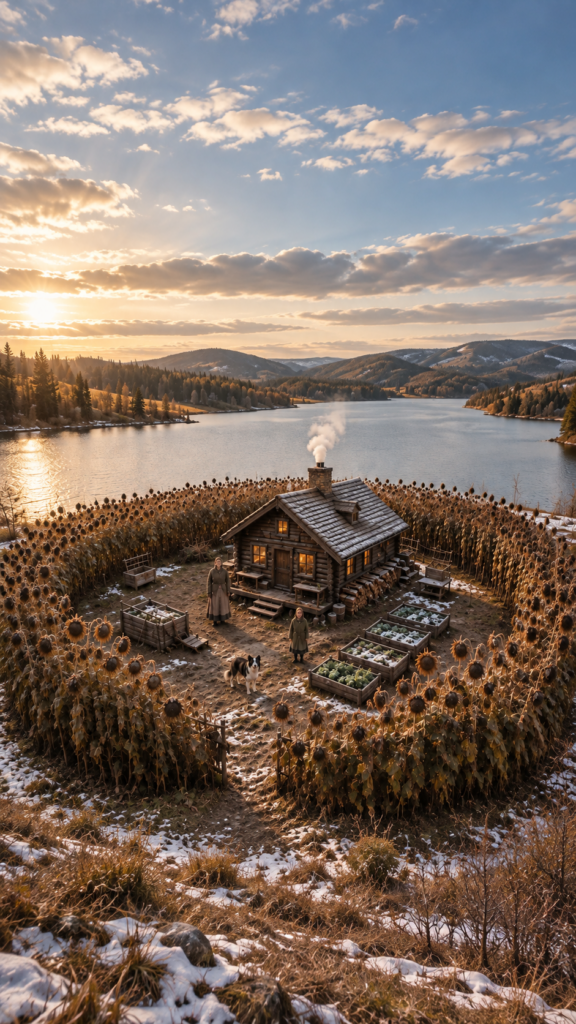
In the spring of 1884, while the settlers of Wyoming’s high country were cutting timber, repairing roofs, and stacking firewood for the winter ahead, a widow named Eliza Marsh was digging a trench around her cabin.
Not a trench deep enough to drain a flooded field. Not a ditch wide enough to keep wandering animals from her door. Just a shallow line in the hard ground, following the perimeter of her small log home.
When she finished, she took a cloth sack from the porch, knelt in the dirt, and began pressing sunflower seeds into the earth.
Hundreds of them.
She planted them so closely that there was barely enough space between them for a woman’s fingers.
From the road, it looked ridiculous.
The growing season in that part of Wyoming was short, the winters were merciless, and every sensible family in the basin understood that a warm month was a month that could not be wasted.
Yet here was Eliza Marsh, a woman with no husband, no grown sons, and a nine-year-old daughter depending on her, spending precious daylight planting flowers.
By autumn, people would be laughing openly at what she was building.
By December, some of those same people would be struggling to keep their homes above freezing.
And the thing standing between Eliza’s daughter and the terrible cold would be the wall everybody had told her was foolish.
But on that spring morning, Eliza knew nothing about the storm waiting at the end of the year.
She knew only that another winter was coming.
And she had already lost too much to the cold.
Four winters earlier, her husband, Thomas Marsh, had ridden away from their cabin during a sudden whiteout.
He never returned.
The details of that day had settled into Eliza’s memory with a clarity she sometimes wished she could escape. The wind had risen faster than anyone expected. Snow had swallowed the familiar shape of the trail. By the time the weather cleared, Thomas was gone.
The old wool coat he had left behind still hung beside the cabin door.
Eliza had never moved it.
During the warmer months, the coat looked out of place, heavy and dark against the rough wooden wall. When winter came, it seemed to belong there again, as if its owner might step through the door and reach for it.
Nine-year-old Nell had grown up knowing that coat almost as well as she remembered her father’s face.
Sometimes, when she passed it, her hand brushed the worn sleeve.
Eliza noticed.
She rarely said anything.
There were losses a mother could explain to a child, and there were losses that remained in the room long after the explaining was finished.
Thomas’s absence had changed every ordinary calculation of their lives.
A family with several strong adults could divide winter work among them. One person might cut wood while another repaired the roof. Someone could look after the stove while someone else traveled for supplies.
Eliza had only two hands.
Nell helped wherever she could, but she was still a child. Eliza intended to keep her one for as long as possible.
Their other companion was Duke, an aging hound whose muzzle had turned gray and whose favorite place was beside the iron stove.
He could warn them about strangers or strange noises. He could keep Nell company while Eliza worked.
He could not swing an ax.
And winter did not care how many people were available to prepare for it.
The Marsh cabin stood exposed to the wind that swept across the high basin. Its logs had weathered years of sun, snow, and driving rain. The structure was sound enough to stand, but standing against a Wyoming winter and keeping its occupants warm were two different things.
Eliza knew every troublesome corner.
She knew where frost first appeared between the logs. She knew which floorboard grew cold before the others. She knew how the bottom of the door sometimes admitted a narrow stream of air that could be felt even when the stove burned brightly.
Most of all, she knew how quickly firewood disappeared when the wind began forcing cold air through the cabin.
Every additional log she burned was another log she had to gather, cut, carry, and store.
The men of the valley could afford to think of winter as a contest between the size of their woodpiles and the length of the storm.
Eliza could not.
She had to find a way to make the heat already inside her home last longer.
That was why she had started digging.
Nell watched her from the porch, holding the small sack of seeds against her chest.
“Are we going to have sunflowers all the way around the house?” she asked.
“That’s the idea.”
“Even behind the cabin?”
“Especially behind the cabin.”
Nell looked toward the northern wall, where cold air seemed to find a way inside every winter.
“Are we going to eat the seeds?”
“Not these.”
“Then what are they for?”
Eliza pressed another seed into the earth, covered it with her thumb, and glanced at the rough log wall beside her.
“They’re going to help us when it gets cold.”
Nell considered the answer.
She knew sunflowers needed sunshine. She knew flowers withered when the weather turned.
But her mother was not a woman who wasted work on a whim.
So she crouched beside Eliza and began planting.
The idea had come from something Eliza had learned years earlier from Thomas’s mother.
Her mother-in-law had brought old farming knowledge west from a German settlement in Colorado. It was the kind of knowledge passed through families because people had seen it work, not because anyone had written it in a book.
Among the things she had taught Eliza was a method of using dried sunflower stalks around cellars and smokehouses.
The stalks were hollow and rigid after they dried. When bound closely together, they created a thick layer containing countless small pockets of air.
If the layer was arranged properly, it slowed the wind before the wind reached the building itself.
Thomas’s mother had explained the principle in words Eliza had never forgotten.
“The cold hunts for your walls,” she had said. “So give it something else to find first.”
It was not a complicated lesson.
But the longer Eliza lived alone in that cabin, the more sense it made.
Her problem was not simply the cold outside.
It was the wind carrying that cold through every tiny opening in the house.
She could burn more wood and keep fighting it.
Or she could try to slow the wind before it reached the logs.
So she planted sunflowers.
At first there was nothing for the neighbors to notice except the freshly disturbed soil.
Then the first green shoots appeared.
Nell checked them almost every morning, kneeling close enough to count the leaves. Eliza watered the young plants and watched the sky for the kind of sudden cold that could ruin weeks of effort.
She had planted more seeds than she expected to survive.
She had also placed them closer together than anyone growing sunflowers for food would have done.
A gardener hoping for large flower heads might have thinned the plants. Eliza wanted something different.
She wanted density.
She wanted a barrier thick enough to stand between the wind and her home.
As spring moved toward summer, the young plants rose around the cabin in crowded ranks.
Their broad leaves brushed one another.
The stalks became thicker.
By midsummer, the sunflowers stood chest-high, creating a green band nearly three feet deep around the foundation.
From inside, Nell could look through the window and see the leaves moving in the breeze.
From outside, the house appeared to be standing in the middle of a small field.
The sight attracted attention.
Wagons began slowing on the road.
People who would ordinarily have passed without stopping found reasons to look toward the Marsh property.
Some seemed amused.
Others merely puzzled.
A few shook their heads and continued on.
Eliza noticed them, but she did not invite their opinions.
She had already learned that explaining a difficult decision to someone who wanted to laugh could consume more time than doing the work itself.
One afternoon, Elias Crane rode over from his ranch three miles away.
Elias was a practical man, accustomed to judging a task by the amount of labor it required and the result it produced.
His own log home was solidly built, with thick timber walls and careful joints. Every autumn he made certain that enough firewood was stacked to see his household through the worst of the season.
He understood preparation.
What he could not understand was why Eliza Marsh had surrounded her home with flowers.
He stopped near the cabin and looked over the thick stand of plants.
“Eliza,” he called, “what in the world are you building out here?”
Eliza straightened slowly from her work.
“Good afternoon, Elias.”
He glanced at the sunflowers.
“These don’t look like a garden.”
“They aren’t, exactly.”
“Then what are they?”
She brushed dirt from her hands.
“Something I hope will be useful.”
Elias waited for more.
When no explanation came, he looked toward the far side of the cabin, where the flowers continued around the corner.
“That’s an awful lot of ground to give up for something you aren’t planning to harvest.”
“I’m planning to use them.”
“For what?”
Eliza smiled faintly.
“For winter.”
He stared at her.
Then he let out a short laugh.
“Well, I suppose you’ve got your reasons.”
“I do.”
There was no sharpness in her answer.
That seemed to trouble him more than an argument would have.
He studied the plants again, shook his head, and rode away.
By the time the growing season began to turn, the story had traveled farther than the Marsh property.
At the general store, Otis Crane found it particularly entertaining.
Otis had a way of turning other people’s decisions into public amusement, especially when those decisions looked different from what everybody else was doing.
When Eliza came for supplies, he glanced at the twine she needed and asked whether she intended to tie up her flowers so they would not run away.
She gave him the quantity she wanted.
He laughed anyway.
“I’ve seen folks do some foolish things,” he said, “but trying to grow a wall around a house might be the finest one yet.”
Eliza counted out her payment.
“They’re only flowers until they’re dry.”
Otis leaned forward.
“And what are they after that?”
“Something I can use.”
She gathered the twine and left before he could make another joke.
By then, people had begun calling her place the sunflower widow’s cabin.
It was not meant kindly.
The words reduced everything Eliza was doing to two things the valley considered unusual: she was a widow trying to manage without a husband, and she was growing flowers instead of making the usual preparations for winter.
Eliza understood the insult.
She simply had more important things to do.
As the days shortened, the sunflowers began to lose their summer brightness.
Leaves drooped.
The great flower heads darkened.
The green stalks dried into hard, hollow stems.
What had once been a living ring around the house became the raw material Eliza had been waiting for.
She began cutting the stalks carefully and laying them in rows.
Nell carried lengths of twine and helped stack the dried stems according to their size.
Duke followed them, sniffing among the fallen leaves and occasionally settling in a patch of weak autumn sunlight.
Eliza worked until her shoulders ached.
She cut, sorted, gathered, and bound.
Her fingers developed blisters from pulling twine tight around the brittle stalks. Some stems cracked if she handled them roughly. Others were bent or too thin to fit neatly with the rest.
She learned to sort them by feel.
The larger stems formed the body of each bundle. Smaller ones filled spaces that would otherwise let air move too freely.
She placed the bundles around the outer walls in overlapping rows, making certain that the joint between two bundles did not line up with the joint in the layer beneath.
She did not want a single straight opening through which the wind could pass.
At the corners, where two walls met, she worked even more carefully.
Nell watched her examine a narrow space between two bundles.
“It’s only a little gap,” the girl said.
Eliza held her palm against it.
“Little gaps are how the cold gets invited inside.”
“Even through all these?”
“Especially if we leave it a straight path.”
She loosened the nearest bundle and moved it until the opening disappeared.
Nell looked along the growing wall.
“There’s going to be a lot of them to check.”
“I know.”
“Will we have enough?”
Eliza considered the remaining rows of dried stems.
“We’ll make what we have count.”
Not everyone who came to inspect her work was content to laugh.
Walter Boone, widely regarded as the most experienced carpenter in the territory, stopped near the cabin one afternoon and examined the bundles with an increasingly troubled expression.
Unlike Otis, Walter knew enough about buildings to see a genuine problem in what Eliza was attempting.
“You’re going to trap moisture against those logs,” he told her.
Eliza kept her hands on the bundle she was tying.
“That’s something I’ve considered.”
“Have you?”
His tone suggested he doubted it.
“Wet wood rots. You crowd a wall with this much dead growth, and you’re asking for trouble.”
She looked at the logs.
“I’ll watch for it.”
“You can’t watch water out of timber once it’s settled in.”
Eliza knew his warning was not foolish.
Moisture could damage wood. Poorly placed material could create problems worse than the ones it was meant to solve.
She had no intention of pretending otherwise.
But Walter was looking at her sunflower bundles as though they were nothing but discarded plants.
He was not considering what the layer of still air might do against a hard, continuous winter wind.
“I appreciate the warning,” she said.
Walter folded his arms.
“Then take it.”
“I am taking it.”
He waited for her to pull the bundles away.
Instead, she began checking the next section.
Walter walked off unconvinced.
Eliza did not mistake stubbornness for wisdom.
She listened to warnings, examined her work, and made changes when the evidence required them.
But she also understood that a man could be an excellent carpenter and still be unfamiliar with an old method of protecting a building from the wind.
She had been taught to distinguish between cold air and moving cold air.
It was the movement that caused so much trouble.
The hollow sunflower stems could not warm a house. They produced no heat and could not replace the stove.
What they could do was make it harder for the wind to reach the cracks between the logs.
Her mother-in-law had known that.
Now Eliza needed to find out whether she could make the same idea work in her own cabin.
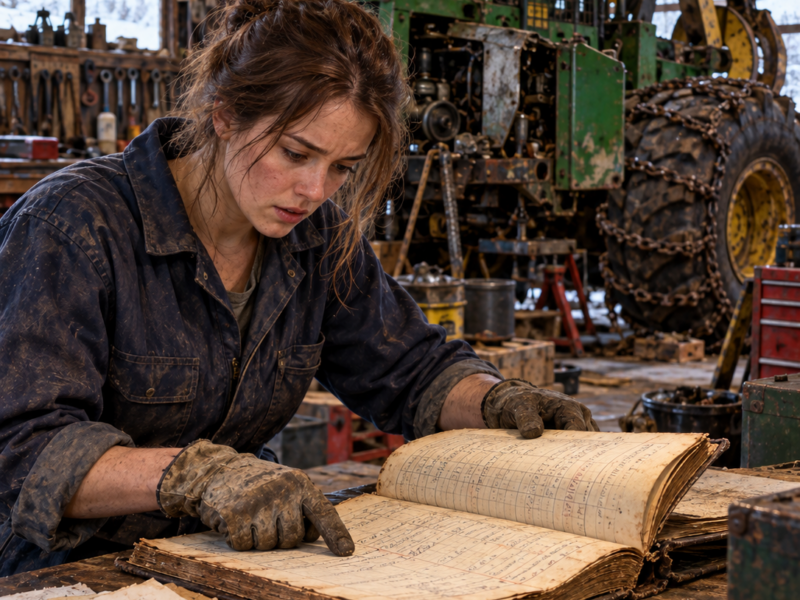
She began keeping a small ledger on the kitchen table.
Each evening, she recorded the temperature inside the cabin and the amount of wood she used to maintain it.
At first the entries were simple.
A temperature.
A quantity of wood.
A note about the weather.
As the wall grew more complete, her observations grew more particular.
She paid attention to the direction of the wind and the places where drafts could still be felt.
Nell sometimes watched her write.
“Why do you keep putting all those numbers down?”
“Because I don’t want to guess.”
“Guess about what?”
“Whether this is helping us.”
Nell glanced toward the window, where the dried stalks stood beyond the glass.
“Don’t you know?”
“I know what I hope. That’s not quite the same thing.”
The answer stayed with the child.
Her mother believed in the wall, but she was not willing to call it a success simply because she had worked hard on it.
The weather would decide.
By late autumn, the cabin had acquired a second outer layer unlike anything else in the basin.
The dead stalks stood packed tightly around the log walls, bound with twine, reinforced where necessary, and arranged to interrupt the path of the wind.
From the road, the house looked strange.
To Eliza, it looked promising.
There were mornings when she stood outside and listened to the wind moving through the dry stems.
The sound was different from the sharp whistle she knew so well around exposed logs.
It rustled and shifted through the layers instead of striking the cabin directly.
She could not yet know how it would behave in a true blizzard.
But the sound gave her reason to continue.
Then, in late November, the first serious test arrived.
A hard gale swept across the basin, driving dust and loose leaves against the buildings.
The wind caught the western side of the Marsh cabin with enough force to tear an entire section of bundled stalks from its supports.
Eliza heard the damage from inside.
A sudden tearing sound.
A sharp rattle against the logs.
Then the scrape of loose stalks dragging across the ground.
She opened the door and looked toward the western wall.
Her careful work lay scattered in the dirt.
Several bundles had broken apart. Others hung crookedly from their bindings.
The exposed logs stood bare where the protective layer had been only moments before.
Nell came to the doorway behind her.
“Mama?”
Eliza stared at the ruined section.
For the first time since planting the seeds, she allowed herself to feel the full weight of what could go wrong.
A little more wind, and the other sections might follow.
If the entire wall failed during a blizzard, the hours she had spent building it would count for nothing.
And when real winter arrived, she could not assume there would be time to rebuild.
Nell stepped beside her.
“Does this mean it won’t work?”
Eliza looked at the broken bindings, then at the exposed logs.
She was tired.
Her hands were sore.
The cold season was approaching, and she had already used more time on this strange wall than anyone in the valley thought reasonable.
But the ruined section had shown her something important.
The stalks themselves had not failed.
The spaces between the bindings were too wide.
She could see exactly where the wind had found its purchase.
“No,” Eliza said at last.
“It means we have to build this part better.”
And she went to collect the scattered stalks.
Part 2
The morning after the gale, broken sunflower stalks lay scattered across the western side of the Marsh property.
Some had been carried several yards from the cabin. Others were caught against the remaining bundles, twisted together by the wind.
Eliza went outside before the day had properly warmed.
The cold touched her hands as soon as she began picking through the damage.
Nell followed with a coil of twine, and Duke moved slowly along the wall, sniffing at the disturbed ground.
The damage was worse than it had appeared from the doorway.
A considerable section had torn loose, exposing the logs beneath.
Yet the more closely Eliza examined it, the less the failure resembled the disaster she had first imagined.
The stems had remained largely sound. Many of the bundles could be used again.
The trouble was in the way she had fastened them.
She had allowed too much distance between the bindings, giving the wind enough room to catch the dry stalks and pull them away.
It was a mistake she could correct.
Walter Boone happened past while she was studying the ruined section.
He stopped, looked at the exposed wall, and shook his head.
“Told you so,” he muttered.
Eliza heard him.
She could have reminded him that the wall had failed because of loose bindings, not because the logs had rotted.
She could have pointed out that the other sections had survived the gale.
Instead, she bent down and picked up another bundle.
Walter continued on his way.
Nell waited until he was gone.
“Why didn’t you tell him what happened?”
Eliza laid the bundle beside the others.
“Because telling him won’t fix it.”
“But he thinks he was right.”
“Then he can think that for now.”
She picked up the twine.
“We have work to do.”
That was one of the things Nell was learning from her mother, though Eliza never put it into a lesson.
Being right was not much use if the house was still cold.
Pride could not hold a stalk against the wind.
Only careful work could do that.
For the next several days, Eliza rebuilt the entire western section.
She shortened the distances between the bindings and tightened the bundles more securely.
Where one bundle ended, another overlapped it.
She tested the new arrangement with her hands, pulling and pressing to discover any weakness before the weather found it.
When she finished the damaged section, she walked around the rest of the cabin.
What had failed on the west wall might fail somewhere else.
She strengthened the other bindings as well.
The work was slower than the first construction.
By evening, her fingers often felt too stiff to close comfortably.
Nell helped her gather discarded twine, sort usable stalks, and carry material from one side of the cabin to another.
Sometimes the girl asked whether they would be finished before winter.
Eliza always answered the same way.
“We’ll finish what needs finishing.”
It was not quite a promise.
Eliza had learned to be careful with promises about the weather.
But she could promise effort.
That belonged to her.
As the days grew colder, another problem appeared.
Mice discovered the sunflower bundles.
To a small animal searching for shelter, the tightly packed stalks offered a protected place out of the wind.
Eliza noticed the first signs near the lower layers.
Small disturbances appeared between the stems. Bits of dried material had been moved. Tiny openings showed where the animals had worked their way inward.
She examined the damage with growing concern.
A few mice might not destroy the entire wall, but they could loosen the careful packing and create paths for air.
And she did not intend to invite them any closer to the cabin.
Walter had warned that the bundles might attract trouble.
On this point, she had to admit he had reason for concern.
Nell crouched beside one of the small openings.
“Do we have to take it all down?”
“Not yet.”
“What are you going to do?”
Eliza looked toward the patches of wild sage growing beyond the cabin.
“I think I know something they won’t like.”
She gathered sage and packed it tightly between the stalks where the mice had been entering.
The scent clung to her fingers and drifted through the dried plants as she worked.
She repeated the treatment wherever she found signs of activity.
Then she watched.
During the next few days, the disturbances became less frequent.
The fresh openings stopped appearing.
Eventually, the mice abandoned the bundles.
Nell checked their usual hiding places with particular satisfaction.
“They’ve gone.”
“Looks that way.”
“Because of the sage?”
“That’s what I hoped.”
Nell grinned.
Eliza did not celebrate much.
She had spent too many years watching small problems become large ones when people decided the trouble was over too soon.
Still, that evening, she made a note to remember what had worked.
Another problem solved.
Another weakness corrected.
The wall was slowly becoming better than it had been when she first assembled it.
And in a way, each problem was teaching her how the structure needed to behave.
She could not keep the wind from coming.
She could only make sure it had fewer places to enter.
One night, after Nell had settled near the stove, Duke began behaving strangely.
The old hound rose from his usual resting place and walked toward the northern side of the cabin.
He paused near the floorboards.
Then he began scratching.
Eliza looked up from her ledger.
“Duke.”
The dog ignored her.
He pressed his nose close to the boards, sniffed, and scratched again.
Nell lifted her head.
“What’s wrong with him?”
Eliza stood.
She crossed the room and crouched beside the dog.
At first, she felt nothing unusual.
Then she lowered her hand closer to the floor.
A thin draft touched her fingers.
It was faint, but unmistakable.
The cold air had found a path through the northern side of the cabin.
Eliza moved her hand along the floor until she felt where it was strongest.
Then she looked toward the outer wall.
Somewhere beyond the logs, the sunflower bundles were not doing their job.
She could have added more wood to the stove and ignored the little stream of air.
The room was not dangerously cold.
The dog had merely noticed something before she did.
But Eliza understood what a small draft could become when winter winds strengthened.
She took her coat from its peg.
Nell watched with concern.
“You’re going outside now?”
“I want to see something.”
“It’s dark.”
“I know.”
Duke followed her to the door.
Outside, the cold settled around the cabin, and the dried stalks rustled in the night air.
Eliza carried enough light to inspect the northern section.
She moved carefully along the wall until she located the area corresponding to the draft Duke had found.
The bundles looked sound from a distance.
Up close, she discovered small spaces hidden beneath overlapping stems.
The outer layers had concealed a weakness near the wall itself.
She began loosening the bindings.
Working after dark was awkward.
Her fingers struggled with the twine, and the brittle stalks scraped against her sleeves.
But she refused to cover the weakness with another superficial layer.
She pulled the section apart until she could examine the seams properly.
Then she rebuilt it from the inside outward.
When she was satisfied, she checked each overlap by hand.
Only then did she return inside.
Nell had remained near the stove.
“Did you find it?”
“I think so.”
Duke was already walking toward the northern wall.
He lowered his nose to the floorboards.
Sniffed once.
Then turned away and settled near the stove again.
Eliza watched him.
“Well,” she said quietly, “I suppose that’s one opinion.”
Nell laughed.
It was the first easy laughter either of them had shared that evening.
Eliza opened her ledger and made another note.
The wall was no longer simply something she had built.
It was something she was learning to maintain.
The distinction mattered.
A structure exposed to Wyoming weather could not be finished once and forgotten.
It needed attention, especially when the people living behind it had so little room for failure.
By early December, the dead sunflower stalks formed a thick, closely bound barrier around the cabin.
The green leaves and bright flower heads of summer were gone.
The plants no longer looked beautiful.
They were dry, faded, and weather-beaten.
To anyone passing along the road, the place still appeared strange.
But Eliza could feel a difference inside.
On windy evenings, the drafts were weaker.
The iron stove did not seem to be fighting the weather quite as fiercely.
Her ledger gave her a way to compare what she felt with what was actually happening.
The nights were growing colder, yet she could often hold the indoor temperature without increasing her usual supply of wood.
She was encouraged.
Not satisfied.
Encouraged.
The hardest weather was still ahead.
A few days before the season turned, an old trapper named Silas Pratt passed the Marsh property.
Silas had spent more winters in the surrounding mountains than most men in the territory could remember.
He was not the sort of person who wasted words.
Nor was he easily impressed by fashionable ideas or clever explanations.
He had lived long enough to know that some of the most useful things were also the least impressive to look at.
When he saw the dried stalks surrounding Eliza’s cabin, he slowed his horse.
Then he dismounted.
Eliza was working near the wall when he approached.
“Afternoon,” she said.
Silas nodded.
He looked at the bundles.
Then he began walking.
He examined the western wall first, where Eliza had strengthened the bindings.
He moved along the northern side, checking the closely packed stems.
He paused at a corner and studied the overlap between the layers.
Eliza watched him without interrupting.
Unlike the neighbors who came to laugh, Silas was not looking at the wall as an odd decoration.
He seemed interested in the way it had been put together.
He pressed lightly against one section, then moved to another.
He looked at the spaces between the stems.
He was not measuring the thickness of the wood.
He was looking for the paths the air could take.
After completing his inspection, he stood for a moment beside the cabin.
His weathered face revealed little.
Eliza waited.
At last, Silas gave one slow nod.
He returned to his horse, mounted, and rode away.
He never offered a compliment.
He never explained his approval.
But the nod stayed with Eliza long after he disappeared down the road.
Silas had survived winters that had defeated stronger men.
He understood the difference between something that merely looked substantial and something that could protect a person from the elements.
He had examined the wall as though it deserved examination.
That meant more to Eliza than she cared to admit.
On December 8, the wind stopped.
The sudden stillness unsettled Eliza almost immediately.
In that basin, a breeze was so common that people learned to live with its constant presence.
The wind rattled loose boards, moved dry grasses, and whispered around the corners of buildings even on ordinary days.
But now it was gone.
The air seemed to be holding itself motionless.
Duke refused to go outside.
When Eliza opened the door, he backed away and pressed himself close to the iron stove.
Nell noticed.
“He’s acting strange again.”
Eliza glanced toward the window.
Outside, the sky had taken on a heavy, bruised color.
She had seen skies like that before.
So had Thomas.
The thought of him arrived without warning.
For a moment she remembered the whiteout that had swallowed him four winters earlier.
There had been so little time between ordinary weather and danger.
That was what frightened her most about storms in the high country.
They did not always announce themselves gradually.
Sometimes a person had only minutes to understand that familiar ground had become a place where survival could no longer be taken for granted.
Eliza closed the door.
She checked the stove and looked over the wood stored inside.
Then she walked outside to examine the wall.
She tested the bindings along the western side.
She checked the corners.
She pressed against the northern section Duke had helped her repair.
The stalks were dry and firmly secured.
The worst weaknesses she had discovered were gone.
She could find nothing else that needed immediate attention.
Still, she made another complete circuit of the cabin.
Nell stood in the doorway watching her.
“Is something coming?”
Eliza looked up at the sky.
“I think so.”
“A storm?”
“Yes.”
“How bad?”
Eliza considered the question.
She could have told her daughter that everything would be fine.
She wanted to say it.
Instead, she looked toward the basin, where the distant land lay strangely quiet beneath the darkening sky.
“I don’t know yet.”
Nell pulled her shawl closer.
“Will the flowers help?”
Eliza rested a hand against the nearest bundle.
“That’s why we put them here.”
They went inside before dark.
The following evening, the storm arrived.
It did not begin as a gentle snowfall that slowly thickened into something dangerous.
The wind struck with violent speed.
It drove across the basin, caught loose snow and debris, and slammed against buildings that had seemed perfectly secure only hours earlier.
The temperature began falling.
Then it fell faster.
Within a matter of hours, the basin lost more than fifty degrees of warmth.
Wind gusts climbed toward seventy-five miles per hour.
Fence lines disappeared beneath drifting snow or collapsed under the force of the gale.
The open country became a moving confusion of white and gray.
Three miles away, Elias Crane heard the first hard gust strike his well-built log house.
He went to the stove and added more wood.
Then he felt a current of freezing air creeping through the chinking between the logs.
He added another piece.
The temperature inside continued to fall.
At the Marsh cabin, Eliza stood beside the stove and listened.
Beyond the log walls, the blizzard battered the dead sunflower stalks she had spent months growing, cutting, binding, and repairing.
The outer layers trembled.
The wind pressed against them.
For a moment, Eliza thought she heard something tearing.
She looked toward Nell.
Her daughter was sitting near the fire, watching her mother’s face.
Eliza turned back toward the wall.
Everything she had built was being tested now.
And for the first time, there was nothing left for her to repair.
Part 3
By midnight, the blizzard had swallowed the Wyoming basin.
Snow moved so violently through the darkness that the distance between one building and another might as well have been a hundred miles.
The wind found every exposed corner.
It struck roofs, rattled shutters, and forced itself through openings that had gone unnoticed during ordinary winter weather.
Inside his ranch house three miles from the Marsh cabin, Elias Crane was losing a battle he had never expected to fight.
His home was properly built.
He had always taken pride in that.
The logs were thick, the joints carefully fitted, and the woodpile he had prepared for the season was more than sufficient for a normal winter.
But this was no normal storm.
With every violent gust, cold air worked through the chinking between the logs.
Elias moved close to the wall and felt the draft against his hand.
He could see frost beginning to form where warm indoor air met the freezing surfaces.
He returned to his stove.
Another log went into the fire.
Then another.
The flames burned brightly, but the heat seemed to disappear almost as quickly as the wood was consumed.
He wrapped himself in furs and sat close enough to the stove to feel the heat directly against his face.
The rest of the room remained painfully cold.
His indoor thermometer struggled to stay above forty degrees.
For a while, he tried to convince himself that the worst would soon pass.
But the wind only grew stronger.
He had already burned nearly twice his usual amount of wood, and the house was colder than he had known it to be in years.
He stared at the glowing stove.
It was a strange thing to possess more than enough fuel and still feel as though the cold was winning.
He knew the walls were standing.
He knew the roof was secure.
Yet the air moving through the small spaces in his home made all that solid timber seem almost useless.
Then he remembered Eliza Marsh.
He pictured her little cabin surrounded by dead sunflower stalks.
Only a few months earlier, he had laughed at the sight.
He had thought the woman was wasting time on a foolish idea when she ought to have been making ordinary winter preparations.
Now he wondered how much firewood she had stored.
He wondered whether those dried plants had already been blown across the basin.
And he wondered what chance a widow and her young daughter had against the storm battering his own stronger house.
He pushed another log into the stove.
The cold continued to creep inward.
At the Marsh cabin, the same blizzard was producing a very different experience.
Eliza stood near the kitchen table, listening carefully to the wind.
She could hear its distant roar.
At times the outer sunflower wall rattled as the gusts struck.
But the familiar sharp drafts that usually traveled through the cabin were largely absent.
The wind was meeting the dried stalks first.
Instead of slamming directly against the logs, much of its force was being disturbed and slowed by the densely packed layers.
The hollow stems and the still air trapped between them were doing the work Eliza had hoped they would do.
The sunflowers were not creating warmth.
They were helping the cabin keep the warmth its stove produced.
Eliza moved toward the northern wall.
She placed her palm against the logs and waited.
No stream of freezing air touched her fingers.
She checked the place near the floorboards where Duke had discovered the earlier draft.
The repair was holding.
She returned to the kitchen table.
The thermometer stood near sixty degrees.
Eliza leaned closer, making sure she was reading it correctly.
Then she looked toward the iron stove.
The fire was burning at its ordinary winter pace.
She had not needed to pile on extra wood to make up for the storm outside.
For a moment, she did nothing.
The cabin was warm.
The wall was holding.
The little girl who had helped her plant hundreds of seeds in the spring was safe beside the fire.
“Mama?”
Eliza turned.
Nell sat on the rug with a book open in her lap.
“Yes?”
“Is it really bad outside?”
“Very bad.”
Nell glanced toward the wall.
“It doesn’t sound as bad in here.”
Eliza listened to the muffled rumble beyond the stalks.
“No,” she said. “It doesn’t.”
Nell considered that.
“Are the sunflowers doing it?”
Eliza looked at the thermometer again.
“They’re helping.”
Nell smiled and returned to her book.
Duke, who ordinarily pressed himself as close to the stove as possible during bitter weather, was stretched across the floor several feet away.
His old legs rested comfortably against the boards.
He made no attempt to move nearer the heat.
Eliza watched him for a moment and almost laughed.
Months earlier, the dog had shown her where the cold was slipping through the north wall.
Now he seemed entirely satisfied with the result.
She sat at the table and opened her ledger.
The pages contained the record of a long season’s work.
There were notes from the warmer months, when the flowers had grown around the cabin.
There were figures from autumn evenings, when the temperature had begun to fall.
There were observations from the nights after she finished the wall and the days following her repairs.
Now she entered the temperature inside the cabin and the wood used to maintain it.
She wrote slowly, taking care with each number.
Outside, the blizzard continued.
Inside, her measurements told a story that needed no exaggeration.
The warmth was holding.
For the first time that night, Eliza allowed herself to feel something beyond watchfulness.
Relief.
Not the kind that came when a difficult task was finished, but the deeper kind that arrived when a danger she had been preparing for finally came and her preparations proved sufficient.
Her gaze moved toward the door.
Thomas’s old wool coat still hung on its peg.
She thought of him riding into the whiteout four winters earlier.
The memory had never stopped hurting.
She had spent years carrying the knowledge that cold weather could take a person away without giving the family left behind any chance to bargain.
Now another terrible storm had reached her home.
But this time, Nell was inside.
The stove was steady.
The walls were warm.
And the wind, for all its violence, was having to fight through a barrier of dried flowers before it could touch the logs.
Eliza returned to her ledger.
She would not claim victory before the storm was over.
There was still a night to survive.
She continued checking the stove, listening to the walls, and watching the thermometer.
When the wind rose, she waited.
When the outer stalks rattled, she listened for the sound of a binding failing.
But the central layers remained secure.
Her stronger western section held.
The repaired northern wall held.
The small improvements made after every setback had become part of the cabin’s defense.
The gale in November had shown her where to reinforce the structure.
The mice had taught her to pay attention to what could settle between the stalks.
Duke’s sharp nose had revealed a hidden opening.
Even Walter Boone’s warnings had reminded her to examine the possible weaknesses in her work.
None of those difficulties had been wasted.
By the next day, the basin was almost unrecognizable beneath the snow.
The blizzard continued to punish every exposed building.
Elias Crane spent another miserable stretch of hours feeding his stove and watching his supply of firewood diminish.
He dozed uneasily when exhaustion overcame him, then woke whenever another powerful gust rattled the house.
His hands were stiff.
His face felt dry from sitting so near the fire.
Whenever he moved away from the stove, the cold met him.
He had never been so conscious of the difference between a fire that was burning and a home that was truly warm.
And the thought of the Marsh cabin would not leave him.
He could not imagine that a wall made of dead flowers had survived the wind battering his own house.
By the time the storm finally broke on the morning of December 11, Elias was exhausted.
Outside, the world lay buried beneath fresh snow.
Fence lines that had once marked the familiar boundaries of the basin were broken or hidden.
The wind had carved drifts into uneven ridges around buildings and across the open ground.
The silence after the storm seemed almost unnatural.
Elias looked toward the direction of the Marsh property.
He thought of Eliza and Nell.
Then he pulled on his outer clothing and made his way through the snow.
The three miles seemed far longer than usual.
He pushed through drifts and crossed stretches where the frozen surface resisted every step.
The cold still bit at his face.
He expected the worst.
Perhaps the stalks had been torn away.
Perhaps the widow’s little cabin had filled with drafts.
Perhaps there would be no fire left burning inside.
He did not want to imagine what might have happened to the child.
As he approached the property, however, he noticed something that made him slow.
Smoke was rising from the chimney.
Not thick clouds from a desperate fire being fed beyond its normal limits.
Just a steady, unhurried trail of smoke curling into the pale morning air.
Elias stopped and stared.
The cabin stood where it always had.
Around its walls, the sunflower barrier was battered.
Some outer bundles had been damaged, and several sections showed the marks of the tremendous wind.
But the main structure remained intact.
The tightly packed inner layers were still standing around the logs.
Elias moved closer.
He reached toward the dried stalks and examined the way they had been secured.
The wall was not beautiful.
It looked rougher than it had before the storm.
Yet it had survived.
He stepped toward the door and knocked.
After a moment, Eliza opened it.
Warm air moved past him.
Elias stared at her.
She looked tired, as anyone would after such a storm.
But she did not look frozen or desperate.
“Morning, Elias.”
He struggled for a moment to answer.
“Morning.”
She stepped aside.
“Come in out of the cold.”
He entered.
And the difference struck him immediately.
The cabin was warm.
Not merely warmer than the air outdoors.
Comfortably warm.
The kind of warmth that allowed a person to relax his shoulders and stop thinking about his fingers.
Nell was inside with Duke.
The stove burned steadily, but it was not roaring with an enormous fire.
Elias looked at the walls.
Then at the stove.
Then at Eliza.
“How much wood have you been burning?”
She glanced toward the kitchen table.
“About the usual amount.”
He looked at her as though he expected her to correct herself.
She did not.
Eliza walked to the table and opened her ledger.
“That’s what I’ve been keeping track of.”
Elias stepped closer.
He studied the entries.
The figures showed indoor temperatures and the amounts of wood Eliza had used to maintain them.
He had spent the storm feeding his fire almost constantly.
He knew how much wood he had consumed.
The difference was impossible to ignore.
His own cabin had struggled to stay above forty degrees.
Eliza’s had remained near sixty.
And she had accomplished it without burning more than her usual amount of wood.
For a while, Elias said nothing.
He looked toward the wall again.
Then he crossed the room and pressed his bare hand against the inner logs.
They were warm.
He held his palm there a moment longer.
He had expected to find a cold surface, the same kind he had felt in his own house.
Instead, the wall gave him the unmistakable impression of a building that had been protected from the worst of the outside weather.
He turned to Eliza.
“Those sunflowers.”
She nodded.
“They helped keep the wind off the logs.”
He glanced at the ledger.
“And that’s all the wood you used?”
“That’s what I recorded.”
He studied her face.
There was no triumph in it.
She had not invited him in to prove a point.
She had offered shelter to a cold and exhausted neighbor.
Somehow, that made his embarrassment harder to escape.
He remembered standing outside the cabin months earlier, questioning why she was growing flowers instead of preparing properly for winter.
He remembered how confidently he had trusted his own methods.
And he remembered the long night he had just spent shivering beside a stove in a house he had believed was better equipped for the cold.
At last, he lowered his eyes.
“I was wrong, Eliza.”
She said nothing.
“About the wall. About what you were doing.”
He looked around the cabin once more.
“We were all wrong.”
Eliza rested her hand on the open ledger.
She could have reminded him of the laughter.
She could have repeated the things Otis had said or described how Walter had dismissed her work.
She could have asked whether anyone still thought she had wasted her summer.
But those words would not make the cabin any warmer.
And the wall had already answered every question that mattered.
“I’m glad you made it through the storm,” she said.
Elias looked at her.
After a moment, he nodded.
“So am I.”
He stayed long enough to recover some warmth.
Before leaving, he examined the sunflower wall again, this time not as a curiosity but as something he wanted to understand.
He studied the bundles and the spacing of the bindings.
He noticed the way the stems overlapped.
He looked at the places where the outer layer had been damaged but the inner wall had remained secure.
The rough appearance no longer troubled him.
He had seen what careful construction could accomplish.
And he had experienced what happened when wind struck an ordinary log wall without such protection.
The difference was no longer a matter of opinion.
It was something he had felt in his own bones.
By the time the spring thaw reached the basin, Elias Crane was digging trenches around his farmhouse.
He planted sunflower seeds.
Not for decoration.
Not because he had suddenly developed a fondness for flowers.
He planted them because he remembered the winter when his stove had consumed almost twice its usual fuel and still failed to keep his house comfortably warm.
He planted them because he had stood inside Eliza Marsh’s cabin and felt what her wall had accomplished.
Other people noticed.
A man who had once questioned Eliza’s strange work was now following her example.
That carried more weight through the valley than another season of argument ever could have done.
Walter Boone also began reconsidering the construction.
He still understood the danger of poorly protected timber.
He still cared about moisture and the long-term condition of log walls.
But he could no longer dismiss the sunflower barrier as a foolish idea.
He began making wooden brackets intended to hold the bundled stalks more securely against cabin walls for the following winter.
His experience as a carpenter, once used mainly to criticize Eliza’s work, was now being applied to improve the method.
Eliza had shown that the idea could work.
Walter began helping make the construction more reliable.
At the general store, Otis Crane stopped making jokes about the sunflower widow.
The laughter faded.
People no longer slowed their wagons simply to stare at an odd little house surrounded by dried plants.
They began asking practical questions instead.
How closely should the sunflowers be planted?
When should the stalks be cut?
How tightly should the bundles be tied?
What happened when the wind damaged a section?
Eliza answered what she could.
She did not pretend that she had invented the idea.
She explained that Thomas’s mother had taught her the old method years earlier, drawing on knowledge brought west from a German farming settlement in Colorado.
The dried hollow stalks trapped pockets of still air.
The closely packed layers slowed the wind.
And when the wind was no longer striking every crack in a cabin at full force, the warmth from the stove had a better chance of remaining inside.
It was a simple principle, though putting it into practice required patience.
The families of the valley began planting sunflower rings around their own homes.
Each summer, more green stalks appeared near the foundations of cabins and farmhouses.
Each autumn, people cut and bundled them.
Wooden brackets and tighter bindings made the walls more secure.
The idea spread not because someone ordered people to adopt it, but because they had seen the difference it made during a brutal winter.
In time, the old nickname disappeared.
People stopped calling Eliza’s home the sunflower widow’s cabin.
They spoke instead of the flower wall.
It became an ordinary part of preparing for cold weather.
And once something becomes ordinary, people often forget how strange it seemed in the beginning.
Years passed.
Children who had never witnessed the great December storm helped their families plant sunflowers around their houses.
They carried twine, gathered dry stalks, and watched adults bind the stems into protective layers.
To those children, the work was simply something people did before winter.
They did not remember the wagons slowing to stare at Eliza Marsh’s cabin.
They did not remember Otis Crane laughing at the general store.
They did not remember Walter Boone warning that the wall would ruin her home.
And they did not remember the exhausted rancher who had trudged through the snow on December 11 expecting to find a widow and her daughter frozen inside.
Within two generations, much of the story behind the custom had faded.
The knowledge remained, even when the name of the woman who had helped establish it in the valley was largely forgotten.
It was knowledge that had existed long before Eliza planted her first seed.
Builders in different parts of the world had learned to use earth, turf, felt, and other materials to slow the movement of heat and protect shelters from the wind.
Eliza had not discovered a new law of nature.
She had applied an old practical idea to the particular problem facing her family.
She understood that thick logs could provide strength without completely stopping drafts.
She understood that trapped still air and a barrier against the wind could help preserve the warmth already inside.
And she understood something the people laughing at her had failed to consider.
A woman without the strength or spare hands to gather endless supplies of firewood might still possess the knowledge to make better use of what she had.
That had been the real difference.
Eliza Marsh had never needed to defeat the winter through force.
She needed to understand how the cold reached her home.
Then she had to interrupt its path.
It had taken hundreds of seeds, a summer of growth, weeks of exhausting labor, and the willingness to correct one mistake after another.
It had taken patience when neighbors laughed and determination when the wind tore her first construction apart.
It had taken an old lesson from her mother-in-law, a small ledger, and an aging hound that knew where a draft was hiding.
But when the worst storm in a generation swept across the Wyoming basin, the wall held.
Nell remained warm.
Duke slept comfortably away from the stove.
And Eliza, who had already lost her husband to a winter storm, did not lose her daughter to another.
She never called herself an engineer.
The valley never gave her that title either.
But on the morning after the blizzard, while the strongest houses were still struggling against the cold, her little cabin stood warm behind a battered wall of dead sunflowers.
And the man who had once laughed at her had to place his hand against those warm logs before he could fully understand what she had built.
The neighbors had seen a widow planting flowers.
Eliza had seen a way to keep her child alive.
That was why she planted them.
And that was why, long after the laughter disappeared, sunflowers continued to grow around the homes of the valley.