Part 1
The first warning came in a water bucket.
It was noon in the middle of October, and the stove inside Bell’s Mercantile had been burning since morning. Yet a thin, cloudy film of ice had formed across the water sitting beside it.
Eighteen-year-old Nora Vail stood with her hand suspended above the bucket.
She pressed one finger against the surface.
The ice broke with a faint crack.
For several seconds, she watched the fragments drift apart. Then she turned toward the window.
Outside, Cinder Gap was carrying on as though nothing in the world had changed. A freight wagon rattled through the muddy street. Two men argued over timber prices outside the livery. Children chased a wooden hoop between puddles while their mother shouted for them to keep away from the horses.
Beyond the rooftops, the Bitterroot Mountains stood against a pale, cloudless sky.
There had been no snowfall. No remarkable frost. Nothing that explained ice forming beside a burning stove in the middle of the day.
Nora touched the bucket again.
Her father would have told her to pay attention.
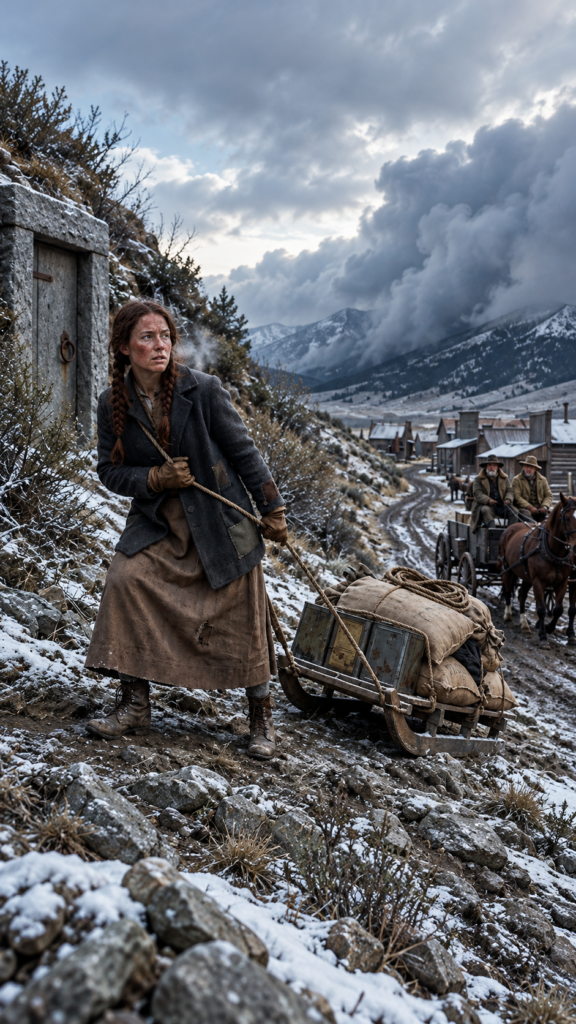
By sunset, she was dragging a hand sled loaded with nearly eighty pounds of winter supplies toward the mountain.
Every other household was carrying provisions down into town, closer to stoves, neighbors, and the shelter of established buildings.
Nora was going the opposite direction.
The sled runners scraped over exposed stone as she climbed past the last cabins. A fraying rope dug through her mittens, and blisters beneath both heels made each step painful. Her dark auburn braid had come loose beneath her wool cap. The elbows of her charcoal-colored coat bore patches she had sewn herself.
She stopped once near the cemetery fence.
Below her, the town glimmered with lamplight. Smoke rose from chimneys, and she could hear the distant ring of Cal Rusk’s hammer at the smithy.
It would have been easier to turn back.
But she had nowhere to turn back to.
Nora tightened the sled rope around her waist and kept climbing.
Beyond the hunters’ trail, wind-bent fir trees leaned against a granite ridge. There she knelt beneath a tangle of exposed roots and brushed away dead needles until her fingers found a rusted iron ring.
She pulled.
A narrow slab of stone shifted inward, revealing an opening barely wide enough for her shoulders.
Cold air moved against her face.
Ten feet inside, the passage widened into a chamber cut directly into the mountain. Timber braces supported the ceiling. Old drill marks scarred the granite walls. A stone flue disappeared through a crack high overhead.
Nora lowered her lantern.
Along one wall stood shelves she had repaired using boards from an abandoned mine. Opposite them lay neatly separated stacks of pine, coal, and kindling.
The room had never appeared on any town map.
Her father had called it the High Room.
Eli Vale had discovered it years earlier while surveying a proposed railroad route. The railroad company had abandoned the project after deciding the mountain grade was too steep, but her father had remembered the chamber.
When Nora was nine, he brought her there during a summer thunderstorm.
She remembered being frightened by the darkness and the sound of water moving somewhere behind the rock.
Her father had knelt beside the stove opening and shown her how to test the flue with smoke, examine the timber braces for movement, and recognize the difference between harmless dripping and water pressing through stone.
“Down in town,” he told her, tapping the granite with his knuckles, “people watch the calendar.”
He placed her small hand against the wall.
“Up here, you watch what the world is doing.”
At nine, she had thought it was another of his peculiar lessons.
At eighteen, she understood.
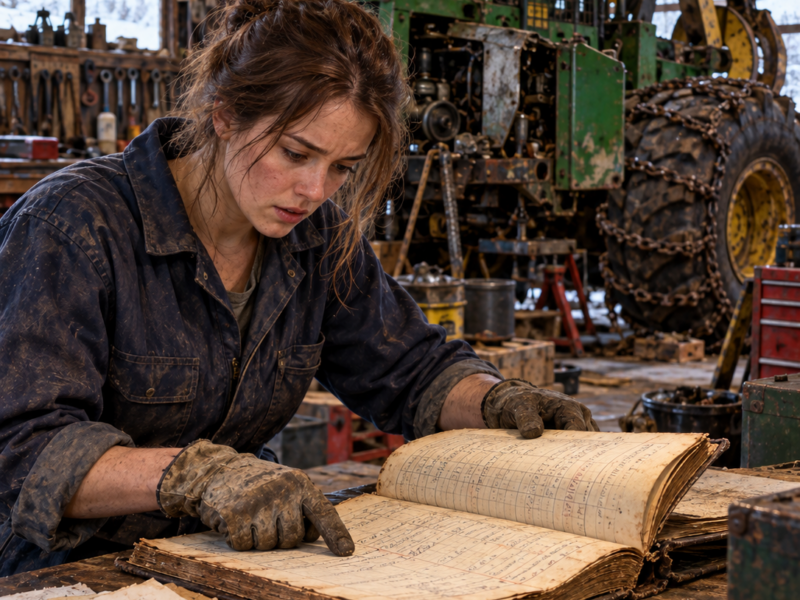
Nora dragged the supplies inside, closed the stone door, and opened her ledger.
She counted fifty-two pounds of flour, twenty-nine pounds of beans, nine pounds of dried onions, six tins of lamp oil, and three sacks of coal.
She recorded every amount in pencil.
The supplies would sustain one person through a difficult stretch of weather.
They would not be enough for a terrible winter.
Still, she looked around the chamber with something approaching relief.
For the first time in weeks, she had a door she could close without wondering who would order her to open it again.
Her father had been dead eleven months.
A broken trace chain had sent him beneath a freight wagon on the western road. By the time the wagon reached Cinder Gap, there was nothing anyone could do.
His death had taken more than the only parent Nora depended upon.
It had taken her place in the world.
Her older half brother, Wade, had a wife, Nell, and two little boys. Nell was expecting another baby. After a grasshopper summer, winter feed had nearly doubled in price, their cow had gone dry, and the pantry shelves seemed emptier every morning.
Wade had never been a cruel man.
That was what made September so difficult to remember.
He had stood before the pantry one evening, counting six remaining sacks of grain, then looking toward the boys asleep beside the stove.
Nora was washing dishes when he said her name.
She turned, still holding a plate.
Wade placed their father’s old coat on the bench.
“I can give you two weeks.”
For a moment, she thought he meant two weeks before they would need to buy more grain.
Then she saw Nell standing in the doorway, one hand resting against her swollen stomach, her eyes lowered.
Nora set the plate down.
“Two weeks for what?”
Wade looked toward the pantry.
“You know what.”
He did not say that she was lazy. He did not accuse her of stealing food or being ungrateful.
He simply counted the people who depended upon him and decided there was one too many.
Nora wanted to ask whether he had counted her as family before reaching his answer.
Instead, she folded her dishcloth.
“I’ll be gone tomorrow.”
Wade looked startled.
“You don’t have to leave that fast.”
She could not bear to hear him offer another kindness that did not change what he had decided.
The following morning, Nora departed with a blanket, skillet, bedroll, her father’s coat, and eleven dollars sewn into the cuff of her dress.
For several nights, she slept in the hayloft above the abandoned assay office.
When the owner discovered her, he did not threaten to have her arrested. He merely pointed toward the door and explained that the roof was unsafe.
He could not be responsible if it collapsed on her.
Nora understood that he wanted her gone.
She had become very good at understanding what people meant without making them say it twice.
That afternoon, she climbed to the High Room.
At first, the chamber was only a place to sleep.
Then the animals began behaving strangely.
Mice disappeared from the grain bins behind the mercantile. Deer wandered across the lower road in daylight. Smoke that should have risen from chimneys flattened toward the north.
One morning, Nora watched geese flying south so low their wings nearly brushed the cottonwoods along the river.
An elderly teamster stopped beside her.
He followed the birds with his eyes, then slowly removed his cap.
“Don’t much like that,” he muttered.
Neither did Nora.
The spring above Miller’s Cut had also stopped running, although the ground had not frozen deeply enough to explain it.
Each sign alone might have meant little.
Together, they troubled her more than any ordinary October storm.
She remembered the ice in the bucket and her father’s hand against the granite.
She returned to Bell’s Mercantile with nine of her last eleven dollars.
No sweet bread. No coffee. No canned peaches.
She purchased flour, oats, beans, salt, lard, dried onions, lamp oil, and two coils of rope.
Mr. Bell watched her arrange the purchases on her sled.
“You feeding a logging camp?”
“No, sir.”
“That’s a powerful lot of food for one girl.”
Nora tightened the canvas over the sacks.
“One person can need a powerful lot of food when winter comes.”
Bell studied her.
“How long you planning to stay up there?”
She looked toward the mountains through his window.
“As long as the mountain decides.”
He laughed softly, believing she was joking.
Outside the smithy, Cal Rusk leaned against the doorway with a horseshoe in his hand.
“Vail!” he called. “You opening a store up there?”
Three men paused their work.
Nora continued dragging the sled.
Cal raised his voice.
“What are you doing, then?”
She stopped.
There were many answers she might have given. She could have told them about the geese, the empty grain bins, or the spring that had stopped flowing.
But she already knew what their faces would look like.
“I’m closing a debt,” she said.
Cal frowned.
“What debt?”
Nora looked over her shoulder.
“The one winter collects.”
The men laughed.
By evening, children were pulling broken crates through town, pretending to be Nora Vail and shouting warnings about winter coming to collect its money.
She heard some of them from the mountain trail.
She kept hauling.
There was too much work to spend time defending herself.
Coal went in the driest corner. Flour was sealed in waxed cloth. Beans were transferred into containers that mice could not enter. Salt went high on the shelves, away from damp stone.
She raised her sleeping pallet on cedar poles and filled gaps around the door with clay and moss.
She stored drinking water in stoneware crocks rather than glass.
Every evening, she tested the chimney draft with damp grass, watching how the smoke behaved.
Every morning, she examined the timber braces before lighting a new fire.
The work was exhausting, but the order steadied her.
A full shelf was something she could understand.
A repaired door was something she could trust.
People were more complicated.
On the fourth night, while Nora was sitting beside the stove, a scraping sound came from behind the rear wall.
She stopped moving.
The lamp flame narrowed in a sudden draft.
Another scrape followed.
It did not sound like claws.
It sounded like leather rubbing against stone.
Nora reached for the short-handled splitting maul beside her bedroll.
Behind an angled timber brace, a narrow black opening was nearly invisible in the shadows.
Her father had mentioned that the original survey crew might have cut a second passage, but he had never explored it.
Nora raised her lantern.
“Whoever you are,” she said, trying to keep her voice steady, “I know the passage is there.”
Nothing answered.
She remained awake until dawn with the maul across her knees.
At first light, she searched the shelves.
Nothing was missing.
But beside the outer door lay a bundle wrapped in burlap.
Inside were two snowshoe hares, cleaned and skinned, and a small tin of rendered fat.
There was no note.
No visible track explained who had left them.
Nora looked toward the hidden passage.
Someone knew about the High Room.
Someone had been close enough to hear her moving inside.
She waited several minutes before carrying the bundle indoors.
The meat became stew, the bones became broth, and the fat helped seal cracks in the leather of her boots.
Three days later, she discovered a new iron pin beside the entrance.
The old latch had begun to bend under pressure. Whoever installed the pin had noticed the weakness before Nora did.
She examined the work carefully.
It was properly fitted.
Whoever was watching her seemed more interested in keeping her alive than frightening her.
Still, she began keeping the maul within reach.
October grew warmer.
That was what frightened her most.
Cinder Gap should already have seen its first hard snowfalls. Instead, men repaired fences in their shirtsleeves, and ranchers postponed bringing cattle down from the upper grazing country.
At the hotel dining room, people called the mild weather a blessing.
Nora went there one afternoon because she could no longer bear the thought of remaining silent.
“Bring your cattle down now,” she told the ranchers gathered around the stove. “Fill your barrels. Cut more firewood than you think you’ll need.”
Sheriff Hollis looked up from his plate.
“Based on what, Nora?”
“The animals are moving wrong. The smoke keeps lying low. The spring above Miller’s Cut stopped running.”
A young cattle buyer smiled.
“And that frozen water bucket?”
“Yes.”
“It was probably standing beside a drafty door.”
“It was beside a stove.”
“Then somebody wasn’t tending the stove.”
Laughter moved around the table.
Nora waited until it faded.
“The cold is gathering high in the mountains,” she said. “When it comes down, it won’t give us much warning.”
The hotel owner began clearing plates.
The conversation was over.
Outside, Ada Pike followed her into the street.
Ada was old enough to have delivered half the children in Cinder Gap and buried more than a few. She wore a black shawl regardless of the season and supported herself with a cane carved from mountain ash.
She stood beside Nora and studied the clear northern sky.
“My mother had a name for weather like this.”
Nora waited.
“Widow weather.”
“Why?”
Ada adjusted her shawl.
“Because it smiles before it takes a husband.”
For the first time that afternoon, Nora felt someone truly understood her concern.
Ada gripped her sleeve.
“Keep carrying, child.”
Later, Mr. Bell sold Nora the last coal he would allow her on credit.
After recording the amount in his account book, he added a sack of cracked corn to the sled.
“I didn’t ask for that.”
“I know.”
“I can’t pay you.”
Bell tied the sack firmly.
“You can tell me I was foolish in the spring.”
Nora understood the kindness hidden inside his practical words.
She thanked him quietly.
Near the ridge, she found fresh bootprints beside the fir roots.
One set, belonging to a large man, approached from the east face of the mountain, stopped near the hidden door, then returned the way it had come.
Inside, a new length of stove pipe lay beside the flue.
Nora fitted it before dark.
That night, the northern stars began disappearing.
Not behind ordinary clouds.
Behind a low gray wall that appeared to rise from the earth itself.
Nora stepped outside.
Far below, lamps glowed along Cinder Gap’s streets. Someone was playing a fiddle near the hotel. The town looked peaceful, almost festive.
Then she heard the noise.
A steady, distant roar.
It sounded like a river moving beneath frozen ground.
She returned to the High Room and opened her ledger.
Her stores had grown through repeated trips and careful purchases: 106 pounds of flour, sixty-one pounds of beans and corn, twenty-four pounds of dried meat, six crocks of water, and perhaps twelve days of coal if she burned it sparingly.
She had planned for one person.
Nora closed the book and stared toward the hidden passage.
For reasons she could not explain, she had the terrible feeling that the mountain was preparing to send her more.
Shortly after eleven, the wind struck.
It did not arrive gradually.
It hit the stone entrance like a heavy wagon driven against a locked gate.
Dust fell from the timber braces. The stove flame bent almost flat. Snow began hammering the mountain so relentlessly that individual gusts became impossible to distinguish.
Nora secured the door, reinforced the inner latch with rope, and fed another careful measure of coal into the stove.
Outside, Cinder Gap disappeared beneath the storm.
Inside, she sat beside her ledger and listened.
Everything she had carried uphill was about to be tested.
And nothing in her careful calculations had allowed for the possibility that she might have to share it.
Part 2
By dawn, the chimney was failing.
Smoke rolled backward into the High Room, gathering beneath the timber braces before spreading downward in a bitter gray cloud.
Nora woke coughing.
She tied a scarf across her mouth, lifted the stove damper, and listened to the weak draft struggling through the flue.
Ice had formed near the upper opening.
She climbed onto the woodpile, wedged the new section of stove pipe higher into place, and struck it carefully with the flat side of her maul.
The first blow shook loose a shower of black soot.
The second loosened a crust of ice.
On the third, the draft caught.
Smoke rushed upward.
Nora crouched beside the stove, breathing through her scarf until the room began to clear.
Then she looked at the new pipe.
Without it, the stove might have become useless during the first night.
Whoever had left it knew this mountain better than she did.
The storm continued without interruption.
When Nora tried to open the outer door, it would not move.
Snow had packed against the stone so firmly that the slab felt as though it had been mortared into place.
She took the coal shovel and began digging from the narrow space around the entrance.
For nearly an hour, she worked in darkness, pushing snow backward into the passage, then carrying it farther inside in small loads.
Finally, a blade of blue daylight appeared.
Cold air rushed through the crack.
Nora widened the opening enough to crawl outside.
The valley below was almost unrecognizable.
Only the church steeple, the hotel roof, and the upper section of the grain elevator remained clearly visible above the whiteness.
Roads had vanished.
Fence lines were gone.
Cabins stood like low humps beneath enormous drifts.
The wind had changed the landscape so completely that Nora had to study the cemetery fence posts to understand where she was looking.
She started to retreat inside.
Then something moved near the cemetery.
A dark shape rose above the snow, fell, and struggled upward again.
Nora narrowed her eyes.
It was a person.
Someone was trying to reach the mountain.
She stood motionless for one terrible moment.
Her father’s lessons had taught her never to travel blindly in weather like this. A single wrong turn could carry a person into a drift deeper than a house.
But the figure below was moving more slowly each time it rose.
Nora hurried inside.
She took one of her long ropes, secured it around a granite brace, and tied the other end firmly beneath her arms.
Then she dragged the free length outside and began descending.
The cold struck her lungs so sharply that she could hardly draw breath.
Snow blew across the mountain in thick horizontal sheets, hiding the ground from one step to the next.
She moved by counting rope lengths and probing ahead with the shovel handle.
Twice, she lost sight of the figure.
The third time it appeared, she realized it was a man crawling with a child strapped to his back.
“Hold still!” she shouted.
The wind carried the words away.
She pushed forward until she reached him near the cemetery gate.
It was Ben Larkin, the schoolmaster.
Blood had frozen along one side of his face.
The child on his back was his ten-year-old nephew, Jamie, wrapped in a horse blanket.
“The schoolhouse chimney came down!” Ben shouted. “We tried the hotel, but the roof’s gone!”
Nora dropped beside Jamie.
His face was gray with cold. She pressed two fingers beneath his jaw, searching for a pulse.
It was there.
Weak, but present.
She unfastened the boy from Ben’s back and secured him against her own.
“Take the rope,” she ordered.
Ben staggered upright.
“I can walk.”
“You can fall while holding it.”
He looked at her.
“Both hands, Mr. Larkin.”
This time he obeyed.
The climb back took less than ten minutes, though Nora would remember it as one of the longest journeys of her life.
Once the wind lifted her sideways, nearly twisting Jamie from her back.
Ben fell waist-deep into a drift and had to pull himself free using the rope.
When the fir roots finally appeared, Nora almost passed them.
She located the stone opening by touch and dragged Ben into the narrow passage.
Inside, she laid Jamie near the stove.
The boy’s boots had frozen hard around his feet. Nora eased them off slowly, wrapped his feet in dry wool, and began warming his chest beneath blankets.
Ben stared at the room.
Shelves of food lined the walls. Coal lay stacked beside the stove. Water stood in covered crocks. Every item had been placed where it could be found quickly.
All the work Cinder Gap had laughed at now surrounded him.
“Nora,” he said, his voice breaking, “how did you know?”
She handed him a cup of warm broth.
“Drink first.”
Twenty minutes later, Jamie coughed.
A little color returned to his lips.
Ben sat down heavily and covered his face.
Nora allowed herself one brief moment of relief.
Then she heard knocking against the outer stone.
Three hard blows.
She went to the entrance with her shovel.
Cal Rusk stood outside, half carrying his wife through the snow. Their baby daughter was secured between them with harness leather.
Cal’s face was white with frost.
“Can you take us?”
Nora moved aside.
“Get in.”
An hour later, Ada Pike arrived with two frightened children whose mother had been injured by a falling roof beam.
Then came Mr. Bell, his eyebrows crusted with ice and blood seeping from a deep cut across his palm.
Each time Nora opened the door, snow swept inside.
Each time, she cleared another place along the wall.
By nightfall, eleven people crowded the High Room.
The following morning, there were sixteen.
On the third day, twenty-one.
A ranch hand arrived with a broken wrist. Three miners came after abandoning their shack when the snow reached the eaves. A widow from the north road was helped inside by men who had found her struggling through the drifts.
No one arrived comfortably.
Everyone brought wet clothing, injuries, fear, or exhaustion.
Nora accepted them anyway.
She moved the smallest children nearest the safest sleeping places. Wet gloves were hung where they could dry without scorching. Boots were arranged away from the stove so their leather would not crack.
The High Room, once silent enough for Nora to hear water behind the granite, filled with breathing, coughing, whispered prayers, and the restless sounds of frightened children.
On the third afternoon, she opened the door and found Wade standing outside.
Nell leaned against him, both hands supporting her pregnant belly.
Their two little boys huddled against their father’s legs.
Snow was melting from Wade’s beard.
For several seconds, neither sibling spoke.
Nora remembered the pantry.
She remembered the coat placed on the bench.
She remembered eleven dollars sewn into her cuff and nights spent sleeping in a hayloft because there had not been enough room for her beneath her brother’s roof.
Wade looked past her into the chamber.
His expression changed as he recognized the people already sheltering there.
Then he lowered his eyes.
“Nora—”
“Where’s the baby?” she asked.
Nell answered before he could.
“Not yet.”
A contraction bent her forward.
Ada was beside her immediately.
“Bring her over here. Carefully.”
Wade helped Nell into the room while Nora closed the door against the storm.
There was no time for an argument about September.
There was barely time to prepare for a birth.
The mountain chamber had been cut by men expecting railroad construction. Its timber braces and stone walls were meant to protect tools, powder, and supplies.
Now it had become a place where a child might enter the world.
Nora gave Ada the cleanest sheets she owned.
She set water to boil and moved the smaller children to the far wall.
Ben helped clear a space beside the stove.
Cal hung blankets to provide Nell a little privacy.
Wade knelt beside his wife, looking helpless in a way Nora had never seen before.
Then Nora opened her ledger.
Twenty-one people.
Perhaps twenty-two before morning.
She counted the flour. She counted the beans. She examined the coal remaining in each sack.
What had seemed sufficient for one person now looked frighteningly small.
Coal for approximately six days.
Flour for four days at full rations.
Beans and corn for five.
Water could be stretched if they melted ice from the vent and used it carefully.
The blizzard showed no sign of ending.
Nora began dividing the food into smaller portions.
By evening, she had reduced every ration by one-third.
She explained the calculation to the adults without softening it.
“We can eat more today,” she said, “or we can make sure there’s something left tomorrow.”
No one argued.
The storm grew worse.
The flue iced over twice. Each time, Nora climbed to clear it while Cal steadied the woodpile beneath her.
One of the miners developed a fever and lay sweating beneath his blanket.
Jamie began to recover his strength, but the tips of his toes darkened, and Ada warned Ben that the boy’s feet would need careful attention.
Nora slept in fragments, waking at every change in the sound of the chimney.
Through it all, Nell labored.
Fourteen hours passed.
Wade held her hand until his fingers cramped.
Ada gave quiet instructions, stopping now and then to wipe her brow.
The children slept or pretended to sleep. The adults moved carefully around the chamber, afraid that even ordinary conversation might disturb the work behind the hanging blankets.
Near midnight, a baby cried.
The sound carried into every corner of the High Room.
People who had been staring silently into the stove lifted their heads.
Cal’s wife smiled through her exhaustion.
Ben pressed Jamie closer.
Wade sat against the granite wall and wept openly.
Ada emerged holding a little girl wrapped in Nora’s father’s spare wool shirt.
“A daughter,” she announced.
Nell looked pale and exhausted, but her eyes followed the baby.
Then she looked toward Nora.
“What should we call her?”
Nora stared at the shirt around the tiny body.
Her father had worn it on cold mornings while working outside. For months she had kept it because it still seemed to belong to him.
Now it warmed someone he would never meet.
Nora shook her head.
“Call her after someone who gets to grow up warm.”
Nell’s eyes filled with tears.
Ada placed the baby against her mother’s chest.
For a little while, the storm outside seemed less important than the gentle sound of the newborn breathing.
But life required food.
The next morning, Nora found herself scraping flour dust from the corners of an almost empty sack.
Ada watched her work.
“How long?”
Nora kept scraping.
“Two days, maybe.”
“And the storm?”
“Could stop tomorrow. Could last another week.”
Ada reached beneath her black shawl and withdrew a small pouch.
She emptied dried sage, beans, and strips of apple into Nora’s hands.
Nora looked up in surprise.
“Where did you get these?”
“My burial dress has a deeper pocket than most people know.”
Nora almost laughed.
Ada lifted one eyebrow.
“I decided I didn’t need all of it yet.”
Nora added the food to the shelf.
Then Ben Larkin stood and opened the lining of his coat.
He removed two packets of oats.
“I kept these for Jamie.”
Cal reached into his bedroll and produced a slab of bacon wrapped in newspaper.
Mr. Bell began cutting stitches in the canvas around his belongings.
From the lining, he drew out small packets of coffee and rice.
One of the miners contributed dried mushrooms kept in a tobacco tin.
The food appeared slowly, each person revealing something that had been concealed against the possibility of greater hunger.
Nora did not scold them.
She understood why frightened people hid provisions.
She had once spent nights guarding her own supplies from an unknown visitor.
Last of all, Wade reached beneath his shirt.
He placed three pounds of cornmeal on the table.
“I thought I was protecting my boys,” he said.
His voice was almost too quiet to hear.
Nora looked at the cornmeal.
Then at the little boys asleep beneath a blanket near the stove.
“You were,” she answered.
Wade lifted his head.
“From everyone else.”
She pushed the cornmeal toward the growing pile.
“Now everyone else is protecting them.”
He could find no words.
For a moment, Nora remembered the six sacks of grain in his pantry.
He had once looked at those sacks and seen too many mouths.
Now he was watching strangers surrender food to keep his children alive.
The provisions filled only a small portion of the shelf.
But the room itself felt different afterward.
People began asking what work they could do rather than merely waiting to be helped.
Ben offered to take the next night watch.
Cal examined the stove tools for repairs.
The miners checked the braces.
Mr. Bell began helping Nora measure the rations.
They were still cold, hungry, and trapped.
But they were no longer twenty-one separate people calculating their private chances of survival.
That evening, while Nora was recording the new supplies, a scraping sound came from behind the angled timber brace.
She froze.
It was the same sound she had heard before the storm.
Then came three measured knocks.
Not from the outer door.
From inside the mountain.
Cal stood.
“What was that?”
Nora closed her ledger.
“Something I’ve been meaning to find out.”
She took the lantern and moved toward the rear wall.
The angled brace shifted when she pulled it.
Behind it, a narrow tunnel sloped upward into darkness.
Cold air rushed across her face.
Cal came closer.
“You shouldn’t go in there alone.”
Nora handed him the ledger.
“If I don’t come back, burn two pieces of coal at a time. No more.”
She entered the passage.
For several yards, she had to crouch beneath low beams.
The tunnel twisted through raw granite. Wind whistled somewhere ahead, and loose grit moved beneath her boots.
Nora held the lantern close to the ground, following the slight upward grade.
Then another light appeared.
She straightened as much as the tunnel allowed.
An elderly man stood beside a second opening farther up the ridge.
He wore a buffalo coat dusted white with snow.
In one gloved hand, he held the lead rope of a mountain mule.
Behind the animal rested a low freight sled piled beneath heavy hides.
The stranger studied Nora with an expression suggesting he had been expecting her.
“Took you long enough to open that brace,” he said.
Nora raised the lantern.
“Who are you?”
“Gideon Shaw.”
The name meant nothing to her.
She looked toward the sled.
“You left the hares.”
He nodded.
“And the stove pipe?”
“Figured you’d need it.”
“You’ve been watching me?”
“I’ve been watching that room longer than you’ve been alive.”
Nora waited.
Gideon shifted the mule’s lead rope to his other hand.
“Helped cut it back in sixty-nine. Railroad company paid us six weeks, then decided the grade was too steep. Three of us stayed through the winter. Turned the powder chamber into a refuge.”
Nora glanced behind her toward the tunnel.
“My father found it years later.”
“Then he found a useful place.”
She studied Gideon’s weathered face.
“Why didn’t you come inside?”
He looked toward the distant glow of the High Room.
“A full shelf can make a selfish person dangerous.”
The answer stung.
“So you decided whether I deserved help?”
Gideon regarded her for a long moment.
“No,” he said. “The storm decided.”
Nora looked again at the freight sled.
“What have you got under those hides?”
The old man stepped aside.
“Barley. Smoked elk. Hardtack. Dried peas. Candles. Lamp oil.”
Her fingers tightened around the lantern handle.
There was more food on the sled than she had dared hope for.
“Why bring it here?”
Gideon looked past her, toward the chamber where the others waited.
“Enough to keep your people alive.”
Your people.
Nora had been alone so recently that the words struck with unexpected force.
She thought of Jamie breathing beside the stove, Ada keeping watch over Nell’s daughter, and Wade’s boys sleeping under a blanket she had carried up the mountain herself.
She looked at Gideon.
“Then we’d better get it inside.”
Part 3
The first sack was heavier than Nora expected.
Gideon lifted it onto his shoulder and stepped into the narrow tunnel, moving with the confidence of a man who had spent years navigating the ridge.
Nora followed with a smaller bundle of dried peas and candles.
The passage was so tight that they could not walk side by side. Several times, they had to stop and maneuver the supplies beneath low timber beams.
When Nora reached the High Room, every face turned toward her.
Cal came forward first.
Then he saw Gideon emerging from the darkness with a sack of barley across his shoulder.
The room became still.
Gideon lowered the sack to the floor.
“I brought food,” he said simply.
Mr. Bell stood and removed his cap.
Cal did the same.
Wade stared at the provisions, then at the narrow tunnel through which they had arrived.
More bundles followed.
Smoked elk. Hardtack. Dried peas. Candles. Lamp oil.
Items that might ordinarily have seemed unremarkable now looked more precious than gold.
For several moments, no one quite knew how to react.
Gideon wiped snow from his beard.
Then he gestured toward Nora.
“She built the reason it matters.”
Nora hardly seemed to hear.
She was already kneeling beside the sacks, opening her ledger.
“Mr. Bell, help me count.”
He moved at once.
“Cal, we need these kept dry.”
Cal cleared another shelf.
“Ben, tell me how much drinking water we’ve used since morning.”
Ben checked the crocks.
Relief did not make Nora careless.
She had learned that supplies were only useful when someone knew how much remained and how quickly it was disappearing.
As Gideon unloaded the last of his sled, she recorded everything.
He also told her about a second vent in the mountain, one the original survey crew had left behind.
The passage through it would allow the stove to burn more cleanly and reduce the amount of coal they needed.
Nora examined the arrangement with him before changing anything.
She remembered the smoke filling the chamber on the first morning of the storm.
She was not willing to gamble with the lives now depending upon that stove.
But Gideon knew the old construction intimately.
Together, they improved the draft and revised the fuel plan.
Four additional days of heating became possible.
When Nora finished her calculations, she sat back on her heels.
For the first time since the blizzard began, the numbers suggested they might survive.
She looked toward Gideon.
“You knew another entrance was there all along.”
He nodded.
“And you’ve been coming up here?”
“From time to time.”
“Even after the railroad abandoned it?”
“Especially then.”
Nora studied the old man’s expression.
There were questions she wanted to ask about his years in the mountain, his two companions, and how long he had been living beyond the eastern ridge.
But another child began coughing near the stove.
Nora closed the ledger.
There would be time for questions if they lived to see clear weather.
The blizzard lasted nine days.
For nine days, Cinder Gap existed inside a chamber cut from granite.
The storm pressed against the mountain with such force that the walls seemed to carry its vibration.
Sometimes the wind roared overhead.
At other times, the snow became so thick around the entrances that almost no sound penetrated.
Those quiet periods were the most unnerving.
People would stop whatever they were doing and listen, afraid that the silence meant something had collapsed outside.
Nora established a routine.
Food was measured at regular intervals.
Coal was counted before being burned.
Water was checked twice daily.
The vent required constant attention.
The children were taught to feed kindling into the stove without wasting it, although an adult always supervised the work.
Ben turned multiplication lessons into ration calculations.
He drew figures on a slate and asked the older children how long a sack of beans would last if each person received a particular measure.
At first they complained.
Then Jamie began answering before the others.
Soon even the smallest children gathered around the slate, eager to participate.
It gave them something to think about besides the storm.
Cal repaired damaged tools using a small pocket hammer.
The miners examined the timber braces, reinforcing the weakest support with salvaged boards.
Mr. Bell discovered that flour spilled onto a clean shelf could be carefully swept, sifted, and recovered.
Ada monitored the sick miner, checked Jamie’s feet, and watched over Nell and the newborn.
Wade volunteered for every unpleasant task.
He carried waste away from the sleeping area, cleaned soot from the stove tools, helped clear snow from the vent, and moved coal until his shoulders ached.
Nora noticed.
She did not praise him.
There were too many things left to do, and she was not ready to pretend their earlier conversation had never happened.
But she stopped expecting him to abandon a task when it became difficult.
That, for the moment, was enough.
On the sixth night, Wade found her sitting beside the stove, her pencil resting motionless across the ledger.
Most of the others were sleeping.
He remained standing for a while before lowering himself onto the opposite side of the hearth.
“You haven’t slept much.”
Nora looked at the stove.
“Someone has to hear when the flue changes.”
“I can listen.”
“You’ve worked all day.”
“So have you.”
She turned another page in the ledger.
Wade watched her hands.
“I didn’t know this place was up here.”
“Father showed it to me.”
“When?”
“When I was nine.”
Wade considered that.
“He taught you a lot of things.”
Nora nodded.
The room remained quiet except for the stove.
Then Wade spoke again.
“I keep thinking about September.”
Nora’s pencil stopped.
He rubbed his palms together.
“I thought if I could make the grain last, I’d keep Nell and the boys safe. Every day I looked at those sacks and tried to figure out how to get us through winter.”
“I know.”
“I kept counting what we had.”
Nora looked directly at him.
“You counted me, too.”
Wade’s face tightened.
“Yes.”
For a long moment, he said nothing.
Then he lowered his eyes.
“I should have found another way.”
Nora wanted an apology to mean more than a few words spoken in a warm room after someone had rescued him.
She wanted to know whether he would have reached the same conclusion without the storm, without the hunger, without seeing his own children protected by people he had once considered strangers.
But his regret was real.
And she knew the fear that had driven him.
She closed the ledger.
“Your boys need you tomorrow,” she said. “Get some sleep.”
Wade hesitated.
Then he nodded and went back to his family.
Nora remained beside the stove.
She did not feel that everything between them had been repaired.
But for the first time, she believed it might be possible.
By the seventh day, the people in the High Room had begun moving around one another with practiced familiarity.
The children knew which sleeping blankets belonged to whom.
Ben knew when Nora needed the slate cleared for counting.
Cal could recognize the stove’s usual sounds.
The miners understood which braces needed daily inspection.
Even the frightened widow from the north road had begun helping fold dried blankets and sort the smaller provisions.
Nobody had planned to become a community.
They had only kept finding work that needed doing.
Nora still slept in pieces of twenty minutes.
Sometimes she woke because of a change in the flue. Other times, she opened her eyes without knowing what had disturbed her.
Once, she found Ada sitting awake with Nell’s baby in her arms.
“She wouldn’t settle,” Ada whispered.
Nora crouched beside them.
The child was warm beneath her father’s old wool shirt.
“She’s hungry?”
“Fed already. Just wanted holding.”
Nora touched the little girl’s hand.
The baby closed her fingers around one of Nora’s.
For a moment, the ledger, coal, and storm seemed very far away.
Nora remembered the evening Wade had placed her father’s coat on the bench.
At the time, it had felt like the last piece of her old life being handed back because no one had room for her anymore.
Now another of her father’s garments protected a child who might never have survived without the place he had shown Nora years before.
His lessons had not been enough to prevent his death.
They had not kept her from being put out of Wade’s home.
But they had given her something stronger than a promise that nothing bad would happen.
They had taught her what to do when it did.
On the ninth morning, Nora woke to a sound she barely recognized.
Silence.
Not the heavy silence that had sometimes settled between gusts.
This was different.
The mountain no longer seemed to tremble beneath the pressure of the wind.
She remained still, listening.
Then she rose and went to the stove.
The draft was steady.
She checked the door.
No new snow sifted through its edges.
Gideon was already awake.
He looked toward the rear passage.
“Think it’s time?”
Nora hesitated.
Then she took the lantern.
Together, they climbed through the narrow tunnel toward the upper hatch.
The snow beyond had hardened into a pale surface, and they had to push carefully before the opening gave way.
Sunlight flooded through.
Nora covered her eyes.
After nine days of lamplight and firelight, the brightness was almost painful.
She crawled outside.
The valley below had become a white sea.
Only rooftops, chimneys, and treetops interrupted the smooth drifts.
Nora searched for the streets she knew.
It took several seconds to find where the hotel had stood.
Where the schoolhouse should have been, the snow lay in an unnatural ridge.
She began counting smoke rising from the valley.
One column near the eastern cabins.
Another beyond the grain elevator.
A third farther south.
Only three.
Gideon stood beside her.
Neither spoke.
The storm was over.
But the damage it had done was only beginning to reveal itself.
The people descended from the High Room in groups, tied together with rope.
The injured moved slowly.
The smallest children were carried or guided between adults.
Nell held her newborn close beneath her coat while Wade helped their boys negotiate the deep snow.
Nora traveled among the group, checking that no one had become separated.
The town they entered was badly wounded.
The hotel roof had collapsed into the dining room where Nora had tried to warn the ranchers.
One wall of the schoolhouse had split open.
Half the livery was destroyed.
Along the south fence, cattle stood frozen where their owners had waited too long to bring them down from the upper grazing country.
People moved between damaged buildings, calling names and digging through snow.
There were losses that could not be repaired.
Nora saw the evidence everywhere.
She also saw twenty-two people walking down the mountain alive, including the little girl born while the storm had buried Cinder Gap.
Twenty-two people who might otherwise have been among the missing.
The story of the High Room spread quickly.
By the end of the week, nearly everyone knew about the supplies Nora had carried uphill.
They knew who had laughed.
They knew about the food hidden inside coats and bedrolls.
They heard how close the ledger had come to showing nothing left.
Some spoke of Gideon Shaw as though he had appeared out of the mountain itself.
Others argued that Nora had somehow predicted the blizzard.
Nora listened to none of it for long.
There were people who needed help rebuilding roofs, clearing doors, and recovering whatever provisions had survived.
Survival had not ended when the wind stopped.
It merely changed the kind of work required.
A town meeting was called in the church because it was the largest building with a roof still intact.
The stove inside was cold.
People filled the pews wearing heavy coats and carrying expressions shaped by fatigue, gratitude, and grief.
No one sat in the front row.
Then Nora entered.
Several townspeople turned toward her.
She recognized the men who had laughed outside the smithy. She saw the young cattle buyer from the hotel. Mr. Bell stood near the wall, his injured hand bandaged.
Wade sat with Nell and the children.
Nora chose a place near the back.
Mayor Tomlin stood beside the cold iron stove.
“We need to decide what to do about that room in the mountain.”
Cal Rusk rose.
“I say we name it after Nora.”
Several people agreed immediately.
“And the road leading up to it,” someone added.
Nora looked down at her hands.
She had never wanted a road named after her.
She had wanted enough coal to keep a fire burning.
The mayor raised his hand until the voices quieted.
“Nora, would you come forward?”
She stood reluctantly and walked toward the front.
The mayor faced her.
“You’ve done more for this town than anyone had a right to ask. What would you like us to do?”
Nora looked across the congregation.
She saw gratitude, shame, exhaustion, and uncertainty.
She saw Wade holding his youngest son on his knee.
She saw Mr. Bell’s bandaged hand.
She saw Ada Pike sitting with her cane beside her and Nell’s new daughter sleeping nearby.
Nora placed the ledger on the pulpit.
“I want every family to keep its own winter stores.”
A few people nodded.
“And I want the High Room filled before the first freeze. Not after the first storm. Before.”
Mayor Tomlin leaned forward.
“With town funds?”
“With town hands.”
The answer puzzled him.
Nora opened the ledger to the pages she had written during the blizzard.
“Money can buy flour,” she said. “But it can’t carry it uphill. It can’t cut wood or clear the vent or test the braces.”
She touched the pencil marks.
“It can’t remember which child needs medicine. It can’t make people share what they have when they’re afraid there won’t be enough.”
The congregation listened.
“Winter keeps accounts,” Nora continued. “It counted every day we delayed bringing in the cattle. Every roof we didn’t brace. Every sack we thought we could buy later.”
She paused.
Then she looked toward Wade.
“It also counted what people shared.”
Wade lowered his eyes.
Nora closed the ledger.
“I don’t want a monument. I want a place people can depend on.”
For several seconds, no one spoke.
Then Cal stood again.
“I can make a better door.”
Mr. Bell raised his bandaged hand.
“I can supply sealed tins.”
Ben Larkin offered books and slates to keep children occupied if they ever had to shelter there again.
Ada said the room needed proper medical supplies and clean birthing cloth.
Others volunteered timber, grain, candles, rope, and labor.
The meeting became less concerned with honoring Nora and more concerned with doing what she had asked.
She stood beside the pulpit and listened.
It was the first time she could remember hearing the people of Cinder Gap discuss preparing for disaster without someone laughing.
That spring, the town began rebuilding.
The schoolhouse and livery were repaired. Families helped clear damaged properties, and the roads slowly became usable again.
In August, Cal forged a new iron door for the High Room.
He fitted it carefully against the granite entrance, testing the latch until it moved smoothly.
In September, ranchers carried salt meat and grain up the mountain trail.
Mr. Bell contributed sealed containers.
Ben brought slates, books, and chalk.
Ada stocked bandages, herbs, clean cloth, and a bottle of carbolic.
Wade hauled coal.
He carried more than anyone else.
Nora watched him arrive one afternoon, bent beneath a load that made his face red with effort.
He set the coal beside the shelves and straightened slowly.
“Where do you want the next lot?”
She pointed toward the far wall.
“Stack it there. Leave room around the vent.”
Wade nodded.
No argument.
No excuses.
He picked up the empty sack and headed back down the trail.
Their relationship did not become simple overnight.
There were still things Nora remembered when she looked at him.
There were still moments when Wade seemed unable to meet her eyes.
But he came back the next day.
And the next.
Sometimes that mattered more than another apology.
Even families with very little brought something to the High Room.
A candle.
A jar of beans.
A pair of dry socks.
A small box of matches dipped in wax.
Nora recorded every contribution.
No item was too insignificant to enter in the ledger.
She had learned how much difference a small amount of food or warmth could make when every resource was counted carefully.
Gideon Shaw appeared twice that autumn.
He repaired the upper hatch and showed Nora where meltwater could be collected safely.
He also taught Cal how to recognize the subtle sounds a timber brace made when it was carrying too much weight.
Nora listened closely whenever Gideon spoke about the mountain.
There were things he knew that her father had never had the chance to teach her.
One clear morning, Gideon arrived without his usual supplies.
He placed an old survey compass on top of Nora’s ledger.
She looked at it.
“What’s this for?”
“Thought you might find a use for it.”
She picked up the instrument.
The casing was worn smooth in places by years of handling.
“Are you coming back?”
Gideon glanced toward the eastern ridge.
“Can’t say.”
Nora wanted to ask where he intended to go.
Instead, she closed her fingers around the compass.
“Thank you.”
The old man nodded.
Then he walked east along the mountain.
Nora watched until the trees hid him from sight.
She never saw Gideon Shaw again.
Years passed.
The railroad finally reached Cinder Gap, although its tracks followed a lower route than the one once proposed through the mountains.
Electric wires came later.
The hotel was rebuilt in brick.
The children who had slept beside the High Room stove grew into adults and eventually carried their own children along the steep trail.
The story of Nora Vail changed as people retold it.
Some claimed she had predicted the storm from a bucket of frozen water.
Others said she could hear storms approaching through the granite itself.
A few insisted that Gideon Shaw had been a ghost who appeared only when the people of Cinder Gap needed him.
His old compass remained in a glass case at the school, though that did not entirely discourage the stories.
Nora rarely corrected anyone.
She knew what had happened.
The ice in the bucket had frightened her, but it had not given her the strength to haul coal uphill.
The movement of animals had warned her, but it had not stocked the shelves.
The hidden chamber had offered shelter, but it could not have saved twenty-two people without supplies, work, and cooperation.
And Gideon’s help, welcome as it was, had arrived only after people had already begun giving what they had to one another.
There had been nothing magical about the long hours spent repairing timber, counting beans, sealing flour, or digging snow away from an entrance.
There had been nothing miraculous about blisters, exhaustion, and choosing to do necessary work while other people laughed.
Every October, the people of Cinder Gap climbed beyond the cemetery, past the hunters’ trail, and toward the hidden entrance beneath the fir roots.
They checked the chimney.
They tested the braces.
They replaced old food.
They counted blankets.
They filled the shelves.
Parents taught their children how to recognize unsafe weather and how to care for the supplies that might one day protect strangers as well as family.
Nora continued keeping the ledger.
Over the years, its pages filled with different handwriting as more people took responsibility for the work.
That pleased her more than any monument could have.
She had once climbed the mountain believing she needed to save herself because there was no longer room for her in anyone else’s home.
She had not expected that the shelter she built would become a place where an entire town learned to make room for one another.
Her father had told her to watch what the world was doing.
She had watched.
She had believed what she saw.
And when the time came, she had done the work before anyone thought to thank her.
Cinder Gap never forgot the winter when twenty-two people emerged alive from a room hidden inside the mountain.
But the most important part of Nora’s story was not that she had known a storm was coming.
It was that she had prepared for it while the sky was still clear.
After that, when October returned and the first chill touched the valley, the people of Cinder Gap no longer asked whether winter was coming.
They asked whether their account was paid.