Part 1
The first glass of wine landed on the marble floor.
The second landed on Valeria Montiel.
She felt the cold liquid run beneath the collar of her uniform, soaking the fabric against her back. For a moment, she remained on her knees, one hand gripping the mop, the other pressed against the wet floor.
Above her, Regina Salcedo gave a delicate gasp.
“Oh, goodness. How clumsy of me.”
Three beautifully dressed women standing beside Regina dissolved into laughter.
Valeria did not look up.
At thirty thousand pesos a month, or even three times that amount, there were humiliations no one should have to endure. But Valeria wasn’t working in the Arriaga mansion because she enjoyed serving wealthy people who barely remembered her name.
She was there because her sister Rosa had two children to feed. Because the bills in Zapopan never stopped arriving. Because the little money she managed to send every two weeks made a difference.
And because eight years earlier, an accusation written on a piece of paper had destroyed everything her father owned.
“Did you hear me?” Regina demanded. “I said I’m sorry.”
Valeria wrung out the mop.
“Of course, Miss Regina.”
Regina smiled at her friends.
“See? At least she knows how to behave.”
The party continued around them.
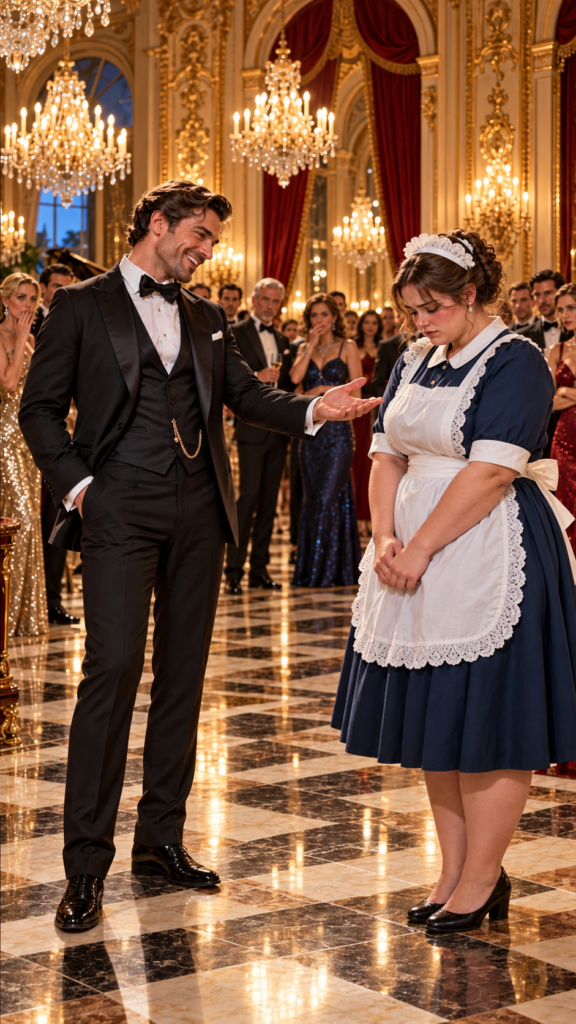
Crystal chandeliers illuminated the enormous reception hall. An orchestra played near the grand staircase, waiters moved between guests carrying silver trays, and some of Guadalajara’s wealthiest families celebrated the fortieth anniversary of Arriaga Tequila.
At the center of everything stood Sebastián Arriaga.
Forty-two years old, handsome, confident, and immensely wealthy, Sebastián controlled three distilleries and a tequila business exporting to twenty countries.
He also owned the mansion where Valeria had worked for two years.
And he was engaged to Regina.
From his position near the orchestra, Sebastián was laughing with several business associates. He had not noticed what his fiancée had done.
Someone else had.
“Valeria, come here, sweetheart.”
The voice belonged to Doña Amparo Arriaga.
Sebastián’s eighty-four-year-old grandmother sat near a window, both hands resting on her walking stick.
Valeria approached reluctantly.
“Is there something you need, Doña Amparo?”
“Yes. Sit beside me.”
“I really shouldn’t. There’s still so much to clean.”
Amparo gave her a tired smile.
“I may be old, but I still have some authority in this house.”
She handed Valeria a linen napkin.
“Dry your neck.”
Valeria hesitated.
“Thank you.”
“That young woman has plenty of money,” Amparo said, glancing toward Regina. “Unfortunately, she was never taught manners.”
Despite herself, Valeria laughed.
Amparo was the only member of the household who consistently treated her as a person rather than a uniform.
Each morning, when Valeria brought chamomile tea to her bedroom, the elderly woman asked about Rosa and the children. Sometimes she asked whether Valeria had slept well.
Small questions.
But in a house where people could walk past her without acknowledging her existence, they mattered.
Amparo studied her grandson across the room.
“Look at him. Strutting around like he invented success.”
Valeria followed her gaze.
Sebastián lifted his glass toward a group of investors.
“His father was different,” Amparo murmured. “Rodrigo started with a battered truck and bottles that didn’t even have proper labels. He knew every employee by name.”
Her expression grew distant.
“My grandson inherited everything except the memory of where we came from.”
Valeria said nothing.
She had learned that the safest place for a housekeeper’s opinions was behind closed lips.
But Amparo’s words stayed with her.
Because Valeria, too, had once belonged to a very different world.
And before the night ended, the past she had tried desperately to bury would find its way back to her.
At eleven o’clock, Sebastián climbed onto the orchestra’s small stage.
“Friends, family, business partners,” he began, raising his champagne glass. “Forty years ago, my father built this company with little more than a truck, a dream, and the determination to succeed.”
The guests quieted.
“Today we operate three distilleries and sell our tequila in twenty countries. Tonight, I want to honor the man who made all of this possible.”
He raised his glass higher.
“To Rodrigo Arriaga.”
Applause thundered through the room.
Regina hurried onto the stage, kissed Sebastián’s cheek, and made sure everyone could see the enormous diamond on her engagement ring.
Near the foot of the stage, Ernesto Vidal watched with a carefully composed smile.
The silver-haired attorney had served the Arriaga family for more than thirty years. He handled contracts, financial disputes, inheritance matters, and nearly every important legal decision Sebastián made.
Sebastián trusted him almost as completely as he had once trusted his father.
That confidence had made Ernesto one of the most powerful men in the household.
It had also given him access to secrets nobody else knew existed.
“Now,” Sebastián announced, “let’s dance!”
The orchestra began with romantic boleros before moving into cumbias.
Couples filled the dance floor.
Valeria continued collecting empty glasses, weaving between expensive gowns and tailored suits.
Her back still smelled faintly of wine. Her feet ached. She was counting the hours until she could return to her small room in the servants’ quarters.
Then the music changed.
A bandoneon sounded.
One long, aching note.
Valeria stopped walking.
Violins joined it, and something inside her chest seemed to tighten.
She recognized the tango.
Not simply its melody, but the particular way the opening notes rose and fell.
Her father had played that recording almost every morning at the Academia Montiel in Santa Tere.
She could see him as clearly as if he were standing in front of her.
Aurelio Montiel, wearing his freshly ironed white shirt, sweeping the wooden floor before the first students arrived.
Listen, sweetheart.
The tango isn’t danced with your feet.
It’s danced with your dignity.
Valeria closed her eyes.
Without realizing it, she shifted her weight and marked the rhythm with her right foot.
A tiny movement.
Almost nothing.
But Regina saw it.
“Oh, look!” she called loudly. “Our housekeeper thinks she’s a dancer.”
Several guests turned.
Valeria opened her eyes.
Heat rushed into her face.
“I should get back to work,” she whispered.
But Sebastián had heard Regina.
He approached with a glass in his hand and an amused expression.
“Wait a minute. What’s your name?”
“Valeria, sir.”
“Valeria.” He repeated it as though discovering it for the first time. “My fiancée tells me you like the tango.”
“I was only listening.”
“Really? She says you were dancing.”
A few of his friends chuckled.
Valeria tightened her grip on the tray.
“I’m sorry if I disturbed anyone.”
“You didn’t disturb anyone.”
Sebastián’s smile widened.
“In fact, I have an idea.”
He raised his voice.
“Ladies and gentlemen, I think our housekeeper wants to give us a performance!”
People began gathering around them.
Someone lifted a phone to record.
Valeria looked toward the kitchen doors.
She could still escape.
Then Sebastián extended his hand, the theatrical gesture of a gentleman inviting a lady to dance.
His eyes were bright with amusement.
“If you can dance this tango,” he declared, “I’ll marry you.”
The room erupted.
Two hundred guests laughed.
A man with a thick mustache shouted, “Take the offer, girl! You’ll never get another chance to be rich!”
Regina leaned against one of her friends, laughing so hard she nearly spilled her champagne.
“Oh, Sebastián. You’re terrible!”
Sebastián seemed delighted.
“Come on, Valeria. Don’t be shy.”
Valeria stared at his offered hand.
She knew exactly what he expected.
A frightened smile. An embarrassed refusal. Perhaps a whispered apology before disappearing into the kitchen.
That was what people like him expected from people like her.
But the bandoneon was still playing.
And somewhere beneath six years of grief and eight years of hardship, Aurelio Montiel’s daughter was still alive.
She remembered the dance academy.
The polished floor.
The mirrors.
Her father’s patient hands correcting her posture.
She remembered winning the national tango competition in Mexico City at nineteen.
The invitation to train and perform in Buenos Aires.
And then the men who had arrived with an alleged debt her father swore he had never incurred.
The academy had disappeared.
Their home had disappeared.
Eventually, her father had died.
Valeria had placed her dancing shoes inside a cardboard box and had not worn them since.
Until now, she had believed that part of herself was gone forever.
“Are you afraid?” Sebastián asked.
The laughter rose again.
Valeria searched the crowd.
Near the windows, Doña Amparo was standing, leaning heavily on her cane.
She wasn’t laughing.
She met Valeria’s eyes and gave one small nod.
Valeria took a breath.
“Are you serious about your promise, Mr. Arriaga?”
Sebastián laughed.
“On my family name.”
He glanced toward the attorney.
“An Arriaga’s word is worth gold. Isn’t that right, Ernesto?”
The lawyer’s smile tightened.
“Of course.”
Valeria slowly removed her stained apron.
She folded it and handed it to a stunned waitress.
Then she tucked a loose strand of hair behind her ear.
When she placed her hand in Sebastián’s, he noticed something unexpected.
She wasn’t trembling.
Her fingers were steady.
“Maestro,” Valeria called to the orchestra conductor, “would you please start the piece again?”
The elderly musician studied her.
Then he raised his baton.
Sebastián leaned closer.
“Just so you know, I don’t like losing.”
For the first time in two years, Valeria looked directly into her employer’s eyes.
“Neither do I.”
The music began.
And Sebastián Arriaga took the first step toward the greatest humiliation of his privileged life.
He tried to lead.
Naturally.
Sebastián was accustomed to controlling everything: business negotiations, family decisions, financial agreements.
He expected the woman in front of him to follow his movements.
But after the first turn, he realized he was outmatched.
Valeria moved with a precision he had never witnessed outside a professional performance.
Every step belonged to the music.
Every change of direction had a purpose.
She seemed to glide over the marble without effort, her body perfectly balanced, her attention fixed on the man struggling to keep pace with her.
“Relax your shoulders,” she murmured.
Sebastián blinked.
“Excuse me?”
“Don’t push. Listen to the music.”
He tried to correct his posture.
She guided him through a turn.
“That’s better.”
“Where did you learn to dance like this?”
“Later,” she answered. “Right now, concentrate.”
Around them, the laughter began to fade.
The woman who had covered her mouth to giggle lowered her hand.
The man with the mustache stopped smiling.
Several guests kept recording, but their expressions had changed.
Valeria pivoted, paused, and extended one leg in a beautifully controlled sweep.
Sebastián nearly lost the rhythm.
She adjusted her movement.
Without making it obvious, she brought him back into time.
He stared at her.
She wasn’t trying to embarrass him.
She was helping him.
After everything he had said, she was protecting him from looking foolish.
“Why are you doing that?” he whispered.
“Doing what?”
“Helping me.”
Valeria’s expression softened with an old sadness.
“My father taught me something. When two people dance tango, neither one falls alone. If one loses balance, both suffer.”
Sebastián had no answer.
Behind them, Doña Amparo began to cry.
She recognized something in Valeria’s movements.
The controlled turns.
The unusual timing.
The delicate strike of the heel at the end of a phrase.
She had seen those steps before.
Decades earlier.
Performed by a young man whose laughter had once filled her family’s modest home.
The realization struck her so sharply that she pressed one hand against her chest.
On the dance floor, Valeria spun through the final movement.
Then, as the last note approached, she leaned backward in a deep, graceful dip.
Sebastián caught her.
For one suspended second, neither moved.
The music stopped.
Silence settled over the entire ballroom.
Then one pair of hands began clapping.
Doña Amparo.
The conductor joined her.
The servants standing at the kitchen entrance followed.
Within seconds, all two hundred guests were on their feet.
Valeria straightened and stepped away.
She bowed with the same quiet elegance her father had taught her.
Sebastián remained frozen in the center of the floor.
He had intended to entertain his friends.
Instead, the woman he had mocked had given them the most extraordinary performance of the evening.
And suddenly, someone shouted:
“Where’s the wedding, Sebastián?”
Another voice answered.
“You gave your word!”
“An Arriaga’s word is worth gold!”
His friends began chanting.
Sebastián forced a laugh.
“Come on, everyone. It was only a joke.”
Regina hurried to his side.
“Obviously! As if Sebastián would actually marry the help.”
Sebastián cleared his throat.
“Well done, Valeria. I’ll arrange a bonus for you.”
The applause weakened.
Valeria looked at him.
Then at Regina.
“You don’t need to worry about keeping your promise, Mr. Arriaga.”
He gave a relieved smile.
“Good. I’m glad you understand.”
“I wouldn’t have accepted.”
His smile vanished.
Valeria spoke clearly enough for the surrounding guests to hear.
“I would never marry a man who thinks humiliating the people who work for him is entertainment.”
Nobody laughed.
Valeria collected her apron, tied it around her waist, and walked toward the kitchen.
The guests parted to let her through.
For the first time that evening, Sebastián watched the housekeeper leave without being able to think of a single thing to say.
The moment the kitchen door closed, Valeria gripped the edge of a table.
Her legs were shaking.
Doña Chela, the sixty-year-old cook who had worked for the family for decades, hurried toward her.
“Good heavens, child! What have you done?”
Valeria tried to answer.
Instead, she burst into tears.
“They’ll fire me.”
Chela embraced her.
“Where did you learn to dance like that?”
Valeria sat on a stool.
For a long moment, she could only stare at the floor.
Then she began talking about Aurelio Montiel.
About the academy in Santa Tere.
About losing her mother at twelve and growing up among tango lessons, waltzes, and danzón classes.
About the national competition she had won when she was nineteen.
“I was supposed to go to Buenos Aires,” she whispered. “I wanted to become a professional dancer.”
“What happened?”
“Eight years ago, some men arrived at the academy with a promissory note. Two million pesos. They said my father had borrowed the money and failed to repay it.”
Chela covered her mouth.
“He swore the signature wasn’t his. He said someone had forged it. But nobody believed him.”
Valeria wiped her cheeks.
“They took the academy. Then our house. My father stopped teaching. Two years later, he died.”
She swallowed.
“The doctor said it was his heart. But I think losing his life’s work broke something inside him.”
Chela held her hand.
“And you stopped dancing?”
“Until tonight.”
Neither woman knew that, upstairs, Ernesto Vidal had already requested Valeria’s complete employment file.
He wanted her address.
Her family information.
Her background.
And above all, he wanted to know whether the surname Montiel meant what he feared it meant.
Shortly after one in the morning, Doña Amparo summoned Valeria to her bedroom.
The old woman’s eyes were swollen.
“Tell me your full name, sweetheart.”
“Valeria Montiel Ruiz.”
Amparo went pale.
“Montiel?”
“Yes.”
“Was your father Aurelio Montiel? The dance teacher from Santa Tere?”
Valeria stared at her.
“You knew my father?”
The teacup slipped from Amparo’s hand and shattered against the floor.
“Oh, Rodrigo,” she whispered, covering her face. “My poor son. What did they do?”
Within hours, Amparo’s blood pressure had risen so dangerously that her nurse called a doctor.
Before medication finally allowed her to sleep, she caught Valeria’s wrist.
“Don’t tell anyone you’re Aurelio’s daughter. Not yet. Promise me.”
Valeria promised.
She had no idea what the warning meant.
The following morning, the video of the tango had already accumulated four million views.
It had traveled from Mexico to Argentina, Spain, and Colombia.
Comments flooded Sebastián’s phone.
That woman has more dignity than everyone in the room.
The millionaire needs lessons in humility.
What kind of fiancée laughs at something like that?
Regina was furious.
“Fire her today!”
Ernesto arrived with a brown folder beneath his arm.
“I agree,” he said smoothly. “For the sake of the company’s reputation, offer her a generous settlement, have her sign a confidentiality agreement, and send her away from Guadalajara.”
Sebastián glanced at him.
“Why away from Guadalajara?”
The lawyer hesitated.
“It’s simply better if she avoids the reporters.”
Then Valeria entered to replace the spilled breakfast coffee.
She worked calmly, despite Regina’s insults.
When she left, Sebastián looked at the cup she had placed before him.
He remembered how she had prevented him from stumbling during the tango.
How she had shown him more kindness than he had shown her.
“No,” he said.
Regina frowned.
“No what?”
“Nobody is firing her.”
Ernesto’s face hardened.
“You don’t know who that woman is, Sebastián.”
“Do you?”
The attorney said nothing.
As he rose, his folder opened slightly.
Sebastián caught sight of a name written across one divider.
MONTIEL.
For the first time, he wondered what his father’s trusted lawyer might be hiding.
And for the first time, he chose not to ignore the question.
Part 2
The following morning, at six, Sebastián appeared in the kitchen wearing sweatpants and an old sweatshirt.
Valeria was preparing coffee with cinnamon and piloncillo.
“Is there enough for one more?”
She turned sharply.
“Mr. Arriaga! I’ll bring a cup to the dining room.”
“Could I drink it here?”
He sat on the same wooden stool where she had cried after the party.
Valeria poured coffee into an earthenware mug.
Sebastián took a sip.
For a moment, his expression changed.
“My father used to make coffee like this when we were poor. Before the business became what it is.”
Valeria leaned against the counter.
Neither spoke.
Then Sebastián set down the mug.
“I owe you an apology.”
“For which part?”
He smiled faintly.
“I suppose there are several to choose from.”
She didn’t smile back.
“What I did at the party was cruel,” he continued. “I embarrassed you for the amusement of people whose opinions shouldn’t matter more than your dignity.”
Valeria watched him carefully.
“I appreciate the apology, sir.”
“At six in the morning, perhaps you could call me Sebastián.”
She didn’t agree.
But she didn’t refuse.
He asked about her dancing.
“My father taught me,” she said, choosing her words carefully. “He believed you could tell what sort of person someone was by the way they treated a dance partner.”
“He sounds like a wise man.”
“He was.”
“Is he still alive?”
“No. He died six years ago.”
Sebastián looked into his coffee.
“My father died ten years ago. I still miss him.”
Then, unexpectedly, he began telling her things he rarely admitted to anyone.
How his mother had left when he was eight.
How Rodrigo’s exhausting work schedule had kept them apart.
How, at thirty-two, Sebastián had inherited distilleries, hundreds of employees, and a fortune large enough to make every friendship feel uncertain.
“Everyone wants something,” he admitted. “Distributors, investors, politicians. Sometimes I can’t tell whether anyone actually likes me.”
Valeria studied him.
“And Miss Regina?”
Sebastián was quiet.
“Her family’s company distributes our tequila throughout northern Mexico. Ernesto believes our marriage would strengthen both businesses.”
“That wasn’t what I asked.”
He glanced up.
“What did you ask?”
“Do you love her?”
For a long time, Sebastián said nothing.
Valeria didn’t need an answer.
The coffee became a morning ritual.
Sebastián began arriving at six with sweet bread from a neighborhood bakery. Sometimes he brought conchas, sometimes orejas.
He shared them with Valeria and Doña Chela.
He learned about Rosa and her children. He asked Valeria what books she enjoyed. He spoke about company problems, and she listened without treating his wealth as something extraordinary.
For the first time in years, Sebastián enjoyed a conversation that wasn’t leading toward a negotiation.
One morning, he repeated something Rodrigo used to say.
“My father always told me a man’s word mattered more than his signature. A signature can be forged, but a promise reveals character.”
Valeria froze.
Her father’s voice returned to her.
That signature isn’t mine.
She said nothing.
But the resemblance between the two men’s words unsettled her.
Regina noticed the changes.
Sebastián no longer joined her for breakfast. He seemed more relaxed. Whenever Valeria entered a room, his attention shifted toward her.
One morning, Regina discovered them laughing over a shared piece of sweet bread.
She didn’t confront them.
She went upstairs, locked herself in a bedroom, and made a phone call.
“Godfather,” she whispered, “we have a problem.”
Later that day, Doña Amparo summoned Valeria.
She had recovered enough strength to sit comfortably, but her expression was grave.
“Lock the door, sweetheart.”
Valeria obeyed.
Amparo directed her to an old wooden box concealed behind coats in her closet.
Inside were photographs, letters, and keepsakes collected across decades.
The elderly woman searched until she found a faded picture.
Two young men stood together at a party.
They were laughing, their arms positioned as if they were about to begin a tango.
Valeria recognized one of them instantly.
“Papa.”
She touched the photograph.
Aurelio Montiel was barely twenty-five, wearing the familiar white shirt that had always made him look so handsome.
“And the other man?”
“Turn it over.”
On the back, written in blue ink, were the words:
To Aurelio, the brother life gave me. None of this would exist without you. I owe you everything. Rodrigo. 1986.
Valeria lifted her eyes.
“Rodrigo Arriaga?”
Amparo nodded.
“Your father and my son were like brothers.”
She explained how Rodrigo had grown up among agave harvesters in Arandas, dreaming of building his own tequila company.
Aurelio had met him at a dance and offered to teach him tango so he could impress a woman from a wealthy family.
That woman eventually became Sebastián’s mother.
Friendship followed.
Aurelio spent Sundays eating pozole with the Arriagas. He affectionately called her Mama Amparo.
When Rodrigo struggled to finance his fledgling business, an unnamed friend provided the money that saved him.
“Rodrigo never told me where it came from,” Amparo admitted. “But he always said someone had given him a chance when nobody else would.”
“Could it have been my father?”
“I don’t know. That’s the truth.”
Years later, Ernesto Vidal joined the company.
Then Aurelio stopped visiting.
Rodrigo became strangely evasive whenever Amparo mentioned his old friend.
“When my son was dying,” she said, “he told me he had to make something right with Aurelio.”
She swallowed.
“He summoned Ernesto to the hospital. They spoke privately. Afterward, Ernesto assured me everything had been resolved.”
Valeria felt cold.
“Your son died ten years ago.”
“Yes.”
“Two years later, someone took everything my father owned with a debt he never signed.”
They stared at each other.
The coincidence was too painful to ignore.
“I should leave this house,” Valeria whispered.
Amparo caught her hand.
“If you leave now, we may never discover what happened. Your father deserves the truth.”
That night, Sebastián asked Valeria to teach him tango.
She stared at him.
“Why?”
“Because I used dancing to humiliate you. I want to learn what it actually means to you.”
He offered to pay for lessons.
She refused.
“I have two conditions.”
“Anything.”
“During the lessons, you aren’t my employer. I’m the teacher, and you’re the student.”
Sebastián smiled.
“Understood.”
“And tango isn’t about showing off. It’s about listening. If you can’t do that, I won’t teach you.”
“Agreed.”
Their lessons began in an unused room beside the garage.
On the first evening, Sebastián stepped on her feet eleven times.
Valeria counted each mistake aloud.
By the eleventh, they were both laughing helplessly.
“You dance the way you negotiate contracts,” she complained. “You’re trying to control every movement.”
“Isn’t that what leading means?”
“No. Leading means making a suggestion your partner can understand. Then listening to the answer.”
He remembered those words.
At home, he began learning the names of his employees.
He thanked Chela for her cooking.
When he learned that the gardener, Don Fermín, had a sick wife, he advanced the man’s Christmas bonus.
At the distillery, he finally met with workers who had spent months requesting an audience.
The change surprised everyone.
Sebastián had begun to understand that listening was not a weakness.
One evening, their lesson ended, but neither immediately released the other.
He brushed a stray lock of hair away from Valeria’s cheek.
“Valeria…”
She stepped back.
“You’re engaged.”
“I know.”
“Then don’t say something you might take back tomorrow.”
He lowered his hand.
And for the first time, he understood the difference between wanting someone and being worthy of their trust.
The truth about Ernesto arrived in fragments.
Valeria showed Sebastián the old photograph, without revealing who Aurelio was.
Sebastián recognized Rodrigo immediately.
When he confronted Ernesto with the picture, the attorney denied knowing Aurelio.
But his fingers tightened around his pen.
Sebastián remembered the folder marked Montiel.
He stopped believing his attorney’s reassuring explanations.
Then, one night, as Valeria carried tea toward Amparo’s bedroom, she overheard voices in Ernesto’s office.
Regina was crying.
“Godfather, Sebastián spends every night dancing with her. He’s going to cancel our wedding!”
Ernesto answered coldly.
“This is no longer about jealousy. That woman is Aurelio Montiel’s daughter.”
Valeria went still.
“I checked her records,” the attorney continued. “If she finds out what happened with that promissory note, we both lose.”
Regina asked what they should do.
“Get her out of the house,” Ernesto said. “But not by firing her. Sebastián would bring her back.”
A faint sound escaped Valeria’s trembling cup.
The door opened.
Ernesto stood there, watching her.
“How long have you been listening?”
“I just arrived. Doña Amparo wondered whether you’d like some tea.”
The attorney stared at her.
“In thirty years, she’s never sent me tea.”
“Perhaps she thought you might like some tonight.”
She held his gaze.
Eventually, he dismissed her.
Valeria walked away without running.
Behind the closed door, Regina whispered frantically.
“She heard us!”
Ernesto studied the diamond necklace around Regina’s throat.
The necklace was an heirloom from her grandmother, worth approximately three million pesos.
“Your birthday is Friday,” he said.
Regina frowned.
“What does that have to do with anything?”
Ernesto smiled.
“Everything.”
Valeria told Amparo what she had overheard.
They agreed they needed evidence before confronting Sebastián.
The attorney had spent too many years controlling the family’s documents. An accusation unsupported by proof would be easy for him to dismiss.
Meanwhile, Sebastián told Regina he wanted to postpone their wedding.
To his surprise, she accepted calmly.
“All right, darling. Just give me one thing. Let me celebrate my birthday here on Friday.”
He agreed.
The night before the party, Sebastián completed an entire tango without a mistake.
As they stood together after the final note, he told Valeria about postponing the wedding.
She felt a rush of hope that frightened her.
“Why did you do it?” she asked.
“Because you’ve taught me to listen. And I finally heard what I’ve been trying not to admit to myself.”
Valeria looked away.
She didn’t trust herself to answer.
For the first time in years, she went to bed allowing herself to imagine that happiness might still be possible.
It was the last peaceful night she would have for a long time.
Forty guests attended Regina’s birthday dinner.
She wore a red dress and her grandmother’s diamond necklace.
Throughout the evening, she told anyone who would listen how precious the jewelry was.
Halfway through dinner, she complained that the necklace felt uncomfortable and went upstairs to put it in her jewelry box.
She returned without it.
Only Don Fermín noticed something unusual afterward through a window overlooking the service corridor.
He kept silent.
Shortly after midnight, a scream sounded from upstairs.
“My necklace! Somebody stole my necklace!”
Regina came running down the staircase carrying an empty jewelry box.
Ernesto immediately took control.
“For everyone’s protection, I suggest we search the servants’ rooms.”
Sebastián objected.
“These people work for me. We aren’t treating them all like criminals.”
“It’s merely a precaution,” Ernesto insisted. “Innocent people have nothing to fear.”
The guests murmured their agreement.
Cornered by their expectations, Sebastián reluctantly allowed the search.
The butler returned several minutes later.
His face was pale.
In one hand, he carried Regina’s necklace.
In the other, an old cardboard box.
“We found it in Valeria’s room,” he said. “Beneath her dancing shoes.”
Valeria stopped breathing.
The box.
Her father’s box.
The one containing the shoes she had worn when she won the national competition.
The only possessions that still connected her to the life she had lost.
“No,” she whispered. “That’s impossible.”
Regina pointed at her.
“Thief!”
“I never touched your necklace!”
Valeria looked toward Sebastián.
He was the only person whose opinion mattered to her.
Their morning coffees.
Their conversations.
The lessons.
The moments when she had nearly allowed herself to fall in love.
Surely he knew her.
Surely he would defend her.
Sebastián looked at the necklace.
Then at Valeria.
For one second, uncertainty crossed his face.
He said nothing.
And that was enough.
Ernesto announced that he had already called the police.
The officers arrived in less than ten minutes.
Valeria protested her innocence as they handcuffed her before the guests.
Chela wept.
Amparo hurried down the stairs, gripping her cane.
“My child! I know you didn’t do this!”
Valeria barely heard her.
She was looking at Sebastián.
He took one step forward.
But the officers were already leading her away.
Someone recorded the arrest.
By dawn, that video had spread across the same social media accounts that had celebrated her dancing.
Now the headlines called her a thief.
Sebastián arrived at the detention center at six in the morning.
He had not changed his clothes.
Valeria sat on the floor of her cell.
“I came to see you,” he said.
She didn’t stand.
“To see the thief?”
“Don’t call yourself that.”
“Why not? You believed it.”
“Valeria, I was shocked. I didn’t know what to think.”
She finally looked at him.
“Everyone else thought I was guilty. But I looked for you. Because I thought you knew me.”
“I do know you.”
“You doubted me.”
“Only for a second.”
Her expression crumpled.
“Sometimes one second is enough.”
She turned away.
Sebastián remained at the bars until a guard told him to leave.
When he returned home, Amparo was waiting on the staircase.
“You abandoned her,” she said.
“I went to see her.”
“That doesn’t change what happened.”
He lowered his eyes.
“You saw how she looked at you,” Amparo continued. “She searched for the one person she thought would stand beside her. And you gave her doubt.”
Sebastián sat down heavily.
Then Amparo finally revealed everything she knew.
Valeria’s identity.
Aurelio’s friendship with Rodrigo.
The photograph.
The suspicious debt.
Ernesto’s involvement.
Regina’s secret relationship with the attorney.
Sebastián stared at his grandmother.
“Regina is Ernesto’s goddaughter?”
“Yes.”
“He introduced us. He arranged our first dinner. He told me her family would make ideal business partners.”
“Now you understand why.”
Sebastián jumped to his feet.
“I’m going to confront him.”
“No.”
Amparo’s command stopped him.
“If you accuse Ernesto without proof, he’ll destroy whatever documents remain. And Valeria may stay in prison.”
Sebastián forced himself to sit again.
“What should I do?”
“Use your head. Then follow your heart.”
That morning, Sebastián made two calls.
The first was to Tomás Rentería, a former prosecutor’s office investigator who now worked privately.
“I want to know everything about a two-million-peso promissory note connected to Aurelio Montiel.”
The second was to Marisa Ochoa, an experienced criminal defense attorney.
“There’s an innocent woman being held at the police station. I need you to represent her.”
But when Ochoa visited Valeria, the young woman refused.
“I don’t want Mr. Arriaga’s money or his pity.”
The attorney smiled.
“Then you’ll be relieved to know Doña Amparo is paying my fees.”
Valeria looked up.
“She asked me to tell you something,” Ochoa continued. “This isn’t charity. It’s a debt her family owes your father.”
Two days later, Valeria was released on bail while the investigation continued.
She went directly to Rosa’s home in Zapopan.
She did not return to the mansion.
And she left Sebastián a handwritten resignation.
Mr. Arriaga,
I’m leaving for Mérida with my sister and nephews. We have a cousin there who may be able to help us find work.
Please don’t look for me.
Thank you for the six o’clock coffees. They were the only beautiful part of my time in that house.
Valeria.
Sebastián read the letter three times.
Then he grabbed his car keys.
Amparo stopped him at the doorway.
“What are you going to offer her, Sebastián? Another apology?”
He looked at the letter.
“She doesn’t want me to find her.”
“Then first find the truth. When you go to her, don’t arrive with empty promises.”
He put down the keys.
That evening, he stood outside a cellphone store in Santa Tere.
According to the old records, it had once been Academia Montiel.
An elderly woman sweeping the sidewalk told him that Aurelio had taught neighborhood children for free.
“My son learned to dance here,” she said. “He’s a schoolteacher now. Don Aurelio helped keep so many children off the streets.”
She shook her head.
“When they took this place, he said he’d been cheated. I believed him.”
Sebastián stared at the storefront.
His father had built an empire.
Valeria’s father had lost everything.
And somewhere between those two stories was a lie Sebastián intended to expose.
That same night, Amparo searched through her wooden box again.
She removed every letter and photograph.
When she reached the bottom, she noticed something strange.
The wood sounded hollow.
She lifted a concealed panel with her fingernails.
Beneath it was a yellowed envelope.
Written across the front in Rodrigo’s handwriting were the words:
For my mother. Open only if Aurelio or his family are ever harmed.
Amparo covered her mouth.
Suddenly she remembered.
Rodrigo had given it to her in the hospital two weeks before his death.
Grief had swallowed her memory of it.
For ten years, the envelope had remained hidden.
She called Sebastián.
Together, they opened it.
Inside were a letter and a copy of a notarized will.
Sebastián began reading.
His father explained that in 1986, when no bank would finance his dream, Aurelio had sold the house inherited from his parents.
He had given Rodrigo every peso from that sale.
He had refused a contract.
A brother doesn’t charge his brother, Aurelio had said.
Years later, Ernesto showed Rodrigo documents claiming Aurelio intended to sue for half the company.
Rodrigo believed the accusation.
He ended their friendship without giving Aurelio a chance to defend himself.
Only shortly before his death did he discover that the documents were forged.
His letter contained a confession.
He had been a coward.
He had trusted Ernesto instead of his oldest friend.
And, to make amends, Rodrigo had signed a new will leaving Aurelio ten percent of Arriaga Tequila.
Sebastián stopped reading.
Tears ran down his face.
“My father tried to make it right.”
Amparo gripped his hand.
“And Ernesto made sure he couldn’t.”
Now Sebastián finally understood.
The fortune everyone celebrated had been built with the sacrifice of a man whose daughter later cleaned its floors.
And the man responsible for destroying that family had been sitting at their dinner table for thirty years.
Part 3
Three days later, Tomás Rentería arrived at Sebastián’s office carrying a thick folder.
“I went to Arandas,” the investigator said. “I found the notary who handled your father’s final will.”
Sebastián leaned forward.
“Benjamín Ortega?”
“He died one month after your father. That’s probably why Ernesto was able to submit the earlier will without anyone challenging it.”
“And the newer one?”
“Still registered in the notary’s official archive. It’s genuine, legally valid, and more recent than the document Vidal used.”
Sebastián exhaled.
Rentería opened another folder.
“The promissory note is more interesting.”
He explained that the two-million-peso debt had been collected by a company called Inversiones del Bajío.
Its owner was Arturo Salcedo.
Regina’s father.
The money recovered from the sale of the Montiel academy and home had then passed through accounts before reaching one in Monterrey controlled by Ernesto Vidal.
Sebastián sat back.
The pattern was becoming unmistakable.
Ernesto had helped separate Rodrigo from Aurelio using forged accusations.
He had concealed Rodrigo’s final will.
Then he had used a false debt to destroy the man who should have owned ten percent of the tequila business.
And the Salcedo family had helped him.
“What about Regina’s necklace?”
“I’m still working on that,” Rentería answered.
Sebastián rubbed his forehead.
Without proof of the planted necklace, Valeria would remain under suspicion.
He needed more than a document proving her father’s innocence.
He needed to give her back her own name.
Ernesto, meanwhile, had realized something was wrong.
Amparo’s wooden box was no longer in its usual place.
Sebastián had stopped returning his calls.
And the elderly woman had begun meeting privately with attorneys he did not know.
From his office, Ernesto made a tense telephone call.
“The girl is leaving for Mérida on the seven o’clock bus,” he told the person on the other end. “If she and that will reach a notary together, everything is finished.”
He paused.
“Make sure she doesn’t get there.”
The following morning, at five-thirty, Rosa Montiel heard someone knocking on her door in Zapopan.
When she opened it, she found Sebastián Arriaga standing outside.
He looked exhausted.
In his hands was a yellow envelope.
“My name is Sebastián Arriaga,” he said. “I need five minutes with your sister.”
Rosa crossed her arms.
“I know who you are. I saw both videos.”
“I understand.”
“She doesn’t want to see you.”
“I know that too.”
Behind Rosa, Valeria appeared.
Her suitcase stood near the doorway.
She was holding her bus ticket to Mérida.
“I asked you not to come looking for me.”
Sebastián glanced at the suitcase, then back at her.
“I know. And I won’t ask you for anything beyond five minutes.”
She studied his face.
Finally, she stepped aside.
“Five minutes.”
They sat in Rosa’s small kitchen.
The furniture was simple. The coffee cups were chipped. Through the open doorway, Sebastián could hear the children getting ready.
Rosa poured coffee and took the boys into another room.
Sebastián placed the envelope on the table.
“I didn’t come to buy your forgiveness.”
Valeria looked away.
“And I won’t pretend what happened at the party wasn’t my responsibility. I failed you. I should have believed you immediately.”
He pushed the envelope toward her.
“But there’s something you deserve to know about your father.”
Valeria slowly opened it.
She read Rodrigo’s letter.
At first, she remained perfectly still.
Then she reached the line about Aurelio selling his parents’ house to finance the tequila business.
Her breath caught.
She continued reading.
When she reached the words about a brother never charging another brother, tears blurred the page.
“My father used to say that,” she whispered.
Sebastián nodded.
“He gave my father everything he had. And my father believed a lie about him.”
Valeria pressed the letter against her chest.
“He never stole anything?”
“No.”
“The debt?”
“Forged. We have evidence connecting it to Ernesto Vidal and Regina’s father’s company.”
She began crying.
Not because her childhood home would suddenly reappear.
Not because the lost years could be returned.
But because, after eight years of being treated as the daughter of a dishonest man, she finally had proof that Aurelio had told the truth.
Sebastián stayed where he was.
He did not reach for her.
He allowed her to decide whether she wanted comfort.
When she finally lifted her head, he spoke again.
“My father left ten percent of Arriaga Tequila to Aurelio. That inheritance belongs to you and Rosa now.”
Valeria shook her head in disbelief.
“All those years…”
“I know.”
He swallowed.
“I’m not asking you to stay for me. I haven’t earned that. But please stay long enough to fight for what your father was owed.”
Valeria looked at the bus ticket.
Then at the letter.
Then at Sebastián.
“I’ll stay.”
Hope flickered in his eyes.
“But not for you,” she added quietly. “Not yet.”
He nodded.
“That’s enough.”
At that moment, Rosa’s six-year-old son Mateo wandered into the kitchen.
He studied Sebastián with enormous curiosity.
“Are you the man from the video who couldn’t dance?”
Rosa called his name in embarrassment.
But Sebastián laughed.
“Yes, that’s me.”
“My aunt is the best dancer in the world.”
Sebastián glanced at Valeria.
“I know.”
She lowered her eyes.
For the first time in days, a small smile touched her lips.
Then Sebastián’s phone rang.
It was Rentería.
“Don’t leave the house,” the investigator said sharply. “A gray car followed you from Guadalajara. I’ve sent two men to check it.”
Sebastián moved toward the window.
A vehicle sat at the corner with its engine running.
Two men approached it.
The driver immediately sped away.
Rentería called again a minute later.
“We got the license plate. It belongs to a company connected to Vidal.”
Sebastián looked back at Valeria.
The danger was no longer confined to old documents and stolen jewelry.
Ernesto was becoming desperate.
That morning, Ernesto entered Amparo’s bedroom without knocking.
She sat by the window drinking chamomile tea.
“Good morning, Ernesto.”
He glanced toward the wooden box resting open on her bed.
“I need to collect some documents that belonged to Rodrigo,” he said. “Business matters. You wouldn’t understand their importance.”
Amparo reached beside her chair.
“Were you looking for this?”
She held up the yellow envelope.
Ernesto crossed the room and snatched it from her hand.
He opened it.
Empty.
“The original is already with Attorney Ochoa,” Amparo said calmly. “A copy is at the prosecutor’s office.”
Ernesto’s expression changed.
“You’re eighty-four years old, Amparo. People your age become confused. They imagine things.”
She watched him.
“A judge would understand that,” he continued. “Especially a judge who knows me.”
Amparo set down her cup.
“And I have a nurse who knows me.”
The nurse stepped out from behind a folding screen.
She was holding a phone.
She had recorded the confrontation.
For the first time in thirty years, Ernesto had nothing to say.
He dropped the envelope and walked out.
Only after the door closed did Amparo allow her hands to tremble.
The final piece of evidence arrived from someone nobody had expected.
Don Fermín came to Sebastián’s office with his hat clutched between his hands.
“Sir, there’s something I should have told you days ago.”
Sebastián invited him to sit.
The gardener remained standing.
“On Miss Regina’s birthday, I was collecting chairs outside. Through the service corridor window, I saw her come downstairs carrying something shiny.”
Sebastián went still.
“She entered Valeria’s room,” Fermín continued. “When she came out, there was nothing in her hands.”
“Why didn’t you tell me?”
The older man lowered his eyes.
“Because I’m a gardener, sir. She’s a wealthy woman. I thought nobody would believe me.”
Sebastián approached him.
“You should never have had to feel that way.”
Fermín nodded.
“You helped my wife when she was ill. And Valeria doesn’t deserve what happened. If I have to testify, I will.”
Sebastián shook his hand.
That evening, Rentería arrived with a USB drive.
“Vidal told the police the service corridor cameras weren’t working,” he explained.
“Weren’t they?”
“The recorder in the house had been disconnected. But the cameras also transmitted footage to an online backup service.”
He connected the drive.
The recording showed Regina wearing her red birthday dress.
At 10:15 p.m., she entered the service corridor carrying her necklace.
She opened Valeria’s bedroom door.
Forty seconds later, she came out without the jewelry.
The image was unmistakable.
Sebastián stared at the screen.
He remembered Valeria searching for his eyes while the police put handcuffs on her.
He remembered his hesitation.
This time, there would be no uncertainty.
The following day, Marisa Ochoa delivered the footage, Fermín’s testimony, the nurse’s recording, the verified will, and Rentería’s financial evidence to the authorities.
The charges against Valeria were dropped.
Investigations began against Regina for making a false accusation and against Ernesto for document forgery, fraud, and unlawful dispossession of the Montiel family’s property.
When Sebastián learned that Ernesto’s arrest warrant was expected within days, he made a decision.
He wanted the truth exposed in the same ballroom where Valeria had been humiliated.
But this time, she would be the one holding the microphone.
On Saturday evening, two hundred guests returned to the Arriaga mansion.
The invitation promised an important family announcement.
Regina arrived wearing an expensive gown and the diamond necklace.
She was smiling.
Sebastián had invited her personally, and she believed he intended to announce their wedding date.
Ernesto sat nearby, holding a leather folder.
Behind the stage curtain stood Valeria.
She wore a simple black dress Rosa had lent her.
Her hands were shaking.
Doña Amparo stood beside her.
“Your father would be proud,” the elderly woman whispered, gently smoothing Valeria’s hair.
Valeria looked toward the ballroom.
The same people.
The same chandeliers.
The same orchestra.
Even the man who had shouted that marrying Sebastián would be her chance to escape poverty was there.
Only one thing had changed.
Valeria was no longer afraid of being seen.
Sebastián stepped onto the stage.
The music stopped.
“Several weeks ago,” he began, “I stood here and mocked a woman who worked in my home.”
Regina’s smile weakened.
“I told her that if she could dance a tango, I would marry her. Everyone laughed, including me.”
He looked across the guests.
“She danced beautifully. Then she taught me something about respect that I should have learned long ago.”
He paused.
“Later, when she was falsely accused of theft, I failed her again. I allowed her to be taken from this house in handcuffs.”
The guests began whispering.
Regina stared at him.
“Tonight isn’t about announcing a wedding. It’s about telling the truth.”
He turned toward the curtain.
“Valeria Montiel.”
Valeria stepped onto the stage.
For one terrible moment, she could not speak.
Then she saw Sebastián standing off to the side.
He nodded.
There was no doubt in his expression.
She lifted the microphone.
“My father was Aurelio Montiel. He taught tango in Santa Tere.”
Her voice steadied.
“In 1986, he sold the only house he owned so his best friend could start a business.”
A photograph appeared on the large screen.
Two young men dancing together.
Smiling.
Rodrigo Arriaga and Aurelio Montiel.
Valeria explained their friendship.
The investment.
The forged documents that separated them.
Rodrigo’s discovery of the truth before his death.
The will leaving Aurelio ten percent of the company.
The false debt that had destroyed her father’s academy.
She did not shout.
She spoke with the quiet certainty of someone who had lived every consequence.
Then Benjamín Ortega’s son, who now oversaw the notary’s archives in Arandas, stepped forward and read the relevant provision of Rodrigo’s final will.
The audience was stunned.
Ernesto suddenly stood.
“This is absurd!”
He raised his leather folder.
“That will is worthless. I have a document signed by Aurelio Montiel in 2015, renouncing any claim to Arriaga Tequila.”
Several guests turned toward him.
“And another thing,” Ernesto continued. “Doña Amparo has suffered from dementia for years. Her memory cannot be trusted. This woman has manipulated an elderly lady and a vulnerable man!”
Regina looked hopeful again.
For a moment, the old attorney seemed to regain control.
Then Valeria opened her handbag.
She removed a small framed certificate.
Its edges were worn with age.
It was the diploma Aurelio had given her when she won the national tango competition.
“May I see that document, Mr. Vidal?”
Ernesto hesitated.
Sebastián approached, took the folder, and brought it to her.
Valeria placed the alleged renunciation beside her diploma.
The camera projected both signatures onto the screen.
“My father signed hundreds of diplomas,” she said. “He signed them for children, adults, competition winners, and students who simply finished their first class.”
She pointed toward her father’s name on the diploma.
“Every time he signed, he drew a little musical note at the end.”
Guests leaned forward.
“He used to say that even his signature ought to dance.”
She pointed toward the document Ernesto had produced.
“This signature has no musical note.”
Then she displayed a copy of the old promissory note.
“Neither does this one.”
Ernesto’s expression stiffened.
Valeria looked directly at him.
“My father spent his final years insisting these signatures weren’t his. He never stopped telling the truth.”
Tomás Rentería stepped forward with another document.
“We have a forensic handwriting analysis,” he announced. “The signatures on the promissory note and the alleged renunciation were forged by the same hand.”
Amparo rose slowly from her chair.
“And regarding my supposed dementia, Ernesto…”
She gripped her cane.
“The person who’ll have trouble remembering what happened will be you, when a judge starts asking questions.”
The ballroom erupted in whispers.
Marisa Ochoa gestured toward the entrance.
Two officers entered carrying an arrest warrant.
“Ernesto Vidal Rangel, you are under arrest for document forgery, fraud, and unlawful dispossession in connection with the Montiel family’s property.”
Ernesto looked around.
His business associates moved away from him.
The men who had once trusted him with contracts worth millions refused to meet his eyes.
The officers placed him in handcuffs.
They led him toward the same doors through which Valeria had been taken.
This time, the man with the mustache was the one recording.
Regina rose abruptly.
An officer stopped her.
“Miss Salcedo, we also need you to accompany us. There’s video evidence from the service corridor that requires an explanation.”
“I didn’t do anything!”
Her voice cracked.
“It was my godfather’s idea! He told me where to put the necklace! I only wanted that servant out of the house!”
She stopped.
Every face had turned toward her.
Her confession seemed to hang in the air.
Slowly, she unclasped the diamond necklace.
She placed it on a nearby table.
Then she left with the authorities.
None of her friends accompanied her.
A few days later, Arriaga Tequila canceled its distribution agreements with Arturo Salcedo’s company.
The scandal that Regina had tried to create for Valeria became inseparable from her own name.
After the officers departed, the guests remained strangely quiet.
Then the woman who had laughed behind her hand on the night of the first tango began applauding.
The conductor joined her.
Others stood.
Soon the entire room was on its feet.
Several guests approached Valeria to apologize.
One elderly man admitted that he had laughed when Sebastián challenged her.
Another confessed that he had believed the theft accusation without knowing anything about her.
Valeria listened.
She accepted their apologies without pretending the harm had never happened.
Her father’s reputation had finally been restored.
And she had reclaimed her own.
Then Sebastián approached the orchestra conductor and whispered something.
The elderly musician smiled.
He raised his baton.
A bandoneon sounded.
Valeria recognized the melody immediately.
The same tango.
Sebastián walked to the center of the dance floor.
Every person in the ballroom watched him.
He stopped before Valeria.
Then he went down on one knee.
“Valeria, the first time I offered to marry you, it was because I thought humiliating someone would make me look important.”
She looked at him, stunned.
“I’ve spent my life surrounded by wealth,” he continued. “And I nearly lost the only person who taught me what was truly valuable.”
He extended his hand.
“I can’t give back the years your father lost. I can’t erase what happened to you. And I know loving someone isn’t enough unless you’re willing to believe them, stand beside them, and listen.”
His voice faltered.
“But I want to spend the rest of my life doing those things.”
He looked into her eyes.
“Valeria Montiel, will you dance with me for the rest of my life?”
Tears filled her eyes.
She looked toward Amparo, who was crying openly.
Rosa had arrived with the children.
Mateo was grinning.
Chela and Fermín stood near the kitchen entrance.
All the people who had defended her when she had nothing were there.
She turned back to Sebastián.
“Yes.”
He smiled through his tears.
“But I have one condition.”
“Anything.”
“You’re still the student.”
Laughter swept through the ballroom.
Not cruel laughter.
Not laughter directed at someone powerless.
This time it was filled with affection.
Sebastián rose.
Valeria took his hand.
And together, they danced.
He no longer forced the steps.
He listened.
She trusted him to follow the music with her.
When the final phrase approached, she leaned backward.
Just as she had on that first terrible night.
Sebastián supported her without hesitation.
From her chair, Amparo lifted her eyes toward the ceiling.
“It’s done, Rodrigo,” she whispered. “We’ve finally asked them to forgive us.”
Six months later, the doors of Academia Montiel reopened in Santa Tere.
The old space that had become a cellphone shop once again had a wooden dance floor.
Mirrors lined the walls.
Music returned to the neighborhood.
Valeria used her rightful inheritance from Rodrigo Arriaga’s final will to purchase and restore the academy.
Rosa handled the administration.
Valeria taught children from the neighborhood, retired women, shy young men, and couples preparing for their weddings.
Some lessons were free, just as Aurelio’s had been.
On the entrance wall hung two things.
A photograph of Aurelio Montiel and Rodrigo Arriaga dancing together in 1986.
And Valeria’s national competition diploma, signed with the little musical note her father had always drawn.
The academy was no longer simply a place to teach dancing.
It was a monument to a friendship that betrayal had interrupted but could not erase.
Not long after reopening, Valeria and Sebastián married on that same wooden floor.
There were no elaborate society decorations.
No expensive spectacle.
Chela made the pozole.
Fermín brought flowers from the garden.
The guests of honor were the employees from the mansion and the distilleries.
Rosa stood beside her sister.
Doña Amparo walked with the bride and groom, holding their arms while balancing her cane.
And when the music began, their first dance as husband and wife was, naturally, a tango.
Ernesto Vidal was eventually sentenced to many years in prison and ordered to return what he had stolen.
Regina faced legal proceedings for her false accusation.
Neither could undo the damage they had caused.
But neither could take away what Valeria had recovered.
Her father’s honor.
Her family’s inheritance.
Her own future.
And a love that had grown from a cruel joke into something neither wealth nor power could purchase.
Every morning at six, before the academy’s first students arrive, Sebastián prepares coffee with cinnamon and piloncillo.
Valeria sweeps the wooden floor while the same old tango plays softly from the speakers.
Sometimes she pauses, watching her husband bring two steaming mugs into the room.
He has exchanged many of his luxurious morning routines for a simple kitchen and the smell of freshly brewed coffee.
And he has never seemed happier.
“Sebastián,” she says, holding out her hand.
He sets the cups aside.
“Yes, my love?”
“Do you remember what my father always said?”
He smiles.
He knows the answer.
But he enjoys hearing her say it.
“The tango,” she begins, “isn’t danced with your feet.”
He steps toward her.
Their hands meet.
“It’s danced with your dignity.”
Then the music rises.
And together, they dance.