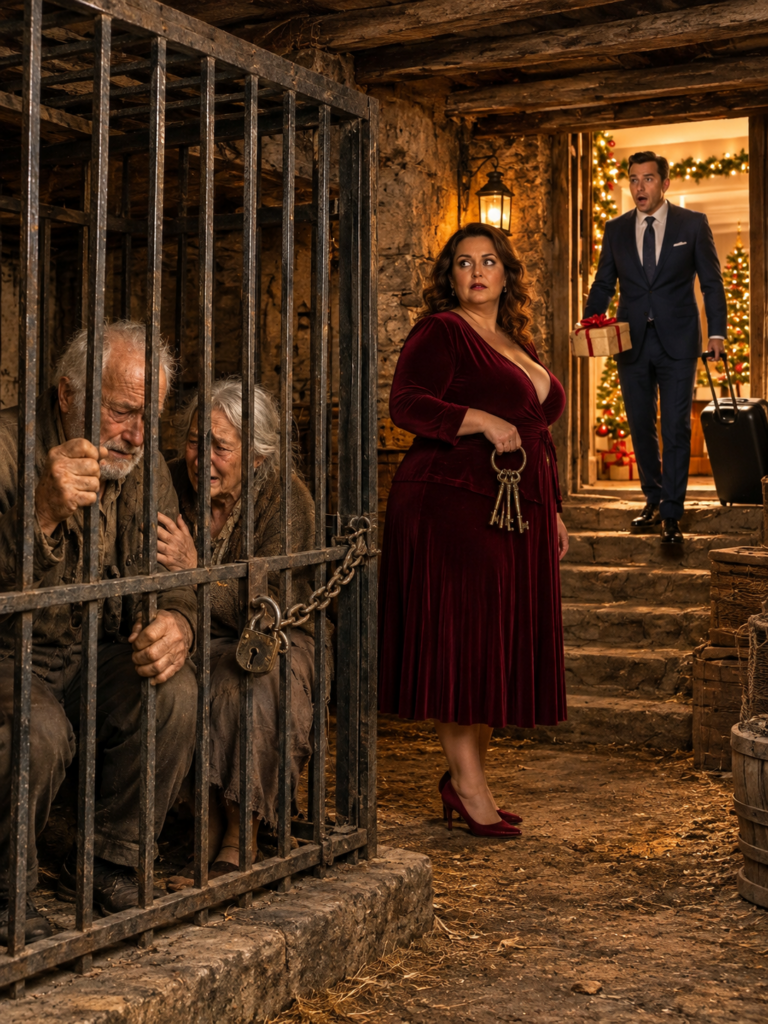
Part 1
The first thing Ethan Mercer noticed was the Christmas tree.
It stood nearly ten feet tall behind the front window of his parents’ Vermont farmhouse, glittering with gold ornaments and expensive white lights. There were matching wreaths on the porch, fresh paint on the shutters, and a black luxury SUV parked beside the old barn.
His father would never have spent that kind of money on Christmas decorations.
His mother would never have allowed anyone to replace the little wooden ornaments her children had made in elementary school.
And neither of them would have left the front porch light burning in broad daylight.
Ethan was still studying the house when the front door opened.
His older sister appeared in a burgundy cashmere sweater, holding a glass of wine.
For half a second, Claire Mercer looked terrified.
Then she smiled.
“Ethan? Oh my God. What are you doing here?”
He stepped onto the porch, snow crunching beneath his boots.
“Merry Christmas, Claire.”
She hugged him so tightly that he couldn’t see past her into the hallway.
“Twelve years,” she said. “Twelve years, and you just show up without calling?”
“That’s generally how surprises work.”
She gave a small laugh.
But when Ethan tried to step inside, she didn’t move.
“Where’s Mom and Dad?” he asked.
Claire’s fingers tightened around his arm.
“They’re not here.”
Ethan looked past her at the unfamiliar furniture.
“What do you mean, they’re not here?”
“They went away for Christmas.”
His smile disappeared.
His parents had spent forty-three Christmases together in that house.
They had never spent one anywhere else.
And although Ethan didn’t know it yet, his sister had just told him the first of several lies that would change their family forever.
Twelve years earlier, Ethan Mercer had left the small town of Briar Glen, Vermont, with two duffel bags, a secondhand laptop, and eighty-seven dollars in his checking account.
He was twenty-three, stubborn, ambitious, and determined not to spend his entire life repairing tractors and worrying about the price of feed.
His father, Arthur Mercer, had worked the family dairy farm for more than four decades. He was a quiet man with rough hands, a bad knee, and the habit of answering difficult questions with practical advice.
His mother, June, had kept the household running through uncertain harvests, harsh winters, medical bills, and the endless small emergencies that came with raising two children on a farm.
They had never been wealthy.
There were years when June patched the same winter coats rather than buying new ones. Arthur drove his pickup until the frame rusted beneath him.
But the mortgage was paid, the farmhouse was warm, and no one who came through their kitchen ever left hungry.
Ethan remembered that kitchen better than any other room.
His mother standing at the counter making cinnamon rolls on Christmas morning.
His father drinking coffee beside the window while the snow piled against the barn.
Claire teasing him about the ridiculous business plans he used to scribble into school notebooks.
He had promised them all that one day he would make enough money to give them an easier life.
And in one sense, he had kept that promise.
By thirty-five, Ethan was the founder and chief executive of Mercer Logistics Group, a privately held freight and fulfillment company headquartered in Boston.
He had begun with software that helped regional trucking companies plan more efficient routes. One contract became ten. Ten became hundreds. He expanded into warehousing, e-commerce fulfillment, and transportation management.
The company now served clients across the United States and parts of Europe.
Ethan owned more money than he had ever imagined earning.
He lived in a Boston penthouse, flew business class without checking the fare, and negotiated contracts large enough to purchase every farm in Briar Glen.
Yet almost nobody in his hometown knew how successful he had become.
He preferred it that way.
Money attracted attention, and attention changed people. He had seen friendships turn into investment proposals and family gatherings become conversations about financial favors.
So he told his parents only that the business was doing well.
He sent them money every month, enough to cover property taxes, medical expenses, repairs, and anything else they might need.
At first, he also called every Sunday.
His mother would tell him about the weather or which neighbor had stopped by with fresh bread. His father would ask whether he was eating properly and whether he had remembered to change the oil in his car.
Then the calls became less frequent.
There were investors to reassure, employees to manage, acquisitions to negotiate, and problems that always seemed too urgent to postpone.
A missed Sunday became a missed month.
Eventually, Ethan found himself sending short messages instead of calling.
Hope you’re both doing well. Money’s in the account. Love you.
His mother always replied.
We’re fine, sweetheart. Don’t work too hard.
He had accepted those words without asking what fine really meant.
On December 22, sitting alone in his Boston apartment after another fourteen-hour workday, Ethan found an old Christmas photograph on his phone.
His mother stood beside the farmhouse tree, wearing a flour-dusted apron. His father held a badly wrapped present. Claire stood behind them, grinning.
Ethan was in the center, twenty-two years old and still convinced that success would make everything simple.
He stared at the picture for a long time.
Then he opened his calendar.
The next three days were filled with meetings that other people could handle.
For once, he let them.
The following morning, he packed a suitcase, collected a gift he had bought for his father months earlier, and drove north.
He was going home for Christmas.
By early afternoon on December 23, the highway had narrowed into a two-lane road winding between snow-covered woods.
The mountains rose dark and blue beyond the fields. A frozen creek followed the road toward Briar Glen, and a covered bridge that Ethan remembered from childhood stood at the edge of town.
Some things had changed.
The old hardware store was now a coffee shop. A new pharmacy occupied the corner where his father once bought tractor parts. The diner had been renovated, though its familiar red sign still hung above the door.
But the town itself felt smaller than Ethan remembered.
He stopped at the diner for coffee.
Behind the counter, an elderly woman looked up from the register.
“Ethan Mercer?”
He recognized Martha Ellis, who had worked there since he was a teenager.
“Hi, Martha.”
She stared at him.
“Well, I’ll be.”
He smiled. “It’s good to see you.”
Martha came around the counter and hugged him.
But when he told her he was heading out to surprise his parents, her expression changed.
“You’re going to the farm?”
“That’s the plan.”
She looked toward the front window, then back at him.
“Have you spoken to your mom lately?”
“Not as much as I should. Why?”
Martha opened her mouth.
Then she closed it again.
“Nothing. It’s just… I’m glad you’re here.”
Ethan waited.
She picked up a towel and began wiping a section of the counter that was already clean.
“You should go see them.”
He left with his coffee untouched.
Ten minutes later, he drove past the property where Walter Finch lived.
Walter had been his father’s closest friend since their twenties. The two men had repaired fences together, shared equipment, and argued about baseball for as long as Ethan could remember.
Walter was standing beside his mailbox.
Ethan slowed, rolled down the window, and called his name.
The older man turned.
Recognition brought a brief smile to his face.
Then, just as it had with Martha, the smile faded.
“Ethan. You back for Christmas?”
“Yeah. Thought I’d surprise everybody.”
Walter glanced toward the Mercer farm, half a mile down the road.
“Have you been home yet?”
“Not yet.”
Walter rubbed a gloved hand across his mouth.
“Then you’d better get there.”
Something in his voice made Ethan sit straighter.
“Is something wrong?”
Walter hesitated.
“Just go, son. And come talk to me afterward.”
Ethan drove away with an uneasiness he could no longer dismiss.
The farmhouse stood on twenty-seven acres of land that had belonged to the Mercer family for three generations.
The old barn was still standing. So were the maple trees near the driveway, the stone walls bordering the pasture, and the workshop his grandfather had built.
But the house looked almost unrecognizable.
The exterior had been renovated. The porch railings were new. There were expensive security cameras beneath the eaves and an electronic keypad beside the front door.
His parents had always preferred simple things.
They cared about a roof that didn’t leak and windows that kept out the cold.
They didn’t care about decorative landscaping or imported stone countertops.
And the SUV in the driveway certainly didn’t belong to Arthur Mercer, who considered paying extra for heated seats a personal insult.
Ethan climbed the porch steps.
Then Claire opened the door.
Now, standing in front of his sister, he tried to ignore the uneasiness he had carried all the way from town.
“Where did they go?” he asked.
Claire shifted aside just enough to let him enter.
“To cousin Andrew’s cabin. Up in the Adirondacks.”
Ethan stopped.
“Andrew?”
“Yes.”
“Andrew died six years ago.”
For a moment, Claire said nothing.
Then she waved a hand.
“His son, Ethan. Andrew Junior. You know what I meant.”
Ethan studied her.
“I didn’t know his son had a cabin.”
“Well, you haven’t exactly been around.”
The remark landed harder than she probably intended.
Or perhaps exactly as hard.
“Fair enough,” Ethan said.
Claire shut the door behind him.
“Anyway, they wanted a change of scenery. I told them to enjoy themselves.”
“At Christmas?”
“People are allowed to change their traditions.”
“Of course they are.”
But he knew his parents.
His mother had attended the same Christmas Eve church service for more than forty years. His father always insisted on eating breakfast at home on Christmas morning, even during the years when the cattle required attention before sunrise.
Leaving town two days before Christmas without mentioning it to their son seemed almost impossible.
Still, Ethan followed Claire into the living room.
The changes inside were even more dramatic.
His mother’s floral sofa was gone.
The oak coffee table his grandfather had made had disappeared.
Modern furniture stood where familiar pieces had once been, and the framed family photographs that used to cover the walls had been replaced with abstract prints.
Even the smell was different.
The house had once smelled of coffee, baking bread, firewood, and whatever his mother had been cooking.
Now it smelled of expensive scented candles.
“Quite a renovation,” Ethan said.
Claire smiled.
“I figured the place needed updating.”
“Did Mom pick out the furniture?”
“Some of it.”
“Really?”
Claire folded her arms.
“Ethan, are you here to celebrate Christmas or inspect my decorating?”
He gave a small, conciliatory smile.
“Sorry. It’s just different.”
“That’s what happens when you don’t visit for twelve years.”
He couldn’t argue with that.
Claire led him into the kitchen and offered coffee.
There, Ethan noticed something else.
Only one place had been set at the kitchen table.
One plate.
One glass.
One folded napkin.
There was no sign of his father’s chipped blue coffee mug or his mother’s collection of handwritten recipes.
“Do you live here full-time now?” he asked.
“Pretty much.”
“I thought you were still in Hartford.”
“I left that job last year.”
“You didn’t tell me.”
“You never asked.”
Her answer was sharp enough to end the conversation.
Ethan leaned against the counter.
“Are Mom and Dad doing okay financially?”
Claire paused while pouring coffee.
“Of course.”
“I send money every month. I assume they’re getting it?”
“They are.”
“And they’re using it?”
“I handle the accounts now.”
Ethan looked at her.
“Since when?”
“Since I moved back. Mom gets overwhelmed by paperwork, and Dad doesn’t understand online banking.”
That didn’t sound like his father.
Arthur Mercer could calculate the cost of feed, equipment maintenance, and milk production in his head. He had managed the farm’s finances through recessions and unpredictable markets.
He might dislike online banking, but he was not incapable of handling money.
“Did they ask you to take over?” Ethan asked.
Claire set the coffee pot down.
“They trust me, Ethan. Someone has to be here to help.”
He noticed her hand trembling.
She quickly slipped it into her pocket.
Ethan changed the subject.
But the questions stayed with him.
Late that afternoon, Ethan walked into the backyard.
Snow lay along the stone path leading toward the woodshed. The barn doors were closed, and the pasture fence needed repair.
He found his father’s gray wool sweater hanging from an old chair beneath the covered porch.
His mother had knitted it fifteen years earlier.
One sleeve was slightly longer than the other. Arthur had worn it almost every winter morning since.
Ethan lifted the sweater.
The fabric was stiff and dusty.
It had been left outside for weeks, perhaps longer.
On a small table beside the chair lay a pair of reading glasses.
One arm was bent.
His father’s glasses.
Ethan picked them up.
Arthur couldn’t read a newspaper without them.
Why would he leave for a Christmas trip without his glasses or his warmest sweater?
“Ethan?”
He turned.
Walter Finch stood near the fence separating the properties.
The older man looked thinner than Ethan remembered. His beard was almost entirely white, and his shoulders were bent beneath a heavy work jacket.
“Walter.”
“Can we talk?”
Ethan crossed the yard.
Walter kept his voice low.
“Don’t tell Claire I came over.”
Ethan felt his stomach tighten.
“What’s going on?”
“I haven’t seen your parents in months.”
Ethan stared at him.
“What?”
“Arthur used to stop by every Thursday. We’d have coffee, complain about the weather, pretend we knew what the Red Sox should be doing.”
He tried to smile.
It didn’t last.
“Then he stopped coming.”
“Maybe he’s been sick.”
“That’s what I thought. But whenever I came over, Claire wouldn’t let me see him. Said he was sleeping. Said he and June were visiting relatives. Said they’d gone away for a few days.”
Walter glanced toward the house.
“Every time, a different story.”
Ethan looked down at the broken glasses in his hand.
“Did you talk to anyone?”
“I talked to Martha. I talked to a couple of neighbors. Nobody’s seen either of them. Rose Bennett was worried too.”
“Rose? Mom’s caregiver?”
Walter nodded.
“Claire fired her five months ago. Wouldn’t even let her say goodbye.”
Ethan felt a sudden chill that had nothing to do with the weather.
Rose had helped his mother after her hip surgery. June loved her. Arthur trusted her. Ethan had personally approved the money to pay her wages.
“Why was she fired?”
“Claire said they didn’t need her anymore.”
Walter paused.
“But Rose told me something wasn’t right. She said Claire had been keeping people away from the house, controlling their calls, asking strange questions about property records.”
“Why didn’t anyone call the police?”
“Welfare checks were requested. Claire told the deputies your parents were away. We had no proof anything criminal was happening.”
Walter stepped closer.
“I’m not saying I know what she’s done. But I know your father. He wouldn’t disappear without telling me.”
Ethan swallowed.
“And I know he wouldn’t leave those glasses behind.”
Walter looked at the object in Ethan’s hand.
His expression hardened.
“Neither would I.”
Dinner that evening was painfully ordinary.
Claire had bought a prepared roast chicken and vegetables from an upscale grocery store in Montpelier.
She talked about the renovations, the weather, and the difficulty of managing the property.
Ethan listened.
Then he asked the question he had been holding back.
“Can I call Mom?”
Claire’s fork stopped halfway to her mouth.
“Why?”
“Because I haven’t spoken to her in a while.”
“They barely have any reception at the cabin.”
“I can still try.”
“Don’t ruin the surprise. They’ll be home after Christmas.”
Ethan placed his fork on the plate.
“You said they were only going for a few days.”
“They are.”
“And when exactly are they coming back?”
Claire looked irritated.
“I don’t know. The twenty-sixth. Maybe New Year’s.”
“Which is it?”
“Ethan, they’re adults. I don’t keep track of their every movement.”
He looked at her for a long moment.
Then he nodded.
“Right.”
Claire resumed eating.
But Ethan noticed that she didn’t finish her dinner.
That night, he lay awake in the guest room that had once been his bedroom.
The photographs were gone. His desk was gone. The shelves that had held his old baseball trophies were empty.
His family had apparently built an entirely different life in his absence.
Or Claire had built one for them.
He looked at his phone.
11:48 p.m.
He considered calling the county sheriff’s office.
But what would he say?
My sister redecorated the house. My father left his sweater outside. Some neighbors haven’t seen my parents.
He knew how little that sounded like evidence.
At 12:16 a.m., he heard something.
A dull thump.
Ethan sat up.
The house settled back into silence.
He waited.
Another thump came from somewhere beneath the floor.
He got out of bed.
Barefoot, he walked down the hallway toward the kitchen.
The only light came from the illuminated Christmas tree in the living room.
He heard it again.
Three faint knocks.
Not from the walls.
Not from the windows.
From below.
Ethan remembered a detail he hadn’t thought about in years.
Beneath the old kitchen was a stone root cellar.
His grandfather had used it to store potatoes, preserves, and farm supplies before the house had modern refrigeration.
A narrow staircase led down from a door behind the pantry cabinet.
When Ethan was little, his father had warned him not to go down there alone because the steps were uneven.
He went to the pantry.
The cabinet had been replaced during the renovation.
But when he examined the floor, he saw faint scrape marks along the tiles.
The unit had been moved recently.
He put his shoulder against it.
The heavy cabinet shifted.
Behind it was the old cellar door.
And fastened to that door was a shiny new lock.
Ethan stared at it.
Then he heard another sound.
A weak, deliberate knock from the other side.
He placed his palm against the wood.
“Hello?”
Nothing.
He leaned closer.
“Is somebody down there?”
For several seconds, he heard only his own breathing.
Then came three more knocks.
Ethan slowly stepped backward.
His parents weren’t at a cabin.
Someone was beneath the house.
And whoever it was had just answered him.
Part 2
Ethan remained in the kitchen long after the knocking stopped.
He tried the cellar door again.
Locked.
He examined the new hardware, looking for a way to remove it without making noise. The lock had been installed over the old mechanism, and the screws were inaccessible while the door was shut.
He went to the garage for tools.
Halfway down the hallway, he heard footsteps upstairs.
Claire.
He stopped.
A bedroom door opened, followed by the sound of someone walking toward the staircase.
“Ethan?”
He turned.
Claire stood on the landing in a silk robe.
“What are you doing up?”
“Couldn’t sleep.”
She looked beyond him toward the kitchen.
“Why is the pantry cabinet moved?”
“I thought I heard something.”
“What kind of something?”
“Probably an animal.”
Claire descended three steps.
“An animal?”
“Yeah. Under the kitchen.”
Her face changed.
Only slightly.
But Ethan saw it.
“We’ve had mice,” she said. “I’ll call somebody after the holidays.”
“Sounded bigger than a mouse.”
She laughed.
“Old houses make noises. You remember that.”
Ethan held her gaze.
“I remember.”
For several seconds, neither moved.
Then Claire crossed her arms.
“Go back to bed, Ethan.”
He wanted to demand answers.
He wanted to pull her aside and ask what was behind that door.
But if his parents were trapped down there, and Claire was responsible, confronting her without a way to reach them might put them in greater danger.
He needed to get that door open.
And he needed to do it without warning her.
At breakfast, Ethan played the part of the tired traveler.
He accepted coffee.
He asked about the weather.
He listened while Claire talked about a contractor who had overcharged her for replacing the upstairs windows.
His mind never left the cellar door.
He also noticed the keys.
Claire carried a ring clipped to the side of her trousers.
Among the car keys, house keys, and older brass keys was a small silver key that looked almost new.
When Claire stood, she instinctively touched the ring.
The gesture was quick and unconscious.
The kind of movement someone developed after repeatedly checking that something important was still there.
At 8:40 a.m., she glanced at her phone.
“I have to go into Montpelier.”
“On Christmas Eve?”
“Banking issue. Something with a business account.”
“Want me to come?”
“No.”
The answer came too quickly.
She softened her voice.
“I’ll be back before lunch. Make yourself at home.”
Ethan watched from the window as she drove away.
He waited until the SUV had disappeared beyond the trees.
Then he went straight to the kitchen.
He pushed the cabinet aside and examined the lock again.
There was an old keyhole beneath the new metal plate.
And suddenly, a childhood memory surfaced.
His father had always kept spare keys in a rusted coffee tin behind the toolshed.
“Because if you put spare keys inside the house, they aren’t much use when you’re locked outside,” Arthur used to say.
Ethan ran across the frozen yard.
The toolshed smelled of dust, machine oil, and old lumber.
He searched beneath a workbench, moved a box of rusted bolts, and found the familiar red coffee tin tucked behind a wooden crate.
Inside were several keys wrapped in a faded shop rag.
His hands were shaking as he carried them back.
At the cellar door, he tried the first key.
Nothing.
The second turned halfway.
The third fit.
The old lock released with a heavy click.
The new metal plate was attached to the door but had not been fully secured to the frame. When Ethan pushed, the entire assembly shifted.
The door opened.
Cold air rose from the darkness.
And with it came a smell that turned his stomach.
Damp stone.
Stale food.
Human waste.
Ethan switched on his phone’s flashlight.
“Hello?”
He took one step down.
Then another.
The staircase was narrower than he remembered. The wooden handrail was splintered, and the light switch near the door had been disconnected.
At the bottom, the cellar opened into a low stone room.
Old shelves lined the walls.
Empty jars stood beside sacks of spoiled grain.
There was a small ventilation window, covered from the inside.
And across the far end of the room, someone had installed a metal security partition.
It looked like a gate from a commercial storage facility.
A heavy padlock held it shut.
Behind it were two thin mattresses.
A plastic bucket.
A few blankets.
And two people huddled together against the wall.
Ethan stopped breathing.
The man lifted his head.
His cheeks had sunk inward. His hair was almost completely white. The familiar strength had gone from his shoulders.
But Ethan knew those eyes.
“Dad?”
Arthur Mercer stared at him.
For a moment, he seemed unable to understand what he was seeing.
Then his mouth opened.
“Ethan?”
The voice was barely recognizable.
Ethan rushed toward the gate.
“Dad. Jesus Christ. Dad, it’s me.”
His mother stirred beside Arthur.
She was wrapped in a gray blanket, her face pale and her hair tangled around her shoulders.
“June,” Arthur whispered. “Look.”
She raised her head.
When she saw her son, she reached for the bars.
“Ethan?”
He dropped to his knees.
“Mom.”
Her fingers were cold.
He held them through the gate.
For a few seconds, none of them could speak.
Then June began to cry.
“Oh, sweetheart. You came.”
The words hurt more than anything Ethan had ever heard.
He pressed her hand against his face.
“I’m here. I’m here now.”
Arthur tried to stand.
His legs trembled beneath him.
Ethan reached through the bars to steady him.
“Don’t move. I’ll get you out.”
His father caught his wrist.
“Your sister.”
Ethan looked at him.
“What about Claire?”
Arthur’s grip tightened.
“Be careful.”
The story came out in fragments.
Claire had returned to Vermont almost a year earlier after losing her job at a property management company in Connecticut.
She had also lost her apartment.
There were unpaid credit cards, personal loans, and debts connected to a failed business venture she had never told her family about.
At first, she had been helpful.
She drove June to appointments.
She picked up prescriptions.
She organized repairs.
She told Arthur he had done enough work for one lifetime and offered to manage the farm’s accounts.
The changes were gradual.
Claire began intercepting mail.
She discouraged visitors.
She persuaded her parents to sign a power of attorney, explaining that it would make it easier to handle medical bills and financial paperwork.
Arthur and June trusted their daughter.
They signed.
Then Claire began transferring money.
First from the household account.
Then from the savings Ethan had been sending for years.
When Arthur challenged her, she claimed she had moved the money into safer investments.
But eventually he discovered that she was using it to pay her own debts.
He demanded control of the accounts.
Claire refused.
A few weeks later, she produced documents concerning the farmhouse and surrounding property.
She told them the paperwork was necessary to protect the land from future estate taxes and complications.
Arthur read enough to realize that the documents gave her authority to sell the property.
He refused to sign.
June supported him.
That night, Claire accused them of treating her like an unpaid servant while Ethan lived comfortably in Boston.
The argument grew ugly.
By evening, Claire had convinced them to go downstairs to look at what she described as a water leak near the cellar wall.
Once they were inside, she shut the door.
And locked it.
At first, Arthur thought she was trying to frighten them.
He shouted through the door.
Claire told him she would let them out when they agreed to sign.
When he refused, she left them there overnight.
The following morning, she returned with food and blankets.
The security gate appeared several days later.
Then weeks passed.
Claire brought enough groceries and bottled water to keep them alive, but never enough to make them comfortable.
If they shouted, she threatened to stop bringing meals.
She removed their phones.
She closed the ventilation window with a heavy board to keep their voices from carrying into the yard.
She told them everyone believed they had moved away.
Eventually, she claimed to have found a buyer for the entire property.
The sale was scheduled to close on January 2.
“She said she needed our signatures,” June whispered. “When your father wouldn’t cooperate, she started making them herself.”
Ethan stared at her.
“How long?”
Arthur looked toward the cellar wall.
“Almost four months.”
Four months.
Ethan tried to calculate what he had been doing while his parents lived in that room.
An industry conference in Chicago.
A negotiation in London.
A corporate retreat in Colorado.
A weekend in Miami with investors.
He remembered buying a watch that cost more than his parents’ annual grocery expenses.
He remembered forwarding his mother’s last voicemail to his assistant with the instruction to remind him to call her later.
He had never called.
“I didn’t know,” he said.
Arthur closed his eyes.
“We know, son.”
“I’m so sorry.”
June shook her head.
“Later, Ethan. Please. Just get us out.”
Her voice was weak, but the instruction was unmistakable.
Ethan stood.
“You’re right.”
He examined the gate.
The padlock was too heavy to break with anything he could find nearby.
He searched his pockets for the keys from the toolshed.
None fit.
Then he heard a car door slam outside.
Claire had returned.
Footsteps crossed the kitchen.
A cabinet scraped against the floor.
“Ethan?”
Claire’s voice echoed down the staircase.
He turned.
She descended slowly, holding her keys.
The moment she saw him standing in front of the metal gate, she stopped.
Her face went completely still.
Arthur put his arm around June.
Ethan looked at his sister.
“Open it.”
Claire did not move.
“Ethan, listen—”
“Open the gate.”
“You don’t understand.”
He took one step toward her.
“I understand they’re locked in a basement. I understand they’re half-starved. And I understand you’ve been telling everyone they’re away visiting relatives.”
Claire’s eyes moved toward their parents.
“I was taking care of them.”
Arthur gave a short, bitter laugh.
“Is that what you call this?”
Claire flinched.
Ethan held out his hand.
“The keys.”
She backed against the staircase.
“You can’t just come home after twelve years and decide you know everything.”
“Give me the keys.”
“Do you know what it was like here? Do you have any idea?”
Ethan didn’t answer.
Claire laughed sharply.
“Of course you don’t. You left. You got to go off and build your company. Everybody was so proud of Ethan. Ethan was going to be somebody. Ethan was going to make us all rich.”
She looked at her father.
“Meanwhile, who took you to your appointments? Who dealt with the insurance company when Mom had surgery? Who got called when the furnace broke?”
“You did,” Arthur said.
“And did anybody care?”
“Claire—”
“Nobody cared.”
She turned toward Ethan.
“You sent money. Congratulations. You sent money and thought that made you a good son.”
Ethan felt the accusation find its mark.
Because there was truth in it.
He had used money to compensate for the time he refused to give.
But the truth of that failure could not explain what stood behind the gate.
“You’re right about one thing,” he said quietly.
Claire blinked.
“I should have come home. I should have called more. I should have noticed when things changed.”
Her expression shifted, uncertain.
“But you don’t get to turn that into permission to torture them.”
“I didn’t torture anybody.”
Ethan pointed toward the mattresses.
“Look at them.”
Claire looked away.
“Look at them, Claire.”
“I was desperate.”
“Then you should have asked for help.”
“From you?” She laughed again. “The great Ethan Mercer? I wasn’t going to beg you for money.”
“You were willing to steal it.”
Her face hardened.
“I was owed something.”
Arthur struggled to sit straighter.
“We would have helped you, sweetheart.”
Claire looked at him.
“You always say that.”
“Because it’s true.”
“You helped Ethan leave. You told him to follow his dreams. Every time I wanted something different, you reminded me how much the farm needed me.”
June spoke softly.
“We didn’t know you felt trapped.”
“Because you never asked.”
There was a silence.
Not because Claire had won the argument.
Because something painful had finally been said aloud.
Ethan had never understood how differently his sister remembered their childhood.
He remembered freedom.
She remembered obligation.
He remembered encouragement.
She remembered being expected to stay.
But whatever those memories meant, they could not make her parents responsible for her choices.
“Claire,” Ethan said, “we can talk about all of that after they’re safe.”
She shook her head.
“No.”
“Why?”
“Because if they leave, everything comes out.”
Her voice cracked.
“The sale collapses. The bank comes after me. The police get involved. I go to prison.”
Ethan stared at her.
“You know you committed a crime.”
Tears filled her eyes.
“I know I’m going to lose everything.”
Behind the gate, June made a small sound.
It was not anger.
It was grief.
Claire heard it.
For the first time, she looked directly at her mother.
The woman who had raised her.
Who had stayed up when she was sick.
Who had defended her when teachers complained and held her when relationships failed.
That woman was sitting on a filthy mattress, wrapped in a blanket too thin for the winter.
Claire’s mouth trembled.
Ethan held out his hand again.
“The keys.”
She hesitated.
Then, with a sudden movement, she threw them onto the stone floor.
They landed near his feet.
“Fine.”
Ethan picked them up.
He found the right key on the third attempt.
The padlock opened.
He pulled the gate wide.
His mother reached for him first.
He caught her as she tried to stand.
Arthur followed, leaning heavily against the wall.
Ethan supported them both, moving slowly toward the staircase.
Behind him, Claire began to cry.
He didn’t look back.
At the top of the stairs, he settled his parents in the living room, wrapped them in clean blankets, and called 911.
He told the dispatcher that two elderly people had been unlawfully confined and needed urgent medical attention.
While he answered the dispatcher’s questions, Claire disappeared through the back door.
Ethan didn’t follow her.
He was finished chasing the wrong priorities.
His parents needed him.
The ambulance arrived fourteen minutes later.
Two paramedics examined Arthur and June while deputies from the county sheriff’s office searched the property.
Both parents showed signs of dehydration, prolonged undernourishment, muscle weakness, and untreated medical problems.
The paramedics warned Ethan not to give them a large meal immediately.
After a careful assessment, they arranged transport to the regional hospital for fluids, blood tests, and observation.
June held Ethan’s hand while a paramedic checked her blood pressure.
“Is Claire here?” she asked.
“She’s gone.”
June closed her eyes.
“She used to be such a good girl.”
Ethan couldn’t find an answer.
Outside, Walter Finch stood beside the ambulance.
He had seen the emergency vehicles and hurried over.
When he saw Arthur being brought through the front door, his face crumpled.
“Art?”
Arthur lifted one unsteady hand.
Walter hurried forward.
For a moment, the two old friends simply held each other.
Neither seemed able to speak.
Then Walter said, “I knew something wasn’t right.”
Arthur managed a weak smile.
“Should’ve known you’d be making a fuss.”
Walter gave a shaky laugh.
“You’re damn right.”
Rose Bennett arrived less than an hour later.
She was a woman in her late sixties, with silver hair, a practical winter coat, and the brisk manner of someone who had spent years caring for people who preferred not to admit they needed help.
Walter had called her.
When Ethan answered the door, Rose was carrying a thick folder.
“I heard June and Arthur are alive,” she said.
“They’re at the hospital.”
Rose’s face collapsed with relief.
“Thank God.”
Then she handed Ethan the folder.
“I kept these because I was afraid something would happen.”
Inside were photographs taken during her final weeks at the farmhouse.
Some showed Arthur sitting alone in an unheated room, looking exhausted.
Others showed June’s prescription bottles left untouched on a shelf.
There were copies of correspondence from a real estate agency, pages from a proposed sales agreement, and photographs of documents Claire had left beside the printer.
Rose explained that she had become suspicious when Claire began restricting visits and refusing to allow her to speak privately with June.
“I tried to get help,” she said. “But I couldn’t prove what was happening. I had photos and concerns. I didn’t know they were locked downstairs.”
Ethan examined one of the documents.
His father’s signature appeared near the bottom.
He recognized it immediately.
And he recognized what was wrong with it.
Arthur always made the final letter of his surname with a long downward stroke.
This signature didn’t.
Ethan looked at the next page.
Another questionable signature.
Then another.
A purchase agreement.
A power-of-attorney document.
Emails concerning an anticipated January 2 closing.
And an estimated sale price of just over two million dollars.
Claire had planned to sell the farmhouse, the barns, and the surrounding land.
Everything their family had worked for across three generations.
Ethan closed the folder.
“I need an attorney.”
Rose nodded.
“There’s someone else you should speak to.”
“Who?”
“Your parents.”
She looked toward the ambulance disappearing down the road.
“They’ve been silenced long enough.”
By midafternoon, Ethan was at the hospital.
His parents had been admitted for observation and treatment. The attending physician, Dr. Maya Patel, explained that the effects of prolonged confinement would require careful management.
They were medically fragile.
Recovery would not happen in a day.
Or even a week.
Arthur needed treatment for dehydration, poor nutrition, and a worsening heart condition.
June’s hip had stiffened badly from inactivity, and she had developed significant weakness.
Both would need rehabilitation, nutritional support, and follow-up care.
Ethan listened to every word.
For once, he didn’t check his phone.
After the doctor left, he sat beside his mother’s hospital bed.
June was asleep.
Arthur occupied the bed near the window.
For several minutes, father and son watched the snow falling outside.
Then Arthur spoke.
“Your company doing well?”
Ethan almost laughed.
Of all the things his father could have asked.
“Yeah, Dad. It’s doing well.”
“Good.”
Arthur looked toward him.
“You worked hard.”
Ethan shook his head.
“Not at the things that mattered.”
His father considered that.
“Maybe not.”
The answer surprised him.
Arthur reached for the plastic cup beside his bed.
Ethan helped him take a sip of water.
“Money’s useful, son,” Arthur said. “It pays bills. Keeps the lights on. Makes life easier.”
He settled back against the pillow.
“But it can’t sit beside somebody when they’re afraid.”
Ethan stared at the floor.
“I should’ve known.”
“You should’ve visited.”
The words were not cruel.
They were simply true.
Ethan nodded.
“I know.”
Arthur looked out at the falling snow.
“Then visit now.”
Ethan stayed.
That afternoon, he contacted a Boston attorney and a local Vermont lawyer, Naomi Price, who agreed to help preserve the property and review the suspicious transactions.
By evening, the sheriff’s office had opened an investigation into unlawful confinement, elder abuse, financial exploitation, and suspected forgery.
Claire’s whereabouts were still unknown.
Ethan had also learned something else.
Most of her outstanding business debt was tied to a single private lender.
His lawyers were already working to stop the lender from pursuing the farmhouse and to determine whether Ethan could take over the debt himself.
He wasn’t doing it to protect Claire from prosecution.
He was doing it because he refused to let the consequences of her actions take another thing from their parents.
At six-thirty that evening, June opened her eyes and asked what day it was.
“Christmas Eve,” Ethan told her.
She looked at the clock.
“St. Luke’s service starts at eight.”
Ethan glanced at Arthur.
His father was already looking at him.
“No,” Ethan said immediately. “You’re staying here.”
June gave him a familiar, stubborn look.
“Ethan, I’ve missed four months of my life.”
“I know, Mom.”
“I don’t want to miss Christmas too.”
He looked toward the nurse outside the room.
Their doctor had already made clear that they were too weak for an extended outing.
Ethan knew the safest choice was to remain at the hospital.
But his mother wasn’t asking to go home.
She was asking whether her life still belonged to her.
After further discussion, the medical team agreed that, if their vital signs remained stable, they could make a short, carefully supervised visit to the nearby heated church hall, with wheelchairs, medical assistance, and a prompt return to the hospital.
Arthur listened as the arrangements were explained.
Then he looked at Ethan.
“Your sister told us the whole town had forgotten us.”
His eyes filled.
“I’d like to see for myself.”
Part 3
The Christmas Eve service at St. Luke’s had always been one of Briar Glen’s most cherished traditions.
Families arrived early.
Children wore sweaters that their grandparents had bought them. Neighbors exchanged small gifts, complained about the snow, and passed around plates of homemade cookies in the church hall.
The church itself was modest, built from gray stone with a square wooden bell tower.
Arthur Mercer had helped repair its roof twenty years earlier.
June had volunteered at its annual Christmas dinner for almost three decades.
When Ethan brought his parents through the hall’s side entrance, the conversations gradually stopped.
Arthur sat in a wheelchair wearing a clean flannel shirt and the old brown jacket Rose Bennett had brought from the farmhouse.
June had a knitted blanket over her knees.
Both looked painfully thin.
But their heads were raised.
And they were there by choice.
Martha Ellis was the first to recognize them.
“June?”
Her hand flew to her mouth.
Then she hurried across the room.
“Oh, honey.”
She knelt beside June’s wheelchair, careful not to hug her too tightly.
Behind her, Walter Finch approached Arthur.
Other neighbors followed.
Some asked what had happened.
Others seemed to understand that questions could wait.
They offered warm greetings, squeezed hands, and quietly made room.
June looked around the hall.
For months, Claire had told her that nobody cared enough to visit.
Yet here were dozens of people who knew her name.
People who remembered her birthday.
People who had attended her children’s school concerts, helped repair the barn after a storm, and eaten at her kitchen table.
Her eyes filled with tears.
“They didn’t forget us,” she whispered.
Ethan crouched beside her.
“No, Mom.”
June looked up at him.
“They really didn’t.”
Across the hall, Arthur was talking to Walter.
His voice was thin, but Ethan heard him make a joke about Walter’s terrible Christmas tie.
Walter laughed so hard he had to remove his glasses.
For the first time since arriving home, Ethan felt something other than fear or anger.
He felt relief.
Then the doors opened.
And Claire Mercer walked inside.
She had changed clothes.
The expensive sweater was gone, replaced by a dark coat over jeans and a simple blouse.
Her hair was loose.
Her eyes were red.
But her expression was determined.
Several people turned toward her.
Whispers moved through the room.
Claire stopped near the Christmas tree.
“So this is what we’re doing?” she asked.
Ethan stood.
“Claire.”
She looked at the crowd.
“Everybody’s looking at me like I’m some kind of monster.”
Nobody answered.
Claire gave a shaky laugh.
“Of course. Ethan comes home with his money, and suddenly everybody’s ready to believe whatever he says.”
Walter took a step forward.
“Claire, this isn’t the place.”
“No, Walter. This is exactly the place.”
She pointed toward Ethan.
“Where were you when Mom had surgery? Where were you when Dad couldn’t manage the farm anymore? Where were you when they needed someone to take care of them?”
Ethan didn’t move.
Claire looked around the hall.
“I was here. I gave up my time. My career. Everything. He got to build a company, live in a fancy apartment, and come home whenever he felt like it.”
Her voice broke.
“And now I’m the villain?”
For a moment, no one spoke.
Ethan could feel the old instinct rising inside him.
The instinct to win an argument.
To expose every contradiction.
To present the evidence and make certain everybody understood exactly what Claire had done.
It was the same instinct that had helped him become successful in business.
But then his mother spoke.
“Claire.”
The single word stopped him.
June looked at her daughter.
“Come closer.”
Claire hesitated.
Then she approached.
June studied her face.
“You were unhappy,” she said.
Claire swallowed.
“Yes.”
“You were angry with us.”
“Yes.”
“You felt we expected too much from you.”
Tears ran down Claire’s cheeks.
“I did.”
June nodded slowly.
“I wish you’d told us how badly you were hurting.”
Claire wiped her face.
“I tried.”
“Maybe you did. Maybe we weren’t listening well enough.”
Arthur turned toward them.
“June—”
She lifted one hand.
“Let me finish.”
Her voice was quiet, but nobody interrupted.
“I can admit we made mistakes as parents. I can admit we may have expected things from you that we didn’t expect from Ethan.”
Claire began crying harder.
“But none of that gave you the right to lock us downstairs.”
Claire looked away.
“You don’t understand—”
“No, sweetheart. I do understand what happened.”
June took a slow breath.
“I remember every night.”
The hall was silent.
“I remember how cold the floor was. I remember your father trying to make me laugh because he knew I was frightened. I remember hearing your footsteps above us and wondering whether you would bring dinner.”
Claire covered her mouth.
“I remember asking you to let me call my son.”
June’s eyes filled.
“And I remember you telling me he wouldn’t come.”
Ethan looked down.
His mother continued.
“I love you, Claire. You’re my daughter. That hasn’t changed.”
She paused.
“But loving you doesn’t mean pretending you didn’t hurt us.”
Arthur moved his wheelchair forward.
“Ethan,” he said.
His son stepped aside.
Arthur looked up at Claire.
“When you were little, you were terrified of thunderstorms.”
Claire stared at him.
“You’d come downstairs with your blanket and sit beside me until the storm passed.”
His voice trembled.
“I used to tell you there was nothing in this world you had to face alone.”
Claire’s shoulders shook.
“I meant it.”
Arthur swallowed.
“If you were drowning in debt, we would’ve helped. Maybe we couldn’t have fixed everything. But we would’ve tried.”
“Dad—”
“Instead, you made us afraid of our own home.”
Claire closed her eyes.
Arthur let the silence settle.
“I don’t hate you.”
Her eyes opened.
“But I don’t trust you. And I won’t tell anyone you deserve to escape the consequences of what you’ve done.”
Claire turned toward Ethan.
“You think you’re better than me?”
“No.”
The answer surprised her.
Ethan reached inside his coat.
He had brought copies of the documents Rose Bennett had recovered.
The originals and digital evidence were already with the investigators and attorneys.
He held up the proposed property transfer.
“I think you committed crimes that need to be answered for.”
He looked around the room.
“My parents were confined in their own basement for almost four months. Deputies have seen where they were held. They’ve taken statements and are reviewing the financial records.”
Claire shook her head.
“I didn’t mean for any of this to happen.”
“You installed a locked gate,” Ethan replied. “You controlled their food. You forged signatures. And you arranged to sell their home.”
Her expression crumpled.
“I didn’t know what else to do.”
“There were other choices.”
“I was going to lose everything.”
Ethan studied her for a long moment.
Then he said something that made her look up.
“You won’t lose the house because of your debts.”
Claire blinked.
“What?”
“Our parents’ house isn’t yours to sell. Their lawyers are challenging every document you used to claim authority over it.”
He paused.
“And the private lender you owe money to? My attorneys reached an agreement today to purchase your outstanding business notes.”
Claire stared at him.
“You… what?”
“I’ve agreed to take over that debt.”
“Why would you do that?”
“Because Mom and Dad have already paid enough for your mistakes.”
She shook her head, struggling to understand.
“You’re buying my debt?”
“Yes.”
“Then you’ll own everything I owe.”
“The loans will be handled separately from the criminal case. I won’t use them to control you.”
Claire looked toward her parents.
Ethan continued.
“I didn’t do this to erase what happened. And I didn’t do it to make everybody think I’m some kind of hero.”
His voice softened.
“I did it because I don’t want our family home tied to another threat.”
For the first time that evening, Claire seemed to have no argument left.
She looked at the floor.
All the anger she had rehearsed during the drive to the church had nowhere to go.
She had expected Ethan to destroy her.
She had expected their parents to reject her.
Instead, they were telling her that she would have to live with what she had done, without pretending she had never belonged to the family.
That was harder to dismiss.
Then two sheriff’s deputies appeared at the entrance.
Someone had called after seeing Claire arrive.
One deputy approached her.
“Claire Mercer?”
She looked up.
“Yes.”
“You’re under arrest in connection with the unlawful confinement of Arthur and June Mercer. There are also allegations of financial exploitation and forgery under investigation.”
Claire’s face went pale.
For an instant, Ethan thought she might run.
She didn’t.
The deputy explained her rights and secured her hands.
Claire looked at her parents.
“Dad?”
Arthur lowered his eyes.
Then she looked at June.
“Mom, I’m sorry.”
June began to cry.
“I know you’re sorry now.”
Claire’s mouth trembled.
“I don’t know how I became this person.”
June held out her hand.
The deputy allowed Claire a brief moment to take it.
“You need to figure that out,” June whispered.
Claire nodded.
Then the deputies led her away.
Nobody applauded.
Nobody cheered.
The church hall remained quiet as the doors closed.
The family had received answers.
But the answers had cost them something they could never fully recover.
The Christmas service began shortly afterward.
Reverend Matthew Wells, who had known the Mercers for twenty years, changed the sermon he had prepared.
He did not mention Claire by name.
Instead, he spoke about the difference between forgiveness and forgetting, and about the courage required to admit harm without pretending that accountability was cruelty.
He reminded the congregation that caring for family was not something measured in money alone.
It was measured in attention.
In difficult conversations.
In showing up when showing up was inconvenient.
Ethan sat between his parents.
He had heard hundreds of speeches about leadership and responsibility throughout his business career.
None had unsettled him as much as the sight of his mother quietly holding his father’s hand.
Halfway through the service, June leaned toward him.
“Do you remember the Christmas you got sick?”
Ethan smiled faintly.
“Which one?”
“The year you were ten. You had that awful fever. You thought Santa wouldn’t come because you couldn’t get out of bed.”
He remembered.
His father had carried the presents upstairs.
His mother had sat beside him reading stories until he fell asleep.
June touched his hand.
“You kept apologizing because you thought you’d ruined Christmas.”
“What did you tell me?”
“That Christmas wasn’t about everything going according to plan.”
Ethan looked at her.
June smiled weakly.
“I suppose I should take my own advice.”
He bent and kissed her forehead.
After the service, medical staff helped Arthur and June return to the hospital.
Ethan rode with them.
For the first time in years, he didn’t think about when he needed to return to Boston.
The legal consequences unfolded over the following months.
The investigation uncovered fraudulent transfers, unauthorized withdrawals, altered financial records, and forged property documents.
Naomi Price worked with Ethan’s attorneys to challenge the attempted sale and ensure that Arthur and June retained legal ownership of their land.
The proposed January 2 closing never happened.
The private lender agreed to release any disputed claim against the farmhouse, while Claire remained responsible for answering the criminal allegations.
Eventually, Claire entered guilty pleas to several charges.
The court imposed a multiyear prison sentence.
Her genuine remorse was considered, but it did not erase the seriousness of imprisoning and exploiting two vulnerable people.
Ethan attended the sentencing with his parents.
He didn’t celebrate.
He watched his sister being led away and remembered the girl who used to build snow forts with him behind the barn.
He wondered when resentment had become something she carried everywhere.
He wondered how much of it she had hidden from the people who loved her.
But he understood something he had not understood before.
Knowing why someone had done something terrible was not the same as excusing it.
And loving someone did not require surrendering the truth.
Arthur and June’s recovery was slow.
There were difficult weeks.
Arthur struggled to regain strength in his legs. June needed physical therapy and treatment for complications caused by prolonged inactivity.
Both suffered nightmares.
For a long time, June hated being alone in a room with a closed door.
Arthur startled whenever he heard a lock turn.
Ethan paid for their care, but he also learned that professional help could not replace familiarity.
So he changed his life.
He postponed an international expansion project.
He delegated more of the company’s daily operations to executives he trusted.
He rented an apartment close to the hospital during his parents’ initial rehabilitation, then began splitting his time between Boston and Vermont.
Eventually, he established a permanent office in the renovated farmhouse.
He didn’t abandon his business.
He simply stopped treating every business problem as more urgent than the people he loved.
At first, the adjustment was uncomfortable.
He was used to decisions being made quickly.
Healing didn’t work that way.
Some mornings, his father wanted company.
Other mornings, he didn’t want to talk.
June had days when she laughed at everything and others when she grew quiet without explanation.
Ethan learned not to fix every silence.
Sometimes he sat with them.
Sometimes he made coffee.
Sometimes he drove his mother to physical therapy and waited in the parking lot with a newspaper.
And every Sunday, without exception, the three of them had lunch together.
As spring arrived, Ethan began thinking about the other elderly residents of Briar Glen.
He had assumed that his parents’ suffering was an unimaginable exception.
The confinement had been.
But the isolation was less unusual than he wanted to believe.
Walter told him about a widower who had gone weeks without seeing another person.
Rose knew families who struggled to arrange transportation to medical appointments.
The local clinic had patients who missed appointments because they couldn’t drive in winter.
And there were older people who simply needed someone to check on them.
Ethan met with Rose, Walter, Dr. Patel, and several community leaders.
Together, they developed a plan.
Ethan provided funding to renovate an unused building near the town center.
It became a daytime community center for older residents, offering meals, social activities, transportation assistance, and regular visits from healthcare professionals.
Rose agreed to oversee its daily operations.
Walter volunteered to organize card games, dominoes, and a weekly coffee morning.
Dr. Patel helped establish connections with local medical services.
Ethan insisted that the center be governed by a community board rather than controlled by him.
He had learned how dangerous it could be when one person controlled access to the people and resources others depended on.
The center opened the following summer.
Above the entrance was a simple wooden sign.
THE ARTHUR & JUNE MERCER COMMUNITY HOUSE
Arthur looked at the sign for a long time.
Then he turned to Ethan.
“You named a building after us?”
“Apparently.”
“People are going to think we died.”
June laughed.
For the first time in months, her laughter sounded almost exactly as Ethan remembered it.
“Arthur, stop complaining.”
His father examined the sign again.
“Could’ve at least named it after someone more interesting.”
Ethan smiled.
“Too late. The paperwork’s done.”
Arthur shook his head.
But when the first visitors arrived, Ethan noticed him standing a little straighter.
Claire began writing letters from prison.
At first, June read every one.
Arthur refused.
“She had four months to talk to us,” he said. “She doesn’t get to decide when we’re ready to listen.”
June didn’t argue.
She kept the letters in a drawer.
Months passed.
Claire wrote about counseling sessions, the work she had started doing to understand her behavior, and the ways she had used her anger to justify cruelty.
She didn’t ask for money.
She didn’t demand forgiveness.
Some letters were awkward.
Others were painfully honest.
Ethan read them only when his parents invited him to.
He had no intention of forcing a reconciliation.
Eventually, Arthur asked June to bring him one of the letters.
He sat at the kitchen table for almost an hour before opening it.
After reading it, he folded it carefully.
“She sounds different,” June said.
Arthur looked toward the window.
“Maybe.”
“Do you want to write back?”
“Not yet.”
June nodded.
That was enough.
A few weeks later, Arthur asked for another letter.
And then another.
Their relationship with Claire remained damaged.
There was no sudden forgiveness.
No promise that everything would return to the way it had been.
But there was a small opening.
And for the moment, that was all anyone needed.
One afternoon the following spring, Ethan sat in the farmhouse kitchen with his father.
The windows were open.
Outside, the maple trees were beginning to show their first green leaves.
The barn had been repaired. The yard was clean. The old family photographs had returned to the walls.
The expensive Christmas decorations were long gone.
June was at the counter preparing hot chocolate.
She had regained much of her strength, though she still used a cane on difficult days.
Arthur wore the old gray wool sweater that Ethan had found outside.
Rose had washed it, repaired a loose seam, and returned it to him after he came home from rehabilitation.
The sleeves were still uneven.
Arthur insisted that was what made it comfortable.
Ethan watched his father looking across the property.
“Thinking about the farm?” he asked.
Arthur nodded.
“Your grandfather used to say this place would outlive all of us.”
“Looks like he was right.”
“Probably.”
They sat quietly.
Then Arthur turned toward him.
“Can I tell you something?”
“Of course.”
“Down in that cellar, your mother and I used to talk about you.”
Ethan looked at him.
“We wondered what you were doing. Whether you were happy. Whether the business was still going well.”
His father rubbed his hands together.
“Some nights, when things were particularly bad, she’d tell me you were going to come home.”
Ethan swallowed.
“Dad—”
“I didn’t always believe her.”
Arthur looked toward the kitchen floor.
“But I kept hoping.”
Ethan stared at the table.
“I should have come sooner.”
“Yes,” Arthur said.
The word was gentle, but it didn’t pretend otherwise.
Ethan nodded.
“I know.”
Arthur reached across the table and placed his hand over his son’s.
“But you’re here now.”
In the kitchen, June poured hot chocolate into three mugs.
“Ethan,” she called, “come help me carry these.”
He stood immediately.
“Coming, Mom.”
Arthur chuckled.
“She waited twelve years to have somebody else do the carrying.”
June turned.
“I heard that.”
“Good,” Arthur replied.
Ethan picked up two mugs.
As he returned to the table, he looked around the room.
The kitchen where he had eaten breakfast before school.
The kitchen where his mother had baked Christmas cookies.
The kitchen where his father had taught him how to repair a broken chair.
The same kitchen beneath which his parents had spent four terrible months waiting to be found.
The house could never return completely to what it had been.
Too much had happened.
But it was warm again.
His parents were safe.
And for the first time since leaving Briar Glen, Ethan understood that building a successful life meant more than creating something impressive enough for the world to admire.
It meant knowing who needed him.
It meant being present when there was nothing to gain.
It meant listening before someone had to beg to be heard.
June set the final mug on the table.
“Christmas at home this year?” she asked.
Ethan smiled.
“Wouldn’t miss it.”
His mother reached for his hand.
Outside, the afternoon sunlight moved slowly across the old barn.
And somewhere in the quiet rhythm of an ordinary family day, the distance of twelve years finally began to close.
The End.