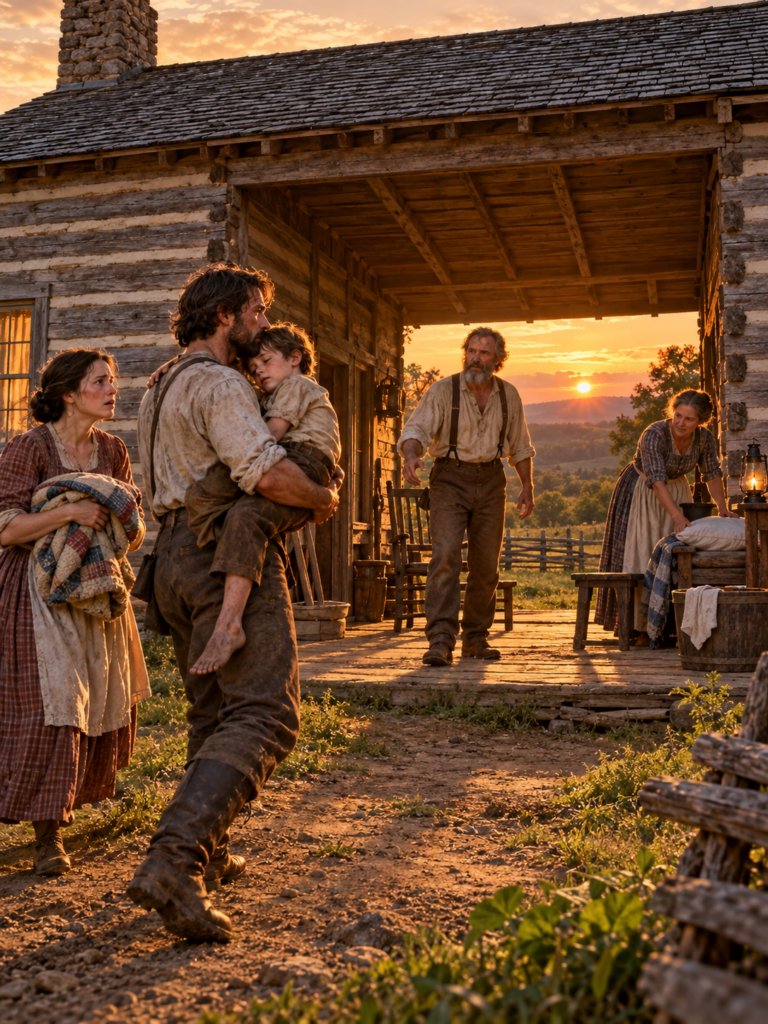
Thomas lowered himself into the chair as Samuel settled opposite him, the evening breeze moving gently between the two log rooms.
“Tell me one thing,” Thomas began. “If you wanted a porch, why not build a porch?”
Samuel considered the question.
“Because a porch runs along the outside. This passage sits between the rooms, beneath the same roof. Air can come through either end.”
Thomas looked around.
The structure was simple enough.
Two enclosed rooms.
A single long roof.
An open central passage.
Yet the difference between seeing it and understanding it had taken him an entire summer.
“Does it always feel like this?”
“When there’s a breeze to catch, it helps.”
“And when there isn’t?”
“Then it’s still hot.”
Thomas frowned.
Samuel smiled.
“I never said I’d built a house that could change the weather.”
That answer was so ordinary Thomas almost laughed.
He had imagined Samuel claiming some remarkable secret.
Instead, the man was explaining a practical compromise.
The roof shaded the space beneath it.
The open ends allowed air to travel through.
And the doors of the adjoining rooms could be opened when conditions made that useful.
Thomas looked toward his son.
The boy remained asleep.
“Still seems like a lot of space to give up.”
“It is.”
“Could’ve been another room.”
“Could have.”
“And in winter?”
“We use the enclosed rooms.”
Thomas rubbed his jaw.
There had to be a disadvantage Samuel wasn’t admitting.
“What about rain blowing sideways through here?”
“Then we put up the barriers where they’ll help and move anything needing proper shelter inside.”
“Barriers?”
Samuel pointed toward removable wooden sections stored near the eastern wall.
Thomas stood to examine them.
The fittings were simple.
They were intended to reduce wind-driven exposure without turning the passage into a permanent room.
“So you planned for that too?”
“I planned for what I could.”
Thomas studied the pieces.
“And if the weather gets worse than those can manage?”
“Then we keep ourselves in the enclosed rooms.”
There was no boast in Samuel’s voice.
The house had limits.
Samuel knew them.
That made Thomas’s mistake more difficult to dismiss.
He had judged the design by weaknesses that its builder had already considered.
From the western doorway, Samuel’s wife spoke.
“We don’t spend every hour out here, Thomas. Some days the rooms suit us better. Some days the passage does.”
She glanced toward his sleeping son.
“Tonight it seems to be doing him some good.”
Thomas nodded.
“More than you know.”
His wife sat beside him.
She had been listening.
“Samuel, you said you saw another house like this?”
“Years back. Traveling with a timber crew.”
“Did you know straightaway you wanted one?”
Samuel shook his head.
“Thought it looked foolish.”
Thomas lifted his head.
“You did?”
“Certainly did.”
“You mean you laughed at it?”
“Near enough.”
Thomas stared.
Samuel leaned back.
“First time I saw two rooms separated by an open passage, I figured the builder had stopped halfway through the job.”
Thomas began smiling despite himself.
“That sounds familiar.”
“Then somebody invited me into the shade on a hot afternoon. I sat there awhile and learned something.”
“What?”
“That a fellow can be too certain about what he hasn’t tried.”
Thomas lowered his eyes.
Beyond the passage, the darkness deepened.
Then his son stirred.
“Pa?”
Thomas rose immediately.
“Here, son.”
The boy opened his eyes.
“Are we going home?”
“Soon.”
“Can we come back tomorrow?”
Thomas looked toward Samuel.
His neighbor said, “The passage will still be here.”
The boy settled against his father’s shoulder.
Thomas thanked Samuel and his wife before gathering the blankets.
But as the family approached the edge of the roof, a sudden gust lifted dust from the yard.
The air changed.
The distant trees began moving sharply.
Samuel stood.
He looked toward the darkening western sky.
“That rain may be coming sooner than I expected.”
A low rumble crossed the fields.
Thomas glanced back at the unprotected passage.
For the first time that evening, he saw the open space not as comfort, but as a possible weakness.
Samuel moved toward the stored wooden barriers.
“Thomas, could use your hands a moment.”
Thomas handed his son to his wife.
“Where do you want me?”
Samuel lifted one end of the first barrier toward its fittings.
“Right here.”
Thomas caught the opposite end.
Then the wind struck the house hard enough to shake the loose panel in their hands.
Thomas tightened his grip as the wooden panel shuddered between his hands.
“Hold your end!” Samuel called.
“I’ve got it!”
Rain swept across the yard, striking the dry earth and sending dust swirling beneath the roof.
The passage that had seemed so wonderfully comfortable only moments earlier was now exposed to a hard western wind.
Samuel guided the lower edge of the barrier toward its fastening.
Thomas leaned into the panel.
Together they settled it into place.
“Keep it steady,” Samuel said.
Thomas held on while his neighbor secured the fitting.
Then they moved to the next section.
The rain was driving through the opening now.
Water darkened the floor near the exposed edge.
Samuel’s wife had already carried the blankets and lantern farther inside.
Thomas’s wife stood in the western room with their son.
The child watched the men work, wide-eyed but no longer distressed by the heat.
“Will the house be all right?” she called.
Samuel glanced toward her.
“The enclosed rooms will give us proper shelter. These panels should take some of the rain off the passage.”
Thomas examined the barrier.
It was not a wall.
It was never meant to be.
The sections reduced the opening exposed to the wind, but they did not seal the entire center.
Water could still enter.
The arrangement had its limits.
Samuel understood them well enough not to pretend otherwise.
Once the fittings were secured, they carried the remaining tools into the eastern room.
Thomas stepped beneath the protection of its solid roof and walls.
Rain struck overhead.
Wind rattled the shutters.
He breathed heavily from the work.
“Well,” he said, “there’s one argument for closing the middle.”
Samuel wiped rain from his forehead.
“There is.”
Thomas looked surprised.
“You’re agreeing with me?”
“A closed room offers better protection from weather like this.”
“Then why not build one?”
Samuel glanced toward the passage.
“Because weather like this doesn’t last every day.”
Thomas said nothing.
Samuel continued.
“Most summer afternoons, I want a place that’s shaded and open to moving air. When weather turns rough, we’ve got enclosed rooms.”
Thomas watched rain scatter across the yard beyond the partly screened passage.
“You’ve built a house for more than one kind of day.”
“That’s the notion.”
The answer was simple.
But it rearranged something in Thomas’s mind.
He had always judged houses by how well they served one purpose.
Protection.
Solid walls.
Dependable roof.
As much enclosed room as a family could afford.
Those were worthy things.
Yet Samuel had considered another question.
What happened when keeping the weather out also kept the air from moving through?
***
The rain lasted through the evening.
Thomas’s family remained with the Reeds until the weather eased enough for the walk home.
The women prepared a modest supper while the men checked the shutters and roof edges.
Inside the western room, the families sat together.
Thomas’s son ate quietly and leaned against his mother’s shoulder.
Samuel set a cup beside Thomas.
“Better than carrying him through the rain.”
Thomas nodded.
“Much better.”
Then he studied his neighbor.
“You weren’t worried when that wind came up.”
“Of course I was.”
“You didn’t look it.”
Samuel smiled faintly.
“Looking worried doesn’t hold timber in place.”
Thomas chuckled.
“I suppose not.”
He looked around the room.
It was solidly built.
Ordinary in most respects.
The walls were carefully fitted.
The furniture was plain.
Nothing suggested wealth or extravagance.
Samuel had not spent a fortune creating a peculiar home.
He had used familiar frontier materials in an arrangement Thomas had never thought worth trying.
“And you didn’t put up the barriers permanently,” Thomas observed.
“No.”
“Even though they’d keep some of the weather off.”
“They’d block some of the air too.”
Thomas nodded slowly.
That was the problem, wasn’t it?
An improvement in one season could become a disadvantage in another.
A solid wall gave shelter from wind and rain.
But it could also obstruct the breeze on a hot afternoon.
An opening improved airflow when moving air was available.
But it exposed the passage to changing weather.
Every choice had a cost.
What Thomas had mistaken for bad construction was a deliberate decision about which advantages mattered most to the household.
***
After the storm, Samuel and Thomas stepped outside.
The rain had eased to scattered drops.
Moisture shone on the logs.
The air smelled of wet soil.
Samuel unfastened one of the barriers.
Thomas helped him carry it back to its storage place.
As they worked, Thomas asked something that had troubled him since the night before.
“Why this kind of house, Samuel? I know you saw one down south, but seeing something isn’t the same as needing it.”
Samuel became quiet.
For a while he adjusted the final fastening without answering.
Then he looked toward the western room.
“My wife took sick one summer.”
Thomas stopped.
He knew she had suffered a serious illness years before.
He had not connected it to the house.
“She recovered,” Samuel continued. “But our old cabin was hard to bear in the heat.”
Thomas waited.
“We opened what windows we had. Kept the door open when we could. Tried sleeping on the porch some nights.”
Samuel rested his palm against a supporting post.
“Some evenings, nothing helped much. The air hardly moved.”
Thomas remembered his son’s restless nights.
The damp bedding.
The helpless feeling of watching someone he loved struggle to find a comfortable place to sleep.
Samuel looked down.
“I couldn’t do anything about the summer heat. Couldn’t command the wind. And no house would’ve cured what made her ill.”
He paused.
“But after she was well, I kept thinking there ought to be a better arrangement for the hot months.”
“And you remembered the house you’d seen.”
“Yes.”
Thomas looked toward the passage.
“So you built this.”
“When I had the chance.”
The answer carried no drama.
No claim of extraordinary wisdom.
Samuel had seen his wife suffer through uncomfortable nights.
He had remembered a building that made use of shade and moving air.
And when he could, he built a home that offered his family another place to rest.
Thomas felt ashamed.
He had spent months making jokes about a man whose decisions he had never troubled himself to understand.
“You might have told me.”
Samuel glanced at him.
“Would you have listened?”
Thomas opened his mouth.
Then closed it.
After a moment, he shook his head.
“Probably not.”
Samuel nodded.
“I reckoned as much.”
Thomas studied the opening.
“I’m sorry I made sport of it.”
His neighbor accepted the apology quietly.
“No harm in learning something late.”
Thomas looked toward the house.
“I might have learned sooner if I’d asked an honest question.”
***
By the following week, other families had heard about the unusually comfortable evening Thomas’s son had spent at Samuel’s house.
Some came to look.
One neighbor stood in the passage during the late afternoon and remarked that it felt more pleasant than his closed cabin.
Another wondered whether sacrificing twelve feet of covered space was too expensive.
Samuel answered both men without exaggeration.
He did not claim that the passage would be comfortable in every condition.
On windless days, the air could still be oppressive.
During hard rain, the opening could become troublesome.
In winter, the household relied more heavily on its enclosed rooms.
But when the sun burned over the fields and a breeze moved through, the shaded passage offered a useful place to work or rest.
The men began asking practical questions.
How wide was the opening?
How had Samuel supported the roof?
Did the adjoining doors face into the passage?
What did his family do when storms came?
Samuel answered as plainly as he could.
Thomas listened.
Once, he would have laughed at those same questions.
Now he understood that the neighbors were trying to learn what he had failed to notice.
One afternoon a settler asked whether the arrangement worked because it somehow made the air colder.
Samuel shook his head.
“Air’s still air. Roof keeps the sun off us, and a breeze can pass through.”
Thomas added, “And if you close the passage, you’ve got to find another way for the air to move.”
The others looked at him.
Thomas almost laughed at himself.
Only a few months earlier he had been the loudest critic of the opening.
Now he was explaining why it mattered.
***
By September, the fiercest heat began to ease.
Thomas’s household slept more comfortably again.
The nightly trips to Samuel’s passage became unnecessary.
But Thomas’s thoughts kept returning to the building.
He started noticing things he had formerly ignored.
The direction of the afternoon sun.
The way trees offered shade.
How air entered one window but seemed to stop before crossing the room.
Where an opening might allow better ventilation.
How often his family chose the porch over the enclosed cabin during warm weather.
One evening his wife found him standing beside their house, looking at the empty ground to the east.
“What are you staring at?”
“The wind.”
She glanced across the field.
“Can’t see much of it.”
“I can see where it comes from.”
She followed his gaze.
Then smiled.
“You’re thinking about Samuel’s house again.”
“Maybe.”
“More than maybe.”
Thomas folded his arms.
“We’ve talked about adding another room.”
“We have.”
“There’s enough space over there.”
She looked toward the open ground.
“Yes.”
“And if we raised it apart from the cabin, then carried a roof between them…”
She began to understand.
“You mean leaving a passage like Samuel’s?”
“Something similar.”
For a moment she said nothing.
Then she looked at the house.
“Our cabin needs more room. We wouldn’t want to give up too much covered space.”
“I know.”
“And we’d have to think about rain.”
“I know that too.”
She turned toward him.
“Then perhaps it’s worth planning.”
Thomas smiled.
He had expected her to remind him of all the foolish things he’d said about Samuel’s design.
Instead, she considered the idea on its merits.
His wife looked toward the field.
“Though I do believe Samuel will have something to say when he sees your stakes.”
Thomas laughed.
“He will.”
***
That winter, the Whitakers planned their addition carefully.
Thomas did not intend to rebuild everything.
Their existing cabin was sound.
The family needed more usable room, but had limited materials and time.
A second structure, connected beneath a common roof, might suit their needs.
The passage would provide a shaded working and resting place in warm weather.
It would not replace the protection of enclosed rooms when conditions turned cold or wet.
He studied the ground.
Measured the distance.
Considered where the doors would open.
And remembered how Samuel had managed the wind-driven rain.
By early spring, Thomas had set the first stakes.
He was checking their alignment when he heard footsteps behind him.
Samuel Reed approached from the neighboring field.
“Morning, Thomas.”
“Morning.”
Samuel examined the markers.
“Building something?”
“Planning to.”
Samuel looked from the original cabin to the stakes marking the new room.
Then he examined the generous space Thomas had left between them.
A slow smile appeared.
“Seems you’ve forgotten a wall.”
Thomas straightened.
And for the first time in their friendship, he was delighted to hear the accusation.
Thomas leaned against the handle of his shovel and grinned.
“Not forgetting it.”
Samuel walked between the stakes.
“That’s a fair distance you’ve left.”
“Twelve feet, near enough.”
Samuel raised an eyebrow.
“What’s the space for?”
Thomas looked across the field.
“Air.”
For a moment Samuel simply stared at him.
Then he began to laugh.
Thomas joined him.
Their laughter carried across the yard, where Thomas’s wife stood in the doorway watching two grown men enjoy a joke she understood perfectly well.
“Careful, Samuel,” Thomas called. “Wouldn’t want you thinking I’ve lost my senses.”
“Too late for that.”
Samuel bent to examine the marked ground.
“Have you thought about the roof?”
“Some.”
“And how you’ll support it?”
“That’s where I hoped you might offer an opinion.”
Samuel straightened.
“Gladly.”
The two men walked around the foundation, examining the slope of the land and the existing cabin.
Thomas described how he planned to raise the second room without sacrificing the useful structure already standing.
He wanted a covered passage between them.
Wide enough to make a comfortable working space.
Open enough to allow air to pass through when the weather cooperated.
Samuel listened carefully.
Then he pointed toward the western edge.
“Remember that rain we had?”
“Hard to forget.”
“You’ll want to consider how to shelter this side when the wind comes across the field.”
Thomas nodded.
“I’ve been thinking about removable sections.”
“Could be useful.”
“And the roof needs to carry water well away from the openings.”
“It does.”
They continued around the stakes.
The conversation was practical.
Neither man treated the idea as mysterious.
The work would require timber.
Labor.
Careful fitting.
And judgment about how the family intended to use the building.
But this time Thomas understood the purpose before he began.
***
The first days of construction were slow.
Thomas still had a farm to maintain.
There were fences to repair, tools to sharpen, and fields demanding attention.
He worked on the addition when he could spare the time.
Samuel helped with the heavier timbers.
Other neighbors occasionally lent a hand, as frontier neighbors often did when a large piece needed lifting or several men were required to raise part of a frame.
Thomas’s son watched whenever his chores were finished.
“Pa?”
Thomas paused beside a support post.
“Yes?”
“Are we building a house like Mr. Reed’s?”
“Something like it.”
“Will it have the windy middle?”
Thomas smiled.
“That’s what we’re hoping for.”
The boy studied the open ground.
“Good.”
“Why’s that?”
“So we won’t have to go over there every time it’s hot.”
Thomas laughed.
“Well, I reckon that would be convenient.”
Then he became thoughtful.
He remembered carrying the boy across the fields that miserable summer evening.
The child’s hot forehead against his shoulder.
His wife’s worried expression.
The relief of seeing him finally sleep.
Thomas had once viewed the opening as useless floor space.
His son remembered it as the place where he had been comfortable.
The difference mattered.
A house was not built simply to satisfy the opinions of other men.
It was built to serve the people who lived there.
***
As the walls of the second room rose, Thomas found himself reconsidering other assumptions.
He had spent years believing that every sound construction choice must resemble something already familiar to him.
There had been comfort in that certainty.
He knew how to select timber.
How to fit logs.
How to build a roof that shed rain.
How to judge whether a wall stood true.
Those skills were valuable.
But possessing useful knowledge had encouraged him to believe he knew all the useful answers.
Samuel’s house had shown him the limits of that belief.
A man might be skilled at building walls and still misunderstand why someone had deliberately left an opening.
One afternoon, while Thomas fitted a timber, a younger neighbor came over to watch.
The young man stood beside the unfinished passage.
“Looks odd, having two rooms with nothing between them.”
Thomas lowered his tool.
“I thought the same.”
“Wouldn’t a third room be better?”
“For some families, perhaps.”
The young man looked confused.
“Then why leave it open?”
Thomas set down the timber.
“Come back on a hot afternoon after the roof’s finished. You’ll understand one reason.”
The young man glanced at Samuel, who was working nearby.
“Is it his idea?”
“Not originally.”
Thomas looked toward his neighbor.
“Samuel saw houses built that way when he was traveling south. Thought they looked strange himself.”
The young man smiled.
“That so?”
Samuel nodded.
“Sure enough.”
Thomas continued.
“Then he sat in one and discovered the covered passage had a use.”
The young man considered the open space again.
“So you’re copying him?”
“I’m learning from him.”
Thomas picked up the timber.
“There’s a difference.”
***
The work went on through spring.
The new room took shape beside the existing cabin.
A common roof covered the structures and bridged the passage.
Thomas considered how the openings faced the prevailing breezes and how the surrounding land might influence the comfort of the sheltered center.
He did not expect the design to accomplish miracles.
On a completely still day, the passage would not manufacture a wind.
When sunlight heated the entire landscape, the air flowing through would still be warm.
But under the roof, the family could sit out of direct sunlight.
When a breeze arrived, the open ends would allow it to pass through rather than being stopped by a central wall.
When doors and windows were opened appropriately, the adjoining rooms might also benefit from improved air movement.
The difference was practical.
That was enough.
One afternoon Samuel helped Thomas examine the roof over the new passage.
Thomas stood below, looking upward.
“Think it’ll hold?”
Samuel studied the timbers and their supports.
“Looks sound from here. Let’s check those joints once more.”
They did.
Then they checked the roof covering and the path rainwater would take along its edges.
Thomas remembered the storm that had struck Samuel’s house.
He wanted the opening to remain useful, but he also wanted his family prepared when wind-driven rain made it uncomfortable.
The men discussed where removable barriers might be stored.
They considered how the exposed floor could be kept clear of belongings vulnerable to rain.
And they agreed that the enclosed rooms would remain the household’s best refuge during severe weather.
None of those considerations weakened the design’s purpose.
They made its purpose more realistic.
***
At last, the covered passage stood ready.
Thomas carried a chair into the center.
His wife followed.
The afternoon was warm, though not as oppressive as the previous summer.
A faint breeze moved across the fields.
Thomas sat beneath the roof.
For a while, nothing happened.
Then the air stirred gently along the passage.
His wife lifted her face.
“There it is.”
Thomas smiled.
“Yes.”
She looked toward the new room.
“We’ll be able to use this space for work.”
“That’s the idea.”
“And for sitting in the evening.”
“Certainly.”
“Perhaps the boy can read out here when the light is good.”
Thomas nodded.
He had thought so much about the design that he had nearly forgotten the ordinary pleasures it might provide.
A place to mend tools.
A shaded area for household work.
A space where family members could sit together without crowding into a warm room.
A passage between two enclosed sections of the home.
Simple things.
But ordinary comfort was no small matter on a working frontier farm.
His wife settled into the chair beside him.
Then she looked toward the original cabin.
“You know, Thomas, we might have managed quite well without this.”
He nodded.
“We might.”
“And some folks would rather have another enclosed room.”
“They would.”
She smiled.
“But I believe we’re going to like it.”
Thomas took her hand.
“So do I.”
***
The new passage proved useful as the weather grew hotter.
It did not make summer disappear.
The fields still baked beneath the sun.
Dust still rose from the roads.
Some afternoons were so still that the family sought whatever shade they could find without expecting much movement from the air.
But when a breeze came, their covered passage welcomed it.
Thomas’s son began using the space for small chores and quiet play.
His wife sometimes prepared household work beneath the roof, where she could enjoy the shade without being confined in the warmer enclosed room.
Thomas repaired harnesses and sharpened tools there.
In the evenings, they sometimes sat together and watched the last sunlight settle across the fields.
The structure changed how they used their home.
Not every hour.
Not every season.
But often enough that Thomas was grateful for the decision.
When rain blew across the yard, they protected what they could and moved into the enclosed rooms.
When cold weather returned, those rooms became the comfortable heart of the household.
The open passage remained available, but it was not expected to serve every purpose.
Thomas had learned to value that distinction.
A building did not need to perform the same way in every season to be useful.
Sometimes its strength came from offering different spaces for different needs.
***
The next year, a traveler stopped near Thomas’s farm and studied the house.
He pointed toward the open passage.
“That’s an uncommon arrangement around here.”
Thomas smiled.
“Perhaps.”
“Why not put a wall through the middle?”
Thomas laid down the tool he was repairing.
For a brief moment he heard his own voice from two springs before.
*Where are you putting the middle wall?*
He remembered how certain he had sounded.
How thoroughly he had mistaken his own familiarity for wisdom.
He looked at the traveler.
“Because we’re using the space the way it is.”
The man examined the passage.
“For what?”
“Shade, work, and a bit of moving air when the weather gives us some.”
The traveler stepped beneath the roof.
A faint breeze passed through.
He nodded.
“Well, I can see the appeal.”
Thomas rested against a support post.
“Has its disadvantages too. Rain can blow in. Some days there’s hardly a breeze. And we gave up the chance to make another room of this part.”
The traveler glanced toward the enclosed sections.
“But you reckon the trade’s worthwhile?”
“For this family, yes.”
The man considered that.
Then he thanked Thomas and continued on his way.
Thomas watched him go.
He was quietly pleased that he had answered without telling another man how every house ought to be built.
***
Samuel Reed’s house was not the invention of a single frontier carpenter.
Buildings with two enclosed sections connected beneath a shared roof by an open central passage already existed in parts of the American South.
Some families constructed the arrangement all at once.
Others began with one log cabin and later added a second, joining the two beneath a common roof while leaving the center open.
The form would become widely known as a dogtrot house.
Its name was plain.
Its practical purpose was just as plain.
It made sheltered outdoor space part of the home’s everyday arrangement.
The central passage offered shade while allowing breezes to travel between its open ends.
Doors from the adjoining rooms could open into that space.
When conditions allowed, the design could improve air movement and make warm-weather activities more comfortable.
It was not an early machine for producing cold air.
It did not lower the outdoor temperature by some mysterious power.
It could not guarantee relief during oppressive, windless weather.
And it did not eliminate the need for proper enclosed shelter.
Its advantages came from basic physical realities.
A roof kept direct sunlight off the passage.
The open ends allowed moving air to travel through.
The arrangement provided an alternative to sitting inside enclosed rooms that might retain uncomfortable heat.
For some households, those benefits justified the loss of additional enclosed floor space.
For others, they did not.
That was why the design was a choice rather than a universal answer.
The details varied from place to place.
Some dogtrot houses had wide passages.
Others had narrower ones.
Some included porches.
Others gained additional rooms as families grew or circumstances changed.
Building materials, available labor, climate, land, and household needs all influenced the final arrangement.
Over time, some owners enclosed their central passages.
The reasons were understandable.
A family might need more indoor space.
A changing lifestyle might favor privacy or storage.
Severe weather might make a fully enclosed area more appealing.
But closing the passage also altered the original airflow.
What had once been an unobstructed route for outdoor air became another interior part of the house.
The trade-off Thomas had first failed to recognize remained important.
A covered opening was not necessarily unfinished construction.
It could be a deliberate feature serving a different purpose.
***
For Samuel, the idea had never been about proving he was cleverer than his neighbors.
He had watched his wife endure a miserable summer in a house that offered too few comfortable places to rest.
That experience had stayed with him.
When he later had the opportunity to build another home, he remembered an arrangement he’d seen elsewhere.
He was willing to use it despite the jokes.
Thomas’s transformation was different.
He had never lacked building skill.
What he lacked was the willingness to believe that an unfamiliar arrangement might solve a problem he had overlooked.
That summer changed him because the evidence was personal.
He had felt the heat inside his own cabin.
He had carried his restless son across the fields.
He had watched the boy finally sleep in the shaded passage of a house he’d mocked.
And he had seen Samuel make room for his family without demanding an apology first.
Later, he had helped secure the barriers against a storm.
He had learned that the house had limitations.
He had heard the reason Samuel had wanted such a design.
And eventually he had adapted the idea for his own home.
No miracle had occurred.
The weather remained the weather.
The limitations of the building remained real.
But Thomas’s understanding had changed.
And that change found its way into the timber, roof, and open passage of his own house.
***
Another summer came to Middle Tennessee.
On a warm afternoon, Samuel sat beneath the roof of his familiar twelve-foot passage.
The eastern room held his tools.
The western room remained the center of the household.
Between them, the shaded opening stretched across the house.
A light breeze moved through it.
Samuel had been repairing a small wooden handle when footsteps sounded outside.
He looked up.
Thomas Whitaker approached along the path, carrying a tool in need of attention.
“Afternoon, Samuel.”
“Afternoon.”
Thomas stopped at the edge of the passage.
“Mind if I come through?”
Samuel pointed toward an empty chair.
“Wouldn’t have left it open otherwise.”
Thomas laughed.
He stepped into the shade and sat.
For several minutes, the two men worked quietly.
Beyond the roof, sunlight covered the fields.
The air was warm.
But the breeze moved gently through the opening, reaching them without obstruction.
Thomas glanced toward the western doorway.
He remembered the night his wife had stood there holding their tired son.
He remembered the relief in her face.
He remembered how Samuel had made room for them without mentioning the jokes.
Thomas set down his tool.
“Funny thing.”
Samuel looked over.
“What’s that?”
“First time I came here, I thought the best part of this house was the part you hadn’t finished.”
Samuel smiled.
“And now?”
Thomas looked through the broad opening toward the field beyond.
“Now I reckon it’s the part you had the good sense to leave alone.”
Samuel returned to his work.
Neither man needed to say more.
The roof cast its shade.
The breeze crossed the floor.
And the empty space between the rooms continued doing exactly what its builder had intended.
Thomas no longer measured its worth by the walls that could have filled it.
He measured it by what happened because the walls were absent.
His son had rested there.
His wife had found relief there.
Neighbors had gathered there.
Two men had repaired tools, shared ideas, and become better friends there.
And an old certainty had given way to a useful lesson.
Samuel Reed had not forgotten to finish his house.
He had built it with an understanding that his neighbors were slow to recognize.
Sometimes a thoughtful builder improves a home not by adding another wall, but by knowing when an opening is worth keeping.
And sometimes the wisest thing a man can do is admit that what he once called a mistake was something he had not yet learned to understand.