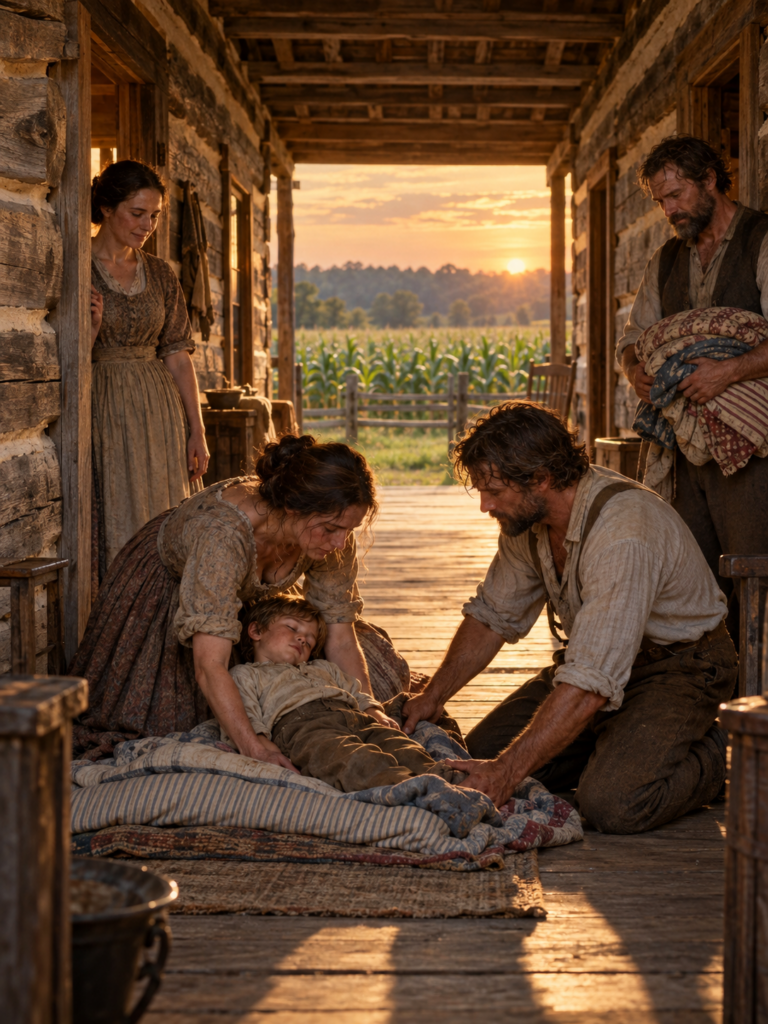
Samuel pulled the first blanket flat while Thomas’s wife knelt beside him, still holding her restless son against her shoulder.
The boy stirred and began to whimper.
“Easy now,” she whispered. “We’ve found a place.”
Thomas stood motionless, his folded blankets pressed against his chest.
He had come hoping for relief, but the embarrassment of asking had caught up with him.
Samuel’s wife emerged from the western room carrying a cup of water.
“Set him down when you’re ready,” she told the mother. “There’s room enough.”
Thomas finally stepped forward.
He unfolded the remaining blankets and laid them beside the first.
The wooden boards beneath their feet were dry and shaded. The roof above them had kept the day’s direct sunlight away, and the open ends allowed what little evening air there was to cross the passage.
But even here the air was warm.
Samuel would not pretend otherwise.
“Best not expect a cold night,” he said. “We haven’t got one to give you.”
Thomas looked up.
“You think the breeze will last?”
“Can’t promise it. You may find more comfort here than inside, though.”
The boy’s mother lowered him onto the bedding.
For several minutes, he remained restless.
She sat beside him, brushing damp hair away from his forehead.
Samuel’s wife brought another cup of water.
Thomas crouched near the edge of the passage, watching his son.
Then a faint breath of wind moved through the corn.
It crossed the open yard.
Entered beneath the roof.
Passed over the waiting blankets.
The boy’s mother lifted her face.
“There,” she murmured.
Another little movement of air followed.
The child’s breathing gradually steadied.
His eyelids closed.
Before long, he was sleeping.
His mother remained beside him, almost afraid to move.
Thomas stared at the small figure lying under the roof of the house he had called unfinished.
Samuel quietly gathered his tools from a bench and carried them into the eastern room so their conversation would not disturb the boy.
When he returned, Thomas was still watching.
“I told you that you were wasting timber,” Thomas said.
Samuel sat on the opposite side of the passage.
“You did.”
“And that you ought to put a wall here.”
“That too.”
Thomas looked at the open ground beyond the house.
“If you’d listened to me, my boy wouldn’t be sleeping there tonight.”
Samuel did not answer immediately.
His wife had settled near the mother and child, speaking softly with her.
For a moment, he remembered another summer, another sleepless night, and the helplessness of watching someone he loved search for comfort inside a room that would not release its heat.
“This wasn’t my invention,” he finally said.
Thomas looked surprised.
“I saw houses built this way farther south, years ago. Thought they looked peculiar myself. Then I sat in one of these passages on a hot day.”
“And remembered it?”
“Every summer afterward.”
Thomas studied the roof timbers.
“You’ve known all along?”
“I knew what I’d felt. Didn’t know how much difference it might make here.”
That admission struck Thomas harder than a boast would have.
Samuel had not gambled on some miraculous protection from heat.
He had remembered a useful building arrangement and adapted it to his own land.
The walls sheltered two rooms.
The roof shaded the passage.
The opening made room for air.
None of it could change the weather.
But it could change how a family lived through it.
Thomas’s wife settled beside her sleeping son and leaned against a post.
“Could we stay until morning?” she asked.
Samuel looked toward his wife.
She nodded.
“Of course,” he replied.
Thomas lowered himself into the chair near the outer edge.
Across the passage, the darkness deepened over the fields.
His son’s breathing remained steady.
But Thomas knew one comfortable night did not settle everything.
Their own cabin would still be hot tomorrow.
There were more August days to endure, and they could not reasonably move their household into Samuel’s passage for the rest of summer.
He looked from the sleeping boy to the open roof overhead.
Then he reached for Samuel’s measuring cord, which lay on the bench beside him.
“Would you show me,” Thomas asked quietly, “how you laid this place out?”
Samuel picked up the cord and held one end.
Thomas took the other.
Together they stretched it across the twelve-foot opening, measuring the very space Thomas had once insisted should be filled with a wall.
The measuring cord tightened between the two men.
Thomas held his end near the eastern wall while Samuel stood beside the western doorway.
“Twelve feet,” Samuel said.
Thomas examined the distance.
“Twelve feet that you could have enclosed.”
“Yes.”
“And you’ve never wished you had?”
Samuel looked toward the bedding on the floor, where Thomas’s son was sleeping.
“Not tonight.”
Thomas gave a reluctant smile.
Beyond the house, the dark cornfield rustled faintly.
He pulled the cord a little tighter and looked upward.
The roof crossed the entire structure without enclosing the passage beneath it.
Above their heads, broad timbers connected the two rooms.
The floor was raised clear of the earth.
The overhanging roof gave the central opening useful shade during the day.
Thomas had seen every part of the construction while Samuel was building.
Yet he had not understood why the parts belonged together.
“You built two rooms,” he said, “but you arranged the whole house around the place between them.”
Samuel nodded.
“That’s the part I wanted most.”
Thomas let the cord slacken.
He remembered how confidently he had explained the waste of covering an empty passage.
Now he was sitting in that same passage because his own enclosed house had become almost impossible for his boy to rest in.
The thought was not pleasant.
Samuel saw the look on his face.
“Your place has served you well many years,” he said. “There’s no shame in building as most people do.”
“Except most people don’t seem able to sleep in their houses this week.”
“Neither can we sleep comfortably in ours all the time. We use this space when it helps.”
Thomas glanced toward the western room.
“Does it truly make much difference inside?”
“Some. With the door and outer window open, the air can pass through instead of sitting still. But on a windless day, it won’t do much.”
That interested Thomas.
He had expected Samuel to defend his unusual house as though it solved every difficulty of summer.
Instead, the man explained its limitations as readily as its advantages.
Samuel’s wife came to the doorway.
“There’s another thing Thomas ought to know,” she said.
Both men turned.
“On a fine morning, that passage is convenient for nearly everything. On a hard rain with the wind driving sideways, you won’t be so fond of it.”
Thomas looked toward the two open ends.
“Rain comes right through?”
“Some does, when the wind carries it. Samuel knows he’ll have to keep the shutters and weather screens ready.”
Samuel nodded.
“Every house has its troublesome side.”
His wife settled into the chair he offered her.
“And this one requires us to mind which way the wind is blowing.”
Thomas considered that while folding the measuring cord.
It was an unfamiliar sort of comfort.
Samuel had not built a house meant to shut the world out altogether.
He had built one that could be used differently when conditions changed.
An enclosed room for cold or privacy.
A shaded passage for heat.
Doors and windows that could be opened when air was moving.
And preparations for the weather that made such openness inconvenient.
For the first time, Thomas began thinking about his own cabin in those terms.
Not merely as a set of walls keeping out rain and winter wind, but as a place whose arrangement determined how comfortably a family could live through different seasons.
The women spoke quietly while the child slept.
Thomas remained until well after dark.
His wife eventually lay down beside their son, and her eyes closed.
Samuel brought Thomas a cup of water.
“Take the chair,” he said.
Thomas accepted it.
“I’ve occupied this chair often enough already.”
“You’ve been good company.”
Thomas looked at him.
“Even when I kept telling you your house was foolish?”
Samuel shrugged.
“I knew what I wanted to build.”
“That isn’t what I asked.”
Samuel smiled faintly.
“You’ve been good company, Thomas.”
For a while, neither spoke.
There was no need.
The children of the neighborhood knew Thomas Bell as a practical man, quick with advice and quicker still to point out a poor arrangement.
He was accustomed to being right about the ordinary problems of country life.
A broken fence needed sound posts.
A leaking roof required repair.
An animal needed proper shelter.
Good timber should not be wasted.
Those rules had served him well.
But he was beginning to understand that sound judgment did not mean every problem had only one answer.
At last, Thomas rose and walked toward the open western end of the passage.
“Your wife wasn’t well that summer, was she?”
Samuel’s expression changed.
“No.”
“I remember hearing she’d been poorly.”
“She was.”
Thomas waited, but Samuel said nothing more.
There was no tragic secret behind the house and no sudden catastrophe that one unusual design could have prevented.
There was simply a summer Samuel did not wish to repeat.
He had carried bedding outdoors.
He had opened every available door and window.
He had watched his wife struggle for sleep.
And he had understood that a larger version of the same stifling cabin would not necessarily make them more comfortable.
“She recovered,” Samuel said.
Thomas nodded.
“But you remembered.”
“Yes.”
Behind them, Samuel’s wife spoke without raising her voice.
“So did I.”
Thomas turned.
She was sitting beside the sleeping mother and child, her hands folded loosely in her lap.
“Samuel wanted another room at first,” she continued. “Then he told me about the houses he’d seen farther south. I thought about all those nights we carried bedding outside.”
“And you agreed to this?”
“I agreed we ought to try building better for the summers we know we’ll have.”
Her answer made Thomas look again at the central opening.
He had spent months describing it as Samuel’s peculiar idea.
He had never troubled himself to consider that both husband and wife had reasons to want it.
Samuel did not speak for her.
He did not need to.
The house reflected something they had learned together.
The next morning, Thomas’s son woke more rested than he had been for several nights.
His mother rose from the bedding with visible relief.
Samuel’s wife offered them breakfast before the day’s heat became troublesome.
Thomas helped roll the blankets.
There was a moment when he appeared ready to deliver a formal apology.
Samuel saved him the discomfort.
“Those blankets will be easier to carry if you fold them lengthwise,” he said.
Thomas gave a short laugh.
“Always a carpenter’s son.”
“Somebody has to keep you from making work harder.”
They carried the bedding to the Bell home together.
The morning was already growing warm.
Inside Thomas’s cabin, the air felt heavier than outside.
He stood in the doorway, noticing things that had seemed perfectly ordinary until the previous night.
The small windows.
The solid walls.
The single main room.
The roof above them.
Nothing was broken.
Nothing had been neglected.
Yet the house offered moving air only limited ways to enter and leave.
Thomas opened a window and stood aside.
“Seems I built this place to keep out everything I could.”
Samuel examined the room.
“You built it to shelter your family.”
“Yes. And it does.”
Thomas looked toward the doorway.
“Except when we’re waiting for a breeze.”
Samuel had no ready instruction that would turn Thomas’s existing cabin into his own unusual house.
He knew better than to pretend that every building could be changed without cost.
Thomas would need to work with what he had.
But the conversation did not end there.
During the following days, the Bells returned in the cooler evenings.
Sometimes Thomas came alone with a small repair.
Sometimes his wife brought their youngest boy.
They did not treat Samuel’s home as though it belonged to them.
They asked when visiting was convenient and helped keep the passage clear when others needed it.
Samuel and his wife welcomed them.
Gradually, the open middle of the house became more than a place for two families to escape an uncomfortable evening.
It became a place for work.
Samuel found he could repair tools there without sitting inside a sun-warmed room.
Thomas discovered that a broken harness was easier to mend where he had shade and a little air.
The women could sort grain there.
A meal could be eaten beneath the roof without shutting everyone inside.
When the weather was agreeable, the passage allowed people to sit together while still looking out across the fields.
There were no costly furnishings.
No grand parlor.
Only a wooden floor, a roof, a few chairs, and the remarkable usefulness of not having walls where walls were not always needed.
One afternoon, Thomas brought a cracked box for Samuel to examine.
“Another repair?” Samuel asked.
“Wouldn’t want your hands to get idle.”
Samuel looked at the box.
“I repaired this one last month.”
“Then you didn’t do it very well.”
Samuel raised an eyebrow.
Thomas grinned.
They both knew the visit had very little to do with the box.
By then, Thomas’s opinion of the house had changed so plainly that his wife began teasing him about it.
“You’ve spent more summer afternoons in Samuel’s middle room than in our own.”
“It isn’t a room,” Thomas replied automatically.
She smiled.
“That’s what you’ve been telling us since spring.”
Thomas looked down at the open passage.
For once, he had no argument.
Other neighbors began stopping by.
Samuel’s sister visited with her daughter.
An older neighbor whose cabin held the evening heat came to rest beneath the roof.
Children found that the covered floor gave them somewhere to play out of direct sunlight.
Visitors moved their chairs according to the shade and the direction of the breeze.
No one suggested anymore that Samuel should close the passage.
But the house was still being tested.
The summer had brought heat.
Now another kind of weather was approaching.
Late one day, clouds gathered, and the wind began to shift.
Samuel noticed it while putting away his tools.
He looked toward the southwestern sky.
The air coming across the field was stronger than the mild breezes that had made the passage so welcome.
Leaves turned and fluttered.
Loose objects near the open end of the house began to move.
Samuel set his work aside.
His wife stepped into the passage.
“Time for the screens?”
“I believe so.”
Together they went to the eastern storage room, where Samuel had kept heavy shutters and removable weather screens ready for such conditions.
Thomas, who had come by with yet another small repair, followed them.
“You’re going to close it after all?” he asked.
“Only as much as the weather calls for.”
Thomas studied the wooden panels.
Samuel had prepared them before the storm ever arrived.
They were not a sudden remedy for a design he regretted.
They were part of the design’s practical limitations.
Thomas set down his repair and reached for one of the screens.
“Where does this go?”
Samuel showed him.
The two men carried it toward the exposed opening.
The wind pressed against their shirts.
Beyond the yard, the gathering rain blurred the distant trees.
Thomas took hold of the wooden frame as Samuel began fitting it into place.
And for the first time since the house was built, the same opening that had given them relief from August’s heat now demanded their full attention for an entirely different reason.
The first gust struck the screen while Thomas was still holding it.
He braced his feet against the wooden floor.
“Hold your end, Samuel!”
“I have it.”
Together they guided the frame into position.
Samuel secured it while Thomas kept the wind from twisting it out of their hands.
Across the passage, Samuel’s wife was fastening another protective panel where the approaching weather was most likely to drive rain beneath the roof.
The house that had welcomed every mild summer breeze was now exposed to a stronger kind of wind.
Thomas could feel it.
The opening gave the gusts a direct way beneath the roof, and without some protection, rain could be driven across the covered floor.
He glanced up at the timbers overhead.
“Well,” he said, “this is the part I warned you about.”
Samuel checked the panel’s fastening.
“You did warn me about a great many things.”
“And some of them were sensible.”
“Most of them.”
Thomas nearly smiled.
Then the rain began.
At first, it came in scattered heavy drops, striking the yard and darkening the ground.
Soon it was falling steadily, carried sideways whenever the wind strengthened.
Samuel closed the doors leading from the central passage into the enclosed rooms where necessary.
His wife moved anything that needed to stay dry farther from the exposed edges.
They did not try to pretend that the passage was as secure as a sealed room.
They used the protections Samuel had made for it.
The removable screens reduced the force of the wind through the center.
The broad roof continued to provide cover from the rain falling more nearly straight down.
Where the storm drove moisture beneath the edges, Samuel accepted that the floor might become wet.
There was no reason to risk anyone’s safety trying to make an open passage behave like a completely enclosed chamber.
“Come inside awhile,” his wife called.
Samuel looked at Thomas.
“We’ve done what we can out here.”
Thomas gave the final fastening a tug.
“It’ll hold?”
“It ought to. We’ll see how it stands.”
They stepped into the western room and closed the door.
For a time, they listened to the storm.
Thomas sat near the window.
Every so often, he looked toward the center of the house, watching the rain through the opening.
He had imagined that a strong storm would prove Samuel’s house a foolish undertaking.
But Samuel seemed neither surprised nor defeated.
He had known from the beginning that an open passage could not offer the same protection as a solid wall.
The question was whether the household could use it wisely under different conditions.
“You’re not sorry you built it?” Thomas asked.
Samuel looked at him.
“Because it rains?”
“Because you’ve had to put up screens and move things about.”
Samuel considered his answer.
“I move things when summer comes. I move them again when cooler weather comes. We do the same with our work and the animals. A house needs tending, same as anything else.”
His wife sat opposite him.
“And we still have two rooms to keep us sheltered.”
Thomas glanced toward the eastern room.
He had heard Samuel explain that arrangement dozens of times without appreciating it.
There was an enclosed space for sleeping.
Another for storage, guests, and work.
Both stood beneath the same roof, joined by the passage.
The center was never meant to do every job.
It was intended to do several jobs well when conditions allowed.
“Suppose,” Thomas said, “you’d put a wall across the front when I told you to.”
“Then I’d have had another closed room.”
“More room for belongings.”
“Likely.”
“More room for sleeping.”
“Perhaps.”
Thomas looked toward the door.
“And nowhere for the breeze to pass through.”
Samuel nodded.
Outside, rain continued to beat upon the yard.
The storm did not last forever.
When the stronger gusts diminished, Samuel went to inspect the screens.
Thomas accompanied him.
A little water had entered the passage.
Some of the exposed boards were wet.
But the weather protections had served their purpose, and the enclosed rooms had remained the family’s shelter.
The two men made certain nothing had shifted dangerously before turning their attention to the minor cleanup.
Thomas fetched a cloth.
Samuel moved one of the benches away from a damp patch.
His wife opened a door once the weather had eased sufficiently.
The air smelled of wet earth.
Across the field, the corn stood beneath a darkened sky.
Thomas paused in the middle of the passage.
For a moment, he seemed almost disappointed.
Samuel noticed.
“What is it?”
“I thought this storm would settle our argument.”
“And has it?”
Thomas considered the question.
“Not quite the way I expected.”
Samuel picked up the cloth.
“That’s often how arguments go.”
They went on with the work.
The following morning, Samuel removed the protective screens where they were no longer needed.
Air again moved through the central opening.
Nothing about the house had fundamentally changed.
It had not suddenly become a different building because the weather was different.
It had simply returned to the arrangement that served its purpose on an ordinary warm day.
Thomas helped carry the panels back to storage.
He stood in the passage afterward, watching Samuel put away the last fastening.
“Seems I was wrong about the middle of this place,” he said.
Samuel turned.
“You weren’t wrong about the cost of timber.”
Thomas shook his head.
“That wasn’t what mattered.”
Samuel waited.
Thomas looked along the roof toward the distant field.
“I kept counting how much room you hadn’t enclosed. Never thought about what you gained by leaving it open.”
Samuel followed his gaze.
It was a plain confession, offered without ceremony.
But Samuel understood what it had cost Thomas to say it.
He had known his neighbor long enough to recognize that the words were more meaningful than any elaborate apology.
“Well,” Samuel replied, “you’ve found good use for it yourself.”
Thomas laughed.
“That’s putting it mildly.”
The hottest part of the season began to ease as August passed into September.
The nights gradually became more bearable.
The Bells slept more often in their own home.
The visiting children returned to their ordinary routines.
Samuel still used the passage for work, but it no longer needed to serve as the neighborhood’s refuge every evening.
The change made the summer feel almost strange in recollection.
A few months earlier, people had stood by the road laughing at the open middle of Samuel’s house.
Now they spoke of it as one of the handiest places for miles around during a hot spell.
Samuel did not take particular satisfaction in proving them wrong.
He was more concerned with whether his house continued to serve his wife and their household through the changing seasons.
One September morning, he sat beneath the roof repairing a wooden tool handle.
His wife came through the western doorway carrying a basket of things she intended to sort.
She set it beside him and examined the passage.
The boards were dry.
The air was mild.
Sunlight reached part of the yard, but the broad roof kept their work area shaded.
“Do you remember,” she asked, “how many times we carried our bedding out of the old cabin?”
Samuel stopped working.
“I remember.”
“And how you used to stand in the doorway hoping the air would turn?”
“I remember that too.”
She took the chair opposite him.
“I wasn’t certain about the size of this opening when you first measured it.”
Samuel looked amused.
“You didn’t say so.”
“I wanted to see the roof finished before I decided whether it was as peculiar as it looked.”
“And?”
“It is peculiar.”
He laughed.
She looked around the shaded passage.
“But I’d sooner have it than another room that keeps the summer heat inside.”
Samuel laid down the tool handle.
For a moment, he thought of the nights when she had been ill.
Of her lying awake in their old cabin.
Of the discomfort he had been unable to lift.
This house had not been built as a cure for illness.
It could not protect them from every hard summer, any more than it could prevent storms or make a poor harvest plentiful.
But it was evidence that they had learned something from the hardships they had shared.
And that learning had changed the way they lived.
His wife reached for the basket.
“Shall I put this on the table?”
Samuel moved his tools aside to make room.
“There’s space enough.”
She glanced toward the open ends.
“More than enough, some days.”
They worked together until the morning grew warm.
***
Over the following months, Thomas Bell began studying his own home with fresh eyes.
He had lived in that cabin long enough to know its strengths.
Its walls offered dependable shelter.
Its roof kept the rain out.
In colder weather, the enclosed space could be warmed.
The house had served his family, and he did not intend to tear it apart because Samuel had built differently.
But he could no longer ignore the difficulties that had been so obvious during August.
His doorway admitted some moving air.
His small windows admitted a little more.
Yet the arrangement was limited.
When the day had been hot and the night remained close, the family often struggled to find comfortable places to rest.
He began considering how a future addition might work with the old building instead of simply enlarging the same enclosed space.
One afternoon, he walked over to Samuel’s property.
Samuel was working near the eastern room.
“I’ve been thinking about a new room,” Thomas said.
Samuel set down his tool.
“At your place?”
“Yes. We could use it.”
“Have you decided where?”
Thomas unfolded a rough plan he had made for himself.
Samuel studied it.
The new room would stand apart from the existing cabin, close enough that a roof could eventually connect the two structures.
Between them, Thomas intended to leave a broad covered opening.
Samuel looked up.
“That looks familiar.”
Thomas crossed his arms.
“Does it?”
“Might be something I’ve seen before.”
“Well, don’t grow proud. I’m not copying your whole house.”
“I wouldn’t expect you to.”
“My ground isn’t laid out the same. And my old cabin won’t move itself to suit a new plan.”
Samuel nodded.
Thomas pointed to the space he intended to leave between the buildings.
“But I believe I could make use of this.”
Samuel studied the proposed opening.
“You’ll want to mind the way the wind comes across your place.”
“I’ve been watching it.”
“And how you’ll roof the addition.”
“I’ve been thinking about that too.”
Samuel handed back the plan.
“Then you’ve made a start.”
Thomas folded it carefully.
He had expected some teasing.
Samuel, who had endured months of it from his neighbor, seemed entitled to a little.
But Samuel merely asked practical questions.
What timber would Thomas use?
Where would the new door open?
How would the family protect the passage when wind-driven rain came through?
Where would tools and supplies be stored while the addition was built?
They talked for much of the afternoon.
Thomas left with no promise that his new arrangement would work exactly like Samuel’s.
He understood that the position of a house, the prevailing breezes, the shape of the rooms, and the available timber all mattered.
What he had gained was not a perfect pattern that could be placed anywhere without thought.
It was a useful principle.
By the following spring, Thomas began work on the addition.
He measured carefully.
He raised the new room a short distance from the existing cabin.
And instead of closing the space between them, he arranged for a roof to cover it.
As Samuel had done, Thomas intended to let the air travel through.
The first time Samuel visited during construction, he stood beside the foundations and looked at the gap.
Thomas watched him.
“Well? What’s wrong with it?”
Samuel walked from one marked edge to the other.
He looked toward the old cabin, then toward the place where the new room would stand.
“Nothing that I can see yet.”
Thomas nodded, pleased.
Then Samuel asked, with complete seriousness, “Have you considered putting a wall across the middle?”
Thomas stared at him.
Samuel’s mouth twitched.
For one long moment, Thomas tried not to laugh.
Then both men broke into laughter loud enough to bring Thomas’s wife outside.
“What now?” she demanded.
Thomas wiped his brow.
“He’s trying to talk me into closing the passage.”
She looked at Samuel.
“And after all the trouble we had getting Thomas to understand why it ought to stay open?”
“Just offering a suggestion,” Samuel said.
She shook her head and returned indoors.
Thomas was still smiling when he picked up his measuring cord.
It was the same sort of cord Samuel had used to mark the twelve-foot opening in his own house.
Thomas stretched it between the new room and the old cabin.
This time, he did not ask where the missing wall would go.
He was making certain the opening would remain.
***
When the next summer came, Thomas had a different place to sit during the warmest part of the afternoon.
His new covered passage was not an exact copy of Samuel’s.
The older cabin and the newly built room had not been raised together.
The dimensions differed.
The surrounding ground differed.
The way the breeze approached the house differed.
But when the air moved across the property, it now had another way to pass beneath a roof without meeting an immediate wall.
The arrangement also gave the family an outdoor work and resting space protected from direct sun.
Thomas’s wife used it when household tasks were more pleasant in shade.
Their children could sit there without crowding the enclosed rooms.
Thomas discovered that the place was suitable for repairing tools and equipment.
When the weather demanded it, they could keep the enclosed parts of the house sheltered and protect the open section as conditions required.
There were days when the heat was severe enough that the passage offered only modest comfort.
There were times when the wind fell still and no arrangement of walls could summon a breeze.
Thomas accepted those limitations.
He had not been promised anything more.
What mattered was that the covered opening provided a useful alternative to remaining inside the warmed cabin.
One afternoon, Samuel came by while Thomas was sitting in the passage.
Thomas did not rise immediately.
He was comfortably settled in his chair with a small repair in his hands.
Samuel stood at the edge of the floor.
“Looks like you’ve found yourself a good place to work.”
Thomas nodded.
“Not bad.”
“Useful, is it?”
“On a day like this.”
Samuel glanced toward the open far end.
“And what do you call this middle part?”
Thomas looked up.
“Don’t start.”
Samuel smiled.
Thomas put down the tool.
“All right. I suppose I owe you something.”
“What’s that?”
“An admission.”
Samuel leaned against a post.
Thomas gestured to the open passage around them.
“You were right to leave the middle of your house open.”
Samuel did not answer.
Thomas continued.
“And I was wrong to assume it was wasted space just because there wasn’t a room built around it.”
Samuel looked along the covered floor.
“Other people were building this way before I was born.”
“I know.”
“I only remembered what I’d seen.”
“That doesn’t make the remembering worth less.”
Samuel looked at his neighbor.
Thomas picked up his tool again.
“Next time I tell you how to build something, you might remind me of this.”
Samuel nodded solemnly.
“I expect I will.”
They sat together through the warm afternoon, making small repairs beneath the roof.
A breeze moved through the passage.
Neither man needed to explain why it was welcome.
***
The kind of house Samuel had built was not unknown in the American South.
Other families had used similar arrangements, sometimes constructing two separate log rooms at once and sometimes adding a second room beside an older cabin.
A shared roof connected the enclosed sections.
Between them remained a broad, open passage.
That building form became commonly known as a dogtrot house.
Its usefulness did not depend on complicated machinery or rare materials.
It depended on the relationship between shelter, shade, and moving air.
The roof provided cover.
The enclosed rooms provided protection, privacy, and space for living or storing belongings.
The passage allowed breezes to pass through and gave people a shaded place to work, sit, eat, or sleep when conditions favored it.
Doors opening onto the central passage could also help ventilate adjoining rooms when windows on their outer walls were open.
The arrangement could not make the outdoor air colder.
Nor could it guarantee comfort during still, oppressive weather.
Its advantage was that it made better use of the air already moving across the property while keeping the central space shaded.
And like most practical frontier building arrangements, it had trade-offs.
Wind-driven rain might enter an exposed passage.
Cold weather could make the open center less inviting.
Screens, shutters, doors, and seasonal adjustments helped families use such houses according to the weather.
The idea survived because it was useful, not because it was perfect.
Samuel understood that.
So did Thomas, once he had spent a summer learning the difference.
Some families in the region had grown up in houses of similar design.
Others had seen them while traveling farther south.
In later years, some owners enclosed the central passages, turning the open area into another room.
Doing so gained enclosed floor space.
But it also removed the direct path for breezes that had made the original arrangement valuable.
That was the choice Samuel had made when he first laid out his foundations.
He could have built a larger enclosed house.
He could have put up a wall between the two rooms.
He could have used every foot beneath the roof as interior floor space.
Instead, he chose to leave twelve feet open.
Not because he had forgotten a wall.
Not because he was unable to finish construction.
And not because he expected the house to defeat the weather.
He did it because he understood that shelter was not always improved by enclosing more and more of the space beneath a roof.
***
One evening, after Thomas’s new addition had been completed, Samuel and his wife sat together in the passage of their own house.
The sun was descending behind the fields.
The day’s work was finished.
Inside the western room, their bedding waited.
In the eastern room, tools and stored belongings were safely under cover.
Between those rooms stood the shaded wooden passage that had once made their neighbors question Samuel’s judgment.
His wife carried two cups outside.
She placed one beside him and took the other to her chair.
For a while, they watched the evening settle across the farm.
A slight breeze touched the corn.
A few moments later, it passed through the center of the house.
Samuel lifted his head.
His wife smiled.
“There’s your wind.”
“There’s our wind,” he corrected.
She looked toward the room where they slept.
“Do you remember the first cabin?”
“I don’t suppose I’ll ever forget it.”
“Neither will I.”
They sat without speaking for a while.
There was no bitterness in her voice.
Their old home had protected them from winter rain and cold.
They had worked hard to build it.
They had lived through ordinary seasons and difficult ones beneath its roof.
But that summer of her illness had shown them something neither wished to ignore.
The building had offered shelter when they needed it.
Yet it had also made rest more difficult when the heat lingered.
They could not change the weather.
They could, however, change the next house they built.
His wife stretched her feet comfortably before her.
“Thomas seems pleased with his new passage.”
Samuel chuckled.
“He is.”
“And he spent a whole spring telling you yours was a mistake.”
“He did.”
“Has he apologized?”
“In his fashion.”
“That must have been worth hearing.”
“It was.”
Samuel looked down at the wooden floor.
He remembered the day he had measured the opening while Thomas watched.
He remembered the jokes from travelers on the road.
The men who told him he had forgotten the middle of his house.
The suggestions that he build another room before finishing the roof.
He also remembered the night Thomas had arrived carrying blankets.
The boy who could not sleep in his own cabin.
The mother whose shoulders had eased when her son finally settled.
The frightened uncertainty of a family who had been unable to make their home comfortable during the worst of the heat.
And the quiet relief of making space for them beneath the roof.
For Samuel, that memory mattered more than hearing his neighbor admit he had been wrong.
His wife seemed to understand what he was thinking.
“We had room for them,” she said.
“Yes.”
“More room than Thomas thought we had.”
Samuel laughed softly.
She reached across the narrow distance between their chairs and laid her hand over his.
The passage was not the grandest part of the house.
It held no fine furniture.
Its floorboards were plain.
Its posts were sturdy rather than handsome.
Beyond its open ends lay the same fields Samuel had been working before the first foundation stake was driven into the earth.
But it had become a place where they could share ordinary work, invite neighbors, rest on warm evenings, and remember how far they had come.
Samuel turned his hand beneath hers.
“I wanted us to have a better house,” he said.
She looked around.
“We do.”
He glanced toward the western room.
“Even without that extra wall?”
She smiled.
“Especially without it.”
The sun dropped farther.
Their cups stood on the boards beside their chairs.
The house held its two enclosed rooms beneath one broad roof, with twelve feet of open passage between them.
It was still the same arrangement that had made the neighbors laugh.
Nothing had been added to fill the middle.
Nothing needed to be.
In the beginning, Thomas Bell and the others had measured the value of Samuel Reed’s new house by the amount of ground it enclosed.
By the end of that summer, they had learned to measure one part of it differently.
By the comfort it offered.
By the work it made easier.
By the neighbors it welcomed.
By the sleeping child who had finally found relief beneath its roof.
And by the breeze that could cross a Tennessee field, pass through the middle of a home, and continue unhindered beyond it.
Samuel had not built a house with something missing.
He had built a house around something worth leaving open.