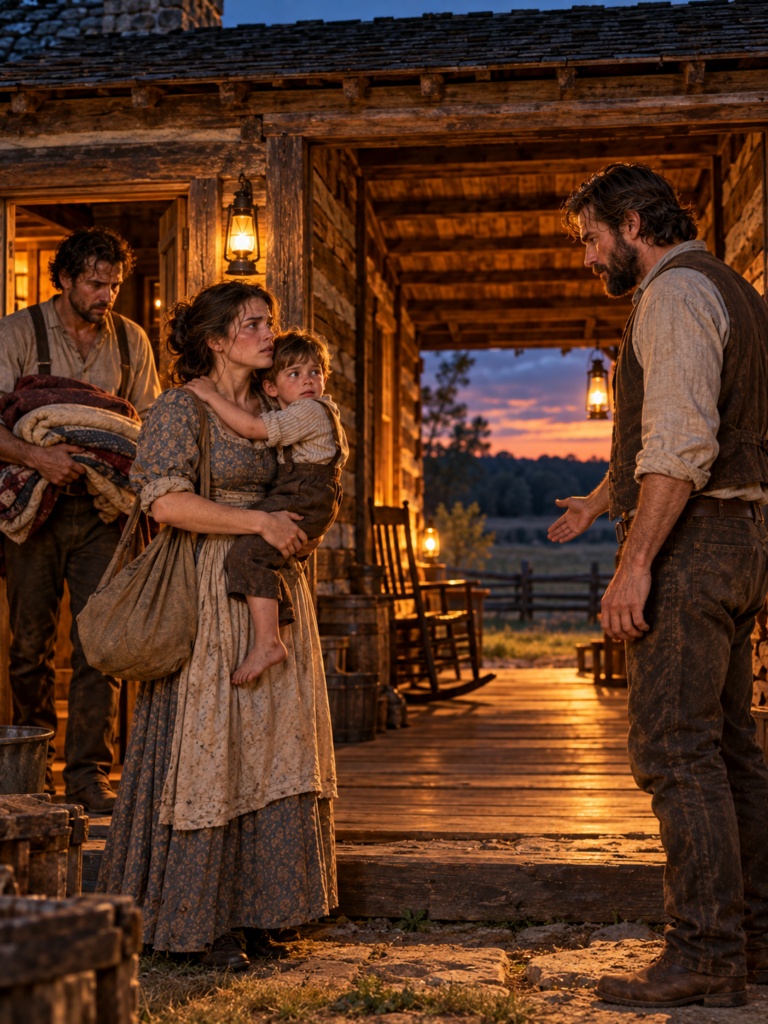
Samuel pulled the cot across the wooden floor, clearing a broad space in the middle of the passage.
Thomas set down the blankets and reached to help.
The boards were still warm beneath their boots, but a small movement of air passed between the open ends of the house.
Thomas’s wife felt it against her face.
“Here,” she said quietly.
She knelt and spread the first blanket where the breeze was strongest.
Their son clung to her dress until she settled beside him. His cheeks were flushed, and his hair lay damp against his forehead.
Samuel brought a cup of water.
“He’s been drinking?” he asked.
“Some,” she answered. “Not as much as usual.”
Samuel nodded. He made no claim that the passage could cure anything. It was simply a place where the boy might rest more comfortably.
His wife came from the western room with another folded covering.
Thomas looked between them.
“You don’t mind us taking up your floor?”
Samuel glanced around the broad passage.
“Floor’s here to be used.”
Thomas lowered himself onto one of the posts’ wooden supports.
He had spent months insisting that this space was useless.
Now he watched his wife arrange a bed upon it.
The contradiction troubled him more than any argument Samuel might have offered.
Beyond the house, the dark field lay almost motionless.
The night was still hot.
There was no miracle hidden in the timber.
But when a breeze finally traveled across the grass, nothing blocked its journey through the center of Samuel’s home.
The child stirred.
His mother placed a hand against his shoulder.
Slowly, his breathing settled.
Thomas looked toward Samuel.
“Did you know it would work this well?”
“I knew it might help.”
“That’s not the same thing.”
“No,” Samuel agreed. “It isn’t.”
The answer surprised Thomas.
He had expected triumph.
Perhaps a speech about the foolishness of neighbors.
Instead, Samuel checked the outer windows of the western room, leaving them open where the night air could pass.
Thomas watched him.
“You went to all this trouble for a possibility?”
Samuel rested a hand on the doorframe.
“I’d seen a house like this before.”
“Where?”
“Farther south. Years ago, when I traveled with a timber crew.”
Thomas looked through the passage.
“So it wasn’t your notion?”
“Not originally.”
Samuel explained how the two rooms had stood beneath a shared roof, with a shaded opening between them.
He remembered sitting there during the hottest part of the day and discovering that the open space was more comfortable than the rooms on either side.
At the time, he too had thought the builders had left something unfinished.
Thomas almost smiled.
“Then you once thought just as I did.”
“Near enough.”
“What changed your mind?”
Samuel was quiet.
From the blankets came the soft sound of the little boy breathing in sleep.
Samuel looked toward the western room.
“My wife had a hard summer once.”
Thomas knew she had been ill, but Samuel had seldom spoken of those nights.
“The old cabin was dreadful in the heat,” Samuel continued. “We tried sleeping inside. Then on the porch. Then outside altogether.”
“Was the cabin making her sick?”
“I don’t know. I never did.”
He glanced at Thomas.
“But I knew it wasn’t helping her rest.”
Thomas looked down at his hands.
The two men had worked neighboring farms for years, yet Samuel had never told him what lay behind those empty twelve feet.
Thomas’s wife lifted her sleeping son’s head and settled him more comfortably.
“Could we stay until morning?” she asked.
Samuel answered without hesitation.
“Of course.”
Thomas opened his mouth, then shut it again.
He wanted to apologize, but the words felt painfully inadequate while his family lay beneath the roof he had mocked.
So he rose to help Samuel shift the remaining furniture farther from the blankets.
A stronger breeze crossed the floor.
The sleeping boy did not wake.
His mother closed her eyes.
Thomas stood at the edge of the passage, staring into the darkness.
He had come seeking relief for one night.
But he was beginning to understand that the trouble awaiting him tomorrow had not changed.
His own house would still be standing exactly as before.
Its walls would still hold the afternoon heat.
And his family would have to return to it.
He turned toward Samuel, then looked back at the blankets.
Finally, Thomas reached for the empty chair beside the open passage and dragged it into the moving air, beginning the conversation he had avoided since spring.
The chair scraped over the wooden boards.
Thomas placed it near the edge of the passage, where he could watch his sleeping family without disturbing them.
Samuel remained standing beside the western doorway.
For a while neither man spoke.
Outside, the fields were dark. The air was warm enough that Thomas’s shirt clung to his back, but now and then a faint breeze passed beneath the roof.
Thomas studied the empty opening.
“I ought to have listened to you.”
Samuel lowered himself into the other chair.
“You listened.”
“I laughed.”
“That too.”
Thomas gave a tired smile.
Then he looked toward his son.
“He’s slept more in these few minutes than he did most of last night.”
Samuel followed his gaze.
The boy’s mother had settled beside him, one arm resting protectively near his shoulder.
“Glad of it,” Samuel said.
Thomas rubbed his palms together.
“I kept telling myself every house gets hot in August. Mine did when I was young. My father’s did before that. Figured it was simply something a body endured.”
“Most of us figured the same.”
“But you didn’t.”
“Not after that summer with my wife.”
Thomas considered the two rooms standing on either side of them.
The western room had its doorway opening into the passage. The eastern room did too. Windows in the outside walls could be opened when conditions allowed.
Nothing about the arrangement seemed especially complicated.
That bothered him.
He had spent his life working around buildings and had missed something that now appeared almost plain.
“You really built the whole place around this opening?”
“That was the intention.”
“Even though you needed another room?”
Samuel looked toward the eastern chamber.
“I needed storage and a place to work. I’ve got both.”
“You could’ve had twice as much covered space.”
“Twice as much enclosed space,” Samuel corrected gently.
Thomas looked at him.
Samuel continued.
“There’s a difference.”
The words stayed with Thomas.
He glanced at the blankets, the cot, the chairs, and the tools stacked near the eastern wall.
The passage was not empty anymore.
It had not truly been empty even before his family arrived.
The trouble was that Thomas had been looking for value in the wrong form.
***
Morning came with pale light spilling across the fields.
Thomas’s son woke more rested than he had been in days.
His mother sat beside him as he drank water.
The child was still tired from the oppressive weather, but the calmer night had given the family some relief.
Thomas thanked Samuel’s wife first.
She had helped arrange the bedding and made certain the visitors were comfortable.
Then he approached Samuel, who was checking a tool near the eastern room.
“I owe you an apology.”
Samuel continued examining the handle.
“For what?”
“For telling half the countryside you’d built a house without knowing how.”
Samuel looked up.
“You weren’t the only one.”
“Doesn’t make it right.”
“No.”
Thomas waited.
Samuel set the tool aside.
“Apology accepted.”
The simplicity of it left Thomas with nothing else to defend.
He returned home with his wife and son later that morning.
By noon, the cabin was oppressive again.
Thomas opened the door.
He opened the small windows.
He stood outside and felt a passing breeze move across his arms.
Then he walked inside.
The air felt heavier.
He stepped back outside and looked toward Samuel’s farm.
For the first time, he saw his own walls differently.
They kept out rain.
They protected the household in winter.
They offered privacy and security.
But they also interrupted the movement of air.
His cabin had been built to close the world out.
Samuel’s had been built to allow part of the world through.
Thomas could not rebuild his house overnight.
Nor would he claim Samuel’s design was perfect for every season.
But he understood now why the open passage mattered.
And understanding made the coming afternoons more difficult to ignore.
***
During the following days, Thomas found himself returning to Samuel’s place.
Sometimes he carried a small repair.
Sometimes his wife came along.
Other times the entire family stayed through the hottest part of the evening.
They were not the only visitors.
Samuel’s sister arrived with her daughter.
An older neighbor whose cabin remained uncomfortable after sunset began making the journey when the heat was particularly severe.
Other families came to sit in the shade.
Samuel had not set out to build a neighborhood gathering place.
Yet his strange middle passage was becoming one.
In daylight, children gathered where the sun could not reach them directly.
There was room to sit without crowding either enclosed chamber.
Women sometimes sorted grain there.
Tools were repaired in the shade.
Meals could be carried into the passage, allowing the family to avoid sitting in the warmest room when the weather permitted.
The same few feet of floor served several purposes.
And because the passage remained open, heat was less likely to remain trapped there as it did within an enclosed room.
Thomas watched all this with increasing interest.
One afternoon, he arrived carrying a damaged box.
Samuel sat with him beneath the roof.
They turned the box upside down and began working on a loosened joint.
The day was fierce.
The field beyond the western opening shimmered beneath the sun.
Thomas wiped his brow.
“If you’d walled this up, it would be another room.”
Samuel held a board steady.
“Yes.”
“Could’ve stored things here.”
“Yes.”
“Could’ve slept here.”
Samuel glanced toward the shaded floor.
“We sleep here now.”
Thomas stopped working.
Samuel had spoken without raising his eyes.
Thomas looked across the passage.
The cot stood to one side.
A chair rested near the post.
Nothing prevented the breeze from moving through.
Thomas began laughing.
This time it was not at Samuel.
“You’ve a way of making a fellow feel slow.”
“Wasn’t my intention.”
“No. That’s the worst of it.”
They returned to repairing the box.
After a time, Thomas asked whether Samuel believed every family ought to build such a house.
Samuel shook his head.
“Depends on what a family’s building for.”
Thomas considered this.
“In winter, a passage like this would be cold.”
“Certainly.”
“Rain could blow through.”
“Sometimes.”
“Wind could come hard enough to make a trouble of it.”
“That’s why I made shutters and screens.”
Thomas looked up.
Samuel explained that removable barriers could help protect the open passage when severe weather approached.
The house still needed sound enclosed rooms for cold or dangerous conditions.
Its open center was not meant to replace their shelter.
It was meant to give the household another way of living when the weather made enclosed rooms unpleasant.
Thomas nodded slowly.
“So you haven’t built a house that’s always open.”
“I’ve built one that can be.”
The distinction appealed to him.
He began asking questions about the raised floor, the overhanging roof, and the positions of the doors.
Samuel answered what he could.
He did not pretend to be a scholar of buildings.
He was a farmer who had learned from another man’s house, from his own uncomfortable summers, and from the practical needs of his family.
But Thomas could see that each part of the arrangement served a purpose.
The roof shaded the passage.
The openings at either end allowed air to cross.
The doors joining the enclosed rooms to the middle offered additional ventilation.
The outer windows created possible routes for air through the rooms when a breeze was present.
It was simple.
Yet the simplicity had required Samuel to disregard almost everyone who offered an opinion.
***
The worst stretch of August continued.
Some nights brought almost no relief.
The warm air remained heavy long after sunset.
Samuel’s passage could not make the surrounding countryside cool.
On a still night, when there was no meaningful breeze, the open center remained warm.
Nobody who visited could mistake it for a cold cellar.
Yet it offered shade by day and a place exposed to any movement of night air.
That small difference became precious.
Thomas learned to recognize the sound of an approaching breeze.
A faint stirring in the grass.
A light rustle along the field edge.
Then a current moving beneath the roof.
He began to notice how people responded.
Shoulders relaxed.
Conversation resumed.
Children who had been irritable grew quieter.
An older neighbor moved his chair from one side of the passage to the other, seeking the strongest movement of air.
Samuel’s wife noticed how often visitors arrived carrying small tasks.
She smiled one afternoon as Thomas appeared with another tool handle.
“At this rate, Thomas, you’ll have repaired every piece of equipment on your farm.”
He looked embarrassed.
Samuel laughed.
“There’s a chair waiting.”
Thomas accepted the invitation.
He knew by then that nobody believed the broken handle was the whole reason for his visit.
***
Late in the season, a different kind of weather began to gather.
The sky darkened one afternoon.
Clouds built toward the southwest.
The air changed.
Thomas noticed the gusts before the rain arrived.
He was standing in Samuel’s passage when a strong wind swept across the yard.
Loose dust stirred beyond the house.
The familiar breeze had become something much harsher.
Thomas glanced toward the open end of the passage.
For the first time since he had begun appreciating the design, he felt a return of his original doubt.
The same opening that admitted welcome air would also admit driven rain.
And the roof above it might shelter them from falling water while doing little to stop spray blown sideways.
He watched Samuel put down his work.
“Now there’s the trouble with your house.”
Samuel followed his gaze.
“Could be, if we left it as it is.”
Thomas frowned.
Samuel walked toward the eastern room.
“Give me a hand.”
Together they brought out the heavy shutters and simple removable screens Samuel had prepared for such conditions.
Thomas stared at them.
“You made these before summer?”
“I knew weather wouldn’t always be pleasant.”
A gust struck the side of the building.
Samuel held one barrier in position.
Thomas took the other end.
They began fitting it into place.
The first heavy drops struck the earth beyond the raised floor.
Thomas looked toward the widening curtain of rain.
For months he had believed the missing walls were proof of carelessness.
Now he was helping Samuel protect the open passage without destroying the very opening that made it useful.
And as the wind pushed harder against the house, Thomas understood that the next few minutes would reveal whether Samuel had considered more than just the summer heat.
“Hold that end steady,” Samuel said.
Thomas planted his boots and gripped the wooden barrier as the first hard gust struck it.
The barrier shuddered against Thomas’s hands.
He tightened his grip while Samuel secured the opposite side.
Rain began sweeping across the yard.
The open passage, so welcoming during the hot afternoons, was suddenly exposed to wind strong enough to send spray beneath the roof.
Thomas leaned forward.
“Harder than I expected!”
Samuel checked the fastening.
“Keep it steady a moment.”
Together they settled the removable barrier into its proper position.
The wind continued to strike the house.
But the worst of the driven rain no longer had a completely unobstructed path through the central passage.
Samuel crossed to the other side and adjusted the remaining protection where it was needed.
Thomas followed, helping him secure the fittings.
Neither man imagined they could seal the entire opening like an enclosed room.
That had never been the purpose of the design.
The barriers reduced exposure.
The enclosed rooms remained available when the weather demanded greater shelter.
And the open passage could return to its ordinary use when conditions improved.
Once the work was finished, the men stepped into the western room.
Rain rattled on the roof.
Thomas stood near the doorway, looking across the partly protected center of the building.
Samuel’s wife had already seen that the household’s belongings were clear of the exposed edges.
She looked toward her husband.
“Will it hold?”
“Should do well enough for this weather.”
Thomas watched the rain for a moment.
Then he turned.
“You expected this.”
Samuel shrugged.
“I expected the weather to change.”
“But you didn’t put up permanent walls.”
“No.”
Thomas glanced back at the opening.
“Because then you’d lose the passage.”
Samuel nodded.
And there, with rain pushing across the fields and wind moving around the house, Thomas finally understood the design more fully than he had on any hot afternoon.
Samuel had not simply built a house for pleasant weather.
He had built a house with different ways to respond to changing weather.
Its enclosed rooms provided shelter.
Its broad covered center provided shade and ventilation.
Its removable barriers helped manage exposure when stronger conditions arrived.
The design was not perfect.
No building could offer every advantage without compromise.
But it was thoughtful.
And the compromise Samuel had chosen was deliberate.
Thomas looked toward his neighbor.
“Suppose I’d told you to close it up this spring, and you’d listened.”
Samuel gave him a brief glance.
“Would’ve been another room.”
“Would’ve been a mighty hot one.”
“Likely.”
Thomas smiled faintly.
Then he grew serious.
“I thought you were building wrong because you weren’t building the way I knew.”
Samuel did not rush to comfort him.
The rain continued striking the roof.
At last he said, “I thought the same when I first saw a place like this.”
Thomas turned.
“You did?”
Samuel nodded.
“I told you I’d seen the design farther south. But I didn’t tell you how foolish I thought it looked.”
For the first time, Thomas heard the full story of Samuel’s first encounter with the unusual house.
Years before, traveling with a timber-cutting crew, Samuel had stopped at buildings where two separate log rooms stood beneath a shared roof.
He had assumed, as Thomas later would, that the builders had failed to complete the middle.
Then someone had invited him to sit in the shaded passage during the hottest part of the day.
He remembered the surprise of feeling moving air beneath the roof.
The room beside him had been warm.
The space between the rooms was more comfortable.
It was not a mysterious trick.
It was the arrangement of the building itself.
The roof kept direct sunlight off the passage.
The open ends allowed the breeze to pass across it.
And the doors opening from the side rooms gave that air additional ways to circulate.
Samuel had gone home remembering the lesson.
But remembering was not the same as having reason to act.
That reason came later.
***
The rain eased before nightfall.
The men removed the barriers when conditions permitted, leaving the middle passage open once more.
Water dripped from the roof edges.
The ground beyond the house smelled of wet earth.
Thomas stood beneath the covered center and watched the last clouds move away.
The air had changed.
He looked around him.
A few hours earlier, the passage had been a shaded place to work.
During the storm, it had required protection.
Now it stood ready to welcome the evening air again.
Thomas rested his palm against one of the supporting posts.
“There’s something I’ve been wondering.”
Samuel waited.
“After your wife took sick that summer, did you decide straightaway to build this kind of house?”
“Not straightaway.”
Samuel glanced toward the western room.
“For a while, all I could think about was getting through the days.”
He had never been a man who enjoyed making much of his own troubles.
Yet Thomas had earned a fuller answer.
“The old cabin held heat something fierce. We’d open the door, open the windows, and hope the air would move. Some nights it did. Most nights there wasn’t enough.”
He remembered lifting bedding from the room when his wife could not settle.
He remembered carrying it onto the porch.
He remembered how even the ground beneath a tree seemed preferable to the stifling cabin.
And he remembered the helplessness of having built walls to protect someone, only to discover that those walls could also make ordinary summer discomfort worse.
“She recovered,” he said.
Thomas nodded.
He knew that part.
“But once she was well, I kept thinking about the next summer. And the one after that.”
Samuel looked along the passage.
“When I had the chance to build again, I didn’t want to make a larger copy of the same trouble.”
Thomas said nothing.
Samuel continued.
“I couldn’t change the heat. Couldn’t make July comfortable just by wishing. But I could remember a house I’d seen that made better use of whatever breeze there was.”
For Thomas, the meaning of the building changed once again.
He had viewed the passage as an eccentric construction choice.
Then as a clever shelter from summer discomfort.
Now he understood it as the result of a husband’s long memory.
Samuel had watched someone he loved suffer through miserable nights.
When the opportunity came to rebuild, he had allowed those memories to influence every stake he drove into the ground.
The house did not promise his wife freedom from illness.
It did not guarantee pleasant summers.
It offered something smaller, more honest, and perhaps more valuable.
A chance to rest in a shaded place when the enclosed rooms became uncomfortable.
A way to welcome the breeze instead of obstructing it.
A little more choice over where to spend the hardest hours.
Thomas looked down.
“I wish I’d known.”
Samuel answered mildly.
“You knew enough to see what I was building.”
“I saw the gap.”
“That’s what everybody saw.”
Thomas lifted his eyes toward the open field.
“But I never asked why you wanted it.”
Samuel considered that.
Then he smiled.
“Well, you know now.”
***
By September, the fiercest heat began to ease.
The farms returned gradually to familiar routines.
Children slept more comfortably.
Families spent less time searching for relief after sunset.
Thomas no longer needed to carry blankets across the fields in the evening.
But the weeks at Samuel’s house had changed more than his opinion of one building.
He had begun to examine the meaning of good shelter.
Before that summer, he had measured houses largely by what they kept out.
Rain.
Cold.
Wind.
Strangers.
He still valued those things.
A frontier family needed solid walls and a dependable roof. Thomas would never argue otherwise.
Yet he had learned that a house could also become uncomfortable because of what it kept from entering.
Air.
Light.
The possibility of using a shaded space without enclosing it.
At home, he began noticing how the breeze moved around his own cabin.
He stood beside an open window and watched the leaves stir outside.
He considered the direction of the afternoon sun.
He thought about where a second opening might help air move through.
He examined the ground beside his house, where there was room for another structure.
For a man who had spent years giving advice about cabins, these new observations were humbling.
His wife noticed.
One evening she found him standing outside, studying the side of their home.
“What are you looking at?”
“The way the air comes across this ground.”
She followed his gaze.
“It always comes across there.”
“I know.”
“Then why are you staring at it like you’ve never seen it?”
Thomas smiled.
“Because I don’t believe I’ve ever thought about what happens to it when it reaches the house.”
She looked toward Samuel’s farm.
Then back at her husband.
“You’ve been thinking about that passage.”
“For some time.”
She considered the empty ground.
“There’s room for another building there, should we need one.”
Thomas nodded.
“And room between them.”
His wife looked at him with quiet amusement.
“Now you’re beginning to sound like Samuel.”
Thomas accepted the remark.
He had earned it.
But he was not interested in copying Samuel’s house simply to prove his change of heart.
The neighboring family had its own needs.
Their cabin had a different arrangement.
Their resources remained limited.
Whatever improvements Thomas made would have to suit the land, the household, and the work he could reasonably accomplish.
Still, he had learned an idea worth keeping.
***
That winter, the lessons of the summer did not disappear.
Samuel’s family continued using the enclosed rooms when cold weather made the passage less inviting.
The open center remained part of the building, but it was no longer the household’s favorite resting place every hour of the day.
Thomas noticed that too.
He had once imagined a proper house as something that ought to perform the same way at all times.
Now he understood that different seasons demanded different use.
A shaded passage could be valuable in July.
A sound enclosed room could be essential in January.
The useful question was not which arrangement was universally better.
It was which arrangement offered the family what it needed when the conditions changed.
Samuel’s house had both.
And because its passage was not permanently walled in, the household could use it differently as circumstances allowed.
By the following spring, Thomas had made his decision.
He would add a room beside his existing cabin.
But he would not attach it in the ordinary way.
He planned a broad covered opening between the old structure and the new one.
A place sheltered from direct sun.
A place through which air could move.
A space that might serve for work, rest, or ordinary family activity without becoming another enclosed room.
He began marking out the ground.
Samuel came over to see the preparations.
Thomas watched his neighbor examine the stakes.
For a moment, neither spoke.
Then Samuel measured the space between them with his eyes.
“Leaving yourself a little room?”
Thomas grinned.
“More than a little.”
“What’s it for?”
Thomas looked toward the field.
“Air.”
Samuel began laughing.
Thomas joined him.
They stood together on the ground where another covered passage would soon take shape.
It was a laughter entirely different from the laughter of the previous spring.
This time neither man was mocking the other.
They were laughing because both remembered how unlikely the idea had once seemed.
***
The work progressed as Thomas had the time and materials.
He did not reconstruct his entire home.
Instead, he adapted the principle Samuel had demonstrated.
The new room stood apart from the original cabin.
A common covered section connected them.
The middle remained open enough to allow air to travel through.
Thomas considered how the opening would be used and how it could be protected when necessary.
He remembered the evening he had helped Samuel secure the storm barriers.
He remembered his son sleeping beneath the open roof.
He remembered the long August nights when even a modest breeze had seemed precious.
Those memories gave meaning to every practical decision.
Samuel offered advice where it was useful.
But he did not act as though the idea belonged to him.
He had learned it from buildings encountered during his travels.
Others had used similar arrangements before him.
And Thomas, in turn, was adapting it for his own family.
The knowledge moved from one household to another through observation, work, and experience.
No grand invention was required.
Only the willingness to notice what was already useful.
When Thomas’s new passage was finally covered, he walked beneath it for the first time.
The roof shaded the ground.
Air moved across the opening.
He stood still.
Then he looked toward his wife.
“Well?”
She stepped beside him and felt the breeze.
A small smile appeared.
“I believe we’ll get some use from this.”
Thomas looked along the passage.
He could almost hear his own voice from the previous spring.
*Where are you putting the middle wall?*
He shook his head.
“I believe we will.”
***
There was nothing supernatural about the arrangement Samuel had built.
It did not cool the air below the surrounding outdoor temperature by some secret mechanism.
It did not guarantee comfort on a completely still afternoon.
It could be vulnerable to wind-driven rain.
It required sensible sheltering arrangements when weather became severe.
And the cost of giving so much covered space to an open passage was real.
A family choosing such a design gave up the chance to enclose that area as another conventional room.
Thomas had been right about that trade-off.
Where he had been wrong was in assuming that enclosed floor space was the only valuable kind.
The shaded passage could serve several purposes.
It provided an area for sitting and repairing tools.
It allowed ordinary household activities to take place beneath a roof without trapping as much heat as an enclosed room.
It offered sleeping space during oppressive evenings.
And it could help improve air movement through the adjoining rooms when doors and windows were properly opened and a breeze was available.
For a household in a hot climate, those benefits could be worth the sacrifice.
Samuel had understood them well enough to put his limited resources behind the idea.
His neighbors needed a summer of uncomfortable weather to appreciate the same thing.
In other parts of the South and across the expanding American frontier, similar houses were already familiar.
The arrangement would become widely associated with a plainspoken name: the dogtrot house.
Two enclosed sections.
One roof.
An open central passage.
Some were constructed in a single project.
Others developed gradually, as a second cabin was raised near an existing one and the two were connected beneath a roof.
Their details varied.
Some passages were broader than others.
Some roofs extended farther beyond the rooms.
Some houses included porches, additional rooms, or other features suited to the families who occupied them.
But the central principle remained recognizable.
The building used shade and moving air as part of its design.
It made an open space useful rather than treating every gap as unfinished construction.
Over time, some owners enclosed those passages.
Their reasons were understandable.
Another room could offer storage, privacy, or protection from changing conditions.
But enclosing the opening also changed the way the house worked.
What had once been an uninterrupted route for outdoor air became an interior space.
The very quality that made the passage valuable in summer could be lost.
Samuel had understood that trade-off when he refused to place walls between his two rooms.
He was not a trained architect.
He had not invented the dogtrot house.
He did not calculate airflow with instruments or claim to possess unusual knowledge.
He had simply remembered how another family had built, compared that arrangement with his own experience, and made a deliberate choice.
That choice had seemed foolish to men who measured a home by the space it enclosed.
Then summer came.
And those same men discovered why the open space mattered.
***
Another warm season returned to Middle Tennessee.
The fields turned green.
The corn began growing.
Work filled the mornings, and the sun drew families toward shade during the hottest hours.
Samuel still kept his tools near the eastern room.
His wife still used the western room as the center of their household life.
And the twelve-foot passage still lay between them, open beneath its continuous roof.
One afternoon Thomas came walking from the east.
He carried a tool needing attention, though both men knew the repair could have been done at home.
Samuel sat in the shade.
Thomas stopped at the edge of the passage.
“Mind if I come through?”
Samuel gestured toward the empty chair.
“Wouldn’t have left it open otherwise.”
Thomas stepped inside.
A breeze moved across the floor.
He set down his tool and took his seat.
For a while they worked without speaking.
The afternoon was warm.
Beyond the roof, sunlight lay bright across the field.
Thomas glanced toward the western doorway.
He remembered the night his wife had stood there carrying their exhausted boy.
He remembered her relief when the child finally slept.
He remembered Samuel making room without a single word about the ridicule he had endured.
Thomas picked up the tool again.
“Funny thing,” he said.
Samuel looked over.
“What’s that?”
“Last spring, I thought the best part of your house was the part you hadn’t finished.”
Samuel smiled.
“And now?”
Thomas looked straight through the middle of the building toward the field beyond.
“Now I reckon it’s the part you had the good sense to leave alone.”
Samuel returned to his work.
Neither man needed to say more.
The roof cast its shade.
The open ends welcomed the faint breeze.
And in the middle of the house, where everyone had once insisted a wall should stand, there was room for people to gather, work, rest, and breathe.
Samuel Reed had never forgotten to finish his home.
He had simply understood that sometimes the most useful part of a house was the space a wiser builder chose not to close.