His fingers closed around the revolver as another horse’s hoofbeats sounded beyond the bend.
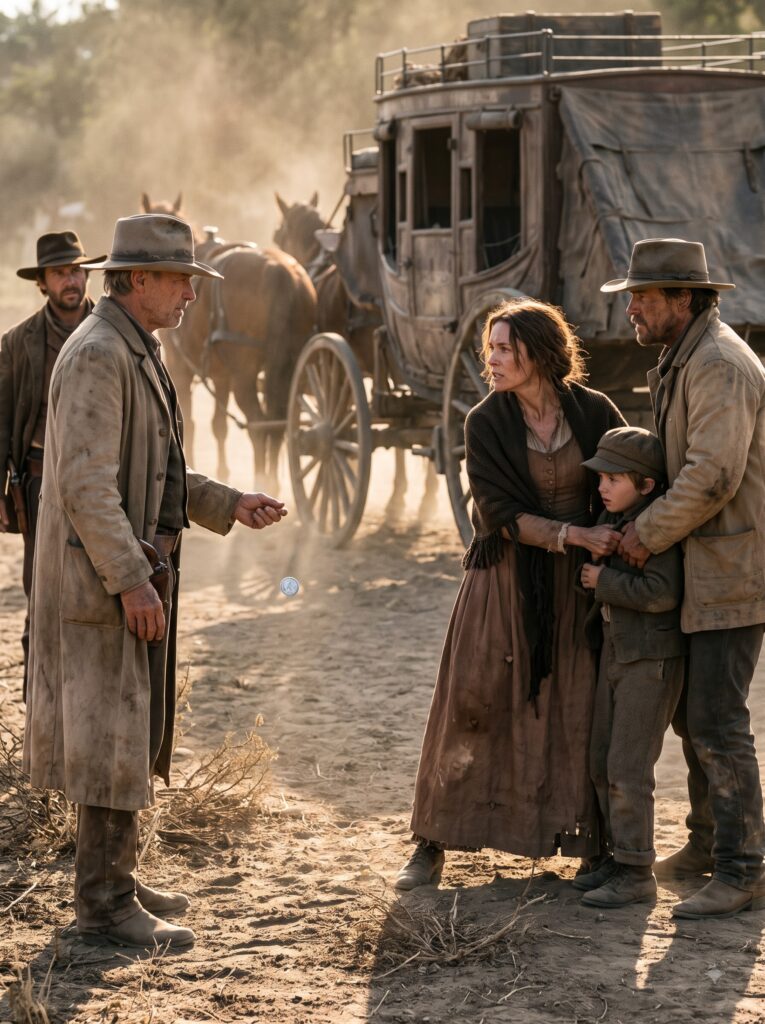
Josie pulled Ben against her.
“Get behind the rocks,” the stranger said.
She moved without arguing, but kept her pistol ready. The rider approaching was the stagecoach driver.
He came at an uneven gallop, stopped a short distance away, and nearly fell from his saddle.
“They turned back,” he gasped. “Voss and his men. They’re cutting across the lower trail.”
The stranger lowered his weapon.
“How far?”
“Maybe twenty minutes behind me.”
Josie’s stomach tightened.
The men who had walked away were mounted again. Either they had recovered their horses or found replacements.
The driver looked toward Ben.
“There’s another thing. They knew the boy’s name before anybody said it.”
Josie felt her son grip her coat.
The stranger’s expression changed.
“Who told them?”
“Don’t know.”
The driver looked frightened enough to be telling the truth.
The stranger thanked him and sent him toward Silver Creek.
Then he turned to Josie.
“We need higher ground. A narrow trail where three horses can’t ride abreast.”
“Your horse is lame.”
“Bruised. He can walk if I don’t rush him.”
“Then Ben and I walk too.”
The stranger looked at the boy’s dusty boots.
“It’ll be hard country.”
“He’s walked hard country before.”
Ben lifted his chin.
“I can keep up.”
Something almost gentle entered the stranger’s eyes.
“I believe you.”
They followed an ascending trail between sandstone ridges.
For the first hour, Josie concentrated on keeping Ben’s steps steady.
The stranger walked ahead, leading his horse and looking back often.
At a shallow creek he stopped to let the animal drink.
Josie filled their canteen.
She noticed him studying the trail behind them.
“Tell me something,” she said. “Did you help us because of Deacon?”
“Yes.”
“Then this isn’t really about my husband’s survey.”
“It is now.”
She straightened.
“That isn’t good enough.”
He looked at her for a long moment.
“Deacon murdered my father twenty years ago. I was sixteen. I watched him do it.”
Ben had gone still beside the creek.
Josie’s voice softened.
“I’m sorry.”
“Don’t be. My father had done things worth answering for. Being shot in the back wasn’t one of them.”
He checked the horse’s hoof, then stood.
“That’s all I can tell you tonight.”
Josie disliked the answer, but understood the boundary.
“Then I have one of my own. You don’t decide what danger my son and I can bear without telling us.”
“Fair.”
“And you don’t use us to settle your account with Deacon.”
He met her eyes.
“I won’t.”
For a few seconds neither moved.
Then Ben spoke.
“Ma, he’s bleeding.”
The stranger looked down.
A thin red line had soaked through his sleeve.
One of the bullets on the road had grazed his upper arm.
“You said nobody hit you,” Josie said.
“Nobody asked.”
“Sit down.”
He looked surprised.
She pointed to a flat rock.
“Now.”
He obeyed.
Josie opened her bag, took out clean cloth, and examined the shallow wound.
Thomas had taught her enough about injuries during his survey journeys to know it needed washing and binding.
The stranger watched her hands.
“You’re practiced.”
“My husband worked miles from a doctor. Someone had to learn.”
Her voice did not break this time.
She rinsed the cut with clean water and bound it firmly.
For the first time since the stagecoach, the man seemed uncertain what to say.
“Thank you.”
“You’re welcome.”
Ben offered him the silver dollar.
“For luck.”
The stranger shook his head.
“Keep it.”
Then he heard something.
He turned toward the ridge.
A distant column of dust rose beyond the sandstone.
Three riders.
Deacon had found the trail.
The stranger stood, tested his wounded arm, and led his horse toward a narrow cut between the rocks.
“We can reach Silver Creek before dark,” he said. “But they’ll be watching the town.”
Josie studied the steep passage, then looked toward her son.
She knew what remaining on the open trail meant.
She also knew the man beside her had spent twenty years carrying a burden he refused to explain.
She tightened Ben’s coat, took the horse’s reins so the stranger could keep his injured arm free, and stepped toward the narrow passage.
“Then we take the rocks.”
Josie guided the horse into the narrow passage, feeling the reins tighten as the animal hesitated before the uneven stone.
“Easy, Scout,” she murmured.
The horse followed.
Behind her, the stranger watched the ridge while Ben climbed ahead, choosing footholds between patches of loose gravel.
“There’s a ledge on your left,” the man called softly. “Keep the horse close to the wall.”
Josie glanced back.
“You know this country?”
“Enough to stay alive in it.”
“That doesn’t answer much.”
“No, ma’am.”
Despite everything, she nearly smiled.
They climbed until the trail widened beneath a sheltering overhang. From there they could see the route below.
Three riders emerged from the dust.
Deacon Voss rode at their center.
Even from that distance, Josie recognized the way he held his shoulders, relaxed as though pursuing a woman and child were no more troublesome than collecting a debt.
The stranger crouched beside Ben.
“See that shelf of rock above the trail?”
Ben nodded.
“Stay behind it with your mother. Don’t stand where somebody below can see you against the sky.”
“Are we going to fight?”
“Not if we can help it.”
Josie studied his face.
“You could shoot them from here.”
“Probably.”
“Why won’t you?”
“Because your husband didn’t die so somebody could win a gunfight. He died because of what he knew.”
The answer unsettled her.
This man knew Deacon. Hated him, perhaps.
Yet he understood that the evidence mattered more than revenge.
They waited until the riders passed below and disappeared toward another branch of the trail.
Only then did the stranger rise.
“Silver Creek’s three hours from here, allowing for Scout’s foot. We can rest there, but we shouldn’t linger.”
Josie took Ben’s hand.
“Then we’d best start walking.”
***
They reached Silver Creek with the last sunlight catching the tops of its modest wooden buildings.
Ben had stopped complaining about his feet an hour earlier. That worried Josie more than the complaints would have.
She knelt beside him.
“Tell me the truth.”
“I’m tired.”
“Anything else?”
“Hungry.”
“That makes two of us.”
The stranger pointed toward a boardinghouse near the end of the street.
“Food and a room. I’ll see who’s asking questions.”
Josie caught his sleeve.
“You’re leaving us?”
“For an hour, if I can manage it.”
“What’s to stop you from disappearing?”
“Nothing.”
She studied him.
A man who lied easily would have offered a grander promise.
“Then I suppose we’ll see.”
He nodded toward Ben.
“Get him fed.”
At the boardinghouse, Josie paid for supper and a small room from her remaining money.
Ben ate beans, bread, and nearly everything she left on her plate.
While he ate, she examined Thomas’s field book.
The pages were crowded with measurements, elevations, and careful drawings.
She knew the marks.
She had spent evenings listening to her husband explain how a proposed line could be moved on paper without moving a single stone in the ground.
Thomas had believed that careful records protected honest people.
The railroad had taught her otherwise.
She closed the book when the boardinghouse keeper approached.
“That your husband’s work?”
“Yes.”
“Surveyor?”
Josie nodded.
The older woman looked toward the street.
“Then keep it close. Two strangers were asking about a surveyor’s widow this afternoon.”
Josie’s hand tightened over the cover.
“Did you tell them anything?”
“I told them rooms cost extra for men who ask too many questions.”
For the first time that day, Josie felt gratitude toward someone who had no reason to help her.
***
Across town, the stranger stood at a saloon counter.
“Whiskey,” he told the barkeeper.
The drink remained untouched.
“Stagecoach came through yesterday?” he asked.
“Empty,” the barkeeper answered. “Driver said he’d never seen a woman aboard.”
The stranger nodded.
Good.
At least one man knew how to keep quiet.
Then a voice behind him said, “Twenty years is a long time to run, boy.”
He didn’t turn.
Deacon Voss sat at a corner table.
His hat rested beside a clean glass.
“You used to be quicker,” Deacon said.
The stranger finally faced him.
“And you used to have better company.”
Deacon chuckled.
“You remember San Lucas?”
The room seemed to grow quieter.
“Of course you do,” Deacon continued. “Your daddy made quite a name for himself.”
“Leave him buried.”
“Sonora Kid. Fastest thief south of the border, according to some.”
The stranger’s jaw tightened.
Deacon leaned forward.
“And his little boy holding the horses while a bank teller got himself killed.”
The stranger said nothing.
“Does your widow know that story?”
“Stay away from her.”
Deacon smiled.
“Five thousand dollars says I won’t.”
***
Josie found the stranger outside the boardinghouse after Ben had fallen asleep.
He stood beneath the porch roof, looking across the street.
“Deacon is here,” she said.
“I know.”
“He came to speak with me.”
The stranger turned sharply.
“Did he touch you?”
“No.”
“What did he say?”
“That your father was the Sonora Kid.”
His face closed.
“That’s true.”
“That you rode with him.”
“Also true.”
“And that a bank teller died while you held the horses.”
He looked away.
“Yes.”
Josie felt a terrible disappointment settling into the place where trust had begun.
“Why didn’t you tell me?”
“Because I knew what you’d think.”
“Then you knew I deserved to hear it.”
He accepted that without argument.
She stepped back.
“Did you know about the reward before you found us?”
“Not until Deacon named it.”
“Have you considered collecting it?”
“No.”
“How am I supposed to believe you?”
He looked at the boardinghouse door, then back at her.
“By watching what I do. Not by trusting what I say.”
Josie shook her head.
“That may not be enough.”
“I understand.”
He took several coins from his pocket and placed them on the porch rail.
“For the room and breakfast. No debt attached.”
“I didn’t ask for charity.”
“It isn’t charity. I made the road harder when I chose to interfere.”
“And I chose to follow.”
“Then we’re both responsible for getting you to Denver.”
His refusal to defend himself angered her almost as much as the secret.
She wanted a villain she could recognize.
Instead, she had a man who admitted the worst accusation and still offered her the freedom to walk away.
“Ben and I may take the morning stage,” she said.
“That’s your decision. But Culver Pass is where Deacon will look first.”
“Perhaps he’s expecting us to stay with you.”
“Perhaps.”
Josie turned toward the door.
“Good night.”
“Good night, Mrs. Carver.”
She paused.
“You know my name.”
“Yes.”
“I still don’t know yours.”
For a moment she thought he might finally answer.
Instead, he lowered his eyes.
“Not yet.”
***
Near midnight, Ben woke her.
“Ma. Listen.”
Something scraped outside the room.
Josie reached for the pistol beneath her pillow.
The door opened before she could rise.
Deacon’s men came through with their weapons drawn.
“Easy, Mrs. Carver,” one whispered. “The boy comes too.”
Josie raised her pistol.
But the man nearest Ben had already seized his collar.
She froze.
“Put that away,” he said.
Her eyes moved from the revolver to her son’s terrified face.
She slowly lowered the weapon.
They searched her bag.
Found Thomas’s field book.
And dragged both mother and child into the night.
***
Deacon waited beside a freight platform beyond the last occupied buildings.
A lantern burned near stacked railroad supplies.
He took the field book from his men.
“Thomas Carver,” he said, turning the pages. “A careful fellow.”
Josie stood between two guards with Ben pressed against her.
“That book belongs to my husband.”
“Your husband isn’t here to complain.”
Deacon carried it toward the lantern.
“You wanted the law to read his notes. A touching idea.”
He pulled several pages loose.
Josie struggled forward.
“No!”
One guard restrained her.
Deacon touched the pages to the flame.
They caught immediately.
“Three days, Mrs. Carver,” he said. “That’s all that’s left before Pell gets his signatures.”
He held the remaining book above the fire.
Josie watched Thomas’s handwriting curl into black fragments.
For an instant she was back in their little house, listening to his pencil scratch across paper while Ben slept.
Every measurement had cost him days in the field.
Every line had been drawn carefully.
Now the work was becoming ash.
Deacon dropped the book.
“By the time the hearing begins, you’ll be sitting in the county jail on a theft charge.”
“You won’t get away with this.”
He gave her a pitying smile.
“Mrs. Carver, men with money arrange the truth before honest folks arrive to tell it.”
Then he looked at Ben.
“And we’ll keep the little fellow comfortable until his escort comes looking.”
Josie understood.
They were not simply prisoners.
They were bait.
Deacon didn’t care whether the gunslinger came for the money, the widow, or the boy.
He wanted the son of the Sonora Kid to come.
***
Ben was the first to notice the empty place in their captors’ plan.
The men had searched his coat.
They had taken Josie’s pistol.
They had burned the field book.
But nobody had searched Scout’s saddle.
The horse stood tethered near the far end of the platform, where one of Deacon’s men had led him after finding him outside the boardinghouse.
Ben edged closer to his mother.
“Ma,” he whispered.
“Quiet.”
“The letter.”
She barely moved her lips.
“What about it?”
“It’s still where he put it.”
Before reaching town, the stranger had insisted they separate the evidence.
Josie had kept the field book.
Ben had watched him stitch Pell’s letter inside Scout’s saddle lining.
The boy’s eyes flickered toward the horse.
Josie squeezed his hand once.
Then she raised her chin and addressed Deacon.
“You burned a dead man’s work because you’re frightened of what it proves.”
Deacon laughed.
“I burned it because I could.”
“And Pell paid you to do it?”
“Careful, widow.”
She took a deliberate step forward.
“If my husband was lying, why kill him?”
The smile left Deacon’s face.
For one brief moment, Josie saw anger beneath the polished cruelty.
Then he turned away.
“Put them in the freight shed. The boy stays with her.”
As the guards moved them toward the building, Josie looked back at Scout.
One letter.
One surviving piece of proof.
And a gunslinger somewhere in the darkness who still did not know they had been taken.
She dug her heels into the earth and twisted toward Deacon.
“Before you lock that door, answer me one thing.”
He stopped.
“What?”
“Did Horace Pell order my husband’s death?”
Deacon’s eyes narrowed.
Then he smiled slowly.
“Ask me again when your escort gets here.”
Deacon’s smile remained fixed as Josie held his gaze.
“Then you know the answer,” she said.
“I know more than you ought to.”
He gestured toward the freight shed.
“Lock them up.”
The guard pushed Josie forward, but she turned in time to shield Ben from the rough wooden doorway.
Inside, the shed smelled of old grain, oil, and damp timber.
A narrow window overlooked the tracks.
The door closed.
A heavy bolt scraped into place.
Ben caught his mother’s hand.
“Are they going to kill us?”
Josie knelt before him.
She wanted to promise they wouldn’t.
But Thomas had taught her something about promises.
They mattered only when a person could keep them.
“I’m going to do everything I can to get us out,” she said.
Ben searched her face.
“Do you think he’ll come?”
The nameless stranger.
The man who had saved them twice, then allowed her to doubt him without demanding forgiveness.
“I don’t know, sweetheart.”
Ben looked down at the silver dollar in his palm.
“He said he’d help.”
Josie closed his fingers around it.
“Then we’ll do our part.”
She examined the room.
The boards near the floor were tight, but the small window had a loose lower fastening. Too narrow for her. Perhaps wide enough for Ben, if he could reach it.
Outside, railroad workers shouted to one another near a waiting locomotive.
Josie heard Deacon giving instructions.
“Keep the lantern clear of the powder.”
Powder.
She looked through a crack in the boards.
Several wooden crates stood beside the freight platform.
Deacon had placed his men around the railroad equipment.
This was no ordinary hiding place.
He was preparing for a fight.
And the stranger, wherever he was, would be walking into it.
***
Beyond the freight yard, the nameless gunslinger approached through the darkness.
He had discovered the empty boardinghouse room, the overturned washbasin, and Josie’s pistol beneath the bed where it had been kicked during the struggle.
The keeper had seen armed men leading a woman and child toward the tracks.
That was enough.
He moved along the outer buildings, staying beyond the lantern light.
Through a gap between freight cars he saw Scout tied near the platform.
Then he saw the shed.
One guard stood at its door.
Another watched the tracks.
And Deacon sat beneath a lantern with a revolver resting across his knee.
Waiting.
Just as he had waited twenty years earlier.
The stranger felt an old memory rise.
A small cantina.
Warm bread.
His father seated across a rough wooden table.
The sound of a pistol fired from behind.
He had carried that moment through every lonely mile since.
For years he had imagined finding Deacon with no witnesses and no reason to leave him alive.
Now a widow and a boy were trapped behind a wooden door.
The choice before him was simpler than revenge.
It was also harder.
He reached beneath his coat and checked his remaining ammunition.
Then he slipped into the freight yard.
***
Inside the shed, Josie lifted Ben toward the window.
“Can you reach the latch?”
He stretched.
“Almost.”
“Try once more.”
His fingers caught the metal hook.
It shifted.
Then the opening widened.
Cool night air brushed his face.
“You can get through,” Josie whispered.
“But what about you?”
“I need you to reach Scout.”
Ben looked terrified.
“Those men are out there.”
“I know. Listen carefully.”
She told him to wait until the guard moved away, slip behind the freight stacks, and untie the horse only when the way was clear.
“Don’t try to fight anyone. Don’t make a sound. Just get the horse to the far side of the shed.”
“What if I can’t?”
“Then hide until you can.”
He nodded, fighting tears.
Josie kissed his forehead.
“You’ve got your father’s good sense. Use it.”
She helped him through the narrow window.
For one terrible second his boot caught on the sill.
Then he dropped quietly into the shadows.
Josie lowered the window.
And began making as much noise as she dared.
“Guard!”
Boots approached.
“What now?”
“My boy’s sick. He needs water.”
“Sit down.”
“He’s a child!”
The guard swore and moved to the window.
Josie kept his attention on her while Ben crawled unseen toward the stacked freight.
Then a voice sounded from the tracks.
“Evening, Deacon.”
Josie’s heart stopped.
The gunslinger had come.
***
Deacon rose slowly.
There was pleasure in his expression.
“I wondered how long it’d take.”
The stranger stood between two freight cars, his wounded arm hanging close to his side.
“Let them go.”
“Not until we settle something.”
“We settled enough on the road.”
Deacon laughed.
“You’ve no notion what enough means.”
He took a step into the lantern light.
“Do you remember your daddy’s last supper?”
The stranger’s expression did not change.
Deacon seemed disappointed.
“I walked in behind him while he was cutting his bread. A thousand dollars for the Sonora Kid. That’s what they paid.”
“You shot him in the back.”
“Money spends the same.”
The stranger looked at the freight shed.
“Josie! Ben!”
“I’m here!” Josie cried.
Deacon lifted his revolver.
“Quiet, widow.”
The stranger’s hand moved.
A shot smashed the lantern above Deacon’s shoulder.
Darkness dropped across the platform.
Someone shouted.
A second shot struck the guard’s revolver as he tried to draw.
The stranger ran toward the shed.
Gunfire flashed between the freight cars.
He took cover behind a stack of railroad ties and called toward the locked door.
“Josie, move away from the entrance!”
She obeyed.
A moment later the bolt gave beneath a heavy blow.
The door swung open.
He stood in the gap, breathing hard.
“Where’s Ben?”
“Outside. I sent him to Scout.”
The stranger looked sharply toward the horse.
Then he nodded.
“Good thinking.”
Josie caught his sleeve.
“Deacon has powder by the platform.”
“I saw.”
“He means to kill you here.”
“He may try.”
She gripped his arm harder.
“Don’t you dare talk as though your life is already spent.”
For the first time that night, he truly looked at her.
Then a small voice called from the shadows.
“Ma!”
Ben appeared, leading Scout by the reins.
Josie ran to him.
The boy clung to her.
The stranger looked at the horse, then the child.
“You managed it.”
Ben nodded.
“Scout helped.”
“He’s a good horse.”
The stranger checked the saddle.
The hidden letter was still secure.
One piece of evidence remained.
One chance to save forty homesteads.
He turned toward the far end of the tracks.
“There’s a way out beyond the freight cars. Keep low.”
Josie looked back at the burning wreckage of the shattered lantern.
“What about Deacon?”
“He won’t stop looking.”
“Then we go together.”
The stranger hesitated.
She understood the look.
“You planned to stay behind.”
“I planned to give you time.”
“And leave us wondering whether you were alive?”
He said nothing.
Josie stepped closer.
“Thomas never got to come home. I’m not asking you to die proving you’re different from Deacon.”
Something moved behind his eyes.
An old certainty beginning to break.
Then he nodded.
“Together.”
***
They had nearly reached the end of the freight yard when Deacon emerged between the cars.
His revolver pointed toward Ben.
“That’s far enough.”
Josie pushed her son behind Scout.
The stranger stepped forward.
“Leave them out of this.”
“They’ve been in it since you interfered.”
Deacon smiled.
“You could’ve ridden away, boy.”
“So could you.”
For a moment, the two men stood facing one another in the darkness.
Then Deacon shifted his pistol toward Josie.
The stranger fired.
Deacon’s weapon flew from his hand.
He fell against a freight car, clutching his injured wrist.
Before another shot could follow, the stranger approached and kicked the revolver out of reach.
Deacon stared up at him.
“You’ve waited twenty years. Go on.”
The stranger held his weapon steady.
“You shot my father while he sat at supper.”
“He was an outlaw.”
“He was still facing away from you.”
Deacon spat into the dirt.
“And what were you? His little apprentice?”
The stranger’s hand tightened.
For a second, Josie feared he would shoot.
Then he lowered the revolver.
“I was sixteen,” he said. “I held the horses at San Lucas. A bank teller died because my father robbed that bank, and I helped him get there.”
The confession seemed to cost him more than any wound.
“I can’t change that.”
Deacon laughed weakly.
“No, you can’t.”
“But I can decide what kind of man stands here tonight.”
The stranger stepped back.
“I’m not shooting an unarmed man.”
He turned toward Josie.
“Get on Scout.”
Deacon’s voice followed him.
“You think a widow and her boy make you respectable?”
The stranger stopped.
Josie felt Ben’s hand tighten around hers.
The man turned only enough to answer.
“No. What I do is mine to answer for.”
Then they rode out of the freight yard, leaving Deacon wounded and alive.
***
By morning they had reached an abandoned line shack Thomas once used during his survey work.
The stranger’s arm had begun bleeding again.
Josie helped him down from Scout and guided him inside.
He tried to dismiss the injury.
She refused.
“Sit.”
“You’ve developed a habit of giving orders.”
“And you’ve developed a habit of needing them.”
He gave a tired half-smile.
She washed the wound and changed the bandage while Ben slept beneath a spare blanket.
The stranger watched her work.
“Thomas taught you this?”
“He taught me enough to know when a man is being stubborn.”
“Sounds like we might have gotten along.”
Josie paused.
“I think you would have.”
For a little while there was only the sound of water being poured into a basin.
Then she spoke.
“Tell me about your father.”
He looked at the wrapped arm.
“Most of what Deacon said was true.”
“Not all?”
“My father was called the Sonora Kid. He robbed banks and coaches. When I was eight, he taught me to draw a pistol. When I was sixteen, I rode with him for a season.”
“And San Lucas?”
“I held the horses.”
He took a breath.
“The bank teller reached for a gun. My father shot him.”
Josie continued wrapping the cloth.
“What did you do?”
“Rode away with him. Then left that night.”
“Why?”
“Because I’d seen the man fall. I knew his face would be the last thing I remembered if I stayed.”
The stranger looked toward the door.
“Two weeks later, my father sent word. Said he was finished with robbing. Wanted to meet.”
“The supper.”
He nodded.
“Deacon came in behind him. My father never saw him.”
Josie tied the final knot.
“And afterward?”
“I buried him beneath a mesquite tree.”
His voice was almost inaudible.
“My mother had made me a poncho before fever took her. I was wearing it that night. It’s one of the few things I’ve kept.”
Josie looked at the folded garment near his saddle.
“Your mother must have loved you.”
“She did.”
“Then I expect she’d be glad you lived long enough to become something other than what your father taught you.”
He looked at her.
“How can you know that?”
“Because I’m a mother.”
For a moment he had no answer.
Then he said, “I should’ve told you in Silver Creek.”
“Yes.”
“I was afraid you’d leave.”
“I nearly did.”
“I know.”
She sat beside him, leaving a little space between them.
“Trust isn’t a thing you can demand from someone. You have to give them the truth and let them decide what to do with it.”
He nodded slowly.
“Then there’s another truth.”
Josie waited.
“Deacon isn’t the only man responsible for Thomas’s death.”
She felt herself grow cold.
“Pell?”
“I believe so. Deacon said enough in town to make it plain he was working for him.”
“But believing isn’t proving.”
“No.”
Josie looked at the saddle.
“The letter is proof of the false survey. But not necessarily the killing.”
“Then we’ll need a witness.”
“Deacon will never testify against Pell.”
The stranger considered that.
“He might not have to be the one.”
***
The route to Denver was narrowing.
A storm had closed Culver Pass.
The ordinary wagon road could not get them through in time.
Only the railroad crossing above Culver Gorge remained.
Josie knew the place.
Thomas had worked there.
He had died on that stretch of line.
When she told the stranger, his face tightened.
“Deacon knows you’ll have to pass there.”
“Yes.”
“Then he’ll be waiting.”
“Perhaps.”
Josie looked toward Ben, still sleeping.
“We can turn back.”
“And the homesteads?”
“They’ll be signed away.”
She folded Thomas’s old scarf between her hands.
Forty families.
Her own land.
Her son’s future.
Everything Thomas had tried to protect.
Then she stood.
“We go.”
The stranger rose with difficulty.
“Josie, if you’re choosing this because of your husband—”
“I’m choosing it because he was right.”
He looked at her steadily.
She continued.
“Those families deserve their land. Ben deserves to know his father didn’t die for nothing. And I deserve to finish something without another man deciding whether I’m capable.”
The stranger bowed his head.
“Then I’ll ride beside you.”
***
They approached Culver Gorge the following evening.
The railroad trestle stretched across a deep cut in the mountains, its timbers dark against the fading light.
Below, water ran between broken stone.
Josie stopped near the place where Thomas had fallen.
She could not bring herself to speak.
The stranger dismounted.
He waited without touching her.
After a while, she drew a slow breath.
“This is where they found him.”
Ben looked down at the tracks.
“Papa was here?”
“Yes, darling.”
Josie held her son’s hand.
“He was trying to make sure families kept their homes.”
The stranger looked down the line.
Then his expression hardened.
Someone was standing at the far end of the trestle.
Deacon Voss.
His injured wrist was bound, but he carried another revolver in his left hand.
Two riders waited behind him.
“End of track,” Deacon called.
The stranger moved in front of Josie and Ben.
“Stay near the rocks,” he told them. “Keep hold of Scout.”
Josie caught his coat.
“Come back.”
He turned.
For the first time, she saw the full weight of what she had asked.
Not a promise to kill.
A promise to live.
“I’ll do what I can,” he said.
Then he stepped onto the approach to the trestle.
***
Deacon grinned when he saw him.
“Third time, boy.”
“I know.”
“You’ve spared me twice already.”
“And you still haven’t learned.”
Deacon lifted his revolver.
“Your father never saw my face. You will.”
The stranger stepped into the open.
“I’m looking.”
For a few seconds neither moved.
Then Deacon fired.
The shot struck a timber post.
The stranger returned fire.
Deacon staggered, dropped his pistol, and fell to one knee.
His companions drew their weapons.
Before they could fire, a voice shouted from behind the rocks.
“Stop!”
Josie stood with Thomas’s field notes gone, his letter concealed in the saddle, and her pistol steady in both hands.
She had taken the weapon from the line shack, where the stranger had recovered it from the boardinghouse.
“Nobody else needs to die.”
One rider hesitated.
The other began raising his gun.
Josie fired into the dirt beside his boot.
“Drop it.”
He obeyed.
The stranger approached Deacon.
The wounded man looked up, almost pleased.
“Finish it.”
The stranger shook his head.
“No.”
“After what I did to your father?”
“Especially after that.”
Deacon stared.
The stranger holstered his pistol.
“I remember my father sitting at supper. I remember carrying him outside. I remember every mile I rode because I thought killing you would make that night different.”
His voice was steady now.
“It won’t.”
Deacon’s face twisted.
“Then what have you got left?”
The stranger looked toward Josie and Ben.
“A choice.”
He stepped away.
One of Deacon’s riders, a young man whose face had grown increasingly troubled, lowered his gun.
“I’ll take him back.”
The stranger studied him.
“You ride with Deacon?”
“I did.”
“Then you know what he was paid to do.”
The young man swallowed.
“I heard him talking about Pell.”
Josie came closer.
“What did he say?”
The rider hesitated.
Then he looked at Deacon.
“That the railroad agent paid three hundred dollars to have the surveyor thrown from the train.”
Deacon cursed him.
The rider kept speaking.
“I heard it myself. And I’ll tell it in Denver.”
The stranger said nothing for a moment.
Then he nodded.
“That’s the right road to take.”
***
They reached Denver in time for the hearing.
Josie entered the room wearing her dusty traveling dress.
Ben walked beside her.
The stranger followed with the rider who had agreed to testify.
Horace Pell stood near the front, dressed as though nothing in the world could disturb him.
When he saw Josie, his face changed.
Only slightly.
But she noticed.
The official presiding over the hearing examined the papers before him.
“Mrs. Carver, I understand you wish to challenge the railroad survey.”
“Yes, sir.”
“Have you brought your husband’s field book?”
Josie drew a breath.
“No. It was burned by men acting to prevent me from reaching this hearing.”
Pell rose.
“An unsupported accusation. This woman is wanted for theft in her home county.”
Josie did not look at him.
Instead, she turned toward Ben.
“Would you bring me Scout’s saddle, sweetheart?”
The boy went to the stranger, who carried the saddle forward.
Josie opened the carefully stitched lining.
From it she withdrew a folded letter.
The paper was creased, but intact.
She placed it before the official.
“This was written by Horace Pell.”
Pell stiffened.
The official read it carefully.
Then he read it again.
“Mr. Pell, do you recognize this handwriting?”
Pell said nothing.
The official looked at the signature.
“The letter orders the survey route changed through the Culver homesteads and directs that the original field notes be destroyed.”
Pell rose abruptly.
“It’s taken out of context.”
Josie faced him.
“My husband refused to change his measurements. He wrote to Denver. A week later he was dead.”
The official raised his hand.
“Have you evidence connecting Mr. Pell to that death?”
The young rider stepped forward.
“I heard Deacon Voss say Pell paid him three hundred dollars for the surveyor’s fall.”
Pell’s face drained.
“That is a lie.”
The rider continued.
“Voss told me he’d earned that money getting rid of the man who wouldn’t change the railroad line.”
Josie stood very still.
For months she had carried the terrible certainty that Thomas had been murdered.
Now the truth had finally been spoken where someone with authority had to hear it.
The official called for the marshals.
“Mr. Pell will be held for investigation. The proposed survey is rejected. The existing homestead claims will not be displaced by this submission.”
Pell began protesting.
The official turned to the papers again.
“And the reward notice against Mrs. Carver, connected with this affair, is to be withdrawn.”
Josie gripped the back of the nearest chair.
For an instant, she thought her knees might fail her.
Then Ben took her hand.
“Ma?”
She looked down.
“Yes?”
“Did we do it?”
Her eyes filled.
“Yes, sweetheart.”
The boy smiled.
“Papa was right.”
Josie knelt and embraced him.
“He was.”
***
Outside the hearing room, the stranger stood beside Scout.
The city was busy around them.
Wagons rattled over the street. Men hurried between offices. A woman crossed the road with a basket of fresh bread.
Life continued.
Josie approached him with Ben at her side.
“You could’ve come inside when they read the decision.”
“It was your husband’s work.”
“And ours.”
He looked at her.
She held out the silver dollar.
Ben had kept it throughout the journey.
“Your coin.”
The stranger shook his head.
“Let him have it.”
Ben frowned.
“But it’s lucky.”
The man crouched until they were eye to eye.
“No coin kept us alive. Your mother did. And you helped.”
Ben looked pleased.
Then serious.
“Are you coming home with us?”
The stranger slowly stood.
Josie waited.
For a moment he looked toward the street.
“I don’t know if there’s a place for a man like me in your home.”
Josie felt the old ache of fear.
She had already buried a man she loved.
Already stood beside a grave wishing for one more ordinary day.
Trusting again would mean accepting that happiness could be lost.
She thought of Thomas.
Of his kindness.
Of the quiet way he’d believed her capable of more than the life other people expected her to live.
Then she looked at the stranger.
“You asked me to judge you by what you did.”
“Yes.”
“You helped my boy when you could have walked away. You told me the truth, even when it might cost you my trust. And you spared a man who gave you every reason to hate him.”
He looked away.
“I’ve done things I’m not proud of.”
“I know.”
“People may remember them.”
“Then let them remember what you do next.”
For a long moment, he said nothing.
Then Ben tugged on his sleeve.
“Mister?”
“Yes?”
“Do you have another place to go?”
The stranger gave a faint smile.
“Not one I’m eager to reach.”
“Then you could come see ours.”
Josie touched her son’s shoulder.
“Ben, let him answer.”
The stranger looked at her.
“And if I did come?”
“You’d be a guest. Not a man owed anything because he protected us. And you’d have to learn that I intend to make decisions about my own land.”
“I wouldn’t expect otherwise.”
“We’re going to repair the house. Thomas had plans for the creek pasture. I mean to finish them.”
“That’s a great deal of work.”
“I’ve never been afraid of work.”
“I noticed.”
She allowed herself a small smile.
“Then perhaps you could help.”
He looked almost startled.
“Perhaps I could.”
***
They returned to the Culver homestead as autumn settled over the valley.
The house had been left unattended long enough for dust to gather over the furniture and weeds to crowd the garden.
Ben ran ahead to the porch.
Josie stopped at the gate.
For a moment, she saw Thomas standing there in memory, brushing dirt from his hands and smiling as they returned from town.
She closed her eyes.
The stranger remained beside Scout.
He did not urge her forward.
At last Josie opened the gate.
“This is our home,” she said.
Ben ran inside.
And the work began.
The stranger repaired a broken hinge and replaced the damaged rails along the pasture fence.
Josie studied Thomas’s remaining survey copies and marked the sections of creek bank that needed reinforcing before spring.
She kept the accounts, arranged supplies, and worked beside the stranger whenever the task called for another pair of hands.
He taught Ben how to care for Scout’s hooves and how to recognize when a horse needed rest.
Josie taught the man that a household did not become peaceful merely because its roof kept out the rain.
Some evenings he spoke easily.
Other evenings the past settled over him.
When that happened, she did not demand words.
But she did not accept silence as an answer to every difficult question.
One night, as they sat on the porch, she finally asked him what she had wanted to know since the first day.
“What’s your name?”
He turned toward her.
The question was no longer about whether she could trust him with her safety.
It was about whether he would trust her with himself.
He looked at his hands.
“Most people have called me by things they heard about my father.”
“I’m not asking what they called you.”
He was quiet for a long time.
Then he told her.
His given name was Daniel.
Daniel Hale.
Josie repeated it softly.
“Daniel.”
He looked at her as though he had not heard it spoken kindly in many years.
“That’s me.”
She smiled.
“It suits you better than ‘mister.'”
***
Winter came without ceremony.
There were cold mornings, broken fence rails, tired horses, and more work than daylight.
But there were also suppers around the same table.
Ben’s laughter.
A second cup beside Josie’s.
And the quiet discovery that Daniel could be trusted to stay when he said he would.
He did not replace Thomas.
Josie never asked him to.
Thomas’s survey tools remained on their shelf.
His drawings remained in the house.
Ben spoke of his father whenever he wished.
And Daniel listened.
One evening, Ben asked him whether he would teach him to shoot.
Daniel considered the boy.
“I’ll teach you to handle a gun safely when you’re old enough. But first I’ll teach you when not to use one.”
Ben frowned.
“Is that harder?”
“For some men.”
Josie looked across the table.
Daniel caught her eye.
There was a quiet understanding between them.
Both knew how easily a boy could inherit a man’s anger.
Neither intended to let that happen to Ben.
***
When spring returned, the pasture fence stood straight, the garden was planted, and the creek flowed beside land that still belonged to the Carvers.
One evening Josie found Daniel on the porch, repairing a worn saddle strap.
Ben was asleep inside.
The last light lay across the fields.
“Daniel.”
He looked up.
“Yes?”
“I’ve been thinking.”
“That usually means more work.”
She smiled.
“Perhaps.”
Then she sat beside him.
“I want you to stay.”
He set down the leather.
“Josie—”
“Not because you rescued us. Not because Ben’s fond of you. And not because I cannot manage without you.”
“I know you can.”
“I want you here because my life is better when you’re part of it.”
He looked toward the creek.
“I’ve spent a long time believing there wasn’t much left of me worth bringing into a home.”
She reached for his hand.
“Then you’ve been wrong a long time.”
His fingers closed gently around hers.
“I love you,” he said.
No grand speech followed.
No promise that the past would disappear.
Just the truth.
Josie felt tears gather, but she did not look away.
“I love you too.”
When he kissed her, it was neither a rescue nor a reward.
It was a choice they had reached together.
***
Months later, on a clear autumn morning, Josie and Daniel married in a simple ceremony attended by Ben and a handful of neighbors.
They made their vows with full knowledge of the lives each had lived.
The homestead remained Josie’s secure holding, and the work of building its future belonged to them both.
Daniel never asked her to surrender the decisions Thomas had trusted her to make.
Josie never asked Daniel to pretend he had been a different young man.
They built their marriage from the people they had become.
On the evening after the ceremony, Ben found Daniel standing beside Scout.
He held out a silver dollar.
“I kept it.”
Daniel smiled.
“So I see.”
Ben turned the coin over in his palm.
“Deacon thought you were going to kill him, didn’t he?”
“Probably.”
“But you didn’t.”
“No.”
“Why?”
Daniel looked toward the house.
Josie stood on the porch beneath the warm light of the open doorway.
“Because there’s more than one way to spend the rest of your life.”
Ben thought about that.
Then he slipped the coin into his pocket.
“Good. I like this way.”
Daniel rested a hand on the boy’s shoulder.
“So do I.”
Josie called them in for supper.
They started toward the house together.
The silver dollar had once fallen between a frightened widow, her son, and armed men demanding five thousand dollars for her capture.
Now it rested safely in a boy’s pocket.
Not as payment.
Not as proof of a gunfighter’s power.
But as a reminder of the day a stranger had chosen to stand between cruelty and a family, and had found the courage to become more than the name his father’s enemies left him.
At the porch, Daniel stopped and looked at Josie.
She held the door open.
“Coming?”
He smiled.
“Home, am I?”
She took his hand.
“If that’s what you choose.”
Daniel stepped through the doorway beside her.
“It is.”