Part 1
“Are those cattle, Mrs. Hensley, or did somebody forget to feed their dogs?”
The laughter rolled through the livestock barn before Willa Hensley could answer.
She stood beside a small red Dexter cow, one hand resting against its warm neck, while nearly two dozen ranchers watched from behind the auction ring fence. Some smiled politely. Others made no effort to hide their amusement.
At the center of the crowd stood Preston Whitmore, the wealthiest cattleman in Rollins County.
He owned six thousand acres, ran several thousand head of commercial cattle, and had a way of making an insult sound like friendly advice.
“Now, don’t misunderstand me,” Preston continued, adjusting his expensive felt hat. “They’re mighty pretty little things. But what are you planning to do with them? Open a petting zoo?”
Another round of laughter.
Willa kept her eyes on the animal beside her.
The little cow was named Rosie. She had a dark red coat, a white patch beneath her chin, and the patient brown eyes Willa remembered from the calves her father used to raise.
Rosie shifted her weight, uneasy with the noise.
Willa scratched behind her ear.
“They’re registered Dexters,” she said quietly. “An old Irish breed. Good for both beef and milk. They don’t require the same amount of feed as larger cattle.”
Preston gave a theatrical whistle.
“Well, there you have it, boys. We’ve been raising the wrong cows all these years.”
Someone called out, “Maybe they’ll fit in the back of a pickup!”
Willa felt heat climb her neck.
She had prepared for questions about breeding records, carcass weights, fertility rates, and feed efficiency. She had brought twelve carefully groomed animals, three decades of her father’s records, and a handwritten price list.
She had not prepared for becoming the county’s entertainment.
Preston leaned against the fence.
“Tell me something, Willa. How much beef do you get off one of these little things?”
“Less per animal than a full-size Angus.”
“Then why bother?”
“Because there’s more than one way to measure what a cow costs.”
Preston smiled.
“That’s a fine saying. Unfortunately, the bank measures things in dollars.”
A few men nodded.
Willa could not argue with that.
Her bank account held $2,184.
The repair estimate for her failing well pump was $1,800. Property taxes were due in September, and her daughter would begin college in August.
She had come to the fair hoping to sell one animal at a reasonable price.
By late afternoon, she had sold nothing.
Someone had written MINIATURE PETS across the cardboard sign hanging above her cattle pen.
Willa found it while loading her animals into her father’s old livestock trailer.
For a moment, she simply stared.
Then she fetched a wet rag, rubbed the words away, and finished loading.
She did not cry.
Not there.
Not where anyone could see.
The drive home took forty-five minutes along county roads bordered by prairie that had already begun turning brown.
It was only April.
Usually, the grass remained green well into June.
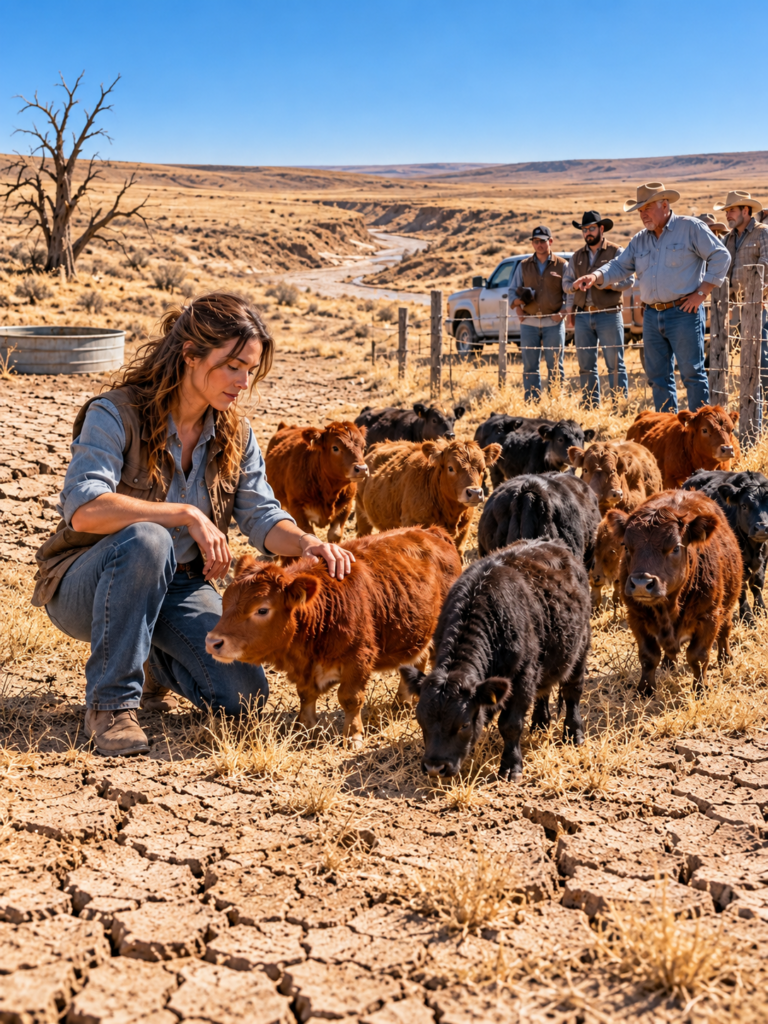
Willa noticed the dry creek beds, the powdery dust trailing behind her trailer, and the cattle gathered around distant water tanks.
Her father would have noticed too.
Earl Hensley had spent forty-seven years on their seventy-four-acre ranch, a modest patch of Wyoming land that most cattlemen considered too small to matter.
He had died six weeks earlier.
One moment he had been repairing a broken hinge on the equipment shed. The next, his heart had stopped.
Willa had found him lying on the dirt floor with a wrench beside his hand.
She was fifty-one years old, recently divorced, and suddenly responsible for everything her father had spent a lifetime maintaining.
The fences.
The well.
The aging tractor.
The house with the sagging porch.
And twelve small cows that nobody in Rollins County seemed to want.
When she pulled into the yard, the evening sun was settling behind the cottonwoods.
Her seventeen-year-old daughter, June, came out carrying a bucket of feed.
“How’d it go?”
Willa climbed down from the truck.
“Not much interest.”
June looked into the trailer.
“All twelve came home?”
“All twelve.”
June sighed.
“Mom, we need money.”
“I know.”
“The pump makes that awful noise every morning. The truck barely shifts into third. And the college deposit is due next month.”
“I know, June.”
“Then why don’t we sell some?”
Willa looked toward the pasture.
“Your grandfather spent his whole life building this herd.”
“Grandpa isn’t here anymore.”
The words were not cruel.
That somehow made them hurt more.
June immediately looked sorry.
“Mom, I didn’t mean—”
“I know what you meant.”
Willa opened the trailer gate.
The cattle stepped down one after another, their small hooves tapping against the metal ramp.
June watched them wander into the pasture.
“You can’t save everything just because Grandpa loved it.”
Willa closed the gate.
“No,” she said. “I suppose I can’t.”
That night, after June had gone upstairs, Willa sat alone at the kitchen table.
The house smelled of coffee, old wood, and the lavender soap her father had used for years.
His work jacket still hung beside the back door.
She had not found the courage to move it.
Beside her lay three bills, the well repair estimate, and the county tax notice.
Willa rubbed her forehead.
For eleven years, she had worked inventory at the local feed cooperative. She understood feed prices, livestock expenses, and agricultural markets.
What she did not understand was why her father had insisted on keeping a herd that seemed incapable of supporting the land it occupied.
He had been an intelligent man.
Stubborn, certainly.
But never foolish.
She remembered something he used to say whenever another rancher bragged about running more cattle than his neighbors.
“Don’t count your cows until you’ve counted your grass.”
Willa had heard it a thousand times.
That evening, it seemed less like wisdom and more like the excuse of a man who could never afford a bigger herd.
She rose to search for the pump warranty in the old cabinet beside the freezer.
Instead, she found a thick, clothbound ledger.
Its corners were worn smooth.
Inside were pages of figures written in her father’s unmistakable left-handed handwriting.
Rainfall.
Pasture rotation.
Feed purchases.
Cow weights.
Calving dates.
Water consumption.
Every year from 1984 onward.
She turned the pages slowly.
There were records of good years, bad years, calves lost during winter storms, and summers when hay prices rose beyond anything a small ranch could reasonably afford.
In 2012, beside the names of four animals that had died during a dry spell, Earl had written one word.
Wrong.
Willa touched the faded pencil mark.
Her father had never told her about those losses.
He had never discussed the mistakes that kept him awake at night.
He had simply continued working.
Near the back of the ledger, one line caught her attention.
Whitmore—1998. Trial refused.
Willa frowned.
Why would her father have written Preston Whitmore’s family name in a grazing ledger?
And what trial had they refused?
She searched several more pages but found no explanation.
Outside, the wind rattled a loose section of gutter.
Willa closed the book.
Somewhere beyond the kitchen window, twelve little cows rested beneath a sky that had forgotten how to rain.
She had no idea that the figures in her father’s ledger would soon become the most important numbers in Rollins County.
Or that the man who had laughed loudest at the fair would one day stand at her gate without a single joke left to tell.
Part 2
Nine days after the county fair, Preston Whitmore drove onto Willa’s property in a polished black pickup.
He arrived shortly after breakfast.
Willa was replacing a cracked hose beside the equipment shed when she heard the engine.
She wiped her hands on her jeans and walked toward the truck.
Preston stepped out carrying a leather folder.
“Morning, Willa.”
“Morning.”
“Beautiful place your father kept.”
Willa glanced across the faded pasture.
“That’s one way to describe it.”
Preston smiled.
“Earl always had the prettiest little piece of nothing in the county.”
She did not return the smile.
“What brings you out here?”
Preston looked down the county road.
“My company’s expanding our livestock transport operation. We’ve leased additional grass in Nebraska, and your property sits right along the best route between two of our facilities.”
Willa folded her arms.
“I see.”
“I’d like to buy your place.”
The words landed harder than she expected.
Preston opened his folder and showed her a figure.
It was considerably more money than Willa had imagined anyone would offer for seventy-four dry acres.
Enough to repair the truck.
Enough to pay every outstanding bill.
Enough to put June through college without loans.
Enough, perhaps, to begin again somewhere closer to town.
She stared at the number.
Preston watched her carefully.
“I’m not trying to take advantage of you. I know what it’s like losing a father. I’m offering you a clean way out.”
“A way out of what?”
He gestured toward the pasture.
“Of trying to run a commercial ranch on land that isn’t commercially viable.”
Willa looked toward the old house.
Her father had rebuilt the porch three times.
Her mother had planted roses along its south wall before cancer took her when Willa was twenty-three.
June had learned to ride a bicycle along the gravel driveway.
Willa herself had learned to walk in the kitchen.
There was almost no corner of the property without a memory attached to it.
“I’m not selling.”
Preston studied her face.
“You should think carefully.”
“I have.”
“Pride doesn’t pay taxes.”
“Neither does selling the only home I’ve ever known.”
He sighed.
“The drought forecast is worse than most people realize. I have specialists watching the water situation. Some outfits won’t survive the summer.”
“Then I hope yours does.”
For the first time, his smile disappeared.
He climbed back into his truck.
“If you change your mind, the offer stands until August.”
Willa watched him drive away.
Only after the dust settled did she sit on the porch steps and unfold the paper he had left behind.
She looked at the number again.
Then she folded it into quarters and slipped it beneath the sugar bowl.
She did not tell June.
That afternoon, Nora Ellison from the county agricultural extension office called.
Nora was a practical woman in her early fifties who had spent most of her career helping farmers understand things they often preferred not to hear.
“How many cattle are you carrying?” Nora asked.
“Twelve.”
“Total?”
“Twelve Dexters.”
A brief silence followed.
Willa braced herself.
Instead, Nora said, “That’s manageable. Mind if I come walk your pastures?”
They met the following Tuesday.
Nora arrived carrying a clipboard, a soil probe, and a measuring hoop.
For nearly three hours, the women crossed the ranch under a white, merciless sky.
Nora knelt at intervals, clipped grass samples, examined roots, and studied the bare patches along the creek bed.
By noon, her expression had grown serious.
“Your available forage is already about forty percent below a normal year.”
Willa looked across the pasture.
“What does that mean for my herd?”
“It means we have to stop thinking in terms of twelve head and start thinking in terms of total body weight.”
Nora wrote two figures on her clipboard.
“Your mature Dexter cows average around seven hundred and forty pounds. A lot of the commercial cows around here weigh thirteen hundred or more.”
“So?”
“So twelve of your cows don’t eat what twelve of theirs eat.”
Willa looked toward Rosie and Hazel grazing near the fence.
She knew the breed required less feed.
Her father had said so for years.
But hearing Nora explain the difference in pounds, forage requirements, and stocking pressure made the information feel entirely different.
“You’re saying I might keep them?”
“I’m saying you have a chance. But the breed alone won’t save you. You’ll have to manage every acre carefully.”
“What would you do?”
Nora looked toward the south pasture.
“Divide your grazing area into smaller sections. Move the herd before they graze the plants too short. Protect that sandy corner. And buy hay before everybody realizes how bad this summer is going to become.”
Willa glanced toward the farmhouse.
“With what money?”
Nora’s face softened.
“That’s the question I can’t answer for you.”
Over the next two weekends, Willa built temporary fencing until her hands blistered.
She purchased secondhand electric wire, plastic fence posts, and a battered solar energizer from a retired rancher in Lusk.
June helped after school.
They stretched wire across uneven ground, carried buckets, repaired gates, and argued about where the fence lines should run.
By Sunday evening, the original three grazing pastures had become nine smaller paddocks.
Willa also fenced off ten acres of thin sandy ground.
June stood beside the new fence, staring at the unused grass.
“We’re shutting cattle out of land we paid taxes on?”
“We’re giving it a chance to recover.”
“During a drought?”
“Especially during a drought.”
June shook her head.
“Sometimes you sound exactly like Grandpa.”
Willa smiled faintly.
“Sometimes I hope I do.”
In June, she drove to Douglas and purchased thirty-one tons of grass hay.
The price was $140 per ton.
She paid $4,340.
The purchase nearly emptied the savings account Earl had left behind.
The dealer watched his crew load the bales.
“You buying for a whole ranch?”
“Twelve cows.”
He laughed.
“Lady, those animals must eat better than the governor.”
Willa said nothing.
She simply counted every bale.
By August, that same hay was selling for more than twice what she had paid.
And in many places, there was none left to buy.
The drought spread across the county like a slow-moving disaster.
Creeks became strings of muddy pools.
Stock ponds dried into cracked bowls.
The grass turned brittle.
Cattle began losing condition.
Ranchers hauled water hundreds of miles and paid extraordinary sums for grazing leases.
At the monthly cattlemen’s meeting, Preston Whitmore stood before a crowded room and discussed emergency relocation.
He explained transportation costs, early weaning strategies, and the challenges of feeding large commercial herds.
His recommendations were sound.
Men listened.
Willa sat near the back.
Then an older rancher named Clem Hadlock asked whether smaller cattle might help producers reduce feed demand.
A few men chuckled.
Preston smiled.
“Well, we all saw those tiny cows at the fair. But nobody’s paying ranch bills with a handful of miniature animals.”
Several faces turned toward Willa.
Preston continued.
“Scale is how this business works. Without it, you’re keeping pets.”
Willa felt the familiar sting.
She wanted to stand and tell the room about forage consumption, animal weights, and her father’s records.
Instead, she remained seated.
She knew twelve cows could not replace a county’s commercial cattle industry.
But she also knew that Preston had not asked a single serious question about her operation.
That night, she opened her father’s ledger.
On a fresh page, she wrote the date.
Then she began recording everything.
Hay fed per day.
Water pumped.
Pasture recovery.
Body condition.
Veterinary expenses.
Mineral supplements.
Fence repairs.
Fuel.
Every dollar.
Every mistake.
If her father’s strange little herd survived, she wanted to know why.
If it failed, she wanted the same answer.
As July approached, the temperature climbed above one hundred degrees.
The wind became hot enough to sting her face.
And beyond her fence, larger ranches began selling cattle they had spent generations breeding.
One afternoon, Willa drove past Merle Euler’s property.
Three livestock trailers stood beside his loading chute.
Merle was seventy-two.
He had raised cattle on that ground for thirty-one years.
Now he watched the last of his herd being loaded.
Willa parked and walked over.
Merle wore a clean white shirt.
She recognized the gesture immediately.
He was dressing properly for something that mattered.
“I’m sorry,” she said.
Merle looked toward the empty corral.
“Kept telling myself we’d get rain.”
Neither spoke for a moment.
Then he asked, “You still have your little cows?”
“Yes.”
“All twelve?”
“All twelve.”
He nodded.
“Then don’t let anybody talk you into getting greedy.”
Willa glanced at him.
“What do you mean?”
“Everybody thinks the trick is having enough cattle. Sometimes the trick is knowing how few you can afford.”
He turned back toward the corral.
Willa left without another word.
That evening, she moved her herd into the next paddock and measured the remaining hay.
There was enough for now.
Perhaps enough for autumn.
But she had begun calculating how many days remained until winter.
And the numbers frightened her.
Part 3
The first week of August brought temperatures above one hundred and three degrees.
The air felt heavy and strange, as though the prairie itself were holding its breath.
Every morning, Willa checked the water tanks before breakfast.
Every evening, she walked the pasture fences with a flashlight.
She had stopped listening to weather forecasts.
The promises of scattered showers were becoming harder to bear than the heat.
June had been accepted into an animal science program at a university two hundred and ten miles away.
Her scholarship covered tuition, but housing, books, transportation, and living expenses would require money Willa did not have.
One Sunday afternoon, mother and daughter were repairing a float valve when June spoke.
“I called the university.”
Willa kept turning the wrench.
“About what?”
“Deferring until January.”
The wrench stopped.
“Why?”
“Because I can work at the co-op this fall. I could save four thousand dollars.”
“No.”
“Mom—”
“Absolutely not.”
June straightened.
“You don’t even know what they said.”
“I know you’re going to school in August.”
“You used Grandpa’s savings to buy hay.”
Willa looked away.
“That was ranch money.”
“It was supposed to help us.”
“It is helping us.”
“By keeping twelve cows alive?”
Willa stood.
“By keeping this place alive.”
June’s eyes filled with frustration.
“Have you ever considered that I might care more about having my mother than having Grandpa’s cows?”
The words struck Willa with an almost physical force.
June continued.
“You come inside exhausted every night. You barely eat. You pretend everything’s fine when I can see the bills on the table.”
“I’m handling it.”
“No, Mom. You’re hiding it.”
Willa had no answer.
June wiped her hands on her jeans.
“You’re making decisions for both of us, and you won’t even let me understand them.”
She walked toward the house.
Willa remained beside the tank.
For years, she had believed that shielding June from financial worry was part of being a good mother.
Now she wondered whether she had mistaken secrecy for strength.
She finished repairing the valve, though her hands shook.
Four days later, the well stopped working.
Willa discovered it just after noon.
The farthest water tank had dropped several inches.
She walked to the wellhead and listened.
Nothing.
No motor.
No vibration.
Only wind crossing the dry grass.
She opened the electrical control box.
The smell of burned insulation reached her immediately.
She called the nearest pump company.
Their next available appointment was eleven days away.
The second company did not answer.
She called Graham Bellamy, the county veterinarian, because she could not think of anyone else.
“Call Russ Okafor in Glendo,” Graham told her. “He’s expensive, but he doesn’t leave livestock without water.”
Russ arrived that evening.
He worked beneath truck headlights until nearly midnight.
Finally, he emerged from the wellhouse carrying a flashlight and an expression Willa did not like.
“The motor’s damaged. Wiring too. I can replace it if I get the parts.”
“How much?”
“Thirty-eight hundred dollars.”
Willa stared.
“Can you do it tomorrow?”
“Three days. Best I can promise.”
Three days.
In ordinary circumstances, seventy-two hours meant little.
In August, with twelve thirsty animals and no working well, it could mean disaster.
Willa borrowed a fifteen-hundred-gallon portable tank from the feed cooperative.
She drove into town to fill it, then returned along the washboard road with water sloshing behind her.
Four trips a day.
Thirty dollars per fill.
Fuel she could scarcely afford.
A truck transmission that slipped whenever she climbed a grade.
She moved the cattle into a small shaded enclosure behind the equipment shed.
There, she fed hay rather than risk animals wandering too far from water.
Each bale she opened felt like money slipping through her fingers.
On the second day, Hazel stopped eating.
Hazel was fourteen years old.
She was the oldest cow on the property, a deep red Dexter with a pale muzzle and one crooked horn.
Earl had bought her as a calf.
She had survived winters severe enough to freeze water pipes and summers that left the prairie yellow for months.
Now she stood beneath the cottonwoods, head lowered, ignoring her feed.
Willa knelt beside her.
“Come on, old girl.”
Hazel did not move.
Willa offered water.
Nothing.
She called Graham.
He arrived at sunset and examined the cow carefully.
“She’s dehydrated,” he said. “And overheated. She’s also fourteen.”
“Is she going to die?”
“Not necessarily.”
Willa swallowed.
“These cows are supposed to be hardy.”
Graham looked at her.
“Hardy doesn’t mean invincible.”
He explained what Hazel needed, including electrolytes, shade, careful monitoring, and additional treatment if she failed to improve.
Then he rested a hand on Willa’s shoulder.
“You’ve done better than most people could have under these conditions.”
“It doesn’t feel that way.”
“Keeping animals alive through a drought isn’t proof that nothing will go wrong. It’s making good decisions when things do.”
After he left, Willa sat beside Hazel with a bucket of water.
The sky darkened.
Coyotes called beyond the far fence.
The air remained hot long after midnight.
Willa remembered her father sitting in this same enclosure during a February blizzard, warming a sick calf beneath an old horse blanket.
She had been fifteen then.
“Why don’t you go inside?” she had asked him.
He had looked up, eyelashes white with frost.
“Because she can’t.”
Now Willa understood him in a way she never had before.
At four the following morning, Hazel finally drank.
Willa watched the old cow lower her muzzle into the water and swallow.
Then Willa covered her face with both hands.
The tears came suddenly.
She cried for Hazel.
For her father.
For the house she could barely afford to keep.
For June, whose future seemed to be disappearing into feed bills and broken machinery.
And for the terrible fear that all her efforts might still amount to nothing.
The pump was repaired on Friday.
Willa paid the bill using money from an account Earl had established in June’s name when she was four.
It was meant for her education.
Willa told herself she would replace every dollar.
She did not tell June.
But June found the receipt in the truck.
That evening, she placed it on the kitchen table.
“You used my college money.”
Willa looked at the paper.
“I was going to tell you.”
“When?”
“When I knew how I’d put it back.”
June’s voice trembled.
“You wouldn’t even let me defer school to save money.”
“I wanted you to have your education.”
“But you took the money anyway.”
“I had twelve animals without water.”
“I know that!”
June’s voice broke.
“That’s the worst part. I know you had no choice. But you wouldn’t let me help you make it.”
Willa sat down heavily.
June remained standing.
“Grandpa let you work beside him. He taught you everything he knew. Why won’t you let me do the same?”
Willa looked toward the old ledger on the table.
Her father had never pretended to her that ranching was easy.
He had shown her dead calves.
Empty feed bins.
Unpaid bills.
And the quiet satisfaction of solving a problem together.
She had believed she was protecting June.
Instead, she had made her daughter feel like a stranger in her own home.
“I’m sorry,” Willa whispered.
June pulled out a chair.
For a long time, neither spoke.
Then Willa opened the ledger and turned it toward her daughter.
“Let me show you the numbers.”
They spent the next two hours reviewing expenses.
For the first time, June understood exactly how much the ranch was costing.
And for the first time since Earl’s death, Willa did not feel entirely alone.
Three days later, while searching for an old well permit, Willa found a manila envelope in the bottom drawer of her father’s desk.
It was tied with a brittle rubber band.
On the front, in faded ink, were two words.
Whitmore correspondence.
Inside were four letters dated 1998.
Willa unfolded the first.
As she began reading, her hands went still.
Her father had not simply raised unusual cattle because he loved them.
He had been trying to answer a question.
And nearly thirty years earlier, the Whitmore family had refused to help him find the answer.
Part 4
The letters were written during another difficult period in Rollins County.
Willa remembered that summer.
She had been ten.
The creek had dried early, her father had sold his saddle horse, and her mother had spent evenings carefully dividing groceries into smaller portions.
But the letters revealed a story Earl had never told.
In March 1998, he had approached Whitmore Cattle Holdings with a proposal.
Not a loan.
Not a partnership.
Not a request to buy his small herd.
He wanted to conduct a controlled grazing trial.
Two comparable pieces of land.
Two different cattle types.
The same pasture rotation schedule.
The same measurements.
The same honest accounting of failures.
He wanted to determine whether smaller livestock, managed carefully, could reduce financial exposure during extended droughts.
One paragraph made Willa read it twice.
Her father had written that he was not claiming commercial cattle were inferior. He simply believed nobody fully understood what happened when drought reduced the available grass for several consecutive seasons.
He wanted evidence before another disaster forced ranchers to make decisions they could not reverse.
The Whitmore family had declined.
The response was courteous and professional.
Their commercial operation depended on producing larger carcasses for a market that rewarded weight.
The proposed experiment did not appear financially justified.
Earl had responded with three brief sentences.
He thanked them.
He stated that he intended to continue the research on his own property.
And he promised that his records would remain available to anyone who wanted to study them.
Willa sat on the floor beside the desk.
Her father had kept that promise for nearly three decades.
Without university funding.
Without recognition.
Without anyone asking whether his observations mattered.
He had measured rainfall, pasture recovery, calf growth, hay purchases, and livestock losses because he believed the answers might someday help somebody.
The following week, Willa invited Nora Ellison to the ranch.
They spread six volumes of Earl’s records across the kitchen table.
Nora examined them for nearly four hours.
Sometimes she made notes.
Sometimes she returned to earlier pages.
At one point, she stopped and removed her reading glasses.
“Willa, do you understand what your father kept here?”
“Records.”
“Twenty-seven years of consistent observations on the same ground. Weather, stocking rates, forage recovery, body condition, feed costs. He recorded the mistakes too.”
Willa looked down.
“He never told me it mattered.”
“Maybe he wasn’t sure it did.”
Nora touched one of the ledgers.
“But this kind of long-term record is unusual. It can help us understand what worked here and what didn’t.”
“Does it prove his cattle are better?”
Nora shook her head.
“No. And we shouldn’t pretend otherwise.”
Willa frowned.
“Then what does it prove?”
“It may show that a smaller herd, combined with conservative grazing management, can survive certain kinds of financial and environmental shocks that would force a larger operation into more expensive decisions.”
Willa stared at the open pages.
“That sounds like something my father would say.”
Nora smiled.
“I suspect that’s because he spent years finding out.”
As August ended, conditions across the county became desperate.
The Whitmore operation had relocated eleven hundred cattle to leased grazing land in Nebraska.
Transportation, labor, temporary housing, and rising lease costs were consuming money at a frightening rate.
Other ranchers had already sold portions of their herds.
Some were preparing to sell land.
Then Caleb Whitmore drove onto Willa’s property.
Caleb was twenty-nine, Preston’s only son.
He had grown up in the cattle business and now oversaw much of the day-to-day operation.
Unlike his father, he did not arrive with a business proposal.
He stepped out of the truck carrying a notebook.
“Mrs. Hensley, could I look at your grazing setup?”
Willa studied him.
“Why?”
“Because our cattle are scattered across two states, and yours are still here.”
She considered refusing.
Preston’s laughter at the fair remained painfully clear.
But Caleb had never joined in.
“Come on,” she said.
For two hours, they walked the ranch.
She showed him the nine paddocks, the temporary electric fencing, the protected sandy corner, and the grazing schedule she had adjusted throughout the summer.
He asked about water usage.
Feed intake.
Cow weights.
Rest periods.
Body condition.
He studied the ledger carefully.
At the sandy corner, Caleb stopped.
Inside the protected fence, several inches of grass still stood.
Outside, much of the surrounding ground was bare.
“You haven’t grazed this at all?”
“Not since spring.”
“Even when you needed feed?”
“Especially then.”
He looked toward the cattle.
“They look good.”
“They had hay starting in July. And one nearly died when the well failed.”
Caleb nodded.
“Most people telling this story would leave that part out.”
“My father didn’t teach me to keep records that way.”
Caleb closed his notebook.
“We’ve got six thousand acres and an expensive cattle problem. You’ve got seventy-four acres and a management system we should’ve been paying attention to.”
Willa shook her head.
“You can’t compare our operations that simply.”
“I know. That’s why I’m asking questions.”
Before leaving, Caleb requested permission to record a short video of her herd.
Willa agreed.
He filmed twelve red and black cows grazing in a dusty Wyoming pasture.
Their coats were smooth.
Their ribs were covered.
They were small, but they were healthy.
The video spread from rancher to rancher across four counties.
Soon Willa began receiving calls.
Some people wanted to purchase cattle.
Others wanted breeding information.
Several demanded to know what special feed she used.
One caller asked whether Dexter cattle could live without hay.
“No,” Willa answered firmly. “Mine certainly couldn’t.”
Another asked whether they required less water.
“Generally, smaller cattle have lower total requirements, but they still need dependable water every day.”
Some callers were disappointed.
They wanted a miracle.
Willa had no miracle to sell.
She had numbers.
One afternoon, a livestock marketer from Colorado arrived and offered to purchase her entire herd.
The figure he wrote on a business card was enormous by Willa’s standards.
She could pay her debts.
Replace June’s savings.
Repair the truck.
Fix the farmhouse.
And still have money remaining.
For the first time in months, she allowed herself to imagine living without constant fear.
But selling all twelve would end her breeding program.
It would place her father’s carefully preserved bloodlines in the hands of a company whose business plans she could not control.
She asked for time.
The man agreed.
For nine nights, Willa studied the offer.
On the tenth morning, Preston Whitmore arrived with Caleb.
This time, he did not laugh.
He stood beside her fence and watched the little cattle grazing.
Then he removed his hat.
“Willa,” he said, “I’d like to understand exactly what you’re doing.”
She invited them into the kitchen.
There, surrounded by Earl’s ledgers, Preston made a substantial proposal.
He wanted six breeding animals.
He also wanted to hire Willa to advise his company on pasture management.
And he requested exclusive purchasing rights to her herd for five years.
Willa listened without interrupting.
When he finished, she folded her hands.
“No exclusivity.”
Preston leaned back.
“That clause is important to the investment.”
“It’s important to your investment.”
“That’s generally how business works.”
“My father’s work wasn’t created for one company to own.”
Preston frowned.
“I don’t understand.”
Willa placed the 1998 letters on the table.
“Your family was offered a chance to study these cattle twenty-eight years ago.”
Preston glanced at the papers.
Caleb leaned forward.
“I’ve seen copies of those in our records room.”
Preston’s face tightened.
“My father handled correspondence in those days.”
Willa nodded.
“Then perhaps you should read what my father wrote.”
Preston read the letters in silence.
When he finished, he looked out the window.
For the first time since Willa had known him, he seemed uncertain of what to say.
Finally, he spoke.
“I remember Earl coming by during branding season. He asked questions about pasture recovery and feed intake.”
“He was trying to learn.”
“I thought he was just a man with an unusual hobby.”
Willa looked at him steadily.
“So did everyone else.”
Preston lowered his eyes.
Caleb broke the silence.
“What if we held an open meeting? Nora could explain the records. People could hear what actually happened this summer.”
Preston hesitated.
“They’ll say I’m endorsing miniature cattle.”
Caleb answered quietly.
“They’re already asking why we didn’t listen sooner.”
Willa looked at the letters on the table.
For years, her father’s work had existed in dusty books nobody wanted to read.
Now those records might finally receive the attention they deserved.
But there was one question she still feared.
What if the numbers showed her father had been wrong?
That evening, Nora called with the final pasture and livestock production analysis.
Her voice was unusually serious.
“Willa, I’ve got the results.”
Willa gripped the telephone.
“Tell me.”
“Your cattle didn’t produce more beef per acre than the county’s normal-year commercial average.”
Willa closed her eyes.
For a moment, all she could hear was Preston’s laughter at the fair.
Then Nora continued.
“But that isn’t the whole story.”
Part 5
Sixty-one people gathered in the basement of the Methodist church on the first Saturday in October.
The room smelled of coffee, old carpet, and damp wool coats.
Ranchers stood along the walls.
Some had sold cattle.
Some had taken loans to purchase emergency feed.
Others had watched family operations shrink in ways their grandparents would never have imagined.
Willa arrived carrying her father’s ledgers in two cardboard boxes.
June walked beside her.
“Are you nervous?” June whispered.
“Terrified.”
June squeezed her arm.
“Grandpa would’ve been too.”
Willa smiled.
“He would’ve pretended otherwise.”
Nora stood at the front of the room beside a projector.
Preston Whitmore sat in the second row with Caleb.
When Willa passed, Preston stood and nodded.
It was a small gesture.
But people noticed.
Nora began without ceremony.
She explained that the meeting was not intended to promote Dexter cattle as a universal solution.
Different breeds performed differently under different market and environmental conditions.
The purpose was to examine what Earl Hensley had recorded and what his daughter had experienced during an exceptionally dry year.
The first slide showed animal weights.
Twelve Dexter cows averaging approximately 740 pounds each.
Twelve typical commercial cows averaging around 1,300 pounds.
Nora explained how body size affected total feed demand.
“During the period we examined, Willa’s herd required substantially less total dry matter than an equal head count of larger commercial cows.”
She moved to the next slide.
“That’s not a miracle. Smaller animals generally have lower total intake requirements. What matters is whether those lower requirements create an economic advantage under particular conditions.”
Several men began taking notes.
Then came the production figures.
“In a normal year, larger commercial cattle often have the advantage in total marketable weight under our local system.”
A murmur passed through the room.
Nora continued.
“Willa’s animals did not outperform the county’s typical commercial production figures on every measure. What they offered was a different pattern of risk.”
She explained that maintaining fewer pounds of livestock reduced the total demand on limited forage.
She showed the impact of Willa’s early hay purchase.
The nine grazing paddocks.
The protected ten acres.
The conservative stocking rate.
And the difficult decision not to expand when demand for her breed began rising.
“Any producer here can improve grazing management,” Nora said. “You don’t need Dexters to rest pasture, monitor feed demand, or maintain forage reserves.”
She looked toward Willa.
“The cattle helped. The decisions kept them alive.”
The room fell quiet.
Willa felt something inside her loosen.
For months, she had thought she needed to prove her small cattle were better than Preston’s enormous herd.
But her father had never made that claim.
He had simply believed there was value in understanding another way of doing things.
Nora opened the oldest ledger.
“In 1998, Earl Hensley proposed a comparative grazing trial to Whitmore Cattle Holdings.”
She explained the experiment, then read the central passage from Earl’s letter.
He had written that commercial cattle performed well in good conditions, but he wanted to know how different systems would endure prolonged drought.
He had wanted an honest comparison before a crisis forced decisions upon everyone.
Nora placed the letter on the table.
“That was twenty-eight years ago.”
Nobody laughed.
Preston Whitmore rose slowly.
For several seconds, he stood without speaking.
Then he removed his hat.
“I remember Earl Hensley.”
Willa looked toward him.
“He was a good rancher,” Preston continued. “But I didn’t understand what he was trying to do.”
His voice remained steady.
“My family declined his proposal. At the time, we didn’t believe the investment would pay.”
He glanced toward the ledgers.
“This summer, my company spent over a hundred thousand dollars moving and maintaining cattle on leased grass. We sold hundreds of animals at prices none of us wanted to accept.”
Several ranchers lowered their eyes.
Preston continued.
“At the county fair in April, I made fun of Willa Hensley’s cattle. I asked if she was starting a petting zoo.”
The room grew very still.
“I said it in front of a crowd, so I ought to admit it in front of one.”
Willa felt June’s hand close around hers.
Preston turned toward her.
“I was wrong to dismiss something I hadn’t bothered to understand.”
There was no applause.
No dramatic outburst.
Only the sound of the old refrigerator humming behind the church kitchen door.
Then Preston asked the question Willa would remember for the rest of her life.
“If a man with six thousand acres wanted to try a smaller herd on some difficult ground, where would you tell him to start?”
Every face turned toward her.
Willa stood slowly.
She thought of her father sitting alone at the kitchen table, recording numbers long after the rest of the county had gone to bed.
She thought of Hazel refusing water beneath the cottonwoods.
She thought of June holding the pump receipt with tears in her eyes.
And she thought of twelve little cows surrounded by laughter in a crowded fair barn.
“Start with ten,” she said.
A few men leaned forward.
“Not a hundred. Ten. Put them on land you can measure. Record the grass, the feed, the water, and the weight. Don’t decide they’re the answer before you know the results.”
Preston nodded.
“And if the trial fails?”
Willa looked at the old ledger.
“Write that down too.”
A quiet ripple of laughter passed through the room.
This time, nobody was laughing at her.
When the meeting ended, people gathered around Willa and Nora.
They asked about grazing plans.
Calving records.
Breeding availability.
Pasture measurements.
Several requested copies of Earl’s notes.
Merle Euler came forward last.
He held his cap in both hands.
“Your dad would’ve liked today,” he said.
Willa swallowed.
“I wish he could’ve seen it.”
Merle shook his head.
“Maybe he did see something like it. Just not with his own eyes.”
Willa looked down at the ledger.
The ink had faded in places.
The binding was worn.
But the pages had survived.
And now people wanted to read them.
The first meaningful rain arrived three weeks later.
It began as a light tapping against the farmhouse roof.
Willa woke shortly after midnight and lay still, listening.
For several seconds, she barely dared believe it.
Then she rose, put on her father’s old work jacket, and stepped onto the porch.
Rain fell across the dusty yard.
The smell of wet earth rose around her.
Beyond the fence, the cattle stood beneath the cottonwoods, their backs shining in the porch light.
June appeared beside her.
“It’s raining.”
Willa smiled.
“It surely is.”
They stood together without speaking.
The rain did not repair the land overnight.
The pasture needed years to recover fully.
Ranchers who had sold animals could not simply purchase them back at the prices they had received.
Some families had lost too much.
The drought had left debts that would outlast the dry weather.
But the rain was a beginning.
That November, Willa sold six breeding females to Whitmore Cattle Holdings under terms that allowed her to retain her foundation breeding stock and continue selling to other operations.
She accepted a short consulting contract helping Preston and Caleb design rotational grazing trials.
She also began working with Nora to organize free workshops for local ranchers.
The first workshop drew thirty-two people.
The third drew ninety.
Some raised Angus.
Some raised Herefords.
Some managed mixed herds.
A few wanted Dexters.
Most simply wanted to learn how to plan better for dry years.
Willa answered their questions with the same honesty her father had practiced.
By January, she had replaced the $3,800 taken from June’s education account.
By March, she had added another $1,200.
She showed June every deposit.
Not because her daughter demanded it.
Because she had finally understood that trust required more than good intentions.
One evening, as they sat balancing the ranch accounts, June looked across the table.
“Mom?”
“Yes?”
“Do you ever regret not taking Mr. Whitmore’s offer for the land?”
Willa considered the question.
There had been mornings when she had regretted nearly everything.
When the well failed.
When Hazel stopped eating.
When she had counted the hay bales and wondered whether the stack would last.
When June had stood in the kitchen and accused her of choosing cattle over family.
“There were days,” Willa admitted.
June nodded.
“I figured.”
“But I don’t regret what we learned.”
June smiled faintly.
“Neither do I.”
That August, June left for college as planned.
Willa helped load her bags into the truck.
Before leaving, June handed her mother an old photograph.
It showed Earl standing beside a tiny red Dexter calf.
Willa was visible in the background, perhaps ten years old, carrying a feed bucket almost too large for her arms.
On the back, Earl had written:
Willa and her first heifer. She notices things other people miss.
Willa pressed the photograph against her chest.
June hugged her.
“Grandpa knew.”
Willa closed her eyes.
Perhaps he had.
Or perhaps he had simply loved his daughter enough to believe that someday she would discover her own strength.
Over the following eighteen months, the ranch gradually changed.
The worst fences were replaced.
The truck received a rebuilt transmission.
The well continued working.
The grass returned in patches, then broader stretches, though some damaged ground recovered slowly.
Willa sold additional breeding animals carefully and maintained a small, sustainable foundation herd.
She never became wealthy.
She still rose before dawn.
She still repaired things herself whenever she could.
She still worried about feed prices and watched the sky whenever clouds gathered.
But she no longer felt compelled to apologize for owning only seventy-four acres.
Preston Whitmore reduced his herd and adjusted his grazing strategy.
Caleb began a small Dexter trial on one hundred and sixty acres of difficult ground.
In its second year, generous rainfall made the results inconclusive.
Caleb wrote that down.
Willa smiled when he told her.
“Your grandfather’s habit is catching,” Caleb said.
“My father always believed the truth was worth more than a good story.”
One spring morning, Willa stood beside the pasture fence holding a mug of coffee.
The air was cool.
A meadowlark called from the gatepost.
Twelve small cattle grazed across the green pasture, including old Hazel, who had survived another winter and produced a healthy calf.
A pickup approached along the county road.
It slowed beside the entrance.
The driver was Preston Whitmore.
He lifted two fingers from the steering wheel in greeting.
Willa returned the gesture.
He continued down the road without stopping.
She watched his truck disappear beyond the hill.
Eighteen months earlier, that same man had stood before a crowd and treated her father’s herd like a joke.
Now he had cattle descended from that herd grazing on his own land.
But that was not what mattered most.
Willa turned toward the farmhouse.
Her father’s jacket still hung beside the back door.
His ledgers occupied a carefully built shelf in the study.
And somewhere two hundred and ten miles away, June was studying animal science with a photocopy of one of those pages tucked inside her notebook.
Willa looked back across the pasture.
For years, she had measured the worth of the ranch against everything it lacked.
Too few acres.
Too few cattle.
Too little money.
Too little influence.
She had believed that recognition would come only when she could prove her little herd was better than everyone else’s.
Her father had understood something simpler.
A thing did not need to be the biggest or the best to be worth keeping.
It only needed to have a purpose, and someone willing to understand that purpose.
Willa took another sip of coffee.
Rosie lifted her head from the grass and looked toward the fence.
“Morning, girl,” Willa called.
The little cow flicked her ears and returned to grazing.
The wind moved gently through the recovering pasture.
Willa thought of Earl, of all the years he had spent working without praise, and of the quiet courage it had taken to keep believing in a question nobody else considered important.
She wished he were standing beside her.
But the longing no longer felt entirely like grief.
Some of it had become gratitude.
He had left her more than land.
More than cattle.
More than a lifetime of carefully recorded figures.
He had left her the patience to keep going when people laughed, the humility to admit mistakes, and the courage to measure success by something other than the world’s approval.
Across the pasture, twelve little cows grazed beneath the morning sunlight.
They were still small.
They would always be small.
And Willa Hensley was finally at peace with that.
Because she had learned that being underestimated was never the same as being worthless.
And sometimes the greatest legacy a parent leaves behind is not the thing everyone else admires.
It is the thing they loved enough to protect until someone finally understood why.